EP1693784A2 - Reconnaissance de mots manuscrits basée sur la décomposition géométrique. - Google Patents
Reconnaissance de mots manuscrits basée sur la décomposition géométrique. Download PDFInfo
- Publication number
- EP1693784A2 EP1693784A2 EP06101041A EP06101041A EP1693784A2 EP 1693784 A2 EP1693784 A2 EP 1693784A2 EP 06101041 A EP06101041 A EP 06101041A EP 06101041 A EP06101041 A EP 06101041A EP 1693784 A2 EP1693784 A2 EP 1693784A2
- Authority
- EP
- European Patent Office
- Prior art keywords
- extrema
- given
- neighbouring
- contour
- minima
- Prior art date
- Legal status (The legal status is an assumption and is not a legal conclusion. Google has not performed a legal analysis and makes no representation as to the accuracy of the status listed.)
- Ceased
Links
Images










Classifications
-
- G—PHYSICS
- G06—COMPUTING OR CALCULATING; COUNTING
- G06V—IMAGE OR VIDEO RECOGNITION OR UNDERSTANDING
- G06V30/00—Character recognition; Recognising digital ink; Document-oriented image-based pattern recognition
- G06V30/10—Character recognition
- G06V30/14—Image acquisition
- G06V30/146—Aligning or centring of the image pick-up or image-field
- G06V30/1475—Inclination or skew detection or correction of characters or of image to be recognised
- G06V30/1478—Inclination or skew detection or correction of characters or of image to be recognised of characters or characters lines
-
- G—PHYSICS
- G06—COMPUTING OR CALCULATING; COUNTING
- G06V—IMAGE OR VIDEO RECOGNITION OR UNDERSTANDING
- G06V30/00—Character recognition; Recognising digital ink; Document-oriented image-based pattern recognition
- G06V30/10—Character recognition
- G06V30/18—Extraction of features or characteristics of the image
- G06V30/182—Extraction of features or characteristics of the image by coding the contour of the pattern
-
- G—PHYSICS
- G06—COMPUTING OR CALCULATING; COUNTING
- G06V—IMAGE OR VIDEO RECOGNITION OR UNDERSTANDING
- G06V30/00—Character recognition; Recognising digital ink; Document-oriented image-based pattern recognition
- G06V30/10—Character recognition
- G06V30/22—Character recognition characterised by the type of writing
- G06V30/226—Character recognition characterised by the type of writing of cursive writing
- G06V30/2264—Character recognition characterised by the type of writing of cursive writing using word shape
-
- G—PHYSICS
- G06—COMPUTING OR CALCULATING; COUNTING
- G06V—IMAGE OR VIDEO RECOGNITION OR UNDERSTANDING
- G06V2201/00—Indexing scheme relating to image or video recognition or understanding
- G06V2201/13—Type of disclosure document
- G06V2201/133—Survey article
-
- G—PHYSICS
- G06—COMPUTING OR CALCULATING; COUNTING
- G06V—IMAGE OR VIDEO RECOGNITION OR UNDERSTANDING
- G06V30/00—Character recognition; Recognising digital ink; Document-oriented image-based pattern recognition
- G06V30/10—Character recognition
Definitions
- the present invention relates to handwritten word recognition. More specifically but not exclusively, the present invention relates to handwritten word recognition based on geometric decomposition.
- Handwriting is one of the basic human communication tools, such as speech, sign and expression. Handwriting has been widely applied in our daily life. For example, people sign their signature in bank cheques and letters. Students acquire the knowledge in class when teachers write their lecture notes on the blackboard. Businesses recruit new employees by way of graphology, which is the study of handwriting shapes and patterns to determine the personality and behaviour of the writer. Although handwriting is such an efficient communication tool in our mind, how handwritten signals are mentally represented in the brain and what kinds of functionality mechanism underlies handwritten recognition is little known to us. Automatic analysis and recognition of handwritten signals by computers can help us better understand this problem to some extent.
- the image of the given word is considered as an entity in its whole and the difficult problem of segmenting a word into its individual characters is completely avoided.
- a word is characterized by a sequence of features such as length, loops, ascenders, descenders. No sub-models are used as a part of its classification strategy.
- the recognition method based on this representation is called "holistic approach" (see a recent survey in [11]). This method can model coarticulation effects.
- no uniform framework in the current literature is presented to extract those features. It is not clear how to solve the corresponding problem of feature points if some features are used as local shape descriptors.
- the method does not make use of information of sub-models. As a result, information cannot be shared across different words. It is difficult to apply this method to cursive word recognition with a large lexicon since samples for each word is not sufficient.
- the word image is segmented into a sequence of graphemes in left-to-right order.
- a grapheme may be one character or a part of a character.
- all possible combinations of adjacent graphemes, up to a maximum number, are considered and fed into a recognizer for isolated characters.
- a dynamic programming technique is used to choose the best sequence of characters.
- segmentation and grapheme recombination are both based on heuristic rules that are derived by human intuition. They are error-prone.
- the other is that the proposed framework is not computationally efficient since a character recognizer has to be used to evaluate each grapheme combination. For a large lexicon, the computational cost is prohibitively high.
- word frequency which can be calculated according to a large language corpus.
- Some dictionaries such as the Collins COBUILD Advanced learner's English Dictionary provide information about word frequency.
- the other strategy is to cluster the vocabulary according to some similarity measures. Then we focus on the research of cursive recognition in individual group.
- handwritten word images mainly consist of some primitives such as lines, arc, and dots.
- Fig. 1 shows some examples.
- word image (o) is ambiguous. It can be "care” or "case”. In this case, the contextual information in a sentence will be required to identify it. Usually humans can identify most isolated words without the contextual information in a sentence. We can draw from this fact that word image and orthography (and phonology) may provide enough information for recognition without higher-level linguistic information. From the computational viewpoint, the computational structure will be modularized easily and the dependence of functionality modules between difference levels will be reduced. As a result, computational efficiency will be enhanced.
- Marr [15] suggested that the representations underlying visual recognition are hierarchical and involve a number of levels during the early visual processing. Each level involves a symbolic representation of the information in the retinal image.
- the primal sketch defined by Marr consists of some primitives and makes explicit important information about two-dimensional images.
- Edge, blobs, contour and curvilinear organization contains useful information for visual recognition.
- Cursive word image is binary and 2D shape, which is not a function of depth. Moreover, it consists of line drawing patterns, such as lines and arcs.
- McClelland and Rumelhart [18] proposed an interactive activation word reading model. A bottom-up and top-down process is integrated to this model. This indicates that letter representation is driven by bottom-up (low-level features to letter) and top-down (word to letter) information. Learning must play an important role in the representation.
- wavelet-based coding a good representation of cursive word image?
- wavelet-based coding is mathematically complete or over-complete, the wavelet code does not meet the explicit criteria [19].
- a wavelet code is simply a linear transform of the original image into a set of new images. There is no interpretation or inference in the process. The structures and features are not explicitly represented. For example, for cursive word recognition, we know that loops and word length are useful information for recognition. It is hard to extract them from redundant wavelet codes.
- Words in the English language have a specified structure. These structure constraints are usually imposed by orthography (the way a word is spelled) and phonology (the way a word is pronounced). For words of length 10 (10 letters), although the maximal combination is 26, valid words only exist in a small-size subset. In the context of cursive word recognition, a statistical language model such as n-grams is usually used to improve the performance [10]. Those models usually have several shortcomings. First, the accuracy of language models is very sensitive to the text domains. When the domain is changed, the language model has to be trained with data in a new domain. In some cases, the large text corpus in a domain may be not available. Second, the orthography information is not directly encoded from local image features.
- the distribution code can be slot-based [18] or a relational unit [20][13].
- each letter goes to its corresponding position.
- the relational unit (called grapheme) consists of one or more letters (e.g. L, T, TCH ).
- a word can be translated into several graphemes.
- a multi-letter grapheme When a multi-letter grapheme is present, its components are activated. For example, "TCH" will activate 'T' and 'CH'.
- the main characteristic of the above representation is that the strength of orthographic units' output depends on not only co-occurrence frequency but also network structure and current input data.
- Handwriting production is a complex process which involves a large number of highly cognitive functions including vision, motor control and natural language understanding.
- the production of handwriting requires a hierarchically organized flow of information through different transforms [21].
- Fig. 3 shows this process.
- the writer starts with the intention to write a message. Then this message is converted to words by means of lexical and syntactical levels. During the writing, the writer plans to select the suitable allographs (shape variants of letters) in advance of the execution process. The choice may depend on the context of neighbouring allographs. This indicates that a visual feedback mechanism is involved in the writing process.
- Hollerbach [22] proposed an oscillatory motion model of handwriting. In this model, cursive handwriting is described by two independent oscillatory motions superimposed on a constant linear drift along the line of writing.
- the parametric form is given by:
- w x and w y are the angular velocities, respectively
- a x ( t ) and B y ( t ) are the horizontal and the vertical amplitude modulations, respectively
- C is the horizontal drift.
- Handwriting analysis is the study of handwriting shapes and patterns to determine the personality and behaviour of the writer.
- the graphologists forensic document examiners ) examines some features such as loops, dotted "i's” and crossed “t's," letter and line spacing, slants, heights, ending strokes, etc. and they believe that such handwriting features are physical manifestations of unconscious mental functions.
- handwriting is brain-writing. From the viewpoint of ecology, interactions of individual experiences and social environments have an effect in handwriting since handwriting is a graphic realization of natural human communication. Although this area is less related to cursive word recognition than computer vision and psychology, it shows that a lot of features are shared by different individuals. The features examined by graphologists could provide some information about feature extraction to the researchers of handwritten recognition.
- the recognition system must be hierarchical. For example, the units such as strokes, graphemes, letters and words must be constructed in an increasing level.
- the primary challenge for these methods is the rejection of spurious minima. Also, the regression-based methods do not work well on short words because of lack of sufficient number of minima points.
- the other approaches for the detection of slope angle are based on the density distribution. In [28], several histograms are computed for different y (vertical) projections. Then the entropy is calculated for each of them. The histogram with the lowest entropy will determine the slope angle. In [29], the Wigner-Ville distribution is calculated for several horizontal projection histograms. The slope angle is selected by Wigner-Ville distribution with the maximal intensity. The main problem for those distribution-based methods is a high computational cost since an image has to be rotated for each angle.
- [29] proposed a slant estimation algorithm based on the use of vertical projection profile of word images and the Wigner-Ville distribution.
- the approaches based on the optimization are relatively robust.
- the above two methods are computationally heavy since multiple shear transformed word images corresponding to different angles in an interval have to be calculated.
- the slice window does not correspond to any perceptual units such as strokes, letters. In most cases, these windows contain meaningless fragments, which are not compatible with the Gestalt principles of perception (similarity) [36]. Moreover, no inference has been made during the process.
- the other strategy is to segment a word image into graphemes that are ordered from left to right [9], [7] and then extract geometrical and structure features for each grapheme. But the segmentation is usually done in the horizontal direction and is still one-dimension while handwriting is a two-dimensional signal.
- a cursive word image is usually binary and 2D in shape, which is not a function of depth. Moreover, it consists of line drawing patterns such as lines and arcs. Since words are written by humans, handwriting signals may satisfy some physical constraints such as Newton's laws of motion.
- a method of recognizing a handwritten word of cursive script comprising: providing a template of previously classified words; optically reading a handwritten word so as to form an image representation thereof comprising a bit map of pixels; extracting an external pixel contour of the bit map; detecting vertical peak and minima pixel extrema on upper and lower zones of the external contour respectively; determining respective feature vectors of the vertical peak and minima pixel extrema and comparing the feature vectors with the template so as to generate a match between a handwritten word and a previously classified word.
- a method for classifying an image representation of a handwritten word of cursive script comprising: optically reading a handwritten word so as to form an image representation thereof comprising a bit map of pixels; extracting a pixel contour of the bit map; detecting vertical peak and minima pixel extrema on upper and lower zones of the contour respectively; organizing the peak and minima pixel extrema into respective independent peak and minima sequences, determining the respective feature vectors of the peak and minima sequences; and classifying the word image according to the peak and minima feature vectors.
- organizing comprises organizing the peak and minima pixel extrema into respective independent peak and minima sequences before said determining respective feature vectors of said vertical peak and minima pixel extrema.
- determining comprises determining feature vectors of the vertical peak and minima sequences.
- a vertical peak pixel extrema comprises a pixel point on the upper zone of said pixel contour wherein neighbouring pixel segments are convex relative thereto.
- a vertical minima pixel extrema comprises a pixel point on the lower zone of the pixel contour wherein neighbouring pixel segments are concave relative thereto.
- organizing the peak and minima pixel extrema into the respective independent peak and minima sequences comprises extracting features at each the extrema selected from the group consisting of:
- determining the respective feature vectors comprises extracting features at each extrema selected from the group consisting of:
- an apparatus for recognizing a handwritten word of cursive script comprising a template of words having been previously classified according to feature vectors, a reader for optically reading a handwritten word, and a controller being linked to the template and said reader; wherein said controller: forms an image representation of said handwritten word comprising a bit map of pixels; extracts a pixel contour of the bit map; detects vertical peak and minima pixel extrema on upper and lower zones of the contour respectively; determines respective feature vectors of the peak and minima sequences; and compares these feature vectors with the template so as to generate a match between the handwritten word and a previously classified word.
- an apparatus for recognizing a handwritten word of cursive script comprising means for rproviding a template of previously classified words; means for optically reading a handwritten word so as to form an image representation thereof comprising a bit map of pixels; means for extracting an external pixel contour of the bit map; means for detecting vertical peak and minima pixel extrema on upper and lower zones of the external contour respectively; means for determining respective feature vectors of the vertical peak and minima pixel extrema; and means for comparing said feature vectors with the template so as to generate a match between said handwritten word and a said previously classified word.
- a method for correcting a slant of an image representation of a handwritten word of cursive script comprising a bit map of pixels, the method comprising:
- a method for correcting the skew of an image representation of a handwritten word comprising a bit map of pixels comprising:
- template should be construed herein to include without limitation a database and the like.
- closed curve should be construed herein to include without limitation a fully closed series of external or edge pixels which may be a word image or a portion of a word image such as a letter for example.
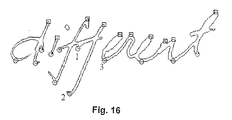
- An example of closed curves is shown in Figure 16, which shows an image of the word “different”, while the contour refers to the external pixels of the whole word “different” as previously defined, the closed curves are closed portions of this contour such as the portions “d", “i”, “ff", and "erent". In the art these portions may sometimes be called contours as well, yet for clarity purposes the term "closed curve” is used instead.
- our portion should be construed herein to include without limitation a series of contiguous pixels on a word image pixel contour between two given pixel points.
- convex attribute should be construed herein to include without limitation the general geometric shape or curvature of an extrema.
- the convex attribute of peak extrema is a convex shape or configuration relative to the peak extrema pixel point
- the convex attribute of theminima extrema is a concave shape relative to the minima extrema pixel point. Therefore, peak extrema have a corresponding convex attribute (convex shape), minima extrema have a corresponding convex attribute (concave shape), and a peak extrema and a minima extrema have different convex shape since one is convex and the other is concave respectfully.
- Inner loop should be construed herein to include without limitation an additional inner closed curve of pixels within a closed curve or a contour.
- Figure 25 shows the closed curve or contour of the letter image "O"
- pixel A is on the contour or closed curve and the inner loop is within this contour or closed curve.
- controller should be construed herein to include without limitation a computer, a processor, a programmer and the like.
- a “peak extrema”, a “minima extrema” and an “extrema” may refer to a single pixel point, a plurality of those single pixel points or a short segment of pixels defining the aforementioned convex attribute and being contiguous with the given extrema pixel point.
- Figure 1 illustrates some cursive word images; a) “almost”, (b) “almost”, (c) “almost”, (d) “almost”, (e) “along”, (f) “already”, (g) “and", (h) “and", (i) “announce", (j) “another”, (k) “answer", (I) “army”, (m) “around”, (n) “art”, (o) “care”, (p) "case”.
- Figure 2 is a schematic block diagram of a transformation network that directly encodes orthographic and phonological information
- Figure 3 is a flow chart showing information flow of handwriting production
- Figure 4(a) illustrates an original handwritten word image and the same word image after skew correction
- Figure 4(b) illustrates an original word image and the same word image after slant correction
- Figure 5 is a part of electronic form
- Figures 6(a)-6(I) illustrate respective samples of cursive word database: (a) “daughter", (b) "and", (c) “announce", (d) “another", (e) "army”, (f) "around", (g) "before", (h) “black", (i) "daughter", (j) "and", (k) "begin", (I) "before”;
- Figure 7 is a graph representing letter distribution in a database wherein letters are case insensitive and wherein the 26 letters are mapped to 26 integers; letter “a” is mapped to "1", letter “b” is mapped to "2”, and so on, and Fig. 7(b) is a graph representing word distribution in terms of the length of the words;
- Figure 8. is a graph illustrating parameters in the definition of radon transform
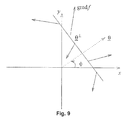
- Figure 9 is a graph of the radon transform of gradient flow in IR 2 , wherein the gradient vector components parallel to the line of integration are used;
- Figure 10 is a graph illustrating Radon transformation in the polar domain
- Figure 11 is a graph illustrating slant angle detection
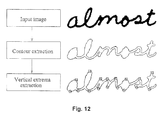
- Figure 12 is a flow chart illustrating vertical extrema on the external contour of a word image, wherein the peaks in the upper contour are marked by rectangles, the minima in the lower contour are marked by circles;
- Figure 13 is a flow chart illustrating the conceptual framework of low-level word image representation, wherein the virtual box (a) contains modules which encapsulate where the important information exists and how to organize them, and the virtual box (b) contains modules which encapsulate what kind of information will be required in order to build a decision model for classification task;
- Figure 14 is a schematic illustration of pruned extrema, wherein local minima 1 is in the upper contour and local peak 2 is in the lower contour;
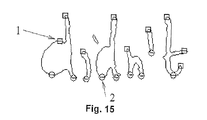
- Figure 15 is a schematic illustration for the extraction of a number of peaks and minima
- Figure 16 is a schematic illustration for the extraction of minimum height difference, wherein the neighbours have the same convex attributes as the current extreme point.
- Figure 17. is a schematic illustration for the extraction of minimum height difference, wherein the neighbors have different convex attribute from the current extreme point;
- Figure 18 is a schematic illustration for the extraction of height ratio
- Figure 19 is a schematic illustration for the extraction of vertical intersection distance
- Figure 20(a) is a graph representing a projection profile on the x-axis
- Figure 20(b) is a graph representing a projection profile on the y-axis
- Figure 21 is a graph illustrating a wrapping function and adjust windows definition
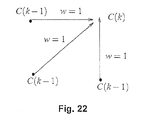
- Figure 22 is a schematic representation of a weighting coefficient w(k) of symmetric form
- Figure 23 is a schematic illustration of some word images wherein extrema are classified to upper peaks and lower minima, the peaks and minima being marked by squares and circles, respectively;
- Figure 24(a)-24(l) illustrate some samples from a French check database; (a) “quinze”, (b) “cinquante”, (c) “mille”, (d) “cts”, (e) “cinquante”, (f) “trente”, (g) “six”, (h) “quinze”, (i) “onze”, (j) "trois", (k) “seize”, (I) "cinq”; and
- Figure 25 illustrates a contour pixel image of the letter image "o", showing a pixel point A on the contour or closed curve as well as an inner loop or closed curve.
- Section I is a brief introduction.
- section II the acquisition of cursive word databases will be described.
- section III two algorithms for word skew/slant correction based on Radon transform are presented.
- section IV a concept framework of low-level word image representation is provided and its relationship with the process of handwriting production is discussed as well as some principles in vision and psychology.
- sections V and VI the detailed algorithms are proposed to implement the above representation.
- section V an algorithm to locate those meaningful extreme points and build a classifier based on support vector machine to classify them into two independent channels is proposed.
- section VI a sequence of feature vectors are extracted at those extreme points in each channel, respectively. Dynamic time wrapping is used to evaluate the performance of the proposed representation.
- Experimental results are given in section VII and show the effectiveness of the proposed low-level word image representation.
- section VIII is a brief conclusion.
- certain extreme points in the vertical direction on a contour are located, and then support vector machines are applied to classify those points into two channels: local peaks in the upper external contour and local minima in the lower external contour.
- support vector machines are applied to classify those points into two channels: local peaks in the upper external contour and local minima in the lower external contour.
- local feature vectors are extracted at those points.
- a cursive word image is represented by two sequences of feature vectors.
- a perceptive global approach to word recognition is used. This approach provides for uncovering the modular parameters of handwritten word images and as such for the mathematical modulation of word images that are sought to be recognized.
- a low-level word image representation for classification is provided, where a word image can be represented as one sequence of peak feature vectors on the upper zone and one sequence of minima feature vectors in the lower zone.
- the representation conforms to the Gestalt principles of perceptual organizations and is very suitable for the development of hierarchical learning systems when the top-down information such as orthography is used.
- a complete recognition system based on this representation is provided.
- efficient and robust algorithms for word skew and slant corrections are provided.
- the recognition rates on IRONOFF French check database and IMDS cursive word database are 94.3% and 56.1% respectively when the matching method of dynamic time wrapping is used.
- a database with large amounts of data allows for building a handwriting recognition system.
- recognition methods When more and more recognition methods are available, the performance comparison of these methods on benchmark databases are becoming increasingly important.
- IRONOFF French check database [38] contains thirty words.
- the underlying lexicon in IAM databases [39] includes 10,841 different words. But this lexicon contains many word inflections. Identifying word inflections may require the contextual information in a sentence. Since the cursive word recognition rate without constraints for the current recognition system is still rather low, it is better to build a database in which the lexicon is increasing in a proper way so that one can investigate the factors that affect the recognition performance in a controlled manner.
- an electronic form having the following features: given a number of words; handwritten collection forms (e.g. Microsoft Word format) can be generated automatically; handwritten words in the form image can be segmented robustly and easily; and word labelling is automatic by high-accuracy machine-printed digit recognition techniques.
- handwritten collection forms e.g. Microsoft Word format
- word labelling is automatic by high-accuracy machine-printed digit recognition techniques.
- Figure 5 shows a part of the electronic form that is used to collect samples.
- the form is scanned for example as a gray-scale image in 300 DPI.
- the two black circles are used as the reference points to de-skew the image. All boxes can be located robustly by connected component analysis.
- some digits are printed. For example, 5 1 2 6 are shown in the box.
- the first digit "5" specifies the frequency band "1 2 6" represents the sequential number of the first word in the current page so that we can create an index table to label the word automatically. Digits are printed in bold font and separated by one blank space for ease of segmentation. Each digit image will be recognized by a high-accuracy machine-printed digit recognition engine.
- the total number of collected samples is 52528. Since the size of vocabulary is 670, the average number of samples of each word is about 78. These samples are randomly split into training and testing sets. As a result, the training and testing sets consists of 38795 and 13733 samples, respectively. In the training set, letter distribution and word length distribution are shown in Figure 7. It can be observed that words of length 4 are the most frequent in the training set.
- ⁇ Dirac delta function
- ⁇ * ⁇ should correspond to the x axis. Therefore, the skew angle is ⁇ /2+ ⁇ *.
- the image width and height of image f ( x, y ) are denoted by w and h, respectively.
- f ( x, y ) is a black/white (1/0) image.
- Input image f ( x, y ), K ⁇ r max ⁇ .
- step (3.1) an angle which corresponds to the maximum response is obtained.
- High-precision Radon transform is not necessary in our algorithm.
- the most expensive operations can be pre-computed as look-up tables in the initial stage and the number of evaluated angles can be much smaller than 180.
- Figure 11 can be used to give a geometric explanation.
- line segment AB is a part of long vertical stroke; CD and EF are a part of two short vertical strokes, respectively.
- AB, CD, EF are projected onto the direction ⁇ ⁇ .
- f ( s ⁇ ⁇ + t ⁇ ⁇ ⁇ ) > 0 ⁇ , where ⁇ 1 is a tolerance parameter and the function U (.) is given by U ( x ) ⁇ 1 if x > 0 0 otherwise If the ratio r is large, then probably there exists a long segment for the fixed s on current projection direction.
- the ratio is 1.0;
- the ratio is (CD+EF)/CF.
- ⁇ ⁇ ⁇ 0 ⁇ ⁇ ⁇ ⁇ ⁇ I ( ⁇ , s ) g ( ⁇ , s ) ⁇ d ⁇ d s ⁇ 0 ⁇ ⁇ ⁇ ⁇ I ( ⁇ , s ) g ( ⁇ , s ) d ⁇ d s ,
- the vector v 1 corresponds to g in Eq.(2) and v 2 corresponds to the denominator in Eq.(8).
- strokes are basic units and a handwriting signal can be represented as a sequence of strokes in the temporal dimension.
- a stroke is bounded by two points with curvature. That is, strokes are separated by extreme points and a handwriting signal can be broken up into strokes under the assumption of contiguity.
- the horizontal and vertical directions are more important than the other orientations.
- strokes are split into two groups: strokes in the upper contour and those in the lower contour. Those strokes are ordered from left to right. This representation has several characteristics:
- the interesting locations are the peaks in the upper external contour and minima in the lower external contour.
- the neighbouring curved segments at those extrema have a convex attribute that is either convex with relation to that extrema or concave with relation to that extreme. If the curves are smooth, the curvatures at those points are positive. Theoretically there exists a point with negative curvature between two neighbouring extrema. This indicates that a point with negative curvature depends on its neighbouring points with positive curvature. Therefore, it is reasonable to assume that peaks in the upper external contours are pairwisely independent. So are the minima in the lower external contours. Also, these locations are analogous to the centers of receptive fields [44], which attract visual attention [45].
- Figure 12 the representation of Figure 12 can be illustrated in Figure 13.
- This proposed conceptual representation framework which differs from the methods in the literature, explicitly and systematically organizes low-level visual information based on some principles from handwriting production, vision and psychology.
- n 1 and n 2 denote the number of initial peaks and number of initial minima, respectively.
- three primary measures are used to prune invalid extreme points: contour length, height difference and bounded variation between two neighbouring extreme points. For example, if the contour length between two neighbouring peaks is small, they will be merged into one peak that will be located at the middle point on the contour. Also, if a local minimum point is located in the upper zone, it will be pruned. In the same manner if a local peak point is located in the lower zone, it will be pruned. For instance, in Figure 14, extreme points 1 and 2 will be pruned.
- Relative position in y axis ( f 7 ).
- the feature is defined by y/h, where y is the coordinate of the current point in the y-axis and h is the image height.
- f 1 and f 2 characterize the information of word length.
- the feature values will be first transformed into the interval [0,1], the variable transformation x 0.4 is applied to each component of the feature vector such that the distribution of each feature is Gaussian-like [47].
- a support vector classifier [48] is constructed to classify points to two classes: extrema on the upper contour and extrema on the lower contour. If one local minima is classified to the upper contour, it will be pruned. If one local peak is classified to the lower contour, it will be pruned. As a result, the valid local peaks will be on the upper contour while the valid local minima will be on the lower contour.
- discriminative features will be extracted at those points for word classification task. Some features are global and will be distributed to all extrema in the corresponding channel. The feature extraction is described according to local peaks; similar operations are applied to local minima.
- Dominant crossing number Project the vertical crossing number (i.e the transition between a black pixel and a white pixel) onto the x-axis. Then the projection function is quantized to three intervals [0,3], [3,5], [5,+ ⁇ ]. Then the histogram is calculated when the crossing number falls into the three intervals.
- the histogram values are features f 22 c , f 23 c and f 24 c .
- the wrapping function F is determined when E(F) attains its minimum value.
- the word representation method described in the present specification has been implemented in C++ on Windows XP and compiled by Microsoft visual C++6.0. It is a part of IMDS handwritten word recognition engine. The experiments were conducted on IMDS cursive word database. Training set and testing set consists of 38795 and 13733 word images, respectively. The size of lexicon is 670
- the vector norm is set to L1 and the size r of the adjusting window is set to 1.
- the performance of the proposed method is first investigated for extrema detection and grouping on IMDS database. Then, the generalization performance of the proposed method is investigated on IRONOFF French cheque database [38] and IMDS cursive databases.
- a support vector machine is used as a classifier to classify extrema into two categories.
- C in the dual form of SVM [48] is set to 10.0.
- SVM is trained by HeroSvm2[51] 6 . Some labelled samples have to be collected before the support vector machine is trained. The strategy is first to label a small number of extrema in the word images manually. Then these samples are divided into training and testing sets. A SVM classifier is constructed. The classifier is used to label other extrema. The misclassified errors are corrected manually. Since the recognition rate of SVM classifier is very high, more than 99%, the number of manual corrections is small. Much time-consuming cost has been saved. Table III shows the performance of SVM classifier, TABLE III PERFORMANCE OF SUPPORT VECTOR MACHINE Training set Testing set Training rate Testing rate SV BSV 354,928 119,825 99.78% 99.6% 4377 2936
- SV and BSV denote the number of support vectors and number of bounded support vectors, respectively.
- the number of support vectors is small, compared with the size of the whole training set. It may indicate that features are discriminative so that a small portion of SVs can characterize the classification boundary.
- the above results are very promising. They indicate that the extrema can be grouped into two categories with a high accuracy though cursive word shapes exhibit considerable variations. It also infers that in low-level visual processing the data-driven learning technique with top-down information can eliminate the uncertainty of a decision to a great extent.
- the baseline information has been used to determine the upper and lower zones. But the detection of baseline is not robust due to uneven writing. Moreover, it is difficult to find a baseline for some short words.
- the output of the SVM classifier can be used as the confidence value.
- the confidence value of the SVM's output is larger, the decision of the classifier becomes more reliable.
- the obtained feature vectors are compared with the a a template such as a database to generate a match between a selected handwritten word and a previously classified word.
- IRONOFF French check database [38] and IMDS cursive word database have been used to test the method according to the present invention.
- There are 30 French words in IRONOFF French check database which consists of a training set of size 7898 and a testing set of size 3948. Some samples from this database are shown in Fig. 24.
- HMM Hidden Markov Model
- Hidden Markov Models perform slightly better than dynamic time wrapping. But their computational cost is much higher than that of dynamic time wrapping. The recognition rates of both methods on IMDS test set are low. There are several reasons. First, The size of vocabulary on IMDS database is larger than that on IRONOFF check database. Second, there are many similar words in IMDS database. Finally, the average number of training samples for each word on IMDS database is 40 while the average number of training samples for each word is about 300. In order to obtain a good performance, a large number of samples are necessary.
- a novel low-level word image representation for classification is proposed, where a word image can be represented as one sequence of peak feature vectors on the upper zone and one sequence of minima feature vectors in the lower zone.
- a cursive word recognition system based on the method according to the invention has been built and achieved a good performance on IRONOFF check database.
- the new low-level word representation is very suitable for the construction of a hierarchical learning system, where the top-down information such as orthography, which plays a key role in word recognition, can be introduced during the training stage.
Landscapes
- Engineering & Computer Science (AREA)
- Computer Vision & Pattern Recognition (AREA)
- Physics & Mathematics (AREA)
- General Physics & Mathematics (AREA)
- Multimedia (AREA)
- Theoretical Computer Science (AREA)
- Image Analysis (AREA)
- Character Input (AREA)
Applications Claiming Priority (1)
| Application Number | Priority Date | Filing Date | Title |
|---|---|---|---|
| US64739605P | 2005-01-28 | 2005-01-28 |
Publications (2)
| Publication Number | Publication Date |
|---|---|
| EP1693784A2 true EP1693784A2 (fr) | 2006-08-23 |
| EP1693784A3 EP1693784A3 (fr) | 2012-04-04 |
Family
ID=36263835
Family Applications (1)
| Application Number | Title | Priority Date | Filing Date |
|---|---|---|---|
| EP06101041A Ceased EP1693784A3 (fr) | 2005-01-28 | 2006-01-30 | Reconnaissance de mots manuscrits basée sur la décomposition géométrique. |
Country Status (3)
| Country | Link |
|---|---|
| US (1) | US8077973B2 (fr) |
| EP (1) | EP1693784A3 (fr) |
| CA (1) | CA2534617C (fr) |
Cited By (4)
| Publication number | Priority date | Publication date | Assignee | Title |
|---|---|---|---|---|
| EP2166488A3 (fr) * | 2008-09-18 | 2013-07-17 | Xerox Corporation | Détecteur de mots écrits à la main à l'aide de requêtes synthétisées entrées avec clavier |
| EP3109797A1 (fr) * | 2015-06-26 | 2016-12-28 | Orange | Procédé de reconnaissance d'écriture manuscrite sur une surface physique |
| EP3333761A1 (fr) * | 2016-12-09 | 2018-06-13 | Free Construction Sp. z o.o. | Procédé d'analyse de données visualisées |
| US11195509B2 (en) | 2019-08-29 | 2021-12-07 | Microsoft Technology Licensing, Llc | System and method for interactive virtual assistant generation for assemblages |
Families Citing this family (160)
| Publication number | Priority date | Publication date | Assignee | Title |
|---|---|---|---|---|
| US8645137B2 (en) | 2000-03-16 | 2014-02-04 | Apple Inc. | Fast, language-independent method for user authentication by voice |
| US7175090B2 (en) * | 2004-08-30 | 2007-02-13 | Cognex Technology And Investment Corporation | Methods and apparatus for reading bar code identifications |
| US8677377B2 (en) | 2005-09-08 | 2014-03-18 | Apple Inc. | Method and apparatus for building an intelligent automated assistant |
| US8548254B2 (en) * | 2006-06-07 | 2013-10-01 | Nec Corporation | Image direction judging device, image direction judging method and image direction judging program |
| US7702145B2 (en) * | 2006-06-28 | 2010-04-20 | Microsoft Corporation | Adapting a neural network for individual style |
| US9318108B2 (en) | 2010-01-18 | 2016-04-19 | Apple Inc. | Intelligent automated assistant |
| CN101281449B (zh) * | 2007-04-03 | 2013-03-06 | 诺基亚(中国)投资有限公司 | 手写字识别方法和系统 |
| US8977255B2 (en) | 2007-04-03 | 2015-03-10 | Apple Inc. | Method and system for operating a multi-function portable electronic device using voice-activation |
| US8111922B2 (en) * | 2007-06-08 | 2012-02-07 | Microsoft Corporation | Bi-directional handwriting insertion and correction |
| US9330720B2 (en) | 2008-01-03 | 2016-05-03 | Apple Inc. | Methods and apparatus for altering audio output signals |
| US8996376B2 (en) | 2008-04-05 | 2015-03-31 | Apple Inc. | Intelligent text-to-speech conversion |
| US10496753B2 (en) | 2010-01-18 | 2019-12-03 | Apple Inc. | Automatically adapting user interfaces for hands-free interaction |
| US20100030549A1 (en) | 2008-07-31 | 2010-02-04 | Lee Michael M | Mobile device having human language translation capability with positional feedback |
| US20100067799A1 (en) * | 2008-09-17 | 2010-03-18 | Microsoft Corporation | Globally invariant radon feature transforms for texture classification |
| CN101398902B (zh) * | 2008-09-27 | 2012-07-04 | 宁波新然电子信息科技发展有限公司 | 一种自然手写阿拉伯字母联机识别方法 |
| JP4738469B2 (ja) * | 2008-10-29 | 2011-08-03 | 株式会社東芝 | 画像処理装置、画像処理プログラムおよび画像処理方法 |
| US9959870B2 (en) | 2008-12-11 | 2018-05-01 | Apple Inc. | Speech recognition involving a mobile device |
| US10255566B2 (en) | 2011-06-03 | 2019-04-09 | Apple Inc. | Generating and processing task items that represent tasks to perform |
| US10241752B2 (en) | 2011-09-30 | 2019-03-26 | Apple Inc. | Interface for a virtual digital assistant |
| US10241644B2 (en) | 2011-06-03 | 2019-03-26 | Apple Inc. | Actionable reminder entries |
| US9858925B2 (en) | 2009-06-05 | 2018-01-02 | Apple Inc. | Using context information to facilitate processing of commands in a virtual assistant |
| US9431006B2 (en) | 2009-07-02 | 2016-08-30 | Apple Inc. | Methods and apparatuses for automatic speech recognition |
| US8649600B2 (en) * | 2009-07-10 | 2014-02-11 | Palo Alto Research Center Incorporated | System and method for segmenting text lines in documents |
| US8566349B2 (en) * | 2009-09-28 | 2013-10-22 | Xerox Corporation | Handwritten document categorizer and method of training |
| US10276170B2 (en) | 2010-01-18 | 2019-04-30 | Apple Inc. | Intelligent automated assistant |
| US10705794B2 (en) | 2010-01-18 | 2020-07-07 | Apple Inc. | Automatically adapting user interfaces for hands-free interaction |
| US10553209B2 (en) | 2010-01-18 | 2020-02-04 | Apple Inc. | Systems and methods for hands-free notification summaries |
| US10679605B2 (en) | 2010-01-18 | 2020-06-09 | Apple Inc. | Hands-free list-reading by intelligent automated assistant |
| US8682667B2 (en) | 2010-02-25 | 2014-03-25 | Apple Inc. | User profiling for selecting user specific voice input processing information |
| KR101207127B1 (ko) * | 2010-03-19 | 2012-11-30 | 전남대학교산학협력단 | 문자 인식 전처리 방법 및 장치 |
| US10762293B2 (en) | 2010-12-22 | 2020-09-01 | Apple Inc. | Using parts-of-speech tagging and named entity recognition for spelling correction |
| DE102011010315A1 (de) * | 2011-02-03 | 2012-08-09 | Hönigsberg & Düvel Datentechnik GmbH | Erkennung von Objekten |
| US9262612B2 (en) | 2011-03-21 | 2016-02-16 | Apple Inc. | Device access using voice authentication |
| US8977059B2 (en) * | 2011-06-03 | 2015-03-10 | Apple Inc. | Integrating feature extraction via local sequential embedding for automatic handwriting recognition |
| US10057736B2 (en) | 2011-06-03 | 2018-08-21 | Apple Inc. | Active transport based notifications |
| CN102254196B (zh) * | 2011-06-22 | 2014-05-14 | 江苏奥博洋信息技术有限公司 | 计算机鉴别手写汉字的方法 |
| US8994660B2 (en) | 2011-08-29 | 2015-03-31 | Apple Inc. | Text correction processing |
| US9014477B2 (en) * | 2011-10-27 | 2015-04-21 | King Abdulaziz City for Science and Technology (KACST) | Method and apparatus for automatically identifying character segments for character recognition |
| JP6146760B2 (ja) * | 2012-02-28 | 2017-06-14 | 国立研究開発法人産業技術総合研究所 | 序列化装置、序列化方法及びプログラム |
| US10134385B2 (en) | 2012-03-02 | 2018-11-20 | Apple Inc. | Systems and methods for name pronunciation |
| US9483461B2 (en) | 2012-03-06 | 2016-11-01 | Apple Inc. | Handling speech synthesis of content for multiple languages |
| US8559718B1 (en) * | 2012-04-27 | 2013-10-15 | Abbyy Development Llc | Defining a layout of text lines of CJK and non-CJK characters |
| US8971630B2 (en) | 2012-04-27 | 2015-03-03 | Abbyy Development Llc | Fast CJK character recognition |
| US8989485B2 (en) | 2012-04-27 | 2015-03-24 | Abbyy Development Llc | Detecting a junction in a text line of CJK characters |
| US9280610B2 (en) | 2012-05-14 | 2016-03-08 | Apple Inc. | Crowd sourcing information to fulfill user requests |
| US9721563B2 (en) | 2012-06-08 | 2017-08-01 | Apple Inc. | Name recognition system |
| US9495129B2 (en) | 2012-06-29 | 2016-11-15 | Apple Inc. | Device, method, and user interface for voice-activated navigation and browsing of a document |
| US9576574B2 (en) | 2012-09-10 | 2017-02-21 | Apple Inc. | Context-sensitive handling of interruptions by intelligent digital assistant |
| US9547647B2 (en) | 2012-09-19 | 2017-01-17 | Apple Inc. | Voice-based media searching |
| CN103824094A (zh) * | 2012-11-16 | 2014-05-28 | 方正国际软件(武汉)有限公司 | 笔迹校验装置和笔迹校验方法 |
| DE112014000709B4 (de) | 2013-02-07 | 2021-12-30 | Apple Inc. | Verfahren und vorrichtung zum betrieb eines sprachtriggers für einen digitalen assistenten |
| US8958644B2 (en) * | 2013-02-28 | 2015-02-17 | Ricoh Co., Ltd. | Creating tables with handwriting images, symbolic representations and media images from forms |
| US9368114B2 (en) | 2013-03-14 | 2016-06-14 | Apple Inc. | Context-sensitive handling of interruptions |
| US10652394B2 (en) | 2013-03-14 | 2020-05-12 | Apple Inc. | System and method for processing voicemail |
| WO2014144949A2 (fr) | 2013-03-15 | 2014-09-18 | Apple Inc. | Entraînement d'un système à commande au moins partiellement vocale |
| WO2014144579A1 (fr) | 2013-03-15 | 2014-09-18 | Apple Inc. | Système et procédé pour mettre à jour un modèle de reconnaissance de parole adaptatif |
| WO2014197334A2 (fr) | 2013-06-07 | 2014-12-11 | Apple Inc. | Système et procédé destinés à une prononciation de mots spécifiée par l'utilisateur dans la synthèse et la reconnaissance de la parole |
| WO2014197336A1 (fr) | 2013-06-07 | 2014-12-11 | Apple Inc. | Système et procédé pour détecter des erreurs dans des interactions avec un assistant numérique utilisant la voix |
| US9582608B2 (en) | 2013-06-07 | 2017-02-28 | Apple Inc. | Unified ranking with entropy-weighted information for phrase-based semantic auto-completion |
| WO2014197335A1 (fr) | 2013-06-08 | 2014-12-11 | Apple Inc. | Interprétation et action sur des commandes qui impliquent un partage d'informations avec des dispositifs distants |
| US10176167B2 (en) | 2013-06-09 | 2019-01-08 | Apple Inc. | System and method for inferring user intent from speech inputs |
| KR101959188B1 (ko) | 2013-06-09 | 2019-07-02 | 애플 인크. | 디지털 어시스턴트의 둘 이상의 인스턴스들에 걸친 대화 지속성을 가능하게 하기 위한 디바이스, 방법 및 그래픽 사용자 인터페이스 |
| KR101809808B1 (ko) | 2013-06-13 | 2017-12-15 | 애플 인크. | 음성 명령에 의해 개시되는 긴급 전화를 걸기 위한 시스템 및 방법 |
| US20150006405A1 (en) * | 2013-06-28 | 2015-01-01 | James Roy Palmer | System and methods for secure entry of a personal identification number (pin) using multi-touch trackpad technologies |
| KR101749009B1 (ko) | 2013-08-06 | 2017-06-19 | 애플 인크. | 원격 디바이스로부터의 활동에 기초한 스마트 응답의 자동 활성화 |
| US9620105B2 (en) | 2014-05-15 | 2017-04-11 | Apple Inc. | Analyzing audio input for efficient speech and music recognition |
| US10592095B2 (en) | 2014-05-23 | 2020-03-17 | Apple Inc. | Instantaneous speaking of content on touch devices |
| US9502031B2 (en) | 2014-05-27 | 2016-11-22 | Apple Inc. | Method for supporting dynamic grammars in WFST-based ASR |
| US9715875B2 (en) | 2014-05-30 | 2017-07-25 | Apple Inc. | Reducing the need for manual start/end-pointing and trigger phrases |
| WO2015184186A1 (fr) | 2014-05-30 | 2015-12-03 | Apple Inc. | Procédé d'entrée à simple énoncé multi-commande |
| US9785630B2 (en) | 2014-05-30 | 2017-10-10 | Apple Inc. | Text prediction using combined word N-gram and unigram language models |
| US9734193B2 (en) | 2014-05-30 | 2017-08-15 | Apple Inc. | Determining domain salience ranking from ambiguous words in natural speech |
| US10289433B2 (en) | 2014-05-30 | 2019-05-14 | Apple Inc. | Domain specific language for encoding assistant dialog |
| US9430463B2 (en) | 2014-05-30 | 2016-08-30 | Apple Inc. | Exemplar-based natural language processing |
| US9760559B2 (en) | 2014-05-30 | 2017-09-12 | Apple Inc. | Predictive text input |
| US9940511B2 (en) * | 2014-05-30 | 2018-04-10 | Kofax, Inc. | Machine print, hand print, and signature discrimination |
| US10078631B2 (en) | 2014-05-30 | 2018-09-18 | Apple Inc. | Entropy-guided text prediction using combined word and character n-gram language models |
| US10170123B2 (en) | 2014-05-30 | 2019-01-01 | Apple Inc. | Intelligent assistant for home automation |
| US9633004B2 (en) | 2014-05-30 | 2017-04-25 | Apple Inc. | Better resolution when referencing to concepts |
| US9842101B2 (en) | 2014-05-30 | 2017-12-12 | Apple Inc. | Predictive conversion of language input |
| US10659851B2 (en) | 2014-06-30 | 2020-05-19 | Apple Inc. | Real-time digital assistant knowledge updates |
| US9338493B2 (en) | 2014-06-30 | 2016-05-10 | Apple Inc. | Intelligent automated assistant for TV user interactions |
| US10446141B2 (en) | 2014-08-28 | 2019-10-15 | Apple Inc. | Automatic speech recognition based on user feedback |
| US9619702B2 (en) | 2014-08-29 | 2017-04-11 | Ancestry.Com Operations Inc. | System and method for transcribing handwritten records using word grouping with assigned centroids |
| US9818400B2 (en) | 2014-09-11 | 2017-11-14 | Apple Inc. | Method and apparatus for discovering trending terms in speech requests |
| US10789041B2 (en) | 2014-09-12 | 2020-09-29 | Apple Inc. | Dynamic thresholds for always listening speech trigger |
| US10074360B2 (en) | 2014-09-30 | 2018-09-11 | Apple Inc. | Providing an indication of the suitability of speech recognition |
| US9646609B2 (en) | 2014-09-30 | 2017-05-09 | Apple Inc. | Caching apparatus for serving phonetic pronunciations |
| US9668121B2 (en) | 2014-09-30 | 2017-05-30 | Apple Inc. | Social reminders |
| US9886432B2 (en) | 2014-09-30 | 2018-02-06 | Apple Inc. | Parsimonious handling of word inflection via categorical stem + suffix N-gram language models |
| US10127911B2 (en) | 2014-09-30 | 2018-11-13 | Apple Inc. | Speaker identification and unsupervised speaker adaptation techniques |
| US9575952B2 (en) | 2014-10-21 | 2017-02-21 | At&T Intellectual Property I, L.P. | Unsupervised topic modeling for short texts |
| US10552013B2 (en) | 2014-12-02 | 2020-02-04 | Apple Inc. | Data detection |
| US9711141B2 (en) | 2014-12-09 | 2017-07-18 | Apple Inc. | Disambiguating heteronyms in speech synthesis |
| US9430703B2 (en) * | 2014-12-19 | 2016-08-30 | Konica Minolta Laboratory U.S.A., Inc. | Method for segmenting text words in document images using vertical projections of center zones of characters |
| US9865280B2 (en) | 2015-03-06 | 2018-01-09 | Apple Inc. | Structured dictation using intelligent automated assistants |
| US9886953B2 (en) | 2015-03-08 | 2018-02-06 | Apple Inc. | Virtual assistant activation |
| US9721566B2 (en) | 2015-03-08 | 2017-08-01 | Apple Inc. | Competing devices responding to voice triggers |
| US10567477B2 (en) | 2015-03-08 | 2020-02-18 | Apple Inc. | Virtual assistant continuity |
| US9899019B2 (en) | 2015-03-18 | 2018-02-20 | Apple Inc. | Systems and methods for structured stem and suffix language models |
| JP2016181057A (ja) * | 2015-03-23 | 2016-10-13 | 株式会社東芝 | 画像処理装置、画像処理方法及び画像処理プログラム |
| US9842105B2 (en) | 2015-04-16 | 2017-12-12 | Apple Inc. | Parsimonious continuous-space phrase representations for natural language processing |
| US9418305B1 (en) * | 2015-04-29 | 2016-08-16 | Xerox Corporation | Segmentation free approach to automatic license plate recognition |
| US10083688B2 (en) | 2015-05-27 | 2018-09-25 | Apple Inc. | Device voice control for selecting a displayed affordance |
| US10127220B2 (en) | 2015-06-04 | 2018-11-13 | Apple Inc. | Language identification from short strings |
| US9578173B2 (en) | 2015-06-05 | 2017-02-21 | Apple Inc. | Virtual assistant aided communication with 3rd party service in a communication session |
| US10101822B2 (en) | 2015-06-05 | 2018-10-16 | Apple Inc. | Language input correction |
| US11025565B2 (en) | 2015-06-07 | 2021-06-01 | Apple Inc. | Personalized prediction of responses for instant messaging |
| US10186254B2 (en) | 2015-06-07 | 2019-01-22 | Apple Inc. | Context-based endpoint detection |
| US10255907B2 (en) | 2015-06-07 | 2019-04-09 | Apple Inc. | Automatic accent detection using acoustic models |
| US10387034B2 (en) | 2015-09-03 | 2019-08-20 | Microsoft Technology Licensing, Llc | Modifying captured stroke information into an actionable form |
| US10210383B2 (en) | 2015-09-03 | 2019-02-19 | Microsoft Technology Licensing, Llc | Interacting with an assistant component based on captured stroke information |
| US10671428B2 (en) | 2015-09-08 | 2020-06-02 | Apple Inc. | Distributed personal assistant |
| US10747498B2 (en) | 2015-09-08 | 2020-08-18 | Apple Inc. | Zero latency digital assistant |
| US9697820B2 (en) | 2015-09-24 | 2017-07-04 | Apple Inc. | Unit-selection text-to-speech synthesis using concatenation-sensitive neural networks |
| US10366158B2 (en) | 2015-09-29 | 2019-07-30 | Apple Inc. | Efficient word encoding for recurrent neural network language models |
| US11010550B2 (en) | 2015-09-29 | 2021-05-18 | Apple Inc. | Unified language modeling framework for word prediction, auto-completion and auto-correction |
| US11587559B2 (en) | 2015-09-30 | 2023-02-21 | Apple Inc. | Intelligent device identification |
| US10691473B2 (en) | 2015-11-06 | 2020-06-23 | Apple Inc. | Intelligent automated assistant in a messaging environment |
| US10049668B2 (en) | 2015-12-02 | 2018-08-14 | Apple Inc. | Applying neural network language models to weighted finite state transducers for automatic speech recognition |
| US10223066B2 (en) | 2015-12-23 | 2019-03-05 | Apple Inc. | Proactive assistance based on dialog communication between devices |
| US10446143B2 (en) | 2016-03-14 | 2019-10-15 | Apple Inc. | Identification of voice inputs providing credentials |
| US9934775B2 (en) | 2016-05-26 | 2018-04-03 | Apple Inc. | Unit-selection text-to-speech synthesis based on predicted concatenation parameters |
| US9972304B2 (en) | 2016-06-03 | 2018-05-15 | Apple Inc. | Privacy preserving distributed evaluation framework for embedded personalized systems |
| US10249300B2 (en) | 2016-06-06 | 2019-04-02 | Apple Inc. | Intelligent list reading |
| US10049663B2 (en) | 2016-06-08 | 2018-08-14 | Apple, Inc. | Intelligent automated assistant for media exploration |
| DK179588B1 (en) | 2016-06-09 | 2019-02-22 | Apple Inc. | INTELLIGENT AUTOMATED ASSISTANT IN A HOME ENVIRONMENT |
| US10509862B2 (en) | 2016-06-10 | 2019-12-17 | Apple Inc. | Dynamic phrase expansion of language input |
| US10192552B2 (en) | 2016-06-10 | 2019-01-29 | Apple Inc. | Digital assistant providing whispered speech |
| US10586535B2 (en) | 2016-06-10 | 2020-03-10 | Apple Inc. | Intelligent digital assistant in a multi-tasking environment |
| US10067938B2 (en) | 2016-06-10 | 2018-09-04 | Apple Inc. | Multilingual word prediction |
| US10490187B2 (en) | 2016-06-10 | 2019-11-26 | Apple Inc. | Digital assistant providing automated status report |
| DK179049B1 (en) | 2016-06-11 | 2017-09-18 | Apple Inc | Data driven natural language event detection and classification |
| DK201670540A1 (en) | 2016-06-11 | 2018-01-08 | Apple Inc | Application integration with a digital assistant |
| DK179343B1 (en) | 2016-06-11 | 2018-05-14 | Apple Inc | Intelligent task discovery |
| DK179415B1 (en) | 2016-06-11 | 2018-06-14 | Apple Inc | Intelligent device arbitration and control |
| US10043516B2 (en) | 2016-09-23 | 2018-08-07 | Apple Inc. | Intelligent automated assistant |
| US10593346B2 (en) | 2016-12-22 | 2020-03-17 | Apple Inc. | Rank-reduced token representation for automatic speech recognition |
| DK201770439A1 (en) | 2017-05-11 | 2018-12-13 | Apple Inc. | Offline personal assistant |
| DK179745B1 (en) | 2017-05-12 | 2019-05-01 | Apple Inc. | SYNCHRONIZATION AND TASK DELEGATION OF A DIGITAL ASSISTANT |
| DK179496B1 (en) | 2017-05-12 | 2019-01-15 | Apple Inc. | USER-SPECIFIC Acoustic Models |
| DK201770432A1 (en) | 2017-05-15 | 2018-12-21 | Apple Inc. | Hierarchical belief states for digital assistants |
| DK201770431A1 (en) | 2017-05-15 | 2018-12-20 | Apple Inc. | Optimizing dialogue policy decisions for digital assistants using implicit feedback |
| DK179560B1 (en) | 2017-05-16 | 2019-02-18 | Apple Inc. | FAR-FIELD EXTENSION FOR DIGITAL ASSISTANT SERVICES |
| US10592595B2 (en) | 2017-09-29 | 2020-03-17 | Dropbox, Inc. | Maintaining multiple versions of a collection of content items |
| US11222162B2 (en) | 2017-09-29 | 2022-01-11 | Dropbox, Inc. | Managing content item collections |
| US10922426B2 (en) | 2017-09-29 | 2021-02-16 | Dropbox, Inc. | Managing content item collections |
| US11038973B2 (en) | 2017-10-19 | 2021-06-15 | Dropbox, Inc. | Contact event feeds and activity updates |
| US10783400B2 (en) | 2018-04-06 | 2020-09-22 | Dropbox, Inc. | Generating searchable text for documents portrayed in a repository of digital images utilizing orientation and text prediction neural networks |
| US11017258B2 (en) * | 2018-06-05 | 2021-05-25 | Microsoft Technology Licensing, Llc | Alignment of user input on a screen |
| TWI676919B (zh) * | 2018-08-02 | 2019-11-11 | 義守大學 | 一種電腦化寫字評估與訓練方法 |
| CN109558880B (zh) * | 2018-10-16 | 2021-06-04 | 杭州电子科技大学 | 一种基于视觉整体和局部特征融合的轮廓检测方法 |
| KR20200101481A (ko) * | 2019-01-28 | 2020-08-28 | 삼성전자주식회사 | 전자 장치 및 그의 필체 보정 방법 |
| CN111063223B (zh) * | 2020-01-07 | 2022-02-08 | 杭州大拿科技股份有限公司 | 英语单词拼写练习方法及装置 |
| US11270153B2 (en) | 2020-02-19 | 2022-03-08 | Northrop Grumman Systems Corporation | System and method for whole word conversion of text in image |
| US11270146B2 (en) * | 2020-03-31 | 2022-03-08 | Konica Minolta Business Solutions U.S.A., Inc. | Text location method and apparatus |
| US20220058842A1 (en) * | 2020-08-24 | 2022-02-24 | Brown University | Generating handwriting via decoupled style descriptors |
| CN112801239B (zh) * | 2021-01-28 | 2023-11-21 | 科大讯飞股份有限公司 | 输入识别方法、装置、电子设备和存储介质 |
| CN113139435A (zh) * | 2021-03-30 | 2021-07-20 | 北京思特奇信息技术股份有限公司 | 自学型签名笔迹深化识别方法及系统 |
| CN117292232B (zh) * | 2023-11-24 | 2024-02-06 | 烟台大学 | T1加权成像的多维空间特征获取方法、系统和设备 |
Family Cites Families (5)
| Publication number | Priority date | Publication date | Assignee | Title |
|---|---|---|---|---|
| US3133266A (en) * | 1960-06-14 | 1964-05-12 | Bell Telephone Labor Inc | Automatic recognition of handwriting |
| US5583956A (en) * | 1993-01-12 | 1996-12-10 | The Board Of Trustees Of The Leland Stanford Junior University | Estimation of skew angle in text image |
| US6757424B2 (en) * | 1998-06-29 | 2004-06-29 | Lumeniq, Inc. | Method for conducting analysis of two-dimensional images |
| US7336827B2 (en) * | 2000-11-08 | 2008-02-26 | New York University | System, process and software arrangement for recognizing handwritten characters |
| US7724958B2 (en) * | 2004-09-07 | 2010-05-25 | Gannon Technologies Group Llc | Systems and methods for biometric identification using handwriting recognition |
-
2006
- 2006-01-30 EP EP06101041A patent/EP1693784A3/fr not_active Ceased
- 2006-01-30 CA CA2534617A patent/CA2534617C/fr not_active Expired - Lifetime
- 2006-01-30 US US11/344,505 patent/US8077973B2/en active Active
Non-Patent Citations (1)
| Title |
|---|
| None * |
Cited By (7)
| Publication number | Priority date | Publication date | Assignee | Title |
|---|---|---|---|---|
| EP2166488A3 (fr) * | 2008-09-18 | 2013-07-17 | Xerox Corporation | Détecteur de mots écrits à la main à l'aide de requêtes synthétisées entrées avec clavier |
| US8731300B2 (en) | 2008-09-18 | 2014-05-20 | Xerox Corporation | Handwritten word spotter system using synthesized typed queries |
| EP3109797A1 (fr) * | 2015-06-26 | 2016-12-28 | Orange | Procédé de reconnaissance d'écriture manuscrite sur une surface physique |
| FR3038100A1 (fr) * | 2015-06-26 | 2016-12-30 | Orange | Procede de reconnaissance d'ecriture manuscrite sur une surface physique |
| US10126825B2 (en) | 2015-06-26 | 2018-11-13 | Orange | Method for recognizing handwriting on a physical surface |
| EP3333761A1 (fr) * | 2016-12-09 | 2018-06-13 | Free Construction Sp. z o.o. | Procédé d'analyse de données visualisées |
| US11195509B2 (en) | 2019-08-29 | 2021-12-07 | Microsoft Technology Licensing, Llc | System and method for interactive virtual assistant generation for assemblages |
Also Published As
| Publication number | Publication date |
|---|---|
| EP1693784A3 (fr) | 2012-04-04 |
| US8077973B2 (en) | 2011-12-13 |
| CA2534617C (fr) | 2014-12-16 |
| US20060193518A1 (en) | 2006-08-31 |
| CA2534617A1 (fr) | 2006-07-28 |
Similar Documents
| Publication | Publication Date | Title |
|---|---|---|
| US8077973B2 (en) | Handwritten word recognition based on geometric decomposition | |
| Dongre et al. | A review of research on Devnagari character recognition | |
| Chaudhuri et al. | Optical character recognition systems | |
| Arica et al. | An overview of character recognition focused on off-line handwriting | |
| Sharma et al. | Online handwritten Gurmukhi character recognition using elastic matching | |
| Ganis et al. | Neural network-based systems for handprint OCR applications | |
| Srihari et al. | An assessment of Arabic handwriting recognition technology | |
| Kaur et al. | A comprehensive survey on word recognition for non-Indic and Indic scripts | |
| Cao et al. | A probabilistic method for keyword retrieval in handwritten document images | |
| Inunganbi | A systematic review on handwritten document analysis and recognition | |
| Fischer | Handwriting recognition in historical documents | |
| Belaïd et al. | Human reading based strategies for off-line Arabic word recognition | |
| Plötz et al. | Markov Models for handwriting recognition | |
| El Moubtahij et al. | Review of feature extraction techniques for offline handwriting arabic text recognition | |
| Connell | A comparison of hidden Markov model features for the recognition of cursive handwriting | |
| Pechwitz et al. | Handwritten Arabic word recognition using the IFN/ENIT-database | |
| Adak | A study on automated handwriting understanding | |
| Gurmu | Offline handwritten text recognition of historical Ge’ez manuscripts using deep learning techniques | |
| Musleh et al. | Fuzzy modeling for handwritten arabic numeral recognition. | |
| Arica | An off-line character recognition system for free style handwriting | |
| Tan et al. | Individuality of alphabet knowledge in online writer identification | |
| Al-Ma'adeed | Recognition of off-line handwritten Arabic words | |
| Ghorbel | Generalized Haar-like filters for document analysis: application to word spotting and text extraction from comics | |
| Indermühle | Analysis of digital link in electronic documents | |
| Senior | O-line cursive handwriting recognition using recurrent neural networks |
Legal Events
| Date | Code | Title | Description |
|---|---|---|---|
| PUAI | Public reference made under article 153(3) epc to a published international application that has entered the european phase |
Free format text: ORIGINAL CODE: 0009012 |
|
| AK | Designated contracting states |
Kind code of ref document: A2 Designated state(s): AT BE BG CH CY CZ DE DK EE ES FI FR GB GR HU IE IS IT LI LT LU LV MC NL PL PT RO SE SI SK TR |
|
| AX | Request for extension of the european patent |
Extension state: AL BA HR MK YU |
|
| RIC1 | Information provided on ipc code assigned before grant |
Ipc: G06K 9/32 20060101ALI20110721BHEP Ipc: G06K 9/48 20060101AFI20110721BHEP |
|
| PUAL | Search report despatched |
Free format text: ORIGINAL CODE: 0009013 |
|
| RIC1 | Information provided on ipc code assigned before grant |
Ipc: G06K 9/32 20060101ALI20120209BHEP Ipc: G06K 9/48 20060101AFI20120209BHEP |
|
| AK | Designated contracting states |
Kind code of ref document: A3 Designated state(s): AT BE BG CH CY CZ DE DK EE ES FI FR GB GR HU IE IS IT LI LT LU LV MC NL PL PT RO SE SI SK TR |
|
| AX | Request for extension of the european patent |
Extension state: AL BA HR MK YU |
|
| RIC1 | Information provided on ipc code assigned before grant |
Ipc: G06K 9/32 20060101ALI20120224BHEP Ipc: G06K 9/48 20060101AFI20120224BHEP |
|
| 17P | Request for examination filed |
Effective date: 20121003 |
|
| AKX | Designation fees paid |
Designated state(s): AT BE BG CH CY CZ DE DK EE ES FI FR GB GR HU IE IS IT LI LT LU LV MC NL PL PT RO SE SI SK TR |
|
| 17Q | First examination report despatched |
Effective date: 20131108 |
|
| APBK | Appeal reference recorded |
Free format text: ORIGINAL CODE: EPIDOSNREFNE |
|
| APBN | Date of receipt of notice of appeal recorded |
Free format text: ORIGINAL CODE: EPIDOSNNOA2E |
|
| APBR | Date of receipt of statement of grounds of appeal recorded |
Free format text: ORIGINAL CODE: EPIDOSNNOA3E |
|
| APAF | Appeal reference modified |
Free format text: ORIGINAL CODE: EPIDOSCREFNE |
|
| APAV | Appeal reference deleted |
Free format text: ORIGINAL CODE: EPIDOSDREFNE |
|
| STAA | Information on the status of an ep patent application or granted ep patent |
Free format text: STATUS: EXAMINATION IS IN PROGRESS |
|
| APBT | Appeal procedure closed |
Free format text: ORIGINAL CODE: EPIDOSNNOA9E |
|
| STAA | Information on the status of an ep patent application or granted ep patent |
Free format text: STATUS: THE APPLICATION HAS BEEN REFUSED |
|
| 18R | Application refused |
Effective date: 20220802 |