EP1694014A2 - Verwendung eines Meta-Viterbi-Algorithmus in intersymbolinterferenzfreien Vermittlungssystemen - Google Patents
Verwendung eines Meta-Viterbi-Algorithmus in intersymbolinterferenzfreien Vermittlungssystemen Download PDFInfo
- Publication number
- EP1694014A2 EP1694014A2 EP05020805A EP05020805A EP1694014A2 EP 1694014 A2 EP1694014 A2 EP 1694014A2 EP 05020805 A EP05020805 A EP 05020805A EP 05020805 A EP05020805 A EP 05020805A EP 1694014 A2 EP1694014 A2 EP 1694014A2
- Authority
- EP
- European Patent Office
- Prior art keywords
- meta
- isi
- event
- viterbi
- detector
- Prior art date
- Legal status (The legal status is an assumption and is not a legal conclusion. Google has not performed a legal analysis and makes no representation as to the accuracy of the status listed.)
- Withdrawn
Links
- 238000004891 communication Methods 0.000 title claims abstract description 40
- 208000011580 syndromic disease Diseases 0.000 claims abstract description 39
- 238000000034 method Methods 0.000 claims abstract description 27
- 238000012937 correction Methods 0.000 claims abstract description 14
- 230000008569 process Effects 0.000 claims abstract description 11
- 230000001186 cumulative effect Effects 0.000 claims description 42
- 238000010586 diagram Methods 0.000 claims description 32
- 238000012545 processing Methods 0.000 claims description 5
- 238000001514 detection method Methods 0.000 description 8
- 239000000654 additive Substances 0.000 description 4
- 230000000996 additive effect Effects 0.000 description 4
- 230000005540 biological transmission Effects 0.000 description 3
- 238000007476 Maximum Likelihood Methods 0.000 description 2
- 230000000295 complement effect Effects 0.000 description 2
- 230000008030 elimination Effects 0.000 description 2
- 238000003379 elimination reaction Methods 0.000 description 2
- 238000013459 approach Methods 0.000 description 1
- 238000003066 decision tree Methods 0.000 description 1
- 230000001419 dependent effect Effects 0.000 description 1
- 238000011161 development Methods 0.000 description 1
- 230000006870 function Effects 0.000 description 1
- 238000010348 incorporation Methods 0.000 description 1
- 239000000463 material Substances 0.000 description 1
- 238000012986 modification Methods 0.000 description 1
- 230000004048 modification Effects 0.000 description 1
- 230000009467 reduction Effects 0.000 description 1
- 238000011160 research Methods 0.000 description 1
Images



Classifications
-
- H—ELECTRICITY
- H04—ELECTRIC COMMUNICATION TECHNIQUE
- H04L—TRANSMISSION OF DIGITAL INFORMATION, e.g. TELEGRAPHIC COMMUNICATION
- H04L25/00—Baseband systems
- H04L25/02—Details ; arrangements for supplying electrical power along data transmission lines
- H04L25/03—Shaping networks in transmitter or receiver, e.g. adaptive shaping networks
- H04L25/03006—Arrangements for removing intersymbol interference
- H04L25/03012—Arrangements for removing intersymbol interference operating in the time domain
- H04L25/03019—Arrangements for removing intersymbol interference operating in the time domain adaptive, i.e. capable of adjustment during data reception
- H04L25/03057—Arrangements for removing intersymbol interference operating in the time domain adaptive, i.e. capable of adjustment during data reception with a recursive structure
-
- H—ELECTRICITY
- H04—ELECTRIC COMMUNICATION TECHNIQUE
- H04L—TRANSMISSION OF DIGITAL INFORMATION, e.g. TELEGRAPHIC COMMUNICATION
- H04L1/00—Arrangements for detecting or preventing errors in the information received
- H04L1/004—Arrangements for detecting or preventing errors in the information received by using forward error control
- H04L1/0045—Arrangements at the receiver end
- H04L1/0054—Maximum-likelihood or sequential decoding, e.g. Viterbi, Fano, ZJ algorithms
-
- H—ELECTRICITY
- H04—ELECTRIC COMMUNICATION TECHNIQUE
- H04L—TRANSMISSION OF DIGITAL INFORMATION, e.g. TELEGRAPHIC COMMUNICATION
- H04L25/00—Baseband systems
- H04L25/02—Details ; arrangements for supplying electrical power along data transmission lines
- H04L25/03—Shaping networks in transmitter or receiver, e.g. adaptive shaping networks
- H04L25/03006—Arrangements for removing intersymbol interference
- H04L25/03178—Arrangements involving sequence estimation techniques
Definitions
- the Viterbi algorithm may be used for the maximum likelihood detection of data.
- the detection of data may be accomplished by using a Viterbi detector with 2 t states.
- the Viterbi algorithm requires performing ⁇ 2t ( ⁇ times 2 t ) add, compare, select (ACS) operations.
- performing a large number of ACS operations is sub-optimal since the implementation complexity also increases.
- Various aspects of the invention provide a system and/or method for detecting and correcting one or more data bit errors transmitted through a communication channel, wherein the communication channel does not exhibit any intersymbol interference, substantially as shown in and/or described in connection with at least one of the following figures, as set forth more completely in the claims.
- a method of detecting and correcting data bit errors in one or more received codewords transmitted through a communication channel comprising:
- said using said symbol detector and said using said Non-ISI Meta-Viterbi detector having 2 t states provides performance equivalent to that of a Viterbi detector having 2 t states.
- said Non-ISI Meta-Viterbi detector uses ⁇ +2 t 2 t add, compare, and select operations.
- said Non-ISI Meta-Viterbi detector provides a soft decision output, log P ( ⁇ i
- v ⁇ i ), for i 1 ,..., ⁇ .
- v ⁇ i ), for i 1,..., ⁇ equates to -( ⁇ i - v i ) 2 + ( ⁇ i - v ⁇ i ) 2 in the noise added to said communication channel is additive white Gaussian.
- said Non-ISI Meta-Viterbi detector uses said hard and said soft decision outputs to correct said one or more received codewords.
- said second processing comprises:
- said minimum cumulative event weight of said trellis diagram for each of said received codeword is equal to its parity syndrome.
- each of said one or more codewords comprises t parity bits.
- said communication channel comprises a wireline data communication channel.
- a method of correcting one or more data bit errors in a received codeword of a communications channel comprising:
- each of said one or more preferred error events corresponds to a parity syndrome whose event weight has minimum value.
- said minimum cumulative event weight is used to correct said received codeword.
- said communications channel incorporates noise that is independent, identically distributed, additive white Gaussian.
- a system for detecting and correcting data bit errors in one or more received codewords transmitted through a communication channel comprising:
- said Non-ISI Meta-Viterbi detector comprises:
- said event weight processor, computational circuitry, parity syndrome calculator, and error correction circuitry are implemented using digital logic circuitry.
- said symbol detector comprises a slicer.
- said Non-ISI Meta-Viterbi detector performs ⁇ +2 t 2 t add, compare, and select operations.
- Figure 1 A is a functional block diagram of an error detection and correction system that utilizes a conventional Viterbi Algorithm to decode a linear block code transmitted through a communication channel, in the absence of intersymbol interference (ISI).
- ISI intersymbol interference
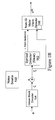
- Figure 1B is a functional block diagram of a system that utilizes the Meta-Viterbi Algorithm in accordance with an embodiment of the invention.
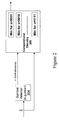
- Figure 2 is a functional block diagram describing a computational circuitry of a Non-ISI Meta-Viterbi detector that is used in determining a preferred set of error events, in accordance with an embodiment of the invention.
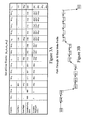
- Figure 3B is a diagram illustrating the 16 state Meta-Viterbi trellis path taken when the error events chosen correspond to ⁇ e 3 , e 7 , e 10 , e 15 ⁇ , as described in relation to Figure 3A, in accordance with an embodiment of the invention.
- Figure 4 illustrates a portion of a Meta-Viterbi trellis diagram in accordance with an embodiment of the invention.
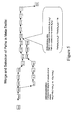
- Figure 5 is a diagram illustrating the selection of a path having lowest cumulative event weight, when two paths merge in a Meta-Viterbi trellis, in accordance with an embodiment of the invention.
- Figure 6 is a functional block diagram of a Non-ISI Meta-Viterbi detector in accordance with an embodiment of the invention.
- Various aspects of the invention provide a system and method of detecting and correcting data bit errors that occur when a data stream is transmitted through a communication channel.
- the data bit errors may be detected and corrected by way of transmitting a sequence of codewords.
- the codewords may incorporate or encode one or more parity bits into the transmitted data.
- the codewords are used in the detection and correction process to recover the data transmitted.
- the method as described herein utilizes what is referred to as a Meta-Viterbi Algorithm for use in communication channels that do not exhibit intersymbol interference (ISI).
- ISI intersymbol interference
- this method may be termed or referred to as a Meta-Viterbi Algorithm.
- the system that performs the detection and correction as described herein may be termed a symbol detector and Non-ISI Meta-Viterbi detector.
- the channel may comprise a wireline communications channel.
- the channel may comprise any communications transmission channel in which ISI is absent.
- aspects of the invention provide performance that is equivalent to that provided by using the Viterbi Algorithm with 2 t states. However, various aspects of the invention provide a significant reduction in implementation complexity compared with that provided by using the Viterbi Algorithm to detect codewords. When using the Viterbi Algorithm having codeword length ⁇ and t parity bits that results in a linear block coding of rate ( ⁇ -t)/ ⁇ , maximum likelihood detection requires the use of 2 t states run over ⁇ steps.
- the Viterbi algorithm requires performing a total of ⁇ 2 t (x multiplied by 2 t ) add, compare, select (ACS) operations.
- the Meta-Viterbi Algorithm may be performed using only a total of ⁇ +2 t 2 t or ⁇ +2 2t operations.
- Various aspects of the invention implement at least a method and a system of determining an optimum set of one or more error events associated with a parity syndrome of a transmitted codeword.
- Each transmitted codeword is associated with an optimal set of one or more error events.
- the set of error events may be used to correct the codeword by way of using its parity syndrome.
- the optimal set of one or more error events is associated with a minimum cumulative event weight computed by a path formed from the decision branches of a trellis diagram.
- the path traverses one or more steps corresponding to the error events associated with the codeword.
- the set or error events may be determined by using the parity syndrome and cumulative parity of the codeword.
- a path or route is taken over a decision tree or trellis diagram by way of one or more decision branches.
- the branch taken corresponds to whether a particular error event occurs in a codeword.
- Each of the one or more paths is associated with an event weight.
- the cumulative weight may be found by summing the event weights of the branches used to create the path of a codeword. The path with the smallest cumulative weight is chosen as the optimal solution for correcting the codeword. Consequently, the set of error events associated with this path is used to correct the received codeword.
- the cumulative parity at the last step of the path may coincide with the parity syndrome of the received codeword.
- Figure 1A is a functional block diagram of an error detection and correction system that utilizes a conventional Viterbi Algorithm to decode a linear block code transmitted through a communication channel, in the absence of intersymbol interference (ISI).
- the system comprises a linear block encoder 104, a noise source 108, and a conventional Viterbi detector 112.
- the sequence of codewords received by the Viterbi detector 112 is represented by the variable ⁇ ⁇ R ⁇ .
- the Viterbi detector 112 utilizes 2 t states over ⁇ steps in the detection and correction process.
- x ) , where ⁇ ⁇ x ⁇ ⁇ 0,1 ⁇ x
- ⁇ ( x ) 0 ⁇ .ln the absence of ISI in the communication channel and with noise that is independent and identically distributed, log P ( ⁇
- Figure 1B is a functional block diagram of a system that utilizes the Meta-Viterbi Algorithm in accordance with an embodiment of the invention.
- the system may comprise a wireline data communications channel that corrects one or more data bit errors of one or more codewords by way of utilizing the Meta-Viterbi Algorithm.
- the system may comprise any type of communication channel without intersymbol noise source 158, a symbol detector 162, and a Non-ISI Meta-Viterbi detector 166.
- aspects of the invention provide that the system shown in Figure 1B processes codewords in a more efficient manner by way of adding t bits of redundancy to each codeword, and allowing the Non-ISI Meta-Viterbi detector 166 to process the codewords using 2 t states.
- Linear block coding may be used at the transmitter, for example, to generate codewords having t bits of parity.
- the system in Figure 1B replaces the Viterbi detector with the symbol detector 162 and the Non-ISI Meta-Viterbi detector 166.
- One may denote a linear operator that generates a parity syndrome for each codeword: ⁇ ⁇ 0,1 ⁇ ⁇ ⁇ ⁇ 0,1 ⁇ t .
- a noise source 158 is applied to the communication channel.
- the noise source 158 may generate independent identically distributed noise into the communication channel.
- the noise output by the noise source 158 is added to the codeword, ⁇ , such that a codeword, ⁇ , is input into the symbol detector 162.
- the symbol detector 162 provides an output, referred to as a hard decision output that is used by the Non-ISI Meta-Viterbi detector 166, for example.
- a slicer makes a decision by quantizing a received sample to a particular value. The value provides an estimate of the actual transmitted sample.
- v arg ⁇ max x ⁇ ⁇ 0 , 1 ⁇ ⁇ log P ( ⁇
- the event weights, w(e) may be determined using the previously defined equation.
- the soft decision output may be generated by using an event weight processor located within the Non-ISI Meta-Viterbi detector 166.
- the soft decision output may be expressed as follows: log P ( ⁇ i
- ⁇ i ), for i 1,..., ⁇ , in which ⁇ i denotes the complement of the bit ⁇ i .
- AWGN additive white Gaussian noise
- this soft decision output is equal to -( ⁇ i - ⁇ i ) 2 +( ⁇ i ;- ⁇ i ) 2 .
- the Non-ISI Meta-Viterbi detector 166 utilizes the hard and soft decision outputs to determine the optimum set of error events for the received codeword.
- the error events are used by the Non-ISI Meta-Viterbi detector 166 to determine the corrected output, ⁇ (0) using v.
- an error event comprising a single bit error, to be specified simply by its bit location within the received codeword.
- the Non-ISI Meta-Viterbi detector 166 determines the probability of an error event occurring by way of computing one or more event weights, w(e). Since aspects of the invention consider a communication channel with no ISI, the weight of an error event is based on soft information (i.e, the soft decision output provided by the event weight processor) at the location of the single bit error.
- the output of the Non-ISI Meta-Viterbi detector 166 generates an output that corresponds to the output of a Viterbi detector using 2 t states.
- the output of the Non-ISI Meta-Viterbi detector 166 may be represented by the following equation which indicates that the hard decision output is added to one or more error events to provide a corrected output:
- FIG. 2 is a functional block diagram describing a computational circuitry 208 of a Non-ISI Meta-Viterbi detector (e.g., 166 of Figure 1B) that is used in determining a preferred set of error events, in accordance with an embodiment of the invention.
- the Non-ISI Meta-Viterbi detector comprises the computational circuitry 208.
- the symbol detector (e.g., slicer) 204 outputs a hard decision output, v, into the computational circuitry 208. Additionally, the noisy codeword, ⁇ , is input into the symbol detector 204 and the computational circuitry 208. The computational circuitry 208 determines the preferred error events that have the smallest event weight for each possible parity syndrome, given t parity bits or 2 t states. In Figure 2, the computational circuitry 208 may also record the parity syndrome values associated with one or more codewords.
- the embodiment of Figure 2 illustrates how the computational circuitry 208 determines a preferred set of error events when a four-bit parity code is used for each codeword.
- this representative embodiment there is a preferred error event associated with each of the 15 possible syndromes within a codeword.
- the preferred error events are considered "locally minimized", since their associated event weight is a minimum value for the associated parity syndrome.
- Each of the preferred error events comprises an error event step in a trellis diagram.
- Figure 2 provides a representative embodiment illustrating the use of a Meta-Viterbi algorithm using codewords having an exemplary four bits of parity.
- the event weights associated with each preferred error event may be ordered according to the parity syndromes produced as follows: ⁇ w ( e 1 ) , w ( e 2 ) , ... , w ( e 2 t ⁇ 1 ) ⁇ .
- the Meta-Viterbi Algorithm as executed by the Non-ISI Meta-Viterbi detector, charts various subsets of each of the preferred sets of error events by way of a Meta-Viterbi trellis diagram. As may be visualized using the Meta-Viterbi trellis diagram, every subset of H k corresponds to a path through the Meta-Viterbi trellis.
- the subset of error events comprises ⁇ e 3 , e 7 , e 10 , e 15 ⁇ .
- the exemplary path shown in Figure 3A corresponds to a sequence of error event steps - "no e 1 ", “no e 2 ", “e 3 ", “no e 4 ", “no e 5 ", etc..
- the Meta-Viterbi path taken corresponds to a series of error event decisions made at each step of the sequence.
- the second row of the table provides the event parity associated with the error event that is taken.
- the third row of the table provides the event weight associated with the error event that is taken.
- the fourth row provides the cumulative parity at each step of the trellis path based on the error events taken.
- the fifth row provides the cumulative event weight at each step of the 16 state Meta-Viterbi trellis diagram.
- the path that provides the smallest cumulative event weight for a codeword is chosen given the codeword's parity syndrome. This path corresponds to an optimal set of error events that corrects the output provided by the symbol detector (e.g., slicer).
- Figure 3B is a diagram illustrating the 16 state Meta-Viterbi trellis path taken when the error events chosen correspond to ⁇ e 3 , e 7 , e 10 , e 15 ⁇ , as described in relation to Figure 3A, in accordance with an embodiment of the invention.
- the sequence of event choice steps which forms a path through the trellis may be indicated as follows: "No e 1 , No e 2 , e 3 , No e 4 , No e 5 , No e 6 , e 7 , No e 8 , No e 9 , e 10 , No e 11 , No e 12 , No e 13 , No e 14 , e 15 ".
- the path corresponds to the cumulative parity as displayed by the fourth row of the table illustrated in Figure 3A.
- the path shown is only one representative embodiment of a path taken through the 16 state Meta-Viterbi trellis. As illustrated, the path ends with a cumulative parity equal to "0001 ".
- the path through the Meta-Viterbi trellis determines the set of error events that may be used to correct the received codeword generated by the symbol detector.
- the path taken comprises a path ending with a cumulative parity corresponding to the syndrome of the codeword.
- Figure 5 is a diagram illustrating the selection of a path having lowest cumulative event weight, when two paths merge in a Meta-Viterbi trellis, in accordance with an embodiment of the invention.
- the cumulative parity is the same for the two paths (1110). However, their associated cumulative weights may differ.
- the cumulative weight is equal to w(e 3 )+w(e 7 )+w(e 10 ) while in the second path, the cumulative weight is equal to w(e 6 )+w(e 8 ).
- each respective path has undergone a sequence of different error events.
- the path comprises the error events ⁇ e 3 , e 7 , e 10 ⁇ while in the other instance, the path comprises the error events ⁇ e 6 , e 8 ⁇ .
- the Non-ISI Meta-Viterbi detector performs an add, compare, and select (ACS) operation similar to that performed by the Viterbi Algorithm. This process allows elimination of "non-survivor" paths when determining the path with the lowest path metric or lowest cumulative event weight.
- the Non-ISI Meta-Viterbi detector may utilize the following pseudo-language sequence of steps which may be used to implement a state machine for performing the Meta-Viterbi Algorithm when constructing a trellis within a codeword:
- the Meta-Viterbi algorithm determines the sequence of error events by using the PathMemory variable.
- the Meta-Viterbi algorithm determines the path metric or cumulative event weight by using the PathMetric variable.
- FIG. 6 is a functional block diagram of a Non-ISI Meta-Viterbi detector 604 in accordance with an embodiment of the invention.
- the Non-ISI Meta-Viterbi detector 604 comprises an event weight processor 608, a computational circuitry 612, a parity syndrome calculator 616, and an error correction circuitry 620.
- the event weight processor 608 is capable of computing one or more event weights, w(e), of a trellis.
- the soft decision output may be expressed as follows:
- the computational circuitry 612 is capable of computing one or more parameters associated with a Meta-Viterbi trellis.
- the symbol detector (e.g., slicer) provides hard decision information which is used by the event weight processor 608.
- the symbol detector also provides the hard decision information used by the parity syndrome calculator 616.
- the event weight processor 608 uses as inputs, the hard decision output provided by the symbol detector and the one or more noisy received codewords, ⁇ .
- the computational circuitry 612 determines the error events that have the smallest event weights for each parity syndrome of a particular received codeword.
- the parity syndrome calculator 616 computes the parity syndrome values associated with the one or more received codewords.
- the parity syndrome calculator 616 processes the output provided by the symbol detector and outputs the parity syndrome values to the computational circuitry 612.
- the computational circuitry 612 receives event weights computed by the event weight processor 608 and the values calculated by the parity syndrome calculator 616.
- the computational circuitry 612 may determine one or more optimal paths taken using a trellis diagram. One of the one or more optimal paths corresponds to a path having minimum cumulative event weight.
- the computational circuitry 612 may compute the cumulative parity of the sequence of error events.
- the computational circuitry 612 may perform one or more ACS operations when determining one or more cumulative event weights of one or more paths in the trellis diagram.
- the computational circuitry 612 may compute one or more event weights associated with one or more error events of a codeword. Additionally, the computational circuitry 612 may compute one or more cumulative event weights associated with one or more codewords.
- the error correction circuitry 620 corrects the one or more received codewords by determining the appropriate set of error events to add to the one or more received codewords.
- the error correction circuitry 620 may utilize the set of error events associated with the optimal path having a minimum cumulative event weight.
- the event weight processor 608, computational circuitry 612, parity syndrome calculator 616, and error correction circuitry 620 may comprise any type of digital logic circuitry used to implement an appropriate state-machine.
Landscapes
- Engineering & Computer Science (AREA)
- Computer Networks & Wireless Communication (AREA)
- Signal Processing (AREA)
- Power Engineering (AREA)
- Artificial Intelligence (AREA)
- Error Detection And Correction (AREA)
Applications Claiming Priority (1)
| Application Number | Priority Date | Filing Date | Title |
|---|---|---|---|
| US11/059,875 US7469373B2 (en) | 2005-02-17 | 2005-02-17 | Application of a Meta-Viterbi algorithm for communication systems without intersymbol interference |
Publications (2)
| Publication Number | Publication Date |
|---|---|
| EP1694014A2 true EP1694014A2 (de) | 2006-08-23 |
| EP1694014A3 EP1694014A3 (de) | 2012-04-25 |
Family
ID=36406032
Family Applications (1)
| Application Number | Title | Priority Date | Filing Date |
|---|---|---|---|
| EP05020805A Withdrawn EP1694014A3 (de) | 2005-02-17 | 2005-09-23 | Verwendung eines Meta-Viterbi-Algorithmus in intersymbolinterferenzfreien Vermittlungssystemen |
Country Status (4)
| Country | Link |
|---|---|
| US (3) | US7469373B2 (de) |
| EP (1) | EP1694014A3 (de) |
| CN (1) | CN1822530B (de) |
| TW (1) | TWI339957B (de) |
Families Citing this family (7)
| Publication number | Priority date | Publication date | Assignee | Title |
|---|---|---|---|---|
| US7490284B2 (en) * | 2005-02-03 | 2009-02-10 | Broadcom Corporation | Meta-Viterbi algorithm for use in communication systems |
| US7469373B2 (en) * | 2005-02-17 | 2008-12-23 | Broadcom Corporation | Application of a Meta-Viterbi algorithm for communication systems without intersymbol interference |
| US8117520B2 (en) * | 2007-06-15 | 2012-02-14 | Micron Technology, Inc. | Error detection for multi-bit memory |
| US20090189739A1 (en) * | 2008-01-25 | 2009-07-30 | Mobitrum Corporation | Passive voice enabled rfid devices |
| US8225252B2 (en) * | 2010-06-25 | 2012-07-17 | Intel Corporation | Systems, methods, apparatus and computer readable mediums for use in association with systems having interference |
| TWI617915B (zh) * | 2017-03-17 | 2018-03-11 | Data verification correction method | |
| CN112087287B (zh) | 2017-05-24 | 2025-07-15 | 华为技术有限公司 | 一种比特块流误码检测方法及设备 |
Family Cites Families (21)
| Publication number | Priority date | Publication date | Assignee | Title |
|---|---|---|---|---|
| US5208816A (en) * | 1989-08-18 | 1993-05-04 | At&T Bell Laboratories | Generalized viterbi decoding algorithms |
| JPH03195129A (ja) | 1989-12-22 | 1991-08-26 | Mitsubishi Electric Corp | 最尤系列推定装置 |
| US5430739A (en) | 1990-03-27 | 1995-07-04 | National Science Council | Real-time Reed-Solomon decoder |
| US5291499A (en) | 1992-03-16 | 1994-03-01 | Cirrus Logic, Inc. | Method and apparatus for reduced-complexity viterbi-type sequence detectors |
| US5388124A (en) * | 1992-06-12 | 1995-02-07 | University Of Maryland | Precoding scheme for transmitting data using optimally-shaped constellations over intersymbol-interference channels |
| DE4224214C2 (de) * | 1992-07-22 | 1995-02-09 | Deutsche Forsch Luft Raumfahrt | Verfahren zur quellengesteuerten Kanaldecodierung durch Erweiterung des Viterbi-Algorithmus |
| US5457704A (en) * | 1993-05-21 | 1995-10-10 | At&T Ipm Corp. | Post processing method and apparatus for symbol reliability generation |
| US5577053A (en) * | 1994-09-14 | 1996-11-19 | Ericsson Inc. | Method and apparatus for decoder optimization |
| CA2147087A1 (en) * | 1995-04-13 | 1996-10-14 | Guy Begin | Method and apparatus for correcting and decoding a sequence of branches representing encoded data bits into estimated information bits |
| DE19539343C2 (de) * | 1995-10-23 | 1997-12-11 | Siemens Ag | Verfahren zur Fehlererkennung eines digitalen Bitdatenstroms, der von einem Sender zu einem Empfänger übertragen wird |
| US5848106A (en) * | 1996-12-16 | 1998-12-08 | Ericsson, Inc. | Receiver decoder circuitry, and associated method, for decoding an encoded signal |
| US6009552A (en) * | 1997-06-18 | 1999-12-28 | Motorola, Inc. | Soft-decision syndrome-based decoder for convolutional codes |
| US6101626A (en) * | 1998-02-04 | 2000-08-08 | Lsi Logic Corporation | Method for choosing coding schemes, mappings, and puncturing rates for modulations/encoding systems |
| US6732328B1 (en) * | 1999-07-12 | 2004-05-04 | Maxtor Corporation | Two stage detector having viterbi detector matched to a channel and post processor matched to a channel code |
| US6427220B1 (en) | 1999-11-04 | 2002-07-30 | Marvell International, Ltd. | Method and apparatus for prml detection incorporating a cyclic code |
| US6307901B1 (en) | 2000-04-24 | 2001-10-23 | Motorola, Inc. | Turbo decoder with decision feedback equalization |
| US6470047B1 (en) * | 2001-02-20 | 2002-10-22 | Comsys Communications Signal Processing Ltd. | Apparatus for and method of reducing interference in a communications receiver |
| JP3823315B2 (ja) | 2002-05-07 | 2006-09-20 | ソニー株式会社 | 符号化装置及び符号化方法、並びに復号装置及び復号方法 |
| US7137056B2 (en) * | 2002-09-25 | 2006-11-14 | Infineon Technologies North America Corp. | Low error propagation rate 32/34 trellis code |
| US7490284B2 (en) * | 2005-02-03 | 2009-02-10 | Broadcom Corporation | Meta-Viterbi algorithm for use in communication systems |
| US7469373B2 (en) * | 2005-02-17 | 2008-12-23 | Broadcom Corporation | Application of a Meta-Viterbi algorithm for communication systems without intersymbol interference |
-
2005
- 2005-02-17 US US11/059,875 patent/US7469373B2/en not_active Expired - Lifetime
- 2005-09-23 EP EP05020805A patent/EP1694014A3/de not_active Withdrawn
-
2006
- 2006-02-15 TW TW095105051A patent/TWI339957B/zh not_active IP Right Cessation
- 2006-02-15 CN CN2006100549052A patent/CN1822530B/zh not_active Expired - Fee Related
- 2006-08-16 US US11/504,949 patent/US7865801B2/en not_active Expired - Fee Related
-
2008
- 2008-12-22 US US12/341,877 patent/US8335971B2/en not_active Expired - Fee Related
Non-Patent Citations (1)
| Title |
|---|
| None |
Also Published As
| Publication number | Publication date |
|---|---|
| EP1694014A3 (de) | 2012-04-25 |
| US8335971B2 (en) | 2012-12-18 |
| US20090172500A1 (en) | 2009-07-02 |
| US7469373B2 (en) | 2008-12-23 |
| CN1822530A (zh) | 2006-08-23 |
| CN1822530B (zh) | 2010-12-08 |
| US7865801B2 (en) | 2011-01-04 |
| US20070011594A1 (en) | 2007-01-11 |
| US20060195771A1 (en) | 2006-08-31 |
| TWI339957B (en) | 2011-04-01 |
| TW200711329A (en) | 2007-03-16 |
Similar Documents
| Publication | Publication Date | Title |
|---|---|---|
| US6848069B1 (en) | Iterative decoding process | |
| JP3801211B2 (ja) | テイルバイティング格子コードの最適ソフト出力復号器 | |
| JP3452560B2 (ja) | 穿孔されたパリティシンボルを復元するターボデコーダ用プリデコーダ及びターボコードの復元方法 | |
| US6597743B1 (en) | Reduced search symbol estimation algorithm | |
| US6484285B1 (en) | Tailbiting decoder and method | |
| EP3469714B1 (de) | Codierung von polarcodes mit punktierung, verkürzung und erweiterung | |
| EP0606724A1 (de) | Erweiterte Viterbi-Algorithmen mit Listenausgabe und Ausgabe von Analogwertentscheidungen | |
| US8335971B2 (en) | Application of a meta-viterbi algorithm for communication systems without intersymbol interference | |
| US11652566B2 (en) | Forward error correction with outer multi-level code and inner contrast code | |
| JP5764670B2 (ja) | デコード方法およびデコーダ | |
| US20080092025A1 (en) | Method and System for Improving Decoding Efficiency in Wireless Receivers | |
| US7836385B2 (en) | Meta-Viterbi algorithm for use in communication systems | |
| US8037398B2 (en) | System for precoding parity bits to meet predetermined modulation constraints | |
| US6981201B2 (en) | Process for decoding signals and system and computer program product therefore | |
| US5850403A (en) | Process of selectively protecting information bits against transmission errors | |
| JP5764671B2 (ja) | スタッフィングビットを含むメッセージを訂正するための方法 | |
| US20040103361A1 (en) | Method and device for performing soft decision decoding on reed-muller codes using decision by majority | |
| US20020150175A1 (en) | Method and apparatus for generating reliability information for channel decoding in a radio receiver | |
| JP2006507736A (ja) | Fec復号化における消失判定手順 | |
| JP3497399B2 (ja) | ビタビ復号器 | |
| JP5586504B2 (ja) | 復号装置 | |
| EP2406908B1 (de) | Mimo-kommunikationsverfahren und vorrichtungen | |
| JP3237864B2 (ja) | 軟判定ビタビ復号方法 | |
| WO2020234185A1 (en) | A method of marking bits, a method of decoding bits, a bit marking device, a decoder, a receiver and a chip | |
| KR100490815B1 (ko) | 비터비 복호기 |
Legal Events
| Date | Code | Title | Description |
|---|---|---|---|
| PUAI | Public reference made under article 153(3) epc to a published international application that has entered the european phase |
Free format text: ORIGINAL CODE: 0009012 |
|
| AK | Designated contracting states |
Kind code of ref document: A2 Designated state(s): AT BE BG CH CY CZ DE DK EE ES FI FR GB GR HU IE IS IT LI LT LU LV MC NL PL PT RO SE SI SK TR |
|
| AX | Request for extension of the european patent |
Extension state: AL BA HR MK YU |
|
| RAP1 | Party data changed (applicant data changed or rights of an application transferred) |
Owner name: BROADCOM CORPORATION |
|
| PUAL | Search report despatched |
Free format text: ORIGINAL CODE: 0009013 |
|
| AK | Designated contracting states |
Kind code of ref document: A3 Designated state(s): AT BE BG CH CY CZ DE DK EE ES FI FR GB GR HU IE IS IT LI LT LU LV MC NL PL PT RO SE SI SK TR |
|
| AX | Request for extension of the european patent |
Extension state: AL BA HR MK YU |
|
| RIC1 | Information provided on ipc code assigned before grant |
Ipc: H04L 1/00 20060101ALI20120320BHEP Ipc: H04L 25/03 20060101AFI20120320BHEP |
|
| 17P | Request for examination filed |
Effective date: 20121025 |
|
| AKX | Designation fees paid |
Designated state(s): DE FR GB |
|
| 17Q | First examination report despatched |
Effective date: 20130109 |
|
| STAA | Information on the status of an ep patent application or granted ep patent |
Free format text: STATUS: THE APPLICATION IS DEEMED TO BE WITHDRAWN |
|
| 18D | Application deemed to be withdrawn |
Effective date: 20130522 |