EP1698767A1 - Verfahren zur Aktivierung der Regeneration eines NOx-Adsorber - Google Patents
Verfahren zur Aktivierung der Regeneration eines NOx-Adsorber Download PDFInfo
- Publication number
- EP1698767A1 EP1698767A1 EP05425115A EP05425115A EP1698767A1 EP 1698767 A1 EP1698767 A1 EP 1698767A1 EP 05425115 A EP05425115 A EP 05425115A EP 05425115 A EP05425115 A EP 05425115A EP 1698767 A1 EP1698767 A1 EP 1698767A1
- Authority
- EP
- European Patent Office
- Prior art keywords
- nitric oxide
- oxide adsorber
- nitric
- determining
- indicating
- Prior art date
- Legal status (The legal status is an assumption and is not a legal conclusion. Google has not performed a legal analysis and makes no representation as to the accuracy of the status listed.)
- Granted
Links
- MWUXSHHQAYIFBG-UHFFFAOYSA-N Nitric oxide Chemical compound O=[N] MWUXSHHQAYIFBG-UHFFFAOYSA-N 0.000 title claims abstract description 346
- 230000008929 regeneration Effects 0.000 title claims abstract description 72
- 238000011069 regeneration method Methods 0.000 title claims abstract description 72
- 238000000034 method Methods 0.000 title claims abstract description 29
- 230000003213 activating effect Effects 0.000 title claims abstract description 20
- JCXJVPUVTGWSNB-UHFFFAOYSA-N nitrogen dioxide Inorganic materials O=[N]=O JCXJVPUVTGWSNB-UHFFFAOYSA-N 0.000 claims abstract description 66
- MGWGWNFMUOTEHG-UHFFFAOYSA-N 4-(3,5-dimethylphenyl)-1,3-thiazol-2-amine Chemical compound CC1=CC(C)=CC(C=2N=C(N)SC=2)=C1 MGWGWNFMUOTEHG-UHFFFAOYSA-N 0.000 claims abstract description 47
- 238000001179 sorption measurement Methods 0.000 claims abstract description 22
- 239000007789 gas Substances 0.000 claims description 22
- 239000013598 vector Substances 0.000 claims description 16
- 239000011159 matrix material Substances 0.000 claims description 15
- 238000006243 chemical reaction Methods 0.000 claims description 12
- 238000002485 combustion reaction Methods 0.000 claims description 11
- 230000001590 oxidative effect Effects 0.000 claims description 5
- 229960003753 nitric oxide Drugs 0.000 description 96
- 239000000446 fuel Substances 0.000 description 20
- BASFCYQUMIYNBI-UHFFFAOYSA-N platinum Chemical compound [Pt] BASFCYQUMIYNBI-UHFFFAOYSA-N 0.000 description 18
- 239000000203 mixture Substances 0.000 description 15
- CURLTUGMZLYLDI-UHFFFAOYSA-N Carbon dioxide Chemical compound O=C=O CURLTUGMZLYLDI-UHFFFAOYSA-N 0.000 description 12
- UGFAIRIUMAVXCW-UHFFFAOYSA-N Carbon monoxide Chemical compound [O+]#[C-] UGFAIRIUMAVXCW-UHFFFAOYSA-N 0.000 description 10
- 229910002091 carbon monoxide Inorganic materials 0.000 description 10
- 229930195733 hydrocarbon Natural products 0.000 description 9
- 150000002430 hydrocarbons Chemical class 0.000 description 9
- QVQLCTNNEUAWMS-UHFFFAOYSA-N barium oxide Chemical compound [Ba]=O QVQLCTNNEUAWMS-UHFFFAOYSA-N 0.000 description 7
- 239000003054 catalyst Substances 0.000 description 7
- 230000009467 reduction Effects 0.000 description 7
- IJGRMHOSHXDMSA-UHFFFAOYSA-N Atomic nitrogen Chemical compound N#N IJGRMHOSHXDMSA-UHFFFAOYSA-N 0.000 description 6
- 238000009825 accumulation Methods 0.000 description 6
- 239000001569 carbon dioxide Substances 0.000 description 6
- 229910002092 carbon dioxide Inorganic materials 0.000 description 6
- 229910052697 platinum Inorganic materials 0.000 description 6
- 230000001603 reducing effect Effects 0.000 description 6
- 229920006395 saturated elastomer Polymers 0.000 description 5
- 229910052788 barium Inorganic materials 0.000 description 4
- DSAJWYNOEDNPEQ-UHFFFAOYSA-N barium atom Chemical compound [Ba] DSAJWYNOEDNPEQ-UHFFFAOYSA-N 0.000 description 4
- TZCXTZWJZNENPQ-UHFFFAOYSA-L barium sulfate Chemical compound [Ba+2].[O-]S([O-])(=O)=O TZCXTZWJZNENPQ-UHFFFAOYSA-L 0.000 description 4
- 238000010586 diagram Methods 0.000 description 4
- 230000003647 oxidation Effects 0.000 description 4
- 238000007254 oxidation reaction Methods 0.000 description 4
- NINIDFKCEFEMDL-UHFFFAOYSA-N Sulfur Chemical compound [S] NINIDFKCEFEMDL-UHFFFAOYSA-N 0.000 description 3
- 239000005864 Sulphur Substances 0.000 description 3
- IWOUKMZUPDVPGQ-UHFFFAOYSA-N barium nitrate Chemical compound [Ba+2].[O-][N+]([O-])=O.[O-][N+]([O-])=O IWOUKMZUPDVPGQ-UHFFFAOYSA-N 0.000 description 3
- 150000001875 compounds Chemical class 0.000 description 3
- 230000007423 decrease Effects 0.000 description 3
- 230000007246 mechanism Effects 0.000 description 3
- 230000008569 process Effects 0.000 description 3
- 239000010948 rhodium Substances 0.000 description 3
- QAOWNCQODCNURD-UHFFFAOYSA-L Sulfate Chemical compound [O-]S([O-])(=O)=O QAOWNCQODCNURD-UHFFFAOYSA-L 0.000 description 2
- RAHZWNYVWXNFOC-UHFFFAOYSA-N Sulphur dioxide Chemical compound O=S=O RAHZWNYVWXNFOC-UHFFFAOYSA-N 0.000 description 2
- 239000003463 adsorbent Substances 0.000 description 2
- 239000002283 diesel fuel Substances 0.000 description 2
- 239000003344 environmental pollutant Substances 0.000 description 2
- 229910052757 nitrogen Inorganic materials 0.000 description 2
- 231100000719 pollutant Toxicity 0.000 description 2
- 229910052703 rhodium Inorganic materials 0.000 description 2
- MHOVAHRLVXNVSD-UHFFFAOYSA-N rhodium atom Chemical compound [Rh] MHOVAHRLVXNVSD-UHFFFAOYSA-N 0.000 description 2
- AKEJUJNQAAGONA-UHFFFAOYSA-N sulfur trioxide Chemical compound O=S(=O)=O AKEJUJNQAAGONA-UHFFFAOYSA-N 0.000 description 2
- 229910021653 sulphate ion Inorganic materials 0.000 description 2
- 239000004215 Carbon black (E152) Substances 0.000 description 1
- UFHFLCQGNIYNRP-UHFFFAOYSA-N Hydrogen Chemical compound [H][H] UFHFLCQGNIYNRP-UHFFFAOYSA-N 0.000 description 1
- 230000032683 aging Effects 0.000 description 1
- QVGXLLKOCUKJST-UHFFFAOYSA-N atomic oxygen Chemical compound [O] QVGXLLKOCUKJST-UHFFFAOYSA-N 0.000 description 1
- -1 barium oxide (BaO) Chemical class 0.000 description 1
- 230000003197 catalytic effect Effects 0.000 description 1
- 238000011217 control strategy Methods 0.000 description 1
- 230000003247 decreasing effect Effects 0.000 description 1
- 230000001419 dependent effect Effects 0.000 description 1
- 238000003795 desorption Methods 0.000 description 1
- 238000009472 formulation Methods 0.000 description 1
- 230000036541 health Effects 0.000 description 1
- 239000001257 hydrogen Substances 0.000 description 1
- 229910052739 hydrogen Inorganic materials 0.000 description 1
- 239000010687 lubricating oil Substances 0.000 description 1
- 239000001301 oxygen Substances 0.000 description 1
- 229910052760 oxygen Inorganic materials 0.000 description 1
- 230000035699 permeability Effects 0.000 description 1
- 238000011946 reduction process Methods 0.000 description 1
- 150000003467 sulfuric acid derivatives Chemical class 0.000 description 1
- 239000004291 sulphur dioxide Substances 0.000 description 1
- 235000010269 sulphur dioxide Nutrition 0.000 description 1
Images



Classifications
-
- B—PERFORMING OPERATIONS; TRANSPORTING
- B01—PHYSICAL OR CHEMICAL PROCESSES OR APPARATUS IN GENERAL
- B01D—SEPARATION
- B01D53/00—Separation of gases or vapours; Recovering vapours of volatile solvents from gases; Chemical or biological purification of waste gases, e.g. engine exhaust gases, smoke, fumes, flue gases, aerosols
- B01D53/34—Chemical or biological purification of waste gases
- B01D53/96—Regeneration, reactivation or recycling of reactants
-
- Y—GENERAL TAGGING OF NEW TECHNOLOGICAL DEVELOPMENTS; GENERAL TAGGING OF CROSS-SECTIONAL TECHNOLOGIES SPANNING OVER SEVERAL SECTIONS OF THE IPC; TECHNICAL SUBJECTS COVERED BY FORMER USPC CROSS-REFERENCE ART COLLECTIONS [XRACs] AND DIGESTS
- Y02—TECHNOLOGIES OR APPLICATIONS FOR MITIGATION OR ADAPTATION AGAINST CLIMATE CHANGE
- Y02A—TECHNOLOGIES FOR ADAPTATION TO CLIMATE CHANGE
- Y02A50/00—TECHNOLOGIES FOR ADAPTATION TO CLIMATE CHANGE in human health protection, e.g. against extreme weather
- Y02A50/20—Air quality improvement or preservation, e.g. vehicle emission control or emission reduction by using catalytic converters
Definitions
- the present invention relates to a method of activating regeneration of a nitric oxide adsorber.
- diesel engine emissions comprise the following compounds, some of which are harmful to health and/or the environment:
- Carbon monoxide and hydrocarbons are convertible to carbon dioxide and steam by the following oxidation process, which is active when the air-fuel mixture is lean, i.e. high in oxygen: C O + H C + O 2 ⁇ C O 2 + H 2 O
- Nitric oxides are convertible to carbon dioxide, nitrogen, and steam by the following reduction process, which is effective when the air-fuel mixture is rich: N O x + C O + H C ⁇ N 2 + C O 2 + H 2 O
- the air-fuel mixture in the combustion chamber of Otto engines equipped with a trivalent catalyst must be stoichiometric, i.e. the amount of air fed into the combustion chamber must be the exact amount required to burn the fuel in the combustion chamber.
- Trivalent catalysts are unsuitable for use in diesel engines, operation of which calls for an air quantity in excess of stoichiometric proportions (lean operation), thus preventing reduction of nitric oxides in normal operating conditions, for the reasons stated above.
- Nitric oxides produced by diesel engines therefore, cannot be eliminated using a trivalent catalyst, and the effectiveness of a catalyst in this type of engine is limited solely to oxidizing carbon monoxide and hydrocarbons into carbon dioxide and steam.
- nitric oxides may be eliminated using a so-called nitric oxide adsorber, whereby, during normal operation of the engine, nitrogen monoxide (NO) is converted to nitrogen dioxide ( NO 2 ) by an oxidizing element, e.g. platinum (Pt), is then trapped in an adsorbent compound, e.g. barium oxide ( BaO ), and is separated, at a specific operating stage, into nitrogen and carbon dioxide by a reducing element, e.g. rhodium (Rh).
- the operating stage known as regeneration, is achieved by calibrating the diesel engine to produce a reducing environment (rich operation) in the exhaust gas for a few seconds.
- the barium oxide ultimately becomes unable to store nitrogen monoxide (NO), on account of saturation of the acceptor sites; and, when the nitric oxide adsorber reaches a saturation level at which nitric oxides are no longer eliminated effectively, the acceptor sites must be "cleared” periodically by so-called regeneration, i.e. desorption and simultaneous reduction of nitric oxides.
- NO nitrogen monoxide
- nitric oxide adsorption and deadsorption are closely related to the composition of the air-fuel mixture during operation of the engine. That is, to adsorb nitric oxides, the air-fuel mixture must be lean (i.e. oxidizing), whereas, to desorb and reduce nitric oxides, the air-fuel mixture must be rich (i.e. reducing).
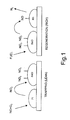
- Figure 1 shows the adsorption and reduction mechanism of a nitric oxide adsorber.
- the nitric oxide adsorption and reduction mechanism commences, as stated, in lean air-fuel mixture conditions, with oxidation of nitrogen monoxide (NO) into nitrogen dioxide ( NO 2 ) by the platinum (Pt) acting as a catalyst, according to the equation: N O + 1 2 O 2 ⁇ N O 2
- the nitrogen dioxide ( NO 2 ) reacts with the adsorbent element - barium oxide ( BaO ) in the example shown - by which it is trapped (i.e. chemically sorbed) in the form of barium nitrate ( Ba(NO 3 ) 2 ), according to the equation: Ba O + N O 2 + 1 2 O 2 ⁇ Ba ( N O 3 ) 2
- the air-fuel mixture is enriched for a predetermined time period to increase carbon monoxide and unburnt hydrocarbon emissions and impart reducing properties to the exhaust gas.
- nitrogen monoxide (NO) and nitrogen dioxide ( NO 2 ) are reduced by carbon monoxide (CO), hydrogen and hydrocarbons to nitrogen ( N 2 ) and carbon dioxide ( CO 2 ).
- a nitric oxide adsorber therefore substantially depends on the ability of barium to trap nitrogen dioxide, which in turn depends on various factors, such as exhaust gas temperature, exhaust gas flow, and the number of acceptor sites available in the barium. In the best possible operating conditions, a nitric oxide adsorber effectively eliminates as much as 90% of the nitric oxides produced by the engine.
- the fuel To prevent sulphates damaging the nitric oxide adsorber, the fuel must therefore contain no sulphur or, to limit the extent of damage, must contain at most 10 ppm.
- nitric oxide adsorber regeneration and accumulation cycle control strategies have been proposed, which comprise a fixed-duration (about 60-second) accumulation step, during which the air-fuel mixture is lean - in particular, assumes a value (A/F) of 20 to 55 - followed by a fixed-duration (about 5-second) regeneration step, during which the air-fuel mixture is enriched - in particular, assumes a value (A/F) of 12 to 14.
- Number 1 in Figure 2 indicates schematically and as a whole an internal combustion engine - in particular, a diesel engine - having an exhaust system 2, of which are shown only the parts required for a clear understanding of the present invention.
- Figure 2 shows, by way of a non-limiting example, a supercharged engine 1, i.e. comprising a turbosupercharger 3 defined by a compressor 4 located along an air intake manifold 5, and by a turbine 6 connected to compressor 4 and located along an exhaust manifold 7 of the engine.
- a supercharged engine i.e. comprising a turbosupercharger 3 defined by a compressor 4 located along an air intake manifold 5, and by a turbine 6 connected to compressor 4 and located along an exhaust manifold 7 of the engine.
- Exhaust system 2 comprises a nitric oxide (NO x ) adsorber 8 located along exhaust manifold 7; and an electronic control system 9 designed, among other things, to activate regeneration of nitric oxide adsorber 8 as described below.
- NO x nitric oxide
- electronic control system 9 comprises an airflow meter or so-called debimeter 10 located along air intake manifold 5 to measure the air intake Q A of the engine; a temperature sensor 11 located along exhaust manifold 7, at the inlet or outlet of nitric oxide adsorber 8, to measure the temperature T G of the exhaust gas flowing through nitric oxide adsorber 8; a measuring device 12 for measuring engine speed RPM and defined by a pulse wheel 13 fitted to the drive shaft 14 (shown schematically by the dash-and-dot line), and by an electromagnetic sensor 15 facing pulse wheel 13; and an electronic central control unit 16 connected to debimeter 10, to temperature sensor 11, and to measuring device 12, and implementing, among other things, the method of activating regeneration of nitric oxide adsorber 8 according to the invention.
- debimeter 10 located along air intake manifold 5 to measure the air intake Q A of the engine
- a temperature sensor 11 located along exhaust manifold 7, at the inlet or outlet of nitric oxide adsorber 8, to measure the temperature T G
- Figure 3 shows a block diagram illustrating the principle of the method of activating regeneration of nitric oxide adsorber 8 implemented by electronic central control unit 16.
- the regeneration activating method according to the invention is substantially based on determining a regeneration index indicating the residual adsorption capacity of the adsorber; comparing the regeneration index with a threshold indicating a minimum residual adsorption capacity; and activating regeneration of the nitric oxide adsorber when the regeneration index exceeds the threshold.
- the regeneration activating method according to the invention substantially comprises:
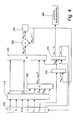
- Figure 4 shows a more detailed block diagram of the regeneration activating method according to the present invention. More specifically, the operations described below are repeated periodically at a frequency related to the clock frequency of electronic central control unit 16, e.g. every 65 ms, and are therefore described with reference to one execution.
- electronic central control unit 16 first acquires (block 200):
- Electronic central control unit 16 also stores the following constants or constant vectors/matrixes, which are calibrated as a function of physical characteristics of nitric oxide adsorber 8 (block 200):
- Electronic central control unit 16 then computes (block 210):
- flow Q NOx of the nitric oxides ( NO X ) produced by combustion is calculated by interpolation on the basis of an interpolation map based on engine bench tests, stored in electronic central control unit 16, and containing test-bench nitric oxide ( NO X ) flow Q NOx values as a function of engine speed RPM and torque TQ .
- Temperature and flow constants K T and K Q assume values of 0 to 1, and are calculated respectively as a function of exhaust gas temperature T G and flow Q G , as described below.
- temperature and flow constants K T and K Q are determined experimentally by feeding a given quantity of nitrogen monoxide (NO) to the nitric oxide adsorber inlet, and measuring the quantity of nitrogen monoxide (NO), nitrogen dioxide ( NO 2 ), and nitric oxides ( NO X ) at the outlet of nitric oxide adsorber 8.
- NO nitrogen monoxide
- NO 2 nitrogen dioxide
- NO X nitric oxides
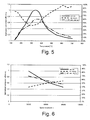
- Figure 5 shows nitrogen monoxide (NO) to nitrogen dioxide ( NO 2 ) conversion efficiency as a function of exhaust gas temperature T G . More specifically, Figure 5 shows the normalized ratio between the quantity of nitrogen dioxide ( NO 2 ) and nitrogen monoxide (NO) as a function of exhaust gas temperature T G , which may be used to calibrate temperature constant or constant vector/matrix K T .
- Figure 6 shows nitrogen monoxide (NO) to nitrogen dioxide ( NO 2 ) conversion efficiency as a function of exhaust gas space velocity Q G . More specifically, Figure 6 shows the normalized ratio between the quantity of nitrogen dioxide ( NO 2 ) and nitrogen monoxide (NO) as a function of exhaust gas space velocity Q G .
- Concentration constant or constant vector/matrix K C assumes values of 0 to 1, and is calculated as a function of constant C Pt proportional to the concentration of platinum in nitric oxide adsorber 8. Constant K C acts on oxidation conversion percentage absolute values, and as a weight applied to the constants described previously, and its value is determined by test comparisons of the inefficiency of different catalytic formulations with decreasing platinum loads.
- M NO2 (t) M N O X ⁇ N O 2 ( t ) ⁇ K T ⁇ K Q ⁇ K C ⁇ I REG
- M NO2 (i) M N O 2 ( i ⁇ 1 ) + M N O 2 ( t )
- the quantity M NO2 (i) of nitrogen dioxide ( NO 2 ) adsorbed is then memorized (block 260), and represents the quantity M NO2 (i-1) used in the next computing cycle to compute the next regeneration index I REG and the next quantity M NO2 (i) of nitrogen dioxide ( NO 2 ) adsorbed.
- Regeneration index I REG is then compared with a regeneration threshold I TH (block 270) : if I REG is greater than I TH , this means not all the nitric oxide adsorber acceptor sites are saturated, so that regeneration of nitric oxide adsorber 8 is not yet indispensable, and the entire computing cycle described above is repeated; conversely, when I REG is equal to or less than I TH , the adsorption capacity of the acceptor sites of nitric oxide adsorber 8 is considered nil, and regeneration of the nitric oxide adsorber is therefore activated as described initially, i.e. by enriching the air-fuel mixture to a value (A/F) of 12 to 14 (block 280) .
- A/F value
- Regeneration threshold I TH is determined as a function of the instantaneous adsorption efficiency of nitric oxide adsorber 8, as described below with reference to Figure 7, which shows a time graph of nitric oxide concentration at the outlet of nitric oxide adsorber 8.
- the graph comprises a substantially straight initial portion, in which nitric oxide concentration increases steadily with time (i.e. the instantaneous adsorption efficiency of nitric oxide adsorber 8 decreases steadily with time), followed by a portion which tends towards an asymptote represented by the nitric oxide concentration at the inlet of nitric oxide adsorber 8 (i.e.
- nitric oxide adsorber 8 decreases with time, tending asymptotically towards zero). From the chemical-physical standpoint, at the straight initial portion, nitric oxides are substantially adsorbed in sites close to the barium oxide layer surface, whereas, at the next asymptotic portion, nitric oxides are adsorbed in sites lower down and therefore dependent on gas permeability dynamics.
- Regeneration threshold I TH is therefore made equal to the quantity of nitric oxides adsorbed by nitric oxide adsorber 8 in a time interval, measured as of regeneration, equal to the duration of the straight portion of the Figure 7 curve, which is computed by integrating nitric oxide flow through nitric oxide adsorber 8 for a time equal to the duration of the straight portion of the Figure 7 curve.
- the duration of the accumulation stage depends on the actual degree of saturation of the nitric oxide adsorber acceptor sites, so that the adsorber is only regenerated when actually saturated.
- the regeneration index may be calculated differently, and in particular may be equal to the ratio between the quantity of nitrogen dioxide ( NO 2 ) adsorbed by the nitric oxide adsorber, and the maximum adsorption capacity ( C MAX ) of the nitric oxide adsorber.
- nitric oxide ( NO X ) flow Q NOx through nitric oxide adsorber 8 may be computed on the basis of nitric oxide concentration in exhaust gas flow through nitric oxide adsorber 8; which concentration may, for example, be measured by a nitric oxide sensor, indicated 17 in Figure 2, located along exhaust manifold 7, at the inlet or outlet of nitric oxide adsorber 8. More specifically, nitric oxide ( NO X ) flow Q NOx may be calculated as a portion of total exhaust gas flow, on the basis of the nitric oxide concentration percentage indicated by sensor 17.
- nitric oxide ( NO X ) flow Q NOX calculated on the basis of nitric oxide concentration measured by sensor 17 may be used solely to validate/check nitric oxide ( NO X ) flow calculated on the basis of engine quantities and characteristic parameters of nitric oxide adsorber 8.
Landscapes
- Chemical & Material Sciences (AREA)
- Engineering & Computer Science (AREA)
- Sustainable Development (AREA)
- Health & Medical Sciences (AREA)
- Biomedical Technology (AREA)
- Environmental & Geological Engineering (AREA)
- Life Sciences & Earth Sciences (AREA)
- Analytical Chemistry (AREA)
- General Chemical & Material Sciences (AREA)
- Oil, Petroleum & Natural Gas (AREA)
- Chemical Kinetics & Catalysis (AREA)
- Solid-Sorbent Or Filter-Aiding Compositions (AREA)
- Exhaust Gas After Treatment (AREA)
Priority Applications (3)
| Application Number | Priority Date | Filing Date | Title |
|---|---|---|---|
| AT05425115T ATE467037T1 (de) | 2005-03-02 | 2005-03-02 | Verfahren zur aktivierung der regeneration eines nox-adsorber |
| EP05425115A EP1698767B1 (de) | 2005-03-02 | 2005-03-02 | Verfahren zur Aktivierung der Regeneration eines NOx-Adsorber |
| DE602005021049T DE602005021049D1 (de) | 2005-03-02 | 2005-03-02 | Verfahren zur Aktivierung der Regeneration eines NOx-Adsorber |
Applications Claiming Priority (1)
| Application Number | Priority Date | Filing Date | Title |
|---|---|---|---|
| EP05425115A EP1698767B1 (de) | 2005-03-02 | 2005-03-02 | Verfahren zur Aktivierung der Regeneration eines NOx-Adsorber |
Publications (2)
| Publication Number | Publication Date |
|---|---|
| EP1698767A1 true EP1698767A1 (de) | 2006-09-06 |
| EP1698767B1 EP1698767B1 (de) | 2010-05-05 |
Family
ID=34943076
Family Applications (1)
| Application Number | Title | Priority Date | Filing Date |
|---|---|---|---|
| EP05425115A Expired - Lifetime EP1698767B1 (de) | 2005-03-02 | 2005-03-02 | Verfahren zur Aktivierung der Regeneration eines NOx-Adsorber |
Country Status (3)
| Country | Link |
|---|---|
| EP (1) | EP1698767B1 (de) |
| AT (1) | ATE467037T1 (de) |
| DE (1) | DE602005021049D1 (de) |
Citations (5)
| Publication number | Priority date | Publication date | Assignee | Title |
|---|---|---|---|---|
| EP0580389A1 (de) * | 1992-07-24 | 1994-01-26 | Toyota Jidosha Kabushiki Kaisha | Abgasreinigungsapparat für Brennkraftmaschinen |
| US5771685A (en) * | 1996-10-16 | 1998-06-30 | Ford Global Technologies, Inc. | Method for monitoring the performance of a NOx trap |
| EP0997626A1 (de) * | 1998-10-28 | 2000-05-03 | Renault | Steuerverfahren zum Entfernen von Stickoxiden von einem Abgaskataslysator einer Brennkraftmaschine |
| EP1083306A1 (de) * | 1999-09-07 | 2001-03-14 | MAGNETI MARELLI S.p.A. | Selbst-adaptives Steuerverfahren für das Auslasssystem einer Brennkraftmaschine |
| EP1402935A1 (de) * | 2002-09-20 | 2004-03-31 | Ford Global Technologies, Inc. | Kontrollverfahren eines Filters und Vorrichtung |
-
2005
- 2005-03-02 AT AT05425115T patent/ATE467037T1/de not_active IP Right Cessation
- 2005-03-02 EP EP05425115A patent/EP1698767B1/de not_active Expired - Lifetime
- 2005-03-02 DE DE602005021049T patent/DE602005021049D1/de not_active Expired - Lifetime
Patent Citations (5)
| Publication number | Priority date | Publication date | Assignee | Title |
|---|---|---|---|---|
| EP0580389A1 (de) * | 1992-07-24 | 1994-01-26 | Toyota Jidosha Kabushiki Kaisha | Abgasreinigungsapparat für Brennkraftmaschinen |
| US5771685A (en) * | 1996-10-16 | 1998-06-30 | Ford Global Technologies, Inc. | Method for monitoring the performance of a NOx trap |
| EP0997626A1 (de) * | 1998-10-28 | 2000-05-03 | Renault | Steuerverfahren zum Entfernen von Stickoxiden von einem Abgaskataslysator einer Brennkraftmaschine |
| EP1083306A1 (de) * | 1999-09-07 | 2001-03-14 | MAGNETI MARELLI S.p.A. | Selbst-adaptives Steuerverfahren für das Auslasssystem einer Brennkraftmaschine |
| EP1402935A1 (de) * | 2002-09-20 | 2004-03-31 | Ford Global Technologies, Inc. | Kontrollverfahren eines Filters und Vorrichtung |
Also Published As
| Publication number | Publication date |
|---|---|
| DE602005021049D1 (de) | 2010-06-17 |
| EP1698767B1 (de) | 2010-05-05 |
| ATE467037T1 (de) | 2010-05-15 |
Similar Documents
| Publication | Publication Date | Title |
|---|---|---|
| US7111451B2 (en) | NOx adsorber diagnostics and automotive exhaust control system utilizing the same | |
| US20110005203A1 (en) | Identifying ammonia non-slip conditions in a selective catlytic reduction application | |
| WO2008108499A1 (ja) | NOx触媒の劣化診断装置 | |
| CN110939501B (zh) | 催化器劣化诊断系统及催化器劣化诊断方法 | |
| US8739615B2 (en) | Device and method of determining deterioration of catalyst | |
| US6418711B1 (en) | Method and apparatus for estimating lean NOx trap capacity | |
| US7481046B2 (en) | Method of desulfating a NOx storage and conversion device | |
| JP7071246B2 (ja) | 触媒劣化診断方法および触媒劣化診断システム | |
| US7735312B2 (en) | Method for determining the instant at which a nitrogen oxide storage catalyst is switched from the storage phase to the regeneration phase and for diagnosing the storage properties of this catalyst | |
| EP3382172B1 (de) | Vorrichtung zur diagnose von anomalien für eine abgasreinigungsvorrichtung | |
| JP2006169997A (ja) | 触媒の劣化判定装置 | |
| JP2009257231A (ja) | 内燃機関の排気浄化装置 | |
| JP2002188430A (ja) | 内燃機関の排気浄化装置 | |
| US9429088B2 (en) | Lean NOx trap desulfation process | |
| JP3674358B2 (ja) | 内燃機関の排気浄化装置 | |
| EP1698767B1 (de) | Verfahren zur Aktivierung der Regeneration eines NOx-Adsorber | |
| US7219008B2 (en) | Method and device for estimating a nitrogen oxide mass stored in a catalytic trapping device of a motor vehicle | |
| US6978598B2 (en) | Deteriorated state evaluation device for exhaust emission control equipment | |
| JP2012031761A (ja) | 触媒異常診断装置 | |
| EP1722086B1 (de) | Verfahren zur Steuerung der Einlassluft einer Brennkraftmaschine, insbesondere zum Regenerieren eines Stickstoffoxidadsorbers | |
| US7614217B2 (en) | Method and device for activating regeneration of a nitric oxide adsorber | |
| JP3508703B2 (ja) | 内燃機関の排気浄化装置 | |
| JP3485076B2 (ja) | 内燃機関の排気浄化装置 | |
| Ye et al. | Control options for exhaust gas aftertreatment and fuel economy of GDI engine systems | |
| GB2396122A (en) | A method for desulphating NOx traps and a method for sulphating an internal combustion engine emission control system under test conditions. |
Legal Events
| Date | Code | Title | Description |
|---|---|---|---|
| PUAI | Public reference made under article 153(3) epc to a published international application that has entered the european phase |
Free format text: ORIGINAL CODE: 0009012 |
|
| 17P | Request for examination filed |
Effective date: 20051219 |
|
| AK | Designated contracting states |
Kind code of ref document: A1 Designated state(s): AT BE BG CH CY CZ DE DK EE ES FI FR GB GR HU IE IS IT LI LT LU MC NL PL PT RO SE SI SK TR |
|
| AX | Request for extension of the european patent |
Extension state: AL BA HR LV MK YU |
|
| 17Q | First examination report despatched |
Effective date: 20070326 |
|
| AKX | Designation fees paid |
Designated state(s): AT BE BG CH CY CZ DE DK EE ES FI FR GB GR HU IE IS IT LI LT LU MC NL PL PT RO SE SI SK TR |
|
| GRAP | Despatch of communication of intention to grant a patent |
Free format text: ORIGINAL CODE: EPIDOSNIGR1 |
|
| GRAS | Grant fee paid |
Free format text: ORIGINAL CODE: EPIDOSNIGR3 |
|
| RIN1 | Information on inventor provided before grant (corrected) |
Inventor name: ASTI, MASSIMO Inventor name: MERLONE BORLA, EDOARDO Inventor name: FARALDI, PAOLO Inventor name: PIDRIA, MARCO FEDERICO |
|
| GRAA | (expected) grant |
Free format text: ORIGINAL CODE: 0009210 |
|
| AK | Designated contracting states |
Kind code of ref document: B1 Designated state(s): AT BE BG CH CY CZ DE DK EE ES FI FR GB GR HU IE IS IT LI LT LU MC NL PL PT RO SE SI SK TR |
|
| REG | Reference to a national code |
Ref country code: GB Ref legal event code: FG4D |
|
| REG | Reference to a national code |
Ref country code: CH Ref legal event code: EP |
|
| REG | Reference to a national code |
Ref country code: IE Ref legal event code: FG4D |
|
| REF | Corresponds to: |
Ref document number: 602005021049 Country of ref document: DE Date of ref document: 20100617 Kind code of ref document: P |
|
| REG | Reference to a national code |
Ref country code: NL Ref legal event code: VDEP Effective date: 20100505 |
|
| LTIE | Lt: invalidation of european patent or patent extension |
Effective date: 20100505 |
|
| PG25 | Lapsed in a contracting state [announced via postgrant information from national office to epo] |
Ref country code: SE Free format text: LAPSE BECAUSE OF FAILURE TO SUBMIT A TRANSLATION OF THE DESCRIPTION OR TO PAY THE FEE WITHIN THE PRESCRIBED TIME-LIMIT Effective date: 20100505 Ref country code: NL Free format text: LAPSE BECAUSE OF FAILURE TO SUBMIT A TRANSLATION OF THE DESCRIPTION OR TO PAY THE FEE WITHIN THE PRESCRIBED TIME-LIMIT Effective date: 20100505 Ref country code: LT Free format text: LAPSE BECAUSE OF FAILURE TO SUBMIT A TRANSLATION OF THE DESCRIPTION OR TO PAY THE FEE WITHIN THE PRESCRIBED TIME-LIMIT Effective date: 20100505 Ref country code: ES Free format text: LAPSE BECAUSE OF FAILURE TO SUBMIT A TRANSLATION OF THE DESCRIPTION OR TO PAY THE FEE WITHIN THE PRESCRIBED TIME-LIMIT Effective date: 20100816 |
|
| PG25 | Lapsed in a contracting state [announced via postgrant information from national office to epo] |
Ref country code: AT Free format text: LAPSE BECAUSE OF FAILURE TO SUBMIT A TRANSLATION OF THE DESCRIPTION OR TO PAY THE FEE WITHIN THE PRESCRIBED TIME-LIMIT Effective date: 20100505 Ref country code: SI Free format text: LAPSE BECAUSE OF FAILURE TO SUBMIT A TRANSLATION OF THE DESCRIPTION OR TO PAY THE FEE WITHIN THE PRESCRIBED TIME-LIMIT Effective date: 20100505 Ref country code: IS Free format text: LAPSE BECAUSE OF FAILURE TO SUBMIT A TRANSLATION OF THE DESCRIPTION OR TO PAY THE FEE WITHIN THE PRESCRIBED TIME-LIMIT Effective date: 20100905 Ref country code: FI Free format text: LAPSE BECAUSE OF FAILURE TO SUBMIT A TRANSLATION OF THE DESCRIPTION OR TO PAY THE FEE WITHIN THE PRESCRIBED TIME-LIMIT Effective date: 20100505 |
|
| PG25 | Lapsed in a contracting state [announced via postgrant information from national office to epo] |
Ref country code: CY Free format text: LAPSE BECAUSE OF FAILURE TO SUBMIT A TRANSLATION OF THE DESCRIPTION OR TO PAY THE FEE WITHIN THE PRESCRIBED TIME-LIMIT Effective date: 20100505 Ref country code: PL Free format text: LAPSE BECAUSE OF FAILURE TO SUBMIT A TRANSLATION OF THE DESCRIPTION OR TO PAY THE FEE WITHIN THE PRESCRIBED TIME-LIMIT Effective date: 20100505 Ref country code: GR Free format text: LAPSE BECAUSE OF FAILURE TO SUBMIT A TRANSLATION OF THE DESCRIPTION OR TO PAY THE FEE WITHIN THE PRESCRIBED TIME-LIMIT Effective date: 20100806 |
|
| PG25 | Lapsed in a contracting state [announced via postgrant information from national office to epo] |
Ref country code: PT Free format text: LAPSE BECAUSE OF FAILURE TO SUBMIT A TRANSLATION OF THE DESCRIPTION OR TO PAY THE FEE WITHIN THE PRESCRIBED TIME-LIMIT Effective date: 20100906 Ref country code: EE Free format text: LAPSE BECAUSE OF FAILURE TO SUBMIT A TRANSLATION OF THE DESCRIPTION OR TO PAY THE FEE WITHIN THE PRESCRIBED TIME-LIMIT Effective date: 20100505 Ref country code: DK Free format text: LAPSE BECAUSE OF FAILURE TO SUBMIT A TRANSLATION OF THE DESCRIPTION OR TO PAY THE FEE WITHIN THE PRESCRIBED TIME-LIMIT Effective date: 20100505 |
|
| PG25 | Lapsed in a contracting state [announced via postgrant information from national office to epo] |
Ref country code: RO Free format text: LAPSE BECAUSE OF FAILURE TO SUBMIT A TRANSLATION OF THE DESCRIPTION OR TO PAY THE FEE WITHIN THE PRESCRIBED TIME-LIMIT Effective date: 20100505 Ref country code: BE Free format text: LAPSE BECAUSE OF FAILURE TO SUBMIT A TRANSLATION OF THE DESCRIPTION OR TO PAY THE FEE WITHIN THE PRESCRIBED TIME-LIMIT Effective date: 20100505 Ref country code: CZ Free format text: LAPSE BECAUSE OF FAILURE TO SUBMIT A TRANSLATION OF THE DESCRIPTION OR TO PAY THE FEE WITHIN THE PRESCRIBED TIME-LIMIT Effective date: 20100505 Ref country code: SK Free format text: LAPSE BECAUSE OF FAILURE TO SUBMIT A TRANSLATION OF THE DESCRIPTION OR TO PAY THE FEE WITHIN THE PRESCRIBED TIME-LIMIT Effective date: 20100505 |
|
| PLBE | No opposition filed within time limit |
Free format text: ORIGINAL CODE: 0009261 |
|
| STAA | Information on the status of an ep patent application or granted ep patent |
Free format text: STATUS: NO OPPOSITION FILED WITHIN TIME LIMIT |
|
| 26N | No opposition filed |
Effective date: 20110208 |
|
| REG | Reference to a national code |
Ref country code: DE Ref legal event code: R097 Ref document number: 602005021049 Country of ref document: DE Effective date: 20110207 |
|
| PG25 | Lapsed in a contracting state [announced via postgrant information from national office to epo] |
Ref country code: MC Free format text: LAPSE BECAUSE OF NON-PAYMENT OF DUE FEES Effective date: 20110331 |
|
| REG | Reference to a national code |
Ref country code: CH Ref legal event code: PL |
|
| GBPC | Gb: european patent ceased through non-payment of renewal fee |
Effective date: 20110302 |
|
| REG | Reference to a national code |
Ref country code: IE Ref legal event code: MM4A |
|
| PG25 | Lapsed in a contracting state [announced via postgrant information from national office to epo] |
Ref country code: CH Free format text: LAPSE BECAUSE OF NON-PAYMENT OF DUE FEES Effective date: 20110331 Ref country code: LI Free format text: LAPSE BECAUSE OF NON-PAYMENT OF DUE FEES Effective date: 20110331 Ref country code: IE Free format text: LAPSE BECAUSE OF NON-PAYMENT OF DUE FEES Effective date: 20110302 |
|
| PG25 | Lapsed in a contracting state [announced via postgrant information from national office to epo] |
Ref country code: GB Free format text: LAPSE BECAUSE OF NON-PAYMENT OF DUE FEES Effective date: 20110302 |
|
| PGFP | Annual fee paid to national office [announced via postgrant information from national office to epo] |
Ref country code: FR Payment date: 20120319 Year of fee payment: 8 |
|
| PGFP | Annual fee paid to national office [announced via postgrant information from national office to epo] |
Ref country code: IT Payment date: 20120323 Year of fee payment: 8 |
|
| PGFP | Annual fee paid to national office [announced via postgrant information from national office to epo] |
Ref country code: DE Payment date: 20120404 Year of fee payment: 8 |
|
| PG25 | Lapsed in a contracting state [announced via postgrant information from national office to epo] |
Ref country code: LU Free format text: LAPSE BECAUSE OF NON-PAYMENT OF DUE FEES Effective date: 20110302 |
|
| PG25 | Lapsed in a contracting state [announced via postgrant information from national office to epo] |
Ref country code: BG Free format text: LAPSE BECAUSE OF FAILURE TO SUBMIT A TRANSLATION OF THE DESCRIPTION OR TO PAY THE FEE WITHIN THE PRESCRIBED TIME-LIMIT Effective date: 20100805 Ref country code: TR Free format text: LAPSE BECAUSE OF FAILURE TO SUBMIT A TRANSLATION OF THE DESCRIPTION OR TO PAY THE FEE WITHIN THE PRESCRIBED TIME-LIMIT Effective date: 20100505 |
|
| PG25 | Lapsed in a contracting state [announced via postgrant information from national office to epo] |
Ref country code: HU Free format text: LAPSE BECAUSE OF FAILURE TO SUBMIT A TRANSLATION OF THE DESCRIPTION OR TO PAY THE FEE WITHIN THE PRESCRIBED TIME-LIMIT Effective date: 20100505 |
|
| REG | Reference to a national code |
Ref country code: FR Ref legal event code: ST Effective date: 20131129 |
|
| REG | Reference to a national code |
Ref country code: DE Ref legal event code: R119 Ref document number: 602005021049 Country of ref document: DE Effective date: 20131001 |
|
| PG25 | Lapsed in a contracting state [announced via postgrant information from national office to epo] |
Ref country code: FR Free format text: LAPSE BECAUSE OF NON-PAYMENT OF DUE FEES Effective date: 20130402 Ref country code: DE Free format text: LAPSE BECAUSE OF NON-PAYMENT OF DUE FEES Effective date: 20131001 |
|
| PG25 | Lapsed in a contracting state [announced via postgrant information from national office to epo] |
Ref country code: IT Free format text: LAPSE BECAUSE OF NON-PAYMENT OF DUE FEES Effective date: 20130302 |