EP1699042B1 - Einrichtungssteuereinrichtung, -verfahren und -programm - Google Patents
Einrichtungssteuereinrichtung, -verfahren und -programm Download PDFInfo
- Publication number
- EP1699042B1 EP1699042B1 EP04807782A EP04807782A EP1699042B1 EP 1699042 B1 EP1699042 B1 EP 1699042B1 EP 04807782 A EP04807782 A EP 04807782A EP 04807782 A EP04807782 A EP 04807782A EP 1699042 B1 EP1699042 B1 EP 1699042B1
- Authority
- EP
- European Patent Office
- Prior art keywords
- speech
- specified
- information
- output
- content
- Prior art date
- Legal status (The legal status is an assumption and is not a legal conclusion. Google has not performed a legal analysis and makes no representation as to the accuracy of the status listed.)
- Expired - Lifetime
Links
Images






Classifications
-
- B—PERFORMING OPERATIONS; TRANSPORTING
- B60—VEHICLES IN GENERAL
- B60R—VEHICLES, VEHICLE FITTINGS, OR VEHICLE PARTS, NOT OTHERWISE PROVIDED FOR
- B60R16/00—Electric or fluid circuits specially adapted for vehicles and not otherwise provided for; Arrangement of elements of electric or fluid circuits specially adapted for vehicles and not otherwise provided for
- B60R16/02—Electric or fluid circuits specially adapted for vehicles and not otherwise provided for; Arrangement of elements of electric or fluid circuits specially adapted for vehicles and not otherwise provided for electric constitutive elements
- B60R16/037—Electric or fluid circuits specially adapted for vehicles and not otherwise provided for; Arrangement of elements of electric or fluid circuits specially adapted for vehicles and not otherwise provided for electric constitutive elements for occupant comfort, e.g. for automatic adjustment of appliances according to personal settings, e.g. seats, mirrors, steering wheel
- B60R16/0373—Voice control
-
- G—PHYSICS
- G10—MUSICAL INSTRUMENTS; ACOUSTICS
- G10L—SPEECH ANALYSIS TECHNIQUES OR SPEECH SYNTHESIS; SPEECH RECOGNITION; SPEECH OR VOICE PROCESSING TECHNIQUES; SPEECH OR AUDIO CODING OR DECODING
- G10L15/00—Speech recognition
- G10L15/26—Speech to text systems
Definitions
- the present invention relates to a device control device, a device control method, and a program which use speech recognition to control devices.
- the scheme identifies a word represented by an input speech, discriminates whether the identified word matches a predetermined keyword or not, and controls an external device based on the discrimination result.
- Such schemes are described in the Unexamined Japanese Patent Application KOKAI Publication No. 118-339288 and in US 2003/0065427 A1 , for example.
- JP 2000 330588 A describes a scheme of interpreting the meaning of a natural language sentence relating to an inputted speech information to prepare a response sentence, including extracting candidates of independent words contained in the speech information by recognition processing the inputted speech information as a series of words having mutually ordered relation, comparing extracted word series with series patterns of two or more parts of speech stored in a database to obtain a sentence candidate string corresponding to said inputted speech information, and creating data of natural language sentence structure by adding further words to the obtained sentence candidate string.
- US Patent 4,827,520 describes a voice actuated control system for controlling vehicle accessories, which compares detected voice input commands with stored voice templates, assigns digital numbers called numerical distances and representing how close a detected voice input command is to a voice template to the detected voice input commands, determines the two closest matches based on the numerical distances and prompts the user to verify a word detected if the difference between the numerical distances of the two closest matches falls within a a predetermined limit indicating a possible ambiguity in the word detected.
- the present invention has been made in view of the above situation, and it is an object of the invention to provide a device control device, a device control method, and a program, which can control a device adequately in response to an instruction uttered in the form of a language by a human.
- a device control device comprises:
- the speech recognition means may include speech part specifying means which specifies a part of speech of the specified words, and the specifying means may specify a content of the speech uttered by the utterer based only on those of the words specified by the speech recognition means which are specified as a predetermined part of speech.
- the specifying means may discriminate whether or not a combination of a plurality of words in the words specified by the speech recognition means which is specified as a predetermined part of speech meets a predetermined condition, and specify a content of the speech uttered by the utterer based on a discrimination result.
- the specifying means may hold information which associates words with one or more categories, and specify a content of the speech uttered by the utterer based on a category in which the words specified by the speech recognition means are classified.
- the specifying means may hold correlation information which associates words of different meanings or different categories with each process of the process execution means, and specify a content of the speech uttered by the utterer based on a combination of those words or categories which are specified by the speech recognition mean, and the correlation information
- the specifying means may hold information which associates words with one or more categories, and specify a content of the speech uttered by the utterer based on a category in which a plurality of words specified by the speech recognition means are commonly classified.
- the specifying means may hold a plurality of words assigned to respective processes of the process execution means, and perform a corresponding process when at least one of the words specified by the speech recognition means is a word assigned to the process.
- the specifying means may prompt an input in a more discriminatable expression.
- the device may further comprise information acquisition means which acquires information from an external device, and the specifying means may select an output content to be output based on the information acquired by the information acquisition means.
- the device control device can further comprise:
- the device control device of the invention can be a navigation device, an audio device or other on-vehicle device control device so constructed as to be mountable on a vehicle having an on-vehicle device mounted thereon, wherein the process execution means specifies a content of control to be performed on the on-vehicle device based on the specified content of the uttered speech, and performs the specified control.
- a device control method comprises:
- a program according to a further aspect of the invention allows a computer to function as a device control device comprising:
- the present invention realizes a device control device, a device control method, and a program, which can control a device adequately in response to an instruction uttered in the form of a language by a human.
- the agent device performs a process by transitioning the state according to input information.
- the agent device functions as an on-vehicle navigation device.
- a part of the agent device functions as a speech recognition device.
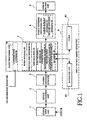
- FIG. 1 is a block diagram showing the structure of the agent device.
- the agent device comprises a speech input unit 1, a speech recognition unit 2, a natural language analyzer 3, a speech synthesis processing unit 4, a speech output unit 5, an input/output target device group 6, and an agent processing unit 7.
- the speech input unit 1 receives a speech, generates speech data of a digital form from the input speech, and supplies the speech data to the speech recognition unit 2.
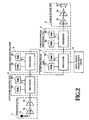
- the speech input unit 1 comprises, for example, a microphone 11, an AF (Audio Frequency) amplifier 12, and an A/D (Analog-to-Digital) converter 13 incorporating a sample and hold circuit as shown in FIG. 2 .
- the microphone 11 converts a speech to a speech signal, and outputs the signal.
- the AF amplifier 12 amplifies the speech signal from the microphone 11, and outputs the signal.
- the A/D converter 13 performs sampling and A/D conversion of the amplified speech signal from the AF amplifier 12, generating digital speech data, and supplies the data to the speech recognition unit 2.
- each of the speech recognition unit 2, the natural language analyzer 3, the speech synthesis processing unit 4 and the agent processing unit 7 comprises a processor 21, 31, 41, 71 comprising, for example, a CPU (Central Processing Unit), a non-volatile memory 22, 32, 42, 72, such as a ROM (Read Only Memory) or a hard disk drive, which stores a program to be run by the processor 21, 31, 41, 71 (a ROM will be explained as an example in the embodiment), and a volatile memory 23, 33, 43, 73, such as a RAM (Random Access Memory), which has a memory area to be a work area for the processor.
- a part or all of the functions of the speech recognition unit 2, the natural language analyzer 3, the speech synthesis processing unit 4, and the agent processing unit 7 may be achieved by a single processor, or a single non-volatile memory and a single volatile memory.
- the speech recognition unit 2 performs a speech recognition process on speech data supplied from the speech input unit 1.
- the speech recognition unit 2 When supplied with speech data from the speech input unit 1, the speech recognition unit 2 performs a process of, for example, canceling noise contained in the speech data, and then specifies all possible word candidates represented by the speech data and likelihoods (scores) S of the candidates by referring to a word database D3 in the agent processing unit 7 to be described later and performing a speech recognition process on the speech data.
- the speech recognition unit 2 calculates the degrees of matching of, for example, an input speech with all the words registered in the word database D3, i.e., the likelihoods (scores) S, to see which word has the highest score S.
- the speech data representing a sentence "uh, ??? ga hettayo" (where hettayo means decreasing, reducing, hungry, etc. in Japanese) is supplied, and the portion "???" represents a speech which can be recognized as "onaka” (meaning stomach in Japanese) and "ohaka” (meaning grave in Japanese)
- the scores S for the respective words e.g., the score S of 80% for the word “onaka” and the score S of 65% for the word “ohaka" are calculated for the portion "???".
- the speech recognition unit 2 generates a sequence of text characters (or word ID (IDentifier)) indicating the result of recognition of "uh, onaka ga hettayo” (meaning that my stomach is hungry in Japanese), and supplies it to the natural language analyzer 3.
- word ID or word ID (IDentifier)
- a scheme for speech recognition which is performed by the speech recognition unit 2 is arbitrary.
- a word the value of whose score S is smaller than a predetermined value may not be selected as a candidate. Further, a plurality of word candidates may be specified for a single speech input. Then, data indicating a specified candidate and the score S of the candidate (hereinafter called word data) is generated, and is supplied to the agent processing unit 7. While the word data may include word information itself and a score S, it is advantageous that the word data includes a word ID and a score S for handing of data.
- the natural language analyzer 3 classifies words representing word data (or text data) supplied from the speech recognition unit 2 for each part of speech by performing, for example, a process of morphological analysis on the word data, adds data indicating a classification result to the word data, then supplies the word data to the agent processing unit 7.
- a scheme for classification which is performed by the natural language analyzer 3 is arbitrary; for example, "ChaSen” which is a scheme developed by Nara Institute of Science and Technology, or the like may be used.
- the non-volatile memory 42 of the speech synthesis processing unit 4 stores a speech segment database D1 which stores data representing waveforms of words, and a phoneme database D2 which stores data representing waveforms constituting phonemes.
- the speech segment database D1 stores data representing waveforms of words.
- the phoneme database D2 stores data representing waveforms constituting phonemes.
- the speech synthesis processing unit 4 generates digital speech data representing a speech reading out text data supplied from the agent processing unit 7 by using the data stored in the speech segment database D1 and/or the phoneme database D2.
- the speech synthesis processing unit 4 supplies the generated speech data to the speech output unit 5.
- the scheme of generating digital speech data is arbitrary; for example, slot filling method and rule-based synthesis (Rule-based synthesis) can be used.
- the slot filling method is a method by which, for example, word-by-word or segment-by-segment speeches are read by an announcer beforehand, and are linked together and output.
- a series of speeches read by an announcer may be separated words or segments in a later process, and stored, and they may be linked together and output.
- the rule-based synthesis is a method by which relatively small units, such as phonemes (consonants or vowels), kana, or phonemic parts of further segmented units, are linked together and output.
- the speech output unit 5 reproduces a speech representing digital speech data supplied from the speech synthesis processing unit 4. More specifically, the speech output unit 5 has a D/A (Digital-to-Analog) converter 51, an AF amplifier 52, and a speaker 53 as shown in FIG. 2 .
- the D/A converter 51 performs DA conversion on digital speech data to convert the data to an analog speech signal.
- the AF amplifier 52 amplifies the analog speech signal.
- the speaker 53 vibrates according to the analog speech signal to reproduce and output a speech represented by the analog speech data.
- the input/output target device group 6 comprises, for example, a navigation unit 61 and a clock 62.
- the navigation unit 61 comprises a known navigation system which uses a mobile station of a GPS (Global Positioning System), a display device, such as a liquid crystal display, and a processor.
- the navigation unit 61 stores map information representing maps, generates data showing which position on a map a current position of a vehicle detected according to a control signal supplied by the agent processing unit 7 corresponds, and supplies the data together with map information representing a map around the current position to the agent processing unit 7.
- the map around the current position is displayed together with a figure indicative of the current position.
- the clock 62 comprises, for example, a crystal oscillator and a counter circuit, sequentially generates data indicative of a current time, and supplies the data to the agent processing unit 7. Time information which is acquired from the GPS may be supplied via the navigation unit 61.
- the agent processing unit 7 has a communication controller 74 comprising a modem and a packet communication terminal, and connects to a distribution server 100 to be discussed later over an external network (e.g., the Internet via a wireless telephone circuit) via the communication controller.
- a communication controller 74 comprising a modem and a packet communication terminal, and connects to a distribution server 100 to be discussed later over an external network (e.g., the Internet via a wireless telephone circuit) via the communication controller.
- the non-volatile memory 72 of the agent processing unit 7 stores the word database D3.
- the word database D3 is a database which stores data of a plurality of words and a category dictionary indicating under which concepts or categories the words are grouped.
- the category dictionary has a data structure as shown in FIG 3 , for example. That is, the category dictionary stores data indicative of a word and data indicative of a category to which the word belongs, in association with each other.
- a word "hetta” meaning hungry in Japanese
- a single word may belong to a plurality of categories.
- a word "onaka” meaning stomach in Japanese
- the agent device handles only a category to which the words commonly belong as a category to which the words belong, thereby allowing intention of the words uttered to be grasped according to the context.
- the agent processing unit 7 can handle only the category to which the words "onaka” (meaning stomach in Japanese) and "hetta” (meaning hungry in Japanese) commonly belong, i.e., only "eating", as a category to which the words "onaka” and "hetta” belong as far as the execution of the process concerning the sentence is concerned.
- the agent processing unit 7 may use only that of word data supplied from the natural language analyzer 3 which represents a specific part of speech (e.g., only noun and verb) in a later process which the agent processing unit 7 performs.
- a category to which a word belongs should not necessarily be specified by a combination of a plurality of words. Because a word "suita” (meaning hungry in Japanese) is associated only with the category "eating", for example, when word data representing the word "suita” is supplied, the agent processing unit 7 may handle the word data as belonging to the category "eating" without combining the word data with other words and performing a discrimination process.
- the non-volatile memory of the agent processing unit 7 further stores a past experience database D, a Japanese food restaurant database D7, a Western food restaurant database D8 and a Chinese food restaurant database D9.
- the past experience database D6 is a database that stores the name of a restaurant whose position on a map is displayed on the navigation unit 61 or which is set as a goal by the agent processing unit 7.
- the Japanese food restaurant database D7, the Western food restaurant database D8 and the Chinese food restaurant database D9 are databases that store the names of Japanese food restaurants, the names of Western food restaurants, and the names of Chinese food restaurants, respectively.
- the non-volatile memory of the agent processing unit 7 further stores the process item database D4 and a wire database D5.
- the process item database D4 is a database storing data (process item data) which describes the contents of various processes to be executed by the agent processing unit 7, e.g., a trigger acquisition process (TGxx), a discrimination process (Cnxx or QBxx), and an input/output process (SPxx or EXxx to be discussed later), process item (pointer) by process item.
- TGxx trigger acquisition process
- Cnxx or QBxx discrimination process
- SPxx input/output process
- EXxx an input/output process
- data describing the contents of the "trigger acquisition process (TGxx)" includes trigger data (data designating the contents of data to be acquired as a trigger) which specifies a trigger to start those processes and a transition constant for determining the progress direction to be discussed later (a constant which indicates the degree of transition constant in the progress direction and becomes a calculation standard for a weighting factor J to be described later).
- Trigger data is arbitrary, and is, for example, data indicating the current position of a vehicle supplied from the navigation unit 61, data indicating a current time supplied from the clock 62, or the aforementioned word data supplied from the natural language analyzer 3.
- trigger data may be data which is given from the process the agent processing unit 7 itself executes.
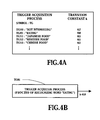
- FIG. 4A shows an example of a trigger acquisition process TGxx.
- a trigger TG01 is a process of acquiring the category "eating" (identifying words grouped under the category “eating” (in the example shown in FIG 3 , words “hetta (meaning hungry in Japanese)", “suita (meaning hungry in Japanese)”, “onaka (meaning stomach in Japanese”, “eat”, “go”, “set”, “someplace”, “where", “eating”) as a trigger, and the transition constant k for determining whether or not to proceed (transition) to a process following that process is 0.8.
- FIG 4B illustrates a flowchart for a trigger acquisition process TG01.
- a trigger acquisition process TG00 is a process of acquiring the word "not interesting”.
- a trigger acquisition process TG51 is a process of acquiring a word "Japanese food”.
- a trigger acquisition process TG52 is a process of acquiring a word "Western food”.
- a trigger acquisition process TG53 is a process of acquiring a word "Chinese food”.
- Data describing the contents of a "discrimination process (Cnxx)" stored in the process item database D4 includes a discrimination condition, a list of possible results as discrimination results, a transition constant k in a return direction to be discussed later, and data described for each discrimination process.
- Data describing the contents of a discrimination process includes a transition constant k for determining a progress direction, and data described for each discrimination result.
- FIG. 5A shows an example of a discrimination process BRxx.
- a discrimination process BR01 is "to discriminate which one of (a) before 12 o'clock, (b) 12 o'clock or later but before 14 o'clock, and (c) 14 o'clock or later it is”.
- transition constant k for determining whether or not to proceed to a subsequent process when it is discriminated as (a) before 12 o'clock is 0.4
- the transition constant k for determining whether or not to proceed to a subsequent process when it is discriminated as (b) 12 o'clock or later but before 14 o'clock is 0.3
- the transition constant k for determining whether or not to proceed to a subsequent process when it is discriminated as (c) 14 o'clock or later is 0.4.
- data to be used in discrimination may be acquired from an arbitrary acquisition source.
- Possible acquisition sources include, for example, other processes to be executed by the speech recognition unit 2, the natural language analyzer 3 and the agent processing unit 7, devices belonging to the input/output target device group 6, and other external devices.
- data which describes the contents of the discrimination process may further include, for example, data specifying an acquisition source for data to be used in discrimination.
- predetermined data may be output to a predetermined output destination prior to discrimination (in which case, a symbol indicating the process is, for example, QBxx). For example, sending data representing a predetermined inquiry to the speech synthesis processing unit 4 prior to discrimination, or the like is possible.
- data which describes the contents of the discrimination process includes, for example, the contents of data to be output and data designating the output destination of the data.
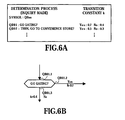
- FIG. 6A shows an example of a discrimination process QBxx.
- a discrimination process QB01 for example, asks a user "Go eating?", and the transition constant k in the progress direction when the response (the user's answer) is "Yes” is 0.7, and the transition constant k in the progress direction when the response is "No” is 0.4.
- FIG. 6B illustrates a flowchart for this example.
- a node QB01.1 shown in FIG 6B is a start node indicating the start point of the process
- a node QB01.2 is a node in the progress direction when it is discriminated that "go eating" is designated in response to the inquiry
- the transition constant k is 0.7.
- a node QB01.3 is a node in the progress direction when it is discriminated that "don't go eating” is designated, and the transition constant k is 0.4.
- a discrimination process QB02 asks the user "Then, go to a convenience store?", the transition constant k in the progress direction when the response (the user's answer) is "Yes” is 0.5, and the transition constant k in the progress direction when the response is "No” is 0.3.
- Data describing the contents of an "input/output process" stored in the process item database D4 comprises data which designates the contents of data to be input or output.
- Input data and output data may have arbitrary contents.
- output data may be data representing reading of a speech which is generated by the speech output unit 5 via the speech synthesis processing unit 4 or a control signal which controls an external device.
- Input data may be, for example, data to be supplied from an external device.
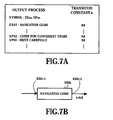
- FIG. 7A shows an example of an input/output process EXxx.
- an output process EX02 for example, is an operation to "Do navigation guide", and the weighting factor k in the progress direction of executing a process after activation is 0.8.
- FIG. 7B illustrates a flowchart for this example.
- a node EX01.1 shown in FIG. 7B is a start node indicating the start point of the process
- a node EX01.2 is a node indicating the end of the process
- the weighting factor k is 0.8.
- selection of a node indicating the termination of a process may be made an essential process without performing setting of the transition constant k or the like.
- the wire database D5 comprises a set of data describing transitions among a plurality of processes (TG, BRxx, QBxx, SPxx, EXxx) (the transition definition data will be hereinafter called wires).
- a wire comprises data described in, for example, a format illustrated in FIG. 8 .
- wire Wn W1, W2(7) designates a preceding process (X), a following process (Y), and a weighting factor J given to transition, regarding the transition (From (X) To (Y)) from the preceding process X (From (X)) to the following process Y (To(Y)).
- the preceding process X is a discrimination process, it is necessary to describe transition from what discrimination resultant of the discrimination process.
- words “go”, “yes” and “yea” which mean affirmative are defined for, for example, a single wire having a process item for discriminating a response to an inquiry based on speech data as a preceding process item, while words “don't go”, “no” and the like which mean negative are defined for the other wires.
- the transition constant k which the aforementioned process item data describes may be rewritten by the agent processing unit 7 or the like according to the achievement resulting from the execution of a transition indicated by wires to be connected.
- the agent processing unit 7 makes it likely to cause the transition indicated by the wire by rewriting the value of the transition constant k described in the process item data indicating a process item of a transition origin indicated by the wire to a value larger than before. This results in a higher probability of making a response intended by the user.
- the agent processing unit 7 executes a flow represented by the process item database D4 and the wire database D5 as a whole.
- the process item database D4 and the wire database D5 can describe a flow illustrated in, for example, FIG 9A .
- the agent processing unit 7 performs the following process when execution of a preceding first process P1 and transition to a following second process P2 are defined by a wire W01, and when execution of the second process P2 and transition to a following third process P3 are defined by a wire W03.
- the process P1 is a process of discriminating whether or not word data representing the word "go" is supplied
- the process P2 is a process of discriminating whether or not word data representing the word "eating” is supplied
- the process P3 is a process of discriminating whether or not information indicating which position of a restaurant or a hospital is to be acquired from the navigation unit 61.
- the transition constant k in each progress direction is 0.5 for any of the processes P1 to P3.
- wires are defined as shown in FIG. 9B .
- the agent processing unit 7 acquires only that word data in word data supplied to the natural language analyzer 3 from the speech recognition unit 2 which represent words are classified as a noun or a verb in the natural language analyzer 3.
- the agent processing unit 7 calculates weighting factors J of the wires W01, W03 and W05, and writes calculation results to the wires W01, W03 and W05. Those values are determined by the transition constant k preset in each process.
- the weighting factor J of the wire W01 becomes the value of the transition constant k associated with the wire of the process P1, or 0.5.
- the weighting factor J of each wire with a given process being a base point is calculated this way. Every time the current state is transitioned, therefore, the weighting factor J is calculated with the current process being a base point.
- the weighting factor J of the wire W03 becomes a value of 0.5 equal to the transition constant k associated with the wire W03 of the process P2
- the agent processing unit 7 writes the weighting factor J of the wire W01 associated with the opposite direction or the direction to return to the process P1 again.
- Calculation of the weighting factor J is set for all the wires of every flow, not only for the processes of a relating flow. Predetermined small calculated values have only to be assigned to wires which are not relevant to a present process. For a wire which has a trigger acquisition process as a preceding process, particularly, the weighting factor J is set high to some extent. This can ensure jumping to a conversation different in content from a conversation that has been made immediately before.
- a condition is set to each wire. Specifically, the word “go” is set as a condition to W01, and the word “eating” is set as a condition to W03.
- a score indicated by the word data is set to W01 when the word data indicates the word "go".
- a score indicated by the word data is set to W03.
- a plurality of different words may be set to each wire as conditions. For instance, the words “eating” and “food” which mean “eating” are assigned as conditions to one wire, and the words “go” and the like which mean “go” are assigned as conditions thereto.
- the word data supplied from the natural language analyzer 3 is the word "eating" and the word "go"
- their scores S are set to the wire. Based on the set scores S, the calculation result for the wire is acquired. In this case, the scores S may be added, or an average may be acquired.
- conditions to be set to each wire are not limited to a case where a single word is set for one meaning. For instance, a plurality of different words representing the same meaning may be set as conditions. For this condition setting, it is sufficient that the relationship between the words and the wire is stored and words whose scores S are to be calculated are stored in the word database D3.
- the speech recognition unit 2 calculates the score S of every word registered in the word database D3, generates word data associated with at least words whose scores acquired are equal to or greater than a predetermined score, and outputs the word data to the agent processing unit 7 via the natural language analyzer 3.
- the agent processing unit 7 discriminates with which wire the each input word data is associated, and sets the score S indicated by the word data to each associated wire. In this manner, even when same word is set as a condition to a plurality of wires, it is sufficient to perform the calculation of the score S of the input speech signal and a word once. Then, the score S of each word acquired is set to the respective wire S associated. While there occurs a case where a plurality of scores S are obtained for a single wire S, the score S with the highest value, for example, should be selected in this case.
- word data indicating the same meaning such as “yes”, “yeah” and “yea”
- word data indicating the same meaning such as “yes”, “yeah” and “yea”
- the processor 21 constituting the speech recognition unit 2 may store data indicative of the status of each device relating to the input/output target device group 6 in the aforementioned non-volatile memory or the like as a status database (similar to the aforementioned "word database D3", for example), which state of which device the input information indicates may be determined by referring to the status database, and the data and the score S may be supplied as status data to the agent processing unit 7.
- the score S should always be set to 100% when a corresponding status is present in the status database.
- the agent processing unit 7 has only to discriminate wires associated with the status indicative of the status data and set the score S to each wire.
- the speech input unit 1, the speech recognition unit 2 and the natural language analyzer 3 individually operate, capture a speech, analyze it, and supply word data to the agent processing unit 7.
- word data or status data regarding discrimination conditions are supplied from the natural language analyzer 3 or the like
- the agent processing unit 7 executes the following processes. a supplied word is recognized (identified) (step S11), and it is discriminated whether or not the data corresponds to a word registered in the word database D4 (step S 12). If it is not registered (step S12, No), a word inputting process is finished.
- step S 12 If it is registered (step S 12, Yes), a product S ⁇ J of the likelihood (score) S of the word and the weighting factor J of the wire is calculated with respect to a process whose condition is the "category" to which the word belongs (step S 13). For example, suppose that the process pointer PP indicates the first process in a case where the flow illustrated in FIG 9A is being executed. The weighting factors J of the individual wires in this case are as illustrated in FIG. 9C . In this state, suppose that word data indicating the word "go" with a score of 80% and the word “eating" with a score of 50% is input. In the example illustrated in FIG.
- the word “go” relates to the discrimination condition in the first process P1
- the word “eating” relates to the discrimination condition in the third process P3.
- the weighting factor J of the wire W01 whose preceding process is a process of inputting the word data indicating the word "go” is 0.5
- the weighting factor J of the wire W03 whose preceding process is a process of inputting the word data indicating the word "eating” is 0.25.
- the products S ⁇ J of the likelihoods S acquired for the wires W01 and W03 and the weighting factors J are as indicated by equations 1 and 2.
- the agent processing unit 7 performs the above-described processes of acquiring the product S ⁇ J of the score S and the weighting factor J for every wire of the flow. Subsequently, the agent processing unit 7 selects wire with the largest product S ⁇ J calculated (step S14 in FIG 10 ). The agent processing unit 7 shifts control to a process following the selected wire (step S15).
- the product S ⁇ J acquired for the wire W01 represents the largest value, for example, the input data is recognized as representing the word "go", and transition takes place to the second process P2 which is the process following the wire W01.
- the weighting factor J of the wire is relatively large.
- the process generally shifts to the next process, but in a case where a word which quite differs from a previous one and has a large likelihood is input, a process corresponding to that word may start.
- the score S for "go" is 30% and the score S for "eating” is 80% in the above-described example, for example, the respective products S ⁇ J become 15 and 20, in which case the wire W03 is selected. This is particularly effective when the user of the agent device knows the flow of processes, skips the current process and jumps to a nearby process.
- the agent processing unit 7 recalculates the weighting factors J of the individual wires based on the status after transition (step S 16). Thereafter, the process is carried out in accordance with the contents of the process (step S17).
- a somewhat large weighting factor may be set for transition from a trigger acquisition process.
- a weighting factor J 1.0 is given to, for example, the wires that define transition from the trigger acquisition process to the process P1.
- the process of the agent processing unit 7 belongs to the flow associated with the trigger acquisition process, for example, as the user pronounces "go eating" and word data whose score S for the word "go", for example, is 80% is obtained, the product S ⁇ J of the score S and the weighting factor J of the wire associated with "determination of whether or not the user have said "go”” is 80% x 1.0, i.e., 80.
- transition in the reverse direction may occur.
- a reverse-direction transition constant k should be set to a smaller value than a preceding-direction transition constant k. Then, even if word data with a high score S is obtained from an input speech, a product S ⁇ J acquired for that wire to which the transition constant k in the return direction is written as the weighting factor J becomes a small value, so that the possibility of transition in the return direction can be suppressed low.
- the agent processing unit 7 may treat a process in which the value of the acquired product S ⁇ J does not meet a predetermined condition (a process in which the value of the product S ⁇ J does not reach a predetermined value) in such a way that the process is excluded from transition execution targets.
- a wire defines transition in the form of transition from a process item to a process item.
- a wire is described in the form as illustrated in FIG. 8 and stored in the wire database, it is possible to define relationships among the individual process items as if they were macro processes of a computer. This can facilitate connection of the individual process items.
- a trigger acquisition process item in the definition of the wire is not defined as the starting point of the wire, but the wire itself is defined as the origin of transition.
- connection relationships among the individual process items are defined by wires
- wires can be added easily.
- a wire is automatically added with respect to the search process item of a family restaurant.
- the wire is automatically added, it becomes possible to appropriately cope with the input "find a family restaurant” by increasing the weighting factor J of a wire connected to a family restaurant search process item to some extent.
- the agent processing unit 7 shall store map data or the like including, for example, information representing the location of a family restaurant, or access external map data or the like.
- the automatic addition of a wire may be automatically carried out when the number of jumps from one process item to another process item (or wire) is counted and reaches a predetermined number.
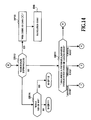
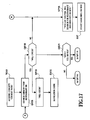
- FIG. 11 to FIG 17 a process which the agent device executes to guide a passenger who is a user to the place of eating will be explained referring to FIG. 11 to FIG 17 .
- the process item database and the wire database generally describe flows shown in FIGS. 11 to 17 .
- the agent processing unit 7 acquires and gives it to a discrimination process step QB1.
- a word to be acquired in the trigger acquisition process TG1 can be any word classified to the category "eating”
- the agent device executes a process following the discrimination process step QB1 in response to various words if arbitrary words, such as "meal” and "food", are classified to the category "eating" in the category dictionary.
- the agent processing unit 7 first supplies word data representing a sentence "Go eating?" to the speech synthesis processing unit 4.
- the speech synthesis processing unit 4 generates speech data representing a speech which reads out the sentence, and supplies the data to the speech output unit 5 which reproduces the speech represented by the speech data.
- the agent processing unit 7 stands by for word data belonging to the category "affirmation” or “negation” from the natural language analyzer 3, and discriminates which of "affirmation” and "negation” the corresponding word data belongs when the word data is supplied.
- a word which means affirmation such as “yes” or “yeah” may be set as a condition to each wire, e.g., a wire which defines a status transition from QB1 to QB3, not to a category-based process, and a word which means negation, such as "no” or “don't go” may be set as a condition to a wire which defines a status transition from QB1 to QB2.
- the natural language analyzer 3 automatically sets the score S of the word corresponding to the input speech to a wire.
- the score S for the word "yeah” of the input speech is 80%, for example, the score S is set to the wire which defines the status transition from QB1 to QB3.
- the calculation result for the wire is acquired by multiplication of the acquired score S and the weighting factor J set to the wire, and the status is shifted to the wire whose calculation result shows the highest value as in the case of classifying individual words to the category.
- word data representing a sentence "Reply either yes or no?" is supplied to the speech synthesis processing unit 4.
- the speech synthesis processing unit 4 generates speech data representing a speech which reads out the sentence, and supplies the speech data to the speech output unit 5, causing the speech output unit 5 to reproduce the speech represented by the speech data. Then, it stands by for word data belonging to the category "affirmation” or "negation” to be supplied, and when word data belonging to either category is supplied, the process is shifted to one of the individual transition destinations in the discrimination process step QB1 according to the category of that word data (discrimination process step QB6).
- the agent processing unit 7 acquires and gives the data to the discrimination process step QB0.
- the discrimination process step QB0 it is discriminated to which category the word "not interesting” is treated as belonging as a consequence of overlapping of other words in the belonging category.
- the process continues, considering that the word data has been acquired in the trigger acquisition process for acquiring a word belonging to that category.
- the agent processing unit 7 first causes the speech output unit 5 to reproduce a speech which reads out a sentence "Then, go to a convenience store?" via the speech synthesis processing unit 4 as done in the discrimination process step QB1. Then, it stands by for word data belonging to the category "affirmation” or “negation” from the natural language analyzer 3, and discriminates to which of "affirmation” and “negation” the corresponding word data belongs when the word data is supplied. When it is discriminated that the data belongs to "affirmation”, the process is shifted to an input/output process step SP2, and when it is discriminated that the data belongs to "negation”, the process is shifted to an input/output process step SP3.
- the agent processing unit 7 causes the speech output unit 5 to reproduce a speech which reads out a sentence "Will guide a convenience store.” via the speech synthesis processing unit 4, and shifts the process to an input/output process step EX2.
- a control signal instructing to display information indicative of the current position of the vehicle having the agent device mounted thereon on a map and the position of the convenience store on the map is sent to the navigation unit 61.
- the navigation unit 61 displays information indicative of the current position of the vehicle on the map and the position of the convenience store on the map, and starts giving a guide for the convenience store.
- the agent processing unit 7 causes the speech output unit 5 to reproduce a speech which reads out a sentence "Drive carefully" via the speech synthesis processing unit 4, and shifts the process to an input/output process step EX3.
- a control signal is sent to the navigation unit 61 to cause the navigation unit 61 to display the current position of the vehicle on the map.
- the agent processing unit 7 causes the speech output unit 5 to read out a sentence "A restaurant determined?", stands by for word data belonging to the category "affirmation” or “negation”, and discriminates to which category the corresponding word data belongs when the word data is supplied.
- the process is shifted to a discrimination process step QB7, and when it is discriminated that the data belongs to "negation”, the process is shifted to a discrimination process step BR1.
- the agent processing unit 7 causes the speech output unit 5 to read out a sentence "Name of the restaurant?" via the speech synthesis processing unit 4, stands by for word data, searches for the restaurant indicated by the word data when supplied, sends a control signal instructing to display information indicative of the current position of the vehicle on the map and the position of the restaurant on the map to the navigation unit 61 when there is the restaurant of interest.
- the navigation unit 61 displays information indicative of the current position of the vehicle on the map and the position of the restaurant on the map, and starts guiding for the restaurant (step EX100).
- the navigation unit 61 returns information to that effect to the agent processing unit 7, and the agent processing unit 7 shifts the process to an input/output process step SP5.
- the agent processing unit 7 causes the speech output unit 5 to read out a sentence "Not present nearby.”, and shifts the process to the discrimination process step BR1.
- the agent processing unit 7 acquires data indicating the current time from the clock 62, and discriminates which one of (a) before 12 o'clock, (b) 12 o'clock or later but before 14 o'clock, and (c) 14 o'clock or later the time indicated by the data is.
- the speech output unit 5 is caused to read out a sentence "Breakfast, isn't it?" (input/output process step SP8), and the process is shifted to a discrimination process step QB10.
- the agent processing unit 7 causes the speech output unit 5 to read out a sentence "Search for recommendable restaurants?", stands by for word data belonging to the category "affirmation” or “negation”, and discriminates to which category the corresponding word data belongs when the word data is supplied.
- the process is shifted to an input/output process step SP14, and when it is discriminated that the data belongs to "negation”, the process is shifted to the discrimination process step QB12.
- the agent processing unit 7 searches for a restaurant nearby the current position of the vehicle, supplies data indicating the name of the searched restaurant to the navigation unit 61 and sends a control signal instructing to display information indicating the current position of the vehicle on the map and the position of the restaurant on the map to the navigation unit 61.
- the agent processing unit 7 causes the speech output unit 5 to read out the name of the restaurant.
- the navigation unit 61 displays information indicative of the current position of the vehicle on the map and the position of the restaurant on the map, and starts giving a guide for the restaurant (step EX5).
- the agent processing unit 7 causes the speech output unit 5 to read out a sentence "Search the past experience DB (database)?", stands by for word data belonging to the category "affirmation” or “negation”, and discriminates to which category the corresponding word data belongs when the word data is supplied.
- the process is shifted to an input/output process step SP15, and when it is discriminated that the data belongs to "negation”, the process is shifted to a discrimination process step QB11.
- the agent processing unit 7 searches the past experience database with, for example, the current position of the vehicle indicated by the information supplied by the navigation unit 61 being a search key, and causes the speech output unit 5 to read out the name of the searched restaurant.
- the agent processing unit 7 sends a control signal instructing to display information indicating the current position of the vehicle on the map and the position of the searched restaurant on the map to the navigation unit 61.
- the navigation unit 61 displays information indicative of the current position of the vehicle on the map and the position of the restaurant on the map, and starts giving a guide for the restaurant (step EX6).
- the agent processing unit 7 causes the speech output unit 5 to read out a sentence "Then, which is preferable, Japanese food, Western food or Chinese food?", stands by for word data representing words “Japanese food”, “Western food” or “Chinese food” to be supplied, and discriminates which words the word data, when supplied, represents.
- the process is shifted to an input/output process step EX51
- the process is shifted to an input/output process step EX52
- the process is shifted to an input/output process step EX53.
- word data of none of the words When word data of none of the words is supplied, it causes the speech output unit 5 to reproduce a speech which reads out a sentence "Reply Japanese food, Western food or Chinese food", stands by for word data representing words “Japanese food”, “Western food” or “Chinese food”, and shifts the process to one of the individual transition destinations in the discrimination process step QB11 according to the category of the supplied word data (discrimination process step QB15).
- the agent processing unit 7 searches the Japanese food restaurant database with, for example, the current position of the vehicle indicated by the information supplied by the navigation unit 61 being a search key, and shifts the process to a discrimination process step QB16.
- the agent processing unit 7 also shifts the process to the input/output process step EX51.
- the Japanese food restaurant database is searched in the input/output process step EX52, and the Chinese food restaurant database is searched in the input/output process step EX53 as done in the input/output process step EX51, and the process is shifted to the discrimination process step QB17 or QB18 as illustrated.
- agent processing unit 7 also shifts the process to the input/output process step EX52 when acquiring word data representing the words "Western food” in the trigger acquisition process TG52. Note that the process is also shifted to the input/output process step EX53 when acquiring word data representing the words "Chinese food” in the trigger acquisition process TG53.
- the agent processing unit 7 causes the speech output unit 5 to read out the name of the restaurant searched in the input/output process step EX51, EX52 or EX53 and a sentence asking for confirmation, and stands by for word data belonging to the category "affirmation” or "negation".
- the corresponding word data is supplied, it is discriminated to which category the word data belongs.
- the process is shifted to an input/output process step SP17, SP18 or SP19, and when it is discriminated that the data belongs to "negation”, the process is shifted to an input/output process step SP16.
- the agent processing unit 7 causes the speech output unit 5 to read out a sentence "Will give a guide", and sends a control signal instructing to display information indicating the current position of the vehicle on the map and the position of the restaurant, searched in the input/output process step EX51, EX52 or EX53, on the map to the navigation unit 61.
- the navigation unit 61 displays information indicative of the current position of the vehicle on the map and the position of the restaurant on the map, and starts giving a guide for the restaurant (step EX8, EX9 or EX10).
- the agent processing unit 7 causes the speech output unit 5 to read out sentences "You are selfish. Will search for restaurant information on Web". Then, the agent processing unit 7 access an external network via the local communication control device, and searches for information indicating the position of a restaurant with the current position taken as a reference (input/output process step EX7). When corresponding information is searched, the navigation unit 61 is allowed to display information indicating the current position of the vehicle on the map and the position of the restaurant on the map.
- the speech recognition unit 2 adds the score to word data to be supplied to the agent processing unit 7, and the process transitions according to the contents of a wire having the largest product S ⁇ J of the weighting factor J and the score S, the flow may jump and a process different from the aforementioned order may be executed. If a transition constant k is set to a high value to some extent with respect to a wire which has a process item to be a trigger as a preceding process item, the weighting factor J of this wire becomes a high value as a result, so that a jump becomes likely to occur, and the agent processing unit 7 can cope with a sudden topical change.
- the aforementioned agent device can respond to the natural utterance of the user, appropriately determine what control should be applied to which device, and apply control according to the result of the discrimination to a device.
- the word database D3 may store not only data representing a word, but also data representing a phrase of plural words, as an element of the word database D3, or may store data representing a part of a word or a phoneme, as an element of the word database D3.
- a word or the like should not necessarily be grouped under a specific concept, and even in a case where grouping is done, data to be used for carrying out grouping may not take the form of a category dictionary.
- the speech recognition unit 2 may recognize only certain words, and directly supplies recognized words to the agent processing unit 7 instead of supplying results of recognizing all speeches uttered by the user to the natural language analyzer 3 (word spotting method). In this case, the agent device need not to have the natural language analyzer 3.
- the agent processing unit 7 may determine a category to which plural words belong based on how those plural words are combined and included in the same sentence.
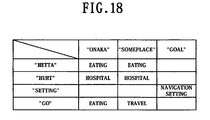
- the agent processing unit 7 may store a table having a data structure which is, for example, shown in FIG 18 , and determine the category of grouped plural words by referring to the table.
- the table exemplified in FIG. 18 indicates that if words "onaka (meaning stomach in Japanese)" and "hetta (meaning hungry in Japanese)" are included in the same sentence for example, those two words are treated as belonging to the a category "eating" as long as a process relating to the sentence is executed.
- words "setting" and "destination” are included in the same sentence, those two words are treated as belonging to the category "navigation setting" as long as a process relating to the sentence is executed.
- the agent processing unit 7 may change the transition constant k corresponding to a wire in accordance with a predetermined rule based on the number of times that a transition represented by the wire has been executed or the like, and rewrite the wire so that the weighting factor J becomes a value calculated based on the changed transition constant k.
- the wire database D5 stores the number of executions of a transition represented by each wire, with respect to that wire.
- the agent processing unit 7 rewrites the value of the number every time the transition is executed, thereby incrementing the value of the number by 1, and rewrites the transition constant k corresponding to each wire to a value which is proportional to, for example, the number stored for the wire.
- conditions set to wires are set to individual wires, but is not limited to those.
- conditions for individual wires may be described in a discrimination process. In this case, to which wire each condition corresponds should be specified beforehand.
- the agent processing unit 7 may change data to be output in a discrimination process and an input/output process in accordance with data passed to those processes, data input through those processes, and other optional conditions.
- the agent device may have a display apparatus (for example, a liquid crystal display or the like) for outputting an image under the control of the agent processing unit 7, and the agent processing unit 7 may control the display apparatus in such a way that it displays a predetermined image for each process in the input/output process and the discrimination process.
- a display apparatus for example, a liquid crystal display or the like
- the agent processing unit 7 may comprise a plurality of data processing units (e.g., computers or the like) which are connected to one another and bear a flow formed generally by various processes, such as a trigger acquisition process, a discrimination process, and an input/output process, and wires.
- each data processing unit which constitutes the agent processing unit 7 stores data representing that portion in the overall flow executable by the agent processing unit 7 which is probably executed by the unit, as elements of the process item database or the wire database. If data to be stored in each data processing unit is such data that macro-defines that portion of the process which is executed by the data processing unit, it is easy to cause a plurality of data processing units to perform distributed processing.
- the agent device may plurally include the speech input unit 1, and the natural language analyzer 3 or the speech output unit 5.
- the speech input unit 1 may have a recording medium drive unit (e.g., a floppy (registered trademark) disk drive, a CD-ROM drive or an MO drive) which reads a waveform signal from a recording medium (e.g., a floppy (registered trademark) disk, a CD (Compact Disc), an MO (Magneto-Optical Disk)) where data representing speeches is recorded, and supplies the signal to the natural language analyzer 3.
- a recording medium drive unit e.g., a floppy (registered trademark) disk drive, a CD-ROM drive or an MO drive
- a recording medium e.g., a floppy (registered trademark) disk, a CD (Compact Disc), an MO (Magneto-Optical Disk)
- the agent device is not limited to the control of the car navigation system for example, and may control other devices. Therefore, it may control the control device of an in-vehicle device, may control an air conditioning device like an air conditioner, and may control opening/closing of a window which opens and closes by the power of a motor, turning on/turning off of a light, and starting/stopping of a electrical wiper.
- it is applicable to the control of radio tuning, and the control of a recording medium drive device which reproduces speeches and images recorded in a recording medium, such as a CD (Compact Disc), an MD (Mini Disc), or a DVD (Digital Versatile Disc), as a possible control of an audio device.
- a recording medium drive device which reproduces speeches and images recorded in a recording medium, such as a CD (Compact Disc), an MD (Mini Disc), or a DVD (Digital Versatile Disc), as a possible control of an audio device.
- Possible and specific embodiment of audio device control is that, for example, combinations (for example, "music piece” and “change”, “another”, and “music piece”, “different” and “music piece”, and so on) of words constituting expressions (e.g., “change the music piece”, “another music piece”, “different music piece”, and so on) possibly used for instruction by the user who wants to change a music piece being reproduced by a CD player is categorized in a category "music piece change" by using a category dictionary, and when a combination of words belonging to the category "music piece change" is uttered during reproduction of a music piece recorded in a CD by the CD player and word data representing the individual corresponding words is supplied to the agent processing unit 7 from the speech recognition unit 2 through the natural language analyzer 3, the agent processing unit 7 responds to this (specifically, the process transitions to a process item following a trigger acquisition process of acquiring word data belonging to the category "music piece change”), and a control signal of instructing changing the truck in reproduction is sent to the CD player, etc
- the score of a word corresponding to an input speech is directly set to a wire by the natural language analyzer 3.
- word data supplied from the natural language analyzer 3 is for a word "music piece” and a word "change”
- scores are set to individual wires. Calculation results of the wires are obtained based on the set scores. In this case, all scores may be summed up, or an average value may be obtained.
- each word is categorized in the aforementioned category, and the calculation results of the wires are obtained by multiplications of the individually obtained score and weighting factors set to the wires, and a status is to transition to a wire which indicates the largest value of the calculation result.
- Another possible embodiment is that when the agent processing unit 7 causes the speech output unit 5 to output a speech "Is this music piece OK?" and then word data of words (e.g., "yes”, “fine”, “OK”, and the like) belonging to a category “affirmation", or words (e.g., "no”, "not”, “don't”, “different”, and the like) belonging to a category “contradiction” is supplied, reproduction and stop of a music piece is instructed to the CD player in accordance with the category of the supplied word data.
- the user may utter cryptic expressions in some cases. For example, a word “not interesting” may be uttered for intending various demands like "music play", “music change”, “shopping” or “eating".
- agent device of the second embodiment of the invention which specifies the intention of an instruction when the instruction in such a cryptic expression is uttered.
- the physical constitution of the agent device is substantively the same as the constitution of the first embodiment shown in, for example, FIG 1 .
- the input/output target device group 6, however, does not include a CD player in addition to the navigation unit 61 and the clock 62.
- a CD player in addition to the navigation unit 61 and the clock 62.
- at least a part of categories defined by the category dictionary is associated with at least any device belonging to the input/output target device group 6.
- the agent processing device 7 searches for a category to which the word "not interesting” belongs. As a result, for example, provided that it belongs to four categories “music play”, “music change”, “shopping”, and “eating", next, the agent processing unit 7 acquires information indicating the current operation status of a device which is associated with the categories among the devices belonging to the input/output target device group 6.
- the agent processing unit 7 causes the speech output unit 5 to generate a speech "Play music? Or, go shopping? Go eating?" for example, thereby prompting to select any of the three categories "music play", “shopping", “eating” except “music change” among the aforementioned four categories.
- the agent processing unit 7 shifts the process to a process following a trigger acquisition process of acquiring word data of words belonging to the category "CD play".
- a speech "CD will be played” is generated by the speech output unit 5, and a control signal for instructing reproduction of the speech is sent to a CD player.
- the agent processing unit 7 shifts the process to a process following a trigger acquisition process of acquiring word data of words belonging to the category "music".
- the agent processing unit 7 shifts the process to a process following a trigger acquisition process of acquiring word data of words belonging to the category "eating”. In this case, the process transitions to the status of, for example, QB3 shown in FIG 11 .
- the agent processing unit 7 makes the speech output unit 5 generate a speech "Change music? Or, go shopping? Go eating?" for example, thus prompting selection of any of the three categories “music change", “shopping", “eating”, except “music play” among the aforementioned four categories.
- the agent device of the second embodiment of the invention appropriately specifies the user's intention based on a speech representing the cryptic instruction of the user by performing the aforementioned operation.
- the agent devices of the individual embodiments adequately determine the demand of the user, and derive the user's demand from a cryptic instruction, thus controlling a device.
- the user may need not only determination of a demand just unilaterally uttered by himself/herself, but also someone to talk to. For example, it is considerable that the user who drives a car alone may feel such a necessity. Conversation using a cellular phone during driving is dangerous, and there is a problem such that phone charges run up.
- the input/output target device group 6 of the agent device shall include a radio receiver which receives FM multiple broadcastings, extracts text information, and supplies it to the agent processing unit 7 as needed, or a receiver including a terminal which acquires text information through an external communication line, and supplies it to the agent processing unit 7 as needed, and the agent processing unit 7 shall store text information supplied from the radio receiver or the terminal in its local non-volatile memory. When the stored text information is read out, data indicating the reading out shall be generated and stored.
- a trigger acquisition process of acquiring word data representing words "Is there any news?" is executed, for example, a process explained below is executed as a process following the trigger acquisition process.
- the agent processing unit 7 causes the speech output unit 5 to generate a speech which reads out a message notifying the genre of the corresponding text information (e.g., "there are news regarding sports and social economies" or the like).
- the agent processing unit 7 determines based on the contents of the corresponding information. Specifically, for example, for text information including the contents like "the executive of the ⁇ party was forced to be replaced because of corruption ", it is determined as the report of a city news page based on the words " ⁇ party", and "corruption". Likewise, for text information including the contents like “the stock price of the ⁇ joint stock corporation rises suddenly because of the announcement of financial statements announced by that company, it is determined as the report of an economic page based on the words “announcement of financial statements", and "stock price”. For text information including the contents like " ⁇ (team name) of the soccer won on ⁇ (when) game, and has come within championship”, it is determined as the report of a sports page based on the words “soccer", “game”, “championship”.
- the agent processing unit 7 causes the speech output unit 5 to generate a speech which reading out a sentence reflecting the report of a sports page not yet read out among text information locally stored (for example, " ⁇ (team name) of the soccer won on ⁇ (when) game, and has come within championship", or the like).
- Text information received as news often uses expressions like "-sita" at the end of a sentence, so that it is not appropriate for normal conversations. Accordingly, text information is not directly read out, but may be read out with the last portion of a sentence being replaced with a word which is likely to be used as the last portion of a conversation between friends, such as "ndatte".
- the agent processing unit 7 may cause the speech output unit to read out only a part of text information (e.g., initial paragraph), wait that the user utters a speech for requiring the detail of the text information (e.g., a speech of asking a question "Is there more detailed information?"), and make the speech output unit to read the remaining part in response to the utterance when the user utters.
- a part of text information e.g., initial paragraph
- the speech output unit e.g., a speech for asking a question "Is there more detailed information?"
- the agent processing unit 7 may search for text information locally stored, determine whether the entire sentence has already been read out or not, and makes the speech output unit generate a speech "No. This is it so far" when determining that the entire sentence has been read, or make the speech output unit generate a speech "Yes, so that the entire sentence will now be read” when there is a detailed part, and then make it generate a speech which reads out the detailed part.
- the agent processing unit 7 may respond to this, search for one, which can be a replay to the inquiry, from text information locally stored, and make the speech output unit 5 read it out. For example, when the user utters a question " against which team did it win the game?", text information which commentates the result of that game is searched, and if found, this text information is read out. When the user asks "When is the next game?", text information which commentates the schedule of the next game is searched, and if found, it is read out or the like.
- the agent processing unit 7 specifies the "team name” and the “game day” based on the contents of the conversation with the user so far, makes the speech output unit 5 generate a speech like "It will be checked for a moment", connects to a ticket sales site through an external network or the like, and makes reference about presence or absence of the corresponding ticket.
- the agent processing unit 7 makes the speech output unit 5 read out a speech which explains the sales status of the ticket like "It is fine so far. ⁇ YEN at o seat, purchase it?" thus prompting the user to reply.
- the agent processing unit responds to word data representing those words, and the process proceeds to a process of supporting purchase of the ticket (e.g., a well known process of supporting net settlement or the like).
- the agent processing unit 7 makes the speech output unit 5 read out a sentence like "sorry, but all booked up", terminates successive processes, and if there is text information not yet output other than that, the process proceeds to a process of outputting the corresponding information.
- the agent device of the third embodiment of the invention not only performs control desired by the user, but also realizes conversation with the user by performing the aforementioned operation.
- the conversation between the agent device and the user is applicable to an audio device.
- the audio device acquires information through the Internet or the like, and stores it in a memory based on an artist condition registered by the user beforehand. The acquired information is classified based on the artist condition.
- the agent device searches for the memory contents, and suggests information not yet suggested by speech output if there is the information not yet suggested. Of course, at this time, it may involve image information.
- the agent device further confirms purchasing of the album with the user, takes an action of purchasing to an Internet CD shop in such a way that it will be purchased if a comprehension is obtained.
- the agent device confirms purchasing of the ticket of the concert with the user, and takes an action of purchasing to an Internet ticket shop in such a way that it will be purchased.
- the program that allows a personal computer to perform the functions of the agent device may be uploaded to, for example, a bulletin board system (BBS) of a communication line, and distributed via the communication line, or a carrier may be modulated with a signal representing the program, the acquired modulated wave may be transmitted, and a device which receives the modulated wave demodulates the modulated wave to restore the program. Then, the above-described processes can be executed by invoking the program, and running the program like other application programs under the control of the OS.
- BSS bulletin board system
- a program excluding that part may be stored in a recording medium.
- a program for executing the individual functions or steps to be executed by the computer is stored in the recording medium.
- the present invention is available for various device control devices or the like which can respond to an instruction uttered in the form of a language by a human being and control a device.
Landscapes
- Engineering & Computer Science (AREA)
- Acoustics & Sound (AREA)
- Health & Medical Sciences (AREA)
- Audiology, Speech & Language Pathology (AREA)
- Human Computer Interaction (AREA)
- Physics & Mathematics (AREA)
- Computational Linguistics (AREA)
- Multimedia (AREA)
- Mechanical Engineering (AREA)
- Navigation (AREA)
- Machine Translation (AREA)
- User Interface Of Digital Computer (AREA)
- Telephonic Communication Services (AREA)
- Traffic Control Systems (AREA)
Claims (36)
- Eine externe Vorrichtung steuernde Vorrichtung, die aufweist:eine Spracherkennungseinrichtung (2, 3), die Sprachdaten, die eine Sprachangabe repräsentieren, akquiriert und in der Sprachangabe enthaltene Wortkandidaten durch Durchführung einer Spracherkennung an den Sprachdaten spezifiziert sowie eine Wahrscheinlichkeit für jeden der spezifizierten Wortkandidaten berechnet;eine Spezifiziereinrichtung (7), die in der Sprachangabe enthaltene Wörter auf der Basis der durch die Spracherkennungseinrichtung (2) berechneten Wahrscheinlichkeit spezifiziert und einen Inhalt der Sprachangabe, wie sie durch einen Sprecher geäußert wird, auf der Basis der spezifizierten Wörter spezifiziert; undeine Datenbank (D5), die einen vorhergehenden Prozess, einen folgenden Prozess und Gewichtungsfaktoren speichert, die jeweils darin einander zugeordnet sind; undeine Prozessausführungseinrichtung (7), die einen Inhalt des folgenden Prozesses, der an der externen Vorrichtung, die ein Steuerziel sein soll, auszuführen ist, auf der Basis eines momentan ausgeführten Prozesses, eines im Zusammenhang mit dem momentan ausgeführten Prozess gespeicherten Gewichtungsfaktors und des Inhalts der geäußerten Sprachangabe, wie sie durch die Spezifiziereinrichtung spezifiziert wird, spezifiziert und die spezifizierte Steuerung ausführt.
- Vorrichtung nach Anspruch 1, wobei die Spracherkennungseinrichtung (2, 3) eine Sprachteil-Spezifiziereinrichtung (3) enthält, die einen Teil der Sprachangabe der spezifizierten Wörter bestimmt, und
wobei die Spezifiziereinrichtung (7) einen Inhalt der durch den Sprecher geäußerten Sprachangabe auf der Basis lediglich derjenigen durch die Spracherkennungseinrichtung (2) spezifizierten Wörter spezifiziert, die als ein vorbestimmter Teil der Sprachangabe bestimmt werden. - Vorrichtung nach Anspruch 2, wobei die Spezifiziereinrichtung (7) unterscheidet, ob eine Kombination aus mehreren Wörtern in den durch die Spracherkennungseinrichtung (2, 3) spezifizierten Wörtern, die als ein vorbestimmter Teil der Sprachangabe spezifiziert werden, eine vorbestimmte Bedingung erfüllt oder nicht und einen Inhalt der durch den Sprecher geäußerten Sprachangabe auf der Basis eines Unterscheidungsergebnisses bestimmt.
- Vorrichtung nach Anspruch 1, wobei die Spezifiziereinrichtung (7) Informationen hält, die Wörter einer oder mehreren Kategorien zuordnen, und einen Inhalt der durch den Sprecher geäußerten Sprachangabe auf der Basis einer Kategorie spezifiziert, in der die durch die Spracherkennungseinrichtung (2, 3) spezifizierten Wörter klassifiziert werden.
- Vorrichtung nach Anspruch 1, wobei die Spezifiziereinrichtung (7) Korrelationsinformationen bereithält, die Wörter unterschiedlicher Bedeutungen oder unterschiedlicher Kategorien jedem Prozess der Prozessausführungseinrichtung (7) zuordnet und einen Inhalt der durch den Sprecher geäußerten Sprachangabe auf der Basis einer Kombination derjenigen Wörter oder Kategorien, die durch die Spracherkennungseinrichtung spezifiziert werden, und der Korrelationsinformationen bestimmt.
- Vorrichtung nach Anspruch 1, wobei die Spezifiziereinrichtung (7) Informationen bereithält, die Wörter einer oder mehreren Kategorien zuordnen, und einen Inhalt der durch den Sprecher geäußerten Sprachangabe auf der Basis einer Kategorie bestimmt, in der mehrere Wörter, die durch die Spracherkennungseinrichtung (2, 3) spezifiziert werden, üblicherweise klassifiziert werden.
- Vorrichtung nach Anspruch 1, wobei die Spezifiziereinrichtung (7) mehrere Wörter bereithält, die jeweiligen Prozessen der Prozessausführungseinrichtung (7) zugewiesen sind, und einen entsprechenden Prozess ausführt, wenn wenigstens einer der durch die Spracherkennungseinrichtung (2, 3) spezifizierten Wörter ein dem Prozess zugewiesenes Wort ist.
- Vorrichtung nach Anspruch 1, wobei in dem Fall, wenn eine Bedeutung einer Spracheingabe nicht unterscheidbar ist, die Spezifiziereinrichtung (7) zu einer Eingabe in einer unterscheidbareren Ausdrucksform auffordert.
- Vorrichtung nach Anspruch 1, die ferner eine Informationsakquisitionseinrichtung (7) aufweist, die Informationen von einer externen Vorrichtung akquiriert, und
wobei die Spezifiziereinrichtung (7) einen Ausgabeinhalt, der ausgegeben werden soll, auf der Basis der durch die Informationsakquisitionseinrichtung (7) akquirierten Informationen auswählt. - Vorrichtung nach Anspruch 1, die ferner aufweist:eine Informationsakquisitionseinrichtung (7), die Informationen über eine vorbestimmte Kommunikationseinrichtung (74) akquiriert; undeine Sprachausgabeeinrichtung (5), die eine Sprachausgabe auf der Basis der durch die Informationsakquisitionseinrichtung (7) akquirierten Informationen ausgibt,wobei in dem Fall, wenn die durch die Prozessausführungseinrichtung (7) spezifizierte Steuerung die Ausgabe von durch die Informationsakquisitionseinrichtung (7) akquirierten Informationen ist, die Sprachausgabeeinrichtung (5) eine Sprachausgabe auf der Basis der Informationen ausgibt.
- Vorrichtung nach Anspruch 10, wobei die Prozessausführungseinrichtung (7) einen Prozess, der ausgeführt werden soll, auf der Basis des spezifizierten Inhalts der geäußerten Sprachangabe bestimmt.
- Vorrichtung nach Anspruch 1, wobei die Prozessausführungseinrichtung (7) eine Einrichtung enthält, die, wenn der Prozess, der als ein auszuführender Prozess spezifiziert wird, ein Prozess zum Darbieten von von außen empfangenen Informationen für den Sprecher ist, die Darbietung durch Erzeugung einer Sprachausgabe, die die Informationen ausliest, vornimmt.
- Vorrichtung nach Anspruch 1, die so aufgebaut ist, dass sie an einem Fahrzeug montiert werden kann, das eine an diesem montierte fahrzeugeigene Vorrichtung aufweist, wobei die Prozessausführungseinrichtung (7) einen Inhalt der Steuerung, die an der fahrzeugeigenen Vorrichtung durchgeführt werden soll, auf der Basis des spezifizierten Inhalts der geäußerten Sprachangabe spezifiziert und die spezifizierte Steuerung durchführt.
- Vorrichtung nach Anspruch 13, die ferner aufweist:eine Informationsakquisitionseinrichtung (7), die Informationen über eine vorbestimmte Kommunikationseinrichtung (74) akquiriert; undeine Sprachausgabeeinrichtung (5), die eine Sprachausgabe auf der Basis der durch die Informationsakquisitionseinrichtung (7) akquirierten Informationen ausgibt,wobei in dem Fall, wenn die durch die Prozessausführungseinrichtung (7) spezifizierte Steuerung die Ausgabe von durch die Informationsakquisitionseinrichtung (7) akquirierten Informationen ist, die Sprachausgabeeinrichtung (5) eine Sprachausgabe auf der Basis der Informationen ausgibt.
- Vorrichtung nach Anspruch 1, die eine Navigationsvorrichtung ist, die so konstruiert ist, dass sie an einem Fahrzeug montiert werden kann, wobei die Prozessausführungseinrichtung (7) einen Inhalt eines Navigationsprozesses, der ausgeführt werden soll, auf der Basis des spezifizierten Inhalts der geäußerten Sprachangabe spezifiziert und den spezifizierten Navigationsprozess ausführt.
- Vorrichtung nach Anspruch 15, die ferner aufweist:eine Informationsakquisitionseinrichtung (7), die Informationen über eine vorbestimmte Kommunikationseinrichtung (74) akquiriert; undeine Sprachausgabeeinrichtung (5), die eine Sprachausgabe auf der Basis der durch die Informationsakquisitionseinrichtung (7) akquirierten Informationen ausgibt,wobei in dem Fall, wenn der Navigationsprozess, der durch die Prozessausführungseinrichtung (7) spezifiziert wird, die Ausgabe von durch die Informationsakquisitionseinrichtung (7) akquirierten Informationen ist, die Sprachausgabeeinrichtung eine Sprachausgabe auf der Basis der Informationen ausgibt.
- Vorrichtung nach Anspruch 1, die eine Audiovorrichtung ist, wobei die Prozessausführungseinrichtung (7) einen Inhalt eines auszuführenden Sprachprozesses auf der Basis des spezifizierten Inhalts der geäußerten Sprachangabe spezifiziert und den spezifizierten Sprachprozess ausführt oder eine externe Vorrichtung in einer derartigen Weise steuert, dass sie die externe Vorrichtung veranlasst, den spezifizierten Sprachprozess auszuführen.
- Vorrichtung nach Anspruch 17, die ferner aufweist:eine Informationsakquisitionseinrichtung (7), die Informationen über eine vorbestimmte Kommunikationseinrichtung (74) akquiriert; undeine Sprachausgabeeinrichtung (5), die eine Sprachausgabe auf der Basis der durch die Informationsakquisitionseinrichtung (7) akquirierten Informationen ausgibt,wobei in dem Fall, wenn der durch die Prozessausführungseinrichtung (7) spezifizierte Sprachprozess ist, durch die Informationsakquisitionseinrichtung (7) akquirierte Informationen auszugeben, die Sprachausgabeeinrichtung (5) eine Sprachausgabe auf der Basis der Informationen ausgibt.
- Verfahren zur Steuerung einer Vorrichtung, das aufweist:einen Spracherkennungsschritt des Akquirierens von Sprachdaten, die eine Sprachangabe repräsentieren, und des Spezifizierens von Wortkandidaten, die in der Sprachangabe enthalten sind, durch Durchführen einer Spracherkennung an den Sprachdaten und des Berechnens einer Wahrscheinlichkeit für jeden der spezifizierten Wortkandidaten;einen Spezifizierschritt des Spezifizierens von Wörtern, die in der Sprachangabe enthalten sind, auf der Basis der in dem Spracherkennungsschritt spezifizierten Wahrscheinlichkeiten und des Spezifizierens eines Inhalts der durch einen Sprecher geäußerten Sprachangabe auf der Basis der spezifizierten Wörter; undeinen Prozessausführungsschritt des Spezifizierens eines Inhalts eines folgenden Prozesses, der an einer externen Vorrichtung, die ein Steuerziel sein soll, auszuführen ist, auf der Basis eines momentan ausgeführten Prozesses, eines vorbestimmten Folgeprozesses, eines dem momentan ausgeführten Prozess zugeordneten Gewichtungsfaktors und des spezifizierten Inhalts der geäußerten Sprachangabe und des Durchführens der spezifizierten Steuerung.
- Verfahren zur Steuerung einer Vorrichtung nach Anspruch 19, das ferner aufweist:einen Informationsakquisitionsschritt des Akquirierens von Informationen über eine vorbestimmte Kommunikationsvorrichtung; undeinen Sprachausgabeschritt des Ausgebens einer Sprachausgabe auf der Basis der in dem Informationsakquisitionsschritt akquirierten Informationen,wobei in dem Fall, wenn die in dem Prozessausführungsschritt spezifizierte Steuerung ist, in dem Informationsakquisitionsschritt akquirierte Informationen auszugeben, in dem Sprachausgabeschritt eine Sprachausgabe auf der Basis der Informationen ausgegeben wird.
- Verfahren zur Steuerung einer Vorrichtung nach Anspruch 19, wobei der Prozessausführungsschritt einen Prozess, der ausgeführt werden soll, auf der Basis des spezifizierten Inhalts der geäußerten Sprachangabe spezifiziert.
- Verfahren zur Steuerung einer Vorrichtung nach Anspruch 19 zur Steuerung einer fahrzeugeigenen Vorrichtung, die an einem Fahrzeug montiert ist, wobei der Prozessausführungsschritt einen Inhalt einer Steuerung, die an der fahrzeugeigenen Vorrichtung durchgeführt werden soll, auf der Basis des spezifizierten Inhalts der geäußerten Sprachangabe spezifiziert und die spezifizierte Steuerung durchführt.
- Verfahren zur Steuerung einer Vorrichtung nach Anspruch 22, das ferner aufweist:einen Informationsakquisitionsschritt zum Akquirieren von Informationen über eine vorbestimmte Kommunikationsvorrichtung; undeinen Sprachausgabeschritt zum Ausgeben einer Sprachausgabe auf der Basis der in dem Informationsakquisitionsschritt akquirierten Informationen,wobei in dem Fall, wenn die in dem Prozessausführungsschritt spezifizierte Steuerung ist, in dem Informationsakquisitionsschritt akquirierte Informationen auszugeben, in dem Sprachausgabeschritt eine Sprachausgabe auf der Basis der Informationen ausgegeben wird.
- Verfahren zur Steuerung einer Vorrichtung nach Anspruch 19 zur Steuerung einer Navigationsvorrichtung, die an einem Fahrzeug montiert ist, wobei der Prozessausführungsschritt einen Inhalt eines auszuführenden Navigationsprozesses auf der Basis des spezifizierten Inhalts der geäußerten Sprachangabe spezifiziert und den spezifizierten Navigationsprozess ausführt.
- Verfahren zur Steuerung einer Vorrichtung nach Anspruch 24, das ferner aufweist:einen Informationsakquisitionsschritt zum Akquirieren von Informationen über eine vorbestimmte Kommunikationsvorrichtung; undeinen Sprachausgabeschritt zum Ausgeben einer Sprachausgabe auf der Basis der in dem Informationsakquisitionsschritt akquirierten Informationen,wobei in dem Fall, wenn der in dem Prozessausführungsschritt spezifizierte Navigationsprozess darin besteht, in dem Informationsakquisitionsschritt akquirierte Informationen auszugeben, in dem Sprachausgabeschritt eine Sprachausgabe auf der Basis der Informationen ausgegeben wird.
- Verfahren zur Steuerung einer Vorrichtung nach Anspruch 19 zur Steuerung einer Audiovorrichtung, wobei der Prozessausführungsschritt einen Inhalt eines Sprachprozesses, der ausgeführt werden soll, auf der Basis des spezifizierten Inhalts der geäußerten Sprachangabe spezifiziert und den Sprachprozess ausführt oder eine Audiovorrichtung in einer derartigen Weise steuert, dass er die Audiovorrichtung veranlasst, den spezifizierten Sprachprozess auszuführen.
- Verfahren zur Steuerung einer Vorrichtung nach Anspruch 26, das ferner aufweist:einen Informationsakquisitionsschritt zum Akquirieren von Informationen über eine vorbestimmte Kommunikationsvorrichtung; undeinen Sprachausgabeschritt zum Ausgeben einer Sprachausgabe auf der Basis der in dem Informationsakquisitionsschritt akquirierten Informationen,wobei in dem Fall, wenn der in dem Prozessausführungsschritt spezifizierte Sprachprozess die Ausgabe von in dem Informationsakquisitionsschritt akquirierten Informationen ist, in dem Sprachausgabeschritt eine Sprachausgabe auf der Basis der Informationen ausgegeben wird.
- Programm, das einem Computer ermöglicht, zu funktionieren als:eine Spracherkennungseinrichtung (2, 3), die Sprachdaten, die eine Sprachangabe repräsentieren, akquiriert und Wortkandidaten, die in der Sprachangabe enthalten sind, durch Durchführung einer Spracherkennung an den Sprachdaten spezifiziert und eine Wahrscheinlichkeit für jeden der spezifizierten Wortkandidaten berechnet;eine Spezifiziereinrichtung (7), die in der Sprachangabe enthaltene Wörter auf der Basis der in der Spracherkennungseinrichtung (2, 3) berechneten Wahrscheinlichkeiten spezifiziert und einen Inhalt der durch einen Sprecher geäußerten Sprachangabe auf der Basis der spezifizierten Wörter spezifiziert;eine Datenbank (D5), die einen vorhergehenden Prozess, einen Folgeprozess und Gewichtungsfaktoren speichert, die jeweils darin einander zugeordnet sind; undeine Prozessausführungseinrichtung (7), die einen Inhalt eines Folgeprozesses, der an einer externen Vorrichtung ausgeführt werden soll, die ein Steuerziel sein soll, auf der Basis eines momentan ausgeführten Prozesses, eines Gewichtungsfaktors, der in Verbindung mit dem momentanen ausgeführten Prozess gespeichert ist, und des Inhalts der geäußerten Sprachangabe, der durch die Spezifiziereinrichtung (7) spezifiziert wird, spezifiziert und die Steuerung durchführt.
- Programm nach Anspruch 28, das einem Computer ermöglicht, ferner zu funktionieren als:eine Informationsakquisitionseinrichtung (7), die Informationen über eine vorbestimmte Kommunikationseinrichtung (74) akquiriert; undeine Sprachausgabeeinrichtung (5), die eine Sprachausgabe auf der Basis der durch die Informationsakquisitionseinrichtung (7) akquirierten Informationen ausgibt,wobei in dem Fall, wenn die durch die Prozessspezifiziereinrichtung (7) spezifizierte Steuerung die Ausgabe von durch die Informationsakquisitionseinrichtung (7) akquirierten Informationen ist, die Sprachausgabeeinrichtung (5) eine Sprachausgabe auf der Basis der Informationen ausgibt.
- Programm nach Anspruch 29, wobei die Prozessausführungseinrichtung (7) einen auszuführenden Prozess auf der Basis des spezifizierten Inhalts der geäußerten Sprachangabe spezifiziert.
- Programm nach Anspruch 28 für einen Computer, der so konstruiert ist, dass er an einem Fahrzeug montiert werden kann, das eine daran montierte fahrzeugeigene Vorrichtung aufweist, wobei die Prozessausführungseinrichtung (7) einen Inhalt einer an der fahrzeugeigenen Vorrichtung durchzuführenden Steuerung auf der Basis des spezifizierten Inhalts der geäußerten Sprachangabe spezifiziert und die Steuerung durchführt.
- Programm nach Anspruch 31, das einem Computer ermöglicht, ferner zu funktionieren als:eine Informationsakquisitionseinrichtung (7), die Informationen über eine vorbestimmte Kommunikationseinrichtung (74) akquiriert; undeine Sprachausgabeeinrichtung (5), die eine Sprachausgabe auf der Basis der durch die Informationsakquisitionseinrichtung (7) akquirierten Informationen ausgibt,wobei in dem Fall, wenn die durch die Prozessausführungseinrichtung (7) spezifizierte Steuerung die Ausgabe von durch die Informationsakquisitionseinrichtung (7) akquirierten Informationen ist, die Sprachausgabeeinrichtung (5) eine Sprachausgabe auf der Basis der Informationen ausgibt.
- Programm nach Anspruch 28, das einem Computer ermöglicht, als eine Navigationsvorrichtung zu funktionieren, die so konstruiert ist, dass sie an einem Fahrzeug montiert werden kann, wobei die Prozessausführungseinrichtung (7) einen Inhalt eines Navigationsprozesses, der ausgeführt werden soll, auf der Basis des spezifizierten Inhalts der geäußerten Sprachangabe spezifiziert und den spezifizierten Navigationsprozess ausführt.
- Programm nach Anspruch 33, das einem Computer ermöglicht, ferner zu funktionieren als:eine Informationsakquisitionseinrichtung (7), die Informationen über eine vorbestimmte Kommunikationseinrichtung (74) akquiriert; undeine Sprachausgabeeinrichtung (5), die eine Sprachausgabe auf der Basis der durch die Informationsakquisitionseinrichtung (7) akquirierten Informationen ausgibt,wobei in dem Fall, wenn der durch die Prozessausführungseinrichtung (7) spezifizierte Navigationsprozess die Ausgabe von durch die Informationsakquisitionseinrichtung (7) akquirierten Informationen ist, die Sprachausgabeeinrichtung eine Sprachausgabe auf der Basis der Informationen ausgibt.
- Programm nach Anspruch 28 für einen Computer, wobei die Prozessausführungseinrichtung (7) einen Inhalt eines Sprachprozesses, der ausgeführt werden soll, auf der Basis des spezifizierten Inhalts der geäußerten Sprachangabe spezifiziert und den spezifizierten Sprachprozess ausführt oder eine externe Vorrichtung in einer derartigen Weise steuert, dass die externe Vorrichtung veranlasst wird, den spezifizierten Sprachprozess auszuführen.
- Programm nach Anspruch 35, das einem Computer ermöglicht, ferner zu funktionieren als:eine Informationsakquisitionseinrichtung (7), die Informationen über eine vorbestimmte Kommunikationseinrichtung (7) akquiriert; undeine Sprachausgabeeinrichtung (5), die eine Sprachausgabe auf der Basis der durch die Informationsakquisitionseinrichtung (7) akquirierten Informationen ausgibt,wobei in dem Fall, wenn der Sprachprozess, der durch die Prozessausführungseinrichtung (7) spezifiziert wird, die Ausgabe von durch die Informationsakquisitionseinrichtung (7) akquirierten Informationen ist, die Sprachausgabeeinrichtung (5) eine Sprachausgabe auf der Basis der Informationen ausgibt.
Applications Claiming Priority (2)
| Application Number | Priority Date | Filing Date | Title |
|---|---|---|---|
| JP2003436976 | 2003-12-26 | ||
| PCT/JP2004/019426 WO2005064592A1 (ja) | 2003-12-26 | 2004-12-24 | 機器制御装置、音声認識装置、エージェント装置、車載機器制御装置、ナビゲーション装置、オーディオ装置、機器制御方法、音声認識方法、エージェント処理方法、車載機器制御方法、ナビゲーション方法、オーディオ装置制御方法及びプログラム |
Publications (3)
| Publication Number | Publication Date |
|---|---|
| EP1699042A1 EP1699042A1 (de) | 2006-09-06 |
| EP1699042A4 EP1699042A4 (de) | 2007-08-08 |
| EP1699042B1 true EP1699042B1 (de) | 2010-02-17 |
Family
ID=34737099
Family Applications (1)
| Application Number | Title | Priority Date | Filing Date |
|---|---|---|---|
| EP04807782A Expired - Lifetime EP1699042B1 (de) | 2003-12-26 | 2004-12-24 | Einrichtungssteuereinrichtung, -verfahren und -programm |
Country Status (6)
| Country | Link |
|---|---|
| US (1) | US8103510B2 (de) |
| EP (1) | EP1699042B1 (de) |
| JP (1) | JPWO2005064592A1 (de) |
| CN (1) | CN1898721B (de) |
| DE (1) | DE602004025616D1 (de) |
| WO (1) | WO2005064592A1 (de) |
Cited By (1)
| Publication number | Priority date | Publication date | Assignee | Title |
|---|---|---|---|---|
| US20240061644A1 (en) * | 2022-08-17 | 2024-02-22 | Jpmorgan Chase Bank, N.A. | Method and system for facilitating workflows via voice communication |
Families Citing this family (234)
| Publication number | Priority date | Publication date | Assignee | Title |
|---|---|---|---|---|
| US8645137B2 (en) | 2000-03-16 | 2014-02-04 | Apple Inc. | Fast, language-independent method for user authentication by voice |
| WO2005062295A1 (ja) * | 2003-12-05 | 2005-07-07 | Kabushikikaisha Kenwood | 機器制御装置、音声認識装置、エージェント装置及び機器制御方法 |
| US7424431B2 (en) * | 2005-07-11 | 2008-09-09 | Stragent, Llc | System, method and computer program product for adding voice activation and voice control to a media player |
| US8677377B2 (en) | 2005-09-08 | 2014-03-18 | Apple Inc. | Method and apparatus for building an intelligent automated assistant |
| JP2008064885A (ja) * | 2006-09-05 | 2008-03-21 | Honda Motor Co Ltd | 音声認識装置、音声認識方法、及び音声認識プログラム |
| US9318108B2 (en) | 2010-01-18 | 2016-04-19 | Apple Inc. | Intelligent automated assistant |
| EP1902906B1 (de) | 2006-09-22 | 2017-07-26 | Harman Becker Automotive Systems GmbH | Hinzufügbares Modul zum externen Steuern eines Sprachdialogsystems |
| US8073681B2 (en) | 2006-10-16 | 2011-12-06 | Voicebox Technologies, Inc. | System and method for a cooperative conversational voice user interface |
| US7818176B2 (en) | 2007-02-06 | 2010-10-19 | Voicebox Technologies, Inc. | System and method for selecting and presenting advertisements based on natural language processing of voice-based input |
| US8977255B2 (en) | 2007-04-03 | 2015-03-10 | Apple Inc. | Method and system for operating a multi-function portable electronic device using voice-activation |
| JP4315211B2 (ja) * | 2007-05-01 | 2009-08-19 | ソニー株式会社 | 携帯情報端末及び制御方法、並びにプログラム |
| US8140335B2 (en) | 2007-12-11 | 2012-03-20 | Voicebox Technologies, Inc. | System and method for providing a natural language voice user interface in an integrated voice navigation services environment |
| US10002189B2 (en) | 2007-12-20 | 2018-06-19 | Apple Inc. | Method and apparatus for searching using an active ontology |
| US8423362B2 (en) * | 2007-12-21 | 2013-04-16 | General Motors Llc | In-vehicle circumstantial speech recognition |
| US9330720B2 (en) | 2008-01-03 | 2016-05-03 | Apple Inc. | Methods and apparatus for altering audio output signals |
| JP5327737B2 (ja) * | 2008-03-06 | 2013-10-30 | 独立行政法人情報通信研究機構 | 対話装置、重み情報学習装置、対話方法、重み情報学習方法、およびプログラム |
| US8996376B2 (en) | 2008-04-05 | 2015-03-31 | Apple Inc. | Intelligent text-to-speech conversion |
| US10496753B2 (en) | 2010-01-18 | 2019-12-03 | Apple Inc. | Automatically adapting user interfaces for hands-free interaction |
| US9305548B2 (en) | 2008-05-27 | 2016-04-05 | Voicebox Technologies Corporation | System and method for an integrated, multi-modal, multi-device natural language voice services environment |
| US20100030549A1 (en) | 2008-07-31 | 2010-02-04 | Lee Michael M | Mobile device having human language translation capability with positional feedback |
| US8676904B2 (en) | 2008-10-02 | 2014-03-18 | Apple Inc. | Electronic devices with voice command and contextual data processing capabilities |
| US9978365B2 (en) * | 2008-10-31 | 2018-05-22 | Nokia Technologies Oy | Method and system for providing a voice interface |
| WO2010067118A1 (en) | 2008-12-11 | 2010-06-17 | Novauris Technologies Limited | Speech recognition involving a mobile device |
| US8326637B2 (en) | 2009-02-20 | 2012-12-04 | Voicebox Technologies, Inc. | System and method for processing multi-modal device interactions in a natural language voice services environment |
| DE112010000947T5 (de) * | 2009-03-02 | 2012-06-14 | Borys Evgenijovich Panchenko | Verfahren zur völlig modifizierbaren Framework-Datenverteilung im Data-Warehouse unter Berücksichtigung der vorläufigen etymologischen Separation der genannten Daten |
| US10241752B2 (en) | 2011-09-30 | 2019-03-26 | Apple Inc. | Interface for a virtual digital assistant |
| US10706373B2 (en) | 2011-06-03 | 2020-07-07 | Apple Inc. | Performing actions associated with task items that represent tasks to perform |
| US10241644B2 (en) | 2011-06-03 | 2019-03-26 | Apple Inc. | Actionable reminder entries |
| US9858925B2 (en) | 2009-06-05 | 2018-01-02 | Apple Inc. | Using context information to facilitate processing of commands in a virtual assistant |
| US9431006B2 (en) | 2009-07-02 | 2016-08-30 | Apple Inc. | Methods and apparatuses for automatic speech recognition |
| JP5638210B2 (ja) * | 2009-08-27 | 2014-12-10 | 京セラ株式会社 | 携帯電子機器 |
| US8560311B2 (en) * | 2009-09-23 | 2013-10-15 | Robert W. Williams | System and method for isolating uncertainty between speech recognition and natural language processing |
| US10705794B2 (en) | 2010-01-18 | 2020-07-07 | Apple Inc. | Automatically adapting user interfaces for hands-free interaction |
| US10553209B2 (en) | 2010-01-18 | 2020-02-04 | Apple Inc. | Systems and methods for hands-free notification summaries |
| US10679605B2 (en) | 2010-01-18 | 2020-06-09 | Apple Inc. | Hands-free list-reading by intelligent automated assistant |
| US10276170B2 (en) | 2010-01-18 | 2019-04-30 | Apple Inc. | Intelligent automated assistant |
| DE202011111062U1 (de) | 2010-01-25 | 2019-02-19 | Newvaluexchange Ltd. | Vorrichtung und System für eine Digitalkonversationsmanagementplattform |
| US8700405B2 (en) * | 2010-02-16 | 2014-04-15 | Honeywell International Inc | Audio system and method for coordinating tasks |
| US8682667B2 (en) | 2010-02-25 | 2014-03-25 | Apple Inc. | User profiling for selecting user specific voice input processing information |
| WO2011163538A1 (en) | 2010-06-24 | 2011-12-29 | Honda Motor Co., Ltd. | Communication system and method between an on-vehicle voice recognition system and an off-vehicle voice recognition system |
| US10762293B2 (en) | 2010-12-22 | 2020-09-01 | Apple Inc. | Using parts-of-speech tagging and named entity recognition for spelling correction |
| US9262612B2 (en) | 2011-03-21 | 2016-02-16 | Apple Inc. | Device access using voice authentication |
| US10057736B2 (en) | 2011-06-03 | 2018-08-21 | Apple Inc. | Active transport based notifications |
| US9160837B2 (en) * | 2011-06-29 | 2015-10-13 | Gracenote, Inc. | Interactive streaming content apparatus, systems and methods |
| US8994660B2 (en) | 2011-08-29 | 2015-03-31 | Apple Inc. | Text correction processing |
| US8515766B1 (en) * | 2011-09-30 | 2013-08-20 | Google Inc. | Voice application finding and user invoking applications related to a single entity |
| US10134385B2 (en) | 2012-03-02 | 2018-11-20 | Apple Inc. | Systems and methods for name pronunciation |
| US9483461B2 (en) | 2012-03-06 | 2016-11-01 | Apple Inc. | Handling speech synthesis of content for multiple languages |
| US9280610B2 (en) | 2012-05-14 | 2016-03-08 | Apple Inc. | Crowd sourcing information to fulfill user requests |
| US10417037B2 (en) | 2012-05-15 | 2019-09-17 | Apple Inc. | Systems and methods for integrating third party services with a digital assistant |
| US9721563B2 (en) | 2012-06-08 | 2017-08-01 | Apple Inc. | Name recognition system |
| KR101914708B1 (ko) | 2012-06-15 | 2019-01-14 | 삼성전자주식회사 | 서버 및 서버의 제어 방법 |
| JP5819261B2 (ja) * | 2012-06-19 | 2015-11-18 | 株式会社Nttドコモ | 機能実行指示システム、機能実行指示方法及び機能実行指示プログラム |
| US9495129B2 (en) | 2012-06-29 | 2016-11-15 | Apple Inc. | Device, method, and user interface for voice-activated navigation and browsing of a document |
| US9576574B2 (en) | 2012-09-10 | 2017-02-21 | Apple Inc. | Context-sensitive handling of interruptions by intelligent digital assistant |
| US9547647B2 (en) | 2012-09-19 | 2017-01-17 | Apple Inc. | Voice-based media searching |
| US9646610B2 (en) | 2012-10-30 | 2017-05-09 | Motorola Solutions, Inc. | Method and apparatus for activating a particular wireless communication device to accept speech and/or voice commands using identification data consisting of speech, voice, image recognition |
| US9144028B2 (en) | 2012-12-31 | 2015-09-22 | Motorola Solutions, Inc. | Method and apparatus for uplink power control in a wireless communication system |
| EP4560630A3 (de) | 2013-02-07 | 2025-08-06 | Apple Inc. | Sprachauslöser für einen digitalen assistenten |
| US9368114B2 (en) | 2013-03-14 | 2016-06-14 | Apple Inc. | Context-sensitive handling of interruptions |
| US10652394B2 (en) | 2013-03-14 | 2020-05-12 | Apple Inc. | System and method for processing voicemail |
| US10748529B1 (en) | 2013-03-15 | 2020-08-18 | Apple Inc. | Voice activated device for use with a voice-based digital assistant |
| WO2014144579A1 (en) | 2013-03-15 | 2014-09-18 | Apple Inc. | System and method for updating an adaptive speech recognition model |
| CN105027197B (zh) | 2013-03-15 | 2018-12-14 | 苹果公司 | 训练至少部分语音命令系统 |
| JP5582225B2 (ja) * | 2013-05-17 | 2014-09-03 | 独立行政法人情報通信研究機構 | 対話装置、重み情報学習装置、対話方法、重み情報学習方法、およびプログラム |
| US9431008B2 (en) * | 2013-05-29 | 2016-08-30 | Nuance Communications, Inc. | Multiple parallel dialogs in smart phone applications |
| WO2014197334A2 (en) | 2013-06-07 | 2014-12-11 | Apple Inc. | System and method for user-specified pronunciation of words for speech synthesis and recognition |
| WO2014197336A1 (en) | 2013-06-07 | 2014-12-11 | Apple Inc. | System and method for detecting errors in interactions with a voice-based digital assistant |
| US9582608B2 (en) | 2013-06-07 | 2017-02-28 | Apple Inc. | Unified ranking with entropy-weighted information for phrase-based semantic auto-completion |
| WO2014197335A1 (en) | 2013-06-08 | 2014-12-11 | Apple Inc. | Interpreting and acting upon commands that involve sharing information with remote devices |
| EP3008641A1 (de) | 2013-06-09 | 2016-04-20 | Apple Inc. | Vorrichtung, verfahren und grafische benutzeroberfläche für gesprächspersistenz über zwei oder mehrere instanzen eines digitaler assistenten |
| US10176167B2 (en) | 2013-06-09 | 2019-01-08 | Apple Inc. | System and method for inferring user intent from speech inputs |
| HK1220313A1 (zh) | 2013-06-13 | 2017-04-28 | 苹果公司 | 用於由语音命令发起的紧急呼叫的系统和方法 |
| US10791216B2 (en) | 2013-08-06 | 2020-09-29 | Apple Inc. | Auto-activating smart responses based on activities from remote devices |
| US9783137B2 (en) * | 2013-10-30 | 2017-10-10 | Powervoice Co., Ltd. | Sound QR system for vehicular services |
| US10296160B2 (en) | 2013-12-06 | 2019-05-21 | Apple Inc. | Method for extracting salient dialog usage from live data |
| US9620105B2 (en) | 2014-05-15 | 2017-04-11 | Apple Inc. | Analyzing audio input for efficient speech and music recognition |
| US10592095B2 (en) | 2014-05-23 | 2020-03-17 | Apple Inc. | Instantaneous speaking of content on touch devices |
| US9502031B2 (en) | 2014-05-27 | 2016-11-22 | Apple Inc. | Method for supporting dynamic grammars in WFST-based ASR |
| US9760559B2 (en) | 2014-05-30 | 2017-09-12 | Apple Inc. | Predictive text input |
| US9842101B2 (en) | 2014-05-30 | 2017-12-12 | Apple Inc. | Predictive conversion of language input |
| US9785630B2 (en) | 2014-05-30 | 2017-10-10 | Apple Inc. | Text prediction using combined word N-gram and unigram language models |
| US10289433B2 (en) | 2014-05-30 | 2019-05-14 | Apple Inc. | Domain specific language for encoding assistant dialog |
| US9715875B2 (en) | 2014-05-30 | 2017-07-25 | Apple Inc. | Reducing the need for manual start/end-pointing and trigger phrases |
| US10170123B2 (en) | 2014-05-30 | 2019-01-01 | Apple Inc. | Intelligent assistant for home automation |
| US9734193B2 (en) | 2014-05-30 | 2017-08-15 | Apple Inc. | Determining domain salience ranking from ambiguous words in natural speech |
| US9966065B2 (en) | 2014-05-30 | 2018-05-08 | Apple Inc. | Multi-command single utterance input method |
| US9430463B2 (en) | 2014-05-30 | 2016-08-30 | Apple Inc. | Exemplar-based natural language processing |
| US9633004B2 (en) | 2014-05-30 | 2017-04-25 | Apple Inc. | Better resolution when referencing to concepts |
| US10078631B2 (en) | 2014-05-30 | 2018-09-18 | Apple Inc. | Entropy-guided text prediction using combined word and character n-gram language models |
| DE102014210716A1 (de) * | 2014-06-05 | 2015-12-17 | Continental Automotive Gmbh | Assistenzsystem, das mittels Spracheingaben steuerbar ist, mit einer Funktionseinrichtung und mehreren Spracherkennungsmodulen |
| US9338493B2 (en) | 2014-06-30 | 2016-05-10 | Apple Inc. | Intelligent automated assistant for TV user interactions |
| US10659851B2 (en) | 2014-06-30 | 2020-05-19 | Apple Inc. | Real-time digital assistant knowledge updates |
| US10446141B2 (en) | 2014-08-28 | 2019-10-15 | Apple Inc. | Automatic speech recognition based on user feedback |
| US9818400B2 (en) | 2014-09-11 | 2017-11-14 | Apple Inc. | Method and apparatus for discovering trending terms in speech requests |
| US10789041B2 (en) | 2014-09-12 | 2020-09-29 | Apple Inc. | Dynamic thresholds for always listening speech trigger |
| US9898459B2 (en) | 2014-09-16 | 2018-02-20 | Voicebox Technologies Corporation | Integration of domain information into state transitions of a finite state transducer for natural language processing |
| EP3195145A4 (de) | 2014-09-16 | 2018-01-24 | VoiceBox Technologies Corporation | Sprachhandel |
| US9668121B2 (en) | 2014-09-30 | 2017-05-30 | Apple Inc. | Social reminders |
| US9646609B2 (en) | 2014-09-30 | 2017-05-09 | Apple Inc. | Caching apparatus for serving phonetic pronunciations |
| US10074360B2 (en) | 2014-09-30 | 2018-09-11 | Apple Inc. | Providing an indication of the suitability of speech recognition |
| US10127911B2 (en) | 2014-09-30 | 2018-11-13 | Apple Inc. | Speaker identification and unsupervised speaker adaptation techniques |
| US9886432B2 (en) | 2014-09-30 | 2018-02-06 | Apple Inc. | Parsimonious handling of word inflection via categorical stem + suffix N-gram language models |
| CN107003999B (zh) | 2014-10-15 | 2020-08-21 | 声钰科技 | 对用户的在先自然语言输入的后续响应的系统和方法 |
| US10431214B2 (en) | 2014-11-26 | 2019-10-01 | Voicebox Technologies Corporation | System and method of determining a domain and/or an action related to a natural language input |
| US10614799B2 (en) | 2014-11-26 | 2020-04-07 | Voicebox Technologies Corporation | System and method of providing intent predictions for an utterance prior to a system detection of an end of the utterance |
| US10552013B2 (en) | 2014-12-02 | 2020-02-04 | Apple Inc. | Data detection |
| US9711141B2 (en) | 2014-12-09 | 2017-07-18 | Apple Inc. | Disambiguating heteronyms in speech synthesis |
| US9294425B1 (en) * | 2015-02-06 | 2016-03-22 | Snapchat, Inc. | Storage and processing of ephemeral messages |
| US10152299B2 (en) | 2015-03-06 | 2018-12-11 | Apple Inc. | Reducing response latency of intelligent automated assistants |
| US9865280B2 (en) | 2015-03-06 | 2018-01-09 | Apple Inc. | Structured dictation using intelligent automated assistants |
| US10567477B2 (en) | 2015-03-08 | 2020-02-18 | Apple Inc. | Virtual assistant continuity |
| US9721566B2 (en) | 2015-03-08 | 2017-08-01 | Apple Inc. | Competing devices responding to voice triggers |
| US9886953B2 (en) | 2015-03-08 | 2018-02-06 | Apple Inc. | Virtual assistant activation |
| US9899019B2 (en) | 2015-03-18 | 2018-02-20 | Apple Inc. | Systems and methods for structured stem and suffix language models |
| US9842105B2 (en) | 2015-04-16 | 2017-12-12 | Apple Inc. | Parsimonious continuous-space phrase representations for natural language processing |
| US10460227B2 (en) | 2015-05-15 | 2019-10-29 | Apple Inc. | Virtual assistant in a communication session |
| US10200824B2 (en) | 2015-05-27 | 2019-02-05 | Apple Inc. | Systems and methods for proactively identifying and surfacing relevant content on a touch-sensitive device |
| US10083688B2 (en) | 2015-05-27 | 2018-09-25 | Apple Inc. | Device voice control for selecting a displayed affordance |
| US10127220B2 (en) | 2015-06-04 | 2018-11-13 | Apple Inc. | Language identification from short strings |
| US9578173B2 (en) | 2015-06-05 | 2017-02-21 | Apple Inc. | Virtual assistant aided communication with 3rd party service in a communication session |
| US10101822B2 (en) | 2015-06-05 | 2018-10-16 | Apple Inc. | Language input correction |
| US10255907B2 (en) | 2015-06-07 | 2019-04-09 | Apple Inc. | Automatic accent detection using acoustic models |
| US11025565B2 (en) | 2015-06-07 | 2021-06-01 | Apple Inc. | Personalized prediction of responses for instant messaging |
| US10186254B2 (en) | 2015-06-07 | 2019-01-22 | Apple Inc. | Context-based endpoint detection |
| US20160378747A1 (en) | 2015-06-29 | 2016-12-29 | Apple Inc. | Virtual assistant for media playback |
| CN106486114A (zh) * | 2015-08-28 | 2017-03-08 | 株式会社东芝 | 改进语言模型的方法和装置以及语音识别方法和装置 |
| US10747498B2 (en) | 2015-09-08 | 2020-08-18 | Apple Inc. | Zero latency digital assistant |
| US10331312B2 (en) | 2015-09-08 | 2019-06-25 | Apple Inc. | Intelligent automated assistant in a media environment |
| US10671428B2 (en) | 2015-09-08 | 2020-06-02 | Apple Inc. | Distributed personal assistant |
| US10740384B2 (en) | 2015-09-08 | 2020-08-11 | Apple Inc. | Intelligent automated assistant for media search and playback |
| US9697820B2 (en) | 2015-09-24 | 2017-07-04 | Apple Inc. | Unit-selection text-to-speech synthesis using concatenation-sensitive neural networks |
| US11010550B2 (en) | 2015-09-29 | 2021-05-18 | Apple Inc. | Unified language modeling framework for word prediction, auto-completion and auto-correction |
| US10366158B2 (en) | 2015-09-29 | 2019-07-30 | Apple Inc. | Efficient word encoding for recurrent neural network language models |
| US11587559B2 (en) | 2015-09-30 | 2023-02-21 | Apple Inc. | Intelligent device identification |
| US10691473B2 (en) | 2015-11-06 | 2020-06-23 | Apple Inc. | Intelligent automated assistant in a messaging environment |
| US10956666B2 (en) | 2015-11-09 | 2021-03-23 | Apple Inc. | Unconventional virtual assistant interactions |
| US10049668B2 (en) | 2015-12-02 | 2018-08-14 | Apple Inc. | Applying neural network language models to weighted finite state transducers for automatic speech recognition |
| US10223066B2 (en) | 2015-12-23 | 2019-03-05 | Apple Inc. | Proactive assistance based on dialog communication between devices |
| CN108604176A (zh) * | 2016-02-18 | 2018-09-28 | 索尼公司 | 信息处理装置、信息处理方法及程序 |
| US10446143B2 (en) | 2016-03-14 | 2019-10-15 | Apple Inc. | Identification of voice inputs providing credentials |
| US9934775B2 (en) | 2016-05-26 | 2018-04-03 | Apple Inc. | Unit-selection text-to-speech synthesis based on predicted concatenation parameters |
| US9972304B2 (en) | 2016-06-03 | 2018-05-15 | Apple Inc. | Privacy preserving distributed evaluation framework for embedded personalized systems |
| US10249300B2 (en) | 2016-06-06 | 2019-04-02 | Apple Inc. | Intelligent list reading |
| US11227589B2 (en) | 2016-06-06 | 2022-01-18 | Apple Inc. | Intelligent list reading |
| US10049663B2 (en) | 2016-06-08 | 2018-08-14 | Apple, Inc. | Intelligent automated assistant for media exploration |
| DK179588B1 (en) * | 2016-06-09 | 2019-02-22 | Apple Inc. | INTELLIGENT AUTOMATED ASSISTANT IN A HOME ENVIRONMENT |
| CN107490971B (zh) * | 2016-06-09 | 2019-06-11 | 苹果公司 | 家庭环境中的智能自动化助理 |
| US12223282B2 (en) | 2016-06-09 | 2025-02-11 | Apple Inc. | Intelligent automated assistant in a home environment |
| US10490187B2 (en) | 2016-06-10 | 2019-11-26 | Apple Inc. | Digital assistant providing automated status report |
| US10192552B2 (en) | 2016-06-10 | 2019-01-29 | Apple Inc. | Digital assistant providing whispered speech |
| US10586535B2 (en) | 2016-06-10 | 2020-03-10 | Apple Inc. | Intelligent digital assistant in a multi-tasking environment |
| US10067938B2 (en) | 2016-06-10 | 2018-09-04 | Apple Inc. | Multilingual word prediction |
| US10509862B2 (en) | 2016-06-10 | 2019-12-17 | Apple Inc. | Dynamic phrase expansion of language input |
| DK179415B1 (en) | 2016-06-11 | 2018-06-14 | Apple Inc | Intelligent device arbitration and control |
| DK179343B1 (en) | 2016-06-11 | 2018-05-14 | Apple Inc | Intelligent task discovery |
| DK179049B1 (en) | 2016-06-11 | 2017-09-18 | Apple Inc | Data driven natural language event detection and classification |
| DK201670540A1 (en) | 2016-06-11 | 2018-01-08 | Apple Inc | Application integration with a digital assistant |
| WO2018023106A1 (en) | 2016-07-29 | 2018-02-01 | Erik SWART | System and method of disambiguating natural language processing requests |
| US10474753B2 (en) | 2016-09-07 | 2019-11-12 | Apple Inc. | Language identification using recurrent neural networks |
| US10043516B2 (en) | 2016-09-23 | 2018-08-07 | Apple Inc. | Intelligent automated assistant |
| US11281993B2 (en) | 2016-12-05 | 2022-03-22 | Apple Inc. | Model and ensemble compression for metric learning |
| US10593346B2 (en) | 2016-12-22 | 2020-03-17 | Apple Inc. | Rank-reduced token representation for automatic speech recognition |
| US11204787B2 (en) | 2017-01-09 | 2021-12-21 | Apple Inc. | Application integration with a digital assistant |
| CN106828372A (zh) * | 2017-01-22 | 2017-06-13 | 斑马信息科技有限公司 | 车载声音控制系统及方法 |
| DK201770383A1 (en) | 2017-05-09 | 2018-12-14 | Apple Inc. | USER INTERFACE FOR CORRECTING RECOGNITION ERRORS |
| US10417266B2 (en) | 2017-05-09 | 2019-09-17 | Apple Inc. | Context-aware ranking of intelligent response suggestions |
| US10726832B2 (en) | 2017-05-11 | 2020-07-28 | Apple Inc. | Maintaining privacy of personal information |
| DK201770439A1 (en) | 2017-05-11 | 2018-12-13 | Apple Inc. | Offline personal assistant |
| DK180048B1 (en) | 2017-05-11 | 2020-02-04 | Apple Inc. | MAINTAINING THE DATA PROTECTION OF PERSONAL INFORMATION |
| US10395654B2 (en) | 2017-05-11 | 2019-08-27 | Apple Inc. | Text normalization based on a data-driven learning network |
| DK179496B1 (en) | 2017-05-12 | 2019-01-15 | Apple Inc. | USER-SPECIFIC Acoustic Models |
| US11301477B2 (en) | 2017-05-12 | 2022-04-12 | Apple Inc. | Feedback analysis of a digital assistant |
| DK201770428A1 (en) | 2017-05-12 | 2019-02-18 | Apple Inc. | LOW-LATENCY INTELLIGENT AUTOMATED ASSISTANT |
| DK179745B1 (en) | 2017-05-12 | 2019-05-01 | Apple Inc. | SYNCHRONIZATION AND TASK DELEGATION OF A DIGITAL ASSISTANT |
| DK201770411A1 (en) | 2017-05-15 | 2018-12-20 | Apple Inc. | Multi-modal interfaces |
| DK201770432A1 (en) | 2017-05-15 | 2018-12-21 | Apple Inc. | Hierarchical belief states for digital assistants |
| DK201770431A1 (en) | 2017-05-15 | 2018-12-20 | Apple Inc. | Optimizing dialogue policy decisions for digital assistants using implicit feedback |
| US20180336892A1 (en) | 2017-05-16 | 2018-11-22 | Apple Inc. | Detecting a trigger of a digital assistant |
| US10303715B2 (en) | 2017-05-16 | 2019-05-28 | Apple Inc. | Intelligent automated assistant for media exploration |
| US10403278B2 (en) | 2017-05-16 | 2019-09-03 | Apple Inc. | Methods and systems for phonetic matching in digital assistant services |
| US10311144B2 (en) | 2017-05-16 | 2019-06-04 | Apple Inc. | Emoji word sense disambiguation |
| DK179549B1 (en) | 2017-05-16 | 2019-02-12 | Apple Inc. | FAR-FIELD EXTENSION FOR DIGITAL ASSISTANT SERVICES |
| US10657328B2 (en) | 2017-06-02 | 2020-05-19 | Apple Inc. | Multi-task recurrent neural network architecture for efficient morphology handling in neural language modeling |
| US10445429B2 (en) | 2017-09-21 | 2019-10-15 | Apple Inc. | Natural language understanding using vocabularies with compressed serialized tries |
| KR102474804B1 (ko) * | 2017-09-25 | 2022-12-06 | 현대자동차주식회사 | 음성 인식 제어 장치, 그를 포함한 시스템 및 그 방법 |
| US10755051B2 (en) | 2017-09-29 | 2020-08-25 | Apple Inc. | Rule-based natural language processing |
| US10636424B2 (en) | 2017-11-30 | 2020-04-28 | Apple Inc. | Multi-turn canned dialog |
| US10733982B2 (en) | 2018-01-08 | 2020-08-04 | Apple Inc. | Multi-directional dialog |
| US10733375B2 (en) | 2018-01-31 | 2020-08-04 | Apple Inc. | Knowledge-based framework for improving natural language understanding |
| US10789959B2 (en) | 2018-03-02 | 2020-09-29 | Apple Inc. | Training speaker recognition models for digital assistants |
| US10592604B2 (en) | 2018-03-12 | 2020-03-17 | Apple Inc. | Inverse text normalization for automatic speech recognition |
| US10818288B2 (en) | 2018-03-26 | 2020-10-27 | Apple Inc. | Natural assistant interaction |
| US10909331B2 (en) | 2018-03-30 | 2021-02-02 | Apple Inc. | Implicit identification of translation payload with neural machine translation |
| US10928918B2 (en) | 2018-05-07 | 2021-02-23 | Apple Inc. | Raise to speak |
| US11145294B2 (en) | 2018-05-07 | 2021-10-12 | Apple Inc. | Intelligent automated assistant for delivering content from user experiences |
| US10984780B2 (en) | 2018-05-21 | 2021-04-20 | Apple Inc. | Global semantic word embeddings using bi-directional recurrent neural networks |
| DK201870355A1 (en) | 2018-06-01 | 2019-12-16 | Apple Inc. | VIRTUAL ASSISTANT OPERATION IN MULTI-DEVICE ENVIRONMENTS |
| US10892996B2 (en) | 2018-06-01 | 2021-01-12 | Apple Inc. | Variable latency device coordination |
| DK180639B1 (en) | 2018-06-01 | 2021-11-04 | Apple Inc | DISABILITY OF ATTENTION-ATTENTIVE VIRTUAL ASSISTANT |
| US11386266B2 (en) | 2018-06-01 | 2022-07-12 | Apple Inc. | Text correction |
| DK179822B1 (da) | 2018-06-01 | 2019-07-12 | Apple Inc. | Voice interaction at a primary device to access call functionality of a companion device |
| US11076039B2 (en) | 2018-06-03 | 2021-07-27 | Apple Inc. | Accelerated task performance |
| DE102018208707A1 (de) | 2018-06-04 | 2019-12-05 | Audi Ag | Verfahren zum Betreiben einer Schallausgabeeinrichtung eines Kraftfahrzeugs, Sprachanalyse- und Steuereinrichtung, Kraftfahrzeug, und kraftfahrzeugexterne Servereinrichtung |
| US11010561B2 (en) | 2018-09-27 | 2021-05-18 | Apple Inc. | Sentiment prediction from textual data |
| US11170166B2 (en) | 2018-09-28 | 2021-11-09 | Apple Inc. | Neural typographical error modeling via generative adversarial networks |
| US11462215B2 (en) | 2018-09-28 | 2022-10-04 | Apple Inc. | Multi-modal inputs for voice commands |
| US10839159B2 (en) | 2018-09-28 | 2020-11-17 | Apple Inc. | Named entity normalization in a spoken dialog system |
| US11475898B2 (en) | 2018-10-26 | 2022-10-18 | Apple Inc. | Low-latency multi-speaker speech recognition |
| US11638059B2 (en) | 2019-01-04 | 2023-04-25 | Apple Inc. | Content playback on multiple devices |
| JP2020135110A (ja) * | 2019-02-14 | 2020-08-31 | 本田技研工業株式会社 | エージェント装置、エージェント装置の制御方法、およびプログラム |
| JP7198122B2 (ja) * | 2019-03-07 | 2022-12-28 | 本田技研工業株式会社 | エージェント装置、エージェント装置の制御方法、およびプログラム |
| US11348573B2 (en) | 2019-03-18 | 2022-05-31 | Apple Inc. | Multimodality in digital assistant systems |
| US11423908B2 (en) | 2019-05-06 | 2022-08-23 | Apple Inc. | Interpreting spoken requests |
| US11307752B2 (en) | 2019-05-06 | 2022-04-19 | Apple Inc. | User configurable task triggers |
| US11475884B2 (en) | 2019-05-06 | 2022-10-18 | Apple Inc. | Reducing digital assistant latency when a language is incorrectly determined |
| DK201970509A1 (en) | 2019-05-06 | 2021-01-15 | Apple Inc | Spoken notifications |
| US11140099B2 (en) | 2019-05-21 | 2021-10-05 | Apple Inc. | Providing message response suggestions |
| US11289073B2 (en) | 2019-05-31 | 2022-03-29 | Apple Inc. | Device text to speech |
| DK201970510A1 (en) | 2019-05-31 | 2021-02-11 | Apple Inc | Voice identification in digital assistant systems |
| US11496600B2 (en) | 2019-05-31 | 2022-11-08 | Apple Inc. | Remote execution of machine-learned models |
| DK180129B1 (en) | 2019-05-31 | 2020-06-02 | Apple Inc. | User activity shortcut suggestions |
| US11227599B2 (en) | 2019-06-01 | 2022-01-18 | Apple Inc. | Methods and user interfaces for voice-based control of electronic devices |
| US11360641B2 (en) | 2019-06-01 | 2022-06-14 | Apple Inc. | Increasing the relevance of new available information |
| WO2021056255A1 (en) | 2019-09-25 | 2021-04-01 | Apple Inc. | Text detection using global geometry estimators |
| JP7287258B2 (ja) * | 2019-12-10 | 2023-06-06 | トヨタ自動車株式会社 | エージェント管理装置、プログラムおよびエージェント管理方法 |
| US11590929B2 (en) * | 2020-05-05 | 2023-02-28 | Nvidia Corporation | Systems and methods for performing commands in a vehicle using speech and image recognition |
| US11043220B1 (en) | 2020-05-11 | 2021-06-22 | Apple Inc. | Digital assistant hardware abstraction |
| US11061543B1 (en) | 2020-05-11 | 2021-07-13 | Apple Inc. | Providing relevant data items based on context |
| JP6990461B2 (ja) * | 2020-06-23 | 2022-01-12 | 株式会社ユピテル | システム及びプログラム |
| US11490204B2 (en) | 2020-07-20 | 2022-11-01 | Apple Inc. | Multi-device audio adjustment coordination |
| US11438683B2 (en) | 2020-07-21 | 2022-09-06 | Apple Inc. | User identification using headphones |
| CA3229316A1 (en) * | 2021-08-19 | 2023-05-11 | Alexander Naiman | Advanced flight processing system and/or method |
| WO2024081741A1 (en) | 2022-10-11 | 2024-04-18 | Merlin Labs, Inc. | System and/or method for pilot attention monitoring |
Family Cites Families (25)
| Publication number | Priority date | Publication date | Assignee | Title |
|---|---|---|---|---|
| US4827520A (en) | 1987-01-16 | 1989-05-02 | Prince Corporation | Voice actuated control system for use in a vehicle |
| JP3530591B2 (ja) * | 1994-09-14 | 2004-05-24 | キヤノン株式会社 | 音声認識装置及びこれを用いた情報処理装置とそれらの方法 |
| US5729659A (en) * | 1995-06-06 | 1998-03-17 | Potter; Jerry L. | Method and apparatus for controlling a digital computer using oral input |
| JPH08339288A (ja) | 1995-06-14 | 1996-12-24 | Canon Inc | 情報処理装置及びその制御方法 |
| JP3794597B2 (ja) * | 1997-06-18 | 2006-07-05 | 日本電信電話株式会社 | 話題抽出方法及び話題抽出プログラム記録媒体 |
| JP3624698B2 (ja) * | 1998-07-01 | 2005-03-02 | 株式会社デンソー | 音声認識装置、その装置を用いたナビゲーションシステム及び自動販売システム |
| US6411926B1 (en) * | 1999-02-08 | 2002-06-25 | Qualcomm Incorporated | Distributed voice recognition system |
| JP3581044B2 (ja) | 1999-05-20 | 2004-10-27 | 株式会社東芝 | 音声対話処理方法、音声対話処理システムおよびプログラムを記憶した記憶媒体 |
| US6542868B1 (en) * | 1999-09-23 | 2003-04-01 | International Business Machines Corporation | Audio notification management system |
| US6526382B1 (en) * | 1999-12-07 | 2003-02-25 | Comverse, Inc. | Language-oriented user interfaces for voice activated services |
| JP2001249686A (ja) * | 2000-03-08 | 2001-09-14 | Matsushita Electric Ind Co Ltd | 音声認識方法、音声認識装置、およびナビゲーション装置 |
| US20020067839A1 (en) * | 2000-12-04 | 2002-06-06 | Heinrich Timothy K. | The wireless voice activated and recogintion car system |
| JP4581290B2 (ja) * | 2001-05-16 | 2010-11-17 | パナソニック株式会社 | 音声認識装置および音声認識方法 |
| JP2003044088A (ja) | 2001-07-27 | 2003-02-14 | Sony Corp | プログラム、記録媒体、並びに音声対話装置および方法 |
| US6721633B2 (en) * | 2001-09-28 | 2004-04-13 | Robert Bosch Gmbh | Method and device for interfacing a driver information system using a voice portal server |
| US7693720B2 (en) * | 2002-07-15 | 2010-04-06 | Voicebox Technologies, Inc. | Mobile systems and methods for responding to natural language speech utterance |
| DE10344007A1 (de) * | 2002-12-24 | 2004-07-08 | Robert Bosch Gmbh | Informationssystem für Fahrzeuge und Verfahren zur Sprachsteuerung |
| JPWO2004064393A1 (ja) * | 2003-01-15 | 2006-05-18 | 松下電器産業株式会社 | 放送受信方法、放送受信システム、記録媒体、及びプログラム |
| EP1493993A1 (de) * | 2003-06-30 | 2005-01-05 | Harman Becker Automotive Systems GmbH | Verfahren und Vorrichtung zur Steuerung eines Sprachdialogsystems |
| US20050096913A1 (en) * | 2003-11-05 | 2005-05-05 | Coffman Daniel M. | Automatic clarification of commands in a conversational natural language understanding system |
| JP4040573B2 (ja) * | 2003-12-12 | 2008-01-30 | キヤノン株式会社 | 音声認識装置および方法 |
| US7542903B2 (en) * | 2004-02-18 | 2009-06-02 | Fuji Xerox Co., Ltd. | Systems and methods for determining predictive models of discourse functions |
| US7689410B2 (en) * | 2004-04-23 | 2010-03-30 | Microsoft Corporation | Lexical semantic structure |
| US20060074658A1 (en) * | 2004-10-01 | 2006-04-06 | Siemens Information And Communication Mobile, Llc | Systems and methods for hands-free voice-activated devices |
| US8036876B2 (en) * | 2005-11-04 | 2011-10-11 | Battelle Memorial Institute | Methods of defining ontologies, word disambiguation methods, computer systems, and articles of manufacture |
-
2004
- 2004-12-24 DE DE602004025616T patent/DE602004025616D1/de not_active Expired - Lifetime
- 2004-12-24 US US10/584,360 patent/US8103510B2/en active Active
- 2004-12-24 CN CN2004800389368A patent/CN1898721B/zh not_active Expired - Lifetime
- 2004-12-24 WO PCT/JP2004/019426 patent/WO2005064592A1/ja not_active Ceased
- 2004-12-24 JP JP2005516667A patent/JPWO2005064592A1/ja active Pending
- 2004-12-24 EP EP04807782A patent/EP1699042B1/de not_active Expired - Lifetime
Cited By (1)
| Publication number | Priority date | Publication date | Assignee | Title |
|---|---|---|---|---|
| US20240061644A1 (en) * | 2022-08-17 | 2024-02-22 | Jpmorgan Chase Bank, N.A. | Method and system for facilitating workflows via voice communication |
Also Published As
| Publication number | Publication date |
|---|---|
| EP1699042A1 (de) | 2006-09-06 |
| WO2005064592A1 (ja) | 2005-07-14 |
| DE602004025616D1 (de) | 2010-04-01 |
| US8103510B2 (en) | 2012-01-24 |
| CN1898721A (zh) | 2007-01-17 |
| JPWO2005064592A1 (ja) | 2007-12-20 |
| EP1699042A4 (de) | 2007-08-08 |
| CN1898721B (zh) | 2011-12-07 |
| US20080048908A1 (en) | 2008-02-28 |
Similar Documents
| Publication | Publication Date | Title |
|---|---|---|
| US8103510B2 (en) | Device control device, speech recognition device, agent device, on-vehicle device control device, navigation device, audio device, device control method, speech recognition method, agent processing method, on-vehicle device control method, navigation method, and audio device control method, and program | |
| US11869495B2 (en) | Voice to voice natural language understanding processing | |
| JP4292646B2 (ja) | ユーザインタフェース装置、ナビゲーションシステム、情報処理装置及び記録媒体 | |
| JP4533845B2 (ja) | オーディオ機器制御装置、オーディオ機器制御方法及びプログラム | |
| US12243530B2 (en) | Multiple skills processing | |
| JP4260788B2 (ja) | 音声認識機器制御装置 | |
| EP1693829A1 (de) | Sprachgesteuertes Datensystem | |
| US12499883B2 (en) | Interactive content output | |
| US20240428787A1 (en) | Generating model output using a knowledge graph | |
| US20240257808A1 (en) | Cross-assistant command processing | |
| US20230360633A1 (en) | Speech processing techniques | |
| US20070256435A1 (en) | Air Conditioner Control Device and Air Conditioner Control Method | |
| JP4461047B2 (ja) | ナビゲーション装置、av装置、アシスタント表示方法、アシスタント表示用プログラム、および電子機器システム | |
| JP2001117581A (ja) | 感情認識装置 | |
| US11922938B1 (en) | Access to multiple virtual assistants | |
| US20250182757A1 (en) | Data processing in a multi-assistant system | |
| US20250201230A1 (en) | Sending media comments using a natural language interface | |
| US20250140234A1 (en) | Configuring applications for natural language processing | |
| US12175976B2 (en) | Multi-assistant device control | |
| US12573408B1 (en) | Input processing with profile context | |
| JP2005241767A (ja) | 音声認識装置 | |
| Antipolis | Special Issue on Adaptation Methods in Speech Recognition. |
Legal Events
| Date | Code | Title | Description |
|---|---|---|---|
| PUAI | Public reference made under article 153(3) epc to a published international application that has entered the european phase |
Free format text: ORIGINAL CODE: 0009012 |
|
| 17P | Request for examination filed |
Effective date: 20060621 |
|
| AK | Designated contracting states |
Kind code of ref document: A1 Designated state(s): DE FR GB |
|
| DAX | Request for extension of the european patent (deleted) | ||
| RBV | Designated contracting states (corrected) |
Designated state(s): DE FR GB |
|
| A4 | Supplementary search report drawn up and despatched |
Effective date: 20070705 |
|
| 17Q | First examination report despatched |
Effective date: 20090203 |
|
| GRAP | Despatch of communication of intention to grant a patent |
Free format text: ORIGINAL CODE: EPIDOSNIGR1 |
|
| RTI1 | Title (correction) |
Free format text: DEVICE CONTROL DEVICE, METHOD AND PROGRAM |
|
| GRAS | Grant fee paid |
Free format text: ORIGINAL CODE: EPIDOSNIGR3 |
|
| GRAA | (expected) grant |
Free format text: ORIGINAL CODE: 0009210 |
|
| AK | Designated contracting states |
Kind code of ref document: B1 Designated state(s): DE FR GB |
|
| REG | Reference to a national code |
Ref country code: GB Ref legal event code: FG4D |
|
| REF | Corresponds to: |
Ref document number: 602004025616 Country of ref document: DE Date of ref document: 20100401 Kind code of ref document: P |
|
| PLBE | No opposition filed within time limit |
Free format text: ORIGINAL CODE: 0009261 |
|
| STAA | Information on the status of an ep patent application or granted ep patent |
Free format text: STATUS: NO OPPOSITION FILED WITHIN TIME LIMIT |
|
| 26N | No opposition filed |
Effective date: 20101118 |
|
| REG | Reference to a national code |
Ref country code: DE Ref legal event code: R082 Ref document number: 602004025616 Country of ref document: DE Representative=s name: RUEGER UND KOLLEGEN, DE |
|
| REG | Reference to a national code |
Ref country code: DE Ref legal event code: R081 Ref document number: 602004025616 Country of ref document: DE Owner name: JVC KENWOOD CORPORATION, YOKOHAMA-SHI, JP Free format text: FORMER OWNER: KABUSHIKI KAISHA KENWOOD, HACHIOUJI, TOKIO/TOKYO, JP Effective date: 20120430 Ref country code: DE Ref legal event code: R082 Ref document number: 602004025616 Country of ref document: DE Representative=s name: RUEGER, BARTHELT & ABEL, DE Effective date: 20120430 Ref country code: DE Ref legal event code: R081 Ref document number: 602004025616 Country of ref document: DE Owner name: JVC KENWOOD CORPORATION, JP Free format text: FORMER OWNER: KABUSHIKI KAISHA KENWOOD, HACHIOUJI, JP Effective date: 20120430 Ref country code: DE Ref legal event code: R082 Ref document number: 602004025616 Country of ref document: DE Representative=s name: RUEGER UND KOLLEGEN, DE Effective date: 20120430 |
|
| REG | Reference to a national code |
Ref country code: FR Ref legal event code: PLFP Year of fee payment: 12 |
|
| REG | Reference to a national code |
Ref country code: FR Ref legal event code: PLFP Year of fee payment: 13 |
|
| REG | Reference to a national code |
Ref country code: FR Ref legal event code: PLFP Year of fee payment: 14 |
|
| PGFP | Annual fee paid to national office [announced via postgrant information from national office to epo] |
Ref country code: GB Payment date: 20231102 Year of fee payment: 20 |
|
| PGFP | Annual fee paid to national office [announced via postgrant information from national office to epo] |
Ref country code: FR Payment date: 20231108 Year of fee payment: 20 Ref country code: DE Payment date: 20231031 Year of fee payment: 20 |
|
| REG | Reference to a national code |
Ref country code: DE Ref legal event code: R071 Ref document number: 602004025616 Country of ref document: DE |
|
| REG | Reference to a national code |
Ref country code: GB Ref legal event code: PE20 Expiry date: 20241223 |
|
| PG25 | Lapsed in a contracting state [announced via postgrant information from national office to epo] |
Ref country code: GB Free format text: LAPSE BECAUSE OF EXPIRATION OF PROTECTION Effective date: 20241223 |
|
| PG25 | Lapsed in a contracting state [announced via postgrant information from national office to epo] |
Ref country code: GB Free format text: LAPSE BECAUSE OF EXPIRATION OF PROTECTION Effective date: 20241223 |