EP1700620A2 - Polymerikzusammensetzung als Barriere gegenüber Noxen - Google Patents
Polymerikzusammensetzung als Barriere gegenüber Noxen Download PDFInfo
- Publication number
- EP1700620A2 EP1700620A2 EP06300223A EP06300223A EP1700620A2 EP 1700620 A2 EP1700620 A2 EP 1700620A2 EP 06300223 A EP06300223 A EP 06300223A EP 06300223 A EP06300223 A EP 06300223A EP 1700620 A2 EP1700620 A2 EP 1700620A2
- Authority
- EP
- European Patent Office
- Prior art keywords
- weight
- composition
- support
- laminated
- laminated support
- Prior art date
- Legal status (The legal status is an assumption and is not a legal conclusion. Google has not performed a legal analysis and makes no representation as to the accuracy of the status listed.)
- Withdrawn
Links
Images
Classifications
-
- A—HUMAN NECESSITIES
- A62—LIFE-SAVING; FIRE-FIGHTING
- A62D—CHEMICAL MEANS FOR EXTINGUISHING FIRES OR FOR COMBATING OR PROTECTING AGAINST HARMFUL CHEMICAL AGENTS; CHEMICAL MATERIALS FOR USE IN BREATHING APPARATUS
- A62D5/00—Composition of materials for coverings or clothing affording protection against harmful chemical agents
Definitions
- the present invention relates to a composition which can act as a barrier to noxious agents when applied for example to a fabric, or other solid support.
- the composition shows enhanced resistance to water and laundering and has better adhesion properties than commercially available membranes.
- a preferred approach to protective garments providing comfort, flexibility and breathability relies on the use of selectively permeable materials.
- selectively permeable materials is well known in the art and is described, for example, in U.S. Patents Nos. 4,943,475 , 5,391,426 and 6,395,383 .
- These permeable materials are permeable only to water vapor as opposed to chemical, noxious or harmful agents.
- selectively permeable materials that possess high water vapor transmission are hydrophilic polymers like polyethylenimine (PEI), polyvinyl alcohol (PVOH) and polyvinyl alcohol co-ethylene.
- PEI polyethylenimine
- PVH polyvinyl alcohol
- polyvinyl alcohol co-ethylene polyvinyl alcohol
- the invention relates to a composition adapted to act as a barrier against harmful or noxious agents comprising from 5 to 80% by weight of a polyvinyl acetate polymer or copolymer, from 5 to 20% by weight of an aliphatic amine, from 0 to 20% of a polyvinyl alcohol or copolymer thereof, from 0.1 to 10% by weight of a surfactant, from 0 to 5% by weight of one or more metal salts or metal oxides, from 0.1 to 10% by weight of an epoxy resin or of a cross-linking agent, from 0.5 to 10% by weight of a defoamer agent and from 10 to 90% by weight of water.
- the invention also relates to a process for the preparation of a laminated support comprising: a) applying the composition of the invention to a selected support to form a laminated support; and b) curing the resulting laminated support at a temperature in the range of 100 to 220 °C. If desired, the resulting laminated support may be secured to a further solid support.
- harmful or noxious agents include chemical warfare agents, toxic industrial compounds of the type set out in NFPA 1994, Standard on Protective Ensembles for Chemical/Biological Terrorism Incidents, NFPA, 2001 Edition. These include but are not limited to dichloro(2-chlorovinyl)arsine, Sarin (isopropyl methanefluorophosphonate), O-ethyl S-(2-diisopropylaminoethyl) methylphosphonothiolate, dimethyl sulfate (sulfuric acid dimethyl ester), ammonia, chlorine, cyanogen chloride, carbonyl chloride and hydrogen cyanide.
- chemical warfare agents include chemical warfare agents, toxic industrial compounds of the type set out in NFPA 1994, Standard on Protective Ensembles for Chemical/Biological Terrorism Incidents, NFPA, 2001 Edition. These include but are not limited to dichloro(2-chlorovinyl)arsine, Sarin (isopropyl methanefluorophosphonate
- the present invention relates to a composition
- a composition comprising:
- composition can also optionally comprise:
- the polyvinyl acetate provides for an improved adhesion of the composition once applied to a support while improving resistance to water and preventing it from swelling when contacted with water.
- a preferred polyvinyl acetate is ethylene vinyl acetate or EVA.
- Aliphatic amines are water-soluble cationic polymers commonly used in ion exchange columns to remove anions from solutions. They are used as a barrier against oxygen penetration in the food industry and have been found to have good barrier properties in film form against chemical warfare agents.
- a preferred aliphatic amine is polyethylenimine.
- Surfactants provide multifunctional properties such as reduction of the surface tension, greater resistance to washing and laundering, and foam control. Test results have shown that the addition of a surfactant to the composition allows the membrane to resist ten washing cycles at 60°C and up to 20 dry cleaning cycles. In the absence of surfactant, delamination occurs after less than three washing cycles, even using cold water.
- 2,4,7,9-tetramethyl-5-decyne-4,7-diol can be used as a surfactant.
- Surfynol 104 can be used and then acts as both a surfactant and a defoamer.
- the role of the epoxy resin or of the cross-linking agent in the composition is to increase the adhesion of the composition to the solid support and to reduce the curing time.
- Many types of crosslinking agents or resins can be used in the present invention and include but are not limited to aziridine, 2-dimethylaminoethanol and melamine-formaldehyde resins.
- defoamers are added to the composition to remove bubbles and to promote the formation of a film having a uniform surface. If bubbles are trapped in the film, this reduces the thickness of the film allowing chemicals to pass through it.
- defoamers include 2,4,7,9-tetramethyl-5-decyne-4,7-diol and other commercial products such as SURFYNOL® DF58 (Air Products), ACRYSOL® RM-2020NPR or RM-8W (Rohm and Haas), ARCOSOLV.® DPNB (Lyondell), BYK® -024,
- Polyvinyl alcohol is a versatile water-soluble polymer used as an adhesive promoter in the preparation of films.
- Suitable polyvinyl alcohols for use in the present invention include, but are not limited to, combinations of low and high molecular weight Airvol 103 and Airvol 125.
- metal salts or oxides can be added to provide biocidal or anti-bacterial properties without reducing the barrier properties of the composition.
- Preferred salts and oxides include those of copper and silver.
- Preferred salts and oxides include those selected from the group consisting of aluminum chloride, zinc oxide, magnesium oxide, calcium oxide, calcium carbonate, silver nitrate, and copper oxide.
- the desired amounts of polyvinyl acetate polymer or copolymer, aliphatic amine, water and optionally, polyvinyl alcohol are mixed.
- the solution is stirred while being heated at a temperature of between 80 to 100°C for a period of time of 10 to 45 minutes. It will be understood by a person skilled in the art that the temperature and stirring time will vary having regard to the nature of the composition being prepared.
- the surfactant, the epoxy resin or crosslinking agent, the defoamer, and optionally, the metal salts are then added to the mixture.
- the resulting solution is applied on a solid support as a continuous film using a knife or any known process to make a continuous film.
- the solid support can be, but is not limited to, a breathable or non-breathable membrane, woven or nonwoven membrane, knit, textile or carbon cloth.
- the thickness of the gel or film on the solid support is between 5 to 100 ⁇ m and, preferably, between 30 to 70 ⁇ m, depending on the barrier properties one wishes the laminated support to have.
- the laminated support is cured during 1 to 7 minutes at a temperature of between 100 and 220°C and, preferably, between 130 and 200°C. The curing period and temperatures depend on the nature of the composition and the selected solid support.
- the laminated support can itself be applied to other supports depending on the properties one wishes the final product to have.
- Such other supports include but are not limited to expanded polytetrafluoroethylene (ePTFE), polyvinyl chloride (PVC), polyurethane (PU), polyamide polyester, or a blend thereof.
- ePTFE expanded polytetrafluoroethylene
- PVC polyvinyl chloride
- PU polyurethane
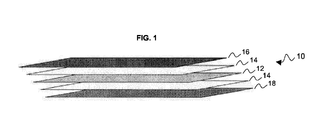
- Figure 1 One such product is illustrated in Figure 1 and has applications in the military field as a textile used in the manufacture of protective suits and garments.
- the product of Figure 1 indicated generally as 10 comprises a thin film of a composition of the invention 12 applied between two polyurethane layers 14.
- a textile layer 16 is then applied on one side of the resulting laminate while a tricot layer 18 is applied on the other side.
- a laminated support can be prepared using a variety of supports, depending on the end use of one finished product and the other properties one may wish to impart to such finished product.
- a second composition as set out below that did not contain a surfactant, was prepared using the identical procedure: Weight percentage (%) 16.4 Polyvinyl alcohol (mixture of 1/3 Airvol 103 and 2/3 of Airvol 125) 5 Polyvinyl acetate (Airflex 410) 16.4 Polyethylenimine (Lupasol F WF from BASF) 0.9 Defoamer (Foamaster® VF from Cognis) 1 Cross-linking agent CX-100 60.3 Water
- Example 1 and Example 2 were applied using a knife on two polyurethane membranes as a continuous film having a thickness of 50 ⁇ m and was cured at 150°C for 4 minutes.
- the resulting laminated products were laundered according to the ISO 6330 standard, Textiles, Domestic Washing and Drying Procedures For Textiles. Without surfactant, the composition delaminated after 2 wash/dry cycles whereas the composition with the surfactant showed no delamination after 10 wash/dry cycles.
- Example 2 The laminated products of Example 2, prepared with and without surfactant, were tested for resistance to penetration by mustard gas (HD) according to the procedure of dynamic flow test of test Operations Procedure (TOP) 8-2-501, Permeation and Penetration of Air-Permeable, Semipermeable, and Impermeable Materials with Chemical Agents or Simulants (Swatch testing), Office of the Undersecretary of Defense, March 1997.
- the test parameters were as follows: Parameter Standard Convective Flow Test Through the Swatch Flow based on ⁇ P of 0.1 iwg a across the material.
- Dynamic Diffusion dual flow
- Static Diffusion Single flow
- composition of the present invention will also show enhanced barrier properties to other chemical warfare agents and toxic industrial compounds listed in NFPA 1994 including but not limited to dichloro(2-chlorovinyl)arsine, Sarin (isopropyl methanefluorophosphonate), O-ethyl S-(2-diisopropylaminoethyl)methylphosphonothiolate, dimethyl sulfate (sulfuric acid dimethyl ester), ammonia, chlorine, cyanogen chloride, carbonyl chloride and hydrogen cyanide.
- composition was prepared: Weight percentage (%) 12 % Polyvinyl alcohol (Airvol 203) 5% Ethylene vinyl acetate polymer (Airflex 920) 16% Polyethylenimine (Lupasol P WF from BASF) 1% Surfactant and defoamer (Surfynol 104E) 1% Cross-linking agent CX-100 1% Silver nitrate 64% Water
- Example 4 without silver nitrate was prepared and coated as described in the same example on a ePTFE membrane.
- An uncoated ePTFE membrane was used as a control.
- the water vapor transmission rate was measured in accordance with ASTM E96BW, Annual Book of ASTM Standards, Vol 14.02 . Using a water vapor permeability apparatus, the transmission rate was measured.
- the laminated support had a moisture vapour transmission rate at 23°C of about 2000 g/m 2 /24 h.
- the uncoated support had a moisture vapour transmission rate at 23°C of about 4500 g/m 2 /24 h.
- composition was prepared: Weight percentage (%) 32 % Ethylene vinyl acetate (Airflex 920) 16 % Polyethylenimine (mixture of 1/4 of Lupasol F WF and % of Lupasol P WF from BASF) 0.2 % Surfactant and defoamer (Surfynol 104H) 1% Cross-linking agent CX-100 50.8 % Water
- the composition was applied to an ePTFE membrane as a continuous film having a thickness of 50 ⁇ m and cured at 165°C for 4 minutes.
- the resulting laminated supports were laundered 5 or 10 times according to ISO 6330 4B.E, were tested for their resistance to penetration by mustard gas according to the procedure of dynamic flow test TOP-8-2-501 as set out in Example 3 above. Results are shown in Table 3. Table 3. Chemical resistance of the laminated support comprising ethylene vinyl acetate to mustard gas (HD).
- composition was applied to a polyester fabric, coated on both sides with polyvinyl chloride as a continuous film having a thickness of 50 ⁇ m, and cured at 160°C for 4 minutes.
- the coated supports obtained were tested as to their resistance to penetration by mustard gas according to the procedure of dynamic flow test TOP-8-2-501.
- An uncoated polyester fabric, coated on both sides with polyvinyl chloride, was used as a control.
Landscapes
- Chemical & Material Sciences (AREA)
- Health & Medical Sciences (AREA)
- Engineering & Computer Science (AREA)
- General Health & Medical Sciences (AREA)
- Materials Engineering (AREA)
- Toxicology (AREA)
- Chemical Kinetics & Catalysis (AREA)
- General Chemical & Material Sciences (AREA)
- Business, Economics & Management (AREA)
- Emergency Management (AREA)
- Laminated Bodies (AREA)
- Materials Applied To Surfaces To Minimize Adherence Of Mist Or Water (AREA)
Applications Claiming Priority (1)
| Application Number | Priority Date | Filing Date | Title |
|---|---|---|---|
| CA002501146A CA2501146C (en) | 2005-03-11 | 2005-03-11 | Polymeric composition acting as barrier to noxious agents |
Publications (2)
| Publication Number | Publication Date |
|---|---|
| EP1700620A2 true EP1700620A2 (de) | 2006-09-13 |
| EP1700620A3 EP1700620A3 (de) | 2009-04-22 |
Family
ID=36606408
Family Applications (1)
| Application Number | Title | Priority Date | Filing Date |
|---|---|---|---|
| EP06300223A Withdrawn EP1700620A3 (de) | 2005-03-11 | 2006-03-10 | Polymerikzusammensetzung als Barriere gegenüber Noxen |
Country Status (3)
| Country | Link |
|---|---|
| US (1) | US7736664B2 (de) |
| EP (1) | EP1700620A3 (de) |
| CA (1) | CA2501146C (de) |
Cited By (2)
| Publication number | Priority date | Publication date | Assignee | Title |
|---|---|---|---|---|
| EP2241440A1 (de) * | 2009-04-14 | 2010-10-20 | General Electric Company | Artikel mit Schadstoffbarrierefunktion, Laminat und dazugehöriges Herstellungsverfahren |
| EP2383019A2 (de) | 2010-03-26 | 2011-11-02 | Stedfast Inc. | Polymerzusammensetzung zur Neutralisierung von schädlichen Wirkstoffen |
Families Citing this family (3)
| Publication number | Priority date | Publication date | Assignee | Title |
|---|---|---|---|---|
| ES2861300T3 (es) | 2012-02-20 | 2021-10-06 | Basf Se | Potenciación de la actividad antimicrobiana de biocidas con polímeros |
| EP2996646B1 (de) * | 2013-05-17 | 2022-02-02 | Hollister Incorporated | Biologisch abbaubare geruchssperrfolie |
| WO2025221336A2 (en) * | 2024-04-03 | 2025-10-23 | Luna Labs Usa, Llc | Chemical protective elastomer materials free of a perfluoroalkyl substance and articles including the same |
Family Cites Families (10)
| Publication number | Priority date | Publication date | Assignee | Title |
|---|---|---|---|---|
| GB1536227A (en) * | 1976-03-23 | 1978-12-20 | Uop Inc | Composite semi-permeable membranes and methods of making same |
| US4943475A (en) | 1986-07-23 | 1990-07-24 | Membrane Technology & Research, Inc. | Multilayer composite protective fabric material and use in protective clothing |
| US4924525A (en) * | 1986-10-20 | 1990-05-15 | Bodigard Technologies, Inc. | Multilayer film for chemical protective clothing |
| US4833010A (en) * | 1988-05-02 | 1989-05-23 | Kappler Safety Group | Composite chemical barrier fabric |
| JPH04198383A (ja) * | 1990-11-28 | 1992-07-17 | Sekisui Chem Co Ltd | 表面保護フィルム |
| US5391426A (en) | 1992-03-11 | 1995-02-21 | W. L. Gore & Associates, Inc. | Polyalkyleneimine coated material |
| JPH08295859A (ja) * | 1995-04-24 | 1996-11-12 | Sekisui Chem Co Ltd | 表面保護フィルム |
| US6395383B1 (en) | 1999-12-13 | 2002-05-28 | Gore Enterprise Holdings, Inc. | Chemical protective covering |
| US8192765B2 (en) * | 2000-06-21 | 2012-06-05 | Icet, Inc. | Material compositions for microbial and chemical protection |
| GB0200957D0 (en) | 2002-01-17 | 2002-03-06 | Secr Defence | Novel polymer and uses thereof |
-
2005
- 2005-03-11 CA CA002501146A patent/CA2501146C/en not_active Expired - Lifetime
- 2005-03-15 US US11/081,149 patent/US7736664B2/en active Active
-
2006
- 2006-03-10 EP EP06300223A patent/EP1700620A3/de not_active Withdrawn
Cited By (6)
| Publication number | Priority date | Publication date | Assignee | Title |
|---|---|---|---|---|
| EP2241440A1 (de) * | 2009-04-14 | 2010-10-20 | General Electric Company | Artikel mit Schadstoffbarrierefunktion, Laminat und dazugehöriges Herstellungsverfahren |
| EP2383019A2 (de) | 2010-03-26 | 2011-11-02 | Stedfast Inc. | Polymerzusammensetzung zur Neutralisierung von schädlichen Wirkstoffen |
| US8642058B2 (en) | 2010-03-26 | 2014-02-04 | U.S. Army Natick Soldier Research, Development And Engineering Center Chemical Technology Team | Polymeric composition for the neutralization of noxious agents |
| EP2383019A3 (de) * | 2010-03-26 | 2014-06-18 | Stedfast Inc. | Polymerzusammensetzung zur Neutralisierung von schädlichen Wirkstoffen |
| US20140309101A1 (en) * | 2010-03-26 | 2014-10-16 | Stedfast, Inc. | Polymeric Composition for the Neutralization of Noxious Agents |
| US8920825B2 (en) * | 2010-03-26 | 2014-12-30 | Stedfast, Inc. | Polymeric composition for the neutralization of noxious agents |
Also Published As
| Publication number | Publication date |
|---|---|
| US20100032084A1 (en) | 2010-02-11 |
| US7736664B2 (en) | 2010-06-15 |
| EP1700620A3 (de) | 2009-04-22 |
| CA2501146A1 (en) | 2006-09-11 |
| CA2501146C (en) | 2009-05-26 |
Similar Documents
| Publication | Publication Date | Title |
|---|---|---|
| KR100543050B1 (ko) | 화학물질 차단 피복재 | |
| EP1636028B1 (de) | Chemikalienschutzkleidungs- oder umhüllungsartikel | |
| EP0630279B1 (de) | Mit polyalkylenenimin oder polyallylamin überzogenes material | |
| EP0525409B1 (de) | Gegen Durchdringung von Flüssigkeit beständiger saugfähiger Schichtstoff | |
| CN1142240A (zh) | 可透水蒸气、不透空气的薄膜、复合涂层和叠层 | |
| CN101959560A (zh) | 具有反应完成膜的功能防护材料以及由其制备的防护衣 | |
| US20090300833A1 (en) | Flame resistant, selectively permeable laminates | |
| US7736664B2 (en) | Polymeric composition acting as barrier to noxious agents | |
| US20090239435A1 (en) | Protective suit and methods of manufacture thereof | |
| US8920825B2 (en) | Polymeric composition for the neutralization of noxious agents | |
| EP2403609B1 (de) | Dehnbares chemikalienschutzmaterial | |
| US8147936B2 (en) | Composite membrane for chemical and biological protection | |
| KR101478638B1 (ko) | 화생 보호복용 선택투과성 보호재 및 그 제조방법 | |
| US20100162473A1 (en) | Water-permeable protective material | |
| JP2005515288A (ja) | ポリマーの新規な使用 | |
| CA2602130A1 (en) | Polyurethane/polyalkylamine polymer compositions and processes for making same | |
| HK1164196B (en) | Stretchable chemical protective material |
Legal Events
| Date | Code | Title | Description |
|---|---|---|---|
| PUAI | Public reference made under article 153(3) epc to a published international application that has entered the european phase |
Free format text: ORIGINAL CODE: 0009012 |
|
| AK | Designated contracting states |
Kind code of ref document: A2 Designated state(s): AT BE BG CH CY CZ DE DK EE ES FI FR GB GR HU IE IS IT LI LT LU LV MC NL PL PT RO SE SI SK TR |
|
| AX | Request for extension of the european patent |
Extension state: AL BA HR MK YU |
|
| PUAL | Search report despatched |
Free format text: ORIGINAL CODE: 0009013 |
|
| AK | Designated contracting states |
Kind code of ref document: A3 Designated state(s): AT BE BG CH CY CZ DE DK EE ES FI FR GB GR HU IE IS IT LI LT LU LV MC NL PL PT RO SE SI SK TR |
|
| AX | Request for extension of the european patent |
Extension state: AL BA HR MK YU |
|
| AKX | Designation fees paid | ||
| REG | Reference to a national code |
Ref country code: DE Ref legal event code: 8566 |
|
| STAA | Information on the status of an ep patent application or granted ep patent |
Free format text: STATUS: THE APPLICATION IS DEEMED TO BE WITHDRAWN |
|
| 18D | Application deemed to be withdrawn |
Effective date: 20090923 |