EP1701113A1 - Machine à froid fonctionnant suivant le cycle de stirling - Google Patents
Machine à froid fonctionnant suivant le cycle de stirling Download PDFInfo
- Publication number
- EP1701113A1 EP1701113A1 EP06290168A EP06290168A EP1701113A1 EP 1701113 A1 EP1701113 A1 EP 1701113A1 EP 06290168 A EP06290168 A EP 06290168A EP 06290168 A EP06290168 A EP 06290168A EP 1701113 A1 EP1701113 A1 EP 1701113A1
- Authority
- EP
- European Patent Office
- Prior art keywords
- piston
- connecting rod
- compression
- regeneration
- cycle
- Prior art date
- Legal status (The legal status is an assumption and is not a legal conclusion. Google has not performed a legal analysis and makes no representation as to the accuracy of the status listed.)
- Granted
Links
Images


Classifications
-
- F—MECHANICAL ENGINEERING; LIGHTING; HEATING; WEAPONS; BLASTING
- F25—REFRIGERATION OR COOLING; COMBINED HEATING AND REFRIGERATION SYSTEMS; HEAT PUMP SYSTEMS; MANUFACTURE OR STORAGE OF ICE; LIQUEFACTION SOLIDIFICATION OF GASES
- F25B—REFRIGERATION MACHINES, PLANTS OR SYSTEMS; COMBINED HEATING AND REFRIGERATION SYSTEMS; HEAT PUMP SYSTEMS
- F25B9/00—Compression machines, plants or systems, in which the refrigerant is air or other gas of low boiling point
- F25B9/14—Compression machines, plants or systems, in which the refrigerant is air or other gas of low boiling point characterised by the cycle used, e.g. Stirling cycle
-
- F—MECHANICAL ENGINEERING; LIGHTING; HEATING; WEAPONS; BLASTING
- F25—REFRIGERATION OR COOLING; COMBINED HEATING AND REFRIGERATION SYSTEMS; HEAT PUMP SYSTEMS; MANUFACTURE OR STORAGE OF ICE; LIQUEFACTION SOLIDIFICATION OF GASES
- F25B—REFRIGERATION MACHINES, PLANTS OR SYSTEMS; COMBINED HEATING AND REFRIGERATION SYSTEMS; HEAT PUMP SYSTEMS
- F25B2500/00—Problems to be solved
- F25B2500/12—Sound
-
- F—MECHANICAL ENGINEERING; LIGHTING; HEATING; WEAPONS; BLASTING
- F25—REFRIGERATION OR COOLING; COMBINED HEATING AND REFRIGERATION SYSTEMS; HEAT PUMP SYSTEMS; MANUFACTURE OR STORAGE OF ICE; LIQUEFACTION SOLIDIFICATION OF GASES
- F25B—REFRIGERATION MACHINES, PLANTS OR SYSTEMS; COMBINED HEATING AND REFRIGERATION SYSTEMS; HEAT PUMP SYSTEMS
- F25B2500/00—Problems to be solved
- F25B2500/18—Optimization, e.g. high integration of refrigeration components
Definitions
- FIG. 1 gives the representation of the isotherms in the pressure plane (in ordinates) / volume (in abscissas): in steady state, the Stirling cycle is represented by the curvilinear trapezoidal quadrilateral A of vertices 1, 2, 3, 4 included between the isotherms T c and T f (Clapeyron diagram); the area W represents the work to be supplied to the gas to describe the cycle and the area Q f represents the cooling energy supplied to the cold source.
- each piston - compression piston or regeneration piston - must only be moved when the other is stabilized at its top dead center (TDC) or low (TDC). If this condition is not realized, the angular portions of the Stirling cycle (points 1 to 4 of the Clapeyron diagram) are not reached and the representation of the cycle takes a curvilinear shape as shown in B in Figure 1.
- the compression piston 6 and the regeneration piston 9 are driven by the same motor via a double crank-crank system (crankshaft 11 and rods 12, 13 coupled at 14).
- the two pistons 6, 9 have respective movements that are rectilinear reciprocating quasi sinusoidal.
- the phase difference between the two pistons 6, 9 is constant and depends on the anchoring point of the two rods on the linkage. This phase shift is usually 90 degrees.
- the cooling capacity is adjusted by adjusting the rotational speed of the engine, thus the number of thermodynamic cycles performed per unit of time.
- the movement of the compression piston (s) is sinusoidal or quasi-sinusoidal.
- the cryogenic power is adapted to the demand by adjusting the speed of rotation of the engine in the first case, and by adjusting the amplitude of oscillation in the second case.
- the regenerative piston is not driven by a motor or an activator, but by the pressure wave coming from the compressor and transmitted via a pipe (or transfer line).
- the phase shift is obtained by the combination of the forces acting on the regenerator (friction, effects of the pressure wave, a return spring, a pressure reference, ).
- Regenerator movement is periodic (not necessarily sinusoidal) at the frequency of the pressure wave.
- the phase shift is more or less variable depending on the ambient temperature, wear, ....
- the object of the invention is therefore to propose an improved technical solution aiming at optimizing the displacement of the pistons in order to tend as much as possible towards the Stirling cycle, that is to say to slow down (ideally to stop) the periodic movement of the pistons at the vicinity of the two dead spots up and down, without however resulting in an excessive complication both in terms of structure and manufacturing.
- the invention proposes a cold machine as mentioned in the preamble which is characterized, being arranged according to the invention, in that at least one of the compression piston or the regeneration piston is arranged with a variable length during a rotation of the crankshaft so that the movement of said piston is at least slowed down at the passages of the top and bottom dead centers.
- the operating cycle of the machine is closer to the theoretical Stirling cycle than to the cold rod (s) rigid (s) carried out so far.
- variable length connecting rod hereinafter referred to as the main connecting rod
- the main connecting rod to be formed of at least two connecting rod sections articulated to one another and which at least one auxiliary link has a first end rotatably coupled to the main link and a second end rotatably coupled to a structural member of the machine.
- the first end of the auxiliary link is rotatably coupled to the joint joining the two main link sections, or that the first end of the auxiliary link is rotatably coupled to the main link.
- one of the sections of the main link in particular to that of the sections of the main link which is secured to the piston.
- the second end of the auxiliary link it can be provided that it is rotatably coupled to a fixed element of the structure of the machine: although this embodiment is structurally simple, it leads to an interesting result. as for the improvement of the operating cycle of the machine, with a significant approximation of the theoretical Stirling cycle. But, if a greater structural and functional complexity is accepted, another embodiment can be envisaged, namely that the second end of the auxiliary link is rotatably coupled to a movable member of the machine structure and in that control means controls the movement of the movable member of the structure.
- the arrangements according to the invention offer the advantage of an implementation possibility whatever the type of the cold machine: if the cold machine is of the integral type, it may be the respective connecting rods of the compression pistons and regeneration which are arranged with respective respective lengths, or, for the sake of economy and / or simplification, it may be only one of these rods, including the regeneration rod because the efforts that apply on the regeneration piston are much weaker than those applying to the compression piston; if the cold machine is of the "split" type, it is the compression rod which is arranged with a variable length.
- the implementation of the provisions of the invention on the compression piston rod can make it possible to modify the operating cycle by stretching it to the top points 1 and 3 of the Stirling theoretical cycle.
- the main advantage provided by the implementation of the means according to the invention is to obtain a cycle closer to the ideal cycle (Stirling cycle), and therefore the increase in the cryogenic power of the cold machine. for identical dimensions.
- a cold machine equipped according to the invention can rotate slower, which indirectly improves the thermodynamic efficiency due to the reduction of certain losses, such as losses by "appendix" effect or losses by friction fluid .
- a lower rotational speed is in the direction of improving reliability.
- the rod or at least one of the rods of the cold machine is arranged with a variable length during a rotation of the crankshaft so that the movement of the corresponding piston is at least idle, or even stopped, at the passage of the top and / or bottom dead center, preferably to both, so that the cycle of operation of the machine is closer to the theoretical Stirling cycle than that of the cold rod machines made up to 'now.
- variable length connecting rod (it will be assumed that example in the following that it is the compression rod 12), which will be referred to in the following by the term of main rod, is formed of at least two connecting rod sections 12a, 12b articulated to each other in 15 and in that at least one auxiliary connecting rod 16 has a first end coupled to rotation at 17 to the connecting rod main 12 and a second end coupled to rotation at 18 on a structural element 19 of the machine.
- the characteristics of the arrangement - in particular lengths of the connecting rod sections 12a, 12b, locations of the joints 15 and 17, length of the auxiliary connecting rod 16, arrangements of the articulation 18 and of the structural element 19 of the machine - are determined according to the desired result.
- FIG. 3A The embodiment variant illustrated in FIG. 3A is the simplest from the structural point of view.
- the joint 15 joining the two sections 12a, 12b of the connecting rod and the joint 17 joining the auxiliary connecting rod 16 to the main rod 12 are combined.
- the two articulations 15 and 17 are distinct and the articulation 17 is transferred to one of the connecting rod sections, for example on the connecting rod section 12a coupled to the piston as illustrated in FIG. Figure 3B.
- the position of the hinge 17 on the connecting rod section is chosen so as to define the appropriate lever arm to obtain the desired movement of the piston 6.
- the main link 12 may consist of a larger number of sections.
- the embodiment of Figure 3C implements a main rod broken down into three connecting rod sections 12a, 12b, 12c joined by joints 15a, 15b; two auxiliary connecting rods 16a, 16b are respectively interposed between the articulations 15a, 15b and a structural element 19 of the machine; the two auxiliary connecting rods 16a, 16b can be joined to the structural element 19 by a joint joint 18 or by two separate joints 18a, 18b separate as shown in Figure 3C.
- the structural element 19 of the machine on which the auxiliary link 16 is articulated can be, in a simple manner, a fixed element of the structure of the machine, as is illustrated in FIGS. Figures 3A, 3B and 3C.
- the hinge 18 it is also conceivable for the hinge 18 to be carried by a structural element that is displaceable in a controlled manner so that the hinge 17 is animated with an additional movement component enabling the movement of the hinge to be controlled more precisely. piston 6.
- FIG. 3D on which the simplest variant of FIG. 3A has been adopted
- the structural element 19 can be driven, under the action of control means (not shown) of a substantially linear movement (arrow 20), or curvilinear, in particular substantially circular or circular (arrow 21), or in any appropriate trajectory.
- the rods 12 and 13 respectively of the two compression pistons 6 and regeneration 9 can be arranged with respective respective lengths as shown in Figure 4A.
- the arrangement of FIG. 3A can be taken again, with the connecting rod 12 formed of two sections 12a, 12b and with the auxiliary connecting rod 16.
- the regenerator 8 it is possible to take a similar arrangement, with the connecting rod 13 formed of two sections 13a, 13b and with an auxiliary connecting rod 24.
- the arrangement according to the invention of the two compression rods 12 and regeneration 13 is considered too complex and / or too expensive, only one of these rods can be equipped according to the invention.
- the implementation of the provisions according to the invention makes it possible to modify the cycle of operation of the cold machine and, by comparison with the cycle B of a conventional machine, to bring this cycle closer to the theoretical Stirling A cycle. in at least some of the regions of the top points 1, 2, 3, 4.
- the diagram of Figure 6 is similar to that of Figure 1 and shows again the theoretical Stirling cycle at A and the cycle B of a machine dashed, while the cycle C of a cold machine modified according to the invention was added in full line so as to improve the cycle in the regions of the two summit points 2 and 4 by slowing down the movement of the piston of regeneration in the vicinity of top and bottom dead spots.
- the equipment of the compression piston according to the invention would likewise be able to improve the cycle in the regions of the two summit points 1 and 3.
Landscapes
- Engineering & Computer Science (AREA)
- Physics & Mathematics (AREA)
- Mechanical Engineering (AREA)
- Thermal Sciences (AREA)
- General Engineering & Computer Science (AREA)
- Compressors, Vaccum Pumps And Other Relevant Systems (AREA)
- Devices That Are Associated With Refrigeration Equipment (AREA)
- Soil Working Implements (AREA)
- Agricultural Chemicals And Associated Chemicals (AREA)
- Compressor (AREA)
- Structures Of Non-Positive Displacement Pumps (AREA)
Abstract
Description
- La présente invention concerne des perfectionnements apportés aux machines à froid fonctionnant suivant le cycle de Stirling et comprenant
- au moins un compresseur avec un piston de compression mobile dans un cylindre de compression,
- un régénérateur avec un piston de régénération mobile dans un cylindre de régénération disposé sous un angle donné par rapport au cylindre de compression,
- un vilebrequin rotatif d'entraînement, et
- deux bielles, respectivement une bielle de compression accouplée au piston de compression et une bielle de régénération accouplée au piston de régénération, qui sont accouplées au vilebrequin avec un écart angulaire mutuel.
- On rappellera que le cycle de Stirling comprend
- une compression isotherme à la température chaude Tc (de 1 à 2 sur la figure 1) obtenue par le déplacement d'un (ou plusieurs) piston de compression -également appelé(s) oscillateur(s)-,
- un refroidissement isochore de la température chaude Tc à la température froide Tf (de 2 à 3) réalisé par passage du gaz à travers un piston poreux appelé régénérateur -ou déplaceur- et jouant un rôle d'échangeur thermique,
- une détente isotherme à la température froide Tf (de 3 à 4) obtenue par retour du piston de compression, et
- un réchauffement isochore de la température froide Tf à la température chaude Tc (de 4 à 1) réalisé par retour du régénérateur.
- La figure 1 donne la représentation des isothermes dans le plan pression (en ordonnées)/volume (en abscisses) : en régime permanent, le cycle de Stirling est représenté par le quadrilatère trapézoïdal curviligne A de sommets 1, 2, 3, 4 compris entre les isothermes Tc et Tf (diagramme de Clapeyron) ; l'aire W représente le travail à fournir au gaz pour décrire le cycle et l'aire Qf représente l'énergie frigorifique fournie à la source froide.
- Pour décrire le cycle de Stirling, il ne faut déplacer chaque piston -piston de compression ou piston de régénération- que lorsque l'autre est stabilisé à son point mort haut (PMH) ou bas (PMB). Si cette condition n'est pas réalisée, les portions anguleuses du cycle de Stirling (points 1 à 4 du diagramme de Clapeyron) ne sont pas atteintes et la représentation du cycle prend une forme curviligne comme montré en B à la figure 1.
- Les machines à froid fonctionnant selon le cycle de Stirling se répartissent en deux catégories : les machines intégrales et les machines dites « splittées ». Aucune ne réalise exactement le cycle théorique de Stirling (cycle A).
- A la figure 2 est représenté très schématiquement une machine à froid du type intégral fonctionnant selon le cycle de Stirling. Cette machine comprend :
- au moins un compresseur 5 avec un piston 6 de compression mobile dans un cylindre 7 de compression,
- un régénérateur 8 avec un piston 9 de régénération mobile dans un cylindre 10 de régénération disposé sous un angle donné par rapport au cylindre 7 de compression, et notamment sensiblement perpendiculairement à ce dernier comme illustré,
- un vilebrequin 11 rotatif d'entraînement, et
- deux bielles, respectivement une bielle 12 de compression accouplée à rotation au piston 6 de compression et une bielle 13 de régénération accouplée à rotation au piston 9 de régénération, lesquelles bielles 12, 13 sont accouplées à rotation au même emplacement 14 du vilebrequin 11 avec un écart angulaire mutuel, notamment d'environ 90°.
- Dans les machines intégrales, le piston 6 de compression et le piston 9 de régénération sont entraînés par un même moteur via un double système bielle-manivelle (vilebrequin 11 et bielles 12, 13 accouplés en 14). Les deux pistons 6, 9 ont des mouvements respectifs qui sont rectilignes alternatifs quasi sinusoïdaux. Le déphasage entre les deux pistons 6, 9 est constant et dépend du point d'ancrage des deux bielles sur l'embiellage. Ce déphasage est généralement de 90 degrés. La puissance frigorifique est réglée par ajustement de la vitesse de rotation du moteur, donc du nombre de cycles thermodynamiques réalisés par unité de temps.
- Sur la figure 2, on a désigné avec les mêmes références 1 à 4 les positions angulaires du vilebrequin 11 en correspondance avec les sommets 1 à 4 du cycle de Stirling de la figure 1.
- En pratique, par rapport au cycle théorique de Stirling, la différence essentielle réside dans le fait que les transitions de chaque piston commencent avant que l'autre piston soit en fin de course. Comme montré sur le diagramme de la figure 2, la conséquence en est que la représentation du cycle B réel dans le plan P-V s'arrondit et que les points sommitaux 1 à 4 du cycle théorique A ne sont plus atteints.
- Par rapport au cycle théorique de Stirling, l'énergie frigorifique et le travail à fournir sont très inférieurs (d'un facteur 2 ou plus), le coefficient de performance (ratio des deux termes) restant identique. Cela revient à dire que coupler les deux pistons 6, 9 par un embiellage 12, 13 conduit à réaliser une machine à froid moins puissante. Pour obtenir une puissance cryogénique égale à celle du cycle théorique de Stirling, il faut donc augmenter la masse de gaz déplacé en un temps donné :
- en faisant tourner la machine plus vite (pour réaliser plus de cycles par unité de temps), et/ou
- en augmentant la cylindrée et/ou la pression de remplissage (pour augmenter la masse de gaz par cycle).
- Ces solutions ont un impact négatif sur la fiabilité, le bruit acoustique, la masse, l'encombrement de la machine.
- Dans les machines « splittées » (non représentées), seul le piston de compression est commandé :
- par un moteur via un embiellage dans les machines rotatives,
- par un moteur linéaire activant un système masse-ressort résonant dans les machines linéaires.
- Dans les deux cas, le mouvement du (ou des) piston de compression est sinusoïdal ou quasi sinusoïdal.
- La puissance cryogénique est adaptée à la demande par réglage de la vitesse de rotation du moteur dans le premier cas, et par réglage de l'amplitude d'oscillation dans le second cas. Le piston régénérateur n'est pas entraîné par un moteur ou un activateur, mais par l'onde de pression issue du compresseur et transmise via une canalisation (ou ligne de transfert). Le déphasage est obtenu par la combinaison des forces agissant sur le régénérateur (frottements, effets de l'onde de pression, d'un ressort de rappel, d'une référence de pression,...). Le mouvement du régénérateur est périodique (pas nécessairement sinusoïdal) à la fréquence de l'onde de pression. Le déphasage est plus ou moins variable en fonction de la température ambiante, de l'usure,....
- En définitive, les machines à froid existantes fonctionnant selon le cycle de Stirling ne permettent pas de décrire le cycle de Stirling idéal du fait du mode de couplage entre compresseur et régénérateur (sans parler des écarts vis-à-vis du cycle théorique qui sont dus à d'autres causes). La puissance cryogénique s'en trouve fortement diminuée.
- L'invention a donc pour but de proposer une solution technique perfectionnée visant à optimiser le déplacement des pistons pour tendre au mieux vers le cycle de Stirling, c'est-à-dire à ralentir (idéalement à arrêter) le mouvement périodique des pistons au voisinage des deux points morts haut et bas, sans cependant qu'il en résulte une complication excessive tant au niveau de la structure qu'au niveau de la fabrication.
- A ces fins, l'invention propose une machine à froid telle que mentionnée au préambule qui se caractérise, étant agencée conformément à l'invention, en ce qu'au moins l'un du piston de compression ou du piston de régénération est agencé avec une longueur variable au cours d'une rotation du vilebrequin de manière que le mouvement dudit piston soit au moins ralenti aux passages des points morts haut et bas.
- Grâce à cette disposition, le cycle de fonctionnement de la machine se rapproche mieux du cycle théorique de Stirling que celui des machines à froid à bielle(s) rigide(s) réalisées jusqu'à présent.
- Dans un mode de réalisation préféré des dispositions fondamentales de l'invention, on prévoit que la bielle à longueur variable, dite ci-après bielle principale, est formée d'au moins deux tronçons de bielle articulés l'un à l'autre et qu'au moins une bielle auxiliaire possède une première extrémité accouplée à rotation à la bielle principale et une seconde extrémité accouplée à rotation sur un élément de structure de la machine.
- Dans ce contexte, on peut faire en sorte que la première extrémité de la bielle auxiliaire soit accouplée à rotation à l'articulation joignant les deux tronçons de bielle principale, ou bien aussi que la première extrémité de la bielle auxiliaire soit accouplée à rotation à l'un des tronçons de la bielle principale, notamment à celui des tronçons de la bielle principale qui est solidaire du piston.
- Sous réserve d'une complication structurelle accrue, il est possible de faire en sorte que le nombre n de tronçons de bielle articulés les uns aux autres soit supérieur à deux, le nombre des bielles auxiliaires étant alors égal à n-1
- Pour ce qui est de la seconde extrémité de la bielle auxiliaire, on peut prévoir qu'elle soit accouplée à rotation à un élément fixe de la structure de la machine : bien que ce mode de réalisation soit structurellement simple, il conduit à un résultat intéressant quant à l'amélioration du cycle de fonctionnement de la machine, avec un rapprochement sensible du cycle théorique de Stirling. Mais, si une complexité structurelle et fonctionnelle plus importante est acceptée, on peut envisager un autre mode de réalisation consistant en ce que la seconde extrémité de la bielle auxiliaire soit accouplée à rotation à un élément mobile de la structure de la machine et en ce que des moyens de commande contrôlent le mouvement de l'élément mobile de la structure.
- Les dispositions conformes à l'invention offrent l'avantage d'une possibilité de mise en oeuvre quel que soit le type de la machine à froid : si la machine à froid est du type intégral, ce peut être les bielles respectives des pistons de compression et de régénération qui sont agencées avec des longueurs respectives variables, ou bien, par souci d'économie et/ou de simplification, ce peut être seulement l'une de ces bielles, notamment la bielle de régénération car les efforts qui s'appliquent sur le piston de régénération sont beaucoup plus faibles que ceux s'appliquant sur le piston de compression ; si la machine à froid est du type « splitté », c'est la bielle de compression qui est agencée avec une longueur variable.
- Avec un régénérateur incorporant une bielle modifiée conformément à l'invention pour ralentir le mouvement au voisinage du point mort haut (PMH), le gaz est refroidi par le régénérateur plus tard que dans une machine d'agencement classique (c'est-à-dire presque à la fin de la compression). De même, si le mouvement du piston de régénération est ralenti au point mort bas (PMB) grâce à la mise en oeuvre d'une bielle modifiée conformément à l'invention, le gaz est ramené à la température chaude plus tard, presqu'à la fin de la détente. Ainsi, en combinant les deux effets, le cycle de fonctionnement se rapproche des points sommitaux 2 et 4 du cycle théorique de Stirling.
- De même, la mise en oeuvre des dispositions de l'invention sur la bielle du piston de compression peut permettre de modifier le cycle de fonctionnement en l'étirant vers les points sommitaux 1 et 3 du cycle théorique de Stirling.
- L'avantage principal procuré par la mise en oeuvre des moyens conformes à l'invention est l'obtention d'un cycle plus proche du cycle idéal (cycle de Stirling), et donc l'augmentation de la puissance cryogénique de la machine à froid pour un encombrement identique.
- A puissance cryogénique identique, une machine à froid équipée conformément à l'invention peut tourner moins vite, ce qui améliore indirectement le rendement thermodynamique du fait de la diminution de certaines pertes, comme les pertes par effet "appendix" ou les pertes par frottement fluide. En outre, une vitesse de rotation plus faible va dans le sens de l'amélioration de la fiabilité.
- L'invention sera mieux comprise à la lecture de la description détaillée qui suit de certains modes de réalisation préférés donnés uniquement à titre d'exemples non limitatifs. Dans cette description, on se réfère aux dessins annexés sur lesquels :
- la figure 1 est un diagramme volume (en abscisses)/pression (en ordonnées) donnant la représentation du cycle théorique de Stirling et du cycle d'une machine à froid classique,
- la figure 2 est une représentation très schématique d'une machine à froid classique du type intégral fonctionnant selon le cycle de Stirling,
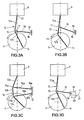
- les figures 3A à 3D sont des vues très schématiques de respectivement plusieurs variantes de réalisation de l'agencement proposé par l'invention,
- les figures 4A et 4B sont des représentations de respectivement deux exemples de réalisation de machine à froid de type intégral agencées conformément à l'invention,
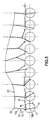
- la figure 5 est un schéma développé montrant les mouvements du piston et des bielles sur un tour de rotation du vilebrequin dans la configuration de montage simple de la figure 3A, et
- la figure 6 est un diagramme analogue à celui de la figure 1 faisant apparaître en outre le cycle de fonctionnement d'une machine à froid agencée conformément à l'invention.
- Conformément à l'invention, on prévoit que la bielle ou que l'une au moins des bielles de la machine à froid soit agencée avec une longueur variable au cours d'une rotation du vilebrequin de manière que le mouvement du piston correspondant soit au moins ralenti, voire arrêté, au passage du point mort haut et/ou bas, de préférence aux deux, de manière que le cycle de fonctionnement de la machine se rapproche mieux du cycle théorique de Stirling que celui des machines à froid à bielle rigide réalisées jusqu'à présent.
- Diverses solutions techniques peuvent être envisagées à cet effet.
- La solution qui paraît être la mieux appropriée pour aboutir à un compromis satisfaisant en terme de simplicité structurelle et en terme de qualité du résultat obtenu consiste, comme illustré aux figures 3A à 3D, en ce que la bielle à longueur variable (on supposera à titre d'exemple dans ce qui suit qu'il s'agit de la bielle de compression 12), que l'on désignera dans ce qui suit par le terme de bielle principale, soit formée d'au moins deux tronçons de bielle 12a, 12b articulés l'un à l'autre en 15 et en ce qu'au moins une bielle auxiliaire 16 possède une première extrémité accouplée à rotation en 17 à la bielle principale 12 et une seconde extrémité accouplée à rotation en 18 sur un élément de structure 19 de la machine. Les caractéristiques de l'agencement - notamment longueurs des tronçons de bielle 12a, 12b, emplacements des articulations 15 et 17, longueur de la bielle auxiliaire 16, agencements de l'articulation 18 et de l'élément de structure 19 de la machine - sont déterminés en fonction du résultat souhaité.
- Diverses variantes de réalisations pratiques peuvent être envisagées.
- La variante de réalisation illustrée à la figure 3A est la plus simple du point de vue structurel. L'articulation 15 réunissant les deux tronçons 12a, 12b de bielle et l'articulation 17 réunissant la bielle auxiliaire 16 à la bielle principale 12 sont confondues.
- Dans la variante de réalisation montrée à la figure 3B, les deux articulations 15 et 17 sont distinctes et l'articulation 17 est reportée sur l'un des tronçons de bielle, par exemple sur le tronçon de bielle 12a accouplé au piston comme illustré à la figure 3B. La position de l'articulation 17 sur le tronçon de bielle est choisie de manière à définir le bras de levier approprié pour obtenir le mouvement souhaité du piston 6.
- Bien entendu, si besoin en est, la bielle principale 12 peut être constituée d'un plus grand nombre de tronçons. La variante de réalisation de la figure 3C met en oeuvre une bielle principale décomposée en trois tronçons de bielle 12a, 12b, 12c réunis par des articulations 15a, 15b ; deux bielles auxiliaires 16a, 16b sont interposées respectivement entre les articulations 15a, 15b et un élément de structure 19 de la machine ; les deux bielles auxiliaires 16a, 16b peuvent être réunies à l'élément de structure 19 par une articulation 18 commune ou bien par deux articulations respectives 18a, 18b distinctes comme illustré à la figure 3C.
- Pour ce qui est de l'élément de structure 19 de la machine sur lequel est articulée la bielle auxiliaire 16, il peut s'agir, de façon simple, d'un élément fixe de la structure de la machine, comme cela est illustré aux figures 3A, 3B et 3C. Toutefois, on peut également envisager que l'articulation 18 soit portée par un élément de structure qui soit déplaçable de façon contrôlée de manière que l'articulation 17 soit animée d'une composante de mouvement additionnelle permettant de commander de façon plus fine le mouvement du piston 6. Comme montré à la figure 3D (sur laquelle on a repris la variante la plus simple de la figure 3A), l'élément de structure 19 peut être animé, sous l'action de moyens de commande (non montrés) d'un mouvement sensiblement linéaire (flèche 20), ou bien curviligne, notamment sensiblement en arc de cercle ou circulaire (flèche 21), ou bien selon toute trajectoire appropriée. Dans le cas où plusieurs bielles auxiliaires sont mises en oeuvre, on peut envisager, pour ce qui est de l'élément de structure 19, non seulement les dispositions évoquées ci-dessus (éléments fixes ou déplaçables), mais aussi une combinaison de ces dispositions (éléments de structure fixes pour certaines bielles auxiliaires et déplaçables pour d'autres).
- Pour fixer les idées, on a représenté de façon très schématisée, à la figure 5, le déplacement du piston dans la configuration structurelle la plus simple de l'agencement de la figure 3A. Sur cette figure, seule est représentée l'articulation 22 du tronçon de bielle 12a avec le piston 6, tandis que le piston lui-même n'est pas montré par souci de clarté de lecture du dessin. On constate clairement que l'articulation 22 est animée d'un mouvement (décomposé sur la trajectoire 23) qui, sur un tour de rotation du vilebrequin 11, n'est plus symétrique ni sinusoïdal, mais qui devient asymétrique entre montée et descente et qui est aplati (ralentissement du piston) vers les points morts haut et bas et plus abrupt (accélération du piston) dans les transitions entre les points morts haut et bas.
- Les dispositions conformes à l'invention se révèlent d'autant plus intéressantes qu'elles peuvent trouver application dans les deux types de machines à froid fonctionnant selon le cycle de Stirling.
- Dans les machines du type intégral, les bielles 12 et 13 respectivement des deux pistons de compression 6 et de régénération 9 peuvent être agencées avec des longueurs respectives variables comme illustré à la figure 4A. Pour le compresseur 5, on peut reprendre par exemple l'agencement de la figure 3A, avec la bielle 12 formée de deux tronçons 12a, 12b et avec la bielle auxiliaire 16. Pour le régénérateur 8, on peut prendre un agencement analogue, avec la bielle 13 formée de deux tronçons 13a, 13b et avec une bielle auxiliaire 24.
- Toutefois si l'agencement conformément à l'invention des deux bielles de compression 12 et de régénération 13 est jugé trop complexe et/ou trop coûteux, seule l'une de ces bielles pourra être équipée selon l'invention. De préférence dans ce cas, il est plus avantageux que ce soit la bielle de régénération 13 qui soit agencée avec une longueur variable comme montré à la figure 4B, eu égard au fait que les efforts s'appliquant sur le piston de régénération sont plus faibles que ceux s'appliquant sur le piston de compression.
- Dans les machines du type « splitté », c'est la bielle du piston de compression qui est agencée avec une longueur variable.
- En définitive, la mise en oeuvre des dispositions conformes à l'invention permet de modifier le cycle de fonctionnement de la machine à froid et, par comparaison avec le cycle B d'une machine classique, de rapprocher ce cycle du cycle théorique de Stirling A dans au moins certaines des régions des points sommitaux 1, 2, 3, 4. Le diagramme de la figure 6 est analogue à celui de la figure 1 et montre à nouveau le cycle théorique de Stirling en A et le cycle B d'une machine classique en tirets, tandis qu'on a ajouté en trait plein le cycle C d'une machine à froid modifiée selon l'invention de manière à améliorer le cycle dans les régions des deux points sommitaux 2 et 4 par ralentissement du mouvement du piston de régénération au voisinage des points morts haut et bas. L'équipement du piston de compression selon l'invention permettrait de la même manière d'améliorer le cycle dans les régions des deux points sommitaux 1 et 3.
Claims (10)
- Machine à froid fonctionnant suivant le cycle de Stirling et comprenant- au moins un compresseur (5) avec un piston (6) de compression mobile dans un cylindre (7) de compression,- un régénérateur (8) avec un piston (9) de régénération mobile dans un cylindre (10) de régénération disposé sous un angle donné par rapport au cylindre (7) de compression,- un vilebrequin rotatif (11) d'entraînement, et- deux bielles, respectivement une bielle (12) de compression accouplée au piston (6) de compression et une bielle (13) de régénération accouplée au piston (8) de régénération, qui sont accouplées au vilebrequin (11) avec un écart angulaire mutuel,caractérisée en ce qu'au moins l'une de la bielle (12) de compression ou de la bielle (13) de régénération est agencée avec une longueur variable au cours d'une rotation du vilebrequin (11) de manière que le mouvement du piston correspondant soit au moins ralenti au passage du point mort haut et/ou bas,
ce grâce à quoi le cycle de fonctionnement de la machine se rapproche mieux du cycle théorique de Stirling que celui des machines à froid à bielle rigide réalisées jusqu'à présent. - Machine à froid selon la revendication 1, caractérisée en ce que la bielle (12; 13) à longueur variable, ou bielle principale, est formée d'au moins deux tronçons de bielle (12a, 12b; 13a, 13b) articulés l'un à l'autre et en ce qu'au moins une bielle auxiliaire (16, 16a, 16b; 24) possède une première extrémité accouplée à rotation (17) à la bielle principale et une seconde extrémité accouplée à rotation (18) sur un élément de structure (19) de la machine.
- Machine à froid selon la revendication 2, caractérisée en ce que la première extrémité de la bielle auxiliaire (16) est accouplée à rotation (17) à l'articulation (15) joignant les deux tronçons (12a, 12b) de bielle principale.
- Machine à froid selon la revendication 2, caractérisée en ce que la première extrémité de la bielle auxiliaire (16) est accouplée à rotation (17) à l'un des tronçons (12a, 12b) de la bielle principale.
- Machine à froid selon la revendication 4, caractérisée en ce que la première extrémité de la bielle auxiliaire est accouplée à rotation (17) à celui (12a) des tronçons de la bielle principale qui est solidaire du piston (6).
- Machine à froid selon l'une quelconque des revendications 2 à 5, caractérisée en ce que la seconde extrémité de la bielle auxiliaire est accouplée à rotation (18) à un élément (19) fixe de la structure de la machine.
- Machine à froid selon l'une quelconque des revendications 2 à 5, caractérisée en ce que la seconde extrémité de la bielle auxiliaire est accouplée à rotation (18) à un élément (19) mobile de la structure de la machine et en ce que des moyens de commande contrôlent le mouvement de l'élément (19) mobile de la structure.
- Machine à froid selon l'une quelconque des revendications 1 à 7, caractérisée en ce que, la machine étant du type intégral, les bielles (12, 13) des deux pistons de compression (6) et de régénération (9) sont agencées avec des longueurs respectives variables.
- Machine à froid selon l'une quelconque des revendications 1 à 7, caractérisée en ce que, la machine étant du type intégral, seule la bielle (13) du piston de régénération (9) est agencée avec une longueur variable.
- Machine à froid selon l'une quelconque des revendications 1 à 7, caractérisée en ce que, la machine étant du type « splitté », c'est la bielle (12) du piston de compression qui est agencée avec une longueur variable.
Applications Claiming Priority (1)
| Application Number | Priority Date | Filing Date | Title |
|---|---|---|---|
| FR0501100A FR2881513B1 (fr) | 2005-02-03 | 2005-02-03 | Machine a froid fonctionnant suivant le cycle de stirling |
Publications (2)
| Publication Number | Publication Date |
|---|---|
| EP1701113A1 true EP1701113A1 (fr) | 2006-09-13 |
| EP1701113B1 EP1701113B1 (fr) | 2009-10-21 |
Family
ID=35447696
Family Applications (1)
| Application Number | Title | Priority Date | Filing Date |
|---|---|---|---|
| EP06290168A Expired - Lifetime EP1701113B1 (fr) | 2005-02-03 | 2006-01-27 | Machine à froid fonctionnant suivant le cycle de stirling |
Country Status (6)
| Country | Link |
|---|---|
| US (1) | US7497085B2 (fr) |
| EP (1) | EP1701113B1 (fr) |
| AT (1) | ATE446488T1 (fr) |
| DE (1) | DE602006009858D1 (fr) |
| FR (1) | FR2881513B1 (fr) |
| IL (1) | IL173495A (fr) |
Families Citing this family (2)
| Publication number | Priority date | Publication date | Assignee | Title |
|---|---|---|---|---|
| US20110225987A1 (en) * | 2010-03-21 | 2011-09-22 | Boyd Bowdish | Self generating power generator for cryogenic systems |
| CN102383929B (zh) * | 2010-09-01 | 2013-07-24 | 中国航空工业集团公司沈阳飞机设计研究所 | 一种曲轴半径可变式活塞内燃机 |
Citations (6)
| Publication number | Priority date | Publication date | Assignee | Title |
|---|---|---|---|---|
| FR2084109A5 (en) * | 1970-03-02 | 1971-12-17 | Knoeoes Stellan | Gas expansion plant - external combustion engine or heat pump on practically reversible operating cycle |
| US4206609A (en) * | 1978-09-01 | 1980-06-10 | Actus, Inc. | Cryogenic surgical apparatus and method |
| JPH08219569A (ja) * | 1995-02-10 | 1996-08-30 | Naoji Isshiki | 可変位相装置 |
| JPH1019406A (ja) * | 1996-06-27 | 1998-01-23 | Sanyo Electric Co Ltd | ガス圧縮膨張機 |
| JPH1163704A (ja) * | 1997-08-27 | 1999-03-05 | Sanyo Electric Co Ltd | ピストン型圧縮機の差圧制御装置 |
| BE1011918A3 (fr) * | 1998-05-15 | 2000-03-07 | Belge De Construction Et D Eng | Procede de transformation de chaleur et installation pour sa realisation. |
Family Cites Families (12)
| Publication number | Priority date | Publication date | Assignee | Title |
|---|---|---|---|---|
| US3431788A (en) * | 1967-03-01 | 1969-03-11 | Philips Corp | Piston rod guide for rhombic drive stirling cycle apparatus |
| US3845624A (en) * | 1970-05-21 | 1974-11-05 | W Roos | Sterling process engines |
| US4365982A (en) * | 1981-12-30 | 1982-12-28 | The United States Of America As Represented By The Secretary Of The Army | Cryogenic refrigerator |
| IL91281A (en) * | 1989-08-11 | 1994-02-27 | Shirat Enterprises Ltd Tel Avi | Method and apparatus for cooling and scanning infrared detector assemblies |
| GB9008522D0 (en) * | 1990-04-17 | 1990-06-13 | Energy For Suitable Dev Limite | Reciprocatory displacement machine |
| US5136987A (en) * | 1991-06-24 | 1992-08-11 | Ford Motor Company | Variable displacement and compression ratio piston engine |
| JP2000136250A (ja) * | 1998-10-29 | 2000-05-16 | Rhein Chem Rheinau Gmbh | 加硫促進剤としてのキサントゲン酸アリ―ルグアニジニウムの使用およびそれの製造方法 |
| JP4038959B2 (ja) * | 2000-05-09 | 2008-01-30 | 日産自動車株式会社 | 内燃機関の可変圧縮比機構 |
| AT411844B (de) * | 2000-05-29 | 2004-06-25 | Kocsisek Karl | Heissgasmotor |
| JP3861583B2 (ja) * | 2000-08-14 | 2006-12-20 | 日産自動車株式会社 | 内燃機関のピストンクランク機構 |
| TW565652B (en) * | 2002-12-13 | 2003-12-11 | Ind Tech Res Inst | Stirling engine with variable stroke |
| JP3783705B2 (ja) * | 2003-10-01 | 2006-06-07 | トヨタ自動車株式会社 | スターリングエンジン及びそれを用いたハイブリッドシステム |
-
2005
- 2005-02-03 FR FR0501100A patent/FR2881513B1/fr not_active Expired - Fee Related
-
2006
- 2006-01-27 EP EP06290168A patent/EP1701113B1/fr not_active Expired - Lifetime
- 2006-01-27 AT AT06290168T patent/ATE446488T1/de not_active IP Right Cessation
- 2006-01-27 DE DE602006009858T patent/DE602006009858D1/de not_active Expired - Lifetime
- 2006-02-02 US US11/346,601 patent/US7497085B2/en active Active
- 2006-02-02 IL IL173495A patent/IL173495A/en active IP Right Grant
Patent Citations (6)
| Publication number | Priority date | Publication date | Assignee | Title |
|---|---|---|---|---|
| FR2084109A5 (en) * | 1970-03-02 | 1971-12-17 | Knoeoes Stellan | Gas expansion plant - external combustion engine or heat pump on practically reversible operating cycle |
| US4206609A (en) * | 1978-09-01 | 1980-06-10 | Actus, Inc. | Cryogenic surgical apparatus and method |
| JPH08219569A (ja) * | 1995-02-10 | 1996-08-30 | Naoji Isshiki | 可変位相装置 |
| JPH1019406A (ja) * | 1996-06-27 | 1998-01-23 | Sanyo Electric Co Ltd | ガス圧縮膨張機 |
| JPH1163704A (ja) * | 1997-08-27 | 1999-03-05 | Sanyo Electric Co Ltd | ピストン型圧縮機の差圧制御装置 |
| BE1011918A3 (fr) * | 1998-05-15 | 2000-03-07 | Belge De Construction Et D Eng | Procede de transformation de chaleur et installation pour sa realisation. |
Non-Patent Citations (3)
| Title |
|---|
| PATENT ABSTRACTS OF JAPAN vol. 1996, no. 12 26 December 1996 (1996-12-26) * |
| PATENT ABSTRACTS OF JAPAN vol. 1998, no. 05 30 April 1998 (1998-04-30) * |
| PATENT ABSTRACTS OF JAPAN vol. 1999, no. 08 30 June 1999 (1999-06-30) * |
Also Published As
| Publication number | Publication date |
|---|---|
| FR2881513A1 (fr) | 2006-08-04 |
| IL173495A0 (en) | 2006-06-11 |
| EP1701113B1 (fr) | 2009-10-21 |
| ATE446488T1 (de) | 2009-11-15 |
| DE602006009858D1 (de) | 2009-12-03 |
| US20060179850A1 (en) | 2006-08-17 |
| US7497085B2 (en) | 2009-03-03 |
| IL173495A (en) | 2010-11-30 |
| FR2881513B1 (fr) | 2007-04-06 |
Similar Documents
| Publication | Publication Date | Title |
|---|---|---|
| EP2064431B1 (fr) | Moteur thermique à source chaude externe | |
| WO2015200432A1 (fr) | Bielle à compression variable | |
| FR2927137A1 (fr) | Dispositif de conversion de mouvement entre translation alternative et rotation | |
| EP1023531B1 (fr) | Procede de controle du mouvement de piston de machine, dispositif de mise en oeuvre et equilibrage du dispositif | |
| EP1701113B1 (fr) | Machine à froid fonctionnant suivant le cycle de stirling | |
| FR2928693A1 (fr) | Moteur a combustion interne | |
| FR2674285A1 (fr) | Inverseur d'action piston-vilebrequin. | |
| FR2986558A1 (fr) | Dispositif de commande variable d'au moins une soupape, par exemple pour un moteur alternatif | |
| FR3093543A1 (fr) | Compresseur thermodynamique hybride | |
| FR2708970A1 (fr) | Moteur thermique à combustion interne comportant au moins deux cylindres opposés. | |
| WO2014140497A1 (fr) | Procédé de contrôle du déroulement d'un cycle de fonctionnement d'un moteur à combustion interne avec une phase de détente prolongée | |
| EP3268679B1 (fr) | Refroidisseur stirling à transfert de fluide par conduit déformable | |
| FR2599084A1 (fr) | Moteur a explosion sans embiellage ni vilebrequin du type cylindres en etoile | |
| EP2486239A2 (fr) | Moteur à pistons rotatifs | |
| JP2005171857A (ja) | 4サイクル往復動式エンジン | |
| CN105793541B (zh) | 具有杠杆系统、双曲柄、力矩连杆及可变压缩比的内燃发动机 | |
| EP3004550B1 (fr) | Dispositif de transformation de mouvement et procédé correspondant | |
| FR3021357A1 (fr) | Moteur a combustion interne a loi de volume optimisee | |
| FR2803874A1 (fr) | Moteur alternatif a combustion interne a chemise deplacable munie d'un orifice de distribution | |
| BE480388A (fr) | ||
| BE507845A (fr) | ||
| WO2015036810A1 (fr) | Moteur a combustion interne a systeme de leviers, a systemes de bielle / manivelles a manivelles multiples et a taux de compression variable | |
| EP3983647A1 (fr) | Moteur a combustion interne a train epicycloïdale et a pistons alternatifs | |
| FR2810694A1 (fr) | Moteur a phase isochore | |
| FR3096425A1 (fr) | Méthode d'équilibrage d'un moteur à combustion interne |
Legal Events
| Date | Code | Title | Description |
|---|---|---|---|
| PUAI | Public reference made under article 153(3) epc to a published international application that has entered the european phase |
Free format text: ORIGINAL CODE: 0009012 |
|
| AK | Designated contracting states |
Kind code of ref document: A1 Designated state(s): AT BE BG CH CY CZ DE DK EE ES FI FR GB GR HU IE IS IT LI LT LU LV MC NL PL PT RO SE SI SK TR |
|
| AX | Request for extension of the european patent |
Extension state: AL BA HR MK YU |
|
| 17P | Request for examination filed |
Effective date: 20060923 |
|
| AKX | Designation fees paid |
Designated state(s): AT BE BG CH CY CZ DE DK EE ES FI FR GB GR HU IE IS IT LI LT LU LV MC NL PL PT RO SE SI SK TR |
|
| GRAP | Despatch of communication of intention to grant a patent |
Free format text: ORIGINAL CODE: EPIDOSNIGR1 |
|
| GRAS | Grant fee paid |
Free format text: ORIGINAL CODE: EPIDOSNIGR3 |
|
| GRAA | (expected) grant |
Free format text: ORIGINAL CODE: 0009210 |
|
| AK | Designated contracting states |
Kind code of ref document: B1 Designated state(s): AT BE BG CH CY CZ DE DK EE ES FI FR GB GR HU IE IS IT LI LT LU LV MC NL PL PT RO SE SI SK TR |
|
| REG | Reference to a national code |
Ref country code: GB Ref legal event code: FG4D Free format text: NOT ENGLISH |
|
| REG | Reference to a national code |
Ref country code: CH Ref legal event code: EP |
|
| REG | Reference to a national code |
Ref country code: IE Ref legal event code: FG4D |
|
| REF | Corresponds to: |
Ref document number: 602006009858 Country of ref document: DE Date of ref document: 20091203 Kind code of ref document: P |
|
| LTIE | Lt: invalidation of european patent or patent extension |
Effective date: 20091021 |
|
| PG25 | Lapsed in a contracting state [announced via postgrant information from national office to epo] |
Ref country code: SE Free format text: LAPSE BECAUSE OF FAILURE TO SUBMIT A TRANSLATION OF THE DESCRIPTION OR TO PAY THE FEE WITHIN THE PRESCRIBED TIME-LIMIT Effective date: 20091021 Ref country code: PT Free format text: LAPSE BECAUSE OF FAILURE TO SUBMIT A TRANSLATION OF THE DESCRIPTION OR TO PAY THE FEE WITHIN THE PRESCRIBED TIME-LIMIT Effective date: 20100222 Ref country code: LT Free format text: LAPSE BECAUSE OF FAILURE TO SUBMIT A TRANSLATION OF THE DESCRIPTION OR TO PAY THE FEE WITHIN THE PRESCRIBED TIME-LIMIT Effective date: 20091021 Ref country code: IS Free format text: LAPSE BECAUSE OF FAILURE TO SUBMIT A TRANSLATION OF THE DESCRIPTION OR TO PAY THE FEE WITHIN THE PRESCRIBED TIME-LIMIT Effective date: 20100221 Ref country code: FI Free format text: LAPSE BECAUSE OF FAILURE TO SUBMIT A TRANSLATION OF THE DESCRIPTION OR TO PAY THE FEE WITHIN THE PRESCRIBED TIME-LIMIT Effective date: 20091021 Ref country code: ES Free format text: LAPSE BECAUSE OF FAILURE TO SUBMIT A TRANSLATION OF THE DESCRIPTION OR TO PAY THE FEE WITHIN THE PRESCRIBED TIME-LIMIT Effective date: 20100201 |
|
| REG | Reference to a national code |
Ref country code: IE Ref legal event code: FD4D |
|
| PG25 | Lapsed in a contracting state [announced via postgrant information from national office to epo] |
Ref country code: SI Free format text: LAPSE BECAUSE OF FAILURE TO SUBMIT A TRANSLATION OF THE DESCRIPTION OR TO PAY THE FEE WITHIN THE PRESCRIBED TIME-LIMIT Effective date: 20091021 Ref country code: PL Free format text: LAPSE BECAUSE OF FAILURE TO SUBMIT A TRANSLATION OF THE DESCRIPTION OR TO PAY THE FEE WITHIN THE PRESCRIBED TIME-LIMIT Effective date: 20091021 Ref country code: LV Free format text: LAPSE BECAUSE OF FAILURE TO SUBMIT A TRANSLATION OF THE DESCRIPTION OR TO PAY THE FEE WITHIN THE PRESCRIBED TIME-LIMIT Effective date: 20091021 |
|
| PG25 | Lapsed in a contracting state [announced via postgrant information from national office to epo] |
Ref country code: AT Free format text: LAPSE BECAUSE OF FAILURE TO SUBMIT A TRANSLATION OF THE DESCRIPTION OR TO PAY THE FEE WITHIN THE PRESCRIBED TIME-LIMIT Effective date: 20091021 |
|
| PG25 | Lapsed in a contracting state [announced via postgrant information from national office to epo] |
Ref country code: RO Free format text: LAPSE BECAUSE OF FAILURE TO SUBMIT A TRANSLATION OF THE DESCRIPTION OR TO PAY THE FEE WITHIN THE PRESCRIBED TIME-LIMIT Effective date: 20091021 Ref country code: IE Free format text: LAPSE BECAUSE OF FAILURE TO SUBMIT A TRANSLATION OF THE DESCRIPTION OR TO PAY THE FEE WITHIN THE PRESCRIBED TIME-LIMIT Effective date: 20091021 Ref country code: EE Free format text: LAPSE BECAUSE OF FAILURE TO SUBMIT A TRANSLATION OF THE DESCRIPTION OR TO PAY THE FEE WITHIN THE PRESCRIBED TIME-LIMIT Effective date: 20091021 Ref country code: DK Free format text: LAPSE BECAUSE OF FAILURE TO SUBMIT A TRANSLATION OF THE DESCRIPTION OR TO PAY THE FEE WITHIN THE PRESCRIBED TIME-LIMIT Effective date: 20091021 Ref country code: BG Free format text: LAPSE BECAUSE OF FAILURE TO SUBMIT A TRANSLATION OF THE DESCRIPTION OR TO PAY THE FEE WITHIN THE PRESCRIBED TIME-LIMIT Effective date: 20100121 |
|
| BERE | Be: lapsed |
Owner name: SAGEM DEFENSE SECURITE Effective date: 20100131 |
|
| PLBE | No opposition filed within time limit |
Free format text: ORIGINAL CODE: 0009261 |
|
| STAA | Information on the status of an ep patent application or granted ep patent |
Free format text: STATUS: NO OPPOSITION FILED WITHIN TIME LIMIT |
|
| PG25 | Lapsed in a contracting state [announced via postgrant information from national office to epo] |
Ref country code: SK Free format text: LAPSE BECAUSE OF FAILURE TO SUBMIT A TRANSLATION OF THE DESCRIPTION OR TO PAY THE FEE WITHIN THE PRESCRIBED TIME-LIMIT Effective date: 20091021 Ref country code: MC Free format text: LAPSE BECAUSE OF NON-PAYMENT OF DUE FEES Effective date: 20100131 Ref country code: CZ Free format text: LAPSE BECAUSE OF FAILURE TO SUBMIT A TRANSLATION OF THE DESCRIPTION OR TO PAY THE FEE WITHIN THE PRESCRIBED TIME-LIMIT Effective date: 20091021 |
|
| REG | Reference to a national code |
Ref country code: CH Ref legal event code: PL |
|
| 26N | No opposition filed |
Effective date: 20100722 |
|
| PG25 | Lapsed in a contracting state [announced via postgrant information from national office to epo] |
Ref country code: LI Free format text: LAPSE BECAUSE OF NON-PAYMENT OF DUE FEES Effective date: 20100131 Ref country code: GR Free format text: LAPSE BECAUSE OF FAILURE TO SUBMIT A TRANSLATION OF THE DESCRIPTION OR TO PAY THE FEE WITHIN THE PRESCRIBED TIME-LIMIT Effective date: 20100122 Ref country code: CH Free format text: LAPSE BECAUSE OF NON-PAYMENT OF DUE FEES Effective date: 20100131 |
|
| PG25 | Lapsed in a contracting state [announced via postgrant information from national office to epo] |
Ref country code: BE Free format text: LAPSE BECAUSE OF NON-PAYMENT OF DUE FEES Effective date: 20100131 |
|
| PG25 | Lapsed in a contracting state [announced via postgrant information from national office to epo] |
Ref country code: IT Free format text: LAPSE BECAUSE OF FAILURE TO SUBMIT A TRANSLATION OF THE DESCRIPTION OR TO PAY THE FEE WITHIN THE PRESCRIBED TIME-LIMIT Effective date: 20091021 |
|
| PG25 | Lapsed in a contracting state [announced via postgrant information from national office to epo] |
Ref country code: CY Free format text: LAPSE BECAUSE OF FAILURE TO SUBMIT A TRANSLATION OF THE DESCRIPTION OR TO PAY THE FEE WITHIN THE PRESCRIBED TIME-LIMIT Effective date: 20091021 |
|
| PG25 | Lapsed in a contracting state [announced via postgrant information from national office to epo] |
Ref country code: LU Free format text: LAPSE BECAUSE OF NON-PAYMENT OF DUE FEES Effective date: 20100127 Ref country code: HU Free format text: LAPSE BECAUSE OF FAILURE TO SUBMIT A TRANSLATION OF THE DESCRIPTION OR TO PAY THE FEE WITHIN THE PRESCRIBED TIME-LIMIT Effective date: 20100422 |
|
| PG25 | Lapsed in a contracting state [announced via postgrant information from national office to epo] |
Ref country code: TR Free format text: LAPSE BECAUSE OF FAILURE TO SUBMIT A TRANSLATION OF THE DESCRIPTION OR TO PAY THE FEE WITHIN THE PRESCRIBED TIME-LIMIT Effective date: 20091021 |
|
| REG | Reference to a national code |
Ref country code: FR Ref legal event code: CA Effective date: 20140805 |
|
| REG | Reference to a national code |
Ref country code: FR Ref legal event code: PLFP Year of fee payment: 10 |
|
| REG | Reference to a national code |
Ref country code: FR Ref legal event code: PLFP Year of fee payment: 11 |
|
| REG | Reference to a national code |
Ref country code: FR Ref legal event code: PLFP Year of fee payment: 12 |
|
| REG | Reference to a national code |
Ref country code: FR Ref legal event code: CD Owner name: SAGEM DEFENSE SECURITE, FR Effective date: 20170126 |
|
| REG | Reference to a national code |
Ref country code: FR Ref legal event code: PLFP Year of fee payment: 13 |
|
| PGFP | Annual fee paid to national office [announced via postgrant information from national office to epo] |
Ref country code: NL Payment date: 20191227 Year of fee payment: 15 |
|
| PGFP | Annual fee paid to national office [announced via postgrant information from national office to epo] |
Ref country code: GB Payment date: 20191223 Year of fee payment: 15 Ref country code: DE Payment date: 20191218 Year of fee payment: 15 |
|
| REG | Reference to a national code |
Ref country code: DE Ref legal event code: R119 Ref document number: 602006009858 Country of ref document: DE |
|
| REG | Reference to a national code |
Ref country code: NL Ref legal event code: MM Effective date: 20210201 |
|
| GBPC | Gb: european patent ceased through non-payment of renewal fee |
Effective date: 20210127 |
|
| PG25 | Lapsed in a contracting state [announced via postgrant information from national office to epo] |
Ref country code: NL Free format text: LAPSE BECAUSE OF NON-PAYMENT OF DUE FEES Effective date: 20210201 |
|
| PG25 | Lapsed in a contracting state [announced via postgrant information from national office to epo] |
Ref country code: DE Free format text: LAPSE BECAUSE OF NON-PAYMENT OF DUE FEES Effective date: 20210803 Ref country code: GB Free format text: LAPSE BECAUSE OF NON-PAYMENT OF DUE FEES Effective date: 20210127 |
|
| PGFP | Annual fee paid to national office [announced via postgrant information from national office to epo] |
Ref country code: FR Payment date: 20241220 Year of fee payment: 20 |