EP1702346B1 - Klystron-verstärker - Google Patents
Klystron-verstärker Download PDFInfo
- Publication number
- EP1702346B1 EP1702346B1 EP03819131A EP03819131A EP1702346B1 EP 1702346 B1 EP1702346 B1 EP 1702346B1 EP 03819131 A EP03819131 A EP 03819131A EP 03819131 A EP03819131 A EP 03819131A EP 1702346 B1 EP1702346 B1 EP 1702346B1
- Authority
- EP
- European Patent Office
- Prior art keywords
- cavity
- amplifier according
- klystron amplifier
- klystron
- cavities
- Prior art date
- Legal status (The legal status is an assumption and is not a legal conclusion. Google has not performed a legal analysis and makes no representation as to the accuracy of the status listed.)
- Expired - Lifetime
Links
Images


Classifications
-
- H—ELECTRICITY
- H01—ELECTRIC ELEMENTS
- H01J—ELECTRIC DISCHARGE TUBES OR DISCHARGE LAMPS
- H01J25/00—Transit-time tubes, e.g. klystrons, travelling-wave tubes, magnetrons
- H01J25/02—Tubes with electron stream modulated in velocity or density in a modulator zone and thereafter giving up energy in an inducing zone, the zones being associated with one or more resonators
- H01J25/10—Klystrons, i.e. tubes having two or more resonators, without reflection of the electron stream, and in which the stream is modulated mainly by velocity in the zone of the input resonator
-
- H—ELECTRICITY
- H01—ELECTRIC ELEMENTS
- H01J—ELECTRIC DISCHARGE TUBES OR DISCHARGE LAMPS
- H01J23/00—Details of transit-time tubes of the types covered by group H01J25/00
- H01J23/36—Coupling devices having distributed capacitance and inductance, structurally associated with the tube, for introducing or removing wave energy
Definitions
- the present invention relates to a klystron amplifier, to a window arrangement for a multibeam klystron amplifier and to a super-multibeam kylstron.
- Klystron amplifiers also known herein as klystrons
- a multi-beam Klystron is described, for example, in US-A-4 827 192 .
- a high power klystron having embodiments which are capable of operating in the range 900-1000 MHz, with high power conversion efficiency, with strong damping of higher-order modes and with a good lifetime.
- a klystron amplifier comprising means defining a plurality of electron beam paths and means defining plural damped disc-shaped cavities, wherein the plurality of electron beam paths cut the cavities and the Klystron amplifier further comprises an annular input cavity and an annular output cavity disposed around the substantially circular external periphery of respective disc-shaped cavities in communication therewith, the output cavity is arranged to receive RF power from the electron beams, wherein the cavities are arranged to support one of a single resonant rotating wave in a whispering-gallery mode, and a single resonant standing wave in a whispering-gallery mode.
- An embodiment further comprises a wall defining a substantially disc-shaped cavity, the wall having one or more apertures for coupling thereto of electron beam energy, the cavity wall having a substantially circular outer periphery permitting coupling to a substantially annular input or output wave guide, wherein the said coupling is afforded by a plurality of windows distributed along the external periphery of the disc-shaped cavity.
- Each window may comprise a ceramic member secured to a waveguide wall.
- An embodiment may comprise an input cavity, two gain cavities, a second harmonic cavity and an output cavity.
- At least one cavity has an RF absorber member disposed therein.
- each cavity has a vacuum port.
- the port is axial.
- the port has a diameter around 40 cm.
- An embodiment of a klystron has a circular RF absorber member.
- the absorber is of SiC, and extends outwardly from the port by a small amount, disposed with its outer radius such that the operating mode of the cavity is virtually unaffected.
- An embodiment is arranged to operate in a TM m,n,q mode
- An embodiment has plural beam tubes.
- An embodiment is arranged to operate in the frequency range 900-1000 MHz.
- An embodiment is arranged to operate at substantially 937 MHz
- a klystron is arranged to provide tens of megawatts.
- An embodiment is arranged to provide about 50 MW.
- An embodiment has a waveguide around each input and output cavity.
- An embodiment is arranged to operate with a power conversion efficiency over 65 %
- An embodiment is arranged to operate with a power conversion efficiency of over 70%
- the transverse beam spacing in a cavity is about half a wavelength.
- the diameter of the beam pipe is small
- the diameter is about 1/16 of the operating wavelength.
- klystrons The properties of klystrons are fairly well known and current experience is that a Klystron capable of supplying high power at high efficiency is best embodied as a multibeam Klystron. This is because having a greater number of beam lets in a klystron enables the power per beam let to be reduced which leads to lower current density and a sufficiently low perveance per beam. Beam perveance which is the current perveance divided by the 3 over 2 power of the voltage strongly influences the power conversion efficiency.
- a multibeam klystron was selected as appropriate for the desired application.
- Commercially available solid-state RF amplifiers are available at the design frequency range to act as input power source, and these can reliably produce 300 W.
- an overall gain of 53 dB is then required from the klystron RF structures.
- the embodiment then typically consists of 5 cavities: an input cavity, two gain cavities, a second harmonic cavity and an output cavity.
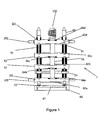
- a multibeam klystron (1) includes a number of beam tubes (51) disposed on a substantially circular path about a central axially-disposed vacuum channel (56). Each of the beam paths is confined in a respective beam tube (51) which extends longitudinally of the klystron (1) from a respective cathode (55) disposed at the base of the Klystron (1) to a common collector (60) disposed a the top of the Klystron (1).
- the beam tubes (51) extend from the top side of the input cavity (102) into a second harmonic cavity structure (54) (which will again be described more fully herein) and from the top side of the second harmonic cavity (54) to open into the lower wall of a first gain or bunching cavity (53).
- the beam tube then continues from the top side of the first bunching cavity (53) to open into a second gain or bunching cavity (52).
- the tube continues from the upper wall of the second bunching or gain cavity (52) into an output cavity (201).
- the common collector structure (60) extends upwardly from the top wall of the output cavity (201).
- the output cavity (201) has an output wave guide (202) associated with it.
- Solenoid coils (61) are disposed around each of the beam tubes for focusing the beam in each tube.
- Each of the input (101), output (201) and bunching (52, 53) cavities has a respective fine tuning member (621-62d) and a respective RF absorber (64a-64d) disposed around its vacuum port. These will be more fully described later herein.
- the common vacuum channel (56) is, in this embodiment, pumped by a common vacuum pump (150) which is adapted to provide a good level of vacuum, typically 10 exp-8mbar or better.
- each of the cavities namely the input cavity (101), the second harmonic cavity (54), the bunching cavities (52, 53) and the output cavity (201), are disposed neutrally parallel and in respective horizontal planes.
- A- high voltage ceramic seal (66) supports a member (67) which carries the cathodes (55).
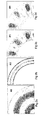
- Figures 2a and 2d depict modes in a disc shape (radial) cavity
- Figures 2b and 2c represent modes in an annular (waveguide type) cavity.
- These modes have very different R / Q values ( R / Q gives the square of the voltage as seen by the beam for a given stored energy in the cavity).
- One prior MBK has a simple TM 0,1,0 (pillbox) cavity.
- the beamlets typically between 6 and 30
- very high efficiencies 80 % have been demonstrated, but they have been achieved for relatively low RF power levels (tens of kW). Getting a higher power out of this device would require an increase in the beam current, which for this geometry is soon limited by both space charge effects and cathode loading.
- a 1.3 GHz, 10 MW, 6-beam MBK for example, uses the TM 0,2,0 mode (see Fig. 2a ).
- the present invention has a disc-shaped cavity, and preferred embodiments use a high-azimuthal-order TM m ,1,0 mode.
- An embodiment has 27 beams (see Fig. 3d). In this device the total number of beamlets is equal to about twice the index m of the operating mode.
- TM m,n,q modes with large m can easily be made extremely sparse.
- a major property of whispering gallery modes is that the majority of the energy is at or close to the outer wall of a curved cavity or waveguide.
- Figure 3a shows a vertical cross-section through an exemplary cavity along a plane passing through the axis.
- Figure 3b shows a horizontal cross-section through the cavity along the line b-b'.
- the cavities (101,102) are each defined by a generally closed generally circular-cylindrical wall (110), forming a structure having a lower generally circular wall portion (111), an upper generally circular wall portion (112) and a cylindrical peripheral wall portion (113).
- the peripheral wall portion (113) allows for transfer therethrough of e.m. energy via one or more so-called “windows” as will be later described herein.
- the lower wall portion (111) has a central port (113) with a circular aperture for connection of the common vacuum channel (56).
- a circular RF absorber member (64) e.g. of SiC, which extends outwardly from the port (113) by a small amount.
- the outer radius of the RF absorber member (64) is such that the operating mode of the cavity is virtually unaffected.
- the function of the RF absorber is to reduce higher order radial index modes.
- a SiC absorber ring was placed at a position which produced a 10 % reduction of the operating mode Q -factor from 3.3 ⁇ 10 4 to 3.0 ⁇ 10 4 .
- the Q-factors of all modes with a radial index higher than 3 were reduced by a factor of more than 1000 in the frequency band investigated. It is assumed that a Q-factor reduction of about 100 is enough to eliminate any effects on the beam.
- the upper wall portion (112) likewise has an axial circular port (114) surrounded by a fine tuning member (62) for frequency tuning.
- the upper and lower wall portions (111,112) are each mainly planar, but each wall has a concentric annular inwardly dished region (111 a, 112a) at the same radial position for connection thereto of the beam pipes (51).
- the diameter of the beam pipe is small ( ⁇ 1/16 of the operating wavelength) and takes advantage of the low single-beam current and low frequency.
- fringe fields decay very rapidly resulting in a quasi-rectangular longitudinal electric field distribution.
- the electric field remains very constant, within 0.1 %, across the beam waist ( ⁇ /32).
- the inter-beam space charge effects are minimised by the fact that the transverse beam spacing in a cavity is about half a wavelength ( ⁇ 16 cm). A good level of vacuum is necessary (10 -8 mbar or better) to avoid beam instabilities due to ionisation of residual gas.
- the damped disc cavity unlike the other geometries, can be very well pumped by mounting a high vacuum conductivity port (diameter ⁇ 40 cm) on the central part of the cavity.
- the cavity impedance can be adjusted to the required value by a careful dimensioning of the RF absorber.
- Klystron cavities normally operate in a standing wave (SW) regime.
- the output cavity is a travelling-wave structure section where energy propagates in the longitudinal direction.
- a resonant rotating wave (RW (rotating wave)) regime is established, which can be viewed as superposition of two standing waves shifted in space and time by a quarter of a period. The resulting wave travels along the outer cavity wall in a rotating mode.
- RW rotating wave
- the RW (rotating wave) regime brings certain advantages. First of all, the number of beam lets is decoupled now from the azimuthal index of the operating mode and can be arbitrarily chosen, as with the TM 0, n ,0 mode. In embodiments the number of beamlets chosen is odd so that the coupling of beam current to the modes that have closest azimuthal indices will be additionally reduced. In tests, compared to SW, the RW (rotating wave) regime, for the same operating mode, reduces the single beam current by 25 %, so ensuring a higher efficiency.
- coupling to the input and output cavities is by a rectangular waveguide (304) running peripherally around the entire cavity (302).
- the cut-off frequency of the feeder (waveguide width) is chosen such that the phase velocities of the waves in both the waveguide and the cavity are identical at the operating frequency.
- coupling to the cavity (302) is made through many small coupling holes (320) in the wall (301) between the cavity and the waveguide (304).
- the distance between coupling holes is equal to a quarter of the operating mode wavelength - the total number of holes is therefore 4xm.
- Klystron ceramic output windows are probably the most delicate RF components in the whole system. Statistics for 10 years for example, showed that about 25 % of all klystron malfunctions were caused by RF window breakdown. In the described embodiment a multi-megawatt, mini-windows concept is used to exploit the properties of the damped disc cavity operating mode.
- the "window” is in fact a series of many mini-windows, each covering an individual coupling hole as shown in Fig. 5a .
- Each single mini-window (320) is first brazed into its own support (322) and then is electron-beam welded, or even clamped, into the inner wall (301) of the waveguide (304).
- Typical dimensions of the ceramic disc are 2 mm thickness and about 30 mm diameter.
- the damped disc cavity field configuration is such that there is no notable electric field at the mini-window location.
- Embodiments have high reliability. Following the MBK RF configuration, a system of individual solenoids (61) for each beamlet is used. By way of example, a focusing magnetic field of 600 G to 700 G is needed to steer each 150 kV, 15 A beam. A conventional solenoid requires about 1 kW per beamlet and this will reduce the overall klystron efficiency. In alternative embodiments PPM focusing methods are used, similar to those developed for the SLAC X band klystron.
- the current density is the parameter that defines the cathode configuration. It is exponentially proportional to the temperature, and also inversely proportional to the exponential of the work function of the cathode material [Richardson-Dushman equation]. To keep beam compression as low as possible cathode loading is desirably increased, but this would increase the surface temperature and reduce the lifetime. Oxides of alkaline earth metals such as barium and strontium are added to the tungsten cathode to reduce operating temperatures. The lifetime of a klystron is primarily determined by cathode end-of-life emission, a result of barium depletion at the cathode surface.
- the klystron Since the klystron has been conveniently divided up into separate beamlets that can be considered as stand-alone klystrons in parallel, some embodiments use individual collectors for each beamlet. However, the cooling of such a device becomes complicated when about 30 small collectors are connected up in parallel to a common water supply and this also appears to be expensive to manufacture.
- the important design parameters for the collector are the mean and peak power to be dissipated, and the surface area on which the electron beam impinges.
- the minimum amount of cooling water (turbulent flow) required is generally estimated as 3 litres/minute for each kilowatt of average RF power dissipated.
- a common collector 60
- each beam passing through its own pole piece at the output end of the tube, and allowed to expand in this magnetic-field-free region is employed.
- the overall gain (the ratio of peak output power to input drive power) will determine the minimum number of cavities that will be required. Where a small bandwidth is needed, for example ⁇ 3 %, it can be assumed that all gain cavities are tuned to approximately the same fundamental frequency and not stagger tuned.
- a second harmonic cavity structure (54) is formed by a member (500) which defines a set of individual TM 0,1,0 second harmonic cavities (501) for interacting with every single beamlet.
- the above described embodiment is typified by a multibeam klystron with 27 individual mini-klystron sectors, each of which produces about 4 % of the total power obtained from the common output cavity.
- Each single sector can in fact be treated as an individual device.
- a second embodiment instead of using a single beamlet in this sector ( Fig. 7a ), uses plural mini-beamlets such that each sector acts like a mini MBK, thus creating a Super MBK (SMBK).
- SMBK Super MBK
- the magnetic system as well as the second harmonic cavity remains unique for every mini MBK, i.e. for each sector.
- Such a SMBK may have one of two configurations.
- the first way ( Fig 7b ) uses a beam pipe with a larger radius, which can house at least 6 mini-beamlets. In this configuration the annular beam can also be considered as a very good candidate, but unfortunately the second harmonic cavity becomes rather inefficient.
- the second way ( Fig 7c ) uses individual beam pipes for each mini beam. In the example shown there a six mini-beams and hence six mini beam pipes.
- Modulators that provide the long voltage pulse ( ⁇ 100 ⁇ s) for either a MBK or SMBK device generate the same peak beam power.
- the beam voltage levels are different. If a classical modulator using a pulse transformer is considered then the lower voltage system enables a faster rise time since less turns are required on the secondary winding.
- the pulse transformer is also more compact due to the lower volt-seconds, and both leakage inductance and the self-capacitance of the windings are reduced. This improves the pulse response times and the energy efficiency by reducing the losses in the rise and fall of this voltage pulse.
- the voltage levels for both the MBK and SMBK are considerably lower than for an equivalent single beam klystron with the same output power, pulse width and duty cycle.
Landscapes
- Particle Accelerators (AREA)
- Microwave Tubes (AREA)
- Oscillators With Electromechanical Resonators (AREA)
- Amplifiers (AREA)
- Networks Using Active Elements (AREA)
- Microwave Amplifiers (AREA)
Claims (14)
- Klystron-Verstärker mit Mitteln, die eine Vielzahl von Elektronenstrahlwege definieren, und mit Mitteln, die mehrfach gedämpfte scheibenförmige Hohlräume definieren, wobei die Vielzahl von Elektronenstrahlwege die Hohlräume schneiden, und der Klystron-Verstärker weiters einen ringförmigen Eingangshohlraum und einen ringförmigen Ausgangshohlraum umfasst, die um den im Wesentlichen kreisförmigen äußeren Umfang der jeweiligen scheibenförmigen, mit ihnen in Verbindung stehenden Hohlräume herum angeordnet sind, wobei der Ausgangshohlraum vorgesehen ist, um die HF-Energie aus den Elektronenstrahlen aufzunehmen, dadurch gekennzeichnet, dass die Hohlräume angeordnet sind, um eine einzelne drehende Resonanzwelle in einem "whispering-Gallery"-Modus oder eine einzelne stehende Resonanzwelle in einem "Whispering-Gallery"-Modus zu unterstützen.
- Klystron-Verstärker nach Anspruch 1, welcher weiters eine Wand umfasst, die einen im Wesentlichen scheibenförmigen Hohlraum definiert, wobei die Wand zur Koppelung von Elektronenstrahlenergie daran eine oder mehrere Öffnungen aufweist, wobei der Hohlraum einen im Wesentlichen kreisförmigen äußeren Umfang aufweist, der ein Koppeln an einen im Wesentlichen ringförmigen Eingangs- oder Ausgangswellenleiter ermöglicht, wobei das Koppeln durch eine Vielzahl von Fenstern gewährt wird, die entlang des äußeren Umfangs des scheibenförmigen Hohlraums verteilt sind.
- Klystron-Verstärker nach Anspruch 2, wobei jedes Fenster ein Keramikelement umfasst, das an eine Wellenleiterwand befestigt ist.
- Klystron-Verstärker nach einem der vorangehenden Ansprüche, umfassend einen Eingangshohlraum, zwei Verstärkerhohlräume, einen zweiten harmonischen Hohlraum und einen Ausgangshohlraum.
- Klystron-Verstärker nach einem der vorangehenden Ansprüche, wobei zumindest ein Hohlraum ein darin angeordnetes HF-Absorberelement aufweist.
- Klystron-Verstärker nach einem der vorangehenden Ansprüche, wobei jeder Hohlraum eine Vakuumöffnung aufweist.
- Klystron-Verstärker nach Anspruch 6, wobei die Vakuumöffnung axial ist.
- Klystron-Verstärker nach Anspruch 6 oder 7 mit einem kreisförmigen HF-Absorberelement.
- Klystron-Verstärker nach Anspruch 8, wobei der Absorber aus SiC besteht und sich von der Vakuumöffnung um einen Anteil nach außen erstreckt, so dass der Betriebsmodus des Hohlraums praktisch nicht beeinflusst wird.
- Klystron-Verstärker nach einem der vorangehenden Ansprüche, der zum Betrieb in einem TMm,n,q-Modus angeordnet ist.
- Klystron-Verstärker nach einem der vorangehenden Ansprüche mit mehrfachen Strahlenröhren.
- Klystron-Verstärker nach Anspruch 11 mit einem Fokussier-Solenoid pro Strahlenröhre.
- Klystron-Verstärker nach einem der vorangehenden Ansprüche mit einer Wellenleiter um jeden Eingangs- und Ausgangshohlraum herum.
- Klystron-Verstärker nach einem der vorangehenden Ansprüche, wobei der Abstand des transversalen Strahls in einem Hohlraum einer halben Wellenlänge entspricht.
Applications Claiming Priority (1)
| Application Number | Priority Date | Filing Date | Title |
|---|---|---|---|
| PCT/EP2003/014805 WO2005059946A1 (en) | 2003-12-19 | 2003-12-19 | Klystron amplifier |
Publications (2)
| Publication Number | Publication Date |
|---|---|
| EP1702346A1 EP1702346A1 (de) | 2006-09-20 |
| EP1702346B1 true EP1702346B1 (de) | 2008-05-07 |
Family
ID=34684506
Family Applications (1)
| Application Number | Title | Priority Date | Filing Date |
|---|---|---|---|
| EP03819131A Expired - Lifetime EP1702346B1 (de) | 2003-12-19 | 2003-12-19 | Klystron-verstärker |
Country Status (7)
| Country | Link |
|---|---|
| US (1) | US7446478B2 (de) |
| EP (1) | EP1702346B1 (de) |
| JP (1) | JP4584147B2 (de) |
| AT (1) | ATE394788T1 (de) |
| AU (1) | AU2003300547A1 (de) |
| DE (1) | DE60320870D1 (de) |
| WO (1) | WO2005059946A1 (de) |
Families Citing this family (14)
| Publication number | Priority date | Publication date | Assignee | Title |
|---|---|---|---|---|
| WO2009123593A1 (en) * | 2008-04-03 | 2009-10-08 | Patrick Ferguson | Hollow beam electron gun for use in a klystron |
| US8847489B2 (en) * | 2009-10-21 | 2014-09-30 | Omega P-Inc. | Low-voltage, multi-beam klystron |
| US8994297B2 (en) * | 2009-10-21 | 2015-03-31 | Omega P Inc. | Low-voltage, Multi-Beam Klystron |
| US8547006B1 (en) | 2010-02-12 | 2013-10-01 | Calabazas Creek Research, Inc. | Electron gun for a multiple beam klystron with magnetic compression of the electron beams |
| US9013104B1 (en) * | 2013-04-22 | 2015-04-21 | Calabazas Creek Research, Inc. | Periodic permanent magnet focused klystron |
| CN104752125A (zh) * | 2013-12-31 | 2015-07-01 | 中国科学院电子学研究所 | 高次模同轴输出腔 |
| CN104752124A (zh) * | 2013-12-31 | 2015-07-01 | 中国科学院电子学研究所 | 高次模圆柱输出腔 |
| JP6401485B2 (ja) * | 2014-04-14 | 2018-10-10 | 東芝電子管デバイス株式会社 | 多空胴クライストロン |
| CN108899262B (zh) * | 2018-06-20 | 2020-02-18 | 电子科技大学 | 一种速调管tesla理论输入腔耦合项处理方法 |
| EP4310881A4 (de) * | 2021-03-17 | 2025-07-16 | Canon Electron Tubes & Devices Co Ltd | Klystron |
| CN115440550B (zh) * | 2021-06-04 | 2024-12-17 | 中国科学院空天信息创新研究院 | 一种抑制速调管输出电路振荡的结构、方法及速调管 |
| CN113764242B (zh) * | 2021-07-30 | 2023-06-20 | 中国工程物理研究院应用电子学研究所 | 一种共形输入耦合小型化相对论速调管放大器 |
| CN113838727B (zh) * | 2021-09-16 | 2023-06-16 | 电子科技大学 | 一种基于单脊CeSRR单元的小型化大功率速调管 |
| CN116153745B (zh) * | 2022-12-01 | 2026-04-03 | 电子科技大学 | 一种基于速调管实现高增益锁频锁相的阵列化振荡器 |
Family Cites Families (11)
| Publication number | Priority date | Publication date | Assignee | Title |
|---|---|---|---|---|
| US3390300A (en) * | 1965-10-22 | 1968-06-25 | Varian Associates | High frequency electron discharge devices of the klystron type incorporating below cut-off waveguide leaky wall h-field tuners |
| US4024426A (en) * | 1973-11-30 | 1977-05-17 | Varian Associates, Inc. | Standing-wave linear accelerator |
| IT1202869B (it) * | 1979-01-24 | 1989-02-15 | Sits Soc It Telecom Siemens | Klystron oscillatore a due cavita' |
| FR2596199B1 (fr) * | 1986-03-19 | 1994-03-18 | Thomson Csf | Circuit de sortie pour klystron et klystron comportant un tel circuit de sortie |
| FR2658000B1 (fr) * | 1990-02-02 | 1992-04-17 | Thomson Tubes Electroniques | Tube hyperfrequence multifaisceau a groupes de cavites adjacentes. |
| US5132638A (en) * | 1991-01-16 | 1992-07-21 | The United States Of America As Represented By The Secretary Of The Navy | High power klystron amplifier |
| FR2672730B1 (fr) * | 1991-02-12 | 1993-04-23 | Thomson Tubes Electroniques | Dispositif convertisseur de modes et diviseur de puissance pour tube hyperfrequence et tube hyperfrequence comprenant un tel dispositif. |
| KR0140501B1 (ko) * | 1993-05-27 | 1998-06-01 | 김광호 | 전자렌지 |
| US5469022A (en) * | 1993-07-30 | 1995-11-21 | Litton Systems, Inc. | Extended interaction output circuit using modified disk-loaded waveguide |
| US5698949A (en) * | 1995-03-28 | 1997-12-16 | Communications & Power Industries, Inc. | Hollow beam electron tube having TM0x0 resonators, where X is greater than 1 |
| US5811943A (en) * | 1996-09-23 | 1998-09-22 | Schonberg Research Corporation | Hollow-beam microwave linear accelerator |
-
2003
- 2003-12-19 AT AT03819131T patent/ATE394788T1/de not_active IP Right Cessation
- 2003-12-19 AU AU2003300547A patent/AU2003300547A1/en not_active Abandoned
- 2003-12-19 EP EP03819131A patent/EP1702346B1/de not_active Expired - Lifetime
- 2003-12-19 WO PCT/EP2003/014805 patent/WO2005059946A1/en not_active Ceased
- 2003-12-19 JP JP2005512172A patent/JP4584147B2/ja not_active Expired - Fee Related
- 2003-12-19 US US10/583,026 patent/US7446478B2/en not_active Expired - Fee Related
- 2003-12-19 DE DE60320870T patent/DE60320870D1/de not_active Expired - Lifetime
Also Published As
| Publication number | Publication date |
|---|---|
| AU2003300547A1 (en) | 2005-07-05 |
| DE60320870D1 (de) | 2008-06-19 |
| EP1702346A1 (de) | 2006-09-20 |
| US20070146084A1 (en) | 2007-06-28 |
| WO2005059946A1 (en) | 2005-06-30 |
| ATE394788T1 (de) | 2008-05-15 |
| US7446478B2 (en) | 2008-11-04 |
| JP4584147B2 (ja) | 2010-11-17 |
| JP2007524186A (ja) | 2007-08-23 |
Similar Documents
| Publication | Publication Date | Title |
|---|---|---|
| EP1702346B1 (de) | Klystron-verstärker | |
| US4851788A (en) | Mode suppressors for whispering gallery gyrotron | |
| US3221204A (en) | Traveling-wave tube with trap means for preventing oscillation at unwanted frequencies | |
| US8018159B2 (en) | Magnetron device with mode converter and related methods | |
| WO2009123593A1 (en) | Hollow beam electron gun for use in a klystron | |
| US11545329B2 (en) | THz vacuum electronic devices with micro-fabricated electromagnetic circuits | |
| US4891557A (en) | Magnetron device | |
| US2858472A (en) | Slow-wave circuit for a traveling wave tube | |
| Phillips et al. | High-power klystrons for the next linear collider | |
| Yong et al. | Development of an S-band klystron with bandwidth of more than 11% | |
| US5668442A (en) | Plasma-assisted tube with helical slow-wave structure | |
| EP0883152B1 (de) | Coaxiale Röhre mit induktivem Ausgang | |
| JPS61179030A (ja) | 電子ビ−ムのガイド装置 | |
| US4742271A (en) | Radial-gain/axial-gain crossed-field amplifier (radaxtron) | |
| Jensen et al. | A novel idea for a CLIC 937 MHz 50 MW multibeam klystron | |
| Jensen et al. | CLIC 50 MW L-band multi-beam klystron | |
| RU2244980C1 (ru) | Многолучевой прибор о-типа | |
| RU2364977C1 (ru) | Свч-прибор о-типа | |
| US3250947A (en) | Discharge device having electron grids with heights rising substantially above the grid support rims | |
| JPS59114730A (ja) | 競合によるモ−ド減少のための多重径空胴のジヤイロトロン発振器 | |
| US6384537B2 (en) | Double loop output system for magnetron | |
| RU2239256C1 (ru) | Многолучевой клистрон | |
| RU2507626C1 (ru) | Многолучевой свч прибор о-типа | |
| Guzilov | 6 kW L-band pulsed MBK with broad frequency band of 15% | |
| RU2804521C1 (ru) | Многолучевой клистрон |
Legal Events
| Date | Code | Title | Description |
|---|---|---|---|
| PUAI | Public reference made under article 153(3) epc to a published international application that has entered the european phase |
Free format text: ORIGINAL CODE: 0009012 |
|
| 17P | Request for examination filed |
Effective date: 20060718 |
|
| AK | Designated contracting states |
Kind code of ref document: A1 Designated state(s): AT BE BG CH CY CZ DE DK EE ES FI FR GB GR HU IE IT LI LU MC NL PT RO SE SI SK TR |
|
| DAX | Request for extension of the european patent (deleted) | ||
| GRAP | Despatch of communication of intention to grant a patent |
Free format text: ORIGINAL CODE: EPIDOSNIGR1 |
|
| GRAS | Grant fee paid |
Free format text: ORIGINAL CODE: EPIDOSNIGR3 |
|
| GRAA | (expected) grant |
Free format text: ORIGINAL CODE: 0009210 |
|
| AK | Designated contracting states |
Kind code of ref document: B1 Designated state(s): AT BE BG CH CY CZ DE DK EE ES FI FR GB GR HU IE IT LI LU MC NL PT RO SE SI SK TR |
|
| REG | Reference to a national code |
Ref country code: GB Ref legal event code: FG4D |
|
| REG | Reference to a national code |
Ref country code: CH Ref legal event code: EP |
|
| REG | Reference to a national code |
Ref country code: IE Ref legal event code: FG4D Free format text: LANGUAGE OF EP DOCUMENT: FRENCH |
|
| REF | Corresponds to: |
Ref document number: 60320870 Country of ref document: DE Date of ref document: 20080619 Kind code of ref document: P |
|
| PG25 | Lapsed in a contracting state [announced via postgrant information from national office to epo] |
Ref country code: SI Free format text: LAPSE BECAUSE OF FAILURE TO SUBMIT A TRANSLATION OF THE DESCRIPTION OR TO PAY THE FEE WITHIN THE PRESCRIBED TIME-LIMIT Effective date: 20080507 |
|
| PG25 | Lapsed in a contracting state [announced via postgrant information from national office to epo] |
Ref country code: NL Free format text: LAPSE BECAUSE OF FAILURE TO SUBMIT A TRANSLATION OF THE DESCRIPTION OR TO PAY THE FEE WITHIN THE PRESCRIBED TIME-LIMIT Effective date: 20080507 Ref country code: ES Free format text: LAPSE BECAUSE OF FAILURE TO SUBMIT A TRANSLATION OF THE DESCRIPTION OR TO PAY THE FEE WITHIN THE PRESCRIBED TIME-LIMIT Effective date: 20080818 Ref country code: FI Free format text: LAPSE BECAUSE OF FAILURE TO SUBMIT A TRANSLATION OF THE DESCRIPTION OR TO PAY THE FEE WITHIN THE PRESCRIBED TIME-LIMIT Effective date: 20080507 |
|
| NLV1 | Nl: lapsed or annulled due to failure to fulfill the requirements of art. 29p and 29m of the patents act | ||
| PG25 | Lapsed in a contracting state [announced via postgrant information from national office to epo] |
Ref country code: AT Free format text: LAPSE BECAUSE OF FAILURE TO SUBMIT A TRANSLATION OF THE DESCRIPTION OR TO PAY THE FEE WITHIN THE PRESCRIBED TIME-LIMIT Effective date: 20080507 |
|
| PG25 | Lapsed in a contracting state [announced via postgrant information from national office to epo] |
Ref country code: CZ Free format text: LAPSE BECAUSE OF FAILURE TO SUBMIT A TRANSLATION OF THE DESCRIPTION OR TO PAY THE FEE WITHIN THE PRESCRIBED TIME-LIMIT Effective date: 20080507 Ref country code: DK Free format text: LAPSE BECAUSE OF FAILURE TO SUBMIT A TRANSLATION OF THE DESCRIPTION OR TO PAY THE FEE WITHIN THE PRESCRIBED TIME-LIMIT Effective date: 20080507 Ref country code: SE Free format text: LAPSE BECAUSE OF FAILURE TO SUBMIT A TRANSLATION OF THE DESCRIPTION OR TO PAY THE FEE WITHIN THE PRESCRIBED TIME-LIMIT Effective date: 20080807 Ref country code: PT Free format text: LAPSE BECAUSE OF FAILURE TO SUBMIT A TRANSLATION OF THE DESCRIPTION OR TO PAY THE FEE WITHIN THE PRESCRIBED TIME-LIMIT Effective date: 20081007 |
|
| PG25 | Lapsed in a contracting state [announced via postgrant information from national office to epo] |
Ref country code: BE Free format text: LAPSE BECAUSE OF FAILURE TO SUBMIT A TRANSLATION OF THE DESCRIPTION OR TO PAY THE FEE WITHIN THE PRESCRIBED TIME-LIMIT Effective date: 20080507 Ref country code: SK Free format text: LAPSE BECAUSE OF FAILURE TO SUBMIT A TRANSLATION OF THE DESCRIPTION OR TO PAY THE FEE WITHIN THE PRESCRIBED TIME-LIMIT Effective date: 20080507 Ref country code: RO Free format text: LAPSE BECAUSE OF FAILURE TO SUBMIT A TRANSLATION OF THE DESCRIPTION OR TO PAY THE FEE WITHIN THE PRESCRIBED TIME-LIMIT Effective date: 20080507 |
|
| PLBE | No opposition filed within time limit |
Free format text: ORIGINAL CODE: 0009261 |
|
| STAA | Information on the status of an ep patent application or granted ep patent |
Free format text: STATUS: NO OPPOSITION FILED WITHIN TIME LIMIT |
|
| 26N | No opposition filed |
Effective date: 20090210 |
|
| PG25 | Lapsed in a contracting state [announced via postgrant information from national office to epo] |
Ref country code: EE Free format text: LAPSE BECAUSE OF FAILURE TO SUBMIT A TRANSLATION OF THE DESCRIPTION OR TO PAY THE FEE WITHIN THE PRESCRIBED TIME-LIMIT Effective date: 20080507 Ref country code: BG Free format text: LAPSE BECAUSE OF FAILURE TO SUBMIT A TRANSLATION OF THE DESCRIPTION OR TO PAY THE FEE WITHIN THE PRESCRIBED TIME-LIMIT Effective date: 20080807 |
|
| PG25 | Lapsed in a contracting state [announced via postgrant information from national office to epo] |
Ref country code: MC Free format text: LAPSE BECAUSE OF NON-PAYMENT OF DUE FEES Effective date: 20081231 |
|
| REG | Reference to a national code |
Ref country code: CH Ref legal event code: PL |
|
| PG25 | Lapsed in a contracting state [announced via postgrant information from national office to epo] |
Ref country code: IT Free format text: LAPSE BECAUSE OF FAILURE TO SUBMIT A TRANSLATION OF THE DESCRIPTION OR TO PAY THE FEE WITHIN THE PRESCRIBED TIME-LIMIT Effective date: 20080507 |
|
| REG | Reference to a national code |
Ref country code: IE Ref legal event code: MM4A |
|
| PG25 | Lapsed in a contracting state [announced via postgrant information from national office to epo] |
Ref country code: CH Free format text: LAPSE BECAUSE OF NON-PAYMENT OF DUE FEES Effective date: 20081231 Ref country code: LI Free format text: LAPSE BECAUSE OF NON-PAYMENT OF DUE FEES Effective date: 20081231 Ref country code: IE Free format text: LAPSE BECAUSE OF NON-PAYMENT OF DUE FEES Effective date: 20081219 |
|
| PG25 | Lapsed in a contracting state [announced via postgrant information from national office to epo] |
Ref country code: LU Free format text: LAPSE BECAUSE OF NON-PAYMENT OF DUE FEES Effective date: 20081219 Ref country code: CY Free format text: LAPSE BECAUSE OF FAILURE TO SUBMIT A TRANSLATION OF THE DESCRIPTION OR TO PAY THE FEE WITHIN THE PRESCRIBED TIME-LIMIT Effective date: 20080507 Ref country code: HU Free format text: LAPSE BECAUSE OF FAILURE TO SUBMIT A TRANSLATION OF THE DESCRIPTION OR TO PAY THE FEE WITHIN THE PRESCRIBED TIME-LIMIT Effective date: 20081108 |
|
| PG25 | Lapsed in a contracting state [announced via postgrant information from national office to epo] |
Ref country code: TR Free format text: LAPSE BECAUSE OF FAILURE TO SUBMIT A TRANSLATION OF THE DESCRIPTION OR TO PAY THE FEE WITHIN THE PRESCRIBED TIME-LIMIT Effective date: 20080507 |
|
| PG25 | Lapsed in a contracting state [announced via postgrant information from national office to epo] |
Ref country code: GR Free format text: LAPSE BECAUSE OF FAILURE TO SUBMIT A TRANSLATION OF THE DESCRIPTION OR TO PAY THE FEE WITHIN THE PRESCRIBED TIME-LIMIT Effective date: 20080808 |
|
| PGFP | Annual fee paid to national office [announced via postgrant information from national office to epo] |
Ref country code: FR Payment date: 20101224 Year of fee payment: 8 |
|
| PGFP | Annual fee paid to national office [announced via postgrant information from national office to epo] |
Ref country code: GB Payment date: 20101215 Year of fee payment: 8 |
|
| PGFP | Annual fee paid to national office [announced via postgrant information from national office to epo] |
Ref country code: DE Payment date: 20101215 Year of fee payment: 8 |
|
| GBPC | Gb: european patent ceased through non-payment of renewal fee |
Effective date: 20111219 |
|
| REG | Reference to a national code |
Ref country code: FR Ref legal event code: ST Effective date: 20120831 |
|
| REG | Reference to a national code |
Ref country code: DE Ref legal event code: R119 Ref document number: 60320870 Country of ref document: DE Effective date: 20120703 |
|
| PG25 | Lapsed in a contracting state [announced via postgrant information from national office to epo] |
Ref country code: GB Free format text: LAPSE BECAUSE OF NON-PAYMENT OF DUE FEES Effective date: 20111219 Ref country code: DE Free format text: LAPSE BECAUSE OF NON-PAYMENT OF DUE FEES Effective date: 20120703 |
|
| PG25 | Lapsed in a contracting state [announced via postgrant information from national office to epo] |
Ref country code: FR Free format text: LAPSE BECAUSE OF NON-PAYMENT OF DUE FEES Effective date: 20120102 |