EP1702375B1 - Kohlenstoffbeschichtete siliziumpartikelleistung als anodenmaterial für lithiumionenbatterien und herstellungsverfahren dafür - Google Patents
Kohlenstoffbeschichtete siliziumpartikelleistung als anodenmaterial für lithiumionenbatterien und herstellungsverfahren dafür Download PDFInfo
- Publication number
- EP1702375B1 EP1702375B1 EP04821041.3A EP04821041A EP1702375B1 EP 1702375 B1 EP1702375 B1 EP 1702375B1 EP 04821041 A EP04821041 A EP 04821041A EP 1702375 B1 EP1702375 B1 EP 1702375B1
- Authority
- EP
- European Patent Office
- Prior art keywords
- particles
- forming material
- silicon
- coated
- carbon residue
- Prior art date
- Legal status (The legal status is an assumption and is not a legal conclusion. Google has not performed a legal analysis and makes no representation as to the accuracy of the status listed.)
- Expired - Lifetime
Links
Images


Classifications
-
- H—ELECTRICITY
- H01—ELECTRIC ELEMENTS
- H01M—PROCESSES OR MEANS, e.g. BATTERIES, FOR THE DIRECT CONVERSION OF CHEMICAL ENERGY INTO ELECTRICAL ENERGY
- H01M4/00—Electrodes
- H01M4/02—Electrodes composed of, or comprising, active material
- H01M4/36—Selection of substances as active materials, active masses, active liquids
-
- C—CHEMISTRY; METALLURGY
- C25—ELECTROLYTIC OR ELECTROPHORETIC PROCESSES; APPARATUS THEREFOR
- C25D—PROCESSES FOR THE ELECTROLYTIC OR ELECTROPHORETIC PRODUCTION OF COATINGS; ELECTROFORMING; APPARATUS THEREFOR
- C25D17/00—Constructional parts, or assemblies thereof, of cells for electrolytic coating
- C25D17/10—Electrodes, e.g. composition, counter electrode
-
- H—ELECTRICITY
- H01—ELECTRIC ELEMENTS
- H01M—PROCESSES OR MEANS, e.g. BATTERIES, FOR THE DIRECT CONVERSION OF CHEMICAL ENERGY INTO ELECTRICAL ENERGY
- H01M4/00—Electrodes
- H01M4/02—Electrodes composed of, or comprising, active material
- H01M4/04—Processes of manufacture in general
- H01M4/0402—Methods of deposition of the material
- H01M4/0416—Methods of deposition of the material involving impregnation with a solution, dispersion, paste or dry powder
-
- H—ELECTRICITY
- H01—ELECTRIC ELEMENTS
- H01M—PROCESSES OR MEANS, e.g. BATTERIES, FOR THE DIRECT CONVERSION OF CHEMICAL ENERGY INTO ELECTRICAL ENERGY
- H01M4/00—Electrodes
- H01M4/02—Electrodes composed of, or comprising, active material
- H01M4/04—Processes of manufacture in general
- H01M4/0471—Processes of manufacture in general involving thermal treatment, e.g. firing, sintering, backing particulate active material, thermal decomposition, pyrolysis
-
- H—ELECTRICITY
- H01—ELECTRIC ELEMENTS
- H01M—PROCESSES OR MEANS, e.g. BATTERIES, FOR THE DIRECT CONVERSION OF CHEMICAL ENERGY INTO ELECTRICAL ENERGY
- H01M4/00—Electrodes
- H01M4/02—Electrodes composed of, or comprising, active material
- H01M4/13—Electrodes for accumulators with non-aqueous electrolyte, e.g. for lithium-accumulators; Processes of manufacture thereof
-
- H—ELECTRICITY
- H01—ELECTRIC ELEMENTS
- H01M—PROCESSES OR MEANS, e.g. BATTERIES, FOR THE DIRECT CONVERSION OF CHEMICAL ENERGY INTO ELECTRICAL ENERGY
- H01M4/00—Electrodes
- H01M4/02—Electrodes composed of, or comprising, active material
- H01M4/13—Electrodes for accumulators with non-aqueous electrolyte, e.g. for lithium-accumulators; Processes of manufacture thereof
- H01M4/133—Electrodes based on carbonaceous material, e.g. graphite-intercalation compounds or CFx
-
- H—ELECTRICITY
- H01—ELECTRIC ELEMENTS
- H01M—PROCESSES OR MEANS, e.g. BATTERIES, FOR THE DIRECT CONVERSION OF CHEMICAL ENERGY INTO ELECTRICAL ENERGY
- H01M4/00—Electrodes
- H01M4/02—Electrodes composed of, or comprising, active material
- H01M4/13—Electrodes for accumulators with non-aqueous electrolyte, e.g. for lithium-accumulators; Processes of manufacture thereof
- H01M4/134—Electrodes based on metals, Si or alloys
-
- H—ELECTRICITY
- H01—ELECTRIC ELEMENTS
- H01M—PROCESSES OR MEANS, e.g. BATTERIES, FOR THE DIRECT CONVERSION OF CHEMICAL ENERGY INTO ELECTRICAL ENERGY
- H01M4/00—Electrodes
- H01M4/02—Electrodes composed of, or comprising, active material
- H01M4/36—Selection of substances as active materials, active masses, active liquids
- H01M4/362—Composites
- H01M4/366—Composites as layered products
-
- H—ELECTRICITY
- H01—ELECTRIC ELEMENTS
- H01M—PROCESSES OR MEANS, e.g. BATTERIES, FOR THE DIRECT CONVERSION OF CHEMICAL ENERGY INTO ELECTRICAL ENERGY
- H01M4/00—Electrodes
- H01M4/02—Electrodes composed of, or comprising, active material
- H01M4/36—Selection of substances as active materials, active masses, active liquids
- H01M4/38—Selection of substances as active materials, active masses, active liquids of elements or alloys
-
- H—ELECTRICITY
- H01—ELECTRIC ELEMENTS
- H01M—PROCESSES OR MEANS, e.g. BATTERIES, FOR THE DIRECT CONVERSION OF CHEMICAL ENERGY INTO ELECTRICAL ENERGY
- H01M4/00—Electrodes
- H01M4/02—Electrodes composed of, or comprising, active material
- H01M4/36—Selection of substances as active materials, active masses, active liquids
- H01M4/58—Selection of substances as active materials, active masses, active liquids of inorganic compounds other than oxides or hydroxides, e.g. sulfides, selenides, tellurides, halogenides or LiCoFy; of polyanionic structures, e.g. phosphates, silicates or borates
-
- H—ELECTRICITY
- H01—ELECTRIC ELEMENTS
- H01M—PROCESSES OR MEANS, e.g. BATTERIES, FOR THE DIRECT CONVERSION OF CHEMICAL ENERGY INTO ELECTRICAL ENERGY
- H01M4/00—Electrodes
- H01M4/02—Electrodes composed of, or comprising, active material
- H01M4/36—Selection of substances as active materials, active masses, active liquids
- H01M4/58—Selection of substances as active materials, active masses, active liquids of inorganic compounds other than oxides or hydroxides, e.g. sulfides, selenides, tellurides, halogenides or LiCoFy; of polyanionic structures, e.g. phosphates, silicates or borates
- H01M4/583—Carbonaceous material, e.g. graphite-intercalation compounds or CFx
-
- H—ELECTRICITY
- H01—ELECTRIC ELEMENTS
- H01M—PROCESSES OR MEANS, e.g. BATTERIES, FOR THE DIRECT CONVERSION OF CHEMICAL ENERGY INTO ELECTRICAL ENERGY
- H01M10/00—Secondary cells; Manufacture thereof
- H01M10/05—Accumulators with non-aqueous electrolyte
- H01M10/052—Li-accumulators
- H01M10/0525—Rocking-chair batteries, i.e. batteries with lithium insertion or intercalation in both electrodes; Lithium-ion batteries
-
- H—ELECTRICITY
- H01—ELECTRIC ELEMENTS
- H01M—PROCESSES OR MEANS, e.g. BATTERIES, FOR THE DIRECT CONVERSION OF CHEMICAL ENERGY INTO ELECTRICAL ENERGY
- H01M4/00—Electrodes
- H01M4/02—Electrodes composed of, or comprising, active material
- H01M2004/021—Physical characteristics, e.g. porosity, surface area
-
- H—ELECTRICITY
- H01—ELECTRIC ELEMENTS
- H01M—PROCESSES OR MEANS, e.g. BATTERIES, FOR THE DIRECT CONVERSION OF CHEMICAL ENERGY INTO ELECTRICAL ENERGY
- H01M4/00—Electrodes
- H01M4/02—Electrodes composed of, or comprising, active material
- H01M2004/026—Electrodes composed of, or comprising, active material characterised by the polarity
- H01M2004/027—Negative electrodes
-
- Y—GENERAL TAGGING OF NEW TECHNOLOGICAL DEVELOPMENTS; GENERAL TAGGING OF CROSS-SECTIONAL TECHNOLOGIES SPANNING OVER SEVERAL SECTIONS OF THE IPC; TECHNICAL SUBJECTS COVERED BY FORMER USPC CROSS-REFERENCE ART COLLECTIONS [XRACs] AND DIGESTS
- Y02—TECHNOLOGIES OR APPLICATIONS FOR MITIGATION OR ADAPTATION AGAINST CLIMATE CHANGE
- Y02E—REDUCTION OF GREENHOUSE GAS [GHG] EMISSIONS, RELATED TO ENERGY GENERATION, TRANSMISSION OR DISTRIBUTION
- Y02E60/00—Enabling technologies; Technologies with a potential or indirect contribution to GHG emissions mitigation
- Y02E60/10—Energy storage using batteries
-
- Y—GENERAL TAGGING OF NEW TECHNOLOGICAL DEVELOPMENTS; GENERAL TAGGING OF CROSS-SECTIONAL TECHNOLOGIES SPANNING OVER SEVERAL SECTIONS OF THE IPC; TECHNICAL SUBJECTS COVERED BY FORMER USPC CROSS-REFERENCE ART COLLECTIONS [XRACs] AND DIGESTS
- Y10—TECHNICAL SUBJECTS COVERED BY FORMER USPC
- Y10T—TECHNICAL SUBJECTS COVERED BY FORMER US CLASSIFICATION
- Y10T29/00—Metal working
- Y10T29/49—Method of mechanical manufacture
- Y10T29/49002—Electrical device making
- Y10T29/49108—Electric battery cell making
-
- Y—GENERAL TAGGING OF NEW TECHNOLOGICAL DEVELOPMENTS; GENERAL TAGGING OF CROSS-SECTIONAL TECHNOLOGIES SPANNING OVER SEVERAL SECTIONS OF THE IPC; TECHNICAL SUBJECTS COVERED BY FORMER USPC CROSS-REFERENCE ART COLLECTIONS [XRACs] AND DIGESTS
- Y10—TECHNICAL SUBJECTS COVERED BY FORMER USPC
- Y10T—TECHNICAL SUBJECTS COVERED BY FORMER US CLASSIFICATION
- Y10T29/00—Metal working
- Y10T29/53—Means to assemble or disassemble
- Y10T29/5313—Means to assemble electrical device
- Y10T29/53135—Storage cell or battery
-
- Y—GENERAL TAGGING OF NEW TECHNOLOGICAL DEVELOPMENTS; GENERAL TAGGING OF CROSS-SECTIONAL TECHNOLOGIES SPANNING OVER SEVERAL SECTIONS OF THE IPC; TECHNICAL SUBJECTS COVERED BY FORMER USPC CROSS-REFERENCE ART COLLECTIONS [XRACs] AND DIGESTS
- Y10—TECHNICAL SUBJECTS COVERED BY FORMER USPC
- Y10T—TECHNICAL SUBJECTS COVERED BY FORMER US CLASSIFICATION
- Y10T428/00—Stock material or miscellaneous articles
- Y10T428/29—Coated or structually defined flake, particle, cell, strand, strand portion, rod, filament, macroscopic fiber or mass thereof
- Y10T428/2982—Particulate matter [e.g., sphere, flake, etc.]
- Y10T428/2991—Coated
- Y10T428/2993—Silicic or refractory material containing [e.g., tungsten oxide, glass, cement, etc.]
- Y10T428/2995—Silane, siloxane or silicone coating
Definitions
- the present invention relates to silicon/carbon composite materials that are useful as electrode active materials in batteries. More particularly, the present invention relates to carbon-coated silicon particles that find particular use as electrode materials, as well as methods for the manufacture of said carbon-coated silicon particles.
- Synthetic graphites are widely used as standard negative electrode materials in lithium ion batteries. Other carbonaceous materials are also widely used in such batteries due to their efficiency and reasonable cost. Lithium ion batteries are primarily used as power sources in portable electronic devices. Compared to other classes of rechargeable batteries such as nickel-cadmium and nickel-metal hydride storage cells, lithium ion cells have become increasingly popular due to relatively high storage capacity and rechargeability.
- lithium ion cells Due to increased storage capacity per unit mass or unit volume over similarly rated nickel-cadmium and nickel-metal hydride storage cells, the smaller space requirements of lithium ion cells allow production of cells that meet specific storage and delivery requirements. Consequently, lithium ion cells are popularly used in a growing number of devices, such as digital cameras, digital video recorders, computers, etc., where compact size is particularly desirable from a utility standpoint
- rechargeable lithium ion storage cells are not without deficiencies. These deficiencies may be minimized with the use of improved materials of construction.
- Commercial lithium ion batteries which use synthetic graphite electrodes are expensive to produce and have low relatively lithium capacities.
- graphite products currently used in lithium ion electrodes are near their theoretical limits for energy storage (372mAhr/g). Accordingly, there is a need in the art for improved electrode materials that reduce the cost of rechargeable lithium batteries and provide improved operating characteristics, such as higher energy density, greater reversible capacity and greater initial charge efficiency. There also exists a need for improved methods for the manufacture of such electrode materials.
- Silicon has been investigated as an anode material for lithium ion batteries because silicon can alloy with a relatively large amount of lithium, providing greater storage capacity. In fact, silicon has a theoretical lithium capacity of more than ten times that of graphite. However, pure silicon is a poor electrode material because its unit cell volume can increase to more than 300% when lithiated. This volume expansion during cycling destroys the mechanical integrity of the electrode and leads to a rapid capacity loss during battery cycling. Although silicon can hold more lithium than carbon, when lithium is introduced to silicon, the silicon disintegrates and results in less electrical contact which ultimately results in decreased ability to recharge the storage cell.
- Silicon/carbon composite particles or powders have good cycle life compared to mechanical mixtures of carbon and silicon powders made by milling or other mechanical methods.
- Thin film silicon-coated carbon particles or carbon-coated silicon powders are potential replacements for graphite powders as the anode material for next generation lithium ion batteries.
- chemical vapor deposition methods typically used to apply silicon coatings or carbon coatings have intrinsic shortcomings that include slow deposition rates and/or expensive precursors for deposition. Vapor deposited silicon films may be extremely expensive relative to the cost of bulk silicon powders. Therefore, another method of manufacturing coated silicon particles is needed.
- the present invention provides processes for the manufacture of the silicon/carbon composite materials.
- the silicon/carbon composite materials comprise coated silicon particles that are combined with coated carbon particles; wherein the resulting silicon/carbon composite particle is further coated with a layer of oxidized, carbon residue-forming material. These carbon-coated silicon/carbon composite particles are useful in the manufacture of electrodes in electrical storage cells, particularly in rechargeable lithium ion electrical storage cells.
- compositions of the invention provide high capacity and high efficiency carbon-coated silicon/carbon composite particles that can be derived from a wide variety of carbon sources.
- the silicon/carbon composite particle may be coated with multiple layers of carbon residue forming material.
- the coating layer(s) of the composite particle may be optionally carbonized.
- compositions of the present invention provide carbon-coated silicon/carbon composite particles with substantially smooth coatings. Additionally, the compositions feature good powder flowability, which is particularly beneficial during the handling or manufacturing steps necessary to form these materials into useful electrodes or into other articles not specifically described herein.
- the present invention provides processes for the manufacture of silicon/carbon composite particles, which particles exhibit improved operating characteristics when used as electrodes in electrical storage cells, particularly in rechargeable electrical storage cells.
- the process contemplates combining coated fine silicon powders with coated carbonaceous particles to form a silicon/carbon composite particle and further coating the composite particle with a layer or layers of carbon residue-forming material.
- particles of a carbonaceous material substrate are coated with a fusible, carbon residue-forming material.
- Particles of fine silicon powders, which have been coated with a fusible, carbon residue-forming material are embedded onto the coated carbonaceous particle to form a composite particle of silicon and carbonaceous materials.
- the silicon/carbon composite particle is further provided with at least one coating of a fusible, carbon residue-forming material.
- the coated silicon / carbon composite particle is thereafter stabilized by subjecting said coated composite particle to an oxidation reaction using an oxidizing agent. The stabilized coated composite particle is thereafter carbonized.
- the silicon particles be coated prior to embedding the silicon onto the carbonaceous substrate material to achieve an enhancement in cycling ability and mechanical strength over that of composite particle comprising uncoated silicon powder.
- the silicon /graphite composite particle may be further coated with additional layer(s) of carbon residue-forming material following stabilization or optional carbonization.
- the process provides carbon-coated silicon/carbon composite particles having substantially smooth coatings.
- the composite particles may be coated repeatedly with carbon residue forming material to further increase the mechanical strength of the particles.
- particles of carbonaceous substrate material are required for the practice of the invention. These may be obtained from a variety of sources, examples of which include petroleum and coal tar cokes, synthetic and natural graphite, or pitches as well as other sources of carbonaceous materials that are known in the manufacture of prior art electrodes, although these sources are not elucidated here.
- Preferred sources of carbonaceous materials include calcined or uncalcined petroleum cokes as well as synthetic graphite.
- Preferred sources of carbonaceous materials also include calcined or uncalcined, highly crystalline "needle" cokes.
- Particularly preferred sources of carbonaceous material include natural graphite and flake coke.
- preferred carbonaceous materials are either graphitic materials or materials which form graphite on heating to graphitization temperatures of 2200°C or higher.
- Fine particles of such carbonaceous substrate material are conveniently provided by milling, crushing, grinding or by any other means that can be used to provide a pulverant carbonaceous substrate material having particles of dimensions that are suitable for use in the formation of electrodes.
- preferred carbonaceous substrate particles having average particle sizes up to about 50 ⁇ m, more preferably from about 1 to about 30 ⁇ m.
- Particles of silicon are required for the practice of the invention; such particles may be used alone or in conjunction with the carbonaceous substrate material.
- the purity of the silicon may be of ordinary industrial strength, i.e., 97-98 wt.%.
- preferred silicon particles having average particle sizes up to about 50 ⁇ m, more preferably from about 0.03 to about 20 ⁇ m.
- the silicon particles, carbonaceous substrate particles and silicon / carbon composite particles are provided with a fusible, carbon residue-forming material as a coating material.
- Preferred for use as coating materials are carbon residue-forming materials that are capable of being reacted with an oxidizing agent.
- Preferred compounds include those with a high melting point and a high carbon yield after thermal decomposition.
- Exemplary useful coating materials include heavy aromatic residues from petroleum, chemical process pitches; lignin from pulp industry; phenolic resins; and carbohydrate materials such as sugars and polyacrylonitriles.
- Especially preferred for use as coating materials are petroleum and coal tar pitches and lignin that are readily available and have been observed to be effective as fusible, carbon residue-forming materials.
- the carbon residue-forming material provided as the coating for the carbonaceous, silicon or silicon/carbon composite particles may be any material which, when oxidized and then thermally decomposed in an inert atmosphere to a carbonization temperature of 850°C or an even greater temperature forms a residue which is "substantially carbon". It is to be understood that “substantially carbon” indicates that as the residue is at least 95% by weight carbon, it is also preferred that the carbon residue-forming material form at least 10%, and preferably at least 40% and more preferably at least 60% carbon residue on carbonization, based on the original mass of the carbon residue-forming coating for the carbonaceous substrate, silicon or silicon/carbon composite particle.
- the coatings used for one type of particle may vary significantly from the coatings used for another type of particle.
- the carbon residue forming material provided as a coating for the carbonaceous substrate particles may be composed of a completely different carbon residue forming material as that provided as a coating for the silicon particles or for that provided as a coating for composite particles.
- subsequent coatings provided for composite particles may be composed of carbon residue forming materials that differ from coatings applied to the carbonaceous or silicon particles, or from the previous coatings on the composite particles.
- any organic compound that can be oxidized and then thermally decomposed to yield carbon residue can be used as the coating material.
- aromatics compounds that include various molecular weights are preferred because of the mutual dissolution of the compound with the solvent.
- Preferred compounds include those with a high melting point and a high carbon yield after thermal decomposition (e.g., petroleum and coal tar pitches).
- any useful technique for coating the carbonaceous, silicon or composite particles may be used.
- useful techniques include the steps of: liquefying the carbon residue-forming material by a means such as melting or forming a solution with a suitable solvent combined with a coating step such as spraying the liquefied carbon residue-forming material onto the subject particle, or dipping the particle in the liquefied carbon residue-forming material and subsequently drying out any solvent.
- a particularly useful method of forming a uniform coating of a carbon residue-forming material by precipitating the material onto the surface of the carbonaceous, silicon or silicon/carbon composite particles is provided according to the following process.
- a concentrated solution of the carbon residue-forming material in a suitable solvent is formed.
- the solution of carbon residue-forming material is prepared by combining the carbon residue-forming material with a solvent or a combination of solvents.
- the solvent should be compatible with the carbon residue-forming material and should dissolve all or a substantial portion of the coating material.
- Solvents include pure organic compounds or a mixture of different solvents. The choice of solvent(s) depends on the particular coating material used.
- Suitable solvents for dissolving the carbon residue-forming material include, e.g., benzene, toluene, xylene, quinoline, tetrahydrofuran, naphthalene, acetone, cyclohexane, and tetrahydronaphthalene (sold by Dupont under the trademark Tetralin), ether, water and methyl-pyrrolidinone, etc.
- solvents such as toluene, xylene, quinoline, tetrahydrofuran, Tetralin, or naphthalene are preferred.
- the ratio of the solvent(s) to the carbon residue-forming material for the carbonaceous, silicon or composite particle in the solution and the temperature of the solution is controlled so that the carbon residue-forming material completely or almost completely dissolves into the solvent.
- the solvent to carbon residue-forming material ratio is less than 2, and preferably about 1 or less, and the carbon residue-forming material is dissolved in the solvent at a temperature that is below the boiling point of the solvent.
- Concentrated solutions wherein the solvent-to-solute ratio is less than 2:1 are commonly known as flux solutions.
- Many pitch-type materials form concentrated flux solutions wherein the pitch is highly soluble when mixed with the solvent at solvent-to-pitch ratios of 0.5 to 2.0.
- Dilution of these flux mixtures with the same solvent or a solvent in which the carbon residue-forming material is less soluble results in partial precipitation of the carbon residue-forming coating material.
- the particles act as nucleating sites for the precipitation. The result is an especially uniform coating of the carbon residue material on the particles.
- the coating layer of the subject particle can be applied by mixing the particles into a solution of carbon residue-forming material directly.
- additional solvent(s) is generally added to the resulting mixture to effect partial precipitation of the carbon residue-forming material.
- the additional solvent(s) can be the same as or different than the solvent(s) used to prepare the solution of the carbon residue-forming materials.
- An alternative method to precipitation would require a suspension of carbonaceous substrate, silicon or silicon/carbon composite particles be prepared by homogeneously mixing the particles in the same solvent used to form the solution of carbon residue-forming material, in a combination of solvent(s) or in a different solvent to a desired temperature, preferably below the boiling point of the solvent(s).
- the suspension of the target particles is then combined with the solution of carbon residue-forming material causing a certain portion of the carbon residue-forming material to deposit substantially uniformly on the surface of the particles.
- the total amount and morphology of the carbon residue-forming material that precipitates onto the surface of a particle depends on the portion of the carbon residue-forming material that precipitates out from the solution, which in turn depends on the difference in the solubility of the carbon residue-forming material in the initial solution and in the final solution.
- the carbon residue-forming material is a pitch
- wide ranges of molecular weight species are typically present.
- partial precipitation of such a material would fractionate the material such that the precipitate would be relatively high molecular weight and have a high melting point, and the remaining solubles would be relatively low molecular weight and have a low melting point compared to the original pitch.
- the solubility of the carbon residue-forming material in a given solvent or solvent mixture depends on a variety of factors including, for example, concentration, temperature, and pressure. As stated earlier, dilution of concentrated flux solutions causes solubility to decrease since the solubility of the carbon residue-forming material in an organic solvent increases with temperature, precipitation of the coating is further enhanced by starting the process at an elevated temperature and gradually lowering the temperature during the coating process.
- the carbon residue-forming material can be deposited at either ambient or reduced pressure and at a temperature of about -5°C to about 400°C. By adjusting the total ratio of the solvent to the carbon residue-forming material and the solution temperature, the total amount and hardness of the precipitated carbon residue-forming material on the carbonaceous, silicon or composite particles can be controlled.
- the suspension of carbonaceous substrate, silicon or silicon/carbon composite particles in the final diluted solution of carbon residue-forming material generally has a ratio of solvent to carbon residue-forming material of greater than about 2; and preferably greater than about 4. It would be understood by one skilled in the art that the specific solvent to carbon residue-forming pitch ratio at the conclusion of the coating process depends on the carbon residue-forming material and solvent selected for the process. On one hand, it is desirable to use as little solvent as possible because of the cost of solvent, while on the other hand, enough solvent is required so that the particles can be dispersed in the solvent.
- the coated particles are separated from the mixture of solvent, particles, and carbon residue-forming material using conventional methods, such as, for example, centrifugal separation, or filtration.
- the particles are optionally washed with solvent to remove residual pitch (or other carbon forming residue forming material) solution and dried using conventional methods.
- the silicon /carbon composite particle is produced by co-precipitating pitch onto a mixture of uncoated fine silicon powder particles and coated, relatively coarse carbonaceous particles simultaneously, thereby effectively embedding silicon particles onto the coating layer of the relatively large carbonaceous substrate particles.
- the resulting silicon/carbon composite particle is thereafter coated with pitch.
- the silicon/carbon composite particle may be produced by separately coating silicon particles and carbonaceous substrate particles with pitch in separate containers; thereafter the coated particles are mixed together in a solution of pitch and solvent to embed the coated silicon particle onto the coated carbonaceous substrate particle.
- the coating layer of the silicon, carbon and silicon/carbon composite particles are rendered partly or completely infusible, preferably by oxidative stabilization.
- the coating of the particles are stabilized by subjecting said particles to an oxidation reaction using an oxidizing agent under appropriate reaction conditions. Generally, only mild-to-moderate reaction conditions are required. Typically, contacting the coated particles with an oxidizing agent at mild conditions and activating the oxidizing agent at elevated conditions satisfactorily perform the oxidation reaction. Contact with the oxidizing agent can occur at ambient temperatures (approximately 20°C) or at moderately elevated temperatures (up to approximately 400°C). Activation of the oxidizing agent would typically occur at moderately elevated temperatures up to 400°C. Preferably the temperature of the oxidation reaction is maintained below the instantaneous melting point of the coating material so as to insure that melting point of the coating material is not exceeded during the oxidation reaction.
- the stabilized coated silicon, carbonaceous substrate particles or silicon/carbon composite particles may be optionally carbonized.
- the degree to which the surface of the coating is rendered infusible by stabilization is dependent upon the type of pitch used as well as the solvents or combination of solvents used. Further, if multiple layers of coating are desired, it is preferable to apply additional layers of coating following stabilization or carbonization.
- the final coating on a composite particle with multiple coatings is preferably carbonized.
- the stabilization step of the current invention is carried out to render the surface of the coating layer infusible to the subsequent carbonization.
- Oxidative stabilization allows the smooth surface produced in the coating process to be preserved in the coated composite particles of the instant invention, as the oxidative stabilization renders the surface of the coating infusible to the subsequent processing steps.
- Heat treatment of the stabilized coated particles is desirably conducted in a controlled manner in order to minimize fusion of the particles.
- highly stabilized, infusible, coated particles can be heated relatively aggressively and quickly during carbonization.
- relatively mildly stabilized coated particles require slower heating in order to avoid excessive melting of the coating and fusion of the particles.
- Use of a fluidized bed during stabilization and heat treatment is especially beneficial in preventing clumping and fusion of the coated particles.
- the temperature required to insure carbonization for coated particles desirably this is achieved by raising the temperature in a controlled manner from a starting temperature, usually ambient temperature, to the final carbonization temperature which falls within the above-identified range of about 400°C to about 1500°C, preferably within the range of about 800°C to about 1300°C, and more preferably within the range of about 900°C and 1200 °C.
- the atmosphere may be ambient air up to about 850°C but an inert atmosphere is preferred at temperatures above about 400°C.
- Ambient air is an acceptable atmosphere when the oxygen is largely displaced during heating or during heating under vacuum.
- Suitable inert atmospheres include nitrogen, argon, helium, etc., which are non-reactive with the heated coated particles.
- the thermal degradation of the coating is to be effected by a controlled temperature rise wherein the process temperature is maintained at or below the instantaneous melting point of the coating where said melting point is generally increasing with time during the process.
- preferred heating processes are those that exhibit slower rates of temperature rise.
- the most preferred aspects of the invention result in the provision of a smooth coating upon the silicon/carbon composite particles.
- the stabilization of the coating of the silicon/carbon composite particle is followed by controlled heating of the coated stabilized silicon/carbon composite particles so as to effect carbonization of the coated particles with little or no clumping or self-adhesion of the individual particles.
- the desired results are coated particles with little or no broken fracture surfaces of the type which are characteristically formed when the separate particles fuse and must be crushed or broken apart in order to provide a free flowing powder. Such fracture surfaces are desirably minimized or avoided, as they are believed to contribute to low electrochemical efficiency when the particles are used as an anode material in rechargeable electrical storage cells, particularly in rechargeable lithium ion batteries.
- the carbon residue forming material is provided in a fluid form. It has been observed by the inventors that when the carbon residue forming material is precipitated from a liquid, a smooth coating forms at the interface of the individual carbonaceous particles and the surrounding liquid. A smooth coating is retained when subsequently carbonized.
- the carbon residue-forming coating when supplied as a solid, it is desirably fused on the surface of the particles in order to form a smooth coating thereon.
- Especially preferred embodiments of the present invention produce a free-flowing powder of coated particles after the carbonization, which particles exhibit little or no fusion among the particles, but can generally be broken into a free-flowing powder by simple mechanical agitation, such as by use of a stirring rod, or by rubbing between the thumb and forefinger. Where some fusion may have occurred between particles, and mechanical agitation is used to separate these particles which may result in the formation of new fracture surfaces, in the preferred embodiments of the invention these fracture surfaces do not comprise more than 10%, preferably no more than 2% of the total surface area of the particles. Such are considered as being substantially smooth coatings.
- a preferred aspect of the present invention is in the pitch coating process, or carbon residue-forming material coating process.
- This coating process provides uniform carbon residue-forming coating on particles regardless of particle size.
- the coating can be accomplished in a number of ways but it is especially advantageous to precipitate the coating material in the presence of a suspension of the targeted particles, whether silicon; carbonaceous substrate material or silicon/carbon composite particles.
- This coating method yields a uniform coating of controlled composition and produces a loose particle powder, so that the pitch-coated particles do not agglomerate and no further milling process is required in the subsequent process steps.
- Another preferred aspect of the present invention is in an oxidation reaction that is carried out on the coated particles prior to carbonization of the coating.
- the oxidation reaction is believed to provide certain technical benefits. First, it is believed that the reacted coated particles are relatively infusible following oxidation, which is particularly desirable in view of subsequent process steps, and subsequent handling of the particles. Second, it is believed that the reacted coated particles are endowed with a surface which yields high efficiency when used as an electrode, particularly when the reacted coated particles are used in an anode material in a rechargeable storage cell, particularly in a rechargeable lithium ion cell.
- a further aspect of the invention contemplates the use of coated silicon or coated silicon/carbon composite particles in electrodes, particularly anodes, of electrical storage cells, particularly in rechargeable batteries.
- a method for the manufacture of an electrical storage cell which comprises the steps of: incorporating into an anode of the electrical storage cell silicon materials comprising silicon/carbon composite particles having a coating layer formed of an oxidized, carbon residue forming material.
- the coated silicon/carbon composite particles produced from the processes described above are formed using the conventional techniques into electrodes, particularly anodes. While not described with particularity herein, it is contemplated that known-art manufacturing techniques for the assemblage of such electrodes, as well as known-art devices which facilitate in the formation of such electrodes can be used.
- a particular advantage which is obtained by the use of the coated particles taught herein lies in the fact that due to their coating, they rarely fuse together thus resulting in a flowable powder.
- the silicon powder used in this example had an average particle size of 5 ⁇ m (from Johnson Matthey Company).
- the pitch used for the coating layer was a petroleum pitch from Conoco, Inc. that was approximately 27% insoluble in xylene.
- the procedure for coating pitch on silicon powder is as follows. First, 20 grams of the silicon powder was mixed with about 100 ml of xylene so that silicon particles were uniformly dispersed in xylene in a glass flask. Concurrently, 14 grams of the pitch was mixed with an equal amount of xylene in another flask so that the pitch was completely dissolved in xylene. Both the solutions were heated to approximately 110°C and the pitch solution was added into the silicon solution while being continuously mixed.
- the resulting solution was then heated to 140° C and continuously stirred for about 15 minutes.
- the solution was removed from the heater and the solution gradually cooled to ambient temperature ( ⁇ 25° C). While the solutions were mixed and cooled, the insoluble pitch precipitated out of solution and coated uniformly onto the silicon particles.
- the resulting solid particles in the solution are pitch-coated silicon powder.
- the powder was then separated from the liquid by filtration and washed with 50 ml of xylene.
- the pitch-coated silicon powders were then dried under vacuum at ⁇ 100° C.
- the total weight of the dried powder was about 23.8 g, resulting in a 16 wt% pitch coating on the silicon.
- the powders were then transferred into a tube furnace and heated at 1° C/minute to 300° C and heated further for 10 hours at 300° C under a reduced air pressure (typically ⁇ -22" Hg).
- a reduced air pressure typically ⁇ -22" Hg
- the weight of the pitch on silicon particles increased by about 5%.
- the powders were heated at 5° C/minute to a temperature higher than 1150°C in nitrogen gas for 2 hours.
- the weight of the stabilized pitch decreased by about 25% during carbonization. Based on the amount of initial pitch prior to stabilization, the overall weight of the pitch decreased by about 20% or about 80% of the pitch remains as carbon coating after carbonization.
- Figure 2 shows a comparison of the potential profiles during the first cycle charge and discharge for different cut-off potentials.
- the potential profiles of a mechanic mixture of plain silicon and graphite powders were also shown in the figure.
- the y-axis is the electrical potential of the silicon electrode versus lithium metal during the charging and discharging
- the x-axis represents the charge stored into and removed from the electrode based on unit weight of the composite material.
- the electrical potential of the material is an indicator of the saturation level of lithium alloying; the lower the potential, the closer the material is to saturation.
- the ratio of coulombic efficiency is fairly high (>90%) for the composite carbon/silicon particles, whereas it is very low ( ⁇ 30%) for the mechanic mixture of graphite and plain silicon.
- the capacity as defined in the next section is very large for the carbon-coated silicon powder.
- a uniform slurry was formed by thoroughly mixing powder (5 grams) with 3.82 grams of a solution containing 0.382 grams of polyvinylidene fluoride (PVDF, ex. Aldrich Chemical Co., Inc.), 3.44 g of 1-methyl-pyrrolidinone (NMP, ex. Aldrich Chemical Co., Inc.), and 0.082 grams of acetylene black (having an effective surface area of 80 m 2 /g, ex. Alfa Aesar). The slurry was then manually cast utilizing a doctor blade to form a thin film having a loading of about 6 mg/cm 2 onto the rough side of an electrodeposited copper foil (10 ⁇ m, ex. Fuduka Metal Foil & Powder Co., Ltd.).
- PVDF polyvinylidene fluoride
- NMP 1-methyl-pyrrolidinone
- acetylene black having an effective surface area of 80 m 2 /g, ex. Alfa Aesar
- the cast film was then dried on a hot plate at approx. 100 °C and pressed to a desired density (approx. 1.4 g/cm 2 ) with a roll press.
- a disc having an area of 1.6 cm 2 was then punched out from the film and weighed to determine the exact amount of the mass on the copper foil. Subsequently this disc was further dried under vacuum at a temperature of 80°C for approximately 15 minutes and transferred into a sealed box without exposing the disc to ambient air.
- the sealed box was filled with ultra-pure argon gas having oxygen and moisture levels of less than 1 ppm.
- the disc was cast as the positive electrode in the manufacture of a standard coin cell (2025 size) which was subsequently used as the test cell.
- the other electrode of the test cell was a foil of pure lithium (100 ⁇ m, ex. Alfa Aesar).
- a two layer separator was used in the test cell: a glass mat (GF/B Glass Microfibre Filter, Whatman International Ltd.) was used as the first layer on the composite Carbon/silicon powder and a porous polypropylene film (available as Celgard ® 2300, ex. Celgard Inc.) was used as the second layer on the lithium foil.
- the electrolyte of the test cell was a 1 M LiPF 6 in ethylene carbonate (EC)/diethyl carbonate (DEC)/dimethyl carbonate (DMC) solvent mixture (40/30/30) (purchased from EM Industrial).
- Test cells were produced utilizing the component described above according to conventional techniques, although the samples of powder particles were varied to ensure that at least one sample coin cell was produced incorporating a powder particle sample according to either one of the demonstrative examples, or according to one of the comparative examples. These powders were tested as the anode material in a coin cell configuration of carbon/separator/lithium metal at room temperature ( ⁇ 25 °C). Two or three cells were made for each sample; the reported charge capacity and charge efficiency were the average value of the cells.
- the capacity and charging efficiency of a specific powder particle sample was determined according to the following protocol. Utilizing a standard electrochemical test station (Model BT-2043, Arbin Instrument Corp.), an assembled test cell was first discharged (equivalently alloyed with lithium) at 0.5mA (approx. 52mA/g) to a given voltage on the first cycle. Thereafter, the assembled test cell was charged (de-alloyed) at 0.5mA to 1.5 volts during which time the charge passed during charging was used to calculate the specific capacity of the composite powder, while the ratio of the total charge passed during charging to the total charge passed during discharging was used to determine the charge efficiency.
- a standard electrochemical test station Model BT-2043, Arbin Instrument Corp.
- Example 1 Twenty grams of a natural flake graphite powder (average particle size 5 ⁇ m from China) were coated with 10wt% petroleum pitch according to the procedure as described in Example 1. The coated graphite powder was stabilized, carbonized, and graphitized at 3000 °C in argon. Concurrently, a silicon powder (average particle size 2 ⁇ m, purchased from Johnson Matthey company) was coated with 10 wt% pitch as described in Example 1, stabilized, and carbonized at 1050 °C. A mixture of the coated natural graphite powder and the coated silicon powder were combined in the proportion of 6 parts coated graphite and 4 parts of coated silicon powder and coated with 15 wt% solution of the same pitch using the same method.
- a natural flake graphite powder average particle size 5 ⁇ m from China
- the resulting composite powder was carbonized at 1050 °C in nitrogen atmosphere.
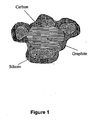
- the resulting graphite/silicon/carbon composite particle powder has morphology as shown in Figure 3 . It can be seen that small silicon particles are embedded in the carbon coating on large graphite particles, a structure similarly illustrated in Figure 1 .
- the composite powder was then evaluated as the anode material for a lithium-ion battery, as described above in the section entitled "Evaluation of Electrical Capacity".
- the cycling potential window was between 0.09 and 1.5 volts.
- the results are shown in Figure 4 . It can be noted that the material has a capacity of about 850 mAh/g and is fairly reversible from cycle to cycle.
- electrodes were made by adding 20% graphite to uncoated silicon and 7% of the same graphite to the carbon-coated silicon.
- the graphite used was natural graphite based composite graphite powder.
- FIG 2 shows the charge and discharge cell voltage profiles for the carbon-coated silicon and uncoated silicon powders.
- charging means that the lithium is being electrochemically inserted into the electrode and “discharging” denotes that the lithium is being removed from the electrode.
- the charge and discharge capacity was calculated based on total electrode material except for the binding material. As shown in the figure, the cell voltage rapidly drops to the low cut-off voltage on the charging and the discharged capacity and the efficiency are very small for the silicon/graphite mixture electrode.
Landscapes
- Chemical & Material Sciences (AREA)
- Chemical Kinetics & Catalysis (AREA)
- Electrochemistry (AREA)
- General Chemical & Material Sciences (AREA)
- Engineering & Computer Science (AREA)
- Materials Engineering (AREA)
- Composite Materials (AREA)
- Inorganic Chemistry (AREA)
- Manufacturing & Machinery (AREA)
- Dispersion Chemistry (AREA)
- Metallurgy (AREA)
- Organic Chemistry (AREA)
- Battery Electrode And Active Subsutance (AREA)
- Carbon And Carbon Compounds (AREA)
- Secondary Cells (AREA)
Claims (52)
- Verfahren zur Herstellung beschichteter Silizium/Kohlenstoffpartikel, das Folgendes beinhaltet:Bereitstellen eines Kohlenstoffrest-bildenden Materials;Bereitstellen von Siliziumpartikeln;Beschichten der genannten Siliziumpartikel mit dem genannten Kohlenstoffrest-bildenden Material, um beschichtete Siliziumpartikel zu bilden;Bereitstellen von Partikeln aus einem kohlenstoffhaltigen Material;Beschichten der genannten Partikel aus kohlenstoffhaltigem Material mit dem genannten Kohlenstoffrest-bildenden Material, um beschichtete kohlenstoffhaltige Partikel zu bilden;Einbetten der genannten beschichteten Siliziumpartikel auf den genannten beschichteten kohlenstoffhaltigen Partikeln, um Silizium/Kohlenstoff-Kompositpartikel zu bilden;Beschichten der genannten Silizium/Kohlenstoff-Kompositpartikel mit dem genannten Kohlenstoffrest-bildenden Material, um beschichtete Silizium/Kohlenstoff-Kompositpartikel zu bilden; undStabilisieren der beschichteten Kompositpartikel durch Unterziehen der genannten beschichteten Kompositpartikel einer Oxidationsreaktion.
- Verfahren nach Anspruch 1, wobei das genannte Kohlenstoffrest-bildende Material in einer Lösung bereitgestellt wird, die ein oder mehrere Lösungsmittel und das genannte Kohlenstoffrest-bildende Material umfasst.
- Verfahren nach Anspruch 2, wobei die Siliziumpartikel als eine Suspension in einer Lösung bereitgestellt werden, die ein oder mehrere Lösungsmittel umfasst, bevor ein Mischen mit der genannten Lösung von Kohlenstoffrest-bildendem Material erfolgt.
- Verfahren nach Anspruch 2, wobei Partikel eines kohlenstoffhaltigen Materials als Suspension in einer Lösung bereitgestellt werden, die ein oder mehrere Lösungsmittel umfasst, bevor ein Mischen mit der Lösung von Kohlenstoffrest-bildendem Material erfolgt.
- Verfahren nach Anspruch 2, wobei die Silizium/Kohlenstoff-Kompositpartikel als Suspension in einer Lösung bereitgestellt werden, die ein oder mehrere Lösungsmittel umfasst, bevor ein Mischen mit der genannten Lösung von Kohlenstoffrest-bildendem Material erfolgt.
- Verfahren nach Anspruch 2, das ferner das Zugeben von einem oder mehreren Lösungsmitteln zu einem Gemisch aus der Lösung von Kohlenstoffrest-bildendem Material und den Partikeln beinhaltet.
- Verfahren nach Anspruch 1, das ferner das Stabilisieren der Siliziumpartikel nach dem Beschichten beinhaltet.
- Verfahren nach Anspruch 1, das ferner das Stabilisieren der kohlenstoffhaltigen Partikel nach dem Beschichten beinhaltet.
- Verfahren nach Anspruch 7, das ferner das Karbonisieren der beschichteten Siliziumpartikel beinhaltet.
- Verfahren nach Anspruch 8, das ferner das Karbonisieren der beschichteten kohlenstoffhaltigen Partikel beinhaltet.
- Verfahren nach Anspruch 9, wobei die beschichteten Siliziumpartikel in einer inerten Atmosphäre bei einer Temperatur zwischen etwa 400°C und etwa 1500°C karbonisiert werden.
- Verfahren nach Anspruch 10, wobei die beschichteten kohlenstoffhaltigen Partikel in einer inerten Atmosphäre bei einer Temperatur zwischen etwa 400°C und etwa 1500°C karbonisiert werden.
- Verfahren nach Anspruch 2, wobei das Lösungsmittel aus der Gruppe bestehend aus Toluol, Benzol, Xylol, Chinolin, Tetrahydrofuran, Tetrahydronaphthalen, Naphthalen, Methanol, Aceton, Methyl-pyrrolidinon, Cyclohexan, Ether und Wasser ausgewählt wird.
- Verfahren nach Anspruch 2, wobei die Lösung von Kohlenstoffrest-bildendem Material bei einer erhöhten Temperatur gemischt wird, um das Kohlenstoffrest-bildende Material in den ein oder mehreren Lösungsmitteln zu lösen.
- Verfahren nach Anspruch 3, wobei die Suspension von Partikeln bei erhöhter Temperatur gemischt wird.
- Verfahren nach Anspruch 3, wobei das Verhältnis zwischen den ein oder mehreren Lösungsmitteln und dem Kohlenstoffrest-bildenden Material in dem Gemisch aus der Lösung von Kohlenstoffrest-bildendem Material und der Partikelsuspension 2:1 oder mehr beträgt.
- Verfahren nach Anspruch 3, wobei das Verhältnis zwischen den ein oder mehreren Lösungsmitteln und dem Kohlenstoffrest-bildenden Material in einem Gemisch aus der Lösung von Kohlenstoffrest-bildendem Material und der Partikelsuspension 4:1 oder mehr beträgt.
- Verfahren nach Anspruch 1, wobei die beschichteten Siliziumpartikel und die beschichteten kohlenstoffhaltigen Partikel einer Lösung von Kohlenstoffrest-bildendem Material zugegeben werden, um die beschichteten Siliziumpartikel auf den kohlenstoffhaltigen Partikeln einzubetten.
- Verfahren nach Anspruch 1, wobei die Schicht aus Kohlenstoffrest-bildendem Material unter Umgebungs- oder höherem Druck abgesetzt wird.
- Verfahren nach Anspruch 19, wobei die Schicht aus Kohlenstoffrest-bildendem Material bei einer Temperatur von etwa -5°C bis etwa 400°C abgesetzt wird.
- Verfahren nach Anspruch 1, wobei die Schicht aus Kohlenstoffrest-bildendem Material gleichförmig und im Wesentlichen glatt ist.
- Verfahren nach Anspruch 1, wobei der stabilisierte beschichtete Silizium/Kohlenstoff-Kompositpartikel ferner mit Kohlenstoffrest-bildendem Material beschichtet wird, um eine zusätzliche Beschichtungslage aus Kohlenstoffrest-bildendem Material zu bilden.
- Verfahren nach Anspruch 22, wobei der mehrfach beschichtete Silizium/Kohlenstoff-Kompositpartikel ferner mit Kohlenstoffrest-bildendem Material beschichtet wird, um zusätzliche Beschichtungslagen aus Kohlenstoffrest-bildendem Material zu bilden.
- Verfahren nach Anspruch 22, wobei die letzte Beschichtungslage aus Silizium/Kohlenstoff-Kompositpartikel karbonisiert wird.
- Verfahren nach Anspruch 1, wobei die kohlenstoffhaltigen Partikel ein pulvriges kohlenstoffhaltiges Material umfassen, das aus der Gruppe bestehend aus Erdölpech, kalziniertem Erdölkoks, unkalziniertem Erdölkoks, hochkristallinem Koks, Kohlenteerkoks, synthetischen Graphiten, natürlichen Graphiten, von organischen Polymeren abgeleiteten weichen Kohlenstoffen und von natürlichen Polymeren abgeleiteten weichen Kohlenstoffen ausgewählt wird.
- Verfahren nach Anspruch 1, wobei die kohlenstoffhaltigen Partikel eine durchschnittliche Partikelgröße von bis zu etwa 50 µm haben.
- Verfahren nach Anspruch 1, wobei die kohlenstoffhaltigen Partikel eine durchschnittliche Partikelgröße zwischen etwa 1 µm und etwa 30 µm haben.
- Verfahren nach Anspruch 1, wobei die Siliziumpartikel eine durchschnittliche Partikelgröße von bis zu etwa 50 µm haben.
- Verfahren nach Anspruch 1, wobei die Siliziumpartikel eine durchschnittliche Partikelgröße zwischen etwa 0,03 µm und etwa 20 µm haben.
- Verfahren nach Anspruch 2, wobei das Kohlenstoffrest-bildende Material auf die Oberfläche der Partikel durch selektives Präzipitieren des Kohlenstoffrest-bildenden Materials auf die Partikel abgesetzt wird.
- Verfahren nach Anspruch 1, wobei das Kohlenstoffrest-bildende Material ein Polymermaterial ist, das aus der Gruppe bestehend aus schweren aromatischen Resten von Erdöl und Kohle aus chemischen Prozessen, Lignin aus der Zellstoffindustrie, phenolischen Harzen und Kohlenhydratmaterialien ausgewählt wird.
- Verfahren nach Anspruch 1, wobei das Kohlenstoffrest-bildende Material aus der Gruppe bestehend aus Erdölpech und Kohlenteerpech oder durch chemische Prozesse hergestelltem Pech ausgewählt wird.
- Verfahren nach Anspruch 1, wobei die Oxidationsreaktion in Anwesenheit eines Oxidationsmittels durchgeführt wird.
- Verfahren nach Anspruch 33, wobei die Oxidation bei erhöhten Temperaturen durchgeführt wird.
- Verfahren nach Anspruch 34, wobei die erhöhte Temperatur in einer kontrollierten Weise mit Temperaturrampen und Halteperioden zugeführt wird.
- Verfahren nach Anspruch 33, wobei die Oxidation unter reduziertem Druck durchgeführt wird.
- Verfahren nach Anspruch 1 zur Herstellung beschichteter Silizium/Kohlenstoff-Kompositpartikel mit im Wesentlichen glatten Beschichtungen aus einem oxidierten Kohlenstoffrest-bildenden Material, das Folgendes beinhaltet:Bereitstellen einer ersten Lösung von einem Kohlenstoffrest-bildenden Material, das aus der Gruppe bestehend aus Erdölpech und Kohlenteerpech ausgewählt wird, wobei die erste Lösung ein oder mehrere Lösungsmittel umfasst, die aus der Gruppe bestehend aus Toluol, Xylol, Chinolin, Tetrahydrofuran, Tetrahydronaphthalen und Naphthalen ausgewählt werden;Bereitstellen von Partikeln aus einem kohlenstoffhaltigen Material, das ausgewählt wird aus der Gruppe bestehend aus kalziniertem oder unkalziniertem Erdölkoks, natürlichem Graphit und synthetischem Graphit, wobei die Partikel in einer zweiten Lösung bereitgestellt werden, die ein oder mehrere Lösungsmittel umfasst;Mischen der ersten Lösung und der zweiten Lösung bei einer erhöhten Temperatur;Absetzen eines Überzugs aus dem Kohlenstoffrest-bildenden Material auf die Oberfläche der kohlenstoffhaltigen Partikel, um beschichtete kohlenstoffhaltige Partikel zu bilden;Bereitstellen von Siliziumpartikeln, wobei die Siliziumpartikel in einer dritten Lösung bereitgestellt werden, die ein oder mehrere Lösungsmittel umfasst;Mischen der ersten Lösung und der dritten Lösung bei einer erhöhten Temperatur;Absetzen eines Überzugs aus dem Kohlenstoffrest-bildenden Material auf die Oberfläche der Siliziumpartikel, um beschichtete Siliziumpartikel zu bilden;Mischen der ersten Lösung mit den beschichteten Siliziumpartikeln und den beschichteten kohlenstoffhaltigen Partikeln bei einer erhöhten Temperatur, um Silizium/Kohlenstoff-Kompositpartikel zu bilden;Absetzen eines Überzugs aus dem Kohlenstoffrest-bildenden Material auf die Oberfläche der Kompositpartikel, um beschichtete Silizium/Kohlenstoff-Kompositpartikel zu bilden;Stabilisieren der beschichteten Kompositpartikel durch Unterziehen der beschichteten Kompositpartikel einer Oxidationsreaktion; undKarbonisieren der beschichteten Kompositpartikel.
- Verfahren nach Anspruch 37, wobei die beschichteten Kompositpartikel in einer inerten Atmosphäre bei einer Temperatur von mehr als etwa 400°C karbonisiert werden.
- Verfahren nach Anspruch 37, wobei die beschichteten Kompositpartikel in einer inerten Atmosphäre bei einer Temperatur zwischen etwa 550°C und etwa 1500°C karbonisiert werden.
- Elektrische Speicherzelle, die die mit dem Verfahren aus Anspruch 38 hergestellten beschichteten Kompositpartikel umfasst.
- Elektrische Speicherzelle nach Anspruch 40, wobei die elektrische Speicherzelle eine wiederaufladbare elektrische Speicherzelle ist.
- Anode einer elektrischen Speicherzelle, die die mit dem Verfahren aus Anspruch 38 hergestellten beschichteten Kompositpartikel umfasst.
- Anode einer elektrischen Speicherzelle nach Anspruch 42, wobei die elektrische Speicherzelle eine wiederaufladbare elektrische Speicherzelle ist.
- Verfahren nach Anspruch 2, wobei die Beschichtung der Partikel dadurch verbessert wird, indem eine teilweise Präzipitation des Kohlenstoffrest-bildenden Materials auf die Oberfläche der Partikel bewirkt wird.
- Verfahren nach Anspruch 44, wobei die teilweise Präzipitation durch Verdünnen einer konzentrierten Lösung von einem Kohlenstoffrest-bildenden Material durch Zugabe einer größeren Menge desselben oder eines oder mehrerer verschiedener Lösungsmittel(s) bewirkt wird.
- Verfahren nach Anspruch 45, wobei das Verhältnis zwischen Lösungsmittel und Kohlenstoffrest-bildendem Material in der konzentrierten Lösung 2:1 oder geringer ist und das Verhältnis zwischen Lösungsmittel und Kohlenstoffrest-bildendem Material in der verdünnten Lösung größer 2:1 ist.
- Verfahren nach Anspruch 45, wobei das Verhältnis zwischen Lösungsmittel und Kohlenstoffrest-bildendem Material in der konzentrierten Lösung 2:1 oder geringer ist und das Verhältnis zwischen Lösungsmittel und Kohlenstoffrest-bildendem Material in der verdünnten Lösung größer 5:1 ist.
- Verfahren nach Anspruch 45, wobei die teilweise Präzipitation des Kohlenstoffrest-bildenden Materials dadurch bewirkt wird, dass ein Gemisch aus den Silizium- und kohlenstoffhaltigen Partikeln und dem Kohlenstoffrest-bildenden Material im Laufe des Beschichtungsschritts gekühlt wird.
- Verfahren nach Anspruch 2, wobei die Schicht aus Kohlenstoffrest-bildendem Material unter Umgebungs- oder höherem Druck abgesetzt wird.
- Verfahren zur Herstellung beschichteter Silizium/Kohlenstoff-Kompositpartikel mit im Wesentlichen glatten Beschichtungen aus einem oxidierten Kohlenstoffrest-bildenden Material, das Folgendes beinhaltet:Bereitstellen einer ersten Lösung von einem Kohlenstoffrest-bildenden Material, das aus der Gruppe bestehend aus Erdölpech und Kohlenteerpech ausgewählt wird, wobei die erste Lösung ein oder mehrere Lösungsmittel umfasst, die aus der Gruppe bestehend aus Toluol, Xylol, Chinolin, Tetrahydrofuran, Tetrahydronaphthalen und Naphthalen ausgewählt werden;Bereitstellen von Partikeln aus einem kohlenstoffhaltigen Material, das aus der Gruppe bestehend aus kalziniertem oder unkalziniertem Erdölkoks, natürlichem Graphit und synthetischem Graphit ausgewählt wird, wobei die Partikel in einer zweiten Lösung bereitgestellt werden, die ein oder mehrere Lösungsmittel umfasst;Mischen der ersten Lösung und der zweiten Lösung bei einer erhöhten Temperatur;Absetzen eines Überzugs aus dem Kohlenstoffrest-bildenden Material auf die Oberfläche der kohlenstoffhaltigen Partikel, um beschichtete kohlenstoffhaltige Partikel zu bilden;Bereitstellen von Siliziumpartikeln, wobei die Siliziumpartikel in einer dritten Lösung bereitgestellt werden, die ein oder mehrere Lösungsmittel umfasst;Mischen der ersten Lösung mit den Siliziumpartikeln und den beschichteten kohlenstoffhaltigen Partikeln bei einer erhöhten Temperatur, um Silizium/Kohlenstoff-Kompositpartikel zu bilden;Absetzen eines Überzugs aus dem Kohlenstoffrest-bildenden Material auf die Oberfläche der Kompositpartikel, um beschichtete Silizium/Kohlenstoff-Kompositpartikel zu bilden;Stabilisieren der beschichteten Kompositpartikel durch Aussetzen der Partikel einer Oxidationsreaktion; undKarbonisieren der beschichteten Kompositpartikel.
- Verfahren nach Anspruch 50, wobei die beschichteten Kompositpartikel in einer inerten Atmosphäre bei einer Temperatur von mehr als etwa 400°C karbonisiert werden.
- Verfahren nach Anspruch 50, wobei die beschichteten Kompositpartikel in einer inerten Atmosphäre bei einer Temperatur zwischen etwa 550°C und etwa 1500°C karbonisiert werden.
Applications Claiming Priority (2)
| Application Number | Priority Date | Filing Date | Title |
|---|---|---|---|
| US10/741,381 US7618678B2 (en) | 2003-12-19 | 2003-12-19 | Carbon-coated silicon particle powders as the anode material for lithium ion batteries and the method of making the same |
| PCT/US2004/038115 WO2005065082A2 (en) | 2003-12-19 | 2004-11-15 | Carbon-coated silicon particle power as the anode material for lithium ion batteries and the method of making the same |
Publications (3)
| Publication Number | Publication Date |
|---|---|
| EP1702375A2 EP1702375A2 (de) | 2006-09-20 |
| EP1702375A4 EP1702375A4 (de) | 2009-11-04 |
| EP1702375B1 true EP1702375B1 (de) | 2013-04-10 |
Family
ID=34678135
Family Applications (1)
| Application Number | Title | Priority Date | Filing Date |
|---|---|---|---|
| EP04821041.3A Expired - Lifetime EP1702375B1 (de) | 2003-12-19 | 2004-11-15 | Kohlenstoffbeschichtete siliziumpartikelleistung als anodenmaterial für lithiumionenbatterien und herstellungsverfahren dafür |
Country Status (9)
| Country | Link |
|---|---|
| US (2) | US7618678B2 (de) |
| EP (1) | EP1702375B1 (de) |
| JP (1) | JP5064803B2 (de) |
| KR (1) | KR101167277B1 (de) |
| CN (2) | CN1894811B (de) |
| CA (1) | CA2548988C (de) |
| ES (1) | ES2405600T3 (de) |
| TW (1) | TWI361510B (de) |
| WO (1) | WO2005065082A2 (de) |
Cited By (5)
| Publication number | Priority date | Publication date | Assignee | Title |
|---|---|---|---|---|
| CN104810506A (zh) * | 2014-09-15 | 2015-07-29 | 万向A一二三系统有限公司 | 一种高能量密度的锂离子电池 |
| US10629895B2 (en) | 2014-02-06 | 2020-04-21 | Wacker Chemie Ag | Si/G/C-composites for lithium-ion-batteries |
| US12406996B2 (en) | 2021-04-27 | 2025-09-02 | Northwestern University | Composite material with conformal graphene coating, fabricating methods and applications of same |
| EP4456185A4 (de) * | 2021-12-22 | 2025-11-05 | Oci Co Ltd | Anodenaktivmaterial für eine sekundärbatterie und verfahren zur herstellung davon |
| US12580183B2 (en) | 2020-05-04 | 2026-03-17 | Northwestern University | Conformal pickering emulsion graphene coatings for electrode materials and forming methods applications of same |
Families Citing this family (210)
| Publication number | Priority date | Publication date | Assignee | Title |
|---|---|---|---|---|
| US7785661B2 (en) * | 2003-12-19 | 2010-08-31 | Conocophillips Company | Methods of preparing composite carbon-graphite-silicon particles and using same |
| US20060008706A1 (en) | 2004-07-09 | 2006-01-12 | Takitaro Yamaguchi | Rechargeable lithium battery |
| KR100738054B1 (ko) * | 2004-12-18 | 2007-07-12 | 삼성에스디아이 주식회사 | 음극 활물질, 그 제조 방법 및 이를 채용한 음극과 리튬전지 |
| US7883801B2 (en) * | 2005-11-15 | 2011-02-08 | Samsung Sdi Co., Ltd. | Electrolyte for rechargeable lithium battery, and rechargeable lithium battery including the same |
| US7914931B2 (en) * | 2005-12-21 | 2011-03-29 | Samsung Sdi Co., Ltd. | Separator for rechargeable lithium battery, rechargeable lithium battery including the same, and method for preparing rechargeable lithium battery |
| US20070147214A1 (en) * | 2005-12-22 | 2007-06-28 | General Electric Company | Methods for storing holographic data and articles having enhanced data storage lifetime derived therefrom |
| TW200746523A (en) * | 2006-01-30 | 2007-12-16 | Tokai Carbon Kk | Negative electrode material for lithium ion secondary battery and process for producing the same |
| CN1913200B (zh) * | 2006-08-22 | 2010-05-26 | 深圳市贝特瑞电子材料有限公司 | 锂离子电池硅碳复合负极材料及其制备方法 |
| JP5348878B2 (ja) * | 2007-02-21 | 2013-11-20 | Jfeケミカル株式会社 | リチウムイオン二次電池用負極材料およびその製造方法、リチウムイオン二次電池用負極ならびにリチウムイオン二次電池 |
| KR100938059B1 (ko) * | 2007-10-23 | 2010-01-21 | 삼성에스디아이 주식회사 | 리튬 이차전지용 음극 및 이를 이용한 리튬 이차 전지 |
| TWI493780B (zh) * | 2008-03-31 | 2015-07-21 | 派諾得公司 | 用於電池的陽極粉末 |
| KR101075028B1 (ko) * | 2008-04-24 | 2011-10-20 | 쇼와 덴코 가부시키가이샤 | 리튬 이차전지용 탄소 음극재 및 그 제조방법과 이를 이용한 리튬 이차전지 |
| US8277974B2 (en) * | 2008-04-25 | 2012-10-02 | Envia Systems, Inc. | High energy lithium ion batteries with particular negative electrode compositions |
| KR101025278B1 (ko) * | 2008-05-29 | 2011-03-29 | 삼성에스디아이 주식회사 | 음극활물질, 이를 구비하는 음극 및 리튬이차전지 |
| JP5463772B2 (ja) * | 2008-07-30 | 2014-04-09 | 住友化学株式会社 | ナトリウム二次電池 |
| WO2010041907A2 (en) * | 2008-10-10 | 2010-04-15 | Knu-Industry Cooperation Foundation | Negative active material for rechargeable lithium battery, method of preparing the same, and rechargeable lithium battery comprising the same |
| KR101131937B1 (ko) * | 2008-10-10 | 2012-04-03 | 강원대학교산학협력단 | 리튬 이차 전지용 음극 활물질, 이의 제조방법 및 이를 포함하는 리튬 이차 전지 |
| WO2010047828A1 (en) * | 2008-10-24 | 2010-04-29 | Primet Precision Materials, Inc. | Group iva small particle compositions and related methods |
| US9012073B2 (en) | 2008-11-11 | 2015-04-21 | Envia Systems, Inc. | Composite compositions, negative electrodes with composite compositions and corresponding batteries |
| KR101057162B1 (ko) * | 2008-12-01 | 2011-08-16 | 삼성에스디아이 주식회사 | 음극활물질, 이를 구비하는 음극 및 리튬이차전지 |
| US8580432B2 (en) | 2008-12-04 | 2013-11-12 | Nanotek Instruments, Inc. | Nano graphene reinforced nanocomposite particles for lithium battery electrodes |
| US8241793B2 (en) * | 2009-01-02 | 2012-08-14 | Nanotek Instruments, Inc. | Secondary lithium ion battery containing a prelithiated anode |
| US9093693B2 (en) * | 2009-01-13 | 2015-07-28 | Samsung Electronics Co., Ltd. | Process for producing nano graphene reinforced composite particles for lithium battery electrodes |
| US7964240B2 (en) * | 2009-01-19 | 2011-06-21 | Conocophillips Company | Producing coated graphitic anode powders by extracting pitch from high volatile matter coke and coating the same in-situ |
| KR101066256B1 (ko) * | 2009-02-05 | 2011-09-20 | 삼성에스디아이 주식회사 | 전극조립체 및 이를 구비하는 이차전지 |
| ITRM20090161A1 (it) * | 2009-04-08 | 2010-10-09 | Jusef Hassoun | Accumulatori litio-zolfo |
| CN101527357B (zh) * | 2009-04-24 | 2012-05-16 | 清华大学 | 纳米硅无定型碳复合锂离子电池负极材料及其制备方法 |
| KR101093705B1 (ko) * | 2009-04-29 | 2011-12-19 | 삼성에스디아이 주식회사 | 리튬 이차 전지 |
| WO2011041468A1 (en) * | 2009-09-29 | 2011-04-07 | Georgia Tech Research Corporation | Electrodes, lithium-ion batteries, and methods of making and using same |
| KR20120128125A (ko) * | 2009-11-03 | 2012-11-26 | 엔비아 시스템즈 인코포레이티드 | 리튬 이온 전지용 고용량 아노드 물질 |
| US8497359B2 (en) * | 2010-02-26 | 2013-07-30 | Ppg Industries Ohio, Inc. | Cationic electrodepositable coating composition comprising lignin |
| WO2011118026A1 (ja) * | 2010-03-26 | 2011-09-29 | トヨタ自動車株式会社 | 電極活物質の製造方法 |
| TW201140920A (en) * | 2010-04-08 | 2011-11-16 | Conocophillips Co | Methods of preparing carbonaceous material |
| US20110256449A1 (en) * | 2010-04-19 | 2011-10-20 | Conocophillips Company | Organic coated fine particle powders |
| KR101510510B1 (ko) * | 2010-04-26 | 2015-04-08 | 도요타지도샤가부시키가이샤 | 전극 활물질의 제조 방법 |
| WO2011140150A1 (en) | 2010-05-03 | 2011-11-10 | Georgia Tech Research Corporation | Alginate-containing compositions for use in battery applications |
| US9558860B2 (en) | 2010-09-10 | 2017-01-31 | Samsung Electronics Co., Ltd. | Graphene-enhanced anode particulates for lithium ion batteries |
| US20120264020A1 (en) * | 2010-10-07 | 2012-10-18 | Applied Sciences, Inc. | Method of depositing silicon on carbon nanomaterials |
| KR101126202B1 (ko) | 2010-11-04 | 2012-03-22 | 삼성에스디아이 주식회사 | 리튬 이차 전지용 음극 활물질 및 이를 포함하는 리튬 이차 전지 |
| JP5881943B2 (ja) * | 2010-12-10 | 2016-03-09 | 日立化成株式会社 | リチウム二次電池 |
| KR101334615B1 (ko) * | 2010-12-27 | 2013-11-29 | 주식회사 엘지화학 | 음극 활물질 및 이를 이용한 이차전지 |
| FR2970245B1 (fr) * | 2011-01-07 | 2013-01-25 | Commissariat Energie Atomique | Materiau composite silicium/carbone, procede de synthese et utilisation d'un tel materiau |
| JP2012178224A (ja) * | 2011-01-31 | 2012-09-13 | Dow Corning Toray Co Ltd | 表面炭素被覆ケイ素含有炭素系複合材料の製造方法 |
| US9786947B2 (en) * | 2011-02-07 | 2017-10-10 | Sila Nanotechnologies Inc. | Stabilization of Li-ion battery anodes |
| EP2650950B1 (de) * | 2011-02-15 | 2017-03-15 | Lg Chem, Ltd. | Verfahren zur herstellung eines anodenaktivmaterials |
| EP2698851B1 (de) | 2011-04-13 | 2018-12-12 | Sei Corporation | Elektrodenmaterial für eine lithiumsekundärbatterie und lithiumsekundärbatterie |
| KR101342600B1 (ko) | 2011-05-11 | 2013-12-17 | 삼성에스디아이 주식회사 | 음극 활물질, 그의 제조방법 및 이를 포함하는 리튬 전지 |
| US9601228B2 (en) | 2011-05-16 | 2017-03-21 | Envia Systems, Inc. | Silicon oxide based high capacity anode materials for lithium ion batteries |
| US8642214B2 (en) | 2011-08-25 | 2014-02-04 | Uchicago Argonne, Llc | Silicon-carbonaceous encapsulated materials |
| CN103022435B (zh) * | 2011-09-20 | 2016-05-04 | 宁波杉杉新材料科技有限公司 | 一种锂离子电池硅碳复合负极材料及其制备方法 |
| EP2573845B1 (de) * | 2011-09-26 | 2018-10-31 | VARTA Micro Innovation GmbH | Strukturstabiles Aktivmaterial für Batterieelektroden |
| US20130115372A1 (en) * | 2011-11-08 | 2013-05-09 | Primestar Solar, Inc. | High emissivity distribution plate in vapor deposition apparatus and processes |
| US8785034B2 (en) | 2011-11-21 | 2014-07-22 | Infineon Technologies Austria Ag | Lithium battery, method for manufacturing a lithium battery, integrated circuit and method of manufacturing an integrated circuit |
| US9139441B2 (en) | 2012-01-19 | 2015-09-22 | Envia Systems, Inc. | Porous silicon based anode material formed using metal reduction |
| US9705127B2 (en) * | 2012-02-01 | 2017-07-11 | The Regents Of The University Of California | Conductive polymer and Si nanoparticles composite secondary particles and structured current collectors for high loading lithium ion negative electrode application |
| US9299978B2 (en) * | 2012-05-02 | 2016-03-29 | Showa Denko K.K. | Negative electrode material for lithium battery |
| US10553871B2 (en) | 2012-05-04 | 2020-02-04 | Zenlabs Energy, Inc. | Battery cell engineering and design to reach high energy |
| US9780358B2 (en) | 2012-05-04 | 2017-10-03 | Zenlabs Energy, Inc. | Battery designs with high capacity anode materials and cathode materials |
| US9929400B2 (en) | 2012-08-06 | 2018-03-27 | Ut-Battelle, Llc | High capacity monolithic composite Si/carbon fiber electrode architectures synthesized from low cost materials and process technologies |
| EP2888778A1 (de) * | 2012-08-21 | 2015-07-01 | Kratos LLC | Funktionalisierte gruppe-iva-partikel und verwendungsverfahren dafür |
| US9461309B2 (en) | 2012-08-21 | 2016-10-04 | Kratos LLC | Group IVA functionalized particles and methods of use thereof |
| WO2014059440A1 (en) | 2012-10-12 | 2014-04-17 | The Penn State Research Foundation | Synthesis of micro-sized interconnected si-c composites |
| US10170746B2 (en) | 2012-10-17 | 2019-01-01 | Infineon Technologies Ag | Battery electrode, battery, and method for manufacturing a battery electrode |
| EP2924784B1 (de) * | 2012-11-20 | 2019-01-09 | Showa Denko K.K. | Verfahren zur herstellung von negativem elektrodenmaterial für lithium-ionen-batterien |
| WO2014080632A1 (ja) * | 2012-11-21 | 2014-05-30 | 昭和電工株式会社 | リチウムイオン電池用負極材の製造方法 |
| KR101557559B1 (ko) | 2012-11-30 | 2015-10-07 | 주식회사 엘지화학 | 리튬 이차 전지용 음극재, 이의 제조 방법 및 이를 포함하는 리튬 이차 전지 |
| KR101560892B1 (ko) | 2012-11-30 | 2015-10-19 | 주식회사 엘지화학 | 다공성 규소 산화물―탄소재 복합체를 포함하는 음극 활물질 및 이의 제조방법 |
| WO2014084635A1 (ko) * | 2012-11-30 | 2014-06-05 | 주식회사 엘지화학 | 리튬 이차 전지용 음극재, 이의 제조 방법 및 이를 포함하는 리튬 이차 전지 |
| KR101906973B1 (ko) * | 2012-12-05 | 2018-12-07 | 삼성전자주식회사 | 표면 개질된 음극 활물질용 실리콘 나노입자 및 그 제조방법 |
| WO2014107704A1 (en) * | 2013-01-07 | 2014-07-10 | William Marsh Rice University | Combined electrochemical and chemical etching processes for generation of porous silicon particulates |
| KR101708363B1 (ko) * | 2013-02-15 | 2017-02-20 | 삼성에스디아이 주식회사 | 음극 활물질, 및 이를 채용한 음극과 리튬 전지 |
| DE102013204799A1 (de) * | 2013-03-19 | 2014-09-25 | Wacker Chemie Ag | Si/C-Komposite als Anodenmaterialien für Lithium-Ionen-Batterien |
| US10020491B2 (en) | 2013-04-16 | 2018-07-10 | Zenlabs Energy, Inc. | Silicon-based active materials for lithium ion batteries and synthesis with solution processing |
| KR20140139294A (ko) * | 2013-05-27 | 2014-12-05 | 삼성에스디아이 주식회사 | 리튬 이차 전지용 음극 활물질, 이를 포함하는 음극 및 리튬 이차 전지 |
| US10886526B2 (en) | 2013-06-13 | 2021-01-05 | Zenlabs Energy, Inc. | Silicon-silicon oxide-carbon composites for lithium battery electrodes and methods for forming the composites |
| CA2820468A1 (fr) * | 2013-06-21 | 2014-12-21 | Hydro-Quebec | Anode comprenant un alliage de lithium pour batteries a haute energie |
| JP2016522552A (ja) * | 2013-07-31 | 2016-07-28 | エルジー・ケム・リミテッド | 寿命特性が向上した二次電池用負極活物質 |
| US10020494B2 (en) | 2013-08-08 | 2018-07-10 | Nanotek Instruments, Inc. | Anode containing active material-coated graphene sheets and lithium-ion batteries containing same |
| US9564630B2 (en) | 2013-08-08 | 2017-02-07 | Nantek Instuments, Inc. | Anode active material-coated graphene sheets for lithium batteries and process for producing same |
| EP2838139B1 (de) * | 2013-08-12 | 2017-01-11 | VARTA Micro Innovation GmbH | Elektrochemisches Aktivmaterial und seine Herstellung |
| WO2015024004A1 (en) | 2013-08-16 | 2015-02-19 | Envia Systems, Inc. | Lithium ion batteries with high capacity anode active material and good cycling for consumer electronics |
| CN103474631B (zh) * | 2013-10-08 | 2017-01-11 | 深圳市贝特瑞新能源材料股份有限公司 | 一种锂离子电池用氧化亚硅复合负极材料、制备方法及锂离子电池 |
| KR102211528B1 (ko) * | 2014-01-09 | 2021-02-02 | 삼성에스디아이 주식회사 | 리튬 이차 전지용 음극, 및 이를 포함하는 리튬 이차 전지 |
| KR102164001B1 (ko) * | 2014-01-09 | 2020-10-12 | 삼성에스디아이 주식회사 | 리튬 이차 전지 |
| KR101572364B1 (ko) * | 2014-03-19 | 2015-11-26 | 오씨아이 주식회사 | 탄소-실리콘 복합체, 이를 이용한 리튬 이차전지용 음극 및 리튬 이차전지 |
| EP2966037A1 (de) * | 2014-07-08 | 2016-01-13 | Umicore SA | Kompositpartikel mit kohlenstoffbasierter Matrix und darin eingebettete Siliciumteilchen, Pulver aus solchen Kompositpartikeln, Verwendung solcher Kompositpartikel und Elektrode für eine Batterie |
| KR20160008041A (ko) * | 2014-07-11 | 2016-01-21 | 오씨아이 주식회사 | 이차전지용 음극활물질 및 이의 제조방법 |
| US10128496B2 (en) | 2014-08-14 | 2018-11-13 | Giner, Inc. | Three-dimensional, porous anode for use in lithium-ion batteries and method of fabrication thereof |
| JP6020533B2 (ja) * | 2014-10-29 | 2016-11-02 | 日立化成株式会社 | リチウムイオン二次電池 |
| WO2016070120A1 (en) * | 2014-10-30 | 2016-05-06 | The Regents Of The University Of Colorado, A Body Corporate | Stable silicon-ionic liquid interface lithium-ion batteries |
| JP2017536676A (ja) | 2014-11-25 | 2017-12-07 | コーニング インコーポレイテッド | リチウムイオン電池アノードのための方法および材料 |
| KR101888230B1 (ko) * | 2014-11-27 | 2018-08-13 | 주식회사 엘지화학 | 규소계 음극활물질 및 이의 제조방법 |
| US10483529B2 (en) | 2014-12-23 | 2019-11-19 | Umicore | Composite powder for use in an anode of a lithium ion battery, method of preparing such a composite powder and method for analysing such a composite powder |
| CN107112504A (zh) * | 2014-12-29 | 2017-08-29 | 罗伯特·博世有限公司 | 硅碳复合物、制备该复合物的方法及包含该复合物的电极材料和电池 |
| CN107743659B (zh) | 2015-01-30 | 2021-01-26 | 科罗拉多州立大学董事会(法人团体) | 离子液体型高能锂离子电池 |
| EP3309873B1 (de) * | 2015-06-15 | 2020-05-27 | UNIST (Ulsan National Institute of Science and Technology) | Anodenaktivmaterial für lithiumsekundärbatterie, herstellungsverfahren dafür und lithiumsekundärbatterie damit |
| CN105047887B (zh) * | 2015-06-19 | 2017-03-15 | 苏州大学 | 一种改善锂离子电池硅负极材料的方法 |
| DE102016202458A1 (de) * | 2016-02-17 | 2017-08-17 | Wacker Chemie Ag | Verfahren zur Herstellung von Si/C-Kompositpartikeln |
| US10734642B2 (en) | 2016-03-30 | 2020-08-04 | Global Graphene Group, Inc. | Elastomer-encapsulated particles of high-capacity anode active materials for lithium batteries |
| US10008723B1 (en) | 2016-05-17 | 2018-06-26 | Nanotek Instruments, Inc. | Chemical-free production of graphene-wrapped electrode active material particles for battery applications |
| US9899672B2 (en) | 2016-05-17 | 2018-02-20 | Nanotek Instruments, Inc. | Chemical-free production of graphene-encapsulated electrode active material particles for battery applications |
| BR112019000112A2 (pt) | 2016-07-05 | 2019-04-09 | Kratos LLC | partículas do grupo iva micrônicas e sub-micrônicas pré-litiadas passivadas e métodos de preparação das mesmas |
| PL3516716T3 (pl) * | 2016-09-19 | 2021-06-28 | Umicore | Akumulatorowe ogniwo elektrochemiczne i akumulator wielokrotnego ładowania |
| US9997784B2 (en) | 2016-10-06 | 2018-06-12 | Nanotek Instruments, Inc. | Lithium ion battery anode containing silicon nanowires grown in situ in pores of graphene foam and production process |
| CN106384825B (zh) * | 2016-11-07 | 2019-02-19 | 北京壹金新能源科技有限公司 | 一种硅碳复合微球及其制备方法和应用 |
| EP3580797B1 (de) * | 2017-02-07 | 2022-05-18 | Wacker Chemie AG | Kern-schale-kompositpartikel für anodenmaterialien von lithium-ionen-batterien |
| US11495792B2 (en) | 2017-02-16 | 2022-11-08 | Global Graphene Group, Inc. | Method of manufacturing a lithium secondary battery having a protected high-capacity anode active material |
| US10211455B2 (en) | 2017-02-20 | 2019-02-19 | Nanotek Instruments, Inc. | Lithium secondary batteries containing protected particles of anode active materials and method of manufacturing |
| US10084182B2 (en) | 2017-02-23 | 2018-09-25 | Nanotek Instruments, Inc. | Alkali metal-sulfur secondary battery containing a protected sulfur cathode and manufacturing method |
| US11978904B2 (en) | 2017-02-24 | 2024-05-07 | Honeycomb Battery Company | Polymer binder for lithium battery and method of manufacturing |
| US10840502B2 (en) | 2017-02-24 | 2020-11-17 | Global Graphene Group, Inc. | Polymer binder for lithium battery and method of manufacturing |
| US10411264B2 (en) | 2017-02-27 | 2019-09-10 | Global Graphene Group, Inc. | Cathode active material layer for lithium secondary battery and method of manufacturing |
| US10985373B2 (en) | 2017-02-27 | 2021-04-20 | Global Graphene Group, Inc. | Lithium battery cathode and method of manufacturing |
| WO2018183909A1 (en) | 2017-03-31 | 2018-10-04 | Kratos LLC | Precharged negative electrode material for secondary battery |
| US11742475B2 (en) | 2017-04-03 | 2023-08-29 | Global Graphene Group, Inc. | Encapsulated anode active material particles, lithium secondary batteries containing same, and method of manufacturing |
| US10916766B2 (en) | 2017-04-10 | 2021-02-09 | Global Graphene Group, Inc. | Alkali metal-sulfur secondary battery containing a polymer-encapsulated sulfur cathode and manufacturing method |
| US10770721B2 (en) | 2017-04-10 | 2020-09-08 | Global Graphene Group, Inc. | Lithium metal secondary battery containing anode-protecting polymer layer and manufacturing method |
| US10483533B2 (en) | 2017-04-10 | 2019-11-19 | Global Graphene Group, Inc. | Encapsulated cathode active material particles, lithium secondary batteries containing same, and method of manufacturing |
| US10862129B2 (en) | 2017-04-12 | 2020-12-08 | Global Graphene Group, Inc. | Lithium anode-protecting polymer layer for a lithium metal secondary battery and manufacturing method |
| US10964951B2 (en) | 2017-08-14 | 2021-03-30 | Global Graphene Group, Inc. | Anode-protecting layer for a lithium metal secondary battery and manufacturing method |
| US10804537B2 (en) | 2017-08-14 | 2020-10-13 | Global Graphene Group, Inc. | Protected particles of anode active materials, lithium secondary batteries containing same and method of manufacturing |
| CN107732158B (zh) * | 2017-09-06 | 2025-06-06 | 深圳市比克动力电池有限公司 | 锂离子电池负极极片制备方法、负极极片及锂离子电池 |
| KR102746456B1 (ko) * | 2017-11-15 | 2025-01-17 | 삼성전자주식회사 | 리튬전지 전해질 첨가제, 이를 포함하는 유기전해액 및 리튬전지 |
| US11094925B2 (en) | 2017-12-22 | 2021-08-17 | Zenlabs Energy, Inc. | Electrodes with silicon oxide active materials for lithium ion cells achieving high capacity, high energy density and long cycle life performance |
| CN108258230B (zh) * | 2018-02-06 | 2021-02-26 | 马鞍山科达普锐能源科技有限公司 | 一种锂离子电池用中空结构硅碳负极材料及其制备方法 |
| US10573894B2 (en) | 2018-02-21 | 2020-02-25 | Global Graphene Group, Inc. | Protected particles of anode active materials for lithium batteries |
| US10601034B2 (en) | 2018-02-21 | 2020-03-24 | Global Graphene Group, Inc. | Method of producing protected particles of anode active materials for lithium batteries |
| US11721832B2 (en) | 2018-02-23 | 2023-08-08 | Global Graphene Group, Inc. | Elastomer composite-encapsulated particles of anode active materials for lithium batteries |
| US10971722B2 (en) | 2018-03-02 | 2021-04-06 | Global Graphene Group, Inc. | Method of manufacturing conducting elastomer composite-encapsulated particles of anode active materials for lithium batteries |
| US10964936B2 (en) | 2018-03-02 | 2021-03-30 | Global Graphene Group, Inc. | Conducting elastomer composite-encapsulated particles of anode active materials for lithium batteries |
| US11005094B2 (en) | 2018-03-07 | 2021-05-11 | Global Graphene Group, Inc. | Electrochemically stable elastomer-encapsulated particles of anode active materials for lithium batteries |
| US10818926B2 (en) | 2018-03-07 | 2020-10-27 | Global Graphene Group, Inc. | Method of producing electrochemically stable elastomer-encapsulated particles of anode active materials for lithium batteries |
| US10971723B2 (en) | 2018-04-16 | 2021-04-06 | Global Graphene Group, Inc. | Process for alkali metal-selenium secondary battery containing a cathode of encapsulated selenium particles |
| US11043694B2 (en) | 2018-04-16 | 2021-06-22 | Global Graphene Group, Inc. | Alkali metal-selenium secondary battery containing a cathode of encapsulated selenium particles |
| US11038195B2 (en) | 2018-06-01 | 2021-06-15 | Global Graphene Group, Inc. | Multi-level graphene-protected anode active material particles for battery applications |
| US10734635B2 (en) | 2018-06-01 | 2020-08-04 | Global Graphene Group, Inc. | Multi-level graphene-protected battery cathode active material particles |
| US10727479B2 (en) | 2018-06-01 | 2020-07-28 | Global Graphene Group, Inc. | Method of producing multi-level graphene-protected anode active material particles for battery applications |
| US10559815B2 (en) | 2018-06-01 | 2020-02-11 | Global Graphene Group, Inc. | Method of producing multi-level graphene-protected cathode active material particles for battery applications |
| US11018336B2 (en) | 2018-06-06 | 2021-05-25 | Global Graphene Group, Inc. | Multi-level graphene-protected anode active material particles for fast-charging lithium-ion batteries |
| US10978698B2 (en) | 2018-06-15 | 2021-04-13 | Global Graphene Group, Inc. | Method of protecting sulfur cathode materials for alkali metal-sulfur secondary battery |
| US11121398B2 (en) | 2018-06-15 | 2021-09-14 | Global Graphene Group, Inc. | Alkali metal-sulfur secondary battery containing cathode material particulates |
| US10985376B2 (en) | 2018-06-18 | 2021-04-20 | Global Graphene Group, Inc. | Lithium-sulfur battery containing an electrode-protecting layer |
| US10978744B2 (en) | 2018-06-18 | 2021-04-13 | Global Graphene Group, Inc. | Method of protecting anode of a lithium-sulfur battery |
| US10985365B2 (en) | 2018-06-18 | 2021-04-20 | Global Graphene Group, Inc. | Lithium-sulfur battery containing two anode-protecting layers |
| US10854927B2 (en) | 2018-06-18 | 2020-12-01 | Global Graphene Group, Inc. | Method of improving cycle-life of alkali metal-sulfur secondary battery |
| US10862157B2 (en) | 2018-06-18 | 2020-12-08 | Global Graphene Group, Inc. | Alkali metal-sulfur secondary battery containing a conductive electrode-protecting layer |
| US10957912B2 (en) | 2018-06-18 | 2021-03-23 | Global Graphene Group, Inc. | Method of extending cycle-life of a lithium-sulfur battery |
| US11276852B2 (en) | 2018-06-21 | 2022-03-15 | Global Graphene Group, Inc. | Lithium metal secondary battery containing an elastic anode-protecting layer |
| US10727531B2 (en) | 2018-06-21 | 2020-07-28 | Global Graphene Group, Inc. | Lithium metal secondary battery featuring an anode-protecting layer |
| US12609344B2 (en) | 2018-06-21 | 2026-04-21 | Honeycomb Battery Company | Method of improving the cycle stability and energy density of a lithium metal secondary battery |
| US10777810B2 (en) | 2018-06-21 | 2020-09-15 | Global Graphene Group, Inc. | Lithium metal secondary battery containing a protected lithium anode |
| US12288883B2 (en) | 2018-06-21 | 2025-04-29 | Honeycomb Battery Company | Method of improving cycle-life of a lithium metal secondary battery |
| US10734646B2 (en) | 2018-06-21 | 2020-08-04 | Global Graphene Group, Inc. | Lithium metal secondary battery containing an electrochemically stable anode-protecting layer |
| US12218346B2 (en) | 2018-06-21 | 2025-02-04 | Honeycomb Battery Company | Method of extending cycle-life of a lithium metal secondary battery |
| US10784509B2 (en) | 2018-06-21 | 2020-09-22 | Global Graphene Group, Inc. | Lithium metal secondary battery containing two anode-protecting layers |
| US10873088B2 (en) | 2018-06-25 | 2020-12-22 | Global Graphene Group, Inc. | Lithium-selenium battery containing an electrode-protecting layer and method of improving cycle-life |
| US10770748B2 (en) | 2018-06-25 | 2020-09-08 | Global Graphene Group, Inc. | Lithium-selenium battery containing an electrode-protecting layer and method for improving cycle-life |
| US11239460B2 (en) | 2018-08-22 | 2022-02-01 | Global Graphene Group, Inc. | Method of producing electrochemically stable elastomer-encapsulated particles of cathode active materials for lithium batteries |
| US11043662B2 (en) | 2018-08-22 | 2021-06-22 | Global Graphene Group, Inc. | Electrochemically stable elastomer-encapsulated particles of cathode active materials for lithium batteries |
| US10886528B2 (en) | 2018-08-24 | 2021-01-05 | Global Graphene Group, Inc. | Protected particles of cathode active materials for lithium batteries |
| US11223049B2 (en) | 2018-08-24 | 2022-01-11 | Global Graphene Group, Inc. | Method of producing protected particles of cathode active materials for lithium batteries |
| US10385075B1 (en) | 2018-10-11 | 2019-08-20 | Nanostar, Inc. | Mechanochemical functionalization of silicon |
| US10971724B2 (en) | 2018-10-15 | 2021-04-06 | Global Graphene Group, Inc. | Method of producing electrochemically stable anode particulates for lithium secondary batteries |
| US10629899B1 (en) | 2018-10-15 | 2020-04-21 | Global Graphene Group, Inc. | Production method for electrochemically stable anode particulates for lithium secondary batteries |
| US12444744B2 (en) | 2018-10-15 | 2025-10-14 | Honeycomb Battery Company | Electrochemically stable anode particulates for lithium secondary batteries |
| US11152620B2 (en) | 2018-10-18 | 2021-10-19 | Global Graphene Group, Inc. | Process for producing porous graphene particulate-protected anode active materials for lithium batteries |
| US12322785B2 (en) | 2018-10-18 | 2025-06-03 | Honeycomb Battery Company | Porous graphene particulate-protected anode active materials for lithium batteries |
| TWI711209B (zh) * | 2018-11-22 | 2020-11-21 | 國家中山科學研究院 | 一種矽碳負極材料及其應用 |
| US11289698B2 (en) | 2018-11-26 | 2022-03-29 | Global Graphene Group, Inc. | Chemical-free production of graphene-protected porous anode particles for lithium batteries |
| US10797306B2 (en) | 2018-11-26 | 2020-10-06 | Global Graphene Group, Inc. | Chemical-free production method of graphene-protected porous anode particles for lithium batteries |
| US11031589B2 (en) | 2018-11-26 | 2021-06-08 | Global Graphene Group, Inc. | Chemical-free production of protected anode active material particles for lithium batteries |
| US11289697B2 (en) | 2018-11-26 | 2022-03-29 | Global Graphene Group, Inc. | Graphite protected anode active material particles for lithium batteries |
| US11063253B2 (en) | 2018-11-30 | 2021-07-13 | National Cheng Kung University | Composite particle for electrode |
| KR102243610B1 (ko) * | 2018-12-17 | 2021-04-27 | 주식회사 티씨케이 | 음극 활물질, 그의 제조 방법 및 그를 포함하는 리튬이차전지 |
| US11189822B2 (en) | 2019-01-02 | 2021-11-30 | Global Graphene Group, Inc. | Graphite protected anode active material particles for rechargeable lithium batteries |
| WO2020146264A2 (en) * | 2019-01-07 | 2020-07-16 | The Board of Regents for the Oklahoma Agricultural and Mechanical Colleges | Preparation of silicon-based anode for use in a li-ion battery |
| US11641012B2 (en) | 2019-01-14 | 2023-05-02 | Global Graphene Group, Inc. | Process for producing graphene/silicon nanowire hybrid material for a lithium-ion battery |
| US10971725B2 (en) | 2019-01-24 | 2021-04-06 | Global Graphene Group, Inc. | Lithium metal secondary battery containing elastic polymer foam as an anode-protecting layer |
| US11791450B2 (en) | 2019-01-24 | 2023-10-17 | Global Graphene Group, Inc. | Method of improving cycle life of a rechargeable lithium metal battery |
| US11038172B2 (en) | 2019-03-08 | 2021-06-15 | Global Graphene Group, Inc. | Environmentally benign process for producing graphene-protected anode particles for lithium batteries |
| US11735722B2 (en) | 2019-04-10 | 2023-08-22 | Global Graphene Group, Inc. | Method of producing conducting polymer network-enabled particulates of anode active material particles for lithium-ion batteries |
| US10957910B2 (en) | 2019-05-01 | 2021-03-23 | Global Graphene Group, Inc. | Particulates of conducting polymer network-protected cathode active material particles for lithium batteries |
| US11658290B2 (en) | 2019-05-06 | 2023-05-23 | Global Graphene Group, Inc. | Lithium metal secondary battery containing a conducting polymer network-based anode-protecting layer |
| US11961998B2 (en) | 2019-05-06 | 2024-04-16 | Honeycomb Battery Company | Method of producing protected anode active material particles for rechargeable lithium batteries |
| US11984580B2 (en) | 2019-05-06 | 2024-05-14 | Honeycomb Battery Company | Protected anode active material particles for rechargeable lithium batteries |
| US11881564B2 (en) | 2019-05-06 | 2024-01-23 | Global Graphene Group, Inc. | Method of improving the cycle stability of lithium metal secondary batteries |
| US11916223B2 (en) | 2019-05-09 | 2024-02-27 | Global Graphene Group, Inc. | Alkali metal-sulfur secondary battery containing conducting polymer network-protected cathode material particulates |
| US11302911B2 (en) | 2019-05-13 | 2022-04-12 | Global Graphene Group, Inc. | Particulates of polymer electrolyte-protected anode active material particles for lithium-ion batteries |
| US20210020905A1 (en) * | 2019-07-16 | 2021-01-21 | Giga Solar Materials Corp. | Lithium ion battery silicon carbon electrode material and preparation method thereof |
| TWI719913B (zh) * | 2019-07-16 | 2021-02-21 | 碩禾電子材料股份有限公司 | 正負極電極材料及其製備方法 |
| CN110713186B (zh) * | 2019-08-26 | 2023-03-14 | 浙江工业大学 | 一种制备非晶硅/碳复合材料的方法 |
| CN112670459B (zh) * | 2019-12-09 | 2022-11-08 | 宁波杉杉新材料科技有限公司 | 一种石墨负极材料及其制备和应用 |
| US12009505B2 (en) | 2020-05-12 | 2024-06-11 | Honeycomb Battery Company | Conducting polymer network/graphene-protected negative electrode for a lithium-ion battery |
| CN115699360B (zh) * | 2020-05-28 | 2026-04-21 | 株式会社力森诺科 | 复合粒子、其制造方法及其用途 |
| SE545277C2 (en) * | 2020-07-03 | 2023-06-13 | Stora Enso Oyj | A method for producing a carbon-silicon composite material powder, a carbon-silicon composite material powder, and a negative electrode for a non-aqueous battery |
| US12095079B2 (en) | 2020-12-21 | 2024-09-17 | Honeycomb Battery Company | Elastic network polymer-encapsulated anode particles for lithium batteries and method of manufacturing |
| US12278371B2 (en) * | 2021-02-03 | 2025-04-15 | Honeycomb Battery Company | Phosphazene compound-based elastic polymer-encapsulated anode particles for lithium batteries and method of manufacturing |
| US20220263082A1 (en) * | 2021-02-18 | 2022-08-18 | Ionobell, Inc. | Silicon anode battery |
| CN113097487B (zh) * | 2021-04-01 | 2022-11-22 | 广东凯金新能源科技股份有限公司 | 一种高度致密结构硅碳复合材料、其制备方法及其应用 |
| EP4347540A4 (de) | 2021-05-25 | 2025-12-31 | ionobell Inc | Siliziummaterial und herstellungsverfahren |
| CN113488649B (zh) * | 2021-06-02 | 2022-11-18 | 江苏正力新能电池技术有限公司 | 包覆型负极材料及其制备方法、负极片及锂离子电池 |
| US11799075B2 (en) | 2021-10-12 | 2023-10-24 | Ionobell, Inc. | Silicon battery and method for assembly |
| DE102021211974A1 (de) * | 2021-10-25 | 2023-04-27 | Volkswagen Aktiengesellschaft | Anodenmaterial, Batterie und Verfahren zur Herstellung eines Anodenmaterials |
| KR102752800B1 (ko) * | 2021-12-01 | 2025-01-09 | 오씨아이 주식회사 | 이차전지용 음극재 및 이의 제조 방법 |
| SE545990C2 (en) * | 2021-12-10 | 2024-04-02 | Stora Enso Oyj | Method for producing a granular carbon-silicon composite from a lignin-silicon composite |
| US11945726B2 (en) | 2021-12-13 | 2024-04-02 | Ionobell, Inc. | Porous silicon material and method of manufacture |
| CN114447294B (zh) * | 2021-12-28 | 2024-03-22 | 长沙矿冶研究院有限责任公司 | 一种高致密结构的硅碳复合负极材料及其制备方法 |
| TWI805421B (zh) * | 2022-06-27 | 2023-06-11 | 中國鋼鐵股份有限公司 | 矽碳複合材料顆粒及其製造方法 |
| WO2024010903A1 (en) | 2022-07-08 | 2024-01-11 | Ionobell, Inc. | Electrode slurry and method of manufacture |
| KR20240030437A (ko) * | 2022-08-30 | 2024-03-07 | 오씨아이 주식회사 | 이차전지 음극재용 실리콘-탄소 복합체 및 이의 제조방법 |
Family Cites Families (94)
| Publication number | Priority date | Publication date | Assignee | Title |
|---|---|---|---|---|
| BE833512A (fr) * | 1974-09-17 | 1976-03-17 | Nouvelle composition de latex charge par un compose hydrophobe, sa preparation et son application photographique | |
| US4064330A (en) | 1976-09-01 | 1977-12-20 | Gaines Jr Fredrick William | Carbon electrode assembly for lithium fused salt battery |
| DE3305530A1 (de) * | 1983-02-18 | 1984-08-23 | Kernforschungsanlage Jülich GmbH, 5170 Jülich | Verfahren zur herstellung poroeser, durchstroembarer formkoerper aus kohlenstoff |
| US4503026A (en) * | 1983-03-14 | 1985-03-05 | E. I. Du Pont De Nemours And Company | Spinnable precursors from petroleum pitch, fibers spun therefrom and method of preparation thereof |
| US4550064A (en) | 1983-12-08 | 1985-10-29 | California Institute Of Technology | High cycle life secondary lithium battery |
| JPS6134222A (ja) * | 1984-07-20 | 1986-02-18 | Osaka Gas Co Ltd | 炭素繊維の製造方法 |
| CA1296766C (en) | 1986-05-13 | 1992-03-03 | Yuzuru Takahashi | Secondary battery |
| JPH01305859A (ja) | 1988-06-01 | 1989-12-11 | Nkk Corp | 高密度炭素材の製造方法 |
| US5069683A (en) | 1989-05-11 | 1991-12-03 | Moli Energy Limited | Process of making a rechargeable battery |
| US5028500A (en) | 1989-05-11 | 1991-07-02 | Moli Energy Limited | Carbonaceous electrodes for lithium cells |
| JP2592143B2 (ja) | 1989-09-06 | 1997-03-19 | シャープ株式会社 | 非水系リチウム二次電池用炭素電極およびその製造方法 |
| US5162175A (en) | 1989-10-13 | 1992-11-10 | Visco Steven J | Cell for making secondary batteries |
| JP2645756B2 (ja) * | 1989-12-18 | 1997-08-25 | 日本カーボン株式会社 | 球状炭素材料の製造方法 |
| US5053295A (en) | 1990-03-26 | 1991-10-01 | Hope Henry F | Lightweight electroconductive solderless internal cell connector for alkaline or alkaline earth metal batteries |
| JP2884746B2 (ja) | 1990-09-03 | 1999-04-19 | 松下電器産業株式会社 | 非水電解液2次電池 |
| US5196279A (en) | 1991-01-28 | 1993-03-23 | Bell Communications Research, Inc. | Rechargeable battery including a Li1+x Mn2 O4 cathode and a carbon anode |
| JP3077218B2 (ja) | 1991-03-13 | 2000-08-14 | ソニー株式会社 | 非水電解液二次電池 |
| JPH05101818A (ja) | 1991-08-07 | 1993-04-23 | Mitsubishi Gas Chem Co Inc | 負極用炭素成形体及びリチウム二次電池 |
| US5474862A (en) | 1991-09-13 | 1995-12-12 | Matsushita Electric Industrial Co., Ltd. | Nonaqueous electrolyte secondary batteries |
| US5256504A (en) | 1991-09-13 | 1993-10-26 | Matsushita Electric Industrial Co., Ltd. | Monaqueous electrolyte secondary batteries |
| US5171413A (en) | 1991-09-16 | 1992-12-15 | Tufts University | Methods for manufacturing solid state ionic devices |
| US5686138A (en) | 1991-11-12 | 1997-11-11 | Sanyo Electric Co., Ltd. | Lithium secondary battery |
| CA2083001C (en) | 1991-12-17 | 1996-12-17 | Yuzuru Takahashi | Lithium secondary battery using a non-aqueous solvent |
| EP0555080B1 (de) | 1992-02-04 | 1996-05-15 | Sharp Kabushiki Kaisha | Kohlenstoff-Verbund-Elektrodenmaterial |
| JP3059832B2 (ja) | 1992-07-27 | 2000-07-04 | 三洋電機株式会社 | リチウム二次電池 |
| US5639575A (en) | 1992-12-04 | 1997-06-17 | Sony Corporation | Non-aqueous liquid electrolyte secondary battery |
| EP0633618B1 (de) | 1992-12-25 | 2000-03-22 | TDK Corporation | Lithium-sekundärbatterie |
| US5510212A (en) | 1993-01-13 | 1996-04-23 | Delnick; Frank M. | Structural micro-porous carbon anode for rechargeable lithium ion batteries |
| US5776610A (en) | 1993-02-03 | 1998-07-07 | Sharp Kabushiki Kaisha | Carbon composite electrode material and method of making thereof |
| EP0682817A1 (de) | 1993-02-12 | 1995-11-22 | Valence Technology, Inc. | Electroden für wiederaufladbare lithiumbatterien |
| JP2991884B2 (ja) | 1993-02-16 | 1999-12-20 | シャープ株式会社 | 非水系二次電池 |
| US5436093A (en) | 1993-04-30 | 1995-07-25 | California Institute Of Technology | Method for fabricating carbon/lithium-ion electrode for rechargeable lithium cell |
| DE69422854T2 (de) | 1993-06-03 | 2000-10-19 | Sony Corp., Tokio/Tokyo | Sekundärbatterie mit flüssigem nicht-wässerigen Elektrolyten |
| CA2098248C (en) | 1993-06-11 | 1999-03-16 | Jeffrey Raymond Dahn | Electron acceptor substituted carbons for use as anodes in rechargeable lithium batteries |
| US5387479A (en) | 1993-06-16 | 1995-02-07 | Valence Technology, Inc. | Electrodes for rechargeable lithium batteries |
| US5497493A (en) * | 1993-09-30 | 1996-03-05 | Intel Corporation | High byte right-shift apparatus with a register alias table |
| JP3556270B2 (ja) | 1994-06-15 | 2004-08-18 | 株式会社東芝 | リチウム二次電池 |
| US5683834A (en) | 1994-09-07 | 1997-11-04 | Fuji Photo Film Co., Ltd. | Nonaqueous secondary battery |
| US5900336A (en) | 1995-01-25 | 1999-05-04 | Ricoh Company, Ltd. | Negative electrode for lithium secondary battery and lithium secondary battery using the negative electrode |
| EP0729194B1 (de) | 1995-02-02 | 1999-06-02 | Hitachi, Ltd. | Sekundärbatterie und Material für negative Elektrode einer Sekundärbatterie |
| JP3069509B2 (ja) | 1995-04-10 | 2000-07-24 | 株式会社日立製作所 | 非水系二次電池および黒鉛粉末製造方法 |
| JPH09102318A (ja) | 1995-10-06 | 1997-04-15 | Sumitomo Electric Ind Ltd | 金属多孔体の製造方法及びそれにより得られた電池用電極基板用金属多孔体 |
| US5753387A (en) | 1995-11-24 | 1998-05-19 | Kabushiki Kaisha Toshiba | Lithium secondary battery |
| US5705222A (en) * | 1995-11-27 | 1998-01-06 | The Trustees Of Columbia University In The City Of New York | Process for preparing nanocomposite particles |
| US5863673A (en) | 1995-12-18 | 1999-01-26 | Ballard Power Systems Inc. | Porous electrode substrate for an electrochemical fuel cell |
| JP2983003B2 (ja) | 1996-02-19 | 1999-11-29 | 日本カーボン株式会社 | リチウム電池負極材料用カーボン |
| JP3873325B2 (ja) | 1996-07-25 | 2007-01-24 | 大阪瓦斯株式会社 | リチウム二次電池負極用炭素材及びその製造方法 |
| US6627352B1 (en) | 1996-08-22 | 2003-09-30 | Matsushita Electric Industrial Co., Ltd. | Lithium ion secondary battery and its negative electrode |
| JPH10152311A (ja) * | 1996-09-24 | 1998-06-09 | Petoca:Kk | 表面黒鉛化炭素材、その製造方法、およびそれを用いたリチウムイオン二次電池用負極 |
| US6022518A (en) * | 1996-09-24 | 2000-02-08 | Petoca, Ltd. | Surface graphitized carbon material and process for producing the same |
| JP3372848B2 (ja) | 1996-10-31 | 2003-02-04 | キヤノン株式会社 | 電子放出素子及び画像表示装置及びそれらの製造方法 |
| EP0948825B1 (de) | 1996-12-20 | 2001-06-27 | Danionics A/S | Lithium sekundärbatterie mit einer negativen elektrode enthaltend natürlichen schuppengraphit |
| JPH10239716A (ja) | 1996-12-24 | 1998-09-11 | Nippon Oil Co Ltd | エレクトロクロミック素子用対向電極及び素子 |
| US6066413A (en) | 1997-03-06 | 2000-05-23 | Telcordia Technologies, Inc. | Method for increasing reversible lithium intercalation capacity in carbon electrode secondary batteries |
| US6342319B1 (en) | 1997-03-13 | 2002-01-29 | Kabushiki Kaisha Toshiba | Nonaqueous electrolyte secondary battery and method of manufacturing negative electrode |
| JP3727664B2 (ja) * | 1997-04-09 | 2005-12-14 | コノコフィリップス・カンパニー | ピッチ繊維の高温、低酸化安定化 |
| US6123829A (en) * | 1998-03-31 | 2000-09-26 | Conoco Inc. | High temperature, low oxidation stabilization of pitch fibers |
| US5894403A (en) | 1997-05-01 | 1999-04-13 | Wilson Greatbatch Ltd. | Ultrasonically coated substrate for use in a capacitor |
| KR100483126B1 (ko) | 1997-05-30 | 2005-04-14 | 마츠시타 덴끼 산교 가부시키가이샤 | 비수전해질 2차전지 |
| US20020168574A1 (en) | 1997-06-27 | 2002-11-14 | Soon-Ho Ahn | Lithium ion secondary battery and manufacturing method of the same |
| JP4461498B2 (ja) | 1997-12-16 | 2010-05-12 | パナソニック株式会社 | 非水電解液二次電池およびその負極 |
| US6337156B1 (en) | 1997-12-23 | 2002-01-08 | Sri International | Ion battery using high aspect ratio electrodes |
| JP4081621B2 (ja) | 1998-03-05 | 2008-04-30 | 大阪瓦斯株式会社 | リチウム二次電池用負極炭素材およびリチウム二次電池 |
| JP3949303B2 (ja) | 1998-03-20 | 2007-07-25 | 三星エスディアイ株式会社 | リチウム二次電池負極用炭素材及びこれを用いたリチウム二次電池 |
| US6235427B1 (en) | 1998-05-13 | 2001-05-22 | Fuji Photo Film Co., Ltd. | Nonaqueous secondary battery containing silicic material |
| US6482547B1 (en) | 1998-05-21 | 2002-11-19 | Samsung Display Devices Co., Ltd. | Negative active material for lithium secondary battery and lithium secondary battery using the same |
| US6432583B1 (en) | 1998-07-31 | 2002-08-13 | Mitsui Mining Co., Ltd. | Anode material for lithium secondary battery, process for production thereof, and lithium secondary battery |
| US6096454A (en) | 1998-08-31 | 2000-08-01 | The Regents Of The University Of California | Surface modifications for carbon lithium intercalation anodes |
| JP3526223B2 (ja) | 1998-09-17 | 2004-05-10 | 日本碍子株式会社 | リチウム二次電池 |
| US6391495B1 (en) | 1998-11-25 | 2002-05-21 | Samsung Display Devices Co., Ltd. | Negative active material for lithium secondary battery, method of preparing the same and lithium secondary battery comprising the same |
| US6506520B1 (en) | 1998-12-02 | 2003-01-14 | Matsushita Electric Industrial Co., Ltd. | Non-aqueous electrolyte secondary battery |
| EP1052712B1 (de) | 1998-12-02 | 2010-02-24 | Panasonic Corporation | Sekundärzelle mit nichtwässrigem elektrolyten |
| US6413672B1 (en) | 1998-12-03 | 2002-07-02 | Kao Corporation | Lithium secondary cell and method for manufacturing the same |
| EP1020944B1 (de) * | 1999-01-14 | 2011-12-07 | Hitachi Chemical Company, Ltd. | Lithiumsekundärbatterie und Verfahren zur Herstellung |
| JP4393610B2 (ja) | 1999-01-26 | 2010-01-06 | 日本コークス工業株式会社 | リチウム二次電池用負極材料、リチウム二次電池、及び同二次電池の充電方法 |
| JP2000239079A (ja) * | 1999-02-19 | 2000-09-05 | Nippon Carbon Co Ltd | 表面を緻密化した炭素材料 |
| CA2308346A1 (en) | 1999-05-14 | 2000-11-14 | Mitsubishi Cable Industries, Ltd. | Positive electrode active material, positive electrode active material composition and lithium ion secondary battery |
| US6528212B1 (en) | 1999-09-13 | 2003-03-04 | Sanyo Electric Co., Ltd. | Lithium battery |
| JP3834746B2 (ja) | 1999-09-22 | 2006-10-18 | 潤二 伊藤 | 多孔質ゴム系電極用バインダー、これを用いた多孔質ゴム系電極及び多孔質ゴム系電極基材 |
| US6395427B1 (en) | 1999-11-04 | 2002-05-28 | Samsung Sdi Co., Ltd. | Negative active material for rechargeable lithium battery and method of preparing same |
| US6541156B1 (en) | 1999-11-16 | 2003-04-01 | Mitsubishi Chemical Corporation | Negative electrode material for non-aqueous lithium secondary battery, method for manufacturing the same, and non-aqueous lithium secondary battery using the same |
| EP1101769A3 (de) * | 1999-11-18 | 2001-10-24 | Pfizer Products Inc. | Stickstoff-enthaltend Erythromycin-Derivate |
| KR100350535B1 (ko) | 1999-12-10 | 2002-08-28 | 삼성에스디아이 주식회사 | 리튬 이차 전지용 음극 활물질 및 그의 제조 방법 |
| US6623889B2 (en) | 1999-12-20 | 2003-09-23 | Kabushiki Kaisha Toshiba | Nonaqueous electrolyte secondary battery, carbon material for negative electrode, and method for manufacturing carbon material for negative electrode |
| EP1202668B1 (de) * | 1999-12-22 | 2006-10-11 | Koninklijke Philips Electronics N.V. | Medizinisches gerät mit einem zusammenstosssensor |
| KR100358805B1 (ko) | 2000-03-07 | 2002-10-25 | 삼성에스디아이 주식회사 | 리튬 이차 전지용 음극 활물질 및 그의 제조 방법 |
| US6749892B2 (en) | 2000-03-22 | 2004-06-15 | Samsung Electronics Co., Ltd. | Method for fabricating membrane-electrode assembly and fuel cell adopting the membrane-electrode assembly |
| JP4137350B2 (ja) | 2000-06-16 | 2008-08-20 | 三星エスディアイ株式会社 | リチウム二次電池用の負極材料及びリチウム二次電池用の電極及びリチウム二次電池並びにリチウム二次電池用の負極材料の製造方法 |
| JP2002008656A (ja) * | 2000-06-23 | 2002-01-11 | Hitachi Maxell Ltd | リチウム二次電池 |
| AUPR143400A0 (en) * | 2000-11-13 | 2000-12-07 | Usf Filtration And Separations Group Inc. | Modified membranes |
| US6503660B2 (en) | 2000-12-06 | 2003-01-07 | R. Terry K. Baker | Lithium ion battery containing an anode comprised of graphitic carbon nanofibers |
| US6733922B2 (en) * | 2001-03-02 | 2004-05-11 | Samsung Sdi Co., Ltd. | Carbonaceous material and lithium secondary batteries comprising same |
| JP2005505487A (ja) * | 2001-10-12 | 2005-02-24 | エルジー ケミカル エルティーディー. | 電極物質及びその製造方法 |
| US20030160215A1 (en) * | 2002-01-31 | 2003-08-28 | Zhenhua Mao | Coated carbonaceous particles particularly useful as electrode materials in electrical storage cells, and methods of making the same |
-
2003
- 2003-12-19 US US10/741,381 patent/US7618678B2/en not_active Expired - Fee Related
-
2004
- 2004-11-15 CA CA2548988A patent/CA2548988C/en not_active Expired - Fee Related
- 2004-11-15 EP EP04821041.3A patent/EP1702375B1/de not_active Expired - Lifetime
- 2004-11-15 ES ES04821041T patent/ES2405600T3/es not_active Expired - Lifetime
- 2004-11-15 CN CN2004800379008A patent/CN1894811B/zh not_active Expired - Fee Related
- 2004-11-15 WO PCT/US2004/038115 patent/WO2005065082A2/en not_active Ceased
- 2004-11-15 CN CN2008101294844A patent/CN101359734B/zh not_active Expired - Fee Related
- 2004-11-15 KR KR1020067012137A patent/KR101167277B1/ko not_active Expired - Fee Related
- 2004-11-15 JP JP2006545651A patent/JP5064803B2/ja not_active Expired - Fee Related
- 2004-11-30 TW TW093136844A patent/TWI361510B/zh not_active IP Right Cessation
-
2008
- 2008-12-08 US US12/329,670 patent/US20090130562A1/en not_active Abandoned
Cited By (6)
| Publication number | Priority date | Publication date | Assignee | Title |
|---|---|---|---|---|
| US10629895B2 (en) | 2014-02-06 | 2020-04-21 | Wacker Chemie Ag | Si/G/C-composites for lithium-ion-batteries |
| CN104810506A (zh) * | 2014-09-15 | 2015-07-29 | 万向A一二三系统有限公司 | 一种高能量密度的锂离子电池 |
| CN104810506B (zh) * | 2014-09-15 | 2017-09-12 | 万向一二三股份公司 | 一种高能量密度的锂离子电池 |
| US12580183B2 (en) | 2020-05-04 | 2026-03-17 | Northwestern University | Conformal pickering emulsion graphene coatings for electrode materials and forming methods applications of same |
| US12406996B2 (en) | 2021-04-27 | 2025-09-02 | Northwestern University | Composite material with conformal graphene coating, fabricating methods and applications of same |
| EP4456185A4 (de) * | 2021-12-22 | 2025-11-05 | Oci Co Ltd | Anodenaktivmaterial für eine sekundärbatterie und verfahren zur herstellung davon |
Also Published As
| Publication number | Publication date |
|---|---|
| ES2405600T3 (es) | 2013-05-31 |
| CA2548988C (en) | 2013-08-13 |
| EP1702375A2 (de) | 2006-09-20 |
| US7618678B2 (en) | 2009-11-17 |
| JP5064803B2 (ja) | 2012-10-31 |
| KR20060111588A (ko) | 2006-10-27 |
| CN101359734A (zh) | 2009-02-04 |
| US20090130562A1 (en) | 2009-05-21 |
| WO2005065082A3 (en) | 2005-09-09 |
| CN1894811B (zh) | 2010-10-27 |
| CA2548988A1 (en) | 2005-07-21 |
| US20050136330A1 (en) | 2005-06-23 |
| JP2007519182A (ja) | 2007-07-12 |
| CN101359734B (zh) | 2010-09-01 |
| TW200532975A (en) | 2005-10-01 |
| CN1894811A (zh) | 2007-01-10 |
| WO2005065082A2 (en) | 2005-07-21 |
| TWI361510B (en) | 2012-04-01 |
| KR101167277B1 (ko) | 2012-07-27 |
| EP1702375A4 (de) | 2009-11-04 |
Similar Documents
| Publication | Publication Date | Title |
|---|---|---|
| EP1702375B1 (de) | Kohlenstoffbeschichtete siliziumpartikelleistung als anodenmaterial für lithiumionenbatterien und herstellungsverfahren dafür | |
| US7323120B2 (en) | Coated carbonaceous particles particulary useful as electrode materials in electrical storage cells, and methods of making the same | |
| CA2716012C (en) | Anode powders for batteries | |
| CN101165948B (zh) | 阳极活性物质及其制备方法以及包含该物质的阳极和锂电池 | |
| EP2228855B1 (de) | Offen poröses elektrisch leitfähiges Nanoverbundmaterial | |
| US7785661B2 (en) | Methods of preparing composite carbon-graphite-silicon particles and using same | |
| JP5172564B2 (ja) | 非水電解質二次電池 | |
| JP2015176867A (ja) | 高い単位面積あたり容量を維持するリチウムイオン電池のためのSi/C複合体アノード | |
| KR100481959B1 (ko) | 복합 전극 재료 및 그 제조 방법, 및 그 복합 전극 재료를이용한 전기 화학 소자 | |
| KR20160104827A (ko) | 리튬 이차전지용 음극판 및 이를 포함한 리튬 이차전지 | |
| KR20100031728A (ko) | 배터리용 리튬 전이 금속 다가음이온 분말의 제조 방법 | |
| CN1984841B (zh) | 石墨质材料及其制造方法、锂离子二次电池用负极及其材料和锂离子二次电池 | |
| US7531273B2 (en) | Fullerene-based secondary cell electrodes | |
| KR20240167656A (ko) | 코팅된 애노드 조성물 | |
| JPH11191408A (ja) | リチウムイオン二次電池用負極活物質、これを用いて製造した負極板及びリチウムイオン二次電池 | |
| JP4856867B2 (ja) | フラーレンベースの二次電池電極 |
Legal Events
| Date | Code | Title | Description |
|---|---|---|---|
| PUAI | Public reference made under article 153(3) epc to a published international application that has entered the european phase |
Free format text: ORIGINAL CODE: 0009012 |
|
| 17P | Request for examination filed |
Effective date: 20060707 |
|
| AK | Designated contracting states |
Kind code of ref document: A2 Designated state(s): AT BE BG CH CY CZ DE DK EE ES FI FR GB GR HU IE IS IT LI LU MC NL PL PT RO SE SI SK TR |
|
| DAX | Request for extension of the european patent (deleted) | ||
| A4 | Supplementary search report drawn up and despatched |
Effective date: 20091001 |
|
| 17Q | First examination report despatched |
Effective date: 20100128 |
|
| REG | Reference to a national code |
Ref country code: DE Ref legal event code: R079 Ref document number: 602004041733 Country of ref document: DE Free format text: PREVIOUS MAIN CLASS: H01M0004580000 Ipc: C25D0017100000 |
|
| RIC1 | Information provided on ipc code assigned before grant |
Ipc: H01M 4/02 20060101ALI20110907BHEP Ipc: H01M 4/583 20100101ALI20110907BHEP Ipc: C25D 17/10 20060101AFI20110907BHEP Ipc: H01M 4/134 20100101ALI20110907BHEP Ipc: H01M 4/04 20060101ALI20110907BHEP Ipc: H01M 4/38 20060101ALI20110907BHEP Ipc: H01M 4/133 20100101ALI20110907BHEP |
|
| GRAP | Despatch of communication of intention to grant a patent |
Free format text: ORIGINAL CODE: EPIDOSNIGR1 |
|
| RAP1 | Party data changed (applicant data changed or rights of an application transferred) |
Owner name: PHILLIPS 66 COMPANY |
|
| GRAS | Grant fee paid |
Free format text: ORIGINAL CODE: EPIDOSNIGR3 |
|
| GRAP | Despatch of communication of intention to grant a patent |
Free format text: ORIGINAL CODE: EPIDOSNIGR1 |
|
| GRAJ | Information related to disapproval of communication of intention to grant by the applicant or resumption of examination proceedings by the epo deleted |
Free format text: ORIGINAL CODE: EPIDOSDIGR1 |
|
| GRAS | Grant fee paid |
Free format text: ORIGINAL CODE: EPIDOSNIGR3 |
|
| GRAP | Despatch of communication of intention to grant a patent |
Free format text: ORIGINAL CODE: EPIDOSNIGR1 |
|
| GRAA | (expected) grant |
Free format text: ORIGINAL CODE: 0009210 |
|
| AK | Designated contracting states |
Kind code of ref document: B1 Designated state(s): AT BE BG CH CY CZ DE DK EE ES FI FR GB GR HU IE IS IT LI LU MC NL PL PT RO SE SI SK TR |
|
| REG | Reference to a national code |
Ref country code: GB Ref legal event code: FG4D |
|
| REG | Reference to a national code |
Ref country code: CH Ref legal event code: EP Ref country code: AT Ref legal event code: REF Ref document number: 606085 Country of ref document: AT Kind code of ref document: T Effective date: 20130415 |
|
| REG | Reference to a national code |
Ref country code: IE Ref legal event code: FG4D |
|
| REG | Reference to a national code |
Ref country code: ES Ref legal event code: FG2A Ref document number: 2405600 Country of ref document: ES Kind code of ref document: T3 Effective date: 20130531 |
|
| REG | Reference to a national code |
Ref country code: DE Ref legal event code: R096 Ref document number: 602004041733 Country of ref document: DE Effective date: 20130606 |
|
| PG25 | Lapsed in a contracting state [announced via postgrant information from national office to epo] |
Ref country code: SI Free format text: LAPSE BECAUSE OF FAILURE TO SUBMIT A TRANSLATION OF THE DESCRIPTION OR TO PAY THE FEE WITHIN THE PRESCRIBED TIME-LIMIT Effective date: 20130410 |
|
| REG | Reference to a national code |
Ref country code: AT Ref legal event code: MK05 Ref document number: 606085 Country of ref document: AT Kind code of ref document: T Effective date: 20130410 |
|
| REG | Reference to a national code |
Ref country code: NL Ref legal event code: VDEP Effective date: 20130410 |
|
| PG25 | Lapsed in a contracting state [announced via postgrant information from national office to epo] |
Ref country code: IS Free format text: LAPSE BECAUSE OF FAILURE TO SUBMIT A TRANSLATION OF THE DESCRIPTION OR TO PAY THE FEE WITHIN THE PRESCRIBED TIME-LIMIT Effective date: 20130810 Ref country code: PT Free format text: LAPSE BECAUSE OF FAILURE TO SUBMIT A TRANSLATION OF THE DESCRIPTION OR TO PAY THE FEE WITHIN THE PRESCRIBED TIME-LIMIT Effective date: 20130812 Ref country code: AT Free format text: LAPSE BECAUSE OF FAILURE TO SUBMIT A TRANSLATION OF THE DESCRIPTION OR TO PAY THE FEE WITHIN THE PRESCRIBED TIME-LIMIT Effective date: 20130410 Ref country code: GR Free format text: LAPSE BECAUSE OF FAILURE TO SUBMIT A TRANSLATION OF THE DESCRIPTION OR TO PAY THE FEE WITHIN THE PRESCRIBED TIME-LIMIT Effective date: 20130711 Ref country code: SE Free format text: LAPSE BECAUSE OF FAILURE TO SUBMIT A TRANSLATION OF THE DESCRIPTION OR TO PAY THE FEE WITHIN THE PRESCRIBED TIME-LIMIT Effective date: 20130410 Ref country code: FI Free format text: LAPSE BECAUSE OF FAILURE TO SUBMIT A TRANSLATION OF THE DESCRIPTION OR TO PAY THE FEE WITHIN THE PRESCRIBED TIME-LIMIT Effective date: 20130410 Ref country code: BE Free format text: LAPSE BECAUSE OF FAILURE TO SUBMIT A TRANSLATION OF THE DESCRIPTION OR TO PAY THE FEE WITHIN THE PRESCRIBED TIME-LIMIT Effective date: 20130410 Ref country code: NL Free format text: LAPSE BECAUSE OF FAILURE TO SUBMIT A TRANSLATION OF THE DESCRIPTION OR TO PAY THE FEE WITHIN THE PRESCRIBED TIME-LIMIT Effective date: 20130410 |
|
| PG25 | Lapsed in a contracting state [announced via postgrant information from national office to epo] |
Ref country code: BG Free format text: LAPSE BECAUSE OF FAILURE TO SUBMIT A TRANSLATION OF THE DESCRIPTION OR TO PAY THE FEE WITHIN THE PRESCRIBED TIME-LIMIT Effective date: 20130710 Ref country code: PL Free format text: LAPSE BECAUSE OF FAILURE TO SUBMIT A TRANSLATION OF THE DESCRIPTION OR TO PAY THE FEE WITHIN THE PRESCRIBED TIME-LIMIT Effective date: 20130410 Ref country code: CY Free format text: LAPSE BECAUSE OF FAILURE TO SUBMIT A TRANSLATION OF THE DESCRIPTION OR TO PAY THE FEE WITHIN THE PRESCRIBED TIME-LIMIT Effective date: 20130410 |
|
| PG25 | Lapsed in a contracting state [announced via postgrant information from national office to epo] |
Ref country code: SK Free format text: LAPSE BECAUSE OF FAILURE TO SUBMIT A TRANSLATION OF THE DESCRIPTION OR TO PAY THE FEE WITHIN THE PRESCRIBED TIME-LIMIT Effective date: 20130410 Ref country code: CZ Free format text: LAPSE BECAUSE OF FAILURE TO SUBMIT A TRANSLATION OF THE DESCRIPTION OR TO PAY THE FEE WITHIN THE PRESCRIBED TIME-LIMIT Effective date: 20130410 Ref country code: DK Free format text: LAPSE BECAUSE OF FAILURE TO SUBMIT A TRANSLATION OF THE DESCRIPTION OR TO PAY THE FEE WITHIN THE PRESCRIBED TIME-LIMIT Effective date: 20130410 Ref country code: EE Free format text: LAPSE BECAUSE OF FAILURE TO SUBMIT A TRANSLATION OF THE DESCRIPTION OR TO PAY THE FEE WITHIN THE PRESCRIBED TIME-LIMIT Effective date: 20130410 |
|
| PGFP | Annual fee paid to national office [announced via postgrant information from national office to epo] |
Ref country code: DE Payment date: 20131129 Year of fee payment: 10 |
|
| PLBE | No opposition filed within time limit |
Free format text: ORIGINAL CODE: 0009261 |
|
| STAA | Information on the status of an ep patent application or granted ep patent |
Free format text: STATUS: NO OPPOSITION FILED WITHIN TIME LIMIT |
|
| PG25 | Lapsed in a contracting state [announced via postgrant information from national office to epo] |
Ref country code: RO Free format text: LAPSE BECAUSE OF FAILURE TO SUBMIT A TRANSLATION OF THE DESCRIPTION OR TO PAY THE FEE WITHIN THE PRESCRIBED TIME-LIMIT Effective date: 20130410 |
|
| 26N | No opposition filed |
Effective date: 20140113 |
|
| REG | Reference to a national code |
Ref country code: DE Ref legal event code: R097 Ref document number: 602004041733 Country of ref document: DE Effective date: 20140113 |
|
| PGFP | Annual fee paid to national office [announced via postgrant information from national office to epo] |
Ref country code: ES Payment date: 20140326 Year of fee payment: 10 |
|
| REG | Reference to a national code |
Ref country code: CH Ref legal event code: PL |
|
| GBPC | Gb: european patent ceased through non-payment of renewal fee |
Effective date: 20131115 |
|
| PG25 | Lapsed in a contracting state [announced via postgrant information from national office to epo] |
Ref country code: MC Free format text: LAPSE BECAUSE OF FAILURE TO SUBMIT A TRANSLATION OF THE DESCRIPTION OR TO PAY THE FEE WITHIN THE PRESCRIBED TIME-LIMIT Effective date: 20130410 Ref country code: CH Free format text: LAPSE BECAUSE OF NON-PAYMENT OF DUE FEES Effective date: 20131130 Ref country code: LI Free format text: LAPSE BECAUSE OF NON-PAYMENT OF DUE FEES Effective date: 20131130 |
|
| REG | Reference to a national code |
Ref country code: FR Ref legal event code: ST Effective date: 20140731 |
|
| REG | Reference to a national code |
Ref country code: IE Ref legal event code: MM4A |
|
| PGFP | Annual fee paid to national office [announced via postgrant information from national office to epo] |
Ref country code: IT Payment date: 20140328 Year of fee payment: 10 |
|
| PG25 | Lapsed in a contracting state [announced via postgrant information from national office to epo] |
Ref country code: IE Free format text: LAPSE BECAUSE OF NON-PAYMENT OF DUE FEES Effective date: 20131115 |
|
| PG25 | Lapsed in a contracting state [announced via postgrant information from national office to epo] |
Ref country code: FR Free format text: LAPSE BECAUSE OF NON-PAYMENT OF DUE FEES Effective date: 20131202 Ref country code: GB Free format text: LAPSE BECAUSE OF NON-PAYMENT OF DUE FEES Effective date: 20131115 |
|
| REG | Reference to a national code |
Ref country code: DE Ref legal event code: R119 Ref document number: 602004041733 Country of ref document: DE |
|
| PG25 | Lapsed in a contracting state [announced via postgrant information from national office to epo] |
Ref country code: TR Free format text: LAPSE BECAUSE OF FAILURE TO SUBMIT A TRANSLATION OF THE DESCRIPTION OR TO PAY THE FEE WITHIN THE PRESCRIBED TIME-LIMIT Effective date: 20130410 |
|
| PG25 | Lapsed in a contracting state [announced via postgrant information from national office to epo] |
Ref country code: LU Free format text: LAPSE BECAUSE OF NON-PAYMENT OF DUE FEES Effective date: 20131115 Ref country code: HU Free format text: LAPSE BECAUSE OF FAILURE TO SUBMIT A TRANSLATION OF THE DESCRIPTION OR TO PAY THE FEE WITHIN THE PRESCRIBED TIME-LIMIT; INVALID AB INITIO Effective date: 20041115 |
|
| PG25 | Lapsed in a contracting state [announced via postgrant information from national office to epo] |
Ref country code: DE Free format text: LAPSE BECAUSE OF NON-PAYMENT OF DUE FEES Effective date: 20150602 |
|
| PG25 | Lapsed in a contracting state [announced via postgrant information from national office to epo] |
Ref country code: IT Free format text: LAPSE BECAUSE OF NON-PAYMENT OF DUE FEES Effective date: 20141115 |
|
| REG | Reference to a national code |
Ref country code: ES Ref legal event code: FD2A Effective date: 20160129 |
|
| PG25 | Lapsed in a contracting state [announced via postgrant information from national office to epo] |
Ref country code: ES Free format text: LAPSE BECAUSE OF NON-PAYMENT OF DUE FEES Effective date: 20141116 |