EP1702900B1 - Corps fritté en alumine, son procédé de fabrication, mandrin électrostatique et son procédé de fabrication. - Google Patents
Corps fritté en alumine, son procédé de fabrication, mandrin électrostatique et son procédé de fabrication. Download PDFInfo
- Publication number
- EP1702900B1 EP1702900B1 EP06251300A EP06251300A EP1702900B1 EP 1702900 B1 EP1702900 B1 EP 1702900B1 EP 06251300 A EP06251300 A EP 06251300A EP 06251300 A EP06251300 A EP 06251300A EP 1702900 B1 EP1702900 B1 EP 1702900B1
- Authority
- EP
- European Patent Office
- Prior art keywords
- sintered body
- alumina
- alumina sintered
- electrode
- binder
- Prior art date
- Legal status (The legal status is an assumption and is not a legal conclusion. Google has not performed a legal analysis and makes no representation as to the accuracy of the status listed.)
- Ceased
Links
Images


Classifications
-
- B—PERFORMING OPERATIONS; TRANSPORTING
- B21—MECHANICAL METAL-WORKING WITHOUT ESSENTIALLY REMOVING MATERIAL; PUNCHING METAL
- B21D—WORKING OR PROCESSING OF SHEET METAL OR METAL TUBES, RODS OR PROFILES WITHOUT ESSENTIALLY REMOVING MATERIAL; PUNCHING METAL
- B21D39/00—Application of procedures in order to connect objects or parts, e.g. coating with sheet metal otherwise than by plating; Tube expanders
- B21D39/04—Application of procedures in order to connect objects or parts, e.g. coating with sheet metal otherwise than by plating; Tube expanders of tubes with tubes; of tubes with rods
- B21D39/048—Application of procedures in order to connect objects or parts, e.g. coating with sheet metal otherwise than by plating; Tube expanders of tubes with tubes; of tubes with rods using presses for radially crimping tubular elements
-
- H—ELECTRICITY
- H02—GENERATION; CONVERSION OR DISTRIBUTION OF ELECTRIC POWER
- H02N—ELECTRIC MACHINES NOT OTHERWISE PROVIDED FOR
- H02N13/00—Clutches or holding devices using electrostatic attraction, e.g. using Johnson-Rahbek effect
-
- B—PERFORMING OPERATIONS; TRANSPORTING
- B21—MECHANICAL METAL-WORKING WITHOUT ESSENTIALLY REMOVING MATERIAL; PUNCHING METAL
- B21D—WORKING OR PROCESSING OF SHEET METAL OR METAL TUBES, RODS OR PROFILES WITHOUT ESSENTIALLY REMOVING MATERIAL; PUNCHING METAL
- B21D37/00—Tools as parts of machines covered by this subclass
- B21D37/10—Die sets; Pillar guides
-
- C—CHEMISTRY; METALLURGY
- C04—CEMENTS; CONCRETE; ARTIFICIAL STONE; CERAMICS; REFRACTORIES
- C04B—LIME, MAGNESIA; SLAG; CEMENTS; COMPOSITIONS THEREOF, e.g. MORTARS, CONCRETE OR LIKE BUILDING MATERIALS; ARTIFICIAL STONE; CERAMICS; REFRACTORIES; TREATMENT OF NATURAL STONE
- C04B35/00—Shaped ceramic products characterised by their composition; Ceramics compositions; Processing powders of inorganic compounds preparatory to the manufacturing of ceramic products
- C04B35/01—Shaped ceramic products characterised by their composition; Ceramics compositions; Processing powders of inorganic compounds preparatory to the manufacturing of ceramic products based on oxide ceramics
- C04B35/10—Shaped ceramic products characterised by their composition; Ceramics compositions; Processing powders of inorganic compounds preparatory to the manufacturing of ceramic products based on oxide ceramics based on aluminium oxide
- C04B35/111—Fine ceramics
-
- C—CHEMISTRY; METALLURGY
- C04—CEMENTS; CONCRETE; ARTIFICIAL STONE; CERAMICS; REFRACTORIES
- C04B—LIME, MAGNESIA; SLAG; CEMENTS; COMPOSITIONS THEREOF, e.g. MORTARS, CONCRETE OR LIKE BUILDING MATERIALS; ARTIFICIAL STONE; CERAMICS; REFRACTORIES; TREATMENT OF NATURAL STONE
- C04B35/00—Shaped ceramic products characterised by their composition; Ceramics compositions; Processing powders of inorganic compounds preparatory to the manufacturing of ceramic products
- C04B35/622—Forming processes; Processing powders of inorganic compounds preparatory to the manufacturing of ceramic products
- C04B35/626—Preparing or treating the powders individually or as batches ; preparing or treating macroscopic reinforcing agents for ceramic products, e.g. fibres; mechanical aspects section B
- C04B35/62605—Treating the starting powders individually or as mixtures
- C04B35/62645—Thermal treatment of powders or mixtures thereof other than sintering
- C04B35/62655—Drying, e.g. freeze-drying, spray-drying, microwave or supercritical drying
-
- C—CHEMISTRY; METALLURGY
- C04—CEMENTS; CONCRETE; ARTIFICIAL STONE; CERAMICS; REFRACTORIES
- C04B—LIME, MAGNESIA; SLAG; CEMENTS; COMPOSITIONS THEREOF, e.g. MORTARS, CONCRETE OR LIKE BUILDING MATERIALS; ARTIFICIAL STONE; CERAMICS; REFRACTORIES; TREATMENT OF NATURAL STONE
- C04B35/00—Shaped ceramic products characterised by their composition; Ceramics compositions; Processing powders of inorganic compounds preparatory to the manufacturing of ceramic products
- C04B35/622—Forming processes; Processing powders of inorganic compounds preparatory to the manufacturing of ceramic products
- C04B35/626—Preparing or treating the powders individually or as batches ; preparing or treating macroscopic reinforcing agents for ceramic products, e.g. fibres; mechanical aspects section B
- C04B35/62605—Treating the starting powders individually or as mixtures
- C04B35/62695—Granulation or pelletising
-
- C—CHEMISTRY; METALLURGY
- C04—CEMENTS; CONCRETE; ARTIFICIAL STONE; CERAMICS; REFRACTORIES
- C04B—LIME, MAGNESIA; SLAG; CEMENTS; COMPOSITIONS THEREOF, e.g. MORTARS, CONCRETE OR LIKE BUILDING MATERIALS; ARTIFICIAL STONE; CERAMICS; REFRACTORIES; TREATMENT OF NATURAL STONE
- C04B35/00—Shaped ceramic products characterised by their composition; Ceramics compositions; Processing powders of inorganic compounds preparatory to the manufacturing of ceramic products
- C04B35/622—Forming processes; Processing powders of inorganic compounds preparatory to the manufacturing of ceramic products
- C04B35/626—Preparing or treating the powders individually or as batches ; preparing or treating macroscopic reinforcing agents for ceramic products, e.g. fibres; mechanical aspects section B
- C04B35/63—Preparing or treating the powders individually or as batches ; preparing or treating macroscopic reinforcing agents for ceramic products, e.g. fibres; mechanical aspects section B using additives specially adapted for forming the products, e.g.. binder binders
- C04B35/632—Organic additives
-
- C—CHEMISTRY; METALLURGY
- C04—CEMENTS; CONCRETE; ARTIFICIAL STONE; CERAMICS; REFRACTORIES
- C04B—LIME, MAGNESIA; SLAG; CEMENTS; COMPOSITIONS THEREOF, e.g. MORTARS, CONCRETE OR LIKE BUILDING MATERIALS; ARTIFICIAL STONE; CERAMICS; REFRACTORIES; TREATMENT OF NATURAL STONE
- C04B35/00—Shaped ceramic products characterised by their composition; Ceramics compositions; Processing powders of inorganic compounds preparatory to the manufacturing of ceramic products
- C04B35/622—Forming processes; Processing powders of inorganic compounds preparatory to the manufacturing of ceramic products
- C04B35/626—Preparing or treating the powders individually or as batches ; preparing or treating macroscopic reinforcing agents for ceramic products, e.g. fibres; mechanical aspects section B
- C04B35/63—Preparing or treating the powders individually or as batches ; preparing or treating macroscopic reinforcing agents for ceramic products, e.g. fibres; mechanical aspects section B using additives specially adapted for forming the products, e.g.. binder binders
- C04B35/632—Organic additives
- C04B35/634—Polymers
- C04B35/63404—Polymers obtained by reactions only involving carbon-to-carbon unsaturated bonds
- C04B35/63416—Polyvinylalcohols [PVA]; Polyvinylacetates
-
- C—CHEMISTRY; METALLURGY
- C04—CEMENTS; CONCRETE; ARTIFICIAL STONE; CERAMICS; REFRACTORIES
- C04B—LIME, MAGNESIA; SLAG; CEMENTS; COMPOSITIONS THEREOF, e.g. MORTARS, CONCRETE OR LIKE BUILDING MATERIALS; ARTIFICIAL STONE; CERAMICS; REFRACTORIES; TREATMENT OF NATURAL STONE
- C04B35/00—Shaped ceramic products characterised by their composition; Ceramics compositions; Processing powders of inorganic compounds preparatory to the manufacturing of ceramic products
- C04B35/622—Forming processes; Processing powders of inorganic compounds preparatory to the manufacturing of ceramic products
- C04B35/64—Burning or sintering processes
- C04B35/645—Pressure sintering
-
- H—ELECTRICITY
- H10—SEMICONDUCTOR DEVICES; ELECTRIC SOLID-STATE DEVICES NOT OTHERWISE PROVIDED FOR
- H10P—GENERIC PROCESSES OR APPARATUS FOR THE MANUFACTURE OR TREATMENT OF DEVICES COVERED BY CLASS H10
- H10P72/00—Handling or holding of wafers, substrates or devices during manufacture or treatment thereof
- H10P72/70—Handling or holding of wafers, substrates or devices during manufacture or treatment thereof for supporting or gripping
- H10P72/72—Handling or holding of wafers, substrates or devices during manufacture or treatment thereof for supporting or gripping using electrostatic chucks
- H10P72/722—Details of electrostatic chucks
-
- C—CHEMISTRY; METALLURGY
- C04—CEMENTS; CONCRETE; ARTIFICIAL STONE; CERAMICS; REFRACTORIES
- C04B—LIME, MAGNESIA; SLAG; CEMENTS; COMPOSITIONS THEREOF, e.g. MORTARS, CONCRETE OR LIKE BUILDING MATERIALS; ARTIFICIAL STONE; CERAMICS; REFRACTORIES; TREATMENT OF NATURAL STONE
- C04B2235/00—Aspects relating to ceramic starting mixtures or sintered ceramic products
- C04B2235/02—Composition of constituents of the starting material or of secondary phases of the final product
- C04B2235/50—Constituents or additives of the starting mixture chosen for their shape or used because of their shape or their physical appearance
- C04B2235/54—Particle size related information
- C04B2235/5418—Particle size related information expressed by the size of the particles or aggregates thereof
-
- C—CHEMISTRY; METALLURGY
- C04—CEMENTS; CONCRETE; ARTIFICIAL STONE; CERAMICS; REFRACTORIES
- C04B—LIME, MAGNESIA; SLAG; CEMENTS; COMPOSITIONS THEREOF, e.g. MORTARS, CONCRETE OR LIKE BUILDING MATERIALS; ARTIFICIAL STONE; CERAMICS; REFRACTORIES; TREATMENT OF NATURAL STONE
- C04B2235/00—Aspects relating to ceramic starting mixtures or sintered ceramic products
- C04B2235/02—Composition of constituents of the starting material or of secondary phases of the final product
- C04B2235/50—Constituents or additives of the starting mixture chosen for their shape or used because of their shape or their physical appearance
- C04B2235/54—Particle size related information
- C04B2235/5418—Particle size related information expressed by the size of the particles or aggregates thereof
- C04B2235/5436—Particle size related information expressed by the size of the particles or aggregates thereof micrometer sized, i.e. from 1 to 100 micron
-
- C—CHEMISTRY; METALLURGY
- C04—CEMENTS; CONCRETE; ARTIFICIAL STONE; CERAMICS; REFRACTORIES
- C04B—LIME, MAGNESIA; SLAG; CEMENTS; COMPOSITIONS THEREOF, e.g. MORTARS, CONCRETE OR LIKE BUILDING MATERIALS; ARTIFICIAL STONE; CERAMICS; REFRACTORIES; TREATMENT OF NATURAL STONE
- C04B2235/00—Aspects relating to ceramic starting mixtures or sintered ceramic products
- C04B2235/60—Aspects relating to the preparation, properties or mechanical treatment of green bodies or pre-forms
- C04B2235/604—Pressing at temperatures other than sintering temperatures
-
- C—CHEMISTRY; METALLURGY
- C04—CEMENTS; CONCRETE; ARTIFICIAL STONE; CERAMICS; REFRACTORIES
- C04B—LIME, MAGNESIA; SLAG; CEMENTS; COMPOSITIONS THEREOF, e.g. MORTARS, CONCRETE OR LIKE BUILDING MATERIALS; ARTIFICIAL STONE; CERAMICS; REFRACTORIES; TREATMENT OF NATURAL STONE
- C04B2235/00—Aspects relating to ceramic starting mixtures or sintered ceramic products
- C04B2235/65—Aspects relating to heat treatments of ceramic bodies such as green ceramics or pre-sintered ceramics, e.g. burning, sintering or melting processes
- C04B2235/656—Aspects relating to heat treatments of ceramic bodies such as green ceramics or pre-sintered ceramics, e.g. burning, sintering or melting processes characterised by specific heating conditions during heat treatment
- C04B2235/6562—Heating rate
-
- C—CHEMISTRY; METALLURGY
- C04—CEMENTS; CONCRETE; ARTIFICIAL STONE; CERAMICS; REFRACTORIES
- C04B—LIME, MAGNESIA; SLAG; CEMENTS; COMPOSITIONS THEREOF, e.g. MORTARS, CONCRETE OR LIKE BUILDING MATERIALS; ARTIFICIAL STONE; CERAMICS; REFRACTORIES; TREATMENT OF NATURAL STONE
- C04B2235/00—Aspects relating to ceramic starting mixtures or sintered ceramic products
- C04B2235/65—Aspects relating to heat treatments of ceramic bodies such as green ceramics or pre-sintered ceramics, e.g. burning, sintering or melting processes
- C04B2235/656—Aspects relating to heat treatments of ceramic bodies such as green ceramics or pre-sintered ceramics, e.g. burning, sintering or melting processes characterised by specific heating conditions during heat treatment
- C04B2235/6565—Cooling rate
-
- C—CHEMISTRY; METALLURGY
- C04—CEMENTS; CONCRETE; ARTIFICIAL STONE; CERAMICS; REFRACTORIES
- C04B—LIME, MAGNESIA; SLAG; CEMENTS; COMPOSITIONS THEREOF, e.g. MORTARS, CONCRETE OR LIKE BUILDING MATERIALS; ARTIFICIAL STONE; CERAMICS; REFRACTORIES; TREATMENT OF NATURAL STONE
- C04B2235/00—Aspects relating to ceramic starting mixtures or sintered ceramic products
- C04B2235/65—Aspects relating to heat treatments of ceramic bodies such as green ceramics or pre-sintered ceramics, e.g. burning, sintering or melting processes
- C04B2235/658—Atmosphere during thermal treatment
-
- C—CHEMISTRY; METALLURGY
- C04—CEMENTS; CONCRETE; ARTIFICIAL STONE; CERAMICS; REFRACTORIES
- C04B—LIME, MAGNESIA; SLAG; CEMENTS; COMPOSITIONS THEREOF, e.g. MORTARS, CONCRETE OR LIKE BUILDING MATERIALS; ARTIFICIAL STONE; CERAMICS; REFRACTORIES; TREATMENT OF NATURAL STONE
- C04B2235/00—Aspects relating to ceramic starting mixtures or sintered ceramic products
- C04B2235/65—Aspects relating to heat treatments of ceramic bodies such as green ceramics or pre-sintered ceramics, e.g. burning, sintering or melting processes
- C04B2235/66—Specific sintering techniques, e.g. centrifugal sintering
- C04B2235/661—Multi-step sintering
-
- C—CHEMISTRY; METALLURGY
- C04—CEMENTS; CONCRETE; ARTIFICIAL STONE; CERAMICS; REFRACTORIES
- C04B—LIME, MAGNESIA; SLAG; CEMENTS; COMPOSITIONS THEREOF, e.g. MORTARS, CONCRETE OR LIKE BUILDING MATERIALS; ARTIFICIAL STONE; CERAMICS; REFRACTORIES; TREATMENT OF NATURAL STONE
- C04B2235/00—Aspects relating to ceramic starting mixtures or sintered ceramic products
- C04B2235/70—Aspects relating to sintered or melt-casted ceramic products
- C04B2235/72—Products characterised by the absence or the low content of specific components, e.g. alkali metal free alumina ceramics
-
- C—CHEMISTRY; METALLURGY
- C04—CEMENTS; CONCRETE; ARTIFICIAL STONE; CERAMICS; REFRACTORIES
- C04B—LIME, MAGNESIA; SLAG; CEMENTS; COMPOSITIONS THEREOF, e.g. MORTARS, CONCRETE OR LIKE BUILDING MATERIALS; ARTIFICIAL STONE; CERAMICS; REFRACTORIES; TREATMENT OF NATURAL STONE
- C04B2235/00—Aspects relating to ceramic starting mixtures or sintered ceramic products
- C04B2235/70—Aspects relating to sintered or melt-casted ceramic products
- C04B2235/72—Products characterised by the absence or the low content of specific components, e.g. alkali metal free alumina ceramics
- C04B2235/721—Carbon content
-
- C—CHEMISTRY; METALLURGY
- C04—CEMENTS; CONCRETE; ARTIFICIAL STONE; CERAMICS; REFRACTORIES
- C04B—LIME, MAGNESIA; SLAG; CEMENTS; COMPOSITIONS THEREOF, e.g. MORTARS, CONCRETE OR LIKE BUILDING MATERIALS; ARTIFICIAL STONE; CERAMICS; REFRACTORIES; TREATMENT OF NATURAL STONE
- C04B2235/00—Aspects relating to ceramic starting mixtures or sintered ceramic products
- C04B2235/70—Aspects relating to sintered or melt-casted ceramic products
- C04B2235/74—Physical characteristics
- C04B2235/77—Density
-
- C—CHEMISTRY; METALLURGY
- C04—CEMENTS; CONCRETE; ARTIFICIAL STONE; CERAMICS; REFRACTORIES
- C04B—LIME, MAGNESIA; SLAG; CEMENTS; COMPOSITIONS THEREOF, e.g. MORTARS, CONCRETE OR LIKE BUILDING MATERIALS; ARTIFICIAL STONE; CERAMICS; REFRACTORIES; TREATMENT OF NATURAL STONE
- C04B2235/00—Aspects relating to ceramic starting mixtures or sintered ceramic products
- C04B2235/70—Aspects relating to sintered or melt-casted ceramic products
- C04B2235/74—Physical characteristics
- C04B2235/78—Grain sizes and shapes, product microstructures, e.g. acicular grains, equiaxed grains, platelet-structures
- C04B2235/786—Micrometer sized grains, i.e. from 1 to 100 micron
-
- Y—GENERAL TAGGING OF NEW TECHNOLOGICAL DEVELOPMENTS; GENERAL TAGGING OF CROSS-SECTIONAL TECHNOLOGIES SPANNING OVER SEVERAL SECTIONS OF THE IPC; TECHNICAL SUBJECTS COVERED BY FORMER USPC CROSS-REFERENCE ART COLLECTIONS [XRACs] AND DIGESTS
- Y10—TECHNICAL SUBJECTS COVERED BY FORMER USPC
- Y10T—TECHNICAL SUBJECTS COVERED BY FORMER US CLASSIFICATION
- Y10T279/00—Chucks or sockets
- Y10T279/23—Chucks or sockets with magnetic or electrostatic means
Definitions
- the present invention relates to an alumina-sintered body, and an associated manufacturing method, as well as to an electrostatic chuck, and an associated manufacturing method, and in particular, to an alumina-sintered body suitable for use in an electrostatic chuck applicable to a semiconductor manufacturing apparatus, and a manufacturing method of the alumina-sintered body, as well as to an electrostatic chuck using the alumina-sintered body, and a manufacturing method associated therewith.
- an oxide of a VA family metal and SiO 2 are added to low-purity alumina after an acid cleaning process, and a resultant mixture is sintered at temperatures within 1320 to 1600 ° C to obtain a sintered body with high strength and toughness due to occurrences of anisotropic growth in alumina crystal particles.
- an aluminum material containing impurities, such as silicon oxide and calcium oxide, and easily sinterable for high densification at low sintering temperature is used as a raw material, which is calcined within 1000 to 1300 ° C, and then sintered within 1100 to 1500°C under unidirectional pressures for deformation, to obtain a sintered body with high strength and toughness.
- a sintered body containing 0.1 to 1.0% by weight of titanium oxide and 1.2% or less by weight of carbon, the rest being substantially composed of alumina can exhibit a low volume resistivity within 10° to 10 8 ⁇ cm without degradation in characteristic of alumina.
- sintered bodies are obtainable with high strength or with low volume resistivity within 10° to 10 8 ⁇ cm.
- conventional technique are unable to meet requirements of use for an electrostatic chuck to be applied to a semiconductor manufacturing apparatus, which needs a metal contamination-less condition, or for an electrostatic chuck of a Coulomb's force type, which needs a volume resistivity of 10 15 ⁇ cm or more.
- the present invention has been made in view of such points. It therefore is an object of the invention to provide an alumina-sintered body, and a manufacturing method thereof, as well as an electrostatic chuck, and a manufacturing method thereof, meeting the requirements of high strength, metal contamination-less condition, and volume resistivity of 10 15 ⁇ cm or more.
- the alumina sintered body as set out in claim 2.
- An electrostatic chuck according to the present invention is set out in claim 3.
- a method of the invention for manufacturing such a chuck is set out in claim 4.
- an alumina sintered body meeting requirements of high strength, metal contamination-less condition, and volume resistivity of 10 15 ⁇ cm or more.
- FIG. 1A is a flowchart of four steps S11 to S14 of a manufacturing method of alumina-sintered body according to an embodiment of the invention.
- a binder is mixed to powder of an alumina material, for preparation of a rawmaterial (step S11). Then, the rawmaterial is granulated by using a spray dryer (step S12), and a capacity of resultant granule is formed into a compact by using a metallic die (step S13). Thereafter, the compact is sintered in a hot-pressing manner to obtain an alumina-sintered body (step s14) .
- the alumina material is mixed with the binder and a solvent, for a prescribed interval of time, to obtain a mixture in the form of slurry. Then, at the step S12, the mixture is screened, to be dried for the granulation.
- the alumina material is powder of a purity of 99.5% or more. Preferably, average grain size of this alumina powder is 1 to 3 ⁇ m.
- the binder is polyvinyl alcohol (PVA).
- PVA polyvinyl alcohol
- the amount of the added binder ranges between 1.1% to 11% by weight, in consideration of a commensurate content of carbon to be residual in the alumina sintered body.
- a screen of a rotary type such as a trommel
- the mixing time may be within one to three hours.
- the mixture of alumina material and binder is dissolved in the solvent in advance.
- the spray drier (SD) to be used may preferably be either an atomizing type or a centrifugal type that is adapted for an instantaneously drying of the mixture from the slurry state into a granulation state.
- Grain size of the granulated powder to be obtained is within a range of approximately 70 to 130 micrometers in average.
- an adequate capacity of granule of alumina material containing the binder is formed into the form of a plate, as a compact shaped by a die therefore. Then, at the step S14, the plate is sintered in a hot pressing manner under the following sintering condition.
- the sintering temperature is controlled first to rise at a rate within 100 to 700°C/hr over a temperature range from a normal temperature to about 1100 °C, and then, to rise at a rate within 30 to 150 ° C/hr up to an adequate temperature within a range of approximately 1400 to 1600°C, before a sintering to be performed within a temperature range of approximately 1400 to 1700°C, for an adequate interval of time within one to four hours, in a nitrogen atmosphere.
- the temperature is controlled to fall at a rate within 100 to 300°C/hr, to a temperature within a range of 1000 to 1400°C, where the alumina-sintered body is released from a pressing pressure that has been exerted thereon till then within a pressure range of 100 to 200kg/cm 2 .
- alumina material and binder were mixed, together with a solvent, for two hours in a trommel, and the mixture was screened, to be dried by a spray dryer for granulation to obtain granulated powder of an average grain size of 100 ⁇ m.
- Alumina material alumina powder of an alumina purity of 99.5% and an average grain size of 1 ⁇ m.
- Binder 3% by weight of PVA
- the granulated powder was formed, using a die, in the form of a plate, and this work was sintered to an alumina-sintered body of a size of 340mm diameter by 5mm thickness, by a process illustrated in Fig. 1B .
- FIG. 1B is a time chart of a hot-press sintering that corresponds to the step S14 in the manufacturing method of FIG. 1A .
- Example 1 the alumina-sintered body thus obtained had characteristics listed in Table 1. As shown in Table 1, the crystal grain size was 1.5 ⁇ m in average, four-point bending strength was 550MPa with a ⁇ (standard deviation) of 29MPa, and residual carbon content was 0.14% by weight.
- Table 2 shows a volume resistivity of the alumina-sintered body of Example 1, that was 2 ⁇ 10 17 ⁇ cm.
- an SEM JSM900LV manufactured by NIPPON DENSHI
- a room-temperature four-point bending strength was measured to JIS R1601 .
- the density was measured by an Archimedes method employing pure water as the medium.
- An ICP SPQ9000 manufactured by SEIKO INSTRUMENT CO., LTD
- Si, Fe, Ca and Mg contents were employed for C content.
- C content measurement was made by a high-frequency induction heating infrared radiation absorption method.
- the volume resistivity was measured at 23° C in an atmospheric atmosphere by a method based on JIS C2141, where a voltage of 1000V/mm was applied, and a current at 30 min. after the voltage application was read for calculation of volume resistivity therefrom.
- FIG. 2A and FIG. 2B show SEM photographs of a surface of the sintered body of Example 1, taken by magnifications of 1000 and 2000, respectively.
- An alumina-sintered body was manufactured in like manner to Example 1, subject to mixing no binder.
- the alumina-sintered body had characteristics listed in Table 1. As shown in Table 1, the crystal grain size was 3.8 ⁇ m in average, four-point bending strength was 420MPa ( ⁇ : 15), and residual carbon content was less than 0.01% by weight.
- FIG. 3A and FIG. 3B are SEM photographs of a surface of the sintered body of Comparative Example 1, taken by magnifications of 1000 and 2000, respectively.
- An alumina-sintered body was manufactured in like manner to Example 1, subject to mixing no binder by pressureless sintering.
- the alumina-sintered body had characteristics listed in Table 1. As shown in Table 1, the crystal grain size was 7.5 ⁇ m in average, four-point bending strength was 310MPa ( ⁇ : 20), and residual carbon content was less than 0.01% by weight.
- FIG. 4A and FIG. 4B are SEM photographs of a surface of the sintered body of Comparative Example 2, taken by magnifications of 1000 and 2000, respectively.
- Table 1 Example 1 Comparative Example 1 Comparative Example 2 Sintering method Hot-Press Hot-Press Pressureless Binder 3 wt%PVA - - Average crystal grain size of sintered body [ ⁇ m] 1.5 3.8 7.5
- the Comparative Example 2 of which the sintering was performed by pressureless sintering, with no binder mixed exhibited a four-point bending strength of 310MPa
- the Comparative Example 1, of which the sintering was performed under a high pressure at a high temperature, with no binder mixed exhibited a four-point bending strength of 420MPa
- the Example 1, of which the sintering was performed under a high pressure at a high temperature, with mixed binder exhibited a four-point bending strength of 550MPa.
- Example 4 Sintering method Hot-Press Hot-Press Hot-Press Hot-Press Hot-Press Binder (wt.%) 0.7% 1.1% 3% 11% 13%
- Four-Point bending strength [MPa] 481 ( ⁇ :15) 519 ( ⁇ :18) 550 ( ⁇ :29) 592 ( ⁇ :20) 310 ( ⁇ :20) Density [g/cm 3 ] 3.92 3.92 3.92 3.92 3.91 Volume resistivity [ ⁇ cm] 6E+17 4E+17 2E+17 5E+15 8E+14
- Chemical analysis Si [ppm] 720 722 733 705 741 Fe [ppm] 87 89 84 80 85
- An alumina-sintered body was manufactured in like manner to the Example 1, subject a changed constitution and quantity of binder mixed.
- the content of residual carbon was 0.05% by weight, and four-point bending strength was 519MPa ( ⁇ : 18).
- the amount of binder added was 1.1 wt% at this time.
- An alumina-sintered body was manufactured in like manner to the Example 1, subject a changed constitution and quantity of binder mixed.
- the content of residual carbon was 0.5% by weight, and four-point bending strength was 592MPa ( ⁇ : 20).
- the amount of binder added was 11 wt% at this time.
- An alumina-sintered body was manufactured in like manner to the Example 1, subject a changed constitution and quantity of binder mixed.
- the content of residual carbon was 0.03% by weight, and four-point bending strength was 481MPa ( ⁇ : 15).
- the amount of binder added was 0.7 wt% at this time.
- An alumina-sintered body was manufactured in like manner to the Example 1, subject a changed constitution and quantity of binder mixed.
- the content of residual carbon was 0.6% by weight, and four-point bending strength was 310MPa ( ⁇ : 20).
- the amount of binder added was 13 wt% at this time.
- the four-point flexural strength was reduced to less than 500 MPa. This is considered to be because when about 13 wt% of the binder, which was an excessive amount, was mixed, the amount of residual carbon increased to 0.6 wt% to reduce the density at forming.
- the volume resistivity was less than E+15 ⁇ cm. This is considered to be because the amount of remaining carbon increased to 0.6 wt%, which was excessive, and an amount of remaining carbon dif fused was excessively increased accordingly.
- the remaining carbon has an effect on suppressing growth of the alumina crystal grains, as shown in Table 1 and FIGS. 2 to 4 , as the amount of remaining carbon increases, the size of the crystal grains in the alumina sintered body is reduced.
- the ceramics has a maximum crack length proportional to the grain size, and has a greater strength with a smaller grain size. Further, the strength is controlled by inter-granule contact areas, and becomes higher, as they increase with smaller granules.
- the content of Fe (iron) was within a range of 80 to 89ppm, and that of Mg (magnesium) was within a range of 521 to 537ppm. Further, as in Table 2, the volume resistivity was within a range of 5E+15 to 4E+17.
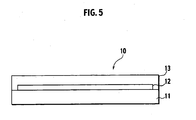
- FIG. 5 shows a side view of an electrostatic chuck 10 according to an embodiment of the invention.
- the electrostatic chuck 10 is configured with a first alumina-sintered body 11, an electrode 12, and a second alumina-sintered body13.
- a brief description is given of a manufacturing method of the electrostatic chuck 10.
- the first alumina sintered body 11 was produced by the same method as that of Examples 1 to 3 described above.
- the electrode 12 was formed on a predetermined outer surface of the first alumina sintered body 11 by screen printing.
- the second alumina sintered body 13 was formed on the electrode 12 and the predetermined outer surface of the first alumina sintered body 11 with the electrode 12 printed thereon. Specifically, the second alumina sintered body 13 was formed by hot-press sintering of alumina granulated powder obtained by mixing the alumina material and binder so that the electrode 12 was covered with and embedded in the second alumina sintered body 13.
- the first alumina sintered body 11 was produced in the same method as that of Examples 1 to 3 described above, the first alumina sintered body 11 includes properties (for example, the four-point flexural strength, density, and the like shown in Tables 1 and 2) equal to those of the alumina sintered bodies of Examples 1 to 3.
- the electrostatic chuck produced by this method includes high resistivity and high strength. Accordingly, it is possible to reduce leak current generated when high voltage is applied to the electrode 12. Furthermore, the electrostatic chuck thus produced has enough strength to electrical stress generated when high voltage is applied and serves as an electrostatic chuck over a long period of time.
Landscapes
- Engineering & Computer Science (AREA)
- Chemical & Material Sciences (AREA)
- Ceramic Engineering (AREA)
- Manufacturing & Machinery (AREA)
- Structural Engineering (AREA)
- Organic Chemistry (AREA)
- Materials Engineering (AREA)
- Inorganic Chemistry (AREA)
- Chemical Kinetics & Catalysis (AREA)
- Physics & Mathematics (AREA)
- Thermal Sciences (AREA)
- Mechanical Engineering (AREA)
- Compositions Of Oxide Ceramics (AREA)
- Container, Conveyance, Adherence, Positioning, Of Wafer (AREA)
Claims (4)
- Procédé de fabrication d'un corps fritté en alumine, comprenant les étapes consistant à :(i) mélanger du poly(alcool vinylique), servant de liant, et une poudre d'alumine ayant une pureté de 99,5 % ou plus, pour préparer une poudre granulée, la quantité de liant étant de 1,1 à 11 % en poids, la poudre granulée étant préparée par un procédé de séchage par pulvérisation, et la taille de grain moyenne de la poudre granulée étant située dans la plage allant de 70 à 130 µm ;(ii) former un comprimé de la poudre granulée avec une matrice métallique ; et(iii) effectuer un frittage sous presse chaude du comprimé,
dans lequel l'étape (iii) comprend les étapes consistant à :augmenter la température, à une vitesse située dans la plage allant de 100 à 700°C/h, sur une plage de températures allant d'une température normale à environ 1100°C ;augmenter la température, à une vitesse située dans la plage allant de 30 à 150°C/h, jusqu'à une température située dans la plage allant de 1400 à 1600°C ;effectuer un frittage à une température située dans la plage allant de 1400 à 1700°C pendant un temps situé dans la plage allant d'une à quatre heures dans une atmosphère d'azote. - Corps fritté en alumine pouvant être obtenu par le procédé selon la revendication 1, lequel corps fritté en alumine contient 0,05 % à 0,5 % en poids de carbone résiduel, et a une résistance à la flexion en quatre points de 500 MPa ou plus et une résistivité volumique de 1015 Ω·cm ou plus, et dans lequel la taille des grains cristallins dans le corps fritté en alumine est de 1 à 3 µm.
- Mandrin électrostatique (10) comprenant :un premier corps fritté en alumine (11) ;une électrode (12) formée sur une surface extérieure du premier corps fritté en alumine par sérigraphie ; etun deuxième corps fritté en alumine (13) formé sur l'électrode et la surface extérieure avec l'électrode formée dessus par frittage sous presse chaude de poudre granulée d'alumine obtenue par mélange de poudre d'alumine et d'un liant, le deuxième corps fritté en alumine couvrant l'électrode et ayant l'électrode encastrée dans celui-ci,dans lequel le premier corps fritté en alumine est le corps fritté en alumine tel que revendiqué dans la revendication 2.
- Procédé de fabrication d'un mandrin électrostatique (10), comprenant les étapes consistant à :former une électrode (12) sur une surface extérieure d'un premier corps fritté en alumine (11) par sérigraphie ; etformer un deuxième corps fritté en alumine (13) sur l'électrode et la surface extérieure avec l'électrode formée dessus par frittage sous presse chaude de poudre granulée d'alumine obtenue par mélange de poudre d'alumine et d'un liant, le deuxième corps fritté en alumine couvrant l'électrode et ayant l'électrode encastrée dans celui-ci,dans lequel le premier corps fritté en alumine est fabriqué par le procédé tel que revendiqué dans la revendication 1.
Applications Claiming Priority (1)
| Application Number | Priority Date | Filing Date | Title |
|---|---|---|---|
| JP2005069689 | 2005-03-11 |
Publications (2)
| Publication Number | Publication Date |
|---|---|
| EP1702900A1 EP1702900A1 (fr) | 2006-09-20 |
| EP1702900B1 true EP1702900B1 (fr) | 2012-05-02 |
Family
ID=36264051
Family Applications (1)
| Application Number | Title | Priority Date | Filing Date |
|---|---|---|---|
| EP06251300A Ceased EP1702900B1 (fr) | 2005-03-11 | 2006-03-10 | Corps fritté en alumine, son procédé de fabrication, mandrin électrostatique et son procédé de fabrication. |
Country Status (5)
| Country | Link |
|---|---|
| US (1) | US7387977B2 (fr) |
| EP (1) | EP1702900B1 (fr) |
| JP (1) | JP5084155B2 (fr) |
| KR (1) | KR100758888B1 (fr) |
| TW (1) | TWI314921B (fr) |
Families Citing this family (11)
| Publication number | Priority date | Publication date | Assignee | Title |
|---|---|---|---|---|
| JP4394667B2 (ja) * | 2006-08-22 | 2010-01-06 | 日本碍子株式会社 | ヒータ付き静電チャックの製造方法 |
| US20090159007A1 (en) * | 2007-11-14 | 2009-06-25 | Ngk Insulators, Ltd. | Substrate support |
| JP5203313B2 (ja) * | 2008-09-01 | 2013-06-05 | 日本碍子株式会社 | 酸化アルミニウム焼結体及びその製法 |
| GB201005457D0 (en) * | 2010-03-31 | 2010-05-19 | Isis Innovation | Ceramic materials |
| US8810992B2 (en) * | 2010-07-26 | 2014-08-19 | Kyocera Corporation | Electrostatic chuck |
| JP6159982B2 (ja) * | 2012-06-28 | 2017-07-12 | 日本特殊陶業株式会社 | 静電チャックの製造方法 |
| JP6277015B2 (ja) * | 2014-02-28 | 2018-02-07 | 株式会社日立ハイテクノロジーズ | プラズマ処理装置 |
| CN107207367A (zh) * | 2014-05-07 | 2017-09-26 | 摩根先进陶瓷公司 | 用于制造大型共烧物件的改进的方法 |
| JP6373212B2 (ja) * | 2015-03-26 | 2018-08-15 | 日本碍子株式会社 | アルミナ焼結体の製法及びアルミナ焼結体 |
| KR102751967B1 (ko) * | 2023-09-27 | 2025-01-09 | 솔믹스 주식회사 | 소결체, 이를 포함하는 부품 및 소결체의 제조방법 |
| JP2026055735A (ja) * | 2024-09-18 | 2026-03-31 | 株式会社フェローテック | ウエハ支持体及びウエハ支持体の製造方法 |
Family Cites Families (16)
| Publication number | Priority date | Publication date | Assignee | Title |
|---|---|---|---|---|
| DE2314442A1 (de) * | 1973-03-23 | 1974-10-03 | Rosenthal Stemag Tech Keramik | Verfahren zum herstellen einer hochverschleissfesten al tief 2 o tief 3-keramik |
| US5242298A (en) * | 1988-04-09 | 1993-09-07 | Dentaurum J. P. Winkelstroeter Kg | Shaped bodies of transparent, polycrystalline alumina |
| JP2759288B2 (ja) | 1989-09-29 | 1998-05-28 | 京セラ株式会社 | 酸化アルミニウム焼結体の製造方法 |
| JP3425271B2 (ja) * | 1994-05-23 | 2003-07-14 | 株式会社東芝 | 電力用抵抗体、その製造方法および電力用遮断器 |
| JPH1171168A (ja) | 1997-06-26 | 1999-03-16 | Ngk Spark Plug Co Ltd | アルミナ基セラミックス焼結体及びその製造方法 |
| JP3177650B2 (ja) * | 1997-11-28 | 2001-06-18 | ファインセラミックス技術研究組合 | 高強度アルミナ質焼結体およびその製造方法 |
| JP3023784B1 (ja) | 1998-11-18 | 2000-03-21 | 工業技術院長 | 高強度、高靱性酸化アルミニウム焼結体及びその製造方法 |
| JP2000219569A (ja) | 1999-01-29 | 2000-08-08 | Ngk Spark Plug Co Ltd | アルミナ基セラミックス焼結体及びその製造方法 |
| JP4447750B2 (ja) * | 1999-09-30 | 2010-04-07 | 日本碍子株式会社 | 窒化アルミニウム焼結体および半導体製造用部材 |
| US6648638B2 (en) * | 2001-12-28 | 2003-11-18 | 3M Innovative Properties Company | Orthodontic appliances including polycrystalline alumina-based ceramic material, kits, and methods |
| JP4230175B2 (ja) | 2002-06-14 | 2009-02-25 | 新日鉄マテリアルズ株式会社 | アルミナ質焼結体及びその製造方法 |
| US6858173B2 (en) * | 2003-01-30 | 2005-02-22 | The Regents Of The University Of California | Nanocrystalline ceramic materials reinforced with single-wall carbon nanotubes |
| US6875374B1 (en) * | 2003-02-26 | 2005-04-05 | The Regents Of The University Of California | Ceramic materials reinforced with single-wall carbon nanotubes as electrical conductors |
| JP2005019480A (ja) * | 2003-06-24 | 2005-01-20 | Taiheiyo Cement Corp | 給電端子の接合構造 |
| JP4476701B2 (ja) | 2004-06-02 | 2010-06-09 | 日本碍子株式会社 | 電極内蔵焼結体の製造方法 |
| JP4542485B2 (ja) * | 2004-12-14 | 2010-09-15 | 日本碍子株式会社 | アルミナ部材及びその製造方法 |
-
2006
- 2006-03-07 JP JP2006060886A patent/JP5084155B2/ja not_active Expired - Lifetime
- 2006-03-08 US US11/370,662 patent/US7387977B2/en active Active
- 2006-03-09 KR KR1020060022205A patent/KR100758888B1/ko not_active Expired - Lifetime
- 2006-03-10 TW TW095108128A patent/TWI314921B/zh active
- 2006-03-10 EP EP06251300A patent/EP1702900B1/fr not_active Ceased
Also Published As
| Publication number | Publication date |
|---|---|
| US20060205585A1 (en) | 2006-09-14 |
| JP2006282502A (ja) | 2006-10-19 |
| EP1702900A1 (fr) | 2006-09-20 |
| JP5084155B2 (ja) | 2012-11-28 |
| TW200640822A (en) | 2006-12-01 |
| KR100758888B1 (ko) | 2007-09-19 |
| US7387977B2 (en) | 2008-06-17 |
| KR20060097664A (ko) | 2006-09-14 |
| TWI314921B (en) | 2009-09-21 |
Similar Documents
| Publication | Publication Date | Title |
|---|---|---|
| KR100618530B1 (ko) | 정전 척과 그 제조 방법 및 알루미나 소결 부재와 그 제조방법 | |
| KR100496115B1 (ko) | 고강도유전체스퍼터링타겟및그의제조방법 | |
| EP3061739B1 (fr) | Siliziumnitrid-substrat und siliziumnitrid-leiterplatte mit diesem substrat | |
| EP1702900B1 (fr) | Corps fritté en alumine, son procédé de fabrication, mandrin électrostatique et son procédé de fabrication. | |
| EP2090557A2 (fr) | Matériau d'oxyde d'yttrium, élément d'un dispositif pour la fabrication de semi-conducteurs, et procédé pour la préparation d'un matériau d'oxyde d'yttrium | |
| US20100248935A1 (en) | Alumina sintered body, method for manufacturing the same, and semiconductor manufacturing apparatus member | |
| CN101844916B (zh) | 氧化铝烧结体、其制法和半导体制造装置部件 | |
| US10293581B2 (en) | Bonding material composition, aluminum nitride bonded body, and method for producing the same | |
| KR100543735B1 (ko) | 세라믹 소결체 및 그 제조방법 | |
| JP7660738B2 (ja) | 窒化珪素基板 | |
| EP1582509B1 (fr) | Corps dense fritté à base de cordiérite | |
| US8231964B2 (en) | Aluminum oxide sintered body, method for producing the same and member for semiconductor producing apparatus | |
| EP2189431A2 (fr) | Produit fritté de nitrure d'aluminium, procédé de sa production et mandrin électrostatique contenant ce produit | |
| EP1142849B1 (fr) | Substrat composite au nitrure de silicium | |
| JP2968539B2 (ja) | 窒化アルミニウム構造物の製造方法 | |
| KR100706064B1 (ko) | 세라믹스 부재 및 그 제조 방법 | |
| JP3150606B2 (ja) | 炭化珪素焼結体の比抵抗制御方法 | |
| JP7556880B2 (ja) | 酸化物含有セラミック焼結体の製法及び離型シート | |
| KR102583016B1 (ko) | MgO계 정전척 및 그 제조방법 | |
| KR20200021023A (ko) | 180 W/mk 내지 230 W/mk의 열전도성을 갖는 질화알루미늄 기판의 제조방법 | |
| JP6045117B2 (ja) | 強靭性の静電気放電防止黒色セラミックスおよびその製造方法 | |
| KR19980058570A (ko) | 와이어 본딩장치의 볼 본딩 캐필러리용 알루미나-탄화규소 나노복합체 및 그 제조방법 | |
| JP3450400B2 (ja) | 窒化アルミニウム焼結体および窒化アルミニウム多層回路基板 | |
| KR940006429B1 (ko) | 질화알루미늄기판의 제조방법 | |
| JP2021072350A (ja) | 複合焼結体および複合焼結体の製造方法 |
Legal Events
| Date | Code | Title | Description |
|---|---|---|---|
| PUAI | Public reference made under article 153(3) epc to a published international application that has entered the european phase |
Free format text: ORIGINAL CODE: 0009012 |
|
| AK | Designated contracting states |
Kind code of ref document: A1 Designated state(s): AT BE BG CH CY CZ DE DK EE ES FI FR GB GR HU IE IS IT LI LT LU LV MC NL PL PT RO SE SI SK TR |
|
| AX | Request for extension of the european patent |
Extension state: AL BA HR MK YU |
|
| 17P | Request for examination filed |
Effective date: 20070315 |
|
| AKX | Designation fees paid |
Designated state(s): DE FR GB |
|
| 17Q | First examination report despatched |
Effective date: 20070503 |
|
| GRAP | Despatch of communication of intention to grant a patent |
Free format text: ORIGINAL CODE: EPIDOSNIGR1 |
|
| GRAS | Grant fee paid |
Free format text: ORIGINAL CODE: EPIDOSNIGR3 |
|
| GRAA | (expected) grant |
Free format text: ORIGINAL CODE: 0009210 |
|
| AK | Designated contracting states |
Kind code of ref document: B1 Designated state(s): DE FR GB |
|
| REG | Reference to a national code |
Ref country code: GB Ref legal event code: FG4D |
|
| REG | Reference to a national code |
Ref country code: DE Ref legal event code: R096 Ref document number: 602006029198 Country of ref document: DE Effective date: 20120705 |
|
| PLBE | No opposition filed within time limit |
Free format text: ORIGINAL CODE: 0009261 |
|
| STAA | Information on the status of an ep patent application or granted ep patent |
Free format text: STATUS: NO OPPOSITION FILED WITHIN TIME LIMIT |
|
| 26N | No opposition filed |
Effective date: 20130205 |
|
| REG | Reference to a national code |
Ref country code: DE Ref legal event code: R097 Ref document number: 602006029198 Country of ref document: DE Effective date: 20130205 |
|
| REG | Reference to a national code |
Ref country code: FR Ref legal event code: PLFP Year of fee payment: 11 |
|
| REG | Reference to a national code |
Ref country code: FR Ref legal event code: PLFP Year of fee payment: 12 |
|
| REG | Reference to a national code |
Ref country code: FR Ref legal event code: PLFP Year of fee payment: 13 |
|
| PGFP | Annual fee paid to national office [announced via postgrant information from national office to epo] |
Ref country code: GB Payment date: 20220127 Year of fee payment: 17 Ref country code: DE Payment date: 20220203 Year of fee payment: 17 |
|
| PGFP | Annual fee paid to national office [announced via postgrant information from national office to epo] |
Ref country code: FR Payment date: 20220209 Year of fee payment: 17 |
|
| REG | Reference to a national code |
Ref country code: DE Ref legal event code: R119 Ref document number: 602006029198 Country of ref document: DE |
|
| GBPC | Gb: european patent ceased through non-payment of renewal fee |
Effective date: 20230310 |
|
| PG25 | Lapsed in a contracting state [announced via postgrant information from national office to epo] |
Ref country code: GB Free format text: LAPSE BECAUSE OF NON-PAYMENT OF DUE FEES Effective date: 20230310 |
|
| PG25 | Lapsed in a contracting state [announced via postgrant information from national office to epo] |
Ref country code: GB Free format text: LAPSE BECAUSE OF NON-PAYMENT OF DUE FEES Effective date: 20230310 Ref country code: FR Free format text: LAPSE BECAUSE OF NON-PAYMENT OF DUE FEES Effective date: 20230331 Ref country code: DE Free format text: LAPSE BECAUSE OF NON-PAYMENT OF DUE FEES Effective date: 20231003 |