EP1705155A1 - Procédé et dispositif pour le traitement des eaux usées dans les industries alimentaires, en particulier des fluides de lavage dans les brasseries - Google Patents
Procédé et dispositif pour le traitement des eaux usées dans les industries alimentaires, en particulier des fluides de lavage dans les brasseries Download PDFInfo
- Publication number
- EP1705155A1 EP1705155A1 EP05006425A EP05006425A EP1705155A1 EP 1705155 A1 EP1705155 A1 EP 1705155A1 EP 05006425 A EP05006425 A EP 05006425A EP 05006425 A EP05006425 A EP 05006425A EP 1705155 A1 EP1705155 A1 EP 1705155A1
- Authority
- EP
- European Patent Office
- Prior art keywords
- filter
- hydrocyclone
- liquor
- fine filter
- cleaning
- Prior art date
- Legal status (The legal status is an assumption and is not a legal conclusion. Google has not performed a legal analysis and makes no representation as to the accuracy of the status listed.)
- Granted
Links
- 238000000034 method Methods 0.000 title claims description 18
- 238000005406 washing Methods 0.000 title claims description 6
- 239000002351 wastewater Substances 0.000 title abstract description 3
- 239000012530 fluid Substances 0.000 title 1
- 238000004140 cleaning Methods 0.000 claims abstract description 63
- 239000000706 filtrate Substances 0.000 claims abstract description 41
- 239000002245 particle Substances 0.000 claims abstract description 15
- 238000001914 filtration Methods 0.000 claims description 14
- 239000012528 membrane Substances 0.000 claims description 13
- XLYOFNOQVPJJNP-UHFFFAOYSA-N water Substances O XLYOFNOQVPJJNP-UHFFFAOYSA-N 0.000 claims description 13
- 239000000463 material Substances 0.000 claims description 10
- 239000000919 ceramic Substances 0.000 claims description 5
- 238000002360 preparation method Methods 0.000 claims description 4
- 238000004519 manufacturing process Methods 0.000 claims description 3
- 239000011148 porous material Substances 0.000 claims description 2
- 239000003518 caustics Substances 0.000 abstract description 4
- 238000004062 sedimentation Methods 0.000 description 7
- 239000004094 surface-active agent Substances 0.000 description 6
- 239000007788 liquid Substances 0.000 description 4
- 238000011001 backwashing Methods 0.000 description 3
- 238000000746 purification Methods 0.000 description 3
- 239000003795 chemical substances by application Substances 0.000 description 2
- 239000011362 coarse particle Substances 0.000 description 2
- 230000000694 effects Effects 0.000 description 2
- 239000000835 fiber Substances 0.000 description 2
- 239000012535 impurity Substances 0.000 description 2
- 239000000047 product Substances 0.000 description 2
- 239000010802 sludge Substances 0.000 description 2
- 239000004458 spent grain Substances 0.000 description 2
- 239000013543 active substance Substances 0.000 description 1
- 239000003513 alkali Substances 0.000 description 1
- 239000011230 binding agent Substances 0.000 description 1
- 230000003139 buffering effect Effects 0.000 description 1
- 229910010293 ceramic material Inorganic materials 0.000 description 1
- 239000000084 colloidal system Substances 0.000 description 1
- 239000000470 constituent Substances 0.000 description 1
- 238000010276 construction Methods 0.000 description 1
- 239000000356 contaminant Substances 0.000 description 1
- 238000011109 contamination Methods 0.000 description 1
- 238000005429 filling process Methods 0.000 description 1
- 239000010419 fine particle Substances 0.000 description 1
- 239000013505 freshwater Substances 0.000 description 1
- 239000003292 glue Substances 0.000 description 1
- 238000002347 injection Methods 0.000 description 1
- 239000007924 injection Substances 0.000 description 1
- 238000003780 insertion Methods 0.000 description 1
- 230000037431 insertion Effects 0.000 description 1
- 238000001471 micro-filtration Methods 0.000 description 1
- 239000000049 pigment Substances 0.000 description 1
- 239000000523 sample Substances 0.000 description 1
- 238000000926 separation method Methods 0.000 description 1
- 238000004513 sizing Methods 0.000 description 1
- 239000000243 solution Substances 0.000 description 1
Images



Classifications
-
- C—CHEMISTRY; METALLURGY
- C02—TREATMENT OF WATER, WASTE WATER, SEWAGE, OR SLUDGE
- C02F—TREATMENT OF WATER, WASTE WATER, SEWAGE, OR SLUDGE
- C02F1/00—Treatment of water, waste water, or sewage
- C02F1/38—Treatment of water, waste water, or sewage by centrifugal separation
-
- C—CHEMISTRY; METALLURGY
- C02—TREATMENT OF WATER, WASTE WATER, SEWAGE, OR SLUDGE
- C02F—TREATMENT OF WATER, WASTE WATER, SEWAGE, OR SLUDGE
- C02F1/00—Treatment of water, waste water, or sewage
- C02F1/44—Treatment of water, waste water, or sewage by dialysis, osmosis or reverse osmosis
- C02F1/444—Treatment of water, waste water, or sewage by dialysis, osmosis or reverse osmosis by ultrafiltration or microfiltration
-
- C—CHEMISTRY; METALLURGY
- C02—TREATMENT OF WATER, WASTE WATER, SEWAGE, OR SLUDGE
- C02F—TREATMENT OF WATER, WASTE WATER, SEWAGE, OR SLUDGE
- C02F2103/00—Nature of the water, waste water, sewage or sludge to be treated
- C02F2103/32—Nature of the water, waste water, sewage or sludge to be treated from the food or foodstuff industry, e.g. brewery waste waters
Definitions
- the invention relates to a method and apparatus for processing contaminated cleaning liquors accumulating in food production, especially in breweries, according to the preambles of claims 1 and 13, and to a corresponding bottle cleaning system.
- Bottles are cleaned, for example, with a bottle cleaning system, as shown in FIG. 7.
- bottle cleaning systems include, as will be described in detail later, a Vorlaugebad 32, a Hauptlaugebad 28 and a Nachlaugebad 37.
- the condition of the cleaning liquor deteriorates despite the increase because more and more sludge settles and soluble, insoluble or colloid dissolved components in the lye are included.
- These include paper fibers from shredded labels, color pigments, binders from the labels, wet strength agents, sizing agents, precipitated sludge from limescale constituents, adhering dirt from bottles, etc.
- the cleaning liquor is first filtered by a hydrocyclone filter 1 and then by a fine filter, there is the advantage that the filter assembly does not clog.
- the coarse filtered particles can be easily removed through the underflow of the hydrocyclone filter, whereby the smaller particles can be filtered out with the fine filter.
- the construction of the hydrocyclone filter ensures that there is no clogging of the filter during coarse filtration. With the help of the fine filter can be achieved beyond that even surfactants (surfactants, label color) can be filtered out.
- the hydrocyclone filter serves as a coarse filter and preferably filters out particles of a size ⁇ 150 ⁇ m.
- the fine filter can filter out particles of a size ⁇ 2 ⁇ m, preferably ⁇ 0.4 ⁇ m.
- surface-active substances can also be removed from the contaminated cleaning liquor with such a filter performance, so that the treated filtrate can be removed, for example.
- B. can also be used as a rinse.
- a fine filter a pressure housing with ceramic membranes can be used, which are flowed through in the crossflow of the contaminated cleaning liquor.
- the fine filter may comprise, for example, at least one multi-tube membrane filter cartridge. Such fine filters can be easily cleaned in the inventive arrangement by rinsing.
- the fine filter can have a non-filtrate stream and a filtrate stream, wherein the unfiltered material can be recycled to the hydrocyclone filter and / or the fine filter.
- the filtrate from the fine filter can then be used again as a cleaning liquor.
- the main liquor from a bottle cleaning machine is treated as the cleaning liquor and then returned to the main liquor, ie the main liquor bath.
- the main liquor filtered by the hydrocyclone may be fed to a feed tank before it is filtered by the fine filter.
- the feed tank serves to buffer the concentration the cleaning solution from the fine filter.
- the unfiltered material from the fine filter is returned to the feed container.
- the main lye bath is fed and a part of the fine filter is supplied.
- a portion of the filtrate of the main liquor from the hydrocyclone filter directly back to the main liquor, d. H. the main lye bath is fed and a part of the fine filter is supplied.
- the main lye bath is cleaned with a large volume flow and, in addition, a small volume flow is still filtered by the fine filter.
- the main liquor is constantly regenerated to maintain the detergency. Only a part of it is finely filtered, since in this combination surfactants still have to remain in the main liquor, since they are needed here for the purification.
- the dirty water coming from the underflow of the hydrocyclone filter may be supplied to a pre-cleaning bath of the bottle washing machine.
- the inventive method can also be used for cleaning liquors from the brewhouse.
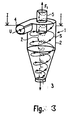
- a hydrocyclone filter 1 as shown for example in FIG. 3, and a fine filter 13, as shown for example in FIGS. 4 to 6, are used to treat polluted cleaning liquors 37, 28 produced in breweries.
- the hydrocyclone 1 has a hollow body 2, at the upper end of a Unfiltratzulauf 4 for contaminated cleaning liquor 37, 28 is provided.
- the Unfiltratzulauf 4 has an inlet pipe which extends tangentially to the hollow body 2.
- the hollow body 2 is formed in its upper region of a hollow cylinder and extends in the lower region conically down to.
- at the upper end there may be a dip tube which protrudes into the hollow body 2 and constitutes a so-called overflow nozzle (vortex finder) or overflow, which serves as a filtrate outlet for the filtrate F1.
- the hydrocyclone filter 1 operates as follows.
- the contaminated cleaning liquor 37, 28 is pumped by a pump at high speed into the non-filtrate inlet 4 and thus passed tangentially into the cylindrical hollow body 2.
- the cleaning liquor tangentially supplied with pressure via a pump is forced on the inner wall of the hollow body 2 to an outer, downwardly directed helical circulating flow (outer vortex S). Due to a throttle effect in the lower conical part of the outer vortex parts are constantly deflected to an inner upward vortex flow Z (inner vortex). Due to the centrifugal force, the larger and heavier particles of the cleaning liquor collect on the inner walls of the hollow body 2 and can be discharged at the lower end via the lower run 3.
- the internal vortex rises in the cone axis, ie the longitudinal axis of the hollow body 2 upwards and can be removed there as filtrate F1.
- the hollow body 2 is conical in the lower region educated.
- the device can also be formed as a hollow cylinder with a flat bottom.
- the hydrocyclone filter serves as a coarse filter and filters e.g. Particles of particle size ⁇ 150 microns out. Downstream of the hydrocyclone filter 1 is a fine filter 13, the fine particles of a size ⁇ 2 microns, preferably aus 0.4 microns filters out.
- a pressure housing may be provided with ceramic membranes, which are traversed in the crossflow of the contaminated cleaning liquor.
- FIGS. 4 to 6 A possible embodiment of such a fine filter 13 is shown in FIGS. 4 to 6, wherein the fine filter here comprises a pressure housing 42 and at least one multi-tube membrane filter cartridge 40. Between the membrane filter cartridge 40 and the pressure housing 42, a filtrate 43 is formed.
- the multi-tube membrane filter cartridge 40 as shown in more detail in FIGS. 5 and 6, has a plurality of tubes 21 extending longitudinally through the filter cartridge 40.
- the filter cartridge may be formed of ceramic material, wherein on the inside of the tube a few micrometers thick membrane layer may be arranged.
- the pore size here is ⁇ 2 microns, preferably ⁇ 0.4 microns.
- unfiltered material coming from the hydrocyclone filter 1 enters the tubes 21 of the filter cartridge 40, passes through the membrane in the tubes 21 and through the ceramic of the filter cartridge 40 and leaves the surface 41 of the filter cartridge 40 as filtrate and enters the Filtratraum 43, where the filtrate F2 can be deducted.
- the non-filtrate U which flows through the tubes 21, leaves the fine filter 13 and can for example be fed again to the non-filtrate inlet 4 of the hydrocyclone filter 1 or else be fed back to the fine filter.
- the combination of the hydrocyclone filter 1 and the fine filter 13 allows that even heavily polluted cleaning liquors can be reliably processed without the filter assembly added.
- the device according to the invention and the method according to the invention can be used, for example, for cleaning liquors from the brewhouse or the bottle cellar.
- FIG. 7 shows the preparation of the main liquor and FIG. 2 shows the preparation of the afterglow.
- Fig. 7 shows a single-end cleaning machine in which the bottle insert 53 and the bottle delivery 54 are located on the same side. After the insertion of the bottles, there is first a residual emptying 52. Subsequently, the bottles pass successively through the Vorweiche 34, the projection 36 and the Vorweiche 35 and are then transported into the Vorlaugebad 32. This is followed by the longest and most intensive treatment in the main spa 28 where most of the dirt and contaminants dissolve. This also applies to the labels and label glue.
- the cleaning system may include corresponding means 90 for removing the labels.
- the device according to the invention is not shown.
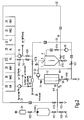
- the device according to the invention for the treatment of the main liquor 28 is shown in FIG.
- the apparatus shown in Fig. 1 is connected to the tepid bath shown in Fig. 7 for supplying the main liquor 28 via a corresponding piping system.
- the device further comprises the hydrocyclone filter 1, which has been explained in detail in connection with FIG.
- the underflow 3 is here connected to a sedimentation device 27, which has a discharge valve V9.
- the overflow 5 of the hydrocyclone filter 1 is connected on the one hand via the valve V2 with a line 19 which leads into a feed tank 14 to direct filtrate F1 from the hydrocyclone filter 1 in the feed tank 14.
- the overflow 5 is also connected to a line 18, which may have a control valve V9, and filtrate F1 from the hydrocyclone 1 directly back to the Hauptlaugebad without fine filtration, in the line from the Hauptlaugebad to the hydrocyclone 1, a pump 22 is provided.
- the feed tank 14 is connected at its lower end via a line 15 of a pump 16 and a valve V4 with the fine filter 13, wherein the unfiltered from the fine filter 13 can be recycled via a line 17 and the valve V3 the feed tank 14.
- the feed tank 14 also has drain valves V5, V6, V7. Hot water can be introduced into the upper region of the feed container 14 via the hot water supply 36 and the valve V12.
- the feed container 14 further comprises a level sensor 23.
- the filtrate F 2 from the fine filter 13 can be supplied via a line 20 of the main liquor 28.
- the device has a compressed air device 24 and a hot water device 25 with corresponding valves V10 and V11, which are used for backwashing and cleaning as explained in more detail below.
- Fig. 1 operates as follows.
- the filter system Before operation, the filter system must first be filled.
- the pump 22 is turned on.
- the control valve V9 is closed and the valve V2 is opened.
- the pump 22 permanently pumps main liquor 28 from the main bath into the hydrocyclone filter 1, wherein the filtrate F1 is supplied from the overflow 5 via the line 19 to the feed tank 14.
- Also from the sedimentation device 27 lye can be fed into the feed tank 14, since this is relatively clear, as settle coarse particles in the sedimentation.
- the filling process is carried out until it is reported via a level sensor 23 that a certain level has been reached.
- the valve V9 is opened, as are the valves V2, V4 and V8 open.
- Main liquor 28 is pumped via the pump 22 into the hydrocyclone filter 1, which filters out coarse particles and discharges them via the underflow 3 into the sedimentation device 27.
- the heavy particles settle in the sedimentation device 27 and relatively clear liquor is in the upper part of the sedimentation device.
- This can be fed to the feed tank 14.
- the coarsely filtered filtrate F1 leaves the hydrocyclone filter 1 via the overflow 5, wherein a large coarse-cleaned volume flow is conducted via the line 18 directly back to the main lye bath.
- a small volume flow is finely filtered by the fine filter 13.
- the coarsely filtered filtrate F1 is fed via the line 19 to the feed tank 14 and from the feed tank 14 via the line 15, the pump 16 and the Valve V4 fed to the fine filter 13, which as described in connection with Figs. 3 to 6, a fine filtrate F2 generated, which is supplied via the line 20 and the valve V8 to the Hauptlaugebad.
- the hydrocyclone filter 1 and the setting of the corresponding valves, etc. is designed so that about 3/4 (60 to 80%) of the purified by him amount of cleaning liquor, ie here main liquor, again runs directly into the main liquor 28. It cleans the Hauptlaugebad with a large volume flow and in addition is still the smaller volume flow of the fine filter 13 finely filtered.
- the main liquor can be constantly regenerated and the cleaning effect can be maintained. Since only a small portion is finely filtered, the surfactants can remain in the main liquor since they are still needed for cleaning. About 1/4 (or 20 to 40%) of the coarse filtrate F1 is fed to the fine filtration here.
- 11 m 3 per hour of main liquor 28 are fed to the hydrocyclone filter 1, 0.5 to 1 m 3 per hour fed via the lower reaches of the hydrocyclone 1 the sedimentation 27, 7 to 8 m 3 per hour via the line 18th fed to the main liquor 28 and fed about 2 to 3 m 3 per hour of fine filtrate F2 via the line 20 of the main liquor 28.
- About 10 m 3 per hour are fed to the feed tank 14 via line 19.
- the device is first backwashed, wherein the pipes and filters are emptied via the compressed air device 24 and corresponding circuit of the valves and are rinsed with hot water through a hot water supply 25 and 26.
- Fig. 2 shows the apparatus for treating Nachlauge 37 from the Nachlaugebad shown in Fig. 7 bottle cleaning system 100.
- the device has a line 55 and a corresponding valve V13, via which the Nachlauge of Nachlaugebad the hydrocyclone filter 1 can be supplied.
- the device has a pump 56 which pumps the lye 37 into the hydrocyclone filter 1.
- the overflow 5, from which the coarse filtrate F1 emerges from the hydrocyclone filter 1, is via a line 30 and a pump 57 connected to the fine filter 13.
- the unfiltered material from the filter 13 can be supplied to the hydrocyclone filter 1 again via a line 58.
- the fine filtrate F2 can be recycled via a line 31 and valve V19 again the Nachlaugebad with the Nachlauge 37.
- the device has a compressed air device 24 for backwashing and a hot water supply 25, 26 for cleaning.
- the underflow of the hydrocyclone filter 3 is connected via a return line 33 with the Vorlaugebad 32.
- the hydrocyclone is responsible for the coarse filtration (up to about 150 microns), while the fine filter 13 (up to about 0.4 microns) takes over the fine filtration.
- the interconnection of hydrocyclone filter 1 and fine filter 13 takes place here without additional feed tank 14.
- the concentration of contamination taking place in the fine filter circuit is kept within limits by the constant separation of liquid from underflow 3 of the hydrocyclone filter, so that the feed tank needed for buffering the concentration can be dispensed with ,
- the device described here operates as follows. First, the filter system is filled. When filling, valves V27, V14, control valves V18, V17 are fully open and pumps 56 and 57 are off and valves V15 and V16 are closed. Via the pump 70 and the subsequent valve or else via the line 55 with the valve V13 open, a filling of the filter system with lye 37 can first be carried out until the ring probe 71 reports liquid, whereupon e.g. the valve V30 is closed.
- valve V13 is then opened, the pumps 56 and 57 are turned on, the valve 19 and the valve V16 are opened, the valves V21, V20 and V31 are closed and the control valve V18 is set to a value such that As a result of a set pressure level in the membrane of the fine filter results in the largest possible volume flow, wherein the control valve V17 is set to a value that a predetermined flow, for example, 10 m 3 per hour can be sucked by the pump 56.
- after-liquor 37 from the after-bath which is shown in Fig. 7, via the valve 13 and the line 55 via the pump 56 in the hydrocyclone filter 1 with high Speed introduced tangentially.
- the filtrate F1 (particle size up to about 150 microns) is pumped via the line 30 from the pump 57 in the fine filter 13 to be subjected to a fine filtration here as described above.
- the fine filtrate F2 which has a particle size of ⁇ 2 ⁇ m, preferably 0.4 ⁇ m, is returned to the post-wash bath with the after-caustic liquor 37 again via the line 31.
- the unfiltered material U coming from the fine filter 13 can be fed again via the line 58 from the pump 56 via the nonfiltrate feed 4 to the hydrocyclone filter 1.
- Part of the unfiltered material from the fine filter 13 can also be fed again via the line 80 from the pump 57 to the fine filtration.
- a part of the unfiltered material U from the fine filter 13 can be fed again to the hydrocyclone filter 1 and a part again to the fine filter 13.
- the dirty water from the lower run 3 of the hydrocyclone filter 1 can be supplied via the line 33 of the Vorlauge 32 and must not be discarded.
- the filtration of the after-liquor according to the invention makes it possible for the bottles to be rinsed out with as clean a liquid as possible in the after-bath, and for the subsequent rinsing zones to be protected from the entry of dirt.
- the fine filter d. H.
- microfiltration it is possible to filter out even existing surfactants (surfactants, label color) so that the product bottle has a higher surface tension at the end of the cleaning, which leads to a higher product quality.
- the compressed air device 24 By means of the compressed air device 24, by switching the corresponding valves (V13 to V22, V30, V31), the liquids can be backwashed from the lines and via the hot water supply 25, 26, the lines can be flushed in a simple manner.
- a hydrocyclone filter 1 and a fine filter, d. H. Microfilter 13 comprises, it is possible to filter continuously cleaning liquor without enforcing the filter.
- the filter assembly can be cleaned by simply backwashing and rinsing.
- the fact that here includes a fine filter with a Unfiltratstrom and a pressure housing with ceramic membranes, which are flowed through in the crossflow, and the fine filter can be easily cleaned by simply rinsing.
Landscapes
- Engineering & Computer Science (AREA)
- Chemical & Material Sciences (AREA)
- Water Supply & Treatment (AREA)
- Organic Chemistry (AREA)
- Life Sciences & Earth Sciences (AREA)
- Hydrology & Water Resources (AREA)
- Environmental & Geological Engineering (AREA)
- Mechanical Engineering (AREA)
- Analytical Chemistry (AREA)
- Separation Using Semi-Permeable Membranes (AREA)
- Cleaning By Liquid Or Steam (AREA)
- Filtration Of Liquid (AREA)
- Soy Sauces And Products Related Thereto (AREA)
Priority Applications (4)
| Application Number | Priority Date | Filing Date | Title |
|---|---|---|---|
| AT05006425T ATE374733T1 (de) | 2005-03-23 | 2005-03-23 | Verfahren und vorrichtung zum aufbereiten von bei der lebensmittelherstellung insbesondere in brauereien anfallenden verunreinigten reinigungslaugen |
| DE502005001627T DE502005001627D1 (de) | 2005-03-23 | 2005-03-23 | Verfahren und Vorrichtung zum Aufbereiten von bei der Lebensmittelherstellung insbesondere in Brauereien anfallenden verunreinigten Reinigungslaugen |
| EP05006425A EP1705155B1 (fr) | 2005-03-23 | 2005-03-23 | Procédé et dispositif pour le traitement des eaux usées dans les industries alimentaires, en particulier des fluides de lavage dans les brasseries |
| PCT/EP2006/002430 WO2006099991A1 (fr) | 2005-03-23 | 2006-03-16 | Procede et dispositif de traitement de liquides d'epuration contamines produits dans l'industrie alimentaire, notamment dans des brasseries |
Applications Claiming Priority (1)
| Application Number | Priority Date | Filing Date | Title |
|---|---|---|---|
| EP05006425A EP1705155B1 (fr) | 2005-03-23 | 2005-03-23 | Procédé et dispositif pour le traitement des eaux usées dans les industries alimentaires, en particulier des fluides de lavage dans les brasseries |
Publications (2)
| Publication Number | Publication Date |
|---|---|
| EP1705155A1 true EP1705155A1 (fr) | 2006-09-27 |
| EP1705155B1 EP1705155B1 (fr) | 2007-10-03 |
Family
ID=34934475
Family Applications (1)
| Application Number | Title | Priority Date | Filing Date |
|---|---|---|---|
| EP05006425A Expired - Lifetime EP1705155B1 (fr) | 2005-03-23 | 2005-03-23 | Procédé et dispositif pour le traitement des eaux usées dans les industries alimentaires, en particulier des fluides de lavage dans les brasseries |
Country Status (4)
| Country | Link |
|---|---|
| EP (1) | EP1705155B1 (fr) |
| AT (1) | ATE374733T1 (fr) |
| DE (1) | DE502005001627D1 (fr) |
| WO (1) | WO2006099991A1 (fr) |
Cited By (1)
| Publication number | Priority date | Publication date | Assignee | Title |
|---|---|---|---|---|
| EP2016992A1 (fr) | 2007-07-16 | 2009-01-21 | KRONES Aktiengesellschaft | Dispositif et procédé destinés au traitement de liquides de nettoyage utilisés dans des brasseries |
Families Citing this family (4)
| Publication number | Priority date | Publication date | Assignee | Title |
|---|---|---|---|---|
| RU2531404C1 (ru) * | 2013-05-23 | 2014-10-20 | Федеральное государственное бюджетное образовательное учреждение высшего профессионального образования "Южно-Уральский государственный университет" (национальный исследовательский университет) (ФГБОУ ВПО "ЮУрГУ" (НИУ)) | Способ подготовки воды для пищевых производств |
| DE102014015537A1 (de) * | 2014-10-21 | 2016-04-21 | Lorenz Eichinger | Vorrichtung zur ökologischen Wasseraufbereitung mit einem Hydrozyklon |
| CN109264827A (zh) * | 2018-11-02 | 2019-01-25 | 北京市环境保护科学研究院 | 处理废聚酯瓶片洗涤废水的陶瓷膜分离处理方法和系统 |
| CN114269692A (zh) * | 2019-06-28 | 2022-04-01 | 埃科莱布美国股份有限公司 | 再循环洗涤溶液 |
Citations (3)
| Publication number | Priority date | Publication date | Assignee | Title |
|---|---|---|---|---|
| EP0815961A2 (fr) * | 1996-06-24 | 1998-01-07 | WABAG Wassertechnische Anlagen GmbH | Procédé pour traiter de l'eau usée d'un machine de nettoyage de bouteilles |
| DE19741546A1 (de) * | 1997-09-20 | 1999-04-01 | Inocermic Ges Fuer Innovative | Reinigungsverfahren mit zwei Flüssigkeitskreisläufen |
| US20030205514A1 (en) * | 2002-05-03 | 2003-11-06 | Potter J. Leon | Water filtration system for food processing line |
-
2005
- 2005-03-23 EP EP05006425A patent/EP1705155B1/fr not_active Expired - Lifetime
- 2005-03-23 DE DE502005001627T patent/DE502005001627D1/de not_active Expired - Lifetime
- 2005-03-23 AT AT05006425T patent/ATE374733T1/de not_active IP Right Cessation
-
2006
- 2006-03-16 WO PCT/EP2006/002430 patent/WO2006099991A1/fr not_active Ceased
Patent Citations (3)
| Publication number | Priority date | Publication date | Assignee | Title |
|---|---|---|---|---|
| EP0815961A2 (fr) * | 1996-06-24 | 1998-01-07 | WABAG Wassertechnische Anlagen GmbH | Procédé pour traiter de l'eau usée d'un machine de nettoyage de bouteilles |
| DE19741546A1 (de) * | 1997-09-20 | 1999-04-01 | Inocermic Ges Fuer Innovative | Reinigungsverfahren mit zwei Flüssigkeitskreisläufen |
| US20030205514A1 (en) * | 2002-05-03 | 2003-11-06 | Potter J. Leon | Water filtration system for food processing line |
Non-Patent Citations (3)
| Title |
|---|
| BRAEKEN L ET AL: "Regeneration of brewery waste water using nanofiltration", WATER RESEARCH, PERGAMON PRESS, OXFORD, GB, vol. 38, no. 13, July 2004 (2004-07-01), pages 3075 - 3082, XP004521287, ISSN: 0043-1354 * |
| RÖGENER F, MAVROV V, CHMIEL H: "Aufarbeitung des Nachspülwassers von Flaschenwaschmaschinen mittels Membranfiltration mit dem Ziel der Wiederverwendung", CHEMIE INGENIEUR TECHNIK, vol. 74, no. 4, 2002, WEINHEIM, DE, pages 517 - 524, XP002333084 * |
| SCHARNAGL N ET AL: "Recycling of washing waters from bottle cleaning machines using membranes", DESALINATION, ELSEVIER, AMSTERDAM, NL, vol. 131, no. 1-3, 20 December 2000 (2000-12-20), pages 55 - 63, XP004306338, ISSN: 0011-9164 * |
Cited By (5)
| Publication number | Priority date | Publication date | Assignee | Title |
|---|---|---|---|---|
| EP2016992A1 (fr) | 2007-07-16 | 2009-01-21 | KRONES Aktiengesellschaft | Dispositif et procédé destinés au traitement de liquides de nettoyage utilisés dans des brasseries |
| WO2009010164A1 (fr) | 2007-07-16 | 2009-01-22 | Krones Ag | Dispositif et procédé de préparation de liquides de nettoyage |
| US20100224575A1 (en) * | 2007-07-16 | 2010-09-09 | Martin Nissen | Device and Method for Processing Cleaning Fluids |
| RU2440180C2 (ru) * | 2007-07-16 | 2012-01-20 | Кронэс Аг | Способ переработки моющих жидкостей и устройство для этой цели |
| CN101772375B (zh) * | 2007-07-16 | 2012-11-07 | 克朗斯股份公司 | 用于处理清洗液的设备及方法 |
Also Published As
| Publication number | Publication date |
|---|---|
| ATE374733T1 (de) | 2007-10-15 |
| EP1705155B1 (fr) | 2007-10-03 |
| DE502005001627D1 (de) | 2007-11-15 |
| WO2006099991A1 (fr) | 2006-09-28 |
Similar Documents
| Publication | Publication Date | Title |
|---|---|---|
| DE102011056633B4 (de) | Verfahren zum Reinigen eines Filters | |
| EP0537516B1 (fr) | Procédé pour le traitement de liquides de lavage à contre-courant provenant d'un filtre au lavage à contre-courant et dispositif du sédimentation pour liquides de lavage | |
| EP2167222B1 (fr) | Procédé de préparation de liquides de nettoyage | |
| DE10022538C2 (de) | Verfahren und Vorrichtung zum Abscheiden von Getränkesatz | |
| DE4231837C2 (de) | Verfahren und Anlage zum Reinigen von ölverschmutztem und emulgiertem Bilgewasser auf Schiffen | |
| EP0636401B1 (fr) | Installation et procédé de recyclage d'eau de traitement | |
| EP1705155B1 (fr) | Procédé et dispositif pour le traitement des eaux usées dans les industries alimentaires, en particulier des fluides de lavage dans les brasseries | |
| DE102006010842A1 (de) | Vorrichtung und Verfahren zum Aufbereiten von rückgespültem Fluid | |
| EP1832333A1 (fr) | Procédé destiné à la récupération de liquides contaminés | |
| WO2004037381A1 (fr) | Dispositif de separation, notamment pour extraire des solides contenus dans des liquides | |
| DE102009012189B4 (de) | Verfahren und Abwasserreinigungsanlage zur Behandlung von Abwässern der Ölfrüchte- und Getreideverarbeitung | |
| DE2363040A1 (de) | Verfahren zum reinigen und entfernen von filterrueckstaenden | |
| DE102005013553A1 (de) | Filter | |
| DE102021121254A1 (de) | Filtervorrichtung und Verfahren zur Zurückhaltung von in Flüssigkeiten enthaltenen Partikeln, Schwebstoffen oder Fremdkörpern | |
| AT502037A4 (de) | Verfahren zum reinigen von gegenständen und reinigungssystem | |
| EP3338877B1 (fr) | Procédé et dispositif de filtration d'un fluide brut contenant une impureté au moyen d'au moins une unité de filtre à membrane ainsi que leur utilisation | |
| DE102014016453B4 (de) | Filtersystem, seine Verwendung sowie ein Verfahren zur Filtration von einer Lauge | |
| WO2001051186A1 (fr) | Procede et dispositif pour liberer des chemins d'ecoulement dans des modules de filtration | |
| DE4305099C2 (de) | Verfahren zur Reinigung einer Filtereinrichtung und Filtereinrichtung zur Durchführung des Verfahrens | |
| DE2606804C2 (de) | Verfahren und Vorrichtung zum Reinigen von Spaltfilterkerzen | |
| DE202006003680U1 (de) | Vorrichtung zum Aufbereiten von rückgespültem Fluid | |
| DE102022131787A1 (de) | Reinigungseinheit und Verfahren zur Aufbereitung von Unfiltrat | |
| DE19635005A1 (de) | Verfahren zum Aufbereiten von verunreinigtem Abwasser und Vorrichtung zu dessen Durchführung | |
| DE69211570T2 (de) | Verfahren und vorrichtung zur wiederverwendung von wasser | |
| DE202016003845U1 (de) | Abfördereinrichtung für gereinigtes Wasser aus einer Kläranlage |
Legal Events
| Date | Code | Title | Description |
|---|---|---|---|
| PUAI | Public reference made under article 153(3) epc to a published international application that has entered the european phase |
Free format text: ORIGINAL CODE: 0009012 |
|
| AK | Designated contracting states |
Kind code of ref document: A1 Designated state(s): AT BE BG CH CY CZ DE DK EE ES FI FR GB GR HU IE IS IT LI LT LU MC NL PL PT RO SE SI SK TR |
|
| AX | Request for extension of the european patent |
Extension state: AL BA HR LV MK YU |
|
| 17P | Request for examination filed |
Effective date: 20061011 |
|
| GRAP | Despatch of communication of intention to grant a patent |
Free format text: ORIGINAL CODE: EPIDOSNIGR1 |
|
| AKX | Designation fees paid |
Designated state(s): AT BE BG CH CY CZ DE DK EE ES FI FR GB GR HU IE IS IT LI LT LU MC NL PL PT RO SE SI SK TR |
|
| RIN1 | Information on inventor provided before grant (corrected) |
Inventor name: STUMPE, CORNELIA Inventor name: WAMUHT, KLAUS Inventor name: STIPPLER, KURT DR. |
|
| GRAS | Grant fee paid |
Free format text: ORIGINAL CODE: EPIDOSNIGR3 |
|
| GRAA | (expected) grant |
Free format text: ORIGINAL CODE: 0009210 |
|
| AK | Designated contracting states |
Kind code of ref document: B1 Designated state(s): AT BE BG CH CY CZ DE DK EE ES FI FR GB GR HU IE IS IT LI LT LU MC NL PL PT RO SE SI SK TR |
|
| REG | Reference to a national code |
Ref country code: GB Ref legal event code: FG4D Free format text: NOT ENGLISH |
|
| RIN1 | Information on inventor provided before grant (corrected) |
Inventor name: STUMPE, CORNELIA Inventor name: WASMUHT, KLAUS Inventor name: STIPPLER, KURT DR. |
|
| REG | Reference to a national code |
Ref country code: CH Ref legal event code: EP |
|
| REG | Reference to a national code |
Ref country code: IE Ref legal event code: FG4D Free format text: LANGUAGE OF EP DOCUMENT: GERMAN |
|
| REF | Corresponds to: |
Ref document number: 502005001627 Country of ref document: DE Date of ref document: 20071115 Kind code of ref document: P |
|
| NLV1 | Nl: lapsed or annulled due to failure to fulfill the requirements of art. 29p and 29m of the patents act | ||
| GBV | Gb: ep patent (uk) treated as always having been void in accordance with gb section 77(7)/1977 [no translation filed] | ||
| PG25 | Lapsed in a contracting state [announced via postgrant information from national office to epo] |
Ref country code: ES Free format text: LAPSE BECAUSE OF FAILURE TO SUBMIT A TRANSLATION OF THE DESCRIPTION OR TO PAY THE FEE WITHIN THE PRESCRIBED TIME-LIMIT Effective date: 20080114 Ref country code: NL Free format text: LAPSE BECAUSE OF FAILURE TO SUBMIT A TRANSLATION OF THE DESCRIPTION OR TO PAY THE FEE WITHIN THE PRESCRIBED TIME-LIMIT Effective date: 20071003 Ref country code: SE Free format text: LAPSE BECAUSE OF FAILURE TO SUBMIT A TRANSLATION OF THE DESCRIPTION OR TO PAY THE FEE WITHIN THE PRESCRIBED TIME-LIMIT Effective date: 20080103 |
|
| PG25 | Lapsed in a contracting state [announced via postgrant information from national office to epo] |
Ref country code: IS Free format text: LAPSE BECAUSE OF FAILURE TO SUBMIT A TRANSLATION OF THE DESCRIPTION OR TO PAY THE FEE WITHIN THE PRESCRIBED TIME-LIMIT Effective date: 20080203 Ref country code: BG Free format text: LAPSE BECAUSE OF FAILURE TO SUBMIT A TRANSLATION OF THE DESCRIPTION OR TO PAY THE FEE WITHIN THE PRESCRIBED TIME-LIMIT Effective date: 20080103 Ref country code: PT Free format text: LAPSE BECAUSE OF FAILURE TO SUBMIT A TRANSLATION OF THE DESCRIPTION OR TO PAY THE FEE WITHIN THE PRESCRIBED TIME-LIMIT Effective date: 20080303 Ref country code: LT Free format text: LAPSE BECAUSE OF FAILURE TO SUBMIT A TRANSLATION OF THE DESCRIPTION OR TO PAY THE FEE WITHIN THE PRESCRIBED TIME-LIMIT Effective date: 20071003 Ref country code: PL Free format text: LAPSE BECAUSE OF FAILURE TO SUBMIT A TRANSLATION OF THE DESCRIPTION OR TO PAY THE FEE WITHIN THE PRESCRIBED TIME-LIMIT Effective date: 20071003 |
|
| REG | Reference to a national code |
Ref country code: IE Ref legal event code: FD4D |
|
| EN | Fr: translation not filed | ||
| PG25 | Lapsed in a contracting state [announced via postgrant information from national office to epo] |
Ref country code: CZ Free format text: LAPSE BECAUSE OF FAILURE TO SUBMIT A TRANSLATION OF THE DESCRIPTION OR TO PAY THE FEE WITHIN THE PRESCRIBED TIME-LIMIT Effective date: 20071003 Ref country code: DK Free format text: LAPSE BECAUSE OF FAILURE TO SUBMIT A TRANSLATION OF THE DESCRIPTION OR TO PAY THE FEE WITHIN THE PRESCRIBED TIME-LIMIT Effective date: 20071003 |
|
| PLBE | No opposition filed within time limit |
Free format text: ORIGINAL CODE: 0009261 |
|
| STAA | Information on the status of an ep patent application or granted ep patent |
Free format text: STATUS: NO OPPOSITION FILED WITHIN TIME LIMIT |
|
| PG25 | Lapsed in a contracting state [announced via postgrant information from national office to epo] |
Ref country code: SK Free format text: LAPSE BECAUSE OF FAILURE TO SUBMIT A TRANSLATION OF THE DESCRIPTION OR TO PAY THE FEE WITHIN THE PRESCRIBED TIME-LIMIT Effective date: 20071003 Ref country code: RO Free format text: LAPSE BECAUSE OF FAILURE TO SUBMIT A TRANSLATION OF THE DESCRIPTION OR TO PAY THE FEE WITHIN THE PRESCRIBED TIME-LIMIT Effective date: 20071003 |
|
| 26N | No opposition filed |
Effective date: 20080704 |
|
| BERE | Be: lapsed |
Owner name: KRONES A.G. Effective date: 20080331 |
|
| PG25 | Lapsed in a contracting state [announced via postgrant information from national office to epo] |
Ref country code: MC Free format text: LAPSE BECAUSE OF NON-PAYMENT OF DUE FEES Effective date: 20080331 Ref country code: IE Free format text: LAPSE BECAUSE OF FAILURE TO SUBMIT A TRANSLATION OF THE DESCRIPTION OR TO PAY THE FEE WITHIN THE PRESCRIBED TIME-LIMIT Effective date: 20071003 Ref country code: FR Free format text: LAPSE BECAUSE OF FAILURE TO SUBMIT A TRANSLATION OF THE DESCRIPTION OR TO PAY THE FEE WITHIN THE PRESCRIBED TIME-LIMIT Effective date: 20080718 |
|
| PG25 | Lapsed in a contracting state [announced via postgrant information from national office to epo] |
Ref country code: GB Free format text: LAPSE BECAUSE OF FAILURE TO SUBMIT A TRANSLATION OF THE DESCRIPTION OR TO PAY THE FEE WITHIN THE PRESCRIBED TIME-LIMIT Effective date: 20071003 |
|
| PG25 | Lapsed in a contracting state [announced via postgrant information from national office to epo] |
Ref country code: EE Free format text: LAPSE BECAUSE OF FAILURE TO SUBMIT A TRANSLATION OF THE DESCRIPTION OR TO PAY THE FEE WITHIN THE PRESCRIBED TIME-LIMIT Effective date: 20071003 Ref country code: GR Free format text: LAPSE BECAUSE OF FAILURE TO SUBMIT A TRANSLATION OF THE DESCRIPTION OR TO PAY THE FEE WITHIN THE PRESCRIBED TIME-LIMIT Effective date: 20080104 |
|
| PG25 | Lapsed in a contracting state [announced via postgrant information from national office to epo] |
Ref country code: BE Free format text: LAPSE BECAUSE OF NON-PAYMENT OF DUE FEES Effective date: 20080331 |
|
| PG25 | Lapsed in a contracting state [announced via postgrant information from national office to epo] |
Ref country code: SI Free format text: LAPSE BECAUSE OF FAILURE TO SUBMIT A TRANSLATION OF THE DESCRIPTION OR TO PAY THE FEE WITHIN THE PRESCRIBED TIME-LIMIT Effective date: 20071003 |
|
| PG25 | Lapsed in a contracting state [announced via postgrant information from national office to epo] |
Ref country code: CY Free format text: LAPSE BECAUSE OF FAILURE TO SUBMIT A TRANSLATION OF THE DESCRIPTION OR TO PAY THE FEE WITHIN THE PRESCRIBED TIME-LIMIT Effective date: 20071003 |
|
| PG25 | Lapsed in a contracting state [announced via postgrant information from national office to epo] |
Ref country code: AT Free format text: LAPSE BECAUSE OF NON-PAYMENT OF DUE FEES Effective date: 20080323 |
|
| REG | Reference to a national code |
Ref country code: CH Ref legal event code: PL |
|
| PG25 | Lapsed in a contracting state [announced via postgrant information from national office to epo] |
Ref country code: CH Free format text: LAPSE BECAUSE OF NON-PAYMENT OF DUE FEES Effective date: 20090331 Ref country code: LI Free format text: LAPSE BECAUSE OF NON-PAYMENT OF DUE FEES Effective date: 20090331 |
|
| PG25 | Lapsed in a contracting state [announced via postgrant information from national office to epo] |
Ref country code: FI Free format text: LAPSE BECAUSE OF FAILURE TO SUBMIT A TRANSLATION OF THE DESCRIPTION OR TO PAY THE FEE WITHIN THE PRESCRIBED TIME-LIMIT Effective date: 20071003 |
|
| PG25 | Lapsed in a contracting state [announced via postgrant information from national office to epo] |
Ref country code: LU Free format text: LAPSE BECAUSE OF NON-PAYMENT OF DUE FEES Effective date: 20080323 Ref country code: HU Free format text: LAPSE BECAUSE OF FAILURE TO SUBMIT A TRANSLATION OF THE DESCRIPTION OR TO PAY THE FEE WITHIN THE PRESCRIBED TIME-LIMIT Effective date: 20080404 |
|
| PG25 | Lapsed in a contracting state [announced via postgrant information from national office to epo] |
Ref country code: TR Free format text: LAPSE BECAUSE OF FAILURE TO SUBMIT A TRANSLATION OF THE DESCRIPTION OR TO PAY THE FEE WITHIN THE PRESCRIBED TIME-LIMIT Effective date: 20071003 |
|
| PG25 | Lapsed in a contracting state [announced via postgrant information from national office to epo] |
Ref country code: IT Free format text: LAPSE BECAUSE OF NON-PAYMENT OF DUE FEES Effective date: 20080331 |
|
| PGFP | Annual fee paid to national office [announced via postgrant information from national office to epo] |
Ref country code: DE Payment date: 20180313 Year of fee payment: 14 |
|
| REG | Reference to a national code |
Ref country code: DE Ref legal event code: R119 Ref document number: 502005001627 Country of ref document: DE |
|
| PG25 | Lapsed in a contracting state [announced via postgrant information from national office to epo] |
Ref country code: DE Free format text: LAPSE BECAUSE OF NON-PAYMENT OF DUE FEES Effective date: 20191001 |