EP1705403A2 - Elektrischer Linearantrieb - Google Patents
Elektrischer Linearantrieb Download PDFInfo
- Publication number
- EP1705403A2 EP1705403A2 EP06111316A EP06111316A EP1705403A2 EP 1705403 A2 EP1705403 A2 EP 1705403A2 EP 06111316 A EP06111316 A EP 06111316A EP 06111316 A EP06111316 A EP 06111316A EP 1705403 A2 EP1705403 A2 EP 1705403A2
- Authority
- EP
- European Patent Office
- Prior art keywords
- screw
- supporting
- bearing
- screw shaft
- electrically driven
- Prior art date
- Legal status (The legal status is an assumption and is not a legal conclusion. Google has not performed a legal analysis and makes no representation as to the accuracy of the status listed.)
- Withdrawn
Links
Images

Classifications
-
- F—MECHANICAL ENGINEERING; LIGHTING; HEATING; WEAPONS; BLASTING
- F16—ENGINEERING ELEMENTS AND UNITS; GENERAL MEASURES FOR PRODUCING AND MAINTAINING EFFECTIVE FUNCTIONING OF MACHINES OR INSTALLATIONS; THERMAL INSULATION IN GENERAL
- F16H—GEARING
- F16H25/00—Gearings comprising primarily only cams, cam-followers and screw-and-nut mechanisms
- F16H25/18—Gearings comprising primarily only cams, cam-followers and screw-and-nut mechanisms for conveying or interconverting oscillating or reciprocating motions
- F16H25/20—Screw mechanisms
- F16H25/22—Screw mechanisms with balls, rollers, or similar members between the co-operating parts; Elements essential to the use of such members
- F16H25/2204—Screw mechanisms with balls, rollers, or similar members between the co-operating parts; Elements essential to the use of such members with balls
-
- F—MECHANICAL ENGINEERING; LIGHTING; HEATING; WEAPONS; BLASTING
- F16—ENGINEERING ELEMENTS AND UNITS; GENERAL MEASURES FOR PRODUCING AND MAINTAINING EFFECTIVE FUNCTIONING OF MACHINES OR INSTALLATIONS; THERMAL INSULATION IN GENERAL
- F16H—GEARING
- F16H25/00—Gearings comprising primarily only cams, cam-followers and screw-and-nut mechanisms
- F16H25/18—Gearings comprising primarily only cams, cam-followers and screw-and-nut mechanisms for conveying or interconverting oscillating or reciprocating motions
- F16H25/20—Screw mechanisms
- F16H25/24—Elements essential to such mechanisms, e.g. screws, nuts
-
- F—MECHANICAL ENGINEERING; LIGHTING; HEATING; WEAPONS; BLASTING
- F16—ENGINEERING ELEMENTS AND UNITS; GENERAL MEASURES FOR PRODUCING AND MAINTAINING EFFECTIVE FUNCTIONING OF MACHINES OR INSTALLATIONS; THERMAL INSULATION IN GENERAL
- F16H—GEARING
- F16H25/00—Gearings comprising primarily only cams, cam-followers and screw-and-nut mechanisms
- F16H25/18—Gearings comprising primarily only cams, cam-followers and screw-and-nut mechanisms for conveying or interconverting oscillating or reciprocating motions
- F16H25/20—Screw mechanisms
- F16H2025/2043—Screw mechanisms driving an oscillating lever, e.g. lever with perpendicular pivoting axis
-
- F—MECHANICAL ENGINEERING; LIGHTING; HEATING; WEAPONS; BLASTING
- F16—ENGINEERING ELEMENTS AND UNITS; GENERAL MEASURES FOR PRODUCING AND MAINTAINING EFFECTIVE FUNCTIONING OF MACHINES OR INSTALLATIONS; THERMAL INSULATION IN GENERAL
- F16H—GEARING
- F16H57/00—General details of gearing
- F16H57/0006—Vibration-damping or noise reducing means specially adapted for gearings
-
- Y—GENERAL TAGGING OF NEW TECHNOLOGICAL DEVELOPMENTS; GENERAL TAGGING OF CROSS-SECTIONAL TECHNOLOGIES SPANNING OVER SEVERAL SECTIONS OF THE IPC; TECHNICAL SUBJECTS COVERED BY FORMER USPC CROSS-REFERENCE ART COLLECTIONS [XRACs] AND DIGESTS
- Y10—TECHNICAL SUBJECTS COVERED BY FORMER USPC
- Y10T—TECHNICAL SUBJECTS COVERED BY FORMER US CLASSIFICATION
- Y10T74/00—Machine element or mechanism
- Y10T74/18—Mechanical movements
- Y10T74/18568—Reciprocating or oscillating to or from alternating rotary
- Y10T74/18576—Reciprocating or oscillating to or from alternating rotary including screw and nut
Definitions
- the present invention relates to an electrically driven linear actuator used in driving train such as a brake, engine or transmission of an automobile, and more particularly to an electrically driven linear actuator for converting a rotary motion of an electric motor to a linear motion via a ball screw mechanism.
- a gear mechanism comprising a trapezoidal screw thread or a rack and pinion as a mechanism for converting the rotary motion of the electric motor to the linear motion in an axial direction.
- These converting mechanisms usually have sliding contact portions and thus a defect of power loss. This requires increase of power of the electric motor and thus is obliged to increase the power consumption. Accordingly, a ball screw mechanism has been increasingly used as a more efficient actuator.
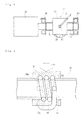
- This electrically driven linear actuator 50 generally comprises a pair of links 51, a ball screw 52 for swingably driving a driven member via the links 51, and an electric motor 53 for driving the ball screw 52.
- the ball screw 52 comprises a screw shaft 54 rotationally driven by the electric motor 53, a nut 55 formed on its inner circumferential surface with a helical screw groove 55a corresponding to the screw groove 54a formed on the outer circumferential surface of the screw shaft 54, and a number of balls 56 contained between the screw grooves 54a and 55a.
- a supporting shaft 57 for pivotably supporting the link 51 at its one end is mounted on the nut 55 as shown in Fig. 5.
- the supporting shaft 57 is arranged so that it passes through the center of gravity of the nut 55 and perpendicularly to the axis of the screw shaft 54.
- the ball screw 52 also comprises a return tube58 (see Fig. 6) as a ball circulating member forming an endless circulating passage for circulating balls 56 between the screw grooves 54a and 55a.
- the return tube 58 is mounted on the nut 55 at a side (a lower side in Fig. 6) opposite to a side (an upper side in Fig. 6) on which a radial component force "Fr" of a load "F” acting on the nut 55 via the supporting shaft 57 acts.
- an object of the present invention to provide an electrically driven linear actuator which can suppress generation of vibration or noise even if the alternating load or vibratory load would be applied to the electrically driven linear actuator.
- an electrically driven linear actuator comprising an electric motor mounted on a housing; a screw shaft coaxially connected to a motor shaft of the electric motor and formed on its outer circumferential surface with a screw groove; a nut threadably engaged with the screw shaft, having a pair of supporting shafts on the outer circumferential surface of the nut supporting one end of a link and formed on its inner circumferential surface with a screw groove corresponding to the screw groove of the screw shaft; a number of balls contained between the screw grooves; ball circulating members each being formed with an endless ball circulating passage between the screw grooves; a ball screw for converting a rotary motion of the electric motor to an axial motion of the nut and causing a swing motion of the link via the supporting shafts; and a pair of supporting bearings for supporting the screw shaft rotatably but axially immovably relative to the housing; characterized in that one supporting bearing arranged at a side of the electric motor of each pair of the supporting
- one supporting bearing arranged at a side of the electric motor of each pair of the supporting bearing is an angular ball bearing and the other supporting bearing is a sliding bearing, it is possible to suppress the angular run-out of supporting bearing at the side obliged to be loaded by the axial load even if the alternating load or vibratory load would be applied to the electrically driven linear actuator.
- the sliding bearing since the sliding bearing has high rigidity and can accept the elongation of the screw shaft which would be caused by temperature rise during driving of a vehicle, it is possible to further effectively absorb the vibration.
- a light preload is applied to the ball screw as defined in claim 2. This enables to suppress increase of the rotational torque of the ball screw and the temperature rise as well as to suppress generation of vibration or noise even if the alternating load or vibratory load would be applied to the electrically driven linear actuator.
- the angular ball bearing may be a double row angular ball bearing as defined in claim 3, the angular ball bearing may be a four-point contact ball bearing as defined in claim 4.
- a chamfered surface is formed between the outer circumferential surface of the screw shaft on which the screw groove is formed and a journal supported by the sliding bearing as having an inclined surface 45° or less than 45° relative to said outer circumferential surface of the screw shaft as defined in claim 5, the difference in diameter of said outer circumferential surface of the screw shaft and the journal can be reduced.
- a single coil can be used both for induction hardening the screw groove and the journal and accordingly it is possible to reduce the steps of heat treatment and thus manufacturing cost.
- the electrically driven linear actuator of the present invention comprises an electric motor mounted on a housing; a screw shaft coaxially connected to a motor shaft of the electric motor and formed on its outer circumferential surface with a screw groove; a nut threadably engaged with the screw shaft, having a pair of supporting shafts on the outer circumferential surface of the nut supporting one end of a link and formed on its inner circumferential surface with a screw groove corresponding to the screw groove of the screw shaft; a number of balls contained between the screw grooves; ball circulating members each being formed with an endless ball circulating passage between the screw grooves; a ball screw for converting a rotary motion of the electric motor to an axial motion of the nut and causing a swing motion of the link connected via the supporting shafts; and a pair of supporting bearings for supporting the screw shaft rotatably but axially immovably relative to the housing; and is characterized in that one supporting bearing arranged at a side of the electric motor of each pair of the supporting bearing is an angular ball bearing and the other
- the sliding bearing has high rigidity and can accept the elongation of the screw shaft which would be caused by temperature rise during driving of a vehicle, it is possible to further effectively absorb the vibration.
- an electrically driven linear actuator comprising an electric motor mounted on a housing; a screw shaft coaxially connected to a motor shaft of the electric motor and formed on its outer circumferential surface with a screw groove; a nut threadably engaged with the screw shaft, having a pair of supporting shafts on the outer circumferential surface of the nut supporting one end of a link and formed on its inner circumferential surface with a screw groove corresponding to the screw groove of the screw shaft; a number of balls contained between the screw grooves; ball circulating members each being formed with an endless ball circulating passage between the screw grooves; a ball screw for converting a rotary motion of the electric motor to an axial motion of the nut and causing a swing motion of the link via the supporting shafts; and a pair of supporting bearings for supporting the screw shaft rotatably but axially immovably relative to the housing; characterized in that one supporting bearing arranged at a side of the electric motor of each pair of the supporting bearing is an angular ball bearing and
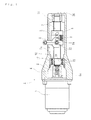
- Fig. 1 is a longitudinal section view showing a first embodiment of the electrically driven linear actuator of the present invention
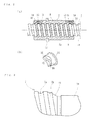
- Fig. 2 (a) is a longitudinal section view of a ball screw of Fig. 1
- Fig. 2 (a) is a longitudinal section view of a ball screw of Fig. 1
- Fig. 2 (b) is a perspective view of a bridge member of Fig. 2 (a)
- Fig. 3 is an partially enlarged view of a screw shaft of the present invention.
- the electrically driven linear actuator 1 comprises a link 2, a ball screw 3 for swingably driving a driven member (not shown) via the link 2, and an electric motor 5 mounted on a housing 4 for driving a screw shaft 7.
- the ball screw 3 is coaxially connected to a motor shaft 5a of the electric motor 5 via a coupling 6.
- the ball screw 3 comprises a screw shaft 7 formed on its outer circumferential surface with a screw groove 7a, a nut 8 formed on its inner circumferential surface with a screw groove 8a corresponding to the screw groove 7a of the screw shaft 7, and a number of balls 9 contained between the screw grooves 7a and 8a.
- the cross-sectional configuration of the screw grooves 7a and 8a may be either the circular arc or the Gothic arc configuration.
- the Gothic arc configuration is preferable since it enables to have a large contact angle relative to the balls 9 and also to set a small axial gap in order to increase the rigidity against the axial load and to suppress vibration.
- Oval bridge windows 13 are formed in a barrel of the nut 8 through a wall of the barrel by cutting out a portion of the screw groove 8a and a bridge member 14 also having an oval configuration is fitted in each of the bridge window 10.
- the bridge member 14 is formed with a connecting groove 15 for connecting mutually adjacent screw grooves 8a.
- the connecting groove 12 and a substantially one circumferential length of the screw groove 8a form a ball rolling passage.
- a number of balls 9 arranged between the inner and outer screw grooves 7a and 8a within the ball rolling passage can roll along the screw grooves 7a and 8a, climb over a land of the screw groove 7a with being guided by the connecting groove 15 of the bridge member 14, then return to the adjacent screw groove 7a, and again roll along the screw grooves 7a and 8a.
- the connecting groove 15 of the bridge member 14 is formed in a "S" curved configuration so as to smoothly connecting the adjacent screw grooves 8a of the nut 8. Accordingly, opposite opened edges 16 of the connecting groove 15 are adapted to be connected to the screw groove 8a of the nut 8 so that they can correspond to the opened edges of the bridge window 13 of the adjacent screw grooves 8a of the nut 8.
- the depth of the connecting groove 15 is set so that balls 9 can climb over the land of the screw groove 7a within the connecting groove 15.
- the bridge member 14 may be made of sintered alloy formed by an injection machine with injecting plastically adjusted metal powder.
- metal powder and binder comprising plastics and wax are kneaded by a kneading machine and then the kneaded material is pelletized. Obtained pellets are fed to a hopper of the injection machine and formed to the bridge member 14 by pressing heat melted pellets into a mold.
- the metal powder is preferably material able to be sintered such as that comprising "C" (carbon) of 0.3 wt% "Ni" (nickel) of 1 - 2 wt% and the remainder of "Fe”.
- Other injection moldable material such as "PA” (polyamide) may be used for making the bridge member 14.
- the screw shaft 7 is supported by a pair of supporting bearings 10 and 11 rotatably but axially immovably relative to the housing 4.
- the nut 8 is provided a pair of supporting shafts 12 at an axially central position of the outer circumferential surface of the nut and perpendicularly to the axis of the screw shaft 7.
- Each of the shafts 12 rotatably supports one end of the link 2. Accordingly the nut 8 is supported axially movably but rotationally immovably.
- the screw shaft 7 is rotated in accordance with rotation of the electric motor 5 and then the nut 8 is moved axially (left and right directions in Fig. 1) by the rotation of the screw shaft 7. That is, the rotary motion of the motor shaft 5a is converted to the axial motion of the nut 8 via the ball screw 3 and then the link 2 connected to the nut 8 via the supporting shaft 12 can be swingably moved.
- the ball screw 3 is applied a predetermined light preload. That is, a larger diameter is selected for balls 9 contained between the screw groove 7a and 8a. Thus, it is possible to suppress generation of vibration or noise even if the alternating load or vibratory load would be applied to the ball screw 3.
- Other structures may be adopted as preload applying means other than selecting balls having a larger diameter, for example as the so-called "double nut type" in which the nut 8 is formed by a pair of nuts and a spacer as a gap adjuster is interposed between the pair of nuts, or as a type in which a preload is applied between the screw shaft 7 and the nut 8 by continuously varying the lead of the screw groove 7a of the screw shaft 7.
- the screw shaft 7 is rotatably supported by a pair of supporting bearings 10 and 11.
- one bearing 10 arranged at a side of the electric motor 5 is a double row angular ball bearing and the other bearing 11 arranged at the journal of the screw shaft 7 is a sliding bearing.
- the supporting bearing 10 is the double row angular ball bearing comprising an outer ring 17 formed on its inner circumferential surface double row outer rolling contact surfaces, an inner ring 18 formed on its outer circumferential surface double row inner rolling contact surfaces, and double row balls 19 rollably contained between the outer and inner rolling contact surfaces.
- This supporting bearing 10 has a predetermined contact angle which has a loading capacity larger than that of conventionally used deep groove ball bearings and can suppress the angular run-out. This enables to suppress generation of vibration or noise even if the alternating load or vibratory load would be applied to the electrically driven linear actuator 1 in combination with the application of light preload to the ball screw 3.
- the supporting bearing 11 is made of high carbon chrome steel such as SUJ2 and treated by dipping hardening. Since the supporting bearing 11 is formed by the sliding bearing and has high rigidity, it is possible to accept the elongation of the screw shaft which would be caused by temperature rise during driving of a vehicle and thus to absorb vibration or noise.
- the screw shaft 7 is made of medium carbon steel such as S53C including carbon of 0.40 - 0.80wt% by weight and the screw groove 7a and the journal 20 of the screw shaft 7 are hardened by induction hardening to have desirable wear resistance.
- a chamfered surface 21 is formed between the outer circumferential surface of the screw shaft 7 on which the screw groove 7a is formed and a journal 20 to be supported by the sliding bearing 11. It has an inclined surface 45° or less than 45°, preferably 20 - 40° relative to said outer circumferential surface of the screw shaft 7.
- a numeral 7b denotes an incomplete thread and a two-dot chain line in Fig. 3 denotes a configuration of blank of the screw shaft 7 before rolling of the screw groove 7a.
- the chamfered surface having a relatively small inclination is formed between the outer circumferential surface of the screw shaft 7 on which the screw groove 7a is formed and a journal 20, it is possible to reduce the difference in diameter of said outer circumferential surface of the screw shaft 7 and the journal 20. Accordingly, a single coil can be used both for induction hardening the screw groove 7a and the journal 20 and thus it is possible to reduce the steps of heat treatment and thus manufacturing cost. In addition, it is possible to ensure the surface hardness of the journal 20 of at least 50 HRC by setting the surface hardness of the screw groove 7a at 58 - 64 HRC.
- Fig. 4 is a longitudinal section view showing a second embodiment of the electrically driven linear actuator of the present invention. Since this embodiment is different from the first embodiment only in the structure of the supporting bearing, same reference numerals are used for designating similar parts in both embodiments.
- the screw shaft 7 is supported by a supporting bearing 22 comprising a rolling bearing and a supporting bearing 11 comprising a sliding bearing rotatably but axially immovably relative to the housing 4.
- a supporting bearing 22 comprising a rolling bearing and a supporting bearing 11 comprising a sliding bearing rotatably but axially immovably relative to the housing 4.
- one bearing 22 arranged at a side of the electric motor 5 is a four-point contact ball bearing.
- the four-point contact ball bearing 22 comprises an outer ring 23, an inner ring 24 including a pair of ring members 24a and 24b arranged with being abutted each other, and balls 19 rollably contained between the outer and inner rings 23 and 24.
- the cross-sectional configuration of the rolling surface of the outer ring 23 is the so-called Gothic arc configuration formed by a pair of arcs having centers of curvature offset each other at equidistant in the axial direction relative to the center of width of the bearing.
- the cross-sectional configuration of the rolling surface of the inner ring members 24a and 24b is a circular arc having a predetermined radius of curvature and forms the rolling surface of Gothic arc configuration with cooperating each other.
- the supporting bearing 22 is the four-point contact ball bearing and the cross-sectional configuration of the rolling surface of the inner and outer rings is formed as the gothic arc, it is possible to support axial loads in either directions although it is a compact single row ball bearing and to reduce a range of axial gap relative to radial gap of the bearing. Accordingly, it is possible to suppress generation of vibration or noise even if the alternating load or vibratory load would be applied to the ball screw 3.
- the present invention can be applied to an electrically driven linear actuator in which a ball screw is coaxially connected to the shaft of an electric motor and adapted to convert the rotational motion of the motor to an axial motion of a nut engaging a screw shaft of the ball screw, and the screw shaft is supported by supporting bearings rotatably and axially immovably relative to a housing of the actuator.
Landscapes
- Engineering & Computer Science (AREA)
- General Engineering & Computer Science (AREA)
- Mechanical Engineering (AREA)
- Transmission Devices (AREA)
Applications Claiming Priority (1)
| Application Number | Priority Date | Filing Date | Title |
|---|---|---|---|
| JP2005081815A JP2006266310A (ja) | 2005-03-22 | 2005-03-22 | 電動リニアアクチュエータ |
Publications (1)
| Publication Number | Publication Date |
|---|---|
| EP1705403A2 true EP1705403A2 (de) | 2006-09-27 |
Family
ID=36499074
Family Applications (1)
| Application Number | Title | Priority Date | Filing Date |
|---|---|---|---|
| EP06111316A Withdrawn EP1705403A2 (de) | 2005-03-22 | 2006-03-17 | Elektrischer Linearantrieb |
Country Status (3)
| Country | Link |
|---|---|
| US (1) | US20060213298A1 (de) |
| EP (1) | EP1705403A2 (de) |
| JP (1) | JP2006266310A (de) |
Families Citing this family (9)
| Publication number | Priority date | Publication date | Assignee | Title |
|---|---|---|---|---|
| US8015889B2 (en) * | 2005-11-15 | 2011-09-13 | Honeywell International Inc. | Ballscrew with an integral high-efficiency thrust bearing |
| DE202007004692U1 (de) * | 2007-03-30 | 2008-08-14 | Robert Bosch Gmbh | Loslager und Gewindetrieb mit einem derartigen Loslager |
| DE102008000638B4 (de) * | 2008-03-13 | 2022-05-25 | Zf Friedrichshafen Ag | Betätigungseinrichtung zum Betätigen zumindest einer Schalteinrichtung und Verfahren zum Montieren und Demontieren derselben |
| DE102013106388B3 (de) * | 2013-06-19 | 2014-10-09 | Limoss Gmbh & Co. Kg | Verstellmechanik zur Verstellung von beweglichen Möbelteilen |
| USD709933S1 (en) * | 2013-12-25 | 2014-07-29 | Timotion Technology Co., Ltd. | Linear actuator |
| US9744985B2 (en) * | 2015-02-17 | 2017-08-29 | Hyundai Motor Company | Rack bar unit of vehicle steering device |
| JP6779645B2 (ja) * | 2016-03-30 | 2020-11-04 | Ntn株式会社 | 電動アクチュエータ |
| JP2018074790A (ja) * | 2016-10-31 | 2018-05-10 | Ntn株式会社 | 電動アクチュエータ |
| JP2020146196A (ja) * | 2019-03-13 | 2020-09-17 | 株式会社ジェイテクト | 寝台揺動用アタッチメント、及び寝台揺動装置 |
Citations (1)
| Publication number | Priority date | Publication date | Assignee | Title |
|---|---|---|---|---|
| JP2004084827A (ja) | 2002-08-27 | 2004-03-18 | Nsk Ltd | アクチュエータ装置 |
Family Cites Families (9)
| Publication number | Priority date | Publication date | Assignee | Title |
|---|---|---|---|---|
| DE69432192T2 (de) * | 1993-10-12 | 2003-12-04 | Smc K.K., Tokio/Tokyo | Linearantrieb |
| US6250170B1 (en) * | 1999-09-15 | 2001-06-26 | Emerson Electric Co. | Load directing trunnion mount for linear actuator |
| DE10120450A1 (de) * | 2001-04-26 | 2002-10-31 | Ina Schaeffler Kg | Elektromotorisch verdrehbare Welle |
| JP3878827B2 (ja) * | 2001-10-03 | 2007-02-07 | 株式会社ジェイテクト | ウォーム減速装置及びこれを用いる電動式動力舵取装置 |
| US6639794B2 (en) * | 2001-12-18 | 2003-10-28 | Maxxan Systems, Inc. | Chassis with adaptive fan control |
| US6927977B2 (en) * | 2002-02-12 | 2005-08-09 | Siemens Communications, Inc. | Blower exhaust for a closed frame |
| JP4012445B2 (ja) * | 2002-08-13 | 2007-11-21 | 株式会社日立製作所 | 内燃機関の可変動弁装置 |
| US7075788B2 (en) * | 2003-06-11 | 2006-07-11 | Hewlett-Packard Development Company, L.P. | Computer cooling system and method |
| JP4169716B2 (ja) * | 2004-03-24 | 2008-10-22 | 株式会社日立製作所 | 可変動弁装置のアクチュエータ |
-
2005
- 2005-03-22 JP JP2005081815A patent/JP2006266310A/ja active Pending
-
2006
- 2006-03-17 EP EP06111316A patent/EP1705403A2/de not_active Withdrawn
- 2006-03-22 US US11/386,987 patent/US20060213298A1/en not_active Abandoned
Patent Citations (1)
| Publication number | Priority date | Publication date | Assignee | Title |
|---|---|---|---|---|
| JP2004084827A (ja) | 2002-08-27 | 2004-03-18 | Nsk Ltd | アクチュエータ装置 |
Also Published As
| Publication number | Publication date |
|---|---|
| US20060213298A1 (en) | 2006-09-28 |
| JP2006266310A (ja) | 2006-10-05 |
Similar Documents
| Publication | Publication Date | Title |
|---|---|---|
| JP6091149B2 (ja) | 電動リニアアクチュエータ | |
| US9574648B2 (en) | Electric linear actuator | |
| US9476489B2 (en) | Electric linear actuator | |
| EP1026067B1 (de) | Elektrisch angetriebene Lenkeinrichtung | |
| US10520068B2 (en) | Gear and an electric actuator provided therewith | |
| US9614408B2 (en) | Electric linear actuator | |
| EP2778475A1 (de) | Elektrischer linearantrieb | |
| US20080295625A1 (en) | Supporting Structure of Ball Screw Shaft | |
| US20060213298A1 (en) | Electrically driven linear actuator | |
| JP2013099840A (ja) | ねじ軸及びその製造方法並びにボールねじユニット | |
| US8240222B2 (en) | Electrically driven linear actuator | |
| JP2013148108A (ja) | 電動リニアアクチュエータ | |
| EP1703171B1 (de) | Kugelgewindetrieb | |
| JP2012039765A (ja) | 電動アクチュエータ | |
| JP6074192B2 (ja) | 電動リニアアクチュエータ | |
| EP2208902B1 (de) | Tragestruktur eines Kugelumlaufspindelschafts | |
| JP4467349B2 (ja) | 自動車用ボールねじ | |
| DE102006041717B4 (de) | Elektromechanische Lenkung | |
| US20210381584A1 (en) | Ball screw device | |
| DE102011007698A1 (de) | Differenzial mit integrierter Lagerung der Kronenräder | |
| JP2018053971A (ja) | ボールねじ | |
| JP2007232015A (ja) | 電動アクチュエータ | |
| JP2008014417A (ja) | 自動車用ボールねじ |
Legal Events
| Date | Code | Title | Description |
|---|---|---|---|
| PUAI | Public reference made under article 153(3) epc to a published international application that has entered the european phase |
Free format text: ORIGINAL CODE: 0009012 |
|
| AK | Designated contracting states |
Kind code of ref document: A2 Designated state(s): AT BE BG CH CY CZ DE DK EE ES FI FR GB GR HU IE IS IT LI LT LU LV MC NL PL PT RO SE SI SK TR |
|
| AX | Request for extension of the european patent |
Extension state: AL BA HR MK YU |
|
| STAA | Information on the status of an ep patent application or granted ep patent |
Free format text: STATUS: THE APPLICATION IS DEEMED TO BE WITHDRAWN |
|
| 18D | Application deemed to be withdrawn |
Effective date: 20081001 |