EP1705843A1 - Verfahren und Vorrichtung zur Erhöhung der Leistung eines MIMO-Systems (multiple-input-multiple-output) durch Weiterleitung - Google Patents
Verfahren und Vorrichtung zur Erhöhung der Leistung eines MIMO-Systems (multiple-input-multiple-output) durch Weiterleitung Download PDFInfo
- Publication number
- EP1705843A1 EP1705843A1 EP05257316A EP05257316A EP1705843A1 EP 1705843 A1 EP1705843 A1 EP 1705843A1 EP 05257316 A EP05257316 A EP 05257316A EP 05257316 A EP05257316 A EP 05257316A EP 1705843 A1 EP1705843 A1 EP 1705843A1
- Authority
- EP
- European Patent Office
- Prior art keywords
- base station
- wireless
- communicating
- wireless device
- wpan
- Prior art date
- Legal status (The legal status is an assumption and is not a legal conclusion. Google has not performed a legal analysis and makes no representation as to the accuracy of the status listed.)
- Withdrawn
Links
- 238000000034 method Methods 0.000 title description 4
- 238000004891 communication Methods 0.000 claims description 25
- 230000001413 cellular effect Effects 0.000 claims description 17
- 238000006243 chemical reaction Methods 0.000 claims description 6
- 238000005516 engineering process Methods 0.000 claims description 5
- 230000008901 benefit Effects 0.000 description 11
- 230000001276 controlling effect Effects 0.000 description 3
- 238000012545 processing Methods 0.000 description 2
- 230000005540 biological transmission Effects 0.000 description 1
- 238000010276 construction Methods 0.000 description 1
- 230000000694 effects Effects 0.000 description 1
- 230000007257 malfunction Effects 0.000 description 1
- 239000000203 mixture Substances 0.000 description 1
- 238000012986 modification Methods 0.000 description 1
- 230000004048 modification Effects 0.000 description 1
- 238000012544 monitoring process Methods 0.000 description 1
- 239000013307 optical fiber Substances 0.000 description 1
- 230000001105 regulatory effect Effects 0.000 description 1
- 238000001228 spectrum Methods 0.000 description 1
Images


Classifications
-
- H—ELECTRICITY
- H04—ELECTRIC COMMUNICATION TECHNIQUE
- H04W—WIRELESS COMMUNICATION NETWORKS
- H04W88/00—Devices specially adapted for wireless communication networks, e.g. terminals, base stations or access point devices
- H04W88/02—Terminal devices
- H04W88/06—Terminal devices adapted for operation in multiple networks or having at least two operational modes, e.g. multi-mode terminals
-
- H—ELECTRICITY
- H04—ELECTRIC COMMUNICATION TECHNIQUE
- H04B—TRANSMISSION
- H04B7/00—Radio transmission systems, i.e. using radiation field
- H04B7/02—Diversity systems; Multi-antenna system, i.e. transmission or reception using multiple antennas
- H04B7/022—Site diversity; Macro-diversity
- H04B7/026—Co-operative diversity, e.g. using fixed or mobile stations as relays
-
- H—ELECTRICITY
- H04—ELECTRIC COMMUNICATION TECHNIQUE
- H04W—WIRELESS COMMUNICATION NETWORKS
- H04W88/00—Devices specially adapted for wireless communication networks, e.g. terminals, base stations or access point devices
- H04W88/02—Terminal devices
- H04W88/04—Terminal devices adapted for relaying to or from another terminal or user
-
- H—ELECTRICITY
- H04—ELECTRIC COMMUNICATION TECHNIQUE
- H04W—WIRELESS COMMUNICATION NETWORKS
- H04W88/00—Devices specially adapted for wireless communication networks, e.g. terminals, base stations or access point devices
- H04W88/08—Access point devices
- H04W88/085—Access point devices with remote components
-
- H—ELECTRICITY
- H04—ELECTRIC COMMUNICATION TECHNIQUE
- H04W—WIRELESS COMMUNICATION NETWORKS
- H04W92/00—Interfaces specially adapted for wireless communication networks
- H04W92/04—Interfaces between hierarchically different network devices
- H04W92/10—Interfaces between hierarchically different network devices between terminal device and access point, i.e. wireless air interface
Definitions
- This invention relates generally to wireless user equipment systems and, more particularly, to method and apparatus of a multiple-input-multiple-output wireless user equipment system and components.
- a wireless communications system generally includes one or more base stations and a number of mobile stations (such as mobile phones) communicating with the base stations. Each of the base stations and the mobile stations comprises a transceiver including a transmitter and a receiver and an antenna operable at a certain frequency.
- Formula (1) indicates two ways to improve the capacity of a system, i.e., providing a broader bandwidth for the channel and increasing the SNR.
- a broader bandwidth not only results in more interference and more noise, but is often impractical, because the available frequency spectrum is limited and highly regulated.
- Increasing the SNR is inefficient, because the capacity of the system only increases logarithmically with the SNR.
- Employing the MIMO scheme in a wireless system requires that both the base stations and mobile stations each have multiple antennas. This requirement is easily satisfied at the base stations, which can have as many antennas as required.
- the mobile stations are generally small and may not be able to contain multiple antennas. For example, in a 2.4 GHz system, antennas need to be separated by more than 125 cm, which is impractical for a mobile telephone, which typically has a size of around 10 cm.
- the destination mobile phone When one of the mobile phones, referred to as the destination mobile phone, communicates with the base station, signals are transmitted not only directly between the destination mobile phone and the base station, but also indirectly through the other mobile phones.
- a special protocol employed by the system makes sure that signals received by the other mobile phones are relayed to the destination mobile phone or the base station.
- each of the other mobile phones acts as a "virtual" antenna for the destination mobile phone, and multiple channels can be obtained between the destination mobile phone and the base station.
- Problems with this proposal include 1) mobile phones have limited power supply and users are reluctant to contribute to such a sharing scheme; 2) the proposed MIMO system needs to employ complex protocols to coordinate the mobile phones due to their high mobility, as some mobile phones may travel out of reach while additional mobile phones may enter the MIMO system during the communication between the destination mobile phone and the base station; and 3) when a relaying mobile phone has a weak signal, the relaying mobile phone itself needs a relay, which causes increased delay in the destination mobile phone receiving the signals.
- a wireless system that includes a base station, user equipment (UE), and at least one wireless device capable of communicating with the base station.
- the wireless device and the UE belong to an area network.
- the UE is capable of communicating with a base station directly and communicating with the base station through the wireless device.
- the wireless device communicates with the base station wirelessly and communicates with the UE either wirelessly or through cable.
- a wireless personal area network that includes a plurality of wireless devices, each wireless devices being capable of communicating with a base station both directly and through others of the wireless devices.
- a wireless system that includes a plurality of base stations, a plurality of wireless personal area networks (WPANs) each comprising a plurality of wireless devices capable of communicating with one of the base stations, and a mobile device communicating with the base stations.
- WPANs wireless personal area networks
- the mobile device acts as a WPAN coordinator for the one of the WPANs, and the mobile device communicates with the base stations both directly and through the wireless devices of the one of the WPANs.
- UE user equipment located in a wireless personal area network (WPAN), the WPAN including a plurality of wireless devices capable of relaying communication between the UE and a base station.
- the UE includes means for directly communicating with the base station and means for communicating through the wireless devices with the base station.
- a wireless device within a wireless personal area network including a WPAN coordinator, wherein the wireless device is capable of relaying communication between one other wireless device located in the WPAN and a base station.
- the wireless device includes a first means for communicating with the base station through a first frequency band and a second means for communicating with the other wireless device through a second frequency band.
- Fig. 1 illustrates a conventional wireless communications system with a plurality of remote antennas
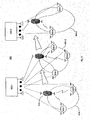
- Fig. 2 illustrates a wireless communications system including user equipment and a plurality of wireless devices consistent with a first embodiment of the present invention
- Fig. 3 shows the structure of one wireless device consistent with the first embodiment of the present invention
- Fig. 4 shows the structure of the user equipment of Fig. 2;
- Fig. 5 shows a wireless communications system consistent with a second embodiment of the present invention.
- RA remote antennas
- MIMO multiple-input-multiple-output
- Fig. 1 illustrates a conventional wireless communications system 100 including a base station 102 located in one of a plurality of wireless cells 104.
- Each wireless cell 104 has a certain area equivalent to an area reachable by wireless transmitters used in system 100. Therefore, only the shaded cell 104 in which base station 102 is located can be reached by base station 102, and a mobile device in other cells 104 is unable to receive signals from base station 102 with a good quality.
- a plurality of RAs 106 may be installed in each of the other cells 104 to expand the coverage area of base station 102.
- RAs 106 installed in the 6 neighboring cells 104 of base station 102.
- RAs 106 are connected to base station 102 through connection links 108, which may be electric wires, optical fibers, or high-speed internet cables.
- RAs 106 receive signals from base station 102 and re-transmit the signals wirelessly so that mobile devices in the corresponding cells 104 may receive high-quality signals.
- a wireless system that includes a base station having multiple antennas and a user equipment (UE) communicating with the base station both directly and through wireless equipment in the neighborhood of the UE acting as RAs for the UE.
- the UE and the wireless equipment may belong to an area network, such as a local area network (LAN). a metropolitan area network (MAN), etc.
- a LAN is a network including, within a small area, devices capable of communicating with one another, either directly or through a centralized controller such as a router.
- a MAN is a network of devices that spans over a larger area than a LAN, such as a city, with dedicated or high-performance hardware.
- a PAN is a network including, within a small area and generally within a personal work area, devices capable of directly communicating with one another rather than through access points.
- Wireless system 200 may comprise a cellular network, a wireless local area network (WLAN), or a wireless metropolitan area network (WMAN), etc., and includes a base station 202 having a plurality of antennas (not numbered) and a UE 204 communicating with base station 202.
- Base station 202 may comprise a cellular base station, a WLAN access point, or a WMAN base station.
- UE 204 may comprise a mobile telephone, notebook, personal digital assistant (PDA), smart phone, etc.
- PDA personal digital assistant
- system 200 also includes a plurality of wireless devices 206 in the neighborhood of UE 204 acting as RAs for UE 204.
- Fig. 2 shows three wireless devices 206, i.e., 206-1, 206-2, 206-3.
- Wireless devices 206 and UE 204 form a wireless PAN (WPAN) 208, which may be a part of a WLAN or a WMAN.
- WPAN wireless PAN
- Wireless devices 206 and UE 204 are generally spaced sufficiently apart so that almost no correlation exists between any two of them.
- each wireless device 206 When UE 204 communicates with base station 202, each wireless device 206 receives signals from base station 202 and relays the signals to UE 204, and also receives signals from UE 204 and relays the signals to base station 202. At the same time, UE 204 also directly communicates with base station 202. Therefore, there are multiple channels for UE 204 to communicate on with base station 202, including a direct channel between base station 202 and UE 204 and multiple indirect channels through wireless devices 206. Wireless devices 206 may then be referred to as RA devices of UE 204. UE 204 determines how signals are relayed through wireless devices 206 by transmitting control signals to wireless devices 206.
- wireless devices 206 may communicate with UE 204 wirelessly, and may be referred to as cable-less RAs.
- wireless devices 206-1 and 206-2 are cable-less RAs.
- wireless devices 206 are connected to UE 204 through cables, and may be referred to as cabled RAs.
- wireless device 206-3 is cabled RA.
- a wireless system consistent with the first embodiment of the present invention may include a plurality of cable-less RAs, or a plurality of cabled RAs, or a mixture of both cable-less and cabled RAs.
- a network 210 comprising UE 204 and wireless devices 206 is referred to as an RA-link network
- a network 212 comprising base station 202 and RA-link network 210 is referred to as an RAT (remote activity technology) network.
- RAT remote activity technology
- Different frequency bands may be employed in RA-link network 210 and RAT network 212, and may be respectively referred as RA-link bands and RAT bands.
- cable-less RAs 206 may communicate with UE 204 in a different RA-link band than cabled RAs 206.
- each wireless device 206 needs to be able to communicate with both base station 202 and UE 204, i.e., within RA-link network 210 and within RAT network 212.
- Fig. 3 illustrates an example of a structure of one wireless device 206.
- wireless device 206 has a means 302 for communicating with UE 204 and an RAT-link antenna 304 operable in an RAT band for communicating with base station 202.
- Means 302 may comprise an RA-link antenna for receiving and transmitting signals wirelessly if wireless device 206 is cable-less, or may comprise a means for connecting a cable to UE 204 if wireless device 206 is cabled.
- a single antenna operable in both an RA-link band and an RAT band may be used in wireless device 206 for communications with both UE 204 and base station 202.
- wireless device 206 may use multiple antennas each for communicating with a certain type of device.
- wireless device 206 may include a first antenna for communicating with base station 202 when base station 202 is cellular based, a second antenna for communicating with base station 202 when base station 202 is WLAN based, a third antenna for communicating with base station 202 when base station 202 is WMAN based, and, if wireless device 206 is cable-less, a fourth antenna for communicating with UE 204.
- Wireless device 206 includes a first converter 306 for converting signals from an RA-link band to an RAT band and a second converter 308 for converting signals from the RAT band to the RA-link band.
- First converter 306 includes an RA-link network front end receiver 310 for receiving signals in the RA-link band, a frequency band shifter 312 for converting the signals form the RA-link band to the RAT band, a cellular based RAT front end transmitter 314 for transmitting the signals in the RAT band when base station 202 comprises a cellular base station, and an area network based RAT front end transmitter 316 for transmitting the signals in the RAT band.
- Area network based RAT front end transmitter 316 may be WLAN based when base station 202 comprises a WLAN base station or may be WMAN based when base station 202 comprises a WMAN base station.
- Frequency band shifter 312 may include an RAT band selection filter, an RA-link band selection filter, and a frequency synthesizer and translator.
- First converter 306 may further include a controller (not shown) for controlling amplitude and phase of the signals in the RAT and RA-link bands and a conversion gain balancer (not shown) for balancing the gain of converting the signals from the RA-link band to the RAT band.
- Second converter 308 includes a cellular based RAT front end receiver 318 for receiving signals from base station 202 through antenna 304 when base station 202 comprises a cellular base station, an area network based RAT front end receiver 320 for receiving signals from base station 202 when base station 202 comprises a WLAN base station, a frequency band shifter 322 for transferring the signals from an RAT band to an RA-link band, and an RA-link network front end transmitter 324 for transmitting the signals in the RA-link band.
- Area network based RAT front end receiver 320 may be WLAN based when base station 202 comprises a WLAN base station or may be WMAN based when base station 202 comprises a WMAN base station.
- Frequency band shifter 322 may include an RAT band selection filter, an RA-link band selection filter, and a frequency synthesizer and translator.
- Second converter 308 may further include a controller (not shown) for controlling amplitude and phase of the signals in the RAT and RA-link bands and a conversion gain balancer (not shown) for balancing the gain of converting the signals from the RAT band to the RA-link band.
- wireless device 206 also includes a control signal receiver 326 for receiving control signals from UE 204.
- Wireless device 206 may also include other circuit modules such as an RA device controller 328 for controlling the operations of first converter 306 and second converter 308, a device error indicator 330 for monitoring and indicating malfunctions of wireless device 206, and a battery or power module 332, etc.
- UE 204 also communicates with both base station 202 and wireless devices 206.
- Fig. 4 illustrates an example of a structure of UE 204.
- UE 204 includes a first RAT antenna 402 for communicating with base station 202 when base station 202 is cellular based, a second RAT antenna 404 for communicating with base station 202 when base station 202 is WLAN based, and a third RAT antenna 405 for communicating with base station 202 when base station 202 is WMAN based.
- UE 204 also includes a means 406 for communicating with wireless devices 206.
- Means 406 may comprise an RA-link antenna for receiving and transmitting signals wirelessly if system 200 includes cable-less RAs 206, or a means for connecting a cable to cabled RAs 206, or both.
- UE 204 may use fewer antennas, if the antennas are operable to serve multiple purposes.
- UE 204 includes a cellular-based RAT transceiver 408 for receiving and transmitting signals through first RAT antenna 402, a WLAN-based RAT transceiver 410 for receiving and transmitting signals through second RAT antenna 404, a WMAN-based RAT transceiver 411 for receiving and transmitting signals through third RAT antenna 405, an RAT baseband processor 412 for processing signals received or to be transmitted through first RAT antenna 402, second RAT antenna 404, or third RAT antenna 405, an MIMO coprocessor 414 for processing signals received or to be transmitted through means 406, and an RA-link network transceiver 416 for receiving and transmitting signals through means 406.
- a cellular-based RAT transceiver 408 for receiving and transmitting signals through first RAT antenna 402
- WLAN-based RAT transceiver 410 for receiving and transmitting signals through second RAT antenna 404
- WMAN-based RAT transceiver 411 for receiving and transmitting signals through third RAT antenna 405
- MIMO coprocessor 414 enables UE 204 to coordinate wireless devices 206 to act as RAs for UE 204.
- Cellular-based RAT transceiver 408, WLAN-based RAT transceiver 410, WMAN-based transceiver 411, RAT baseband processor 412, and MIMO coprocessor 414 each may be provided as part of a chip on board (COB) construction.
- RA-link network transceiver 416 may be provided as a COB or as a plug-in module.
- system 200 is an MIMO system, wherein UE 204 communicates with base station 202 through multiple channels, including a direct channel between UE 204 and base station 202 and multiple relay channels through wireless devices 206. Because UE 204 and wireless devices 206 form WPAN 208, problems associated with the above described proposed MIMO scheme may be obviated. For example, the same user may be using wireless devices 206 and UE 204 and, therefore, there is no problem of reluctance of other users to share wireless devices. In addition, because wireless devices 206 are known, MIMO system 200 consistent with the first embodiment of the present invention requires much simpler protocols for communications between base station 202 and WPAN 208.
- MIMO system 200 as shown in Figs. 2-4 equally benefits any of wireless devices 206 in their communications with base station 202, since multiple channels also exist when any one wireless device 206 communicates with base station 202, including a direct channel and multiple relaying channels through other wireless devices 206 and UE 204.
- the one wireless device 206 receives signals from and transmits signals to base station 202 directly.
- each of UE 204 and other wireless devices 206 receives signals from base station 202 and relays the signals.
- UE 204 acts as a WPAN coordinator for coordinating the communications of wireless devices 206 and UE 204 with base station 202.
- one of wireless devices 206 acts as the WPAN coordinator and includes an MIMO coprocessor for coordinating communications between wireless devices 206 and base station 202. In other words, the benefits of an MIMO system are available to each wireless device 206 even in the absence of UE 204.
- System 200 consistent with the first embodiment of the present invention also allows easy addition of wireless devices 206. For example, if an additional laptop computer is to use the network, it may simply do so by registering with the WPAN coordinator.
- a wireless communications system including one or more base stations, an area network including wireless devices distributed in one or more local areas, and a UE traveling around the base stations.
- the wireless devices in each local area may be considered to form a WPAN, and the wireless devices within one WPAN act as RAs for the UE when the UE is within the area of the one WPAN.
- Fig. 5 illustrates a wireless system 500 consistent with the second embodiment of the present invention.
- system 500 includes a plurality of base stations 502, e.g., 502-1, 502-2, etc., and a plurality of WPANs 504, e.g., 504-1, 504-2, 504-3, etc.
- a plurality of wireless devices 506, e.g., 506-1, 506-2, etc., are distributed in the WPANs 504.
- Base stations 502 may include cellular base stations, WLAN base stations, or WMAN base stations. In the example shown in Fig.
- wireless devices 506-1 and 506-2 belong to WPAN 504-1
- wireless devices 506-3 (shown to be cabled)
- 506-4 and 506-5 belong to WPAN 504-2
- wireless devices 506-6 and 506-7 (shown to be cabled) belong to WPAN 504-3.
- a UE 508 travels around and communicates with base stations 502.
- Each of wireless devices 506 has a structure similar to the structure of wireless device 206 shown in Fig. 3
- UE 508 has a structure similar to the structure of UE 204 shown in Fig. 4.
- wireless devices 506-1 and 506-2 act as cable-less RAs for UE 508 and form an RA-link network with UE 508.
- wireless device 506-3 acts as a cabled RA and wireless devices 506-4 and 506-5 act as cable-less RAs for UE 508 and form an RA-link network with UE 508.
- wireless device 506-6 acts as a cable-less RA and wireless device 506-7 acts as a cabled RA for.UE 508 and form an RA-link network with UE 508.
- UE 508 enters the area of one WPAN 504, UE 508 acts as the WPAN coordinator for the one WPAN 504 to coordinate communications between wireless devices 506 in that WPAN 504 and base stations 502.
- UE 508 can communicate with base stations 502 while traveling around base stations 502 and enjoying benefits of an MIMO system.
Landscapes
- Engineering & Computer Science (AREA)
- Computer Networks & Wireless Communication (AREA)
- Signal Processing (AREA)
- Mobile Radio Communication Systems (AREA)
Applications Claiming Priority (2)
| Application Number | Priority Date | Filing Date | Title |
|---|---|---|---|
| US66459405P | 2005-03-24 | 2005-03-24 | |
| US11/194,546 US20060217093A1 (en) | 2005-03-24 | 2005-08-02 | Method and apparatus of a multiple-input-multiple-output wireless system and components |
Publications (1)
| Publication Number | Publication Date |
|---|---|
| EP1705843A1 true EP1705843A1 (de) | 2006-09-27 |
Family
ID=36613495
Family Applications (1)
| Application Number | Title | Priority Date | Filing Date |
|---|---|---|---|
| EP05257316A Withdrawn EP1705843A1 (de) | 2005-03-24 | 2005-11-29 | Verfahren und Vorrichtung zur Erhöhung der Leistung eines MIMO-Systems (multiple-input-multiple-output) durch Weiterleitung |
Country Status (3)
| Country | Link |
|---|---|
| US (1) | US20060217093A1 (de) |
| EP (1) | EP1705843A1 (de) |
| TW (1) | TWI291816B (de) |
Cited By (2)
| Publication number | Priority date | Publication date | Assignee | Title |
|---|---|---|---|---|
| CN101359950B (zh) * | 2008-09-03 | 2012-06-06 | 中国科学技术大学 | 一种基于奇异值分解迫零波束成型的多天线中继传输方法 |
| EP2355372A3 (de) * | 2010-02-02 | 2013-05-29 | Research In Motion Limited | MIMO-Benutzergerät-Funkfrequenz-Hilfssystem |
Families Citing this family (11)
| Publication number | Priority date | Publication date | Assignee | Title |
|---|---|---|---|---|
| KR100909529B1 (ko) * | 2005-04-20 | 2009-07-27 | 삼성전자주식회사 | Mimo 무선 네트워크에서 협력 다이버시티 방법 |
| US8085662B2 (en) * | 2008-05-14 | 2011-12-27 | Hewlett-Packard Company | Open network connections |
| US8896421B2 (en) * | 2005-09-30 | 2014-11-25 | Zebra Enterprise Solutions Corp. | Wide-area dynamic RFID system using UWB |
| CN101141165A (zh) * | 2006-09-05 | 2008-03-12 | 华为技术有限公司 | 实现发射及接收分集的系统及方法 |
| GB2444097A (en) * | 2006-09-08 | 2008-05-28 | Fujitsu Ltd | Multi-hop wireless communication system |
| KR101142605B1 (ko) | 2008-02-21 | 2012-05-10 | 조선대학교산학협력단 | 무선 랜에서 파손 링크 또는 저 전송률 링크를 위한 통과전송 매체 접근 제어 장치 및 제어 방법 |
| US8432821B2 (en) | 2008-10-02 | 2013-04-30 | Qualcomm Incorporated | Method and apparatus for cooperation strategy selection in a wireless communication system |
| US8363591B2 (en) * | 2009-06-09 | 2013-01-29 | Electronics And Telecommunications Research Institute | Transmitter, receiver and method for extending coverage in WLAN |
| KR101642151B1 (ko) * | 2009-06-09 | 2016-07-25 | 한국전자통신연구원 | 근거리 무선 통신 네트워크에서 커버리지 확장을 위한 송신장치 및 송신방법, 그리고, 수신장치 |
| JP5573571B2 (ja) * | 2009-11-13 | 2014-08-20 | ソニー株式会社 | 無線通信装置、無線通信システム、プログラム、および無線通信方法 |
| US11632271B1 (en) | 2022-02-24 | 2023-04-18 | T-Mobile Usa, Inc. | Location-based channel estimation in wireless communication systems |
Citations (2)
| Publication number | Priority date | Publication date | Assignee | Title |
|---|---|---|---|---|
| DE10027115A1 (de) * | 2000-05-31 | 2001-12-13 | Siemens Ag | Funk-Kommunikationssystem |
| US20040131025A1 (en) * | 2001-06-28 | 2004-07-08 | Mischa Dohler | Electronic data communication systems |
Family Cites Families (6)
| Publication number | Priority date | Publication date | Assignee | Title |
|---|---|---|---|---|
| US5559501A (en) * | 1994-08-12 | 1996-09-24 | Lucent Technologies Inc. | Plug-in wireless module for operation with portable wireless enabled host equipment |
| US6690657B1 (en) * | 2000-02-25 | 2004-02-10 | Berkeley Concept Research Corporation | Multichannel distributed wireless repeater network |
| JP4052835B2 (ja) * | 2001-12-28 | 2008-02-27 | 株式会社日立製作所 | 多地点中継を行う無線伝送システム及びそれに使用する無線装置 |
| JP2003332963A (ja) * | 2002-05-17 | 2003-11-21 | Toshiba Corp | 無線通信システム及び無線通信装置 |
| US6954446B2 (en) * | 2002-06-25 | 2005-10-11 | Motorola, Inc. | Multiple mode RF communication device |
| US20060046645A1 (en) * | 2004-08-25 | 2006-03-02 | Ogilvie Scott A | Cell phones that communicate over a network of other cell phones as well as base stations |
-
2005
- 2005-08-02 US US11/194,546 patent/US20060217093A1/en not_active Abandoned
- 2005-11-02 TW TW094138460A patent/TWI291816B/zh not_active IP Right Cessation
- 2005-11-29 EP EP05257316A patent/EP1705843A1/de not_active Withdrawn
Patent Citations (2)
| Publication number | Priority date | Publication date | Assignee | Title |
|---|---|---|---|---|
| DE10027115A1 (de) * | 2000-05-31 | 2001-12-13 | Siemens Ag | Funk-Kommunikationssystem |
| US20040131025A1 (en) * | 2001-06-28 | 2004-07-08 | Mischa Dohler | Electronic data communication systems |
Non-Patent Citations (1)
| Title |
|---|
| LANEMAN, J.N., TSE, D.N.C, WORNELL, G.W.: "Cooperative Diversity in Wireless Networks: Efficient Protocols and Outage Behaviour", IEEE, December 2004 (2004-12-01), pages 3062 - 3080, XP002389089, Retrieved from the Internet <URL:http://ieeexplore.ieee.org/iel5/18/29865/01362898.pdf?tp=&arnumber=1362898&isnumber=29865> [retrieved on 20060706] * |
Cited By (4)
| Publication number | Priority date | Publication date | Assignee | Title |
|---|---|---|---|---|
| CN101359950B (zh) * | 2008-09-03 | 2012-06-06 | 中国科学技术大学 | 一种基于奇异值分解迫零波束成型的多天线中继传输方法 |
| EP2355372A3 (de) * | 2010-02-02 | 2013-05-29 | Research In Motion Limited | MIMO-Benutzergerät-Funkfrequenz-Hilfssystem |
| US8583035B2 (en) | 2010-02-02 | 2013-11-12 | Blackberry Limited | Multiple input multiple output user equipment radio frequency assistant system |
| US9077423B2 (en) | 2010-02-02 | 2015-07-07 | Blackberry Limited | Multiple input multiple output user equipment radio frequency assistant system |
Also Published As
| Publication number | Publication date |
|---|---|
| TW200635255A (en) | 2006-10-01 |
| US20060217093A1 (en) | 2006-09-28 |
| TWI291816B (en) | 2007-12-21 |
Similar Documents
| Publication | Publication Date | Title |
|---|---|---|
| US10686638B2 (en) | Wireless communication system to communicate using different beamwidths | |
| US6587444B1 (en) | Fixed frequency-time division duplex in radio communications systems | |
| EP2340669B1 (de) | Verfahren für mehrband-funkkommunikation und bandbreitenverwaltung | |
| US10097257B2 (en) | Wireless communications network using frequency conversion of MIMO signals | |
| US8204028B2 (en) | Techniques for spatial reuse in wireless personal area networks based on virtual time divisional multiple access | |
| US8477790B2 (en) | Apparatus and method for operating relay link in relay broadband wireless communication system | |
| JP5184654B2 (ja) | Fddインバンド・バックホーリングおよびその方法 | |
| US20040162037A1 (en) | Multi-channel WLAN transceiver with antenna diversity | |
| CN103596198A (zh) | 用于多带速率缩放的方法和系统 | |
| CN109565324A (zh) | 用户设备操作管理的系统和方法 | |
| WO2002030141A1 (en) | Mobile base station system where the central unit and the antenna units are separated from each other | |
| EP1705843A1 (de) | Verfahren und Vorrichtung zur Erhöhung der Leistung eines MIMO-Systems (multiple-input-multiple-output) durch Weiterleitung | |
| KR20090023280A (ko) | 통신 시스템에서 주파수 및 시간 자원 활용 시스템 및 방법 | |
| US20120163317A1 (en) | Apparatus and system of providing wireless local area network service for transport means | |
| US8509681B2 (en) | Relay network and entity for continuous transmission based on superposition coding | |
| US8774756B2 (en) | Devices and methods for signal sharing | |
| CN109565318A (zh) | 终端装置,基站,方法和记录介质 | |
| US20120182928A1 (en) | Wireless internet connection repeater without signal interference | |
| US11791847B2 (en) | Low-cost transceiver structure for wireless communication and sensing | |
| US20130322330A1 (en) | Communication apparatus and method for group moving object in communication system | |
| JP2004500724A (ja) | 無線通信システムにおける周波数時分割二重 | |
| CN113038490A (zh) | 一种无线通信系统 | |
| JP2009268093A (ja) | マルチアンテナ装置、移動端末およびマルチアンテナ通信システム | |
| US20060217134A1 (en) | Access point | |
| WO2026029695A1 (en) | A control unit for controlling a digital interface chip of a multi-antenna transmitter and receiver arrangement and corresponding multi-antenna transmitter and receiver arrangement, foldable wireless device, method, computer program product, and nontransitory computer-readable storage medium |
Legal Events
| Date | Code | Title | Description |
|---|---|---|---|
| PUAI | Public reference made under article 153(3) epc to a published international application that has entered the european phase |
Free format text: ORIGINAL CODE: 0009012 |
|
| AK | Designated contracting states |
Kind code of ref document: A1 Designated state(s): AT BE BG CH CY CZ DE DK EE ES FI FR GB GR HU IE IS IT LI LT LU LV MC NL PL PT RO SE SI SK TR |
|
| AX | Request for extension of the european patent |
Extension state: AL BA HR MK YU |
|
| RIN1 | Information on inventor provided before grant (corrected) |
Inventor name: TING, PANG-AN,IND. TECHNOLOGY RES. INST. Inventor name: CHUANG, WEI PING5F.,NO.30,LANE 122, Inventor name: KUO, CHUN-CHUN,IND. TECHNOLOGY RES. INST. Inventor name: WHANG,HUI-MING16F.,NO.74,JINGFU STREET |
|
| 17P | Request for examination filed |
Effective date: 20070227 |
|
| 17Q | First examination report despatched |
Effective date: 20070328 |
|
| AKX | Designation fees paid |
Designated state(s): DE FR GB |
|
| STAA | Information on the status of an ep patent application or granted ep patent |
Free format text: STATUS: THE APPLICATION IS DEEMED TO BE WITHDRAWN |
|
| 18D | Application deemed to be withdrawn |
Effective date: 20110601 |