EP1705954A2 - Verfahren zur Herstellung einer Hörhilfekomponente und entsprechende Hörhilfekomponente - Google Patents
Verfahren zur Herstellung einer Hörhilfekomponente und entsprechende Hörhilfekomponente Download PDFInfo
- Publication number
- EP1705954A2 EP1705954A2 EP06111610A EP06111610A EP1705954A2 EP 1705954 A2 EP1705954 A2 EP 1705954A2 EP 06111610 A EP06111610 A EP 06111610A EP 06111610 A EP06111610 A EP 06111610A EP 1705954 A2 EP1705954 A2 EP 1705954A2
- Authority
- EP
- European Patent Office
- Prior art keywords
- hearing aid
- aid component
- negative
- hearing
- mold
- Prior art date
- Legal status (The legal status is an assumption and is not a legal conclusion. Google has not performed a legal analysis and makes no representation as to the accuracy of the status listed.)
- Withdrawn
Links
Images
Classifications
-
- H—ELECTRICITY
- H04—ELECTRIC COMMUNICATION TECHNIQUE
- H04R—LOUDSPEAKERS, MICROPHONES, GRAMOPHONE PICK-UPS OR LIKE ACOUSTIC ELECTROMECHANICAL TRANSDUCERS; ELECTRIC HEARING AIDS; PUBLIC ADDRESS SYSTEMS
- H04R25/00—Electric hearing aids
- H04R25/65—Housing parts, e.g. shells, tips or moulds, or their manufacture
- H04R25/652—Ear tips; Ear moulds
-
- B—PERFORMING OPERATIONS; TRANSPORTING
- B29—WORKING OF PLASTICS; WORKING OF SUBSTANCES IN A PLASTIC STATE IN GENERAL
- B29C—SHAPING OR JOINING OF PLASTICS; SHAPING OF MATERIAL IN A PLASTIC STATE, NOT OTHERWISE PROVIDED FOR; AFTER-TREATMENT OF THE SHAPED PRODUCTS, e.g. REPAIRING
- B29C33/00—Moulds or cores; Details thereof or accessories therefor
- B29C33/38—Moulds or cores; Details thereof or accessories therefor characterised by the material or the manufacturing process
- B29C33/3835—Designing moulds, e.g. using CAD-CAM
-
- B—PERFORMING OPERATIONS; TRANSPORTING
- B29—WORKING OF PLASTICS; WORKING OF SUBSTANCES IN A PLASTIC STATE IN GENERAL
- B29C—SHAPING OR JOINING OF PLASTICS; SHAPING OF MATERIAL IN A PLASTIC STATE, NOT OTHERWISE PROVIDED FOR; AFTER-TREATMENT OF THE SHAPED PRODUCTS, e.g. REPAIRING
- B29C33/00—Moulds or cores; Details thereof or accessories therefor
- B29C33/38—Moulds or cores; Details thereof or accessories therefor characterised by the material or the manufacturing process
- B29C33/3842—Manufacturing moulds, e.g. shaping the mould surface by machining
-
- B—PERFORMING OPERATIONS; TRANSPORTING
- B29—WORKING OF PLASTICS; WORKING OF SUBSTANCES IN A PLASTIC STATE IN GENERAL
- B29C—SHAPING OR JOINING OF PLASTICS; SHAPING OF MATERIAL IN A PLASTIC STATE, NOT OTHERWISE PROVIDED FOR; AFTER-TREATMENT OF THE SHAPED PRODUCTS, e.g. REPAIRING
- B29C64/00—Additive manufacturing, i.e. manufacturing of three-dimensional [3D] objects by additive deposition, additive agglomeration or additive layering, e.g. by 3D printing, stereolithography or selective laser sintering
- B29C64/30—Auxiliary operations or equipment
- B29C64/386—Data acquisition or data processing for additive manufacturing
-
- B—PERFORMING OPERATIONS; TRANSPORTING
- B33—ADDITIVE MANUFACTURING TECHNOLOGY
- B33Y—ADDITIVE MANUFACTURING, i.e. MANUFACTURING OF THREE-DIMENSIONAL [3D] OBJECTS BY ADDITIVE DEPOSITION, ADDITIVE AGGLOMERATION OR ADDITIVE LAYERING, e.g. BY 3D PRINTING, STEREOLITHOGRAPHY OR SELECTIVE LASER SINTERING
- B33Y50/00—Data acquisition or data processing for additive manufacturing
-
- B—PERFORMING OPERATIONS; TRANSPORTING
- B33—ADDITIVE MANUFACTURING TECHNOLOGY
- B33Y—ADDITIVE MANUFACTURING, i.e. MANUFACTURING OF THREE-DIMENSIONAL [3D] OBJECTS BY ADDITIVE DEPOSITION, ADDITIVE AGGLOMERATION OR ADDITIVE LAYERING, e.g. BY 3D PRINTING, STEREOLITHOGRAPHY OR SELECTIVE LASER SINTERING
- B33Y80/00—Products made by additive manufacturing
-
- H—ELECTRICITY
- H04—ELECTRIC COMMUNICATION TECHNIQUE
- H04R—LOUDSPEAKERS, MICROPHONES, GRAMOPHONE PICK-UPS OR LIKE ACOUSTIC ELECTROMECHANICAL TRANSDUCERS; ELECTRIC HEARING AIDS; PUBLIC ADDRESS SYSTEMS
- H04R25/00—Electric hearing aids
- H04R25/65—Housing parts, e.g. shells, tips or moulds, or their manufacture
- H04R25/658—Manufacture of housing parts
-
- B—PERFORMING OPERATIONS; TRANSPORTING
- B29—WORKING OF PLASTICS; WORKING OF SUBSTANCES IN A PLASTIC STATE IN GENERAL
- B29L—INDEXING SCHEME ASSOCIATED WITH SUBCLASS B29C, RELATING TO PARTICULAR ARTICLES
- B29L2031/00—Other particular articles
- B29L2031/753—Medical equipment; Accessories therefor
Definitions
- the present invention relates to a method for producing a hearing aid component such as a hearing aid shell, a part thereof or an earmold by providing CAD data from the three-dimensional shape of the hearing aid component. Moreover, the present invention relates to a casting mold for producing such a hearing aid component as well as this hearing aid component itself.
- Modern manufacturing processes for hearing aid shells and earmolds or earmolds use CAD design software and rapid prototyping technologies.
- Such a method by which the earmolds or earmolds can be adapted to the contours of an ear canal is from the European Patent EP 0 516 808 B1 known. Accordingly, the outer contours of an ear impression, for example by means of laser interferometry or a video camera can be detected.
- the data obtained are digitized and converted by means of algorithms known from the CAD-CAM technique into a three-dimensional computer representation of the outer contours of the earmold or the earmold.
- the three-dimensional computer model is transformed into a sequence of cross sections.
- the earmold is then produced by the fact that the individual cross-sectional planes are formed successively and one above the other, with each other or next to each other and then joined together. For example, a stereolithographic or similar process may be used for this operation.
- This stereolithographic process can be carried out, for example, such that on a computer-controlled, movable platform a container with activated, liquid Resin is arranged.
- a container with activated, liquid Resin By targeted use of directed onto the surface of the liquid synthetic resin, a partial polymerization of the resin causing radiation, a first cross-sectional area of the earmold can be generated. Thereafter, it is necessary to lower the platform by the thickness of one layer each time a cross-sectional area is completed so that the next cross-sectional plane on the surface of the liquid synthetic resin can be produced in the same manner. This is continued until finally the at least partially polymerized plastic can be removed from the container.
- plastics are suitable for such production processes.
- the material properties of these plastics often do not meet the requirements that are placed on hearing aid shells or earmolds.
- the plastics suitable for the stereolithographic production process are very hard, so that the hearing aids or earmolds made with this plastic would significantly disturb the hearing aid wearer when chewing, for example.
- the object of the present invention is to produce hearing aids or earmolds that are more comfortable to wear for the hearing device wearer.
- this object is achieved by a method for producing a hearing aid component by providing CAD data from the three-dimensional shape of the hearing aid component, forming negative data on the shape of the hearing aid component, forming a negative of the hearing aid component from the negative data and casting the hearing aid component with the aid of the negative ,
- the present invention provides a mold for producing a hearing aid component made by a rapid prototyping method.
- a hearing aid according to the invention for example, from an elastic, comfortable to wear, skin-friendly plastic to be poured.
- the desired ear piece or the desired hearing aid shell is produced from the CAD data, but a negative, which can subsequently be used as an injection mold. Consequently, a variety of materials can be used for the final product, even if they are not suitable for the production process of the negative.
- the molding is preferably based on the technology of rapid prototyping.
- a stereolithographic process for producing the negative can be used directly from the CAD data. This makes it possible to use very exact methods for producing the hearing device shells or ear pieces, without being limited to the materials to be used for these methods.
- a mold by rapid prototyping method, such. Example, the stereolithographic process, is characterized by the typical edges of the individual layers, which are successively formed one above the other. Accordingly, a hearing aid component made with such a mold also has the corresponding, typical, unprocessed surface texture after casting. Incidentally, the hearing aid component has the characteristic layer structure.
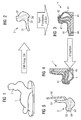
- FIG. 1 the three-dimensional data of a piece of a patient's ear space is recorded by one of the methods mentioned at the outset.
- a Conraum 1 and a auditory canal space 2 can be seen.
- FIGS. 2 to 5 show, in a clockwise circular arrangement, the manufacturing process of the desired earmold, which is shown in FIG.
- a computer model of the desired earmold piece namely a positive 3 according to FIG. 2
- this positive 3 has a concha section 31 and an auditory canal section 32.
- a sound channel 33 and a ventilation channel 34 are taken into account.
- the mold 4 is produced by a rapid prototyping method, such as a stereolithographic method (SLA).
- SLA stereolithographic method
- the casting mold 4 has an outer contour section 41, a sound channel molding part 42 and a ventilation bore molding part 43. The latter serve to form the sound channel 33 and the ventilation bore 34 from FIG. 2.
- the casting mold 4 has injection or outlet channels 44 and 45.
- the injection molding is carried out according to the schematic diagram of FIG 4. It is a plastic 5, the is skin-friendly and elastic, injected into the injection port 45.
- the finished product 6 After solidification, the finished product 6, as shown in FIG 5, removed from the mold 4.
- the finished product 6 corresponds exactly to the computer model 3 of FIG. 2. It has a concha section 61 and an ear canal section 62.
- a sound passage 63 and a ventilation channel 64 are formed in the earmold.
- a sound tube 65 has been inserted into the sound channel 63 after the earmold has been cast.
- a negative mold suitable as an injection mold is thus calculated directly from the CAD data of the desired ear piece in accordance with the invention.
- This data-based negative mold can now be converted directly into a physical injection mold by an exact prototyping process.
- any sprayable materials can now be used, which significantly increase the wearing comfort of a hearing aid or ear tip.
Landscapes
- Engineering & Computer Science (AREA)
- Manufacturing & Machinery (AREA)
- Mechanical Engineering (AREA)
- Chemical & Material Sciences (AREA)
- Materials Engineering (AREA)
- Physics & Mathematics (AREA)
- Neurosurgery (AREA)
- Health & Medical Sciences (AREA)
- General Health & Medical Sciences (AREA)
- Otolaryngology (AREA)
- Acoustics & Sound (AREA)
- Signal Processing (AREA)
- Optics & Photonics (AREA)
- Moulds For Moulding Plastics Or The Like (AREA)
Abstract
Der Tragekomfort eines Hörgeräts oder eines Ohrpassstücks soll gesteigert werden. Dazu ist vorgesehen, ein dreidimensionales Modell (3) dieser Hörhilfekomponente bereitzustellen und eine Negativform der herzustellenden Hörhilfekomponente zu errechnen. Daraus wird eine Spritzgussform (4) für die Hörhilfekomponente ausgebildet. Schließlich wird die Hörhilfekomponente mit Hilfe der Spritzgussform (4) vorzugsweise mit einem elastischen Material gegossen.
Description
- Die vorliegende Erfindung betrifft ein Verfahren zur Herstellung einer Hörhilfekomponente wie beispielsweise einer Hörgerätschale, eines Teils davon oder einer Otoplastik durch Bereitstellen von CAD-Daten von der dreidimensionalen Form der Hörhilfekomponente. Darüber hinaus betrifft die vorliegende Erfindung eine Gussform zur Herstellung einer derartigen Hörhilfekomponente sowie diese Hörhilfekomponente selbst.
- Moderne Herstellungsverfahren für Hörgeräteschalen und Ohrpassstücke bzw. Otoplastiken nutzen CAD-Design-Software und Rapid-Prototyping-Technologien. Ein derartiges Verfahren, mit dem die Otoplastiken oder Ohrpassstücke an die Konturen eines Ohrkanals angepasst werden können, ist aus der
europäischen Patentschrift EP 0 516 808 B1 bekannt. Demnach können die äußeren Konturen eines Ohrabdrucks, beispielsweise mit Hilfe von Laserinterferometrie oder einer Videokamera erfasst werden. Daneben besteht auch die Möglichkeit, die Konturen des Ohrkanals durch berührungsloses Abtasten, z. B. durch Ultraschall, zu gewinnen. Die gewonnenen Daten werden digitalisiert und mittels aus der CAD-CAM-Technik bekannter Algorithmen in eine dreidimensionale Computerdarstellung der äußeren Konturen der Otoplastik oder des Ohrpassstücks umgesetzt. Dabei wird das dreidimensionale Computermodell in eine Folge von Querschnitten umgewandelt. Die Otoplastik wird dann dadurch hergestellt, dass die einzelnen Querschnittsebenen nacheinander und übereinander, untereinander oder nebeneinander ausgebildet und dann miteinander verbunden werden. Für diesen Arbeitsschritt kann beispielsweise ein stereolithografisches oder ähnliches Verfahren verwendet werden. - Dieses stereolithografische Verfahren kann beispielsweise so ausgeführt werden, dass auf einer computergesteuerten, bewegbaren Plattform ein Behälter mit aktiviertem, flüssigem Kunstharz angeordnet ist. Durch gezielten Einsatz einer auf die Oberfläche des flüssigen Kunstharzes gerichteten, eine Teilpolymerisation des Kunstharzes bewirkenden Strahlung kann eine erste Querschnittsfläche der Otoplastik erzeugt werden. Anschließend ist es erforderlich, jeweils nach Fertigstellen einer Querschnittsfläche, die Plattform um die Dicke einer Schicht abzusenken, damit die nächste Querschnittsebene auf der Oberfläche des flüssigen Kunstharzes in der gleichen Weise erzeugt werden kann. Dies wird solange fortgesetzt, bis schließlich die mindestens teilweise polymerisierte Plastik dem Behälter entnommen werden kann.
- Für derartige Herstellungsverfahren sind nur einige wenige Kunststoffe geeignet. Die Materialeigenschaften dieser Kunststoffe entsprechen vielfach nicht den Anforderungen, die an Hörgeräteschalen oder Ohrpassstücke gestellt werden. So sind die für das stereolithografische Herstellungsverfahren geeigneten Kunststoffe in aller Regel sehr hart, so dass die mit diesem Kunststoff hergestellten Hörgeräte oder Ohrpassstücke den Hörgeräteträger beispielsweise beim Kauen deutlich stören würden.
- Die Aufgabe der vorliegenden Erfindung besteht darin, für den Hörgeräteträger komfortabler zu tragende Hörgeräte oder Ohrpassstücke herzustellen.
- Erfindungsgemäß wird diese Aufgabe gelöst durch ein Verfahren zur Herstellung einer Hörhilfekomponente durch Bereitstellen von CAD-Daten von der dreidimensionalen Form der Hörhilfekomponente, Bilden von Negativdaten zu der Form der Hörhilfekomponente, Ausformen eines Negativs der Hörhilfekomponente aus den Negativdaten und Gießen der Hörhilfekomponente mit Hilfe des Negativs.
- Dementsprechend wird erfindungsgemäß eine Gussform zur Herstellung einer Hörhilfekomponente bereitgestellt, die durch ein Rapid-Prototyping-Verfahren hergestellt ist. Damit kann eine erfindungsgemäße Hörhilfekomponente beispielsweise aus einem elastischen, angenehm zu tragenden, hautverträglichen Kunststoff gegossen werden.
- Entsprechend der vorliegenden Erfindung wird somit nicht das gewünschte Ohrstück bzw. die gewünschte Hörgeräteschale aus den CAD-Daten hergestellt, sondern ein Negativ, das anschließend als Spritzgussform verwendet werden kann. Folglich kann eine Vielzahl von Materialien für das Endprodukt zum Einsatz kommen, auch wenn diese nicht für das Herstellungsverfahren des Negativs geeignet sind.
- Das Ausformen erfolgt vorzugsweise auf der Basis der Technologie des Rapid-Prototyping. Insbesondere kann ein stereolithographisches Verfahren zur Herstellung des Negativs direkt aus den CAD-Daten herangezogen werden. Damit können sehr exakte Verfahren zur Herstellung der Hörgeräteschalen bzw. Ohrpassstücke eingesetzt werden, ohne auf die für diese Verfahren zu verwendende Materialien beschränkt zu sein.
- Eine Gussform, die durch Rapid-Prototyping-Verfahren, wie z. B. das stereolithographische Verfahren, hergestellt ist, zeichnet sich durch die typischen Kanten der einzelnen Schichten aus, die sukzessive übereinander ausgebildet werden. Dementsprechend besitzt auch eine Hörhilfekomponente, die mit einer solchen Gussform hergestellt wurde, die entsprechende, typische Oberflächenstruktur im Rohzustand nach dem Gießen. Im Übrigen besitzt die Hörhilfekomponente den charakteristischen Schichtaufbau.
- Die vorliegende Erfindung wird nun anhand der beigefügten Zeichnungen näher erläutert, in denen zeigen:
- FIG 1
- ein dreidimensionales Modell eines Gehörgangs;
- FIG 2
- ein Computermodell eines gewünschten Ohrpassstücks;
- FIG 3
- ein Gusswerkzeug zur Herstellung des Ohrpassstücks gemäß FIG 2;
- FIG 4
- den Einspritzvorgang in die Gussform von FIG 3; und
- FIG 5
- das durch Spritzguss hergestellte Ohrpassstück.
- Das nachfolgend näher geschilderte Ausführungsbeispiel stellt eine bevorzugte Ausführungsform der vorliegenden Erfindung dar.
- Entsprechend FIG 1 werden die dreidimensionalen Daten eines Stücks eines Ohrraums eines Patienten durch eines der Eingangs erwähnten Verfahren aufgenommen. Im vorliegenden Beispiel ist ein Concharaum 1 und ein Gehörgangsraum 2 erkennbar. Die folgenden FIG 2 bis 5 zeigen nun in einer kreisförmigen Anordnung im Uhrzeigersinn den Herstellungsprozess des gewünschten Ohrpassstücks, das in FIG 5 wiedergegeben ist. Zunächst wird hierzu aus den dreidimensionalen Daten von FIG 1 durch eine CAD-Design-Software ein Computermodell des gewünschten Ohrpassstücks, und zwar ein Positiv 3 entsprechend FIG 2 erstellt. Dieses Positiv 3 besitzt hier einen Conchaabschnitt 31 und einen Gehörgangsabschnitt 32. Im Inneren des als Positiv 3 wiedergegebenen Computermodells sind ein Schallkanal 33 und ein Belüftungskanal 34 berücksichtigt.
- Aus dem Positiv 3 von FIG 2, das als Computerdatenmodell vorliegt, wird nun ein Negativ errechnet und aus diesem Negativ (nicht dargestellt) unmittelbar eine Gussform 4 hergestellt, wie sie in FIG 3 schematisch wiedergegeben ist. Die Herstellung der Gussform 4 erfolgt durch eine Rapid-Prototyping-Methode, wie beispielsweise ein stereolithographisches Verfahren (SLA). Die Gussform 4 besitzt einen Außenkonturabschnitt 41, ein Schallkanalformteil 42 und ein Lüftungsbohrungsformteil 43. Letztere dienen zur Formung des Schallkanals 33 und der Lüftungsbohrung 34 aus FIG 2. Außerdem besitzt die Gussform 4 Einspritz- bzw. Auslasskanäle 44 und 45.
- Mit der Gussform 4 erfolgt das Spritzgießen entsprechend der Prinzipskizze von FIG 4. Dabei wird ein Kunststoff 5, der hautverträglich und elastisch ist, in die Einspritzöffnung 45 eingespritzt.
- Nach dem Erstarren wird das fertige Produkt 6, wie es in FIG 5 dargestellt ist, aus der Gussform 4 entnommen. Das fertige Produkt 6 entspricht exakt dem Computermodell 3 von FIG 2. Es weist einen Conchaabschnitt 61 und einen Gehörgangsabschnitt 62 auf. Außerdem sind ein Schalldurchgang 63 und ein Belüftungskanal 64 im Ohrpassstück ausgebildet. Ferner ist FIG 5 zu entnehmen, dass in den Schallkanal 63 nach dem Gießen des Ohrpassstücks ein Schallschlauch 65 eingesteckt wurde.
- Bei der Herstellung des Ohrpassstücks entsprechend den FIG 1 bis 5 wird somit auf erfindungsgemäße Art direkt aus den CAD-Daten des gewünschten Ohrstücks eine als Spritzgussform geeignete Negativform errechnet. Diese aus Daten bestehende Negativform lässt nun durch ein exaktes Prototyping-Verfahren unmittelbar in eine körperliche Spritzgussform umsetzen. Für das Spritzgießen können nun beliebige spritzfähige Materialien verwendet werden, die den Tragekomfort eines Hörgeräts bzw. Ohrpassstücks deutlich erhöhen.
Claims (6)
- Verfahren zur Herstellung einer Hörhilfekomponente durch- Bereitstellen von CAD-Daten von der dreidimensionalen Form (3) der Hörhilfekomponente,
gekennzeichnet durch- Bilden von Negativdaten zu der Form (3) der Hörhilfekomponente,- Ausformen eines Negativs (4) der Hörhilfekomponente aus den Negativdaten und- Gießen der Hörhilfekomponente (6) mit Hilfe des Negativs (4). - Verfahren nach Anspruch 1, wobei das Ausformen nach einer Rapid-Prototyping-Methode erfolgt.
- Verfahren nach Anspruch 2, wobei als Rapid Prototyping ein stereolithographisches Verfahren herangezogen wird.
- Gussform (4) zur Herstellung einer Hörhilfekomponente (6)
dadurch gekennzeichnet, dass
sie durch ein Rapid-Prototyping-Verfahren hergestellt ist. - Gussform (4) nach Anspruch 4, die durch ein stereolithographisches Verfahren hergestellt ist.
- Hörhilfekomponente (6),
dadurch gekennzeichnet, dass
sie/er mit einer Gussform (4) nach Anspruch 4 oder 5 gegossen ist.
Applications Claiming Priority (1)
| Application Number | Priority Date | Filing Date | Title |
|---|---|---|---|
| DE102005013834A DE102005013834A1 (de) | 2005-03-24 | 2005-03-24 | Verfahren zur Herstellung einer Hörhilfekomponente und entsprechende Hörhilfekomponente |
Publications (1)
| Publication Number | Publication Date |
|---|---|
| EP1705954A2 true EP1705954A2 (de) | 2006-09-27 |
Family
ID=36603417
Family Applications (1)
| Application Number | Title | Priority Date | Filing Date |
|---|---|---|---|
| EP06111610A Withdrawn EP1705954A2 (de) | 2005-03-24 | 2006-03-23 | Verfahren zur Herstellung einer Hörhilfekomponente und entsprechende Hörhilfekomponente |
Country Status (4)
| Country | Link |
|---|---|
| US (1) | US20060239481A1 (de) |
| EP (1) | EP1705954A2 (de) |
| CN (1) | CN1863414A (de) |
| DE (1) | DE102005013834A1 (de) |
Cited By (5)
| Publication number | Priority date | Publication date | Assignee | Title |
|---|---|---|---|---|
| DE102006046269A1 (de) * | 2006-09-28 | 2008-04-03 | Egger Otoplastik + Labortechnik Gmbh | Otoplastik mit Verbindungseinrichtung |
| EP2298524A1 (de) * | 2009-09-21 | 2011-03-23 | Stavros Basseas | Maßgefertigte Spritzgießform und Formgebungsprozess mit schnellen Prototyperstellungsverfahren |
| WO2012021355A1 (en) * | 2010-08-09 | 2012-02-16 | Synthes Usa, Llc | Method for manufacturing an injection molded product |
| EP2007173A3 (de) * | 2007-06-20 | 2013-07-10 | Siemens Medical Instruments Pte. Ltd. | Verschlusselement für Gehäuseöffnungen bei einem Tumbling-Prozess |
| US20240365075A1 (en) * | 2023-04-26 | 2024-10-31 | Iyo Inc. | Ear interfaces and associated systems, methods, and non-transitory computer-readable media |
Families Citing this family (11)
| Publication number | Priority date | Publication date | Assignee | Title |
|---|---|---|---|---|
| DE102007044550A1 (de) * | 2007-09-18 | 2009-03-26 | Siemens Medical Instruments Pte. Ltd. | Schallkanal für eine Hörvorrichtung und entsprechendes Herstellungsverfahren |
| BR112012008840A2 (pt) * | 2009-10-16 | 2020-09-24 | 3Shape A/S | componentes macios feitos individualmente sob medida |
| US20140120196A1 (en) | 2012-10-29 | 2014-05-01 | Makerbot Industries, Llc | Quick-release extruder |
| US11048829B2 (en) * | 2013-03-15 | 2021-06-29 | Kemeera Llc | 3D printing systems and methods for fabricating injection molds |
| US9313568B2 (en) | 2013-07-23 | 2016-04-12 | Chicago Custom Acoustics, Inc. | Custom earphone with dome in the canal |
| CN104349265A (zh) * | 2014-11-12 | 2015-02-11 | 苏州立人听力器材有限公司 | 一种软耳模制作工艺及应用于该工艺的造型铲 |
| WO2016161187A2 (en) * | 2015-03-31 | 2016-10-06 | Zerog Oy | System and method for reproducing molded insole |
| US11457323B2 (en) | 2016-04-26 | 2022-09-27 | Gn Hearing A/S | Custom elastomeric earmold with secondary material infusion |
| CN110641023A (zh) * | 2019-08-28 | 2020-01-03 | 广州普天云健康科技发展有限公司 | 基于3d打印的补偿器的实现方法及装置 |
| US20220339040A1 (en) * | 2019-09-17 | 2022-10-27 | Pro3dure Medical GmbH | Profiled ear piece and device for the generation of an ear piece |
| CN111844756B (zh) * | 2020-06-09 | 2022-04-19 | 苏州海卡缔听力技术有限公司 | 一种基于3d打印技术制备软耳膜的方法 |
Citations (1)
| Publication number | Priority date | Publication date | Assignee | Title |
|---|---|---|---|---|
| EP0516808B1 (de) | 1990-12-21 | 1996-01-24 | TOPHOLM & WESTERMANN APS | Verfahren zum herstellen von individuell an die konturen eines ohrkanals angepassten otoplastiken oder ohrpassstücken |
Family Cites Families (4)
| Publication number | Priority date | Publication date | Assignee | Title |
|---|---|---|---|---|
| US4569812A (en) * | 1984-06-22 | 1986-02-11 | Beltone Electronics Corporation | Process for making a hearing aid vent |
| US5487012A (en) * | 1990-12-21 | 1996-01-23 | Topholm & Westermann Aps | Method of preparing an otoplasty or adaptive earpiece individually matched to the shape of an auditory canal |
| US5641448A (en) * | 1996-03-11 | 1997-06-24 | National Research Council Of Canada | Method of producing plastic injection molds for prototype parts |
| US20050035498A1 (en) * | 2003-08-13 | 2005-02-17 | Stevens Randal Alan | Methods of making a negative hearing aid mold |
-
2005
- 2005-03-24 DE DE102005013834A patent/DE102005013834A1/de not_active Withdrawn
-
2006
- 2006-03-23 EP EP06111610A patent/EP1705954A2/de not_active Withdrawn
- 2006-03-24 CN CNA2006100714596A patent/CN1863414A/zh active Pending
- 2006-03-24 US US11/389,373 patent/US20060239481A1/en not_active Abandoned
Patent Citations (1)
| Publication number | Priority date | Publication date | Assignee | Title |
|---|---|---|---|---|
| EP0516808B1 (de) | 1990-12-21 | 1996-01-24 | TOPHOLM & WESTERMANN APS | Verfahren zum herstellen von individuell an die konturen eines ohrkanals angepassten otoplastiken oder ohrpassstücken |
Cited By (9)
| Publication number | Priority date | Publication date | Assignee | Title |
|---|---|---|---|---|
| DE102006046269A1 (de) * | 2006-09-28 | 2008-04-03 | Egger Otoplastik + Labortechnik Gmbh | Otoplastik mit Verbindungseinrichtung |
| EP2007173A3 (de) * | 2007-06-20 | 2013-07-10 | Siemens Medical Instruments Pte. Ltd. | Verschlusselement für Gehäuseöffnungen bei einem Tumbling-Prozess |
| EP2298524A1 (de) * | 2009-09-21 | 2011-03-23 | Stavros Basseas | Maßgefertigte Spritzgießform und Formgebungsprozess mit schnellen Prototyperstellungsverfahren |
| WO2012021355A1 (en) * | 2010-08-09 | 2012-02-16 | Synthes Usa, Llc | Method for manufacturing an injection molded product |
| CN103038036A (zh) * | 2010-08-09 | 2013-04-10 | 斯恩蒂斯有限公司 | 用于制造注射模制产品的方法 |
| US8852478B2 (en) | 2010-08-09 | 2014-10-07 | DePuy Synthes Products, LLC | Injection molding method including machining of both injection mold and molded product |
| CN103038036B (zh) * | 2010-08-09 | 2015-07-08 | 斯恩蒂斯有限公司 | 用于制造注射模制产品的方法 |
| KR101847368B1 (ko) | 2010-08-09 | 2018-04-10 | 신세스 게엠바하 | 사출 성형 제품을 제조하기 위한 방법 |
| US20240365075A1 (en) * | 2023-04-26 | 2024-10-31 | Iyo Inc. | Ear interfaces and associated systems, methods, and non-transitory computer-readable media |
Also Published As
| Publication number | Publication date |
|---|---|
| DE102005013834A1 (de) | 2006-09-28 |
| US20060239481A1 (en) | 2006-10-26 |
| CN1863414A (zh) | 2006-11-15 |
Similar Documents
| Publication | Publication Date | Title |
|---|---|---|
| EP1705954A2 (de) | Verfahren zur Herstellung einer Hörhilfekomponente und entsprechende Hörhilfekomponente | |
| DE69715126T2 (de) | Feingiessen | |
| EP3017343B1 (de) | Verfahren zum herstellen eines dreidimensionalen objekts | |
| EP1974688B1 (de) | Verfahren zum Herstellen von Zahnersatzteilen, Verfahren zum Erstellen eines Datensatzes und computerlesbares Medium | |
| EP3148475B1 (de) | Verfahren zur herstellung eines dentalen prothesenbasishalbzeugs | |
| DE4041105A1 (de) | Verfahren zum herstellen von individuell an die konturen eines ohrkanals angepassten otoplastiken oder ohrpassstuecken | |
| EP2301741A1 (de) | Im Ohr tragbare Gehäuseschale oder Otoplastik | |
| WO2016091629A1 (de) | Verfahren zum herstellen eines kompressorlaufrads | |
| WO2020208090A1 (de) | Verfahren zum erstellen von fertigungsdaten und computerprogramm sowie verfahren zur fertigung einer orthopädietechnischen einrichtung | |
| EP1808286B1 (de) | Verfahren zum Formen eines Schallkanals einer Hörvorrichtung | |
| DE102020107158B4 (de) | Verfahren und Vorrichtung zur Herstellung einer WC-Sitzgarnitur | |
| DE102006007032A1 (de) | Verfahren zur Herstellung eines Ohreinsatzes, Ohreinsatzanordnung und Verwendung einer Ohreinsatzanordnung | |
| EP2965710A1 (de) | Individualisierte Negativformen | |
| DE19807404A1 (de) | Tief- und Streckziehwerkzeug mit durch konturgetreu geformte Masken abgedeckten Funktionsflächen und Verfahren zu seiner Herstellung | |
| EP3416813B1 (de) | Bearbeitungswerkzeug und verfahren zu seiner herstellung mittels eines generativen schichtbauprozesses | |
| EP3661719B1 (de) | Verfahren und vorrichtung zum herstellen eines verkleidungsteils eines kraftfahrzeugs, verwendung der vorrichtung | |
| EP1296809B1 (de) | Verfahren zur naturgetreuen herstellung medizinischer implantate und epithesen und danach hergestellte implantate und epithesen | |
| DE102007053540A1 (de) | In-dem-Ohr Hörgerätgehäuse und dessen Herstellung | |
| EP3668694B1 (de) | Schäumwerkzeug | |
| DE102017217718B4 (de) | Otoplastik zur Einführung in einen Ohrkanal und Verfahren zur Fertigung einer Otoplastik | |
| DE102022109896B4 (de) | Verfahren zur Herstellung einer Gießverfahren-Gussform | |
| WO2006042515A1 (de) | Verfahren zur herstellung von ohrpassstücken mit heterogenen materialeigenschaften auf der basis der 3d-printertechnologie | |
| EP3395286B1 (de) | Herstellungsverfahren für einen positioner | |
| DE102018210533A1 (de) | Verfahren zur Herstellung einer Formschale zum Herstellen einer Dekorhaut eines Fahrzeuginnenverkleidungsteils | |
| EP0645195A2 (de) | Verfahren zur Herstellung von Sonotroden |
Legal Events
| Date | Code | Title | Description |
|---|---|---|---|
| PUAI | Public reference made under article 153(3) epc to a published international application that has entered the european phase |
Free format text: ORIGINAL CODE: 0009012 |
|
| AK | Designated contracting states |
Kind code of ref document: A2 Designated state(s): AT BE BG CH CY CZ DE DK EE ES FI FR GB GR HU IE IS IT LI LT LU LV MC NL PL PT RO SE SI SK TR |
|
| AX | Request for extension of the european patent |
Extension state: AL BA HR MK YU |
|
| STAA | Information on the status of an ep patent application or granted ep patent |
Free format text: STATUS: THE APPLICATION IS DEEMED TO BE WITHDRAWN |
|
| 18D | Application deemed to be withdrawn |
Effective date: 20101001 |