EP1707455A2 - Rétracteur de ceinture de sécurité, système de ceinture de sécurité et véhicule automobile avec système de ceinture de sécurité - Google Patents
Rétracteur de ceinture de sécurité, système de ceinture de sécurité et véhicule automobile avec système de ceinture de sécurité Download PDFInfo
- Publication number
- EP1707455A2 EP1707455A2 EP06004140A EP06004140A EP1707455A2 EP 1707455 A2 EP1707455 A2 EP 1707455A2 EP 06004140 A EP06004140 A EP 06004140A EP 06004140 A EP06004140 A EP 06004140A EP 1707455 A2 EP1707455 A2 EP 1707455A2
- Authority
- EP
- European Patent Office
- Prior art keywords
- power transmission
- seatbelt
- motor
- gear
- state
- Prior art date
- Legal status (The legal status is an assumption and is not a legal conclusion. Google has not performed a legal analysis and makes no representation as to the accuracy of the status listed.)
- Withdrawn
Links
- 230000005540 biological transmission Effects 0.000 claims abstract description 375
- 230000007246 mechanism Effects 0.000 claims abstract description 128
- 238000001514 detection method Methods 0.000 claims abstract description 29
- 238000003860 storage Methods 0.000 claims description 15
- 238000005516 engineering process Methods 0.000 abstract description 5
- 230000002093 peripheral effect Effects 0.000 description 19
- 238000003825 pressing Methods 0.000 description 18
- 238000000034 method Methods 0.000 description 9
- 230000008569 process Effects 0.000 description 9
- 230000009467 reduction Effects 0.000 description 6
- 230000000149 penetrating effect Effects 0.000 description 5
- 230000006870 function Effects 0.000 description 4
- 206010040007 Sense of oppression Diseases 0.000 description 2
- 230000009471 action Effects 0.000 description 2
- 238000005299 abrasion Methods 0.000 description 1
- 239000003638 chemical reducing agent Substances 0.000 description 1
- 150000001875 compounds Chemical class 0.000 description 1
- 230000007423 decrease Effects 0.000 description 1
- 230000003247 decreasing effect Effects 0.000 description 1
- 238000004519 manufacturing process Methods 0.000 description 1
- 230000015654 memory Effects 0.000 description 1
- 230000035515 penetration Effects 0.000 description 1
- 239000012495 reaction gas Substances 0.000 description 1
- 239000011347 resin Substances 0.000 description 1
- 229920005989 resin Polymers 0.000 description 1
Images





Classifications
-
- B—PERFORMING OPERATIONS; TRANSPORTING
- B60—VEHICLES IN GENERAL
- B60R—VEHICLES, VEHICLE FITTINGS, OR VEHICLE PARTS, NOT OTHERWISE PROVIDED FOR
- B60R22/00—Safety belts or body harnesses in vehicles
- B60R22/34—Belt retractors, e.g. reels
- B60R22/44—Belt retractors, e.g. reels with means for reducing belt tension during use under normal conditions
Definitions
- the present invention relates to a technology for structuring a seatbelt retractor mounted on a motor vehicle.
- a seatbelt apparatus configured to protect an occupant seated on a motor vehicle seat by a seatbelt (webbing) keeping the occupant under restraint is known.
- Patent Document 1 in a seatbelt apparatus, a configuration of a seatbelt retractor for performing retracting operation and withdrawing operation of the seatbelt by rotating a spool (retracting shaft) by an electric motor is disclosed.
- the seatbelt retractor having a configuration for switching power transmitting states from a power transmitting state in which a power of the electric motor is transmitted to the spool via a clutch-type power transmission mechanism by rotating the electric motor, to a power transmission released-state in which the power transmitting state is released and vice versa is known.
- the present invention is made in light of the above-described problems, and the object of the present invention is to provide an effective technology for increasing reliability with respect to the power transmission releasing operation of the power transmission mechanism in the seatbelt retractor having a configuration for switching the power transmitting states from the power transmitting state in which power of the electric motor is transmitted to a spool via a clutch-type power transmission mechanism by rotating the electric motor, to a power transmission released-state in which the power transmitting state is released, and vice versa.
- the present invention is typically applicable for a seatbelt retractor mounted on automobiles, however, the present invention can be applied to a structuring technology for a seatbelt retractor mounted on motor vehicles other than the automobile.
- the first invention of the present invention for solving the aforementioned problems is that of a seatbelt retractor according to Claim 1.
- the seatbelt retractor claimed in Claim 1 is composed of, at least a spool, an electric motor, a detection device, a power transmission mechanism, and a control device.
- the spool of the present invention serves as a member to perform a retracting operation and a withdrawing operation for a seatbelt.
- the seatbelt being retracted and withdrawn by the seatbelt retractor is a lengthy belt worn by an occupant seated on the motor vehicle seat and is sometimes called "webbing".
- the detection device of the present invention is configured to serve as a device for detecting information relevant to a motor load of the electric motor of the present invention.
- the "information relevant to a motor load” may be the motor load per se, or the information relevant to the motor load.
- the motor load is led by detecting the motor-current value.
- the power transmission mechanism of the present invention is configured to serve as a mechanism that enables the spool to perform retracting operation and withdrawing operation by transmitting power of the electric motor of the present invention.
- the control device of the present invention performs control operation for the electric motor to rotate in a power transmission judging mode when a power transmission releasing operation is performed, and judges a transmitting state of the power transmission mechanism on the basis of the information detected by the detection device when performing the control operation for the electric motor to rotate.
- the control device when the control device judges the power transmission mechanism to be in the power transmitting state, the control device performs control operation for the electric motor to rotate in a direction of a power transmission releasing state so as to release the power transmitting state, and when the control device judges the power transmission mechanism to be in the power transmission released-state, the control device performs control operation for the power transmission mechanism to keep the power transmission released-state.
- the power transmitting state of the power transmission mechanism in the present invention includes one or more than one transmitting state.
- the power transmission mechanism when the power transmission mechanism is in the predetermined state, and as a result of the electric motor being controlled to rotate in the power transmission releasing direction, the power transmission mechanism may move into a state in which the predetermined power transmitting state is released and the power transmission per se is released (a state in which the power transmission to the spool is cutoff), or may move into another power transmitting state in which the predetermined power transmitting state is released.
- the control device is typically configured to include a CPU (Central Processing Unit), an input and output device, a memory device, a peripheral device, and the like.
- the control device judges the transmitting state of the power transmission mechanism when performing the clutch releasing operation, and the control device can perform a clutch releasing operation in a desired mode, which is appropriate for the transmitting state of the power transmission mechanism, by starting the clutch releasing operation in a best mode on the basis of the detected result. Accordingly, it is prevented that the electric motor is controlled to be rotating even when the clutch is already in the state of being turned off (in the state of power transmission cutoff mode) and the noise caused by unnecessary rotation of the electric motor is prevented from occurring.
- the second invention of the present invention for solving the aforementioned problems is that of a seatbelt retractor claimed in Claim 2.
- the seatbelt retractor claimed in Claim 2 is composed of, at least the spool, the electric motor, the detection device, the power transmission mechanism, and the control device.
- the spool, the electric motor, the detection device, and the power transmission mechanism of the present invention have a similar configuration as that of the spool, the electric motor, the detection device, and the power transmission mechanism of Claim 1.
- the control device of the present invention has a function to switch the states of the power transmission mechanism among a first power transmitting state, a second power transmitting state, and a power transmission cutoff state, and releases the first power transmitting state by performing a control operation for the electric motor to rotate in a first rotating direction, and releases the second power transmitting state by performing a control operation for the electric motor to rotate in a second rotating direction that is contrary to the first rotating direction.
- the first power transmitting state is determined to be a state in which the spool rotates in a relatively high speed and by low torque
- the second power transmitting state is determined to be a state in which the spool rotates in a relatively low speed and by high torque.
- the spool rotates at a slower speed and by higher torque in the second power transmitting state than those in the first power transmitting state. Accordingly, in the present invention, in other words, it can be said that the first power transmitting state is a state in which the spool rotates at a predetermined speed and by predetermined torque, and the second state is a state in which the spool rotates at a speed lower than the predetermined speed in the first power transmitting state and by torque higher than the predetermined toque in the first power transmitting state.
- the control device is typically configured to include a CPU (Central Processing Unit), an input and output device, a memory device, a peripheral device, and the like.
- CPU Central Processing Unit
- the control device performs control operation for the electric motor to rotate in the transmitting state judging mode when performing the power transmission releasing operation, and judges the transmitting state of the power transmission mechanism on the basis of information detected by the detection device when performing the control operation for the rotation of the electric motor. Further, the control device performs control operation for the electric motor to rotate in the first rotating direction when the control device judges the power transmission mechanism to be in the first power transmitting state.
- control device judges the power transmission mechanism to be in the second power transmitting state
- the control device performs the control operation for the electric motor to rotate in the second rotating direction.
- the control device judges the power transmission mechanism to be in the power transmission released-state
- the control device keeps the power transmission released-state.
- the control device judges the transmitting state of the power transmission mechanism when performing the power transmission-releasing operation, and by using the configuration in which the power transmission releasing operation is performed on the basis of the judged result, the reliability of the power transmission mechanism relevant to the power transmission releasing operation is enabled to be increased.
- the seatbelt retractor is configured such that only when the power transmission mechanism is in the power transmitting state, the releasing operation is performed and when the power transmission mechanism is already in the power transmission released-state, the power transmission releasing operation is not performed, hence the problem of occurrence of the noise due to unnecessary rotation of the electric motor relevant to the power transmission releasing operation can be prevented.
- the releasing operation can be performed in the desired mode that is appropriate for the current power transmitting state when the power transmission mechanism is in the power transmitting state, by configuring the seatbelt retractor to perform the releasing operation after judging whether the power transmitting state is in the first power transmitting state or the second power transmitting state.
- the third invention of the present invention to solve the aforementioned problems is the seatbelt retractor claimed in Claim 3.
- the power transmission mechanism claimed in Claim 3 is composed of, at least the drive gear at the electric motor side, the driven gear at the spool side, the driven device intervening between the drive gear and the driven gear.
- the driven device transmits rotating force of the drive gear to the driven gear and configured to invert rotating directions (i.e., rotating direction of the normal rotation or that of the reversed rotation) of the driven gear when the drive gear rotates in the predetermined direction, to each other between in the first power transmitting state and in the second power transmitting state.
- the driven device is configured by appropriately setting the number of components and the disposition after combining components such as various kinds of gears and various kinds of connectors and the like.
- the reliability relevant to the power transmission releasing operation of the power transmission mechanism can be increased in the configuration of the power transmission mechanism composed of, at least the drive gear at the electric motor side, the driven gear at the spool side, and the driven device intervening between the drive gear and the driven gear.
- the forth invention of the present invention to solve the aforementioned problems is a seatbelt apparatus claimed in Claim 4.
- the seatbelt apparatus claimed in Claim 4 is composed of, at least the seatbelt and the seatbelt retractor claimed in Claims 1 through 3.
- the seatbelt of the present invention is a lengthy belt worn by an occupant seated on a motor vehicle seat and is sometimes called webbing. Typically, it is intended to protect the occupant seated on the motor vehicle seat by keeping the occupant under restraint by the seatbelt when the occupant encounters a crash of the motor vehicle. According to such a configuration of the seatbelt apparatus claimed in Claim 4, the seatbelt apparatus having increased reliability relevant to a power transmission releasing operation of the seatbelt retractor is provided.
- the fifth invention of the present invention to solve the aforementioned problems is a motor vehicle having the seatbelt apparatus claimed in Claim 5.
- the motor vehicle having the seatbelt apparatus claimed in Claim 5 is a motor vehicle in which the seatbelt apparatus of the Claim 4 is stored in a storage space therein, such as for example, the storage space in a pillar, the storage space in a seat, or the storage space at another portion in the motor vehicle. According to the thus described configuration, the motor vehicle having a configuration in which the seatbelt apparatus with increased reliability relevant to the power transmission releasing operation of the seatbelt retractor is stored in the storage space in the motor vehicle is provided.
- an effective technology to increase the reliability relevant to the power transmission releasing operation of the power transmission mechanism is provided by a configuration in which when the power transmission releasing operation is performed, the power transmission releasing operation is performed by judging the transmitting state of the power transmission mechanism on the basis of the information of the motor load of the electric motor detected by the detection device.
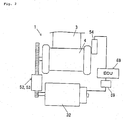
- FIG. 1 is a drawing illustrating a configuration of a seatbelt apparatus 100 which is one of the embodiments of a seatbelt apparatus of the present invention
- FIG. 2 is a drawing illustrating a configuration around a seatbelt retractor 1 in FIG. 1
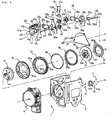
- FIG. 3 is a partially exploded perspective view illustrating part of the seatbelt retractor 1 which is one the embodiments of a seatbelt retractor of the present invention
- FIG. 4 is a partially exploded perspective view illustrating remaining part of the seatbelt retractor which is one of the embodiments of the seatbelt retractor of the present invention
- FIG. 5 is a drawing illustrating a state of the seatbelt retractor from which, a locking unit having a return spring and a base frame in examples illustrated in FIGs.
- FIG. 6 is a drawing illustrating engagement of a clutch gear 43 and a carrier gear 31, and a clutch pawl 49 and ratchet teeth 31c;
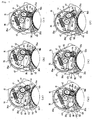
- FIG. 7 is a drawing explaining a power transmission mode and a power transmission mode switching operation at a power transmission gear mechanism 52, in which (a) is a drawing schematically and partially illustrating a power transmission cutoff mode, (b) is a drawing schematically and partially illustrating a power transmission mode of a low speed-reduction ratio, and (f) is a drawing schematically and partially illustrating the power transmission mode of a high speed-reduction ratio, (c), (d) and (e) are drawings explaining each of the power transmission mode switching operation; and FIG.
- FIG. 8 is a flowchart illustrating a clutch-releasing process at the seatbelt retractor of the embodiment of the present invention.
- an embodiment of the present invention will be explained in detail, referring to the drawings. First, referring to FIGs. 1 through 7, one of the embodiments of the present invention will be explained.
- FIG. 1 is a drawing illustrating a configuration of a seatbelt apparatus 100 which is one of the embodiments of a seatbelt apparatus of the present invention
- FIG. 2 is a drawing illustrating a configuration around a seatbelt retractor 1 in FIG. 1
- FIG. 3 is a partially exploded perspective view illustrating part of the seatbelt retractor 1 which is one the embodiments of a seatbelt retractor of the present invention
- FIG. 4 is a partially exploded perspective view illustrating a remaining part of the seatbelt retractor which is one of the embodiments of the seatbelt retractor of the present invention
- FIG. 5 is a drawing illustrating a state of the seatbelt retractor, from which a locking unit having a return spring and a base frame in examples illustrated in FIGs.
- FIG. 6 is a drawing illustrating respective engagements of a clutch gear 43 and a carrier gear 31, and a clutch pawl 49 and ratchet teeth 30c, and FIG.
- FIG. 7 is a drawing explaining a power transmission mode at a power transmission gear mechanism 52, and a power transmission mode switching operation, in which (a) is a drawing schematically and partially illustrating a power transmission cutoff mode, (b) is a drawing schematically and partially illustrating a power transmission mode of a low speed-reduction ratio, (f) is a drawing schematically and partially illustrating the power transmission mode of a high speed-reduction ratio, and (c), (d) and (e) are drawings explaining each of the power transmission mode switching operations.
- the seatbelt apparatus 100 of the present embodiment serves as a seatbelt apparatus for use in a motor vehicle, mounted on an automobile that is the motor vehicle having the seatbelt apparatus in the present invention, and is mainly composed of a seatbelt retractor 1, a seatbelt 3, an ECU 68, and the like.
- an inputting element 70 for detecting various kinds of information such as that relevant to prevision for a crash of the motor vehicle and occurrence of the crash of the motor vehicle, the information relevant to a driving state of the motor vehicle, the information relevant to a seated position of an occupant C, and a physique of the occupant C seated on a seat of the motor vehicle, the information relevant to a circumferential traffic situation, the information relevant to weather and a time zone, and the like, and inputting the detected information into the ECU 68, is mounted.
- the detected information of the input element 70 is transmitted to the ECU 68 constantly or at each of a predetermined time and is used for performing controlling operation for the seatbelt apparatus 100.
- the seatbelt 3 is a lengthy belt (webbing) used for keeping the occupant C seated on the motor vehicle seat 80 (corresponding to "a seat” in the present invention) under restraint, or for releasing the occupant C from the restraint.
- the seatbelt 3 corresponds to "the seatbelt” in the present invention.
- the seatbelt 3 is withdrawn from a seatbelt retractor 1 attached to the motor vehicle and connected to an out-anchor 64 via a shoulder anchor 60 provided in a shoulder region of the occupant C, and passing through a tongue 62.
- the shoulder guide anchor 60 has a function to hook and guide the seatbelt 3 in the shoulder region of the occupant C.
- the seatbelt 3 is brought to a state to be worn by the occupant C when the tongue 62 is inserted into a buckle 66 attached to the motor vehicle. Further, a buckle switch 66a is embedded in the buckle 66 and the buckle switch 66a detects that the tongue 62 is inserted into the buckle 66 (substantially, the seatbelt 3 is brought to a state to be worn by the occupant C).
- the seatbelt retractor 1 is an apparatus that enables the seatbelt 3 to be retracted or withdrawn by a spool 4, to be described later, corresponding to "a seatbelt retractor" of the present invention.
- the retractor 1 is mounted on a place in a storage space in a B-pillar 82 of the motor vehicle as an example, shown in FIG. 1.
- the ECU 68 has a function for performing control operation relevant to various operating mechanisms, such as the seatbelt retractor 1 or the like, and is composed of a CPU (Central Processing Unit), input/output devices, memories, peripheral devices, and the like. Specifically, in the explanation of the present embodiment, the ECU 68 performs the control operation relevant to a motor 32 of the seatbelt retractor, to be described later. In concrete terms, the ECU 68 controls the amount of the passage of electric current through a magnetic coil of the motor 32 and a direction of the passage of electric current, and accordingly, a rotation speed of a motor shaft or the rotating direction thereof is made variable. The ECU 68 corresponds to a "control device" of the present invention.
- a CPU Central Processing Unit
- a detecting sensor 54 that directly detects information relevant to a rotation of the spool 4 is mounted on a portion in the seatbelt retractor 1.
- the ECU 68 performs control operation for the motor 32 on the basis of the information detected by the detecting sensor 54.
- information detected by the detecting sensor 54 existence or absence of rotation of the spool 4, a rotating angle, a rotating direction, a rotating speed, an amount of rotation and the like can be appropriately used.
- sorts of sensors such as a hole sensor, a volume, a photointerrupter and the like can be arbitrarily used.
- driving operation of the motor 32 of the present embodiment is controlled by the ECU 68 on the basis of an electric current value of the motor 32 detected by a motor-current detection meter 69.
- the power of the motor 32 is transmitted to the spool 4 through the power transmission gear mechanism 52 and a power transmission mode switching mechanism 53, to be described later.
- the seatbelt retractor 1 is provided with a groove-shaped base frame 2, and in the base frame 2, the spool 4 for retracting the seatbelt 3 to keep the occupant C under restraint is rotatably provided.
- a locking mechanism and the spring mechanism heretofore known mechanisms are adopted.
- a pre-tensioner 6 is disposed at an outside of the base frame 2 at an opposite side of the locking unit 5 having a return spring, and is configured to remove a slack of the seatbelt 3 between the spool 4 and the occupant C by retracting the seatbelt (the seatbelt 3 in FIGs. 1 and 2) by rotating the spool 4 in a belt-retracting direction ⁇ , operating when the high speed-reduction of the motor vehicle occurs.
- a torsion bar 7 is provided in a concentric manner with the spool 4 penetrating through the same and one end portion 7a of the torsion bar 7 is fit into the spool 4 by a spline-fitting in a manner so as to be integrally rotatable with the spool 4.
- the other end portion 7b of the torsion bar 7 is fit into a fitting portion (not shown) (provided at a face of a side of the other end portion 7b of the torsion bar 7 in FIG. 3, in a concentric manner with the torsion bar 7) of a disk-shaped connector 8 by the spline-fitting in a manner so as to be integrally rotatable with the connector 8.
- a spline shaft 8a is disposed in a concentric manner with the torsion bar 7, and the spline shaft 8a is fit into a spline groove hole (not shown) of a connecting member 9 (provided at a face of a side of the spline shaft 8a in FIG. 3 in a concentric manner with the torsion bar 7) in a manner so as to be integrally rotatable with the connecting member 9.
- a cylindrical portion 9a is disposed in a concentric manner with the torsion bar 7 and a ring-shaped first separator 10 is fit into the cylindrical portion 9a.
- the same number of bearing pins 11 are respectively fit in a rotatable manner and at a plurality of (four in number) grooves 10b disposed at the other side of the first separator 10 in the shaft direction, the same number of bearing pins 12 are respectively fit in a rotatable manner.
- the first separator 10 is configured to be relatively rotatable to the cylindrical portion 9a.
- a spline shaft portion 9b is provided in the connecting member 9 continuously to the cylindrical portion 9a in a concentric manner with the torsion bar 7 and the spline shaft portion 9b is fit into a spline groove portion 13a provided at an internal face of a ring plate-shaped carrier 13 in a concentric manner with the torsion bar 7.
- the connecting member 9 and the carrier 13 are configured to be integrally rotatable.
- a spline shaft 13b is provided in a concentric manner with the torsion bar 7 and the spline shaft 13b penetrates a spline groove hole 31b, to be described later, in a manner so as to be integrally rotatable with the spline groove hole 31b of the carrier gear 31. Further, the spline shaft 13b is fit into a spline groove hole (not shown) (provided at a face of a side of the spline shaft 13b in FIG.
- a locking base 14 of the locking mechanism of the locking unit 5 having a return spring in a manner so as to be integrally rotatable with the spline groove hole.
- the locking base 14 the same one that is heretofore known is adopted.
- a pawl 14a swingably supported by a pawl supporting portion of the locking base 14 engages with a tooth 2a of the base frame 2 by being swung when the locking mechanism is operated, and thereby, a rotation of the locking base 14 in a belt withdrawing direction is , configured to be prevented. Accordingly, impact energy received by the occupant C from the seatbelt (the seatbelt 3 in FIGs. 1 and 2) caused by inertia is absorbed and eased by a deformation caused by torsion of the torsion bar 7 when the locking mechanism is operated.
- a retainer 15 is attached with four attaching screws 16, to an inside of an opposite side of the base frame 2, at which the pre-tensioner 6 is provided.
- a ring-shaped retainer bearing 17 is fit into and attached to a hole 15a of the retainer 15 having a large diameter.
- a cylindrical portion 9a of the connecting member 9 is rotatably supported by the retainer bearing 17.
- An internal peripheral face 18a of a ring-shaped center member 18 is fit into an outer periphery of the first separator 10 by the bearing pins 11 and 12 in a relatively rotatable manner.
- the center member 18 is attached to a gear 19 because a step portion 18b of the center member 18 is engaged with picks 19a disposed at three positions of the gear 19.
- Circularly aligned external teeth 19b are formed around the gear 19 and a guide portion 19c for movably holding a sun gear 20, to be described later, while guiding the sun gear in a radial direction (a state of the above and below direction, shown in FIG. 3) is provided in the gear 19.
- a second peripheral face 18c of the center member 18 is fit into a center hole 20a of the ring-shaped sun gear 20.
- a diameter of the center hole 20a is set to be greater than that of the second peripheral face 18c and the sun gear 20 is provided in an eccentric manner relative to the second peripheral face 18c, namely, an eccentric manner relative to the external teeth 19b of the gear 19.
- the sun gear 20 is supported by the guide portion 19c of the gear 19 in a relatively movable manner in a radial direction.
- the center member 18, the gear 19 and the sun gear 20 are configured to be integrally rotatable, and the sun gear 20 is provided in a manner so as to be relatively movable relative to the gear 19 in a radial direction (in the above and below direction in FIG. 3).
- a pair of springs 21 and a receive spring 22 are provided between the gear 19 and the sun gear 20 and thereby, the movement of the sun gear 20 relative to the gear 19 in the radial direction is limited by the pair of springs 21.
- An outer peripheral face 20b of the sun gear 20 is fit into a second separator 23.
- the plural number (12 in number in the example, shown in the drawing) of grooves 23 are formed in the shaft direction at one side of the second separator 23 and the same number of bearing pins 24 as that of the grooves 23 are respectively fit thereinto in a rotatable manner.
- the second separator 23 is configured so as to be rotatable relative to the outer peripheral face 20b of the sun gear 20 by the bearing pins 24.
- the second separator 23 is fit into a center hole 25a of a circular planet gear 25 in a relatively rotatable manner by the bearing pins 24.
- the planet gear 25 and the lifter 26 are provided such that projection shafts 13c (shown in FIG. 5) that are protruding in a perpendicularly standing manner from a face of an opposite side of the spline shaft 13b of the carrier 13, being in the shaft direction, and corresponding to the holes 25c and the holes 26a are fit into the holes 25c and 26a.
- a diameter of each of the holes 25c is set to be greater than that of each of the projection shafts 13c as shown in FIG. 5, and thereby, each of the projection shafts 13c is fit into each of the holes 25c with clearance therebetween in a movable manner relative to the holes 25c.
- a circular speed-reduction plate 27 is provided at a face of the planet gear 25 opposite to the carrier 13 side.
- the speed-reduction plate 27 is riveted to the carrier 13 using the hole 27a and the projection shaft 13c of the carrier 13.
- the planet gear 25 and the lifter 26 are sandwiched between the carrier 13 and the speed-reduction plate 27, and the planet gear 25 is decentered from a center shaft of the carrier 13, namely a center shaft of the torsion bar 7.
- a peripheral face 13d of the carrier 13 is fit into a third separator 28.
- a plurality of bearing pins 29 in the same number (thirty in number in the example, shown in the drawing) of the plurality of grooves 28a formed at one side of the third separator 28 are fit into respective grooves 28a in the shaft direction and in a rotatable manner.
- the third separator 28 is configured so as to be rotatable relative to the peripheral face 13d of the carrier 13 by the plurality of bearing pins 29. Further, the third separator 28 is fit into a center hole 30a of a circularly shaped internal gear 30 in a manner so as to be relatively rotatable by the bearing pins 29.
- Circularly shaped internal teeth 30b are formed at a center hole 30a of the internal gear 30 at a side of the retainer 15.
- the planet gear 25 is positioned in the circularly shaped internal teeth 30b in an eccentric manner from the center of the circularly shaped internal teeth 30b, and is configured such that part of the external teeth 25b of the planet gear 25 are partially engaged with part of the internal teeth 30b.
- circularly shaped ratchet teeth 30c are provided at a center hole 30a of the internal gear 30 at a side of the retainer 15.
- circularly-shaped carrier gear 31 Adjacent to the internal gear 30 at a side of the locking base 14, circularly-shaped carrier gear 31 is provided in a concentric manner with the internal gear 30, i.e., in a concentric manner with the torsion bar 7.
- external teeth 31a are disposed and spline groove holes 31b are formed at a center portion of the carrier gear 31.
- the spline shaft 13b of the carrier 13 is penetrated through and engaged with the spline shaft hole 31b. Accordingly, the carrier 13 and the carrier gear 31 are able to be integrally rotatable.
- a motor 32 that generates rotation torque applied to the spool 4 is attached to an upper position of the pre-tensioner 6 and at an outside of the retainer 15 by means of attaching screws 33.
- a motor rotation shaft 32a of the motor 32 intrudes into the retainer 15 penetrating through a penetration hole 15b of the retainer 15 and a rotation transmission member 34 is attached to a portion in the motor rotation shaft 32a located inside the retainer 15 in a manner so as to be integrally rotatable.
- the rotation transmission member 34 is fit into a fitting portion (not shown) of a disk-shaped motor gear 35 (concentrically provided on a same shaft as the motor rotation shaft 32a at a face of a side of the rotation transmission member 34 in FIG. 3) by means of a spline, in a manner so as to be integrally rotatable.
- the motor gear 35 is provided with circularly shaped first external teeth 35a having relatively large diameter, circularly shaped second external teeth 35b having a relatively small diameter, and a rotation shaft 35c.
- the rotation shaft 35c of the motor gear 35 is rotatably supported by a bearing portion of a retainer cover 37 attached to the retainer 15 by attaching screws 36 (concentrically provided with the rotation shaft 35c at a face of the motor gear 35 side, namely, on the same axis of the motor rotation shaft 32a in FIG. 3).
- the first external teeth 35a of the motor gear 35 are engaged with the external teeth 19b of the gear 19 and the second external teeth 35b are engaged with external teeth 41a of a first connecting gear 41, to be described later.
- An upper guide plate 38 and a lower guide plate 39 are overlapped with each other and attached to the retainer 15 with an attaching screw 40.
- a predetermined clearance is formed in an intermediate portion between the overlapped upper guide plate 38 and the lower guide plate 39 by step portions 39a and 39b attached to the lower guide plate 39.
- the first connecting gear 41, a second connecting gear 42, and the clutch gear 43 are provided in the predetermined clearance.
- the first connecting gear 41 is provided with external teeth 41a at an outer peripheral face thereof and a hexagonal fitting hole 41b at a center portion thereof.
- the second connecting gear 42 is provided with external teeth 42a having a diameter smaller than that of the external teeth 41a at an outer peripheral face thereof and a hexagonal fitting shaft 42b at a center thereof.
- the first and the second connect gears 41 and 42 are concentrically combined with each other being provided with a predetermined clearance in an integrally rotatable manner by fitting the fitting shaft 42b of the second connecting gear 42 into the fitting hole 41b of the first connecting gear 41, and are supported by a rotation shaft (not shown) on the upper guide plate 38 and the lower guide plate 39 in a rotatable manner.
- the clutch gear 43 has external teeth 43a having the same diameter as that of the external teeth 42a, and the external teeth 42a of the second connecting gear 42 and the external teeth 43a of the clutch gear 43 are engaged with each other.
- the clutch gear 43 is rotatably supported by the clutch gear shaft 44 and the clutch gear shaft 44 is configured so as to be movable along an arc-shaped guide hole 38a provided in the upper guide plate 38 and an arc-shaped guide hole 39c provided in the lower guide plate 39. Both the guide holes 38a and 39c are aligned in the shaft direction and arcs of both the guide holes 38a and 39c are set to be arcs of circles having a common center serving as a rotation axis of the first and second connecting gears 41 and 42.
- the clutch gear 43 is brought to move around an outer periphery of the second connecting gear 42 being rotating on the clutch gear shaft 44 as a center axis, in a state of constantly being engaged with the second connecting gear 42. Further, the clutch gear 43 is configured so as to be engaged with the external teeth 31a of the carrier gear 31 when the clutch gear 43 arrives at a position, shown in FIG. 4 by moving around the outer periphery of the second connecting gear 42.
- a U-shaped clutch spring 45 is disposed in the clearance between the first and the second connecting gears 41 and 42.
- a curved portion 45a of the clutch spring 45 is supported in a relatively rotatable manner by a protruding shaft (not shown) provided on the second connecting gear 42 in a manner so as to be protruding toward the first connecting gear 41 in the shaft direction.
- the clutch spring 45 is rotatable around a rotation axis of the second connecting gear 42 as a rotation center.
- the curved portion 45a is in a state of frictional engagement with the protruding shaft of the second connecting gear 42 at a predetermined frictional force and when relative rotation force between the clutch spring 45 and the second connecting gear 42 exceed the predetermined frictional force, the clutch spring 45 is brought to a state of a relative rotation being sliding with the second connecting gear 42.
- the clutch arm 47 is configured in a manner so as to sandwich the upper guide plate 38 and the lower guide plate 39 by two of the side walls 47a and 47b, and supporting shafts respectively protruding on the upper guide plate 38 and the lower guide plate 39 are fit into supporting holes respectively formed in both the side walls 47a and 47b.
- the clutch arm 47 is supported on the upper guide plate 38 and the lower guide plate 39 in a relative rotation manner.
- the clutch gear shaft 44 is capable of contacting each of right ends 47e of both the side walls 47a and 47b of the clutch arm 47. Furthermore, an arc-shaped engaging concave 47f to be engaged with the clutch gear shaft 44 is formed on the right end 47e. Still further, a pawl limiting hole 47g is formed at the side wall 47a of the clutch arm 47. In addition, at the left ends of the side walls 47a and 47b, stopper hooking portions 47h are respectively formed. The stopper hooking portions 47h are configured so as to be capable of contacting the stopper shafts provided in the upper guide plate 38 and the lower guide plate 39 when the clutch arm 47 rotates in a clockwise direction. (In FIG. 4, only a stopper shaft 38d of the upper guide plate 38 is shown and that of the lower guide plate 39 is not shown. However, in the explanation described later, numeral 38d denotes the stopper shaft of the lower guide plate 39, although not shown.)
- a spring 48 is compressed.
- the clutch arm 47 is constantly biased in a direction so as to be in a non-operating state, shown in FIG. 5 (initial state), namely, in a clockwise direction by the spring 48.
- the stopper hooking portion 47h of the clutch arm 47 is held at a position, at which the stopper hooking portion 47h is hooked on a stopper shaft 38d by the spring 48 and a further rotation of the clutch arm 47 in the clockwise direction is thereby prevented.
- the clutch arm 47 rotates in a counterclockwise direction in FIG.
- a clutch pawl 49 is rotatably mounted on the retainer 15.
- an arc-shaped supporting portion 49a of one end side of the clutch pawl 49 is rotatably supported by an arc-shaped supporting concave portion 15c of the retainer 15.
- a hooking pick 49b is formed at the other end side of the clutch pawl 49 and the hooking pick 49b is able to be hooked with the ratchet teeth 30c of the internal gear 30 when being at a position, shown in FIG. 6.
- the hooking pick 49b cannot be hooked with the ratchet teeth 30c when being at a position, shown in FIG. 5.
- a cylindrically shaped projection shaft 49c is provided in the clutch pawl 49, and is provided penetrating a pawl limiting hole 47g of both side walls 47a.
- a diameter of the projection shaft 49c is set to be smaller than that of the pawl limiting hole 47g to some tune, and the projection shaft 49c is configured to be movable within the area of the pawl limiting hole 47g. In other words, the rotation of the clutch pawl 49 is limited by the pawl limiting hole 47g.
- a stopper spring 50 is provided in the lower guide plate 39.
- the stopper spring 50 is attached to the lower guide plate 39 with an attaching screw 51.
- an arc-shaped hooking portion 50b positioned at one end side of the stopper spring 50 is hooked by the projection shaft 49c of the clutch pawl 49 and the other end side of the stopper spring 50 is configured to be a guide portion 50c having an angled shape that is angled at approximately 90 degree.
- a pressing portion 50d is formed between a supporting portion 50a and the guide portion 50c as shown in FIG. 4.
- the power transmission gear mechanism 52 for transmitting rotation torque of the motor 32 to the spool 4 is composed of the carrier 13, the center member 18, the gear 19, the sun gear 20, the second separator 23, the planet gear 25, the lifter 26, the third separator 28, the internal gear 30, the carrier gear 31, the motor gear 35, the first connecting gear 41, the second connecting gear 42, the clutch gear 43, the clutch gear shaft 44 and the like.
- the power transmission mode switching mechanism 53 for switching the power transmission modes among three of the power transmission modes, to be described later, which is set in the power transmission gear mechanism 52 is composed of the clutch gear 44, the clutch spring 45, the clutch arm 47, the spring 48, the clutch pawl 49, the stopper spring 50, and the like. Furthermore, a speed-reduction mechanism for transmitting a rotation of the motor 32 to the spool 4 in a manner so as to reduce the speed is composed of the power transmission gear mechanism 52 and the power transmission mode switching mechanism 53.
- the speed-reduction mechanism, or the power transmission gear mechanism 52 corresponds to a power transmission mechanism of the present invention.
- the power transmission cutoff mode is a mode in which the motor 32 is not driven and the power transmission between the spool and the motor 32 is cutoff (a non-operating state, namely, an initial state).
- the clutch gear shaft 44 at the power transmission mode switching mechanism 53 is set to a position contacting right ends of guide holes 38a and 39c, and the clutch gear 43 is set to a position at which the clutch gear 43 does not engage with the carrier gear 31.
- a torque transmission path (a high speed and low torque transmission path, described later) between the clutch gear 43 and the carrier gear 31 is cutoff.
- the stopper hooking portion 47h of the clutch arm 47 is held at a position at which the stopper hooking portion 47h is hooked on a stopper shaft 38d by the spring 48.
- the pressing portion 50d of the stopper spring 50 is in a state of contacting the corner portion 47j of the clutch arm 47 and the clutch arm 47 is biased in a counterclockwise direction by the pressing portion 50d and the stopper spring 50 is positioned at a position, shown in the drawing, by the clutch arm 47.
- the projection shaft 49c of the clutch pawl 49 is pressed by an internal peripheral edge of the pawl limiting hole 47g of the clutch arm 47.
- the low speed-reduction ratio power transmission mode is a high speed and low torque transmission mode (a high speed mode) in which the motor 32 rotates in a seatbelt retracting direction (counterclockwise direction) (hereinafter referred to as a normal rotation).
- a high speed mode in which the motor 32 rotates in a seatbelt retracting direction (counterclockwise direction) (hereinafter referred to as a normal rotation).
- the hooking pick 49b of the clutch pawl 49 is not engaged with the ratchet teeth 30c of the internal gear 30 and the internal gear 30 is released to be freely rotatable.
- the low speed and high torque transmission path is thereby cutoff.
- the clutch gear shaft 44 of the power transmission mode switching mechanism 53 contacts the right end 47e of both side walls 47a and 47b of the clutch arm 47, and the clutch gear 43 is engaged with the carrier gear 31. Accordingly, the clutch gear 43 and the carrier 13 are connected through the carrier gear 31, and the rotation of the motor 32 is transmitted at a reduced speed.
- a high speed and low torque transmission path in which the speed-reduction ratio is lower than that of the high speed-reduction ratio power transmission mode, described later, is set.
- the motor 32 is connected to the spool 4 via the motor rotation shaft 32a, the rotation transmission member 34, the second external teeth 35b of the motor gear 35, the first connecting gear 41, the second connecting gear 42, the clutch gear 43, the carrier gear 31, the carrier 13 the connecting member 9, connector 8, and the torsion bar 7.
- the low speed-reduction ratio power transmission mode is set.
- driving force of the motor 32 is transmitted to the spool at a high speed and by low torque, and the seatbelt 3 can be rapidly retracted.
- the high speed-reduction ratio power transmission mode is a low speed and high torque transmission mode (A high speed reduction mode means a low speed mode.) in which the motor 32 rotates in a reversed direction (reversed rotation).
- a high speed reduction mode means a low speed mode.
- the clutch gear 43 is separated from the carrier gear 31, as shown in FIG. 7(e), and the high speed and low torque transmission path is cutoff.
- the hooking pick 49b of the clutch pawl 49 is engaged with the ratchet teeth 30c of the internal gear 30 (brought to be a state, clearly shown in FIG. 6), and the internal gear 30 is stopped to be rotated by torque of the motor 32.
- the gear 19 and the carrier 13 are connected via the sun gear 20 and the planet gear 25, and the rotation of the motor 32 is transmitted to the carrier 13.
- the rotation of the motor 32 is converted into a rotation of the planet gear 25 by a planetary composed of the carrier 13, the sun gear 20, the planet gear 25, and the internal gear 30.
- the rotation of the motor 32 is transmitted to the carrier 13 at a highly reduced speed, and the speed reduction ratio of the rotation is higher than that of the low speed-reduction ratio power transmission mode, described above.
- the low speed high torque transmission path is set. That is, the motor 32 is connected to the spool 4 via the motor rotation shaft 32a, the rotation transmission member 34, the first external teeth 35a of the motor gear 35, the gear 19, the sun gear 20, the planet gear 25, the carrier 13, the connecting member 9, the connector 8, and the torsion bar 7.
- the high speed-reduction ratio power transmission mode is set.
- the driving force of the motor 32 is transmitted to the spool 4 at a low speed and by high torque and the seatbelt 3 can be retracted under relatively strong or high belt tension.
- Switching operation for switching the power transmission modes among the aforementioned power transmission cutoff mode, the low speed-reduction ratio power transmission mode, and the high speed-reduction ratio power transmission mode is performed by the power transmission mode switching mechanism 53.
- the operation of the power transmission mode switching mechanism 53 is performed by the driving force of the motor 32, and the driving force of the motor 32 is controlled by the ECU 68 on the basis of a motor-current value detected by the motor-current detection meter (the motor-current detection meter 69, shown in FIG. 2).
- the first connecting gear 41 rotates in a clockwise direction at a deduced speed by the counterclockwise rotation of the motor gear 35 via the second external teeth 35b of the motor gear 35.
- the second connecting gear 42 is also integrally rotated in the same direction as that of the first connecting gear 41 by the rotation thereof, and the clutch spring 45 is also integrally rotated in the same direction as that of the second connecting gear 42 around the rotation shaft of the second connecting gear 42 serving as a rotation center by a frictional engagement with the protruding shaft (not shown) provided on the second connecting gear 42.
- the clutch gear 43 moves in a direction for approaching the carrier gear 31.
- the moving operation of the clutch gear 43 is performed in a manner such that the clutch gear shaft 44 moves along the guide holes 38a and 39a.
- the clutch gear 43 is rotated in a counterclockwise direction by the rotation of the second connecting gear 42 being in engagement with the clutch gear 43.
- the clutch gear 43 is engaged with the carrier gear 31 at this stopping position.
- the power transmission mode switching operation of the power transmission gear mechanism 52 from the power transmission cutoff mode to the low speed-reduction ratio power transmission mode is performed, and the power transmission gear mechanism 52 is set to the low speed-reduction ratio power transmission mode.
- the rotating direction of the motor 32 is a controlled direction of the motor rotation for switching the power transmission modes from the low speed-reduction ratio power transmission mode to the power transmission cutoff mode, and is corresponding to "a first rotating direction" and "a power transmission releasing direction" of the present invention.
- the pressing force of the clutch arm 47 for pressing the projecting portion 49c caused by the spring 48 is brought to be weaker than the pressing force of the pressing portion 49c for pressing the clutch arm 47 in a reversed direction caused by the stopper spring 50.
- the clutch arm 47 is rotated in the counterclockwise direction.
- the clutch pawl 49 is rotated in a clockwise direction by the stopper spring 50 and the hooking pick 49b is brought to a position to be able to hook on the ratchet teeth 30c of the internal gear 30.
- the hooking pick 49b and the ratchet gear 30c are not engaged with each other.
- the control device When the motor-current value detected by the motor-current detection meter 69 exceeds a preset current value, which is a threshold value, the control device once stops the rotation of the motor 32 and then rotates the same in the reversed direction. Then, because the first and the second connecting gear 41 and 42 are rotated in a direction contrary to the above-described direction, i.e., the counterclockwise direction as shown in FIG. 7(e), the internal gear 30 is rotated in the counterclockwise direction and thereby, the hooking pick 49b of the clutch pawl 49 is engaged with the ratchet teeth 30c of the internal gear 30.
- a preset current value which is a threshold value
- the clutch spring 45 is also rotated in the counterclockwise direction and the clutch gear shaft 44 moves along the guide holes 38a and 39c to be separated from the clutch arm 41 and is separated from the engaging concave 47f.
- the clutch gear shaft 44 is separated from the engaging concave 47f, the clutch gear 43 moves in a direction to be separated from the carrier gear 31, and the engagement of the clutch gear 43 with the carrier gear 31 is released. Further, when the clutch gear shaft 44 is separated from the engaging concave 47f, the pressing force for rotating the clutch arm 47 in the counterclockwise direction is brought to be weak.
- the clutch arm 47 is rotated in the clockwise direction by the spring 48, and the internal peripheral edge of the pawl limiting hole 47g contacts the projection shaft 49c of the clutch pawl 49.
- the clutch arm 47 is not further rotated in the clockwise direction and stops at this position. This is because the hooking pick 49b of the clutch pawl 49 is engaged with the ratchet teeth 30c of the internal gear 30.
- the power transmission mode switching operation of the power transmission gear mechanism 52 from the low speed-reduction ratio power transmission mode to the high speed-reduction ratio power transmission mode is performed and the power transmission mode of the power transmission gear mechanism 52 is set to the high speed-reduction ratio power transmission mode.
- the clutch gear shaft 44 continues to move and contacts the right ends of the guide holes 38a and 39c and stops, as shown in FIG. 7(f), and as a result, the clutch gear shaft 44, the clutch gear 43, and the clutch spring 45 return to the initial position together.
- the power transmission gear mechanism 52 of the present embodiment is composed of the gear 19, the sun gear 20, the planet gear 25, the first connecting gear 41, the second connecting gear 42, and a driven device including the clutch gear 43 or the like (corresponding to a driven device in the present invention) between the motor gear 35 serving as a drive gear of a side of the motor 32 (constitutes a drive gear in the present invention) and the carrier 13 serving as a driven gear of a side of the spool 4 (constitutes a driven gear in the present invention), as described above.
- the driven device is configured to transmit the rotating force of the motor gear 35 to the carrier 13, and to switch the rotating directions of the carrier 13, when rotating in a predetermined rotating direction (a direction of the normal rotation or a direction of the reversed rotation) to be contrary to each other between the low speed-reduction ratio power transmission mode and the high speed-reduction ratio power transmission mode.
- the rotating direction of the motor 32 is switched from the reversed rotation to the normal rotation, first.
- the power transmission mode is switched from the high speed-reduction ratio power transmission mode to the low speed-reduction ratio power transmission mode, shown in FIG. 7(b).
- the rotating direction of the motor 32 is the controlled direction of the motor rotation in which the high speed-reduction ratio power transmission mode is released and the power transmission mode is being transferred, and is corresponding to "the second rotating direction contrary to the first rotating direction" and "the power transmission releasing direction" of the present invention.
- the rotating directions of the motor 32 by further switching the rotating directions of the motor 32 from that of the low speed-reduction ratio power transmission mode, shown in FIG. 7(b), i.e., from normal rotation to the reversed rotation, the power transmission between the spool 4 and the motor 32 is cutoff and the power transmission mode is switched to that of the power transmission cutoff mode, shown in FIG. 7(a).
- a setting operation of the power transmission gear mechanism 52 in the present embodiment is switched by the rotation control of the motor 32 that is performed by the ECU 68.
- the power transmission mode is switched from the low speed-reduction ratio power transmission mode to the power transmission cutoff mode by controlling the rotating direction of the motor 32 to that of the reversed rotation, and low speed-reduction ratio power transmission mode is released.
- the power transmission mode is switched from the high speed-reduction ratio power transmission mode to the low speed-reduction ratio power transmission mode by controlling the rotating direction of the motor 32 to that of the normal rotation, and the high speed-reduction ratio power transmission mode is released.
- the transmitting state of the power transmission gear mechanism 52 is uncertain when the clutch-releasing operation is performed, and therefore, a desired direction of the motor 32 controlled to be rotated is uncertain. In such a case, there is a problem in which the desired clutch-releasing operation cannot be performed. Further, for example, even when a clutch is already turned off (power transmission released-state), the motor 32 is continuously controlled to be rotated and thereby, there is a possibility of unnecessary rotation of the motor 32 resulting in occurring noise.
- the ECU 68 judges the transmitting state when the clutch-releasing operation is performed, and the seatbelt retractor 1 of the present embodiment is configured to start the clutch-releasing operation at a best mode on the basis of the judged result.
- a clutch-releasing process power transmission releasing process
- the clutch-releasing process is performed by the ECU 68.
- the motor 32 is controlled to be rotated in a mode such that the transmitting state can be judged, that is, the motor 32 is controlled to be rotated in a mode to be rotated by a weak driving force to an extent such that the transmitting state is not switched, in Step S10.
- the control operation for the rotation of the motor 32 corresponds to "the control operation for the rotation in a transmitting state judging mode" of the present invention.
- Step S20 the motor-current value at a time when the motor 32 is rotated in Step S10 is detected, in Step S20.
- the motor-current value is detected by the motor-current detection meter 69, shown in FIG. 2.
- the motor-current value detected in Step S20 and the pre-specified value is compared, in Step S30.
- the ETC 68 judges that a motor load is relatively heavy and the clutch is in a state of being turned on (the low speed-reduction ratio power transmission mode or the high speed-reduction ratio power transmission mode), and when the motor-current value is less than the pre-specified value, the ETC 68 judges that the motor load is relatively light and the clutch is in a state of being turned off (the power transmission cutoff mode).
- the motor-current detection meter 69 is a detection device for detecting information relevant to the motor load of the motor 32, and is corresponding to "the detection device" in the present invention.
- Step S30 when the ETC 68 judges that the clutch is being turned on (YES, in Step S30), the ETC 68 performs control operation for a clutch-releasing process in Step S40, and when the ETC 68 judges that the clutch is being tuned off (NO, in Step S30), the ETC 68 completes the clutch-releasing process straight and continues the power transmission cutoff mode.
- the ETC 68 judges whether the motor-current value detected in Step S20 is a relatively far smaller value corresponding to the low speed-reduction ratio power transmission mode, or a relatively large value corresponding to the high speed-reduction ratio power transmission mode, first.
- the ETC 68 judges that the result is the low speed-reduction ratio power transmission mode, the ETC 68 performs control operation for the motor 32 to rotate in the direction of reversed rotation, and performs the releasing operation for the low speed-reduction ratio power transmission mode, and when the ETC 68 judges that the result is the high speed-reduction ratio power transmission mode, the ETC 68 performs control operation for the motor 32 to rotate in the direction of normal rotation, and performs the releasing operation for the high speed-reduction ratio power transmission mode.
- the ETC 68 switches the power transmission gear mechanism 52 among the low speed-reduction ratio power transmission mode, the high speed-reduction ratio power transmission mode, and the power transmission cutoff mode.
- the ETC 68 releases the low speed-reduction ratio power transmission mode by performing control operation for the motor 32 to rotate in the reversed direction, and releases the high speed-reduction ratio power transmission mode by performing control operation for the motor 32 to rotate in the direction of the normal rotation.
- the ETC 68 performs control operation for the motor 32 to rotate in the transmitting state judging mode.
- the ETC 68 judges the transmitting state of the power transmission gear mechanism 52 on the basis of the information detected by the motor-current detection meter 69 at a time when the motor 32 is controlled to be rotated. Moreover, the ETC 68 is configured to perform control operation for the motor 32 to rotate in the reversed direction when judging the power transmission gear mechanism 52 is in the low speed-reduction ratio power transmission mode, and to control the motor 32 to rotate in the direction of normal rotation when judging the power transmission gear mechanism 52 is in the high speed-reduction ratio power transmission mode, and to maintain the power transmission cutoff mode when judging the power transmission gear mechanism 52 is in the power transmission cutoff mode.
- the clutch-releasing operation is brought to be able to perform the desired mode that matches with the transmitting state of the power transmission gear mechanism 52.
- the motor 32 is prevented from being controlled to continue rotation even when the clutch is already in the state of being turned off (in the state of power transmission cutoff mode) and the noise caused by unnecessary rotation of the motor is prevented from occurring.
- the setting operation of each of the belt modes is performed by controlling the motor 32 by a motor control device.
- the belt storage mode is a belt mode of a state in which the seatbelt 3 is not used and is completely retracted by the spool 4.
- the seatbelt retractor 1 is set to a state in which the motor 32 is not rotated and the power transmission gear mechanism 52 is in the power transmission cutoff mode. Further, the motor 32 has no electric power consumption.
- the belt withdrawal mode is a belt mode in which the seatbelt 3 is withdrawn from the spool 4 so that the occupant C wears the seatbelt 3.
- the seatbelt retractor 1 is set to the state in which the power transmission gear mechanism 52 is in the power transmission cutoff mode. As a result, the seatbelt 3 can be withdrawn by weak force. Further, the motor 32 is not rotated and the motor 32 also has no electric power consumption.
- the belt retracting mode for fitting is a belt mode in which the excessively withdrawn seatbelt 3 is retracted for fitting on the occupant C after the seatbelt 3 is withdrawn and the tongue is inserted and hooked with the buckle, causing the buckle switch to be turned on, or in which the withdrawn seatbelt 3 is retracted when the seated occupant C has once moved after being seated on a regular position, causing the seatbelt 3 to be withdrawn in a predetermined amount, and again get back to be seated on the regular position of the motor vehicle seat when the seatbelt 3 is in a state of normal wearing (At this moment, the buckle switch is in a state of being turned on.).
- the seatbelt retractor 1 In the belt retracting mode for fitting, the seatbelt retractor 1 is set to a state in which the motor 32 is driven in the belt retracting direction and the power transmission gear mechanism 52 is set to the low speed-reduction ratio transmission mode. Accordingly, the seatbelt 3 is rapidly retracted by low torque and is worn by the occupant C in a state of being fit thereon by stopping the motor 32 when a predetermined slight belt tension force occurs.
- the normal wearing mode is a belt mode in a normal wearing state of the seatbelt 3 which is set after the belt retracting for fitting is brought to completion.
- the seatbelt retractor 1 is set to a state in which the motor 32 is not driven and the power transmission gear mechanism 52 is set to the power transmission cutoff mode.
- the motor 32 also has no electric power consumption.
- the warning mode is a belt mode in which the seatbelt retractor 1 repeats the retracting operation of the seatbelt 3 for a predetermined number of times to give a warning to the occupant C when a doze of the occupant C while driving the motor vehicle is detected, or when an impediment or the like ahead in the direction of travel of the motor vehicle is detectedin the normal wearing mode.
- the seatbelt retractor 1 is set in a manner such that the motor 32 is repeatedly driven.
- the emergency mode is a belt mode that is set when there is an enormous possibility that the motor vehicle collides with the impediment or the like when traveling in the normal wearing mode and includes the following two steps.
- the seatbelt retractor 1 is set in a manner that the motor 32 is rotated in the direction of normal rotation. Then, the power transmission gear mechanism 52 is switched from the power transmission cutoff mode to the low speed-reduction ratio power transmission mode. Accordingly, the seatbelt 3 is rapidly retracted at a low torque and the slack of the seatbelt 3 is rapidly removed.
- the emergency mode proceeds to the late stage, being continued from the early stage.
- the tension force of the seatbelt 3, i.e., the belt load substantially increases and the motor-current value is thereby increased.
- the motor-current value detected by the motor-current detection meter 69 is increased up to the preset current value, the motor 32 rotates in the reversed direction after stopping. Then, the power transmission gear mechanism 52 is switched from the low speed-reduction ratio power transmission mode to the high speed-reduction ratio power transmission mode. Thereby, the seatbelt 3 is retracted at a high torque and the occupant C is kept under restraint under extremely strong belt tension.
- the belt retracting mode for storage is a belt mode in which when the tongue is pulled out from the buckle and the buckle switch is turned off so as to release wearing operation of the seatbelt 3, the seatbelt 3 is completely retracted to be stored.
- the control device rotates the motor 32 in the direction of normal rotation, the power transmission gear mechanism 52 is set to be in the low speed-reduction ratio power transmission mode.
- the withdrawn seatbelt 3 is rapidly retracted by the low torque.
- the motor 32 is stopped when the seatbelt 3 is completely retracted and predetermined slight belt tension force occurs.
- the power transmission gear mechanism 52 is switched from the low speed-reduction ratio power transmission mode to the power transmission cutoff mode by the slightly reversed rotation of the motor 32. Thereafter, the motor 32 is stopped and the seatbelt 3 is brought to be in the belt storage mode.
- the seatbelt retractor 1 is configured to perform control operation using a detection sensor (detection sensor 54 in FIG. 2) in order to increase reliability relevant to the storing operation for the seatbelt 3 by solving various kinds of problems such as that the seatbelt 3 is not stored even when the seatbelt 3 is required to be stored, and is kept in a state of being withdrawn, or the storing operation for the seatbelt 3 is started even when the seatbelt 3 is in the middle of being worn by the occupant C and is not required to be stored.
- a detection sensor detection sensor 54 in FIG. 2
- the control device judges whether the seatbelt 3 is in an appropriate state to start storing operation on the basis of information (existence or absence of the rotating operation, a rotating angle, a rotating direction, a rotating speed, an amount of rotation, or the like) relevant to the rotation of the spool 4, directly detected by the detection sensor 54. Then, the ECU 68 performs the control operation for driving the motor 32 in the belt retracting direction when the seatbelt 3 is judged to be in the appropriate state to start storing operation, and starts performing storing operation for the seatbelt 3.
- a condition to start storing operation for the seatbelt 3 for example, a below mentioned “first starting condition for storing” to a “third starting condition for storing” are used.
- the storing operation for the seatbelt 3 is started.
- the information of rotating operation of the spool 4 can be easily detected by detecting the information of rotating operation of the spool 4 per se by the detection sensor 54.
- the state in which the rotating operation of the spool 4 is stopped after a state of the buckle switch 66a is changed from being turned on to being turned off is detected by the detection sensor 54.
- the state is that even though the occupant C has performed the releasing operation for the seatbelt 3, the storing operation for the seatbelt 3 is not performed, and the storing operation for the seatbelt 3 is judged to be appropriate.
- the second starting condition for storing it is listed that the state in which the spool 4 is rotated equal to or more than the specified rotation angle, which is previously determined, in a state that the buckle switch 66a is turned off and the motor 32 is stopped, and thereafter the rotation of the spool 4 is again stopped is detected.
- the state is that the tongue 62 is not inserted and engaged with the buckle 66 when the occupant C withdraws the seatbelt 3 and the operation is completed is detected. Therefore, the storing operation for the seatbelt 3 is judged to be appropriate.
- the third starting condition for storing it is listed that the state in which the rotation of the spool 4 is stopped after the door of the motor vehicle in a closed state is opened while the buckle switch 66a is turned off is detected.
- the state is that the occupant C is getting off the motor vehicle after performing releasing operation for the seatbelt 3. Therefore, the storing operation for the seatbelt 3 is judged to be appropriate.
- the ECU 68 judges the transmitting state when the clutch releasing operation is performed, and the clutch releasing operation is started on the basis of the judged result and is started in the best mode. Therefore, the clutch releasing operation can be performed in the desired mode that matches with the transmitting state of the power transmission gear mechanism 52. Further, for example, the motor 32 is prevented from being controlled to continue rotation even when the clutch is already in the state of being turned off (in the state of power transmission cutoff mode) and the noise caused by unnecessary rotation of the motor is prevented from occurring.
- the power transmission gear mechanism 52 can increase the reliability relevant to the power transmission releasing operation by configuring the power transmission gear mechanism 52 to include, at least the drive gear of the motor 32 side, the driven gear of the spool 4 side, and a driven device intervening between the drive gear and the driven gear.
- the storing operation for the seatbelt 3 is started in the case when at least one of the first to third starting conditions for storing is satisfied.
- the reliability of the seatbelt retractor 1 can be increased by solving the problems such as that the seatbelt 3 is not stored in the state of being kept withdrawn, or the seatbelt storing operation is started when the occupant C is in the middle of wearing the seatbelt 3.
- the first to third starting condition for storing a highly-detailed setting relevant to the starting condition for the seatbelt storing operation is brought to be possible.
- the power transmission gear mechanism 52 is set to have two power transmission paths, i.e., the low speed-reduction ratio power transmission mode composed of a high speed and low torque power transmission path, and the high speed-reduction ratio power transmission mode composed of a low speed and high torque power transmission path, two belt-retracting capabilities, i.e., a rapid belt retracting operation for removing the slack of the seatbelt 3, performed by the low speed-reduction power transmission mode, and a belt retracting operation with high torque for keeping the occupant C under restraint, performed by the high speed-reduction ratio power transmission mode are realized.
- two belt-retracting capabilities i.e., a rapid belt retracting operation for removing the slack of the seatbelt 3, performed by the low speed-reduction power transmission mode, and a belt retracting operation with high torque for keeping the occupant C under restraint, performed by the high speed-reduction ratio power transmission mode are realized.
- the rotation torque of the motor 32 can be efficiently transmitted to the spool 4. Therefore, these two retracting capabilities can be securely realized within limited power consumption. Specifically, because a belt retracting operation for keeping the occupant C under restraint by high torque is performed by the low speed and high torque power transmission path, the rotation torque of the motor 32 can be small sized compared to the conventional seatbelt retractor. As a result, the power consumption of the motor 32 can be decreased and a relatively smaller motor can be used. Therefore, the seatbelt retractor 1 can be made compact.
- a pre-tensioning function according to the rotation torque of the motor 32 can be added to the seatbelt retractor 1.
- the pre-tensioner using a reaction gas in the conventional seatbelt retractor is brought to be unnecessary and the manufacturing cost can be reduced.
- the power transmission gear mechanism 52 is set to the low speed-reduction ratio power transmission mode or the high speed-reduction ratio power transmission mode corresponding to the tension force of the seatbelt 3, the power transmission mode switching operation can be easily performed without controlling the rotation torque of the motor 32.
- the power transmission cutoff mode in which the rotation torque of the motor 32 is not transmitted to the spool 4 is set to the power transmission gear mechanism 52, the withdrawal of the seatbelt 3, the normal wearing of the seatbelt 3 without feeling the oppression, and the storing operation for the seatbelt 3 at a time of non-wearing state can be performed without being affected by the motor 32.
- the storing and the retracting operation of the seatbelt 3 are performed by only the rotation torque of the motor 32, biasing force in the seatbelt retracting direction caused by a retracting device such as a spiral spring or the like that is constantly applied to the seatbelt 3 can be eliminated or reduced to be extremely small without using an additional module such as a tension reducer or the like.
- the storing and retracting operation for the seatbelt 3 can be securely performed by assisting the retracting operation for the seatbelt 3 by transmitting the rotation of the motor 32 to the spool 4 in the low speed-reduction ratio power transmission mode.
- a high-speed transmission clutch mechanism that switches the transmission mode from the low speed-reduction ratio power transmission mode to the high speed-reduction ratio power transmission mode, accurately correlating with the belt load is required to stabilize the seatbelt load at a time of the power transmission mode switching operation.
- a high speed transmission clutch mechanism has to adopt a mechanism using a balance of force between a member that generates a load correlating with the belt load and the other member that tends to keep high speed transmission, opposing to the aforementioned member.
- Such a mechanism has to be generally formed with a compound of a spring load to the member, friction between the members, action of force between the members and the like. Accordingly, the balancing relationship of the force is varied by mechanical fluctuation such as a coefficient of spring, a coefficient of friction, action angle of the force and the like. As a result, the belt load sometimes becomes unstable when the transmission mode is switched.
- the seatbelt retractor 1 of the present embodiment is configured to switch the power transmission mode between the low speed-reduction ratio power transmission mode and the high speed-reduction ratio power transmission mode by changing the rotating direction of the motor 32, it is easy to control the operation of the power transmission mode switching mechanism 53 for performing the power transmission mode switching operation among the power transmission cutoff mode, the low speed-reduction ratio power transmission mode, and the high speed-reduction ratio power transmission mode, and the structure of the power transmission mode switching mechanism 53 can be simplified. Accordingly, parameter of the aforementioned mechanical variation and fluctuation that occurs when the power transmission mode is switched can be reduced and the belt load occurring when the power transmission mode is switched can be stabilized. As a result, the switching operation for the power transmission modes can be more accurately and securely performed.
- the parameter of the variation or the fluctuation that influences the belt load at the time when the power transmission mode is switched can be concentrated on the motor-current value corresponding to the motor torque.
- the timing for switching the power transmission modes is determined by the motor-current value correlating with the belt load by utilizing an inversion per se of the rotating direction from the normal rotation to the reversed rotation for the switching operation for the low speed-reduction ratio power transmission mode from turning on to turning off. As a result, the switching operation for the power transmission modes can be more accurately and securely performed.
- the low speed and high torque transmission path can be formed into a compact size.
- the mechanism for setting the high speed-reduction power transmission mode is configured to have the planetary, composed of the carrier 13, the sun gear 20, the planet gear 25, and the internal gear 30. Accordingly, even when the power transmission gear mechanism 52 is configured to have the low speed-reduction ratio power transmission mode or the high speed-reduction ratio power transmission mode, the seatbelt retractor 1 is efficiently suppressed to grow in size.
- the seatbelt retractor 1 having the power transmission gear mechanism 52 which is set to either one of the low speed-reduction ratio power transmission mode or the high speed-reduction ratio power transmission mode, i.e., a so-called multistage clutch is described.
- the present invention can be also applied to a seatbelt retractor having a so-called single-stage clutch provided with one kind of power transmission mode.
- a control device switches a power transmission mechanism (the power transmission gear mechanism 52, for example) from a power transmitting state in which the spool 4 performs rotating operation (a state of rotating operation at a predetermined speed and by predetermined torque) to a power transmission released-state in which the power transmitting state is released.
- the control device performs control operation for the motor 32 to rotate in the transmitting state judging mode and judges the transmitting state of the power transmission mechanism on the basis of the information detected by the motor-current detection meter 69, when performing the power transmission releasing operation.
- the control device judges that the power transmission mechanism is in the power transmitting state, the control device performs control operation for the motor 32 to rotate in the power transmission releasing direction, and when the control device judges that the power transmission mechanism is in the power transmission released-state, the control device performs control operation for the power transmission mechanism to keep the power transmission released-state.
- This configuration of the seatbelt retractor is included in the configuration described in Claim 1. Further, according to this configuration of the seatbelt retractor, similar to the present embodiment, the motor 32 is prevented from being rotated by the control device even when the clutch is already turned off (power transmission released-state), and the noise that occurs due to the unnecessary rotation of the motor 32 is also prevented.
- the switching operation for the power transmission modes is performed by inversing the rotating direction of the motor 32 from the normal rotation to the reversed rotation when the motor-current value of the motor 32 exceeds the preset current value, which is the threshold value.
- the switching operation for the power transmission modes may be performed by inversing the rotating direction of the motor 32 from the normal rotation to the reversed rotation when the time length for which the motor-current value exceeds the preset current value exceeds the set length of time. According to the thus configured switching operation for the power transmission modes, a failure of the timing for inversing the rotating direction of the motor 32 can be suppressed and the power transmission mode switching operation can be far more accurately performed.
- a mechanism other than the power transmission mode switching mechanism 53 using two of the low torque and the high torque of the motor 32 namely, a mechanism such as for example, a solenoid or the like can be used.
- the rotation torque of the motor 32 is constant when the power transmission mode is being switched, however, in each of the belt retracting mode for fitting, the warning mode, the emergency mode, the belt retracting mode for storage, and the like, the rotation torque of the motor 32 can be controlled in a manner to be varied corresponding to each of the belt modes.
- the seatbelt retractor 1 mounted on a motor vehicle is described in the aforementioned embodiment, however, the seatbelt retractor of the present invention is used in the seatbelt apparatus mounted on conveyance or vehicles, such as for example, an automobile, an airplane, a vessel or the like that carries the occupant C, and is able to be preferably utilized for the seatbelt retractor 1 that retracts the seatbelt 3 for keeping the occupant under restraint and protecting the same, by a motor.
- the seatbelt apparatus of the present invention can be utilized for the seatbelt apparatus that efficiently keeps the occupant under restraint and protects the same that is carried by conveyance or vehicles, such as for example, an automobile, an airplane, a vessel or the like by utilizing the rotation torque of the motor and by controlling the retracting force of the spool in an accurate manner.
Landscapes
- Engineering & Computer Science (AREA)
- Mechanical Engineering (AREA)
- Automotive Seat Belt Assembly (AREA)
Applications Claiming Priority (1)
| Application Number | Priority Date | Filing Date | Title |
|---|---|---|---|
| JP2005105419A JP2006282015A (ja) | 2005-03-31 | 2005-03-31 | シートベルトリトラクタ、シートベルト装置、シートベルト装置付車両 |
Publications (2)
| Publication Number | Publication Date |
|---|---|
| EP1707455A2 true EP1707455A2 (fr) | 2006-10-04 |
| EP1707455A3 EP1707455A3 (fr) | 2007-01-10 |
Family
ID=36613474
Family Applications (1)
| Application Number | Title | Priority Date | Filing Date |
|---|---|---|---|
| EP06004140A Withdrawn EP1707455A3 (fr) | 2005-03-31 | 2006-03-01 | Rétracteur de ceinture de sécurité, système de ceinture de sécurité et véhicule automobile avec système de ceinture de sécurité |
Country Status (4)
| Country | Link |
|---|---|
| US (1) | US20060220368A1 (fr) |
| EP (1) | EP1707455A3 (fr) |
| JP (1) | JP2006282015A (fr) |
| CN (1) | CN1840389A (fr) |
Cited By (5)
| Publication number | Priority date | Publication date | Assignee | Title |
|---|---|---|---|---|
| EP1745994A1 (fr) * | 2005-07-19 | 2007-01-24 | Takata Corporation | Enrouleur de ceinture de sécurité, dispositif de ceinture de sécurité et un vehicule avec un dispositif de ceinture de sécurité |
| EP1749717A1 (fr) * | 2005-08-05 | 2007-02-07 | Takata Corporation | Enrouleur de ceinture de sécurité, dispositif de ceinture de sécurité et un vehicule avec un dispositif de ceinture de sécurité |
| EP2143597A1 (fr) * | 2008-07-09 | 2010-01-13 | Honda Motor Co., Ltd. | Dispositif de ceinture de sécurité et véhicule |
| EP2060450A4 (fr) * | 2006-11-22 | 2012-11-07 | Takata Corp | Dispositif de ceinture de securite et procede de commande de ceinture de securite |
| US10604259B2 (en) | 2016-01-20 | 2020-03-31 | Amsafe, Inc. | Occupant restraint systems having extending restraints, and associated systems and methods |
Families Citing this family (14)
| Publication number | Priority date | Publication date | Assignee | Title |
|---|---|---|---|---|
| JP4570141B2 (ja) * | 2004-10-05 | 2010-10-27 | タカタ株式会社 | シートベルト巻き取り装置及びシートベルト装置 |
| JP5086669B2 (ja) * | 2006-06-09 | 2012-11-28 | 本田技研工業株式会社 | 車両のシートベルト装置およびその制御方法 |
| JP4934400B2 (ja) * | 2006-10-24 | 2012-05-16 | 本田技研工業株式会社 | 車両のシートベルト装置 |
| JP5215549B2 (ja) * | 2006-11-24 | 2013-06-19 | タカタ株式会社 | シートベルト巻き取り装置 |
| JP5180481B2 (ja) * | 2007-01-24 | 2013-04-10 | タカタ株式会社 | モータリトラクタの制御方法、モータリトラクタ及びシートベルト装置 |
| JP4885773B2 (ja) * | 2007-03-23 | 2012-02-29 | タカタ株式会社 | シートベルト巻取装置、シートベルト装置及びシートベルト巻取方法 |
| US7954854B2 (en) * | 2008-07-15 | 2011-06-07 | Autoliv Asp, Inc. | Seat belt retractor and torsion bar providing secondary load limiting |
| US8857854B2 (en) * | 2009-10-06 | 2014-10-14 | Autoliv Development Ab | Passenger restraint device for vehicles |
| KR101305566B1 (ko) * | 2011-09-06 | 2013-09-09 | 현대자동차주식회사 | 차량용 시트벨트 프리텐셔너 및 이를 이용한 승객 보호방법 |
| CN102774349B (zh) * | 2012-07-27 | 2015-06-03 | 浙江吉利汽车研究院有限公司杭州分公司 | 一种预紧电机式安全带的辅助装置及辅助方法 |
| JP6988458B2 (ja) * | 2017-12-25 | 2022-01-05 | トヨタ自動車株式会社 | 車両用シート |
| CN108528382B (zh) * | 2018-05-16 | 2023-12-26 | 张连生 | 安全带单向放松装置 |
| CN113859170A (zh) * | 2021-08-09 | 2021-12-31 | 重庆光大产业有限公司 | 一种限力工况动态可调的主动预紧安全带卷收器及减速机构 |
| CN117400868A (zh) * | 2023-11-30 | 2024-01-16 | 均胜均安汽车电子(上海)有限公司 | 一种用于安全带卷收器的控制器、控制系统以及控制方法 |
Citations (1)
| Publication number | Priority date | Publication date | Assignee | Title |
|---|---|---|---|---|
| JP2003507252A (ja) | 1999-08-24 | 2003-02-25 | ブリード・オートモティブ・テクノロジィ・インク | シートベルトリトラクタ |
Family Cites Families (10)
| Publication number | Priority date | Publication date | Assignee | Title |
|---|---|---|---|---|
| US4659108A (en) * | 1985-09-11 | 1987-04-21 | American Safety Equipment Corp. | Automatic seat belt adjusting system |
| JP4142750B2 (ja) * | 1995-09-08 | 2008-09-03 | タカタ株式会社 | 車両の乗員拘束保護システム |
| US6702056B2 (en) * | 1997-08-06 | 2004-03-09 | Takata Corporation | Seatbelt retractor |
| GB2370540B (en) * | 1997-12-16 | 2002-08-14 | Nsk Ltd | Automotive passenger restraint and protection apparatus and seatbelt protraction and retraction amount-detecting device |
| US6485057B1 (en) * | 1997-12-16 | 2002-11-26 | Nsk Autoliv Co., Ltd. | Automotive passenger restraint and protection apparatus and seatbelt protraction and retraction amount-detecting device |
| JP4467688B2 (ja) * | 1999-01-19 | 2010-05-26 | タカタ株式会社 | シートベルト巻取装置 |
| JP4356852B2 (ja) * | 1999-12-13 | 2009-11-04 | タカタ株式会社 | シートベルト制御装置 |
| JP2005029014A (ja) * | 2003-07-14 | 2005-02-03 | Takata Corp | シートベルトリトラクタ |
| JP4472299B2 (ja) * | 2003-09-25 | 2010-06-02 | タカタ株式会社 | モータ付シートベルト巻き取り装置の制御方法及び装置 |
| JP2005119403A (ja) * | 2003-10-15 | 2005-05-12 | Takata Corp | シートベルトリトラクタ |
-
2005
- 2005-03-31 JP JP2005105419A patent/JP2006282015A/ja not_active Withdrawn
-
2006
- 2006-03-01 EP EP06004140A patent/EP1707455A3/fr not_active Withdrawn
- 2006-03-27 US US11/389,280 patent/US20060220368A1/en not_active Abandoned
- 2006-03-31 CN CNA2006100738622A patent/CN1840389A/zh active Pending
Patent Citations (1)
| Publication number | Priority date | Publication date | Assignee | Title |
|---|---|---|---|---|
| JP2003507252A (ja) | 1999-08-24 | 2003-02-25 | ブリード・オートモティブ・テクノロジィ・インク | シートベルトリトラクタ |
Cited By (7)
| Publication number | Priority date | Publication date | Assignee | Title |
|---|---|---|---|---|
| EP1745994A1 (fr) * | 2005-07-19 | 2007-01-24 | Takata Corporation | Enrouleur de ceinture de sécurité, dispositif de ceinture de sécurité et un vehicule avec un dispositif de ceinture de sécurité |
| US7600600B2 (en) | 2005-07-19 | 2009-10-13 | Takata Corporation | Seat belt retractor and seat belt device |
| EP1749717A1 (fr) * | 2005-08-05 | 2007-02-07 | Takata Corporation | Enrouleur de ceinture de sécurité, dispositif de ceinture de sécurité et un vehicule avec un dispositif de ceinture de sécurité |
| US7533903B2 (en) | 2005-08-05 | 2009-05-19 | Takata Corporation | Seat belt apparatus |
| EP2060450A4 (fr) * | 2006-11-22 | 2012-11-07 | Takata Corp | Dispositif de ceinture de securite et procede de commande de ceinture de securite |
| EP2143597A1 (fr) * | 2008-07-09 | 2010-01-13 | Honda Motor Co., Ltd. | Dispositif de ceinture de sécurité et véhicule |
| US10604259B2 (en) | 2016-01-20 | 2020-03-31 | Amsafe, Inc. | Occupant restraint systems having extending restraints, and associated systems and methods |
Also Published As
| Publication number | Publication date |
|---|---|
| JP2006282015A (ja) | 2006-10-19 |
| EP1707455A3 (fr) | 2007-01-10 |
| US20060220368A1 (en) | 2006-10-05 |
| CN1840389A (zh) | 2006-10-04 |
Similar Documents
| Publication | Publication Date | Title |
|---|---|---|
| EP1707455A2 (fr) | Rétracteur de ceinture de sécurité, système de ceinture de sécurité et véhicule automobile avec système de ceinture de sécurité | |
| US7278600B2 (en) | Seat belt retractor and seat belt device | |
| US7216827B2 (en) | Seatbelt retractor and seatbelt device | |
| JP4885764B2 (ja) | ウエビング巻取装置 | |
| KR100933397B1 (ko) | 프리텐션 장치를 포함하는 안전벨트 리트랙터 | |
| EP1642788A2 (fr) | Rétracteur de ceinture de sécurité et dispositif de ceinture de sécurité avec un tel rétracteur | |
| EP1726494B1 (fr) | Enrouleur de ceinture, dispositif de ceinture de sécurité et véhicule avec un dispositif de ceinture de sécurité | |
| EP1724163B1 (fr) | Enrouleur de ceinture, dispositif de ceinture de sécurité et véhicule avec un dispositif de ceinture de sécurité | |
| US20060237570A1 (en) | Seat belt retractor and seat belt device | |
| CN100503317C (zh) | 带子卷绕装置 | |
| EP1717113A2 (fr) | Enrouleur de ceinture de sécurité et un dispositif de ceinture de sécurité équipé avec d'un tel enrouleur | |
| JP4458526B2 (ja) | シートベルトリトラクタ及びシートベルト装置 | |
| US20080093494A1 (en) | Seat belt retractor and seat belt apparatus employing the same | |
| US7240923B2 (en) | Seatbelt retractor and seatbelt device | |
| JP2006290285A (ja) | シートベルトリトラクタ、シートベルト装置、シートベルト装置付車両 | |
| EP1690757B1 (fr) | Rétracteur de ceinture de sécurité, dispositif de ceinture de sécurité et véhicule equipé d'un tel dispositif | |
| US20060022078A1 (en) | Seatbelt retractor and seatbelt system | |
| EP1712436A2 (fr) | Rétracteur de ceinture de sécurité, dispositif de ceinture de sécurité et véhicule avec dispositif de ceinture de sécurité | |
| US9302646B2 (en) | Seat belt retractor | |
| JP4429108B2 (ja) | ウエビング巻取装置 | |
| KR20250160184A (ko) | 자동차의 안전 벨트 장치용 벨트 리트랙터 |
Legal Events
| Date | Code | Title | Description |
|---|---|---|---|
| PUAI | Public reference made under article 153(3) epc to a published international application that has entered the european phase |
Free format text: ORIGINAL CODE: 0009012 |
|
| AK | Designated contracting states |
Kind code of ref document: A2 Designated state(s): AT BE BG CH CY CZ DE DK EE ES FI FR GB GR HU IE IS IT LI LT LU LV MC NL PL PT RO SE SI SK TR |
|
| AX | Request for extension of the european patent |
Extension state: AL BA HR MK YU |
|
| PUAL | Search report despatched |
Free format text: ORIGINAL CODE: 0009013 |
|
| AK | Designated contracting states |
Kind code of ref document: A3 Designated state(s): AT BE BG CH CY CZ DE DK EE ES FI FR GB GR HU IE IS IT LI LT LU LV MC NL PL PT RO SE SI SK TR |
|
| AX | Request for extension of the european patent |
Extension state: AL BA HR MK YU |
|
| AKX | Designation fees paid |
Designated state(s): DE FR GB SE |
|
| STAA | Information on the status of an ep patent application or granted ep patent |
Free format text: STATUS: THE APPLICATION IS DEEMED TO BE WITHDRAWN |
|
| 18D | Application deemed to be withdrawn |
Effective date: 20070711 |