EP1707672A2 - Verfahren zur Herstellung einer mehrlagigen Pappe - Google Patents
Verfahren zur Herstellung einer mehrlagigen Pappe Download PDFInfo
- Publication number
- EP1707672A2 EP1707672A2 EP06251501A EP06251501A EP1707672A2 EP 1707672 A2 EP1707672 A2 EP 1707672A2 EP 06251501 A EP06251501 A EP 06251501A EP 06251501 A EP06251501 A EP 06251501A EP 1707672 A2 EP1707672 A2 EP 1707672A2
- Authority
- EP
- European Patent Office
- Prior art keywords
- slurry
- starch
- paperboard
- cationic
- level
- Prior art date
- Legal status (The legal status is an assumption and is not a legal conclusion. Google has not performed a legal analysis and makes no representation as to the accuracy of the status listed.)
- Withdrawn
Links
- 239000011087 paperboard Substances 0.000 title claims abstract description 44
- 238000000034 method Methods 0.000 title claims abstract description 42
- 239000000835 fiber Substances 0.000 claims abstract description 83
- 239000002002 slurry Substances 0.000 claims abstract description 55
- 125000002091 cationic group Chemical group 0.000 claims description 53
- 229920002472 Starch Polymers 0.000 claims description 50
- 235000019698 starch Nutrition 0.000 claims description 50
- 239000008107 starch Substances 0.000 claims description 44
- 229920006320 anionic starch Polymers 0.000 claims description 29
- 239000000834 fixative Substances 0.000 claims description 24
- 229920003043 Cellulose fiber Polymers 0.000 claims description 16
- 238000001035 drying Methods 0.000 claims description 8
- 239000007788 liquid Substances 0.000 claims description 8
- 238000002156 mixing Methods 0.000 claims description 6
- 239000000654 additive Substances 0.000 abstract description 14
- 238000007792 addition Methods 0.000 description 36
- 125000000129 anionic group Chemical group 0.000 description 17
- KRKNYBCHXYNGOX-UHFFFAOYSA-N citric acid Chemical compound OC(=O)CC(O)(C(O)=O)CC(O)=O KRKNYBCHXYNGOX-UHFFFAOYSA-N 0.000 description 15
- 239000000463 material Substances 0.000 description 12
- 229920001131 Pulp (paper) Polymers 0.000 description 11
- 101100216185 Oryza sativa subsp. japonica AP25 gene Proteins 0.000 description 9
- 206010052904 Musculoskeletal stiffness Diseases 0.000 description 8
- 239000003431 cross linking reagent Substances 0.000 description 8
- 239000000203 mixture Substances 0.000 description 7
- 239000002253 acid Substances 0.000 description 6
- 239000011122 softwood Substances 0.000 description 6
- 229920002125 Sokalan® Polymers 0.000 description 5
- 238000009472 formulation Methods 0.000 description 5
- 239000000123 paper Substances 0.000 description 5
- 239000004584 polyacrylic acid Substances 0.000 description 5
- NGDLSKPZMOTRTR-OAPYJULQSA-N (4z)-4-heptadecylidene-3-hexadecyloxetan-2-one Chemical compound CCCCCCCCCCCCCCCC\C=C1/OC(=O)C1CCCCCCCCCCCCCCCC NGDLSKPZMOTRTR-OAPYJULQSA-N 0.000 description 4
- 238000011068 loading method Methods 0.000 description 4
- 230000014759 maintenance of location Effects 0.000 description 4
- XLYOFNOQVPJJNP-UHFFFAOYSA-N water Substances O XLYOFNOQVPJJNP-UHFFFAOYSA-N 0.000 description 4
- 150000007513 acids Chemical class 0.000 description 3
- 230000000996 additive effect Effects 0.000 description 3
- 239000011248 coating agent Substances 0.000 description 3
- 238000000576 coating method Methods 0.000 description 3
- 238000010790 dilution Methods 0.000 description 3
- 239000012895 dilution Substances 0.000 description 3
- 230000000694 effects Effects 0.000 description 3
- 238000005516 engineering process Methods 0.000 description 3
- 239000000126 substance Substances 0.000 description 3
- 238000004448 titration Methods 0.000 description 3
- 229920002873 Polyethylenimine Polymers 0.000 description 2
- 239000004372 Polyvinyl alcohol Substances 0.000 description 2
- 230000015572 biosynthetic process Effects 0.000 description 2
- 238000004061 bleaching Methods 0.000 description 2
- 238000003490 calendering Methods 0.000 description 2
- 229920006317 cationic polymer Polymers 0.000 description 2
- 230000001186 cumulative effect Effects 0.000 description 2
- 239000002245 particle Substances 0.000 description 2
- 229920000371 poly(diallyldimethylammonium chloride) polymer Polymers 0.000 description 2
- 229920000642 polymer Polymers 0.000 description 2
- 229920002451 polyvinyl alcohol Polymers 0.000 description 2
- 239000013055 pulp slurry Substances 0.000 description 2
- 238000004088 simulation Methods 0.000 description 2
- 239000007787 solid Substances 0.000 description 2
- GGAUUQHSCNMCAU-ZXZARUISSA-N (2s,3r)-butane-1,2,3,4-tetracarboxylic acid Chemical compound OC(=O)C[C@H](C(O)=O)[C@H](C(O)=O)CC(O)=O GGAUUQHSCNMCAU-ZXZARUISSA-N 0.000 description 1
- CEGRHPCDLKAHJD-UHFFFAOYSA-N 1,1,1-propanetricarboxylic acid Chemical compound CCC(C(O)=O)(C(O)=O)C(O)=O CEGRHPCDLKAHJD-UHFFFAOYSA-N 0.000 description 1
- 241000157282 Aesculus Species 0.000 description 1
- 229920013683 Celanese Polymers 0.000 description 1
- VEXZGXHMUGYJMC-UHFFFAOYSA-M Chloride anion Chemical compound [Cl-] VEXZGXHMUGYJMC-UHFFFAOYSA-M 0.000 description 1
- 235000005018 Pinus echinata Nutrition 0.000 description 1
- 241001236219 Pinus echinata Species 0.000 description 1
- 235000017339 Pinus palustris Nutrition 0.000 description 1
- LSNNMFCWUKXFEE-UHFFFAOYSA-N Sulfurous acid Chemical compound OS(O)=O LSNNMFCWUKXFEE-UHFFFAOYSA-N 0.000 description 1
- 229920006318 anionic polymer Polymers 0.000 description 1
- 230000004888 barrier function Effects 0.000 description 1
- 238000005452 bending Methods 0.000 description 1
- 125000003178 carboxy group Chemical group [H]OC(*)=O 0.000 description 1
- 150000001735 carboxylic acids Chemical class 0.000 description 1
- 239000003054 catalyst Substances 0.000 description 1
- 229920002678 cellulose Polymers 0.000 description 1
- 239000001913 cellulose Substances 0.000 description 1
- 238000001311 chemical methods and process Methods 0.000 description 1
- 238000010276 construction Methods 0.000 description 1
- 238000007796 conventional method Methods 0.000 description 1
- 229920001577 copolymer Polymers 0.000 description 1
- 238000011161 development Methods 0.000 description 1
- GQOKIYDTHHZSCJ-UHFFFAOYSA-M dimethyl-bis(prop-2-enyl)azanium;chloride Chemical compound [Cl-].C=CC[N+](C)(C)CC=C GQOKIYDTHHZSCJ-UHFFFAOYSA-M 0.000 description 1
- 230000002708 enhancing effect Effects 0.000 description 1
- 238000002474 experimental method Methods 0.000 description 1
- 238000005189 flocculation Methods 0.000 description 1
- 230000016615 flocculation Effects 0.000 description 1
- 239000011121 hardwood Substances 0.000 description 1
- 235000010181 horse chestnut Nutrition 0.000 description 1
- 230000003116 impacting effect Effects 0.000 description 1
- 239000002655 kraft paper Substances 0.000 description 1
- 238000004519 manufacturing process Methods 0.000 description 1
- 238000005259 measurement Methods 0.000 description 1
- 238000012986 modification Methods 0.000 description 1
- 230000004048 modification Effects 0.000 description 1
- 238000004806 packaging method and process Methods 0.000 description 1
- 230000000704 physical effect Effects 0.000 description 1
- 229920002401 polyacrylamide Polymers 0.000 description 1
- 229920000768 polyamine Polymers 0.000 description 1
- 229920001444 polymaleic acid Polymers 0.000 description 1
- WZAPMUSQALINQD-UHFFFAOYSA-M potassium;ethenyl sulfate Chemical compound [K+].[O-]S(=O)(=O)OC=C WZAPMUSQALINQD-UHFFFAOYSA-M 0.000 description 1
- 238000003825 pressing Methods 0.000 description 1
- 238000007670 refining Methods 0.000 description 1
- 230000000717 retained effect Effects 0.000 description 1
- 239000012898 sample dilution Substances 0.000 description 1
- 238000012360 testing method Methods 0.000 description 1
- 238000010977 unit operation Methods 0.000 description 1
- 238000007704 wet chemistry method Methods 0.000 description 1
- 238000004804 winding Methods 0.000 description 1
Images


Classifications
-
- D—TEXTILES; PAPER
- D21—PAPER-MAKING; PRODUCTION OF CELLULOSE
- D21H—PULP COMPOSITIONS; PREPARATION THEREOF NOT COVERED BY SUBCLASSES D21C OR D21D; IMPREGNATING OR COATING OF PAPER; TREATMENT OF FINISHED PAPER NOT COVERED BY CLASS B31 OR SUBCLASS D21G; PAPER NOT OTHERWISE PROVIDED FOR
- D21H23/00—Processes or apparatus for adding material to the pulp or to the paper
- D21H23/02—Processes or apparatus for adding material to the pulp or to the paper characterised by the manner in which substances are added
- D21H23/04—Addition to the pulp; After-treatment of added substances in the pulp
- D21H23/06—Controlling the addition
- D21H23/08—Controlling the addition by measuring pulp properties, e.g. zeta potential, pH
- D21H23/10—Controlling the addition by measuring pulp properties, e.g. zeta potential, pH at least two kinds of compounds being added
-
- D—TEXTILES; PAPER
- D21—PAPER-MAKING; PRODUCTION OF CELLULOSE
- D21H—PULP COMPOSITIONS; PREPARATION THEREOF NOT COVERED BY SUBCLASSES D21C OR D21D; IMPREGNATING OR COATING OF PAPER; TREATMENT OF FINISHED PAPER NOT COVERED BY CLASS B31 OR SUBCLASS D21G; PAPER NOT OTHERWISE PROVIDED FOR
- D21H17/00—Non-fibrous material added to the pulp, characterised by its constitution; Paper-impregnating material characterised by its constitution
- D21H17/20—Macromolecular organic compounds
- D21H17/21—Macromolecular organic compounds of natural origin; Derivatives thereof
- D21H17/24—Polysaccharides
- D21H17/28—Starch
-
- D—TEXTILES; PAPER
- D21—PAPER-MAKING; PRODUCTION OF CELLULOSE
- D21H—PULP COMPOSITIONS; PREPARATION THEREOF NOT COVERED BY SUBCLASSES D21C OR D21D; IMPREGNATING OR COATING OF PAPER; TREATMENT OF FINISHED PAPER NOT COVERED BY CLASS B31 OR SUBCLASS D21G; PAPER NOT OTHERWISE PROVIDED FOR
- D21H17/00—Non-fibrous material added to the pulp, characterised by its constitution; Paper-impregnating material characterised by its constitution
- D21H17/20—Macromolecular organic compounds
- D21H17/21—Macromolecular organic compounds of natural origin; Derivatives thereof
- D21H17/24—Polysaccharides
- D21H17/28—Starch
- D21H17/29—Starch cationic
-
- D—TEXTILES; PAPER
- D21—PAPER-MAKING; PRODUCTION OF CELLULOSE
- D21H—PULP COMPOSITIONS; PREPARATION THEREOF NOT COVERED BY SUBCLASSES D21C OR D21D; IMPREGNATING OR COATING OF PAPER; TREATMENT OF FINISHED PAPER NOT COVERED BY CLASS B31 OR SUBCLASS D21G; PAPER NOT OTHERWISE PROVIDED FOR
- D21H21/00—Non-fibrous material added to the pulp, characterised by its function, form or properties; Paper-impregnating or coating material, characterised by its function, form or properties
- D21H21/14—Non-fibrous material added to the pulp, characterised by its function, form or properties; Paper-impregnating or coating material, characterised by its function, form or properties characterised by function or properties in or on the paper
- D21H21/18—Reinforcing agents
-
- D—TEXTILES; PAPER
- D21—PAPER-MAKING; PRODUCTION OF CELLULOSE
- D21H—PULP COMPOSITIONS; PREPARATION THEREOF NOT COVERED BY SUBCLASSES D21C OR D21D; IMPREGNATING OR COATING OF PAPER; TREATMENT OF FINISHED PAPER NOT COVERED BY CLASS B31 OR SUBCLASS D21G; PAPER NOT OTHERWISE PROVIDED FOR
- D21H27/00—Special paper not otherwise provided for, e.g. made by multi-step processes
- D21H27/30—Multi-ply
Definitions
- the present application relates to increasing the bond strength in a multi-ply paperboard that has high crosslinked cellulose fiber present in at least one of the plies.
- This invention provides a method for forming a paperboard comprising the steps of forming a slurry of cellulose fibers comprising crosslinked fibers, adding a cationic fixative and mixing with said slurry, adding an anionic starch subsequent to adding said cationic fixative, adding a cationic starch subsequent to adding said anionic starch, wherein, after each addition step, the slurry ionic demand is less than zero, forming a fibrous web layer by withdrawing liquid from said slurry, drying said web to form a paperboard.
- Said crosslinked fibers may be present at a level from 25 to 80 percent of the total fiber weight in at least one ply of the paperboard, and preferably are present at a level from 40 to 75 percent of the total dry weight of the fiber weight in at least one ply of the paperboard.
- the total starch level may be 50 to 120 lb/ t, preferably 60 to 100 lb/ t and more preferably 80 to 90 lb/ t.
- the cationic starch may be added to the furnish before the anionic starch and the cationic fixative is added after the anionic starch.
- a method for forming a paperboard comprising the steps of forming a slurry of cellulose fibers comprising crosslinked fibers, adding a cationic fixative and mixing with said slurry, adding an anionic starch subsequent to adding said cationic fixative, wherein, after each addition step, the slurry ionic demand is less than zero, forming a fibrous web layer by withdrawing liquid from said slurry, drying said web to form a paperboard.
- the anionic starch may be added to the slurry before the cationic fixative.
- crosslinked fibers are present at a level from 25 to 80 percent of the total fiber weight in at least one ply of the paperboard and more specifically are present at a level from 40 to 60 percent of the total dry weight of the fiber weight in at least one ply of the paperboard.
- the total starch level may be 50 to 120 lb/t, more specifically 60 to 100 lb/t, and preferably 80 to 90 lb/t.
- the invention still further provides a method for forming a paperboard comprising the steps of forming a slurry of cellulose fibers comprising crosslinked fibers, adding a cationic starch and mixing with said slurry, adding an anionic starch subsequent to adding said cationic fixative, wherein, after each addition step the slurry ionic demand is less than zero, forming a fibrous web layer by withdrawing liquid from said slurry, drying said web to form a paperboard.
- the application is directed to improving the internal bond strength of paperboard with greater than 25 percent crosslinked fiber in at least one ply.
- additives are added to the slurry in various combinations and order while maintaining the ionic demand of the slurry at less than zero. Paperboard with high ZDT, Scott Bond and Taber Stiffness is obtained.
- the density of the stratum will drop below 0.4 g/cc.
- the internal bond strength can drop so low as to not only be well below levels required for converting the paperboard into packaging products but also below the level where conventional methods of increasing the internal strength cannot provide enough increase to meet minimum levels needed for converting.
- the present application provides a method for increasing the internal bond of low density paperboard back into the range which is useable for converting.
- a distinguishing characteristic of the present application is that at least one ply of the paperboard, whether a single-ply or a multiple-ply structure, contains crosslinked cellulose fibers and strength enhancing additives such as anionic and cationic starches to offset the board strength lost by adding the crosslinked cellulosic fibers.
- the crosslinked cellulosic fibers increase the bulk density of the insulating paperboard characteristics of the board.
- the paperboard also contains chemical pulp fibers.
- chemical pulp fibers useable in the present application are derived primarily from wood pulp. Suitable wood pulp fibers for use with the application can be obtained from well-known chemical processes such as the kraft and sulfite processes, with or without subsequent bleaching. Softwoods and hardwoods can be used.
- wood pulp fibers are well known to those skilled in the art.
- suitable cellulosic fibers produced from southern pine that are useable in the present application are available from a number of companies including Weyerhaeuser Company under the designations C-Pine, Chinook, CF416, FR416 , and NB416.
- C-Pine Chinook
- CF416, FR416 FR416
- NB416 NB416.
- a bleached Kraft Douglas Fir pulp, KKT, Prince Albert Softwood and Grande Prairie Softwood, all manufactured by Weyerhaeuser are examples of northern softwoods that can be used.
- Mercerized fibers such as HPZ and mercerized flash dried fibers such as HPZ III, both manufactured by Buckeye Technologies, Memphis TN, and Porosinier- J-HP available from Rayonier Performance Fibers Division, Jessup, GA are also suitable for use in the present application when used with crosslinked cellulose fibers.
- Non crosslinked cellulose fibers include chemithermomechanical pulp fibers (CTMP), bleached chemithermomechanical pulp fibers (BCTMP), thermomechanical pulp fibers (TMP), refiner groundwood pulp fibers, groundwood pulp fibers, TMP (thermomechanical pulp) made by Weyerhaeuser, Federal Way, WA, and CTMP ( chemi-thermomechanical pulp) obtained from NORPAC, Longview, WA, sold as a CTMP NORPAC Newsprint Grade, jet dried cellulosic fibers and treated jet dried cellulosic fibers manufactured by the Weyerhaeuser Company by the method described in U.S. Application No. 10/923,447 filed August 20, 2004 . Ttiese fibers are twisted kinked and curled. Additional fibers include flash dried and treated flash dried fibers as described in U.S. 6,837,970 ,
- Suitable crosslinking agents for making crosslinked fibers include carboxylic acid crosslinking agents such as polycarboxylic acids.
- carboxylic acid crosslinking agents such as polycarboxylic acids.
- Polycarboxylic acid crosslinking agents e.g., citric acid, propane tricarboxylic acid, and butane tetracarboxylic acid
- catalysts are described in U.S. Patent Nos. 3,526,048 ; 4,820,307 ; 4,936,865 ; 4,975,209 ; and 5,221,285 .
- C 2 -C 9 polycarboxylic acids that contain at least three carboxyl groups e.g., citric acid and oxydisuceinic acid
- crosslinking agents is described in U.S. Patent Nos. 5,137,537 ; 5,183,707 ; 5,190,563 ; 5,562,740 ; and 5,873,979 .
- Polymeric polycarboxylic acids are also suitable crosslinking agents for making crosslinked fibers. These include polymeric polycarboxylic acid crosslinking agents are described in U.S. Patent Nos. 4,391,878 ; 4,420,368 ; 4,431,481 ; 5,049,235 ; 5,160,789 ; 5,442,899 ; 5,698,074 ; 5,496,476 ; 5,496,477 ; 5,728,771 ; 5,705,475 ; and 5,981,739 . Polyacrylic acid and related copolymers as crosslinking agents are described U.S. Patent Nos. 5,549,791 and 5,998,511 . Polymaleic acid crosslinking agents are described in U.S. Patent No.
- crosslinked cellulosic fibers are present in at least one layer at a level of 25 to 80 percent by total fiber weight of the ply.
- the crosslinked fibers are present at a level of 40 to 75 percent by total fiber weight of the ply and in yet another embodiment they are present at a level of 50 to 70 percent by total fiber weight of the ply.
- Single-ply handsheets designed to simulate the mid-ply of low density multi-ply paperboard were made. A 0.015 percent to 0.035 percent consistency slurry was used in these studies.
- the handsheet making equipment was a standard 8" x 8" sheet mold modified with an extended headbox so that twice the normal volume of stock was used. This modification was necessary to improve handsheet formation when using materials designed to generate high bulk such as crosslinked cellulosic fibers. Fiber weights are expressed as a weight percent of the total fiber dry weight; additives are based on weight of dry fiber.
- a series of handsheets were made using different levels of wet-end additives and different addition order to demonstrate the level of internal bond strength that could be generated by starch loading the web.
- the additives were added to the slurry in the order across each sample row and the slurry stirred after each addition.
- Avebe® AP25 an anionic starch, was obtained from Carolina Starches, North Charleston, SC, Stay-Lok®300 and Stay-Lok®330, both cationic starches, were obtained from A.E. Staley, a subsidiary of Tate and Lyle, Decatur, IL Kymene® was obtained from Hercules, Wilmington DE and RediBOND® 3050 from National Starch, Indianapolis IN.
- Each handsheet was then coated with Polyvinyl Alcohol (PVA) coating, Celvol V24203 supplied by Celanese Ltd., Houston, TX.
- PVA Polyvinyl Alcohol
- Celvol V24203 supplied by Celanese Ltd., Houston, TX.
- the total coat weight was about 50 g/m 2 and was divided equally to each side of the sheet.
- the coating was added to the surface to facilitate testing Z-direction tensile (ZDT) and Internal Scott Bond, because low density structures without the coating tended to separate at the tape instead of the within the sheet.
- ZDT Z-direction tensile
- Internal Scott Bond Internal Scott Bond
- Table I shows the results for these key characteristics.
- Table I Handsheet formulation and addition order Sample No. Target BW, g/m 2 CHB405, wt. % D.Fir, wt.
- ZDT (Z-direction tensile) strength was determined by TAPPI method T 541 om-05, Scott Bond strength was determined by TAPPI 569 om-00 and Taber Stiffness by TAPPI T 489 om-04.
- Sample 1 is a fiber formulation designed to deliver low density paper and uses conventional wet chemistry. The result is a very low ZDT and Scott bond.
- Samples 2 shows that by adding 4% total starch to the furnish, the ZDT and Scott Bond essentially double.
- Samples 3 shows that when the amount of anionic starch is doubled, the cationic starch remains constant and Kymeme® 557H, a higher ionic demand cationic polymer (+ 2.2 meq /g) than the cationic starch, (+0.3 meq/g, Table III), is used to balance the additional anionic charge, the result is a further increase in internal bond, increasing ZDT by 500% over the control; Scott Bond is nearly doubled.
- a fixative is a charged polymer that ionically bonds to a molecule of the opposite charge by an ionic bond.
- fixatives include, but are not limited to cationic starch, polyamines, polyaluminum chloride® (PAC), poly DADMAC (polydiallyldimethylammonium chloride), EPEDMA, Kymene®, PAAE (polyamidoamine-epichlorohydrin), PASS (polyaluminiumsilicasulate), PEI (polyethyleneimine), and cationic polyacrylamide.
- a cationic fixative is added to the slurry followed by addition of an anionic starch and then followed by addition of a cationic starch. In each case, after addition of the additive, the ionic demand of the slurry is less than zero.
- the cationic starch is added to the slurry before the anionic starch and the cationic fixative is added after the anionic starch.
- a cationic fixative is added to the slurry and the anionic starch is added to the slurry subsequent to addition of the cationic fixative. In each case, after addition of the additive, the ionic demand of the slurry is less than zero.
- the anionic starch is added to the slurry before addition of the cationic fixative, in each case, after addition of the starch or fixative, the ionic demand of the slurry is less than zero.
- a combination of anionic and cationic starches can also be used.
- a cationic starch is added to the slurry followed by addition of an anionic starch, in each case, after addition of the starch, the ionic demand of the slurry is less than zero.
- the anionic starch is added to the slurry followed by addition of the cationic starch. After addition of the starch the ionic demand of the slurry is less than zero.
- Kymene® is added at a level of from 2.5 lb /t to 20 lb/t. In another embodiment it is added at a level of 5 lb/t to 15 Ib/t and in yet another embodiment it is added at a level of 8 lb/t to 10 lb/t.
- Table II shows the basic formulations and conditions used in making handsheets in this study.
- Table II Handsheet Formulation, Addition Order and Sheet Properties Sample No. Basis Wt., g/m 2 CHB505 wt. % Douglas Fir, wt.
- Ionic demand refers to the number of charges (both positive or negative) needed to bring the net charge of a given volume of furnish to zero.
- Cationic demand refers to the quantity of cationic charges needed to bring the sample to a net zero charge.
- a sample with a cationic demand is net anionic.
- Anionic demand refers to the quantity of anionic charges needed to bring the sample to net zero charge.
- a sample with an anionic demand is net cationic.
- Aniofax® AP25 (-0.25 meq/ g ionic demand) was exchanged with Hercules RediBOND® 3050 which has a lower ionic demand of ⁇ -0.19 meq/g . Further the Sta-Loc® 300, with an ionic demand of +0.30 meq/g was exchanged for Sta-Lok® 330 having an ionic demand of about +0.41 meq/g.
- Table II indicate that an equal mass of the RediBOND® 3050 as Aniofax® AP25 results in about 10% lower ZDT. This decrease is believed to be due to the lower charge contribution of the RediBOND® 3050 resulting in a lower retention of the subsequent addition of the starch. However, the Scott Bond and Taber Stiffness development are approximately equivalent (Sample no. 5 vs. 6, 7 vs. 8 and 9 vs. 10).
- the technology relies on the ability to balance the ionic demand in the wet end of the paper machine such that 1) anionic polymeric materials can be retained on the fibers and fines without excess remaining in the water system, 2) the fibers and system do not pass through the zero charge point which destabilizes retention and drainage 3) since pulp fibers are anionic, some cationic material can be added, however, adding too much cationic material without balancing the excess anionic demand will either cause the fibers to flocculate reducing formation and/or cause the drainage to drop, impacting the runnability.
- Each of the components used in the paperboard containing crosslinked fiber in this disclosure has a specific charge density typically measured by ionic demand titration.
- a Mutek PCD - Titrator was used for the particle charge titration coupled with the PCD 02 Particle Charge Detector for measuring the ionic demand of the component or fiber furnish. The method was performed according to a procedure from A.E. Staley Manufacturing, a subsidiary of Tate and Lyle, Decatur, IL The method is as follows.
- Table III Ionic Demand Of Specific Components Component Ionic Demand, meq/g Fully Bleached Softwood Pulp (a) -0.015, total (a) Fully Bleached Softwood Pulp* -.0015, available (a) CHB505 -0.63, total (a) CHB505 -0.017, available (a) CHB 405 -.0.43 total (a) CHB405 -0.015, available (a) Kymene ®577H +2.2 Hercobond® 2000 -1.8 Sta-Loc 300 +0.3 RediBOND®3050 (HRB®3050) -0.19 Aniofax AP25 -0.25 Sta-Lok ®®330 +0.41 PSM -Particol®BX - Aquapel®650 0 (a) determined by Mutek method; other values were obtained from suppliers.
- the difference between the total and available ionic demand represents the amount of charge that is internal to the fiber that is not accessible to polymers of molecular weight above 300,000 g/mole.
- the available ionic demand is more representative of the results obtained in practice than the total ionic demand.
- the fiber slurry is anionic to start with and should remain anionic through the paper making process i.e. the ionic demand of the slurry should less than zero.
- the second entry in a cell is the ionic demand contribution by the component Table V. Calculated Cumulative Ionic Demand Of The Slurry At Each Addition Step In Table II Sample No CHB50 5 ueq/kg D. Fir ueq/kg Pulp Stock ueq/kg Kymene® ueq/kg Avebe Aniofax® AP25 ueq/kg Hercules RediBOND® ueq/kg Starch Sta-Lok® 300 ueq/kg Starch Sta-Lok® 330 ueq/kg Aquapel® 650 ueq/kg At forming ueq/kg 4 -10200 -600 -10800 -5300 5500 -2300 3000 -2300 -2300 5 -10200 -600 -10800 -5300 5500 -10300 -5000 -7300 3000 -7300 -7300 6 -10200 -600 -10800 -5300 5500 -9100 -3800 -6100 3000 -6100 -6100 7
- Table VI represents the measured amount of ionic demand of similar combinations of additives at a 0.5 percent slurry consistency using mill white water for dilution.
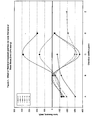
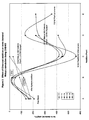
- Sample 16 and 19 each had 0.5 lb/t PSM Particol®BX added after the addition of HRB®3050. Comparing samples made with CHB405, (citric acid crosslinked fibers) with CHB505 (polyacrylic acid crosslinked fibers), Table V1, 15 and 16 vs 18 and 19, Figures 2 and 3 indicates there is a small difference in ionic demand between the two crosslinked cellulose fibers grades. The net result is no specific impact on the number of available sites for retaining binding materials. This is supported by the fact that adding the same amount of Kymene® produces the same ionic demand.
- a single or multi-ply board can be made using a 3-3.2 percent slurry consistency of a 50/50 dry weight ratio of a crosslinked fiber such as polyacrylic acid crosslinked fiber, (CHB505), and Douglas Fir fiber. Slurry consistencies from 0.05 percent to 4 percent can also be used in preparing the paperboard.
- the term "consistency" means the percent solids content of a solid and liquid mixture, for example, a two percent consistency means there are two grams of cellulose fibers in one hundred grams of fiber and liquid. Dry weight as defined herein means representative fibers are dried at 105°C+/-2°C and weighed at one hour increments until a constant weight is obtained. In practice, the moisture content of the commercial grade fibers is approximately 9 percent.
- the Douglas Fir can be refined to 500 CSF or lower prior to addition to the machine chest.
- a standard 4 mm barrier screen can be used before the headbox.
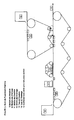
- Addition points of the various additives such as Kymene®, anionic and cationic starch are shown in Figure 4.
- the paperboard formed can have a basis weight of 200 to 500 g/m 2 with surface plies of 15- 25 percent by dry weight each of the total fiber and the center ply at 50-70 percent of the total fiber dry weight.
- a single ply paperboard is made.
- a paperboard with at least two plies is made.
- Crosslinked cellulose fiber can be in both plies or in only one.
- a paperboard can be made with three plies. The plies may all be the same, all different or there can be combination of the various plies.
- Surface plies can be formed separately from the mid-ply using conventional Fourdrinier technology with stock consistency ⁇ 0.6 percent, as shown in Figure 5.
- the mid-ply can be formed using Beloit top former directly on the bottom-ply on the Fourdrinier table. Dewatering can be accomplished by a top wire drainage unit.
- the top ply can be combined with the bottom and middle plies via a pick-up roll.
- the combined web can subsequently be processed by typical paper machine unit operations, wet pressing with conventional felted wet presses, steam can drying, size press where ⁇ 2 to 2.5 percent starch based on dry weight fiber can be applied to the web, followed by steam can drying to 6.5 percent moisture, wet calendering, dry calendering and winding.
Landscapes
- Paper (AREA)
Applications Claiming Priority (1)
| Application Number | Priority Date | Filing Date | Title |
|---|---|---|---|
| US66444005P | 2005-03-22 | 2005-03-22 |
Publications (1)
| Publication Number | Publication Date |
|---|---|
| EP1707672A2 true EP1707672A2 (de) | 2006-10-04 |
Family
ID=36681553
Family Applications (1)
| Application Number | Title | Priority Date | Filing Date |
|---|---|---|---|
| EP06251501A Withdrawn EP1707672A2 (de) | 2005-03-22 | 2006-03-21 | Verfahren zur Herstellung einer mehrlagigen Pappe |
Country Status (5)
| Country | Link |
|---|---|
| US (1) | US20060213630A1 (de) |
| EP (1) | EP1707672A2 (de) |
| JP (1) | JP2006265817A (de) |
| CN (1) | CN1837466A (de) |
| CA (1) | CA2540540A1 (de) |
Cited By (1)
| Publication number | Priority date | Publication date | Assignee | Title |
|---|---|---|---|---|
| EP1835075A1 (de) * | 2006-03-17 | 2007-09-19 | Weyerhaeuser Company | Verfahren zur Herstellung einer mehrlagigen Pappe |
Families Citing this family (9)
| Publication number | Priority date | Publication date | Assignee | Title |
|---|---|---|---|---|
| JP2007277795A (ja) * | 2006-03-14 | 2007-10-25 | Nippon Paper Industries Co Ltd | 抄紙方法および紙 |
| JP2008248398A (ja) * | 2007-03-29 | 2008-10-16 | Nippon Paper Industries Co Ltd | 紙の製造方法および紙 |
| SE535014C2 (sv) * | 2009-12-03 | 2012-03-13 | Stora Enso Oyj | En pappers eller kartongprodukt och en process för tillverkning av en pappers eller kartongprodukt |
| SE1050985A1 (sv) * | 2010-09-22 | 2012-03-23 | Stora Enso Oyj | En pappers eller kartongprodukt och en process förtillverkning av en pappers eller en kartongprodukt |
| EP3080354B1 (de) * | 2013-12-13 | 2019-08-07 | Stora Enso Oyj | Mehrlagige pappe |
| FI127348B (en) * | 2014-08-18 | 2018-04-13 | Kemira Oyj | Strength substance, its use and method for increasing strength properties of paper |
| CN104928994B (zh) * | 2015-05-25 | 2017-10-27 | 广东绿保生态科技股份有限公司 | 一种植物多纤维改性板的生产方法 |
| EP4134236A1 (de) * | 2021-08-11 | 2023-02-15 | Billerud Aktiebolag (publ) | Asymmetrische pappe |
| EP4134235A1 (de) * | 2021-08-11 | 2023-02-15 | Billerud Aktiebolag (publ) | Asymmetrische pappe |
Family Cites Families (12)
| Publication number | Priority date | Publication date | Assignee | Title |
|---|---|---|---|---|
| GB8531558D0 (en) * | 1985-12-21 | 1986-02-05 | Wiggins Teape Group Ltd | Loaded paper |
| FR2612213B1 (fr) * | 1987-03-13 | 1989-06-30 | Roquette Freres | Procede de fabrication du papier |
| ATE141357T1 (de) * | 1991-07-02 | 1996-08-15 | Eka Chemicals Ab | Verfahren zur herstellung von papier |
| JP3629034B2 (ja) * | 1994-03-25 | 2005-03-16 | ウェヤーハウザー・カンパニー | 嵩高いセルロース繊維を用いているセルロース製品 |
| WO1995026441A1 (en) * | 1994-03-25 | 1995-10-05 | Weyerhaeuser Company | Multi-ply cellulosic products using high-bulk cellulosic fibers |
| US5876563A (en) * | 1994-06-01 | 1999-03-02 | Allied Colloids Limited | Manufacture of paper |
| JPH10504859A (ja) * | 1994-08-16 | 1998-05-12 | ケミソルブ リミテッド | 基体への物質の使用に関する改良 |
| US6113741A (en) * | 1996-12-06 | 2000-09-05 | Eka Chemicals Ab | Process for the production of paper |
| US5969011A (en) * | 1997-02-05 | 1999-10-19 | Akzo Nobel Nv | Sizing of paper |
| US6918995B2 (en) * | 2000-08-07 | 2005-07-19 | Akzo Nobel N.V. | Process for the production of paper |
| US6723204B2 (en) * | 2002-04-08 | 2004-04-20 | Hercules Incorporated | Process for increasing the dry strength of paper |
| US7108765B2 (en) * | 2003-04-04 | 2006-09-19 | Weyerhaeuser Company | Method for making an insulating paperboard |
-
2006
- 2006-03-17 US US11/378,761 patent/US20060213630A1/en not_active Abandoned
- 2006-03-21 EP EP06251501A patent/EP1707672A2/de not_active Withdrawn
- 2006-03-21 CA CA002540540A patent/CA2540540A1/en not_active Abandoned
- 2006-03-22 CN CNA2006100682665A patent/CN1837466A/zh active Pending
- 2006-03-22 JP JP2006078595A patent/JP2006265817A/ja active Pending
Cited By (1)
| Publication number | Priority date | Publication date | Assignee | Title |
|---|---|---|---|---|
| EP1835075A1 (de) * | 2006-03-17 | 2007-09-19 | Weyerhaeuser Company | Verfahren zur Herstellung einer mehrlagigen Pappe |
Also Published As
| Publication number | Publication date |
|---|---|
| CN1837466A (zh) | 2006-09-27 |
| CA2540540A1 (en) | 2006-09-22 |
| JP2006265817A (ja) | 2006-10-05 |
| US20060213630A1 (en) | 2006-09-28 |
Similar Documents
| Publication | Publication Date | Title |
|---|---|---|
| EP3183388B1 (de) | Festigkeitsmittel, dessen verwendung und verfahren zur erhöhung der festigkeitseigenschaften von papier | |
| US11214927B2 (en) | Method for increasing the strength properties of a paper or board product | |
| EP3768892B1 (de) | Verfahren zur herstellung eines mehrschichtigen kartons, mehrschichtiger karton und zusammensetzung zur verwendung bei der herstellung eines mehrschichtigen kartons | |
| US20070215301A1 (en) | Method for making a low density multi-ply paperboard with high internal bond strength | |
| CA3032886A1 (en) | Dry strength composition, its use and method for making of paper, board or the like | |
| US6824649B2 (en) | Method for increasing filler retention of cellulosic fiber sheets | |
| EP1707672A2 (de) | Verfahren zur Herstellung einer mehrlagigen Pappe | |
| US10767317B2 (en) | Method and treatment system for making of paper | |
| EP4202119A1 (de) | Recycelbares papier mit hoher nassfestigkeit | |
| CA3061848C (en) | Method for increasing the strength properties of a paper or board product | |
| EP4684058A1 (de) | Verfahren zur herstellung einer mehrschichtigen platte |
Legal Events
| Date | Code | Title | Description |
|---|---|---|---|
| PUAI | Public reference made under article 153(3) epc to a published international application that has entered the european phase |
Free format text: ORIGINAL CODE: 0009012 |
|
| AK | Designated contracting states |
Kind code of ref document: A2 Designated state(s): AT BE BG CH CY CZ DE DK EE ES FI FR GB GR HU IE IS IT LI LT LU LV MC NL PL PT RO SE SI SK TR |
|
| AX | Request for extension of the european patent |
Extension state: AL BA HR MK YU |
|
| STAA | Information on the status of an ep patent application or granted ep patent |
Free format text: STATUS: THE APPLICATION IS DEEMED TO BE WITHDRAWN |
|
| 18D | Application deemed to be withdrawn |
Effective date: 20091001 |