EP1707943A2 - Integratorsystem und Verfahren zur raschen Feststellung der Wirksamkeit einer Germizidbehandlung - Google Patents
Integratorsystem und Verfahren zur raschen Feststellung der Wirksamkeit einer Germizidbehandlung Download PDFInfo
- Publication number
- EP1707943A2 EP1707943A2 EP06251723A EP06251723A EP1707943A2 EP 1707943 A2 EP1707943 A2 EP 1707943A2 EP 06251723 A EP06251723 A EP 06251723A EP 06251723 A EP06251723 A EP 06251723A EP 1707943 A2 EP1707943 A2 EP 1707943A2
- Authority
- EP
- European Patent Office
- Prior art keywords
- chemical
- color
- integrator
- substrate
- group
- Prior art date
- Legal status (The legal status is an assumption and is not a legal conclusion. Google has not performed a legal analysis and makes no representation as to the accuracy of the status listed.)
- Granted
Links
- QJYRUYURLPTHLR-UHFFFAOYSA-N NC(CCCNC(N)=N)C=O Chemical compound NC(CCCNC(N)=N)C=O QJYRUYURLPTHLR-UHFFFAOYSA-N 0.000 description 1
Images
Classifications
-
- G—PHYSICS
- G01—MEASURING; TESTING
- G01N—INVESTIGATING OR ANALYSING MATERIALS BY DETERMINING THEIR CHEMICAL OR PHYSICAL PROPERTIES
- G01N21/00—Investigating or analysing materials by the use of optical means, i.e. using sub-millimetre waves, infrared, visible or ultraviolet light
- G01N21/17—Systems in which incident light is modified in accordance with the properties of the material investigated
- G01N21/25—Colour; Spectral properties, i.e. comparison of effect of material on the light at two or more different wavelengths or wavelength bands
- G01N21/31—Investigating relative effect of material at wavelengths characteristic of specific elements or molecules, e.g. atomic absorption spectrometry
-
- B—PERFORMING OPERATIONS; TRANSPORTING
- B23—MACHINE TOOLS; METAL-WORKING NOT OTHERWISE PROVIDED FOR
- B23Q—DETAILS, COMPONENTS, OR ACCESSORIES FOR MACHINE TOOLS, e.g. ARRANGEMENTS FOR COPYING OR CONTROLLING; MACHINE TOOLS IN GENERAL CHARACTERISED BY THE CONSTRUCTION OF PARTICULAR DETAILS OR COMPONENTS; COMBINATIONS OR ASSOCIATIONS OF METAL-WORKING MACHINES, NOT DIRECTED TO A PARTICULAR RESULT
- B23Q3/00—Devices holding, supporting, or positioning work or tools, of a kind normally removable from the machine
- B23Q3/12—Devices holding, supporting, or positioning work or tools, of a kind normally removable from the machine for securing to a spindle in general
-
- A—HUMAN NECESSITIES
- A61—MEDICAL OR VETERINARY SCIENCE; HYGIENE
- A61L—METHODS OR APPARATUS FOR STERILISING MATERIALS OR OBJECTS IN GENERAL; DISINFECTION, STERILISATION OR DEODORISATION OF AIR; CHEMICAL ASPECTS OF BANDAGES, DRESSINGS, ABSORBENT PADS OR SURGICAL ARTICLES; MATERIALS FOR BANDAGES, DRESSINGS, ABSORBENT PADS OR SURGICAL ARTICLES
- A61L2/00—Disinfection or sterilisation of materials or objects, in general; Accessories therefor
- A61L2/26—Accessories
- A61L2/28—Devices for testing the effectiveness or completeness of sterilisation or disinfection, e.g. indicators which change colour
-
- B—PERFORMING OPERATIONS; TRANSPORTING
- B23—MACHINE TOOLS; METAL-WORKING NOT OTHERWISE PROVIDED FOR
- B23Q—DETAILS, COMPONENTS, OR ACCESSORIES FOR MACHINE TOOLS, e.g. ARRANGEMENTS FOR COPYING OR CONTROLLING; MACHINE TOOLS IN GENERAL CHARACTERISED BY THE CONSTRUCTION OF PARTICULAR DETAILS OR COMPONENTS; COMBINATIONS OR ASSOCIATIONS OF METAL-WORKING MACHINES, NOT DIRECTED TO A PARTICULAR RESULT
- B23Q3/00—Devices holding, supporting, or positioning work or tools, of a kind normally removable from the machine
- B23Q3/16—Devices holding, supporting, or positioning work or tools, of a kind normally removable from the machine controlled in conjunction with the operation of the tool
-
- C—CHEMISTRY; METALLURGY
- C12—BIOCHEMISTRY; BEER; SPIRITS; WINE; VINEGAR; MICROBIOLOGY; ENZYMOLOGY; MUTATION OR GENETIC ENGINEERING
- C12Q—MEASURING OR TESTING PROCESSES INVOLVING ENZYMES, NUCLEIC ACIDS OR MICROORGANISMS; COMPOSITIONS OR TEST PAPERS THEREFOR; PROCESSES OF PREPARING SUCH COMPOSITIONS; CONDITION-RESPONSIVE CONTROL IN MICROBIOLOGICAL OR ENZYMOLOGICAL PROCESSES
- C12Q1/00—Measuring or testing processes involving enzymes, nucleic acids or microorganisms; Compositions therefor; Processes of preparing such compositions
- C12Q1/02—Measuring or testing processes involving enzymes, nucleic acids or microorganisms; Compositions therefor; Processes of preparing such compositions involving viable microorganisms
- C12Q1/22—Testing for sterility conditions
-
- G—PHYSICS
- G01—MEASURING; TESTING
- G01N—INVESTIGATING OR ANALYSING MATERIALS BY DETERMINING THEIR CHEMICAL OR PHYSICAL PROPERTIES
- G01N31/00—Investigating or analysing non-biological materials by the use of the chemical methods specified in the subgroup; Apparatus specially adapted for such methods
- G01N31/22—Investigating or analysing non-biological materials by the use of the chemical methods specified in the subgroup; Apparatus specially adapted for such methods using chemical indicators
- G01N31/226—Investigating or analysing non-biological materials by the use of the chemical methods specified in the subgroup; Apparatus specially adapted for such methods using chemical indicators for investigating the degree of sterilisation
-
- Y—GENERAL TAGGING OF NEW TECHNOLOGICAL DEVELOPMENTS; GENERAL TAGGING OF CROSS-SECTIONAL TECHNOLOGIES SPANNING OVER SEVERAL SECTIONS OF THE IPC; TECHNICAL SUBJECTS COVERED BY FORMER USPC CROSS-REFERENCE ART COLLECTIONS [XRACs] AND DIGESTS
- Y10—TECHNICAL SUBJECTS COVERED BY FORMER USPC
- Y10T—TECHNICAL SUBJECTS COVERED BY FORMER US CLASSIFICATION
- Y10T436/00—Chemistry: analytical and immunological testing
- Y10T436/10—Composition for standardization, calibration, simulation, stabilization, preparation or preservation; processes of use in preparation for chemical testing
- Y10T436/101666—Particle count or volume standard or control [e.g., platelet count standards, etc.]
-
- Y—GENERAL TAGGING OF NEW TECHNOLOGICAL DEVELOPMENTS; GENERAL TAGGING OF CROSS-SECTIONAL TECHNOLOGIES SPANNING OVER SEVERAL SECTIONS OF THE IPC; TECHNICAL SUBJECTS COVERED BY FORMER USPC CROSS-REFERENCE ART COLLECTIONS [XRACs] AND DIGESTS
- Y10—TECHNICAL SUBJECTS COVERED BY FORMER USPC
- Y10T—TECHNICAL SUBJECTS COVERED BY FORMER US CLASSIFICATION
- Y10T436/00—Chemistry: analytical and immunological testing
- Y10T436/13—Tracers or tags
Definitions
- This invention relates to an integrator system and a method for rapidly determining the effectiveness of a germicidal process for medical equipment.
- Medical devices are sterilized before use in hospitals, physicians' offices, and other medical facilities. Steam, heat, ethylene oxide, and hydrogen peroxide are commonly used as sterilizing agents.
- a sterility indicator in a load of articles to be sterilized in a sterilizer.
- the sterility indicator provides a measure of whether the sterilization process was effective in sterilizing the articles in a particular load. If the sterilization process was not effective, as indicated by the sterility indicator, the load of equipment is rejected for use.
- Bio indicators are generally recognized as reliable sterility indicators.
- the biological indicator includes a carrier that has been inoculated with spores or other microorganisms. Spores are generally utilized in biological indicators, because spores are more resistant to sterilization than other microorganisms.
- the biological indicator is placed into the sterilizer with the equipment to be sterilized. At the end of the sterilization process, the biological indicator is removed from the sterilizer, and the carrier is immersed in a sterile culture medium. The culture medium and carrier are incubated for a predetermined time at an appropriate temperature. At the end of the incubation period, it is determined whether any microorganisms have grown in the growth medium. If there is no growth of microorganisms in the growth medium, it is assumed that the equipment in the sterilizer has been properly sterilized. If microorganism growth is observed, the sterilization process was not effective, and the articles in the sterilizer are rejected for use.
- the growth of microorganisms is determined through a signal such as the generation of turbidity or a color change in a pH indicator due to a pH change from byproducts of cell growth in the medium.
- Biological indicators are described, for example, in U. S. Patent Nos. 5,552,320 and 6,436,659 , both of which are incorporated herein by reference in their entirety.
- Foltz et al. (U. S. Patent No. 6,355,448 ) describe a method of determining the effectiveness of a sterilization process by using the activity of enzymes rather than spores. It is stated that the enzyme test procedure requires only a few minutes rather than the several days that are required to obtain the results from biological indicators.
- One aspect of the invention involves a method for rapidly determining the effectiveness of an oxidative germicidal process.
- the method includes providing a substrate having a known amount of a first chemical on the substrate, where the first chemical is selected from the group consisting of a primary amine, mixtures of primary amines, an aldehyde, and mixtures of aldehydes.
- the first chemical has a first color.
- the method also includes exposing the substrate and the first chemical to an oxidative germicide, thereby decreasing the known amount of the first chemical to a final amount.
- the substrate having the final amount of the first chemical having the first color is contacted with a second chemical having a second color, thereby generating a third chemical having a third color.
- the intensity of the third color is related to the final amount of the first chemical on the substrate.
- the second chemical is a chemical selected from the group consisting of a primary amine and mixtures of primary amines when the first chemical is a chemical selected from the group consisting of an aldehyde and a mixture of aldehydes.
- the second chemical is a chemical selected from the group consisting of an aldehyde and a mixture of aldehydes when the first chemical is a chemical selected from the group consisting of a primary amine and a mixture of primary amines.
- the method also includes determining the intensity of the third color and determining the effectiveness of the germicidal process from the intensity of the third color.
- the effectiveness of the germicidal process is determined by correlating the intensity of the third color with results from biological indicators.
- the oxidative germicide is a sterilant.
- the oxidative germicide is a disinfectant.
- the substrate may be an absorbent substrate.
- the substrate is a nonabsorbent substrate.
- the oxidative germicide is a liquid, a vapor, or a gas.
- the intensity of the third color is determined visually.
- the intensity of said third color is determined spectrophotometrically in the visible or ultraviolet region.
- the method also includes exposing the substrate and the oxidative germicide to plasma.
- the percent completeness of the germicidal process is determined by comparing the intensity of the third color with the intensity of the color of a standard.
- the primary amine is glycine or histidine, and the aldehyde is ortho-phthalaldehyde or glutaldehyde.
- the integrator includes a substrate with a known amount of a first chemical on the substrate, where the first chemical is selected from the group consisting of a primary amine, mixtures of primary amines, an aldehyde, and mixtures of aldehydes.
- the substrate is in an enclosure.
- the first chemical is capable of reacting with the oxidative germicide when exposed to the oxidative germicide.
- the integrator also includes a reservoir of a second chemical, where the second chemical is a chemical selected from the group consisting of a primary amine and mixtures of primary amines when the first chemical is a chemical selected from the group consisting of an aldehyde and a mixture of aldehydes, and the second chemical is a chemical selected from the group consisting of an aldehyde and a mixture of aldehydes when the first chemical is a chemical selected from the group consisting of a primary amine and a mixture of primary amines.
- the second chemical is capable of reacting with the first chemical to form a third chemical having a color.
- the reservoir has a breakable barrier that isolates the second chemical from the first chemical and from the oxidative germicide during the contacting of the first chemical with the oxidative germicide. Breaking the breakable barrier in the reservoir contacts the second chemical with the first chemical, thereby forming the third chemical having the color.
- the reservoir is in the enclosure.
- the breakable barrier in the reservoir includes a frangible ampoule in the enclosure.
- the integrator also includes a second barrier, where the second barrier is inside the enclosure between the frangible ampoule and the first chemical.
- the second barrier in the enclosure is permeable to the second chemical. The second barrier prevents fragments from the frangible ampoule from contacting the first chemical.
- the integrator also includes a window in the enclosure, where the window is permeable to the oxidative germicide.
- the window allows the oxidative germicide to enter the enclosure.
- the primary amine is selected from the group consisting of glycine and histidine
- the aldehyde is selected from the group consisting of ortho-phthalaldehyde and glutaldehyde.
- the enclosure on the integrator also includes a transparent window, where the color change on the substrate can be observed through the transparent window visually or with a spectrophotometer.
- germicide as used herein is meant to include both sterilants and disinfectants.
- germicidal process as used herein includes both sterilization processes and disinfection processes.
- Sterilization indicators that utilize chemicals to mimic the resistance of a biological indicator (BI) have been termed as integrators.
- Integrators utilize an indicator chemical that responds to the germicide that is used in the germicidal process. The chemical reacts with the germicide in a repeatable manner and responds to the factors that are important to sterilization or disinfection in the germicidal process. The reaction of the indicator chemical with the germicide is integrated over time, and the amount of indicator chemical remaining on the integrator is correlated with the BI response.
- Integrators integrate the reaction of the chemical over time in response to the critical parameters over a specified range of sterilization cycles.
- the integrators and the method according to embodiments of the present invention provide results quickly, reproducibly, and accurately.
- the chemicals that are used in the integrators are inexpensive and stable.
- the results that are obtained from the integrators and the method according to embodiments of the present invention correlate well with the results from biological indicator tests.
- the integrator according to embodiments of the present invention is meant to mimic the resistance of a biological indicator (BI) without using spores.
- the integrator according to an embodiment of the present invention includes an indicator chemical that reacts with an oxidative germicide.
- the integrator is suitable for oxidative germicides including hydrogen peroxide, peracetic acid, ethylene oxide, ozone, and chlorine dioxide.
- the oxidative germicides may be in the form of a liquid, a vapor, or a gas.
- plasma may be utilized in combination with the oxidative germicides to enhance the reaction of the oxidative germicides with the microorganisms in the chamber and the indicator chemical on the integrator and/or to break down the oxidative germicide after use.
- the use of plasma is optional.
- results from the integrator according to embodiments of the present invention are available quickly, approximately 30 seconds to approximately 5-6 minutes, depending on the chemicals selected for the integrators, compared to the 24-48 hours that are normally required to obtain results from a biological indicator.
- the integrator may be used with a variety of germicidal processes.
- the description of germicidal processes such as sterilization or disinfection with hydrogen peroxide and plasma through the STERRAD® process is illustrative only and is not meant to be limiting.
- the integrator contains an indicator chemical.
- the indicator chemical reacts with the germicide and responds to the factors that are important for sterilization.
- the amount of indicator chemical that remains on the integrator after exposure to the germicide can be correlated with the response of BI's that are placed into the sterilization chamber together with the integrator.
- the response of a BI is a generally accepted measure of the effectiveness of a germicidal process.
- the response of a BI in the sterilization chamber can be correlated with response of the integrators to "calibrate" the response of the integrators with the response of a biological indicator.
- primary amines or aldehydes are used as indicator chemicals in integrators according to embodiments of the present invention.
- Oxidative germicides react with both primary amines and aldehydes.
- Both primary amines and aldehydes are suitable indicator chemicals for integrators according to embodiments of the present invention.
- the amount of the primary amine indicator chemical or the aldehyde indicator chemical that remains on the integrator after the germicide process can be used to determine the effectiveness of the sterilization or disinfection process for the load that is treated in the sterilizer.
- the amount of primary amine indicator chemical or aldehyde indicator chemical that remains on the integrator can be measured in a variety of ways such as instrumental methods, chemical analysis, etc. Any suitable method of measuring the concentration of the primary amine indicator chemical or the aldehyde indicator chemical is suitable.
- the completeness of the germicidal process may be conveniently determined by observing a change in color in the integrator.
- the amount of primary amine indicator chemical or the amount of aldehyde indicator chemical remaining on the integrator after exposure to the oxidative germicide can be determined from the intensity of the color of the product of the reaction of an aldehyde with a primary amine.
- an aldehyde that is contacted with a primary amine indicator chemical or a primary amine that is contacted with an aldehyde indicator chemical is termed a "dye precursor", because the product of the reaction of a primary amine with an aldehyde is colored, a "dye", even if neither the primary amine nor the aldehyde has a color.
- the primary amine and the aldehyde can change roles, depending on which chemical is utilized as the indicator chemical in the integrator.
- the dye precursor is an aldehyde.
- the dye precursor is a primary amine.
- the intensity of the color of the colored product resulting from the reaction of the primary amine with the aldehyde can be used to determine the effectiveness of the treatment of the load with the oxidative germicide.
- an integrator contains a first chemical having a first color, where the first chemical is an indicator chemical.
- the indicator chemical is selected from the group consisting of a primary amine, a mixture of primary amines, an aldehyde, and a mixture of aldehydes.
- the integrator containing the indicator chemical is placed into a sterilizer with a load of equipment that is to be treated.
- the load and integrator are contacted with an oxidative germicide in a sterilizer.
- the oxidative germicide reacts with the indicator chemical, decreasing the amount of indicator chemical remaining on the integrator.
- the amount of indicator chemical remaining on the integrator after the contacting with the oxidative germicide is a measure of the effectiveness of the germicidal treatment with the oxidative germicide.
- the integrator containing the first chemical having the first color is contacted with a second chemical having a second color.
- the first chemical having the first color is the indicator chemical.
- the second chemical having the second color is the dye precursor.
- the dye precursor is a chemical selected from the group consisting of a primary amine, a mixture of primary amines, an aldehyde, and a mixture of aldehydes. Primary amines may not be mixed with aldehydes to form the dye precursor.
- the second chemical, the dye precursor is an aldehyde or a mixture of aldehydes.
- the first chemical, the indicator chemical is an aldehyde or a mixture of aldehydes
- the second chemical, the dye precursor is a primary amine or a mixture of primary amines.
- the product from the reaction of the first chemical, the indicator chemical, with the second chemical, the dye precursor, is a third chemical having a third color.
- the intensity of the third color of the third chemical resulting from the reaction of the first chemical with the second chemical can be used to determine how much of the first chemical, the indicator chemical, remains on the integrator.
- the amount of the first chemical indicator chemical that remains on the integrator is a measure of how effective the treatment with the oxidative germicide was. If only a small amount of the first chemical indicator chemical remains on the integrator, the intensity of the third color due to the third chemical is low. A low intensity of the third color is an indication that the treatment with the oxidative germicide was effective.
- the degree of completeness of the treatment with the oxidative germicide can be determined from the intensity of the third color due to the third chemical, the product of the reaction of the first chemical indicator compound with the second chemical dye precursor.
- the indicator compound on the integrator, the first compound reacts with the oxidative germicide in parallel with the germicidal treatment of the load in the sterilization chamber.
- the intensity of the third color due to the third chemical resulting from the reaction of the first chemical indicator chemical with the second chemical dye precursor decreases as the amount of the indicator chemical decreases due to the reaction with the oxidative germicide.
- the intensity of the third color can be correlated with results from biological indicators that are placed into the sterilization chamber together with the indicators.
- the intensity of the third color can be correlated with the percent sterilization or percent disinfection, as determined from biological indicators. The percent sterilization or disinfection can therefore be determined from the intensity of the third color due to the third compound.
- the first chemical, the indicator chemical is placed on a substrate for ease of handling.
- the substrate can be a variety of materials.
- the substrate can be an absorbing substrate or a nonabsorbing substrate. Absorbing substrates absorb the germicide. Nonabsorbing substrates absorb little or none of the germicide.
- Filter paper is an absorbing substrate, because filter paper absorbs the germicide.
- a glass filter disk is a nonabsorbing substrate, because the glass filter disk does not absorb significant quantities of the germicide and is thus preferred.
- the indicator chemical can be packaged in a water-soluble binder such as an acrylic polymer or carboxymethylcellulose.
- a water-soluble binder such as an acrylic polymer or carboxymethylcellulose.
- the indicator chemical and water-soluble binder can be applied to the surface of the integrator or sterility indicator by, for example, ink jet printing a solution of the indicator chemical and the water-soluble binder onto the surface of an inert backing material.
- Absorbing substrates absorb germicide during the germicidal process.
- the absorbed germicide on the absorbing substrate can react with the dye precursor.
- Oxidative germicides generally react with primary amines and aldehydes, the two forms of dye precursor. It is therefore generally advantageous to use excess second chemical primary amine or aldehyde dye precursor when the substrate is an absorbing substrate, because the absorbed germicide reacts with the dye precursor when the dye precursor is contacted with the absorbing substrate.
- the integrator containing the indicator chemical is placed in the sterilizer with the equipment to be sterilized and is exposed to the germicide.
- the indicator chemical reacts with the germicide, reducing the initial concentration of the indicator chemical from an initial value to a final value.
- the integrator containing the first chemical indicator chemical is exposed to the second chemical dye precursor. If any indicator chemical is still present, contacting the indicator chemical with the dye precursor forms the third compound having the third color. If significant color develops on the integrator, the germicidal cycle is judged to have not been effective.
- the second chemical dye precursor be contacted with the integrator after the conclusion of the cycle, because the dye precursor reacts with the germicide. If the dye precursor is contacted with the integrator before the conclusion of the cycle, the germicide will react with the second chemical dye precursor, and it may be necessary to add dye precursor to provide sufficient dye precursor to cause a color change from the reaction of the second chemical dye precursor with the first chemical indicator chemical, forming the third chemical having the third color.
- the second chemical dye precursor is therefore generally contacted with the integrator at the end of the cycle. In an embodiment, the cycle may be a canceled cycle.
- the second chemical is isolated from the germicide until the conclusion of the cycle. Isolating the second chemical dye precursor from the germicide protects the second chemical from reacting with the germicide and being destroyed.
- the color change from the reaction of the first chemical indicator chemical with the second chemical dye precursor to form the third chemical having the third color can be determined visually. Because a visual change is somewhat subjective, the color change is generally determined with an optical detector.
- the optical detector for the color change resulting from the reaction of the first chemical indicator chemical with the second chemical dye precursor can operate at visible or ultraviolet wavelengths.
- the primary amine may be any suitable primary amine.
- the primary amine is an amino acid.
- the primary amine is selected from the group consisting of arginine, histidine, and combinations thereof.
- Other suitable primary amines include the following amino acids: alanine, proline, amino-caproic acid, phenylalanine, tryptophan, methionine, glycine, serine, cysteine, tyrosine, glutamine, aspartic acid, glutamic acid, lysine, arginine, and histidine.
- Peptides or polypeptides formed from any number or type or amino acids are also suitable primary amines.
- Arginine is an exemplary primary amine indicator chemical. Arginine gives a strong, rapid color change when exposed to aldehydes. Arginine also reacts rapidly with germicides. Arginine is a water-soluble solid that is conveniently weighed, dissolved in a solvent, and applied to the substrate or other support. Other primary amines can be used in other embodiments, as will become clear in the description and the Examples below.
- Arginine has structure I, below.
- the NH 2 groups are primary amine groups.
- the NH groups are secondary amine groups. Aldehydes often do not react with secondary amine groups.
- the aldehyde may be any aldehyde that reacts with primary amines but not secondary or tertiary amines to produce a color.
- Aldehydes such as OPA (ortho-phthalaldehyde), glutaldehyde, and aromatic aldehydes are suitable. Other aldehydes are also suitable.
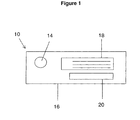
- FIG 1 shows a diagram of an integrator system 10 according to an embodiment of the present invention.
- the integrator system 10 of Figure 1 includes integrator chemistry 14 located on integrator strip 16, where the integrator strip 16 is an inert material for supporting the integrator chemistry 14.
- the integrator strip 16 is generally made of a material that does not react with or adsorb the germicide.
- the integrator chemistry 14 includes a first chemical, the indicator chemical.
- the integrator strip 16 is a substrate for the integrator chemistry 14.
- Peel off label 18 is optionally located on the integrator strip 16. Information on the sterilization cycle can be written on the peel off label 18, and the peel off label 18 with the information on the sterilization cycle can be placed into a sterilization logbook.
- Chemical indicator strip 20 contains a chemical that undergoes a color change when exposed to the germicide. A color change in chemical indicator strip 20 simply shows that the chemical indicator strip 20 has been exposed to the germicide. The chemical indicator strip 20 is not an indicator of the effectiveness of sterilization but is simply an indicator as to whether the chemical indicator strip 20 has been exposed to germicide.
- the color change on the chemical indicator strip 20 shows the operator that the integrator system 10 should not be used again.
- Bordeaux Red changes color when exposed to hydrogen peroxide.
- Other dyes can be used on the chemical indicator strip 20 to indicate exposure to other germicides. Suitable dyes are described, for example, in U. S. Patent No. 5,942,438 , which is incorporated herein by reference in its entirety.
- the integrator chemistry 14 portion of the integrator strip 16 is exposed to the second chemical, the dye precursor.
- the second chemical dye precursor reacts with the first chemical indicator chemical on the integrator chemistry 14 to form the third chemical having the third color.
- the presence of a significant amount of color on the integrator chemistry 14 on integrator strip 16 after exposure of the integrator chemistry 14 to the second chemical dye precursor indicates that the cycle was not effective.
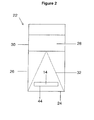
- FIG. 2 shows a compressible integrator system 22.
- Compressible integrator system 22 of Figure 2 includes integrator chemistry 14 on substrate 44 located in container 26. Gas permeable surface 24 allows the germicide to enter container 26 and contact the integrator chemistry 14.
- the dye precursor 28 is contained in reservoir 30.
- Supports 32 are located adjacent to reservoir 30.
- Reservoir 30 protects the dye precursor from being destroyed by reacting with the oxidative germicide during the germicidal cycle.
- compressible integrator system 22 is crushed or squeezed. Supports 32 pierce the reservoir 30, and the second chemical dye precursor 28 that was contained in the reservoir 30 contacts the integrator chemistry 14.
- the second chemical dye precursor reacts with any first chemical indicator chemical that remains after the cycle. If any first chemical indicator chemical remains on the substrate 44, the first chemical indicator chemical in the integrator chemistry 14 reacts with the second chemical dye precursor to form the third chemical having the third color on the substrate 44, indicating that the germicidal process was incomplete. A lack of color on the integrator chemistry 14 indicates that the germicidal treatment was successful.
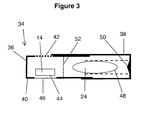
- FIG. 3 shows a schematic diagram of a slidable integrator system 34.
- Slidable integrator system 34 includes closable sliding container 36.
- the closable sliding container 36 is formed of outer shell 38 and inner shell 40.
- Outer shell 38 slides over inner shell 40.
- Sliding outer shell 38 over inner shell 40 opens window 42 in closable sliding container 36.
- Window 42 allows germicide to enter the interior of closable sliding container 36.
- the germicide may be a liquid, a vapor, or a gas.
- the closable sliding container 36 contains substrate 44 supporting integrator chemistry 14.
- the integrator chemistry 14 includes the first chemical, the indicator chemical.
- Substrate 44 is located adjacent transparent window 46 on inner shell 40. Any color change in the substrate 44 can be observed through transparent window 46.
- Substrate 44 is the substrate for the indicator chemistry 14.
- the indicator chemistry 14 includes the first chemical, the indicator chemical.
- substrate 44 is a glass filter, a nonabsorbing substrate.
- the second chemical, the dye precursor 24, is contained in crushable ampoule 48 inside closable sliding container 36.
- Crushable ampoule 48 is made of a frangible material such as glass. Crushable ampoule 48 protects the second chemical, the dye precursor 24, from being destroyed by the germicide during the germicidal process.
- Wedge 50 is attached to an inside of outer shell 38 of the closable sliding container 36.
- Wedge 50 is a projection on the inside of the outer shell 38.
- wedge 50 has a sharp edge to aid in penetrating the crushable ampoule 48.
- Barrier 52 is located inside closable sliding container 34 between crushable ampoule 48 and substrate 44. Barrier 52 prevents fragments of crushable ampoule 48 from interfering with the reading of substrate 44.
- Barrier 52 is permeable to the second chemical, the dye precursor 24. When crushable ampoule 48 is crushed, the second chemical, the dye precursor, is released and can flow through barrier 52 to contact the first chemical indicator chemical on substrate 44.
- barrier 52 is a wire screen.
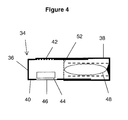
- Figure 4 shows a schematic diagram of the slidable integrator system 34 and closable sliding container 36 of Figure 3 after the conclusion of the cycle.
- the outer shell 38 of the closable sliding container 36 in Figure 4 has been moved toward the left of Figure 4 by sliding outer shell 38 over inner shell 40.
- Sliding outer shell 38 over inner shell 40 has several effects, as shown in Figure 4.
- the second chemical dye precursor 24 that is released flows though barrier 52 and contacts the substrate 44.
- the second chemical dye precursor 24 reacts with the first chemical indicator chemical in the integrator chemistry 14 to form the third chemical having a third color.
- the third color is distinctive and readily distinguished from the first color of the first chemical and the second color of the second chemical.
- Barrier 52 prevents fragments of the crushable ampoule 48 from contacting the substrate 44 and interfering with the determination. The color change on the substrate 44 can be observed through transparent window 46.
- the integrator according to an embodiment of the present invention is placed into the sterilization chamber with the load that is to be sterilized, and the germicidal cycle is run. After the completion of the sterilization cycle, the second chemical dye precursor is contacted with the integrator. The second chemical, the dye precursor, reacts with any first chemical indicator chemical remaining on the integrator to produce the third chemical having the third color.
- the color that is produced depends on the structure of the first chemical indicator chemical and the second chemical dye precursor.
- the intensity of the color depends on the amount of first chemical indicator chemical that remains on the integrator and on the concentration of the second chemical dye precursor.
- the sterilization cycle is judged to have been ineffective.
- the intensity of the color on the integrator may be judged visually by comparing to a color standard, or the intensity of the color may be measured spectrophotometrically in the visible or ultraviolet region. Judging the color intensity visually is more subjective than measuring the color intensity with an instrument.
- the second chemical dye precursor may be contacted with the integrator in various manners.
- the second chemical dye precursor is contacted with the integrator manually using a pipette, an eyedropper, or other suitable device.
- Figures 2 and 3 show embodiments of integrators where the second chemical dye precursor is present in the integrator during the sterilization cycle but is protected from exposure to the germicide by being enclosed in a reservoir or a crushable ampoule. Other means of protecting the second chemical dye precursor from being exposed to the germicide may be used in other embodiments.
- a series of integrators was prepared by contacting paper disks with an aqueous solution of arginine.
- the integrators were placed in a STERRAD® 50 sterilizer with a load of equipment to be sterilized and several biological indicators.
- the paper disks are absorbing substrates.
- the sterilizer was evacuated to 0.8 torr. Plasma was produced in the chamber for 15 minutes to condition the load. The sterilizer was evacuated further to 0.4 torr, and hydrogen peroxide was injected and contacted with the load, integrators, and biological indicators for 6 minutes.
- the sterilizer was vented with air for 2 minutes.
- the sterilizer was evacuated again to 0.5 torr, and plasma was produced for an additional 2 minutes.
- the plasma power was 400 watts for both plasma exposures.
- the cycles with 100 and 250 ⁇ L of hydrogen peroxide were ineffective, as shown by the positive biological indicator results.
- the integrator results were consistent with the biological indicator results, because the integrators for the cycles with 100 and 250 ⁇ L of hydrogen peroxide had significant color within 3-6 minutes after being contacted with the OPA.
- the color is the result of a reaction between unreacted arginine, the primary amine indicator compound, and OPA, the aldehyde dye precursor.
- the data from the integrators according to an embodiment of the present invention were consistent with the data from the biological indicators. However, the results from the integrators were available in 5-6 minutes, compared to 24-48 hours for the biological indicator results.
- Non adsorbent glass fiber disks were impregnated with an aqueous solution of arginine.
- the glass fiber disks are nonabsorbing substrates.
- the disks were placed in a STERRAD® 50 sterilizer and processed under the same conditions as in Example 1 with varying injection volumes of hydrogen peroxide.
- the quantities of hydrogen peroxide are shown in Table 2 below.
- the glass fiber disks were contacted with 50 ⁇ L of a 5% aqueous solution of OPA dye precursor after the cycle was complete.
- the intensity of light absorption of the disks was determined with a TAOS TCS230EVM evaluation module color sensor (Parallax, Rocklin, California) at approximately 470 nm, approximately 550 nm, and approximately 610 nm (red, green, and blue wavelengths).
- the integrator response range of 58-85 for the samples that were exposed to 50 ⁇ L of hydrogen peroxide indicates significant color, showing ineffective sterilization.
- Example 2 demonstrate that the results from the integrators according to embodiments of the present invention can be measured effectively with a spectrophotometer rather than visually, as in Example 1.
- Histidine rather than arginine was used as the primary amine indicator chemical to form a series of integrators in Example 3.
- An aqueous solution of histidine was placed on a series of glass fiber disks to form integrators according to an alternative embodiment of the present invention.
- the integrators were placed into a standard STERRAD® 50 validation load, and cycles were run as described in Examples 1 and 2.
- the light absorption results were consistent with the treatment with 0 ⁇ L of hydrogen peroxide being ineffective at sterilization and the treatment with 300 ⁇ L of hydrogen peroxide being effective at sterilization.
- the example demonstrates that histidine can be used as a primary amine indicator compound in place of arginine.
- a wide variety of primary amines can be used as primary amine indicator compounds.
- Example 4 The results of Example 4 are a demonstration that glutaraldehyde can be used as an aldehyde dye precursor in place of OPA
- a series of integrators are prepared with OPA as the indicator chemical.
- the indicators are placed into a sterilizer with a load to be sterilized and a series of biological indicators.
- the load, biological indicators, and integrators are contacted with 100-500 ⁇ L of hydrogen peroxide under the conditions described in Example 1.
- the integrators with OPA as the indicator chemical are contacted with an aqueous solution of arginine as the dye precursor.
- the results from the integrators with OPA as an aldehyde indicator chemical and arginine as a primary amine dye precursor correlate well with the results from the biological indicators.
- Example 5 demonstrate that aldehydes such as OPA can be used as the indicator chemical with primary amines such as arginine as the dye precursor.
- the integrator according to embodiments of the present invention allows the effectiveness of the sterilization process to be determined rapidly.
Landscapes
- Life Sciences & Earth Sciences (AREA)
- Health & Medical Sciences (AREA)
- Chemical & Material Sciences (AREA)
- Physics & Mathematics (AREA)
- General Health & Medical Sciences (AREA)
- Organic Chemistry (AREA)
- Engineering & Computer Science (AREA)
- Immunology (AREA)
- Analytical Chemistry (AREA)
- Biochemistry (AREA)
- Spectroscopy & Molecular Physics (AREA)
- Wood Science & Technology (AREA)
- Molecular Biology (AREA)
- Pathology (AREA)
- Biophysics (AREA)
- Epidemiology (AREA)
- Public Health (AREA)
- Proteomics, Peptides & Aminoacids (AREA)
- Zoology (AREA)
- General Physics & Mathematics (AREA)
- Mechanical Engineering (AREA)
- Microbiology (AREA)
- Biotechnology (AREA)
- Bioinformatics & Cheminformatics (AREA)
- General Engineering & Computer Science (AREA)
- Genetics & Genomics (AREA)
- Animal Behavior & Ethology (AREA)
- Veterinary Medicine (AREA)
- Apparatus For Disinfection Or Sterilisation (AREA)
- Investigating Or Analyzing Non-Biological Materials By The Use Of Chemical Means (AREA)
- Investigating Or Analysing Materials By The Use Of Chemical Reactions (AREA)
Priority Applications (1)
| Application Number | Priority Date | Filing Date | Title |
|---|---|---|---|
| PL06251723T PL1707943T3 (pl) | 2005-03-30 | 2006-03-29 | Układ integratora i sposób szybkiego określania skuteczności procesu bakteriobójczego |
Applications Claiming Priority (1)
| Application Number | Priority Date | Filing Date | Title |
|---|---|---|---|
| US11/093,529 US20060228801A1 (en) | 2005-03-30 | 2005-03-30 | Integator system and method for rapidly determining effectiveness of a germicidal treatment |
Publications (3)
| Publication Number | Publication Date |
|---|---|
| EP1707943A2 true EP1707943A2 (de) | 2006-10-04 |
| EP1707943A3 EP1707943A3 (de) | 2007-11-21 |
| EP1707943B1 EP1707943B1 (de) | 2011-10-12 |
Family
ID=36603396
Family Applications (1)
| Application Number | Title | Priority Date | Filing Date |
|---|---|---|---|
| EP06251723A Expired - Lifetime EP1707943B1 (de) | 2005-03-30 | 2006-03-29 | Integratorsystem und Verfahren zur raschen Feststellung der Wirksamkeit einer Germizidbehandlung |
Country Status (15)
| Country | Link |
|---|---|
| US (2) | US20060228801A1 (de) |
| EP (1) | EP1707943B1 (de) |
| JP (1) | JP4668108B2 (de) |
| KR (1) | KR101190526B1 (de) |
| CN (1) | CN1853734B (de) |
| AR (1) | AR055760A1 (de) |
| AT (1) | ATE528638T1 (de) |
| AU (1) | AU2006201247B2 (de) |
| BR (1) | BRPI0601129B1 (de) |
| CA (1) | CA2541490C (de) |
| CO (1) | CO5770103A1 (de) |
| ES (1) | ES2372612T3 (de) |
| PL (1) | PL1707943T3 (de) |
| RU (1) | RU2425693C2 (de) |
| TW (1) | TWI446935B (de) |
Cited By (5)
| Publication number | Priority date | Publication date | Assignee | Title |
|---|---|---|---|---|
| WO2008130802A1 (en) * | 2007-04-19 | 2008-10-30 | American Sterilizer Company | Process challenge device for assessing the effective performance of a biocontamination deactivation process |
| CN106970078A (zh) * | 2017-05-15 | 2017-07-21 | 北京长江脉医药科技有限责任公司 | 一种检测邻苯二甲醛的试纸及其制备和检测方法 |
| WO2017192305A1 (en) * | 2016-05-05 | 2017-11-09 | 3M Innovative Properties Company | Method of disinfecting a medical device |
| EP3305331A1 (de) * | 2016-09-13 | 2018-04-11 | Brandes Innovation Inh. Ronald Brandes | Verfahren zum überprüfen zumindest eines desinfektionsmittels |
| GB2597069A (en) * | 2020-07-13 | 2022-01-19 | Tristel Plc | Disinfectant system |
Families Citing this family (32)
| Publication number | Priority date | Publication date | Assignee | Title |
|---|---|---|---|---|
| US20060228801A1 (en) * | 2005-03-30 | 2006-10-12 | Ben Fryer | Integator system and method for rapidly determining effectiveness of a germicidal treatment |
| US7850925B2 (en) * | 2007-06-15 | 2010-12-14 | American Sterilizer Company | Apparatus for removal of vaporized hydrogen peroxide from a region |
| WO2009036303A1 (en) * | 2007-09-12 | 2009-03-19 | David Spenciner | Finite and multiple sterilization indication method for devices |
| USD608455S1 (en) | 2008-09-30 | 2010-01-19 | American Sterilizer Company | Self-contained biological indicator |
| US8173388B2 (en) * | 2008-09-30 | 2012-05-08 | American Sterilizer Company | Self-contained biological indicator |
| EP2347007A2 (de) * | 2008-10-17 | 2011-07-27 | 3M Innovative Properties Company | Biologischer sterilisationsindikator, system und verfahren zur verwendung davon |
| US20110211991A1 (en) * | 2008-11-06 | 2011-09-01 | Foltz William E | Process challenge device and method |
| US12065698B2 (en) | 2009-10-02 | 2024-08-20 | Thermo Fisher Scientific Baltics Uab | Sample processing apparatus and method |
| FI20096013A7 (fi) | 2009-10-02 | 2011-04-03 | Finnzymes Oy | Menetelmä reaktioseoksen valmistelemiseksi ja tähän liittyvät tuotteet |
| WO2013129473A1 (ja) | 2012-02-29 | 2013-09-06 | 日油技研工業株式会社 | 過酸化物検知インジケータ |
| JP5842941B2 (ja) * | 2014-01-10 | 2016-01-13 | キヤノンマーケティングジャパン株式会社 | 滅菌装置。 |
| AT515571B1 (de) * | 2014-03-26 | 2018-01-15 | Thonhauser Gmbh | Verfahren zum Reinigen von Anlagen |
| CA2998327A1 (en) | 2015-09-11 | 2017-03-16 | Stryker Corporation | Sterilization enclosure for surgical instruments |
| EP3408405B1 (de) * | 2016-01-25 | 2020-06-17 | American Sterilizer Company | Kondensator zum nachweis lebensfähiger mikroorganismen |
| US10907126B2 (en) | 2016-03-01 | 2021-02-02 | Asp Global Manufacturing Gmbh | Self-contained biological indicator |
| WO2018125798A1 (en) * | 2016-12-28 | 2018-07-05 | 3M Innovative Properties Company | Article and methods to determine efficacy of disinfection process |
| US11242505B2 (en) * | 2017-01-03 | 2022-02-08 | Asp Global Manufacturing Gmbh | Self-contained biological indicator |
| US11053534B2 (en) | 2017-06-30 | 2021-07-06 | Asp Global Manufacturing Gmbh | Systems and methods for confirming activation of biological indicators |
| US11248250B2 (en) | 2017-12-01 | 2022-02-15 | Asp Global Manufacturing Gmb | Self-contained biological indicator |
| CA3107135A1 (en) * | 2018-08-03 | 2020-02-06 | X2O Corp. | Universal marker for water quality assessment |
| CN113164637B (zh) * | 2018-11-12 | 2023-03-03 | Gke德国有限责任公司 | 在过程挑战装置中使用的渐缩指示物 |
| CA3118386A1 (en) * | 2019-03-14 | 2020-09-17 | Miura Co., Ltd. | Sterilizing method and sterilizer |
| WO2020217093A1 (en) | 2019-04-26 | 2020-10-29 | 3M Innovative Properties Company | Process and device for generating a moving front within a sterilization monitoring device and uses thereof |
| AU2020350213A1 (en) | 2019-09-20 | 2022-03-31 | Asp Global Manufacturing Gmbh | Biological indicator for use with a liquid sterilant |
| CA3197939A1 (en) | 2020-11-10 | 2022-05-19 | Nick N. Nguyen | Ampoule breaker for a biological indicator |
| US11603551B2 (en) | 2020-12-02 | 2023-03-14 | Steritec Products Mfg. Co., Inc. | Biological indicators, and systems and methods for determining efficacy of sterilization |
| CN114225079B (zh) * | 2021-12-31 | 2023-05-26 | 老肯医疗科技股份有限公司 | 一种用于量化过氧化氢低温等离子灭菌器灭菌效果的装置 |
| KR102792181B1 (ko) | 2022-08-04 | 2025-04-10 | 주식회사 챔버 | 생물학적 인디케이트 앰플 장치 |
| KR102792190B1 (ko) | 2022-08-04 | 2025-04-10 | 주식회사 챔버 | 생물학적 인디케이트 앰플 장치 |
| KR102792197B1 (ko) | 2022-08-04 | 2025-04-10 | 주식회사 챔버 | 생물학적 인디케이트 앰플 장치 |
| CN115814136A (zh) * | 2022-12-28 | 2023-03-21 | 深圳市金派医疗包装灭菌服务有限公司 | 一种监测环氧乙烷灭菌的指示物抗力仪及方法 |
| JP7466163B1 (ja) | 2023-04-06 | 2024-04-12 | 株式会社ガステック | インジケータ及び濃度測定システム |
Family Cites Families (18)
| Publication number | Priority date | Publication date | Assignee | Title |
|---|---|---|---|---|
| CA1144849A (en) * | 1979-10-24 | 1983-04-19 | Brown (Albert) Limited | Sterilisation indicators |
| US4471055A (en) * | 1982-03-26 | 1984-09-11 | Minnesota Mining And Manufacturing Company | Process and kit for determining concentrations of aldehydes |
| US4521376A (en) * | 1983-06-13 | 1985-06-04 | Info-Chem Inc. | Glutaraldehyde indicator |
| US5096813A (en) * | 1988-07-18 | 1992-03-17 | Massachusetts Institute Of Technology | Visual indicator system |
| US5486459A (en) * | 1989-12-14 | 1996-01-23 | Medical College Of Ohio | Biologically relevant methods for the rapid determination of sterility |
| AU687819B2 (en) * | 1993-08-09 | 1998-03-05 | Johnson & Johnson Medical, Inc. | Self-contained biological indicator |
| JP3355584B2 (ja) * | 1993-08-11 | 2002-12-09 | 日油技研工業株式会社 | ホルムアルデヒド殺菌検知用インジケータ組成物およびインジケータインク |
| US5990199A (en) * | 1995-04-19 | 1999-11-23 | North American Science Associates, Inc. | Indicator ink compositions |
| US6394111B1 (en) * | 1997-06-11 | 2002-05-28 | Ethicon, Inc. | Detection of cleanliness of a medical device during a washing process |
| US5942438A (en) * | 1997-11-07 | 1999-08-24 | Johnson & Johnson Medical, Inc. | Chemical indicator for oxidation-type sterilization processes using bleachable dyes |
| US6355448B1 (en) * | 1998-06-02 | 2002-03-12 | 3M Innovative Properties Company | Sterilization indicator with chemically stabilized enzyme |
| US6528277B1 (en) * | 1999-11-22 | 2003-03-04 | 3M Innovative Properties Company | Indicator systems for determination of sterilization |
| EP1281080A4 (de) * | 2000-05-08 | 2006-03-22 | Jp Lab Inc | Die farbe ändernder dampfsterilisationsindikator |
| JP3418937B2 (ja) * | 2000-06-29 | 2003-06-23 | 株式会社ホギメディカル | プラズマ滅菌用インジケーター |
| US6436659B1 (en) * | 2000-10-27 | 2002-08-20 | Ethicon, Inc. | Biological indicator for sterilization processes with double buffer system |
| US20030054562A1 (en) * | 2001-03-16 | 2003-03-20 | Peter Zhu | Method and apparatus for rapidly assaying aldehyde-containing disinfectant |
| CN1639575A (zh) * | 2001-10-05 | 2005-07-13 | 斯特里斯公司 | 用于抗朊病毒活性的体外模型 |
| US20060228801A1 (en) * | 2005-03-30 | 2006-10-12 | Ben Fryer | Integator system and method for rapidly determining effectiveness of a germicidal treatment |
-
2005
- 2005-03-30 US US11/093,529 patent/US20060228801A1/en not_active Abandoned
-
2006
- 2006-03-27 AU AU2006201247A patent/AU2006201247B2/en not_active Ceased
- 2006-03-29 PL PL06251723T patent/PL1707943T3/pl unknown
- 2006-03-29 AT AT06251723T patent/ATE528638T1/de not_active IP Right Cessation
- 2006-03-29 TW TW095110824A patent/TWI446935B/zh not_active IP Right Cessation
- 2006-03-29 BR BRPI0601129A patent/BRPI0601129B1/pt not_active IP Right Cessation
- 2006-03-29 JP JP2006091805A patent/JP4668108B2/ja not_active Expired - Fee Related
- 2006-03-29 ES ES06251723T patent/ES2372612T3/es not_active Expired - Lifetime
- 2006-03-29 RU RU2006110110/15A patent/RU2425693C2/ru not_active IP Right Cessation
- 2006-03-29 EP EP06251723A patent/EP1707943B1/de not_active Expired - Lifetime
- 2006-03-29 CA CA2541490A patent/CA2541490C/en not_active Expired - Fee Related
- 2006-03-30 KR KR1020060029035A patent/KR101190526B1/ko not_active Expired - Fee Related
- 2006-03-30 CN CN2006100794355A patent/CN1853734B/zh not_active Expired - Fee Related
- 2006-03-30 AR ARP060101260A patent/AR055760A1/es not_active Application Discontinuation
- 2006-03-30 CO CO06031464A patent/CO5770103A1/es not_active Application Discontinuation
- 2006-09-26 US US11/527,273 patent/US8343768B2/en active Active
Cited By (9)
| Publication number | Priority date | Publication date | Assignee | Title |
|---|---|---|---|---|
| WO2008130802A1 (en) * | 2007-04-19 | 2008-10-30 | American Sterilizer Company | Process challenge device for assessing the effective performance of a biocontamination deactivation process |
| AU2008242363B2 (en) * | 2007-04-19 | 2011-03-24 | American Sterilizer Company | Process challenge device for assessing the effective performance of a biocontamination deactivation process |
| US7927866B2 (en) | 2007-04-19 | 2011-04-19 | American Sterilizer Company | Process challenge device for assessing the effective performance of a biocontamination deactivation process |
| WO2017192305A1 (en) * | 2016-05-05 | 2017-11-09 | 3M Innovative Properties Company | Method of disinfecting a medical device |
| US10792383B2 (en) | 2016-05-05 | 2020-10-06 | 3M Innovative Properties Company | Method of disinfecting a medical device |
| EP3305331A1 (de) * | 2016-09-13 | 2018-04-11 | Brandes Innovation Inh. Ronald Brandes | Verfahren zum überprüfen zumindest eines desinfektionsmittels |
| CN106970078A (zh) * | 2017-05-15 | 2017-07-21 | 北京长江脉医药科技有限责任公司 | 一种检测邻苯二甲醛的试纸及其制备和检测方法 |
| GB2597069A (en) * | 2020-07-13 | 2022-01-19 | Tristel Plc | Disinfectant system |
| GB2597069B (en) * | 2020-07-13 | 2022-08-31 | Tristel Plc | Disinfectant system |
Also Published As
| Publication number | Publication date |
|---|---|
| KR20060105600A (ko) | 2006-10-11 |
| EP1707943A3 (de) | 2007-11-21 |
| RU2425693C2 (ru) | 2011-08-10 |
| BRPI0601129A (pt) | 2007-01-09 |
| CN1853734A (zh) | 2006-11-01 |
| CN1853734B (zh) | 2012-04-11 |
| US20060228801A1 (en) | 2006-10-12 |
| TWI446935B (zh) | 2014-08-01 |
| EP1707943B1 (de) | 2011-10-12 |
| JP2006280933A (ja) | 2006-10-19 |
| US8343768B2 (en) | 2013-01-01 |
| JP4668108B2 (ja) | 2011-04-13 |
| AU2006201247A1 (en) | 2006-10-19 |
| ATE528638T1 (de) | 2011-10-15 |
| AR055760A1 (es) | 2007-09-05 |
| CO5770103A1 (es) | 2007-06-29 |
| CA2541490C (en) | 2013-01-08 |
| RU2006110110A (ru) | 2007-10-10 |
| ES2372612T3 (es) | 2012-01-24 |
| PL1707943T3 (pl) | 2012-03-30 |
| US20070092969A1 (en) | 2007-04-26 |
| KR101190526B1 (ko) | 2012-10-16 |
| CA2541490A1 (en) | 2006-09-30 |
| AU2006201247B2 (en) | 2012-02-02 |
| BRPI0601129B1 (pt) | 2015-12-08 |
| TW200714303A (en) | 2007-04-16 |
Similar Documents
| Publication | Publication Date | Title |
|---|---|---|
| EP1707943B1 (de) | Integratorsystem und Verfahren zur raschen Feststellung der Wirksamkeit einer Germizidbehandlung | |
| US7183048B2 (en) | Kits and methods for determining the effectiveness of sterilization of disinfection processes | |
| JP5934231B2 (ja) | 生物学的滅菌インジケーター | |
| US7642067B2 (en) | Device and method for rapidly determining the effectiveness of sterilization or disinfection processes | |
| EP2344664B1 (de) | Biologische artikel und verfahren zur kontrolle von sterilisationsvorgängen | |
| US20140370535A1 (en) | Sterility indicating biological compositions, articles and methods | |
| JP4012071B2 (ja) | 試験インジケータ | |
| BR102018003436A2 (pt) | Aparelho e método para leitura de indicador biológico | |
| TW201920940A (zh) | 用於確認生物指示劑之啟動的系統及方法 | |
| AU9733401A (en) | Hydrogen peroxide indicator employing enzyme and dye | |
| JP2003325646A (ja) | 滅菌レベル測定装置及び滅菌レベル測定方法 | |
| US20240279586A1 (en) | Biological Indicator with Adjusted Resistance Characteristics | |
| MXPA06003502A (en) | Integator system and method for rapidly determining effectiveness of a germicidal treatment |
Legal Events
| Date | Code | Title | Description |
|---|---|---|---|
| PUAI | Public reference made under article 153(3) epc to a published international application that has entered the european phase |
Free format text: ORIGINAL CODE: 0009012 |
|
| AK | Designated contracting states |
Kind code of ref document: A2 Designated state(s): AT BE BG CH CY CZ DE DK EE ES FI FR GB GR HU IE IS IT LI LT LU LV MC NL PL PT RO SE SI SK TR |
|
| AX | Request for extension of the european patent |
Extension state: AL BA HR MK YU |
|
| PUAL | Search report despatched |
Free format text: ORIGINAL CODE: 0009013 |
|
| AK | Designated contracting states |
Kind code of ref document: A3 Designated state(s): AT BE BG CH CY CZ DE DK EE ES FI FR GB GR HU IE IS IT LI LT LU LV MC NL PL PT RO SE SI SK TR |
|
| AX | Request for extension of the european patent |
Extension state: AL BA HR MK YU |
|
| 17P | Request for examination filed |
Effective date: 20080507 |
|
| 17Q | First examination report despatched |
Effective date: 20080616 |
|
| AKX | Designation fees paid |
Designated state(s): AT BE BG CH CY CZ DE DK EE ES FI FR GB GR HU IE IS IT LI LT LU LV MC NL PL PT RO SE SI SK TR |
|
| GRAP | Despatch of communication of intention to grant a patent |
Free format text: ORIGINAL CODE: EPIDOSNIGR1 |
|
| GRAS | Grant fee paid |
Free format text: ORIGINAL CODE: EPIDOSNIGR3 |
|
| GRAA | (expected) grant |
Free format text: ORIGINAL CODE: 0009210 |
|
| AK | Designated contracting states |
Kind code of ref document: B1 Designated state(s): AT BE BG CH CY CZ DE DK EE ES FI FR GB GR HU IE IS IT LI LT LU LV MC NL PL PT RO SE SI SK TR |
|
| REG | Reference to a national code |
Ref country code: GB Ref legal event code: FG4D |
|
| REG | Reference to a national code |
Ref country code: CH Ref legal event code: NV Representative=s name: E. BLUM & CO. AG PATENT- UND MARKENANWAELTE VSP Ref country code: CH Ref legal event code: EP |
|
| REG | Reference to a national code |
Ref country code: IE Ref legal event code: FG4D |
|
| REG | Reference to a national code |
Ref country code: DE Ref legal event code: R096 Ref document number: 602006025020 Country of ref document: DE Effective date: 20120105 |
|
| REG | Reference to a national code |
Ref country code: NL Ref legal event code: T3 |
|
| REG | Reference to a national code |
Ref country code: ES Ref legal event code: FG2A Ref document number: 2372612 Country of ref document: ES Kind code of ref document: T3 Effective date: 20120124 |
|
| LTIE | Lt: invalidation of european patent or patent extension |
Effective date: 20111012 |
|
| REG | Reference to a national code |
Ref country code: PL Ref legal event code: T3 |
|
| REG | Reference to a national code |
Ref country code: AT Ref legal event code: MK05 Ref document number: 528638 Country of ref document: AT Kind code of ref document: T Effective date: 20111012 |
|
| PG25 | Lapsed in a contracting state [announced via postgrant information from national office to epo] |
Ref country code: IS Free format text: LAPSE BECAUSE OF FAILURE TO SUBMIT A TRANSLATION OF THE DESCRIPTION OR TO PAY THE FEE WITHIN THE PRESCRIBED TIME-LIMIT Effective date: 20120212 Ref country code: BE Free format text: LAPSE BECAUSE OF FAILURE TO SUBMIT A TRANSLATION OF THE DESCRIPTION OR TO PAY THE FEE WITHIN THE PRESCRIBED TIME-LIMIT Effective date: 20111012 Ref country code: LT Free format text: LAPSE BECAUSE OF FAILURE TO SUBMIT A TRANSLATION OF THE DESCRIPTION OR TO PAY THE FEE WITHIN THE PRESCRIBED TIME-LIMIT Effective date: 20111012 |
|
| PG25 | Lapsed in a contracting state [announced via postgrant information from national office to epo] |
Ref country code: GR Free format text: LAPSE BECAUSE OF FAILURE TO SUBMIT A TRANSLATION OF THE DESCRIPTION OR TO PAY THE FEE WITHIN THE PRESCRIBED TIME-LIMIT Effective date: 20120113 Ref country code: SE Free format text: LAPSE BECAUSE OF FAILURE TO SUBMIT A TRANSLATION OF THE DESCRIPTION OR TO PAY THE FEE WITHIN THE PRESCRIBED TIME-LIMIT Effective date: 20111012 Ref country code: PT Free format text: LAPSE BECAUSE OF FAILURE TO SUBMIT A TRANSLATION OF THE DESCRIPTION OR TO PAY THE FEE WITHIN THE PRESCRIBED TIME-LIMIT Effective date: 20120213 Ref country code: LV Free format text: LAPSE BECAUSE OF FAILURE TO SUBMIT A TRANSLATION OF THE DESCRIPTION OR TO PAY THE FEE WITHIN THE PRESCRIBED TIME-LIMIT Effective date: 20111012 Ref country code: SI Free format text: LAPSE BECAUSE OF FAILURE TO SUBMIT A TRANSLATION OF THE DESCRIPTION OR TO PAY THE FEE WITHIN THE PRESCRIBED TIME-LIMIT Effective date: 20111012 |
|
| PG25 | Lapsed in a contracting state [announced via postgrant information from national office to epo] |
Ref country code: CY Free format text: LAPSE BECAUSE OF FAILURE TO SUBMIT A TRANSLATION OF THE DESCRIPTION OR TO PAY THE FEE WITHIN THE PRESCRIBED TIME-LIMIT Effective date: 20111012 |
|
| PG25 | Lapsed in a contracting state [announced via postgrant information from national office to epo] |
Ref country code: BG Free format text: LAPSE BECAUSE OF FAILURE TO SUBMIT A TRANSLATION OF THE DESCRIPTION OR TO PAY THE FEE WITHIN THE PRESCRIBED TIME-LIMIT Effective date: 20120112 Ref country code: DK Free format text: LAPSE BECAUSE OF FAILURE TO SUBMIT A TRANSLATION OF THE DESCRIPTION OR TO PAY THE FEE WITHIN THE PRESCRIBED TIME-LIMIT Effective date: 20111012 Ref country code: EE Free format text: LAPSE BECAUSE OF FAILURE TO SUBMIT A TRANSLATION OF THE DESCRIPTION OR TO PAY THE FEE WITHIN THE PRESCRIBED TIME-LIMIT Effective date: 20111012 Ref country code: SK Free format text: LAPSE BECAUSE OF FAILURE TO SUBMIT A TRANSLATION OF THE DESCRIPTION OR TO PAY THE FEE WITHIN THE PRESCRIBED TIME-LIMIT Effective date: 20111012 Ref country code: CZ Free format text: LAPSE BECAUSE OF FAILURE TO SUBMIT A TRANSLATION OF THE DESCRIPTION OR TO PAY THE FEE WITHIN THE PRESCRIBED TIME-LIMIT Effective date: 20111012 |
|
| PLBE | No opposition filed within time limit |
Free format text: ORIGINAL CODE: 0009261 |
|
| STAA | Information on the status of an ep patent application or granted ep patent |
Free format text: STATUS: NO OPPOSITION FILED WITHIN TIME LIMIT |
|
| PG25 | Lapsed in a contracting state [announced via postgrant information from national office to epo] |
Ref country code: RO Free format text: LAPSE BECAUSE OF FAILURE TO SUBMIT A TRANSLATION OF THE DESCRIPTION OR TO PAY THE FEE WITHIN THE PRESCRIBED TIME-LIMIT Effective date: 20111012 |
|
| 26N | No opposition filed |
Effective date: 20120713 |
|
| PG25 | Lapsed in a contracting state [announced via postgrant information from national office to epo] |
Ref country code: MC Free format text: LAPSE BECAUSE OF NON-PAYMENT OF DUE FEES Effective date: 20120331 |
|
| REG | Reference to a national code |
Ref country code: DE Ref legal event code: R097 Ref document number: 602006025020 Country of ref document: DE Effective date: 20120713 |
|
| PG25 | Lapsed in a contracting state [announced via postgrant information from national office to epo] |
Ref country code: AT Free format text: LAPSE BECAUSE OF FAILURE TO SUBMIT A TRANSLATION OF THE DESCRIPTION OR TO PAY THE FEE WITHIN THE PRESCRIBED TIME-LIMIT Effective date: 20111012 |
|
| PG25 | Lapsed in a contracting state [announced via postgrant information from national office to epo] |
Ref country code: FI Free format text: LAPSE BECAUSE OF FAILURE TO SUBMIT A TRANSLATION OF THE DESCRIPTION OR TO PAY THE FEE WITHIN THE PRESCRIBED TIME-LIMIT Effective date: 20111012 |
|
| PG25 | Lapsed in a contracting state [announced via postgrant information from national office to epo] |
Ref country code: TR Free format text: LAPSE BECAUSE OF FAILURE TO SUBMIT A TRANSLATION OF THE DESCRIPTION OR TO PAY THE FEE WITHIN THE PRESCRIBED TIME-LIMIT Effective date: 20111012 |
|
| PG25 | Lapsed in a contracting state [announced via postgrant information from national office to epo] |
Ref country code: LU Free format text: LAPSE BECAUSE OF NON-PAYMENT OF DUE FEES Effective date: 20120329 |
|
| PG25 | Lapsed in a contracting state [announced via postgrant information from national office to epo] |
Ref country code: HU Free format text: LAPSE BECAUSE OF FAILURE TO SUBMIT A TRANSLATION OF THE DESCRIPTION OR TO PAY THE FEE WITHIN THE PRESCRIBED TIME-LIMIT Effective date: 20060329 |
|
| REG | Reference to a national code |
Ref country code: FR Ref legal event code: PLFP Year of fee payment: 11 |
|
| REG | Reference to a national code |
Ref country code: FR Ref legal event code: PLFP Year of fee payment: 12 |
|
| REG | Reference to a national code |
Ref country code: FR Ref legal event code: PLFP Year of fee payment: 13 |
|
| PGFP | Annual fee paid to national office [announced via postgrant information from national office to epo] |
Ref country code: CH Payment date: 20190314 Year of fee payment: 14 Ref country code: IE Payment date: 20190311 Year of fee payment: 14 |
|
| PGFP | Annual fee paid to national office [announced via postgrant information from national office to epo] |
Ref country code: FR Payment date: 20190213 Year of fee payment: 14 Ref country code: NL Payment date: 20190313 Year of fee payment: 14 |
|
| REG | Reference to a national code |
Ref country code: GB Ref legal event code: 732E Free format text: REGISTERED BETWEEN 20200109 AND 20200115 |
|
| REG | Reference to a national code |
Ref country code: CH Ref legal event code: PL |
|
| REG | Reference to a national code |
Ref country code: NL Ref legal event code: MM Effective date: 20200401 |
|
| PG25 | Lapsed in a contracting state [announced via postgrant information from national office to epo] |
Ref country code: NL Free format text: LAPSE BECAUSE OF NON-PAYMENT OF DUE FEES Effective date: 20200401 |
|
| PG25 | Lapsed in a contracting state [announced via postgrant information from national office to epo] |
Ref country code: LI Free format text: LAPSE BECAUSE OF NON-PAYMENT OF DUE FEES Effective date: 20200331 Ref country code: FR Free format text: LAPSE BECAUSE OF NON-PAYMENT OF DUE FEES Effective date: 20200331 Ref country code: CH Free format text: LAPSE BECAUSE OF NON-PAYMENT OF DUE FEES Effective date: 20200331 Ref country code: IE Free format text: LAPSE BECAUSE OF NON-PAYMENT OF DUE FEES Effective date: 20200329 |
|
| PGFP | Annual fee paid to national office [announced via postgrant information from national office to epo] |
Ref country code: IT Payment date: 20210323 Year of fee payment: 16 |
|
| PGFP | Annual fee paid to national office [announced via postgrant information from national office to epo] |
Ref country code: DE Payment date: 20210329 Year of fee payment: 16 Ref country code: GB Payment date: 20210329 Year of fee payment: 16 |
|
| PGFP | Annual fee paid to national office [announced via postgrant information from national office to epo] |
Ref country code: ES Payment date: 20210405 Year of fee payment: 16 |
|
| PG25 | Lapsed in a contracting state [announced via postgrant information from national office to epo] |
Ref country code: PL Free format text: LAPSE BECAUSE OF NON-PAYMENT OF DUE FEES Effective date: 20200329 |
|
| REG | Reference to a national code |
Ref country code: DE Ref legal event code: R119 Ref document number: 602006025020 Country of ref document: DE |
|
| GBPC | Gb: european patent ceased through non-payment of renewal fee |
Effective date: 20220329 |
|
| PG25 | Lapsed in a contracting state [announced via postgrant information from national office to epo] |
Ref country code: GB Free format text: LAPSE BECAUSE OF NON-PAYMENT OF DUE FEES Effective date: 20220329 Ref country code: DE Free format text: LAPSE BECAUSE OF NON-PAYMENT OF DUE FEES Effective date: 20221001 |
|
| REG | Reference to a national code |
Ref country code: ES Ref legal event code: FD2A Effective date: 20230508 |
|
| PG25 | Lapsed in a contracting state [announced via postgrant information from national office to epo] |
Ref country code: IT Free format text: LAPSE BECAUSE OF NON-PAYMENT OF DUE FEES Effective date: 20220329 |
|
| PG25 | Lapsed in a contracting state [announced via postgrant information from national office to epo] |
Ref country code: ES Free format text: LAPSE BECAUSE OF NON-PAYMENT OF DUE FEES Effective date: 20220330 |