EP1708511B1 - Réalisation hardware d'un quantificateur inverse apte à traiter plusieurs standards de codage vidéo - Google Patents
Réalisation hardware d'un quantificateur inverse apte à traiter plusieurs standards de codage vidéo Download PDFInfo
- Publication number
- EP1708511B1 EP1708511B1 EP06006944.0A EP06006944A EP1708511B1 EP 1708511 B1 EP1708511 B1 EP 1708511B1 EP 06006944 A EP06006944 A EP 06006944A EP 1708511 B1 EP1708511 B1 EP 1708511B1
- Authority
- EP
- European Patent Office
- Prior art keywords
- circuit
- multiplexer
- receives
- register
- inverse
- Prior art date
- Legal status (The legal status is an assumption and is not a legal conclusion. Google has not performed a legal analysis and makes no representation as to the accuracy of the status listed.)
- Ceased
Links
- 238000013139 quantization Methods 0.000 title description 30
- 239000011159 matrix material Substances 0.000 claims description 22
- 238000012937 correction Methods 0.000 claims description 4
- 238000010586 diagram Methods 0.000 description 16
- 238000000034 method Methods 0.000 description 10
- 230000006870 function Effects 0.000 description 6
- 101000969688 Homo sapiens Macrophage-expressed gene 1 protein Proteins 0.000 description 5
- 241000023320 Luma <angiosperm> Species 0.000 description 5
- 102100021285 Macrophage-expressed gene 1 protein Human genes 0.000 description 5
- 239000000872 buffer Substances 0.000 description 5
- OSWPMRLSEDHDFF-UHFFFAOYSA-N methyl salicylate Chemical compound COC(=O)C1=CC=CC=C1O OSWPMRLSEDHDFF-UHFFFAOYSA-N 0.000 description 5
- 102100027896 Cytochrome b-c1 complex subunit 7 Human genes 0.000 description 3
- 101710147953 Cytochrome b-c1 complex subunit 7 Proteins 0.000 description 3
- 238000003874 inverse correlation nuclear magnetic resonance spectroscopy Methods 0.000 description 3
- 230000009466 transformation Effects 0.000 description 2
- 206010009691 Clubbing Diseases 0.000 description 1
- 238000013459 approach Methods 0.000 description 1
- 230000006835 compression Effects 0.000 description 1
- 238000007906 compression Methods 0.000 description 1
- 230000001419 dependent effect Effects 0.000 description 1
- 238000011161 development Methods 0.000 description 1
- 230000010354 integration Effects 0.000 description 1
- 238000007620 mathematical function Methods 0.000 description 1
- 238000011160 research Methods 0.000 description 1
- 230000002123 temporal effect Effects 0.000 description 1
- 238000000844 transformation Methods 0.000 description 1
Images



Classifications
-
- H—ELECTRICITY
- H04—ELECTRIC COMMUNICATION TECHNIQUE
- H04N—PICTORIAL COMMUNICATION, e.g. TELEVISION
- H04N19/00—Methods or arrangements for coding, decoding, compressing or decompressing digital video signals
- H04N19/42—Methods or arrangements for coding, decoding, compressing or decompressing digital video signals characterised by implementation details or hardware specially adapted for video compression or decompression, e.g. dedicated software implementation
-
- H—ELECTRICITY
- H04—ELECTRIC COMMUNICATION TECHNIQUE
- H04N—PICTORIAL COMMUNICATION, e.g. TELEVISION
- H04N19/00—Methods or arrangements for coding, decoding, compressing or decompressing digital video signals
- H04N19/10—Methods or arrangements for coding, decoding, compressing or decompressing digital video signals using adaptive coding
- H04N19/102—Methods or arrangements for coding, decoding, compressing or decompressing digital video signals using adaptive coding characterised by the element, parameter or selection affected or controlled by the adaptive coding
- H04N19/12—Selection from among a plurality of transforms or standards, e.g. selection between discrete cosine transform [DCT] and sub-band transform or selection between H.263 and H.264
-
- H—ELECTRICITY
- H04—ELECTRIC COMMUNICATION TECHNIQUE
- H04N—PICTORIAL COMMUNICATION, e.g. TELEVISION
- H04N19/00—Methods or arrangements for coding, decoding, compressing or decompressing digital video signals
- H04N19/10—Methods or arrangements for coding, decoding, compressing or decompressing digital video signals using adaptive coding
- H04N19/102—Methods or arrangements for coding, decoding, compressing or decompressing digital video signals using adaptive coding characterised by the element, parameter or selection affected or controlled by the adaptive coding
- H04N19/124—Quantisation
- H04N19/126—Details of normalisation or weighting functions, e.g. normalisation matrices or variable uniform quantisers
-
- H—ELECTRICITY
- H04—ELECTRIC COMMUNICATION TECHNIQUE
- H04N—PICTORIAL COMMUNICATION, e.g. TELEVISION
- H04N19/00—Methods or arrangements for coding, decoding, compressing or decompressing digital video signals
- H04N19/10—Methods or arrangements for coding, decoding, compressing or decompressing digital video signals using adaptive coding
- H04N19/134—Methods or arrangements for coding, decoding, compressing or decompressing digital video signals using adaptive coding characterised by the element, parameter or criterion affecting or controlling the adaptive coding
- H04N19/157—Assigned coding mode, i.e. the coding mode being predefined or preselected to be further used for selection of another element or parameter
- H04N19/159—Prediction type, e.g. intra-frame, inter-frame or bidirectional frame prediction
-
- H—ELECTRICITY
- H04—ELECTRIC COMMUNICATION TECHNIQUE
- H04N—PICTORIAL COMMUNICATION, e.g. TELEVISION
- H04N19/00—Methods or arrangements for coding, decoding, compressing or decompressing digital video signals
- H04N19/10—Methods or arrangements for coding, decoding, compressing or decompressing digital video signals using adaptive coding
- H04N19/169—Methods or arrangements for coding, decoding, compressing or decompressing digital video signals using adaptive coding characterised by the coding unit, i.e. the structural portion or semantic portion of the video signal being the object or the subject of the adaptive coding
- H04N19/186—Methods or arrangements for coding, decoding, compressing or decompressing digital video signals using adaptive coding characterised by the coding unit, i.e. the structural portion or semantic portion of the video signal being the object or the subject of the adaptive coding the unit being a colour or a chrominance component
-
- H—ELECTRICITY
- H04—ELECTRIC COMMUNICATION TECHNIQUE
- H04N—PICTORIAL COMMUNICATION, e.g. TELEVISION
- H04N19/00—Methods or arrangements for coding, decoding, compressing or decompressing digital video signals
- H04N19/44—Decoders specially adapted therefor, e.g. video decoders which are asymmetric with respect to the encoder
-
- H—ELECTRICITY
- H04—ELECTRIC COMMUNICATION TECHNIQUE
- H04N—PICTORIAL COMMUNICATION, e.g. TELEVISION
- H04N19/00—Methods or arrangements for coding, decoding, compressing or decompressing digital video signals
- H04N19/60—Methods or arrangements for coding, decoding, compressing or decompressing digital video signals using transform coding
- H04N19/61—Methods or arrangements for coding, decoding, compressing or decompressing digital video signals using transform coding in combination with predictive coding
-
- H—ELECTRICITY
- H04—ELECTRIC COMMUNICATION TECHNIQUE
- H04N—PICTORIAL COMMUNICATION, e.g. TELEVISION
- H04N19/00—Methods or arrangements for coding, decoding, compressing or decompressing digital video signals
- H04N19/70—Methods or arrangements for coding, decoding, compressing or decompressing digital video signals characterised by syntax aspects related to video coding, e.g. related to compression standards
Definitions
- MPEG Motion Picture Experts Group
- MPEG Motion Picture Experts Group
- MPEG-4 Part 10 (also known as Advanced Video Coding and also known and now referred to as H.264).
- VC-1 is a recent standard promoted by Microsoft Corporation. Although there are similarities between VC-1 and H.264, VC-1 also includes a number of differences.
- a Configurable inverse quantizer able to support inverse quantization for multiple standards - in particular for MPEG-2, MPEG-4 and WMV (which is VC-1) - is disclosed in European patent application EP1351515 . Further limitations and disadvantages of conventional and traditional approaches will become apparent to one of ordinary skill in the art through comparison of such systems with the present invention as set forth in the remainder of the present application with reference to the drawings.
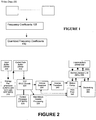
- Video data comprises a series of pictures 100.
- the video data is compressed using a variety of techniques that take advantage of both temporal and spatial redundancies.
- Pixel-to-frequency transformations are applied to take advantage of spatial redundancies.
- the transformation result in a set of frequency coefficients 105.
- the frequency coefficients 105 are then quantized 110.
- the quantization further compresses the video data by controlling the numbers of bits that are used to quantize the frequency coefficients. Additional compression techniques are then used to further compress the video data.
- the quantization techniques used depend on the encoding standard.
- the encoding standards include standards promulgated by the Motion Picture Experts Group (MPEG) and that promulgated by the Society of Motion Pictures and Television Engineers (SMPTE) and Microsoft Corporation.
- the standards promulgated by MPEG include MPEG1, MPEG-2 and MPEG-4, Part 10 (also known as Advanced Video Coding and also known and now referred to as H.264).
- VC-1 is a standard promulgated by the SMPTE, and by Microsoft Corporation (as Windows Media 9 or WM9).
- the video decoder 200 comprises an entropy pre-processor 205, a coded data buffer 210, a variable length decoder 215, a control processor 220, an inverse quantizer 225, a macroblock header processor 230, an inverse transformer 235, a motion compensator 240, a deblocker 245, a memory access unit 250, and frame buffers 255.
- the entropy pre-processor 205 receives encoded video data.
- the encoded video data can comprise entropy coded symbols.
- the entropy pre-processor 205 decodes the entropy coded symbols.
- the entropy pre-processor 205 writes the symbols to the coded data buffer 210.
- the variable length decoder 215 decodes variable length codes in the encoded video data.
- the inverse quantizer 225 inverse quantizes the quantized frequency coefficients 110, resulting in frequency coefficients 105.
- the inverse transformer 235 inverse transforms the frequency coefficients 105, resulting in pixel data.
- the motion compensator 240 motion compensates the pixel data, using previously decoded pictures 100 stored in the frame buffers 255.
- the quantization techniques used depend on the encoding standard.
- the encoding standards include standards promulgated by the Motion Picture Experts Group (MPEG) and that by the Society of Motion Pictures and Television Engineers (SMPTE) and Microsoft Corporation.
- MPEG Motion Picture Experts Group
- SMPTE Society of Motion Pictures and Television Engineers
- VC-1 is a standard promulgated by the SMPTE, and by Microsoft Corporation (as Windows Media 9 or WM9.
- the inverse quantizer 225 is capable of inverse quantizing video data encoded in accordance with a plurality of standards.
- the inverse quantizer 225 can inverse quantize video data encoded in accordance with the MPEG-2, H.264, and VC-1 standards.
- the inverse quantizer 225 comprises a run level decoder and inverse scanner 310, a DC transformer 315, a DC predictor 320, an AC predictor 325, an inverse quantization engine 330, and external interfaces 335.
- the run level decoder/inverse scanner 320 and DC predictor 320 can be clubbed in a single data path if their operations are sequentially dependent.
- the run level decoder/inverse scanner 310 does the 'zero" filling operation, decided by the run count of the current run-level pair.
- DC predictor 320 performs DC prediction if DC prediction is enabled for the current block. This is present in intra blocks of VC-1. This is done by choosing the prediction direction, which is based on the relative DC values of the neighboring left, top and diagonal blocks.
- the inverse scan operation is accomplished by providing a correct address of a buffer based on a lookup table value. These lookup table values are programmed during the picture level initialization.
- the AC predictor 325 performs AC prediction if AC prediction is enabled for the current block under decode. AC prediction is present in the VC-1 video standard.
- the DC-Predictor 320 supplies the prediction direction and the prediction data will be from either top row or the left column. The prediction coefficients are written to a DRAM.
- the DC transformer 315 performs matrix multiplication of the DC-only luma and chroma sub-blocks of AVC with the constant matrix.
- the constant matrix has signed unit coefficients. Based on this fact, matrix multiplication is performed by add-accumulate operation. There are two passes in the DC transform for two sets of matrix multiplication.
- the inverse quantization engine 330 supports inverse quantization for a plurality of video encoding standards.
- the inverse quantization engine 230 comprises an MPEG1/MPEG-2 inverse quantizer 335, an H.264 inverse quantizer 340, and a VC-1 inverse quantizer 345, and there are seven types of the inverse quantization present based on the block-type (video standard under decode), where MPEG2 has two types, AVC has three types and VC-1 has two types.
- the type of the Inverse quantization depends on the macro-block type and Luma-chroma blocks (sub-blocks).
- the inverse quantization process can be numerically equivalent to the following pseudo-code.
- the dequantization operation is done on the output of the coefficients after inverse scan operation.
- MPEG-2 has two types of inverse quantization.
- the classification is based on the macro-block type, intra or non-intra macroblocks.
- intra macroblocks the sign function is included for inverse quantization operation and other wise not included.
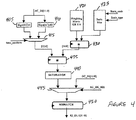
- FIGURE 4 there is illustrated a block diagram of a circuit for inverse quantizing video data encoded in accordance with the MPEG-2 standard.
- the circuit uses two multipliers that operate independently. There are four register stages in the data path to reduce the critical timing issue.
- Registers 405 and 410 receive AC_Coeff data from Run-level decoder. Multiplexer 415 selects between the contents of register 405 and register 410 based on a control signal indicating whether the macroblock is intracoded or non-intracoded. Multiplier 430 multiplies the output of weighting matrix 420 and scale map 425. Multiplier 435 multiplies the output of multiplexer 415 and multiplier 430 and provides the product to register 440. Multiplexer 445 selects between the contents of the register 440 and DC coefficients, DC_IN[11:0] based on signal, AC_DC_SEL, that indicates whether the coefficients is an AC coefficient or a DC coefficient. Register 450 receives the selection of multiplexer 445 and provides the inverse quantized output IQ_OUT[11:0].
- i and j form a two-dimensional frequency index for coefficients within each sub block.
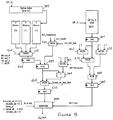
- FIGURE 5 there is illustrated a block diagram describing an exemplary circuit for inverse quantizing H.264 encoded video data.
- Inverse Quantization of AVC is given by Equations 1-5.
- AVC can have separate DC-only blocks for Luma and Chroma, the inverse quantization is different for these sub-blocks.
- the common feature seen in this operation is that there is a multiplication and right shift by a fixed number.
- the modules and the divisions are implemented by use of look-up table, because the inputs to this look-up table have a fixed number of values.
- QP_in is used to address the two tables of QP%6 505 and QP/6 tables 510. There are 51 and 31 entries in these tables, respectively, which are calculated as per the equation 1-5.
- the mux select signals, AC_DC_Sel, QP Correction, Luma_dc_less_than_12 are generated to pass the appropriate table or the processed table values to the multipliers.
- a shift count logic generates the shift count, Shift_Dir based on the block to be decoded. The direction of the shifter is based on the Luma-chroma block under decode as shown in Figure 5 .
- the Qp%6 Table 505 receives input QP_in and provides an output to V Matrix C0, V Matrix C1, and V Matrix C2.
- Multiplexer 515 receives outputs from the V Matrix C0, V Matrix C1, and V Matrix C2 and selects one of the three based on control signal 520.
- Register 525 receives the output of multiplexer 515.
- Multiplexer 530 receives a DC Transform input, DC Transform, and AC Coefficient, AC Coeff, and selects one of the two based on control signal, AC_DC_Sel.
- Multiplier 535 receives and multiplies the outputs of register 525 and multiplexer 530.
- Multiplexer 540 outputs either a one or a two based on a control signal, QP Correction.
- Adder 545 adds the outputs of multiplier 535 and multiplexer 540.
- Multiplexer 550 selects one of the outputs of multiplexer 535 and adder 545, and provides the selection to register 555.
- Register 560 receives the output of QP_by_6 table 510 and provides the output to multiplexers 565 and 570.
- Multiplexer 570 selects between the outputs of multiplexers 565 and register 560.
- Multiplexer 575 selects between a one and a two.
- Subtractor 580 takes the difference between multiplexers 570 and 575 and provides the result to register 585.
- Shifter 590 receives the contents of registers 555 and subtractor 585 and provides an inverse quantized output, IQ_OUT.
- DCStepSize is based on the value of PQUANT (or MQUANT in P, B pictures) and is provided via DINO.
- CP-MIPS FW calculates this parameter.
- dequant_coeff quant_coeff * double_quant if 3 ⁇ QP deadzone quantizer
- dequant_coeff quant_coeff * double_quant + sign quant_coeff * quant_scale if 5 ⁇ QP deadzone quantizer
- FIGURE 6 there is illustrated a block diagram describing an exemplary circuit for inverse quantizing video data encoded in accordance with the VC-1 standard.
- VC-1 There are two types of inverse quantization operations present in VC-1 as shown in equations 6 and 7 for DC values of intra blocks and AC values of intra and all inter blocks.
- a common data path diagram is used to perform both the inverse quantization operations. Selecting the AC and DC value controls these operations.
- the control unit generates the AC DC select signal based on the transform coefficient under decode. Based on the Quantizer dead-zone values a correction applied to the AC values. If the Quantizer dead-zone is 5QP, a Quantizer scale code is considered and added to the inverse Quantized values.
- the circuit comprises a first multiplier 605 that multiplies the quantizer scale, Quant_scale(Mquant or Pquant), by 2.
- Multiplexer 610 receives the output of the multiplier 605 and the DC stepsize, DC_STEPSIZE, and selects one of the two based on a signal, Ac_dc_sel that indicates whether the coefficients received are AC coefficients or DC coefficients.
- Multiplexer 615 receives both AC coefficients and DC coefficients and selects one of the two based on the signal, Ac_dc_sel.
- Register 620 receives the sign of the AC coefficient, SignofAC and provides the sign to multiplier 630.
- Multiplier 630 multiplies the sign of the AC coefficient, SignofAC by the quantizer scale, Quant_scale[4:0].
- Multiplier 625 receives and multiplies the outputs of multiplixer 610 and multiplexer 615.
- Adder 635 receives and adds the outputs of multiplier 625 and multiplier 630.
- Multiplexer 640 receives the outputs of multiplier 625 and adder 635, and selects one of the two based on a signal indicating either 3QP Deadzone Quantizer or 5 QP Deadzone Quantizer.
- MPEG-2 inverse quantizer 335, H.264 inverse quantizer 340, and VC-1 inverse quantizer 345 can use common logic.
- FIGURE 7 there is illustrated a block diagram describing of a multiplier 705 forming a portion of MPEG-2 inverse quantizer 335, H.264 inverse quantizer 340, and VC-1 inverse quantizer 345.
- the multiplier 705 performs the function of multiplier 435 in the MPEG-2 inverse quantizer 335, multiplier 535 in the H.264 inverse quantizer 340, and multiplier 625 in the VC-1 inverse quantizer 345.
- a 6:2 multiplexer 710 receives outputs of multiplexer 415, multiplier 430, register 525, multiplexer 530, multiplexer 610, and multiplexer 615, based on whether the video data is MPEG-2, H.264, or VC-1 encoded.
- FIGURE 8 there is illustrated a flow diagram describing the inverse quantization of video data from a plurality of standards in accordance with an embodiment of the present invention.
- the video data is received.
- the encoding standard for the video data is determined. If at 810, the video data is MPEG-2, at 815, the video data is inverse quantized in accordance with the inverse quantization for the MPEG-2 standard. If at 810, the video data is H.264, at 820, the video data is inverse quantized in accordance with the inverse quantization for the H.264 standard. If at 825, the video data is VC-1, at 825, the video data is inverse quantized in accordance with the inverse quantization for the VC-1 standard.
- the embodiments described herein may be implemented as a board level product, as a single chip, application specific integrated circuit (ASIC), as part of an ASIC containing other functions, or with varying levels of the decoder system integrated with other portions of the system as separate components.
- ASIC application specific integrated circuit
- the degree of integration of the decoder system will primarily be determined by the speed and cost considerations. Because of the sophisticated nature of modern processor, it is possible to utilize a commercially available processor, which may be implemented external to an ASIC implementation. If the processor is available as an ASIC core or logic block, then the commercially available processor can be implemented as part of an ASIC device wherein certain functions can be implemented in firmware. Alternatively, the functions can be implemented as hardware accelerator units controlled by the processor.
Landscapes
- Engineering & Computer Science (AREA)
- Multimedia (AREA)
- Signal Processing (AREA)
- Physics & Mathematics (AREA)
- Discrete Mathematics (AREA)
- General Physics & Mathematics (AREA)
- Compression Or Coding Systems Of Tv Signals (AREA)
Claims (1)
- Système permettant de décoder des données vidéo, ledit système comprenant :un quantificateur inverse (230) pour la quantification inverse de données vidéo codées en fonction d'une première norme de codage et pour la quantification inverse de données vidéo codées en fonction d'une deuxième norme de codage ;dans lequel le quantificateur inverse (230) est adapté pour quantifier par inverse des données vidéo codées en fonction d'une troisième norme de codage ;le système, comprenant en outre :un premier circuit pour la quantification inverse des données vidéo codées en fonction de la première norme de codage, dans lequel la première norme de codage est MPEG-2 et la deuxième norme de codage est H.264 ;un deuxième circuit pour la quantification inverse des données vidéo codées en fonction de la deuxième norme de codage ;un troisième circuit pour la quantification inverse des données vidéo codées en fonction de la troisième norme de codage ; etun multiplicateur commun (705) formant une partie du premier circuit, du deuxième circuit, et du troisième circuit ;dans lequel la troisième norme de codage est VC-1 ;dans lequel le premier circuit comprend : un premier (405) et un deuxième (410) registre dans le premier circuit qui reçoivent des données AC_Coeff d'un décodeur de niveau d'exécution ; un premier multiplexeur (415) dans le premier circuit qui sélectionne entre les contenus du premier (405) et du deuxième (410) registre dans le premier circuit sur la base d'un premier signal de commande indiquant si un macrobloc des données vidéo est intracodé ou non intracodé ; un multiplicateur supplémentaire (430) dans le premier circuit qui multiplie une sortie d'une matrice de pondération (420) et une carte d'échelle (425) ; le multiplicateur commun (705) qui multiplie une sortie du premier multiplexeur (415) dans le premier circuit et du multiplicateur supplémentaire (430) dans le premier circuit, et fournit le produit à un troisième registre (440) dans le premier circuit ; un deuxième multiplexeur (445) dans le premier circuit qui sélectionne entre les contenus du troisième registre (440) dans le premier circuit et des coefficients DC, DC_IN [11:0] basés sur un signal, AC_DC_SEL, qui indique si des coefficients délivrés en sortie par le deuxième multiplexeur (445) dans le premier circuit sont des coefficients AC ou des coefficients CC ; et un quatrième registre (450) dans le premier circuit qui reçoit la sélection du deuxième multiplexeur (445) dans le premier circuit, et fournit une sortie quantifiée inverse IQ_OUT [11:0] des données vidéo ;dans lequel le deuxième circuit comprend : une table Qp%6 (505) qui reçoit une entrée QP_in et fournit une sortie à une matrice V C0, une matrice V C1, et une matrice V C2 ; un premier multiplexeur (515) dans le deuxième circuit qui reçoit des sorties provenant de la matrice V C0, de la matrice V C1 et de la matrice V C2, et sélectionne l'une des trois sur la base d'un deuxième signal de commande (520) ; un premier registre (525) dans le deuxième circuit qui reçoit la sortie du premier multiplexeur (515) dans le deuxième circuit ; un deuxième multiplexeur (530) dans le deuxième circuit qui reçoit une entrée de transformée CC, transformée CC, et un coefficient CA, coeff CA, et sélectionne l'un des deux sur la base d'un troisième signal de commande, AC_DC_Sel ; le multiplicateur commun (705) qui reçoit et multiplie des sorties du premier registre (525) dans le deuxième circuit et du deuxième multiplexeur (530) dans le deuxième circuit ; un troisième multiplexeur (540) dans le deuxième circuit qui délivre en sortie soit une, soit deux sur la base d'un quatrième signal de commande, correction(s) QP ; un additionneur (545) dans le deuxième circuit qui ajoute des sorties du multiplicateur commun (705) et du troisième multiplexeur (540) dans le deuxième circuit; un quatrième multiplexeur (550) dans le deuxième circuit qui sélectionne l'une des sorties du multiplicateur commun (705) et de l'additionneur (545) dans le deuxième circuit, et fournit la sélection à un deuxième registre (555) dans le deuxième circuit ; un troisième registre (560) dans le deuxième circuit qui reçoit une sortie d'une table QP_by_6 (510) et fournit la sortie à un cinquième (565) et un sixième (570) multiplexeur dans le deuxième circuit, dans lequel le sixième multiplexeur (570) dans le deuxième circuit sélectionne entre des sorties du cinquième multiplexeur (565) dans le deuxième circuit et du troisième registre (560) dans le deuxième circuit ; un septième multiplexeur (575) dans le deuxième circuit qui sélectionne entre un ou deux ; un soustracteur (580) qui prend la différence entre le sixième (570) et le septième (575) multiplexeur dans le deuxième circuit, et fournit le résultat à un quatrième registre (585) dans le deuxième circuit ; et un déphaseur (590) qui reçoit les contenus du deuxième registre (555) dans le deuxième circuit et du soustracteur (585), et fournit une sortie quantifiée inverse, IQ_OUT, du signal vidéo ;dans lequel le troisième circuit comprend : un multiplicateur supplémentaire (605) dans le troisième circuit qui multiplie une échelle de quantificateur, Quant_scale (Mquant ou Pquant), par 2 ; un premier multiplexeur (610) dans le troisième circuit qui reçoit une sortie du multiplicateur supplémentaire (605) dans le troisième circuit et un pas de progression CC, DC_STEPSIZE, et sélectionne l'un des deux sur la base d'un signal supplémentaire, Ac_dc_sel qui indique si les coefficients reçus sont des coefficients CA ou des coefficients CC ; un deuxième multiplexeur (615) dans le troisième circuit qui reçoit à la fois des coefficients CA et des coefficients CC et sélectionne l'un des deux sur la base du signal supplémentaire Ac_dc_sel ; un premier registre (620) dans le troisième circuit qui reçoit un signe du coefficient CA, SignofAC, et fournit le signe à encore un multiplicateur (630) supplémentaire dans le troisième circuit, dans lequel l'encore un multiplicateur (630) supplémentaire multiplie le signe du coefficient CA, SignofAC par une échelle de quantificateur supplémentaire, Quant_scale [1:0] ; le multiplicateur commun (705) qui reçoit et multiplie des sorties du premier (610) et du deuxième (615) multiplexeur dans le troisième circuit ; un additionneur (635) dans le troisième circuit qui reçoit et ajoute les sorties du multiplicateur commun (705) et du multiplicateur (630) encore supplémentaire dans le troisième circuit; un troisième multiplexeur (640) dans le troisième circuit qui reçoit des sorties du multiplicateur commun (705) et de l'additionneur (635) dans le troisième circuit, et sélectionne l'un des deux sur la base d'un signal indiquant soit un quantificateur de zone morte 3QP, soit un quantificateur de zone morte 5QP.
Applications Claiming Priority (1)
| Application Number | Priority Date | Filing Date | Title |
|---|---|---|---|
| US11/096,988 US7873105B2 (en) | 2005-04-01 | 2005-04-01 | Hardware implementation of optimized single inverse quantization engine for a plurality of standards |
Publications (3)
| Publication Number | Publication Date |
|---|---|
| EP1708511A2 EP1708511A2 (fr) | 2006-10-04 |
| EP1708511A3 EP1708511A3 (fr) | 2011-08-03 |
| EP1708511B1 true EP1708511B1 (fr) | 2017-07-05 |
Family
ID=36608523
Family Applications (1)
| Application Number | Title | Priority Date | Filing Date |
|---|---|---|---|
| EP06006944.0A Ceased EP1708511B1 (fr) | 2005-04-01 | 2006-03-31 | Réalisation hardware d'un quantificateur inverse apte à traiter plusieurs standards de codage vidéo |
Country Status (4)
| Country | Link |
|---|---|
| US (1) | US7873105B2 (fr) |
| EP (1) | EP1708511B1 (fr) |
| CN (1) | CN100556142C (fr) |
| TW (1) | TWI340597B (fr) |
Families Citing this family (11)
| Publication number | Priority date | Publication date | Assignee | Title |
|---|---|---|---|---|
| US20070147496A1 (en) * | 2005-12-23 | 2007-06-28 | Bhaskar Sherigar | Hardware implementation of programmable controls for inverse quantizing with a plurality of standards |
| JP4621629B2 (ja) * | 2006-05-25 | 2011-01-26 | 株式会社東芝 | 画像復号装置 |
| EP2081387A4 (fr) * | 2007-03-28 | 2011-08-31 | Panasonic Corp | Circuit de déquantification, procédé de déquantification et dispositif de reproduction d'image |
| JPWO2008136164A1 (ja) * | 2007-04-23 | 2010-07-29 | パナソニック株式会社 | 復号化回路、復号化方法及び画像再生装置 |
| EP2308229A4 (fr) * | 2008-07-01 | 2014-08-20 | S K Nandy | Procédé et système sur puce permettant d'adapter un matériel reconfigurable en temps d'exécution pour le décodage de flux vidéo |
| KR20130050404A (ko) * | 2011-11-07 | 2013-05-16 | 오수미 | 인터 모드에서의 복원 블록 생성 방법 |
| JP6120490B2 (ja) | 2011-11-07 | 2017-04-26 | キヤノン株式会社 | 画像符号化装置、画像符号化方法及びプログラム、画像復号装置、画像復号方法及びプログラム |
| US9591302B2 (en) | 2012-07-02 | 2017-03-07 | Microsoft Technology Licensing, Llc | Use of chroma quantization parameter offsets in deblocking |
| US9414054B2 (en) | 2012-07-02 | 2016-08-09 | Microsoft Technology Licensing, Llc | Control and use of chroma quantization parameter values |
| US9628803B2 (en) * | 2014-11-25 | 2017-04-18 | Blackberry Limited | Perceptual image and video coding |
| US10194147B2 (en) * | 2017-01-19 | 2019-01-29 | Google Llc | DC coefficient sign coding scheme |
Family Cites Families (6)
| Publication number | Priority date | Publication date | Assignee | Title |
|---|---|---|---|---|
| US5784631A (en) * | 1992-06-30 | 1998-07-21 | Discovision Associates | Huffman decoder |
| GB2288521B (en) | 1994-03-24 | 1998-10-14 | Discovision Ass | Reconfigurable process stage |
| KR0128881B1 (ko) * | 1994-04-30 | 1998-04-10 | 배순훈 | 디지틀화상복호화장치 |
| KR100198788B1 (ko) * | 1996-12-09 | 1999-06-15 | 정선종 | 차동 펄스 부호 변조기를 포함한 양자화/역양자화 회로 |
| EP1351515A3 (fr) * | 2002-04-01 | 2005-08-03 | Broadcom Corporation | Quantificateur inverse pouvant prendre en charge plusieurs standards de décodage vidéo |
| EP1599049A3 (fr) * | 2004-05-21 | 2008-04-02 | Broadcom Advanced Compression Group, LLC | Décodeur vidéo multistandard |
-
2005
- 2005-04-01 US US11/096,988 patent/US7873105B2/en active Active
-
2006
- 2006-03-31 EP EP06006944.0A patent/EP1708511B1/fr not_active Ceased
- 2006-03-31 TW TW095111472A patent/TWI340597B/zh active
- 2006-04-01 CN CNB2006100737297A patent/CN100556142C/zh not_active Expired - Fee Related
Non-Patent Citations (2)
| Title |
|---|
| MOHANTY S P ET AL: "VLSI implementation of visible watermarking for a secure digital still camera design", VLSI DESIGN, 2004. PROCEEDINGS. 17TH INTERNATIONAL CONFERENCE ON MUMBAI, INDIA 5-9 JAN. 2004, LOS ALAMITOS, CA, USA,IEEE COMPUT. SOC, US, 5 January 2004 (2004-01-05), pages 1063 - 1068, XP010679207, ISBN: 978-0-7695-2072-8, DOI: 10.1109/ICVD.2004.1261070 * |
| TAKASHI HASHIMOTO ET AL: "A 27-MHz/54-MHz 11-mW MPEG-4 Video Decoder LSI for Mobile Applications", IEEE JOURNAL OF SOLID-STATE CIRCUITS, IEEE SERVICE CENTER, PISCATAWAY, NJ, USA, vol. 37, no. 11, 1 November 2002 (2002-11-01), XP011065871, ISSN: 0018-9200 * |
Also Published As
| Publication number | Publication date |
|---|---|
| TWI340597B (en) | 2011-04-11 |
| EP1708511A3 (fr) | 2011-08-03 |
| CN100556142C (zh) | 2009-10-28 |
| US20060222064A1 (en) | 2006-10-05 |
| TW200715865A (en) | 2007-04-16 |
| EP1708511A2 (fr) | 2006-10-04 |
| US7873105B2 (en) | 2011-01-18 |
| CN1842164A (zh) | 2006-10-04 |
Similar Documents
| Publication | Publication Date | Title |
|---|---|---|
| US6385248B1 (en) | Methods and apparatus for processing luminance and chrominance image data | |
| US8045821B2 (en) | Coding method conversion apparatus | |
| EP2001239B1 (fr) | Appareil de codage d'image et appareil de decodage d'image | |
| US6002801A (en) | Method and apparatus for improved video decompression by selection of IDCT method based on image characteristics | |
| US8315467B2 (en) | Image encoding device and image encoding method | |
| US6122321A (en) | Methods and apparatus for reducing the complexity of inverse quantization operations | |
| US20090141808A1 (en) | System and methods for improved video decoding | |
| EP2323407A1 (fr) | Procédé de codage d une image vidéo, procédé de décodage d une image vidéo, appareil de codage d une image vidéo, appareil de décodage d une image vidéo, programme et circuit intégré | |
| US9918088B2 (en) | Transform and inverse transform circuit and method | |
| US20080232465A1 (en) | System and method of fast mpeg-4/avc quantization | |
| US6148032A (en) | Methods and apparatus for reducing the cost of video decoders | |
| US7873105B2 (en) | Hardware implementation of optimized single inverse quantization engine for a plurality of standards | |
| US20080123748A1 (en) | Compression circuitry for generating an encoded bitstream from a plurality of video frames | |
| US6298087B1 (en) | System and method for decoding a variable length code digital signal | |
| WO2022164853A1 (fr) | Introduction d'un biais dynamique dans la sélection de mode en codage vidéo | |
| US20100014592A1 (en) | Decoding circuit, decoding method, and image reproducing apparatus | |
| US20130077674A1 (en) | Method and apparatus for encoding moving picture | |
| KR20100013142A (ko) | 프레임 메모리 압축방법 | |
| US20070147515A1 (en) | Information processing apparatus | |
| US7307550B2 (en) | Decoding method, decoding device, and program for the same | |
| US7801935B2 (en) | System (s), method (s), and apparatus for converting unsigned fixed length codes (decoded from exponential golomb codes) to signed fixed length codes | |
| US7447372B2 (en) | System(s), method(s), and apparatus for decoding exponential Golomb codes | |
| CN100576917C (zh) | 逆扫描频率系数的方法和系统 | |
| US20060227874A1 (en) | System, method, and apparatus for DC coefficient transformation | |
| Pearlstein et al. | An SDTV Decoder with HDTV Capability:“An All-Format ATV Decoder” |
Legal Events
| Date | Code | Title | Description |
|---|---|---|---|
| PUAI | Public reference made under article 153(3) epc to a published international application that has entered the european phase |
Free format text: ORIGINAL CODE: 0009012 |
|
| AK | Designated contracting states |
Kind code of ref document: A2 Designated state(s): AT BE BG CH CY CZ DE DK EE ES FI FR GB GR HU IE IS IT LI LT LU LV MC NL PL PT RO SE SI SK TR |
|
| AX | Request for extension of the european patent |
Extension state: AL BA HR MK YU |
|
| RAP1 | Party data changed (applicant data changed or rights of an application transferred) |
Owner name: BROADCOM CORPORATION |
|
| PUAL | Search report despatched |
Free format text: ORIGINAL CODE: 0009013 |
|
| AK | Designated contracting states |
Kind code of ref document: A3 Designated state(s): AT BE BG CH CY CZ DE DK EE ES FI FR GB GR HU IE IS IT LI LT LU LV MC NL PL PT RO SE SI SK TR |
|
| AX | Request for extension of the european patent |
Extension state: AL BA HR MK YU |
|
| 17P | Request for examination filed |
Effective date: 20120203 |
|
| AKX | Designation fees paid |
Designated state(s): DE FR GB |
|
| 17Q | First examination report despatched |
Effective date: 20140730 |
|
| REG | Reference to a national code |
Ref country code: DE Ref legal event code: R079 Ref document number: 602006052939 Country of ref document: DE Free format text: PREVIOUS MAIN CLASS: H04N0007260000 Ipc: H04N0019159000 |
|
| GRAP | Despatch of communication of intention to grant a patent |
Free format text: ORIGINAL CODE: EPIDOSNIGR1 |
|
| INTG | Intention to grant announced |
Effective date: 20170209 |
|
| RIC1 | Information provided on ipc code assigned before grant |
Ipc: H04N 19/44 20140101ALI20170131BHEP Ipc: H04N 19/126 20140101ALI20170131BHEP Ipc: H04N 19/42 20140101ALI20170131BHEP Ipc: H04N 19/159 20140101AFI20170131BHEP Ipc: H04N 19/186 20140101ALI20170131BHEP Ipc: H04N 19/70 20140101ALN20170131BHEP Ipc: H04N 19/12 20140101ALI20170131BHEP Ipc: H04N 19/61 20140101ALI20170131BHEP |
|
| GRAS | Grant fee paid |
Free format text: ORIGINAL CODE: EPIDOSNIGR3 |
|
| RAP1 | Party data changed (applicant data changed or rights of an application transferred) |
Owner name: AVAGO TECHNOLOGIES GENERAL IP (SINGAPORE) PTE. LTD |
|
| GRAA | (expected) grant |
Free format text: ORIGINAL CODE: 0009210 |
|
| AK | Designated contracting states |
Kind code of ref document: B1 Designated state(s): DE FR GB |
|
| REG | Reference to a national code |
Ref country code: GB Ref legal event code: FG4D Ref country code: DE Ref legal event code: R081 Ref document number: 602006052939 Country of ref document: DE Owner name: AVAGO TECHNOLOGIES INTERNATIONAL SALES PTE. LT, SG Free format text: FORMER OWNER: BROADCOM CORP., IRVINE, CALIF., US |
|
| REG | Reference to a national code |
Ref country code: DE Ref legal event code: R096 Ref document number: 602006052939 Country of ref document: DE |
|
| REG | Reference to a national code |
Ref country code: DE Ref legal event code: R097 Ref document number: 602006052939 Country of ref document: DE |
|
| PLBE | No opposition filed within time limit |
Free format text: ORIGINAL CODE: 0009261 |
|
| STAA | Information on the status of an ep patent application or granted ep patent |
Free format text: STATUS: NO OPPOSITION FILED WITHIN TIME LIMIT |
|
| 26N | No opposition filed |
Effective date: 20180406 |
|
| REG | Reference to a national code |
Ref country code: DE Ref legal event code: R082 Ref document number: 602006052939 Country of ref document: DE Representative=s name: BOSCH JEHLE PATENTANWALTSGESELLSCHAFT MBH, DE Ref country code: DE Ref legal event code: R081 Ref document number: 602006052939 Country of ref document: DE Owner name: AVAGO TECHNOLOGIES INTERNATIONAL SALES PTE. LT, SG Free format text: FORMER OWNER: AVAGO TECHNOLOGIES GENERAL IP (SINGAPORE) PTE. LTD., SINGAPORE, SG |
|
| GBPC | Gb: european patent ceased through non-payment of renewal fee |
Effective date: 20180331 |
|
| PG25 | Lapsed in a contracting state [announced via postgrant information from national office to epo] |
Ref country code: GB Free format text: LAPSE BECAUSE OF NON-PAYMENT OF DUE FEES Effective date: 20180331 |
|
| PG25 | Lapsed in a contracting state [announced via postgrant information from national office to epo] |
Ref country code: FR Free format text: LAPSE BECAUSE OF NON-PAYMENT OF DUE FEES Effective date: 20180331 |
|
| PGFP | Annual fee paid to national office [announced via postgrant information from national office to epo] |
Ref country code: DE Payment date: 20220310 Year of fee payment: 17 |
|
| REG | Reference to a national code |
Ref country code: DE Ref legal event code: R119 Ref document number: 602006052939 Country of ref document: DE |
|
| PG25 | Lapsed in a contracting state [announced via postgrant information from national office to epo] |
Ref country code: DE Free format text: LAPSE BECAUSE OF NON-PAYMENT OF DUE FEES Effective date: 20231003 |