EP1712276A1 - Kohlenstoffnanoröhrchen als stationäre Phasen für die Chromatographie - Google Patents
Kohlenstoffnanoröhrchen als stationäre Phasen für die Chromatographie Download PDFInfo
- Publication number
- EP1712276A1 EP1712276A1 EP06252034A EP06252034A EP1712276A1 EP 1712276 A1 EP1712276 A1 EP 1712276A1 EP 06252034 A EP06252034 A EP 06252034A EP 06252034 A EP06252034 A EP 06252034A EP 1712276 A1 EP1712276 A1 EP 1712276A1
- Authority
- EP
- European Patent Office
- Prior art keywords
- chromatography column
- chromatography
- carbon nanotube
- nanotube material
- chemical mixture
- Prior art date
- Legal status (The legal status is an assumption and is not a legal conclusion. Google has not performed a legal analysis and makes no representation as to the accuracy of the status listed.)
- Withdrawn
Links
- 238000004587 chromatography analysis Methods 0.000 title claims abstract description 89
- OKTJSMMVPCPJKN-UHFFFAOYSA-N Carbon Chemical compound [C] OKTJSMMVPCPJKN-UHFFFAOYSA-N 0.000 title claims abstract description 56
- 239000002041 carbon nanotube Substances 0.000 title claims abstract description 47
- 229910021393 carbon nanotube Inorganic materials 0.000 title claims abstract description 47
- 230000005526 G1 to G0 transition Effects 0.000 title claims abstract description 20
- 239000000463 material Substances 0.000 claims abstract description 124
- 238000012856 packing Methods 0.000 claims abstract description 44
- 239000002071 nanotube Substances 0.000 claims description 60
- 239000000203 mixture Substances 0.000 claims description 33
- 239000000126 substance Substances 0.000 claims description 33
- 238000000034 method Methods 0.000 claims description 16
- 239000002245 particle Substances 0.000 claims description 15
- 239000003463 adsorbent Substances 0.000 claims description 11
- 229920001542 oligosaccharide Polymers 0.000 claims description 9
- 150000002482 oligosaccharides Chemical class 0.000 claims description 9
- 230000002209 hydrophobic effect Effects 0.000 claims description 8
- 102000003886 Glycoproteins Human genes 0.000 claims description 7
- 108090000288 Glycoproteins Proteins 0.000 claims description 7
- 102000002068 Glycopeptides Human genes 0.000 claims description 6
- 108010015899 Glycopeptides Proteins 0.000 claims description 6
- XLYOFNOQVPJJNP-UHFFFAOYSA-N water Substances O XLYOFNOQVPJJNP-UHFFFAOYSA-N 0.000 claims description 6
- 239000011248 coating agent Substances 0.000 claims description 4
- 238000000576 coating method Methods 0.000 claims description 4
- 239000003054 catalyst Substances 0.000 description 11
- 238000000926 separation method Methods 0.000 description 11
- 239000002904 solvent Substances 0.000 description 9
- 238000001179 sorption measurement Methods 0.000 description 7
- XEEYBQQBJWHFJM-UHFFFAOYSA-N iron Substances [Fe] XEEYBQQBJWHFJM-UHFFFAOYSA-N 0.000 description 6
- 229910052751 metal Inorganic materials 0.000 description 6
- 239000002184 metal Substances 0.000 description 6
- 235000018102 proteins Nutrition 0.000 description 6
- 102000004169 proteins and genes Human genes 0.000 description 6
- 108090000623 proteins and genes Proteins 0.000 description 6
- 239000007788 liquid Substances 0.000 description 5
- 239000002048 multi walled nanotube Substances 0.000 description 5
- 230000008569 process Effects 0.000 description 5
- 239000002109 single walled nanotube Substances 0.000 description 5
- 230000008901 benefit Effects 0.000 description 4
- 230000003993 interaction Effects 0.000 description 4
- 229910052742 iron Inorganic materials 0.000 description 4
- RZJRJXONCZWCBN-UHFFFAOYSA-N octadecane Chemical compound CCCCCCCCCCCCCCCCCC RZJRJXONCZWCBN-UHFFFAOYSA-N 0.000 description 4
- 229920000642 polymer Polymers 0.000 description 4
- 230000002441 reversible effect Effects 0.000 description 4
- 229910052799 carbon Inorganic materials 0.000 description 3
- 239000003575 carbonaceous material Substances 0.000 description 3
- 238000005229 chemical vapour deposition Methods 0.000 description 3
- 230000007547 defect Effects 0.000 description 3
- 239000012634 fragment Substances 0.000 description 3
- 230000013595 glycosylation Effects 0.000 description 3
- 238000006206 glycosylation reaction Methods 0.000 description 3
- 238000002347 injection Methods 0.000 description 3
- 239000007924 injection Substances 0.000 description 3
- 238000005342 ion exchange Methods 0.000 description 3
- 230000014759 maintenance of location Effects 0.000 description 3
- 229910001092 metal group alloy Inorganic materials 0.000 description 3
- 150000002739 metals Chemical class 0.000 description 3
- 239000000693 micelle Substances 0.000 description 3
- 230000004048 modification Effects 0.000 description 3
- 238000012986 modification Methods 0.000 description 3
- 239000000178 monomer Substances 0.000 description 3
- 206010028980 Neoplasm Diseases 0.000 description 2
- VYPSYNLAJGMNEJ-UHFFFAOYSA-N Silicium dioxide Chemical compound O=[Si]=O VYPSYNLAJGMNEJ-UHFFFAOYSA-N 0.000 description 2
- 238000004458 analytical method Methods 0.000 description 2
- 201000011510 cancer Diseases 0.000 description 2
- 239000000919 ceramic Substances 0.000 description 2
- 239000000470 constituent Substances 0.000 description 2
- 229920001577 copolymer Polymers 0.000 description 2
- 230000008878 coupling Effects 0.000 description 2
- 238000010168 coupling process Methods 0.000 description 2
- 238000005859 coupling reaction Methods 0.000 description 2
- 238000000151 deposition Methods 0.000 description 2
- 230000008021 deposition Effects 0.000 description 2
- 238000001514 detection method Methods 0.000 description 2
- -1 dipole-dipole Substances 0.000 description 2
- 239000007789 gas Substances 0.000 description 2
- 239000011521 glass Substances 0.000 description 2
- 229910002804 graphite Inorganic materials 0.000 description 2
- 239000010439 graphite Substances 0.000 description 2
- 230000007062 hydrolysis Effects 0.000 description 2
- 238000006460 hydrolysis reaction Methods 0.000 description 2
- 125000002887 hydroxy group Chemical group [H]O* 0.000 description 2
- 229910044991 metal oxide Inorganic materials 0.000 description 2
- 150000004706 metal oxides Chemical class 0.000 description 2
- 229910052750 molybdenum Inorganic materials 0.000 description 2
- 239000003973 paint Substances 0.000 description 2
- 238000006116 polymerization reaction Methods 0.000 description 2
- 238000011112 process operation Methods 0.000 description 2
- 238000006557 surface reaction Methods 0.000 description 2
- 239000000725 suspension Substances 0.000 description 2
- MTCFGRXMJLQNBG-REOHCLBHSA-N (2S)-2-Amino-3-hydroxypropansäure Chemical compound OC[C@H](N)C(O)=O MTCFGRXMJLQNBG-REOHCLBHSA-N 0.000 description 1
- KXGFMDJXCMQABM-UHFFFAOYSA-N 2-methoxy-6-methylphenol Chemical compound [CH]OC1=CC=CC([CH])=C1O KXGFMDJXCMQABM-UHFFFAOYSA-N 0.000 description 1
- 239000004215 Carbon black (E152) Substances 0.000 description 1
- 102000004190 Enzymes Human genes 0.000 description 1
- 108090000790 Enzymes Proteins 0.000 description 1
- MTCFGRXMJLQNBG-UHFFFAOYSA-N Serine Natural products OCC(N)C(O)=O MTCFGRXMJLQNBG-UHFFFAOYSA-N 0.000 description 1
- GWEVSGVZZGPLCZ-UHFFFAOYSA-N Titan oxide Chemical compound O=[Ti]=O GWEVSGVZZGPLCZ-UHFFFAOYSA-N 0.000 description 1
- 238000010521 absorption reaction Methods 0.000 description 1
- 230000002378 acidificating effect Effects 0.000 description 1
- 125000000613 asparagine group Chemical group N[C@@H](CC(N)=O)C(=O)* 0.000 description 1
- 239000011324 bead Substances 0.000 description 1
- 230000015572 biosynthetic process Effects 0.000 description 1
- 230000032823 cell division Effects 0.000 description 1
- 230000003915 cell function Effects 0.000 description 1
- 238000003776 cleavage reaction Methods 0.000 description 1
- 238000003795 desorption Methods 0.000 description 1
- 206010012601 diabetes mellitus Diseases 0.000 description 1
- 229920000359 diblock copolymer Polymers 0.000 description 1
- 201000010099 disease Diseases 0.000 description 1
- 208000037265 diseases, disorders, signs and symptoms Diseases 0.000 description 1
- 239000006185 dispersion Substances 0.000 description 1
- 238000010891 electric arc Methods 0.000 description 1
- 230000005684 electric field Effects 0.000 description 1
- 230000006870 function Effects 0.000 description 1
- 125000000524 functional group Chemical group 0.000 description 1
- 208000019622 heart disease Diseases 0.000 description 1
- 229930195733 hydrocarbon Natural products 0.000 description 1
- 150000002430 hydrocarbons Chemical class 0.000 description 1
- 229910052739 hydrogen Inorganic materials 0.000 description 1
- 239000001257 hydrogen Substances 0.000 description 1
- 210000000987 immune system Anatomy 0.000 description 1
- 230000000899 immune system response Effects 0.000 description 1
- 238000010952 in-situ formation Methods 0.000 description 1
- 230000008595 infiltration Effects 0.000 description 1
- 238000001764 infiltration Methods 0.000 description 1
- 230000009878 intermolecular interaction Effects 0.000 description 1
- JEIPFZHSYJVQDO-UHFFFAOYSA-N iron(III) oxide Inorganic materials O=[Fe]O[Fe]=O JEIPFZHSYJVQDO-UHFFFAOYSA-N 0.000 description 1
- 238000000608 laser ablation Methods 0.000 description 1
- 238000001182 laser chemical vapour deposition Methods 0.000 description 1
- 238000004811 liquid chromatography Methods 0.000 description 1
- 238000004949 mass spectrometry Methods 0.000 description 1
- 230000004770 neurodegeneration Effects 0.000 description 1
- 208000015122 neurodegenerative disease Diseases 0.000 description 1
- 229910052759 nickel Inorganic materials 0.000 description 1
- TWNQGVIAIRXVLR-UHFFFAOYSA-N oxo(oxoalumanyloxy)alumane Chemical compound O=[Al]O[Al]=O TWNQGVIAIRXVLR-UHFFFAOYSA-N 0.000 description 1
- RVTZCBVAJQQJTK-UHFFFAOYSA-N oxygen(2-);zirconium(4+) Chemical compound [O-2].[O-2].[Zr+4] RVTZCBVAJQQJTK-UHFFFAOYSA-N 0.000 description 1
- 244000052769 pathogen Species 0.000 description 1
- 239000005011 phenolic resin Substances 0.000 description 1
- 229920001568 phenolic resin Polymers 0.000 description 1
- 229920005589 poly(ferrocenylsilane) Polymers 0.000 description 1
- 229920002717 polyvinylpyridine Polymers 0.000 description 1
- 230000004481 post-translational protein modification Effects 0.000 description 1
- 125000002924 primary amino group Chemical group [H]N([H])* 0.000 description 1
- 230000004853 protein function Effects 0.000 description 1
- 150000003839 salts Chemical class 0.000 description 1
- 230000007017 scission Effects 0.000 description 1
- 230000035945 sensitivity Effects 0.000 description 1
- 239000000377 silicon dioxide Substances 0.000 description 1
- 239000007787 solid Substances 0.000 description 1
- 239000000243 solution Substances 0.000 description 1
- 239000004094 surface-active agent Substances 0.000 description 1
- 125000000341 threoninyl group Chemical group [H]OC([H])(C([H])([H])[H])C([H])(N([H])[H])C(*)=O 0.000 description 1
- OGIDPMRJRNCKJF-UHFFFAOYSA-N titanium oxide Inorganic materials [Ti]=O OGIDPMRJRNCKJF-UHFFFAOYSA-N 0.000 description 1
- 238000009736 wetting Methods 0.000 description 1
- 229910001928 zirconium oxide Inorganic materials 0.000 description 1
Images


Classifications
-
- B—PERFORMING OPERATIONS; TRANSPORTING
- B01—PHYSICAL OR CHEMICAL PROCESSES OR APPARATUS IN GENERAL
- B01J—CHEMICAL OR PHYSICAL PROCESSES, e.g. CATALYSIS OR COLLOID CHEMISTRY; THEIR RELEVANT APPARATUS
- B01J20/00—Solid sorbent compositions or filter aid compositions; Sorbents for chromatography; Processes for preparing, regenerating or reactivating thereof
- B01J20/02—Solid sorbent compositions or filter aid compositions; Sorbents for chromatography; Processes for preparing, regenerating or reactivating thereof comprising inorganic material
- B01J20/20—Solid sorbent compositions or filter aid compositions; Sorbents for chromatography; Processes for preparing, regenerating or reactivating thereof comprising inorganic material comprising free carbon; comprising carbon obtained by carbonising processes
- B01J20/205—Carbon nanostructures, e.g. nanotubes, nanohorns, nanocones, nanoballs
-
- B—PERFORMING OPERATIONS; TRANSPORTING
- B01—PHYSICAL OR CHEMICAL PROCESSES OR APPARATUS IN GENERAL
- B01J—CHEMICAL OR PHYSICAL PROCESSES, e.g. CATALYSIS OR COLLOID CHEMISTRY; THEIR RELEVANT APPARATUS
- B01J20/00—Solid sorbent compositions or filter aid compositions; Sorbents for chromatography; Processes for preparing, regenerating or reactivating thereof
- B01J20/281—Sorbents specially adapted for preparative, analytical or investigative chromatography
- B01J20/282—Porous sorbents
-
- B—PERFORMING OPERATIONS; TRANSPORTING
- B01—PHYSICAL OR CHEMICAL PROCESSES OR APPARATUS IN GENERAL
- B01J—CHEMICAL OR PHYSICAL PROCESSES, e.g. CATALYSIS OR COLLOID CHEMISTRY; THEIR RELEVANT APPARATUS
- B01J2220/00—Aspects relating to sorbent materials
- B01J2220/50—Aspects relating to the use of sorbent or filter aid materials
- B01J2220/54—Sorbents specially adapted for analytical or investigative chromatography
Definitions
- the technical field of the invention relates to chromatography and, in particular, to stationary phases for chromatography.
- LC Liquid Chromatography
- components to be separated are dissolved in a suitable liquid and introduced into a chromatography column.
- the liquid carrying the components is then pushed through the chromatography column, which is packed with a stationary phase that has adsorbent characteristics.
- the components can exhibit different levels of adsorption onto the stationary phase, thus allowing the components to be separated as they exit the chromatography column.
- One continuing challenge in LC is achieving a desired resolution for separating components of a chemical mixture. Poor resolution is typically characterized by peaks of different components overlapping excessively in a resulting chromatogram.
- certain biomolecules such as oligosaccharides, can occur as isomers that differ slightly from one another in terms of chirality or structure, and effective separation of such biomolecules using conventional stationary phases remains a continuing challenge.
- Glycosylation is one of the major post-translational modifications of proteins in a biological system. Glycosylation typically involves modifying proteins with oligosaccharides, such as via O-links at serine or threonine residues or via N-links at asparagine residues, thus producing glycoproteins. Glycosylation can determine a variety of protein and cellular functions, such as those related to immune system response, pathogens homing on host tissues, cell division processes, and a cancer cell's camouflage to escape detection by the immune system. Accordingly, characterizing glycoproteins as well as their sites of modification by oligosaccharides can play an important role in modem biology.
- glycoproteins are typically characterized by cleavage or hydrolysis with specific enzymes followed by analysis of the resulting fragments. Such hydrolysis can produce highly complex chemical mixtures of glycoproteins, glycopeptides, and oligosaccharides.
- the glycoproteins, glycopeptides, and oligosaccharides are typically separated by ion exchange LC or reverse phase LC and then detected using Mass Spectroscopy ("MS"). Ion exchange LC can result in high salt concentrations, thus complicating downstream detection using MS.
- MS Mass Spectroscopy
- particles coated with n-Octadecane are typically used to separate glycopeptides and oligosaccharides under acidic conditions.
- PGC can provide benefits over n-Octadecane in terms of resolution for separating glycopeptides and oligosaccharides.
- PGC is often manufactured under extremes conditions, and, thus, the resulting characteristics of PGC can be difficult to control.
- the invention provides a chromatography system.
- the chromatography system comprises a chromatography column comprising a stationary phase that is exposed to a chemical mixture when the chemical mixture passes through the chromatography column.
- the stationary phase comprises a carbon nanotube material.
- the chromatography system also comprises a detector positioned with respect to the chromatography column to detect components of the chemical mixture.
- the invention also provides a chromatography column.
- the chromatography column comprises a channel defining a passageway.
- the chromatography column also comprises a nanotube material positioned in the passageway and providing an adsorbent surface.
- the invention also provides a packing material for a chromatography column.
- the packing material comprises a support structure.
- the packing material also comprises a stationary phase adjacent to the support structure and comprising a carbon nanotube material.
- the invention further provides a chromatography method.
- the chromatography method comprises providing a chromatography column comprising a carbon nanotube material.
- the chromatography method also comprises passing a chemical mixture through the chromatography column to separate components of the chemical mixture.
- embodiments of the invention allow components of a chemical mixture to be effectively separated, such that chromatographic analyses have a desired resolution and a desired reproducibility.
- effective separation can be achieved by using certain nanotube materials that provide different chirality and adsorption of the components.
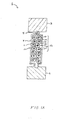
- FIG. 1A illustrates a chromatography system implemented in accordance with an embodiment of the invention.
- FIG. 1B illustrates a chromatography system implemented in accordance with another embodiment of the invention.
- FIG. 1C illustrates a chromatography system implemented in accordance with a further embodiment of the invention.
- FIG. 2 illustrates a packing material implemented in accordance with an embodiment of the invention.
- a set of nanotubes can comprise a single nanotube or multiple nanotubes. Elements of a set can also be referred to as members of the set. Elements of a set can be the same or different. In some instances, elements of a set can share one or more common characteristics.
- adjacent refers to being near or adjoining.
- Adjacent structures can be spaced apart from one another or can be in actual or direct contact with one another. In some instances, adjacent structures can be coupled to one another or can be formed integrally with one another.
- the term "exposed" refers to being subject to possible interaction with the chemical mixture.
- a material can be exposed to a chemical mixture if the material is subject to possible interaction with a set of components of the chemical mixture.
- ком ⁇ онент refers to a portion of the chemical mixture.
- a component of the chemical mixture can comprise a set of molecules that share one or more common characteristics.
- mobile phase refers to a material that carries a set of components of a chemical mixture.
- a mobile phase typically comprises a gas or a liquid in which a set of components of a chemical mixture can be carried upon desorption from a stationary phase.
- a mobile phase carrying a set of components is typically flowed over or through a stationary phase.
- stationary phase refers to a material to which a set of components of a chemical mixture can be adsorbed.
- a stationary phase typically comprises a liquid or a solid, and, in some instances, the stationary phase is positioned in a chromatography column.
- retention time refers to the amount of time required for a component of a chemical mixture to pass through a chromatography column.
- resolution refers to a degree of separation between components of a chemical mixture that pass through a chromatography column.
- One measure of resolution is a degree of separation between adjacent peaks in a resulting chromatogram.
- nm range refers to a range of dimensions from about 0.1 nm to about 1,000 nm, such as from about 0.1 nm to about 500 nm, from about 0.1 nm to about 100 nm, from about 0.1 nm to about 50 nm, or from about 0.1 nm to about 10 nm.
- micrometer range refers to a range of dimensions from about 0.1 micrometer (“ ⁇ m”) to about 1,000 ⁇ m, such as from about 0.1 ⁇ m to about 500 ⁇ m, from about 0.1 ⁇ m to about 100 ⁇ m, from about 0.1 ⁇ m to about 50 ⁇ m, or from about 0.1 ⁇ m to about 10 ⁇ m.
- an aspect ratio refers to a ratio of a largest dimension of a structure and an average of remaining dimensions of the structure, which remaining dimensions are orthogonal with respect to one another and with respect to the largest dimension.
- remaining dimensions of a structure can be substantially the same, and an average of the remaining dimensions can substantially correspond to either of the remaining dimensions.
- an aspect ratio of a cylinder refers to a ratio of a length of the cylinder and a cross-sectional diameter of the cylinder.
- an aspect ratio of a spheroid refers to a ratio of a major axis of the spheroid and a minor axis of the spheroid.
- a size of a cylinder refers to a length of the cylinder.
- a size of a spheroid refers to a major axis of the spheroid.
- hydrophobic and hydrophobic refer to an affinity for water
- hydrophobic and hydroophobicity refer to a lack of affinity for water
- Hydrophobic materials typically correspond to those materials to which water has little or no tendency to adhere. As such, water on a surface of a hydrophobic material tends to bead up. Hydrophobic materials can sometimes be referred to as non-wetting materials. In addition to the characteristics discussed above, hydrophobic materials can sometimes be non-polar.
- One measure of hydrophobicity of a material is a contact angle between a surface of the material and a line tangent to a drop of water at a point of contact with the surface. Typically, the material is considered to be hydrophobic if the contact angle is greater than about 90°, such as greater than about 100°, greater than about 105°, or greater than about 110°.
- polar and polarity refer to a presence of a substantially stable dipole moment or electrical charge
- non-polar refer to a lack of a substantially stable dipole moment or electrical charge
- materials can exhibit different degrees of polarity or non-polarity based on differences in their respective dipole moments or electrical charges. While a material is sometimes referred to herein as being non-polar, it is contemplated that the material can exhibit some detectable dipole moment or electrical charge under certain conditions.
- adsorb As used herein, the terms “adsorb,” “adsorbent,” and “adsorption” refer to an adhesion to a surface. Typically, adsorption is a reversible process and is based on any of a wide variety of intermolecular interactions, such as Van der Waals, dispersion, dipole-dipole, hydrogen bonding, coordination, and the like.
- the terms "robust” and “robustness” refer to a mechanical hardness or strength. Robust materials typically correspond to those materials that exhibit little or no tendency to fragment under typical operating conditions, such as typical operating conditions of the packing materials described herein.
- One measure of robustness of a material is its Vicker microhardness expressed in kilogram/millimeter (“kg/mm”). Typically, the material is considered to be robust if its Vicker microhardness is greater than about 1,000 kg/mm.
- microstructure refers to a microscopic configuration of a material and can encompass, for example, a lattice structure, crystallinity, dislocations, grain boundaries, types of constituent structures, dimensions of constituent structures, range of defects, doping level, surface functionalization, and the like.
- a microstructure is one comprising a Single-Walled Carbon Nanotube ("SWCNT").
- SWCNT Single-Walled Carbon Nanotube
- MWCNT Multi-Walled Carbon Nanotube
- a further example of a microstructure is an array or arrangement of nanotubes.
- nanotube refers to an elongated, hollow structure.
- a nanotube can be represented as comprising an unfilled cylindrical shape.
- a nanotube comprises a cross-sectional diameter in the nm range, a length in the ⁇ m range, and an aspect ratio that is about 2 or greater.
- One example of a nanotube is one that comprises or is formed from carbon, namely a carbon nanotube.
- a carbon nanotube can be formed as a SWCNT or a MWCNT.
- a SWCNT can be represented as a single graphite layer that is rolled into a cylindrical shape.
- a SWCNT typically comprises a cross-sectional diameter that is less than about 2 nm, such as from about 0.1 nm to about 2 nm.
- a MWCNT can be represented as multiple graphite layers that are rolled into concentric cylindrical shapes.
- a MWCNT typically comprises a cross-sectional diameter that is about 3 nm or greater, such as from about 3 nm to about 100 nm.
- a nanotube typically comprises a substantially ordered array or arrangement of atoms and, thus, can be referred to as being substantially ordered or comprising a substantially ordered microstructure. It is contemplated that a nanotube can comprise a range of defects and can be doped or surface functionalized. Nanotubes can be formed using any of a wide variety of techniques, such as arc-discharge, laser ablation, chemical vapor deposition, and the like. Nanotubes can also be formed from certain elongated structures.
- nanotube material refers to a material that comprises or is formed from a set of nanotubes.
- a nanotube material is one that comprises or is formed from a set of carbon nanotubes, namely a carbon nanotube material.
- a nanotube material can comprise a substantially ordered array or arrangement of nanotubes and, thus, can be referred to as being substantially ordered or comprising a substantially ordered microstructure.
- a nanotube material can comprise an array of nanotubes that are substantially aligned with respect to one another or with respect to a certain axis, direction, plane, surface, or three-dimensional shape.
- a nanotube material can comprise a substantially random array or arrangement of nanotubes and, thus, can be referred to as being substantially random or comprising a substantially random microstructure.
- FIG. 1A illustrates a chromatography system 1 implemented in accordance with an embodiment of the invention.
- the chromatography system 1 is implemented as a LC system and operates to separate components of a chemical mixture, such as a set of glycoproteins, glycopeptides, oligosaccharides, or a combination thereof.
- a chemical mixture such as a set of glycoproteins, glycopeptides, oligosaccharides, or a combination thereof.
- the chromatography system 1 can be implemented to separate the components using any other separation technique.
- the chromatography system 1 comprises an injection device 3, which operates to deliver a sample stream 5.
- the sample stream 5 comprises the components to be separated by the chromatography system 1.
- the sample stream 5 also comprises a solvent system, which can serve as a mobile phase and can comprise any of a wide variety of suitable liquids.
- the solvent system can comprise a set of solvents in which the components can be dispersed.
- the solvent system is relatively polar, and, in other implementations, the polarity of the solvent system can be adjusted during operation of the chromatography system 1.
- the injection device 3 can be implemented in any of a wide variety of ways, such as using a pump or a syringe.
- the chromatography system 1 also comprises a chromatography column 7, which is positioned downstream with respect to the injection device 3 to receive the sample stream 5.
- the chromatography column 7 operates to separate the components as a function of differences in degree of adsorption of the components.
- the chromatography column 7 comprises a channel 11, which defines an internal passageway 13.
- the channel 11 comprises a cylindrical shape and a cross-sectional diameter in the ⁇ m range, such as from about 5 ⁇ m to about 500 ⁇ m.
- the channel 11 can comprise any of a wide variety of other shapes and cross-sectional diameters.
- the channel 11 can be formed from any of a wide variety of materials, such as ceramics, glasses, metals, metal alloys, polymers, and the like.
- the chromatography column 7 also comprises a packing material 15, which is positioned in the internal passageway 13.
- the packing material 15 can be packed in the internal passageway 13 using any of a wide variety of high pressure processes.
- the chromatography system 1 further comprises a detector 9, which is positioned downstream with respect to the chromatography column 7 to receive the sample stream 5.
- the detector 9 operates to detect the components that are separated by the chromatography column 7 and to produce a chromatogram.
- the detector 9 can be implemented in any of a wide variety of ways, such as using an ultraviolet absorption detector, a fluorescence detector, or a mass spectrometer.
- the packing material 15 is exposed to the sample stream 5 as it passes through the chromatography column 7. Characteristics of the packing material 15 can affect the degree of separation between the components comprising the sample stream 5, which, in turn, can affect results of chromatographic analyses. In particular, a component that has a greater tendency of being adsorbed onto the packing material 15 will have a longer retention time, while another component that has a reduced tendency of being adsorbed onto the packing material 15 will have a shorter retention time. Accordingly, it is desirable for the packing material 15 to provide different degrees of adsorption of the components, such that chromatographic analyses have a desired resolution. It is also desirable for the packing material 15 to provide different chirality to allow separation of those components that are chiral.
- the packing material 15 comprises a set of support structures, such as support structures 17, 17', 17", and 17"'.
- each of the set of support structures is formed as a support particle, which can be formed from any of a wide variety of materials, such as ceramics, glasses, metals, metal oxides, metal alloys, polymers, and the like.
- the support particle can be formed from silica, titanium oxide, zirconium oxide, aluminum oxide, and the like.
- the packing material 15 also comprises a nanotube material 19, which serves as a stationary phase.
- the nanotube material 19 is formed as a coating or a layer that at least partly covers each of the set of support structures.
- the nanotube material 19 desirably comprises a carbon nanotube material.
- other types of nanotube materials can be used in place of, or in combination with, a carbon nanotube material.
- the nanotube material 19 can provide different chirality and adsorption of the components comprising the sample stream 5.
- the nanotube material 19 can effectively separate the components and can provide a desired resolution for chromatographic analyses.
- the nanotube material 19 can provide a desired resolution when separating certain biomolecules, such as post-translationally modified forms of proteins as well as fragments or portions thereof, which can occur as isomers that differ slightly from one another in terms of chirality or structure.
- post-translationally modified forms of proteins comprise proteins that are phosphorylated, glycosylated, and the like.
- effective separation of such biomolecules can play an important role in the study of certain diseases, such as heart diseases, cancer, neurodegenerative diseases, diabetes, and the like.
- the nanotube material 19 can provide an adsorbent surface that is highly hydrophobic.
- hydrophobicity of the adsorbent surface allows it to exhibit different affinities for the components based on differences in their polarity or non-polarity, which can result from differences in their chirality or structure. It is contemplated that hydrophobicity of the nanotube material 19 can be adjusted by, for example, surface functionalization.
- the nanotube material 19 can exhibit a number of other characteristics that are desirable for LC. Without wishing to be bound by a particular theory, it is believed that a particular microstructure of the nanotube material 19 contributes to at least some of its desirable and unusual characteristics.
- this microstructure can be precisely controlled, such as by controlling chirality, a range of defects, or dimensions of a set of nanotubes, which, in turn, allows fine-tuned control of the characteristics of the nanotube material 19. In such manner, the nanotube material 19 can provide a desired reproducibility for chromatographic analyses.
- the nanotube material 19 can provide an adsorbent surface comprising a high surface area. Such high surface area can enhance interaction with the components comprising the sample stream 5, which, in turn, can enhance resolution for chromatographic analysis. In addition, such high surface area can reduce the amount of the packing material 15 required to achieve a particular resolution.
- Another benefit of the nanotube material 19 is that it can be formed subsequent to the set of support structures being packed in the internal passageway 13. Thus, for example, the set of support structures can be packed in the internal passageway 13 using any of a wide variety of high pressure processes, and the nanotube material 19 can be formed on the set of support structures, such as by growing a set of nanotubes on the set of support structures.
- the nanotube material 19 can reduce interstitial space within the packing material 15, which, in turn, can enhance interaction with the components comprising the sample stream 5 and further enhance resolution for chromatographic analysis.
- the nanotube material 19 can be formed on the set of support structures to form the packing material 15, which, in turn, can be packed in the internal passageway 13.
- a further benefit of the nanotube material 19 is that it can be highly robust when implemented in the packing material 15.
- the nanotube material 19 can exhibit little or no tendency to degrade under typical operating conditions of the packing material 15, thus reducing undesirable chemical background noise in a resulting chromatogram.
- Robustness of the nanotube material 19 can also increase operational lifetime of the packing material 15, such as by allowing the packing material 15 to be readily cleaned and to be reused for multiple tests.
- FIG. 1A illustrates the nanotube material 19 being formed as a coating or a layer
- the packing material 15 can be substantially formed from the nanotube material 19 without requiring the set of support structures.
- FIG. 1B illustrates a chromatography system 1' implemented in accordance with another embodiment of the invention. Certain elements of the chromatography system 1' can be implemented in a similar fashion as previously described for the chromatography system 1 and, thus, need not be further described herein.
- the chromatography system 1' comprises a chromatography column 7', which comprises a channel 11' that defines an internal passageway 13'.
- the chromatography column 7' also comprises a packing material 15' that is positioned in the internal passageway 13'.
- the packing material 15' comprises a set of nanotubes that are packed in the internal passageway 13' using any of a wide variety of high pressure processes. It is also contemplated that the packing material 15' can be formed by polymerization of a set of monomers along with the set of nanotubes, thus forming the chromatography column 7' in a monolithic fashion.
- FIG. 1C illustrates a chromatography system 1" implemented in accordance with a further embodiment of the invention. Certain elements of the chromatography system 1" can be implemented in a similar fashion as previously described for the chromatography system 1 and, thus, need not be further described herein.
- the chromatography system 1" comprises a chromatography column 7", which comprises a channel 11" that defines an internal passageway 13".
- the channel 11" comprises a nanotube material 19", which can be formed as a coating or a layer that at least partly covers an internal surface surrounding the internal passageway 13". It is also contemplated that the channel 11" can be substantially formed from the nanotube material 19".
- portions of the chromatography column 7" can comprise the nanotube material 19".
- any portion of the chromatography column 7" that is exposed to the sample stream 5 can comprise the nanotube material 19".
- different portions of the chromatography column 7" can comprise nanotube materials that are the same or different. Cross-sectional diameters and lengths of nanotubes comprising the different portions can be precisely controlled.
- FIG. 2 illustrates a packing material 21 implemented in accordance with an embodiment of the invention.
- the packing material 21 comprises a support particle 23 that comprises an outer surface 25.
- the support particle 23 comprises a spheroidal shape and a size in the ⁇ m range, such as from about 1 ⁇ m to about 15 ⁇ m or from about 3 ⁇ m to about 5 ⁇ m.
- the support particle 23 can comprise any of a wide variety of other shapes and sizes.
- the packing material 21 also comprises a set of carbon nanotubes, such as carbon nanotubes 27, 27', 27", and 27"', which are adjacent to and extend away from the outer surface 25. While sixteen carbon nanotubes are illustrated in FIG.
- the set of carbon nanotubes comprise lengths in the ⁇ m range, such as from about 1 ⁇ m to about 15 ⁇ m or from about 1 ⁇ m to about 2 ⁇ m.
- the set of carbon nanotubes are formed as an array that is substantially ordered.
- the set of carbon nanotubes are substantially regularly spaced with respect to one another along the outer surface 25 and are substantially aligned radially with respect to the support particle 23.
- an angle defined by an axis extending through a length of each of the set of carbon nanotubes and the outer surface 25 is substantially 90°.
- this angle can be adjusted to differ from 90°, such as any other angle from 0° to 180°.
- the set of carbon nanotubes comprise lengths that are substantially uniform.
- the lengths deviate less than about 50 percent in root mean square (“rms”), such as less than about 20 percent in rms or less than about 5 percent in rms.
- the set of carbon nanotubes can separate components comprising the sample stream and can provide a desired resolution and a desired reproducibility for chromatographic analyses.
- the substantially ordered microstructure of the set of carbon nanotubes contributes to at least some of these desirable characteristics. It is contemplated that the number, spacing, alignment, and dimensions of the set of carbon nanotubes can be adjusted to tune these desirable characteristics.
- the packing material 21 can be formed using any of a wide variety of techniques.
- the set of carbon nanotubes can be grown on the support particle 23 using, for example, chemical vapor deposition.
- chemical vapor deposition uses a hydrocarbon gas as a carbon feedstock and catalysts as "seeds" to grow carbon nanotubes.
- catalysts comprise particles that comprise sizes in the nm range and that are formed from metals, metal oxides, and metal alloys, such as Fe, Fe/Mo, Co, Co/Mo, Ni, Fe/Pt, and the like. Growth of carbon nanotubes can involve deposition or formation of catalysts used for chemical vapor deposition.
- the outer surface 25 can comprise amino or hydroxyl functional groups, and catalysts can be deposited on the outer surface 25 using a suitable catalyst suspension, such as a suspension of Fe 2 O 3 particles.
- a suitable catalyst suspension such as a suspension of Fe 2 O 3 particles.
- the outer surface 25 can be charged by attachment of suitable functional groups. Catalysts can also be charged by attachment of suitable surfactants.
- the catalysts can be attracted to the outer surface 25 and can be deposited thereon.
- the outer surface 25 can be coated with a suitable metal-bearing polymer, such as one comprising iron-complexed polymethylglutarimide, polyferrocenylethylmethylsilane, iron-containing phenolic resin, and the like.
- the outer surface 25 can be coated with micelles formed in solution from diblock copolymers.
- Micelle cores can comprise polymer segments that comprise suitable metal groups.
- copolymers comprise polystyrene-b-Fe complexed polyvinylpyridine, polystyrene-b-polyferrocenylethylmethylsilane, polyisoprene-b-polyferrocenylethylmethylsilane, and the like.
- Micelle size and spacing can be determined by copolymer properties, thus allowing control over a density of the set of carbon nanotubes.
- Removal of carbonaceous material at high temperature can leave the outer surface 25 with catalysts deposited thereon to be used for carbon nanotube growth.
- metal-containing monomer units such as chloromethylsilaferrocenophane
- metal-containing monomer units such as chloromethylsilaferrocenophane
- metal-containing monomer units such as chloromethylsilaferrocenophane
- metal-containing monomer units such as chloromethylsilaferrocenophane
- infiltration with additional silaferrocenophane monomer followed by polymerization yields the outer surface 25 to which polyferrocenylsilanes can be directly attached.
- Catalyts can be formed on the outer surface 25 by removal of carbonaceous material, and the catalysts can be used for carbon nanotube growth.
- the set of carbon nanotubes can be formed using any of a wide variety of techniques and then deposited on the support particle 23.
- the set of carbon nanotubes can be dispersed in a suitable solvent to form a "paint," and this paint can be applied to the outer surface 25.
- the solvent can be relatively inert.
- the solvent can facilitate coupling between the set of carbon nanotubes and the outer surface 25. Heat can be applied to evaporate the solvent or to promote coupling.
- the set of carbon nanotubes can be sprayed at high velocity onto the support particle 23, such that the set of carbon nanotubes are coupled to the outer surface 25.
- the alignment of the set of carbon nanotubes can be achieved by applying an electric field during deposition.
- the set of carbon nanotubes can be deposited on the support particle 23 so as to form a substantially random array.
Landscapes
- Chemical & Material Sciences (AREA)
- Analytical Chemistry (AREA)
- Organic Chemistry (AREA)
- Chemical Kinetics & Catalysis (AREA)
- Engineering & Computer Science (AREA)
- Crystallography & Structural Chemistry (AREA)
- Materials Engineering (AREA)
- Nanotechnology (AREA)
- Inorganic Chemistry (AREA)
- Treatment Of Liquids With Adsorbents In General (AREA)
Applications Claiming Priority (1)
| Application Number | Priority Date | Filing Date | Title |
|---|---|---|---|
| US11/107,459 US20060231494A1 (en) | 2005-04-15 | 2005-04-15 | Carbon nanotube stationary phases for chromatography |
Publications (1)
| Publication Number | Publication Date |
|---|---|
| EP1712276A1 true EP1712276A1 (de) | 2006-10-18 |
Family
ID=36498934
Family Applications (1)
| Application Number | Title | Priority Date | Filing Date |
|---|---|---|---|
| EP06252034A Withdrawn EP1712276A1 (de) | 2005-04-15 | 2006-04-12 | Kohlenstoffnanoröhrchen als stationäre Phasen für die Chromatographie |
Country Status (2)
| Country | Link |
|---|---|
| US (1) | US20060231494A1 (de) |
| EP (1) | EP1712276A1 (de) |
Cited By (2)
| Publication number | Priority date | Publication date | Assignee | Title |
|---|---|---|---|---|
| CN102179238A (zh) * | 2011-03-04 | 2011-09-14 | 兰州大学 | 一种固载纳米碳的硅胶固定相及其制备方法 |
| CN102309958A (zh) * | 2010-07-02 | 2012-01-11 | 中国科学院兰州化学物理研究所 | 一种多壁碳纳米管修饰硅胶色谱填料的制备方法 |
Families Citing this family (7)
| Publication number | Priority date | Publication date | Assignee | Title |
|---|---|---|---|---|
| US20070015179A1 (en) * | 2005-04-26 | 2007-01-18 | Trustees Of Boston University | Plastic microfluidic chip and methods for isolation of nucleic acids from biological samples |
| FR2885898B1 (fr) * | 2005-05-17 | 2007-07-06 | Commissariat Energie Atomique | Composant microfluidique comprenant au moins un canal rempli de nanotubes et procede de fabrication d'un tel composant microfluidique. |
| US8132443B2 (en) | 2008-05-01 | 2012-03-13 | The United States Of America As Represented By The Secretary Of The Navy | Microfabricated gas chromatograph |
| US20110011157A1 (en) * | 2009-07-16 | 2011-01-20 | Bertrand Bourlon | Gas chromatograph column with carbon nanotube-bearing channel |
| WO2013152144A1 (en) | 2012-04-05 | 2013-10-10 | The Research Foundation Of State University Of New York | Three-dimensional carbon structures |
| CN104692358B (zh) * | 2015-02-16 | 2019-03-15 | 中国科学院物理研究所 | 碳纳米管分离方法 |
| US10168207B2 (en) * | 2016-06-01 | 2019-01-01 | International Business Machines Corporation | Sunscreen effectiveness monitoring |
Citations (2)
| Publication number | Priority date | Publication date | Assignee | Title |
|---|---|---|---|---|
| WO1997032571A1 (en) * | 1996-03-06 | 1997-09-12 | Hyperion Catalysis International, Inc. | Functionalized nanotubes |
| US5800706A (en) * | 1996-03-06 | 1998-09-01 | Hyperion Catalysis International, Inc. | Nanofiber packed beds having enhanced fluid flow characteristics |
Family Cites Families (8)
| Publication number | Priority date | Publication date | Assignee | Title |
|---|---|---|---|---|
| US5308481A (en) * | 1992-06-02 | 1994-05-03 | Analytical Bio-Chemistry Laboratories, Inc. | Chemically bound fullerenes to resin and silica supports and their use as stationary phases for chromatography |
| US5658413A (en) * | 1994-10-19 | 1997-08-19 | Hewlett-Packard Company | Miniaturized planar columns in novel support media for liquid phase analysis |
| US20020056686A1 (en) * | 1996-06-14 | 2002-05-16 | Agathagelos Kyrlidis | Chromatography and other adsorptions using modified carbon adsorbents |
| US6210570B1 (en) * | 1998-08-21 | 2001-04-03 | Agilent Technologies, Inc. | Monolithic silica column |
| US6207049B1 (en) * | 1999-07-30 | 2001-03-27 | Agilent Technologies, Inc. | Multichannel capillary column |
| US6787029B2 (en) * | 2001-08-31 | 2004-09-07 | Cabot Corporation | Material for chromatography |
| US6713519B2 (en) * | 2001-12-21 | 2004-03-30 | Battelle Memorial Institute | Carbon nanotube-containing catalysts, methods of making, and reactions catalyzed over nanotube catalysts |
| US20040007528A1 (en) * | 2002-07-03 | 2004-01-15 | The Regents Of The University Of California | Intertwined, free-standing carbon nanotube mesh for use as separation, concentration, and/or filtration medium |
-
2005
- 2005-04-15 US US11/107,459 patent/US20060231494A1/en not_active Abandoned
-
2006
- 2006-04-12 EP EP06252034A patent/EP1712276A1/de not_active Withdrawn
Patent Citations (2)
| Publication number | Priority date | Publication date | Assignee | Title |
|---|---|---|---|---|
| WO1997032571A1 (en) * | 1996-03-06 | 1997-09-12 | Hyperion Catalysis International, Inc. | Functionalized nanotubes |
| US5800706A (en) * | 1996-03-06 | 1998-09-01 | Hyperion Catalysis International, Inc. | Nanofiber packed beds having enhanced fluid flow characteristics |
Cited By (4)
| Publication number | Priority date | Publication date | Assignee | Title |
|---|---|---|---|---|
| CN102309958A (zh) * | 2010-07-02 | 2012-01-11 | 中国科学院兰州化学物理研究所 | 一种多壁碳纳米管修饰硅胶色谱填料的制备方法 |
| CN102309958B (zh) * | 2010-07-02 | 2013-04-10 | 中国科学院兰州化学物理研究所 | 一种多壁碳纳米管修饰硅胶色谱填料的制备方法 |
| CN102179238A (zh) * | 2011-03-04 | 2011-09-14 | 兰州大学 | 一种固载纳米碳的硅胶固定相及其制备方法 |
| CN102179238B (zh) * | 2011-03-04 | 2012-12-05 | 兰州大学 | 一种固载纳米碳的硅胶固定相及其制备方法 |
Also Published As
| Publication number | Publication date |
|---|---|
| US20060231494A1 (en) | 2006-10-19 |
Similar Documents
| Publication | Publication Date | Title |
|---|---|---|
| Valcárcel et al. | Carbon nanostructures as sorbent materials in analytical processes | |
| Zhang et al. | Metal–organic frameworks@ graphene hybrid aerogels for solid-phase extraction of non-steroidal anti-inflammatory drugs and selective enrichment of proteins | |
| Fontanals et al. | New hydrophilic materials for solid-phase extraction | |
| Ansari et al. | A multi-walled carbon nanotube-based magnetic molecularly imprinted polymer as a highly selective sorbent for ultrasonic-assisted dispersive solid-phase microextraction of sotalol in biological fluids | |
| Heidari et al. | Preparation and characterization of ceramic/carbon coated Fe3O4 magnetic nanoparticle nanocomposite as a solid-phase microextraction adsorbent | |
| Tang et al. | Nanoparticle-based monoliths for chromatographic separations | |
| JP2007192805A (ja) | ナノ粒子/ナノファイバによる化学センサ、そのセンサのアレイ、その使用及び製造方法、並びに検体の検出方法 | |
| EP1712276A1 (de) | Kohlenstoffnanoröhrchen als stationäre Phasen für die Chromatographie | |
| Lingli et al. | MXene/reduced graphene oxide hydrogel film extraction combined with gas chromatography–tandem mass spectrometry for the determination of 16 polycyclic aromatic hydrocarbons in river and tap water | |
| Zhou et al. | Enantioselective open-tubular capillary electrochromatography using a β-cyclodextrin–gold nanoparticles–polydopamine coating as a stationary phase | |
| EP2640508A1 (de) | Beschallung für verbesserte teilchengrössenverteilung von kern-hülle-partikeln | |
| Lv et al. | Adsorption-controlled preparation of molecularly imprinted hybrid composites for selective extraction of tetracycline residues from honey and milk | |
| Intrchom et al. | Analytical sample preparation, preconcentration and chromatographic separation on carbon nanotubes | |
| Esrafili et al. | Electrospun zeolitic imidazolate framework-8/poly (lactic acid) nanofibers for pipette-tip micro-solid phase extraction of carbamate insecticides from environmental samples | |
| Li et al. | Self-assembled cyclodextrin-modified gold nanoparticles on silica beads as stationary phase for chiral liquid chromatography and hydrophilic interaction chromatography | |
| F. Samanidou et al. | Carbon nanotubes in sample preparation | |
| US20190092800A1 (en) | Liquid chromatographic separation of carbohydrate tautomers | |
| Mehdinia et al. | Selective adsorption of 2, 4-dinitrophenol on molecularly imprinted nanocomposites of mesoporous silica SBA-15/polyaniline | |
| Liang et al. | Layer-by-layer self-assembled graphene oxide/silica microsphere composites as stationary phase for high performance liquid chromatography | |
| Wang et al. | A study of the precipitation polymerization of bisphenol A-imprinted polymer microspheres and their application in solid-phase extraction | |
| US20120288958A1 (en) | Carbon Laminated Materials for Sample Preparation | |
| Jafari et al. | In situ growth of zeolitic imidazolate framework-8 on a GO–PVDF membrane as a sorbent for thin-film microextraction of caffeine followed by quantitation through high-performance liquid chromatography | |
| Su et al. | Room temperature in situ growth of fluorinated covalent organic framework on electrospun nanofibers for efficient detection of benzoylurea insecticide residue in water samples | |
| Khajeh et al. | Magnetic molecularly imprinted polymers–silver nanoparticle based micro-solid phase extraction for the determination of polycyclic aromatic hydrocarbons in water samples | |
| Chen et al. | Nanoscale carbon-based materials in protein isolation and preconcentration |
Legal Events
| Date | Code | Title | Description |
|---|---|---|---|
| PUAI | Public reference made under article 153(3) epc to a published international application that has entered the european phase |
Free format text: ORIGINAL CODE: 0009012 |
|
| AK | Designated contracting states |
Kind code of ref document: A1 Designated state(s): AT BE BG CH CY CZ DE DK EE ES FI FR GB GR HU IE IS IT LI LT LU LV MC NL PL PT RO SE SI SK TR |
|
| AX | Request for extension of the european patent |
Extension state: AL BA HR MK YU |
|
| RAP1 | Party data changed (applicant data changed or rights of an application transferred) |
Owner name: AGILENT TECHNOLOGIES, INC. |
|
| 17P | Request for examination filed |
Effective date: 20070418 |
|
| 17Q | First examination report despatched |
Effective date: 20070523 |
|
| AKX | Designation fees paid |
Designated state(s): DE FR GB |
|
| STAA | Information on the status of an ep patent application or granted ep patent |
Free format text: STATUS: THE APPLICATION IS DEEMED TO BE WITHDRAWN |
|
| 18D | Application deemed to be withdrawn |
Effective date: 20081101 |