EP1712607A1 - Wärmepumpe-Warmwasserboiler mit einem Kältemittelkreislauf und Kältemaschinenöl dafür - Google Patents
Wärmepumpe-Warmwasserboiler mit einem Kältemittelkreislauf und Kältemaschinenöl dafür Download PDFInfo
- Publication number
- EP1712607A1 EP1712607A1 EP06003450A EP06003450A EP1712607A1 EP 1712607 A1 EP1712607 A1 EP 1712607A1 EP 06003450 A EP06003450 A EP 06003450A EP 06003450 A EP06003450 A EP 06003450A EP 1712607 A1 EP1712607 A1 EP 1712607A1
- Authority
- EP
- European Patent Office
- Prior art keywords
- oil
- refrigeration
- heat
- weight
- polyol ester
- Prior art date
- Legal status (The legal status is an assumption and is not a legal conclusion. Google has not performed a legal analysis and makes no representation as to the accuracy of the status listed.)
- Withdrawn
Links
Images


Classifications
-
- F—MECHANICAL ENGINEERING; LIGHTING; HEATING; WEAPONS; BLASTING
- F25—REFRIGERATION OR COOLING; COMBINED HEATING AND REFRIGERATION SYSTEMS; HEAT PUMP SYSTEMS; MANUFACTURE OR STORAGE OF ICE; LIQUEFACTION SOLIDIFICATION OF GASES
- F25B—REFRIGERATION MACHINES, PLANTS OR SYSTEMS; COMBINED HEATING AND REFRIGERATION SYSTEMS; HEAT PUMP SYSTEMS
- F25B30/00—Heat pumps
-
- C—CHEMISTRY; METALLURGY
- C10—PETROLEUM, GAS OR COKE INDUSTRIES; TECHNICAL GASES CONTAINING CARBON MONOXIDE; FUELS; LUBRICANTS; PEAT
- C10M—LUBRICATING COMPOSITIONS; USE OF CHEMICAL SUBSTANCES EITHER ALONE OR AS LUBRICATING INGREDIENTS IN A LUBRICATING COMPOSITION
- C10M111/00—Lubrication compositions characterised by the base-material being a mixture of two or more compounds covered by more than one of the main groups C10M101/00 - C10M109/00, each of these compounds being essential
- C10M111/02—Lubrication compositions characterised by the base-material being a mixture of two or more compounds covered by more than one of the main groups C10M101/00 - C10M109/00, each of these compounds being essential at least one of them being a non-macromolecular organic compound
-
- C—CHEMISTRY; METALLURGY
- C10—PETROLEUM, GAS OR COKE INDUSTRIES; TECHNICAL GASES CONTAINING CARBON MONOXIDE; FUELS; LUBRICANTS; PEAT
- C10M—LUBRICATING COMPOSITIONS; USE OF CHEMICAL SUBSTANCES EITHER ALONE OR AS LUBRICATING INGREDIENTS IN A LUBRICATING COMPOSITION
- C10M111/00—Lubrication compositions characterised by the base-material being a mixture of two or more compounds covered by more than one of the main groups C10M101/00 - C10M109/00, each of these compounds being essential
- C10M111/04—Lubrication compositions characterised by the base-material being a mixture of two or more compounds covered by more than one of the main groups C10M101/00 - C10M109/00, each of these compounds being essential at least one of them being a macromolecular organic compound
-
- C—CHEMISTRY; METALLURGY
- C10—PETROLEUM, GAS OR COKE INDUSTRIES; TECHNICAL GASES CONTAINING CARBON MONOXIDE; FUELS; LUBRICANTS; PEAT
- C10M—LUBRICATING COMPOSITIONS; USE OF CHEMICAL SUBSTANCES EITHER ALONE OR AS LUBRICATING INGREDIENTS IN A LUBRICATING COMPOSITION
- C10M171/00—Lubricating compositions characterised by purely physical criteria, e.g. containing as base-material, thickener or additive, ingredients which are characterised exclusively by their numerically specified physical properties, i.e. containing ingredients which are physically well-defined but for which the chemical nature is either unspecified or only very vaguely indicated
-
- C—CHEMISTRY; METALLURGY
- C10—PETROLEUM, GAS OR COKE INDUSTRIES; TECHNICAL GASES CONTAINING CARBON MONOXIDE; FUELS; LUBRICANTS; PEAT
- C10M—LUBRICATING COMPOSITIONS; USE OF CHEMICAL SUBSTANCES EITHER ALONE OR AS LUBRICATING INGREDIENTS IN A LUBRICATING COMPOSITION
- C10M171/00—Lubricating compositions characterised by purely physical criteria, e.g. containing as base-material, thickener or additive, ingredients which are characterised exclusively by their numerically specified physical properties, i.e. containing ingredients which are physically well-defined but for which the chemical nature is either unspecified or only very vaguely indicated
- C10M171/008—Lubricant compositions compatible with refrigerants
-
- F—MECHANICAL ENGINEERING; LIGHTING; HEATING; WEAPONS; BLASTING
- F25—REFRIGERATION OR COOLING; COMBINED HEATING AND REFRIGERATION SYSTEMS; HEAT PUMP SYSTEMS; MANUFACTURE OR STORAGE OF ICE; LIQUEFACTION SOLIDIFICATION OF GASES
- F25B—REFRIGERATION MACHINES, PLANTS OR SYSTEMS; COMBINED HEATING AND REFRIGERATION SYSTEMS; HEAT PUMP SYSTEMS
- F25B1/00—Compression machines, plants or systems with non-reversible cycle
-
- C—CHEMISTRY; METALLURGY
- C10—PETROLEUM, GAS OR COKE INDUSTRIES; TECHNICAL GASES CONTAINING CARBON MONOXIDE; FUELS; LUBRICANTS; PEAT
- C10M—LUBRICATING COMPOSITIONS; USE OF CHEMICAL SUBSTANCES EITHER ALONE OR AS LUBRICATING INGREDIENTS IN A LUBRICATING COMPOSITION
- C10M2203/00—Organic non-macromolecular hydrocarbon compounds and hydrocarbon fractions as ingredients in lubricant compositions
- C10M2203/10—Petroleum or coal fractions, e.g. tars, solvents, bitumen
-
- C—CHEMISTRY; METALLURGY
- C10—PETROLEUM, GAS OR COKE INDUSTRIES; TECHNICAL GASES CONTAINING CARBON MONOXIDE; FUELS; LUBRICANTS; PEAT
- C10M—LUBRICATING COMPOSITIONS; USE OF CHEMICAL SUBSTANCES EITHER ALONE OR AS LUBRICATING INGREDIENTS IN A LUBRICATING COMPOSITION
- C10M2203/00—Organic non-macromolecular hydrocarbon compounds and hydrocarbon fractions as ingredients in lubricant compositions
- C10M2203/10—Petroleum or coal fractions, e.g. tars, solvents, bitumen
- C10M2203/1006—Petroleum or coal fractions, e.g. tars, solvents, bitumen used as base material
-
- C—CHEMISTRY; METALLURGY
- C10—PETROLEUM, GAS OR COKE INDUSTRIES; TECHNICAL GASES CONTAINING CARBON MONOXIDE; FUELS; LUBRICANTS; PEAT
- C10M—LUBRICATING COMPOSITIONS; USE OF CHEMICAL SUBSTANCES EITHER ALONE OR AS LUBRICATING INGREDIENTS IN A LUBRICATING COMPOSITION
- C10M2205/00—Organic macromolecular hydrocarbon compounds or fractions, whether or not modified by oxidation as ingredients in lubricant compositions
- C10M2205/02—Organic macromolecular hydrocarbon compounds or fractions, whether or not modified by oxidation as ingredients in lubricant compositions containing acyclic monomers
- C10M2205/028—Organic macromolecular hydrocarbon compounds or fractions, whether or not modified by oxidation as ingredients in lubricant compositions containing acyclic monomers containing aliphatic monomers having more than four carbon atoms
-
- C—CHEMISTRY; METALLURGY
- C10—PETROLEUM, GAS OR COKE INDUSTRIES; TECHNICAL GASES CONTAINING CARBON MONOXIDE; FUELS; LUBRICANTS; PEAT
- C10M—LUBRICATING COMPOSITIONS; USE OF CHEMICAL SUBSTANCES EITHER ALONE OR AS LUBRICATING INGREDIENTS IN A LUBRICATING COMPOSITION
- C10M2205/00—Organic macromolecular hydrocarbon compounds or fractions, whether or not modified by oxidation as ingredients in lubricant compositions
- C10M2205/02—Organic macromolecular hydrocarbon compounds or fractions, whether or not modified by oxidation as ingredients in lubricant compositions containing acyclic monomers
- C10M2205/028—Organic macromolecular hydrocarbon compounds or fractions, whether or not modified by oxidation as ingredients in lubricant compositions containing acyclic monomers containing aliphatic monomers having more than four carbon atoms
- C10M2205/0285—Organic macromolecular hydrocarbon compounds or fractions, whether or not modified by oxidation as ingredients in lubricant compositions containing acyclic monomers containing aliphatic monomers having more than four carbon atoms used as base material
-
- C—CHEMISTRY; METALLURGY
- C10—PETROLEUM, GAS OR COKE INDUSTRIES; TECHNICAL GASES CONTAINING CARBON MONOXIDE; FUELS; LUBRICANTS; PEAT
- C10M—LUBRICATING COMPOSITIONS; USE OF CHEMICAL SUBSTANCES EITHER ALONE OR AS LUBRICATING INGREDIENTS IN A LUBRICATING COMPOSITION
- C10M2207/00—Organic non-macromolecular hydrocarbon compounds containing hydrogen, carbon and oxygen as ingredients in lubricant compositions
- C10M2207/28—Esters
- C10M2207/283—Esters of polyhydroxy compounds
-
- C—CHEMISTRY; METALLURGY
- C10—PETROLEUM, GAS OR COKE INDUSTRIES; TECHNICAL GASES CONTAINING CARBON MONOXIDE; FUELS; LUBRICANTS; PEAT
- C10M—LUBRICATING COMPOSITIONS; USE OF CHEMICAL SUBSTANCES EITHER ALONE OR AS LUBRICATING INGREDIENTS IN A LUBRICATING COMPOSITION
- C10M2207/00—Organic non-macromolecular hydrocarbon compounds containing hydrogen, carbon and oxygen as ingredients in lubricant compositions
- C10M2207/28—Esters
- C10M2207/283—Esters of polyhydroxy compounds
- C10M2207/2835—Esters of polyhydroxy compounds used as base material
-
- C—CHEMISTRY; METALLURGY
- C10—PETROLEUM, GAS OR COKE INDUSTRIES; TECHNICAL GASES CONTAINING CARBON MONOXIDE; FUELS; LUBRICANTS; PEAT
- C10N—INDEXING SCHEME ASSOCIATED WITH SUBCLASS C10M RELATING TO LUBRICATING COMPOSITIONS
- C10N2020/00—Specified physical or chemical properties or characteristics, i.e. function, of component of lubricating compositions
- C10N2020/09—Characteristics associated with water
- C10N2020/097—Refrigerants
- C10N2020/106—Containing Carbon dioxide
-
- C—CHEMISTRY; METALLURGY
- C10—PETROLEUM, GAS OR COKE INDUSTRIES; TECHNICAL GASES CONTAINING CARBON MONOXIDE; FUELS; LUBRICANTS; PEAT
- C10N—INDEXING SCHEME ASSOCIATED WITH SUBCLASS C10M RELATING TO LUBRICATING COMPOSITIONS
- C10N2040/00—Specified use or application for which the lubricating composition is intended
- C10N2040/30—Refrigerators lubricants or compressors lubricants
-
- F—MECHANICAL ENGINEERING; LIGHTING; HEATING; WEAPONS; BLASTING
- F25—REFRIGERATION OR COOLING; COMBINED HEATING AND REFRIGERATION SYSTEMS; HEAT PUMP SYSTEMS; MANUFACTURE OR STORAGE OF ICE; LIQUEFACTION SOLIDIFICATION OF GASES
- F25B—REFRIGERATION MACHINES, PLANTS OR SYSTEMS; COMBINED HEATING AND REFRIGERATION SYSTEMS; HEAT PUMP SYSTEMS
- F25B2309/00—Gas cycle refrigeration machines
- F25B2309/06—Compression machines, plants or systems characterised by the refrigerant being carbon dioxide
- F25B2309/061—Compression machines, plants or systems characterised by the refrigerant being carbon dioxide with cycle highest pressure above the supercritical pressure
-
- F—MECHANICAL ENGINEERING; LIGHTING; HEATING; WEAPONS; BLASTING
- F25—REFRIGERATION OR COOLING; COMBINED HEATING AND REFRIGERATION SYSTEMS; HEAT PUMP SYSTEMS; MANUFACTURE OR STORAGE OF ICE; LIQUEFACTION SOLIDIFICATION OF GASES
- F25B—REFRIGERATION MACHINES, PLANTS OR SYSTEMS; COMBINED HEATING AND REFRIGERATION SYSTEMS; HEAT PUMP SYSTEMS
- F25B2339/00—Details of evaporators; Details of condensers
- F25B2339/04—Details of condensers
- F25B2339/047—Water-cooled condensers
-
- F—MECHANICAL ENGINEERING; LIGHTING; HEATING; WEAPONS; BLASTING
- F25—REFRIGERATION OR COOLING; COMBINED HEATING AND REFRIGERATION SYSTEMS; HEAT PUMP SYSTEMS; MANUFACTURE OR STORAGE OF ICE; LIQUEFACTION SOLIDIFICATION OF GASES
- F25B—REFRIGERATION MACHINES, PLANTS OR SYSTEMS; COMBINED HEATING AND REFRIGERATION SYSTEMS; HEAT PUMP SYSTEMS
- F25B2500/00—Problems to be solved
- F25B2500/16—Lubrication
-
- F—MECHANICAL ENGINEERING; LIGHTING; HEATING; WEAPONS; BLASTING
- F25—REFRIGERATION OR COOLING; COMBINED HEATING AND REFRIGERATION SYSTEMS; HEAT PUMP SYSTEMS; MANUFACTURE OR STORAGE OF ICE; LIQUEFACTION SOLIDIFICATION OF GASES
- F25B—REFRIGERATION MACHINES, PLANTS OR SYSTEMS; COMBINED HEATING AND REFRIGERATION SYSTEMS; HEAT PUMP SYSTEMS
- F25B9/00—Compression machines, plants or systems, in which the refrigerant is air or other gas of low boiling point
- F25B9/002—Compression machines, plants or systems, in which the refrigerant is air or other gas of low boiling point characterised by the refrigerant
- F25B9/008—Compression machines, plants or systems, in which the refrigerant is air or other gas of low boiling point characterised by the refrigerant the refrigerant being carbon dioxide
Definitions
- This invention relates to heat-pump hot-water boilers and specifically to the technology of refrigeration oil for enclosed type motor driven compressors having a refrigeration cycle using carbon dioxide as refrigerant.
- CO 2 carbon dioxide
- CO 2 carbon dioxide
- heat-pump hot-water boilers electric car air conditioners, heaters for cold districts, automatic vending machines, and other products.
- the hot-water supplying methods of heat-pump hot-water boilers are grouped into two.
- One method is running the heat-pump cycle using late-night electric power and storing the hot water for 1-day domestic use in a tank.
- the other method is an instantaneous water heater which runs the heat-pump cycle to supply a required quantity of hot water every time when hot water is used.
- the instantaneous water heater requires an auxiliary small water tank to supply hot water before the heat-pump cycle is ready to supply hot water.
- the instantaneous water heater requires a high-output compressor, the instantaneous water heater can supply hot water without breaking up the supply of hot water every time hot water is required.
- the auxiliary storage tank of the instantaneous water heater need not be so big. It can be of a very small capacity. Therefore, the tank can be housed in the heat-pump cycle unit. This can reduce the installation space and the weight of the instantaneous water heater. Therefore, the water heater can be placed in a narrow space like rooms in multiple dwelling houses like a condominium. Further, since the running time of the instantaneous water heater becomes much shorter than that of the hot-water storing boiler, the instantaneous water heater can improve the COP and save more energy.
- a refrigeration oil for the compressor of the refrigeration cycle is generally included in the refrigerant for lubrication, sealing, and cooling of the sliding part.
- the compressor of the refrigeration cycle using a carbon dioxide refrigerant is run under very severe compressing conditions of high temperature (120 to 130 °C) and high pressure (approx. 15 MPa).
- the refrigeration oil is demanded to be highly lubricant, energy-saving, and highly efficient.
- the motor-driven compressor uses mainly heat-resistant PET (polyethylene terephthalate) as the insulating material by which carbon dioxide produces hydrogen carbonate ions and protons in the presence of lots of water in the system
- PET polyethylene terephthalate
- the refrigeration system may be more deteriorated by the CO 2 refrigerant than the HFC refrigerant. Therefore, the water absorbing property of the refrigeration oil should preferably be low.
- a heat-pump hot-water boiler using carbon dioxide as the refrigerant mainly adopts, as the refrigeration oil, polyalkylene glycol oil whose both ends are alkylated because it has a good compatibility with the refrigerant and thermochemical stability.
- Electrical Appliance and Material Safety Law are to control production, import, and distribution of electric appliances and materials, promote private business units to perform independent actions to assure safety of electrical appliances and materials, and prevent dangers and problems of electrical appliances and materials.
- Patent Document 2 discloses a polyol ester oil as a refrigeration oil which is compatible with carbon dioxide excluding the polyalkylene glycol oil.
- the polyol ester oil is too high in compatibility with the carbon dioxide refrigerant. This means that the solution viscosity drops extremely, that the viscosity of the oil to be added also becomes very high, that the sealing ability of the compressor sections goes down, and that the compression efficiency will not be improved.
- the heat pump cycle using a carbon dioxide refrigerant is run in a supercritical status, the refrigeration oil will leak from the compressor and run through the refrigeration cycle if its compatibility is too high. This will increase a pressure loss and reduce the heat-exchange efficiency drastically.
- Patent Document 3 discloses the use of hydrocarbon oils which are good in electric characteristics such as dielectric constant, low in water absorbing property, and non-compatible with carbon dioxide.
- the hydrocarbon oils are less lubricative and cannot be used under severe compressing conditions when carbon dioxide is used as refrigerant.
- a poly- ⁇ -olefin oil which is a kind of hydrocarbon oil has a high viscosity index and high flowability at low temperature, but the quantity of oil to be returned to the compressor becomes less.
- an alkylbenzene oil is not preferable because its viscosity index is low, and the oil becomes very viscous in the low-temperature section in the refrigeration cycle and is apt to stay there.
- a hydrocarbon oil such as poly- ⁇ -olefin oil and a mineral oil which never or hardly dissolves into carbon dioxide (having non-compatibility with carbon dioxide) as disclosed in the Patent Documents 3 and 4 as a refrigeration oil for a heat-pump type hot water boiler since the hydrocarbon oils are good in sealing the sliding section of the compressor and increase the efficiency of compression. Further, since the hydrocarbon oils are low in dielectric constant and water-absorbing property, the hydrocarbon oils will not cause problems such as increase of leak currents and deterioration of insulating materials.
- the hydrocarbon oils never or hardly dissolve into carbon dioxide, however, they become more fluid at high temperatures at which the compressor runs critically, leak together with the refrigerant from the compressor into the refrigeration cycle, and keep on circulating through the refrigeration cycle.
- the circulating refrigeration oil reaches the cold section of the refrigeration cycle, it becomes less fluid and stagnates there.
- the quantity of refrigeration oil returned to the compressor gradually goes down and finally, there is left no oil in the sliding section of the compressor, causing the sliding section to be abraded or burnt in.
- a poly- ⁇ -olefin oil has a high viscosity index and high flowability at low temperature, but the quantity of oil to be returned to the compressor is not always assured.
- the refrigeration oil must be compatible with carbon dioxide to assure that the required quantity of oil is returned to the compressor.
- the polyalkylene glycol oil which is compatible with carbon dioxide has an extremely high electric characteristic (e.g. dielectric constant)
- the current leaking from the running of the motor-driven compressor goes over the regulated permissible leak value.
- the polyalkylene glycol oil is highly water-absorbent, it deteriorates the insulating characteristics of the motor-driven compressor. In other words, any water content in the refrigeration cycle will hydrolyze the carbon dioxide refrigerant into carbonic acid which greatly reduces the mechanical strength and elongation of the ester-based insulating film.
- the polyol ester oil compatible with carbon dioxide is too compatible with the carbon dioxide refrigerant.
- the refrigeration oil When used by the heat pump cycle using a carbon dioxide refrigerant in a supercritical status, the refrigeration oil will leak from the compressor and run through the refrigeration cycle since its compatibility is too high. This will increase a pressure loss and reduce the heat-exchange efficiency drastically.
- An object of this invention is to assure that the necessary quantity of refrigeration oil is returned to a motor-driven compressor which uses a carbon dioxide refrigerant and to suppress the current leak from the motor-driven compressor under the permissible value.
- this invention teaches to use a refrigeration oil which is a mixture of multiple oils to control the dielectric constant to be up to 3.0 for the enclosed type motor-driven compressor.
- the present invention pertains to heat-pump hot-water boilers having a refrigeration cycle operated with carbon dioxide as refrigerant wherein specific refrigeration oils are used.
- the invention further relates to refrigeration oils suitable for compressors; in particular for refrigerators, air conditioning systems and heat-pumps, such as heat-pump hot-water boiler or heating systems.
- a refrigeration oil having a proper compatibility with carbon dioxide is preferable to assure the quantity of refrigeration oil returned to the motor-driven compressor which compresses a carbon dioxide refrigerant.
- This invention has been invented noticing the properties of CO 2 -compatible and CO 2 -non-compatible refrigeration oils which are opposite to each other that a CO 2 -compatible refrigeration oil which excels in assurance of the quantity of refrigeration oil returned to the compressor has a high dielectric constant and increases a leak current, but that a CO 2 -non-compatible refrigeration oil which never or hardly dissolves into carbon dioxide less excels in assurance of the quantity of returned refrigeration oil has a low dielectric constant and suppresses a leak current.
- the refrigeration oil which has a proper compatibility with carbon dioxide means a refrigeration oil which has a high viscosity index and a high flowability at low temperature to assure the quantity of refrigeration oil returned to the compressor.
- the dielectric constant of the refrigeration oil is measured by a method standardized by JIS C-2101.
- the oil which is highly compatible with CO 2 is a polyol ester oil
- the oil which is not so compatible with CO 2 is preferable to select from one of a poly- ⁇ -olefin oil and a mineral oil.
- a naphthene-based mineral oil or a paraffin-based mineral oil can be used as the mineral oil.
- the content of the polyol ester in the mixture should be 5 to 70 % by weight and the remaining part should be at least one of a poly- ⁇ -olefin oil and a mineral oil excluding general additives such as a lubrication improver and an antioxidant. More preferably, the content of the polyol ester in the mixture should be 5 to 30 % by weight. If the content of the polyol ester in the mixture is less than 5 % by weight, the quantity of the oil will not be returned sufficiently to the compressor and the lubricating property of the mixture oil is not sufficient. As the result, the sliding section of the compressor will be worn out.
- the refrigeration oil will move into the refrigeration cycle. This may cause a great pressure loss and a great reduction in heat exchange efficiency. Furthermore, the polyol ester oil has a water-absorbing property. It is not easy to control the water content in the oil, and the water in the oil will hydrolyze and deteriorate the oil.
- the refrigeration oil which is a mixture of a polyol ester oil and at least one of a poly- ⁇ -olefin oil and a mineral oil should preferably have a kinematic viscosity of 5 to 15 mm 2 /s at 100 °C and a viscosity index of 100 or more.
- the refrigeration oil of this invention can greatly allow carbon dioxide to permeate the oil, the refrigeration oil should preferably be a little more viscous than the chlorofluorocarbon-based refrigeration oil from the point of view of sealing.
- the viscosity of the refrigeration oil for a rotary type refrigerant compressor should preferably be 2 to 8 mm 2 /s at 100 °C and that of a scroll type compressor should preferably be 7 to 15 mm 2 /s at 100 °C.
- the compressor cannot fully keep the abrasion resistance and the sealing ability and may reduce the compression efficiency. Further, if the kinematic viscosity at 100 °C exceeds the above value, the viscous resistance and the mechanical loss go up. This reduces the compression efficiency. Furthermore, the refrigeration oil becomes more viscous and the quantity of return oil may become less.
- the viscosity of the refrigeration oil is measured by a method standardized by JIS K-2283.
- the viscosity index of the refrigeration oil of this invention should preferably be 100 or more at which the return of the refrigeration oil to the compressor can be assured.
- the refrigeration oil of this invention can contain any of general additives such as lubrication improver, antioxidant, acid capture, defoamer, and metal inactivator. The refrigeration oil will not be affected by these additives at all.
- the poly- ⁇ -olefin oil has a molecular distribution
- the poly- ⁇ -olefin oil should preferably contain 50 % by weight of components which have 20 to 50 carbon atoms per molecule. If the poly- ⁇ -olefin oil contains a lot of components which have 20 or less carbon atoms per molecule, the carbon dioxide refrigerant which is highly compressed and in a critical status will easily leak out from the compressor. Contrarily, if the poly- ⁇ -olefin oil contains a lot of components which have 50 or more carbon atoms per molecule, its flowability drastically drops at low temperature.
- a preferable polyol ester oil is a sterically hindered and thermally stable polyol ester oil which is prepared from a polyhydric alcohol and a monohydric fatty acid.
- representative polyhydric alcohols are pentaerythritol and di-pentaerythritol.
- Monohydric fatty acids are pentanoic acid, hexanoic acid, heptanoic acid, octanoic acid, 2-methylbutanoic acid, 2-methylpentanoic acid, 2-methylhexanoic acid, 2-ethylhexanoic acid, isooctanoic acid, and 3,5,5-trimethylhexanoic acid.
- the base oil of the refrigeration oil should preferably be at least one selected from the group of fatty ester oils having at least four ester bonds in each molecule which are expressed by formula (1) and/or (2): wherein R, which may be the same or different, is a linear or branched-chain alkyl group of 4 to 11 carbon atoms.
- Mineral oils available are naphthene-based mineral oils and paraffin-based mineral oils.
- they are burning oils obtained by normally purifying a distillate which is obtained by distilling paraffin-group crude oil, intermediate group crude oil, or naphthene-group crude oil at atmospheric pressure, or distilling the residue of atmospheric distillation at reduced pressure; deep-dewaxed oils obtained by deep-dewaxing the purified oils, and hydrogenated oils obtained by hydrogenating oils.
- Various purifying methods are available for the above.
- the refrigeration oil of this invention can assure that a sufficient quantity of refrigeration oil is returned to a motor-driven compressor which absorbs and compresses a carbon dioxide refrigerant, and reduce the current leak of the motor-driven compressor under the permissible value.
- Fig. 1 shows the basic system configuration of a boiler which is an embodiment of this invention.
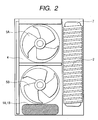
- Fig. 2 shows the layout of major units of this embodiment.
- the boiler of this embodiment has two cycles: a refrigerant cycle (indicated by solid lines) in which circulates a carbon dioxide refrigerant, and a water-heating cycle (which is indicated by dotted lines).
- the boiler of this embodiment is of an instantaneous type which runs a heat-pump cycle to supply a required quantity of hot water every time when hot water is used.
- this invention is not limited to this type.
- the instantaneous type boiler must be equipped with a high-power compressor, its leak current and abrasion of the compressor are not negligible.
- the instantaneous type boiler of this embodiment contains two refrigeration cycles for high output, this invention is not limited to this.
- the compressors 1A and 1B compress a refrigerant gas of low temperature and low pressure and send the compressed refrigerant gas of high temperature and high pressure to the water-refrigerant heat exchanger 2.
- the heat is sensibly transferred from the refrigerant gas to water of low temperature.
- the cooled refrigerant gas turns to the refrigerant of low temperature and low pressure through the motor-driven expansion valves 3A and 3B and sent to the air heat exchangers 4A and 4B.
- the refrigerant absorbs heat from the ambient air and vaporizes.
- the cooled air is blown away by fans 5A and 5B.
- the refrigerant gas of low temperature and low pressure sent from the air heat exchanger 4A and 4B returns to the compressors 1A and 1B. This cycle is repeated.
- This type of boiler using carbon dioxide as the refrigerant can easily produce hot water of almost 100 °C since the carbon dioxide refrigerant exceeds the high critical point in the supercritical cycle and a desired pressure can be set.
- Water of low temperature fed from the water supply port 6 is sent to water refrigerant heat exchanger 2, heated by the refrigerant into hot water, stored in the hot water tank 7, and then served through the taphole 8.
- the hot water from heat exchanger 2 is mixed with cool water fed from the water supply port 6 to control the temperature of hot water before being serviced.
- the heat exchanger 2 is also used to heat up hot water in the hot water tank 7, water in a bath tub (not shown in the figure), and so on.
- the heat exchanger 2 is also used as a heat source for a home total energy system including floor heating system and bathroom heating system.
- the instantaneous water heater of this invention can have only a small auxiliary tank as the hot water tank 7 although a general heat-pump hot-water boiler must have a large-capacity hot water tank and provide separate cabinets to house a heat source tank unit and a hot water tank unit. Therefore, the instantaneous water heater can house a heat source tank unit and a hot water tank unit together in a single cabinet as shown in Fig. 2. This can save installation space dramatically.
- the compressors 1A and 1B are usually scroll or rotary displacement type compressors.
- Fig. 3 shows a longitudinal sectional view of an enclosed type motor-driven compressor of a horizontal scroll type as an example.
- the compression mechanism of the compressor 1A or 1B comprising of the spiral lap 11 perpendicular to the end plate 10 of the stationary scroll member 9, the rotating scroll member 14 made of the end plate 12 and the lap 13 which are substantially the same as those of the stationary scroll member 9, wherein these members are engaged with each other with the laps 11 and 13 are faced to each other.
- the outermost one of the compression chambers 15a, 15b, and so on which are formed by the stationary and rotating scroll members 9 and 14 moves towards the center of the scroll members 9 and 14 while reducing the volume gradually as the rotation proceeds.
- the compression chambers 15a, 15b, and so on communicate with the discharge port 16 and discharge the compressed gas from the compression chambers to the outside through the discharge pipe 17.
- the compressor of Fig. 3 has electric motor 19 in the pressure vessel 18 and is driven to compress by the crank shaft 15 which rotates at a constant speed or a speed corresponding to a voltage controlled by an inverter (not shown in the figure).
- An oil pool is provided below the discharge pipe 17. Refrigeration oil 20 in the pool is supplied for lubrication by a pressure difference through the oil hole 21 in the crank shaft 15 to the sliding section at which the rotating scroll member 14 and crank shaft 15 slide and the bearing 22 and so on.
- the embodiment 1 actually ran the boiler of Fig. 1 for 2160 hours.
- the boiler is operated in a temperature-controlled room which is kept at 20 °C in a summer temperature condition, and supply hot water of 60 °C which is a hot water storage condition.
- Table 1 is a list to show various kinds of refrigeration oil components which are compound A (PAO), compound B (POE), and other compounds which are used to the embodiments of the invention and the comparative examples and their properties and characteristics.
- PAO compound A
- POE compound B
- Table 1 lists properties and characteristics of compounds A to K (refrigeration oils) which are used by the embodiments of this invention and comparative examples.
- PAO, POE, and PAG are respectively short for poly- ⁇ -olefin oil, hindered polyol ester oil (branched chain mixed fatty acid ester of pentaerythritol and di-pentaerythritol) and polyalkylene glycol oil (having dimethyl ether at both ends of polypropylene) in this order.
- Table 2 is a list to show a test items for the heat-pump hot-water boiler which uses a refrigeration oil of the embodiment 1 of the invention and those for the heat-pump hot-water boiler which uses refrigeration oils of the comparative examples 1 to 3 for comparison.
- the refrigeration oil of the embodiment 1 is a mixture of 80 % by weight of compound A (PAO) and 20 % by weight of compound B (POE).
- the comparative example 1 uses compound A (PAO) which is one of the components of the refrigeration oil for the embodiment 1.
- the comparative example 2 uses compound B (POE) which is one of the components of the refrigeration oil for the embodiment 1.
- the comparative example 3 uses compound C (PAG) which is a main refrigeration oil for the carbon dioxide refrigerant.
- test items of the refrigeration oils in the actual service test It is very important to suppress abrasion of the compressor for assurance of the compressor reliability.
- the inventors measured the increment of a clearance due to abrasion caused by test running between the bearing and the shaft, taking the worn-out status of the compressor into consideration.
- the size of the clearance between the bearing and the shaft is proportional to the quantity of abrasion. In general, as the clearance becomes greater, the shaft and the bearing generate more vibrations and noises. Further, the inventors checked the quantity of the refrigeration oil left in the compressor after testing and measured the total acid number of the refrigeration oil used for the test. In general, it is said that the quantity of the refrigeration oil returned to the compressor becomes less and causes deterioration of lubrication in the sliding section as the refrigeration oil is less compatible with the refrigerant.
- the terminals of one filter circuit were respectively connected to the a.c. power supply and grounding, and the a.c. voltage between the terminals of the other filter circuit was measured.
- the leak current value is obtained by dividing the measured a.c. voltage by a resistance of 1 k ⁇ .
- the inventors measured the leak currents for 1 minute after the boiler started and selected peaks among the current leaks. Table 2 lists such current leak peaks. Further, the inventors measured the coefficient of performance (COP) of each boiler and listed the COP values relative to that of the comparative example 3 is 100 % standard).
- COP coefficient of performance
- Table 2 shows the results of evaluations of the embodiment 1 and the comparative examples 1 to 3.
- a value enclosed in parentheses indicates the content (% by weight) of a component in the oil mixture.
- Table 2 also lists up the dielectric constants and the viscosity indexes of the refrigeration oils used by the embodiments and the comparative examples.
- the refrigeration oil of the embodiment 1 can suppress abrasion more than the refrigeration oils of the comparative examples 1 and 2. Therefore, the refrigeration oil of the embodiment 1 can assure high reliability of the boiler.
- leak currents the boiler using the refrigeration oil of the embodiment 1 has a negligible current leak but the boiler using the refrigeration oil of the comparative example 3 has a great current leak which may cause electric shocks.
- the dielectric constants are dependent upon the kinds of the refrigeration oils.
- the polyalkylene glycol oil of the comparative example 3 is poor in electric characteristics.
- the boiler using the refrigeration oil of Embodiment 1 is almost the same as the boiler using the refrigeration oils of the comparative examples 2 and 3 which are compatible with carbon dioxide, assuring the refrigeration oil return to the compressor, sufficiently.
- the refrigeration oil of the comparative example 1 which was not compatible with the refrigerant was stagnating much in the cold area between the electric expansion valve 3 and the air heat exchanger 4 of the refrigeration cycle. This greatly reduced the quantity of the refrigeration oil in the compressor and caused abrasion in the compressor.
- the carbon dioxide refrigerant is not soluble compound A in the oil mixture of the embodiment 1, the compression section of the compressor of the boiler using this refrigeration oil is satisfactorily sealed and as the result, the boiler has higher COP than the boiler using the refrigeration oil of the comparative example 3. Contrarily, since the carbon dioxide refrigerant is highly soluble to the refrigeration oil of the comparative example 2, a lot of the refrigeration oil moved from the compressor into the refrigeration cycle and as the result, the heat exchange efficiency of the boiler was reduced.
- the solution viscosity of the refrigeration oil became low, since the refrigerant is highly soluble to the refrigeration oil. This cannot assure the sealing of the compression section of the compressor and the resulting decrease of COP.
- the refrigeration oil of the embodiment 1 is low enough, but the polyol ester oil of the comparative example 2 is very high because of oil deterioration due to hydrolysis.
- Table 3 is lists to show a test items for the heat-pump hot-water boiler which uses refrigeration oils of the embodiments 2 to 6 of the invention and those for the heat-pump hot-water boiler which uses refrigeration oils of the comparative examples 4 to 6 for comparison.
- the test conditions of these embodiments are the same as those of the embodiment 1 except that the ambient temperature is 7 °C in the intermediate temperature condition, which is lower than the temperature of the embodiment 1.
- the test results are listed in Table 3.
- the test items of Table 3 are the same as those of Table 2.
- the embodiment 2 to the embodiment 6 respectively use a mixture of the compounds A and the compounds B whose performances are already recognized by the embodiment 1 wherein the concentrations of the compounds A and the compounds B are changed.
- the comparative example 4 uses a refrigeration oil which contains less than 5 % by weight of the compound B in the mixture of the compounds A and the compounds B.
- the comparative example 5 uses a refrigeration oil which contains 70 % by weight or more of the compound B in the mixture of the compounds A and the compounds B.
- the comparative example 6 uses the compound C which is a main refrigeration oil for the carbon dioxide refrigerant. These refrigeration oils are respectively used in the boiler system and tested actually as same as the above.
- Table 3 The test results of the embodiments 2 to 6 and the comparative examples 4 to 6 are listed in Table 3.
- Table 3 a value enclosed in parentheses indicates the content % by weight of a component in the oil mixture.
- Table 3 also lists up the dielectric constants and the viscosity indexes of the refrigeration oils used by the embodiments and the comparative examples.
- the boilers using refrigeration oils of the embodiments 2 to 6 of the invention can reduce the increment of clearance due to abrasion between the bearing and the shaft and eliminate a current leak much more than the refrigeration oil of the comparative example 6 by making the content of the compound B (POE) 5 to 70 % by weight.
- the refrigeration oil can assure the quantity of the refrigeration oil return to the compressor sufficiently, and improve or retain the COP of the boiler relative to the COP of the comparative example 6. Further, the inventors recognized that the total acid numbers of the refrigeration oils of the embodiments 2 to 6 after tests were suppressed.
- the refrigeration oil of the comparative example 4 contains 3 % by weight of compound B (POE)
- the clearance between the bearing and the shaft becomes greater because the refrigerant oil is not compatible with carbon dioxide and the refrigeration oil returned to the compressor becomes less.
- the carbon dioxide refrigerant is greatly soluble in the refrigeration oil. This increases the quantity of the refrigeration oil transported from the compressor into the refrigeration cycle and reduces the heat exchange efficiency of the boiler. Further, the solution viscosity of the refrigeration oil became low, since the refrigerant is highly soluble to the refrigeration oil. This cannot assure the sealing of the compression section of the compressor. This reduces the COP and increases the total acid number of the refrigeration oil.
- the boiler can satisfy all test items when using a refrigeration oil which contains 5 to 70 % by weight of the compound B (polyol ester oil) to the compound A (poly- ⁇ -olefin oil). Therefore, the ratio of the compound B to the compound A in the oil mixture should preferably be 10 to 30 % by weight considering the compatibility and the resistance to hydrolysis of the oil mixture.
- Table 4 is a list to show the test items for the heat-pump hot-water boiler which uses refrigeration oils of the embodiments 7 to 9 of the invention and those for the heat-pump hot-water boiler which uses refrigeration oils of the comparative examples 7 to 9 for comparison.
- the test conditions of these embodiments are the same as those of the embodiment 1 except that the ambient temperature is -5 °C in the winter temperature condition and lower than the temperature condition of the embodiments 2 to 6.
- the test results are listed in Table 4.
- the test items of Table 4 are the same as those of Table 2.
- each of the embodiments 7 to 9 was tested using the fixed ratio of 80 % by weight of the compound A (poly- ⁇ -olefin oil) and 20 % by weight of the compound B (polyol ester oil) whose performances were recognized by the embodiments 2 to 6 while the viscosity of the mixture was varied.
- the embodiment 7 used a refrigeration oil mixture of 80 % by weight of the compound D (PAO) and 20 % by weight of the compound E (see Table 1).
- the embodiment 8 as well as the embodiment 1 used a refrigeration oil mixture of 80 % by weight of the compound A and 20 % by weight of the compound B.
- the embodiment 9 used a refrigeration oil mixture of 80 % by weight of the compound F (PAO) and 20 % by weight of the compound G (POE).
- the viscosities of these refrigeration oil mixtures were 5 to 15 mm 2 /s.
- the comparative example 7 used a refrigeration oil mixture of 80 % by weight of the compound H (PAO) and 20 % by weight of the compound I (POE).
- the comparative example 8 used a refrigeration oil mixture of 80 % by weight of the compound J (PAO) and 20 % by weight of the compound K (POE).
- the viscosities of these refrigeration oil mixtures were less than 5 mm 2 /s and more than 15 mm 2 /s.
- the comparative example 9 used a refrigeration oil which contains the compound C (PAG) only.
- Table 4 shows the results of evaluations of the embodiments 7 to 9 and the comparative examples 7 to 9.
- a value enclosed in parentheses indicates the content % by weight of a component in the oil mixture.
- Table 4 also lists up the dielectric constants and the viscosity indexes of the refrigeration oils used by the embodiments and the comparative examples.
- the boilers using refrigeration oils of the embodiments 2 and 6 can reduce the increment of clearance due to abrasion between the bearing and the shaft and eliminate a current leak much more than the refrigeration oil of the comparative example 9 by controlling the viscosity of the oil mixture which contains PAO (poly- ⁇ -olefin oil) and POE (polyol ester oil) in the range of 5 to 15 mm 2 /s.
- PAO poly- ⁇ -olefin oil
- POE polyol ester oil
- the boiler can satisfy all test items by controlling the viscosity of the refrigeration oil mixture which contains PAO (poly- ⁇ -olefin oil) and POE (polyol ester oil) in the range of 5 to 15 mm 2 /s.
- PAO poly- ⁇ -olefin oil
- POE polyol ester oil
- Table 5 is a list to show the test items for the heat-pump hot-water boiler which uses a refrigeration oil of the embodiment 10 of the invention and those for the heat-pump hot-water boiler which uses a refrigeration oil of the comparative example 10 for comparison.
- the test conditions of the embodiment 10 are the same as those of the embodiment 1 except that the ambient temperature is -15 °C in the severe winter temperature condition and lower than the temperature condition of the embodiments 7 to 9.
- the test results are listed in Table 5.
- the test items of Table 5 are the same as those of Table 2.
- the embodiment 10 like the embodiment 8 uses a mixture of 80 % by weight of compound A (PAO) and 20 % by weight of compound B (POE).
- the comparative example 10 like the comparative example 9 uses compound C (PAG) which is a main refrigeration oil for the carbon dioxide refrigerant.
- the inventors found that the refrigeration oil mixture of the embodiment 10 was a little inferior in increment of the clearance between the bearing and the shaft, leak current, and total acid number to the embodiment 8, but satisfied the quantity of the refrigeration oil return to the compressor sufficiently, and excelled the COP of the boiler relative to the COP of the comparative example 10. Judging from this, it is found that the refrigeration oil of the embodiment 10 is available at very low temperature of -15 °C.
- the boiler of the embodiments uses a high-pressure chamber scroll type compressor as the enclosed motor-driven compressor, this invention is not limited to this.
- the same effect can be obtained by a 2-stage compression rotary compressor or a swing type compressor which contains rollers and vanes in a body.
Landscapes
- Chemical & Material Sciences (AREA)
- Engineering & Computer Science (AREA)
- General Chemical & Material Sciences (AREA)
- Oil, Petroleum & Natural Gas (AREA)
- Organic Chemistry (AREA)
- Chemical Kinetics & Catalysis (AREA)
- Physics & Mathematics (AREA)
- Mechanical Engineering (AREA)
- Thermal Sciences (AREA)
- General Engineering & Computer Science (AREA)
- Lubricants (AREA)
- Heat-Pump Type And Storage Water Heaters (AREA)
- Applications Or Details Of Rotary Compressors (AREA)
- Compressor (AREA)
Applications Claiming Priority (1)
| Application Number | Priority Date | Filing Date | Title |
|---|---|---|---|
| JP2005092411A JP2006275339A (ja) | 2005-03-28 | 2005-03-28 | ヒートポンプ式給湯機 |
Publications (1)
| Publication Number | Publication Date |
|---|---|
| EP1712607A1 true EP1712607A1 (de) | 2006-10-18 |
Family
ID=36916159
Family Applications (1)
| Application Number | Title | Priority Date | Filing Date |
|---|---|---|---|
| EP06003450A Withdrawn EP1712607A1 (de) | 2005-03-28 | 2006-02-20 | Wärmepumpe-Warmwasserboiler mit einem Kältemittelkreislauf und Kältemaschinenöl dafür |
Country Status (4)
| Country | Link |
|---|---|
| EP (1) | EP1712607A1 (de) |
| JP (1) | JP2006275339A (de) |
| KR (1) | KR20060103831A (de) |
| CN (1) | CN1840979A (de) |
Cited By (2)
| Publication number | Priority date | Publication date | Assignee | Title |
|---|---|---|---|---|
| EP2141219A4 (de) * | 2007-03-27 | 2011-05-11 | Nippon Oil Corp | Kühlschranköl und arbeitsfluidzusammensetzung für kältemaschine |
| US9321948B2 (en) | 2007-02-27 | 2016-04-26 | Nippon Oil Corporation | Refrigerator oil and working fluid composition for refrigerator |
Families Citing this family (7)
| Publication number | Priority date | Publication date | Assignee | Title |
|---|---|---|---|---|
| JP2008185290A (ja) * | 2007-01-31 | 2008-08-14 | Hitachi Appliances Inc | 二酸化炭素冷媒ヒートポンプ式給湯機 |
| JP2009138037A (ja) * | 2007-12-04 | 2009-06-25 | Hitachi Appliances Inc | 冷媒圧縮機およびヒートポンプ式給湯機 |
| JP2010032175A (ja) * | 2008-07-31 | 2010-02-12 | Hitachi Appliances Inc | ヒートポンプ給湯機 |
| JP5521320B2 (ja) * | 2008-12-10 | 2014-06-11 | 日本精工株式会社 | 潤滑剤組成物及び転動装置 |
| WO2010137120A1 (ja) * | 2009-05-26 | 2010-12-02 | 三菱電機株式会社 | ヒートポンプ式給湯装置 |
| CN102628636A (zh) * | 2012-04-28 | 2012-08-08 | 肖舸 | 复合板材的烘干方法及烘干系统 |
| CN103851892A (zh) * | 2012-12-06 | 2014-06-11 | 美的集团股份有限公司 | 烘干机 |
Citations (8)
| Publication number | Priority date | Publication date | Assignee | Title |
|---|---|---|---|---|
| US5665686A (en) * | 1995-03-14 | 1997-09-09 | Exxon Chemical Patents Inc. | Polyol ester compositions with unconverted hydroxyl groups |
| JPH1046169A (ja) | 1996-08-06 | 1998-02-17 | Idemitsu Kosan Co Ltd | 冷凍機用潤滑油組成物 |
| DE19719132A1 (de) * | 1997-05-07 | 1998-11-12 | Rwe Dea Ag | Polyol-Ester als Schmiermittel für CO¶2¶-Kältemaschinen |
| JP2000104084A (ja) | 1998-09-29 | 2000-04-11 | Nippon Mitsubishi Oil Corp | 冷凍機油 |
| JP2000110725A (ja) | 1998-10-08 | 2000-04-18 | Matsushita Refrig Co Ltd | 圧縮機 |
| JP2001294886A (ja) | 2000-04-10 | 2001-10-23 | Japan Energy Corp | 炭酸ガス冷媒を用いる冷凍装置用潤滑油組成物、作動流体、冷凍サイクルまたはヒートポンプサイクル及び冷凍装置 |
| EP1233186A2 (de) * | 2001-02-14 | 2002-08-21 | Sanyo Electric Co., Ltd. | Rotationsverdichter |
| JP2003336916A (ja) * | 2002-05-16 | 2003-11-28 | Hitachi Home & Life Solutions Inc | 冷凍サイクル及びヒートポンプ式給湯機 |
-
2005
- 2005-03-28 JP JP2005092411A patent/JP2006275339A/ja active Pending
-
2006
- 2006-02-20 EP EP06003450A patent/EP1712607A1/de not_active Withdrawn
- 2006-02-23 KR KR1020060017471A patent/KR20060103831A/ko not_active Withdrawn
- 2006-02-24 CN CNA2006100514250A patent/CN1840979A/zh active Pending
Patent Citations (8)
| Publication number | Priority date | Publication date | Assignee | Title |
|---|---|---|---|---|
| US5665686A (en) * | 1995-03-14 | 1997-09-09 | Exxon Chemical Patents Inc. | Polyol ester compositions with unconverted hydroxyl groups |
| JPH1046169A (ja) | 1996-08-06 | 1998-02-17 | Idemitsu Kosan Co Ltd | 冷凍機用潤滑油組成物 |
| DE19719132A1 (de) * | 1997-05-07 | 1998-11-12 | Rwe Dea Ag | Polyol-Ester als Schmiermittel für CO¶2¶-Kältemaschinen |
| JP2000104084A (ja) | 1998-09-29 | 2000-04-11 | Nippon Mitsubishi Oil Corp | 冷凍機油 |
| JP2000110725A (ja) | 1998-10-08 | 2000-04-18 | Matsushita Refrig Co Ltd | 圧縮機 |
| JP2001294886A (ja) | 2000-04-10 | 2001-10-23 | Japan Energy Corp | 炭酸ガス冷媒を用いる冷凍装置用潤滑油組成物、作動流体、冷凍サイクルまたはヒートポンプサイクル及び冷凍装置 |
| EP1233186A2 (de) * | 2001-02-14 | 2002-08-21 | Sanyo Electric Co., Ltd. | Rotationsverdichter |
| JP2003336916A (ja) * | 2002-05-16 | 2003-11-28 | Hitachi Home & Life Solutions Inc | 冷凍サイクル及びヒートポンプ式給湯機 |
Non-Patent Citations (1)
| Title |
|---|
| PATENT ABSTRACTS OF JAPAN vol. 2003, no. 12 5 December 2003 (2003-12-05) * |
Cited By (4)
| Publication number | Priority date | Publication date | Assignee | Title |
|---|---|---|---|---|
| US9321948B2 (en) | 2007-02-27 | 2016-04-26 | Nippon Oil Corporation | Refrigerator oil and working fluid composition for refrigerator |
| US10214671B2 (en) | 2007-02-27 | 2019-02-26 | Jx Nippon Oil & Energy Corporation | Refrigerator oil and working fluid composition for refrigerator |
| EP2141219A4 (de) * | 2007-03-27 | 2011-05-11 | Nippon Oil Corp | Kühlschranköl und arbeitsfluidzusammensetzung für kältemaschine |
| US8318040B2 (en) | 2007-03-27 | 2012-11-27 | Nippon Oil Corporation | Refrigerator oil and working fluid composition for refrigerating machine |
Also Published As
| Publication number | Publication date |
|---|---|
| CN1840979A (zh) | 2006-10-04 |
| KR20060103831A (ko) | 2006-10-04 |
| JP2006275339A (ja) | 2006-10-12 |
Similar Documents
| Publication | Publication Date | Title |
|---|---|---|
| CN103261689B (zh) | 冷冻空调用压缩机及冷冻空调装置 | |
| US6427479B1 (en) | Refrigerating device utilizing carbon dioxide as a refrigerant | |
| CN101883957B (zh) | 制冷剂压缩机以及制冷循环系统 | |
| CN102408936A (zh) | 冷冻空调用压缩机以及冷冻空调装置 | |
| JP5326525B2 (ja) | 圧縮機 | |
| WO2009116239A1 (ja) | 冷凍装置 | |
| WO2009116282A1 (ja) | 冷凍装置 | |
| CN102003840A (zh) | 使用2,3,3,3-四氟丙烯的冷冻空调装置 | |
| KR102164106B1 (ko) | 전동 압축기 및 냉동 공조 장치 | |
| CN112410109B (zh) | 冷冻机油、工作流体组合物及制冷循环装置 | |
| WO2017199516A1 (ja) | 冷凍サイクル装置 | |
| CN104379713B (zh) | 压缩机及空调装置 | |
| JP2008241086A (ja) | 二酸化炭素冷媒ヒートポンプ式給湯機 | |
| JP2009222351A (ja) | 冷凍装置 | |
| JP2006275339A (ja) | ヒートポンプ式給湯機 | |
| JP2003336916A (ja) | 冷凍サイクル及びヒートポンプ式給湯機 | |
| JP2015014395A (ja) | 空気調和機 | |
| JP2009138037A (ja) | 冷媒圧縮機およびヒートポンプ式給湯機 | |
| JP2016023902A (ja) | 空気調和機 | |
| CN108517247A (zh) | 一种合成冷冻机油及其制备方法 | |
| JP2001255030A (ja) | 冷凍装置 | |
| JP2010031134A (ja) | 冷媒圧縮機 | |
| JP2001255029A (ja) | 冷凍装置 | |
| JP2001152172A (ja) | 冷凍機油 | |
| CN118525174A (zh) | 热源机及其运转方法、以及热源机用冷冻机油 |
Legal Events
| Date | Code | Title | Description |
|---|---|---|---|
| PUAI | Public reference made under article 153(3) epc to a published international application that has entered the european phase |
Free format text: ORIGINAL CODE: 0009012 |
|
| AK | Designated contracting states |
Kind code of ref document: A1 Designated state(s): AT BE BG CH CY CZ DE DK EE ES FI FR GB GR HU IE IS IT LI LT LU LV MC NL PL PT RO SE SI SK TR |
|
| AX | Request for extension of the european patent |
Extension state: AL BA HR MK YU |
|
| RAP1 | Party data changed (applicant data changed or rights of an application transferred) |
Owner name: HITACHI APPLIANCES, INC. |
|
| 17P | Request for examination filed |
Effective date: 20070418 |
|
| 17Q | First examination report despatched |
Effective date: 20070522 |
|
| AKX | Designation fees paid |
Designated state(s): DE |
|
| STAA | Information on the status of an ep patent application or granted ep patent |
Free format text: STATUS: THE APPLICATION IS DEEMED TO BE WITHDRAWN |
|
| 18D | Application deemed to be withdrawn |
Effective date: 20090901 |