EP1712965A1 - Dispositif et méthode pour la commande de robots industriels ou d'appareils similaires, comprenant un terminal de programmation portable sans fil - Google Patents
Dispositif et méthode pour la commande de robots industriels ou d'appareils similaires, comprenant un terminal de programmation portable sans fil Download PDFInfo
- Publication number
- EP1712965A1 EP1712965A1 EP05425218A EP05425218A EP1712965A1 EP 1712965 A1 EP1712965 A1 EP 1712965A1 EP 05425218 A EP05425218 A EP 05425218A EP 05425218 A EP05425218 A EP 05425218A EP 1712965 A1 EP1712965 A1 EP 1712965A1
- Authority
- EP
- European Patent Office
- Prior art keywords
- information
- sub
- manipulator
- channels
- control unit
- Prior art date
- Legal status (The legal status is an assumption and is not a legal conclusion. Google has not performed a legal analysis and makes no representation as to the accuracy of the status listed.)
- Granted
Links
Images
Classifications
-
- G—PHYSICS
- G05—CONTROLLING; REGULATING
- G05B—CONTROL OR REGULATING SYSTEMS IN GENERAL; FUNCTIONAL ELEMENTS OF SUCH SYSTEMS; MONITORING OR TESTING ARRANGEMENTS FOR SUCH SYSTEMS OR ELEMENTS
- G05B19/00—Program-control systems
- G05B19/02—Program-control systems electric
- G05B19/18—Numerical control [NC], i.e. automatically operating machines, in particular machine tools, e.g. in a manufacturing environment, so as to execute positioning, movement or co-ordinated operations by means of program data in numerical form
- G05B19/406—Numerical control [NC], i.e. automatically operating machines, in particular machine tools, e.g. in a manufacturing environment, so as to execute positioning, movement or co-ordinated operations by means of program data in numerical form characterised by monitoring or safety
-
- G—PHYSICS
- G05—CONTROLLING; REGULATING
- G05B—CONTROL OR REGULATING SYSTEMS IN GENERAL; FUNCTIONAL ELEMENTS OF SUCH SYSTEMS; MONITORING OR TESTING ARRANGEMENTS FOR SUCH SYSTEMS OR ELEMENTS
- G05B2219/00—Program-control systems
- G05B2219/20—Pc systems
- G05B2219/23—Pc programming
- G05B2219/23414—Pc as detachable program, debug, monitor device for control system
-
- G—PHYSICS
- G05—CONTROLLING; REGULATING
- G05B—CONTROL OR REGULATING SYSTEMS IN GENERAL; FUNCTIONAL ELEMENTS OF SUCH SYSTEMS; MONITORING OR TESTING ARRANGEMENTS FOR SUCH SYSTEMS OR ELEMENTS
- G05B2219/00—Program-control systems
- G05B2219/30—Nc systems
- G05B2219/33—Director till display
- G05B2219/33192—Radio link, wireless
-
- G—PHYSICS
- G05—CONTROLLING; REGULATING
- G05B—CONTROL OR REGULATING SYSTEMS IN GENERAL; FUNCTIONAL ELEMENTS OF SUCH SYSTEMS; MONITORING OR TESTING ARRANGEMENTS FOR SUCH SYSTEMS OR ELEMENTS
- G05B2219/00—Program-control systems
- G05B2219/30—Nc systems
- G05B2219/36—Nc in input of data, input key till input tape
- G05B2219/36159—Detachable or portable programming unit, display, pc, pda
-
- G—PHYSICS
- G05—CONTROLLING; REGULATING
- G05B—CONTROL OR REGULATING SYSTEMS IN GENERAL; FUNCTIONAL ELEMENTS OF SUCH SYSTEMS; MONITORING OR TESTING ARRANGEMENTS FOR SUCH SYSTEMS OR ELEMENTS
- G05B2219/00—Program-control systems
- G05B2219/30—Nc systems
- G05B2219/39—Robotics, robotics to robotics hand
- G05B2219/39001—Robot, manipulator control
-
- G—PHYSICS
- G05—CONTROLLING; REGULATING
- G05B—CONTROL OR REGULATING SYSTEMS IN GENERAL; FUNCTIONAL ELEMENTS OF SUCH SYSTEMS; MONITORING OR TESTING ARRANGEMENTS FOR SUCH SYSTEMS OR ELEMENTS
- G05B2219/00—Program-control systems
- G05B2219/30—Nc systems
- G05B2219/39—Robotics, robotics to robotics hand
- G05B2219/39447—Dead man switch
-
- G—PHYSICS
- G05—CONTROLLING; REGULATING
- G05B—CONTROL OR REGULATING SYSTEMS IN GENERAL; FUNCTIONAL ELEMENTS OF SUCH SYSTEMS; MONITORING OR TESTING ARRANGEMENTS FOR SUCH SYSTEMS OR ELEMENTS
- G05B2219/00—Program-control systems
- G05B2219/30—Nc systems
- G05B2219/50—Machine tool, machine tool null till machine tool work handling
- G05B2219/50198—Emergency stop
Definitions
- the present invention relates to industrial robots and has been developed with particular attention to the possible use of robots comprising a manipulator, a unit for controlling the manipulator and a portable terminal for manually programming and controlling the robot, wherein the terminal is designed for communicating in a wireless mode with the control unit.
- wireless is meant here a communication that implies a transmission of signals without the use of cables, by means of electromagnetic waves, preferably by radio-frequency but possibly also by ultrasounds or infrared radiations o any other frequency range.
- the activity of programming a robot essentially consists of teaching the robot itself the trajectory that a point of the manipulator thereof will have to repeat automatically while working, in order to perform a certain operation.
- Said point is usually constituted by the so-called "Tool Centre Point” or TCP, which identifies the position of the active part of a tool, mounted on the manipulator.
- the aforesaid portable programming terminal is used, also known as teach pendant, which is operatively connected to the robot control unit and typically comprises a display and a series of push-button used to program and control the robot; the teach pendant can also be used to monitor the program of the robot, check the machine's states, modify certain parameters of the program and so on.
- the terminal is usually connected to the control unit via a long shielded cable, which allows the operator to move in proximity to the manipulator working area to be able to accurately verify the relevant points and trajectories of the TCP.
- the operator uses specific push-buttons on the terminal, known as "jog" push-buttons, which command the actuation of one or more axis of the manipulator.
- jog push-buttons By acting on the jog push-buttons, the TCP can be actuated in a specific positive or negative direction within a reference system, selected by the operator, among a plurality of possible reference or co-ordinate systems stored in the control unit, by means of other push-buttons or keys present on the terminal.
- control unit of a robot is normally capable of operating according to three different modes or states, i.e. a Programming mode, an Automatic mode, and a Remote mode.
- an operator acts, as stated, near the manipulator, to control its operation, store the programme steps and programme its operating activity, through the terminal.
- speed restrictions are applied to the movements of the manipulator and the operator has available in his/her hands, since they are present on the terminal, an emergency stop push-button and an enabling device.
- the robot performs its operating programme, obtained as explained above, possibly in combination with other robots or automatic equipments, inside a cell that is protected against personnel access, but is in view of an operator.
- the terminal from which the programme execution is started, can be located in a fixed position near the cell, with the emergency stop push-button active, through which the operator can stop the robot, if necessary.
- the robot performs an operating programme inside a cell that is protected against personnel access, but in this case programme execution is started by a cell supervisor, such as a PLC, which for example controls both the robot and other automatic equipment present in the same cell; the terminal can in any case be positioned near the cell, with an emergency stop push-button active for any eventuality.
- a cell supervisor such as a PLC, which for example controls both the robot and other automatic equipment present in the same cell
- the terminal can in any case be positioned near the cell, with an emergency stop push-button active for any eventuality.
- the step of programming the robot using the portable terminal is clearly the one that entails the highest risks for the operator, who has to follow the TCP closely in order visually to check its positioning, continually moving around the manipulator.
- the terminal is, for this purpose, provided with the aforesaid Enabling Device, which usually comprises a three-position push-button. Only the central position is operative and, if maintained, it allows to move the manipulator, whilst the release position and the full pressure position disable the movement of the manipulator. In practice, therefore, if in the Programming mode the enabling device is not kept active by the operator, the manipulator cannot perform any movements.
- the programming and actuation commands imparted manually through the terminal must reach the robot control unit in certain and unambiguous fashion, without interference that could give rise, for example, to undesired movements of the manipulator. In most known applications, this risk is avoided by the fact that the terminal is connected to the respective control unit through the aforesaid cable, which is shielded to prevent communication systems or electromagnetic interference present in the workplace from influencing the quality of the instructions sent through the terminal.
- the cable connecting the terminal to the control unit allows a limited manoeuvrability of the operator in his/her programming activity near the manipulator, because (s)he has to move continually around the manipulator; another drawback is that the cable can be caught or tangled with other cables and must then be freed. Moreover, the cable is subject to wear and damage, with the consequent need to repair or replace it.
- WO 02/078915 proposes a transmission technique in which occasional delays in the reception of data packets are allowed, without said delays being interpreted as an emergency command.
- the present invention aims to provide a new control system for robots or similar manoeuvrable apparatuses, comprising a portable programming terminal connected in wireless mode to a control unit, which allows the safe transmission of signals between the portable terminal and the control unit, with particular reference to emergency and safety signals, without superposition of signals or communication delays.
- a control system for industrial robots and the like comprising a manipulator, a unit for controlling the manipulator and a wireless portable terminal, having the features set out in claim 1.
- a method for controlling an industrial robot or the like having the features set out in claim 8 as well as by an industrial robot or the like having the above said control system and/or implementing the above said control method.
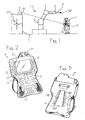
- an industrial robot comprising a manipulator 1 having a plurality of movable parts articulated by means of joints 2 and an end wrist 3 bearing a generic tool 4; as explained in the introductory part of the present description, the end of the tool 4 is the so-called "Tool Centre Point", designated as TCP.
- TCP Tool Centre Point
- the manipulator 1 is connected, through an electric cable C, to a respective control unit 5; a portable terminal or Teach Pendant 6 is also connected, in wireless mode, to the unit 5, used by an operator 7 to programme the robot 1.
- the operator 7 "simulates" a working phase which the manipulator 1 will then be required to complete in the Automatic or Remote mode, varying the posture of the manipulator through the jog push-buttons, provided on the terminal 6; through other push-buttons of the terminal 6, the operator 7 stores the co-ordinates of the optimal path identified for the TCP.
- FIGS. 2 and 3 schematically show a possible embodiment of the terminal 6, which comprises at least
- the device 14 must be kept active by the operator 7 to allow the manipulator to perform the desired movements during the programming phase.
- a longitudinally extended recess is defined centrally, designated 14A in Figure 3; from each of the longitudinal surfaces of the recess 14A the key 14B of a respective push-button projects towards the interior of the recess itself, which is part of the device 14; it is readily apparent that the two keys 14B are substantially shaped as elongated bars.
- the recess 14A and the keys 14B serve as a grip area for the ends of the fingers of the right or left hand of the operator 7, though not the thumbs, when the operator holds the terminal 6 along one or both lateral surfaces thereof; in this way, one of the two keys 14B is necessarily pressed, to activate the use of the push-buttons for controlling the movements of the manipulator 1; vice versa, if neither of the two keys 14B is pressed, or both are pressed, the terminal 6 does not allow to command the movement of the manipulator 1.
- the terminal 6 is provided with means for transmitting signals in air, designated by the reference TX in Figure 1, and that the control unit 5 is provided with respective means for receiving said signals, designated RX.
- the means TX and RX are dimensioned to have a range of a few meters, thus within the field of action of the terminal 6 with respect to the control unit 5 of the robot.
- the display 10 can serve as a remote monitor of the control unit 5, and hence the terminal 6 will be able to receive signals in wireless mode from the unit 5; for this purpose, the unit 5 will be provided with transmitter means and the terminal with respective receiver means, not shown in the figures, which can be of the same type as those designated as TX and RX.
- the wireless connection employed for the communication between the terminal 6 and the control unit 5 essentially allows the exchange of the three following types of information:
- specific and dedicated resources are allocated for the communication from the terminal 6 to the control unit 5, and in particular different transmission sub-channels for the different types of information a), b) and c).
- the purpose of this allocation is to favour the safety of the personnel who use the terminal 6, dedicating redundant resources to the emergency stop functionalities (information b) and to the enabling of the robot movement (information c).
- the emergency stop device 13 and the enabling device 14 are read by the logic that manages the radio transmission by at least a double input each.
- the transmission of the information a), b) and c) takes place using preferably the wireless transmission system defined by the IEEE 802.11a standard (whereto reference is integrally made), and known as Wi-Fi.
- the transmission of the information preferably occurs in radio-frequency (RF), with spectrum division or in single band.
- RF radio-frequency
- the total band is divided into sub-bands, to each of which a sub-channel is assigned (FDM technique, i.e. Frequency Division Multiplexing) for respective information a), b) and c).
- FDM technique i.e. Frequency Division Multiplexing
- the discriminating factor of the sub-channels is not frequency, as in the previous case, but for example time (TDM technique, i.e. Time Division Multiplexing) or an appropriate code (CDM technique, i.e.
- the state of the devices 13 and 14 is thus read by means of double input; the same information is transmitted on two sub-channels, preferably with opposite polarities on each sub-channel, i.e. with positive logic on a sub-channel and negative logic on the other, to read the double input for each device 13, 14.
- the pairs of radio sub-channels dedicated to the transmission of the safety signals b) and c) are continuously tested through a polling procedure by means of sampling by the unit 5, with a rate that can vary as a function of the activity of the processor that manages the communication; also executed is at least a continuous check of the polarity of the inputs of the signals b) and c), and of the consistency between the double input signal.
- the radio sub-channels relating to the information b) and c) have a different priority assigned to them, to allow the timeliness of safety information.
- the state of emergency of the system is detected and immediately signalled in case of fault, inconsistency or loss of the carrier signal within the set polling time.
- the immediate reaction time of the system allows to deactivate the power circuits of the manipulator 1 very following the manual operation of the devices.
- the discriminating factor of the sub-channels to be used to transmit the information a), b) and c) may also not be frequency, but for example time or an appropriate code.
- a suitable finite state machine is associated to the transmitter means TX of the terminal 6, which can be implement in any known way and operative to assign different priority codes to data packets transmitted cyclically which contain, respectively, the information a), b) and c); in particular, the highest priority can be assigned to the packets relating to the information c), the lowest priority to the packets relating to the information a), while a priority being intermediate with respect to the first two can be assigned to the packets relating to the information b).
- the sub-channels are identified by the type or by the degree of priority of the information a), b) or c), transmitted in respective packets on a same channel or frequency band.
- redundant resources are allocated for the emergency stop functionalities (information b) and for the enabling of the movement of the robot (information c), with reading through at least double input each, as explained previously, and hence with cyclical transmission of:
- the receiver means RX of the unit 5 comprise suitable logic processing means, that can be implemented in any known way, able to manage the priorities of the different information, with the purpose of processing the safety information first, i.e., in order, the information c) and b), and lastly the normal data, i.e. the information a). Otherwise, the exchange and control procedures are similar to those described previously, and hence with the reading of the state of the devices 13 and 14 performed by means of double input, with the possibility of transmitting a same information b) or c) with opposite polarity on each of the respective two sub-channels/packets, i.e. with positive logic in one packet and negative logic on the other.
- the transmission sub-channels are assigned according to the operative state of the control unit 5 which, as stated, is capable of operating in three selectable modes, i.e. Programming mode, Automatic mode and Remote mode.
- the reference number 20 schematically designates a selector of a desired mode between Programming, Automatic and Remote, respectively designated with the letters P, A and R.
- diversification of the number of sub-channels employed is performed in function of the operative mode of the control unit 5; in this way, the communication dynamically occupies a different number of sub-channels, with a consequent reduction in the use of resources.
- the Programming mode is the machine state that requires the utmost attention in terms of safety for the operator; in this view, the sub-channels dedicated to the exchange of information between the terminal 6 and unit 5 will be assigned as indicated above, i.e. with:
- the operator In the Automatic mode, the operator is not allowed to enter the cell to command through the terminal 6 the movements of the manipulator 1, such that the enabling device 14 cannot be used; on the contrary, the emergency stop device 13 must always be kept active for any eventuality; if the Automatic mode is selected, the sub-channels will therefore be allocated as follows:
- the dynamic assignment of the sub-channel provided in the preferred embodiment of the system according to the invention offers the choice of immediately changing the priority level.
- the unused sub-channels are freed and are available for other transmissions, with energy savings in transmission and reception, and hence an increase in the duration of the battery of the terminal.
- the aforesaid transmission of information can be achieved combining the two techniques mentioned above, and hence dividing the transmission spectrum into multiple sub-channels, each of which is further sub-divided into multiple communication streams by means of data packets having different identity code/priority, each pertaining to a respective type of information a), b) and c).
Landscapes
- Engineering & Computer Science (AREA)
- Human Computer Interaction (AREA)
- Manufacturing & Machinery (AREA)
- Physics & Mathematics (AREA)
- General Physics & Mathematics (AREA)
- Automation & Control Theory (AREA)
- Manipulator (AREA)
- Numerical Control (AREA)
- General Factory Administration (AREA)
- Selective Calling Equipment (AREA)
Priority Applications (3)
| Application Number | Priority Date | Filing Date | Title |
|---|---|---|---|
| AT05425218T ATE395650T1 (de) | 2005-04-13 | 2005-04-13 | Vorrichtung und verfahren zur steuerung von industriellen robotern oder dergleichen, umfassend ein tragbares drahtloses programmierendgerät |
| DE602005006742T DE602005006742D1 (de) | 2005-04-13 | 2005-04-13 | Vorrichtung und Verfahren zur Steuerung von industriellen Robotern oder dergleichen, umfassend ein tragbares drahtloses Programmierendgerät |
| EP05425218A EP1712965B1 (fr) | 2005-04-13 | 2005-04-13 | Dispositif et méthode pour la commande de robots industriels ou d'appareils similaires, comprenant un terminal de programmation portable sans fil |
Applications Claiming Priority (1)
| Application Number | Priority Date | Filing Date | Title |
|---|---|---|---|
| EP05425218A EP1712965B1 (fr) | 2005-04-13 | 2005-04-13 | Dispositif et méthode pour la commande de robots industriels ou d'appareils similaires, comprenant un terminal de programmation portable sans fil |
Publications (2)
| Publication Number | Publication Date |
|---|---|
| EP1712965A1 true EP1712965A1 (fr) | 2006-10-18 |
| EP1712965B1 EP1712965B1 (fr) | 2008-05-14 |
Family
ID=34943144
Family Applications (1)
| Application Number | Title | Priority Date | Filing Date |
|---|---|---|---|
| EP05425218A Expired - Lifetime EP1712965B1 (fr) | 2005-04-13 | 2005-04-13 | Dispositif et méthode pour la commande de robots industriels ou d'appareils similaires, comprenant un terminal de programmation portable sans fil |
Country Status (3)
| Country | Link |
|---|---|
| EP (1) | EP1712965B1 (fr) |
| AT (1) | ATE395650T1 (fr) |
| DE (1) | DE602005006742D1 (fr) |
Cited By (5)
| Publication number | Priority date | Publication date | Assignee | Title |
|---|---|---|---|---|
| EP2570878A1 (fr) * | 2011-09-17 | 2013-03-20 | Mikron Agie Charmilles AG | Machine CNC sans console de commande |
| CN107976958A (zh) * | 2016-10-24 | 2018-05-01 | 发那科株式会社 | 安装于便携设备的紧急停止系统 |
| EP3663876A1 (fr) * | 2018-12-05 | 2020-06-10 | Hilti Aktiengesellschaft | Procédé de fonctionnement d'un système et système |
| CN117086858A (zh) * | 2022-05-13 | 2023-11-21 | 库卡机器人制造(上海)有限公司 | 控制系统和机器人系统 |
| WO2025128231A1 (fr) * | 2023-12-15 | 2025-06-19 | Boston Dynamics, Inc. | Systèmes et procédés pour modifier le fonctionnement d'une machine |
Citations (4)
| Publication number | Priority date | Publication date | Assignee | Title |
|---|---|---|---|---|
| WO2003035335A1 (fr) * | 2001-10-23 | 2003-05-01 | Abb Ab | Systeme et procede de communication entre un robot industriel et une unite d'apprentissage portable (tpu) |
| US6560513B2 (en) * | 1999-11-19 | 2003-05-06 | Fanuc Robotics North America | Robotic system with teach pendant |
| US6711713B1 (en) * | 1999-05-03 | 2004-03-23 | Siemens Aktiengesellschaft | Method and apparatus for detection, transmission and processing of safety-related signals |
| EP1407860A2 (fr) * | 2002-10-08 | 2004-04-14 | Fanuc Ltd | Dispositif de commande à communication sans fil entre un robot et une boítier de commande portable |
-
2005
- 2005-04-13 DE DE602005006742T patent/DE602005006742D1/de not_active Expired - Lifetime
- 2005-04-13 AT AT05425218T patent/ATE395650T1/de active
- 2005-04-13 EP EP05425218A patent/EP1712965B1/fr not_active Expired - Lifetime
Patent Citations (4)
| Publication number | Priority date | Publication date | Assignee | Title |
|---|---|---|---|---|
| US6711713B1 (en) * | 1999-05-03 | 2004-03-23 | Siemens Aktiengesellschaft | Method and apparatus for detection, transmission and processing of safety-related signals |
| US6560513B2 (en) * | 1999-11-19 | 2003-05-06 | Fanuc Robotics North America | Robotic system with teach pendant |
| WO2003035335A1 (fr) * | 2001-10-23 | 2003-05-01 | Abb Ab | Systeme et procede de communication entre un robot industriel et une unite d'apprentissage portable (tpu) |
| EP1407860A2 (fr) * | 2002-10-08 | 2004-04-14 | Fanuc Ltd | Dispositif de commande à communication sans fil entre un robot et une boítier de commande portable |
Cited By (9)
| Publication number | Priority date | Publication date | Assignee | Title |
|---|---|---|---|---|
| EP2570878A1 (fr) * | 2011-09-17 | 2013-03-20 | Mikron Agie Charmilles AG | Machine CNC sans console de commande |
| CN107976958A (zh) * | 2016-10-24 | 2018-05-01 | 发那科株式会社 | 安装于便携设备的紧急停止系统 |
| US10324450B2 (en) | 2016-10-24 | 2019-06-18 | Fanuc Corporation | Emergency stop system attached to mobile device |
| CN107976958B (zh) * | 2016-10-24 | 2019-08-06 | 发那科株式会社 | 安装于便携设备的紧急停止系统 |
| EP3663876A1 (fr) * | 2018-12-05 | 2020-06-10 | Hilti Aktiengesellschaft | Procédé de fonctionnement d'un système et système |
| WO2020114774A1 (fr) * | 2018-12-05 | 2020-06-11 | Hilti Aktiengesellschaft | Procédé de fonctionnement d'un système et système |
| US12365114B2 (en) | 2018-12-05 | 2025-07-22 | Hilti Aktiengesellschaft | Method and system for establishing a connection between a machine tool and an auxiliary device and testing an emergency cutout functionality of the auxiliary device |
| CN117086858A (zh) * | 2022-05-13 | 2023-11-21 | 库卡机器人制造(上海)有限公司 | 控制系统和机器人系统 |
| WO2025128231A1 (fr) * | 2023-12-15 | 2025-06-19 | Boston Dynamics, Inc. | Systèmes et procédés pour modifier le fonctionnement d'une machine |
Also Published As
| Publication number | Publication date |
|---|---|
| EP1712965B1 (fr) | 2008-05-14 |
| DE602005006742D1 (de) | 2008-06-26 |
| ATE395650T1 (de) | 2008-05-15 |
Similar Documents
| Publication | Publication Date | Title |
|---|---|---|
| US7783387B2 (en) | Process for controlling industrial robots, and related robots, systems and computer programs | |
| US20040260426A1 (en) | Industrial robot | |
| JP3414193B2 (ja) | 溶接機器の通信制御装置 | |
| US7650205B2 (en) | Process for controlling industrial robots, and related robots, systems and computer programs | |
| US20050055130A1 (en) | Industrial robot | |
| US10491290B2 (en) | Controller in wireless communication with operation panel, wireless module, and wireless repeater | |
| US20070276538A1 (en) | Tool for an Industrial Robot | |
| EP2577414B1 (fr) | Procédé et système de commande pour programmer ou prescrire des mouvements ou processus d'un robot industriel | |
| JP6259413B2 (ja) | ロボットまたは工作機械の制御装置、無線教示操作盤および自動機械システム | |
| EP1591210A1 (fr) | Robot industriel ayant un outil muni de moyens de communication sans fil et d'une source d'énergie électrique autonome | |
| WO2009119384A1 (fr) | Système de commande de machine mobile | |
| US7630775B2 (en) | Control system and method for controlling one or several manipulators | |
| EP1712965B1 (fr) | Dispositif et méthode pour la commande de robots industriels ou d'appareils similaires, comprenant un terminal de programmation portable sans fil | |
| CN200988223Y (zh) | 用于由无线示教单元控制机器人的设备 | |
| WO2006117363A1 (fr) | Systeme de commande de robot avec dispositif de commande portatif et equipement de securite | |
| EP1708854B1 (fr) | Alimentation electrique pour applications robotiques | |
| JP7817161B2 (ja) | 制御システム | |
| CN115943022B (zh) | 机器人控制系统 | |
| US20250153976A1 (en) | Remote radio control system for cranes and other mobile equipment | |
| KR101013790B1 (ko) | 공작기계 무선 제어장치 및 그의 작동방법 | |
| EP3898121B1 (fr) | Machine-outil portative | |
| KR20240056904A (ko) | 다중 중장비 원격 조종 장치 시스템 | |
| JP2005122538A (ja) | 産業用設備集中管理システム |
Legal Events
| Date | Code | Title | Description |
|---|---|---|---|
| PUAI | Public reference made under article 153(3) epc to a published international application that has entered the european phase |
Free format text: ORIGINAL CODE: 0009012 |
|
| AK | Designated contracting states |
Kind code of ref document: A1 Designated state(s): AT BE BG CH CY CZ DE DK EE ES FI FR GB GR HU IE IS IT LI LT LU MC NL PL PT RO SE SI SK TR |
|
| AX | Request for extension of the european patent |
Extension state: AL BA HR LV MK YU |
|
| 17P | Request for examination filed |
Effective date: 20070118 |
|
| AKX | Designation fees paid |
Designated state(s): AT BE BG CH CY CZ DE DK EE ES FI FR GB GR HU IE IS IT LI LT LU MC NL PL PT RO SE SI SK TR |
|
| 17Q | First examination report despatched |
Effective date: 20070716 |
|
| GRAP | Despatch of communication of intention to grant a patent |
Free format text: ORIGINAL CODE: EPIDOSNIGR1 |
|
| GRAS | Grant fee paid |
Free format text: ORIGINAL CODE: EPIDOSNIGR3 |
|
| GRAA | (expected) grant |
Free format text: ORIGINAL CODE: 0009210 |
|
| AK | Designated contracting states |
Kind code of ref document: B1 Designated state(s): AT BE BG CH CY CZ DE DK EE ES FI FR GB GR HU IE IS IT LI LT LU MC NL PL PT RO SE SI SK TR |
|
| REG | Reference to a national code |
Ref country code: GB Ref legal event code: FG4D |
|
| REG | Reference to a national code |
Ref country code: CH Ref legal event code: EP |
|
| REG | Reference to a national code |
Ref country code: IE Ref legal event code: FG4D Free format text: LANGUAGE OF EP DOCUMENT: FRENCH |
|
| REF | Corresponds to: |
Ref document number: 602005006742 Country of ref document: DE Date of ref document: 20080626 Kind code of ref document: P |
|
| REG | Reference to a national code |
Ref country code: SE Ref legal event code: TRGR |
|
| PG25 | Lapsed in a contracting state [announced via postgrant information from national office to epo] |
Ref country code: SI Free format text: LAPSE BECAUSE OF FAILURE TO SUBMIT A TRANSLATION OF THE DESCRIPTION OR TO PAY THE FEE WITHIN THE PRESCRIBED TIME-LIMIT Effective date: 20080514 |
|
| PG25 | Lapsed in a contracting state [announced via postgrant information from national office to epo] |
Ref country code: ES Free format text: LAPSE BECAUSE OF FAILURE TO SUBMIT A TRANSLATION OF THE DESCRIPTION OR TO PAY THE FEE WITHIN THE PRESCRIBED TIME-LIMIT Effective date: 20080825 Ref country code: FI Free format text: LAPSE BECAUSE OF FAILURE TO SUBMIT A TRANSLATION OF THE DESCRIPTION OR TO PAY THE FEE WITHIN THE PRESCRIBED TIME-LIMIT Effective date: 20080514 |
|
| NLV1 | Nl: lapsed or annulled due to failure to fulfill the requirements of art. 29p and 29m of the patents act | ||
| PG25 | Lapsed in a contracting state [announced via postgrant information from national office to epo] |
Ref country code: NL Free format text: LAPSE BECAUSE OF FAILURE TO SUBMIT A TRANSLATION OF THE DESCRIPTION OR TO PAY THE FEE WITHIN THE PRESCRIBED TIME-LIMIT Effective date: 20080514 Ref country code: PL Free format text: LAPSE BECAUSE OF FAILURE TO SUBMIT A TRANSLATION OF THE DESCRIPTION OR TO PAY THE FEE WITHIN THE PRESCRIBED TIME-LIMIT Effective date: 20080514 |
|
| PG25 | Lapsed in a contracting state [announced via postgrant information from national office to epo] |
Ref country code: IS Free format text: LAPSE BECAUSE OF FAILURE TO SUBMIT A TRANSLATION OF THE DESCRIPTION OR TO PAY THE FEE WITHIN THE PRESCRIBED TIME-LIMIT Effective date: 20080914 |
|
| PG25 | Lapsed in a contracting state [announced via postgrant information from national office to epo] |
Ref country code: LT Free format text: LAPSE BECAUSE OF FAILURE TO SUBMIT A TRANSLATION OF THE DESCRIPTION OR TO PAY THE FEE WITHIN THE PRESCRIBED TIME-LIMIT Effective date: 20080514 Ref country code: CZ Free format text: LAPSE BECAUSE OF FAILURE TO SUBMIT A TRANSLATION OF THE DESCRIPTION OR TO PAY THE FEE WITHIN THE PRESCRIBED TIME-LIMIT Effective date: 20080514 Ref country code: DK Free format text: LAPSE BECAUSE OF FAILURE TO SUBMIT A TRANSLATION OF THE DESCRIPTION OR TO PAY THE FEE WITHIN THE PRESCRIBED TIME-LIMIT Effective date: 20080514 |
|
| PG25 | Lapsed in a contracting state [announced via postgrant information from national office to epo] |
Ref country code: RO Free format text: LAPSE BECAUSE OF FAILURE TO SUBMIT A TRANSLATION OF THE DESCRIPTION OR TO PAY THE FEE WITHIN THE PRESCRIBED TIME-LIMIT Effective date: 20080514 Ref country code: PT Free format text: LAPSE BECAUSE OF FAILURE TO SUBMIT A TRANSLATION OF THE DESCRIPTION OR TO PAY THE FEE WITHIN THE PRESCRIBED TIME-LIMIT Effective date: 20081014 Ref country code: BE Free format text: LAPSE BECAUSE OF FAILURE TO SUBMIT A TRANSLATION OF THE DESCRIPTION OR TO PAY THE FEE WITHIN THE PRESCRIBED TIME-LIMIT Effective date: 20080514 Ref country code: SK Free format text: LAPSE BECAUSE OF FAILURE TO SUBMIT A TRANSLATION OF THE DESCRIPTION OR TO PAY THE FEE WITHIN THE PRESCRIBED TIME-LIMIT Effective date: 20080514 |
|
| PLBE | No opposition filed within time limit |
Free format text: ORIGINAL CODE: 0009261 |
|
| STAA | Information on the status of an ep patent application or granted ep patent |
Free format text: STATUS: NO OPPOSITION FILED WITHIN TIME LIMIT |
|
| 26N | No opposition filed |
Effective date: 20090217 |
|
| PG25 | Lapsed in a contracting state [announced via postgrant information from national office to epo] |
Ref country code: EE Free format text: LAPSE BECAUSE OF FAILURE TO SUBMIT A TRANSLATION OF THE DESCRIPTION OR TO PAY THE FEE WITHIN THE PRESCRIBED TIME-LIMIT Effective date: 20080514 Ref country code: BG Free format text: LAPSE BECAUSE OF FAILURE TO SUBMIT A TRANSLATION OF THE DESCRIPTION OR TO PAY THE FEE WITHIN THE PRESCRIBED TIME-LIMIT Effective date: 20080814 |
|
| REG | Reference to a national code |
Ref country code: CH Ref legal event code: PL |
|
| GBPC | Gb: european patent ceased through non-payment of renewal fee |
Effective date: 20090413 |
|
| REG | Reference to a national code |
Ref country code: FR Ref legal event code: ST Effective date: 20091231 |
|
| PG25 | Lapsed in a contracting state [announced via postgrant information from national office to epo] |
Ref country code: LI Free format text: LAPSE BECAUSE OF NON-PAYMENT OF DUE FEES Effective date: 20090430 Ref country code: CH Free format text: LAPSE BECAUSE OF NON-PAYMENT OF DUE FEES Effective date: 20090430 |
|
| REG | Reference to a national code |
Ref country code: IE Ref legal event code: MM4A |
|
| PG25 | Lapsed in a contracting state [announced via postgrant information from national office to epo] |
Ref country code: IE Free format text: LAPSE BECAUSE OF NON-PAYMENT OF DUE FEES Effective date: 20090413 Ref country code: MC Free format text: LAPSE BECAUSE OF NON-PAYMENT OF DUE FEES Effective date: 20090430 Ref country code: GB Free format text: LAPSE BECAUSE OF NON-PAYMENT OF DUE FEES Effective date: 20090413 Ref country code: FR Free format text: LAPSE BECAUSE OF NON-PAYMENT OF DUE FEES Effective date: 20091222 |
|
| PG25 | Lapsed in a contracting state [announced via postgrant information from national office to epo] |
Ref country code: GR Free format text: LAPSE BECAUSE OF FAILURE TO SUBMIT A TRANSLATION OF THE DESCRIPTION OR TO PAY THE FEE WITHIN THE PRESCRIBED TIME-LIMIT Effective date: 20080815 |
|
| PG25 | Lapsed in a contracting state [announced via postgrant information from national office to epo] |
Ref country code: IT Free format text: LAPSE BECAUSE OF NON-PAYMENT OF DUE FEES Effective date: 20090413 |
|
| PG25 | Lapsed in a contracting state [announced via postgrant information from national office to epo] |
Ref country code: LU Free format text: LAPSE BECAUSE OF NON-PAYMENT OF DUE FEES Effective date: 20090413 |
|
| PG25 | Lapsed in a contracting state [announced via postgrant information from national office to epo] |
Ref country code: HU Free format text: LAPSE BECAUSE OF FAILURE TO SUBMIT A TRANSLATION OF THE DESCRIPTION OR TO PAY THE FEE WITHIN THE PRESCRIBED TIME-LIMIT Effective date: 20081115 |
|
| PGRI | Patent reinstated in contracting state [announced from national office to epo] |
Ref country code: IT Effective date: 20110616 |
|
| PG25 | Lapsed in a contracting state [announced via postgrant information from national office to epo] |
Ref country code: TR Free format text: LAPSE BECAUSE OF FAILURE TO SUBMIT A TRANSLATION OF THE DESCRIPTION OR TO PAY THE FEE WITHIN THE PRESCRIBED TIME-LIMIT Effective date: 20080514 |
|
| PG25 | Lapsed in a contracting state [announced via postgrant information from national office to epo] |
Ref country code: CY Free format text: LAPSE BECAUSE OF FAILURE TO SUBMIT A TRANSLATION OF THE DESCRIPTION OR TO PAY THE FEE WITHIN THE PRESCRIBED TIME-LIMIT Effective date: 20080514 |
|
| PGFP | Annual fee paid to national office [announced via postgrant information from national office to epo] |
Ref country code: SE Payment date: 20220421 Year of fee payment: 18 Ref country code: DE Payment date: 20220428 Year of fee payment: 18 |
|
| PGFP | Annual fee paid to national office [announced via postgrant information from national office to epo] |
Ref country code: AT Payment date: 20220419 Year of fee payment: 18 |
|
| REG | Reference to a national code |
Ref country code: DE Ref legal event code: R119 Ref document number: 602005006742 Country of ref document: DE |
|
| REG | Reference to a national code |
Ref country code: SE Ref legal event code: EUG |
|
| REG | Reference to a national code |
Ref country code: AT Ref legal event code: MM01 Ref document number: 395650 Country of ref document: AT Kind code of ref document: T Effective date: 20230413 |
|
| PG25 | Lapsed in a contracting state [announced via postgrant information from national office to epo] |
Ref country code: SE Free format text: LAPSE BECAUSE OF NON-PAYMENT OF DUE FEES Effective date: 20230414 Ref country code: DE Free format text: LAPSE BECAUSE OF NON-PAYMENT OF DUE FEES Effective date: 20231103 Ref country code: AT Free format text: LAPSE BECAUSE OF NON-PAYMENT OF DUE FEES Effective date: 20230413 |
|
| PGFP | Annual fee paid to national office [announced via postgrant information from national office to epo] |
Ref country code: IT Payment date: 20240408 Year of fee payment: 20 |