EP1714971A2 - Gerichtete Umschalt-vermittelte DNS-Rekombination - Google Patents
Gerichtete Umschalt-vermittelte DNS-Rekombination Download PDFInfo
- Publication number
- EP1714971A2 EP1714971A2 EP06014556A EP06014556A EP1714971A2 EP 1714971 A2 EP1714971 A2 EP 1714971A2 EP 06014556 A EP06014556 A EP 06014556A EP 06014556 A EP06014556 A EP 06014556A EP 1714971 A2 EP1714971 A2 EP 1714971A2
- Authority
- EP
- European Patent Office
- Prior art keywords
- switch
- region
- promoter
- targeting construct
- switch region
- Prior art date
- Legal status (The legal status is an assumption and is not a legal conclusion. Google has not performed a legal analysis and makes no representation as to the accuracy of the status listed.)
- Withdrawn
Links
Images

Classifications
-
- C—CHEMISTRY; METALLURGY
- C07—ORGANIC CHEMISTRY
- C07K—PEPTIDES
- C07K16/00—Immunoglobulins [IG], e.g. monoclonal or polyclonal antibodies
-
- C—CHEMISTRY; METALLURGY
- C12—BIOCHEMISTRY; BEER; SPIRITS; WINE; VINEGAR; MICROBIOLOGY; ENZYMOLOGY; MUTATION OR GENETIC ENGINEERING
- C12N—MICROORGANISMS OR ENZYMES; COMPOSITIONS THEREOF; PROPAGATING, PRESERVING, OR MAINTAINING MICROORGANISMS; MUTATION OR GENETIC ENGINEERING; CULTURE MEDIA
- C12N15/00—Mutation or genetic engineering; DNA or RNA concerning genetic engineering, vectors, e.g. plasmids, or their isolation, preparation or purification; Use of hosts therefor
- C12N15/09—Recombinant DNA-technology
- C12N15/10—Processes for the isolation, preparation or purification of DNA or RNA
-
- C—CHEMISTRY; METALLURGY
- C07—ORGANIC CHEMISTRY
- C07K—PEPTIDES
- C07K2317/00—Immunoglobulins specific features
- C07K2317/20—Immunoglobulins specific features characterized by taxonomic origin
- C07K2317/24—Immunoglobulins specific features characterized by taxonomic origin containing regions, domains or residues from different species, e.g. chimeric, humanized or veneered
-
- C—CHEMISTRY; METALLURGY
- C07—ORGANIC CHEMISTRY
- C07K—PEPTIDES
- C07K2317/00—Immunoglobulins specific features
- C07K2317/50—Immunoglobulins specific features characterized by immunoglobulin fragments
- C07K2317/52—Constant or Fc region; Isotype
-
- C—CHEMISTRY; METALLURGY
- C07—ORGANIC CHEMISTRY
- C07K—PEPTIDES
- C07K2319/00—Fusion polypeptide
Definitions
- This invention relates generally to methods and compositions for use in recombinant DNA technology, particularly in methods for manipulation of DNA sequences encoding antibodies, proteins, or portions thereof.
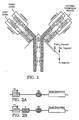
- the basic immunoglobulin (Ig) structural unit in vertebrate systems is composed of two identical "light” polypeptide chains (approximately 23 kDa), and two identical “heavy” chains (approximately 53 to 70 kDa).
- the four chains are joined by disulfide bonds in a "Y" configuration, and the "tail" portions of the two heavy chains are bound by covalent disulfide linkages when the immunoglobulins are generated either by B cell hybridomas or other cell types.
- V L J L variable region
- V H D H J H variable region linked through a combination of the diversity (D H ) region and the joining (J H ) region to the constant region (C H ).
- the V L J L and V H D H J H regions of the light and heavy chains, respectively, are associated at the tips of the Y to form the antibody's antigen binding portion and determine antigen binding specificity.
- the (C H ) region defines the antibody's isotype, i.e., its class or subclass.
- Antibodies of different isotypes differ significantly in their effector functions, such as the ability to activate complement, bind to specific receptors (e.g., Fc receptors) present on a wide variety of cell types, cross mucosal and placental barriers, and form polymers of the basic four-chain IgG molecule.
- specific receptors e.g., Fc receptors
- Antibodies are categorized into "classes" according to the C H type utilized in the immunoglobulin molecule (IgM, IgG, IgD, IgE, or IgA). There are at least five types of C H genes (C ⁇ , C ⁇ , C ⁇ , C ⁇ , and C ⁇ ), and some species (including humans) have multiple C H subtypes (e.g., C ⁇ 1 , C ⁇ 2 , C ⁇ 3 , and C ⁇ 4 in humans). There are a total of nine C H genes in the haploid genome of humans, eight in mouse and rat, and several fewer in many other species.
- C H type utilized in the immunoglobulin molecule
- Each heavy chain class can be associated with either of the light chain classes (e.g., a C H ⁇ region can be present in the same antibody as either a ⁇ or ⁇ light chain), although the constant regions of the heavy and light chains within a particular class do not vary with antigen specificity (e.g., an IgG antibody always has a C ⁇ heavy chain constant region regardless of the antibody's antigen specificity).
- V, D, J, and C regions of the heavy and light chains are encoded by distinct genomic sequences.
- Antibody diversity is generated by recombination between the different V H , D H , and J H gene segments in the heavy chain, and V L and J L gene segments in the light chain.
- the recombination of the different V H , D H , and J H genes is accomplished by DNA recombination during B cell differentiation. Briefly, the heavy chain sequence recombines first to generate a D H J H complex, and then a second recombinatorial event produces a V H D H J H complex.
- a functional heavy chain is produced upon transcription followed by splicing of the RNA transcript. Production of a functional heavy chain triggers recombination in the light chain sequences to produce a rearranged V L J L region which in turn forms a functional V L J L C L region, i.e., the functional light chain.
- progeny of a single B cell can switch the expressed immunoglobulin isotype from IgM to IgG or other classes of immunoglobulin without changing the antigen specificity determined by the variable region.
- This phenomenon known as immunoglobulin class-switching, is accompanied by DNA rearrangement that takes place between switch (S) regions located 5' to each C H gene (except for C ⁇ ) (reviewed in Honjo (1983) Annu. Rev. Immunol. 1:499-528 , and Shimizu & Honjo (1984) Cell 36:801-803 ).
- S-S recombination brings the V H D H J H exon to the proximity of the C H gene to be expressed by deletion of intervening C H genes located on the same chromosome.
- the class-switching mechanism is directed by cytokines ( Mills et al. (1995) J. Immunol. 155:3021-3036 ).
- Switch regions vary in size from 1 kb (S ⁇ ) to 10 kb (S ⁇ 1 ), and are composed of tandem repeats that vary both in length and sequence ( Gritzmacher (1989) Crit. Rev. Immunol. 9:173-200 ).
- switch regions have been characterized including the murine S ⁇ , S ⁇ , S ⁇ , S ⁇ 3, S ⁇ 1, S ⁇ 2b and S ⁇ 2a switch regions and the human S ⁇ switch region (Mills et al. (1995) supra ; Nikaido et al. (1981) Nature 292:845-8 ; Marcu et al. (1982) Nature 298:87-89 ; Takahashi et al. (1982) Cell 29:671-9 ; Mills et al. (1990) Nucleic Acids Res. 18:7305-16 ; Nikaido et al. (1982) J. Biol. Chem. 257:7322-29 ; Stanton et al. (1982) Nucleic Acids Res.
- mice carrying a rearranged expressible V H D H J H heavy chain ⁇ gene integrated outside the mouse IgH locus were found to produce mRNA having the V H D H J H region of the transgene correctly spliced to the endogenous C H region.
- the frequency of trans-splicing is low, and the factors regulating both mechanisms are not well understood.
- chimeric antibodies having a human C H region and non-human (e.g., murine) antigen combining (variable) regions.
- These chimeric antibodies are generally produced by cloning the desired antibody variable region and/or constant region, combining the cloned sequences into a single construct encoding all or a portion of a functional chimeric antibody having the desired variable and constant regions, introducing the construct into a cell capable of expressing antibodies, and selecting cells that stably express the chimeric antibody.
- the chimeric antibody is produced by cloning the desired variable region or constant region, introducing the construct into an antibody-producing cell, and selecting for chimeric antibody-producing cells that result from homologous recombination between the desired variable region and the endogenous variable region, or the desired constant region and the endogenous constant region.
- Examples of techniques which rely upon recombinant DNA techniques such as those described above to produce chimeric antibodies are described in PCT Publication No. WO 86/01533 (Neuberger et al. ), and in U.S. Patent Nos. 4,816,567 (Cabilly et al. ) and 5,202,238 (Fell et al. ). These methods require transferring DNA from one cell to another, thus removing it from its natural locus, and thus require careful in vitro manipulation of the DNA to ensure that the final antibody-encoding construct is functional (e.g., is capable of transcription and translation of the desired gene product).
- the present invention features a method of replacing one DNA sequence with another using switch (S) regions derived from an immunoglobulin (Ig) gene.
- S switch
- Ig immunoglobulin
- directed recombination is brought about between a targeting construct and a target locus.
- the nucleic acid targeting construct is composed minimally of a switch region and a promoter operably linked to and 5' of the switch region. Additionally, depending on the desired recombinatorial product, the targeting construct can also contain a modifying sequence operably linked to and 3' of the switch region, and other DNA sequences between the promoter and switch regions, e.g., 5' of the switch region and 3' of the promoter region.
- a targeting construct with an Ig heavy chain to facilitate isotype switching, e.g., replacement of an endogenous constant region (C H ) in an antibody heavy chain gene (target sequence) with a C H of a different subtype, isotype, or species of origin (modifying sequence).
- exogenous DNA encoding the constant or variable region of an antibody light or heavy chain can be switched with the constant or variable region of an endogenous sequence to create a sequence which encodes an antibody with a different constant or variable region.
- the method of the invention is widely applicable to manipulate DNA sequences for production of a desired protein or protein component, including the production of chimeric antibodies having a desired variable region linked to a non-antibody polypeptide (e.g., a detectable polypeptide label, or a polypeptide having a desired activity).
- a non-antibody polypeptide e.g., a detectable polypeptide label, or a polypeptide having a desired activity.
- the invention features a method for directed switch-mediated recombination by a) introducing a targeting construct into a cell having a target locus, the target locus being minimally composed of a promoter, a switch region, and a target sequence, wherein the targeting construct is minimally composed of a promoter and a switch region, and can contain additional modifying sequences, b) culturing the cell to allow transcription of the target locus and the targeting construct, thereby promoting recombination of the switch regions of the target locus and the targeting construct, and c) selecting a cell containing the desired recombined DNA product sequence, minimally composed of a switch region (composed of DNA sequences from one or both the target locus switch region and targeting construct switch region).
- the targeting construct (P 1 -S 1 ) is composed of a promoter (P 1 ) and switch region (S 1 ) and the target locus (P 2 -S 2 -T) is composed of a promoter (P 2 ), a naturally occurring or artificially inserted switch region (S 2 ), and a target sequence (T).
- Directed S-S recombination between the S-S regions results in a DNA sequence having the P 1 promoter of the targeting construct, a switch region containing DNA sequences from one or both S 1 and S 2 regions, and the T sequence (P 1 -S 1/ S 2 -T).
- the target sequence is removed from the control of the target locus promoter and placed under control of the desired P 1 promoter.
- Cells containing the desired DNA sequence are selected by methods known in the art, including Southern blot analysis or PCR.
- the targeting construct (P 1 -S 1 -M) is composed of a promoter (P 1 ), a switch region (S 1 ), and a modifying sequence (M)
- the target locus (P 2 -S 2 -T) is composed of a promoter (P 2 ), a naturally occurring or artificially inserted switch region (S 2 ), and a target sequence (T).
- Directed S-S recombination between the S-S regions results in two possible recombinatorial product sequences, one having the P 1 promoter of the targeting construct, a switch region containing DNA sequences from one or both S 1 and S 2 regions, and the T sequence (P 1 -S 1 /S 2 -T), and a second sequence having a P 2 promoter, a switch region containing DNA sequences from one or both S 1 and S 2 regions, and the M sequence (P 1 -S 1/ S 2 -M).
- cells expressing the M sequence are selected by methods known in the art, including Southern or Northern blot analysis.
- the targeting construct (P 1 -Z-S 1 ) is composed of a promoter (P 1 ), DNA sequences 5' to the switch region (Z), and the switch region (S 1 ).
- the target locus (P 2 -S 2 -T) is composed of a promoter (P 2 ), a naturally occurring or artificially inserted switch region (S 2 ), and a target sequence (T). Directed S-S recombination between the switch regions results in a DNA sequence having the P 1 promoter of the targeting construct, the Z DNA sequences, a switch region containing DNA sequences from one or both switch regions, and the T sequence (P 1 -Z-S 1 /S 2 -T).
- the target locus is a DNA sequence having a switch region, and may be a native, naturally-occurring sequence (e.g., an Ig locus of an antibody-producing cell), a rearranged Ig locus, or a recombinantly produced DNA sequence artificially inserted at a desired site.
- the target locus can be either an extrachromosomal element or a stably integrated chromosomal element.
- the target locus encodes an antibody heavy chain gene.
- the targeting construct is either an extrachromosomal element or a stably integrated chromosomal element.
- the modifying sequence of the targeting construct preferably encodes a different or modified heavy chain constant region or a non-antibody sequence of interest (e.g., a detectable polypeptide label, an enzyme, a toxin, or a growth factor).
- a non-antibody sequence of interest e.g., a detectable polypeptide label, an enzyme, a toxin, or a growth factor.
- the invention provides a method of modifying a DNA sequence by directed S-S recombination.
- the invention allows DNA recombination to be directed to any site which contains a naturally-occurring switch region or synthetic switch region, including a site into which an S region has been artificially inserted.
- the invention provides a method to replace or modify a first DNA sequence (a target sequence) with a second DNA sequence (a modifying sequence) without the need for isolating the nucleotide sequence containing the target sequence, excising the target sequence, and ligating the modifying sequence in place of the target sequence.
- the invention also provides a method to replace portions of a polypeptide-encoding sequences with a heterologous amino acid sequence, where the polypeptide is composed of two distinct components (e.g., an N-terminal component and a C-terminal component) that, for example, confer distinct functional or structural characteristics upon the polypeptide (e.g., ligand binding or cell-binding).
- the invention allows for the substitution of either the N-terminal portion with a different, heterologous amino acid-encoding sequence, or the C-terminal portion with a different, heterologous amino acid-encoding sequence.
- Directed switch-mediated recombination allows recombination to occur at a specific, pre-selected region with an increased efficiency relative to the naturally-occurring mechanism which is limited to the immunoglobulin heavy chain.
- the method of the invention removes switch-mediated recombination from the limitations of its normal regulatory environment, allowing recombination to be controlled as needed with, for example, the use of constitutive or inducible promoters.
- the ability to accomplish directed in vitro S-mediated recombination avoids tedious, time-consuming manipulation of DNA using conventional recombinant DNA techniques while providing a highly efficient method of inserting a DNA sequence.
- the method allows the detectable label portion of fusion proteins (e.g., ⁇ -galactosidase) to be readily exchanged for a different amino acid sequence (e.g., alkaline phosphatase).
- directed S-S recombination is used to replace the constant region of an antibody heavy chain gene with a different or modified constant region without the need for extensive manipulation of the antibody heavy chain gene. Additionally, the method of the invention allows the antibody gene to be maintained in its native locus.
- artificial refers to an isolated natural or non-naturally occurring material e.g., a nucleotide sequence manufactured by human intervention e.g., fusing natural sequences together or chemically synthesizing natural sequences in isolation.
- switch region means a nucleotide sequence composed of tandem repeat sequences that occur in nature 5' to the immunoglobulin heavy chain constant region and function in intrachromosomal class-switching, i.e., recombination of DNA sequences encoding specific portions of immunoglobulin heavy chain constant regions. Examples of specific switch region sequences are disclosed in Mills et al. (1995) J. Immunol. 155:3021-3036 , herein specifically incorporated by reference.
- Switch region includes both full-length switch sequences of native immunoglobulin sequences, as well as recombinant and synthetic nucleotide sequences that are modified (e.g., contain nucleotide substitutions, additions, mutations, and/or other modifications) relative to a native immunoglobulin switch region, with the proviso that the switch region retains its function in facilitating recombination when transcribed.
- switch-mediated recombination or "directed S-S recombination” are used interchangeably to mean interchromosomal, intrachromosomal, or extrachromosomal DNA recombination facilitated by a switch region.
- S-S recombination results from interaction of 1) a first switch region positioned 3' to a promoter (targeting construct) and 2) a second switch region positioned 3' to a promoter and 5' to a DNA sequence (target locus).
- recombination occurs between the switch regions resulting in an alteration of the target locus DNA sequence.
- the directed S-S recombination of the invention results in interaction between DNA sequences on two different chromosomes, on the same chromosome, between a chromosome and an extrachromosomal element, or between two extrachromosomal elements.
- targeting construct means a nucleic acid construct which is introduced into a cell to cause directed S-S recombination at a natural or artificial switch region.
- a targeting construct minimally comprises: 1) a switch region and 2) a promoter operably linked to and 5' of the switch region.
- the targeting construct further comprises 3) a modifying sequence operably linked to and 3' of the switch region.
- the targeting construct may also comprise 4) one or more DNA sequences between the switch region and promoter.
- the resulting mRNA will encode the switch region, or the switch region and the modifying sequence, or the switch region and DNA sequences between the switch region and/or a modifying sequence.
- target locus means a nucleic acid sequence minimally comprises 1) a switch region, 2) a target sequence adjacent and 3' of the switch region, and 3) a promoter operably positioned in the target locus to provide transcription of the switch region and target sequence as one or more translatable mRNA(s).
- the target locus can further contain an additional DNA sequence positioned adjacent and 5' of the switch region; in such constructs, the promoter provides transcription of the additional DNA sequence, the switch region, and the target sequence as one or more translatable mRNA(s).
- Target loci can be either naturally occurring (e.g., an immunoglobulin gene composed of a rearranged VDJ region positioned 5' of a switch region and C H gene) or recombinantly or synthetically produced, and can be either chromosomal or extrachromosomally located.
- An exemplary target sequence comprises a promoter sequence operatively positioned 5' to a switch region operatively positioned 5' to a coding sequence which is preferably a sequence encoding a constant region of a human antibody.
- target sequence means the nucleic acid sequence adjacent to a switch region where directed S-S recombination takes place.
- a target sequence is replaced by the modifying sequence after switch-mediated recombination.
- Target sequences can be naturally occurring sequences endogenous to a chromosomal sequence or recombinant sequences (i.e., a sequence produced using recombinant genetic manipulation) present as an extrachromosomal element (e.g., a vector) or as a stably integrated element within a chromosomal sequence.
- Target sequences are adjacent to a switch region which may be a naturally occurring switch region or may be a switch region inserted 5' to a desired target sequence by recombinant DNA technology.
- Exemplary target sequences are different from the modifying sequence and include sequences encoding an immunoglobulin heavy chain constant region of a particular isotype, subtype, and/or origin.
- immunoglobulin locus means a nucleotide sequence that encodes all or a portion of the constant region and/or variable region of an antibody molecule, including all or portions of the regulatory sequences that control expression of an antibody molecule from the locus or its processes.
- Heavy chain genes in Ig loci include but are not limited to all or a portion of the V H , D H , J H , and constant regions, as well as the switch regions, intronic sequences, and flanking sequences associated with or adjacent the heavy chain gene.
- Ig loci for light chains include but are not limited to the V L , J L , and constant regions of both the kappa and lambda alleles, intronic sequences, and flanking sequences associated with or adjacent the light chain gene.
- modified target locus means a nucleic acid sequence modified by switch-mediated DNA recombination so that the modified target sequence is minimally composed of a switch region composed of switch sequences derived from the unmodified target locus switch region, or from both the unmodified target locus and the targeting construct.
- the modified target locus is also composed of the promoter of the unmodified target sequence, the first DNA sequence of the unmodified target sequence (when present in the original target locus), and the modifying sequence of the targeting construct. Activation of transcription by the promoter results in transcription of the first DNA sequence, the switch region, and the modifying sequence in one or more translatable mRNA(s).
- promoter means a nucleotide sequence that, when operably linked to a DNA sequence of interest, promotes transcription of that DNA sequence.
- detectable polypeptide label means a amino acid sequence that, when covalently bound to another amino acid sequence, provides a heterologous sequence that can be readily detected.
- the polypeptide can be detected by binding of a polypeptide-specific antibody, by virtue of an enzymatic activity of the polypeptide, or by reaction of the polypeptide with a chemical reagent.
- exemplary detectable polypeptide labels include ⁇ -galactosidase, alkaline phosphatase, horseradish peroxidase, enzymatically active portions of these enzymes, or any amino acid sequence that is immunodetectable and heterologous to the amino acid sequence with which it is associated.
- the method of directed switch region-mediated recombination uses switch regions (e.g., those isolated and derived from an immunoglobulin locus) to facilitate recombination at a specific nucleic acid sequence.
- the nucleic acid sequence to which S-S recombination is directed contains an S region and is termed a "target locus," while the introduced nucleic acid sequence containing a S region sequence is termed a "targeting construct.” Transcription of each S region allows S-S recombination to occur between the two preselected DNA regions.
- the presence of a selected promoter provides constitutive or inducible transcription, thereby enhancing the frequency of S-S recombination occurrence.
- Fig. 2A The basic components of an exemplary target locus suitable for use in the invention are illustrated in Fig. 2A.
- the minimal components of the target locus are (from 5' to 3'): 1) a promoter (P 2 , where the arrow indicates the direction of transcription), 2) a switch region (S 2 ), and 3) a target sequence (T).
- the target locus can further contain an additional DNA sequence positioned 3' of the promoter and 5' of the switch region (Y) (Fig. 2B). Regardless of its composition, the target locus components are positioned so that the promoter activates transcription of the 5' DNA sequence (optional), switch region, and target sequence (optional).
- the target locus can either be an endogenous, naturally-occurring chromosomal sequence (e.g., an Ig heavy chain locus where the 5' DNA sequence is a V H D H J H gene and the target sequence is a C H gene) or an artificially constructed sequence (i.e., a recombinantly produced sequence or a synthesized sequence) which is present as either an extrachromosomal element (e.g., a vector or plasmid) or as a stable chromosomal integrant.
- an extrachromosomal element e.g., a vector or plasmid
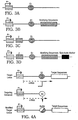
- the basic components of an exemplary targeting construct for use in the invention are illustrated in Figs. 3A-3D.
- the minimal components of the targeting construct are (from 5' to 3'): 1) a promoter (P 1 , where the arrow indicates the direction of transcription) and 2) a switch region (S) (Fig. 3A).
- the targeting construct can additionally contain 3) a modifying sequence 3' to S (Fig. 3B), and/or 4) one or more DNA sequences 5' to S (Fig. 3C).
- the targeting construct can include a selectable marker (Fig. 3D).
- the targeting construct components are positioned so that the promoter activates transcription of the switch regions and modifying sequence.
- the targeting construct is normally a recombinantly or synthetically produced nucleic acid sequences, and can be used in the method of the invention as either an extrachromosomal element (e.g., a plasmid or vector) or as a stable chromosomal integrant.
- exemplary modifying sequences include the C H gene for use in isotype switching (i.e., replacement of the C H gene of the target locus with a C H gene of a different isotype or subtype).
- the IgM heavy chain gene (which includes a V H D H J H region, a switch region (S ⁇ ), and a C ⁇ gene) is constitutively transcribed and translated.
- Class-switching e.g., to production of IgG
- a second switch region e.g., S ⁇
- Transcription of a second switch region is thought to be regulated by control elements associated with each of the switch regions of the C H locus.
- Each of these control elements are activated by a different combination of cellular signals (i.e., one or more cellular signals) normally associated with cytokines which can be activated, for example, in a microbial infection or inflammation (e.g., cytokines such as interleukins, interferons, and tumor necrosis factor).
- cytokines e.g., interleukins, interferons, and tumor necrosis factor
- production of cellular signals is associated with specific types of infections and inflammation.
- a specific type of infection or inflammation results in: 1) production of a specific combination of cellular signals, which in turn determines 2) which of the switch region control elements is activated and, as a result, 3) which switch region is transcribed to promote recombination of its associated C H region with the constitutively transcribed S ⁇ and C ⁇ regions to produce a different, specific antibody isotype (Coffman et al., 1993, supra) .
- the present invention uses switch regions to provide a method of directing recombination to pre-selected sites of interest in a manner that is not controlled by the normal cellular regulatory mechanisms described above.
- the directed S-S recombination of the present invention uses a targeting construct minimally containing a switch region (S 1 ) and a promoter (P 1 ), and a target locus containing a switch region (S 2 ) and target sequence (T) under control of a promoter (P 2 ), to facilitate switch-site specific recombination mediated by the two transcriptionally activated switch regions.
- the resulting recombinatorial product will minimally contain a switch region having sequences from one or both switch regions, e.g., S 1 , or S 1 /S 2 .
- the targeting construct contains a promoter P 1 and S 1
- the desired recombinatorial product will consist of the P 1 promoter, the switch region, and the target sequence, now under control of P 1 instead of P 2 (Fig. 4A).
- the desired recombinatorial product is recognized in a number of ways known to the art including PCR.
- P 1 is an inducible promoter
- a cell containing the desired recombinatorial product can be recognized by induction of transcription.
- the desired recombinatorial product will consist of the P 2 promoter, the switch region, and the modifying sequence which replaces the target sequence (Fig. 4B).
- the switch region may contain sequences from one or both switch regions, e.g., S 1 or S 1 /S 2 .
- the modifying sequence encodes a protein or peptide
- the desired recombinatorial product can be recognized by synthesis of the desired product.
- the targeting construct consists of P 1 , DNA sequences 5' to S 1 , and S 1
- the desired recombinatorial product contains P 1 and the DNA sequences 5' to the S 1 region inserted into the target locus (Fig. 4C).
- the desired recombinatorial product can be identified in a variety of ways, including PCR detection of the presence of the 5' DNA sequences and/or P 1 , or by immunodetection technologies.
- the targeting construct can be used to insert a piece of DNA 3' to a target locus contained in a specific chromosome.
- the targeting construct carries homologous sequences allowing insertion into the selected chromosome by homologous recombination.
- the resulting modified chromosome contains a DNA of the targeting construct at a site 3' from the target locus. This embodiment is useful for induction of intrachromosomal S-mediated recombination.
- Class-switching results when B lymphocytes initially expressing IgM switch their heavy chain isotype to IgG, IgA, or IgE upon maturation.
- Isotype switching results from a deletional DNA recombination event in which the C ⁇ constant region of the heavy chain, initially located downstream of the V H D H J H region, is replaced by a C ⁇ , C ⁇ , or C ⁇ constant regions ( Rabbitts et al. (1980) Nature 283:351 ; Davis et al. (1980) supra ; Kataoka et al. (1981) supra .
- switch regions have been characterized, including the murine S ⁇ , Se, S ⁇ , S ⁇ 3 , S ⁇ 1 , S ⁇ 2b and S ⁇ 2a switch regions and the human S ⁇ switch region, such as S ⁇ , and S ⁇ 4 ( Mills et al. (1995) J. Immunol. 155:3021-3036 , herein specifically incorporated by reference).
- the pentamers ACCAG, GCAGC, and TGAGC are also commonly found in switch regions (Gritzmacher (1989) supra ).
- the heptameric repeat (C/T)AGGTTG is abundantly present in switch region sequences and is found near many, but not all, switch recombination sites that have been characterized in plasmacytomas and hybridomas (Marcu et al. (1982) supra ).
- the murine S ⁇ and S ⁇ loci contain 40 bp and 80 bp sequences, respectively, that are tandemly repeated. These sequences are homologous to S ⁇ , especially in areas of the repeats containing the GAGCT pentamer. Both human and murine S ⁇ regions are much less homologous to S ⁇ than are the S ⁇ and S ⁇ regions.
- the homology of murine S ⁇ regions to S ⁇ decreases with the increasing distance 3' of the variable region (S ⁇ 3>S ⁇ 1>S ⁇ 2b>S ⁇ 2a).
- the murine S ⁇ regions are composed of tandem repeats of 49 bp or 52 bp (S ⁇ 2a), within which the pentameric sequences TGGGG, GCAGC, and ACCAG are commonly found (Kataoka et al. (1981) supra ; Mowatt et al. (1986) supra ; Nikaido et al. (1982) supra , Nikaido et al. (1981) supra ; Stanton et al (1982) supra ; Szurek et al. (1985) supra; Wu et al. (1984) supra ).
- Switch regions suitable for use in the invention can be naturally occurring sequences, e.g., a switch region cloned directly from an Ig locus, preferably from a murine or human Ig locus.
- the switch region can be a synthetically or recombinantly produced sequence.
- Recombinant switch regions can have the same sequence as a native, naturally-occurring switch region, or can be modified (e.g., contain nucleotide substitutions, additions, mutations, and/or other modifications) relative to a native switch region, with the proviso that the switch region retains its function in facilitating recombination.
- Recombinant switch regions can be designed to as to have a minimal nucleotide sequence necessary for switch-mediated recombination at the same (or lower but acceptable) level as a native switch region, or at a level enhanced relative to recombination promoted by a wild-type switch region.
- the switch-mediated recombination of the present invention provides improved efficiency of S-S recombination over the naturally-occurring mechanism, as well as providing a widely application method of producing a desired protein. This is achieved, in part, with the use of promoters providing constitutive or inducible transcription of the targeting construct, the target locus, or both the targeting construct and target locus.
- the improved efficiency of the switch-mediated recombination method of the invention provides a frequency of recombination at a level higher than that which occurs naturally, that is, a 1% to 100% improved efficiency; more preferably, a 20% to 100% improvement; and more preferably a 50% to 100% improvement.
- targeting constructs of the invention are minimally composed of: 1) a switch region and 2) a promoter operably linked to and 5' of the switch region. Additional optional components of the targeting construct include 3) a modifying sequence operably linked to and 3' of the switch region, including proteins, selectable markers, and/or control elements, and/or 4) DNA sequences 3' to the promoter and 5' to the switch region. Transcriptional activation of the promoter results in production of one or more translatable mRNA(s).
- the promoter of the targeting construct is selected according to the cell type in which directed S-S recombination is to be accomplished (e.g., a eukaryotic or prokaryotic cell, normally a eukaryotic cell). Because directed S-S recombination is dependent on transcription of the switch regions of the targeting construct and the target locus, the promoter of the targeting construct can be a constitutive or an inducible promoter. Suitable constitutive and strong constitutive promoters for DNA expression in prokaryotic or eukaryotic cells are well known in the art.
- the promoter can be the heavy chain Ig promoter or a viral promoter, such as a CMV, SV40, murine Moloney Sarcoma virus (MMLV), and spleen-focus forming virus (SFFV) promoter, or an inducible promoter, such as MMTV and ⁇ -inhibin.
- a viral promoter such as a CMV, SV40, murine Moloney Sarcoma virus (MMLV), and spleen-focus forming virus (SFFV) promoter
- an inducible promoter such as MMTV and ⁇ -inhibin.
- the modifying sequence can be any nucleic acid sequence that is suitable for replacing a target sequence in a target locus.
- the modifying sequence can be composed of a nucleotide sequence that encodes a translation product to replace all or a portion of the target sequence.
- the target sequence is a C H gene
- the modifying sequence can be a different native C H gene, a modified C H gene (e.g, encoding an altered effector function relative to the wild-type C H gene), or a native or modified light chain constant region.
- the modifying sequence can encode a non-antibody-derived polypeptide that confers a function upon the polypeptide encoded by the modified target sequence.
- the modifying sequence can encode a toxin, hormone, growth factor, or portions thereof.
- the modifying sequence can also encode a linker to provide covalent or non-covalent linkages between other (e.g., similarly modified) heavy chain gene products or non-antibody polypeptides (e.g., toxins, growth factors, hormones, or other biologically important polypeptide or other molecule).
- a modifying sequence is a nucleotide sequence encoding a detectable polypeptide label or tag, e.g., ⁇ - galactosidase, alkaline phosphatase, horseradish peroxidase, or an immunodetectable polypeptide to which an antibody can bind to facilitate polypeptide detection and/or isolation (e.g., by immunoaffinity chromatography).
- a detectable polypeptide label or tag e.g., ⁇ - galactosidase, alkaline phosphatase, horseradish peroxidase, or an immunodetectable polypeptide to which an antibody can bind to facilitate polypeptide detection and/or isolation (e.g., by immunoaffinity chromatography).
- the modifying sequence can contain regulatory sequences (e.g., a promoter, enhancer element, an intron, or a ribosome binding site) that can be used to either introduce regulatory sequences at a position 3' of a switch region, or to replace regulatory sequences already present in the target sequence.
- regulatory sequences e.g., a promoter, enhancer element, an intron, or a ribosome binding site
- switch-mediated recombination can be used to replace a weak promoter with a strong promoter in a target locus, where the weak promoter is positioned 3' or 5' of the target locus switch region.
- Exemplary regulatory sequences of particular interest in the modification of an Ig locus include a heavy chain enhancer sequence, a kappa chain enhancer sequence, or a promoter derived from MMLV, Rous sarcoma virus (RSV), or SFFV.
- the targeting construct may also contain an amplification gene that allows the modified target locus to be amplified switch-mediated product.
- an amplification gene that allows the modified target locus to be amplified switch-mediated product.
- suitable amplification genes known to the art and useful in the invention, for example, the gene encoding dihydrofolate reductase (DHFR).
- the modifying sequence is selected according to a variety of factors including the target sequence to be modified, and/or the diagnostic or therapeutic use intended for the resultant recombinatorial product.
- the targeting construct can contain an additional, transcribable and translatable DNA sequence operably positioned between the promoter and switch region of the target locus.
- This additional sequence can encode an N-terminal portion of the polypeptide encoded by the target locus.
- the targeting construct can encode a desired V H D H J H polypeptide.
- the recombinatorial product Upon directed switch-recombination with a target locus encoding an Ig heavy chain locus having a desired C H gene at the target sequence, the recombinatorial product contains the desired V H D H J H region and the desired C H coding region, with the switch region positioned between.
- the targeting construct can be based upon any of a variety of vectors that are well known in the art and commercially available (e.g., pBR322, pACYC vectors, plasmids, and viral vectors).
- Vectors include any DNA or RNA molecule (self-replicating or not) that can be used to transform or transfect a desired cell.
- the targeting construct can include other components such as a selectable marker to facilitate screening and selection of cells containing the targeting construct as an extrachromosomal or chromosomally integrated element, and/or to select for cells that have successfully undergone directed S-S recombination, e.g., a selectable marker associated with the modifying sequence that is recombined into the target locus in addition to the modifying sequence.
- a selectable marker to facilitate screening and selection of cells containing the targeting construct as an extrachromosomal or chromosomally integrated element, and/or to select for cells that have successfully undergone directed S-S recombination, e.g., a selectable marker associated with the modifying sequence that is recombined into the target locus in addition to the modifying sequence.
- Suitable selectable marker genes include genes encoding a detectable marker (e.g., ⁇ -galactosidase) or drug resistance genes, e.g., hygromycin resistance (hyg), guanosine phosphoryl transferase (gpt), neomycin resistance (neo), dihydrofolate reductase (DHFR), puromycin (spt) and ampicillin resistance (Amp).
- the construct can also include an origin of replication for stable replication of the construct in a bacterial cell (preferably, a high copy number origin of replication), a nuclear localization signal, or other elements which facilitate production of the DNA construct, the protein encoded thereby, or both.
- the construct may also an amplification gene, which can increase levels of expression of the DNA of interest, particularly where the DNA of interest is a cDNA (e.g., contains no introns of the naturally-occurring sequence).
- amplification gene which can increase levels of expression of the DNA of interest, particularly where the DNA of interest is a cDNA (e.g., contains no introns of the naturally-occurring sequence). Any of a variety of amplification genes known in the art may be used, including DHFR.
- a target locus suitable for use in the method of the invention is minimally composed of: 1) a switch region, 2) a target DNA sequence adjacent and 3' of the switch region, and 3) a promoter operably positioned in the construct to provide transcription of the switch region and target sequence as an mRNA molecule.
- the target locus can further contain an additional DNA sequence positioned adjacent and 5' of the switch region; in such constructs, the promoter provides transcription of the additional DNA sequence, the switch region, and the target sequence as a one or more translatable mRNA(s).
- target loci suitable for use with the targeting constructs of the invention can be any switch-containing sequence in which the switch region is transcribed and can facilitate switch-mediated recombination.
- the target locus can be any native, endogenous chromosomal sequence which contains a switch region (e.g., an Ig heavy chain locus).
- the target locus can be an artificially, recombinantly produced sequence present as either an extrachromosomal element (e.g., a vector or plasmid) or a chromosomally integrated element.
- the targeting construct carries homologous sequences directing recombination at a site 3' of a target locus. S-mediated recombination will then take place intrachromosomally, thus allowing controlled induction of intrachromosomal recombination.
- the promoter of the target locus can be the promoter that is present in the native, naturally-occurring target locus sequence and/or the target sequence, or a promoter that is heterologous to the target locus sequence and/or the target sequence. Because S-S recombination is associated with transcription of the switch region, the target locus promoter preferably provides at least low-level expression, more preferably constitutive expression, and even more preferably, provides high levels of constitutive expression of the target locus, specifically of the switch region-encoding DNA.
- the native target locus promoter can be modified or replaced with a different promoter using S-mediated recombination or other recombinant methods well known in the art, e.g., cloning, homologous recombination).
- the target locus can contain an additional, transcribable and translatable DNA sequence operably positioned between the promoter and switch region of the target locus.
- the additional sequences may encode an N-terminal portion of the polypeptide and the target locus contains a target sequence encoding the C-terminal portion of a polypeptide. After directed switch-mediated recombination, the modified target locus will contain both the N- and C-terminal portions of the polypeptide.
- the target locus can include additional components to facilitate replication in prokaryotic and/or eukaryotic cells, integration of the construct into a eukaryotic chromosome, and markers to aid in selection of and/or screening for cells containing the construct (e.g., the detectable markers and drug resistance genes discussed above for the targeting construct).
- the construct should preferably additionally contain a polyadenylation sequence positioned 3' of the gene to be expressed.
- the polyadenylation signal sequence may be selected from any of a variety of polyadenylation signal sequences known in the art.
- the polyadenylation signal sequence is the SV40 early polyadenylation signal sequence. Expression of the target locus can also be enhanced by inclusion of intronic sequences, as discussed above for the targeting construct.
- An exemplary recombinant target locus of the invention is composed of (from 5' to 3'): 1) a promoter, 2) a first multiple cloning site for insertion of a DNA sequence 5' to the switch region, 3) a switch region, and 4) a second multiple cloning site for insertion of a target DNA sequence.
- the target locus is a recombinant Ig heavy chain gene
- a V H D H J H DNA sequence is inserted 5' to the switch region at the first multiple cloning site
- the target sequence is a C H region inserted into the second cloning site.
- any mammalian cell line capable of expressing the target locus of interest is suitable for use in the present invention.
- the cell line is any mammalian cell capable of expressing a functional antibody.
- the switch-mediated recombination method of the invention to facilitate class-switching in antibody-producing cells or cells with antibody-producing potential (e.g., stem cells).
- the cell line can be, e.g., a hybridoma cell line expressing human antibodies, an embryonic stem cell (e.g., a murine embryonic stem cell), a hybridoma cell line produced from B cells from a transgenic animal (e.g., a transgenic mouse), or any other cell (normally a mammalian cell) capable of expressing at least a functional portion of a heavy chain Ig locus or at least a functional portion of a light chain Ig locus.
- a cell line useful in the method of the invention is a hybridoma cell line expressing human antibodies derived from B cells from the Xenomouse ( Green et al. (1994) Nature Genetics 7:13 and PCT patent publication No.
- WO 94/02602 both of which are herein specifically incorporated by reference.
- the Xenomouse carries large segments of the human heavy chain and K chain loci integrated into its germline, as well as containing functionally inactivated mouse heavy and kappa light chain alleles.
- Xenomouse produces B cells expressing human heavy chain (h ⁇ ) and human K light chain (mK), or h ⁇ and mouse lambda (m ⁇ ) light chain. Co-expression of h ⁇ and m ⁇ does not occur, since expression of one light chain completely excludes the expression of the other (Green et al. (1994) supra) .
- Xenomouse Upon immunization, Xenomouse produces a broad adult-like repertoire of human Ig and give rise to antigen-specific human monoclonal antibodies. Xenomouse allows generation of mouse hybridomas making antigen-specific human monoclonal antibodies.
- Methods for producing hybridoma cell lines are well known in the art (see, for example, Harlow and Lane, eds., 1988, Antibodies: A Laboratory Manual, Cold Spring Harbor Laboratory, Cold Spring Harbor, NY ). Methods for producing cell lines expressing human or "humanized" antibodies are also.well known in the art (see, for example, PCT Publication Nos. WO 94/02602 and WO 91/10741 ).
- the cell line can express the antibody from either a genomic sequence, a modified sequence, a heterologous sequence (e.g., an Ig sequence from another species), a modified heterologous sequence, or a chimeric sequence (e.g., composed of both murine and human Ig sequences).
- the cell line can be, for example, a murine hybridoma cell line producing either a murine, human, or chimeric antibody.
- the hybridoma cell line can be producing human antibodies by, for example, expression of human Ig genes.
- the cell is a murine lymphoid cell producing a human antibody by expression of human Ig genes.
- the constant region gene of the genomic sequence is a human constant (hC H ) region gene, e.g., a hC H gene of the mu class (hC H ⁇ ), and the modifying sequence is a human constant region of the gamma class (hC H ⁇ ).
- Switch-mediated recombination using the construct(s) of the invention can be accomplished in a variety of ways.
- the target locus can be naturally occurring (chromosomally located) and the targeting construct can be used as either an extrachromosomal or chromosomally integrated element; or 2) the target locus can be a naturally occurring or recombinantly produced sequence that is either present as an extrachromosomal or a chromosomally integrated element, and the targeting construct can be used as either an extrachromosomal or chromosomally integrated element.
- the targeting construct and target locus are both chromosomally integrated, they are integrated on the same or different chromosomes.
- the cell line used to accomplish directed switch-mediated recombination either: 1) contains an endogenous, naturally occurring target locus, or 2) contains a chromosomally integrated recombinant target locus.
- Methods for introduction of DNA into a host cell and selection for stable chromosomal integrants containing a specific DNA sequence of interest are well known in the art (see, for example, Sambrook, et al.,1989, Molecular Cloning: A Laboratory Manual, 2nd Ed., Cold Spring Harbor Laboratory Press, Cold Spring Harbor, NY ; hereby incorporated by reference with respect to methods and compositions for recombinant DNA techniques to provide a transformed cell containing a stably integrated DNA of interest, and expression of the DNA of interest).
- the targeting construct can be linearized, e.g., by digestion with a restriction endonuclease(s), and the linear DNA introduced into the host cell using any of a variety of methods known in the art (e.g., electroporation, microinjection, liposome fusion, red blood cell ghost fusions, protoplast fusion, yeast cell fusion, or any other method known in the art (see, for example, Sambrook et al., supra)).
- the linear vector is then integrated into the cell's genome randomly or specifically by directed homologous recombination, and stable integrants are selected by, for example, expression of a selectable marker associated with the targeting construct, or by expression of the modifying sequence in the targeting construct.
- Directed switch-mediated recombination is accomplished by simultaneous transcription of the switch regions in the target locus and the targeting vector.
- Cells containing the recombinatorial product, for example, the modified target locus are identified and selected by expression of the modified target locus gene product (e.g., by ELISA reactivity or fluorescence-activated cell sorting (FACS)).
- FACS fluorescence-activated cell sorting
- the targeting construct is introduced into the cell containing a chromosomally integrated target locus by methods well known in the art (see, for example, Sambrook et al., 1989, supra).
- the targeting construct is maintained as an extrachromosomal element for a time sufficient for transcription of the targeting construct's switch region and recombination with the transcriptionally active switch region of the target locus.
- Cells containing the desired recombinatorial product e.g., a modified target locus, can be identified and selected as described above, e.g., selection for expression of a selectable marker associated with the integrated target sequence, or detection of cells expressing the desired modified target locus gene product.
- Detection of properly recombined sequences can be accomplished in a variety of ways, depending upon the nature of the desired recombinatorial product. For example, where the modifying sequence associated with a selectable marker is recombined into the target locus with the modifying sequence, an initial screen will select for those cells which express the marker. A second screen can be used to determine if the drug resistant cells express the appropriately modified target locus.
- the method used for the second screen will vary with the nature of the modifying sequence inserted into the target locus.
- the modifying sequence can be detected by Southern blot using a portion of the modifying sequence as a probe, or by polymerase chain reaction (PCR) using amplifying primers derived from the modifying and modified regions.
- the cells having an appropriately integrated modifying sequence can also be identified by detecting expression of a functional modified target locus product, e.g., immunodetection of the new C H region in a modified antibody heavy chain locus.
- the expression product of the modified target locus can be detected using a bioassay to test for a particular effector function conferred by the modifying sequence.
- the expression of modifying sequence that encodes a biologically active molecule such as an enzyme, toxin, growth factor, or other peptides is assayed for that particularly biological activity.
- the product of the modified target locus can also be tested for appropriate antigen or ligand recognition via any conventional immunological screening methods known in the art, e.g, ELISA, FACS, antibody-dependent cell cytotoxicity assays, or immunoprecipitation assays (see, for example, Harlow and Lane, supra).
- the vector pTSW-1.4 was generated from the p1bYAC ⁇ Not plasmid containing a 23 kb EcoRI genomic fragment of the entire human ⁇ 2 switch region, isolated from human placenta genomic library. This fragment contained 2 kb of coding sequences, 12 kb of upstream sequences including the I exon and ⁇ 2 switch region, and 9 kb of downstream sequences ( Flanagan & Rabbitts (1982) Nature 300:709-713 ). This plasmid also contains the mouse 3' enhancer ( Dariavach et al. (1991) Eur. J. Immunol.
- the vector was modified to contain a hygromycin selectable marker and a human CMV promoter-enhancer cassette, which included at its 3' end prokaryotic terminator sequences (described below).
- the prokaryotic terminator sequences were used to stop fortuitous prokaryotic transcripts from activating the switch sequences, and thus destabilizing them during cloning in bacteria ( Mowatt & Dunnick (1986) J. Immunology 136:2674-2683 ). These sequences were confirmed to have very little effect on eukaryotic transcription.
- the hygromycin gene driven by the SV40 promoter ( Giordano & McAllister (1990) Gene 88:285-288 ) was cloned as a 1.7 kb HindIII-BamHI fragment from pUC219.TG76 plasmid and inserted into HindIII and BamHI sites in pACYC177 to generate pACYC.hyg plasmid.
- the terminator was synthesized as GCATGCCCGCGG-GAATAGGCGGGCTTTTTTNNNGCCGCGGCTCGA (SEQ ID NO:1), with flanking SphI sites, and an internal XhoI site at the 3' end, for cloning purposes. This sequence was cloned into the SphI site of pIK1.1Cat plasmid, downstream of the human CMV promoter-enhancer sequences.
- the CMV expression cassette together with the terminator sequences, was cloned as a 900 bp HindIII-XhoI fragment, which was placed into the HindIII and XhoI sites in the pACYC.hyg plasmid described above to generate pACYC.hyg.CMVt, in which the CMV transcription orientation is opposite to that of the hygromycin gene.
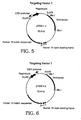
- pTSW-1.4 plasmid (Fig. 5) was generated with CMV transcription orientation in the same direction as that of the human ⁇ 2 coding sequences.
- pTSW-1.9 plasmid (Fig. 6) was generated with CMV transcription orientation opposite to that of the human ⁇ 2 coding sequences.
- pTSW-1.4 An exemplary targeting construct of the invention, designated pTSW-1.4, is shown in Fig. 5.
- pTSW-1.4 is constructed for use in switch-mediated replacement of an Ig heavy chain constant gene with a human heavy chain IgG 2 constant gene (hCH ⁇ 2).
- the pTSW-1.4 construct contains a. CMV promoter operably linked to, in the 5' to 3' orientation, the human IgG2 heavy chain region (approximately 23 kb), which includes the IgG2 heavy chain I exon and its 5' flanking sequences, the human IgG2 switch region, the complete human hCH ⁇ 2 gene, and sequences flanking the IgG2 heavy chain region.
- the hCH ⁇ 2 region is linked to a murine enhancer positioned adjacent and 3' of the hCH ⁇ 2 gene.
- the CMV promoter is a strong constitutive promoter.
- Other constitutive promoters can be used instead of the CMV promoter (e.g., SSFV, MMLV, MCV, RSV, SV40, etc.).
- Both the hCH ⁇ 2 regions have been cloned and sequenced (Mills et al. (1995) supra ).
- Murine 3' enhancer is also well known in the art (Dariavach et al. (1991) supra ).
- a 13 kb BamHI fragment was cloned from the 23 kb EcoRI human ⁇ 2 genomic fragment in p1bYAC ⁇ Not plasmid, as described in Example 1, followed by partial fill-in reaction with Klenow to generate fragment ends compatible with XhoI.
- This clone was inserted into the unique XhoI site in pACYC.hyg.CMVt plasmid, which was also partially filled in with Klenow to make the site compatible with BamHI.
- the correct orientation of the clone in which the transcription orientation of human ⁇ 2 coding sequences is the same as the CMV promoter, was selected.
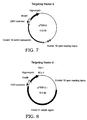
- pTSW-2 Another exemplary targeting construct of the invention, designated pTSW-2, is shown in Fig. 7. Like pTSW-1.4, pTSW-2 is constructed for use in switch-mediated replacement of an Ig heavy chain constant gene with a human heavy chain IgG 2 constant gene (hCH ⁇ 2).
- the pTSW-2 construct is prepared using a CMV promoter operably linked to, in the 5' to 3' orientation, the human IgG2 heavy chain region (approximately 13 kb) including the human IgG2 switch region and 200 bp 5' flanking sequences of the switch region and human ⁇ 2 open reading frame. Some of the flanking sequences present in pTSW-1.4 are not present in pTSW-2.
- the pTSW-2 construct also contains the selectable marker SV2hyg and a prokaryotic transcription terminator (to stabilize the switch region).
- the pTSW-2 construct can be prepared either with or without a murine enhancer positioned 3' of the hCH ⁇ 2 gene.
- the modified plasmid was cloned 5' of the human ⁇ 2 region via the unique XhoI site in pACYC.hyg.CMVt.
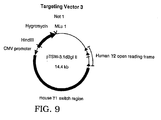
- pTSW-3.1dBglII plasmid (Fig. 9) was generated similarly to pTSW-3.1, except that a 7.9 kb BglII-EcoRI mouse ⁇ 1 switch sequences was included.
- pTSW-3.2 was constructed as described for pTSW-3.1, except that the CMV promoter-enhancer cassette was replaced by the spleen focus forming virus (SSFV) promoter.
- SSFV spleen focus forming virus
- pTSW-3 plasmids contained unique NotI and MluI sites (converted by a linker from the unique BamHI site). HindIII is used for linearization and for cloning of the 3' enhancer.
- pTSW-3.1 A further exemplary targeting construct of the invention, designated pTSW-3.1, is shown in Fig. 8. Like pTSW-1.4 and TSW-2, pTSW-3.1 is constructed for use in switch-mediated replacement of an Ig heavy chain constant gene with a human heavy chain IgG 2 constant gene (hCH ⁇ 2 ).
- the pTSW-3.1 construct is prepared using a CMV promoter operably linked to, in the 5' to 3' orientation, a murine ⁇ 1 switch region which may contain also the mouse ⁇ 1 I exon and flanking sequences, and a human genomic constant hCH ⁇ 1 , hCH ⁇ 2 , or hCH ⁇ 4 coding sequence, which includes the 5' flanking branch point and splice acceptor.
- the pTSW-3.1 construct can optionally further contain a murine ⁇ 1 control element (mI ⁇ 1 ) positioned adjacent and 5' of the mS ⁇ 1 sequence.
- a murine ⁇ 1 control element mI ⁇ 1
- the human switch region of the ⁇ 1 gene hS ⁇ 1
- its 5' flanking sequences such as the I exon (hI ⁇ 1 ) can be used instead of the mI ⁇ 1 and mS ⁇ 1 .
- a splice donor site is provided 3' of the promoter sequences.
- the pTSW-3.1 construct may further optionally contain a murine 3' enhancer positioned adjacent and downstream of the hC H ⁇ gene and/or a 3' eukaryotic transcription terminator positioned 3' and adjacent the hC H ⁇ gene.
- a murine 3' enhancer positioned adjacent and downstream of the hC H ⁇ gene and/or a 3' eukaryotic transcription terminator positioned 3' and adjacent the hC H ⁇ gene.
- Each of the elements of the pTSW-3 construct are well known in the art (mouse S ⁇ 4 , S ⁇ , Mills et al. (1991) supra ; mouse S ⁇ 1 , Mowatt & Dunnick (1986) supra ; human S ⁇ , Mills et al. (1995) supra ; mouse 3' enhancer, Dariavach et al. (1991) supra) .
- the pTSW-3.1 construct also contains the selectable marker SV2 ⁇ 2hyg and a HindIII linearization site
- the immortal cell line fused with the human B cells is of murine origin. This can result in a recombinatorial event where the resulting antibody has a human variable region (human light chains and human heavy chain variable region (hV H D H J H )), but has a murine heavy chain constant region (mC H ⁇ ) (see Fig. 8). Switch-mediated recombination is used to replace the mC H ⁇ gene with a human heavy chain constant region (hC H ⁇ ) gene.
- a hybridoma cell line expressing a monoclonal IgG antibody against antigens, including human antigens, having a human heavy chain variable region (hV H D H J H ) and a murine heavy chain constant region (mC H ⁇ ) is produced using methods well known in the art (for example, see, Green et al. (1994) supra) .
- a targeting construct containing a promoter operably linked to a switch region and the hC H ⁇ gene is constructed as described above. Any of the exemplary vectors described in the examples above (pTSW-1.4, pTSW-2, or pTSW-3.1) is suitable for use in this method.
- the construct is linearized, and the linear construct introduced into the hybridoma cell by, for example, electroporation, lipofection, or other methods known to the art.
- the transfected hybridoma cells, containing stable integrants of the construct, are selected by their ability to grown in hygromycin.
- Hygromycin resistant cells are then cultured further to allow for transcription of the target construct from the CMV promoter and the resulting switch-mediated recombinatorial event.
- Hybridoma single cell cultures are then screened for expression of hC H ⁇ 2 by amplification of recombined antibody message or by using an anti-human IgG2 antibody in a sandwich ELISA assay, or isolated by FACS sorting.
- Switch-mediated recombination may be accomplished in a transgenic mouse in vivo as follows.
- the targeting vector is introduced as a transgene into a human antibody-producing mouse and the recombined antibodies, produced by mouse B cells or their derived hybridomas, are screened as described.
Landscapes
- Chemical & Material Sciences (AREA)
- Health & Medical Sciences (AREA)
- Genetics & Genomics (AREA)
- Organic Chemistry (AREA)
- Life Sciences & Earth Sciences (AREA)
- Engineering & Computer Science (AREA)
- Biotechnology (AREA)
- Biophysics (AREA)
- Zoology (AREA)
- General Engineering & Computer Science (AREA)
- Biomedical Technology (AREA)
- Molecular Biology (AREA)
- Biochemistry (AREA)
- Bioinformatics & Cheminformatics (AREA)
- General Health & Medical Sciences (AREA)
- Wood Science & Technology (AREA)
- Microbiology (AREA)
- Plant Pathology (AREA)
- Physics & Mathematics (AREA)
- Crystallography & Structural Chemistry (AREA)
- Immunology (AREA)
- Medicinal Chemistry (AREA)
- Proteomics, Peptides & Aminoacids (AREA)
- Preparation Of Compounds By Using Micro-Organisms (AREA)
- Micro-Organisms Or Cultivation Processes Thereof (AREA)
- Peptides Or Proteins (AREA)
- Saccharide Compounds (AREA)
- Cephalosporin Compounds (AREA)
- Pharmaceuticals Containing Other Organic And Inorganic Compounds (AREA)
- Medicines Containing Material From Animals Or Micro-Organisms (AREA)
Applications Claiming Priority (2)
| Application Number | Priority Date | Filing Date | Title |
|---|---|---|---|
| US08/619,109 US5714352A (en) | 1996-03-20 | 1996-03-20 | Directed switch-mediated DNA recombination |
| EP97917548A EP0939763B1 (de) | 1996-03-20 | 1997-03-19 | Gerichtete umschalt-vermittelte dns-rekombination |
Related Parent Applications (1)
| Application Number | Title | Priority Date | Filing Date |
|---|---|---|---|
| EP97917548A Division EP0939763B1 (de) | 1996-03-20 | 1997-03-19 | Gerichtete umschalt-vermittelte dns-rekombination |
Publications (2)
| Publication Number | Publication Date |
|---|---|
| EP1714971A2 true EP1714971A2 (de) | 2006-10-25 |
| EP1714971A3 EP1714971A3 (de) | 2007-05-09 |
Family
ID=24480495
Family Applications (2)
| Application Number | Title | Priority Date | Filing Date |
|---|---|---|---|
| EP97917548A Expired - Lifetime EP0939763B1 (de) | 1996-03-20 | 1997-03-19 | Gerichtete umschalt-vermittelte dns-rekombination |
| EP06014556A Withdrawn EP1714971A3 (de) | 1996-03-20 | 1997-03-19 | Gerichtete Umschalt-vermittelte DNS-Rekombination |
Family Applications Before (1)
| Application Number | Title | Priority Date | Filing Date |
|---|---|---|---|
| EP97917548A Expired - Lifetime EP0939763B1 (de) | 1996-03-20 | 1997-03-19 | Gerichtete umschalt-vermittelte dns-rekombination |
Country Status (12)
| Country | Link |
|---|---|
| US (4) | US5714352A (de) |
| EP (2) | EP0939763B1 (de) |
| JP (1) | JP3789486B2 (de) |
| KR (1) | KR100514560B1 (de) |
| AT (1) | ATE335756T1 (de) |
| AU (1) | AU714915B2 (de) |
| CA (1) | CA2248543C (de) |
| DE (1) | DE69736486T2 (de) |
| DK (1) | DK0939763T3 (de) |
| ES (1) | ES2270456T3 (de) |
| PT (1) | PT939763E (de) |
| WO (1) | WO1997034912A1 (de) |
Families Citing this family (391)
| Publication number | Priority date | Publication date | Assignee | Title |
|---|---|---|---|---|
| US5714352A (en) * | 1996-03-20 | 1998-02-03 | Xenotech Incorporated | Directed switch-mediated DNA recombination |
| CA2399148A1 (en) * | 2000-02-10 | 2001-08-16 | Abbott Laboratories | Antibodies that bind human interleukin-18 and methods of making and using |
| US6984522B2 (en) | 2000-08-03 | 2006-01-10 | Regents Of The University Of Michigan | Isolation and use of solid tumor stem cells |
| UA81743C2 (uk) | 2000-08-07 | 2008-02-11 | Центокор, Инк. | МОНОКЛОНАЛЬНЕ АНТИТІЛО ЛЮДИНИ, ЩО СПЕЦИФІЧНО ЗВ'ЯЗУЄТЬСЯ З ФАКТОРОМ НЕКРОЗУ ПУХЛИН АЛЬФА (ФНПα), ФАРМАЦЕВТИЧНА КОМПОЗИЦІЯ, ЩО ЙОГО МІСТИТЬ, ТА СПОСІБ ЛІКУВАННЯ РЕВМАТОЇДНОГО АРТРИТУ |
| US7288390B2 (en) | 2000-08-07 | 2007-10-30 | Centocor, Inc. | Anti-dual integrin antibodies, compositions, methods and uses |
| US6902734B2 (en) | 2000-08-07 | 2005-06-07 | Centocor, Inc. | Anti-IL-12 antibodies and compositions thereof |
| US7405276B2 (en) * | 2000-11-01 | 2008-07-29 | Elusys Therapeutics, Inc. | Method of producing bispecific molecules by protein trans-splicing |
| US7981420B2 (en) | 2000-12-22 | 2011-07-19 | Max-Planck-Gesellschaft Zur Foederung Der Wissenschaften E.V. | Therapeutic use of antibodies directed against repulsive guidance molecule (RGM) |
| ME00502B (me) | 2001-01-05 | 2011-10-10 | Amgen Fremont Inc | Antitjela za insulinu sličan receptor faktora i rasta |
| US20040221327A1 (en) * | 2001-03-27 | 2004-11-04 | Gershwin M. Eric | Antibodies against autoantigens of primary billary cirrhosis and methods of making and using them |
| WO2002085924A2 (en) * | 2001-04-23 | 2002-10-31 | Abgenix, Inc. | ANTI-α3(IV)NC1 MONOCLONAL ANTIBODIES AND ANIMAL MODEL FOR HUMAN ANTI-GLOMERULAR BASEMENT MEMBRANE AUTOANTIBODY DISEASE |
| JP2005519580A (ja) * | 2001-05-16 | 2005-07-07 | アルバート アインシュタイン カレッジ オブ メディシン オブ イエシバ ユニバーシティ | 非ヒト動物由来のヒト抗肺炎球菌抗体 |
| EA200400658A1 (ru) * | 2001-11-09 | 2004-10-28 | Неофарм, Инк. | Способ лечения опухолей, экспрессирующих рецептор для ил-13 (варианты) |
| AR039067A1 (es) | 2001-11-09 | 2005-02-09 | Pfizer Prod Inc | Anticuerpos para cd40 |
| PT2308888T (pt) | 2001-11-14 | 2017-05-03 | Janssen Biotech Inc | Anticorpos anti-il-6, composições, métodos e utilizações |
| AU2002357932A1 (en) * | 2001-12-18 | 2003-06-30 | Whitehead Institute For Biomedical Research | Fusion partner cells and uses thereof |
| PT1527100E (pt) * | 2002-03-29 | 2009-08-25 | Schering Corp | Anticorpos monoclonais humanos para interleucina-5 e métodos e composições compreendendo os mesmos |
| US20050121254A1 (en) * | 2002-05-29 | 2005-06-09 | Marcus Hofmann | Device for establishing noise in a motor vehicle |
| DE10303974A1 (de) | 2003-01-31 | 2004-08-05 | Abbott Gmbh & Co. Kg | Amyloid-β(1-42)-Oligomere, Verfahren zu deren Herstellung und deren Verwendung |
| WO2005011619A2 (en) * | 2003-01-31 | 2005-02-10 | Five Prime Therapeutics, Inc. | Lung-expressed polypeptides |
| WO2004087758A2 (en) * | 2003-03-26 | 2004-10-14 | Neopharm, Inc. | Il 13 receptor alpha 2 antibody and methods of use |
| CN1816356A (zh) | 2003-05-14 | 2006-08-09 | 免疫原公司 | 药物缀合物组合物 |
| HN2004000285A (es) | 2003-08-04 | 2006-04-27 | Pfizer Prod Inc | ANTICUERPOS DIRIGIDOS A c-MET |
| US11311574B2 (en) | 2003-08-08 | 2022-04-26 | Sangamo Therapeutics, Inc. | Methods and compositions for targeted cleavage and recombination |
| US7888121B2 (en) * | 2003-08-08 | 2011-02-15 | Sangamo Biosciences, Inc. | Methods and compositions for targeted cleavage and recombination |
| AR045563A1 (es) | 2003-09-10 | 2005-11-02 | Warner Lambert Co | Anticuerpos dirigidos a m-csf |
| FR2861255B1 (fr) * | 2003-10-24 | 2006-02-17 | Centre Nat Rech Scient | Mammifere non-humain transgenique pour la region constante de la chaine lourde des immunoglobulines humaines de classe a et ses applications. |
| US20050100965A1 (en) | 2003-11-12 | 2005-05-12 | Tariq Ghayur | IL-18 binding proteins |
| US7968684B2 (en) | 2003-11-12 | 2011-06-28 | Abbott Laboratories | IL-18 binding proteins |
| MX370489B (es) * | 2004-01-09 | 2019-12-16 | Pfizer | Anticuerpos contra madcam. |
| EP2369014A1 (de) | 2004-02-03 | 2011-09-28 | The Regents Of The University Of Michigan Office Of Technology Transfer | Zusammensetzungen und Verfahren zur Charakterisierung, Regulierung, Diagnose und Behandlung von Krebs |
| WO2006003179A2 (en) | 2004-07-01 | 2006-01-12 | Novo Nordisk A/S | Antibodies binding to receptors kir2dl1, -2, 3 but not kir2ds4 and their therapeutic use |
| AU2005259221B2 (en) | 2004-07-01 | 2011-02-10 | Innate Pharma | Antibodies binding to receptors KIR2DL1, -2, 3 but not KIR2DS4 and their therapeutic use |
| KR20080019733A (ko) * | 2004-07-16 | 2008-03-04 | 화이자 프로덕츠 인코포레이티드 | 항-아이지에프-1알 항체를 사용하는 비-혈액학적악성종양에 대한 조합 치료 |
| US20110166319A1 (en) * | 2005-02-11 | 2011-07-07 | Immunogen, Inc. | Process for preparing purified drug conjugates |
| ES2503719T3 (es) | 2005-02-11 | 2014-10-07 | Immunogen, Inc. | Procedimiento para preparar conjugados de anticuerpos y de maitansinoides |
| ES2569409T3 (es) | 2005-03-08 | 2016-05-10 | Pfizer Products Inc. | Composiciones de anticuerpo anti-CTLA-4 |
| EP1877075A4 (de) * | 2005-04-25 | 2008-07-30 | Pfizer | Antikörper gegen myostatin |
| CA2763671A1 (en) | 2005-04-26 | 2006-11-02 | Pfizer Inc. | P-cadherin antibodies |
| JO3058B1 (ar) | 2005-04-29 | 2017-03-15 | Applied Molecular Evolution Inc | الاجسام المضادة لمضادات -اي ال-6,تركيباتها طرقها واستعمالاتها |
| SI2452694T1 (sl) | 2005-06-30 | 2019-05-31 | Janssen Biotech, Inc. | Protitelesa proti-IL-23, sestavki in postopki uporabe |
| CN103145842A (zh) * | 2005-06-30 | 2013-06-12 | Abbvie公司 | Il-12/p40结合蛋白 |
| WO2007019232A2 (en) * | 2005-08-03 | 2007-02-15 | Immunogen, Inc. | Immunoconjugate formulations |
| US20090215992A1 (en) * | 2005-08-19 | 2009-08-27 | Chengbin Wu | Dual variable domain immunoglobulin and uses thereof |
| NZ612578A (en) | 2005-08-19 | 2014-11-28 | Abbvie Inc | Dual variable domain immunoglobin and uses thereof |
| US7612181B2 (en) | 2005-08-19 | 2009-11-03 | Abbott Laboratories | Dual variable domain immunoglobulin and uses thereof |
| EP2500355A3 (de) | 2005-08-19 | 2012-10-24 | Abbott Laboratories | Immunglobuline mit zweifacher variabler Domäne und ihre Verwendung |
| CA3000520C (en) | 2005-08-24 | 2023-04-04 | Immunogen, Inc. | Process for preparing antibody maytansinoid conjugates |
| NZ566774A (en) | 2005-09-07 | 2011-11-25 | Pfizer | Human monoclonal antibodies to activin receptor-like kinase-1 |
| WO2007030820A2 (en) | 2005-09-09 | 2007-03-15 | The Johns Hopkins University | Manipulation of regulatory t cell and dc function by targeting neuritin gene using antibodies, agonists and antagonists |
| EP1928905B1 (de) * | 2005-09-30 | 2015-04-15 | AbbVie Deutschland GmbH & Co KG | Bindungsdomänen von proteinen der repulsive guidance molecule (rgm) proteinfamilie und funktionale fragmente davon sowie deren verwendung |
| US7867977B2 (en) * | 2005-11-03 | 2011-01-11 | The United States Of America As Represented By The Department Of Health And Human Services | Immunogenic peptides and methods of use for treating and preventing cancer |
| HRP20140240T4 (hr) * | 2005-11-30 | 2017-02-24 | Abbvie Inc. | Monoklonalna antitijela protiv amiloidnih beta proteina i njihova upotreba |
| US8691224B2 (en) | 2005-11-30 | 2014-04-08 | Abbvie Inc. | Anti-Aβ globulomer 5F7 antibodies |
| US8014957B2 (en) * | 2005-12-15 | 2011-09-06 | Fred Hutchinson Cancer Research Center | Genes associated with progression and response in chronic myeloid leukemia and uses thereof |
| HUE034269T2 (en) | 2005-12-29 | 2018-02-28 | Janssen Biotech Inc | Human anti-IL-23 antibodies, preparations, methods and applications |
| US7820174B2 (en) | 2006-02-24 | 2010-10-26 | The United States Of America As Represented By The Department Of Health And Human Services | T cell receptors and related materials and methods of use |
| US8350011B2 (en) | 2006-08-04 | 2013-01-08 | Medimmune Limited | Antibodies to ErbB2 |
| JP2010502224A (ja) * | 2006-09-08 | 2010-01-28 | アボット・ラボラトリーズ | インターロイキン13結合タンパク質 |
| US8088379B2 (en) * | 2006-09-26 | 2012-01-03 | The United States Of America As Represented By The Department Of Health And Human Services | Modified T cell receptors and related materials and methods |
| CA2669095A1 (en) * | 2006-11-15 | 2008-05-29 | Functional Genetics, Inc. | Anti-tsg101 antibodies and their uses for treatment of viral infections |
| US8455626B2 (en) | 2006-11-30 | 2013-06-04 | Abbott Laboratories | Aβ conformer selective anti-aβ globulomer monoclonal antibodies |
| WO2008089053A2 (en) | 2007-01-12 | 2008-07-24 | Government Of The United States Of America, Represented By The Secretary, Department Of Health And Human Services | Gp100-specific t cell receptors and related materials and methods of use |
| AU2008205457A1 (en) * | 2007-01-18 | 2008-07-24 | University Of Southern California | Gene polymorphisms predictive for dual TKI therapy |
| US8895004B2 (en) * | 2007-02-27 | 2014-11-25 | AbbVie Deutschland GmbH & Co. KG | Method for the treatment of amyloidoses |
| JP2010532158A (ja) * | 2007-04-02 | 2010-10-07 | アムジェン フレモント インク. | 抗IgE抗体 |
| US20090232801A1 (en) * | 2007-05-30 | 2009-09-17 | Abbot Laboratories | Humanized Antibodies Which Bind To AB (1-42) Globulomer And Uses Thereof |
| PE20090329A1 (es) * | 2007-05-30 | 2009-03-27 | Abbott Lab | Anticuerpos humanizados contra el globulomero ab(20-42) y sus usos |
| EP2033971A1 (de) * | 2007-09-06 | 2009-03-11 | Abbott GmbH & Co. KG | Bone Morphogenetic Protein (BMP)-bindende Domänen von Proteinen der Repulsive Guidance Molecule (RGM) Proteinfamilie und funktionale Fragmente davon sowie deren Verwendung |
| EP2915564B1 (de) | 2007-09-28 | 2020-11-04 | Portola Pharmaceuticals, Inc. | Gegenmittel für Faktor-XA-Hemmer und Verfahren zur Verwendung davon |
| EP2214708A4 (de) | 2007-10-26 | 2011-01-12 | Centocor Ortho Biotech Inc | Vektoren, wirtszellen und herstellungsverfahren und verwendungen |
| US8962803B2 (en) | 2008-02-29 | 2015-02-24 | AbbVie Deutschland GmbH & Co. KG | Antibodies against the RGM A protein and uses thereof |
| SG190572A1 (en) | 2008-04-29 | 2013-06-28 | Abbott Lab | Dual variable domain immunoglobulins and uses thereof |
| US20100260668A1 (en) * | 2008-04-29 | 2010-10-14 | Abbott Laboratories | Dual Variable Domain Immunoglobulins and Uses Thereof |
| EP2116556B1 (de) | 2008-05-09 | 2016-03-23 | AbbVie Deutschland GmbH & Co KG | Antikörper zu Rezeptor für Endprodukte der fortgeschrittenen Glykierung (RAGE) und Verwendungen davon |
| TW201006485A (en) | 2008-06-03 | 2010-02-16 | Abbott Lab | Dual variable domain immunoglobulins and uses thereof |
| CA2726087A1 (en) | 2008-06-03 | 2009-12-10 | Tariq Ghayur | Dual variable domain immunoglobulins and uses thereof |
| TW201014602A (en) | 2008-07-08 | 2010-04-16 | Abbott Lab | Prostaglandin E2 binding proteins and uses thereof |
| CN102149825B (zh) * | 2008-07-08 | 2015-07-22 | Abbvie公司 | 前列腺素e2双重可变结构域免疫球蛋白及其用途 |
| JP5362828B2 (ja) * | 2008-07-15 | 2013-12-11 | カーディアック ペースメイカーズ, インコーポレイテッド | 音響的にイネーブルされる埋め込み型医療デバイス用のインプラント補助装置 |
| RU2547595C2 (ru) | 2008-08-18 | 2015-04-10 | Пфайзер Инк | Антитела против ccr2 |
| RU2011127198A (ru) * | 2008-12-04 | 2013-01-10 | Эбботт Лэборетриз | Иммуноглобулины с двойными вариабельными доменами и их применение |
| WO2010075303A1 (en) | 2008-12-23 | 2010-07-01 | The United States Of America, As Represented By The Secretary, Department Of Health And Human Services | Splicing factors with a puf protein rna-binding domain and a splicing effector domain and uses of same |
| WO2010075417A1 (en) | 2008-12-23 | 2010-07-01 | The United States Of America, As Represented By The Secretary, Department Of Health And Human Services | Survivin specific t cell receptor for treating cancer |
| EP2391652A4 (de) * | 2009-01-29 | 2013-01-02 | Abbott Lab | Il-1-bindende proteine |
| US20110165063A1 (en) * | 2009-01-29 | 2011-07-07 | Abbott Laboratories | Il-1 binding proteins |
| WO2010091328A1 (en) | 2009-02-09 | 2010-08-12 | The United States Of America, As Represented By The Secretary, Department Of Health And Human Services | Diagnostic and therapeutic uses of gnptab, gnptg, and nagpa in stuttering |
| US8030026B2 (en) * | 2009-02-24 | 2011-10-04 | Abbott Laboratories | Antibodies to troponin I and methods of use thereof |
| TWI541021B (zh) | 2009-03-05 | 2016-07-11 | 艾伯維有限公司 | Il-17結合蛋白 |
| EP3121271B1 (de) | 2009-03-30 | 2019-07-24 | Portola Pharmaceuticals, Inc. | Gegenmittel für faktor-xa-hemmer und verfahren zur verwendung davon |
| SG10201810743WA (en) | 2009-06-03 | 2018-12-28 | Immunogen Inc | Conjugation methods |
| WO2011008768A1 (en) | 2009-07-13 | 2011-01-20 | Wayne State University | Modified egfr ectodomain |
| ES2605801T3 (es) | 2009-07-15 | 2017-03-16 | Portola Pharmaceuticals, Inc. | Formulación de dosis unitaria de antídoto para inhibidores del factor Xa para su uso en la prevención de la hemorragia |
| UY32808A (es) * | 2009-07-29 | 2011-02-28 | Abbott Lab | Inmunoglobulinas como dominio variable dual y usos de las mismas |
| US9259476B2 (en) | 2009-07-31 | 2016-02-16 | Wayne State University | Monophosphorylated lipid A derivatives |
| US8809285B2 (en) | 2009-07-31 | 2014-08-19 | Wayne State University | Monophosphorylated lipid A derivatives |
| BR112012004546A8 (pt) | 2009-08-29 | 2017-12-05 | Abbott Lab | Terapêutica por proteínas ligantes dll4-ligantes |
| WO2011028811A2 (en) | 2009-09-01 | 2011-03-10 | Abbott Laboratories | Dual variable domain immunoglobulins and uses thereof |
| CA2776143A1 (en) | 2009-10-01 | 2011-04-07 | The United States Of America, As Represented By The Secretary, Departmen T Of Health And Human Services | Anti-vascular endothelial growth factor receptor-2 chimeric antigen receptors and use of same for the treatment of cancer |
| BR112012008833A2 (pt) | 2009-10-15 | 2015-09-08 | Abbott Lab | imunoglobulinas de dominio variavel duplo e usos das mesmas |
| UY32979A (es) * | 2009-10-28 | 2011-02-28 | Abbott Lab | Inmunoglobulinas con dominio variable dual y usos de las mismas |
| WO2011053707A1 (en) * | 2009-10-31 | 2011-05-05 | Abbott Laboratories | Antibodies to receptor for advanced glycation end products (rage) and uses thereof |
| MX2012006560A (es) * | 2009-12-08 | 2012-10-05 | Abbott Gmbh & Co Kg | Anticuerpos monoclonales contra la proteina rgm a para utilizarse en el tratamiento de degeneracion de capa de fibra de nervio retinal. |
| US9056068B2 (en) | 2010-02-04 | 2015-06-16 | The United States Of America, As Represented By The Secretary, Department Of Health And Human Services | Vaccine and methods of use against Strongyloide stercoralis infection |
| KR20130009760A (ko) | 2010-02-10 | 2013-01-23 | 이뮤노젠 아이엔씨 | Cd20 항체 및 이의 용도 |
| TWI622402B (zh) | 2010-02-24 | 2018-05-01 | 免疫遺傳股份有限公司 | 葉酸受體1抗體類和免疫共軛物類及彼等之用途 |
| KR101853278B1 (ko) | 2010-03-02 | 2018-05-02 | 애브비 인코포레이티드 | 치료학적 dll4 결합 단백질 |
| ES2575160T3 (es) | 2010-03-15 | 2016-06-24 | The Board Of Trustees Of The University Of Illinois | Inhibidores de las interacciones que unen la subunidad alfa de la beta integrina-proteína G |
| WO2011119906A1 (en) | 2010-03-26 | 2011-09-29 | The United States Of America, As Represented By The Secretary, Department Of Health And Human Services | HUMAN POLYOMAVIRUS 6 (HPyV6) AND HUMAN POLYOMAVIRUS 7 (HPyV7) |
| HUE036157T2 (hu) | 2010-03-30 | 2018-06-28 | Janssen Biotech Inc | Humanizált IL-25 ellenanyagok |
| WO2011123518A1 (en) | 2010-03-31 | 2011-10-06 | The United States Of America, As Represented By The Secretary, Department Of Health And Human Services | Adenosine receptor agonists for the treatment and prevention of vascular or joint capsule calcification disorders |
| US8987419B2 (en) | 2010-04-15 | 2015-03-24 | AbbVie Deutschland GmbH & Co. KG | Amyloid-beta binding proteins |
| AR081246A1 (es) | 2010-05-14 | 2012-07-18 | Abbott Lab | Proteinas de union a il-1 |
| WO2012006500A2 (en) | 2010-07-08 | 2012-01-12 | Abbott Laboratories | Monoclonal antibodies against hepatitis c virus core protein |
| UY33492A (es) | 2010-07-09 | 2012-01-31 | Abbott Lab | Inmunoglobulinas con dominio variable dual y usos de las mismas |
| CN103025884B (zh) | 2010-07-26 | 2015-11-25 | 特里安尼公司 | 转基因动物和使用方法 |
| US10662256B2 (en) | 2010-07-26 | 2020-05-26 | Trianni, Inc. | Transgenic mammals and methods of use thereof |
| US10793829B2 (en) | 2010-07-26 | 2020-10-06 | Trianni, Inc. | Transgenic mammals and methods of use thereof |
| EP3252072A3 (de) | 2010-08-03 | 2018-03-14 | AbbVie Inc. | Immunglobuline mit zweifacher variabler domäne und verwendungen davon |
| EP3533803B1 (de) | 2010-08-14 | 2021-10-27 | AbbVie Inc. | Anti-amyloid-beta antikörper |
| WO2012024650A2 (en) | 2010-08-19 | 2012-02-23 | Abbott Laboratories | Anti-ngf antibodies and their use |
| JP2013539364A (ja) | 2010-08-26 | 2013-10-24 | アッヴィ・インコーポレイテッド | 二重可変ドメイン免疫グロブリンおよびその使用 |
| CN103124740B (zh) | 2010-09-21 | 2015-09-02 | 美国卫生和人力服务部 | 抗-ssx-2t细胞受体和相关材料及使用方法 |
| WO2012054825A1 (en) | 2010-10-22 | 2012-04-26 | The United States Of America, As Represented By The Secretary, Department Of Health And Human Services | Anti-mage-a3 t cell receptors and related materials and methods of use |
| WO2012061281A1 (en) | 2010-11-04 | 2012-05-10 | The United States Of America, As Represented By The Secretary, Department Of Health And Human Services | Diagnostic assays and methods of use for detection of filarial infection |
| WO2012087943A2 (en) | 2010-12-20 | 2012-06-28 | The Regents Of The University Of Michigan | Inhibitors of the epidermal growth factor receptor-heat shock protein 90 binding interaction |
| TW201307388A (zh) | 2010-12-21 | 2013-02-16 | Abbott Lab | Il-1結合蛋白 |
| PE20141060A1 (es) | 2010-12-21 | 2014-09-26 | Abbvie Inc | Inmunoglobulinas de dominio variable dual biespecificas de il-1 alfa y beta y su uso |
| CN103620032B (zh) | 2010-12-31 | 2016-02-24 | 生物蛋白有限公司 | 抗体的快速人源化 |
| ME03353B (de) | 2011-03-29 | 2019-10-20 | Immunogen Inc | Herstellung von maytansinoid-antikörperkonjugaten anhand eines einstufigen verfahrens |
| MY171008A (en) | 2011-03-29 | 2019-09-23 | Immunogen Inc | Preparation of maytansinoid antibody conjugates by a one-step process |
| CA2832540C (en) | 2011-04-08 | 2020-09-15 | The United States Of America, As Represented By The Secretary, Department Of Health And Human Services | Anti-epidermal growth factor receptor variant iii chimeric antigen receptors and use of same for the treatment of cancer |
| KR20140033391A (ko) | 2011-06-09 | 2014-03-18 | 더 유나이티드 스테이츠 오브 어메리카, 애즈 리프리젠티드 바이 더 세크러테리, 디파트먼트 오브 헬쓰 앤드 휴먼 서비씨즈 | 면역원성이 보다 낮은 t 세포 및/또는 b 세포 에피토프를 갖는 슈도모나스 외독소 a |
| SG10201505454SA (en) | 2011-07-13 | 2015-09-29 | Abbvie Inc | Methods and compositions for treating asthma using anti-il-13 antibodies |
| AU2012309830B2 (en) | 2011-09-15 | 2017-03-30 | The United States Of America, As Represented By The Secretary, Department Of Health And Human Services | T cell receptors recognizing HLA-A1- or HLA-Cw7-restricted mage |
| AU2012308591B2 (en) | 2011-09-16 | 2017-02-23 | The United States Of America, As Represented By The Secretary, Department Of Health And Human Services | Pseudomonas exotoxin a with less immunogenic B cell epitopes |
| WO2013052933A2 (en) | 2011-10-06 | 2013-04-11 | The Board Of Trustees Of The University Of Illinois | Myosin binding protein-c for use in methods relating to diastolic heart failure |
| ES2654060T3 (es) | 2011-10-20 | 2018-02-12 | The U.S.A. As Represented By The Secretary, Department Of Health And Human Services | Receptores de antígenos quiméricos anti-CD22 |
| HK1200322A1 (en) | 2011-10-24 | 2015-08-07 | Abbvie Inc. | Immunobinders directed against sclerostin |
| PE20141545A1 (es) | 2011-10-24 | 2014-11-26 | Abbvie Inc | Inmunoenlazadores dirigidos contra el tnf |
| WO2013068902A1 (en) | 2011-11-08 | 2013-05-16 | Pfizer Inc. | Methods of treating inflammatory disorders using anti-m-csf antibodies |
| DK2797957T3 (da) | 2011-11-23 | 2019-09-23 | Medimmune Llc | Bindingsmolekyler specifikke for her3 og anvendelser deraf |
| CA3204283A1 (en) | 2011-12-14 | 2013-06-20 | AbbVie Deutschland GmbH & Co. KG | Composition and method for the diagnosis and treatment of iron-related disorders |
| CA2855570A1 (en) | 2011-12-14 | 2013-06-20 | AbbVie Deutschland GmbH & Co. KG | Composition and method for the diagnosis and treatment of iron-related disorders |
| TW201333035A (zh) | 2011-12-30 | 2013-08-16 | Abbvie Inc | 針對il-13及/或il-17之雙特異性結合蛋白 |
| WO2013109974A2 (en) | 2012-01-20 | 2013-07-25 | Genzyme Corporation | Anti-cxcr3 antibodies |
| EP3369746A1 (de) | 2012-01-27 | 2018-09-05 | AbbVie Deutschland GmbH & Co KG | Zusammensetzung und verfahren zur diagnose und behandlung von krankheiten im zusammenhang mit neuritenabbau |
| AU2013229786B2 (en) | 2012-03-08 | 2017-06-22 | Halozyme, Inc. | Conditionally active anti-epidermal growth factor receptor antibodies and methods of use thereof |
| CA2867444C (en) | 2012-03-16 | 2021-04-13 | University Health Network | Compositions containing soluble toso protein and uses thereof |
| EP2828290B1 (de) | 2012-03-23 | 2018-08-15 | The United States of America, represented by the Secretary, Department of Health and Human Services | Chimäre anti-mesothelin-antigenrezeptoren |
| US9592289B2 (en) | 2012-03-26 | 2017-03-14 | Sanofi | Stable IgG4 based binding agent formulations |
| WO2013155447A1 (en) | 2012-04-13 | 2013-10-17 | Children's Medical Center Corporation | Tiki inhibitors |
| EP2852613B1 (de) | 2012-05-22 | 2019-01-23 | The United States of America, as represented by The Secretary, Department of Health and Human Services | Anti-ny-eso-1 t-zellrezeptoren aus der maus |
| CA2875783C (en) | 2012-06-06 | 2018-12-11 | Zoetis Llc | Caninized anti-ngf antibodies and methods thereof |
| UY34905A (es) | 2012-07-12 | 2014-01-31 | Abbvie Inc | Proteínas de unión a il-1 |
| US9200073B2 (en) | 2012-08-31 | 2015-12-01 | Immunogen, Inc. | Diagnostic assays and kits for detection of folate receptor 1 |
| KR102480188B1 (ko) | 2012-09-14 | 2022-12-21 | 더 유나이티드 스테이츠 오브 어메리카, 애즈 리프리젠티드 바이 더 세크러테리, 디파트먼트 오브 헬쓰 앤드 휴먼 서비씨즈 | Mhc ii형 제한된 mage-a3을 인식하는 t 세포 수용체 |
| RU2661083C2 (ru) | 2012-10-04 | 2018-07-11 | Иммуноджен, Инк. | Использование пвдф-мембраны для очистки конъюгатов клеточно-связывающий агент - цитотоксический агент |
| RU2658485C2 (ru) | 2012-10-24 | 2018-06-21 | Дзе Юнайтед Стейтс Оф Америка, Эз Репрезентед Бай Дзе Секретари, Департмент Оф Хелс Энд Хьюман Сёрвисез | Химерные антигенные рецепторы м971 |
| TW202037609A (zh) | 2012-11-01 | 2020-10-16 | 美商艾伯維有限公司 | 抗-vegf/dll4雙重可變區域免疫球蛋白及其用途 |
| US8975033B2 (en) | 2012-11-05 | 2015-03-10 | The Johns Hopkins University | Human autoantibodies specific for PAD3 which are cross-reactive with PAD4 and their use in the diagnosis and treatment of rheumatoid arthritis and related diseases |
| US9550986B2 (en) | 2012-12-21 | 2017-01-24 | Abbvie Inc. | High-throughput antibody humanization |
| PE20151893A1 (es) | 2013-03-14 | 2015-12-30 | Parkash Gill | Tratamiento del cancer usando anticuerpos que se unen a grp78 en la superficie celular |
| WO2014143343A1 (en) | 2013-03-14 | 2014-09-18 | Abbott Laboratories | Hcv core lipid binding domain monoclonal antibodies |
| JP2016512241A (ja) | 2013-03-14 | 2016-04-25 | アボット・ラボラトリーズAbbott Laboratories | 改良された抗体検出のためのhcvns3組換え抗原およびこの突然変異体 |
| MX362075B (es) | 2013-03-14 | 2019-01-07 | Abbott Lab | Ensayo de combinación de antígeno-anticuerpo del virus de la hepatitis c (vhc) y métodos y composiciones para usarlo. |
| US9469686B2 (en) | 2013-03-15 | 2016-10-18 | Abbott Laboratories | Anti-GP73 monoclonal antibodies and methods of obtaining the same |
| WO2014144280A2 (en) | 2013-03-15 | 2014-09-18 | Abbvie Inc. | DUAL SPECIFIC BINDING PROTEINS DIRECTED AGAINST IL-1β AND / OR IL-17 |
| US9790282B2 (en) | 2013-03-25 | 2017-10-17 | The United States Of America, As Represented By The Secretary, Department Of Health And Human Services | Anti-CD276 polypeptides, proteins, and chimeric antigen receptors |
| US10183988B2 (en) | 2013-06-07 | 2019-01-22 | Duke University | Anti-Complement factor H antibodies |
| US9890369B2 (en) | 2013-06-20 | 2018-02-13 | The United States Of America, As Represented By The Secretary, Department Of Health And Human Services | Cytolethal distending toxin subunit B conjugated or fused to Bacillus anthracis toxin lethal factor |
| ES2745472T3 (es) | 2013-07-15 | 2020-03-02 | The U S A As Represented By The Secretary Department Of Health And Human Services Office Of Tech Tra | Receptores de células T anti-virus del papiloma humano 16 E6 |
| CN113150145B (zh) | 2013-08-30 | 2025-02-14 | 伊缪诺金公司 | 用于检测叶酸受体1的抗体和测定 |
| JP6282745B2 (ja) | 2013-09-12 | 2018-02-21 | ハロザイム インコーポレイテッド | 修飾抗上皮成長因子受容体抗体およびその使用法 |
| WO2015051199A2 (en) | 2013-10-06 | 2015-04-09 | The United States Of America, As Represented By The Secretary, Department Of Health And Human Services | Modified pseudomonas exotoxin a |
| CA2932424C (en) | 2013-12-06 | 2023-10-10 | The United States Of America, As Represented By The Secretary, Department Of Health And Human Services | Thymic stromal lymphopoietin receptor-specific chimeric antigen receptors and methods using same |
| WO2015097536A2 (en) | 2013-12-24 | 2015-07-02 | Janssen Pharmaceutical Nv | Anti-vista antibodies and fragments |
| US10035848B2 (en) | 2014-01-08 | 2018-07-31 | The United States Of America, As Represented By The Secretary, Department Of Health And Human Services | Antibody targeting cell surface deposited complement protein C3d and use thereof |
| US20160333422A1 (en) | 2014-01-24 | 2016-11-17 | The United States Of America, As Represented By The Secretary, Department Of Health And Human Serv | Anti-ny-br-1 polypeptides, proteins, and chimeric antigen receptors |
| US11648335B2 (en) | 2014-01-31 | 2023-05-16 | Wake Forest University Health Sciences | Organ/tissue decellularization, framework maintenance and recellularization |
| US10189908B2 (en) | 2014-02-05 | 2019-01-29 | The University Of Chicago | Chimeric antigen receptors recognizing cancer-specific TN glycopeptide variants |
| AU2015225867B2 (en) | 2014-03-07 | 2020-02-06 | University Health Network | Methods and compositions for modifying the immune response |
| AU2015244025B2 (en) | 2014-04-08 | 2019-03-21 | Boston Pharmaceuticals Inc. | Binding molecules specific for IL-21 and uses thereof |
| SG11201608192SA (en) | 2014-04-11 | 2016-10-28 | Medimmune Llc | Bispecific her2 antibodies |
| GB201406767D0 (en) | 2014-04-15 | 2014-05-28 | Cancer Rec Tech Ltd | Humanized anti-Tn-MUC1 antibodies anf their conjugates |
| MX375379B (es) | 2014-05-29 | 2025-03-06 | Us Health | Receptores de celulas t anti - papilomavirus 16 e7 humano. |
| WO2016003893A1 (en) | 2014-06-30 | 2016-01-07 | The United States Of America, As Represented By The Secretary, Department Of Health And Human Services | Detection of colorectal cancer with two novel heme-related molecules in human feces |
| EP3193933B1 (de) | 2014-09-17 | 2021-04-28 | The U.S.A. as represented by the Secretary, Department of Health and Human Services | Anti-cd276 antikörper (b7h3) |
| WO2016071343A1 (en) | 2014-11-03 | 2016-05-12 | Immures S.R.L. | T cell receptors |
| GB2537445A (en) | 2014-11-10 | 2016-10-19 | Medimmune Ltd | Binding molecules specific for CD73 and uses thereof |
| GB2538120A (en) | 2014-11-11 | 2016-11-09 | Medimmune Ltd | Therapeutic combinations comprising anti-CD73 antibodies and uses thereof |
| US10413615B2 (en) | 2014-11-19 | 2019-09-17 | Immunogen, Inc. | Process for preparing cell-binding agent-cytotoxic agent conjugates |
| US10093733B2 (en) | 2014-12-11 | 2018-10-09 | Abbvie Inc. | LRP-8 binding dual variable domain immunoglobulin proteins |
| WO2016115345A1 (en) | 2015-01-14 | 2016-07-21 | The Brigham And Women's Hospital, | Treatment of cancer with anti-lap monoclonal antibodies |
| CN107683289B (zh) | 2015-01-26 | 2021-08-06 | 芝加哥大学 | IL13Rα2结合剂和其在癌症治疗中的用途 |
| WO2016123143A1 (en) | 2015-01-26 | 2016-08-04 | The University Of Chicago | CAR T-CELLS RECOGNIZING CANCER-SPECIFIC IL 13Rα2 |
| CN107810198B (zh) | 2015-05-29 | 2021-09-03 | 艾伯维公司 | 抗cd40抗体及其用途 |
| TW201710286A (zh) | 2015-06-15 | 2017-03-16 | 艾伯維有限公司 | 抗vegf、pdgf及/或其受體之結合蛋白 |
| CA2990360C (en) | 2015-06-24 | 2024-02-13 | Janssen Pharmaceutica Nv | Anti-vista antibodies and fragments |
| AU2016285552B2 (en) | 2015-06-29 | 2022-10-13 | Immunogen, Inc. | Anti-CD123 antibodies and conjugates and derivatives thereof |
| US10287338B2 (en) | 2015-07-10 | 2019-05-14 | Miran NERSISSIAN | Factor VIII protein compositions and methods of treating of hemophilia A |
| WO2017023863A1 (en) | 2015-07-31 | 2017-02-09 | Research Institute At Nationwide Children's Hospital | Peptides and antibodies for the removal of biofilms |
| EP3365027B1 (de) | 2015-10-14 | 2022-03-30 | Research Institute at Nationwide Children's Hospital | Hu-spezifische antikörper und deren verwendeng zur hemmung von biofilm |
| EP3156067A1 (de) | 2015-10-16 | 2017-04-19 | Max-Delbrück-Centrum Für Molekulare Medizin | Hpv-t-zellrezeptoren mit hoher avidität |
| MY192146A (en) | 2015-11-10 | 2022-08-01 | Medimmune Llc | Binding molecules specific for asct2 and uses thereof |
| US20170189548A1 (en) | 2015-11-25 | 2017-07-06 | Immunogen, Inc. | Pharmaceutical formulations and methods of use thereof |
| US10813346B2 (en) | 2015-12-03 | 2020-10-27 | Trianni, Inc. | Enhanced immunoglobulin diversity |
| EP4414484A3 (de) | 2016-02-04 | 2025-01-15 | Trianni, Inc. | Erhöhte produktion von immunglobulinen |
| TW201731532A (zh) | 2016-02-05 | 2017-09-16 | 伊繆諾金公司 | 用於製備細胞結合劑-細胞毒性劑結合物之有效方法 |
| WO2017137830A1 (en) | 2016-02-12 | 2017-08-17 | Janssen Pharmaceutica Nv | Anti-vista (b7h5) antibodies |
| CN116284392A (zh) | 2016-03-10 | 2023-06-23 | 艾科赛扬制药股份有限公司 | 活化素2型受体结合蛋白及其用途 |
| WO2017161206A1 (en) | 2016-03-16 | 2017-09-21 | Halozyme, Inc. | Conjugates containing conditionally active antibodies or antigen-binding fragments thereof, and methods of use |
| CN116731156A (zh) | 2016-03-16 | 2023-09-12 | 伊玛提克斯生物技术有限公司 | 用于癌症免疫治疗的转染t细胞和t细胞受体 |
| CN109071653A (zh) | 2016-03-29 | 2018-12-21 | 詹森生物科技公司 | 用增加的抗-il12和/或-23抗体给药间隔治疗牛皮癣 |
| WO2017175058A1 (en) | 2016-04-07 | 2017-10-12 | Janssen Pharmaceutica Nv | Anti-vista antibodies and fragments, uses thereof, and methods of identifying same |
| WO2017185037A1 (en) | 2016-04-22 | 2017-10-26 | Acceleron Pharma Inc. | Alk7 binding proteins and uses thereof |
| JP6871948B2 (ja) | 2016-04-27 | 2021-05-19 | アッヴィ・インコーポレイテッド | 抗il−13抗体を使用する、il−13活性が有害である疾患の治療方法 |
| KR102625416B1 (ko) | 2016-05-16 | 2024-01-15 | 다케다 파머수티컬 컴패니 리미티드 | 항-인자 ix 파두아 항체 |
| CA3025516A1 (en) | 2016-05-27 | 2017-11-30 | The United States Of America, As Represented By The Secretary, Department Of Health And Human Services | Flt3-specific chimeric antigen receptors and methods using same |
| US20180126000A1 (en) | 2016-06-02 | 2018-05-10 | Abbvie Inc. | Glucocorticoid receptor agonist and immunoconjugates thereof |
| WO2017214322A1 (en) | 2016-06-08 | 2017-12-14 | Abbvie Inc. | Anti-b7-h3 antibodies and antibody drug conjugates |
| AU2017279550A1 (en) | 2016-06-08 | 2019-01-03 | Abbvie Inc. | Anti-B7-H3 antibodies and antibody drug conjugates |
| MX2018015285A (es) | 2016-06-08 | 2019-09-18 | Abbvie Inc | Anticuerpos anti-b7-h3 y conjugados de anticuerpo y farmaco. |
| GB201610198D0 (en) | 2016-06-10 | 2016-07-27 | Ucb Biopharma Sprl | Anti-ige antibodies |
| PL3500593T3 (pl) | 2016-08-17 | 2022-01-03 | Immatics Biotechnologies Gmbh | Receptory komórek t i immunoterapia z ich stosowaniem |
| DE102016115246C5 (de) | 2016-08-17 | 2018-12-20 | Immatics Biotechnologies Gmbh | Neue t-zellrezeptoren und deren verwendung in immuntherapie |
| CA3037961A1 (en) | 2016-09-30 | 2018-04-05 | Janssen Biotech, Inc. | Safe and effective method of treating psoriasis with anti-il23 specific antibody |
| CN110383068A (zh) | 2016-10-03 | 2019-10-25 | 雅培实验室 | 评估患者样品中uch-l1状态的改进方法 |
| US11249082B2 (en) | 2016-10-29 | 2022-02-15 | University Of Miami | Zika virus assay systems |
| US11208474B2 (en) | 2016-11-16 | 2021-12-28 | Janssen Biotech, Inc. | Method of treating psoriasis with anti-IL23 specific antibody |
| EP3544628A4 (de) | 2016-11-23 | 2020-11-18 | Immunoah Therapeutics, Inc. | 4-1bb-bindende proteine und verwendungen davon |
| TN2019000164A1 (en) | 2016-11-23 | 2020-10-05 | Bioverativ Therapeutics Inc | Mono- and bispecific antibodies binding to coagulation factor ix and coagulation factor x |
| DE102016123859B3 (de) | 2016-12-08 | 2018-03-01 | Immatics Biotechnologies Gmbh | Neue T-Zellrezeptoren und deren Verwendung in Immuntherapie |
| DE102016123847B3 (de) | 2016-12-08 | 2018-04-05 | Immatics Biotechnologies Gmbh | Neue T-Zellrezeptoren und deren Verwendung in Immuntherapie |
| KR20240007775A (ko) | 2016-12-08 | 2024-01-16 | 이매틱스 바이오테크놀로지스 게엠베하 | T 세포 수용체 및 이를 사용하는 면역 요법 |
| US11564982B2 (en) | 2017-01-04 | 2023-01-31 | Research Institute At Nationwide Children's Hospital | DNABII vaccines and antibodies with enhanced activity |
| US20180230218A1 (en) | 2017-01-04 | 2018-08-16 | Immunogen, Inc. | Met antibodies and immunoconjugates and uses thereof |
| JP7661008B2 (ja) | 2017-01-04 | 2025-04-14 | リサーチ インスティチュート アット ネイションワイド チルドレンズ ホスピタル | バイオフィルム関連障害の処置のための抗体断片 |
| EP3565845A4 (de) | 2017-01-06 | 2020-10-07 | Biosion, Inc. | Erbb2-antikörper und deren verwendungen |
| EP3354658A1 (de) | 2017-01-25 | 2018-08-01 | Max-Delbrück-Centrum für Molekulare Medizin in der Helmholtz-Gemeinschaft | Neuartige t-zellenrezeptoren und immuntherapie damit zur behandlung von krebs und infektionskrankheiten |
| WO2018140121A1 (en) | 2017-01-30 | 2018-08-02 | Janssen Biotech, Inc. | Anti-tnf antibodies, compositions, and methods for the treatment of active psoriatic arthritis |
| MX2019009377A (es) | 2017-02-07 | 2019-12-11 | Janssen Biotech Inc | Anticuerpos anti-tnf, composiciones y metodos para el tratamiento de la espondilitis anquilosante activa. |
| WO2018170178A1 (en) | 2017-03-15 | 2018-09-20 | Research Institute At Nationwide Children's Hospital | Composition and methods for disruption of bacterial biofilms without accompanying inflammation |
| US11298396B2 (en) | 2017-03-17 | 2022-04-12 | Osaka University | Agent for inhibiting or reducing light sensitivity |
| DE102017106305A1 (de) | 2017-03-23 | 2018-09-27 | Immatics Biotechnologies Gmbh | Neue T-Zellrezeptoren und deren Verwendung in Immuntherapien gegen prame-positive Krebsarten |
| US11236145B2 (en) | 2017-03-23 | 2022-02-01 | Immatics Biotechnologies Gmbh | T cell receptors and immune therapy using the same against PRAME positive cancers |
| CA3261113A1 (en) | 2017-03-23 | 2025-10-27 | Abbott Laboratories | Methods for aiding in the diagnosis and determination of the extent of traumatic brain injury in a human subject using the early biomarker ubiquitin carboxy-terminal hydrolase l1 |
| WO2018191531A1 (en) | 2017-04-15 | 2018-10-18 | Abbott Laboratories | Methods for aiding in the hyperacute diagnosis and determination of traumatic brain injury in a human subject using early biomarkers |
| ES3053676T3 (en) | 2017-04-28 | 2026-01-23 | Abbott Lab | Methods for aiding in the hyperacute diagnosis and determination of traumatic brain injury using early biomarkers on at least two samples from the same human subject |
| US10865238B1 (en) | 2017-05-05 | 2020-12-15 | Duke University | Complement factor H antibodies |
| WO2018213612A1 (en) | 2017-05-18 | 2018-11-22 | The United States Of America, As Represented By The Secretary, Department Of Health And Human Services | Anti-mesothelin polypeptides and proteins |
| US10866251B2 (en) | 2017-05-25 | 2020-12-15 | Abbott Laboratories | Methods for aiding in the determination of whether to perform imaging on a human subject who has sustained or may have sustained an injury to the head using early biomarkers |
| JP7269182B2 (ja) | 2017-05-30 | 2023-05-08 | アボット・ラボラトリーズ | 心臓トロポニンi及び早期バイオマーカーを使用する、ヒト対象における軽度外傷性脳損傷を診断及び査定する一助となるための方法 |
| DE102017114737A1 (de) | 2017-06-30 | 2019-01-03 | Immatics Biotechnologies Gmbh | Neue T-Zellrezeptoren und deren Verwendung in Immuntherapie |
| US11169159B2 (en) | 2017-07-03 | 2021-11-09 | Abbott Laboratories | Methods for measuring ubiquitin carboxy-terminal hydrolase L1 levels in blood |
| EP3652211A1 (de) | 2017-07-14 | 2020-05-20 | Pfizer Inc. | Antikörper gegen madcam |
| EP3625254B1 (de) | 2017-07-31 | 2023-12-13 | F. Hoffmann-La Roche AG | Dreidimensionales strukturbasiertes humanisierungsverfahren |
| EP4029877B1 (de) | 2017-08-03 | 2024-01-17 | Amgen Inc. | Interleukin-21-muteine und verfahren zur behandlung |
| US20200284810A1 (en) | 2017-09-05 | 2020-09-10 | Immunogen, Inc. | Methods for detection of folate receptor 1 in a patient sample |
| AU2018329920B2 (en) | 2017-09-08 | 2022-12-01 | Amgen Inc. | Inhibitors of KRAS G12C and methods of using the same |
| TW201922780A (zh) | 2017-09-25 | 2019-06-16 | 美商健生生物科技公司 | 以抗il12/il23抗體治療狼瘡之安全且有效之方法 |
| EP3694552A1 (de) | 2017-10-10 | 2020-08-19 | Tilos Therapeutics, Inc. | Anti-lap-antikörper und verwendungen davon |
| JP2021502349A (ja) | 2017-11-06 | 2021-01-28 | ヤンセン バイオテツク,インコーポレーテツド | 抗il23特異的抗体で乾癬性関節炎を治療する安全かつ有効な方法 |
| DE102017125888A1 (de) | 2017-11-06 | 2019-05-23 | Immatics Biotechnologies Gmbh | Neue konstruierte T-Zell-Rezeptoren und deren Verwendung in Immuntherapie |
| KR20250052472A (ko) | 2017-11-06 | 2025-04-18 | 이매틱스 바이오테크놀로지스 게엠베하 | 신규 조작된 t 세포 수용체 및 이를 사용하는 면역 요법 |
| JP7379165B2 (ja) | 2017-12-09 | 2023-11-14 | アボット・ラボラトリーズ | Gfapとuch-l1との組合せを使用する、ヒト対象における外傷性脳損傷を診断及び査定する一助となるための方法 |
| EP3721233A2 (de) | 2017-12-09 | 2020-10-14 | Abbott Laboratories | Verfahren zur unterstützung bei der diagnose und bewertung eines patienten, der eine orthopädische verletzung erlitten hat und der eine verletzung des kopfes wie eine leichte traumatische hirnverletzung (tbi) hat oder möglicherweise erlitten hat, unter verwendung eines glialen fibrillären sauren proteins (gfap) und/oder einer ubiquitin-carboxy-terminalen hydrolase l1 (uch-l1) |
| WO2019129892A1 (en) | 2017-12-29 | 2019-07-04 | Max-Delbrück-Centrum Für Molekulare Medizin In Der Helmholtz-Gemeinschaft | T cell receptors for tumor specific proteasome splice variants and uses thereof |
| TW201930344A (zh) | 2018-01-12 | 2019-08-01 | 美商安進公司 | 抗pd-1抗體及治療方法 |
| WO2019150309A1 (en) | 2018-02-02 | 2019-08-08 | Hammack Scott | Modulators of gpr68 and uses thereof for treating and preventing diseases |
| KR20250139415A (ko) | 2018-02-14 | 2025-09-23 | 호라이즌 테라퓨틱스 아일랜드 디에이씨 | 고양이 맥도너 육종(fms)-유사 티로신 키나제 3 수용체 리간드(flt3l)에 대한 항체 및 자가면역 및 염증 질환을 치료하기 위한 이의 용도 |
| MX2020009265A (es) | 2018-03-05 | 2020-10-01 | Janssen Biotech Inc | Metodos para tratar la enfermedad de crohn con un anticuerpo especifico anti-il23. |
| BR112020017701A2 (pt) | 2018-03-12 | 2020-12-29 | Zoetis Services Llc | Anticorpos anti-ngf e métodos dos mesmos |
| CN108486126A (zh) * | 2018-03-27 | 2018-09-04 | 重庆金迈博生物科技有限公司 | 一种核酸分子及其在人源化抗体中的应用 |
| JP7269963B2 (ja) | 2018-06-08 | 2023-05-09 | クリスタル バイオサイエンス インコーポレイテッド | 同じ軽鎖iを有する多様な抗体を産生するためのトランスジェニック動物 |
| MX2020013450A (es) | 2018-06-11 | 2021-08-11 | Univ Florida | Materiales y métodos para tratar el cancer y los trastornos relacionados con el estrés. |
| WO2019240998A1 (en) | 2018-06-13 | 2019-12-19 | Crystal Bioscience Inc. | Production of antibodies by modification of an autonomous heavy chain variable domain by gene conversion |
| WO2019241002A1 (en) | 2018-06-13 | 2019-12-19 | Crystal Bioscience Inc. | Transgenic chicken that makes antibodies with long cdr-h3s stabilized by multiple disulfide bridges and diversified by gene conversion |
| US11830582B2 (en) | 2018-06-14 | 2023-11-28 | University Of Miami | Methods of designing novel antibody mimetics for use in detecting antigens and as therapeutic agents |
| TW202519260A (zh) | 2018-07-02 | 2025-05-16 | 美商安進公司 | 抗steap1抗原結合蛋白 |
| WO2020014306A1 (en) | 2018-07-10 | 2020-01-16 | Immunogen, Inc. | Met antibodies and immunoconjugates and uses thereof |
| US20200025776A1 (en) | 2018-07-18 | 2020-01-23 | Janssen Biotech, Inc. | Sustained Response Predictors After Treatment With Anti-IL23 Specific Antibody |
| WO2020041360A1 (en) | 2018-08-21 | 2020-02-27 | Quidel Corporation | Dbpa antibodies and uses thereof |
| IL326284A (en) | 2018-09-24 | 2026-04-01 | Janssen Biotech Inc | A safe and effective method for treating ulcerative colitis with an anti-IL12/IL23 antibody |
| CN112771074A (zh) | 2018-10-05 | 2021-05-07 | 国家儿童医院研究所 | 用于酶促破坏细菌生物膜的组合物和方法 |
| CN113164780A (zh) | 2018-10-10 | 2021-07-23 | 泰洛斯治疗公司 | 抗lap抗体变体及其用途 |
| IL283192B2 (en) | 2018-11-20 | 2025-10-01 | Janssen Biotech Inc | A safe and effective method for treating psoriasis with a specific anti-IL-23 antibody |
| WO2020106358A1 (en) | 2018-11-20 | 2020-05-28 | Takeda Vaccines, Inc. | Novel anti-zika virus antibodies and uses thereof |
| MA54562A (fr) | 2018-12-18 | 2021-10-27 | Janssen Biotech Inc | Méthode sûre et efficace de traitement du lupus avec un anticorps anti-il12/il23 |
| US12467062B2 (en) | 2018-12-21 | 2025-11-11 | Compass Therapeutics Llc | Transgenic mouse expressing common human light chain |
| JP7689074B2 (ja) | 2019-01-15 | 2025-06-05 | ヤンセン バイオテツク,インコーポレーテツド | 若年性特発性関節炎の治療のための抗tnf抗体、組成物、及び方法 |
| BR112021013824A2 (pt) | 2019-01-18 | 2021-12-14 | Janssen Biotech Inc | Receptores de antígeno quiméricos gprc5d e células que expressam os mesmos |
| WO2020152544A1 (en) | 2019-01-23 | 2020-07-30 | Janssen Biotech, Inc. | Anti-tnf antibody compositions for use in methods for the treatment of psoriatic arthritis |
| KR20210141998A (ko) | 2019-03-14 | 2021-11-23 | 얀센 바이오테크 인코포레이티드 | 항-tnf 항체 조성물의 제조 방법 |
| EP3938384A4 (de) | 2019-03-14 | 2022-12-28 | Janssen Biotech, Inc. | Herstellungsverfahren zur herstellung von anti-il12/il23-antikörperzusammensetzungen |
| EA202192505A1 (ru) | 2019-03-14 | 2022-03-29 | Янссен Байотек, Инк. | Способы получения композиций антитела к фно |
| WO2020183269A1 (en) | 2019-03-14 | 2020-09-17 | Janssen Biotech, Inc. | Manufacturing methods for producing anti-tnf antibody compositions |
| JP2022526493A (ja) | 2019-03-18 | 2022-05-25 | ヤンセン バイオテツク,インコーポレーテツド | 抗il12/il23抗体を用いた小児被験者の乾癬の治療方法 |
| WO2020210719A1 (en) | 2019-04-10 | 2020-10-15 | Elevatebio Management, Inc. | Flt3-specific chimeric antigen receptors and methods of using the same |
| JP7805788B2 (ja) | 2019-05-23 | 2026-01-26 | ヤンセン バイオテツク,インコーポレーテツド | Il-23及びtnfアルファに対する抗体の併用療法による炎症性腸疾患の治療方法 |
| MX2021014882A (es) | 2019-06-03 | 2022-03-25 | Janssen Biotech Inc | Anticuerpos anti-tnf, composiciones y métodos para el tratamiento de la espondilitis anquilosante activa. |
| JP2022536279A (ja) | 2019-06-03 | 2022-08-15 | ヤンセン バイオテツク,インコーポレーテツド | 乾癬性関節炎を治療するための抗tnf抗体組成物及び方法 |
| MA56124A (fr) | 2019-06-04 | 2022-04-13 | Janssen Biotech Inc | Méthode sûre et efficace de traitement de l'arthrite psoriasique au moyen d'un anticorps spécifique anti-il23 |
| AU2020311897A1 (en) | 2019-07-08 | 2022-02-03 | Research Institute At Nationwide Children's Hospital | Antibody compositions for disrupting biofilms |
| AU2020322221A1 (en) | 2019-07-26 | 2022-03-24 | Janssen Biotech, Inc. | Anti-hK2 chimeric antigen receptor (CAR) |
| WO2021028752A1 (en) | 2019-08-15 | 2021-02-18 | Janssen Biotech, Inc. | Anti-tfn antibodies for treating type i diabetes |
| WO2021099944A1 (en) | 2019-11-18 | 2021-05-27 | Janssen Biotech, Inc. | Anti-cd79 chimeric antigen receptors, car-t cells, and uses thereof |
| WO2021119012A1 (en) | 2019-12-09 | 2021-06-17 | The United States Of America, As Represented By The Secretary, Department Of Health And Human Services | ANTIBODIES TARGETING CELL SURFACE DEPOSITED COMPLEMENT PROTEIN C3d AND USE THEREOF |
| EP4077376A2 (de) | 2019-12-19 | 2022-10-26 | Quidel Corporation | Monoklonale antikörperfusionen |
| KR20220137698A (ko) | 2020-02-05 | 2022-10-12 | 라리마 테라퓨틱스, 인코포레이티드 | Tat 펩티드 결합 단백질 및 이의 용도 |
| US20230272056A1 (en) | 2020-04-09 | 2023-08-31 | Merck Sharp & Dohme Llc | Affinity matured anti-lap antibodies and uses thereof |
| EP4136459A1 (de) | 2020-04-13 | 2023-02-22 | Abbott Laboratories | Verfahren, komplexe und kits zum nachweis oder zur bestimmung einer menge eines ss-coronavirus-antikörpers in einer probe |
| US20210347880A1 (en) | 2020-05-05 | 2021-11-11 | Janssen Biotech, Inc. | Methods of Treating Crohn's Disease with Anti-IL23 Specific Antibody |
| KR20230012539A (ko) | 2020-05-13 | 2023-01-26 | 디스크 메디슨, 인크. | 골수섬유증을 치료하기 위한 항-헤모주벨린 (hjv) 항체 |
| IL298389A (en) | 2020-05-21 | 2023-01-01 | Janssen Biotech Inc | Method of treating inflammatory bowel disease with a combination therapy of antibodies to il-23 and tnf alpha |
| EP4161653A1 (de) | 2020-06-03 | 2023-04-12 | Bionecure Therapeutics, Inc. | Trophoblastzelloberflächenantigen-2 (trop-2)-antikörper |
| US20220057381A1 (en) | 2020-06-08 | 2022-02-24 | Janssen Biotech, Inc. | Cell-based assay for determining the in vitro tumor killing activity of chimeric antigen expressing immune cells |
| WO2022010797A2 (en) | 2020-07-07 | 2022-01-13 | Bionecure Therapeutics, Inc. | Novel maytansinoids as adc payloads and their use for the treatment of cancer |
| WO2022013745A1 (en) | 2020-07-13 | 2022-01-20 | Janssen Biotech, Inc. | Safe and effective method of treating psoriatic arthritis with anti-il23 specific antibody |
| EP4182353A1 (de) | 2020-07-17 | 2023-05-24 | Janssen Biotech, Inc. | Antiidiotypische antikörper gegen anti-klk2-antikörper |
| WO2022013819A1 (en) | 2020-07-17 | 2022-01-20 | Janssen Biotech, Inc. | Anti-idiotypic antibodies against anti-gprc5d antibodies |
| JP2023534987A (ja) | 2020-07-24 | 2023-08-15 | アムジエン・インコーポレーテツド | Sars-cov2スパイクタンパク質に由来する免疫原 |
| US20220073603A1 (en) | 2020-07-30 | 2022-03-10 | Janssen Biotech, Inc. | Method of Treating Psoriasis in Pediatric Subjects with Anti-IL12/IL23 Antibody |
| JP2023537470A (ja) | 2020-08-03 | 2023-09-01 | ヤンセン バイオテツク,インコーポレーテツド | ウイルス治療における多方向バイオ輸送のための材料及び方法 |
| CA3188349A1 (en) | 2020-08-04 | 2022-02-10 | A. Scott Muerhoff | Improved methods and kits for detecting sars-cov-2 protein in a sample |
| US11988671B2 (en) | 2020-08-04 | 2024-05-21 | Abbott Rapid Diagnostics International Unlimited Company | Assays for detecting SARS-CoV-2 |
| BR112023004415A2 (pt) | 2020-09-11 | 2023-05-09 | Medimmune Ltd | Moléculas terapêuticas de ligação a b7-h4 |
| CN116615455A (zh) | 2020-09-12 | 2023-08-18 | 免疫医疗有限公司 | 用于抗b7h4抗体-药物缀合物疗法的评分方法 |
| EP4217378A4 (de) | 2020-10-08 | 2025-02-26 | The Trustees Of Dartmouth College | Verfahren und mittel zur behandlung, prävention, diagnose und beurteilung einer therapie für fibrotische, autoimmune und entzündliche erkrankungen |
| US20230391863A1 (en) | 2020-10-23 | 2023-12-07 | Hq Han | Bifunctional antagonists of activin and tumor necrosis factor alpha and uses thereof |
| WO2023102384A1 (en) | 2021-11-30 | 2023-06-08 | Abbott Laboratories | Use of one or more biomarkers to determine traumatic brain injury (tbi) in a subject having received a head computerized tomography scan that is negative for a tbi |
| US20220170948A1 (en) | 2020-12-01 | 2022-06-02 | Abbott Laboratories | Use of one or more biomarkers to determine traumatic brain injury (tbi) in a human subject having received a head computerized tomography scan that is negative for a tbi |
| EP4271998A1 (de) | 2020-12-30 | 2023-11-08 | Abbott Laboratories | Verfahren zur bestimmung des sars-cov-2-antigens und anti-sars-cov-2-antikörpers in einer probe |
| AR124681A1 (es) | 2021-01-20 | 2023-04-26 | Abbvie Inc | Conjugados anticuerpo-fármaco anti-egfr |
| BR112023016360A2 (pt) | 2021-02-16 | 2024-01-23 | Janssen Biotech Inc | Materiais e métodos para determinação aprimorada de ligante alvo |
| IL305802A (en) | 2021-03-12 | 2023-11-01 | Janssen Biotech Inc | A safe and effective method for the treatment of rheumatoid arthritis with a specific anti-IL23 antibody |
| EP4305062A1 (de) | 2021-03-12 | 2024-01-17 | Janssen Biotech, Inc. | Verfahren zur behandlung von patienten mit psoriasisarthritis mit unzureichender reaktion auf eine tnf-therapie mit anti-il23-spezifischem antikörper |
| BR112023017490A2 (pt) | 2021-03-17 | 2023-11-07 | Receptos Llc | Métodos de tratamento de dermatite atópica com anticorpos anti il-13 |
| IL305690B2 (en) | 2021-03-18 | 2025-10-01 | Medimmune Ltd | A therapeutic binding molecule that binds to CCR9 |
| EP4067371A1 (de) | 2021-03-31 | 2022-10-05 | Max-Delbrück-Centrum für Molekulare Medizin in der Helmholtz-Gemeinschaft | Für hepatitis-c-virus-peptide spezifische t-zell-rezeptoren |
| EP4323389A1 (de) | 2021-04-15 | 2024-02-21 | Max-Delbrück-Centrum für Molekulare Medizin in der Helmholtz-Gemeinschaft | T-zell-rezeptoren, die für sowohl von rac1- als auch von rac2-abgeleiteten mutierten epitopen spezifisch sind |
| EP4079753A1 (de) | 2021-04-20 | 2022-10-26 | Max-Delbrück-Centrum für Molekulare Medizin in der Helmholtz-Gemeinschaft | T-zell-rezeptoren spezifisch für sowohl rac1- als auch rac2-abgeleitete mutierte epitope |
| US20240262893A1 (en) | 2021-05-12 | 2024-08-08 | Applied Biomedical Science Institute | Binding polypeptides against sars cov-2 and uses thereof |
| US20220381796A1 (en) | 2021-05-18 | 2022-12-01 | Abbott Laboratories | Methods of evaluating brain injury in a pediatric subject |
| BR112023024064A2 (pt) | 2021-05-20 | 2024-01-30 | Janssen Biotech Inc | Método de tratamento de doença inflamatória intestinal com uma terapia de combinação de anticorpos para il-23 e tnf-alfa |
| EP4347650A1 (de) | 2021-06-01 | 2024-04-10 | Janssen Biotech, Inc. | Antiidiotypische antikörper gegen anti-cd79b-antikörper |
| WO2022266034A1 (en) | 2021-06-14 | 2022-12-22 | Abbott Laboratories | Methods of diagnosing or aiding in diagnosis of brain injury caused by acoustic energy, electromagnetic energy, an over pressurization wave, and/or blast wind |
| JP2024527581A (ja) | 2021-07-09 | 2024-07-25 | ヤンセン バイオテツク,インコーポレーテツド | 抗il12/il23抗体組成物を生産するための製造方法 |
| US12534524B2 (en) | 2021-07-09 | 2026-01-27 | Janssen Biotech, Inc. | Manufacturing methods for producing anti-TNF antibody compositions |
| EP4367136A1 (de) | 2021-07-09 | 2024-05-15 | Janssen Biotech, Inc. | Herstellungsverfahren zur herstellung von anti-tnf-antikörperzusammensetzungen |
| US11807685B2 (en) | 2021-08-05 | 2023-11-07 | The Uab Research Foundation | Anti-CD47 antibody and uses thereof |
| JP2024534849A (ja) | 2021-08-31 | 2024-09-26 | アボット・ラボラトリーズ | 脳の損傷を診断する方法及びシステム |
| CN118715440A (zh) | 2021-08-31 | 2024-09-27 | 雅培实验室 | 诊断脑损伤的方法和系统 |
| TW202323276A (zh) | 2021-09-03 | 2023-06-16 | 瑞士伯恩大學 | 用於治療長qt症候群之組成物及方法 |
| JP2024538608A (ja) | 2021-09-30 | 2024-10-23 | アボット・ラボラトリーズ | 脳の損傷を診断する方法及びシステム |
| EP4423126B1 (de) | 2021-10-29 | 2026-05-06 | Janssen Biotech, Inc. | Verfahren zur behandlung von morbus crohn mit anti-il23-spezifischem antikörper |
| WO2023077343A1 (en) | 2021-11-04 | 2023-05-11 | Janssen Biotech, Inc. | Bcma-targeted car-t cell therapy for multiple myeloma |
| IL312602A (en) | 2021-11-04 | 2024-07-01 | Janssen Biotech Inc | Bcma-targeted car-t cell therapy for multiple myeloma |
| EP4433501A1 (de) | 2021-11-15 | 2024-09-25 | Janssen Biotech, Inc. | Verfahren zur behandlung von morbus crohn mit anti-il23-spezifischem antikörper |
| US20230159633A1 (en) | 2021-11-23 | 2023-05-25 | Janssen Biotech, Inc. | Method of Treating Ulcerative Colitis with Anti-IL23 Specific Antibody |
| EP4448179A1 (de) | 2021-12-17 | 2024-10-23 | Abbott Laboratories | Systeme und verfahren zur bestimmung von uch-l1, gfap und anderen biomarkern in blutproben |
| WO2023150652A1 (en) | 2022-02-04 | 2023-08-10 | Abbott Laboratories | Lateral flow methods, assays, and devices for detecting the presence or measuring the amount of ubiquitin carboxy-terminal hydrolase l1 and/or glial fibrillary acidic protein in a sample |
| EP4223782A1 (de) | 2022-02-07 | 2023-08-09 | Max-Delbrück-Centrum für Molekulare Medizin in der Helmholtz-Gemeinschaft | Neuartige t-zell-rezeptoren und immuntherapie damit zur behandlung von krebs und infektionskrankheiten |
| TW202348252A (zh) | 2022-02-16 | 2023-12-16 | 英商梅迪繆思有限公司 | 用治療性結合分子治療癌症的組合療法 |
| JP2025512860A (ja) | 2022-03-30 | 2025-04-22 | ヤンセン バイオテツク,インコーポレーテツド | Il-23に特異的な抗体によって軽度から中等度の乾癬を治療する方法 |
| EP4526342A1 (de) | 2022-05-18 | 2025-03-26 | Janssen Biotech, Inc. | Verfahren zur bewertung und behandlung von psoriasisarthritis mit il23-antikörper |
| CN120167040A (zh) | 2022-06-29 | 2025-06-17 | 雅培实验室 | 用于确定生物样本中的gfap的磁性定点照护型系统和测定 |
| WO2024040020A1 (en) | 2022-08-15 | 2024-02-22 | Absci Corporation | Quantitative affinity activity specific cell enrichment |
| AR130384A1 (es) | 2022-09-02 | 2024-12-04 | Univ Of Bern | Composiciones y métodos para tratar el síndrome de qt largo |
| JP2025532597A (ja) | 2022-09-15 | 2025-10-01 | アボット・ラボラトリーズ | 軽度及び超軽度の外傷性脳損傷を区別するためのバイオマーカー及び方法 |
| EP4596687A1 (de) | 2022-09-30 | 2025-08-06 | The University of Tokyo | Auf il13ra2 abzielendes herpes-simplex-virus und anti-il13ra2-antikörper oder antigenbindendes fragment davon |
| AU2023383916A1 (en) | 2022-11-22 | 2025-07-10 | Janssen Biotech, Inc. | Method of treating ulcerative colitis with anti-il23 specific antibody |
| WO2024169990A1 (zh) | 2023-02-13 | 2024-08-22 | 浙江大学绍兴研究院 | 双特异性抗体及其应用 |
| EP4688851A1 (de) | 2023-03-27 | 2026-02-11 | LAVA Therapeutics N.V. | Nectin-4-bindende wirkstoffe und verfahren zur verwendung |
| WO2024211475A1 (en) | 2023-04-04 | 2024-10-10 | Abbott Laboratories | Use of biomarkers to determine whether a subject has sustained, may have sustained or is suspected of sustaining a subacute acquired brain injury (abi) |
| EP4713682A1 (de) | 2023-04-28 | 2026-03-25 | Abbott Point of Care Inc. | Verbesserte tests, kartuschen und kits zum nachweis von biomarkern, einschliesslich biomarkern für hirnverletzungen |
| KR20260007593A (ko) | 2023-05-03 | 2026-01-14 | 얀센 바이오테크 인코포레이티드 | Il-23 및 tnf 알파에 대한 항체 조합에 의한 궤양성 대장염 치료 방법 |
| MX2025013098A (es) | 2023-05-03 | 2026-02-03 | Janssen Biotech Inc | Método para tratar la enfermedad de crohn con una combinación de anticuerpos contra il-23 y tnf alfa |
| WO2025012118A2 (en) | 2023-07-07 | 2025-01-16 | LAVA Therapeutics N.V. | 5t4 binding agents and methods of use |
| AU2024318876A1 (en) | 2023-07-31 | 2026-03-19 | Astrazeneca Ab | Cd123 antibody-drug conjugates and methods of using the same |
| WO2025144700A1 (en) | 2023-12-27 | 2025-07-03 | Absci Corporation | Nanobody library screening using bacterial surface display |
| WO2025170902A1 (en) | 2024-02-05 | 2025-08-14 | Legend Biotech Usa Inc. | Bcma-targeted car-t cell therapy for multiple myeloma |
| WO2025184208A1 (en) | 2024-02-27 | 2025-09-04 | Bristol-Myers Squibb Company | Anti-ceacam5 antibodies and uses thereof |
| CA3249015A1 (en) | 2024-03-20 | 2025-10-31 | Janssen Biotech, Inc. | Methods of treating crohn’s disease with anti-il23 specific antibody |
| US20250296989A1 (en) | 2024-03-20 | 2025-09-25 | The United States Of America,As Represented By The Secretary,Department Of Health And Human Services | ANTIBODIES TARGETING CELL SURFACE DEPOSITED COMPLEMENT PROTEIN C3d AND USE THEREOF |
| US20260041768A1 (en) | 2024-05-03 | 2026-02-12 | Janssen Biotech, Inc. | Methods for treating multiple myeloma with car-t cells and bispecific antibodies |
| WO2025231372A2 (en) | 2024-05-03 | 2025-11-06 | Janssen Biotech, Inc. | Methods for treating multiple myeloma with car-t cells and bispecific antibodies |
| WO2025233825A1 (en) | 2024-05-06 | 2025-11-13 | Janssen Pharmaceutica Nv | Enrichment of cells expressing a bird linker |
| WO2025262604A1 (en) | 2024-06-17 | 2025-12-26 | Janssen Biotech, Inc. | Methods of treating crohn's disease with anti-il23 specific antibody |
| CA3258952A1 (en) | 2024-06-27 | 2026-03-01 | Janssen Biotech, Inc. | Methods of treating ulcerative colitis with anti-il23 specific antibody |
| WO2026038097A1 (en) | 2024-08-12 | 2026-02-19 | Janssen Biotech, Inc. | Method of treating psoriatic arthritis with a combination therapy of antibodies to il-23 and tnf alpha |
Family Cites Families (7)
| Publication number | Priority date | Publication date | Assignee | Title |
|---|---|---|---|---|
| US4816567A (en) * | 1983-04-08 | 1989-03-28 | Genentech, Inc. | Recombinant immunoglobin preparations |
| GB8422238D0 (en) * | 1984-09-03 | 1984-10-10 | Neuberger M S | Chimeric proteins |
| US5202238A (en) * | 1987-10-27 | 1993-04-13 | Oncogen | Production of chimeric antibodies by homologous recombination |
| WO1991000906A1 (en) * | 1989-07-12 | 1991-01-24 | Genetics Institute, Inc. | Chimeric and transgenic animals capable of producing human antibodies |
| ATE158021T1 (de) * | 1990-08-29 | 1997-09-15 | Genpharm Int | Produktion und nützung nicht-menschliche transgentiere zur produktion heterologe antikörper |
| US5789650A (en) * | 1990-08-29 | 1998-08-04 | Genpharm International, Inc. | Transgenic non-human animals for producing heterologous antibodies |
| US5714352A (en) * | 1996-03-20 | 1998-02-03 | Xenotech Incorporated | Directed switch-mediated DNA recombination |
-
1996
- 1996-03-20 US US08/619,109 patent/US5714352A/en not_active Expired - Lifetime
-
1997
- 1997-03-19 JP JP53365297A patent/JP3789486B2/ja not_active Expired - Lifetime
- 1997-03-19 DK DK97917548T patent/DK0939763T3/da active
- 1997-03-19 AU AU25839/97A patent/AU714915B2/en not_active Expired
- 1997-03-19 PT PT97917548T patent/PT939763E/pt unknown
- 1997-03-19 EP EP97917548A patent/EP0939763B1/de not_active Expired - Lifetime
- 1997-03-19 WO PCT/US1997/004380 patent/WO1997034912A1/en not_active Ceased
- 1997-03-19 AT AT97917548T patent/ATE335756T1/de active
- 1997-03-19 KR KR1019980707438A patent/KR100514560B1/ko not_active Expired - Lifetime
- 1997-03-19 ES ES97917548T patent/ES2270456T3/es not_active Expired - Lifetime
- 1997-03-19 CA CA002248543A patent/CA2248543C/en not_active Expired - Lifetime
- 1997-03-19 EP EP06014556A patent/EP1714971A3/de not_active Withdrawn
- 1997-03-19 DE DE69736486T patent/DE69736486T2/de not_active Expired - Lifetime
- 1997-06-17 US US08/878,166 patent/US5985615A/en not_active Expired - Lifetime
-
1999
- 1999-08-06 US US09/369,635 patent/US6395515B1/en not_active Expired - Lifetime
-
2002
- 2002-04-03 US US10/115,668 patent/US20030190751A1/en not_active Abandoned
Also Published As
| Publication number | Publication date |
|---|---|
| KR20000064714A (ko) | 2000-11-06 |
| CA2248543A1 (en) | 1997-09-25 |
| EP0939763B1 (de) | 2006-08-09 |
| EP1714971A3 (de) | 2007-05-09 |
| PT939763E (pt) | 2006-12-29 |
| JP3789486B2 (ja) | 2006-06-21 |
| AU714915B2 (en) | 2000-01-13 |
| EP0939763A1 (de) | 1999-09-08 |
| US5714352A (en) | 1998-02-03 |
| DK0939763T3 (da) | 2006-12-11 |
| DE69736486T2 (de) | 2007-02-08 |
| DE69736486D1 (de) | 2006-09-21 |
| US6395515B1 (en) | 2002-05-28 |
| ES2270456T3 (es) | 2007-04-01 |
| KR100514560B1 (ko) | 2006-05-09 |
| AU2583997A (en) | 1997-10-10 |
| EP0939763A4 (de) | 2002-05-08 |
| US20030190751A1 (en) | 2003-10-09 |
| CA2248543C (en) | 2009-10-06 |
| US5985615A (en) | 1999-11-16 |
| WO1997034912A1 (en) | 1997-09-25 |
| ATE335756T1 (de) | 2006-09-15 |
| JP2000511768A (ja) | 2000-09-12 |
Similar Documents
| Publication | Publication Date | Title |
|---|---|---|
| EP0939763B1 (de) | Gerichtete umschalt-vermittelte dns-rekombination | |
| EP0817835B1 (de) | Herstellung von antikörpern mittels cre-vermittelter ortsspezifischer rekombination | |
| US6207418B1 (en) | Production of a multimeric protein by cell fusion method | |
| US6677138B2 (en) | Production of a multimeric protein by cell fusion method | |
| US6091001A (en) | Production of antibodies using Cre-mediated site-specific recombination | |
| EP1819829A1 (de) | Rekombinantes herstellungsverfahren multimeren proteinen | |
| Wood et al. | An internal ribosome binding site can be used to select for homologous recombinants at an immunoglobulin heavy-chain locus. | |
| US8969539B2 (en) | Expression vectors | |
| US20190031752A1 (en) | Method for Producing Antibodies | |
| JP2011182645A (ja) | 動物細胞ディスプレイ法およびそれを利用した完全ヒトモノクローナル抗体の体外成熟法 | |
| CA2216609C (en) | Production of antibodies using cre-mediated site-specific recombination | |
| AU7217401A (en) | Production of a multimeric protein by cell fusion method |
Legal Events
| Date | Code | Title | Description |
|---|---|---|---|
| PUAI | Public reference made under article 153(3) epc to a published international application that has entered the european phase |
Free format text: ORIGINAL CODE: 0009012 |
|
| 17P | Request for examination filed |
Effective date: 20060801 |
|
| AC | Divisional application: reference to earlier application |
Ref document number: 0939763 Country of ref document: EP Kind code of ref document: P |
|
| AK | Designated contracting states |
Kind code of ref document: A2 Designated state(s): AT BE CH DE DK ES FI FR GB GR IE IT LI LU MC NL PT SE |
|
| RIN1 | Information on inventor provided before grant (corrected) |
Inventor name: JAKOBOVITS, AYA |
|
| PUAL | Search report despatched |
Free format text: ORIGINAL CODE: 0009013 |
|
| AK | Designated contracting states |
Kind code of ref document: A3 Designated state(s): AT BE CH DE DK ES FI FR GB GR IE IT LI LU MC NL PT SE |
|
| 17Q | First examination report despatched |
Effective date: 20071116 |
|
| AKX | Designation fees paid |
Designated state(s): AT BE CH DE DK ES FI FR GB GR IE IT LI LU MC NL PT SE |
|
| STAA | Information on the status of an ep patent application or granted ep patent |
Free format text: STATUS: THE APPLICATION IS DEEMED TO BE WITHDRAWN |
|
| 18D | Application deemed to be withdrawn |
Effective date: 20080327 |