EP1715529A2 - Solarzelle mit Löchern als elektrische Kontakte - Google Patents
Solarzelle mit Löchern als elektrische Kontakte Download PDFInfo
- Publication number
- EP1715529A2 EP1715529A2 EP06004722A EP06004722A EP1715529A2 EP 1715529 A2 EP1715529 A2 EP 1715529A2 EP 06004722 A EP06004722 A EP 06004722A EP 06004722 A EP06004722 A EP 06004722A EP 1715529 A2 EP1715529 A2 EP 1715529A2
- Authority
- EP
- European Patent Office
- Prior art keywords
- semiconductor structure
- semiconductor
- array
- semiconductor region
- solar cell
- Prior art date
- Legal status (The legal status is an assumption and is not a legal conclusion. Google has not performed a legal analysis and makes no representation as to the accuracy of the status listed.)
- Withdrawn
Links
Images
Classifications
-
- H—ELECTRICITY
- H10—SEMICONDUCTOR DEVICES; ELECTRIC SOLID-STATE DEVICES NOT OTHERWISE PROVIDED FOR
- H10F—INORGANIC SEMICONDUCTOR DEVICES SENSITIVE TO INFRARED RADIATION, LIGHT, ELECTROMAGNETIC RADIATION OF SHORTER WAVELENGTH OR CORPUSCULAR RADIATION
- H10F77/00—Constructional details of devices covered by this subclass
- H10F77/20—Electrodes
- H10F77/206—Electrodes for devices having potential barriers
- H10F77/211—Electrodes for devices having potential barriers for photovoltaic cells
- H10F77/215—Geometries of grid contacts
-
- Y—GENERAL TAGGING OF NEW TECHNOLOGICAL DEVELOPMENTS; GENERAL TAGGING OF CROSS-SECTIONAL TECHNOLOGIES SPANNING OVER SEVERAL SECTIONS OF THE IPC; TECHNICAL SUBJECTS COVERED BY FORMER USPC CROSS-REFERENCE ART COLLECTIONS [XRACs] AND DIGESTS
- Y02—TECHNOLOGIES OR APPLICATIONS FOR MITIGATION OR ADAPTATION AGAINST CLIMATE CHANGE
- Y02E—REDUCTION OF GREENHOUSE GAS [GHG] EMISSIONS, RELATED TO ENERGY GENERATION, TRANSMISSION OR DISTRIBUTION
- Y02E10/00—Energy generation through renewable energy sources
- Y02E10/50—Photovoltaic [PV] energy
Definitions
- the field of the invention relates to solar cells and more particularly to methods of connecting solar cells to external devices.
- Solar cells photovoltaic cells are designed to convert impinging light into electrical energy and are generally known. Such conversion occurs without the use of either chemical reaction or moving parts.
- Solar cells are typically constructed on silicon (Si) substrates with a photoactive semiconductor disposed on a light-absorbing side of the substrate.
- the photoactive semiconductor layer may include one or more p-n junctions.
- One electrical contact layer is typically placed on a light absorbing side of the solar cell and a second layer is placed on a back of the cell.
- the contact layer on the face of the cell where light enters is generally present in the form of a grid pattern and is generally composed of a good conductor such as metal.
- the grid pattern does not cover the entire face of the cell since grid materials, though good electrical conductors, are generally not transparent to light.
- the grid pattern on the face of the cell is generally widely spaced to allow light to enter the solar cell but not to the extent that the electrical contact layer will have difficulty collecting the current produced by the cell.
- the back electrical contact layer has no such diametrically opposing restrictions.
- the back layer simply functions as an electrical contact and thus covers the entire back surface of the cell structure. Because the back layer must be a very good electrical conductor, it is always made of metal.
- a semiconductor structure that includes a first semiconductor region forming a first surface of the semiconductor structure and having a first polarity and a second semiconductor region forming a second surface of the semiconductor structure and having a second polarity.
- the structure further includes at least one insulating via formed in the semiconductor structure from said first surface to said second surface, an electrical connection extending through said via and an insulated contact pad on the first surface of the semiconductor structure, said electrical connection extending from said second semiconductor region to said insulated contact pad so as to form a terminal of said second semiconductor region on the first surface.
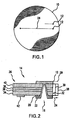
- FIG. 1 is a top view of an array of solar cells (e.g., a wafer) 10 shown generally in accordance with an illustrated embodiment of the invention.
- FIG. 2 is a cut-away side view of a single solar cell 14 of the wafer 10 of FIG. 1.
- the present invention relates to the fabrication of multijunction solar cells using group III-V elements.
- Solar cell semiconductor devices such as those depicted in U.S. Pat. No. 6,680,432 may often include integral bypass diodes epitaxially grown on the substrate but separated from the solar cell structure by a trench that provides electrical isolation of the solar cell and the bypass diode.
- the bypass diode may be provided to reduce the deleterious effects of reverse biasing caused by partial light shading of individual solar cells 14 of the array 10.
- the present invention may be implemented in any solar cell device, the description that follows will make reference to an implementation that includes the integral bypass diodes as an illustration of an advanced device.
- FIG. 2 illustrates a simplified sectional view of an integral semiconductor structure of the solar cell 14 with a triple junction solar cell structure 26 and a monolithic or integral bypass diode 28.
- the device 14 includes a substrate 34, the triple junction solar cell 26, a well 30 and a shunt 32.
- the triple junction cell structure 26 may further include a bottom, middle and top subcells 36, 38, 40, respectively.
- the substrate is a p-type germanium (“Ge”) substrate 34, which has a lower metal contact pad 42.
- the bottom subcell 36 may contain a p-type Ge base layer, an n-type Ge emitter layer and an n-type GaAs layer.
- the base layer may be deposited over the substrate 34.
- the emitter layer may be deposited over the base layer, which in one embodiment can be formed through diffusion from the emitter layer.
- p-type and n-type tunneling junction layers (forming a tunneling diode) may also be deposited.
- the middle layer 38 may include a back surface field ("BSF") layer, a p-type GaAs base layer, an n-type GaAs emitter layer and an n-type gallium indium phosphide2 (GaInP2) window layer.
- BSF back surface field
- the BSF layer drives minority carriers from a highly doped region near the back surface to minimize the effect of recombination loss. In other words, the BSF layer reduces recombination loss at the backside of the solar cell and thereby reduces the recombination in the bare region.
- the window layer used of the middle subscell 38 also operates to reduce the recombination loss.
- the window layer also improves the passivation of the subcell surface of the underlying junctions.
- p-type and n-type tunneling junction layers may be deposited over the middle subcell 38.
- the top subcell 40 may include p-type indium gallium aluminum phosphide2 ("InGaAlP2") BSF layer, a p-type GaInP2 base layer, an n-type GaInP2 emitter layer and an n-type aluminum indium phosphide2 (“AlInP2”) window layer.
- the base layer may be deposited on the BSF layer once the BSF layer is deposited over the tunneling junction layers of the middle subcell 38.
- the window layer is subsequently deposited on the emitter layer after the emitter layer is deposited on the base layer.
- an n-type cap layer may be employed for enhancing contact with metal materials.
- the cap layer may be deposited over the top subcell 40.
- the cap layer also acts as a lateral conduction layer for the bypass diode.
- An n-type GaInP2 stop etch layer may be deposited over the lateral conduction layer. After the stop etch layer is deposited, the bypass diode may be epitaxially deposited.
- the bypass diode 28 may include an n-type GaAs layer, an i-type GaAs layer and a p-type GaAs layer.
- the n-type layer is deposited over the stop etch layer.
- the i-type layer may be deposited over the n-type layer.
- the p-type layer is deposited over the i-type layer.
- a contact pad 29 may be deposited over the bypass diode 28.
- a metal shunt 32 may be deposited into a portion of the well 30.
- One side of the shunt 32 makes chemical contact with substrate 34 and another side of the shunt 32 makes electrical contact with the lateral conduction layer on a top of the cell 14 and thereby to a portion of the triple junction cell 26.
- An anti-reflection coating may be deposited over certain parts of the cell 14 to enhance its performance.
- the multijunction cell solar cell 14 could be formed by any combination of group III to V elements listed in the periodic table, wherein the group III elements include boron (B), aluminum (A1), gallium (Ga), indium (In), and thallium (T).
- the group IV elements include carbon (C), silicon (Si), germanium (Ge), and tin (Sn).
- the group V elements includes nitrogen (N), phosphorus (P), arsenic (As), antimony (Sb), and bismuth (Bi).
- the prior art grid structure that would otherwise be used on the light collecting surface is replaced with a relatively small collector element 12 disposed on a light gathering face of the cell 14.
- a via 16 connects the collector element 12 to a current gathering grid disposed on a lower side of the wafer 10.
- the via 16 may be created by creating a small hole in the wafer 10 by any appropriate method (e.g., laser ablation) and disposing an insulating material (e.g., Si02) 20 around the hole.
- an insulating material e.g., Si02
- the inside of the hole and outer surface of the insulating layer 20 may be plated with an appropriate conductive material (e.g., metal).
- the insulating material around the hole may be present on both the top and bottom sides of the cell 14.
- the insulating material on the top side may isolate the contact 12 from the upper subcell 40. Appropriate contact may then be made with the diode 28 via an extension 29 of the contact 12.
- the insulating material 20 around the hole may be present only on the bottom side of the cell 14 to isolate the potential of the top contact 12 from the potential of the substrate 34 and lower contact 42.
- a contact 22 may be formed on top of the insulating material 20.
- the vias 16 allows the collector elements 12 to be connected with other solar cells 14 using a set of interconnect traces 24 disposed on the bottom of the solar cell 14, instead of the top, as shown in FIG. 3. Placing the interconnection on the bottom of the wafer 10 eliminates the necessity for connecting traces on the face of the wafer 10 thereby reducing the shadowing of the cells 14 produced by the interconnecting traces.
- FIG. 1 shows the collecting elements 12 on the wafer 10.
- the collecting elements 12 may be of any appropriate shape that minimizes shading.
- the contact 12 may include a circular central region with a number of radiating spikes (e.g., in the form of an asterisk).
- FIG. 2 shows the contact 12 and via 16 disposed in the photoactive area of the solar cell 14, it should also be recognized that the via 16 may be moved to a location that is laterally adjacent the diode 28 along a periphery of the cell 14. This would allow the contact 12 to be placed substantially over the diode 28. The spikes that radiate from the contact 12 may then extend into the photoactive area on both sides of the diode 28 in a manner that meets or exceeds the current collection capability of prior art top surface grids while improving the overall percentage of light reaching the photoactive area of the cell 14.
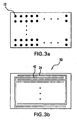
- FIG. 3a and 3b show top and bottom surfaces of a cell 14 that further illustrates embodiments of the invention.
- the number of collecting elements 12 per unit area can be increased to any level (as indicated by the ellipsis in FIG. 3a) that maximizes efficiency, yet reduces shading.
- FIG. 3b depicts a bottom surface of the cell 14 of FIG. 3a.
- a grid 50 of interdigited traces 24, 42 may be disposed in an alternating manner across the bottom of the cell 14.
- the number and density of traces 24, 42 are only limited by the desire of the designer to maximize the density of the collecting elements 12 on the light collecting surface.
Landscapes
- Photovoltaic Devices (AREA)
Applications Claiming Priority (1)
| Application Number | Priority Date | Filing Date | Title |
|---|---|---|---|
| US11/109,016 US20060231130A1 (en) | 2005-04-19 | 2005-04-19 | Solar cell with feedthrough via |
Publications (2)
| Publication Number | Publication Date |
|---|---|
| EP1715529A2 true EP1715529A2 (de) | 2006-10-25 |
| EP1715529A3 EP1715529A3 (de) | 2008-10-29 |
Family
ID=36764198
Family Applications (1)
| Application Number | Title | Priority Date | Filing Date |
|---|---|---|---|
| EP06004722A Withdrawn EP1715529A3 (de) | 2005-04-19 | 2006-03-08 | Solarzelle mit Löchern als elektrische Kontakte |
Country Status (2)
| Country | Link |
|---|---|
| US (1) | US20060231130A1 (de) |
| EP (1) | EP1715529A3 (de) |
Cited By (7)
| Publication number | Priority date | Publication date | Assignee | Title |
|---|---|---|---|---|
| WO2008067577A1 (de) * | 2006-12-05 | 2008-06-12 | Nanoident Technologies Ag | Schichtaufbau |
| EP3787043A1 (de) * | 2019-08-29 | 2021-03-03 | AZUR SPACE Solar Power GmbH | Passivierungsverfahren für ein durchgangsloch einer halbleiterscheibe |
| EP3787039A1 (de) * | 2019-08-29 | 2021-03-03 | AZUR SPACE Solar Power GmbH | Schutzverfahren für durchgangsöffnungen einer halbleiterscheibe |
| EP3787041A1 (de) * | 2019-08-29 | 2021-03-03 | AZUR SPACE Solar Power GmbH | Stapelförmige mehrfachsolarzelle mit einer ein mehrfachschichtsystem umfassenden metallisierung |
| EP3787046A1 (de) * | 2019-08-29 | 2021-03-03 | AZUR SPACE Solar Power GmbH | Stapelförmige mehrfachsolarzelle mit einem dielektrischen isolationsschichtsystem |
| EP3787040A1 (de) * | 2019-08-29 | 2021-03-03 | AZUR SPACE Solar Power GmbH | Metallisierungsverfahren für eine halbleiterscheibe |
| EP3826078A1 (de) * | 2019-11-21 | 2021-05-26 | AZUR SPACE Solar Power GmbH | Stapelförmige mehrfachsolarzelle |
Families Citing this family (21)
| Publication number | Priority date | Publication date | Assignee | Title |
|---|---|---|---|---|
| US7687707B2 (en) * | 2005-11-16 | 2010-03-30 | Emcore Solar Power, Inc. | Via structures in solar cells with bypass diode |
| KR101212198B1 (ko) * | 2006-04-06 | 2012-12-13 | 삼성에스디아이 주식회사 | 태양 전지 |
| US8686282B2 (en) | 2006-08-07 | 2014-04-01 | Emcore Solar Power, Inc. | Solar power system for space vehicles or satellites using inverted metamorphic multijunction solar cells |
| US20080029151A1 (en) * | 2006-08-07 | 2008-02-07 | Mcglynn Daniel | Terrestrial solar power system using III-V semiconductor solar cells |
| US20080185038A1 (en) * | 2007-02-02 | 2008-08-07 | Emcore Corporation | Inverted metamorphic solar cell with via for backside contacts |
| US20100233838A1 (en) * | 2009-03-10 | 2010-09-16 | Emcore Solar Power, Inc. | Mounting of Solar Cells on a Flexible Substrate |
| US9331228B2 (en) | 2008-02-11 | 2016-05-03 | Suncore Photovoltaics, Inc. | Concentrated photovoltaic system modules using III-V semiconductor solar cells |
| US8759138B2 (en) | 2008-02-11 | 2014-06-24 | Suncore Photovoltaics, Inc. | Concentrated photovoltaic system modules using III-V semiconductor solar cells |
| CA2744706C (en) * | 2008-11-26 | 2015-11-24 | Microlink Devices, Inc. | Solar cell with a backside via to contact the emitter layer |
| US9806215B2 (en) | 2009-09-03 | 2017-10-31 | Suncore Photovoltaics, Inc. | Encapsulated concentrated photovoltaic system subassembly for III-V semiconductor solar cells |
| US9012771B1 (en) | 2009-09-03 | 2015-04-21 | Suncore Photovoltaics, Inc. | Solar cell receiver subassembly with a heat shield for use in a concentrating solar system |
| US8241945B2 (en) * | 2010-02-08 | 2012-08-14 | Suniva, Inc. | Solar cells and methods of fabrication thereof |
| US9263611B2 (en) * | 2011-11-17 | 2016-02-16 | Solar Junction Corporation | Method for etching multi-layer epitaxial material |
| WO2013152104A1 (en) * | 2012-04-06 | 2013-10-10 | Solar Junction Corporation | Multi-junction solar cells with through-via contacts |
| US9721984B2 (en) * | 2012-04-12 | 2017-08-01 | Taiwan Semiconductor Manufacturing Company, Ltd. | Image sensor manufacturing methods |
| US9306085B2 (en) | 2012-08-22 | 2016-04-05 | Sunpower Corporation | Radially arranged metal contact fingers for solar cells |
| US9142615B2 (en) | 2012-10-10 | 2015-09-22 | Solar Junction Corporation | Methods and apparatus for identifying and reducing semiconductor failures |
| US9799792B2 (en) * | 2015-01-14 | 2017-10-24 | International Business Machines Corporation | Substrate-free thin-film flexible photovoltaic device and fabrication method |
| DE102021000640A1 (de) * | 2021-02-09 | 2022-08-11 | Azur Space Solar Power Gmbh | Verfahren zur Strukturierung einer Isolationsschicht auf einer Halbleiterscheibe |
| US12046693B2 (en) * | 2021-09-01 | 2024-07-23 | Maxeon Solar Pte. Ltd. | Solar device fabrication limiting power conversion losses |
| DE102023002413A1 (de) * | 2023-06-14 | 2024-12-19 | Azur Space Solar Power Gmbh | Verfahren zur Herstellung eines Vias bei einer III-V Mehrfachsolarzelle |
Family Cites Families (9)
| Publication number | Priority date | Publication date | Assignee | Title |
|---|---|---|---|---|
| US3903427A (en) * | 1973-12-28 | 1975-09-02 | Hughes Aircraft Co | Solar cell connections |
| WO1989005521A1 (en) * | 1987-12-03 | 1989-06-15 | Spectrolab, Inc. | Solar cell panel |
| JPH04223378A (ja) * | 1990-12-25 | 1992-08-13 | Sharp Corp | 太陽電池 |
| EP0881694A1 (de) * | 1997-05-30 | 1998-12-02 | Interuniversitair Micro-Elektronica Centrum Vzw | Solarzelle und Verfahren zu ihrer Herstellung |
| JP3369439B2 (ja) * | 1997-06-05 | 2003-01-20 | 科学技術振興事業団 | 光応答電極および湿式太陽電池 |
| US6278054B1 (en) * | 1998-05-28 | 2001-08-21 | Tecstar Power Systems, Inc. | Solar cell having an integral monolithically grown bypass diode |
| JP2002057359A (ja) * | 2000-06-01 | 2002-02-22 | Sharp Corp | 積層型太陽電池 |
| US6680432B2 (en) * | 2001-10-24 | 2004-01-20 | Emcore Corporation | Apparatus and method for optimizing the efficiency of a bypass diode in multijunction solar cells |
| US7335835B2 (en) * | 2002-11-08 | 2008-02-26 | The Boeing Company | Solar cell structure with by-pass diode and wrapped front-side diode interconnection |
-
2005
- 2005-04-19 US US11/109,016 patent/US20060231130A1/en not_active Abandoned
-
2006
- 2006-03-08 EP EP06004722A patent/EP1715529A3/de not_active Withdrawn
Cited By (13)
| Publication number | Priority date | Publication date | Assignee | Title |
|---|---|---|---|---|
| WO2008067577A1 (de) * | 2006-12-05 | 2008-06-12 | Nanoident Technologies Ag | Schichtaufbau |
| US11417782B2 (en) | 2006-12-05 | 2022-08-16 | ASMAG—Holding GmbH | Layered structure |
| EP3787041A1 (de) * | 2019-08-29 | 2021-03-03 | AZUR SPACE Solar Power GmbH | Stapelförmige mehrfachsolarzelle mit einer ein mehrfachschichtsystem umfassenden metallisierung |
| EP3787039A1 (de) * | 2019-08-29 | 2021-03-03 | AZUR SPACE Solar Power GmbH | Schutzverfahren für durchgangsöffnungen einer halbleiterscheibe |
| EP3787046A1 (de) * | 2019-08-29 | 2021-03-03 | AZUR SPACE Solar Power GmbH | Stapelförmige mehrfachsolarzelle mit einem dielektrischen isolationsschichtsystem |
| EP3787040A1 (de) * | 2019-08-29 | 2021-03-03 | AZUR SPACE Solar Power GmbH | Metallisierungsverfahren für eine halbleiterscheibe |
| US11081615B2 (en) | 2019-08-29 | 2021-08-03 | Azur Space Solar Power Gmbh | Protection method for through-holes of a semiconductor wafer |
| US11316058B2 (en) | 2019-08-29 | 2022-04-26 | Azur Space Solar Power Gmbh | Stacked multi-junction solar cell with a metallization comprising a multilayer system |
| EP3787043A1 (de) * | 2019-08-29 | 2021-03-03 | AZUR SPACE Solar Power GmbH | Passivierungsverfahren für ein durchgangsloch einer halbleiterscheibe |
| US11837672B2 (en) | 2019-08-29 | 2023-12-05 | Azur Space Solar Power Gmbh | Stacked multijunction solar cell having a dielectric insulating layer system |
| US12628461B2 (en) | 2019-08-29 | 2026-05-12 | Azur Space Solar Power Gmbh | Passivation method for a passage opening of a wafer |
| EP3826078A1 (de) * | 2019-11-21 | 2021-05-26 | AZUR SPACE Solar Power GmbH | Stapelförmige mehrfachsolarzelle |
| US11881532B2 (en) | 2019-11-21 | 2024-01-23 | Azur Space Solar Power Gmbh | Stacked multi-junction solar cell |
Also Published As
| Publication number | Publication date |
|---|---|
| US20060231130A1 (en) | 2006-10-19 |
| EP1715529A3 (de) | 2008-10-29 |
Similar Documents
| Publication | Publication Date | Title |
|---|---|---|
| US20060231130A1 (en) | Solar cell with feedthrough via | |
| US7863515B2 (en) | Thin-film solar cell and method of manufacturing the same | |
| EP1775778B1 (de) | Zuverlässige Verbindung von Solarzellen die eine integrierte Bypassdiode aufweisen | |
| EP1788628B1 (de) | Via-Struktur in Solarzellen mit Bypassdiode | |
| AU2013331304B2 (en) | Systems and methods for monolithically integrated bypass switches in photovoltaic solar cells and modules | |
| CN101237007B (zh) | 具有用于背侧接点的通孔的倒置变形太阳能电池 | |
| CN204928739U (zh) | 双面太阳能面板和双面太阳能电池 | |
| KR101867855B1 (ko) | 태양 전지 | |
| CN218585994U (zh) | 太阳能电池及光伏组件 | |
| CN117673177A (zh) | 太阳能电池及光伏组件 | |
| US20140196779A1 (en) | Multi-junction solar cells with through-substrate vias | |
| US9147783B2 (en) | Apparatus and method for hybrid photovoltaic device having multiple, stacked, heterogeneous, semiconductor junctions | |
| CA2744706C (en) | Solar cell with a backside via to contact the emitter layer | |
| EP2816609B1 (de) | Solarzelle | |
| EP2506310A2 (de) | Zweiseitige Solarzelle | |
| TW201344937A (zh) | 具有貫穿通孔接觸的多接面太陽能電池 | |
| US20150206997A1 (en) | Multi-junction solar cells with recessed through-substrate vias | |
| CN102292824A (zh) | 太阳能电池 | |
| WO2015138764A1 (en) | Multi-junction solar cells with through-substrate vias | |
| WO2014144897A1 (en) | Multi-junction solar cells with through-substrate vias | |
| EP0248953A1 (de) | Kaskadensolarzellen | |
| KR20180000498A (ko) | Perl 태양전지 및 그 제조방법 | |
| KR101983361B1 (ko) | 양면 수광형 태양전지 | |
| EP4646061A2 (de) | Vorrichtung und verfahren zur herstellung von solarzellen mit mehreren übergängen von hoher haltbarkeit | |
| KR102110527B1 (ko) | 태양 전지 |
Legal Events
| Date | Code | Title | Description |
|---|---|---|---|
| PUAI | Public reference made under article 153(3) epc to a published international application that has entered the european phase |
Free format text: ORIGINAL CODE: 0009012 |
|
| AK | Designated contracting states |
Kind code of ref document: A2 Designated state(s): AT BE BG CH CY CZ DE DK EE ES FI FR GB GR HU IE IS IT LI LT LU LV MC NL PL PT RO SE SI SK TR |
|
| AX | Request for extension of the european patent |
Extension state: AL BA HR MK YU |
|
| 17P | Request for examination filed |
Effective date: 20080208 |
|
| PUAL | Search report despatched |
Free format text: ORIGINAL CODE: 0009013 |
|
| AK | Designated contracting states |
Kind code of ref document: A3 Designated state(s): AT BE BG CH CY CZ DE DK EE ES FI FR GB GR HU IE IS IT LI LT LU LV MC NL PL PT RO SE SI SK TR |
|
| AX | Request for extension of the european patent |
Extension state: AL BA HR MK YU |
|
| RAP1 | Party data changed (applicant data changed or rights of an application transferred) |
Owner name: EMCORE SOLAR POWER, INC. |
|
| AKX | Designation fees paid |
Designated state(s): AT BE BG CH CY CZ DE DK EE ES FI FR GB GR HU IE IS IT LI LT LU LV MC NL PL PT RO SE SI SK TR |
|
| 17Q | First examination report despatched |
Effective date: 20090811 |
|
| STAA | Information on the status of an ep patent application or granted ep patent |
Free format text: STATUS: THE APPLICATION IS DEEMED TO BE WITHDRAWN |
|
| 18D | Application deemed to be withdrawn |
Effective date: 20131001 |