EP1716913A2 - Filter für Dieselpartikel - Google Patents
Filter für Dieselpartikel Download PDFInfo
- Publication number
- EP1716913A2 EP1716913A2 EP06008528A EP06008528A EP1716913A2 EP 1716913 A2 EP1716913 A2 EP 1716913A2 EP 06008528 A EP06008528 A EP 06008528A EP 06008528 A EP06008528 A EP 06008528A EP 1716913 A2 EP1716913 A2 EP 1716913A2
- Authority
- EP
- European Patent Office
- Prior art keywords
- mole ratio
- mixed oxide
- particulates
- inclusive
- exhaust gas
- Prior art date
- Legal status (The legal status is an assumption and is not a legal conclusion. Google has not performed a legal analysis and makes no representation as to the accuracy of the status listed.)
- Withdrawn
Links
Images


Classifications
-
- B—PERFORMING OPERATIONS; TRANSPORTING
- B01—PHYSICAL OR CHEMICAL PROCESSES OR APPARATUS IN GENERAL
- B01J—CHEMICAL OR PHYSICAL PROCESSES, e.g. CATALYSIS OR COLLOID CHEMISTRY; THEIR RELEVANT APPARATUS
- B01J23/00—Catalysts comprising metals or metal oxides or hydroxides, not provided for in group B01J21/00
- B01J23/10—Catalysts comprising metals or metal oxides or hydroxides, not provided for in group B01J21/00 of rare earths
-
- B—PERFORMING OPERATIONS; TRANSPORTING
- B01—PHYSICAL OR CHEMICAL PROCESSES OR APPARATUS IN GENERAL
- B01D—SEPARATION
- B01D53/00—Separation of gases or vapours; Recovering vapours of volatile solvents from gases; Chemical or biological purification of waste gases, e.g. engine exhaust gases, smoke, fumes, flue gases, aerosols
- B01D53/34—Chemical or biological purification of waste gases
- B01D53/92—Chemical or biological purification of waste gases of engine exhaust gases
- B01D53/94—Chemical or biological purification of waste gases of engine exhaust gases by catalytic processes
- B01D53/944—Simultaneously removing carbon monoxide, hydrocarbons or carbon making use of oxidation catalysts
-
- B—PERFORMING OPERATIONS; TRANSPORTING
- B01—PHYSICAL OR CHEMICAL PROCESSES OR APPARATUS IN GENERAL
- B01J—CHEMICAL OR PHYSICAL PROCESSES, e.g. CATALYSIS OR COLLOID CHEMISTRY; THEIR RELEVANT APPARATUS
- B01J23/00—Catalysts comprising metals or metal oxides or hydroxides, not provided for in group B01J21/00
- B01J23/38—Catalysts comprising metals or metal oxides or hydroxides, not provided for in group B01J21/00 of noble metals
- B01J23/54—Catalysts comprising metals or metal oxides or hydroxides, not provided for in group B01J21/00 of noble metals combined with metals, oxides or hydroxides provided for in groups B01J23/02 - B01J23/36
- B01J23/56—Platinum group metals
- B01J23/63—Platinum group metals with rare earths or actinides
-
- B—PERFORMING OPERATIONS; TRANSPORTING
- B01—PHYSICAL OR CHEMICAL PROCESSES OR APPARATUS IN GENERAL
- B01J—CHEMICAL OR PHYSICAL PROCESSES, e.g. CATALYSIS OR COLLOID CHEMISTRY; THEIR RELEVANT APPARATUS
- B01J35/00—Catalysts, in general, characterised by their form or physical properties
- B01J35/50—Catalysts, in general, characterised by their form or physical properties characterised by their shape or configuration
- B01J35/56—Foraminous structures having flow-through passages or channels, e.g. grids or three-dimensional [3D] monoliths
- B01J35/57—Honeycombs
Definitions
- This invention relates to diesel particulate filters.
- particulates fine particulate matter, especially carbon particulates
- a known typical example of the techniques is a technique in which an oxidation catalyst is disposed in an exhaust flow upstream of a diesel particulate filter (hereinafter, referred to as a DPF) and HC constituents in fuel or the like are supplied to the oxidation catalyst.
- the oxidation catalyst burns HC constituents to raise the temperature of exhaust gas flowing into the DPF and oxidizes NO in the exhaust gas to NO 2 , and the DPF then burns off particulates in the DPF using the exhaust gas raised in temperature and NO 2 .
- NO 2 acts as an oxidizing agent for burning the particulates.
- Another known typical example is a technique in which a NOx trap catalyst is disposed in an exhaust flow upstream of a DPF and an oxidation catalyst material for particulates is coated on the wall surfaces of exhaust gas channels in the DPF.
- the reason for this structure is that since it cannot be expected to oxidize particulates using NO 2 while having the advantage of removing NOx in the exhaust gas, the oxidation catalyst material is placed in the DPF.
- An oxidation catalyst material commonly used contains a catalytic metal such as Pt, cerium dioxide or a Ce-Zr mixed oxide, and active alumina.
- Japanese Unexamined Patent Publication No. 2002-292246 proposes to employ as the oxidation catalytic material for the DPF a mixture of a cerium-based mixed oxide having oxygen storage capacity and a perovskite or spinel mixed oxide to lower the ignition temperature of particulates.
- Japanese Unexamined Patent Publication No. 2004-42021 proposes to employ as the oxidation catalytic material for the DPF ceria or a mixed oxide of Ce and another rare earth element, each stabilized by Ag or Co and including no platinoid element.
- ceria and Ce-Zr mixed oxides are low in the burning rate of particulates when they carry no catalytic metal and conventional mixed oxides of Ce and another rare earth element do not always have high particulate burning rates.
- This tendency is particularly pronounced when a NOx trap catalyst is disposed in the exhaust flow upstream of the DPF, because NO 2 cannot be used for oxidation of particulates. If, as in such cases, particulates in the DPF cannot be promptly burned off, this increases the back pressure of the engine, resulting in deteriorated fuel economy. Therefore, it is a reality that the amount of catalytic metal such as Pt cannot help but be increased. In this case, however, the catalyst cannot obtain sufficient thermal resistance because of the above sintering problem. Further, even if the technique is employed in which an oxidation catalyst is disposed upstream of the DPF to supply fuel (HC constituents) to the oxidation catalyst and thereby raise the exhaust gas temperature, the fuel supply deteriorates fuel economy.
- the present invention solves the above problems by configuring a diesel particulate filter to allow the burning rate of particulates to increase even with a small amount of catalytic metal or even without using any catalytic metal.
- a first solution of the present invention is directed to a diesel particulate filter, disposed in an exhaust passage of an engine, for trapping particulates exhausted from the engine, wherein walls forming exhaust gas channels in a filter body on which the particulates are trapped are coated with a catalyst layer for promoting the burning of the trapped particulates, the catalyst layer contains a mixed oxide in which Ce and Zr are contained in a Ce/(Ce+Zr) mole ratio between 20% exclusive and 80% inclusive, and the mixed oxide further contains a rare earth element R other than Ce.
- the Ce-Zr mixed oxide containing Ce and Zr increases the particulate burning rate with increasing Ce/(Ce+Zr) mole ratio, exhibits a peak at a Ce/(Ce+Zr) mole ratio between 50% and slightly over 60% and then decreases with increasing Ce/(Ce+Zr) mole ratio; Further, when the Ce/(Ce+Zr) mole ratio is between 20% exclusive and 80% inclusive, the Ce-Zr mixed oxide obviously exhibits higher particulate burning rate than CeO 2 and ZrO 2 even after subjected to heat aging. The reason can be believed to be that since the Ce-Zr mixed oxide has not only oxygen storage capacity but also high thermal resistance, the oxygen storage capacity is less deteriorated so that oxygen can be sufficiently supplied as an oxidizing agent during the burning of particulates.
- CeZrR-type mixed oxide containing Ce, Zr and a rare earth element R in the above mole ratio range exhibits significantly larger particulate burning rate than the Ce-Zr mixed oxide carrying catalytic metal even if it carries no catalytic metal.
- the rare earth element R not only acts to thermally stabilize the mixed oxide but also, as will be obvious from the later-described FT-IR data, effectively acts to oxidize CO in the exhaust gas and the oxidation reaction heat of CO promotes the burning of particulates. Therefore, even if a NOx trap catalyst is disposed in the exhaust gas passage upstream of the DPF, particulates on the DPF can be efficiently burned off.
- the back pressure of the engine can be prevented from being increased, or the amount of fuel (HC constituents) supply can be reduced when an oxidation catalyst is disposed upstream of the DPF.
- This is advantageous in improving fuel economy.
- a NOx trap catalyst is disposed in the exhaust passage upstream of the DPF, particulates on the DPF can be efficiently burned off and the thermal resistance is improved. Therefore, the particulate burning performance can be maintained over a long period of time.
- a catalytic metal may be carried on the above mixed oxide.
- a preferable catalytic metal used is a platinoid element such as Pt, Pd or Rh and Pt is particularly preferably used.
- the amount of catalytic metal carried is not particularly limited but may be approximately 2 mass% or less.
- a second solution of the invention is characterized in that in the first solution, the rare earth element R comprises at least one of La and Nd.
- the CeZrR-type mixed oxide containing La or Nd can also have a high particulate burning rate.
- the Ce-Zr mixed oxide can have an excellent effect particularly when it further contains La or Nd as a rare earth element.
- a third solution of the invention is characterized in that in the first or second solution, the mixed oxide has an R/(Ce+Zr+R) mole ratio between 2% and 11% both inclusive.
- the rare earth element R can increase the particulate burning rate as described above, the later-described experimental results show that when the mole ratio of R becomes large, the effect of increasing the particulate burning rate cannot be exhibited. Therefore, it is preferable that the R/(Ce+Zr+R) mole ratio is between 2% and 11 % both inclusive.
- a fourth solution of the invention is characterized in that in the first solution, the rare earth element R is La, the mixed oxide has a La/(Ce+Zr+La) mole ratio between 2% and 11% both inclusive, and a catalytic metal is carried in the range of 0 mass% to 2 mass% on the mixed oxide.
- the amount of catalytic metal carried is preferably 2 mass% or less. In this case, the dispersity of the catalytic metal becomes high, which is advantageous in restraining the sintering of the catalytic metal and maintaining the effect of burning off particulates over a long period of time.
- a preferable catalytic metal used is a platinoid element such as Pt, Pd or Rh and Pt is particularly preferable.
- a fifth solution of the invention is directed to a diesel particulate filter, disposed in an exhaust passage of an engine, for trapping particulates exhausted from the engine, wherein walls forming exhaust gas channels in a filter body on which the particulates are trapped are coated with a catalyst layer for promoting the burning of the trapped particulates, the catalyst layer contains a mixed oxide in which Ce and Zr are contained in a Ce/(Ce+Zr) mole ratio between 10% exclusive and 90% inclusive, and the mixed oxide further contains Pr.
- Ce-Zr-Pr mixed oxide has high particulate burning rate. Therefore, if the Ce-Zr mixed oxide contains Pr even if the Ce/(Ce+Zr) mole ratio is between 10% and 90% both inclusive, it can promptly burn off particulates. Hence, the back pressure of the engine can be prevented from being increased, or the amount of fuel (HC constituents) supply can be reduced when an oxidation catalyst is disposed upstream of the DPF. This is advantageous in improving fuel economy. Further, even when a NOx trap catalyst is disposed in the exhaust passage upstream of the DPF, particulates on the DPF can be efficiently burned off and the thermal resistance is improved. Therefore, the particulate burning performance can be maintained over a long period of time.
- a catalytic metal may be carried on the above mixed oxide.
- a preferable catalytic metal used is a platinoid element such as Pt, Pd or Rh and Pt is particularly preferably used.
- the amount of catalytic metal carried is not particularly limited but may be approximately 2 mass% or less.
- a sixth solution of the invention is characterized in that in the fifth solution, the Ce/(Ce+Zr) mole ratio is between 20% exclusive and 11 % inclusive.
- a seventh solution of the invention is characterized in that in the fifth solution or the sixth solution, the mixed oxide has a Pr/(Ce+Zr+Pr) mole ratio between 2% and 11% both inclusive.
- An eighth solution of the invention is directed to a diesel particulate filter, disposed in an exhaust passage of an engine, for trapping particulates exhausted from the engine, wherein walls forming exhaust gas channels in a filter body on which the particulates are trapped are coated with a catalyst layer for promoting the burning of the trapped particulates, and the catalyst layer contains a mixed oxide in which Ce and Pr are contained in a Ce/(Ce+Pr) mole ratio between 50% exclusive and 90% inclusive.
- the CeZrR-type mixed oxide has an excellent particulate burning effect when Pr is used as the rare earth element as described above, even the Ce-Pr mixed oxide containing no Zr is advantageous in oxidizing CO in the exhaust gas and has a high particulate burning rate and high thermal resistance.
- the Ce/(Ce+Pr) mole ratio of the Ce-Pr mixed oxide is preferably between 50% exclusive and 90% inclusive and more preferably between 60% and 90% both inclusive.
- a CePrR-type mixed oxide containing Ce, Pr and another rare earth element may be used instead of the Ce-Pr mixed oxide. Therefore, in this solution, even when a NOx trap catalyst is disposed in the exhaust passage upstream of the DPF, particulates on the DPF can be efficiently burned off.
- the seventh solution is advantageous in improving fuel economy. Further, even when a NOx trap catalyst is disposed in the exhaust passage upstream of the DPF, particulates on the DPF can be efficiently burned off and the thermal resistance is improved. Therefore, the particulate burning performance can be maintained over a long period of time.
- a catalytic metal may be carried on the above mixed oxide.
- a preferable catalytic metal used is a platinoid element such as Pt, Pd or Rh and Pt is particularly preferably used.
- the amount of catalytic metal carried is not particularly limited but may be approximately 2 mass% or less.
- a ninth solution of the invention is characterized in that in the eighth solution, the mixed oxide further contains La and has a La/(Ce+Pr+La) mole ratio of 13% or less.
- La is used as the rare earth element R in the above CePrR-type mixed oxide.
- the mixed oxide has a La/(Ce+Pr+La) mole ratio of 13% or less, this is advantageous in increasing the particulate burning rate.
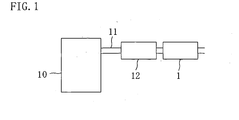
- the reference numeral 1 denotes a DPF disposed in an exhaust passage 11 of a diesel engine 10.
- An upstream catalyst 12 is disposed in part of the exhaust passage 11 located upstream of the DPF 1 in the flow direction of exhaust gas.
- a NOx trap catalyst, an oxidation catalyst or both can be disposed as the upstream catalyst 12.
- the NOx trap catalyst is obtained by carrying, on a support material such as active alumina, a NOx storage component (such as an alkali earth metal, typically Ba, or an alkali metal) for absorbing NOx in the exhaust gas at high oxygen concentrations in the exhaust gas (at lean air-fuel ratios) and a catalytic metal, such as Pt, for reducing NOx released from the NOx storage component when the oxygen concentration in the exhaust gas drops (at stoichiometric or rich air-fuel ratios).
- a NOx storage component such as an alkali earth metal, typically Ba, or an alkali metal
- Pt catalytic metal
- the oxidation catalyst is obtained by carrying a catalytic metal, such as Pt or Pd, on a support material such as active alumina and acts to oxidize HC and CO in the exhaust gas.
- a catalytic metal such as Pt or Pd
- a support material such as active alumina
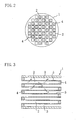
- the DPF 1 has a honeycomb structure in which a large number of exhaust gas channels 2 and 3 run in parallel with each other.
- the DPF 1 has a structure in which a plurality of exhaust gas inflow channels 2 and a plurality of exhaust gas outflow channels 3 are alternately arranged vertically and horizontally.
- Each exhaust gas inflow channel 2 is closed at the downstream end by a plug 4, while each exhaust gas outflow channel 3 is closed at the upstream end by a plug 4.
- the adjacent exhaust gas inflow and outflow channels 2 and 3 are separated from each other by a thin partition wall 5.
- the hatched parts denote the plugs 4 at the upstream ends of the exhaust gas outflow channels 3.
- the body of the DPF 1 is formed of cordierite or an inorganic porous material, such as SiC, Si 3 N 4 or sialon.
- the exhaust gas flowing into each exhaust gas inflow channel 2 flows out through the surrounding partition walls 5 into the adjacent exhaust gas outflow channels 3, as shown in arrows in Figure 3. More specifically, as shown in Figure 4, each partition wall 5 is formed with micro pores (exhaust gas channels) 6 communicating the exhaust gas inflow channel 2 with the adjacent exhaust gas outflow channel 3 so that the exhaust gas flows through the micro pores 6. Particulates are trapped and deposited mainly on the wall surfaces of the exhaust gas inflow channels 2 and the micro pores 6.
- a catalyst layer 7 containing a CeZrR-type mixed oxide, a Ce-Pr mixed oxide or a CePrR-type mixed oxide is formed on walls of all the exhaust gas channels (i.e., exhaust gas inflow channels 2, exhaust gas outflow channels 3 and micro pores 6) in the body of the DPF 1. However, it is not necessarily required to form the catalyst layer on the walls of the exhaust gas outflow channels 3.
- CeZrO materials mixed oxides containing Ce and Zr having different Ce/(Ce+Zr) mole ratios were prepared by coprecipitation.
- cerous nitrate and zirconium oxynitrate were weighed to reach a predetermined mole ratio and dissolved in ion-exchange water, and the obtained mixed solution was stirred at room temperature for about an hour. Thereafter, the mixed solution was heated to 80°C and then mixed with 28% aqueous ammonia by adding the aqueous ammonia prepared in another beaker to the mixed solution at once while stirring strongly and rapidly with a glass bar. The white-turbid solution resulting from the mixture with aqueous ammonia was allowed to stand for a diel to produce a cake, and the cake was centrifuged and sufficiently rinsed in water.
- the water-rinsed cake was dried at approximately 150°C, and then calcined under the condition of keeping it at 400°C for five hours and then keeping it at 500°C for two hours. In this manner, various kinds of CeZrO mixed oxides having different mole ratios were obtained. Further, ZrO 2 having a mole ratio of 0% and CeO 2 having a mole ratio of 100% were also prepared.
- a solution of diamminedinitro platinum nitrate was added to each of the above CeZrO mixed oxides of different mole ratios and ZrO 2 and CeO 2 so that 2 mass% of Pt was carried on each oxide, and ion-exchange water was further added to the solution and mixed. Thereafter, the mixed solution was evaporated to dryness to obtained a dried product. The resultant dried product was pounded in a mortar and then calcined by keeping it at 500°C for two hours. The obtained powder is hereinafter appropriately referred to as Pt/CeZrO.
- CePrO materials mixed oxides containing Ce and Pr
- Ce/(Ce+Pr) mole ratios were prepared by coprecipitation like the CeZrO materials.
- 2 mass% of Pt was carried on each of the mixed oxides by evaporation to dryness in the same manner.
- the obtained powder is hereinafter appropriately referred to as Pt/CePrO.
- Each of the obtained powders of Pt/CeZrO mixed oxides and Pt/CePrO mixed oxides was aged by keeping it at 800°C in the normal atmosphere for 24 hours and mixed with 20 mass % of carbon as particulates, thereby obtaining an evaluation sample.
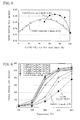
- Each evaluation sample was increased in temperature from room temperature at a rate of 10°C/min in a 10 vol%-oxygen gas flow and then measured in terms of the carbon burning rate when reached to 500°C. The measurement results are shown in Figure 5.
- the carbon burning rate exhibits a peak at a Ce/(Ce+Zr) mole ratio between 50% and slightly over 60% and the lowest value at Ce/(Ce+Zr) mole ratios of 0% (i.e., ZrO 2 ) and 100% (i.e., CeO 2 ).
- Ce/(Ce+Zr) mole ratio is preferably between 10% and 90% both inclusive, more preferably between 20% exclusive and 80% inclusive, and still more preferably between 40% and 80% both inclusive.
- the carbon burning rate exhibits a peak in the vicinity of a Ce/(Ce+Pr) mole ratio of 70%.
- the results show that the Ce/(Ce+Pr) mole ratio is preferably between 50% exclusive and 90% inclusive.
- CeZrR-type mixed oxides according to Examples and Reference Examples were prepared in which a rare earth element R other than Ce was additionally mixed as a third component to a Ce-Zr mixed oxide.
- the CeZrR-type mixed oxides and a CePrO mixed oxide having a Ce/(Ce+Pr) mole ratio of 90% were examined for the carbon burning rate when no catalytic metal was carried thereon, and compared with a CeZrO mixed oxide (carrying no catalytic metal) and another CeZrO mixed oxide (carrying 2 mass% of Pt) both of which are Comparative Examples.
- CeZrO (carrying no catalytic metal) and CeZrO (carrying 2 mass% of Pt) have a Ce/Zr mole ratio of 63/37.
- the CeZrR-type mixed oxides the CePrO mixed oxide, CeZrO (carrying no catalytic metal) and CeZrO (carrying 2 mass% of Pt), each of their sample powders was aged and measured in terms of the carbon burning rate in the same manner as in the case of Figure 5 except that the rate of temperature increase was 100°C/min and the measurement was carried out from 400°C to 600°C in steps of 50°C. The measurement results are shown in Figure 6.
- the five kinds of CeZrR-type mixed oxides and the CePrO mixed oxide have higher carbon burning rates at 450°C and higher temperatures than "CeZrO + 2mass% of Pt".
- the reason for the five kinds of CeZrR-type mixed oxides having higher carbon burning rates is that a rare earth element R was additionally mixed as a third component to the mixed oxides and the reason for CePrO having higher carbon burning rates is that Pr was additionally mixed to a CeO mixed oxide.
- CePrO exhibited high carbon burning rates particularly at low temperatures.
- the DPF can promptly burn off particulates at relatively low temperature even if the catalyst layer contains no catalytic metal.
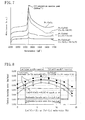
- Pt/CeO 2 has the highest CO adsorption peak and Pt/CeZrO, Pt/CePrO and Pt/CeZrLaO exhibit decreasing CO adsorption peaks in this order.
- Pt/CePrO and Pt/CeZrLaO of Examples of the invention have low CO adsorption peaks, they can easily oxidize CO. Therefore, one of the reasons why the mixed oxides of Examples have high carbon burning rates as shown in Figures 5 and 6 can be believed to be that they have high CO oxidation reactivity. In other words, it can be said that the oxidation reaction heat of CO contributes to the burning of carbons to increase the carbon burning rate.
- CeZrLaO (a constant Ce/Zr ratio of 63/37), CePrLaO (a constant Ce/Pr ratio of 7/3) and CeZrNdO (a constant Ce/Zr ratio of 63/37) were changed in the La/(Ce+Zr+La) mole ratio, the La/(Ce+Pr+La) mole ratio and the Nd/(Ce+Zr+Nd) mole ratio, respectively, from 0 to 14% in steps of 2%, thereby preparing various kinds of mixed oxides.
- prepared were an evaluation sample on which 2 mass% of Pt was carried and an evaluation sample on which no catalytic metal was carried.
- the evaluation samples were aged as in the above manner and then measured in terms of the carbon burning rate.
- the measurement method is the same as described with reference to Figure 5.
- the measurement results for CeZrLaO and CePrLaO evaluation samples are shown in Figure 8 and the measurement results for CeZrNdO evaluation samples are shown in Figure 9.
- CeZrLaO and CePrLaO evaluation samples had peak carbon burning rates in the vicinity of a La mole ratio of 6%, while CeZrNdO evaluation samples had peak carbon burning rates in the vicinity of a Nd mole ratio of 6%.
- the carbon burning rate gradually increased and then gradually decreased.
- the carbon burning rate was increased by carrying Pt on the mixed oxide.
- CePrLaO exhibited better results than CeZrLaO and CeZrNdO exhibited an intermediate performance.
- CeZrLaO can have higher carbon burning rates at La mole ratios between 2% and 11% both inclusive even if no Pt is carried thereon and, particularly, the carbon burning rate thereof preferably ranges from 4% to 10% both inclusive.
- CePrLaO can have higher carbon burning rates at La mole ratios of not more than 13% than Comparative Example even if no Pt is carried thereon and, particularly, the carbon burning rate thereof preferably ranges from 2% to 12% both inclusive.
- CeZrNdO can have higher carbon burning rates at Nd mole ratios between 1% and 12% both inclusive than Comparative Example even if no Pt is carried thereon and, particularly, the carbon burning rate thereof preferably ranges from 4% to 10% both inclusive.
Landscapes
- Chemical & Material Sciences (AREA)
- Engineering & Computer Science (AREA)
- Chemical Kinetics & Catalysis (AREA)
- Materials Engineering (AREA)
- Organic Chemistry (AREA)
- Environmental & Geological Engineering (AREA)
- Health & Medical Sciences (AREA)
- Biomedical Technology (AREA)
- Combustion & Propulsion (AREA)
- Analytical Chemistry (AREA)
- General Chemical & Material Sciences (AREA)
- Oil, Petroleum & Natural Gas (AREA)
- Catalysts (AREA)
- Exhaust Gas Treatment By Means Of Catalyst (AREA)
- Processes For Solid Components From Exhaust (AREA)
- Filtering Of Dispersed Particles In Gases (AREA)
Applications Claiming Priority (2)
| Application Number | Priority Date | Filing Date | Title |
|---|---|---|---|
| JP2005130018 | 2005-04-27 | ||
| JP2006008592A JP2006326573A (ja) | 2005-04-27 | 2006-01-17 | ディーゼルパティキュレートフィルタ |
Publications (2)
| Publication Number | Publication Date |
|---|---|
| EP1716913A2 true EP1716913A2 (de) | 2006-11-02 |
| EP1716913A3 EP1716913A3 (de) | 2007-03-07 |
Family
ID=36636426
Family Applications (1)
| Application Number | Title | Priority Date | Filing Date |
|---|---|---|---|
| EP06008528A Withdrawn EP1716913A3 (de) | 2005-04-27 | 2006-04-25 | Filter für Dieselpartikel |
Country Status (3)
| Country | Link |
|---|---|
| US (1) | US20060245985A1 (de) |
| EP (1) | EP1716913A3 (de) |
| JP (1) | JP2006326573A (de) |
Cited By (3)
| Publication number | Priority date | Publication date | Assignee | Title |
|---|---|---|---|---|
| EP2055365A1 (de) * | 2007-10-10 | 2009-05-06 | Mazda Motor Corporation | Katalysatorgestützter Partikelfilter |
| EP2335811A4 (de) * | 2008-10-09 | 2011-08-17 | Honda Motor Co Ltd | Abgasreinigungsvorrichtung |
| EP1820561B1 (de) * | 2006-02-20 | 2014-12-31 | Mazda Motor Corporation | Dieselpartikelfilter enthaltend eine katalytische Beschichtung |
Families Citing this family (23)
| Publication number | Priority date | Publication date | Assignee | Title |
|---|---|---|---|---|
| JP4501012B2 (ja) * | 2004-12-20 | 2010-07-14 | 田中貴金属工業株式会社 | ディーゼル排ガス処理用の燃焼触媒及びディーゼル排ガスの処理方法 |
| EP1920831B1 (de) * | 2006-11-08 | 2020-06-03 | Nissan Motor Co., Ltd. | Mischoxid-basierter Katalysator zur Oxidierung von Feinstaub |
| JP4941731B2 (ja) * | 2007-03-15 | 2012-05-30 | 日産自動車株式会社 | 排気ガス浄化システム |
| JP4849034B2 (ja) | 2007-08-08 | 2011-12-28 | マツダ株式会社 | 触媒付パティキュレートフィルタ |
| JP4849035B2 (ja) | 2007-08-08 | 2011-12-28 | マツダ株式会社 | 触媒付パティキュレートフィルタ |
| EP2044999B1 (de) | 2007-10-01 | 2012-02-01 | Mazda Motor Corporation | Partikelfilter |
| JP5029273B2 (ja) * | 2007-10-10 | 2012-09-19 | マツダ株式会社 | パティキュレートフィルタ |
| JP5023968B2 (ja) * | 2007-10-30 | 2012-09-12 | マツダ株式会社 | 排ガス成分浄化用触媒材及び同触媒材付パティキュレートフィルタ |
| US8187548B2 (en) | 2007-10-30 | 2012-05-29 | Mazda Motor Corporation | Catalyst-supported particulate filter |
| JP5023969B2 (ja) * | 2007-10-30 | 2012-09-12 | マツダ株式会社 | 排ガス成分浄化用触媒材及び同触媒材付パティキュレートフィルタ |
| JP5419371B2 (ja) * | 2008-03-17 | 2014-02-19 | 日本碍子株式会社 | 触媒担持フィルタ |
| JP5412788B2 (ja) * | 2008-10-17 | 2014-02-12 | マツダ株式会社 | 排気ガス浄化用触媒 |
| JP5381008B2 (ja) * | 2008-10-17 | 2014-01-08 | マツダ株式会社 | パティキュレートフィルタ及びその製造方法 |
| JP5445465B2 (ja) * | 2008-11-21 | 2014-03-19 | 日産自動車株式会社 | 粒子状物質浄化材料、粒子状物質浄化材料を用いた粒子状物質浄化用フィルタ触媒及び粒子状物質浄化用フィルタ触媒の再生方法 |
| US20110219750A1 (en) * | 2009-02-26 | 2011-09-15 | Toyota Jidosha Kabushiki Kaisha | Exhaust gas purifying apparatus for internal combustion engine |
| US8513155B2 (en) * | 2009-03-16 | 2013-08-20 | GM Global Technology Operations LLC | Perovskite-type compounds for use in lean NOx traps |
| JP5427443B2 (ja) * | 2009-03-19 | 2014-02-26 | Dowaエレクトロニクス株式会社 | 排ガス浄化触媒用複合酸化物および排ガス浄化触媒用塗料とディーゼル排ガス浄化用フィルタ |
| JP2010269270A (ja) * | 2009-05-22 | 2010-12-02 | Sumitomo Osaka Cement Co Ltd | ハニカム構造型フィルタ |
| US8615983B2 (en) * | 2010-05-07 | 2013-12-31 | GM Global Technology Operations LLC | Heat exchanger method and apparatus for engine exhaust gas recirculation system |
| KR101180949B1 (ko) | 2010-07-09 | 2012-09-07 | 기아자동차주식회사 | 디젤 분진 필터용 촉매, 이의 제조 방법 및 이를 포함하는 디젤 차량용 매연 저감 장치 |
| JP5876436B2 (ja) | 2013-04-09 | 2016-03-02 | トヨタ自動車株式会社 | 排ガス浄化触媒及び排ガス浄化方法 |
| JP6028710B2 (ja) * | 2013-10-22 | 2016-11-16 | トヨタ自動車株式会社 | 内燃機関の排気浄化装置 |
| US9616384B2 (en) | 2014-06-11 | 2017-04-11 | Basf Se | Base metal catalyst |
Family Cites Families (12)
| Publication number | Priority date | Publication date | Assignee | Title |
|---|---|---|---|---|
| US6040265A (en) * | 1996-02-21 | 2000-03-21 | Asec Manufacturing General Partnership | Methods of making highly dispersed substantially uniform cerium and zirconium mixed-metal-oxide composite supports for exhaust conversion catalysts |
| EP0885053A1 (de) * | 1996-02-21 | 1998-12-23 | ASEC Manufacturing Company | Metalloxidzusammensetzung für abgasumwandlungskatalysatoren |
| US5987882A (en) * | 1996-04-19 | 1999-11-23 | Engelhard Corporation | System for reduction of harmful exhaust emissions from diesel engines |
| US5898014A (en) * | 1996-09-27 | 1999-04-27 | Engelhard Corporation | Catalyst composition containing oxygen storage components |
| DE19714707A1 (de) * | 1997-04-09 | 1998-10-15 | Degussa | Sauerstoff speicherndes Material mit hoher Temperaturstabilität sowie Verfahren zu seiner Herstellung |
| JP2000176282A (ja) * | 1998-12-16 | 2000-06-27 | Toyota Central Res & Dev Lab Inc | リーン排ガス浄化用触媒 |
| WO2002026379A1 (en) * | 2000-09-29 | 2002-04-04 | Omg Ag & Co. Kg | Catalytic soot filter and use thereof in treatment of lean exhaust gases |
| EP1378288A3 (de) * | 2002-04-18 | 2004-01-14 | Ford Global Technologies, LLC, A subsidary of Ford Motor Company | Platingruppenmetal-freie katalytische Beschichtung für Abgas-Partikelfilter |
| US7297656B2 (en) * | 2002-04-22 | 2007-11-20 | Umicore Ag & Co. Kg | Particulate filter and method for treating soot |
| JP3528839B2 (ja) * | 2002-05-15 | 2004-05-24 | トヨタ自動車株式会社 | パティキュレート酸化材及び酸化触媒 |
| CA2546234A1 (en) * | 2003-11-24 | 2005-06-09 | Dow Global Technologies Inc. | Catalyst for a diesel particulate filter |
| JP4501012B2 (ja) * | 2004-12-20 | 2010-07-14 | 田中貴金属工業株式会社 | ディーゼル排ガス処理用の燃焼触媒及びディーゼル排ガスの処理方法 |
-
2006
- 2006-01-17 JP JP2006008592A patent/JP2006326573A/ja active Pending
- 2006-04-12 US US11/402,670 patent/US20060245985A1/en not_active Abandoned
- 2006-04-25 EP EP06008528A patent/EP1716913A3/de not_active Withdrawn
Cited By (3)
| Publication number | Priority date | Publication date | Assignee | Title |
|---|---|---|---|---|
| EP1820561B1 (de) * | 2006-02-20 | 2014-12-31 | Mazda Motor Corporation | Dieselpartikelfilter enthaltend eine katalytische Beschichtung |
| EP2055365A1 (de) * | 2007-10-10 | 2009-05-06 | Mazda Motor Corporation | Katalysatorgestützter Partikelfilter |
| EP2335811A4 (de) * | 2008-10-09 | 2011-08-17 | Honda Motor Co Ltd | Abgasreinigungsvorrichtung |
Also Published As
| Publication number | Publication date |
|---|---|
| US20060245985A1 (en) | 2006-11-02 |
| EP1716913A3 (de) | 2007-03-07 |
| JP2006326573A (ja) | 2006-12-07 |
Similar Documents
| Publication | Publication Date | Title |
|---|---|---|
| US20060245985A1 (en) | Diesel particulate filter | |
| EP1967263B1 (de) | Katalytisches Material und Katalysator zur Reinigung von Abgaskomponenten | |
| EP2644271B1 (de) | Nox-speicherungskatalysator und verfahren zum reduzieren von nox | |
| US7871452B2 (en) | Particulate filter | |
| US8784759B2 (en) | NOx storage catalyst with reduced Rh loading | |
| US11559788B2 (en) | Oxygen storage and release material, catalyst, exhaust gas purification system, and exhaust gas treatment method | |
| EP2363206A1 (de) | Material zur entfernung von teilchenförmiger substanz, filterkatalysator zur entfernung von teilchenförmiger substanz unter verwendung des materials zur entfernung von teilchenförmiger substanz und verfahren zur regeneration von filterkatalysator zur entfernung von teilchenförmiger substanz | |
| CN102281946A (zh) | 用于机动车辆的紧耦合位置中的氮氧化物储存催化剂 | |
| KR101855537B1 (ko) | Rh 로딩량이 감소된 NOx 저장 촉매 | |
| KR20060100447A (ko) | 디젤 입자 필터용 촉매 | |
| CN111741809B (zh) | 废气净化用催化剂 | |
| JP4978581B2 (ja) | パティキュレートフィルタ | |
| US20110118113A1 (en) | Exhaust gas purifying catalyst | |
| JP4633509B2 (ja) | 排気ガス浄化用触媒 | |
| CN120575965A (zh) | 排气净化装置以及排气净化装置的制造方法 | |
| CN111867724B (zh) | 废气净化用催化剂 | |
| EP4696413A1 (de) | Katalysatorartikel zur behandlung von abgas, verfahren zu seiner herstellung und verwendungen davon | |
| EP4696412A1 (de) | Katalysatorartikel zur behandlung von abgas, verfahren zu seiner herstellung und verwendungen davon | |
| US20240075463A1 (en) | Particles for exhaust gas purification catalyst |
Legal Events
| Date | Code | Title | Description |
|---|---|---|---|
| PUAI | Public reference made under article 153(3) epc to a published international application that has entered the european phase |
Free format text: ORIGINAL CODE: 0009012 |
|
| AK | Designated contracting states |
Kind code of ref document: A2 Designated state(s): AT BE BG CH CY CZ DE DK EE ES FI FR GB GR HU IE IS IT LI LT LU LV MC NL PL PT RO SE SI SK TR |
|
| AX | Request for extension of the european patent |
Extension state: AL BA HR MK YU |
|
| PUAL | Search report despatched |
Free format text: ORIGINAL CODE: 0009013 |
|
| AK | Designated contracting states |
Kind code of ref document: A3 Designated state(s): AT BE BG CH CY CZ DE DK EE ES FI FR GB GR HU IE IS IT LI LT LU LV MC NL PL PT RO SE SI SK TR |
|
| AX | Request for extension of the european patent |
Extension state: AL BA HR MK YU |
|
| AKX | Designation fees paid | ||
| STAA | Information on the status of an ep patent application or granted ep patent |
Free format text: STATUS: THE APPLICATION IS DEEMED TO BE WITHDRAWN |
|
| 18D | Application deemed to be withdrawn |
Effective date: 20070910 |
|
| REG | Reference to a national code |
Ref country code: DE Ref legal event code: 8566 |