EP1717455A1 - Device for prestressing a furniture element using several cables - Google Patents
Device for prestressing a furniture element using several cables Download PDFInfo
- Publication number
- EP1717455A1 EP1717455A1 EP05405323A EP05405323A EP1717455A1 EP 1717455 A1 EP1717455 A1 EP 1717455A1 EP 05405323 A EP05405323 A EP 05405323A EP 05405323 A EP05405323 A EP 05405323A EP 1717455 A1 EP1717455 A1 EP 1717455A1
- Authority
- EP
- European Patent Office
- Prior art keywords
- cables
- sleeve
- cable
- furniture component
- rope
- Prior art date
- Legal status (The legal status is an assumption and is not a legal conclusion. Google has not performed a legal analysis and makes no representation as to the accuracy of the status listed.)
- Granted
Links
- 239000011521 glass Substances 0.000 claims description 5
- 239000002184 metal Substances 0.000 description 5
- 238000011161 development Methods 0.000 description 2
- 230000018109 developmental process Effects 0.000 description 2
- 238000010276 construction Methods 0.000 description 1
- 230000001419 dependent effect Effects 0.000 description 1
- 238000004519 manufacturing process Methods 0.000 description 1
- 238000012986 modification Methods 0.000 description 1
- 230000004048 modification Effects 0.000 description 1
- 239000011295 pitch Substances 0.000 description 1
- 238000005496 tempering Methods 0.000 description 1
- 239000002023 wood Substances 0.000 description 1
Images


Classifications
-
- F—MECHANICAL ENGINEERING; LIGHTING; HEATING; WEAPONS; BLASTING
- F16—ENGINEERING ELEMENTS AND UNITS; GENERAL MEASURES FOR PRODUCING AND MAINTAINING EFFECTIVE FUNCTIONING OF MACHINES OR INSTALLATIONS; THERMAL INSULATION IN GENERAL
- F16B—DEVICES FOR FASTENING OR SECURING CONSTRUCTIONAL ELEMENTS OR MACHINE PARTS TOGETHER, e.g. NAILS, BOLTS, CIRCLIPS, CLAMPS, CLIPS OR WEDGES; JOINTS OR JOINTING
- F16B12/00—Jointing of furniture or the like, e.g. hidden from exterior
-
- A—HUMAN NECESSITIES
- A47—FURNITURE; DOMESTIC ARTICLES OR APPLIANCES; COFFEE MILLS; SPICE MILLS; SUCTION CLEANERS IN GENERAL
- A47B—TABLES; DESKS; OFFICE FURNITURE; CABINETS; DRAWERS; GENERAL DETAILS OF FURNITURE
- A47B2220/00—General furniture construction, e.g. fittings
- A47B2220/09—Furniture held together by tension cables
Definitions
- the invention relates to a device for biasing a furniture component with a plurality of ropes.
- the device can be used in particular for furniture construction for tempering large wooden and glass plates, shelves and sideboards.
- the tabletops tend to bulge down in the middle of the table due to their own weight. This is particularly the case when the table tops are long and the legs of the table are located in the corners of the table top.
- the table top can be biased by means of two arranged on the underside of the table top, tensioned ropes. For this, the ropes under the table top are stretched diagonally. At the crossing point of the ropes they push the table top upwards via a bolt.
- Each rope is tensioned with a rope tensioner, which is located at the end of the rope.
- the clamping mechanism is asymmetrical and clearly visible, which is particularly disturbing in glass plates acts. In addition, the problem may arise that the clamping mechanism limits the legroom while sitting.
- An object of the invention is to provide a device for pretensioning a furniture component with a plurality of cables, in which the mechanism for clamping is concealed.
- the device is space-saving, technically easy to manufacture, robust and stable even under high load.
- the inventive solution has the advantage that the length of the rope only has to be determined when the table is mounted.
- the object is achieved by a device for biasing a furniture component with a plurality of ropes with the features according to claim 1.
- the inventive device for biasing a furniture component with a plurality of cables has at the first ends of the cables arranged fastening means with which the cables are connectable to the furniture component.
- a sleeve into which the second ends of the cables are inserted, and provided in the sleeve clamping means are provided, with which the second ends of the cables are connectable and by means of which the cables are tensioned.
- the sleeve has a funnel-shaped cable inlet. As a result, the rope can be easily inserted into the sleeve.
- the funnel-shaped cable inlet is rounded. This avoids that the rope is kinked and thus possibly damaged.
- the funnel-shaped cable inlet is pressed into the sleeve. This ensures that the cable inlet forms together with the tubular portion of the sleeve nuriolo a single component, which simplifies the assembly of the clamping device.
- the clamping means for each rope each having a clamping screw by means of which the respective cable is tensioned. This allows the rope tension to be adjusted individually in each rope.
- the clamping means for each rope have a bore, in each of which a guide sleeve for guiding the respective cable is movably mounted. In this way it can be ensured that the rope does not buckle during tensioning.
- the guide sleeve as a stop on a ring on which the clamping screw acts.
- the device for biasing the furniture component may be formed according to a further feature of the invention so that the sleeve is supported on the furniture component.
- a positioning disc attachable to the furniture component can be provided in order to position the sleeve relative to the furniture component.
- this can be further improved by the fastening means are designed as Seilkauschen.
- the cable ends in a simple manner with the furniture part, for example, the table top or the table legs connect.
- the device according to the invention can be used for pretensioning a furniture component.
- the furniture component may be, for example, a table top, a glass plate, a sideboard or a shelf.
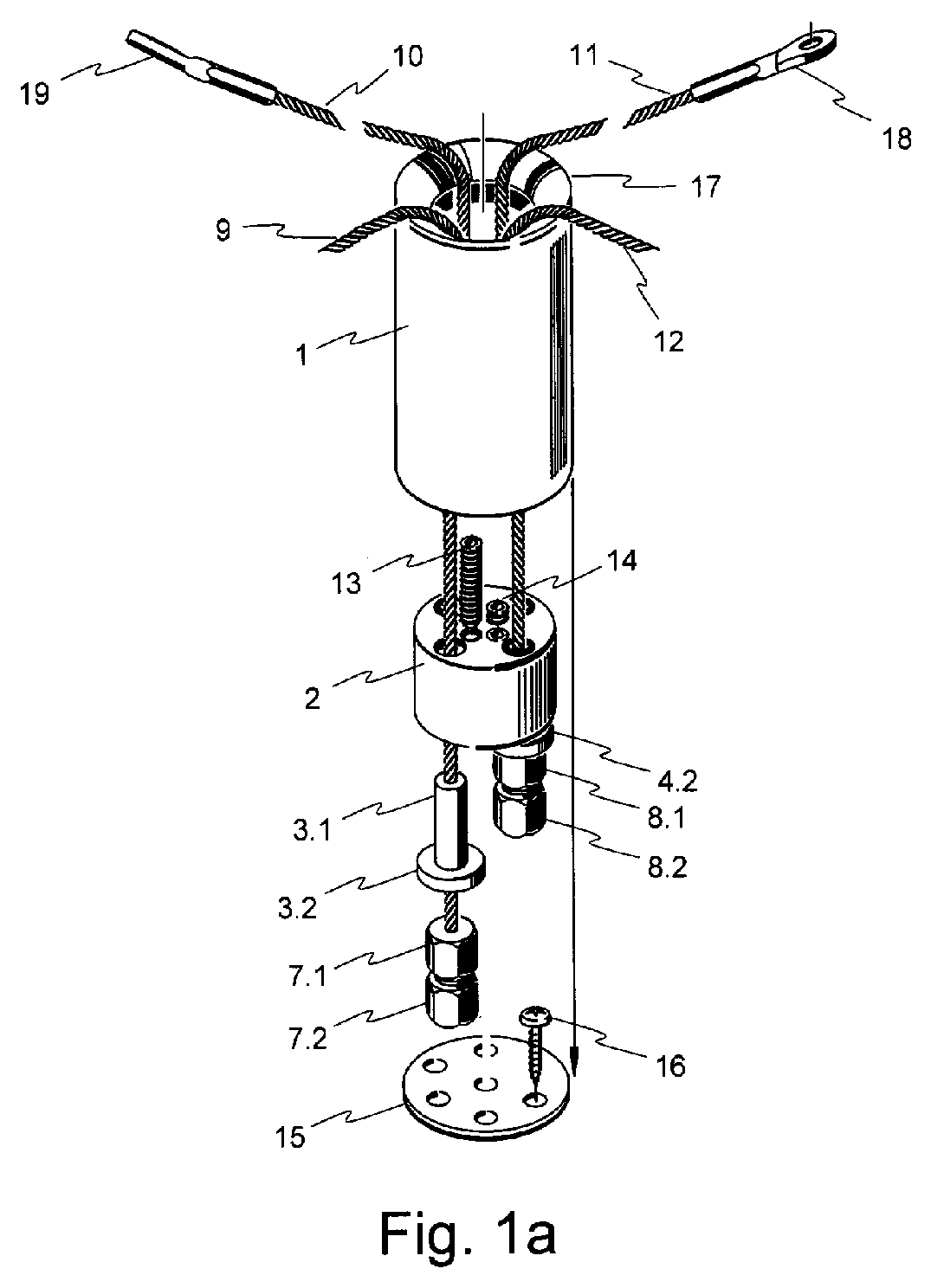
- FIG. 1a shows the device according to the invention for pretensioning a furniture component with a plurality of cables in a three-dimensional view.
- the tensioning device has a sleeve 1, provided on one side with a cover 17 having a cable inlet opening.
- the sleeve 1 may for example consist of metal.
- the lid 17 having the cable inlet opening can likewise be made of metal and the cable-guiding surface of the lid 17 can be curved such that the cables 9, 10, 11 and 12 can be gently guided into the interior of the sleeve 1. For the sake of clarity, only the cable ends of the cables 9 and 12 are shown guided through a tensioning block 2 in FIG. 1a.
- the cable 12 for example, is performed with a further guide sleeve 4.1, 4.2 in the clamping block 2 and has at the end of a stop 8.1 with a screw 8.2.
- the tensioning of the rope 12 via a further clamping screw With the aid of the clamping screw 14 shown in Figure 1a, the rope 11 is stretched.
- a centering plate 15 may be provided which is screwed via one or more screws 16 with the furniture part to be clamped.
- the centering disk 15 can also be glued to the furniture component.
- the second ends of the cables 9 to 12 may be equipped with an already factory-mounted fastener 18 or 19.
- the second end of the rope 10 is provided with the attachment means 19, which is pressed onto the second end of the rope 10 and has a thread for screwing the second end of the rope into a nut provided therefor.
- the second end of the rope may also be provided with a thimble 18 which is crimped to the second end of the rope.
- FIGS. 1b to 1f show alternative attachment forms for the second ends of the cables 9 to 12.
- the Seilkausche 18 can be screwed with a two-element metal ridge rail 25 via the screw 21 and the corresponding nut.
- a closer description of the operation and the structure the ridge 25 is from the European patent application EP 04405347 removable.
- FIG. 1c shows a second embodiment of the attachment of the thimble 18 in a three-dimensional view.
- the plate 26 is a mounting plate for a table leg. It contains a bore through which the cable thimble 18 can be screwed via the screw 21 with a screw-in sleeve 20.
- the screw-in sleeve 20 in turn is screwed into the furniture part to be clamped.
- FIG. 1d shows a third embodiment for fastening the cable thimble 18.
- the Seilkausche 18 is bolted via the screw 21 with a screw 20, which in turn is screwed into the table top or a suitable wooden member 22.
- the wooden component 22 to be the exciting component itself.
- attachment points are preferably the corners of the component in question, so that the cables in the assembled state extend diagonally on the underside of the component to be clamped.
- FIG. 1e shows a fourth embodiment for fastening the cable thimble 18.
- the Seilkausche 18 is screwed via the screw 21 and a corresponding nut with a plate angle 23, which also serves to attach a table leg to the table top.
- FIG. 1f shows a fifth embodiment for fastening the cable thimble 18.
- the Seilkausche 18 is connected to the screw 21 with a mounting plate 24, which in turn is bolted via one or more screws with the table top.
- FIG. 2 shows the device according to the invention for pretensioning a furniture component with a plurality of cables in the mounted state in a three-dimensional view.
- FIG. 3 shows the device according to the invention for pretensioning a furniture component with a plurality of cables in cross-section.
- the sleeve 1 presses with a force that depends on the cable tension on a furniture component 27, which may be, for example, a table top, a glass plate, the bottom of a sideboard or a shelf.
- the assembly of the device for biasing the furniture component is as follows.
- a first step the required pitches of the tension cables 9 to 12 are determined and the tension cables 9 to 12 brought to the determined length.
- the centering disk 15 is fixed on the furniture component 27 where later the biasing force is to be introduced into the furniture component 27.
- the sleeve 1 is brought to the funnel-shaped lid 17 by means of the centering disk 15 in position.
- the first ends of the cables 9 to 12 through the funnel-shaped lid 17 in the sleeve 1 and through the corresponding Drilled holes in the clamping block 2 out. Then the guide sleeve 3.1 is pushed over the cable 9.
- the stop 7.1 is pushed over the end of the rope 9, the rope wedge 7.3 used and the rope wedge 7.3 using the Verschraubteils 7.2, which is screwed onto the stop 7.1, jammed with the rope 9.
- a non-slip stop at the end of the rope 9 is formed, which withstands high tensile forces.
- the second ends of the cables 9 to 12 with the aid of advantageously already factory-fixed cable thimbles 18 at the designated locations, for example, at the corners of the furniture component 27, attached.
- FIGS. 1b to 1f show five different exemplary embodiments for fastening the cable thimbles.
- the clamping screws of which the two clamping screws 13 and 14 are shown in FIG. 3, can be designed as set screws, which can be turned into the clamping block 2 with an Allen wrench.
- the tensioning device is shown in plan view, wherein the ropes 9 to 12 are not shown for clarity.
- the clamping screws are not yet screwed into the clamping block 2 in the illustration in Figure 4.
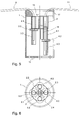
- FIG. 5 shows a cross-section of a second embodiment of the tensioning device according to the invention.
- the second embodiment differs from the first embodiment only in that the stop at the end of the cables 9 to 12 is formed differently.
- the stop at the end of the rope is formed by a cable clamp 3.3 or 4.3, which consists of a sleeve which is pressed onto the end of the respective cable.
- the guide sleeve 3.1 together with the bearing disk 3.2 forms a first component and the cable clamp 3.3 forms a second component.
- the two components can also be produced as a one-piece component.
Landscapes
- Engineering & Computer Science (AREA)
- General Engineering & Computer Science (AREA)
- Mechanical Engineering (AREA)
- Clamps And Clips (AREA)
- Details Of Indoor Wiring (AREA)
- Closing And Opening Devices For Wings, And Checks For Wings (AREA)
- Mutual Connection Of Rods And Tubes (AREA)
Abstract
Die erfindungsgemäße Vorrichtung zum Vorspannen eines Möbelbauteils (27) mit mehreren Seilen (9 - 12) weist an den ersten Enden der Seile angeordnete Befestigungsmittel (18) auf, mit denen die Seile mit dem Möbelbauteil (27) verbindbar sind. Zudem sind eine Hülse (1), in die die zweiten Enden der Seile (9 - 12) einführbar sind, und ein in der Hülse (1) angeordnetes Spannmittel (2) vorgesehen, mit dem die zweiten Enden der Seile (9 - 12) verbindbar sind und mittels dem die Seile (9 - 12) spannbar sind.
Description
Die Erfindung betrifft eine Vorrichtung zum Vorspannen eines Möbelbauteils mit mehreren Seilen. Die Vorrichtung lässt sich insbesondere im Möbelbau zum Vorspannen von großen Holz- und Glasplatten, Fachböden und Anrichten verwenden.The invention relates to a device for biasing a furniture component with a plurality of ropes. The device can be used in particular for furniture construction for tempering large wooden and glass plates, shelves and sideboards.
Bei großen Tischen neigen die Tischplatten dazu, sich in der Tischmitte aufgrund ihres Eigengewichts nach unten zu wölben. Dies ist insbesondere dann der Fall, wenn die Tischplatten lang und die Beine des Tisches in den Ecken der Tischplatte angeordnet sind. Um dem entgegenzuwirken und die Tischplatte wieder plan auszurichten, kann die Tischplatte mit Hilfe zweier auf der Unterseite der Tischplatte angeordneter, gespannter Seile vorgespannt werden. Dazu werden die Seile unter der Tischplatte diagonal spannt. Im Kreuzungspunkt der Seile drücken diese über einen Bolzen die Tischplatte nach oben. Jedes Seil wird mit jeweils einem Seilspanner gespannt, der am Ende des Seils angeordnet ist. Dies hat jedoch den Nachteil, dass der Spannmechanismus unsymmetrisch und deutlich sichtbar ist, was insbesondere bei Glasplatten störend wirkt. Zudem kann das Problem auftreten, dass der Spannmechanismus beim Sitzen die Beinfreiheit einschränkt.For large tables, the tabletops tend to bulge down in the middle of the table due to their own weight. This is particularly the case when the table tops are long and the legs of the table are located in the corners of the table top. To counteract this and to align the table top again flat, the table top can be biased by means of two arranged on the underside of the table top, tensioned ropes. For this, the ropes under the table top are stretched diagonally. At the crossing point of the ropes they push the table top upwards via a bolt. Each rope is tensioned with a rope tensioner, which is located at the end of the rope. However, this has the disadvantage that the clamping mechanism is asymmetrical and clearly visible, which is particularly disturbing in glass plates acts. In addition, the problem may arise that the clamping mechanism limits the legroom while sitting.
Eine Aufgabe der Erfindung ist es, eine Vorrichtung zum Vorspannen eines Möbelbauteils mit mehreren Seilen anzugeben, bei der der Mechanismus zum Spannen verdeckt wird. Vorteilhafterweise ist die Vorrichtung platzsparend, technisch einfach herstellbar, robust und auch unter hoher Belastung stabil.An object of the invention is to provide a device for pretensioning a furniture component with a plurality of cables, in which the mechanism for clamping is concealed. Advantageously, the device is space-saving, technically easy to manufacture, robust and stable even under high load.
Die erfindungsgemässe Lösung hat den Vorteil, dass die Länge des Seils erst dann festgelegt werden muss, wenn der Tisch montiert wird.The inventive solution has the advantage that the length of the rope only has to be determined when the table is mounted.
Die Aufgabe wird durch eine Vorrichtung zum Vorspannen eines Möbelbauteils mit mehreren Seilen mit den Merkmalen gemäß Patentanspruch 1 gelöst.The object is achieved by a device for biasing a furniture component with a plurality of ropes with the features according to
Die erfindungsgemäße Vorrichtung zum Vorspannen eines Möbelbauteils mit mehreren Seilen weist an den ersten Enden der Seile angeordnete Befestigungsmittel auf, mit denen die Seile mit dem Möbelbauteil verbindbar sind. Zudem sind eine Hülse, in die die zweiten Enden der Seile einführbar sind, und ein in der Hülse angeordnetes Spannmittel vorgesehen, mit dem die zweiten Enden der Seile verbindbar und mittels dem die Seile spannbar sind.The inventive device for biasing a furniture component with a plurality of cables has at the first ends of the cables arranged fastening means with which the cables are connectable to the furniture component. In addition, a sleeve into which the second ends of the cables are inserted, and provided in the sleeve clamping means are provided, with which the second ends of the cables are connectable and by means of which the cables are tensioned.
Vorteilhafte Weiterbildungen der Erfindung ergeben sich aus denen in den abhängigen Patentansprüchen angegebenen Merkmalen.Advantageous developments of the invention will become apparent from the features indicated in the dependent claims.
Bei einer Ausführungsform der erfindungsgemäßen Vorrichtung weist die Hülse einen trichterförmigen Seileinlass auf. Dadurch lässt sich das Seil einfach in die Hülse einführen.In one embodiment of the device according to the invention, the sleeve has a funnel-shaped cable inlet. As a result, the rope can be easily inserted into the sleeve.
Bei einer weiteren Ausführungsform der erfindungsgemäßen Vorrichtung ist der trichterförmige Seileinlass abgerundet. Dadurch lässt sich vermeiden, dass das Seil geknickt und damit unter Umständen beschädigt wird.In a further embodiment of the device according to the invention, the funnel-shaped cable inlet is rounded. This avoids that the rope is kinked and thus possibly damaged.
Bei einer zusätzlichen Ausführungsform der erfindungsgemäßen Vorrichtung ist der trichterförmige Seileinlass in die Hülse eingepresst. Dadurch wird erreicht, dass der Seileinlass zusammen mit dem rohrförmigen Bereich der Hülse nurmehr ein einziges Bauteil bildet, was die Montage der Spannvorrichtung vereinfacht.In an additional embodiment of the device according to the invention, the funnel-shaped cable inlet is pressed into the sleeve. This ensures that the cable inlet forms together with the tubular portion of the sleeve nurmehr a single component, which simplifies the assembly of the clamping device.
Zudem ist es von Vorteil, wenn bei der erfindungsgemäßen Vorrichtung zum Vorspannen eines Möbelbauteils das Spannmittel für jedes Seil jeweils eine Spannschraube aufweist, mittels der das jeweilige Seil spannbar ist. Dadurch lässt sich die Seilspannung in jedem Seil individuell einstellen.In addition, it is advantageous if in the device according to the invention for biasing a furniture component, the clamping means for each rope each having a clamping screw by means of which the respective cable is tensioned. This allows the rope tension to be adjusted individually in each rope.
Darüber hinaus kann bei der erfindungsgemäßen Vorrichtung zum Vorspannen eines Möbelbauteils das Spannmittel für jedes Seil eine Bohrung aufweisen, in der jeweils eine Führungshülse zum Führen des jeweiligen Seils beweglich gelagert ist. Auf diese Art und Weise lässt sich sicherstellen, dass das Seil beim Spannen nicht ausknickt.In addition, in the device according to the invention for biasing a furniture component, the clamping means for each rope have a bore, in each of which a guide sleeve for guiding the respective cable is movably mounted. In this way it can be ensured that the rope does not buckle during tensioning.
Bei einer Weiterbildung der erfindungsgemäßen Vorrichtung weist die Führungshülse als Anschlag einen Ring auf, auf den die Spannschraube wirkt.In a further development of the device according to the invention, the guide sleeve as a stop on a ring on which the clamping screw acts.
Die Vorrichtung zum Vorspannen des Möbelbauteils kann nach einem weiteren Merkmal der Erfindung so ausgebildet sein, dass sich die Hülse am Möbelbauteil abstützt.The device for biasing the furniture component may be formed according to a further feature of the invention so that the sleeve is supported on the furniture component.
Zudem kann bei der erfindungsgemäßen Vorrichtung eine auf dem Möbelbauteil befestigbare Positionierscheibe vorgesehen sein, um die Hülse gegenüber dem Möbelbauteil zu positionieren.In addition, in the device according to the invention, a positioning disc attachable to the furniture component can be provided in order to position the sleeve relative to the furniture component.
Nach einem weiteren Merkmal der Erfindung kann diese noch weiter verbessert werden, indem die Befestigungsmittel als Seilkauschen ausgebildet sind. Dadurch lassen sich die Seilenden auf einfache Art und Weise mit dem Möbelteil, beispielsweise der Tischplatte oder den Tischbeinen, verbinden.According to a further feature of the invention, this can be further improved by the fastening means are designed as Seilkauschen. As a result, the cable ends in a simple manner with the furniture part, for example, the table top or the table legs connect.
Des Weiteren ist es möglich, statt der Seile bei der erfindungsgemäßen Vorrichtung Drähte, Kabel, Bänder oder Riemen zu verwenden.Furthermore, it is possible to use wires, cables, bands or belts instead of the cables in the device according to the invention.
Schließlich kann die erfindungsgemäße Vorrichtung zum Vorspannen eines Möbelbauteils verwendet werden. Das Möbelbauteil kann beispielsweise eine Tischplatte, eine Glasplatte, eine Anrichte oder ein Fachboden sein.Finally, the device according to the invention can be used for pretensioning a furniture component. The furniture component may be, for example, a table top, a glass plate, a sideboard or a shelf.
Kurze Beschreibung der ZeichnungenBrief description of the drawings
Im Folgenden wird die Erfindung mit mehreren Ausführungsbeispielen anhand von sechs Figuren weiter erläutert.
- Figur 1a
- zeigt eine mögliche Ausführungsform der erfindungsgemäßen Vorrichtung zum Vorspannen eines Möbelbauteils mit mehreren Seilen in einer dreidimensionalen Ansicht.
- Figur 1b
- zeigt eine erste Möglichkeit zur Befestigung des Spannseils.
- Figur 1c
- zeigt eine zweite Möglichkeit zur Befestigung des Spannseils.
- Figur 1d
- zeigt eine dritte Möglichkeit zur Befestigung des Spannseils.
- Figur 1e
- zeigt eine vierte Möglichkeit zur Befestigung des Spannseils.
- Figur 1f
- zeigt eine fünfte Möglichkeit zur Befestigung des Spannseils.
Figur 2- zeigt die Vorrichtung zum Spannen des Möbelbauteils im montierten Zustand in einer dreidimensionalen Ansicht.
- Figur 3
- zeigt die Spannvorrichtung im montierten Zustand im Querschnitt.
- Figur 4
- zeigt die Spannvorrichtung in der Draufsicht.
- Figur 5
- zeigt eine weitere Ausführungsform der erfindungsgemäßen Spannvorrichtung im Querschnitt.
- Figur 6
- zeigt die weitere Ausführungsform der erfindungsgemäßen Spannvorrichtung in der Draufsicht.
- FIG. 1a
- shows a possible embodiment of the device according to the invention for biasing a furniture component with multiple ropes in a three-dimensional view.
- FIG. 1b
- shows a first way to attach the tensioning cable.
- Figure 1c
- shows a second way to attach the tensioning cable.
- Figure 1d
- shows a third way to attach the tensioning cable.
- Figure 1e
- shows a fourth way to attach the tensioning cable.
- FIG. 1f
- shows a fifth way to attach the tensioning cable.
- FIG. 2
- shows the device for clamping the furniture component in the mounted state in a three-dimensional view.
- FIG. 3
- shows the clamping device in the assembled state in cross section.
- FIG. 4
- shows the clamping device in plan view.
- FIG. 5
- shows a further embodiment of the clamping device according to the invention in cross section.
- FIG. 6
- shows the further embodiment of the clamping device according to the invention in plan view.
In Figur 1a ist die erfindungsgemäße Vorrichtung zum Vorspannen eines Möbelbauteils mit mehreren Seilen in einer dreidimensionalen Ansicht gezeigt. Die Spannvorrichtung weist eine Hülse 1 auf, auf einer Seite mit einem eine Seileinlassöffnung aufweisenden Deckel 17 versehen ist. Die Hülse 1 kann beispielsweise aus Metall bestehen. Der die Seileinlassöffnung aufweisende Deckel 17 kann ebenfalls aus Metall bestehen und die seilführende Fläche des Deckels 17 derart gekrümmt sein, dass die Seile 9, 10, 11 und 12 schonend in das Innere der Hülse 1 geführt werden können. In Figur 1a sind der Übersichtlichkeit halber lediglich die Seilenden der Seile 9 und 12 durch einen Spannblock 2 hindurchgeführt dargestellt. Grundsätzlich werden jedoch alle Seile, die in die Hülse 1 eingeführt werden, durch den Spannblock 2 hindurchgeführt und mit dessen Hilfe gespannt. In Figur 1a ist über das Seil 9 eine erste Führungshülse 3.1 gestülpt, die mit einer als Anschlag dienenden Lagerscheibe 3.2 versehen ist. Am Ende des Seils 9 befindet sich zudem ein Anschlag 7.1, der zusammen mit einem Verschraubteil 7.2 und einem Seilkeil 7.3, der in Figur 1a jedoch nicht gezeigt ist, bewirkt, dass das Ende des Seils 9 einen festen und belastbaren Anschlag erhält. Über eine erste Spannschraube 13, die in den Spannblock 2 eindrehbar ist und auf die Lagerscheibe 3.2 drückt, lässt sich das Seil 9 spannen. Die Seile 10, 11 und 12 weisen hierzu die gleichen baulichen Maßnahmen auf. Das Seil 12 beispielsweise wird mit einer weiteren Führungshülse 4.1, 4.2 im Spannblock 2 geführt und weist am Ende einen Anschlag 8.1 mit einem Verschraubteil 8.2 auf. Das Spannen des Seils 12 erfolgt über eine weitere Spannschraube. Mit Hilfe der in Figur 1a gezeigten Spannschraube 14 wird das Seil 11 gespannt. Damit sich die Hülse 1 auf dem zu spannenden Möbelbauteil einfach positionieren lässt, kann eine Zentrierscheibe 15 vorgesehen sein, die über eine oder mehrere Schrauben 16 mit dem zu spannenden Möbelteil verschraubbar ist. Alternativ dazu kann die Zentrierscheibe 15 auch mit dem Möbelbauteil verklebt werden. Die zweiten Enden der Seile 9 bis 12 können mit einem bereits werkseitig angebrachten Befestigungsmittel 18 oder 19 ausgestattet sein. So ist beispielsweise das zweite Ende des Seils 10 mit dem Befestigungsmittel 19 ausgestattet, welches auf das zweite Ende des Seils 10 aufgepresst ist und ein Gewinde aufweist, um das zweite Ende des Seils in eine dafür vorgesehene Mutter einzuschrauben. Alternativ dazu kann, wie in Figur 1a gezeigt, das zweite Ende des Seils auch mit einer Seilkausche 18 versehen sein, welche mit dem zweiten Ende des Seils verpresst ist.FIG. 1a shows the device according to the invention for pretensioning a furniture component with a plurality of cables in a three-dimensional view. The tensioning device has a
In den Figuren 1b bis 1f sind alternative Befestigungsformen für die zweiten Enden der Seile 9 bis 12 gezeigt.FIGS. 1b to 1f show alternative attachment forms for the second ends of the
So ist in Figur 1b die Seilkausche 18 mit einer aus zwei Elementen bestehenden metallenen Gratleiste 25 über die Schraube 21 und die entsprechende Mutter verschraubbar. Eine nähere Beschreibung der Funktionsweise und des Aufbaus der Gratleiste 25 ist aus der europäischen Patentanmeldung
In Figur 1c ist eine zweite Ausführungsform für die Befestigung der Seilkausche 18 in dreidimensionaler Ansicht gezeigt. Die Platte 26 ist eine Montageplatte für ein Tischbein. Sie enthält eine Bohrung, durch welche die Seilkausche 18 über die Schraube 21 mit einer Einschraubmuffe 20 verschraubbar ist. Die Einschraubmuffe 20 wiederum ist in das zu spannende Möbelteil eingeschraubt.FIG. 1c shows a second embodiment of the attachment of the
In Figur 1d ist eine dritte Ausführungsform zur Befestigung der Seilkausche 18 gezeigt. Dabei ist die Seilkausche 18 über die Schraube 21 mit einer Einschraubmuffe 20 verschraubt, welche wiederum in die Tischplatte oder ein geeignetes hölzernes Bauteil 22 eingeschraubt ist. Das hölzernes Bauteil 22 das zu spannende Bauteil selbst sein. Als Befestigungspunkte kommen vorzugsweise die Ecken des Bauteils in Frage, so dass die Seile im montierten Zustand diagonal auf der Unterseite des zu spannenden Bauteils verlaufen.FIG. 1d shows a third embodiment for fastening the
In Figur 1e ist eine vierte Ausführungsform zur Befestigung der Seilkausche 18 gezeigt. Die Seilkausche 18 wird dabei über die Schraube 21 und eine entsprechende Mutter mit einem Blechwinkel 23 verschraubt, welcher zusätzlich zur Befestigung eines Tischbeins an der Tischplatte dient.FIG. 1e shows a fourth embodiment for fastening the
In Figur 1f ist eine fünfte Ausführungsform zur Befestigung der Seilkausche 18 gezeigt. Die Seilkausche 18 wird dazu über die Schraube 21 mit einer Montageplatte 24 verbunden, welche wiederum über eine oder mehrere Schrauben mit der Tischplatte verschraubt ist.FIG. 1f shows a fifth embodiment for fastening the
In Figur 2 ist die erfindungsgemäße Vorrichtung zum Vorspannen eines Möbelbauteils mit mehreren Seilen im montierten Zustand in dreidimensionaler Ansicht gezeigt. Wenn die Seile 9 bis 12 unter Spannung stehen, wird die Hülse 1 auf das entsprechende Möbelteil gedrückt und führt dadurch dazu, dass das Möbelteil sich nicht mehr nach unten durchbiegt.FIG. 2 shows the device according to the invention for pretensioning a furniture component with a plurality of cables in the mounted state in a three-dimensional view. When the
In Figur 3 ist die erfindungsgemäße Vorrichtung zum Vorspannen eines Möbelbauteils mit mehreren Seilen im Querschnitt dargestellt. Die Hülse 1 drückt mit einer Kraft, die von der Seilspannung abhängt, auf ein Möbelbauteil 27, welches beispielsweise eine Tischplatte, eine Glasplatte, der Boden einer Anrichte oder ein Fachboden sein kann.FIG. 3 shows the device according to the invention for pretensioning a furniture component with a plurality of cables in cross-section. The
Die Montage der Vorrichtung zum Vorspannen des Möbelbauteils erfolgt wie folgt.The assembly of the device for biasing the furniture component is as follows.
In einem ersten Arbeitsschritt werden die erforderlichen Seillängen der Spannseile 9 bis 12 ermittelt und die Spannseile 9 bis 12 auf die ermittelte Länge gebracht. In einem zweiten Arbeitsschritt wird die Zentrierscheibe 15 auf dem Möbelbauteil 27 dort befestigt, wo später die Vorspannkraft in das Möbelbauteil 27 eingeleitet werden soll. Nun wird die Hülse 1 mit dem trichterförmigen Deckel 17 mit Hilfe der Zentrierscheibe 15 in Stellung gebracht. In einem weiteren Arbeitsschritt werden die ersten Enden der Seile 9 bis 12 durch den trichterförmigen Deckel 17 in die Hülse 1 und durch die entsprechenden Bohrungen im Spannblock 2 geführt. Dann wird über das Seil 9 die Führungshülse 3.1 geschoben. Im nächsten Schritt wird der Anschlag 7.1 über das Ende des Seils 9 geschoben, der Seilkeil 7.3 eingesetzt und der Seilkeil 7.3 mit Hilfe des Verschraubteils 7.2, das auf den Anschlag 7.1 geschraubt wird, mit dem Seil 9 verklemmt. Dadurch wird ein rutschfester Anschlag am Ende des Seils 9 gebildet, welcher auch hohen Zugkräften standhält. Mit den Seilenden der Seile 10 bis 12 wird ebenso verfahren. In einem weiteren Schritt werden die zweiten Enden der Seile 9 bis 12 mit Hilfe der vorteilhafter Weise bereits werkseitig befestigten Seilkauschen 18 an den dafür vorgesehenen Stellen, beispielsweise an den Ecken des Möbelbauteils 27, befestigt. In den Figuren 1b bis 1f sind fünf verschiedene Ausführungsbeispiele zum Befestigen der Seilkausche gezeigt. Schließlich werden die Seile 9 bis 12 mit Hilfe der Spannschrauben so stark gespannt, bis die gewünschte Vorspannkraft erreicht ist bzw. bis das Möbelbauteil 27 die gewünschte Planheit aufweist. Die Spannschrauben, von denen in Figur 3 die beiden Spannschrauben 13 und 14 gezeigt sind, können als Madenschrauben ausgebildet sein, die mit einem Inbusschlüssel in den Spannblock 2 gedreht werden können.In a first step, the required pitches of the
Die soeben beschriebenen Arbeitsschritte können auch vertauscht werden ohne dadurch den Umfang der Erfindung zu verlassen.The work steps just described can also be reversed without departing from the scope of the invention.
In Figur 4 ist die Spannvorrichtung in der Draufsicht gezeigt, wobei die Seile 9 bis 12 der Übersichtlichkeit halber nicht gezeigt sind. Die Spannschrauben sind bei der Darstellung in Figur 4 noch nicht in den Spannblock 2 eingedreht. Dafür sind in Figur 4 die vier Gewindebohrungen 2.1, 2.2, 2.3 und 2.4 zu erkennen, in die später die Spannschrauben eindrehbar sind.In Figure 4, the tensioning device is shown in plan view, wherein the
Je nach Bauform des zu spannenden Möbelbauteils 27 und abhängig von den technischen Anforderungen kann es auch genügen, statt der vier Spannseile 9 bis 12 lediglich zwei oder drei Spannseile zu verwenden. Falls fünf oder mehr Spannseile erforderlich sein sollten, ist der Spannblock 2 an die entsprechende Anzahl Seile anzupassen.Depending on the design of the
In Figur 5 ist eine zweite Ausführungsform der erfindungsgemäßen Spannvorrichtung im Querschnitt gezeigt. Die zweite Ausführungsform unterscheidet sich von der ersten Ausführungsform lediglich dadurch, dass der Anschlag am Ende der Seile 9 bis 12 anders ausgebildet ist. Bei der in Figur 5 gezeigten zweiten Ausführungsform wird der Anschlag am Seilende durch eine Seilklemmung 3.3 bzw. 4.3 gebildet, welche aus einer Hülse besteht, die auf das Ende des jeweiligen Seils aufgepresst wird. In Figur 5 bildet die Führungshülse 3.1 zusammen mit der Lagerscheibe 3.2 ein erstes Bauteil und die Seilklemmung 3.3 ein zweites Bauteil. Stattdessen können die beiden Bauteile aber auch als ein einstückiges Bauteil hergestellt werden.FIG. 5 shows a cross-section of a second embodiment of the tensioning device according to the invention. The second embodiment differs from the first embodiment only in that the stop at the end of the
In Figur 6 ist die in Figur 5 gezeigte Spannvorrichtung in der Draufsicht gezeigt, wobei der Übersichtlichkeit halber die Spannseile 9 bis 12 und die Spannschrauben nicht dargestellt sind.In Figure 6, the tensioning device shown in Figure 5 is shown in plan view, the sake of clarity, the
Die vorhergehende Beschreibung der Ausführungsbeispiele gemäß der vorliegenden Erfindung dient nur zu illustrativen Zwecken und nicht zum Zwecke der Beschränkung der Erfindung. Im Rahmen der Erfindung sind verschiedene Änderungen und Modifikationen möglich, ohne den Umfang der Erfindung sowie ihre Äquivalente zu verlassen.The foregoing description of the embodiments according to the present invention is for illustrative purposes only, and not for the purpose of limiting the invention. Within the scope of the invention are various changes and modifications are possible without departing from the scope of the invention and its equivalents.
- 11
- Hülseshell
- 22
- Spannblockclamping block
- 2.12.1
- Innengewindeinner thread
- 2.22.2
- Innengewindeinner thread
- 2.32.3
- Innengewindeinner thread
- 2.42.4
- Innengewindeinner thread
- 3.13.1
- erste Führungshülsefirst guide sleeve
- 3.23.2
- Lagerscheibebearing disk
- 3.33.3
- Seilklemmungcable clamping
- 4.14.1
- zweite Führungshülsesecond guide sleeve
- 4.24.2
- Lagerscheibebearing disk
- 4.34.3
- Seilklemmungcable clamping
- 5.15.1
- dritte Führungshülsethird guide sleeve
- 5.25.2
- Lagerscheibebearing disk
- 6.16.1
- vierte Führungshülsefourth guide sleeve
- 6.26.2
- Lagerscheibebearing disk
- 7.17.1
- Anschlagattack
- 7.27.2
- VerschraubteilVerschraubteil
- 7.37.3
- Seilkeilrope wedge
- 8.18.1
- Anschlagattack
- 8.28.2
- VerschraubteilVerschraubteil
- 8.38.3
- Seilkeilrope wedge
- 99
- erstes Seilfirst rope
- 1010
- zweites Seilsecond rope
- 1111
- drittes Seilthird rope
- 1212
- viertes Seilfourth rope
- 1313
- erste Spannschraubefirst clamping screw
- 1414
- zweite Spannschraubesecond clamping screw
- 1515
- Zentrierscheibecentering
- 1616
- Schraubescrew
- 1717
- Deckelcover
- 1818
- Seilkauschethimble
- 1919
- SeilverbinderSeilverbinder
- 2020
- EindrehmuffeEindrehmuffe
- 2121
- Schraubescrew
- 2222
- Holzplattewood panel
- 2323
- Metallwinkelmetal brackets
- 2424
- Befestigungsscheibemounting disk
- 2525
- GratleisteGratleiste
- 2626
- Blechplattesheet metal plate
- 2727
- Möbelbauteilfurniture component
Claims (12)
bei der die Hülse (1) einen trichterförmigen Seileinlass (17) aufweist.Device according to claim 1,
in which the sleeve (1) has a funnel-shaped cable inlet (17).
bei der der trichterförmige Seileinlass (17) abgerundet ist.Device according to claim 2,
in which the funnel-shaped cable inlet (17) is rounded.
bei der der trichterförmige Seileinlass (17) in die Hülse (1) eingepresst ist.Device according to claim 2 or 3,
in which the funnel-shaped cable inlet (17) is pressed into the sleeve (1).
bei der die Führungshülse (3.1) als Anschlag einen Ring (3.2) aufweist.Device according to claim 6,
in which the guide sleeve (3.1) as a stop has a ring (3.2).
zum Vorspannen des Möbeltauteils (27), welches vorzugsweise eine Tischplatte, eine Glasplatte, eine Anrichte oder ein Fachboden ist.Use of the device according to one of the claims 1 to 11,
for biasing the furniture component (27), which is preferably a table top, a glass plate, a sideboard or a shelf.
Priority Applications (3)
| Application Number | Priority Date | Filing Date | Title |
|---|---|---|---|
| DE502005004804T DE502005004804D1 (en) | 2005-04-29 | 2005-04-29 | Device for pretensioning a furniture component with a plurality of cables |
| AT05405323T ATE402347T1 (en) | 2005-04-29 | 2005-04-29 | DEVICE FOR PRE-TENSIONING A FURNITURE COMPONENT WITH SEVERAL ROPES |
| EP05405323A EP1717455B1 (en) | 2005-04-29 | 2005-04-29 | Device for prestressing a furniture element using several cables |
Applications Claiming Priority (1)
| Application Number | Priority Date | Filing Date | Title |
|---|---|---|---|
| EP05405323A EP1717455B1 (en) | 2005-04-29 | 2005-04-29 | Device for prestressing a furniture element using several cables |
Publications (2)
| Publication Number | Publication Date |
|---|---|
| EP1717455A1 true EP1717455A1 (en) | 2006-11-02 |
| EP1717455B1 EP1717455B1 (en) | 2008-07-23 |
Family
ID=34942980
Family Applications (1)
| Application Number | Title | Priority Date | Filing Date |
|---|---|---|---|
| EP05405323A Expired - Lifetime EP1717455B1 (en) | 2005-04-29 | 2005-04-29 | Device for prestressing a furniture element using several cables |
Country Status (3)
| Country | Link |
|---|---|
| EP (1) | EP1717455B1 (en) |
| AT (1) | ATE402347T1 (en) |
| DE (1) | DE502005004804D1 (en) |
Citations (6)
| Publication number | Priority date | Publication date | Assignee | Title |
|---|---|---|---|---|
| US1549402A (en) * | 1925-04-23 | 1925-08-11 | Theodore H Wittliff | Furniture construction |
| US3498654A (en) * | 1967-08-03 | 1970-03-03 | Hector Mario Diaz | Frame structure assembly |
| FR2614968A1 (en) * | 1987-05-07 | 1988-11-10 | Boissel Eric | Wooden structures which can be delivered as detached parts, particularly furniture or frameworks and construction methods |
| DE4226153A1 (en) * | 1992-08-07 | 1994-02-10 | Walter Sues | Furniture especially recliner, armchair, bed, table or part thereof - has framework of constituent parts linked together and held taut by tension piece consisting of cable pulley |
| FR2774138A1 (en) * | 1998-01-26 | 1999-07-30 | Patrice Michel Curelli | Method of assembly of furniture |
| DE20217336U1 (en) * | 2002-11-06 | 2003-02-06 | Technische Universität Dresden, 01069 Dresden | Component assembly, in particular piece of furniture |
-
2005
- 2005-04-29 DE DE502005004804T patent/DE502005004804D1/en not_active Expired - Lifetime
- 2005-04-29 EP EP05405323A patent/EP1717455B1/en not_active Expired - Lifetime
- 2005-04-29 AT AT05405323T patent/ATE402347T1/en active
Patent Citations (6)
| Publication number | Priority date | Publication date | Assignee | Title |
|---|---|---|---|---|
| US1549402A (en) * | 1925-04-23 | 1925-08-11 | Theodore H Wittliff | Furniture construction |
| US3498654A (en) * | 1967-08-03 | 1970-03-03 | Hector Mario Diaz | Frame structure assembly |
| FR2614968A1 (en) * | 1987-05-07 | 1988-11-10 | Boissel Eric | Wooden structures which can be delivered as detached parts, particularly furniture or frameworks and construction methods |
| DE4226153A1 (en) * | 1992-08-07 | 1994-02-10 | Walter Sues | Furniture especially recliner, armchair, bed, table or part thereof - has framework of constituent parts linked together and held taut by tension piece consisting of cable pulley |
| FR2774138A1 (en) * | 1998-01-26 | 1999-07-30 | Patrice Michel Curelli | Method of assembly of furniture |
| DE20217336U1 (en) * | 2002-11-06 | 2003-02-06 | Technische Universität Dresden, 01069 Dresden | Component assembly, in particular piece of furniture |
Also Published As
| Publication number | Publication date |
|---|---|
| EP1717455B1 (en) | 2008-07-23 |
| DE502005004804D1 (en) | 2008-09-04 |
| ATE402347T1 (en) | 2008-08-15 |
Similar Documents
| Publication | Publication Date | Title |
|---|---|---|
| DE102019219588A1 (en) | Fastening device and table with such a fastening device | |
| DE3833875A1 (en) | GRID FOR DOUBLE FLOORS | |
| DE112022005541T5 (en) | System for mounting at least one photovoltaic panel on a roof | |
| EP1717455B1 (en) | Device for prestressing a furniture element using several cables | |
| WO2010006459A1 (en) | Seat unit and seat bench | |
| DE102007057113A1 (en) | Driving device, particularly for lifting columns and height adjustable tables, has frame with two guide rollers, and cable system running over two guide rollers | |
| EP3586614A1 (en) | Connection system for components in furniture or trade fair construction | |
| EP1257185A1 (en) | Connecting element for a piece of furniture, in particular for a table | |
| DE3819512C1 (en) | Shelving system | |
| DE202014005734U1 (en) | Tape hub | |
| EP2633779B1 (en) | Column for supporting a furniture part | |
| EP2803533B1 (en) | Device for assembling a rail on a support with a longitudinal channel | |
| EP0918115A2 (en) | Exhibition or shop system | |
| DE102017002407A1 (en) | Tape receiving element with increased load capacity | |
| DE102007047115B4 (en) | Desk with cantilever plate | |
| DE102017005297A1 (en) | Adjustable fitting | |
| DE102011076409A1 (en) | Hinged column i.e. leg, for writing table, has vertical elements and support connected with one another, where rotational axis of column and longitudinal axis of deflection unit are arranged offset to each other in folded position of column | |
| DE202018001335U1 (en) | Tape receiving element for wooden frames with mounting plate | |
| DE9014800U1 (en) | Device for carrying bars | |
| DE102005002090A1 (en) | Attachment hardware for table foot has locking device with first and another locking pin which are separated by clamping mechanism from assembly position for insertion of locking pins into locking slot to transfer it in stop position | |
| DE20112944U1 (en) | furniture board | |
| DE20305460U1 (en) | Holding device for vertical cover positioned in front of desk, assembled of c-clamp an holding element | |
| DE202019001723U1 (en) | Support foot for a pole | |
| EP1605172A1 (en) | Fitting for connecting an elongate structural member and a flat structural member | |
| DE9318984U1 (en) | Device for connecting individual compressed air preparation modules to maintenance units |
Legal Events
| Date | Code | Title | Description |
|---|---|---|---|
| PUAI | Public reference made under article 153(3) epc to a published international application that has entered the european phase |
Free format text: ORIGINAL CODE: 0009012 |
|
| AK | Designated contracting states |
Kind code of ref document: A1 Designated state(s): AT BE BG CH CY CZ DE DK EE ES FI FR GB GR HU IE IS IT LI LT LU MC NL PL PT RO SE SI SK TR |
|
| AX | Request for extension of the european patent |
Extension state: AL BA HR LV MK YU |
|
| 17P | Request for examination filed |
Effective date: 20070502 |
|
| AKX | Designation fees paid |
Designated state(s): AT BE BG CH CY CZ DE DK EE ES FI FR GB GR HU IE IS IT LI LT LU MC NL PL PT RO SE SI SK TR |
|
| GRAP | Despatch of communication of intention to grant a patent |
Free format text: ORIGINAL CODE: EPIDOSNIGR1 |
|
| GRAS | Grant fee paid |
Free format text: ORIGINAL CODE: EPIDOSNIGR3 |
|
| GRAA | (expected) grant |
Free format text: ORIGINAL CODE: 0009210 |
|
| AK | Designated contracting states |
Kind code of ref document: B1 Designated state(s): AT BE BG CH CY CZ DE DK EE ES FI FR GB GR HU IE IS IT LI LT LU MC NL PL PT RO SE SI SK TR |
|
| REG | Reference to a national code |
Ref country code: GB Ref legal event code: FG4D Free format text: NOT ENGLISH |
|
| REG | Reference to a national code |
Ref country code: CH Ref legal event code: EP |
|
| REG | Reference to a national code |
Ref country code: IE Ref legal event code: FG4D Free format text: LANGUAGE OF EP DOCUMENT: GERMAN |
|
| REF | Corresponds to: |
Ref document number: 502005004804 Country of ref document: DE Date of ref document: 20080904 Kind code of ref document: P |
|
| REG | Reference to a national code |
Ref country code: CH Ref legal event code: NV Representative=s name: PATENTANWALTSKANZLEI NUECKEL |
|
| NLV1 | Nl: lapsed or annulled due to failure to fulfill the requirements of art. 29p and 29m of the patents act | ||
| PG25 | Lapsed in a contracting state [announced via postgrant information from national office to epo] |
Ref country code: NL Free format text: LAPSE BECAUSE OF FAILURE TO SUBMIT A TRANSLATION OF THE DESCRIPTION OR TO PAY THE FEE WITHIN THE PRESCRIBED TIME-LIMIT Effective date: 20080723 Ref country code: LT Free format text: LAPSE BECAUSE OF FAILURE TO SUBMIT A TRANSLATION OF THE DESCRIPTION OR TO PAY THE FEE WITHIN THE PRESCRIBED TIME-LIMIT Effective date: 20080723 Ref country code: IS Free format text: LAPSE BECAUSE OF FAILURE TO SUBMIT A TRANSLATION OF THE DESCRIPTION OR TO PAY THE FEE WITHIN THE PRESCRIBED TIME-LIMIT Effective date: 20081123 |
|
| PG25 | Lapsed in a contracting state [announced via postgrant information from national office to epo] |
Ref country code: ES Free format text: LAPSE BECAUSE OF FAILURE TO SUBMIT A TRANSLATION OF THE DESCRIPTION OR TO PAY THE FEE WITHIN THE PRESCRIBED TIME-LIMIT Effective date: 20081103 Ref country code: FI Free format text: LAPSE BECAUSE OF FAILURE TO SUBMIT A TRANSLATION OF THE DESCRIPTION OR TO PAY THE FEE WITHIN THE PRESCRIBED TIME-LIMIT Effective date: 20080723 Ref country code: PT Free format text: LAPSE BECAUSE OF FAILURE TO SUBMIT A TRANSLATION OF THE DESCRIPTION OR TO PAY THE FEE WITHIN THE PRESCRIBED TIME-LIMIT Effective date: 20081223 Ref country code: BG Free format text: LAPSE BECAUSE OF FAILURE TO SUBMIT A TRANSLATION OF THE DESCRIPTION OR TO PAY THE FEE WITHIN THE PRESCRIBED TIME-LIMIT Effective date: 20081023 Ref country code: SI Free format text: LAPSE BECAUSE OF FAILURE TO SUBMIT A TRANSLATION OF THE DESCRIPTION OR TO PAY THE FEE WITHIN THE PRESCRIBED TIME-LIMIT Effective date: 20080723 |
|
| REG | Reference to a national code |
Ref country code: IE Ref legal event code: FD4D |
|
| PG25 | Lapsed in a contracting state [announced via postgrant information from national office to epo] |
Ref country code: DK Free format text: LAPSE BECAUSE OF FAILURE TO SUBMIT A TRANSLATION OF THE DESCRIPTION OR TO PAY THE FEE WITHIN THE PRESCRIBED TIME-LIMIT Effective date: 20080723 Ref country code: EE Free format text: LAPSE BECAUSE OF FAILURE TO SUBMIT A TRANSLATION OF THE DESCRIPTION OR TO PAY THE FEE WITHIN THE PRESCRIBED TIME-LIMIT Effective date: 20080723 Ref country code: IE Free format text: LAPSE BECAUSE OF FAILURE TO SUBMIT A TRANSLATION OF THE DESCRIPTION OR TO PAY THE FEE WITHIN THE PRESCRIBED TIME-LIMIT Effective date: 20080723 |
|
| PG25 | Lapsed in a contracting state [announced via postgrant information from national office to epo] |
Ref country code: CZ Free format text: LAPSE BECAUSE OF FAILURE TO SUBMIT A TRANSLATION OF THE DESCRIPTION OR TO PAY THE FEE WITHIN THE PRESCRIBED TIME-LIMIT Effective date: 20080723 Ref country code: RO Free format text: LAPSE BECAUSE OF FAILURE TO SUBMIT A TRANSLATION OF THE DESCRIPTION OR TO PAY THE FEE WITHIN THE PRESCRIBED TIME-LIMIT Effective date: 20080723 Ref country code: SK Free format text: LAPSE BECAUSE OF FAILURE TO SUBMIT A TRANSLATION OF THE DESCRIPTION OR TO PAY THE FEE WITHIN THE PRESCRIBED TIME-LIMIT Effective date: 20080723 |
|
| PLBE | No opposition filed within time limit |
Free format text: ORIGINAL CODE: 0009261 |
|
| STAA | Information on the status of an ep patent application or granted ep patent |
Free format text: STATUS: NO OPPOSITION FILED WITHIN TIME LIMIT |
|
| 26N | No opposition filed |
Effective date: 20090424 |
|
| REG | Reference to a national code |
Ref country code: CH Ref legal event code: PCAR Free format text: PATENTANWALTSKANZLEI NUECKEL;WEINBERGLISTRASSE 4;6005 LUZERN (CH) |
|
| PG25 | Lapsed in a contracting state [announced via postgrant information from national office to epo] |
Ref country code: IT Free format text: LAPSE BECAUSE OF FAILURE TO SUBMIT A TRANSLATION OF THE DESCRIPTION OR TO PAY THE FEE WITHIN THE PRESCRIBED TIME-LIMIT Effective date: 20080723 |
|
| BERE | Be: lapsed |
Owner name: MEYER, RUDOLF Effective date: 20090430 |
|
| GBPC | Gb: european patent ceased through non-payment of renewal fee |
Effective date: 20090429 |
|
| REG | Reference to a national code |
Ref country code: FR Ref legal event code: ST Effective date: 20091231 |
|
| PG25 | Lapsed in a contracting state [announced via postgrant information from national office to epo] |
Ref country code: SE Free format text: LAPSE BECAUSE OF FAILURE TO SUBMIT A TRANSLATION OF THE DESCRIPTION OR TO PAY THE FEE WITHIN THE PRESCRIBED TIME-LIMIT Effective date: 20081023 |
|
| PG25 | Lapsed in a contracting state [announced via postgrant information from national office to epo] |
Ref country code: MC Free format text: LAPSE BECAUSE OF NON-PAYMENT OF DUE FEES Effective date: 20090430 Ref country code: GB Free format text: LAPSE BECAUSE OF NON-PAYMENT OF DUE FEES Effective date: 20090429 Ref country code: FR Free format text: LAPSE BECAUSE OF NON-PAYMENT OF DUE FEES Effective date: 20091222 |
|
| PG25 | Lapsed in a contracting state [announced via postgrant information from national office to epo] |
Ref country code: PL Free format text: LAPSE BECAUSE OF FAILURE TO SUBMIT A TRANSLATION OF THE DESCRIPTION OR TO PAY THE FEE WITHIN THE PRESCRIBED TIME-LIMIT Effective date: 20080723 Ref country code: BE Free format text: LAPSE BECAUSE OF NON-PAYMENT OF DUE FEES Effective date: 20090430 |
|
| PG25 | Lapsed in a contracting state [announced via postgrant information from national office to epo] |
Ref country code: GR Free format text: LAPSE BECAUSE OF FAILURE TO SUBMIT A TRANSLATION OF THE DESCRIPTION OR TO PAY THE FEE WITHIN THE PRESCRIBED TIME-LIMIT Effective date: 20081024 |
|
| PG25 | Lapsed in a contracting state [announced via postgrant information from national office to epo] |
Ref country code: LU Free format text: LAPSE BECAUSE OF NON-PAYMENT OF DUE FEES Effective date: 20090429 |
|
| REG | Reference to a national code |
Ref country code: CH Ref legal event code: PUE Owner name: MEYER AG Free format text: MEYER, RUDOLF#FRIEDENSTRASSE 2#6373 ENNETBUERGEN (CH) -TRANSFER TO- MEYER AG#HERDERN 10#6373 ENNETBUERGEN (CH) |
|
| PG25 | Lapsed in a contracting state [announced via postgrant information from national office to epo] |
Ref country code: HU Free format text: LAPSE BECAUSE OF FAILURE TO SUBMIT A TRANSLATION OF THE DESCRIPTION OR TO PAY THE FEE WITHIN THE PRESCRIBED TIME-LIMIT Effective date: 20090124 |
|
| REG | Reference to a national code |
Ref country code: CH Ref legal event code: NV Representative=s name: PATENTANWALTSKANZLEI NUECKEL |
|
| PG25 | Lapsed in a contracting state [announced via postgrant information from national office to epo] |
Ref country code: TR Free format text: LAPSE BECAUSE OF FAILURE TO SUBMIT A TRANSLATION OF THE DESCRIPTION OR TO PAY THE FEE WITHIN THE PRESCRIBED TIME-LIMIT Effective date: 20080723 |
|
| PG25 | Lapsed in a contracting state [announced via postgrant information from national office to epo] |
Ref country code: CY Free format text: LAPSE BECAUSE OF FAILURE TO SUBMIT A TRANSLATION OF THE DESCRIPTION OR TO PAY THE FEE WITHIN THE PRESCRIBED TIME-LIMIT Effective date: 20080723 |
|
| REG | Reference to a national code |
Ref country code: DE Ref legal event code: R081 Ref document number: 502005004804 Country of ref document: DE Owner name: MEYER AG, CH Free format text: FORMER OWNER: MEYER, RUDOLF, ENNETBUERGEN, CH Effective date: 20120105 Ref country code: DE Ref legal event code: R082 Ref document number: 502005004804 Country of ref document: DE Representative=s name: PATENTANWALTSKANZLEI NUECKEL, CH Effective date: 20120105 |
|
| REG | Reference to a national code |
Ref country code: AT Ref legal event code: PC Ref document number: 402347 Country of ref document: AT Kind code of ref document: T Owner name: MEYER AG, CH Effective date: 20120220 |
|
| REG | Reference to a national code |
Ref country code: CH Ref legal event code: PCAR Free format text: NEW ADDRESS: OBERDORFSTRASSE 16, 8820 WAEDENSWIL (CH) |
|
| PGFP | Annual fee paid to national office [announced via postgrant information from national office to epo] |
Ref country code: DE Payment date: 20180430 Year of fee payment: 14 |
|
| PGFP | Annual fee paid to national office [announced via postgrant information from national office to epo] |
Ref country code: AT Payment date: 20180427 Year of fee payment: 14 |
|
| REG | Reference to a national code |
Ref country code: DE Ref legal event code: R119 Ref document number: 502005004804 Country of ref document: DE |
|
| REG | Reference to a national code |
Ref country code: AT Ref legal event code: MM01 Ref document number: 402347 Country of ref document: AT Kind code of ref document: T Effective date: 20190429 |
|
| PG25 | Lapsed in a contracting state [announced via postgrant information from national office to epo] |
Ref country code: DE Free format text: LAPSE BECAUSE OF NON-PAYMENT OF DUE FEES Effective date: 20191101 Ref country code: AT Free format text: LAPSE BECAUSE OF NON-PAYMENT OF DUE FEES Effective date: 20190429 |
|
| PGFP | Annual fee paid to national office [announced via postgrant information from national office to epo] |
Ref country code: CH Payment date: 20240501 Year of fee payment: 20 |
|
| REG | Reference to a national code |
Ref country code: CH Ref legal event code: PL |