EP1717651A2 - Méthode et système d'analyse des événements relatés à l'opération d'un véhicule - Google Patents
Méthode et système d'analyse des événements relatés à l'opération d'un véhicule Download PDFInfo
- Publication number
- EP1717651A2 EP1717651A2 EP06004424A EP06004424A EP1717651A2 EP 1717651 A2 EP1717651 A2 EP 1717651A2 EP 06004424 A EP06004424 A EP 06004424A EP 06004424 A EP06004424 A EP 06004424A EP 1717651 A2 EP1717651 A2 EP 1717651A2
- Authority
- EP
- European Patent Office
- Prior art keywords
- events
- event
- vehicle
- evaluation
- neural network
- Prior art date
- Legal status (The legal status is an assumption and is not a legal conclusion. Google has not performed a legal analysis and makes no representation as to the accuracy of the status listed.)
- Granted
Links
Images

Classifications
-
- G—PHYSICS
- G05—CONTROLLING; REGULATING
- G05B—CONTROL OR REGULATING SYSTEMS IN GENERAL; FUNCTIONAL ELEMENTS OF SUCH SYSTEMS; MONITORING OR TESTING ARRANGEMENTS FOR SUCH SYSTEMS OR ELEMENTS
- G05B23/00—Testing or monitoring of control systems or parts thereof
- G05B23/02—Electric testing or monitoring
- G05B23/0205—Electric testing or monitoring by means of a monitoring system capable of detecting and responding to faults
- G05B23/0218—Electric testing or monitoring by means of a monitoring system capable of detecting and responding to faults characterised by the fault detection method dealing with either existing or incipient faults
- G05B23/0224—Process history based detection method, e.g. whereby history implies the availability of large amounts of data
- G05B23/024—Quantitative history assessment, e.g. mathematical relationships between available data; Functions therefor; Principal component analysis [PCA]; Partial least square [PLS]; Statistical classifiers, e.g. Bayesian networks, linear regression or correlation analysis; Neural networks
-
- B—PERFORMING OPERATIONS; TRANSPORTING
- B60—VEHICLES IN GENERAL
- B60W—CONJOINT CONTROL OF VEHICLE SUB-UNITS OF DIFFERENT TYPE OR DIFFERENT FUNCTION; CONTROL SYSTEMS SPECIALLY ADAPTED FOR HYBRID VEHICLES; ROAD VEHICLE DRIVE CONTROL SYSTEMS FOR PURPOSES NOT RELATED TO THE CONTROL OF A PARTICULAR SUB-UNIT
- B60W50/00—Details of control systems for road vehicle drive control not related to the control of a particular sub-unit, e.g. process diagnostic or vehicle driver interfaces
- B60W50/02—Ensuring safety in case of control system failures, e.g. by diagnosing, circumventing or fixing failures
- B60W50/0205—Diagnosing or detecting failures; Failure detection models
-
- B—PERFORMING OPERATIONS; TRANSPORTING
- B60—VEHICLES IN GENERAL
- B60W—CONJOINT CONTROL OF VEHICLE SUB-UNITS OF DIFFERENT TYPE OR DIFFERENT FUNCTION; CONTROL SYSTEMS SPECIALLY ADAPTED FOR HYBRID VEHICLES; ROAD VEHICLE DRIVE CONTROL SYSTEMS FOR PURPOSES NOT RELATED TO THE CONTROL OF A PARTICULAR SUB-UNIT
- B60W50/00—Details of control systems for road vehicle drive control not related to the control of a particular sub-unit, e.g. process diagnostic or vehicle driver interfaces
- B60W50/04—Monitoring the functioning of the control system
Definitions
- the invention relates to a method and a device for evaluating events which are determined and / or recorded during the operation of at least one vehicle, in particular a road motor vehicle.
- the control units are z. B. connected to each other via a CAN bus.
- an event relevant for a diagnosis of the vehicle functions in particular a functional error, an entry is made in an event memory.
- the events are z. This is because, for example, a sensor does not output a signal, an electrical short-circuit exists on an actuator, or a signal line between a device (eg actuator) and a control device is interrupted.
- the diagnostic functionalities integrated in the vehicle monitor the vehicle functions and log deviations from the nominal behavior.
- the resulting data is read out of the vehicle in the workshops and analyzed by service employees using powerful diagnostic applications.
- the invention relates to such systems with an event memory, wherein the memory may also consist of several partial memories.
- the invention is not limited to an arrangement with control units connected via CAN bus, but rather relates to all systems having a plurality of vehicle functions for which events are diagnosed and / or diagnosed for operation (including planning and development of new vehicle functions or systems) get saved.
- Every diagnosis in the workshop is considered a complete unit. This has the consequence that the data and the knowledge of the previous diagnoses of the same vehicle or vehicles of the same vehicle series is not used directly. These data are only introduced to the implementation of the current problem analysis by the experience of the service employee.
- the effort to remedy a fault in the vehicle system should be able to be reduced.
- the use of neural networks is proposed. They are able to learn independently and have a memory. This can be used to establish relationships between different events. In particular, this can avoid additional work involved in troubleshooting, which arises from the false assumption that the various events have different causes.
- a following error of a certain error cause which occurs, for example, in another subsystem of the vehicle as a first error, can be recognized as a consequential error. This is based on the knowledge that in increasingly interconnected and distributed in the vehicle subsystems often follow-on errors can occur. If, without such a detection of the consequential error, attempts were first made to repair the subsystem of the consequential error, unnecessary effort would be required.
- events determined during operation of the vehicle can be divided into event clusters, the events belonging to the respective event cluster possibly and / or having a minimum probability having a common cause.
- a large number of the events are determined, the events being of different types.
- the events being of different types.
- the event cluster contains a plurality of events and / or a plurality of event types and wherein based on the evaluation, there is a presumption that the event cluster belonging to the respective events and / or event types have a common cause.
- the same type of event is understood to mean that the "same” event (eg, a particular fault in controlling a vehicle function or the determination that a particular metric is not plausible) occurs multiple times in succession can. However, since the event does not occur multiple times at the same time, it is not the same event, but belongs to the same kind of event.
- the same type of event is defined in particular by the fact that the events are necessarily triggered by the same cause of the error. However, conversely, not all events that occur on the basis of the same cause of the error are of the same type. Rather, especially in complex systems, one cause of the error can cause several different types of events.
- the presumption of the common cause can be objectively expressed by a probability.
- probabilities are determined for different combinations of event types contained in a common event cluster. The different probabilities can then be compared and it can be decided on this basis, which event types have a common cause of failure.
- the history may be evaluated by grouping events into event groups, where the event groups each include one or more events that have occurred closer in time, or with respect to another time-ordered scale, than other combinations of events.
- the event cluster (s) can then be determined from the event groups.
- the event cluster (s) it is possible to repeatedly determine the event cluster (s). For example, further (eg newly added) event groups can always be evaluated and the event cluster (s) can be changed accordingly. As the number of event groups considered increases, the reliability of the result increases.
- the events that are determined during the operation of a plurality of vehicles are taken into account in the determination of the event cluster (s).
- a method based on at least one neural network is proposed, which enables an automated reuse of diagnostic results of earlier diagnoses for a current diagnosis.
- the method may be performed by a vehicle-mounted device ("vehicle module”) for forming the event clusters and / or by means of an entity cluster located outside the vehicle (“server module", eg in a workshop).
- vehicle module a vehicle-mounted device
- server module eg in a workshop
- the server module allows in particular to evaluate the event clusters of different vehicles of a vehicle series.
- the evaluation of an entire vehicle fleet of similar vehicles takes place, for example, by networking (eg via the Internet) the service facilities from which the events during the operation of the individual vehicles are determined. After the evaluation, the result can be transmitted to the individual service facilities, so that, for example, in workshops the information about event relationships for the entire vehicle fleet is available.
- the timeline used in the evaluation may be a nonlinear timeline.
- the total driving distance of a vehicle can also be used (eg km-level) that the vehicle has covered since commissioning or since a later reference event (eg engine change).
- a later reference event eg engine change
- time axis is meant by the above "scale”.
- the event cluster or the event clusters can be determined using a neural network.
- a neural network is understood in particular to mean an arrangement implemented in software and / or hardware, in which (in analogy to neural systems of living beings) "Neurons" are interconnected via signal connections and / or logical links. Neurons can also be linked to themselves.
- Embodiments of a neural network are known for other purposes and z. B. in "Simulation of Neural Networks" by Prof. dr. Andreas Zell, Addison-Wesley, Sept. 1994, ISBN 3-89319-554-8.
- the events are preferably first subjected to a preprocessing during the evaluation, and a result of the preprocessing by the neural network is further processed.
- Preprocessing includes, for example, the assignment of the occurrence times of the events to the events and / or the grouping mentioned.
- each type of event in the neural network is represented by a neuron.
- weights of a pair of neurons are preferably defined, which express a probability for a common cause of the two types of event, the weights are adjusted in the evaluation of the history of events, when events of the two types of events occurred close to each other in time .
- an associated weight is defined for any pair of event types that actually occur in a set of events to be evaluated.
- weights for linking the neurons can each be defined with themselves. In particular, these weights express the likelihood that the neuron (i.e., the type of event) will have no common cause of failure with any other neuron.
- total probabilities for corresponding event clusters can be calculated. In the simplest case, only the sum of all weights of the neuron pairs in the event cluster is calculated, whereby the sum is still normalized (for example, based on the number of pairs involved). However, other methods of calculating the overall probability are possible.
- inventive method can be implemented in particular by computer software and / or hardware.
- the formation of the event cluster can take place fully automatically, in particular in this case.
- software, software / hardware combination, and hardware that are part of the invention are also inventive Execute method in one of its embodiments.
- software computer program
- the procedure is executed when the computer program runs on a computer or computer network.
- a software / hardware combination z. B. specially designed for the execution of the method hardware components such as an FPGA (Field Programmable Gate Array) can be used.
- FPGA Field Programmable Gate Array
- Program code means of the software may be stored on a computer readable medium.
- the volume is also part of the scope of the invention.
- a data structure may be stored which, after being loaded into a working and / or main memory of a computer or computer network, can execute the method according to the invention in one of its embodiments.
- a computer program product having program code means stored on a machine-readable carrier for carrying out the inventive method in one of its embodiments when the program is executed on a computer or computer network.
- the program is understood as a tradable product. In principle, it can be in any form, for example on paper or a computer-readable data carrier, and in particular can be distributed via a data transmission network.
- the determination device can be connected to an event memory in which the events and additional information about the history can be stored.
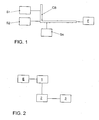
- starting points for the evaluation of events are entries in event memories E.
- the entries are effected, for example, by control units S1, S2,... Sn, which control vehicle functions.
- the control units are z. B. connected via a CAN bus CB with the respective event memory (Fig. 1).
- the event memory E may be a system having a plurality of memories distributed in the vehicle, but which may be read together and / or sequentially.
- the arrangement shown in FIG. 2 has a determination device 1 for determining events and associated additional information.
- the determination device 1 is connected to an event memory E.
- an evaluation device 2 is connected for the evaluation of the additional information.
- the device 3 preferably has a neural network.
- the devices 1 to 3 may be implemented by software and / or hardware.
- the device 3 may be present several times, for. B. as a vehicle module in each case in vehicles and as (possibly distributed over different service facilities) server module outside of vehicles, for example in workshops.
- the structures of neural networks, each implemented in such a device may be identical. In this way it is possible to exchange the parameters (eg the meaning and number of neurons and the current values of the weights, see above) of the neural network.
- Another device 3 can then calculate updated event clusters and their probabilities on the basis of the parameter values and on the basis of additional events to be evaluated.
- the server module has a neural network, which is responsible for the cluster analysis of a vehicle series.
- the neural network on the server module takes into account the results of the neural networks of individual vehicles in a vehicle series by integrating the weights of the neural networks of the individual vehicles. These integrated weights are used by diagnostic devices connected to the server module, e.g. B. from the workshops to the server module In this way the neural network of the server module learns and grows steadily (as new types of events are added).
- the result is a neural network, which is able to determine the event clusters of a vehicle series.
- the neural network of the server module functions like the neural network of the vehicle module. Both give as result a probability table.
- the tables differ in that the neural network table on the server module represents the probabilities of the event clusters of a vehicle series and the neural network table on the vehicle module represents the probabilities of the event clusters of a vehicle.
- Fig. 3 illustrates the principle of the preferred embodiment of the present invention.
- individual events are represented by circles.
- a separate cause is assumed for each of the events.
- a neural network is shown, from which event clusters are formed, which are shown in the right figure part. Those events that lie within one of the ovals belong to a common event cluster. Other than shown in Fig. 3, can also different event clusters are formed with the same event.
- Each of the event clusters is assigned a probability by the neural network that all events of the cluster have a common cause.
- the probability of the cluster shown on the upper right of the right-hand part of the figure is so great that a common cause is assumed and accordingly an attempt is made to correct a single malfunction in the vehicle (the common cause).
- the probability of a common cause for the other two clusters presented is too low.
- the neural network can receive, as input data, in particular binary vectors generated by preprocessing and process them in two phases, the learning phase and the evaluation phase.
- the learning phase the vectors defining an input space are examined for possible event clusters.
- the event clusters formed by the neural network may contain multiple event groups.
- knowledge about the event clusters is stored or distributed in the form of weights in the neural network.
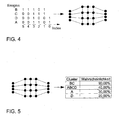
- FIG. 4 shows in the left-hand part of the figure the vectors which, as is illustrated by a right-pointing arrow, are taken over into the neural network as input information.
- Each event group formed in the preprocessing is described by a binary vector (represented in FIG. 4 as a column of numerical values "0" or "1").
- Each event type has a defined position in the binary vectors. In the example, the positions of the event types in the vector have the sequence B C D A. If the event is present in the event group, a 1 is entered at the position of the event in the binary vector. If the event does not exist in the event group, a 0 is entered at the position of the event in the binary vector. Below the long arrow pointing to the right, the index (order number) of the vectors is plotted ascending from right to left.
- the format (number of binary elements) of the binary vector must be extended with the first occurrence of one type of event or only after determining which types of event have occurred , to be created. Therefore, the vector with the order number 0 has only two entries: for event type A and D.
- the weights of the neural network are examined and the information given by the weights about event clusters z. B. output in the form of a table.
- the table contains the determined probability for the possible event clusters.
- the evaluation is, in particular, a statistical analysis of the frequency of common occurrence of identical events.
- FIG. 5 again shows the neural network in the left-hand part of the figure and in the right-hand part of the figure the table for an example.
- the probability of event types B and C appears high enough at 90% to be able to assume a common cause. The theoretical value of 100% would be complete security.
- the probability for the other event clusters is too low.
- the structure comprises a plurality of neurons (or "nodes") forming a neural network. There is a neighborhood relationship defined between the nodes. Each of the nodes has a randomly initialized weight vector (array of weights) of the dimensionality of the input space. During the learning phase, the high-dimensional input vectors are presented to the network in random order. For each node, activation is calculated according to an activation function (e.g., Euclidean distance) and that node with the highest activation (i.e., lowest Euclidean distance) is selected as a result ("winner").
- an activation function e.g., Euclidean distance
- the possible input vectors are then entered into the neural network and the activation value of the winner neuron is recorded.
- the weight vectors of the winner and its neighboring nodes within the network topology are changed following a monotonically decreasing learning rate to become more similar to the applied input vector. This ultimately results in neighboring vectors from the input space being mapped to adjacent nodes, i. This creates a topology-preserving map.
- the highest activation input vectors are highly likely to cluster.
- the SOM is the size of the input space.
- the possible events in a vehicle result in a large number of possible event clusters. Since in the SOM each cluster is represented by a neuron of a so-called two-dimensional Kohonen für, the large input space requires a large number of neurons.
- the Kohonen layer is the processing layer of the self-organizing maps. Each neuron of the Kohonen layer represents an input pattern and is connected to all input neurons via weighted connections.
- Dynamic building means that neurons are added in response to the change in dimensions of the input space, i. a neuron of the neural network is created only when needed in the learning phase. This is in contrast to the case where a contingent of neurons is applied during the definition of the network (static application of the neurons).
- the neural network consists of an input layer and a processing layer.
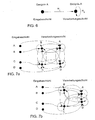
- each neuron of the input layer is connected to exactly one neuron of the processing layer via a directed and weighted connection (FIG. 6).
- a weighted direct feedback on itself is defined for each neuron of the processing layer.
- Fig. 6 shows the corresponding neuron pair of the input layer and the processing layer for the event type A.
- the neurons are represented by circles, the associated weights (weight of the pair and feedback weight of the processing layer neuron) each with w ij .
- the neural network only has to contain as many pairs of neurons as events have occurred.
- the neuron pairs are preferably created at the first occurrence of an event type and remain z. B. throughout the life cycle of a vehicle in the vehicle module or z. B. stored throughout the life cycle of a vehicle series in the server module.
- FIG. 7A shows a neural network for four event types that have occurred. It can be seen from the arrows in the illustration that all neurons of the processing layer are pairwise coupled with each other. Corresponding weights for each of the pairs and for the feedback of the neurons to themselves are defined.
- the weights of the couplings between the neurons of the processing layer represent the topological distance between the neurons (event types) on a multi-dimensional lattice.
- the Weights of the pairs are represented by their distances from one another. The lower the weights are, the closer the distance and the higher the likelihood that the two types of event have a common cause.
- the weights of the direct feedback represent the distance of the neurons in each case to themselves, this distance not being recognizable from FIG. 7.
- the neural network thus has three types of coupling to be distinguished.
- the first type of coupling concerns the connections from the respective neuron of the input layer to the neuron of the processing layer (for the same event type).
- the values of the weights of these compounds may be 0 or 1.
- the second type of coupling concerns the coupling of the neuron pairs in the processing layer.
- the values of the weights of these compounds may be positive real numbers between 0 and 1 in the design.
- the third type of coupling concerns the direct feedback of the neurons of the processing view.
- the values of the weights of these compounds may also be positive real numbers between 0 and 1 in the design.
- X ej is the activation of the neuron which is connected to the neuron j of the processing layer via a weighted compound of weight Wej.
- the following details refer to the processing layer and the neurons of that layer.
- the neurons of the input layer are not affected by the following description because they are activated directly.
- a learning rate may be defined by which the intensity of the change of weights is determined.
- the learning rate can be used for different configuration of a neural network in the vehicle module and a neural network in the server module. Since the neural network of the vehicle module receives only a small amount of data for learning, the learning rate must be set correspondingly high in order to establish a learning effect in the neural network. In contrast, the neural network of the server module is supplied with a great deal of data, so it is desirable in this neural network to learn slower, so as not to be disturbed by rare deviant data in the result.
- the information from two different neural networks are preferably merged as follows, ie the neural networks are "merged";
- the individual neurons of the processing layer from the source network are added to the destination network (the other of the networks) or merge with the same neurons present (same event).
- the weights of the connections between the new neurons are taken from the source network.
- the connections which are not occupied by the weights of the connections of the source network because they did not exist in the source network are assigned 1.
- the weights of the connections between the new input neurons and the processing neurons are added Importing a neural network, z. B. from the vehicle modules in the neural network of the server module, set to 1.
- the weights of the connections between the new input neurons and the processing neurons are set to 0. This is to prevent the evaluation of the neural network in the vehicle module to evaluate the neurons that have not yet occurred in the vehicle. If they occur later in the vehicle, these weights are set to 1 so that these events can also be taken into account in the next evaluation.
- the existing neurons are recorded by adjusting the weights of the neurons.
- the individual weights of the neurons in the target network are approximated to the weights of the neurons from the source network.
- the determined weights of the neural network are evaluated.
- the evaluation is carried out by means of an algorithm, which will be described below.
- the propagation function, the activation function and the output function of the processing layer neurons are adapted. This ensures proper activation of the processing neurons upon excitation by the input neurons.
- w dr is the weight of the direct feedback.
- w ej is the weight of the coupling of the input neuron e to the processing neuron j.
- X ej is the activation of the input eon e.
- All the neurons in the input layer are activated one after the other one after the other.
- the activations of the processing layer neurons are read out.
- the values of the activation are real numbers from 0 to 100 and represent the probability of belonging to the corresponding event to an event cluster.
- the algorithm associates the events associated with the activated neurons, according to their activation, with the areas defined in the table.
- the range table has seven ranges, each extending from a first probability value to a second probability value 10 percent lower.
- area 1 ranges from 100% to 90%, area 2 from 90% to 80%, and so on.
- the event clusters In the formation of the event clusters, in particular those events are grouped together into an event cluster, which can be assigned to the same area (eg area 1) by the value of the activation of their neuron. An event can be assigned to several areas because they can overlap.
- the common probability of the event cluster is calculated from the individual probabilities. This is calculated by the following rule: the probability for the event cluster is equal to the sum of the probabilities of the event types belonging to the event cluster divided by the number of summed probabilities for membership.
- the deactivation of the event A input neuron and the activation of the event B input neuron ensues.
- the event clusters are formed according to the same procedure as described above. Since from the view of the neuron B also an event cluster B, A, C can form, but with a different probability than the previously formed event cluster A, B, C, takes place for the determination of the overall probability of the event cluster by the calculation of the average value the two probabilities.
- the example has shown that the probability of belonging to a common cluster of events with A is higher than the probability from the point of view of the event A.
- the evaluation from the point of view of the event D Togetherness with the event A has been determined to be a common event cluster with a probability of 70%. This gives the final probability for the event cluster A, D of 45%.
- the result obtained can now be used as a basis by the existing diagnostic applications to reduce the number of work steps, for example, when correcting a common fault.
- the number of work steps could be reduced from 4 to 2.
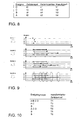
- Fig. 8 shows the information stored in an event memory or a combination of event memories.
- various event memories are repeated, in particular cyclically one after the other, read out.
- each of the event memories can be assigned to a control unit of the vehicle.
- any number of different events can be entered here, in particular as many different events as occurred in the vehicle during an operating phase (eg between two routine workshop visits) or as many as are read during a diagnosis.
- a time stamp (eg a time value or a mileage) of the first occurrence of the event type is entered.
- the total frequency of occurrence of the event type is entered.
- the table is for illustrative purposes only.
- the information does not have to be displayed or even visualized in this way. Rather, the link between the event type and the associated information (eg, timestamp, skip counter value, and frequency) can be made in any other possible way, for example, by software in which a corresponding data array is defined.
- alternative information may be stored in alternative embodiments to the respective type of event, as shown in Fig. 8.
- the middle time interval between the individual occurrence times of the event type could be stored directly.
- the out-of-meter value and the frequency could be dispensed with.
- the frequency could be determined in retrospect, when the end of the observation period is reached on it z. B. when reading the data. It is also conceivable if data storage capacity in the vehicle is cheaper and therefore a larger capacity is available to save the time stamp each occurrence of an event.
- FIG. 9 four steps of processing and grouping events, e.g. B. the events shown in FIG. 8. Each step corresponds to a graph, on the horizontal axis of which the time or a corresponding quantity (such as mileage) of the occurrence of the events is plotted and on whose vertical axis the individual occurring event types are plotted.
- the events that have occurred are represented by a circle.
- step 1 the time of the first occurrence of the event type is determined for each type of event.
- step 2 which can be swapped with step 1 or executed simultaneously, the time of the last occurrence of the event type is determined for each type of event.
- the time of the first occurrence and the time of the second occurrence are each connected by a horizontal line. In other cases than the one shown, an event type may occur only once.
- the frequency of the event types is determined and the individual events of the event type are assigned to a value on the time axis.
- the events of the same type of event as described above, can be distributed evenly between the time of the last occurrence and the time of the first occurrence.
- it is also possible to make a different distribution between the first occurrence and the second occurrence for example, if more information is available, for. B. single or multiple timestamps of the events occurred.
- time intervals can also be defined or determined for the occurrence of individual, several or all events. In this case, it may optionally also be determined or determined at what time in the respective time interval the event has occurred. However, it is also possible, especially if the time intervals are short in comparison to the time intervals of the occurrence of the events, a grouping only on the basis of the time intervals and to assign the event no discrete time.
- the events are grouped into event groups, with z.
- a maximum period or mileage interval
- a maximum period or mileage interval
- Fig. 10 shows the result in tabular form.
- the event types that have occurred in a particular event group are designated by their code letters A, B, C, D.
- T1 to T6 the time stamp of the respective event group.
- a time value of the group may be specified as a transformed timestamp.
- the time value is z. The earliest or latest time of occurrence of any of the events in the group, or an average of the times of all events of the group.
Landscapes
- Engineering & Computer Science (AREA)
- Automation & Control Theory (AREA)
- Human Computer Interaction (AREA)
- Transportation (AREA)
- Mechanical Engineering (AREA)
- Physics & Mathematics (AREA)
- Artificial Intelligence (AREA)
- Evolutionary Computation (AREA)
- Mathematical Physics (AREA)
- General Physics & Mathematics (AREA)
- Traffic Control Systems (AREA)
- Automatic Cycles, And Cycles In General (AREA)
- Time Recorders, Dirve Recorders, Access Control (AREA)
- Testing And Monitoring For Control Systems (AREA)
Applications Claiming Priority (1)
| Application Number | Priority Date | Filing Date | Title |
|---|---|---|---|
| DE102005019335A DE102005019335A1 (de) | 2005-04-26 | 2005-04-26 | Verfahren und Vorrichtung zum Auswerten von Ereignissen aus dem Betrieb zumindest eines Fahrzeuges |
Publications (4)
| Publication Number | Publication Date |
|---|---|
| EP1717651A2 true EP1717651A2 (fr) | 2006-11-02 |
| EP1717651A3 EP1717651A3 (fr) | 2006-11-22 |
| EP1717651B1 EP1717651B1 (fr) | 2010-12-01 |
| EP1717651B8 EP1717651B8 (fr) | 2011-03-02 |
Family
ID=36699176
Family Applications (1)
| Application Number | Title | Priority Date | Filing Date |
|---|---|---|---|
| EP06004424A Expired - Lifetime EP1717651B8 (fr) | 2005-04-26 | 2006-03-04 | Méthode et système d'analyse des événements relatés à l'opération d'un véhicule |
Country Status (3)
| Country | Link |
|---|---|
| EP (1) | EP1717651B8 (fr) |
| AT (1) | ATE490492T1 (fr) |
| DE (2) | DE102005019335A1 (fr) |
Cited By (2)
| Publication number | Priority date | Publication date | Assignee | Title |
|---|---|---|---|---|
| WO2018088949A1 (fr) | 2016-11-14 | 2018-05-17 | Wiretronic Ab | Procédé et système d'analyse de véhicules |
| CN117670057A (zh) * | 2023-12-18 | 2024-03-08 | 北京玖天气象科技有限公司 | 电力有限空间作业风险评估方法以及装置 |
Families Citing this family (3)
| Publication number | Priority date | Publication date | Assignee | Title |
|---|---|---|---|---|
| DE102020207449B4 (de) | 2020-06-16 | 2022-02-10 | Volkswagen Aktiengesellschaft | Verfahren, Computerprogramm und Vorrichtung zum Verarbeiten von Signalen |
| DE102023207077A1 (de) | 2023-07-25 | 2025-01-30 | Robert Bosch Gesellschaft mit beschränkter Haftung | Verfahren und Vorrichtung zum Erkennen einer Fehlerursache eines Fehlerereignisses in einem Fahrzeug basierend auf Fahrzeugereignissen mithilfe von Machine-Learning |
| DE102025113375B3 (de) | 2025-04-04 | 2026-04-23 | Audi Aktiengesellschaft | Verfahren zum Reduzieren von Ereignisspeicherdaten, um eine Fehlerermittlung bei einem oder mehreren Kraftfahrzeugen zu unterstützen, sowie Steuervorrichtung und Fahrzeugsystem |
Citations (1)
| Publication number | Priority date | Publication date | Assignee | Title |
|---|---|---|---|---|
| US20010002451A1 (en) | 1995-06-07 | 2001-05-31 | Breed David S. | Method and apparatus for controlling a vehicular component |
Family Cites Families (9)
| Publication number | Priority date | Publication date | Assignee | Title |
|---|---|---|---|---|
| EP0398481B1 (fr) * | 1989-05-18 | 1996-10-16 | Ford Motor Company Limited | Procedure et appareil pour diagnostiquer un système de réglage électronique d'un véhicule par intermédiaire de reconnaissance de caractères |
| US6175787B1 (en) * | 1995-06-07 | 2001-01-16 | Automotive Technologies International Inc. | On board vehicle diagnostic module using pattern recognition |
| JP2001507772A (ja) * | 1996-10-23 | 2001-06-12 | フォード、グローバル、テクノロジーズ、インコーポレーテッド | ビットシリアルに基くリカレント・ニューロプロセッサーを含む自動車用エンジンの失火検出システム |
| US6615367B1 (en) * | 1999-10-28 | 2003-09-02 | General Electric Company | Method and apparatus for diagnosing difficult to diagnose faults in a complex system |
| US7020595B1 (en) * | 1999-11-26 | 2006-03-28 | General Electric Company | Methods and apparatus for model based diagnostics |
| US20020007237A1 (en) * | 2000-06-14 | 2002-01-17 | Phung Tam A. | Method and system for the diagnosis of vehicles |
| US6609051B2 (en) * | 2001-09-10 | 2003-08-19 | Daimlerchrysler Ag | Method and system for condition monitoring of vehicles |
| DE10222072A1 (de) * | 2002-05-17 | 2003-11-27 | Daimler Chrysler Ag | Diagnoseverfahren für dynamische Systeme |
| CA2520962A1 (fr) * | 2003-03-31 | 2004-10-21 | System Management Arts, Inc. | Procede et appareil de gestion de systeme a partir d'une mise en correlation par livre de codes avec exclusion de symptomes |
-
2005
- 2005-04-26 DE DE102005019335A patent/DE102005019335A1/de not_active Withdrawn
-
2006
- 2006-03-04 AT AT06004424T patent/ATE490492T1/de active
- 2006-03-04 EP EP06004424A patent/EP1717651B8/fr not_active Expired - Lifetime
- 2006-03-04 DE DE502006008414T patent/DE502006008414D1/de not_active Expired - Lifetime
Patent Citations (1)
| Publication number | Priority date | Publication date | Assignee | Title |
|---|---|---|---|---|
| US20010002451A1 (en) | 1995-06-07 | 2001-05-31 | Breed David S. | Method and apparatus for controlling a vehicular component |
Non-Patent Citations (1)
| Title |
|---|
| DR. ANDREAS ZELL; ADDISON-WESLEY, SIMULATION NEURONALER NETZE, September 1994 (1994-09-01) |
Cited By (6)
| Publication number | Priority date | Publication date | Assignee | Title |
|---|---|---|---|---|
| WO2018088949A1 (fr) | 2016-11-14 | 2018-05-17 | Wiretronic Ab | Procédé et système d'analyse de véhicules |
| CN109964182A (zh) * | 2016-11-14 | 2019-07-02 | 瓦尔卓尼克公司(瑞典) | 用于车辆分析的方法和系统 |
| EP3538964A4 (fr) * | 2016-11-14 | 2020-07-01 | Wiretronic AB | Procédé et système d'analyse de véhicules |
| CN116610092A (zh) * | 2016-11-14 | 2023-08-18 | 瓦尔卓尼克公司(瑞典) | 用于车辆分析的方法和系统 |
| US11842575B2 (en) | 2016-11-14 | 2023-12-12 | Wiretronic Ab | Method and system for vehicle analysis |
| CN117670057A (zh) * | 2023-12-18 | 2024-03-08 | 北京玖天气象科技有限公司 | 电力有限空间作业风险评估方法以及装置 |
Also Published As
| Publication number | Publication date |
|---|---|
| EP1717651B8 (fr) | 2011-03-02 |
| DE102005019335A1 (de) | 2006-11-02 |
| EP1717651A3 (fr) | 2006-11-22 |
| ATE490492T1 (de) | 2010-12-15 |
| DE502006008414D1 (de) | 2011-01-13 |
| EP1717651B1 (fr) | 2010-12-01 |
Similar Documents
| Publication | Publication Date | Title |
|---|---|---|
| DE102012102770B9 (de) | System und Verfahren zur Fehlereingrenzung und Fehlerabschwächung basierend auf einer Netzwerkmodellierung | |
| DE102012110710A1 (de) | Verfahren zur Integration von Modellen eines Gesundheitsmanagementsystems für Verkehrsmittel | |
| DE102019135608A1 (de) | Verfahren, Vorrichtung und System zur Detektion von anomalen Betriebszuständen eines Geräts | |
| DE112012001923T5 (de) | Zur Zusammenarbeit fähiges Multi-Agentensystem zur Fehlerdiagnose an einem Fahrzeug sowie zugehöriges Verfahren | |
| EP0893746A2 (fr) | Système et méthode de diagnostic d'un processus | |
| EP3282399B1 (fr) | Procede de reconnaissance ameliore d'anomalies de processus d'une installation technique et systeme de diagnostic correspondant | |
| DE102019124018A1 (de) | Verfahren zum Optimieren von Tests von Regelsystemen für automatisierte Fahrdynamiksysteme | |
| EP3901713A1 (fr) | Procédé et système de fonctionnement d'une installation technique dotée d'un modèle optimal | |
| EP3861681B1 (fr) | Système et procédé de détection d'erreurs et d'analyse des causes des erreurs dans un réseau de composants réseaux | |
| EP1717651B1 (fr) | Méthode et système d'analyse des événements relatés à l'opération d'un véhicule | |
| EP0862827B1 (fr) | Controle d'un echange de donnees effectue selon un protocole de communication | |
| DE10332203A1 (de) | Verteiltes Bayesnetz-basiertes Expertensystem zur Fahrzeugdiagnose und Funktions-Wiederherstellung | |
| DE102018000205A1 (de) | Numerische Steuerung | |
| WO2023169731A1 (fr) | Procédé de contrôle de la pertinence pour des diagnostics à bord d'un signal d'entrée | |
| DE102022200694A1 (de) | Herstellungsverfahren für eine Überwachungsvorrichtung einer Automatisierungsanlage | |
| DE10332202A1 (de) | Bayesnetz-basiertes Expertensystem zur Diagnose, Risikoanalyse und Funktions-Wiederherstellung, insbesondere bei Kraftfahrzeugen | |
| DE102017207036A1 (de) | Verfahren zur rechnergestützten Analyse des Betriebs eines Produktionssystems | |
| DE102019113958A1 (de) | Verfahren zur Leistungssteigerung eines Fahrzeugsystems mit einem neuronalen Netz zum Steuern einer Fahrzeugkomponente | |
| EP3575976A1 (fr) | Procédé de détermination d'une topologie de connexion physique d'un appareil d'essai destiné à la mise au point d'appareil de commande | |
| DE102018112803A1 (de) | Verfahren zum Bestimmen einer physikalischen Verbindungstopologie eines für die Steuergerätentwicklung eingerichteten, echtzeitfähigen Testgeräts | |
| DE102018219852A1 (de) | Verfahren und Vorrichtung zum Ermitteln einer Systemkonfiguration für ein verteiltes System | |
| EP1717650A2 (fr) | Méthode et système d'analyse des événements relatés à l'opération d'un véhicule | |
| EP4506867A1 (fr) | Procédé et appareil de traitement assisté par ordinateur d'un circuit quantique sur une unité de traitement quantique | |
| DE102023126862A1 (de) | Systeme und verfahren zum identifizieren und warnen vor stellflächen-überzyklus-risiken bei allgemeinen mehrprodukt-montagelinien | |
| DE102024001340A1 (de) | Verfahren zum Auslegen eines Fertigungssystems zum Herstellen von Batteriemodulen und Steuerungseinheit |
Legal Events
| Date | Code | Title | Description |
|---|---|---|---|
| PUAI | Public reference made under article 153(3) epc to a published international application that has entered the european phase |
Free format text: ORIGINAL CODE: 0009012 |
|
| PUAL | Search report despatched |
Free format text: ORIGINAL CODE: 0009013 |
|
| AK | Designated contracting states |
Kind code of ref document: A2 Designated state(s): AT BE BG CH CY CZ DE DK EE ES FI FR GB GR HU IE IS IT LI LT LU LV MC NL PL PT RO SE SI SK TR |
|
| AX | Request for extension of the european patent |
Extension state: AL BA HR MK YU |
|
| AK | Designated contracting states |
Kind code of ref document: A3 Designated state(s): AT BE BG CH CY CZ DE DK EE ES FI FR GB GR HU IE IS IT LI LT LU LV MC NL PL PT RO SE SI SK TR |
|
| AX | Request for extension of the european patent |
Extension state: AL BA HR MK YU |
|
| 17P | Request for examination filed |
Effective date: 20070522 |
|
| 17Q | First examination report despatched |
Effective date: 20070625 |
|
| AKX | Designation fees paid |
Designated state(s): AT BE BG CH CY CZ DE DK EE ES FI FR GB GR HU IE IS IT LI LT LU LV MC NL PL PT RO SE SI SK TR |
|
| GRAP | Despatch of communication of intention to grant a patent |
Free format text: ORIGINAL CODE: EPIDOSNIGR1 |
|
| GRAS | Grant fee paid |
Free format text: ORIGINAL CODE: EPIDOSNIGR3 |
|
| GRAA | (expected) grant |
Free format text: ORIGINAL CODE: 0009210 |
|
| AK | Designated contracting states |
Kind code of ref document: B1 Designated state(s): AT BE BG CH CY CZ DE DK EE ES FI FR GB GR HU IE IS IT LI LT LU LV MC NL PL PT RO SE SI SK TR |
|
| REG | Reference to a national code |
Ref country code: GB Ref legal event code: FG4D Free format text: NOT ENGLISH |
|
| REG | Reference to a national code |
Ref country code: CH Ref legal event code: EP |
|
| REG | Reference to a national code |
Ref country code: IE Ref legal event code: FG4D |
|
| REF | Corresponds to: |
Ref document number: 502006008414 Country of ref document: DE Date of ref document: 20110113 Kind code of ref document: P |
|
| RIN2 | Information on inventor provided after grant (corrected) |
Inventor name: LIGATA, EDMIR Inventor name: BRAITSCHINK, PETER Inventor name: BROSE, HEINO |
|
| REG | Reference to a national code |
Ref country code: NL Ref legal event code: VDEP Effective date: 20101201 |
|
| PG25 | Lapsed in a contracting state [announced via postgrant information from national office to epo] |
Ref country code: LT Free format text: LAPSE BECAUSE OF FAILURE TO SUBMIT A TRANSLATION OF THE DESCRIPTION OR TO PAY THE FEE WITHIN THE PRESCRIBED TIME-LIMIT Effective date: 20101201 |
|
| LTIE | Lt: invalidation of european patent or patent extension |
Effective date: 20101201 |
|
| PG25 | Lapsed in a contracting state [announced via postgrant information from national office to epo] |
Ref country code: NL Free format text: LAPSE BECAUSE OF FAILURE TO SUBMIT A TRANSLATION OF THE DESCRIPTION OR TO PAY THE FEE WITHIN THE PRESCRIBED TIME-LIMIT Effective date: 20101201 Ref country code: CY Free format text: LAPSE BECAUSE OF FAILURE TO SUBMIT A TRANSLATION OF THE DESCRIPTION OR TO PAY THE FEE WITHIN THE PRESCRIBED TIME-LIMIT Effective date: 20101201 Ref country code: LV Free format text: LAPSE BECAUSE OF FAILURE TO SUBMIT A TRANSLATION OF THE DESCRIPTION OR TO PAY THE FEE WITHIN THE PRESCRIBED TIME-LIMIT Effective date: 20101201 Ref country code: SI Free format text: LAPSE BECAUSE OF FAILURE TO SUBMIT A TRANSLATION OF THE DESCRIPTION OR TO PAY THE FEE WITHIN THE PRESCRIBED TIME-LIMIT Effective date: 20101201 Ref country code: FI Free format text: LAPSE BECAUSE OF FAILURE TO SUBMIT A TRANSLATION OF THE DESCRIPTION OR TO PAY THE FEE WITHIN THE PRESCRIBED TIME-LIMIT Effective date: 20101201 Ref country code: BG Free format text: LAPSE BECAUSE OF FAILURE TO SUBMIT A TRANSLATION OF THE DESCRIPTION OR TO PAY THE FEE WITHIN THE PRESCRIBED TIME-LIMIT Effective date: 20110301 Ref country code: SE Free format text: LAPSE BECAUSE OF FAILURE TO SUBMIT A TRANSLATION OF THE DESCRIPTION OR TO PAY THE FEE WITHIN THE PRESCRIBED TIME-LIMIT Effective date: 20101201 |
|
| REG | Reference to a national code |
Ref country code: IE Ref legal event code: FD4D |
|
| PG25 | Lapsed in a contracting state [announced via postgrant information from national office to epo] |
Ref country code: GR Free format text: LAPSE BECAUSE OF FAILURE TO SUBMIT A TRANSLATION OF THE DESCRIPTION OR TO PAY THE FEE WITHIN THE PRESCRIBED TIME-LIMIT Effective date: 20110302 |
|
| PG25 | Lapsed in a contracting state [announced via postgrant information from national office to epo] |
Ref country code: PT Free format text: LAPSE BECAUSE OF FAILURE TO SUBMIT A TRANSLATION OF THE DESCRIPTION OR TO PAY THE FEE WITHIN THE PRESCRIBED TIME-LIMIT Effective date: 20110401 Ref country code: EE Free format text: LAPSE BECAUSE OF FAILURE TO SUBMIT A TRANSLATION OF THE DESCRIPTION OR TO PAY THE FEE WITHIN THE PRESCRIBED TIME-LIMIT Effective date: 20101201 Ref country code: IS Free format text: LAPSE BECAUSE OF FAILURE TO SUBMIT A TRANSLATION OF THE DESCRIPTION OR TO PAY THE FEE WITHIN THE PRESCRIBED TIME-LIMIT Effective date: 20110401 Ref country code: CZ Free format text: LAPSE BECAUSE OF FAILURE TO SUBMIT A TRANSLATION OF THE DESCRIPTION OR TO PAY THE FEE WITHIN THE PRESCRIBED TIME-LIMIT Effective date: 20101201 Ref country code: IE Free format text: LAPSE BECAUSE OF FAILURE TO SUBMIT A TRANSLATION OF THE DESCRIPTION OR TO PAY THE FEE WITHIN THE PRESCRIBED TIME-LIMIT Effective date: 20101201 Ref country code: ES Free format text: LAPSE BECAUSE OF FAILURE TO SUBMIT A TRANSLATION OF THE DESCRIPTION OR TO PAY THE FEE WITHIN THE PRESCRIBED TIME-LIMIT Effective date: 20110312 |
|
| PG25 | Lapsed in a contracting state [announced via postgrant information from national office to epo] |
Ref country code: SK Free format text: LAPSE BECAUSE OF FAILURE TO SUBMIT A TRANSLATION OF THE DESCRIPTION OR TO PAY THE FEE WITHIN THE PRESCRIBED TIME-LIMIT Effective date: 20101201 Ref country code: RO Free format text: LAPSE BECAUSE OF FAILURE TO SUBMIT A TRANSLATION OF THE DESCRIPTION OR TO PAY THE FEE WITHIN THE PRESCRIBED TIME-LIMIT Effective date: 20101201 Ref country code: PL Free format text: LAPSE BECAUSE OF FAILURE TO SUBMIT A TRANSLATION OF THE DESCRIPTION OR TO PAY THE FEE WITHIN THE PRESCRIBED TIME-LIMIT Effective date: 20101201 |
|
| BERE | Be: lapsed |
Owner name: VOLKSWAGEN A.G. Effective date: 20110331 |
|
| PLBE | No opposition filed within time limit |
Free format text: ORIGINAL CODE: 0009261 |
|
| STAA | Information on the status of an ep patent application or granted ep patent |
Free format text: STATUS: NO OPPOSITION FILED WITHIN TIME LIMIT |
|
| PG25 | Lapsed in a contracting state [announced via postgrant information from national office to epo] |
Ref country code: DK Free format text: LAPSE BECAUSE OF FAILURE TO SUBMIT A TRANSLATION OF THE DESCRIPTION OR TO PAY THE FEE WITHIN THE PRESCRIBED TIME-LIMIT Effective date: 20101201 Ref country code: MC Free format text: LAPSE BECAUSE OF NON-PAYMENT OF DUE FEES Effective date: 20110331 |
|
| REG | Reference to a national code |
Ref country code: CH Ref legal event code: PL |
|
| 26N | No opposition filed |
Effective date: 20110902 |
|
| GBPC | Gb: european patent ceased through non-payment of renewal fee |
Effective date: 20110304 |
|
| REG | Reference to a national code |
Ref country code: FR Ref legal event code: ST Effective date: 20111130 |
|
| REG | Reference to a national code |
Ref country code: DE Ref legal event code: R097 Ref document number: 502006008414 Country of ref document: DE Effective date: 20110902 |
|
| PG25 | Lapsed in a contracting state [announced via postgrant information from national office to epo] |
Ref country code: BE Free format text: LAPSE BECAUSE OF NON-PAYMENT OF DUE FEES Effective date: 20110331 Ref country code: IT Free format text: LAPSE BECAUSE OF FAILURE TO SUBMIT A TRANSLATION OF THE DESCRIPTION OR TO PAY THE FEE WITHIN THE PRESCRIBED TIME-LIMIT Effective date: 20101201 |
|
| PG25 | Lapsed in a contracting state [announced via postgrant information from national office to epo] |
Ref country code: FR Free format text: LAPSE BECAUSE OF NON-PAYMENT OF DUE FEES Effective date: 20110331 Ref country code: CH Free format text: LAPSE BECAUSE OF NON-PAYMENT OF DUE FEES Effective date: 20110331 Ref country code: LI Free format text: LAPSE BECAUSE OF NON-PAYMENT OF DUE FEES Effective date: 20110331 |
|
| REG | Reference to a national code |
Ref country code: DE Ref legal event code: R082 Ref document number: 502006008414 Country of ref document: DE |
|
| PG25 | Lapsed in a contracting state [announced via postgrant information from national office to epo] |
Ref country code: GB Free format text: LAPSE BECAUSE OF NON-PAYMENT OF DUE FEES Effective date: 20110304 |
|
| REG | Reference to a national code |
Ref country code: AT Ref legal event code: MM01 Ref document number: 490492 Country of ref document: AT Kind code of ref document: T Effective date: 20110304 |
|
| PG25 | Lapsed in a contracting state [announced via postgrant information from national office to epo] |
Ref country code: AT Free format text: LAPSE BECAUSE OF NON-PAYMENT OF DUE FEES Effective date: 20110304 |
|
| PG25 | Lapsed in a contracting state [announced via postgrant information from national office to epo] |
Ref country code: LU Free format text: LAPSE BECAUSE OF NON-PAYMENT OF DUE FEES Effective date: 20110304 |
|
| PG25 | Lapsed in a contracting state [announced via postgrant information from national office to epo] |
Ref country code: TR Free format text: LAPSE BECAUSE OF FAILURE TO SUBMIT A TRANSLATION OF THE DESCRIPTION OR TO PAY THE FEE WITHIN THE PRESCRIBED TIME-LIMIT Effective date: 20101201 |
|
| PG25 | Lapsed in a contracting state [announced via postgrant information from national office to epo] |
Ref country code: HU Free format text: LAPSE BECAUSE OF FAILURE TO SUBMIT A TRANSLATION OF THE DESCRIPTION OR TO PAY THE FEE WITHIN THE PRESCRIBED TIME-LIMIT Effective date: 20101201 |
|
| P01 | Opt-out of the competence of the unified patent court (upc) registered |
Effective date: 20230523 |
|
| PGFP | Annual fee paid to national office [announced via postgrant information from national office to epo] |
Ref country code: DE Payment date: 20240331 Year of fee payment: 19 |
|
| REG | Reference to a national code |
Ref country code: DE Ref legal event code: R119 Ref document number: 502006008414 Country of ref document: DE |
|
| PG25 | Lapsed in a contracting state [announced via postgrant information from national office to epo] |
Ref country code: DE Free format text: LAPSE BECAUSE OF NON-PAYMENT OF DUE FEES Effective date: 20251001 |