EP1720342A2 - Drahtloses Kommunikationsendgerät mit automatischer Kontrollfunktion der Strahlungsintensität der Lichtemissionseinheit und entsprechendes Verfahren - Google Patents
Drahtloses Kommunikationsendgerät mit automatischer Kontrollfunktion der Strahlungsintensität der Lichtemissionseinheit und entsprechendes Verfahren Download PDFInfo
- Publication number
- EP1720342A2 EP1720342A2 EP06252341A EP06252341A EP1720342A2 EP 1720342 A2 EP1720342 A2 EP 1720342A2 EP 06252341 A EP06252341 A EP 06252341A EP 06252341 A EP06252341 A EP 06252341A EP 1720342 A2 EP1720342 A2 EP 1720342A2
- Authority
- EP
- European Patent Office
- Prior art keywords
- focusing lens
- radiation
- distance value
- focus distance
- image
- Prior art date
- Legal status (The legal status is an assumption and is not a legal conclusion. Google has not performed a legal analysis and makes no representation as to the accuracy of the status listed.)
- Withdrawn
Links
Images

Classifications
-
- H—ELECTRICITY
- H04—ELECTRIC COMMUNICATION TECHNIQUE
- H04N—PICTORIAL COMMUNICATION, e.g. TELEVISION
- H04N23/00—Cameras or camera modules comprising electronic image sensors; Control thereof
- H04N23/70—Circuitry for compensating brightness variation in the scene
- H04N23/74—Circuitry for compensating brightness variation in the scene by influencing the scene brightness using illuminating means
-
- E—FIXED CONSTRUCTIONS
- E06—DOORS, WINDOWS, SHUTTERS, OR ROLLER BLINDS IN GENERAL; LADDERS
- E06C—LADDERS
- E06C1/00—Ladders in general
- E06C1/02—Ladders in general with rigid longitudinal member or members
- E06C1/14—Ladders capable of standing by themselves
- E06C1/16—Ladders capable of standing by themselves with hinged struts which rest on the ground
- E06C1/20—Ladders capable of standing by themselves with hinged struts which rest on the ground with supporting struts formed as poles
-
- E—FIXED CONSTRUCTIONS
- E06—DOORS, WINDOWS, SHUTTERS, OR ROLLER BLINDS IN GENERAL; LADDERS
- E06C—LADDERS
- E06C1/00—Ladders in general
- E06C1/02—Ladders in general with rigid longitudinal member or members
- E06C1/38—Special constructions of ladders, e.g. ladders with more or less than two longitudinal members, ladders with movable rungs or other treads, longitudinally-foldable ladders
- E06C1/39—Ladders having platforms; Ladders changeable into platforms
-
- E—FIXED CONSTRUCTIONS
- E06—DOORS, WINDOWS, SHUTTERS, OR ROLLER BLINDS IN GENERAL; LADDERS
- E06C—LADDERS
- E06C7/00—Component parts, supporting parts, or accessories
- E06C7/16—Platforms on, or for use on, ladders, e.g. liftable or lowerable platforms
-
- E—FIXED CONSTRUCTIONS
- E06—DOORS, WINDOWS, SHUTTERS, OR ROLLER BLINDS IN GENERAL; LADDERS
- E06C—LADDERS
- E06C7/00—Component parts, supporting parts, or accessories
- E06C7/18—Devices for preventing persons from falling
- E06C7/185—Devices providing a back support to a person on the ladder, e.g. cages
-
- E—FIXED CONSTRUCTIONS
- E06—DOORS, WINDOWS, SHUTTERS, OR ROLLER BLINDS IN GENERAL; LADDERS
- E06C—LADDERS
- E06C7/00—Component parts, supporting parts, or accessories
- E06C7/50—Joints or other connecting parts
Definitions
- the present invention relates to a wireless communication terminal having a function of automatically controlling an intensity of radiation of a light emitting unit such as a flash, and a method thereof; and, more particularly, to a wireless communication terminal having a function of automatically controlling an intensity of radiation of a light emitting unit such as a flash using a focus distance value of a focusing lens which provides an maximum sharpness of input image when an auto-focusing function is activated, and a method thereof.
- a wireless communication terminal is a portable terminal capable of transmitting/receiving voice, text and image data through a wireless communication network.
- a wireless communication terminal may be a mobile communication terminal, a personal communication service (PCS) terminal, a personal digital assistant (PDA), a smart phone, a next generation mobile terminal for IMT-2000, and a wireless local area network (LAN) terminal.
- PCS personal communication service
- PDA personal digital assistant
- LAN wireless local area network
- a flash for photographing is a device that produces an instantaneous flash of light similar to a sun light for helping to take a photograph in a dark indoor place or at night. Using such a flash, a constant brightness and high image quality can be obtained, and fast moving objects in a dark place can be photographed.
- the flash is used not only as a main light source but also as a supplementary light source with a natural light or an artificial light to obtain pictures with superior image quality.
- the flash is classified into an external flash and an internal flash according to a mounting location of a flash at a wireless communication terminal.
- the flash is also classified into a manual flash and an auto flash.
- the manual flash radiates light with a constant intensity without regard to the intensity of radiation of the surroundings.
- the auto flash automatically controls intensity of radiation according to the intensity of radiation of the surroundings and radiates light according to the regulated intensity of radiation.
- some of conventional communication terminals have a function to control the intensity of radiation of the light emitting unit.
- Such a function controls the intensity of radiation of the light emitting unit according to the user's setting. Therefore, a user must subjectively determine the intensity of radiation of the flash based on various light environment conditions whenever a user takes a picture.
- a user has a hard time to control the intensity of radiation of the light emitting unit to capture an image with normal quality according to the conventional method of controlling the intensity of radiation of the flash.
- an object of the present invention to provide a wireless communication terminal having a function of automatically controlling intensity of radiation of a light emitting unit using a focus distance value of a focusing lens which gives an maximum sharpness of an input image in order to capture the best quality image without manually controlling the intensity of radiation of the flash.
- a wireless communication terminal including: a camera module for capturing an image of a subject through an auto-focusing function; a controller for outputting a charge control signal corresponding to a focus distance value of a focusing lens that gives the maximum sharpness of an image based on calculation in the camera module, and transferring an activation signal according to an image signal; a power supply for supplying electric power according to the charge control signal to the controller; and a light emitting unit for producing an instantaneous flash of light according to the activation signal from the controller by receiving the electric power from the power supply.
- a method of automatically controlling intensity of radiation of a flash in a wireless communication terminal including the steps of: calculating a sharpness of an image according to a focus distance value of a focusing lens when an auto-focusing function is activated; obtaining a focus distance value of the focusing lens that gives an maximum sharpness of the image when the maximum sharpness is calculated; generating a charge control signal corresponding to the obtained focus distance value of the focusing lens; and producing a flash of light using a current charged corresponding to the generated charge control signal.
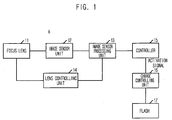
- Fig. 1 is a block diagram illustrating a wireless communication terminal having a function of automatically controlling intensity of radiation of a light emitting unit in accordance with a preferred embodiment of the present invention.
- the wireless communication terminal having a function of automatically controlling intensity of radiation of a light emitting unit in accordance with a preferred embodiment of the present invention includes: a focusing lens 11 for receiving an image of a subject and bringing the subject into a focus by shifting itself forwardly and backwardly in a direction of an optical axis in response to a lens driving unit 14; an image sensor unit 12 for capturing the image of the subject through the focusing lens 11; a image signal processing unit 13 for calculating the sharpness of the image through an auto focus logic, generating a control signal corresponding to a predetermined focus distance value of the focusing lens 11 and transferring the generated control signal to the lens driving unit 14; the lens driving unit 14 for shifting the focusing lens 11 forwardly and backwardly in a direction of an optical axis according to the control signal from the image signal processing unit 13; a controller 15 for monitoring the image signal processing unit 13, generating a charge control signal according to the focus distance value of the focusing lens 11 which gives the maximum sharpness of the image,
- the light emitting unit 17 may be a flash or a light emitting diode for producing the flash of the light for obtaining a superior image quality.
- the wireless communication terminal according to the present embodiment does not include a CODEC if the controller 15 is a mobile station Modem 61XXX series. However, if the controller 15 is a mobile station Modem older than 61XXX series, the wireless communication terminal according to the present embodiment further includes a CODEC.
- the CODEC encodes the focus distance value of the focusing lens 11 from the image signal processing unit 13, and transfers the encoded focus distance value to the controller 15.
- the controller 15 and the image signal processing unit 13 are communicated each other through IIC(Inter Integrated Circuit) communication.
- the focusing lens 11, the image sensor unit 12, the image signal processing unit 13 and the lens driving unit 14 are form a camera module.
- the lens driving unit 14 forwardly or backwardly moves the focusing lens 11 in a direction of an optical axis.
- Forward direction and backward direction of the optical axis denote a direction of incident light and an opposite direction thereof.
- a focus adjusting ring is rotated in a clockwise direction or a counter clockwise direction to move the focusing lens in the forward direction and the backward direction.
- the direction of an optical axis denotes such forward direction and backward direction.
- the focus is automatically controlled through calculating a sharpness of input image through the auto-focusing logic which is well-known to those skilled in the art. Therefore, detail description thereof is omitted.
- the image sensor unit 12 includes a charge coupled device (CCD) and a complementary metal oxide semiconductor (CMOS).
- CCD charge coupled device
- CMOS complementary metal oxide semiconductor
- the sharpness is calculated using an edge of image of a target subject obtained through the image sensor unit 12.
- the auto focus logic is used to calculate the sharpness.
- the sharpness is a numeral value such as modulation transfer function (MTF), or a contrast ratio. If the numeral value is large, the sharpness is high, and if the numeral value is small, the sharpness is low. Since photographing is influenced by peripheral environment such as weather generally, different sharpness can be calculated although a same subject is photographed at same location.
- MTF modulation transfer function
- the controller 15 monitors the image signal processing unit 13 when the auto-focusing function is activated.
- the controller 15 read the focus distance value of the focusing lens 11 and uses the read focus distance value to control the intensity of radiation of the light emitting unit 17. If the focus distance value of the focusing lens 11 is larger than a predetermined threshold value, the controller 15 determines that the subject is close to the wireless communication terminal. Accordingly, the controller 15 reduces the intensity of radiation of the flash 17. On the contrary, if the focus distance value of the focusing lens 11 is smaller than the threshold value, the controller 15 determines that the subject is far from the wireless communication terminal. Therefore, the controller 15 increases the intensity of radiation of the light emitting unit 17.
- the controller 15 controls the light emitting 17 to radiate light with 70% of the maximum intensity of radiation when the focus distance value of the focusing lens 11 is same to the threshold value. If the focus distance value of the focusing lens 11 is reduced 10% below from the threshold value, the controller 15 controls the light emitting unit 17 to radiate light with 80% of the maximum intensity of radiation. If the focus distance value of the focusing lens 11 is reduced 10% to 30% below from the threshold value, the controller 15 controls the light emitting unit 17 to radiate light with 90% of the maximum intensity of radiation. Furthermore, if the focus distance value of the focusing lens 11 is reduced more than 30% below from the threshold value, the controller 15 controls the light emitting unit 17 to radiate light with the maximum intensity of radiation.
- the light emitting unit 17 radiates light with 60% of maximum intensity of radiation, and if the focus distance value of the focusing lens 11 increases more than 10% and less than 30% from the threshold value, the light emitting unit 17 radiates light with 50% of maximum intensity of radiation. Furthermore, if the focus distance value of the focusing lens 11 increases more than 30% from the threshold value, the light emitting unit 17 radiates light with 40% of maximum intensity of radiation.
- the intensity of radiation of the light emitting unit 17 is in proportional to quantity of current applied to the light emitting unit 17.
- a time of radiating the light through the light emitting unit 17 can be controlled. For example, if the focus distance value of the focusing lens 11 is about the predetermined threshold value, the light emitting unit 17 radiates light with 70% of the maximum intensity of radiation for 0.4 second. If the focus distance value of the focusing lens 11 is reduced to 10% of the threshold value, the light emitting unit 17 radiates light with 80% of the maximum intensity of radiation for 0.5 second. Also, if the focus distance value of the focusing lens 11 is reduced to more than 10% and less than 30% of the threshold value, the light emitting unit 17 radiates light with 90% of maximum intensity of radiation for 0.6 second. Furthermore, if the focus distance value of the focusing lens 11 is reduced to more than 30% of the threshold value, the light emitting unit 17 radiates light with 100% of the maximum intensity of radiation for 0.7 second.
- the light emitting unit 17 radiates light with 60% of maximum intensity of radiation for 0.3 second. Also, if the focus distance value of the focusing lens 11 increases more than 10% and less than 30% of the threshold value, the flash 17 radiates light with 50% of maximum intensity of radiation for 0.2 second. Furthermore, if the focus distance value of the focusing lens 11 increases more than 30% of the threshold value, the light emitting unit 17 radiates light with 40% of maximum intensity of radiation for 0.1 second.
- the intensity of radiation of the light emitting unit 17 can be controlled modifying existing software or circuit design without additional electric components.
- the intensity of radiation and the time of the flash can be set by a user in the present embodiment.
- Fig. 2 is a flowchart of a method of automatically controlling intensity of radiation of a light emitting unit in accordance with a preferred embodiment of the present invention.
- Fig. 2 in order to clearly describe the method according to the present embodiment, it assumes that the auto-focusing mode of the wireless communication terminal is turned on and the camera module of the wireless communication terminal captures an image of a target subject. And, peripheral environment is satisfied by the activation condition of the light emitting unit.
- the sharpness of input image of the target subject is obtained by the image sensor unit 12 according to the focus distance value of the focusing lens 11 at step S201.
- the well-know auto-focusing logic is used to calculate the sharpness.
- the focus distance value of the focusing lens 11 is read at step S202. That is, the sharpness is calculated according to the focus distance value of the focusing lens 11 through the auto-focusing logic and the distance value of the focusing lens 11 giving the maximum sharpness of the input image is read.
- a version of the controller 15 is low, the focus distance value of the focusing lens 11 is encoded through a CODEC.
- a charge control signal is generated according to the read focus distance value of the focusing lens 11 at step S203.
- the light emitting unit 17 After generating, the light emitting unit 17 produces the flash of light using the charged current according to activation signal from the user to a light of flash at step S204.
- the amount of the charged current is decided by the charge control signal.
- the intensity of radiation of the light emitting unit is controlled using the focus distance value of the focusing lens that gives the maximum sharpness of the input image when the auto-focusing function is activated in the present invention. Therefore, the best image can be simply and easily obtained without additionally controlling the intensity of radiation of the light emitting unit.
Landscapes
- Engineering & Computer Science (AREA)
- Mechanical Engineering (AREA)
- Multimedia (AREA)
- Signal Processing (AREA)
- Studio Devices (AREA)
- Automatic Focus Adjustment (AREA)
- Stroboscope Apparatuses (AREA)
Applications Claiming Priority (1)
| Application Number | Priority Date | Filing Date | Title |
|---|---|---|---|
| KR1020050037085A KR20060114890A (ko) | 2005-05-03 | 2005-05-03 | 플래시 광량 자동 조절 기능을 가지는 무선통신 단말기 및그 방법 |
Publications (2)
| Publication Number | Publication Date |
|---|---|
| EP1720342A2 true EP1720342A2 (de) | 2006-11-08 |
| EP1720342A3 EP1720342A3 (de) | 2007-10-17 |
Family
ID=36693061
Family Applications (1)
| Application Number | Title | Priority Date | Filing Date |
|---|---|---|---|
| EP06252341A Withdrawn EP1720342A3 (de) | 2005-05-03 | 2006-05-03 | Drahtloses Kommunikationsendgerät mit automatischer Kontrollfunktion der Strahlungsintensität der Lichtemissionseinheit und entsprechendes Verfahren |
Country Status (4)
| Country | Link |
|---|---|
| US (1) | US20060251411A1 (de) |
| EP (1) | EP1720342A3 (de) |
| KR (1) | KR20060114890A (de) |
| CN (1) | CN1881993A (de) |
Cited By (3)
| Publication number | Priority date | Publication date | Assignee | Title |
|---|---|---|---|---|
| WO2014092899A3 (en) * | 2012-12-10 | 2014-11-06 | Qualcomm Incorporated | Image capture device in a networked environment |
| WO2010128484A3 (en) * | 2009-05-07 | 2014-12-18 | Nokia Corporation | Controlling flash unit during exposure of image sensor |
| US9237275B2 (en) | 2013-12-20 | 2016-01-12 | International Business Machines Corporation | Flash photography |
Families Citing this family (2)
| Publication number | Priority date | Publication date | Assignee | Title |
|---|---|---|---|---|
| KR100809247B1 (ko) | 2006-11-22 | 2008-02-29 | 삼성전기주식회사 | 디지털 촬상 장치의 자동 초점 탐색 방법 |
| US10244987B2 (en) * | 2015-08-13 | 2019-04-02 | Pixart Imaging Inc. | Physiological detection system with adjustable signal source and operating method thereof |
Family Cites Families (10)
| Publication number | Priority date | Publication date | Assignee | Title |
|---|---|---|---|---|
| DE3936475A1 (de) * | 1989-11-02 | 1991-05-08 | Westdeutscher Rundfunk | Verfahren zur steuerung der lichtstaerke einer kameraleuchte |
| US6445884B1 (en) * | 1995-06-22 | 2002-09-03 | 3Dv Systems, Ltd. | Camera with through-the-lens lighting |
| JPH10322580A (ja) * | 1997-05-20 | 1998-12-04 | Minolta Co Ltd | 電子スチルカメラ |
| JPH11119289A (ja) * | 1997-10-17 | 1999-04-30 | Nikon Corp | 自動調光装置 |
| JP2000047297A (ja) * | 1998-07-28 | 2000-02-18 | Minolta Co Ltd | デジタルスチルカメラ |
| JP2003174586A (ja) * | 2001-12-07 | 2003-06-20 | Seiko Precision Inc | 撮像装置および携帯電子機器 |
| US20030122957A1 (en) * | 2001-12-31 | 2003-07-03 | Emme Niels Peter | Mobile terminal with digital camera and method of capturing images |
| JP2004157417A (ja) * | 2002-11-08 | 2004-06-03 | Fuji Photo Film Co Ltd | デジタルカメラ及びそのaf制御時の露出設定方法 |
| JP4389546B2 (ja) * | 2003-10-23 | 2009-12-24 | 株式会社ニコン | カメラシステム |
| TWI274952B (en) * | 2005-01-26 | 2007-03-01 | Asia Optical Co Inc | Method and system for automatically adjusting the flash intensity of camera |
-
2005
- 2005-05-03 KR KR1020050037085A patent/KR20060114890A/ko not_active Ceased
-
2006
- 2006-04-28 US US11/413,511 patent/US20060251411A1/en not_active Abandoned
- 2006-05-03 EP EP06252341A patent/EP1720342A3/de not_active Withdrawn
- 2006-05-08 CN CNA2006100927183A patent/CN1881993A/zh active Pending
Cited By (7)
| Publication number | Priority date | Publication date | Assignee | Title |
|---|---|---|---|---|
| WO2010128484A3 (en) * | 2009-05-07 | 2014-12-18 | Nokia Corporation | Controlling flash unit during exposure of image sensor |
| US8922708B2 (en) | 2009-05-07 | 2014-12-30 | Nokia Corporation | Apparatus methods and computer readable storage mediums for exposure control |
| US9729772B2 (en) | 2009-05-07 | 2017-08-08 | Nokia Technologies Oy | Apparatus methods and computer readable storage mediums for controlling a flash unit |
| WO2014092899A3 (en) * | 2012-12-10 | 2014-11-06 | Qualcomm Incorporated | Image capture device in a networked environment |
| US9288371B2 (en) | 2012-12-10 | 2016-03-15 | Qualcomm Incorporated | Image capture device in a networked environment |
| KR101818314B1 (ko) | 2012-12-10 | 2018-01-12 | 퀄컴 인코포레이티드 | 네트워킹된 환경에서의 이미지 캡처 디바이스 |
| US9237275B2 (en) | 2013-12-20 | 2016-01-12 | International Business Machines Corporation | Flash photography |
Also Published As
| Publication number | Publication date |
|---|---|
| CN1881993A (zh) | 2006-12-20 |
| US20060251411A1 (en) | 2006-11-09 |
| EP1720342A3 (de) | 2007-10-17 |
| KR20060114890A (ko) | 2006-11-08 |
Similar Documents
| Publication | Publication Date | Title |
|---|---|---|
| US8558923B2 (en) | Image capturing apparatus and method for selective real time focus/parameter adjustment | |
| US8934050B2 (en) | User interface and method for exposure adjustment in an image capturing device | |
| US8200075B1 (en) | Camera-based mobile communication device and method for controlling flashlight thereof | |
| JP4989385B2 (ja) | 撮像装置及びその制御方法及びプログラム | |
| US7829831B2 (en) | Control of output voltage provided to a flash unit | |
| EP2080059B1 (de) | Hilfslicht-beleuchtungsstärkeregelung | |
| US8711244B2 (en) | Imaging apparatus for calculating a histogram to adjust color balance | |
| US8780231B2 (en) | Imaging apparatus and zoom control method | |
| CN101997981A (zh) | 一种基于手机摄像头的宽容度实现方法及手机 | |
| CN117880628A (zh) | 拍摄方法及其相关设备 | |
| US7636123B2 (en) | Image capturing apparatus with light emission controlling mechanism and method of controlling the image capturing apparatus | |
| EP3544271B1 (de) | Auf mobilem endgerät basierende blitzanordnung und steuerungssystem sowie zugehöriges steuerungsverfahren | |
| KR102072731B1 (ko) | 촬영 장치, 그 제어 방법, 및 컴퓨터 판독가능 저장매체 | |
| CN113810590A (zh) | 图像处理方法、电子设备、介质和系统 | |
| CN100477742C (zh) | 便携式终端装置及改变其中使用的光照度的方法 | |
| WO2019208155A1 (ja) | 画像処理装置、方法、及びプログラム並びに撮像装置 | |
| CN102238394B (zh) | 图像处理设备及其控制方法和摄像设备 | |
| US8531586B2 (en) | Image pickup apparatus and storage medium including focus lens control | |
| CN113994660B (zh) | 智能闪光强度控制系统和方法 | |
| JP6192416B2 (ja) | 撮像装置及びその制御方法、プログラム、並びに記憶媒体 | |
| EP1720342A2 (de) | Drahtloses Kommunikationsendgerät mit automatischer Kontrollfunktion der Strahlungsintensität der Lichtemissionseinheit und entsprechendes Verfahren | |
| CN117714850B (zh) | 延时摄影方法及其相关设备 | |
| KR20100112788A (ko) | 손떨림 방지 기능과 플래쉬 기능의 제어 방법, 이를 이용한 촬영 방법 및 디지털 카메라 모듈 | |
| JP2022170553A (ja) | 撮像装置、その制御方法とプログラム | |
| JP6353585B2 (ja) | 撮像装置及びその制御方法、プログラム、並びに記憶媒体 |
Legal Events
| Date | Code | Title | Description |
|---|---|---|---|
| PUAI | Public reference made under article 153(3) epc to a published international application that has entered the european phase |
Free format text: ORIGINAL CODE: 0009012 |
|
| AK | Designated contracting states |
Kind code of ref document: A2 Designated state(s): AT BE BG CH CY CZ DE DK EE ES FI FR GB GR HU IE IS IT LI LT LU LV MC NL PL PT RO SE SI SK TR |
|
| AX | Request for extension of the european patent |
Extension state: AL BA HR MK YU |
|
| PUAL | Search report despatched |
Free format text: ORIGINAL CODE: 0009013 |
|
| AK | Designated contracting states |
Kind code of ref document: A3 Designated state(s): AT BE BG CH CY CZ DE DK EE ES FI FR GB GR HU IE IS IT LI LT LU LV MC NL PL PT RO SE SI SK TR |
|
| AX | Request for extension of the european patent |
Extension state: AL BA HR MK YU |
|
| 17P | Request for examination filed |
Effective date: 20080416 |
|
| 17Q | First examination report despatched |
Effective date: 20080516 |
|
| AKX | Designation fees paid |
Designated state(s): DE FR GB |
|
| STAA | Information on the status of an ep patent application or granted ep patent |
Free format text: STATUS: THE APPLICATION IS DEEMED TO BE WITHDRAWN |
|
| 18D | Application deemed to be withdrawn |
Effective date: 20080927 |