EP1723875A1 - Möbelzubehör - Google Patents
Möbelzubehör Download PDFInfo
- Publication number
- EP1723875A1 EP1723875A1 EP06001691A EP06001691A EP1723875A1 EP 1723875 A1 EP1723875 A1 EP 1723875A1 EP 06001691 A EP06001691 A EP 06001691A EP 06001691 A EP06001691 A EP 06001691A EP 1723875 A1 EP1723875 A1 EP 1723875A1
- Authority
- EP
- European Patent Office
- Prior art keywords
- frame
- movable frame
- furniture
- accessory
- extraction
- Prior art date
- Legal status (The legal status is an assumption and is not a legal conclusion. Google has not performed a legal analysis and makes no representation as to the accuracy of the status listed.)
- Withdrawn
Links
- 238000000605 extraction Methods 0.000 claims abstract description 38
- 238000006073 displacement reaction Methods 0.000 claims abstract description 24
- 230000002146 bilateral effect Effects 0.000 claims description 2
- 230000002452 interceptive effect Effects 0.000 description 2
- 238000005096 rolling process Methods 0.000 description 2
- 230000006978 adaptation Effects 0.000 description 1
- 230000000295 complement effect Effects 0.000 description 1
- 230000009977 dual effect Effects 0.000 description 1
- 238000004519 manufacturing process Methods 0.000 description 1
- 230000004048 modification Effects 0.000 description 1
- 238000012986 modification Methods 0.000 description 1
- 230000002441 reversible effect Effects 0.000 description 1
Images




Classifications
-
- A—HUMAN NECESSITIES
- A47—FURNITURE; DOMESTIC ARTICLES OR APPLIANCES; COFFEE MILLS; SPICE MILLS; SUCTION CLEANERS IN GENERAL
- A47B—TABLES; DESKS; OFFICE FURNITURE; CABINETS; DRAWERS; GENERAL DETAILS OF FURNITURE
- A47B81/00—Cabinets or racks specially adapted for other particular purposes, e.g. for storing guns or skis
- A47B81/002—Corner cabinets; Cabinets designed for being placed in a corner or a niche
Definitions
- the present invention relates to an accessory for furniture in accordance with the preamble of Claim 1. More particularly the invention relates to an accessory intended to support a frontally extracted built-in unit in corner furniture.
- corner furniture is used to indicate not only furniture comprising two sections arranged at right angles with respect to each other, but also two pieces of furniture arranged against two respective different adjacent walls in a corner of a room, as well as furniture having an internal part which is accessible only via a front opening positioned laterally and extending over a distance smaller than the frontal width of the furniture.
- the furniture in question is corner furniture and the frontally extracted built-in unit is arranged near the corner of the furniture and the inside of the angle formed
- problems of interference between the extracted part of the built-in unit and the remaining parts of the said furniture may occur.
- the problems of interference occur between the widest part of the built-in unit, namely its front panel, and the handles projecting from the adjacent front panels, arranged at right angles with each other along the inside of the angle formed by the furniture.
- the problem of interference is greater in furniture having handles which extend over most of the width of the front panel of the built-in unit or where the handles are positioned close to the internal angle defined by the corner furniture.
- corner furniture having two separate built-in units displaceable horizontally so that a first unit is extractable frontally from the furniture and the second unit is connected to said first unit so that it may be moved by the latter into the position previously occupied by it.
- the first built-in unit at the end of the frontal extraction movement may be rotated through about 90° about a vertical axis of rotation positioned laterally at the front end of the furniture, so as to allow easier access to the second built-in unit.
- an extraction system able to overcome partly the abovementioned problems is provided.
- a guide for extraction of the built-in unit which is slightly curved instead of straight along its initial section, namely along the innermost part inside the furniture body, it is possible to impart a first limited rotational movement to the built-in unit during the initial part of its extraction, so as to prevent its front panel from interfering with the handle of the adjacent front panel arranged at right angles with respect thereto.
- the problem underlying the present invention is to devise a furniture accessory which has structural and functional characteristics such as to satisfy the abovementioned requirement, avoiding at the same time the drawbacks mentioned with reference to the prior art.
- the proposed solution forming the basis of the present invention is that of making use of the smaller width of the body of the front unit to be extracted with respect to the width of its panel, so as to obtain a displacement laterally of the said front panel, thus moving the front panel away from the side where problems of interference may arise.
- the front panel may be displaced until it is positioned flush with the side of the body of the built-in unit.
- the abovementioned lateral displacement is performed during the extraction movement of the built-in unit after the latter has been extracted by an amount greater than the thickness of the front panel and before the front panel interferes with the projecting parts of an adjacent front panel arranged at right angles.
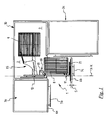
- 1 denotes overall an accessory according to the invention intended to be applied to corner furniture 3.
- the furniture 3 consists of a combination of several modules, 3a, 3b and 3c, respectively, which are arranged at right angles with each other so as to define an L.
- This configuration of the furniture is designed to allow positioning thereof in the corner of a room, for example a kitchen.
- the modules 3a and 3b are arranged laterally next to each other along a first side of the L, while the remaining module 3c which defines the second side of the L is positioned so as to have a side thereof arranged next to a front portion of the end of the furniture module 3b.
- the module 3b With particular reference to the module 3b it can be seen that its body defines a compartment 2 having a front aperture 4 which extends over a predefined distance K1 less than the front width K of the module 3b as measured from its side wall 5 (left-hand side wall in Figures 1 and 2).
- the front opening 4 of the module 3b is less than the front width of the said module since the remaining front portion 2 is intended to be covered by the side of the module 3c.
- About half of the compartment 2 (the right-hand half in the figure) is inset with respect to the front opening 4.
- Each of the abovementioned modules 3a, 3b and 3c is closed by a respective front panel 6 (6a, 6b, 6c) with a predefined thickness S able to cover the front opening of the respective module A.
- Each front panel 6 is then fitted with a handle or grip 7 (7a, 7b and 7c, respectively) which allows the front panel 6 to be operated in order to access the internal part of the respective module 3a, 3b and 3c.
- the compartment 2 of the module 3b is intended to receive two respective built-in units 8 and 9 which are positioned next to each other in the direction of the front width K of the module 3b.
- the first built-in unit 8 is positioned in substantial alignment with the front opening 4 of the compartment 2 and has a width Z3 slightly less than the width K2 of the said opening and a depth such that it may be contained entirely within the compartment 2.
- the second built-in unit 9 has dimensions such that it may be housed inside the abovementioned half of the compartment 2 which is inset with respect to the front opening 4 of the compartment 2.
- these units may be of varying types depending on needs, having elements such as drawers, baskets, trolleys and the like.
- the latter is supported by the body of the module 3b so that it may be extracted frontally from the compartment 2 through the abovementioned front opening 4 of predefined width K1.
- the first built-in unit 8 is therefore able to pass in a reversible manner from a retracted position ( Figures 3, 6) into an extracted position ( Figures 1, 8, 10), where the first built-in unit 8 is entirely housed inside the compartment 2 and is extracted frontally from the compartment 2, respectively.
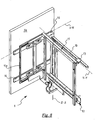
- the accessory 1 comprises:
- the movable frame 11 comprises a front side 11a positioned substantially along the abovementioned front opening 4 of the module 3b, when the movable frame is in the retracted position ( Figure 3). Obviously the dimensions of the movable frame 11 are such as to allow the movement out from the front opening 4 of the compartment 2.
- the first guide means take the form of an extraction guide 12 extending along the wall 5 of the module 3b in a predefined direction of extraction Y-Y, which is horizontal with respect to the ground and is perpendicular with respect to the front wall of the module 3b.
- the guide 12 is formed by two complementary rails, i.e. a fixed rail 12a and movable rail 12b, sliding coupled together in such a way that the movable rail 12b is able to slide with respect to the fixed rail 12a in the direction of extraction Y-Y.
- the movable rail 12b is slidably coupled to the fixed rail 12a with rolling means arranged in between.
- the movable rail 12b is fixed to the movable frame 11, while the fixed rail 12a is fixed to the fixed frame 10 so as to be supported by the latter. More specifically, the fixed rail 12a is fixed to the fixed frame 10 only at its front end point where the fixed rail 12a is hinged with the fixed frame 10 so as to be able to rotate about a vertical axis of rotation Z-Z positioned substantially along the front side of the module 3b next to the wall 5.
- the abovementioned hinged connection of the fixed rail 12a to the fixed frame 10 allows the extraction guide 12 the possibility to rotate about the axis of rotation Z-Z together with the movable frame 11 and the first built-in unit 8.
- the accessory 1 comprises an engaging element 13 integral with the movable frame 11 and able to engage with the fixed frame 10 so as to prevent the abovementioned rotation of the extraction guide 12 about the axis of rotation Z-Z, for as long as the movable frame 11 is in the retracted position or has not yet reached the extracted position.
- the engaging element 13 is disengaged from the fixed frame 10 so as to allow the extraction guide 12 to rotate until it reaches a rotated end-of-travel position ( Figure 2) together with the movable frame 11 and the first built-in unit 8.
- this further rotational movement allows rotation of the first built-in unit 8 about the axis Z-Z through an angle slightly less than 90°, so as to move the first built-in unit 8 away from the front opening 4 of the compartment 2 and facilitate access to the second built-in unit 9.
- the engaging element 13 is fixed to the movable frame 11 in the vicinity of its end remote from the front side 11a so as to achieve a greater stability of the first built-in unit 8 during the frontal extraction movement from the retracted position into the extracted position.
- the second built-in unit 9 is mounted on a support frame 14 which is inserted inside the compartment 2 so as to be able to be displaced laterally from:
- the support frame 14 is operationally associated with the movable frame 11 and if necessary also with the fixed frame 10, by means of an actuating device 15 so that the displacement of the movable frame 11 from the retracted position ( Figure 3) into the extracted position ( Figures 1, 8), and vice versa, produces a corresponding displacement of the support frame 14 from the first position (Figure 1) towards the second position ( Figure 2) and vice versa.
- Said second position ( Figure 2) is reached by the support frame 14 during the rotational movement from the extracted position into the rotated end-of-travel position of the movable frame 11 about the axis Z-Z of rotation.
- the abovementioned actuating device 15 comprises hinged levers, pins, spring means, stop means and other mechanical parts able to interact with each other so as to produce the movement of the support frame from the first position into the second position as a result of a displacement of the movable frame from the retracted position into the extracted position and the rotated end-of-travel position.
- This device has characteristic features which are known per se to a person skilled in the art and is not described below in detail for the sake of brevity of the description.
- the actuating device may be designed in various ways known per se, for example as described in the document US 3863279 or in the document EP 0820244 A .
- the displacement of the support frame 14 and the second built-in unit 9 may be performed manually provided that it has wheels or is mounted on a rail extending parallel to the front end of the module 3b.
- the accessory 1 comprises:
- the initial position is that where the front frame is situated when the movable frame 11 is in the retracted position.
- the front panel 6b is perfectly aligned with the front opening 4 of the compartment 2 of the module 3b so as to ensure closing thereof.
- the offset position is that which the front frame 16 is made to assume so as to obtain a corresponding displacement (to the left with reference to Figure 1) in the position of the front panel 6b with respect to the initial position in order to prevent said panel interfering with the handle 7c of the front panel 6c.
- the displacement of the front frame 16 from the initial position into the laterally offset position occurs in the form of a horizontal translatory movement in a transverse direction X-X parallel to the front side of the module 3b.
- the second guide means are in the form of a sliding guide 21 extending in the transverse direction X-X and comprising a fixed rail 21a and a movable rail 21b slidably coupled together so that the movable rail 21b is able to slide with respect to the fixed rail 21a in the transverse direction X-X.
- the movable rail 21b is slidably coupled to the fixed rail 21a with the arrangement of rolling means in between.
- the fixed rail 21a is associated with the front side of the movable frame, while the movable rail 21b is associated with the front frame 16.
- the accessory 1 comprises stop means (not shown) for limiting the end-of-travel positions of the extraction guides 12 and the sliding guides 21.
- the actuating means 18 act so as to cause the displacement of the front frame 16 from the initial position into the offset position only after the front panel 6b of the module 3b has performed an extraction movement towards the outside of the compartment 2 at least equal to the thickness S of the said front panel.
- the displacement of the front frame from the initial position into the laterally offset position may comprise a roto-translatory movement.
- the second guide means comprise at least two spaced arms having a first end fixed to the front frame so as to support it and a second end connected to the movable frame so as to be able to rotate with respect thereto about a vertical axis of rotation.
- the actuating means 18 comprise a cam system comprising a cam track 19 associated with the fixed frame 10 and a cam follower integral with the front frame 16.
- the cam follower and the cam may be associated in a dual manner with the front frame and, respectively, with the fixed frame 10 or with the body of the module 3b.
- the cam track 19 is integral with the fixed rail 12 of the extraction guide 12. This allows the cam track 19 the possibility of rotating together with the sliding guide 12 as far as the rotated end-of-travel position, without the cam follower 20 ever having to be disengaged from the cam track 19.
- the cam system is of the bilateral desmodromic type, namely it forms a fully constrained system able to guide the cam follower 20 along the cam track 19 precisely during sliding of the movable frame 11 from the retracted position into the extracted position and vice versa.
- the cam track is defined by a groove formed in a plate so as to define an S-shaped track extending mainly in the direction Y-Y.
- the end 19a of the cam track 19 closest to the front side 11a of the movable frame 11 is offset laterally in the transverse direction X-X with respect to the other end 19b by an amount equal to the offset displacement which is to be imparted to the front frame 11.
- the first section of the cam track 19 from its end 19b is substantially straight and arranged in the direction Y-Y so as to prevent that the offset displacement of the front panel 6b occurs at the start of the extraction movement of the built-in unit 8 from the compartment 2.
- the cam track 19 defines solely a unilateral constraint for the cam follower 20.
- the abovementioned actuating means comprise spring means (not shown) acting with a predefined resilient load on the front frame 16 so as to keep the cam follower constantly in contact with the cam track 19 during sliding of the movable frame from the retracted position into the extracted position and vice versa.
- the furniture accessory according to the present invention is able to satisfy the abovementioned requirement and overcome at the same time the drawbacks referred to in the introductory part of the present description with reference to the prior art.
- the accessory 1 is able to impart to the front panel of the built-in unit during its extraction, it is possible to avoid interference between said front panel and the handles on other front panels of the furniture.
- Another advantage of the accessory according to the present invention consists in the possibility of adjusting the lateral displacement which the front panel of the extractable built-in unit must perform depending on the specific requirements.
- Another further advantage of the accessory according to the present invention consists in the possibility of adaptation to extraction systems of built-in units formed differently from each other.
Landscapes
- Drawers Of Furniture (AREA)
Applications Claiming Priority (1)
| Application Number | Priority Date | Filing Date | Title |
|---|---|---|---|
| ITMI20050786 ITMI20050786A1 (it) | 2005-04-29 | 2005-04-29 | Accessorio per un mobile |
Publications (1)
| Publication Number | Publication Date |
|---|---|
| EP1723875A1 true EP1723875A1 (de) | 2006-11-22 |
Family
ID=36498692
Family Applications (1)
| Application Number | Title | Priority Date | Filing Date |
|---|---|---|---|
| EP06001691A Withdrawn EP1723875A1 (de) | 2005-04-29 | 2006-01-27 | Möbelzubehör |
Country Status (2)
| Country | Link |
|---|---|
| EP (1) | EP1723875A1 (de) |
| IT (1) | ITMI20050786A1 (de) |
Cited By (4)
| Publication number | Priority date | Publication date | Assignee | Title |
|---|---|---|---|---|
| EP1925237A2 (de) | 2006-11-27 | 2008-05-28 | Hetal-Werke Franz Hettich GmbH & Co. KG | Beschlag für einen Eckschrank und Eckschrank |
| WO2008116577A1 (de) * | 2007-03-24 | 2008-10-02 | Vauth-Sagel Holding Gmbh & Co. Kg | Ausziehbeschlag für einen schrank mit einer abgewinkelten front |
| ITVR20080085A1 (it) * | 2008-07-30 | 2010-01-31 | Vibo S P A | Dispositivo per la movimentazione e il supporto di elementi di un mobile |
| US20220211174A1 (en) * | 2019-05-09 | 2022-07-07 | Jasbir Singh | Access mechanism for an inaccessible interior of a cabinet |
Citations (5)
| Publication number | Priority date | Publication date | Assignee | Title |
|---|---|---|---|---|
| US3863279A (en) * | 1972-10-24 | 1975-02-04 | Oppliger Ulrich | Piece of furniture for a right-angled corner of a room |
| EP0797942A2 (de) * | 1996-03-29 | 1997-10-01 | Compagnucci - S.P.A. | Modulares korbhaltendes Gerüst für links- und rechtsöffnende Eckschränke |
| EP0820244A1 (de) * | 1995-04-13 | 1998-01-28 | Vauth-Sagel GmbH & Co. Grundstücksverwaltung | Eckschrank zum aufstellen in einer raumecke |
| EP1050246A2 (de) | 1999-05-05 | 2000-11-08 | Peka-Metall Ag | Schrankelement |
| DE202004011748U1 (de) * | 2004-07-27 | 2004-10-14 | Julius Blum Gmbh | Schublade |
-
2005
- 2005-04-29 IT ITMI20050786 patent/ITMI20050786A1/it unknown
-
2006
- 2006-01-27 EP EP06001691A patent/EP1723875A1/de not_active Withdrawn
Patent Citations (5)
| Publication number | Priority date | Publication date | Assignee | Title |
|---|---|---|---|---|
| US3863279A (en) * | 1972-10-24 | 1975-02-04 | Oppliger Ulrich | Piece of furniture for a right-angled corner of a room |
| EP0820244A1 (de) * | 1995-04-13 | 1998-01-28 | Vauth-Sagel GmbH & Co. Grundstücksverwaltung | Eckschrank zum aufstellen in einer raumecke |
| EP0797942A2 (de) * | 1996-03-29 | 1997-10-01 | Compagnucci - S.P.A. | Modulares korbhaltendes Gerüst für links- und rechtsöffnende Eckschränke |
| EP1050246A2 (de) | 1999-05-05 | 2000-11-08 | Peka-Metall Ag | Schrankelement |
| DE202004011748U1 (de) * | 2004-07-27 | 2004-10-14 | Julius Blum Gmbh | Schublade |
Cited By (6)
| Publication number | Priority date | Publication date | Assignee | Title |
|---|---|---|---|---|
| EP1925237A2 (de) | 2006-11-27 | 2008-05-28 | Hetal-Werke Franz Hettich GmbH & Co. KG | Beschlag für einen Eckschrank und Eckschrank |
| EP1925237A3 (de) * | 2006-11-27 | 2010-12-29 | Hetal-Werke Franz Hettich GmbH & Co. KG | Beschlag für einen Eckschrank und Eckschrank |
| WO2008116577A1 (de) * | 2007-03-24 | 2008-10-02 | Vauth-Sagel Holding Gmbh & Co. Kg | Ausziehbeschlag für einen schrank mit einer abgewinkelten front |
| ITVR20080085A1 (it) * | 2008-07-30 | 2010-01-31 | Vibo S P A | Dispositivo per la movimentazione e il supporto di elementi di un mobile |
| US20220211174A1 (en) * | 2019-05-09 | 2022-07-07 | Jasbir Singh | Access mechanism for an inaccessible interior of a cabinet |
| US12102223B2 (en) * | 2019-05-09 | 2024-10-01 | Jasbir Singh | Access mechanism for an inaccessible interior of a cabinet |
Also Published As
| Publication number | Publication date |
|---|---|
| ITMI20050786A1 (it) | 2006-10-30 |
Similar Documents
| Publication | Publication Date | Title |
|---|---|---|
| JP5762438B2 (ja) | 引き戸のための案内レールを有する走行装置 | |
| CN101208028B (zh) | 用于橱柜的支撑拉出式旋转搁架的改进型框架 | |
| CN113039339B (zh) | 用于引导可运动地支承的门扇的引导系统 | |
| JP5390190B2 (ja) | 第1および第2家具部分を有する家具アイテム | |
| CN103002775A (zh) | 用于将抽屉挂钩至纵向引导件的挂钩装置 | |
| HK1212746A1 (zh) | 推拉式门的开关装置 | |
| CN101720377A (zh) | 用于滑动门的对准闭合的机构,尤其用于具有两个或更多门的家具单元或隔室的机构 | |
| CN114786533B (zh) | 家具元件 | |
| AU2004222665B2 (en) | Drawer | |
| EP1723875A1 (de) | Möbelzubehör | |
| EP3254586A1 (de) | Möbelstück mit schiebe und hubmechanismus einer ablage | |
| CN114599254B (zh) | 用于抽屉的拉出引导装置 | |
| EP2241706A1 (de) | Koplanare Schiebeschwingtürkonstruktion, insbesondere für Kleiderschränke und dergleichen | |
| EP2112436B1 (de) | Mechanismus zum Herausziehen eines Gargutträgers aus einem Herd | |
| CN105264158B (zh) | 用于控制家具部件的移动的设备和包括这种设备的家具 | |
| EP3167755B1 (de) | Schubladenauszugsanordnung | |
| EP2229845B1 (de) | Schrank mit ausziehbarem Regal | |
| KR20160003633A (ko) | 슬라이딩 도어를 위한 기능적 피팅 | |
| KR200411166Y1 (ko) | 가구용 슬라이딩 도어의 주행로 가변장치 | |
| WO2013041686A2 (en) | A cooling device wherein shelf height can be changed | |
| CN210520484U (zh) | 抽屉壁和包括抽屉壁与抽屉抽拉导向装置的配置系统 | |
| CN113329667A (zh) | 抽屉 | |
| US11982115B2 (en) | Door panels-frame assembly and cabinet provided with said door panels-frame assembly | |
| CN109922691B (zh) | 家具和打开抽屉和内抽屉的方法 | |
| CN120883008A (zh) | 具有用于可沉降的门的特定的引导滑块的烹饪器具 |
Legal Events
| Date | Code | Title | Description |
|---|---|---|---|
| PUAI | Public reference made under article 153(3) epc to a published international application that has entered the european phase |
Free format text: ORIGINAL CODE: 0009012 |
|
| AK | Designated contracting states |
Kind code of ref document: A1 Designated state(s): AT BE BG CH CY CZ DE DK EE ES FI FR GB GR HU IE IS IT LI LT LU LV MC NL PL PT RO SE SI SK TR |
|
| AX | Request for extension of the european patent |
Extension state: AL BA HR MK YU |
|
| AKX | Designation fees paid | ||
| REG | Reference to a national code |
Ref country code: DE Ref legal event code: 8566 |
|
| STAA | Information on the status of an ep patent application or granted ep patent |
Free format text: STATUS: THE APPLICATION IS DEEMED TO BE WITHDRAWN |
|
| 18D | Application deemed to be withdrawn |
Effective date: 20070523 |