EP1724207A2 - Conteneur pour produits alimentaires ainsi que procédé pour le transport de produits alimentaires - Google Patents
Conteneur pour produits alimentaires ainsi que procédé pour le transport de produits alimentaires Download PDFInfo
- Publication number
- EP1724207A2 EP1724207A2 EP06015372A EP06015372A EP1724207A2 EP 1724207 A2 EP1724207 A2 EP 1724207A2 EP 06015372 A EP06015372 A EP 06015372A EP 06015372 A EP06015372 A EP 06015372A EP 1724207 A2 EP1724207 A2 EP 1724207A2
- Authority
- EP
- European Patent Office
- Prior art keywords
- inliner
- tank
- transport container
- outlet
- container according
- Prior art date
- Legal status (The legal status is an assumption and is not a legal conclusion. Google has not performed a legal analysis and makes no representation as to the accuracy of the status listed.)
- Withdrawn
Links
Images


Classifications
-
- B—PERFORMING OPERATIONS; TRANSPORTING
- B65—CONVEYING; PACKING; STORING; HANDLING THIN OR FILAMENTARY MATERIAL
- B65D—CONTAINERS FOR STORAGE OR TRANSPORT OF ARTICLES OR MATERIALS, e.g. BAGS, BARRELS, BOTTLES, BOXES, CANS, CARTONS, CRATES, DRUMS, JARS, TANKS, HOPPERS, FORWARDING CONTAINERS; ACCESSORIES, CLOSURES, OR FITTINGS THEREFOR; PACKAGING ELEMENTS; PACKAGES
- B65D88/00—Large containers
- B65D88/02—Large containers rigid
- B65D88/12—Large containers rigid specially adapted for transport
- B65D88/128—Large containers rigid specially adapted for transport tank containers, i.e. containers provided with supporting devices for handling
-
- B—PERFORMING OPERATIONS; TRANSPORTING
- B65—CONVEYING; PACKING; STORING; HANDLING THIN OR FILAMENTARY MATERIAL
- B65D—CONTAINERS FOR STORAGE OR TRANSPORT OF ARTICLES OR MATERIALS, e.g. BAGS, BARRELS, BOTTLES, BOXES, CANS, CARTONS, CRATES, DRUMS, JARS, TANKS, HOPPERS, FORWARDING CONTAINERS; ACCESSORIES, CLOSURES, OR FITTINGS THEREFOR; PACKAGING ELEMENTS; PACKAGES
- B65D25/00—Details of other kinds or types of rigid or semi-rigid containers
- B65D25/14—Linings or internal coatings
-
- B—PERFORMING OPERATIONS; TRANSPORTING
- B65—CONVEYING; PACKING; STORING; HANDLING THIN OR FILAMENTARY MATERIAL
- B65D—CONTAINERS FOR STORAGE OR TRANSPORT OF ARTICLES OR MATERIALS, e.g. BAGS, BARRELS, BOTTLES, BOXES, CANS, CARTONS, CRATES, DRUMS, JARS, TANKS, HOPPERS, FORWARDING CONTAINERS; ACCESSORIES, CLOSURES, OR FITTINGS THEREFOR; PACKAGING ELEMENTS; PACKAGES
- B65D25/00—Details of other kinds or types of rigid or semi-rigid containers
- B65D25/02—Internal fittings
-
- B—PERFORMING OPERATIONS; TRANSPORTING
- B65—CONVEYING; PACKING; STORING; HANDLING THIN OR FILAMENTARY MATERIAL
- B65D—CONTAINERS FOR STORAGE OR TRANSPORT OF ARTICLES OR MATERIALS, e.g. BAGS, BARRELS, BOTTLES, BOXES, CANS, CARTONS, CRATES, DRUMS, JARS, TANKS, HOPPERS, FORWARDING CONTAINERS; ACCESSORIES, CLOSURES, OR FITTINGS THEREFOR; PACKAGING ELEMENTS; PACKAGES
- B65D77/00—Packages formed by enclosing articles or materials in preformed containers, e.g. boxes, cartons, sacks or bags
- B65D77/04—Articles or materials enclosed in two or more containers disposed one within another
- B65D77/06—Liquids or semi-liquids or other materials or articles enclosed in flexible containers disposed within rigid containers
- B65D77/061—Liquids or semi-liquids or other materials or articles enclosed in flexible containers disposed within rigid containers the containers being mounted on a pallet
-
- B—PERFORMING OPERATIONS; TRANSPORTING
- B65—CONVEYING; PACKING; STORING; HANDLING THIN OR FILAMENTARY MATERIAL
- B65D—CONTAINERS FOR STORAGE OR TRANSPORT OF ARTICLES OR MATERIALS, e.g. BAGS, BARRELS, BOTTLES, BOXES, CANS, CARTONS, CRATES, DRUMS, JARS, TANKS, HOPPERS, FORWARDING CONTAINERS; ACCESSORIES, CLOSURES, OR FITTINGS THEREFOR; PACKAGING ELEMENTS; PACKAGES
- B65D88/00—Large containers
- B65D88/02—Large containers rigid
- B65D88/06—Large containers rigid cylindrical
- B65D88/08—Large containers rigid cylindrical with a vertical axis
-
- B—PERFORMING OPERATIONS; TRANSPORTING
- B65—CONVEYING; PACKING; STORING; HANDLING THIN OR FILAMENTARY MATERIAL
- B65D—CONTAINERS FOR STORAGE OR TRANSPORT OF ARTICLES OR MATERIALS, e.g. BAGS, BARRELS, BOTTLES, BOXES, CANS, CARTONS, CRATES, DRUMS, JARS, TANKS, HOPPERS, FORWARDING CONTAINERS; ACCESSORIES, CLOSURES, OR FITTINGS THEREFOR; PACKAGING ELEMENTS; PACKAGES
- B65D88/00—Large containers
- B65D88/54—Large containers characterised by means facilitating filling or emptying
- B65D88/58—Large containers characterised by means facilitating filling or emptying by displacement of walls
- B65D88/60—Large containers characterised by means facilitating filling or emptying by displacement of walls of internal walls
- B65D88/62—Large containers characterised by means facilitating filling or emptying by displacement of walls of internal walls the walls being deformable
-
- B—PERFORMING OPERATIONS; TRANSPORTING
- B65—CONVEYING; PACKING; STORING; HANDLING THIN OR FILAMENTARY MATERIAL
- B65D—CONTAINERS FOR STORAGE OR TRANSPORT OF ARTICLES OR MATERIALS, e.g. BAGS, BARRELS, BOTTLES, BOXES, CANS, CARTONS, CRATES, DRUMS, JARS, TANKS, HOPPERS, FORWARDING CONTAINERS; ACCESSORIES, CLOSURES, OR FITTINGS THEREFOR; PACKAGING ELEMENTS; PACKAGES
- B65D90/00—Component parts, details or accessories for large containers
- B65D90/02—Wall construction
- B65D90/04—Linings
-
- B—PERFORMING OPERATIONS; TRANSPORTING
- B65—CONVEYING; PACKING; STORING; HANDLING THIN OR FILAMENTARY MATERIAL
- B65D—CONTAINERS FOR STORAGE OR TRANSPORT OF ARTICLES OR MATERIALS, e.g. BAGS, BARRELS, BOTTLES, BOXES, CANS, CARTONS, CRATES, DRUMS, JARS, TANKS, HOPPERS, FORWARDING CONTAINERS; ACCESSORIES, CLOSURES, OR FITTINGS THEREFOR; PACKAGING ELEMENTS; PACKAGES
- B65D90/00—Component parts, details or accessories for large containers
- B65D90/02—Wall construction
- B65D90/04—Linings
- B65D90/046—Flexible liners, e.g. loosely positioned in the container
-
- B—PERFORMING OPERATIONS; TRANSPORTING
- B65—CONVEYING; PACKING; STORING; HANDLING THIN OR FILAMENTARY MATERIAL
- B65D—CONTAINERS FOR STORAGE OR TRANSPORT OF ARTICLES OR MATERIALS, e.g. BAGS, BARRELS, BOTTLES, BOXES, CANS, CARTONS, CRATES, DRUMS, JARS, TANKS, HOPPERS, FORWARDING CONTAINERS; ACCESSORIES, CLOSURES, OR FITTINGS THEREFOR; PACKAGING ELEMENTS; PACKAGES
- B65D2590/00—Component parts, details or accessories for large containers
- B65D2590/02—Wall construction
- B65D2590/04—Linings
- B65D2590/043—Flexible liners
- B65D2590/046—Bladders
-
- B—PERFORMING OPERATIONS; TRANSPORTING
- B65—CONVEYING; PACKING; STORING; HANDLING THIN OR FILAMENTARY MATERIAL
- B65D—CONTAINERS FOR STORAGE OR TRANSPORT OF ARTICLES OR MATERIALS, e.g. BAGS, BARRELS, BOTTLES, BOXES, CANS, CARTONS, CRATES, DRUMS, JARS, TANKS, HOPPERS, FORWARDING CONTAINERS; ACCESSORIES, CLOSURES, OR FITTINGS THEREFOR; PACKAGING ELEMENTS; PACKAGES
- B65D90/00—Component parts, details or accessories for large containers
- B65D90/22—Safety features
- B65D90/32—Arrangements for preventing, or minimising the effect of, excessive or insufficient pressure
- B65D90/34—Venting means
Definitions
- the invention relates to a transport container for food products and a method for transporting food products, wherein a tank is used.
- the conventional tanks have even more disadvantages.
- the tank emptied by the user must be cleaned after returning to the manufacturer. This can be very complicated, in particular due to product adhesion to the inner walls of the tank.
- the tanks must be regularly checked for their functionality, for example, the tightness of the tank must be checked because a leaking tank not only product can escape, but may also occur in the penetration of contaminated air product contamination.
- a transport container thus comprises a tank and an inliner arranged to be interchangeable in the tank for receiving the product.
- transport containers which are used for transporting between the manufacturer of a food product and the processor or distributor.
- transport containers for the transport of food ingredients, such as fruit or fruit pieces, used.
- transport containers are preferably reusable transport containers, not disposable packages, such as bag-in-box packages, used for retail sale of wine or fruit juices and not intended for recycling.
- the tank is formed Favor dimensionally stable, while the inliner is flexible and in the empty state a much smaller volume claims than the tank. When filling then increases the volume of the inliner, which then applies to the inner wall of the tank.
- the tank can be designed so that the inliner can be switched into or out of the tank. After use of the inliner, so after emptying, thus the inliner can be quickly and easily removed from the transport container and a new inliner just as easily be introduced into the tank.
- the tank may have a tapered, in particular funnel-shaped, outlet arranged in the lower region of the tank, the outlet opening of which is arranged eccentrically.
- eccentric means here that the outlet opening is not centrally located at the bottom of the tank, but is arranged to the edge in the direction of the side wall of the tank.
- the outlet opening can be aligned substantially vertically when the tank is stationary. This additionally facilitates the handling for the user and enables a simplified docking of a filling or emptying device from the side.
- the outlet opening with a sufficiently large diameter, so that a human hand can reach through, preferably with a diameter of at least 10 cm, more preferably with a diameter of 12 to 16 cm, be formed.
- a large spout allows the user to reach into the tank in order to align an in-tank in-line liner so that it can be safely filled.
- the outlet opening can be chosen so large that the inliner can be introduced via this into the tank.
- the tank can continue to have at least one viewing window, in particular at the outlet.
- the viewing window the user has the opportunity to check whether the inliner unfolds during filling and applies as wrinkle-free as possible to the inner wall of the tank. When emptying can also be easily checked whether the liner was completely emptied.
- the tank may have a retainer device, preferably in the upper half, more preferably on the cover, which serves to hold the inliner in the tank.
- a retainer device preferably in the upper half, more preferably on the cover, which serves to hold the inliner in the tank.
- the tank may have a lid with a closable opening for passing an inliner.
- the inliner is inserted from above through the opening into the tank and the area over which the product is introduced into the inliner is aligned with the outlet opening, thanks to the large outlet opening through which the user can reach into the tank.
- the tank may have a bottom with a closable opening for passing an inliner, wherein at least a part of the outlet may be provided on the closure of the opening.
- the inliner is introduced by removing the lid or opening the lid in the tank and then the inliner can be aligned with the outlet opening of the outlet.
- the inliner may have an outlet connection, wherein a closure device, in particular a membrane or rupture disk, is provided on the outlet connection for sterilizing the inner surface of the inliner.
- a closure device in particular a membrane or rupture disk
- a membrane or rupture disk has proven to be particularly advantageous, since these can be pierced or broken through themselves during filling by the food product, so that the interior of the inliner is protected from environmental influences until the last moment. Thus, a sufficient hygiene can be guaranteed especially for sterile food ingredients.
- the outlet nozzle may have a smaller outer diameter than the outlet opening of the tank. This is particularly useful when the liner is inserted through the opening in the lid or in the ground, since then the outlet nozzle must be brought from the inside to the outlet opening of the outlet. Through the large outlet opening, the user can reach into the tank, take the spout in his hand and then bring it to the outlet opening.
- a centering disc can be used to center the outlet nozzle in the outlet opening of the tank. Since the outlet nozzle has a smaller outer diameter, it is ensured by means of the centering that the outlet nozzle is seated at its intended position and can not occur during filling or emptying by displacements of the outlet nozzle voltages on the liner, which lead in the worst case to a rupture of the liner could.
- the centering is made possible by a positive connection between centering and outlet.
- the centering disc may be formed integrally with the outlet nozzle.
- an inliner is completely inserted through the outlet opening, i. H. a closable opening in the bottom or in the lid is not necessary.
- the outlet nozzle can be correctly positioned with the centering disc.
- an opening in the centering disc for receiving the outlet nozzle may be arranged eccentrically. Since the outlet opening has a larger outer diameter than the outlet nozzle, it is advantageous if the opening is arranged eccentrically in the centering, so that the outlet nozzle of the inliner can be arranged as far down the outlet opening, whereby a complete emptying of the inliner is promoted ,
- a part of the outlet nozzle of the tank may project outwardly from the centering disk. At this part of the outlet nozzle can then be directly or indirectly attached to a filling or emptying device.
- a valve device may be placed on the protruding part of the outer nozzle.
- a conventional valve device such as are present on conventional tanks, standard filling / emptying devices can be used without having to provide further adapters.
- At least one seal can lie in the mounted state between outlet nozzle and valve device. This prevents leakage of the food product.
- a fastening means for securing the outlet nozzle may be provided at the outlet opening.
- the fastening means can fix the outlet nozzle against rotation at the outlet opening. This measure prevents tensions when filling or emptying the inliner, which in the worst case could lead to cracks in the inliner.
- the fastening means can also fasten the valve device sealingly on the outlet connection.
- the fastening means can also fasten the valve device sealingly on the outlet connection.
- the inliner may have an overpressure safety device, in particular a rupture disk or a safety valve, preferably a pressure relief valve.
- an overpressure safety device in particular a rupture disk or a safety valve, preferably a pressure relief valve.
- the overpressure assurance means may communicate with the outside of the tank. This ensures that in case of overfilling escaping food product does not pollute the inside of the tank. A cleaning of the inside is much more complex than a cleaning of the outside of the tank. Moreover, when the food product exits via the overpressure safety means, it is easily recognized that the filling of the inliner must be completed.
- the inliner may include a support means for securing the inliner to the tank, especially in the upper half of the tank.
- the inliner can be arranged hanging in the tank, whereby a possible wrinkle-free application is made possible on the inner wall of the tank.
- the overpressure safety means may be provided on the holding means.
- the overpressure safety means together with the holding means must be attached to the inliner next to the outlet connection only at a second location. This optimizes the production of the inliner.
- the invention also relates to an inliner for use in a transport container as described above.
- the inliner according to the invention is made of a food-compatible plastic film, in particular polypropylene or polyethylene, with a sterilized outlet nozzle. Since the transport container according to the invention gets its stability from the tank, one does not need a dimensionally stable material for receiving the food product, but can use conventional plastics which are suitable for transporting food. Furthermore, since the food product is transported within the potion, no additional light protection, such as aluminum foil, is needed on the liner. Preferably, therefore, the liner can only be made of plastic.
- the outlet nozzle may have a closure device, in particular a membrane or rupture disk for sterilizing the inner surface of the inliner.
- a membrane or rupture disk has proven to be particularly advantageous, since these can be pierced or broken through themselves during filling by the food product, so that the interior of the inliner is protected from environmental influences until the last moment. Thus, a sufficient hygiene can be guaranteed especially for sterile food ingredients.
- the membrane or the rupture disk can preferably be designed so that it breaks free of fats under a predetermined pressure load. This prevents that fragments of the membrane or the rupture disk can get into the inliner and so can contaminate the food product.
- the membrane or rupture disk can also be additionally configured such that the membrane or the rupture disk parts can not overlap when the inliner is emptied. Thus, obstruction of the emptying can be prevented.
- the inliner may have an overflow protection means, in particular a rupture disk or a safety valve, preferably a pressure relief valve.
- an overflow protection means in particular a rupture disk or a safety valve, preferably a pressure relief valve.
- a retaining means may be provided for securing the liner within a tank.
- the holding means if necessary together with a Holding device of the tank, the inliner can be arranged hanging in the tank, whereby a possible wrinkle-free application to the inner wall of the tank is made possible.
- a marking can be provided on the holding means and / or overpressure securing means, indicating the orientation under which the inliner is to be introduced into the tank of the transport container with respect to the orientation of the outlet opening, so that after insertion of the inliner the outlet nozzle at the outlet opening lies. If the inliner is inserted from above into the tank, the user can recognize thanks to the marking for which orientation of the inliner the outlet nozzle in the lower area of the tank is opposite to the outlet opening. This prevents the inliner from being twisted or knotted inside the tank, which allows the most wrinkle-free filling possible.
- the empty liner can be folded so that the inliner wrinkle-free on the inner wall of the tank when filling with the food product.
- a Z-shaped fold has shown that the inliner can create as wrinkle-free as possible on the inner wall of the tank.
- At least one adhesive strip or at least one rubber band can be arranged on the folded inliner, depending on the filling level, to deploy the inliner only partially. If the product runs into the inliner, the area unfolds first, which is not held together by adhesive strips or rubber bands. This results in the inliner first settling at the bottom of the tank before the liquid rises, which in turn limits the appearance of wrinkles.
- the overpressure protection system and / or the holding means may be made of a weldable plastic. These can thus be produced cheaply and disinfected by irradiation.
- the invention also relates to a tank for use in a transport container as described above.
- the tank according to the invention comprises a tapering, in particular a funnel-shaped outlet arranged in the lower region of the tank, whose outlet opening is arranged eccentrically. Thanks to the eccentric outlet opening, as described above, access to the inliner is simplified. This allows the inliner in the transport container to be easily aligned with the outlet opening.
- the funnel-shaped outlet also makes it possible to emptying the inliner as completely as possible.
- the tank may have at least one device for venting and / or venting. Since filling the inliner food product, the corresponding volume must be able to escape from the tank. This is done with a venting device. Likewise, a device for venting is provided for emptying to avoid a vacuum formation.
- the invention also relates to a method for transporting food products in a transport container, which is characterized in that the food product is transported in an inliner arranged interchangeably in the interior of a tank.
- the food product is no longer filled directly into the tank, but is located in an in-tank in-tank, eliminating the time and energy-consuming sterilization of the interior of the tank.
- the used inliner is replaced by a new inliner, which also eliminates a costly cleaning.
- the invention further relates to a method for preparing a filling or emptying of a transport container as described above, wherein at the outlet connection of the inliner a connecting piece is connected, which serves to connect a filling or emptying device, characterized in that before connecting a filling or emptying device, the area is disinfected from the connector to the closure device of the outlet nozzle.
- a cold disinfection is carried out here by spraying a disinfectant solution.
- the connector may be the valve device, wherein a disinfectant is introduced through the open valve device in a gap between the valve device and closure device and then the valve device is closed, so that remains until filling or emptying of the disinfectant in the space.
- a disinfectant is introduced through the open valve device in a gap between the valve device and closure device and then the valve device is closed, so that remains until filling or emptying of the disinfectant in the space.
- the invention further relates to a method for filling a transport container, as described above, comprising the steps of docking a filling device, venting the space between the inliner and the tank and filling the inliner via the outlet connection of the inliner.
- the invention also relates to a method for emptying a transport container, as described above, comprising the steps of: docking an emptying device, ventilating the space between the inliner and the tank and emptying the inliner via the outlet nozzle of the inliner.
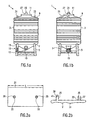
- Fig. 1a shows a side view of a transport container 1 according to the invention for the transport of food products.
- Fig. 1b shows a front view of the transport container 1.
- the transport containers are used in particular for the transport of food ingredients, such as fruit preparations, which may also have pieces of fruit. When using these raw materials in ph-neutral products, such as pudding, etc., it requires a sterilized transport container.
- the product is no longer filled directly into a tank 3 but into an inliner arranged interchangeably in the tank 3 (to be described later).
- the transport container 1 according to the invention is based on a conventional standard transport container, on which, however, in the embodiment shown in FIGS. 1a and 1b, changes were made in the base and lid regions.
- the transport container 1 comprises a tank 3, a base frame 5, in the lower region of the tank 3 a funnel-shaped outlet 7 in this embodiment, and a lid region 9 which has an opening which can be closed by a closure 11.
- the tank 3 For the transport of food products, the tank 3 has a volume of about 1000 l. Depending on the product, both smaller and larger tanks can be provided. Tank 3 is designed for an operating pressure of approx. 1 bar and has a permissible operating temperature range of approx. -20 ° C to + 130 ° C. The tank 3 is preferably made of metal, in particular of aluminum or stainless steel.
- the funnel-shaped outlet 7 is either formed integrally with the tank 3 or represents its own component, which can be sealingly fixed to the tank 3 at the bottom.
- a viewing window 13 is mounted, which serves to check the filling of the transport container 1.
- Other viewing windows 13 could also be arranged on the side wall of the tank 3.
- an outlet opening 15 is arranged eccentrically, that is, laterally to the side edge of the tank 3.
- a connection flange serves to fix an inliner (described later) in the tank 3 by means of a centering disc (to be described later).
- a valve device 17 can be sealingly connected, which serves to fill the inliner by means of a filling or emptying device (not shown) or to empty. This filling or emptying device is attached to a connector 19.
- a valve device 17 is for example a flapper valve.
- the lid portion 9 has in this embodiment, two valves 21, 23, wherein one valve serves as a safety valve and the other valve as a filling or emptying valve.
- the existing in the lid region 9 opening is closed with the closure 11.
- the closure 11 for quick opening and closing serves a bayonet serve, which also allows a predetermined orientation of the closure 11 with respect.
- the tank 3. The closure 11 in turn also has an opening through which a retaining means 25 can be performed on the inside of the tank located inliner. With the help of a union nut 27 is the Holding means 25 attached to the closure 11.
- the closure 11 and the union nut 27 are formed so that in the closed case, the tank 3 is tight.
- the lid region 9 may have a stacking device, which allows a stacking of the transport container 1. Also, on the tank 3, a mounting device for attaching the liner can be provided.
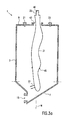
- FIGS. 2 a and 2 b schematically show a plan view and a cross-sectional view of an inliner 31 according to the invention, which can be arranged exchangeably in the tank 3 of the transport container 1 shown in FIG.
- the inliner is made of three nested product compatible plastic films.
- the material is in particular polyethylene (PP) and polypropylene (PE). Since the inliner 31 is used inside the transport container 1, the presence of an additional metallic coating, for example an aluminum coating, as a light protection for the product is not necessary.
- the liner 31 may therefore be made only of plastic.
- the inliner 31 has at one end region an outlet connection 33, via which a product can be filled or carried out in the inliner 31.
- the inliner 31 is welded to the outlet connection 33.
- the connecting piece 33 which is located after installation in the transport container 1 shown in Figure 1 between the valve device 17 and the rest of the inliner 31, must also meet aseptic requirements for food transport.
- the outlet pipe 33 is for example made of food grade plastic and can be sterilized by means of ⁇ -irradiation.
- a closure device 35 serves a membrane or rupture disc. These have the advantage that they can be broken or torn open by an incoming food product stream, so that the interior of the inliner 31 remains sterile until the last moment. So that no membrane or bursting disk material can enter the interior of the inliner 31, the membrane or rupture disk is designed so that it bulges uniformly and bursts open without jarring. Will the product be back pumped from the liner 31, the closure device 35 is further formed so that the fragments can not clog the outlet nozzle 33.
- a sealing device 37 such as an O-ring or a double O-ring, is further formed, which serves to connect the outlet nozzle 33 sealingly with the valve device 17 shown in FIG.
- the holding means 25 additionally has an overpressure securing means 39.
- an overpressure occurring in the inliner 31 may escape due to overfilling.
- the holding means 25 as well as the overpressure protection means 39 are made of plastic and can be sterilized by irradiation.
- Suitable as overpressure protection means 39 is a safety valve or, in a simpler embodiment, also a bursting disc.
- the response pressure for the overpressure protection means 39 is usually in the range of about 1.5 bar overpressure.
- the inliner 31 is fastened to the tank 3 with the union nut 27.
- a thread 41 is formed on the holding means 25.
- the volume V and the shape of the liner 31 are adapted to the volume and shape of the tank 3. Thus, when filling the inliner 31, an unnecessary occurrence of wrinkles on the inner wall of the tank 3 can be suppressed.
- the inliner 31 in its longitudinal direction L is specially, in particular Z-shaped, folded and / or laced at the bottom by a rubber band or the like, such as adhesive strips, defined so that the inliner 31st when filling it takes the shape of the lower portion of the tank 3 before material of the liner 31 is raised up.
- Fig. 3a shows the transport container 1 in cross-section at the level of the outlet opening 15. Elements with the same reference numerals as in Figure 1a or 1b correspond to the already explained in detail there elements and are therefore not explained in detail.
- the outlet 7 is integrally formed with the tank 3 in this embodiment, and the outlet opening 15 is arranged eccentrically with respect to the center axis M of the tank 3. In a standing transport container 1, the opening 15 is vertical. Thus, the outlet opening is easily accessible. This simplifies the attachment and alignment of the liner 31.
- an inliner 31 can be inserted through the opening 43 in the lid portion 9 of the tank 3 in the tank interior.
- a rubber band 45 is schematically illustrated on the inliner 31, which constricts the lower region of the inliner 31 in such a way that the inliner 31 first engages against its boundary wall in the bottom region of the tank 3 when it is filled.
- a mark 46 is attached on the holding means 25, which is arranged so that the user who introduces the inliner 31 above at the same time knows where the outlet nozzle 33 with respect to the outlet opening 15 is located. Thus, it can be prevented that the liner 31 is disposed in a twisted state in the tank 3.
- an inliner 31 is inserted from above and then attached to the tank 3 both at the bottom of the outlet connection 33 and at the top with the holding means 25.
- the invention is not limited to this possibility.
- the inliner 31 can be completely inserted through the opening 15.
- the overpressure protection means 39 would have to be in the aligned state at the outlet opening 15.
- the bottom area of the tank 3, in particular the outlet 7, could be designed to be detachable from the rest of the tank 3, this being indicated by dashed lines in the drawing.
- the lid portion 9 of the tank 3 does not need to be modified, and the liner 31 could be inserted into the outlet 7 with the bottom portion removed.
- Fig. 3b shows an exploded cross-sectional view of the lower portion of the tank 3 of Fig. 3a.
- Fig. 3b illustrates how the spout 33 of the liner 31 is passed from the interior of the tank 3 through the outlet opening 15 to secure the inliner 31 at the bottom of the tank 3 at the outlet opening 15.
- the outlet opening 15 is larger in cross-section than the outside diameter of the outlet nozzle 33.
- the outlet opening 15 is designed such that a user of the transport container 1 grips the inside of the tank with his hand in order to grip the outlet nozzle 33 can and pull through the outlet opening 15 therethrough.
- the outlet opening 15 has a diameter of at least 10 cm, and is preferably in a range of 12 cm to 16 cm.
- the outlet nozzle 33 is centered in the outlet opening 15 by a centering disk 47, preferably in a form-fitting manner.
- the passage opening 49 of the centering disk 47 is formed eccentrically, so that the outlet nozzle 33 is located as close as possible to the lower edge 51 of the outlet opening 15. This facilitates the emptying of the liner 31, since in a stationary transport container 1, the outlet nozzle 33 is thus arranged as far down as possible.
- the outlet nozzle 33 and the centering disk 47 may also be formed in one piece.
- valve device 17 When plugged in, part of the outlet connection piece 33 protrudes from the inside of the tank and projects outwards from the centering disk 47. In this projecting part, in which the seal 37 is located, then the valve device 17 will create a sealing.
- a valve device 17 for example, a flap valve with a flap 53rd used.
- a filling or emptying device can be connected via a connecting thread 55.
- the attachment of the outlet nozzle 33 at the outlet 7 should be possible against rotation, therefore, for example, a bayonet between the flange 57 and the centering 47 is suitable.
- the valve device 17 can be fastened by means of a clamp closure either on the centering disk 47 or on the connection flange 57.
- the gap between the flap 53 and the closure device 35 of the liner 31 is also cleaned or sterilized according to the product requirements.
- a disinfectant can be sprayed into this intermediate space, which then remains in the intermediate space after closing the valve device 17 and is removed from the intermediate space only when it is filled or emptied.
- FIG. 3c shows an exploded cross-sectional view of the upper portion of the tank 3 of Fig. 3a.
- FIG. 3 c illustrates how the holding means in the lid region 9 of the transport container 1 fixes the inliner 31 on the tank 3.
- the holding means 25 is inserted through the opening in the closure 11 and secured by a union nut 27 on the closure 11 against rotation.
- the attachment is sealing to prevent leakage of the food product in the event of bursting of the liner 31.
- the closure 11 is sealingly attached to the lid 9. Again, a bayonet closure is advantageous to prevent unwanted twists of the liner 31.
- valves 21 and 23 may also be arranged on the closure 11.
- Fig. 4 shows schematically the transport container 1 according to the invention with a filled inliner 31 in cross section.
- the inliner 31 abuts against the inner walls of the tank 3, including the lid portion 9 and the spout 7.
- the spout 33 is connected to the valve device 17 attached via the centering disk 47 on the connection flange 57 on the tank 3.
- the holding means 25 is fastened to the closure 11, which in turn closes the opening in the lid region 9.
- the inliner 31 has taken on the shape of the tank 3 in the filled state and is wrinkle-free against the inner wall of the tank 3.
- transport container 1 for transporting food products, in particular sterile foodstuffs, will be described below.
- step S1 the closure 11 is removed from the lid portion 9 of the tank 3. Thereafter, in step S2, the holding means 25 is guided through the opening in the closure 11 from the inside to the outside and with the help of the union nut 27 on the closure 11 sealingly attached. Then, in step S3, the inliner 31 is freely floated from above into the tank 3. It is important to ensure that the mark 46 is aligned so that the outlet nozzle 33 of the outlet opening 15 is opposite. This means that the inliner 31 just hangs in the installed state in the tank 3 and no tensions occur during filling. In step S4, the closure 11 is then secured against rotation on the lid 9 with the bayonet closure.
- step S5 the outlet pipe 33 is pulled out through the outlet opening 15 of the tank 3 in step S5. Since the outlet opening 15 is formed large enough, can be handed by hand into the tank 3, the outlet nozzle 33 is taken and brought to the outlet opening. In step S6 then the outlet nozzle 33 is centered with the centering disk 47 in the outlet opening 15. With the bayonet lock, the outlet nozzle 33, which is arranged in a form-fitting manner in the centering disk 47, can then be secured against rotation on the connection flange 57 (step S7).
- valve device 17 is placed on the outlet pipe 33 (step S8).
- the valve device 17, for example a flapper valve, is then fastened by means of a clamp closure to the discharge nozzle 33, the centering disk 47 or the connecting flange 57 (step S9).
- step S10 the interior space between the valve device 17 and closure device 35 is disinfected with a suitable disinfecting solution through the opened valve 17. This can be done for example by spraying the solution. So that the disinfectant solution does not leak, then the valve device 17 is closed.
- a blind cover can be screwed onto the connecting thread 55 of the valve device 17 until further use.
- step S20 the blind cover screwed onto the connecting thread 55 is removed. Thereafter, a filling device is docked to the connecting thread 55 in step S21. So that when filling the inliner 31, the pressure in the tank 3 can not rise excessively, the tank 3 is vented by means of the valve 21, 23 (S22).
- the structure is then damped.
- the disinfectant solution in the space between the valve device and shutter 35 should mitverdampfen to additionally sterilize the air space in the space (step S23). After this step, a germ-free environment in the transport container 1 is ensured.
- step S24 the flap 53 of the valve device 17 is then opened and the food product enters into the interior of the inliner 31 after the closure device 35 has been broken through.
- the inliner 31 then fills in step S25. In this case, the filling through the viewing window 13 can be observed and monitored. Thanks to the incoming product volume, the inliner 31 opens and deposits evenly on the inner wall of the tank 3. In this case, only the bottom area is filled, since the rubber band 46 prevents the rising of the liner 31 further up the beginning.
- valve device 17 After entry of the desired product volume, the valve device 17 is then closed again and the filling device is removed (step S26).
- a small amount of gas can be injected into the inliner with the aid of a gas pressure surge, for example with nitrogen, so that it already engages against the inner wall before filling.
- the amount of gas should be adjusted so that after filling the safety valve 39 remains closed.
- the filled transport container 1 can now be loaded and the food product, which is now in the inliner inside the tank, can be transported safely and under sterile conditions to the consumer.
- step S30 a dummy cover applied on the connecting thread 55 is removed. Thereafter, the emptying device is docked in step S31. It is important to ensure that the area between the emptying device and valve device 17 is disinfected. You can use the same procedure as when filling the tank 3.
- step S32 the tank 3 is then vented via the valve 21, 23. This can possibly also be done by adding gas, in particular nitrogen.
- gas in particular nitrogen.
- the flap 53 of the valve device 17 is opened and the food product pumped by means of a pump through the emptying device (step S34).
- step S35 the emptying device is removed and again the blind cover is rotated onto the thread 55. Now the transport container 1 returned together with the used inliner 31 to the manufacturer of the food product.
- the used inliner 31 is taken out of the tank 1 again. Before removing it may be determined by weighing, if there is still a residual amount in the liner 31. If this amount is too large, it must be pumped out before removing the liner 31. For this purpose, the procedure described in FIG. 7 is followed. Thereafter, the valve device 17 is then removed from the outlet pipe 33, and possibly a cap placed on the connecting piece 33, to prevent any remaining product residues flow out. Similarly, the closure 11 is removed from the lid portion 9 of the tank 3 and the union nut 27 unscrewed. Then, the liner 31 can be removed from the tank 3 and disposed of. The valve device 17 is cleaned and stored in a disinfecting bath. The tank 3, if dirty, also cleaned.
- the tank 3 and the inliner 31 and the described method it is now no longer necessary to clean the interior of the transport tank on return.
- the use of the inliner, which is removed after use, also the emptying of the transport container is substantially simplified and adhesion of the product to the interior of the tank 3 no longer occurs.
- tanks 3 can be used longer and need less maintenance. By eliminating the time-consuming cleaning process, the tank can also be used more quickly.
Landscapes
- Engineering & Computer Science (AREA)
- Mechanical Engineering (AREA)
- Packages (AREA)
- Basic Packing Technique (AREA)
- Bag Frames (AREA)
- Food Preservation Except Freezing, Refrigeration, And Drying (AREA)
- General Preparation And Processing Of Foods (AREA)
- Closures For Containers (AREA)
Applications Claiming Priority (1)
| Application Number | Priority Date | Filing Date | Title |
|---|---|---|---|
| EP05009977A EP1719714A1 (fr) | 2005-05-06 | 2005-05-06 | Conteneur pour produits alimentaires ainsi que procédé pour le transport de produits alimentaires |
Related Parent Applications (2)
| Application Number | Title | Priority Date | Filing Date |
|---|---|---|---|
| EP05009977A Division EP1719714A1 (fr) | 2005-05-06 | 2005-05-06 | Conteneur pour produits alimentaires ainsi que procédé pour le transport de produits alimentaires |
| EP05009977A Division-Into EP1719714A1 (fr) | 2005-05-06 | 2005-05-06 | Conteneur pour produits alimentaires ainsi que procédé pour le transport de produits alimentaires |
Publications (2)
| Publication Number | Publication Date |
|---|---|
| EP1724207A2 true EP1724207A2 (fr) | 2006-11-22 |
| EP1724207A3 EP1724207A3 (fr) | 2006-11-29 |
Family
ID=34979780
Family Applications (2)
| Application Number | Title | Priority Date | Filing Date |
|---|---|---|---|
| EP06015372A Withdrawn EP1724207A3 (fr) | 2005-05-06 | 2005-05-06 | Conteneur pour produits alimentaires ainsi que procédé pour le transport de produits alimentaires |
| EP05009977A Withdrawn EP1719714A1 (fr) | 2005-05-06 | 2005-05-06 | Conteneur pour produits alimentaires ainsi que procédé pour le transport de produits alimentaires |
Family Applications After (1)
| Application Number | Title | Priority Date | Filing Date |
|---|---|---|---|
| EP05009977A Withdrawn EP1719714A1 (fr) | 2005-05-06 | 2005-05-06 | Conteneur pour produits alimentaires ainsi que procédé pour le transport de produits alimentaires |
Country Status (10)
| Country | Link |
|---|---|
| US (1) | US20080006636A1 (fr) |
| EP (2) | EP1724207A3 (fr) |
| JP (1) | JP2006312493A (fr) |
| KR (3) | KR100872401B1 (fr) |
| CN (1) | CN1857970A (fr) |
| BR (1) | BRPI0603270A (fr) |
| CA (1) | CA2543309A1 (fr) |
| RU (1) | RU2351518C2 (fr) |
| TW (1) | TW200642930A (fr) |
| ZA (1) | ZA200603592B (fr) |
Families Citing this family (27)
| Publication number | Priority date | Publication date | Assignee | Title |
|---|---|---|---|---|
| US20110151083A1 (en) * | 2005-04-19 | 2011-06-23 | Alan Soucy | Cartridges for storing food materials and methods and apparatus for processing food materials stored within such cartridges |
| US20100143549A1 (en) * | 2006-04-19 | 2010-06-10 | Kevin Hoyt | Apparatus, pods and methods for processing expandable food materials |
| DE102005028778A1 (de) * | 2005-06-22 | 2006-12-28 | SUNJÜT Deutschland GmbH | Mehrlagige Folie mit einer Barriere- und einer antistatischen Lage |
| BRPI0711076A2 (pt) * | 2006-04-28 | 2011-08-23 | Bluescope Steel Ltd | tanque de armazenamento de água, dispositivo e método para montagem do mesmo, sistemas de retenção e de armazenamento de água, base e módulo de base para a montagem de uma base adaptada para suportar um tanque de armazenamento de água |
| US9090398B2 (en) * | 2007-05-04 | 2015-07-28 | Emd Millipore Corporation | Disposable processing bag with alignment feature |
| EP2082972A1 (fr) * | 2008-01-25 | 2009-07-29 | INDAG Gesellschaft für Industriebedarf mbH & Co. Betriebs KG | Récipient de transport et/ou de stockage |
| JP5039608B2 (ja) * | 2008-02-27 | 2012-10-03 | 森永乳業株式会社 | 殺菌済原料における汚染の検出方法 |
| DE202008015293U1 (de) | 2008-11-18 | 2009-01-29 | Ucon Ag Containersysteme Kg | Kleincontainer für flüssige und/oder pastöse Stoffe sowie Unterboden hierfür |
| DE102009000619B3 (de) * | 2009-02-04 | 2010-12-16 | Universität Kassel | Tank |
| US20120114821A1 (en) * | 2010-11-08 | 2012-05-10 | John Bean Technologies Corporation | Method and apparatus for handling sterilized food product |
| CN104093652B (zh) * | 2011-11-28 | 2018-06-15 | 纳米产品公司 | 用于亚微米颗粒的阀和密封容器及相关方法 |
| CN104271451B (zh) * | 2012-05-07 | 2016-08-31 | 卓缤科技贸易公司 | 用于处理无菌食品产品的方法和设备 |
| CN104724370B (zh) * | 2013-12-19 | 2018-01-30 | 佛山市顺德区美的饮水机制造有限公司 | 水容器及具有其的净水设备和饮水机 |
| CN104720585B (zh) * | 2013-12-19 | 2017-10-27 | 佛山市顺德区美的饮水机制造有限公司 | 饮水设备 |
| CN104609030A (zh) * | 2015-01-29 | 2015-05-13 | 岳勇斌 | 一种纯水储存装置 |
| SG11201807984YA (en) * | 2016-03-24 | 2018-10-30 | Mauser Werke Gmbh | Pallet container |
| DE102016010621B4 (de) * | 2016-03-24 | 2018-06-28 | Mauser-Werke Gmbh | Inliner für Palettencontainer |
| CN107697486B (zh) | 2016-08-08 | 2020-10-20 | 上海鸿研物流技术有限公司 | 挤推器及流体排放系统和方法 |
| NL2018765B1 (en) * | 2017-04-24 | 2018-11-05 | Green Eye Capital B V | Assembly of an inliner and a tank container |
| CN108945841B (zh) * | 2018-05-22 | 2020-07-24 | 淄博洁林塑料制管有限公司 | 一种ibc吨桶用内衬袋的使用方法 |
| DE202019004097U1 (de) * | 2019-10-07 | 2019-12-03 | Cryotherm Gmbh & Co. Kg | Transportbehälter für konzentriertes Wasserstoffperoxid |
| NL2024686B1 (en) | 2020-01-16 | 2021-09-08 | Mega Inliner Int Group Bv | Method for realizing an aseptic connection between a valve unit and a tank container |
| BR102021004207B1 (pt) * | 2021-03-05 | 2022-12-20 | Leo Krakowiak | Sistema para impedir a formação de vapores de combustível |
| CN112938206B (zh) * | 2021-03-10 | 2022-08-26 | 海南丰席树诺丽产业有限责任公司 | 一种便于移动的诺丽果发酵果汁用储藏罐 |
| CN113212973B (zh) * | 2021-04-08 | 2024-01-12 | 安徽从仁堂国药有限公司 | 一种便于取用可避免中药破损的保存装置 |
| DE102021117729B3 (de) * | 2021-07-08 | 2022-06-30 | U-Consulting GmbH | Schutzvorrichtung und Schutzanordnung für ein Behältnis zum Aufnehmen von Substanzen, insbesondere von pulverförmigen Substanzen |
| KR102785008B1 (ko) * | 2023-03-02 | 2025-03-25 | 김성훈 | 튜브 용기 |
Family Cites Families (19)
| Publication number | Priority date | Publication date | Assignee | Title |
|---|---|---|---|---|
| FR1427992A (fr) * | 1964-12-31 | 1966-02-11 | Dispositif pour éviter le contact de deux fluides à l'intérieur d'un récipient | |
| DE3503916C2 (de) * | 1985-02-06 | 1987-04-30 | International Flavors & Fragrances IFF (Deutschland) GmbH, 4240 Emmerich | Behälter |
| DE8805692U1 (de) * | 1988-04-29 | 1988-07-21 | Schneider, Friedhelm, 5226 Reichshof | Transportbehälter für Flüssigkeiten |
| US5072857A (en) * | 1988-09-30 | 1991-12-17 | Fabricated Metals, Inc. | Bulk material container with flexible liner |
| JP2632664B2 (ja) * | 1988-11-12 | 1997-07-23 | レイテック株式会社 | 流体貯溜槽内養生袋 |
| JP3203262B2 (ja) * | 1992-03-04 | 2001-08-27 | 日本製粉株式会社 | 粉粒体サイロ装置 |
| EP0590902A1 (fr) * | 1992-09-26 | 1994-04-06 | Hydrair Limited | Système de transport |
| US5890616A (en) * | 1997-01-30 | 1999-04-06 | Messe, Inc. | Bulk container with discharge coupling |
| JPH10287389A (ja) * | 1997-04-10 | 1998-10-27 | Maeda Seisakusho:Kk | コンテナ内袋回収システムならびにそのためのコンテナおよび内袋 |
| SE512520C2 (sv) * | 1997-07-07 | 2000-03-27 | Arca Systems Ab | Påsformigt innerhölje i form av en så kallad liner avsedd att användas för transport och lagring av bulkgods tillsammans med ett uppbärande ytterhölje |
| AUPO777997A0 (en) * | 1997-07-09 | 1997-07-31 | Technosearch Pty. Limited | Improvements in containers |
| JP2000043982A (ja) | 1998-05-29 | 2000-02-15 | Raisen:Kk | コンテナ―用内袋の装着方法。 |
| CA2265057C (fr) * | 1999-03-10 | 2003-05-06 | Jaromir K. Aujesky | Contenant et verrou pour raccord de sac a liquide |
| DE19957215C2 (de) * | 1999-11-27 | 2001-10-18 | Protechna Sa | Transport- und Lagerbehälter für Flüssigkeiten und Verfahren zur Herstellung des Innenbehälters des Transport- und Lagerbehälters |
| CN1221448C (zh) * | 2000-05-25 | 2005-10-05 | 毛瑟工厂责任有限及两合公司 | 托板容器 |
| JP2001354292A (ja) * | 2000-06-13 | 2001-12-25 | Kyoritsu Butsuryu System:Kk | 液体コンテナ用の内袋 |
| GB2366283A (en) * | 2000-08-30 | 2002-03-06 | Brendan Mckenna | Apparatus for use in the transportation of liquids, gels, thixotropic fluids and the like |
| US6659132B2 (en) * | 2001-03-19 | 2003-12-09 | Baxter International Inc. | Gas permeable sterile closure |
| JP2004161308A (ja) * | 2002-11-12 | 2004-06-10 | Nisshin Sansho Kk | 内装容器 |
-
2005
- 2005-05-06 EP EP06015372A patent/EP1724207A3/fr not_active Withdrawn
- 2005-05-06 EP EP05009977A patent/EP1719714A1/fr not_active Withdrawn
-
2006
- 2006-04-07 TW TW095112513A patent/TW200642930A/zh unknown
- 2006-04-12 CA CA002543309A patent/CA2543309A1/fr not_active Abandoned
- 2006-04-12 RU RU2006112190/11A patent/RU2351518C2/ru not_active IP Right Cessation
- 2006-04-27 CN CNA2006100760753A patent/CN1857970A/zh active Pending
- 2006-05-01 JP JP2006127604A patent/JP2006312493A/ja active Pending
- 2006-05-02 KR KR1020060039622A patent/KR100872401B1/ko not_active Expired - Fee Related
- 2006-05-02 US US11/416,560 patent/US20080006636A1/en not_active Abandoned
- 2006-05-05 BR BRPI0603270-2A patent/BRPI0603270A/pt not_active IP Right Cessation
- 2006-05-05 ZA ZA200603592A patent/ZA200603592B/xx unknown
-
2008
- 2008-05-23 KR KR1020080048258A patent/KR20080056123A/ko not_active Ceased
- 2008-05-23 KR KR1020080048257A patent/KR20080056122A/ko not_active Ceased
Also Published As
| Publication number | Publication date |
|---|---|
| ZA200603592B (en) | 2007-01-31 |
| KR20080056122A (ko) | 2008-06-20 |
| BRPI0603270A (pt) | 2006-12-26 |
| KR20080056123A (ko) | 2008-06-20 |
| KR20060115590A (ko) | 2006-11-09 |
| US20080006636A1 (en) | 2008-01-10 |
| EP1724207A3 (fr) | 2006-11-29 |
| TW200642930A (en) | 2006-12-16 |
| RU2006112190A (ru) | 2007-11-20 |
| CA2543309A1 (fr) | 2006-11-06 |
| RU2351518C2 (ru) | 2009-04-10 |
| JP2006312493A (ja) | 2006-11-16 |
| KR100872401B1 (ko) | 2008-12-05 |
| CN1857970A (zh) | 2006-11-08 |
| EP1719714A1 (fr) | 2006-11-08 |
Similar Documents
| Publication | Publication Date | Title |
|---|---|---|
| EP1724207A2 (fr) | Conteneur pour produits alimentaires ainsi que procédé pour le transport de produits alimentaires | |
| DE102014003376A1 (de) | Plattencontainer | |
| WO2018054527A1 (fr) | Fût à bonde doté d'un revêtement intérieur ainsi que procédé de fabrication associé | |
| DE2224796A1 (de) | Biegsame Umhüllung zum Einsetzen in einen Behälter | |
| EP3433182A1 (fr) | Caisse-palette | |
| DE102017002876B4 (de) | Kunststoff-Innenbehälter mit Inliner | |
| DE202014105594U1 (de) | Flüssigkeitsbehälter mit Innenhülle | |
| DE69001754T2 (de) | Vorrichtung zum lagern eines materials, z.b. einer flüssigkeit in metallfässern. | |
| DE102014116151B3 (de) | Verschlusseinrichtung für einen Behälter zur aseptischen Aufnahme eines fließfähigen Produkts sowie Behälter und Verfahren zum aseptischen Befüllen | |
| EP0190757B1 (fr) | Système de remplissage et de vidange stérile pour sac mis dans un conteneur | |
| DE202019102700U1 (de) | Inliner sowie mit einem Inliner versehener Transportbehälter | |
| WO2020057772A1 (fr) | Caisse-palette | |
| WO2016045800A1 (fr) | Cuve-palette | |
| DE102016011602B3 (de) | Spundfass mit Inliner | |
| DE2656717A1 (de) | Vakuumtransportbehaelter | |
| EP4543781B1 (fr) | Doublure, emballage composite et conteneur de transport comprenant une doublure, et procédé associé | |
| CH625182A5 (en) | Container for transporting and storing substances to be kept sterile | |
| DE202019102702U1 (de) | Inliner mit einer Entgasungslanze sowie mit einem Inliner versehener Transportbehälter | |
| EP1127806B1 (fr) | Garniture intérieure pour conteneur | |
| EP0204097B1 (fr) | Procédé de transport de produits fermentescibles | |
| EP2082972A1 (fr) | Récipient de transport et/ou de stockage | |
| DE10312684A1 (de) | Container-Inliner-Bag | |
| DE20219946U1 (de) | Behälter zur Lagerung einer Flüssigkeit | |
| DE1073336B (de) | Aus elastischem Werkstoff bestehender unter sterilen Bedingungen gefüllter Behalter und Verfahren zum Füllen des Behalters | |
| DE3704023A1 (de) | Spundverschluss |
Legal Events
| Date | Code | Title | Description |
|---|---|---|---|
| PUAI | Public reference made under article 153(3) epc to a published international application that has entered the european phase |
Free format text: ORIGINAL CODE: 0009012 |
|
| PUAL | Search report despatched |
Free format text: ORIGINAL CODE: 0009013 |
|
| 17P | Request for examination filed |
Effective date: 20060724 |
|
| AC | Divisional application: reference to earlier application |
Ref document number: 1719714 Country of ref document: EP Kind code of ref document: P |
|
| AK | Designated contracting states |
Kind code of ref document: A2 Designated state(s): AT BE BG CH CY CZ DE DK EE ES FI FR GB GR HU IE IS IT LI LT LU MC NL PL PT RO SE SI SK TR |
|
| AX | Request for extension of the european patent |
Extension state: AL BA HR LV MK YU |
|
| AK | Designated contracting states |
Kind code of ref document: A3 Designated state(s): AT BE BG CH CY CZ DE DK EE ES FI FR GB GR HU IE IS IT LI LT LU MC NL PL PT RO SE SI SK TR |
|
| AX | Request for extension of the european patent |
Extension state: AL BA HR LV MK YU |
|
| RAP1 | Party data changed (applicant data changed or rights of an application transferred) |
Owner name: INDAG GESELLSCHAFT FUER INDUSTRIEBEDARF MBH & CO. |
|
| AKX | Designation fees paid |
Designated state(s): AT BE BG CH CY CZ DE DK EE ES FI FR GB GR HU IE IS IT LI LT LU MC NL PL PT RO SE SI SK TR |
|
| REG | Reference to a national code |
Ref country code: HK Ref legal event code: DE Ref document number: 1098994 Country of ref document: HK |
|
| 17Q | First examination report despatched |
Effective date: 20080227 |
|
| STAA | Information on the status of an ep patent application or granted ep patent |
Free format text: STATUS: THE APPLICATION IS DEEMED TO BE WITHDRAWN |
|
| 18D | Application deemed to be withdrawn |
Effective date: 20100213 |
|
| REG | Reference to a national code |
Ref country code: HK Ref legal event code: WD Ref document number: 1098994 Country of ref document: HK |