EP1725624B1 - Encres d'impression destinees a l'impression offset et/ou en relief contenant des absorbeurs de spectre en proche infrarouge et absorbeurs de spectre en proche infrarouge solubles dans des encres d'impression offset et/ou en relief - Google Patents
Encres d'impression destinees a l'impression offset et/ou en relief contenant des absorbeurs de spectre en proche infrarouge et absorbeurs de spectre en proche infrarouge solubles dans des encres d'impression offset et/ou en relief Download PDFInfo
- Publication number
- EP1725624B1 EP1725624B1 EP05715651A EP05715651A EP1725624B1 EP 1725624 B1 EP1725624 B1 EP 1725624B1 EP 05715651 A EP05715651 A EP 05715651A EP 05715651 A EP05715651 A EP 05715651A EP 1725624 B1 EP1725624 B1 EP 1725624B1
- Authority
- EP
- European Patent Office
- Prior art keywords
- group
- printing ink
- linear
- carbon atoms
- nir
- Prior art date
- Legal status (The legal status is an assumption and is not a legal conclusion. Google has not performed a legal analysis and makes no representation as to the accuracy of the status listed.)
- Expired - Lifetime
Links
Classifications
-
- C—CHEMISTRY; METALLURGY
- C09—DYES; PAINTS; POLISHES; NATURAL RESINS; ADHESIVES; COMPOSITIONS NOT OTHERWISE PROVIDED FOR; APPLICATIONS OF MATERIALS NOT OTHERWISE PROVIDED FOR
- C09B—ORGANIC DYES OR CLOSELY-RELATED COMPOUNDS FOR PRODUCING DYES, e.g. PIGMENTS; MORDANTS; LAKES
- C09B69/00—Dyes not provided for by a single group of this subclass
- C09B69/02—Dyestuff salts, e.g. salts of acid dyes with basic dyes
- C09B69/06—Dyestuff salts, e.g. salts of acid dyes with basic dyes of cationic dyes with organic acids or with inorganic complex acids
-
- C—CHEMISTRY; METALLURGY
- C09—DYES; PAINTS; POLISHES; NATURAL RESINS; ADHESIVES; COMPOSITIONS NOT OTHERWISE PROVIDED FOR; APPLICATIONS OF MATERIALS NOT OTHERWISE PROVIDED FOR
- C09B—ORGANIC DYES OR CLOSELY-RELATED COMPOUNDS FOR PRODUCING DYES, e.g. PIGMENTS; MORDANTS; LAKES
- C09B23/00—Methine or polymethine dyes, e.g. cyanine dyes
- C09B23/0075—Methine or polymethine dyes, e.g. cyanine dyes the polymethine chain being part of an heterocyclic ring
-
- C—CHEMISTRY; METALLURGY
- C09—DYES; PAINTS; POLISHES; NATURAL RESINS; ADHESIVES; COMPOSITIONS NOT OTHERWISE PROVIDED FOR; APPLICATIONS OF MATERIALS NOT OTHERWISE PROVIDED FOR
- C09B—ORGANIC DYES OR CLOSELY-RELATED COMPOUNDS FOR PRODUCING DYES, e.g. PIGMENTS; MORDANTS; LAKES
- C09B23/00—Methine or polymethine dyes, e.g. cyanine dyes
- C09B23/02—Methine or polymethine dyes, e.g. cyanine dyes the polymethine chain containing an odd number of >CH- or >C[alkyl]- groups
- C09B23/08—Methine or polymethine dyes, e.g. cyanine dyes the polymethine chain containing an odd number of >CH- or >C[alkyl]- groups more than three >CH- groups, e.g. polycarbocyanines
- C09B23/086—Methine or polymethine dyes, e.g. cyanine dyes the polymethine chain containing an odd number of >CH- or >C[alkyl]- groups more than three >CH- groups, e.g. polycarbocyanines more than five >CH- groups
-
- C—CHEMISTRY; METALLURGY
- C09—DYES; PAINTS; POLISHES; NATURAL RESINS; ADHESIVES; COMPOSITIONS NOT OTHERWISE PROVIDED FOR; APPLICATIONS OF MATERIALS NOT OTHERWISE PROVIDED FOR
- C09D—COATING COMPOSITIONS, e.g. PAINTS, VARNISHES OR LACQUERS; FILLING PASTES; CHEMICAL PAINT OR INK REMOVERS; INKS; CORRECTING FLUIDS; WOODSTAINS; PASTES OR SOLIDS FOR COLOURING OR PRINTING; USE OF MATERIALS THEREFOR
- C09D11/00—Inks
- C09D11/02—Printing inks
- C09D11/03—Printing inks characterised by features other than the chemical nature of the binder
- C09D11/037—Printing inks characterised by features other than the chemical nature of the binder characterised by the pigment
Definitions
- the present invention relates to offset and / or high pressure inks containing NIR absorbers and wherein the solubility of the NIR absorber in the ink is at least 0.1% by weight.
- the NIR absorber is a cyanine cation having an anion which has long chain alkyl or alkylaryl groups.
- the invention further relates to the use of such inks in printing processes in which the curing of the ink is assisted by the use of IR radiation sources.
- the invention relates to an NIR absorber of a cyanine cation having an anion which has long chain alkyl or alkylaryl groups.
- Faster curing allows faster printing and therefore increases cost-effectiveness. It is known to accelerate the curing of printing inks by supplying heat. For this purpose, for example, the freshly printed substrate can be driven through a drying channel and heated with hot air and / or IR lamps. This procedure is particularly common in offset printing, because offset inks contain very high-boiling solvents that practically do not evaporate at room temperature. For example, the so-called heatset (roll) offset method is widespread. Further details are, for example, the Rompp-Lexikon "Paints and printing inks", Georg Thieme Verlag, Stuttgart, New York 1998, p 279/280 refer to.
- IR emitters usually emit broadband in both the near and mid infrared.
- IR emitters is from EP-A 355 473 or EP-A1 302 735 the use of lasers, in particular IR lasers for heating the printing layer has been proposed.
- Common IR lasers emit in particular in the near infrared.
- the higher the power density of the radiation the better the curing of the ink layer with IR radiation. Therefore, lasers are particularly well suited.
- the IR radiation is not only absorbed by the ink on the substrate, but also by the paper.
- Significant as an IR absorber in the paper is especially water. Small amounts of water are always contained in the paper, for example by absorption of atmospheric moisture. Furthermore, water also reaches the paper via the dampening solution used for offset printing. If the paper is heated too much by excessive absorption and dries unevenly, it may undesirably become wavy. This problem is for example in EP-A 1 302 735 in sections [0010], [0011] and [0012].
- EP-A 1 302 735 proposed to use radiant energy sources that emit at a wavelength that is not substantially absorbed by water.
- radiant energy sources that emit at a wavelength that is not substantially absorbed by water.
- printing inks which contain an absorber for NIR radiation.
- cyanine dyes in the form of perchlorate or tetrafluoroborate, an amminium compound in the form of perchlorate and a Ni-Dithiolenkomplex.
- Cyanine dyes and their preparation are known in principle, for example from DE-A 37 21 850 and have been proposed for a wide variety of applications, for example photographic materials ( US 5, 013, 642 . EP-A 342 576 . EP-A 445 627 ), Ribbons ( DE 43 08 635 ) or printing plates ( WO 03/66338 ). Cyanine dyes are commercially available.
- Cyanine dyes consist of a cyanine cation and a corresponding anion. This may be a separately present anion or else an internal anion, i. the anionic group is chemically linked to the cyanine cation. They are usually produced in their preparation as simple salts, for example as halides, tetrafluoroborates, perchlorates or tosylates. Cyanine dyes with anions which have long-chain alkyl or alkyl-substituted aryl groups are not yet known.
- the change in hues seems to be caused at least in part by insufficient solubility of the dyes in the off-set inks.
- the solubility of common cyanine dyes in the nonpolar, viscous solvents used for offset and high pressure inks is typically less than 0.1%.
- the object of the invention was therefore to provide improved printing inks for offset and / or high pressure, which contain NIR absorbers, and in which the disadvantages of the prior art are not observed.
- Task was also to provide for the production of printing inks for offset and / or high pressure suitable NIR absorber, which can be stirred under the inks and thereby lead in the ink to a sufficiently high extinction at certain laserdefinedn wavelengths without it a significant impairment of the color values of the ink comes.
- offset inks were found containing NIR absorbers and the solubility of the NIR absorber in the ink is at least 0.1% by weight, the solubility of the NIR absorber being greater than or equal to the respective concentration of the NIR absorber in the ink ,
- novel offset printing inks comprise, in a manner known in principle, at least one nonpolar solvent, a binder and a colorant absorbing in the visible spectral range.
- optional conventional additives or additives may be included.
- Offset printing ink and "high-pressure ink” are self-explanatory and restrictive at the same time.
- High-pressure paints are also known as letterpress inks.
- Offset and high-pressure inks are in each case paste-like printing inks which comprise high-boiling, nonpolar solvents, generally with a boiling point of about 200 ° C. to about 320 ° C.
- the general principles of the formulation of offset and high-pressure inks are known in the art and, for example, reference works such Römpp Lexicon "Paints and Printing Inks", Georg Thieme Verlag, Stuttgart, New York 1998 , or Leach, Robert H .; Pierce, Ray J. "The Printing Ink Manual; 5th Ed. - London, Blueprint, 1993 refer to.
- the printing inks according to the invention may in principle be all types of offset and / or high-pressure inks. Preferably, however, it is a heatset offset printing ink.
- the printing ink according to the invention comprises, in a manner known in principle, at least one nonpolar, high-boiling solvent.
- suitable solvents include mineral oils, especially low-aromatic mineral oils.
- the boiling point of the mineral oil depends on the desired application and is selected by the expert.
- heatset offset printing generally a boiling point of about 200 ° C to about 270 ° C is recommended, for coldset offset printing and high pressure a boiling point of about 240 ° C to 320 ° C.
- Other examples include vegetable, semi-drying or drying oils, such as soybean oil, wood oil, tall oil or linseed oil. Such oils are particularly suitable for sheet-fed offset and high-pressure inks. They are preferably used in admixture with mineral oils.
- the printing inks according to the invention furthermore comprise at least one binder in a manner known in principle. Preference is given to using mixtures of different binders, for example mixtures of hard and soft resins.
- binders typical of offset and high-pressure inks can be used.
- suitable binders include alkyd resins, natural resins such as rosin resins, which may also be modified, such as, for example, phenol- or maleinate-modified rosin resins or synthetic resins such as coumarone, indene or cyclopentadiene resins.
- the printing ink according to the invention furthermore comprises absorbing colorants in the visible spectral range.
- colorants in particular conventional pigments.
- examples are inorganic pigments such as titanium dioxide pigments or iron oxide pigments, interference pigments, carbon blacks, and organic pigments such as azo, phthalocyanine or isoindoline pigments.
- the colorants may also be soluble organic dyes. Of course, mixtures of different colorants can be used.
- the amount of colorant is usually 5 - 25 wt.% With respect to the sum of all components of the ink.
- the printing inks according to the invention may optionally comprise one or more auxiliaries or additives in a manner known in principle.
- additives and auxiliaries are fillers such as calcium carbonate, alumina hydrate or aluminum or magnesium silicate.
- Waxes increase the abrasion resistance and serve to increase the lubricity. Examples are in particular polyethylene waxes, oxidized polyethylene waxes, petroleum waxes or ceresin waxes. Fatty acid amides can be used to increase the surface smoothness.
- Dispersing agents can be used to disperse the pigments. Co or Mn salts, so-called dryers, can be used to accelerate oxidative curing.
- the total amount of all additives and auxiliaries usually does not exceed 20% by weight with respect to the sum of all constituents and is preferably 0.1-10% by weight.
- the printing inks for high and / or offset printing furthermore comprise at least one NIR absorber which has substantially no absorption in the visible spectral range.
- NIR absorber which has substantially no absorption in the visible spectral range.
- mixtures of several different NIR absorbers can be used.
- NIR absorbers are also referred to by the person skilled in the art as NIR dyes or more generally as IR dyes. Such dyes or absorbers have absorption maxima in the spectral range from 700 nm to 3000 nm, preferably 750 nm to 2000 nm and particularly preferably 780 nm to 1500 nm.
- substantially no absorption in the visible spectral range in the sense of this invention is intended to mean that the absorber should ideally have no absorption in the visible spectral range. However, it is sufficient for the purposes of this invention that the absorption of the NIR absorber-in the selected amounts-in the visible spectral range is so low that the color impression of the printing ink is not adversely affected. Naturally, this also depends on the hue and the color strength of the respective printing ink. An NIR absorber, which is no longer suitable for a printing ink with a very specific hue and a specific color intensity, may possibly still be suitable for another printing ink with a different hue and color strength.
- the solubility of the NIR absorber in the printing ink is at least 0.1% by weight with respect to the sum of all components of the ink with the proviso that the solubility of the NIR absorber is greater than or equal to the concentration of the NIR absorber in the printing ink.
- Printing ink contained NIR absorber is chosen by the expert so that a sufficient absorption at the desired laser wavelength is achieved. As a rule, an amount of less than 5% by weight is sufficient.
- the solubility of the NIR absorber in the printing ink is preferably at least 0.2% by weight, more preferably at least 0.5% by weight, very preferably at least 1.0% by weight and, for example, at least 2% by weight.
- any suitable NIR absorber can be used by a person skilled in the art for preparing the printing ink, provided that the NIR absorber has the required solubility.
- the NIR absorber is at least one selected from the group of cyanines, naphthalocyanines, squarains and croconates.
- the NIR absorber is an ionic absorber composed of a cyanine cation X + and a corresponding anion 1 / m Y m- , where m can in particular assume the values 1 or 2.
- the cyanine cation according to the invention has a general formula selected from the following formulas (I) to (IV):
- R 1 and R 2 may optionally be further substituted. Particularly noteworthy here are functional groups such as amino or hydroxy groups. If present, these may be, in particular, functional groups terminally attached to alkyl groups.
- R 3 and R 4 are independently -H or -CN. Preferably, R 3 and R 4 are the same group.
- R 5 and R 6 are different or preferably identical radicals selected from the group of -H, -F, -CI, -Br, -I, -NO 2 -CN or -CF 3 .
- R 5 and R 6 may also be a radical -R 'or -OR 1 , where R 1 is each as defined above. Furthermore, it may be aryl or -O-aryl radicals, wherein aryl is preferably a phenyl radical.
- R 5 and R 6 are preferably -H, -CI, -Br or -I or an alkyl radical.
- the terminal rings may each also have a plurality of identical or different substituents R 5 or R 6 at different positions of the ring. Preferably, no more than two substituents are present on each ring, more preferably only one each.
- R 7 may be -H, -CI, -Br, -I, -phenyl, -O-phenyl, -S-phenyl, -N (phenyl) 2 , -pyridyl, a barbituric acid or a dimedone radical, where the phenyl radicals can also be further substituted.
- Further substituents may be, for example, straight-chain or branched alkyl radicals, for example methyl or ethyl radicals, or else -F, -CI, -Br, -I, -NO 2, -CN or -CF 3 .
- the counterion Y m to the cyanine cation can have the general formula [AR 10 k ] m- . It comprises a polar ionic head group A and k non-polar groups R 10 , where k is a number of 1, 2 or 3 and m is 1 or 2.
- the anion preferably has only one group R 10 . Furthermore, it is preferably monovalent anion. If several nonpolar groups R 10 are present in the anion, they may be different or preferably similar. Of course, it may also be a mixture of several different anions.
- the groups R 10 may be linear, branched or cyclic alkyl groups having 6 to 30 carbon atoms.
- the alkyl groups R 10 preferably have 6 to 12 C atoms.
- suitable groups include 1-hexyl, cyclohexyl, 2-ethyl-1-hexyl, 1-octyl, 1-nonyl, 1-decyl, 1-undecyl, 1-dodecyl or 1-tetradecyl groups. They are preferably linear alkyl groups.
- alkylaryl groups of the general formula -aryl-R 11 , where R 11 is a linear or branched alkyl group having 3 to 30 C atoms.
- suitable groups include 1-propyl, 2-propyl, 1-butyl, 2-butyl, t-butyl, 1-pentyl, 1-hexyl, cyclohexyl, 2-ethyl-1-hexyl, 1-octyl, 1-nonyl, 1-decyl, 1-undecyl, 1-dodecyl or 1-tetradecyl.
- the alkyl groups R 11 preferably have 6 to 12 C atoms. Particularly preferred are linear alkyl groups.
- the aryl unit is in particular a phenylene group, preferably a 1,4-phenylene group.
- suitable alkylaryl groups include - (C 6 H 4 ) -C 3 H 7 , - (C 6 H 4 ) -C 6 H 13 or - (C 6 H 4 ) -C 12 H 25 .
- the polar ionic head group A is, in particular, the anion of a monovalent or divalent acid radical. It may be any inorganic or organic acid group. It is preferably a carboxyl group, or to acid, P or B-containing acid groups. For example, it may be an acid group selected from the group of -SO 3 - , -OSO 3 - , -COO ', - PO 3 2- , -OPO 3 2- or (-O) (- O) PO 2 - act ,
- alkylsulfonates having alkyl radicals in particular linear alkyl radicals having from 6 to 12 carbon atoms, such as, for example, n-octylsulfonate, n-decylsulfonate or n-dodecylsulfonate, and also alkylbenzenesulfonates containing 4-alkyl radicals from 6 to 12 C-atoms such as 4-hexylbenzenesulfonate, 4-octylbenzenesulfonate, 4-decylbenzenesulfonate or 4-dodecylbenzenesulfonate.
- these may also be technical products which have a distribution of different alkyl radicals of different lengths.
- the counterion Y m- for the cyanine cation can also be a borate anion of the general formulas (V) or (VI)
- R 10 is a radical as defined above. There may be one or two identical or different substituents on each of the chelating ligands. Preferably, in each case one substituent is present.
- R 12 is in each case one or more identical or different substituents selected from the group of H or linear, cyclic or branched alkyl groups having 1 to 20 C atoms, preferably a radical having 2 to 12 C atoms. Preferably, only one alkyl group is present as a substituent.
- Such borate anions are obtainable, for example, from boric acid and the corresponding dialcohol.
- non-adjacent carbon atoms may optionally be substituted by oxygen atoms and / or the radicals R 10 , R 11 and R 12 may be completely or partially fluorinated, provided that Non-polar character of the groups is not significantly changed.
- the preparation of the NIR absorber according to the invention can be carried out by various methods. They can be prepared, for example, by means of a two-stage process in which, in a first step, the cyanine cations are synthesized with customary anions such as iodide, tetrafluoroborate, perchlorate or paratoluenesulfonate. Manufacturing instructions are known in the art. As an example, be on DE-A 37 21 850 . EP-A 627 660 and the references cited therein. NIR absorbers based on cyanines are also commercially available.
- the customary anions are then exchanged for the anions Y m according to the invention by means of a suitable process.
- the absorber must not be soluble therein.
- the organic solution or suspension is then extracted with water until the original anion is completely removed from the organic solution.
- the NIR absorber according to the invention can be obtained by removing the solvent from the solution.
- the preparation can also be carried out using acidic ion exchange resins by dissolving the starting salt with conventional anion in a suitable polar solvent, for example an alcohol, such as methanol or ethanol, and adding the solution to the ion exchange column. The absorber cations are then eluted with a solution of the desired anion.
- a suitable polar solvent for example an alcohol, such as methanol or ethanol
- the absorber cations are then eluted with a solution of the desired anion.
- the ion exchange can also be modeled on that of WO 03/76518 procedures disclosed.
- the NIR absorbers according to the invention are readily soluble in offset printing inks.
- the solubility can be influenced by the choice of the anion and the substituents on the cation. Longer alkyl chains than groups R 10 , R 11 or R 12 or as substituents on cyanine generally also lead to better solubility.
- the NIR absorbers according to the invention have absorption maxima in the range from 700 nm to 1200 nm. Preference is given to those dyes which have their absorption maximum close to the emission wavelength of conventional lasers, in particular semiconductor diode lasers. Examples of typical laser wavelengths include 750 nm, 785 nm, 810 nm, 835 nm, 855 nm, 955 nm, 980 nm, preferably 810 nm and 980 nm.
- the absorption maximum of the NIR absorber can be selected by the person skilled in the art in a manner known in principle the substituent on Cyaninkation be influenced.
- the NIR absorbers according to the invention have essentially no absorption in the visible spectral range.
- the extinction coefficient in the range of 400 to 700 nm is generally less than 20%, preferably less than 10%, and more preferably less than 5% of the extinction coefficient at the irradiated laser wavelength.
- the hue of the printing ink is not or at least substantially not changed by the addition of the NIR absorber.
- the preparation of the high and offset printing inks according to the invention offers no special features. It can be done by the principle known methods by intensive mixing or dispersing the ingredients in conventional equipment such as dissolvers, stirred ball mills or a three-roll mill. Like other additives, the NIR absorbers can be mixed in during production and dissolved in the printing ink.
- the NIR absorbers according to the invention can also be manufactured, to mix under commercial offset or high-pressure inks. It is generally advisable in this case to pre-dissolve the absorbers according to the invention in a small amount of mineral oil and to add it to the offset ink as a concentrate.
- NIR absorbers By means of the NIR absorbers according to the invention, printing inks are obtained which contain a sufficient amount of NIR absorber in dissolved form, and in which the hue of the printing ink nevertheless does not or at least essentially not as compared with that of a printing ink without such an NIR absorber changes.
- the printing inks can be used in principle for all techniques of high- and offset printing. Naturally, they are particularly suitable for all printing techniques in which the drying of the ink is supported by means of IR radiation, in particular heatset offset printing.
- the IR absorber achieves a very rapid drying of the printing ink applied to the printing substrate.
- the IR radiation used for drying may be both broadband radiation, it may also be narrow-band radiation or laser radiation with a very specific wavelength.
- Particularly suitable lasers are the known lasers emitting in the NIR range, for example semiconductor diode lasers or solid-state lasers, such as Nd / YAG lasers.
- the printing inks according to the invention are particularly suitable for printing processes in which the curing of the printing ink is assisted by the use of radiant energy sources whose wavelength is not resonant to absorption wavelengths of water.
- This technique is particularly valuable when printing on paper, cardboard or the like.
- a narrow-band radiation source in particular a laser, is preferably used.
- the water contained in the printing material and thus also the printing material itself is not or at least not significantly heated. Negative effects that can be caused by the heating of the printing material, such as waves or deformation of the printing material, thereby avoided. Nevertheless, the printed layer is specifically heated by the IR absorber contained in the print layer and hardens faster.
- EP-A 1 302 735 Details of this technique as well as necessary equipment are in EP-A 1 302 735 , which is to be considered as part of this disclosure, described in detail.
- the person skilled in the art selects among the NIR absorbers according to the invention those which absorb best at the respectively desired wavelength.
- NIR absorbers according to the invention can of course be used not only for the production of offset or high-pressure inks, but can also be used for other applications are used, for example as a readily soluble IR absorbers in paints, especially clearcoats or IR filters.
- the NIR absorbers according to the invention can be synthesized in a two-step process.
- the first stage the synthesis of the cyanine cations with common anions, such as iodide.
- the synthesis is known in principle to a person skilled in the art and can be carried out by syntheses known from the literature, for example according to the instructions of K. Vankataraman "The Chemistry of Synthetic Dyes", Academic Press, New York, 1952, Vol. II and H. Zollinger “Color Chemistry: Synthesis, Properties, and Applications of Organic Dyes and Pigments", Weinheim, Wiley-VCH, 2003 ,
- the customary anion is exchanged for an anion according to the invention.
- non-inventive NIR absorbers A1 to A3 are summarized in Table 1.
- Table 1 Synthesized non-inventive NIR absorbers connection structure anion A1 I- A2 I- A3 I-
- the compound was prepared as follows: 0.003 mol (1.6 g) of the NIR absorber A1 are initially charged together with 0.009 mol (2.3 g) of Na dodecylsulfonate in 50 ml of dichloromethane. Add 50 ml of water, stir for 30 minutes at room temperature and finally separate the phases. The organic phase is washed three times with 50 ml of water until no iodide is detectable in the wash water with silver nitrate solution. After drying the organic phase with sodium sulfate, the solvent is distilled off and the residue is dried at 50 ° C in vacuo.
- Varnishes are ready-made preparations of binder and solvent, but still without colorant. In this way, the behavior of the NIR absorbers can also be studied spectroscopically without interference by the colorant.
- the noninventive NIR absorbers A1, A2 and A3 were virtually insoluble in both solutions (solubility in each case ⁇ 0.01% by weight).
- NIR absorbers B1, B2, B3 and B4 according to the invention, in each case at least 2% by weight of the corresponding NIR absorber, clear solutions without undissolved crystals were obtained.
- the print layer on the paper in each case had no pure yellow, but a brownish-green hue compared to a comparative sample without NIR absorber.
- the absorption at a wavelength of the laser light of 786 nm and 810 nm is very low.
- the procedure was as in the comparative example, except that in each case 0.5% by weight of the inventive NIR absorbers B2 or B4 were used.
- the NIR absorbers B2 and B4 each completely dissolved in the offset color.
- the print layer on the paper had a yellow hue in both cases, which was unchanged compared to a sample without NIR absorber.
Landscapes
- Chemical & Material Sciences (AREA)
- Organic Chemistry (AREA)
- Inorganic Chemistry (AREA)
- Chemical Kinetics & Catalysis (AREA)
- General Chemical & Material Sciences (AREA)
- Life Sciences & Earth Sciences (AREA)
- Engineering & Computer Science (AREA)
- Materials Engineering (AREA)
- Wood Science & Technology (AREA)
- Inks, Pencil-Leads, Or Crayons (AREA)
- Conductive Materials (AREA)
- Compositions Of Oxide Ceramics (AREA)
Claims (17)
- Encres d'impression destinées à l'impression offset et/ou en relief, comprenant 5 à 45 % en poids d'au moins un solvant non polaire ayant un point d'ébullition allant de 200 à 320 °C, 20 à 70 % en poids de liant, 5 à 25 % en poids de colorant absorbant dans le domaine spectral visible, ainsi qu'un absorbeur NIR, qui ne présente essentiellement aucune absorption dans le domaine spectral visible, caractérisées en ce que la solubilité de l'absorbeur NIR dans l'encre d'impression est d'au moins 0,1 % en poids, par rapport à tous les constituants de l'encre d'impression, à la condition que la solubilité de l'absorbeur NIR soit supérieure ou égale à la concentration de l'absorbeur NIR dans l'encre d'impression.
- Encres d'impression selon la revendication 1, caractérisées en ce que la solubilité de l'absorbeur NIR est d'au moins 0,2 % en poids.
- Encres d'impression selon la revendication 1 ou 2, caractérisées en ce que l'absorbeur NIR est au moins un composé choisi parmi le groupe des cyanines, naphtalocyanines, squaraines et croconates.
- Encres d'impression selon la revendication 3, caractérisées en ce que l'absorbeur NIR est un absorbeur ionique constitué d'un cation cyanine X+ et d'un anion correspondant 1/m Ym-, où le cation cyanine présente une formule générale choisie parmi le groupe de (I) à (IV) :
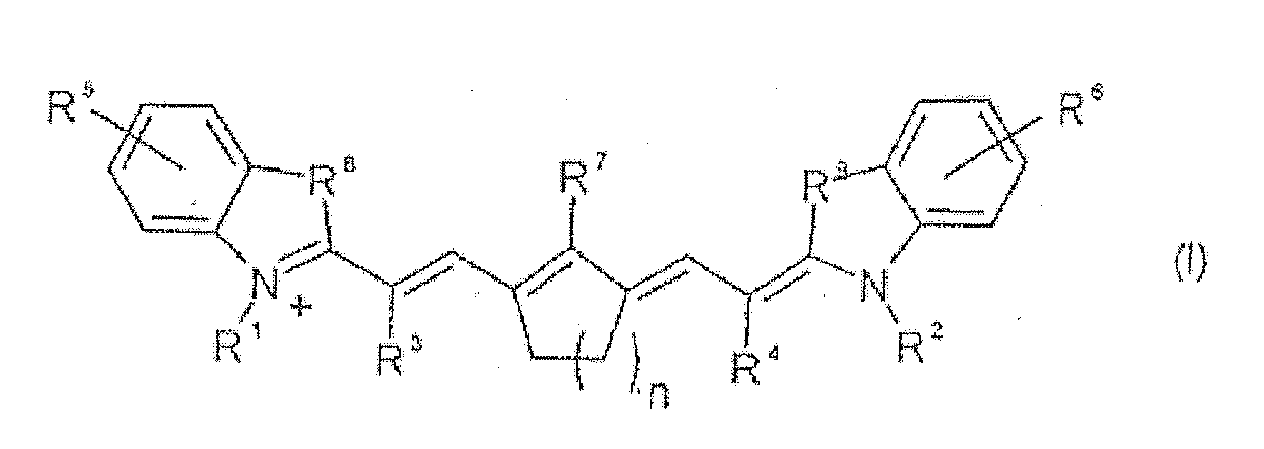


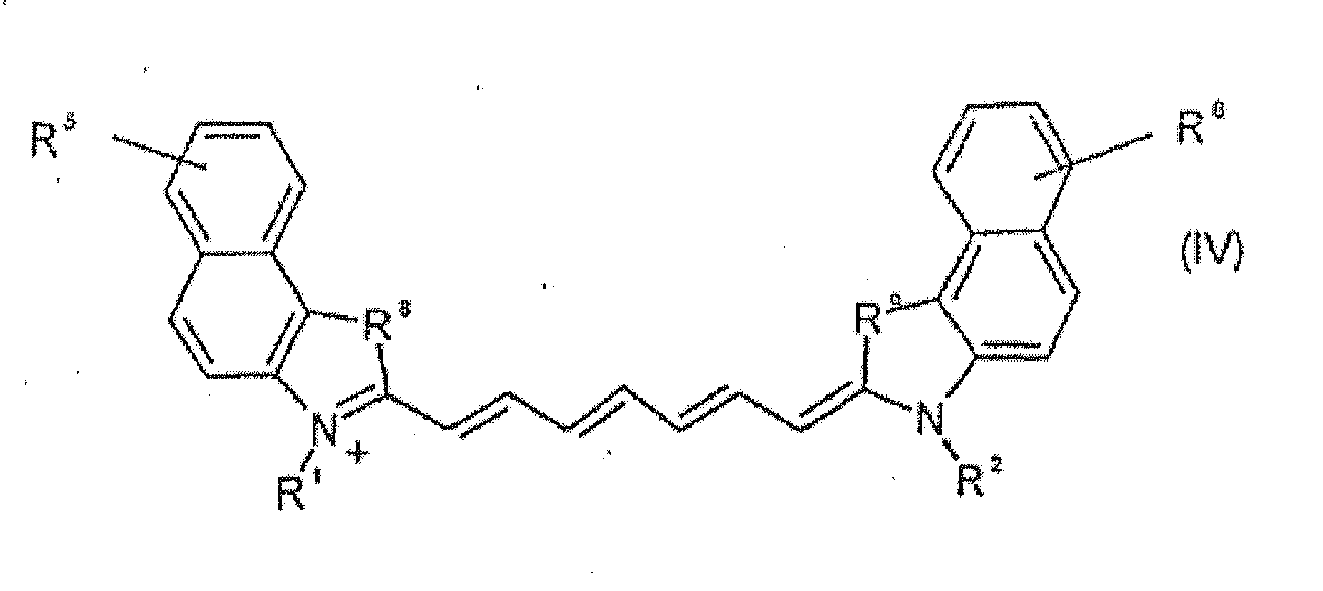 n représentant 1 ou 2 et les radicaux R1 à R9 signifiant ce qui suit .- R1 et R 2 indépendamment l'un de l'autre, un radical alkyle ou aralkyle, linéaire ou ramifié, le cas échéant davantage substitué, ayant 1 à 20 atomes de carbone,- R3 et R4, indépendamment l'un de l'autre, H ou CN,- R5 et R6, indépendamment l'un de l'autre, un ou plusieurs substituants, identiques ou différents, choisis parmi le groupe consistant en -H, -F, -Cl, -Br, -I, -NO2, -CN, -CF3, -R1, -OR1, aryle ou -0-aryle,- R7 -H, -Cl, -Br, -I, -phényle, -O-phényle, -S-phényle, -N(phényl)2, -pyridyle, un radical acide barbiturique ou un radical dimédone, où les radicaux phényle peuvent être également davantage substitués,- R8 et R9, indépendamment l'un de l' autre, >C(CH3)2, -O-, -S-, >NR1 ou -CH=CH-,et où l'anion Ym- présente la formule générale [AR10 k] m-, avec un groupe de tête A polaire, ionique, ainsi que k groupes non polaires R10, k représente un nombre parmi 1, 2 ou 3 et m 1 ou 2, et les groupes non polaires R10 sont choisis chacun indépendamment parmi le groupe :∘ des groupes alkyle linéaires, ramifiés ou cycliques ayant 6 à 30 atomes de carbone, ainsi que∘ des groupes aralkyle de la formule générale -aryl-R11, où R11 représente des groupes alkyle linéaires ou ramifiés ayant 3 à 30 atomes de carbone,ou l'anion Ym- est un anion borate de la formule générale (V) ou (VI) :
où dans les radicaux R10, R11 et R12, des atomes de carbone non voisins peuvent également être substitués le cas échéant par des atomes 0 et/ou les radicaux R10, R11 et R12 peuvent être complètement ou partiellement fluorés, à la condition que le caractère non polaire des groupes ne soit ainsi pas essentiellement influencé. - Encres d'impression selon la revendication 4, caractérisées en ce que le groupe de tête A, polaire, ionique est un radical acide mono- ou bivalent choisi parmi le groupe constitué de -SO3 -, -OSO3 -, -COO-, -PO3 2-, -OPO3 2- ou (-O)(-O)PO2 -.
- Encres d'impression selon la revendication 4 ou 5, caractérisées en ce que R10 est un groupe alkyle linéaire, ramifié ou cyclique ayant 6 à 12 atomes de carbone.
- Encres d'impression selon la revendication 6, caractérisées en ce que R10 est un groupe alkyle linéaire.
- Encres d'impression selon la revendication 4 ou 5, caractérisées en ce que R11 présente 6 à 12 atomes de carbone.
- Encres d'impression selon la revendication 8, caractérisées en ce que R11 est un groupe alkyle linéaire.
- Encres d'impression selon l'une des revendications 1 à 9, caractérisées en ce que la quantité d'absorbeur NIR dans l'encre d'impression se situe dans l'intervalle allant de 0,05 à 4 % en poids, par rapport à la somme de tous les constituants de l'encre.
- Utilisation d'une encre d'impression selon l'une des revendications 1 à 10 dans des procédés d'impression, dans lesquels le durcissement de l'encre d'impression est soutenu par l'utilisation de sources de rayonnement IR, dont la longueur d'onde n'est pas en résonance avec les longueurs d'onde d'absorption de l'eau.
- Absorbeur NIR consistant en un cation cyanine X+ et en un anion correspondant 1/m Ym-, où le cation présente une formule générale choisie parmi le groupe de (I) à (IV) :


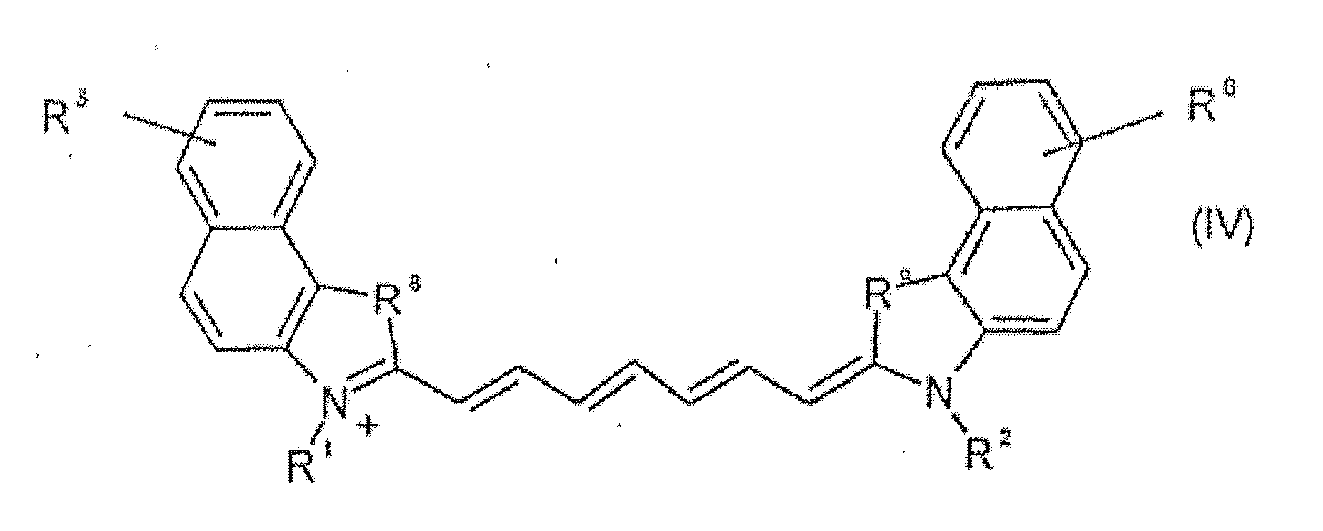 n représentant 1 ou 2 et les radicaux R1 à R9 signifiant ce qui suit :- R1 et R2, indépendamment l'un de l'autre, un radical alkyle ou aralkyle, linéaire ou ramifié, le cas échéant davantage substitué, ayant 1 à 20 atomes de carbone,- R3 et R4, indépendamment l'un de l'autre, H ou CLIP,- R5 et R6, indépendamment l' un de l' autre, un ou plusieurs substituants, identiques ou différents, choisis parmi le groupe consistant en -H, -F, -Cl, -Br, -I, -NO2, -CN, -CF3, -R1, -OR1, aryle ou -O-aryle,- R7 -H, -Cl, -Br, -I, -phényle, -O-phényle, -S-phényle, -N(phényl)2, -pyridyle, un radical acide barbiturique ou un radical dimédone, où les radicaux phényle peuvent être également davantage substitués,- R8 et R9, indépendamment l'un de l'autre, >C(CH3)2, -O-, -S-, >NR1 ou -CH=CH-,et où l'anion Ym- présente la formule générale [AR10 k] m-, avec un groupe de tête A polaire, ionique, ainsi que k groupes non polaires R10, k représente un nombre parmi 1, 2 ou 3 et m 1 ou 2, et les groupes non polaires R10 sont choisis chacun indépendamment parmi le groupe des :∘ des groupes alkyle linéaires, ramifiés ou cycliques ayant 6 à 30 atomes de carbone, ainsi que∘ des groupes aralkyle de la formule générale -aryl-R11, où R11 représente des groupes alkyle linéaires ou ramifiés ayant 3 à 30 atomes de carbone,ou l'anion Ym- est un anion borate de la formule générale (V) ou (VI) :
où dans les radicaux R10, R11 et R12, des atomes de carbone non voisins peuvent également être substitués le cas échéant par des atomes 0 et/ou les radicaux R10, R11 et R12 peuvent être complètement ou partiellement fluorés, à la condition que le caractère non polaire des groupes ne soit ainsi pas essentiellement influencé. - Absorbeur NIR selon la revendication 12, caractérisé en ce que le radical acide mono- ou bivalent A est un groupement choisi parmi le groupe constitué de -SO3 -, -OSO3 -, -COO-, -PO3 2-, -OPO3 2- ou (-O) (-O) PO2 -.
- Absorbeur NIR selon la revendication 12 ou 13, caractérisé en ce que R10 est un groupe alkyle linéaire ou ramifié ayant 6 à 12 atomes de carbone.
- Absorbeur NIR selon la revendication 14, caractérisé en ce que R10 est un groupe alkyle linéaire.
- Absorbeur NIR selon la revendication 12 ou 13, caractérisé en ce que R11 présente 6 à 12 atomes de carbone.
- Absorbeur NIR selon la revendication 16, caractérisé en ce que R11 est un groupe alkyle linéaire.
Priority Applications (1)
| Application Number | Priority Date | Filing Date | Title |
|---|---|---|---|
| PL05715651T PL1725624T3 (pl) | 2004-03-05 | 2005-03-02 | Farby drukarskie do druku offsetowego i/lub druku wypukłego zawierające absorbery NIR oraz absorbery NIR rozpuszczalne w farbach offsetowych i/lub farbach do druku wypukłego |
Applications Claiming Priority (2)
| Application Number | Priority Date | Filing Date | Title |
|---|---|---|---|
| DE102004011347A DE102004011347A1 (de) | 2004-03-05 | 2004-03-05 | Druckfarben für den Offset- und/oder Hochdruck mit NIR-Absorbern sowie in Offset- und/oder Hochdruckfarben lösliche NIR-Absorber |
| PCT/EP2005/002174 WO2005085372A1 (fr) | 2004-03-05 | 2005-03-02 | Encres d'impression destinees a l'impression offset et/ou en relief contenant des absorbeurs de spectre en proche infrarouge et absorbeurs de spectre en proche infrarouge solubles dans des encres d'impression offset et/ou en relief |
Publications (2)
| Publication Number | Publication Date |
|---|---|
| EP1725624A1 EP1725624A1 (fr) | 2006-11-29 |
| EP1725624B1 true EP1725624B1 (fr) | 2008-08-27 |
Family
ID=34895058
Family Applications (1)
| Application Number | Title | Priority Date | Filing Date |
|---|---|---|---|
| EP05715651A Expired - Lifetime EP1725624B1 (fr) | 2004-03-05 | 2005-03-02 | Encres d'impression destinees a l'impression offset et/ou en relief contenant des absorbeurs de spectre en proche infrarouge et absorbeurs de spectre en proche infrarouge solubles dans des encres d'impression offset et/ou en relief |
Country Status (11)
| Country | Link |
|---|---|
| US (2) | US7901494B2 (fr) |
| EP (1) | EP1725624B1 (fr) |
| JP (1) | JP4855383B2 (fr) |
| CN (1) | CN100572466C (fr) |
| AT (1) | ATE406422T1 (fr) |
| CA (1) | CA2557787C (fr) |
| DE (2) | DE102004011347A1 (fr) |
| DK (1) | DK1725624T3 (fr) |
| ES (1) | ES2309723T3 (fr) |
| PL (1) | PL1725624T3 (fr) |
| WO (1) | WO2005085372A1 (fr) |
Families Citing this family (21)
| Publication number | Priority date | Publication date | Assignee | Title |
|---|---|---|---|---|
| EP1602696B1 (fr) * | 2004-06-03 | 2008-07-02 | Sun Chemical B.V. (NL) | Composition d'encre thermodurcissable non-ondulante |
| KR100705927B1 (ko) * | 2005-10-26 | 2007-04-12 | 제일모직주식회사 | 근적외선 흡수 및 색보정 점착제 조성물 및 이를 이용한필름 |
| DE102006012329A1 (de) * | 2006-03-17 | 2007-09-20 | Man Roland Druckmaschinen Ag | Verfahren und Vorrichtung zur Erzeugung taktiler Oberflächen |
| GB0621475D0 (en) * | 2006-10-27 | 2006-12-06 | Datalase Ltd | Laser markable composition |
| DE102007053198A1 (de) * | 2006-11-17 | 2008-05-21 | Basf Ag | Photoinitiatoren für strahlungshärtbare Beschichtungsmassen |
| US20080184910A1 (en) * | 2007-02-06 | 2008-08-07 | Xerox Corporation | Colorant compounds |
| DE102008013312A1 (de) | 2007-03-29 | 2008-10-02 | Heidelberger Druckmaschinen Ag | Verfahren zum Behandeln eines mit Druckfarbe bedruckten Bedruckstoff |
| US8398760B2 (en) * | 2008-09-10 | 2013-03-19 | Datalase Ltd. | Energy activated compositions |
| WO2010055050A1 (fr) * | 2008-11-12 | 2010-05-20 | Basf Se | Matières de revêtement durcissables par rayonnement |
| ES2660964T3 (es) * | 2011-05-25 | 2018-03-26 | Tetra Laval Holdings & Finance Sa | Absorbedores de infrarrojo cercano mejorados |
| CN102516793B (zh) * | 2011-11-22 | 2014-02-05 | 大连理工大学 | 一类双苄基五甲川菁荧光染料、其制备方法及应用 |
| US9339832B2 (en) | 2012-03-22 | 2016-05-17 | Basf Se | Spraygun for producing cured coating films and methods of use thereof |
| JP2015512331A (ja) | 2012-03-22 | 2015-04-27 | ビーエイエスエフ・ソシエタス・エウロパエアBasf Se | 硬化塗膜の製造方法及び製造装置 |
| WO2013192307A1 (fr) * | 2012-06-21 | 2013-12-27 | Sun Chemical Corporation | Encres à base de solvant réagissant au laser fabriquées à partir de concentrés de mélanges maîtres |
| DE102012017010A1 (de) | 2012-08-28 | 2012-10-31 | Heidelberger Druckmaschinen Ag | Immonium-Absorber für Druckfarben und Lacke |
| JP5806183B2 (ja) * | 2012-08-31 | 2015-11-10 | 富士フイルム株式会社 | 可視用着色インク組成物および画像形成方法 |
| DE102013009135A1 (de) * | 2013-05-31 | 2014-12-04 | Heidelberger Druckmaschinen Ag | NIR-vernetzbare Druckfarbe |
| JP2015131928A (ja) * | 2014-01-15 | 2015-07-23 | 株式会社クレハ | 近赤外線硬化型組成物およびその用途 |
| CN105504994B (zh) * | 2014-10-14 | 2022-09-06 | 海德堡印刷机械股份公司 | 喷墨打印用的水基近红外干燥墨水 |
| JP7279718B2 (ja) * | 2018-06-28 | 2023-05-23 | Agc株式会社 | 光学フィルタおよび情報取得装置 |
| CN111334120A (zh) * | 2020-03-20 | 2020-06-26 | 徐州华艺彩色印刷有限公司 | 一种提高胶印油墨流动性的处理工艺 |
Family Cites Families (21)
| Publication number | Priority date | Publication date | Assignee | Title |
|---|---|---|---|---|
| DE3721850A1 (de) | 1987-07-02 | 1989-01-12 | Bayer Ag | Indolin-carbocyaninfarbstoffe |
| US4882265A (en) | 1988-05-18 | 1989-11-21 | E. I. Du Pont De Nemours And Company | Infrared laser recording film |
| DE3828753C2 (de) | 1988-08-25 | 1994-05-19 | Heidelberger Druckmasch Ag | Vorrichtung zum Trocknen von Druckprodukten in einer Druckmaschine |
| US5013642A (en) * | 1989-11-15 | 1991-05-07 | Eastman Kodak Company | Photographic element |
| JPH03251841A (ja) | 1990-03-01 | 1991-11-11 | Fuji Photo Film Co Ltd | ハロゲン化銀写真感光材料 |
| TW207021B (fr) * | 1990-07-23 | 1993-06-01 | Showa Denko Kk | |
| JPH0559290A (ja) | 1991-08-30 | 1993-03-09 | Mita Ind Co Ltd | シアニン色素およびインドレニン誘導体 |
| JP3215988B2 (ja) * | 1992-06-09 | 2001-10-09 | コニカ株式会社 | ヒートモード熱転写記録材料 |
| JPH05338356A (ja) | 1992-06-11 | 1993-12-21 | Mitsubishi Paper Mills Ltd | 感熱記録材料 |
| DE4308635A1 (de) | 1993-03-18 | 1994-09-22 | Basf Ag | Farbbänder, enthaltend im IR-Bereich absorbierende Verbindungen |
| JP3616130B2 (ja) | 1993-06-04 | 2005-02-02 | イーストマン コダック カンパニー | 感赤外線性光熱写真ハロゲン化銀要素及び画像形成性媒体の露光方法 |
| DE69413375T2 (de) * | 1993-12-10 | 1999-05-20 | Bando Chemical Industries Ltd., Kobe, Hyogo | Entfärbbarer Toner und dessen Herstellungsverfahren |
| JPH09249811A (ja) | 1996-03-18 | 1997-09-22 | Toyo Ink Mfg Co Ltd | 硬化性樹脂組成物、ワニスならびにそれを用いた印刷インキ |
| JP3917269B2 (ja) * | 1997-10-07 | 2007-05-23 | パイロットインキ株式会社 | 可逆熱変色性組成物 |
| US6846614B2 (en) * | 2002-02-04 | 2005-01-25 | Kodak Polychrome Graphics Llc | On-press developable IR sensitive printing plates |
| JP2003001953A (ja) | 2001-06-26 | 2003-01-08 | Konica Corp | レーザー熱転写記録材料及び画像記録方法 |
| EP1302735B1 (fr) | 2001-10-10 | 2014-01-01 | Heidelberger Druckmaschinen Aktiengesellschaft | Dispositif et procédé pour délivrer de l'énergie rayonnante sur un support d'impression dans une machine d'impression planographique |
| EP1308485A1 (fr) * | 2001-10-31 | 2003-05-07 | Sicpa Holding S.A. | Assortiment d' encres avec un marquage d'infrarouge |
| AU2003227030A1 (en) | 2002-03-11 | 2003-09-22 | Ciba Specialty Chemicals Holding Inc. | Process for exchanging the anions of cationic compounds |
| EP1359008B1 (fr) * | 2002-04-29 | 2005-08-31 | Agfa-Gevaert | Mélange photosensible, matériau pour l'enregistrement utilisant ce mélange, et procédé pour la fabrication d'une plaque d'impression |
| EP1403333A1 (fr) * | 2002-09-24 | 2004-03-31 | Sicpa Holding S.A. | Procédé et système d' encres pour marquer et authentifier les articles |
-
2004
- 2004-03-05 DE DE102004011347A patent/DE102004011347A1/de not_active Withdrawn
-
2005
- 2005-03-02 EP EP05715651A patent/EP1725624B1/fr not_active Expired - Lifetime
- 2005-03-02 CN CNB200580006935XA patent/CN100572466C/zh not_active Expired - Fee Related
- 2005-03-02 ES ES05715651T patent/ES2309723T3/es not_active Expired - Lifetime
- 2005-03-02 WO PCT/EP2005/002174 patent/WO2005085372A1/fr not_active Ceased
- 2005-03-02 AT AT05715651T patent/ATE406422T1/de not_active IP Right Cessation
- 2005-03-02 PL PL05715651T patent/PL1725624T3/pl unknown
- 2005-03-02 JP JP2007501204A patent/JP4855383B2/ja not_active Expired - Fee Related
- 2005-03-02 DK DK05715651T patent/DK1725624T3/da active
- 2005-03-02 CA CA2557787A patent/CA2557787C/fr not_active Expired - Fee Related
- 2005-03-02 DE DE502005005191T patent/DE502005005191D1/de not_active Expired - Lifetime
- 2005-03-02 US US10/591,250 patent/US7901494B2/en not_active Expired - Fee Related
-
2010
- 2010-11-19 US US12/950,529 patent/US8187373B2/en not_active Expired - Fee Related
Also Published As
| Publication number | Publication date |
|---|---|
| JP2007526379A (ja) | 2007-09-13 |
| US7901494B2 (en) | 2011-03-08 |
| DE502005005191D1 (de) | 2008-10-09 |
| WO2005085372A1 (fr) | 2005-09-15 |
| CA2557787C (fr) | 2012-01-10 |
| CN1926206A (zh) | 2007-03-07 |
| ATE406422T1 (de) | 2008-09-15 |
| US20070277700A1 (en) | 2007-12-06 |
| EP1725624A1 (fr) | 2006-11-29 |
| US8187373B2 (en) | 2012-05-29 |
| US20110064884A1 (en) | 2011-03-17 |
| DE102004011347A1 (de) | 2005-09-29 |
| DK1725624T3 (da) | 2008-12-01 |
| PL1725624T3 (pl) | 2009-02-27 |
| JP4855383B2 (ja) | 2012-01-18 |
| CA2557787A1 (fr) | 2005-09-15 |
| CN100572466C (zh) | 2009-12-23 |
| ES2309723T3 (es) | 2008-12-16 |
Similar Documents
| Publication | Publication Date | Title |
|---|---|---|
| EP1725624B1 (fr) | Encres d'impression destinees a l'impression offset et/ou en relief contenant des absorbeurs de spectre en proche infrarouge et absorbeurs de spectre en proche infrarouge solubles dans des encres d'impression offset et/ou en relief | |
| DE69706004T2 (de) | Verfahren zur herstellung von drucktinte | |
| EP1294708B1 (fr) | Modificateurs de cristallisation a base de derives de quinophthalone | |
| EP0395988B1 (fr) | Préparations de pigments et leur utilisation | |
| EP0628607B1 (fr) | Naphtalocyanine | |
| EP0348347A2 (fr) | Procédé de préparation de solutions solides de quinacridones | |
| DE2832761B1 (de) | Verfahren zur UEberfuehrung von rohen und/oder grobkristallisierten Perylen-tetracarbonsaeurediimiden in eine Pigmentform | |
| DE3920251A1 (de) | Hochkonzentrierte feste pigmentpraeparationen | |
| DE69716338T2 (de) | Verfahren zur Herstellung einer Pigmentzubereitun | |
| EP1723204B1 (fr) | Utilisation d une composition de pigments avec des cristaux mixtes a base de pigment c.i. jaune 74 | |
| EP0290727B1 (fr) | Compositions de pâtes de pigments, leur procédé de fabrication et leur application | |
| DE69711995T2 (de) | Disazopigmentzusammensetzung und Drucktinten | |
| EP0225606A2 (fr) | Préparations de pigment sous forme de pâte, leur procédé de fabrication et leur utilisation | |
| DE4114863C2 (de) | Pastenförmige Pigmentpräparationen, Verfahren zu ihrer Herstellung und ihre Verwendung | |
| DE3331998A1 (de) | Verfahren zum konditionieren von rohem phthalocyaninpigment und phthalocyaninpigmentprodukt | |
| EP1199309B1 (fr) | Procédé de préparation de nouvelles modifications cristallines d'un pigment benzimidazolonedioxazine méthyl-substitué | |
| EP0211324A2 (fr) | Préparation d'encres hélio pour illustrations | |
| EP4526383B1 (fr) | Préparation pigmentaire à base de pigment c.i. violet 23 | |
| EP0074559B1 (fr) | Bêta-céto-amides et préparations pigmentaires contenant ces amides | |
| DE2702985C2 (de) | Verfahren zur Herstellung von deckenden Pyranthronpigmenten | |
| DE2504934A1 (de) | Farbstoffpraeparationen, deren herstellung und verwendung | |
| EP0211323A2 (fr) | Préparation d'encres d'impression chalcographique pour illustrations | |
| DE1546777B (de) | Druckfarbenbindemittel bzw. -firnisse |
Legal Events
| Date | Code | Title | Description |
|---|---|---|---|
| PUAI | Public reference made under article 153(3) epc to a published international application that has entered the european phase |
Free format text: ORIGINAL CODE: 0009012 |
|
| 17P | Request for examination filed |
Effective date: 20061005 |
|
| AK | Designated contracting states |
Kind code of ref document: A1 Designated state(s): AT BE BG CH CY CZ DE DK EE ES FI FR GB GR HU IE IS IT LI LT LU MC NL PL PT RO SE SI SK TR |
|
| DAX | Request for extension of the european patent (deleted) | ||
| GRAP | Despatch of communication of intention to grant a patent |
Free format text: ORIGINAL CODE: EPIDOSNIGR1 |
|
| RAP1 | Party data changed (applicant data changed or rights of an application transferred) |
Owner name: BASF SE Owner name: FLINT GROUP GERMANY GMBH |
|
| GRAS | Grant fee paid |
Free format text: ORIGINAL CODE: EPIDOSNIGR3 |
|
| GRAA | (expected) grant |
Free format text: ORIGINAL CODE: 0009210 |
|
| AK | Designated contracting states |
Kind code of ref document: B1 Designated state(s): AT BE BG CH CY CZ DE DK EE ES FI FR GB GR HU IE IS IT LI LT LU MC NL PL PT RO SE SI SK TR |
|
| REG | Reference to a national code |
Ref country code: GB Ref legal event code: FG4D Free format text: NOT ENGLISH |
|
| REG | Reference to a national code |
Ref country code: CH Ref legal event code: EP |
|
| REG | Reference to a national code |
Ref country code: IE Ref legal event code: FG4D Free format text: LANGUAGE OF EP DOCUMENT: GERMAN |
|
| REF | Corresponds to: |
Ref document number: 502005005191 Country of ref document: DE Date of ref document: 20081009 Kind code of ref document: P |
|
| REG | Reference to a national code |
Ref country code: DK Ref legal event code: T3 |
|
| REG | Reference to a national code |
Ref country code: ES Ref legal event code: FG2A Ref document number: 2309723 Country of ref document: ES Kind code of ref document: T3 |
|
| PG25 | Lapsed in a contracting state [announced via postgrant information from national office to epo] |
Ref country code: LT Free format text: LAPSE BECAUSE OF FAILURE TO SUBMIT A TRANSLATION OF THE DESCRIPTION OR TO PAY THE FEE WITHIN THE PRESCRIBED TIME-LIMIT Effective date: 20080827 Ref country code: IS Free format text: LAPSE BECAUSE OF FAILURE TO SUBMIT A TRANSLATION OF THE DESCRIPTION OR TO PAY THE FEE WITHIN THE PRESCRIBED TIME-LIMIT Effective date: 20081227 |
|
| PG25 | Lapsed in a contracting state [announced via postgrant information from national office to epo] |
Ref country code: SI Free format text: LAPSE BECAUSE OF FAILURE TO SUBMIT A TRANSLATION OF THE DESCRIPTION OR TO PAY THE FEE WITHIN THE PRESCRIBED TIME-LIMIT Effective date: 20080827 Ref country code: FI Free format text: LAPSE BECAUSE OF FAILURE TO SUBMIT A TRANSLATION OF THE DESCRIPTION OR TO PAY THE FEE WITHIN THE PRESCRIBED TIME-LIMIT Effective date: 20080827 |
|
| REG | Reference to a national code |
Ref country code: PL Ref legal event code: T3 |
|
| REG | Reference to a national code |
Ref country code: IE Ref legal event code: FD4D |
|
| PG25 | Lapsed in a contracting state [announced via postgrant information from national office to epo] |
Ref country code: IE Free format text: LAPSE BECAUSE OF FAILURE TO SUBMIT A TRANSLATION OF THE DESCRIPTION OR TO PAY THE FEE WITHIN THE PRESCRIBED TIME-LIMIT Effective date: 20080827 Ref country code: BG Free format text: LAPSE BECAUSE OF FAILURE TO SUBMIT A TRANSLATION OF THE DESCRIPTION OR TO PAY THE FEE WITHIN THE PRESCRIBED TIME-LIMIT Effective date: 20081127 |
|
| PG25 | Lapsed in a contracting state [announced via postgrant information from national office to epo] |
Ref country code: CZ Free format text: LAPSE BECAUSE OF FAILURE TO SUBMIT A TRANSLATION OF THE DESCRIPTION OR TO PAY THE FEE WITHIN THE PRESCRIBED TIME-LIMIT Effective date: 20080827 Ref country code: RO Free format text: LAPSE BECAUSE OF FAILURE TO SUBMIT A TRANSLATION OF THE DESCRIPTION OR TO PAY THE FEE WITHIN THE PRESCRIBED TIME-LIMIT Effective date: 20080827 Ref country code: SK Free format text: LAPSE BECAUSE OF FAILURE TO SUBMIT A TRANSLATION OF THE DESCRIPTION OR TO PAY THE FEE WITHIN THE PRESCRIBED TIME-LIMIT Effective date: 20080827 Ref country code: PT Free format text: LAPSE BECAUSE OF FAILURE TO SUBMIT A TRANSLATION OF THE DESCRIPTION OR TO PAY THE FEE WITHIN THE PRESCRIBED TIME-LIMIT Effective date: 20090127 |
|
| PLBE | No opposition filed within time limit |
Free format text: ORIGINAL CODE: 0009261 |
|
| STAA | Information on the status of an ep patent application or granted ep patent |
Free format text: STATUS: NO OPPOSITION FILED WITHIN TIME LIMIT |
|
| PG25 | Lapsed in a contracting state [announced via postgrant information from national office to epo] |
Ref country code: EE Free format text: LAPSE BECAUSE OF FAILURE TO SUBMIT A TRANSLATION OF THE DESCRIPTION OR TO PAY THE FEE WITHIN THE PRESCRIBED TIME-LIMIT Effective date: 20080827 |
|
| 26N | No opposition filed |
Effective date: 20090528 |
|
| BERE | Be: lapsed |
Owner name: FLINT GROUP GERMANY G.M.B.H. Effective date: 20090331 Owner name: BASF SE Effective date: 20090331 |
|
| PG25 | Lapsed in a contracting state [announced via postgrant information from national office to epo] |
Ref country code: MC Free format text: LAPSE BECAUSE OF NON-PAYMENT OF DUE FEES Effective date: 20090331 |
|
| PG25 | Lapsed in a contracting state [announced via postgrant information from national office to epo] |
Ref country code: SE Free format text: LAPSE BECAUSE OF FAILURE TO SUBMIT A TRANSLATION OF THE DESCRIPTION OR TO PAY THE FEE WITHIN THE PRESCRIBED TIME-LIMIT Effective date: 20081127 |
|
| PG25 | Lapsed in a contracting state [announced via postgrant information from national office to epo] |
Ref country code: BE Free format text: LAPSE BECAUSE OF NON-PAYMENT OF DUE FEES Effective date: 20090331 |
|
| PG25 | Lapsed in a contracting state [announced via postgrant information from national office to epo] |
Ref country code: AT Free format text: LAPSE BECAUSE OF NON-PAYMENT OF DUE FEES Effective date: 20090302 |
|
| PG25 | Lapsed in a contracting state [announced via postgrant information from national office to epo] |
Ref country code: GR Free format text: LAPSE BECAUSE OF FAILURE TO SUBMIT A TRANSLATION OF THE DESCRIPTION OR TO PAY THE FEE WITHIN THE PRESCRIBED TIME-LIMIT Effective date: 20081128 |
|
| PG25 | Lapsed in a contracting state [announced via postgrant information from national office to epo] |
Ref country code: LU Free format text: LAPSE BECAUSE OF NON-PAYMENT OF DUE FEES Effective date: 20090302 |
|
| PG25 | Lapsed in a contracting state [announced via postgrant information from national office to epo] |
Ref country code: HU Free format text: LAPSE BECAUSE OF FAILURE TO SUBMIT A TRANSLATION OF THE DESCRIPTION OR TO PAY THE FEE WITHIN THE PRESCRIBED TIME-LIMIT Effective date: 20090228 |
|
| PG25 | Lapsed in a contracting state [announced via postgrant information from national office to epo] |
Ref country code: TR Free format text: LAPSE BECAUSE OF FAILURE TO SUBMIT A TRANSLATION OF THE DESCRIPTION OR TO PAY THE FEE WITHIN THE PRESCRIBED TIME-LIMIT Effective date: 20080827 |
|
| PG25 | Lapsed in a contracting state [announced via postgrant information from national office to epo] |
Ref country code: CY Free format text: LAPSE BECAUSE OF FAILURE TO SUBMIT A TRANSLATION OF THE DESCRIPTION OR TO PAY THE FEE WITHIN THE PRESCRIBED TIME-LIMIT Effective date: 20080827 |
|
| REG | Reference to a national code |
Ref country code: ES Ref legal event code: PC2A Owner name: FLINT GROUP GERMANY GMBH Effective date: 20140220 |
|
| REG | Reference to a national code |
Ref country code: DE Ref legal event code: R081 Ref document number: 502005005191 Country of ref document: DE Owner name: FLINT GROUP GERMANY GMBH, DE Free format text: FORMER OWNER: BASF SE, FLINT GROUP GERMANY GMBH, , DE Effective date: 20140224 Ref country code: DE Ref legal event code: R081 Ref document number: 502005005191 Country of ref document: DE Owner name: FLINT GROUP GERMANY GMBH, DE Free format text: FORMER OWNERS: BASF SE, 67063 LUDWIGSHAFEN, DE; FLINT GROUP GERMANY GMBH, 70469 STUTTGART, DE Effective date: 20140224 |
|
| REG | Reference to a national code |
Ref country code: NL Ref legal event code: SD Effective date: 20140606 |
|
| REG | Reference to a national code |
Ref country code: FR Ref legal event code: PLFP Year of fee payment: 11 |
|
| PGFP | Annual fee paid to national office [announced via postgrant information from national office to epo] |
Ref country code: IT Payment date: 20150327 Year of fee payment: 11 Ref country code: NL Payment date: 20150323 Year of fee payment: 11 Ref country code: ES Payment date: 20150325 Year of fee payment: 11 Ref country code: CH Payment date: 20150325 Year of fee payment: 11 Ref country code: DK Payment date: 20150325 Year of fee payment: 11 |
|
| PGFP | Annual fee paid to national office [announced via postgrant information from national office to epo] |
Ref country code: GB Payment date: 20150324 Year of fee payment: 11 Ref country code: FR Payment date: 20150319 Year of fee payment: 11 |
|
| PGFP | Annual fee paid to national office [announced via postgrant information from national office to epo] |
Ref country code: PL Payment date: 20150224 Year of fee payment: 11 |
|
| REG | Reference to a national code |
Ref country code: DK Ref legal event code: EBP Effective date: 20160331 |
|
| REG | Reference to a national code |
Ref country code: CH Ref legal event code: PL |
|
| REG | Reference to a national code |
Ref country code: NL Ref legal event code: MM Effective date: 20160401 |
|
| GBPC | Gb: european patent ceased through non-payment of renewal fee |
Effective date: 20160302 |
|
| REG | Reference to a national code |
Ref country code: FR Ref legal event code: ST Effective date: 20161130 |
|
| PG25 | Lapsed in a contracting state [announced via postgrant information from national office to epo] |
Ref country code: NL Free format text: LAPSE BECAUSE OF NON-PAYMENT OF DUE FEES Effective date: 20160401 Ref country code: LI Free format text: LAPSE BECAUSE OF NON-PAYMENT OF DUE FEES Effective date: 20160331 Ref country code: CH Free format text: LAPSE BECAUSE OF NON-PAYMENT OF DUE FEES Effective date: 20160331 Ref country code: GB Free format text: LAPSE BECAUSE OF NON-PAYMENT OF DUE FEES Effective date: 20160302 Ref country code: FR Free format text: LAPSE BECAUSE OF NON-PAYMENT OF DUE FEES Effective date: 20160331 |
|
| PG25 | Lapsed in a contracting state [announced via postgrant information from national office to epo] |
Ref country code: IT Free format text: LAPSE BECAUSE OF NON-PAYMENT OF DUE FEES Effective date: 20160302 |
|
| REG | Reference to a national code |
Ref country code: ES Ref legal event code: FD2A Effective date: 20170428 |
|
| PG25 | Lapsed in a contracting state [announced via postgrant information from national office to epo] |
Ref country code: DK Free format text: LAPSE BECAUSE OF NON-PAYMENT OF DUE FEES Effective date: 20160331 |
|
| PG25 | Lapsed in a contracting state [announced via postgrant information from national office to epo] |
Ref country code: PL Free format text: LAPSE BECAUSE OF NON-PAYMENT OF DUE FEES Effective date: 20160302 Ref country code: ES Free format text: LAPSE BECAUSE OF NON-PAYMENT OF DUE FEES Effective date: 20160303 |
|
| PGFP | Annual fee paid to national office [announced via postgrant information from national office to epo] |
Ref country code: DE Payment date: 20180529 Year of fee payment: 14 |
|
| REG | Reference to a national code |
Ref country code: DE Ref legal event code: R119 Ref document number: 502005005191 Country of ref document: DE |
|
| PG25 | Lapsed in a contracting state [announced via postgrant information from national office to epo] |
Ref country code: DE Free format text: LAPSE BECAUSE OF NON-PAYMENT OF DUE FEES Effective date: 20191001 |