EP1726700B1 - Procédé et dispositif pour la fabrication d'un non-tissé - Google Patents
Procédé et dispositif pour la fabrication d'un non-tissé Download PDFInfo
- Publication number
- EP1726700B1 EP1726700B1 EP06008625A EP06008625A EP1726700B1 EP 1726700 B1 EP1726700 B1 EP 1726700B1 EP 06008625 A EP06008625 A EP 06008625A EP 06008625 A EP06008625 A EP 06008625A EP 1726700 B1 EP1726700 B1 EP 1726700B1
- Authority
- EP
- European Patent Office
- Prior art keywords
- filaments
- accordance
- deposition
- solidification
- equipment
- Prior art date
- Legal status (The legal status is an assumption and is not a legal conclusion. Google has not performed a legal analysis and makes no representation as to the accuracy of the status listed.)
- Expired - Lifetime
Links
Images


Classifications
-
- D—TEXTILES; PAPER
- D04—BRAIDING; LACE-MAKING; KNITTING; TRIMMINGS; NON-WOVEN FABRICS
- D04H—MAKING TEXTILE FABRICS, e.g. FROM FIBRES OR FILAMENTARY MATERIAL; FABRICS MADE BY SUCH PROCESSES OR APPARATUS, e.g. FELTS, NON-WOVEN FABRICS; COTTON-WOOL; WADDING ; NON-WOVEN FABRICS FROM STAPLE FIBRES, FILAMENTS OR YARNS, BONDED WITH AT LEAST ONE WEB-LIKE MATERIAL DURING THEIR CONSOLIDATION
- D04H3/00—Non-woven fabrics formed wholly or mainly of yarns or like filamentary material of substantial length
- D04H3/005—Synthetic yarns or filaments
-
- D—TEXTILES; PAPER
- D04—BRAIDING; LACE-MAKING; KNITTING; TRIMMINGS; NON-WOVEN FABRICS
- D04H—MAKING TEXTILE FABRICS, e.g. FROM FIBRES OR FILAMENTARY MATERIAL; FABRICS MADE BY SUCH PROCESSES OR APPARATUS, e.g. FELTS, NON-WOVEN FABRICS; COTTON-WOOL; WADDING ; NON-WOVEN FABRICS FROM STAPLE FIBRES, FILAMENTS OR YARNS, BONDED WITH AT LEAST ONE WEB-LIKE MATERIAL DURING THEIR CONSOLIDATION
- D04H1/00—Non-woven fabrics formed wholly or mainly of staple fibres or like relatively short fibres
- D04H1/40—Non-woven fabrics formed wholly or mainly of staple fibres or like relatively short fibres from fleeces or layers composed of fibres without existing or potential cohesive properties
- D04H1/44—Non-woven fabrics formed wholly or mainly of staple fibres or like relatively short fibres from fleeces or layers composed of fibres without existing or potential cohesive properties the fleeces or layers being consolidated by mechanical means, e.g. by rolling
- D04H1/50—Non-woven fabrics formed wholly or mainly of staple fibres or like relatively short fibres from fleeces or layers composed of fibres without existing or potential cohesive properties the fleeces or layers being consolidated by mechanical means, e.g. by rolling by treatment to produce shrinking, swelling, crimping or curling of fibres
-
- D—TEXTILES; PAPER
- D04—BRAIDING; LACE-MAKING; KNITTING; TRIMMINGS; NON-WOVEN FABRICS
- D04H—MAKING TEXTILE FABRICS, e.g. FROM FIBRES OR FILAMENTARY MATERIAL; FABRICS MADE BY SUCH PROCESSES OR APPARATUS, e.g. FELTS, NON-WOVEN FABRICS; COTTON-WOOL; WADDING ; NON-WOVEN FABRICS FROM STAPLE FIBRES, FILAMENTS OR YARNS, BONDED WITH AT LEAST ONE WEB-LIKE MATERIAL DURING THEIR CONSOLIDATION
- D04H3/00—Non-woven fabrics formed wholly or mainly of yarns or like filamentary material of substantial length
- D04H3/02—Non-woven fabrics formed wholly or mainly of yarns or like filamentary material of substantial length characterised by the method of forming fleeces or layers, e.g. reorientation of yarns or filaments
-
- D—TEXTILES; PAPER
- D04—BRAIDING; LACE-MAKING; KNITTING; TRIMMINGS; NON-WOVEN FABRICS
- D04H—MAKING TEXTILE FABRICS, e.g. FROM FIBRES OR FILAMENTARY MATERIAL; FABRICS MADE BY SUCH PROCESSES OR APPARATUS, e.g. FELTS, NON-WOVEN FABRICS; COTTON-WOOL; WADDING ; NON-WOVEN FABRICS FROM STAPLE FIBRES, FILAMENTS OR YARNS, BONDED WITH AT LEAST ONE WEB-LIKE MATERIAL DURING THEIR CONSOLIDATION
- D04H3/00—Non-woven fabrics formed wholly or mainly of yarns or like filamentary material of substantial length
- D04H3/02—Non-woven fabrics formed wholly or mainly of yarns or like filamentary material of substantial length characterised by the method of forming fleeces or layers, e.g. reorientation of yarns or filaments
- D04H3/03—Non-woven fabrics formed wholly or mainly of yarns or like filamentary material of substantial length characterised by the method of forming fleeces or layers, e.g. reorientation of yarns or filaments at random
- D04H3/033—Non-woven fabrics formed wholly or mainly of yarns or like filamentary material of substantial length characterised by the method of forming fleeces or layers, e.g. reorientation of yarns or filaments at random reorientation immediately after yarn or filament formation
-
- D—TEXTILES; PAPER
- D04—BRAIDING; LACE-MAKING; KNITTING; TRIMMINGS; NON-WOVEN FABRICS
- D04H—MAKING TEXTILE FABRICS, e.g. FROM FIBRES OR FILAMENTARY MATERIAL; FABRICS MADE BY SUCH PROCESSES OR APPARATUS, e.g. FELTS, NON-WOVEN FABRICS; COTTON-WOOL; WADDING ; NON-WOVEN FABRICS FROM STAPLE FIBRES, FILAMENTS OR YARNS, BONDED WITH AT LEAST ONE WEB-LIKE MATERIAL DURING THEIR CONSOLIDATION
- D04H3/00—Non-woven fabrics formed wholly or mainly of yarns or like filamentary material of substantial length
- D04H3/02—Non-woven fabrics formed wholly or mainly of yarns or like filamentary material of substantial length characterised by the method of forming fleeces or layers, e.g. reorientation of yarns or filaments
- D04H3/03—Non-woven fabrics formed wholly or mainly of yarns or like filamentary material of substantial length characterised by the method of forming fleeces or layers, e.g. reorientation of yarns or filaments at random
- D04H3/037—Non-woven fabrics formed wholly or mainly of yarns or like filamentary material of substantial length characterised by the method of forming fleeces or layers, e.g. reorientation of yarns or filaments at random reorientation by liquid
-
- D—TEXTILES; PAPER
- D04—BRAIDING; LACE-MAKING; KNITTING; TRIMMINGS; NON-WOVEN FABRICS
- D04H—MAKING TEXTILE FABRICS, e.g. FROM FIBRES OR FILAMENTARY MATERIAL; FABRICS MADE BY SUCH PROCESSES OR APPARATUS, e.g. FELTS, NON-WOVEN FABRICS; COTTON-WOOL; WADDING ; NON-WOVEN FABRICS FROM STAPLE FIBRES, FILAMENTS OR YARNS, BONDED WITH AT LEAST ONE WEB-LIKE MATERIAL DURING THEIR CONSOLIDATION
- D04H3/00—Non-woven fabrics formed wholly or mainly of yarns or like filamentary material of substantial length
- D04H3/08—Non-woven fabrics formed wholly or mainly of yarns or like filamentary material of substantial length characterised by the method of strengthening or consolidating
- D04H3/14—Non-woven fabrics formed wholly or mainly of yarns or like filamentary material of substantial length characterised by the method of strengthening or consolidating with bonds between thermoplastic yarns or filaments produced by welding
-
- D—TEXTILES; PAPER
- D04—BRAIDING; LACE-MAKING; KNITTING; TRIMMINGS; NON-WOVEN FABRICS
- D04H—MAKING TEXTILE FABRICS, e.g. FROM FIBRES OR FILAMENTARY MATERIAL; FABRICS MADE BY SUCH PROCESSES OR APPARATUS, e.g. FELTS, NON-WOVEN FABRICS; COTTON-WOOL; WADDING ; NON-WOVEN FABRICS FROM STAPLE FIBRES, FILAMENTS OR YARNS, BONDED WITH AT LEAST ONE WEB-LIKE MATERIAL DURING THEIR CONSOLIDATION
- D04H3/00—Non-woven fabrics formed wholly or mainly of yarns or like filamentary material of substantial length
- D04H3/08—Non-woven fabrics formed wholly or mainly of yarns or like filamentary material of substantial length characterised by the method of strengthening or consolidating
- D04H3/14—Non-woven fabrics formed wholly or mainly of yarns or like filamentary material of substantial length characterised by the method of strengthening or consolidating with bonds between thermoplastic yarns or filaments produced by welding
- D04H3/147—Composite yarns or filaments
-
- D—TEXTILES; PAPER
- D04—BRAIDING; LACE-MAKING; KNITTING; TRIMMINGS; NON-WOVEN FABRICS
- D04H—MAKING TEXTILE FABRICS, e.g. FROM FIBRES OR FILAMENTARY MATERIAL; FABRICS MADE BY SUCH PROCESSES OR APPARATUS, e.g. FELTS, NON-WOVEN FABRICS; COTTON-WOOL; WADDING ; NON-WOVEN FABRICS FROM STAPLE FIBRES, FILAMENTS OR YARNS, BONDED WITH AT LEAST ONE WEB-LIKE MATERIAL DURING THEIR CONSOLIDATION
- D04H3/00—Non-woven fabrics formed wholly or mainly of yarns or like filamentary material of substantial length
- D04H3/08—Non-woven fabrics formed wholly or mainly of yarns or like filamentary material of substantial length characterised by the method of strengthening or consolidating
- D04H3/16—Non-woven fabrics formed wholly or mainly of yarns or like filamentary material of substantial length characterised by the method of strengthening or consolidating with bonds between thermoplastic filaments produced in association with filament formation, e.g. immediately following extrusion
Definitions
- the invention relates to a method for producing a spunbonded nonwoven fabric from continuous filaments and to an apparatus for carrying out this method.
- the continuous filaments consist of a thermoplastic material.
- Endless filaments differ because of their quasi-endless length of staple fibers having much smaller lengths of, for example, 10 to 60 mm.
- the invention is the technical problem of providing a method for producing a spunbonded filament of continuous filaments, can be controlled or minimized with the disadvantageous shrinking forces and can be made with the advantageously thick or voluminous spunbonded nonwoven.
- the invention is further based on the technical problem of specifying a corresponding device.
- the invention teaches a method for producing a voluminous spunbonded nonwoven with natural crimping, wherein the filaments are passed through a drawing unit and thereafter through a diffuser, The filaments are then deposited on a storage device as crimped filaments and wherein these deposited crimped filaments are supplied with this depositing means to a solidifying device in which the filaments are solidified with a fluid. It is within the scope of the invention that the solidification is carried out as thermal solidification with a hot fluid.
- the filaments with natural crimp, non-crimping spun and deposited on the filing device are preferably, in addition to the filaments with natural crimp, non-crimping spun and deposited on the filing device.
- a single-layer or else a multi-layer spunbonded fabric can be produced.
- the individual layers can be formed from natural crimp or non-crimping filaments or blends of natural crimp filaments with non-crimping filaments.
- the spunbonded web according to the invention comprises at least one layer which consists exclusively of natural crimp filaments or of a mixture of natural crimp filaments with non-crimping filaments.
- the spunbond web according to the invention can also be produced as a single-layer spunbonded web which consists entirely of filaments with natural crimping.
- the endless filaments are spun from a spinning head or from a spinnerette.
- the spun continuous filaments are then conveniently cooled and drawn, the cooling and drawing taking place in particular in a combined cooling and drawing unit.
- the term stretching unit also means a combined cooling and drawing unit.
- the diffuser is then arranged between drawing unit and depositing device or between cooling and drawing unit and depositing device. The diffuser is of particular importance in the context of the invention.
- the spun continuous filaments are in particular according to the Reicofil III method ( DE-PS 196 20 379 ) or according to the Reicofil IV method ( EP-OS 1 340 843 ).
- the filaments are deposited on the depositing device and supplied to the solidifying device with this depositing means in the context of the invention in particular that the mechanically relatively weak and less resilient filament filing is guided or carried by this filing device until a loadable by the H Schotece has arisen. It is within the scope of the invention that the deposited filaments are supplied directly to the solidification device with the depositing device, without any prior solidification, for example with a calender. Preferably, no further devices or units for mechanical and / or thermal treatment of the filament deposit are interposed between the depositing area of the filaments on the depositing device and the solidifying device. The filament deposit is thus transported further between its storage area and the solidification device only with the storage device.
- Thermal solidification with a hot fluid means in the context of the method according to the invention in particular the solidification with the aid of a gaseous hot fluid, in particular the thermal solidification with the aid of hot air.
- the hot fluid expediently flows transversely or perpendicular to the surface of the filament deposit onto the filament deposit.
- the solidification device is subjected to a two-dimensional loading of the filament deposit with the hot fluid.
- this preferred treatment according to the invention differs from the loading of the filament deposit with a focused air stream, in particular by means of a hot air knife ("hot air knife").
- the temperature of the hot fluid for thermal solidification is at least above the lowest softening point of all filament raw materials present in the filament deposit. In this way, the Filamentablage can be effectively stabilized.
- the filament deposit or the spunbond is flowed through by the hot fluid.
- filaments with natural crimping means in particular, filaments which have curvature radii of less than 5 mm after being deposited on the depositing device in the relaxed state.
- the filaments have corresponding crimps with the aforementioned radii of curvature over most of their length.
- This crimped state must be identifiable immediately after deposition, in particular after stretching and depositing of the filaments, ie without further mechanical or thermal influences on the filaments.
- the natural crimp filaments are multi-component filaments and preferably multi-component filaments with side / side arrangement and / or with acentric core / sheath arrangement.
- the filaments are deposited on a depositing device as crimped filaments thus means, in particular, that at least some of the naturally crimping filaments develop a crimp even before they are deposited, in particular after the stretching unit or in the diffuser. But these filaments can also develop between the diffuser and filing a crimp.
- the filaments may have a tendency to further or to additional crimping in the subsequent thermal consolidation.
- a crimp activation may be part of the thermal consolidation according to the invention.
- Non-curling filaments in the context of the invention means filaments which are deposited, as it were flat and with radii of curvature greater than 5 mm on the storage device.
- the non-crimping filaments are monocomponent filaments and / or multicomponent filaments having a symmetric core / cladding arrangement. It is within the scope of the invention that the monocomponent filaments are homogeneous full filaments.
- the filament deposit or the spunbonded web has at least one layer consisting of a mixture of filaments with natural crimping and non-crimping filaments.
- this filament mixture is spun from a single spinner and preferably then cooled together and stretched.
- the deposited on the filing device Filamentablage can also consist of at least one layer (layer) of non-crimping filaments and at least one applied layer (layer) of filaments with natural crimp. Then two or more spinning heads are expediently arranged one behind the other.
- An alternative to this is the pre-production of at least one of the layers (layers) mentioned, which can then run in particular from a roll.
- the filament deposit or the deposited layer of a spunbonded fabric has more than 20% by weight, preferably more than 30% by weight and preferably more than 40% by weight, of filaments with natural crimping. It is also within the scope of the invention that the rest of the filaments of this Filamentablage or this layer consists of non-crimping filaments.
- the spun filaments are first passed through a cooling device and through a drawing unit or through a combined cooling and drawing unit, then passed through the diffuser and then deposited on the storage device.
- the cooling device or in the combined cooling and drafting unit normally takes place an air supply or an air intake of cooling air.
- On or in the diffuser or between diffuser and drawing unit is at least one Provided ambient air inlet gap.
- the closed system has proven particularly useful in the context of the method according to the invention and for the solution of the technical problem according to the invention.
- the diffuser is of particular importance for the solution of the technical problem according to the invention.
- the diffuser downstream of the diffuser can be achieved in combination with the other features according to the invention an effective crimping of naturally curling filaments before their storage. In this way, an advantageously thick or voluminous spunbonded fabric can be produced.
- the filament deposit or the spunbonded nonwoven is guided with the depositing device through the solidification device.
- the spunbonded fabric is transported with the depositing device to the solidifying device or through the solidifying device.
- the storage device has at least one storage unit. It is within the scope of the invention that the storage unit is a conveyor unit or a conveyor belt for filament storage.
- a storage device which consists of at least one storage unit in the form of a gas-permeable (air-permeable) wire belt.
- a screen belt is in particular an over Pulleys guided endless belt.
- the use of a wire belt as a storage unit or the use of screen belts in the storage device has proven particularly useful.
- the spunbonded fabric in the solidification device is subjected to the hot fluid with the proviso that the spunbonded fabric is pressed against the deposition device, in particular against a gas-permeable screen belt of the deposition device.
- the hot fluid flows through the spunbonded web and the gas-permeable screen belt.
- the spunbonded fabric can also be acted upon successively from opposite directions with regard to its upper side and its underside with the hot fluid.
- the storage device consists of a first storage unit, in particular in the form of a wire belt, on which the spun filaments are deposited and that the spunbond (filament) with this first storage unit to a second storage unit, in particular Form of a wire belt, is transported and transported by this second storage unit through the solidification device.
- the second storage unit conveys the spunbonded fabric with a transport speed reduced in relation to the first storage unit.
- the first and second storage units directly adjoin one another, without an additional storage unit or conveyor being interposed. In this embodiment, the spunbonded fabric is thus transferred directly from the first storage unit to the second storage unit.
- the spunbonded fabric is transported on the underside of this third storage unit, in particular on the underside of a third sieve belt.
- the spunbonded fabric is expediently held with the aid of suction air at the bottom of the third storage unit. It is in this embodiment, within the scope of the invention, that the transport speed reduces the spunbonded from the first storage unit to the third storage unit and further reduced from the third storage unit to the second storage unit.
- An embodiment of the invention is characterized in that the filaments are deposited on top of a first storage unit and are transported with this first storage unit to a second storage unit.
- the filament tray is then transferred from the first storage unit directly to the second storage unit and transported on the underside of the second storage unit by the solidification device.
- first storage unit and second storage unit preferably consist of screen belts. Conveniently, the transport speed of the second storage unit is less than the transport speed of the first storage unit.
- a further embodiment of the invention is characterized in that the filaments are deposited on a first depositing unit, preferably on a first screen belt, and subsequently transported between the first depositing unit and a second depositing unit, which is preferably designed as a second screen belt, through the solidifying device.
- the spunbonded fabric is suitably held here between a lower wire belt and an upper wire belt during thermal consolidation.
- the spunbond web thermally bonded in the consolidation device is subsequently subjected to a final consolidation.
- This final consolidation may in particular be a hydroentanglement of the spunbonded nonwoven.
- the invention further relates to an apparatus for producing a voluminous spunbond, wherein at least one spinning device for Provision is made of filaments with natural crimping, wherein furthermore a depositing device for filing the filaments with natural crimping is present and wherein a solidification device for solidifying the Filamentablage (spunbonded) is arranged with the proviso that the Filamentablage (spunbonded) with the filing device directly into the solidification device is insertable.
- non-curling filaments can also be produced with the device.
- a preferred embodiment of the device according to the invention is characterized in that a cooling and stretching unit for the filaments is arranged between the spinning device and the depositing device.
- a diffuser for the filaments is also present between the drawing unit and the depositing device.
- the invention is based on the finding that voluminous or thick spunbonded nonwovens can be produced with the method according to the invention and with the device according to the invention, which are distinguished by excellent quality and homogeneous properties.
- These bulky spunbonded fabrics produced according to the invention can be readily compared with the known "high loft nonwovens" of staple fibers in terms of their thickness.
- spunbonded nonwovens can be produced from continuous fibers which have no inhomogeneities or openings or holes caused by uncontrolled shrinkage forces. With the process control according to the invention can an effective control of the shrinkage forces can be achieved.
- the voluminous filament deposit obtained particularly with the aid of the crimped filaments can be effectively fixed by the direct thermal solidification with the hot fluid, while maintaining or even increasing the thickness of the spunbonded web.
- the invention is based on the recognition that the Filamentablage on the storage device, with which it is introduced directly into the thermal solidification device, is effectively supported and guided and that in the direct thermal consolidation, a fixation of the filament deposit can take place without the Filamentablage by included shrinking forces undesirable opened or destroyed.
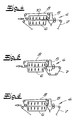
- the Fig. 1 to 7 show a device for carrying out the method according to the invention for producing a bulky spunbonded nonwoven 1 of continuous filaments 2, 3.
- the natural crimp filaments 2 may be acentric core / clad filaments 2 ( Fig. 9 ) or filaments 2 with side / side arrangement ( 10 and 11 ).
- Fig. 10 is a bicomponent filament 2 with symmetrical side / side arrangement and in Fig. 11 a bicomponent filament 2 with asymmetric side / side arrangement shown.
- unillustrated monocomponent filaments can be used or multicomponent filaments or bicomponent filaments 3 with symmetrical core / sheath arrangement (US Pat. Fig. 8 ).
- the spun with one or more spinning devices not shown filaments 2, 3 are advantageously first performed for cooling by a cooling device, not shown, and then for drawing the filaments 2, 3 by a stretching unit, also not shown.
- the diffuser unit is adjoined by a diffuser 5 with diverging diffuser walls, which is inserted into the diffuser Fig. 1 to 7 has been shown schematically.
- the filaments 2, 3 are deposited on the depositing device 4.
- the filaments 2, 3 are fed directly to a solidification device 6, in which the filaments 2, 3 are thermally consolidated with a hot fluid, preferably with hot air.
- a solidification device 6 in which the filaments 2, 3 are thermally consolidated with a hot fluid, preferably with hot air.
- the filaments 2, 3 are supplied with the storage device 4 directly and without the interposition of other solidification devices of the thermal hot fluidification.
- the application of the hot air in the solidifying device 6 has been illustrated by arrows. These arrows show that the hot air preferably impinges perpendicular to the surface of the depositing device 4 and perpendicular or substantially perpendicular to the surface of the spunbonded nonwoven 1. By this action on the hot air, the spunbonded fabric 1 is pressed against the depositing device 4.
- another arrow can be seen below the diffuser 5.
- This arrow is intended to make it clear that air is sucked in through the gas-permeable storage device 4 under the depositing device 4 below the diffuser 5 or below the depositing area of the filaments 2, 3 in order to ensure a functionally reliable filing of the filaments 2, 3 in the usual way.
- Fig. 1 shows a first embodiment of a device according to the invention, in which the storage device 4 consists of a single storage unit in the form of a sieve belt 7.
- the deposited below the diffuser 5 filaments 2, 3 are introduced directly into the solidification device 6 on the top of this screen belt 7 and there is the Filamentablage or the spunbonded fabric 1 thermally solidified with hot air.
- the storage device 4 from a first storage unit in the form of a first wire 7, on which the spun filaments 2, 3 are stored.
- the spunbonded web 1 is guided to a second filing unit in the form of a second screen belt 8, and with this second screen belt 8 the spunbonded web 1 is transported through the solidifying device 6.
- the spunbonded fabric 1 is transported on the upper side of the two sieve belts 7, 8 and transferred directly from the first sieve belt 7, ie to the second sieve belt 8, without the interposition of further storage units.
- the transport speed of the second wire 8 is reduced with respect to the transport speed of the first wire 7. Also, by reducing the speed from the first wire 7 to the second wire 8, an undesirable shrinkage tendency in the filament tray can be effectively compensated.
- the storage device 4 consists of a first storage unit in the form of a first wire 7, a second storage unit in the form of a second wire 8 and a third storage unit in the form of a third wire 9.
- the filaments 2, 3 are first on the first wire 7 filed and then in the Fig. 3 transported to the left in the direction of the arrow to the third screen belt 9.
- the resting on the top of the first wire 7 filament tray is transferred to the bottom of the third wire 9.
- the filament tray is held by air suction on the underside of the third screen belt 9. This air intake on the third screen belt 9 is in Fig. 3 through an arrow indicated. From the bottom of the third wire 9, the filament tray is then transferred to the top of the second wire 8.
- Fig. 3 In the Fig.
- the transport speed of the first screen belt 7 reduces to the third screen belt 9 and the third screen belt 9 to the second screen belt 8. In other words, runs in the embodiment of Fig. 3 the first wire 7 with the highest transport speed, the third wire 9 with the second highest transport speed and the second wire 8 with the lowest transport speed.
- the filaments 2, 3 are deposited on the first wire 7 and initially transported on the top of this wire 7 to the left in the direction of solidification device 6. Subsequently, the filament tray is inserted into a gap 10 bounded by the lower first wire belt 7 and by an upper second wire belt 8. In this gap 10, the filament tray is transported through the solidification device 6. Due to the air forces in the solidification device 6, the filament deposit is raised from the top of the first wire 7 and pressed against the underside of the second wire 8 and, as it were further transported by the second wire 8 to the left.
- the filaments 2, 3 are placed on top of the first wire 7 and transported to the left in the direction of solidification device 6.
- the filament deposit gets in contact with an upper second wire 8 and is of the first wire 7 passed to the underside of the second wire 8 and transported on the underside of the second wire 8 by the solidification device 6.
- the filament deposit is held by the air forces in the solidification device 6 at the bottom of the second screen belt 8.
- the transport speed of the second wire 8 is as in the embodiment according to Fig. 4 Here too, preferably reduced with respect to the transport speed of the first wire 7.
- a further embodiment of the device according to the invention is in Fig. 6 shown.
- the filaments 2, 3 are deposited as on the other device variants on the top of the first wire 7 and transported to the left in the direction of solidification device 6.
- a second upper screen belt 8 is present in the area of the solidification device 6, a second upper screen belt 8 is present.
- the first lower wire belt 7 forms a gap with the second upper wire belt 8 and in this gap, the spunbonded fabric 1 is transported by the solidification device 6, wherein the spunbonded fabric in this embodiment both at the top of the first wire 7, and at the bottom of the second Siebbandes 8 is applied.
- the spunbond is thus as it were clamped between the screen belts 7, 8.
- Fig. 7 shows a device variant for the production of a two-ply spunbonded web 1.
- two spinning heads not shown, with which filaments 2, 3 are spun, which are stored on successively arranged storage areas on top of the first wire 7.
- the two filament deposits are then transferred from the first wire 7 directly to a second wire 8 and transported on the top of this second wire 8 and passed through the solidification device 6.
- suction areas are not only present under the two diffusers 5, but also between the storage areas or between the diffusers 5 below the first sieve belt 7.
Landscapes
- Engineering & Computer Science (AREA)
- Textile Engineering (AREA)
- Mechanical Engineering (AREA)
- Nonwoven Fabrics (AREA)
- Spinning Methods And Devices For Manufacturing Artificial Fibers (AREA)
- Yarns And Mechanical Finishing Of Yarns Or Ropes (AREA)
Claims (15)
- Procédé de fabrication d'un filé-lié (1) avec des filaments (2) à ondulation naturelle, dans lequel les filaments (2) sont guidés dans une unité d'étirage puis dans un diffuseur (5), au moins une partie des filaments ondulant naturellement se mettant à onduler dès leur dépôt dans le diffuseur (5), les filaments sont ensuite déposés sous forme de filaments ondulés sur un dispositif de dépôt et ces filaments ondulés déposés étant acheminés au moyen de cette unité de dépôt vers un dispositif de consolidation dans lequel les filaments (2) sont consolidés à l'aide d'un fluide.
- Procédé selon la revendication 1, dans lequel la consolidation est réalisée sous forme d'une consolidation thermique à l'aide d'un fluide chaud.
- Procédé selon une des revendications 1 ou 2, dans lequel les filaments (2) à ondulation naturelle sont des filaments multicomposants, en particulier des filaments multicomposants disposés côte à côte et/ou avec un coeur/une enveloppe décentré.
- Procédé selon une des revendications 1 à 3, dans lequel, en plus des filaments (2) à ondulation naturelle, des filaments non ondulés (3) sont également filés et déposés sur le dispositif de dépôt.
- Procédé selon la revendication 4, dans lequel les filaments non ondulés (3) sont des filaments monocomposants et/ou des filaments multicomposants à disposition symétrique du coeur/de l'enveloppe.
- Procédé selon une des revendications 4 ou 5, dans lequel le filé-lié (1) présente au moins une couche qui consiste en un mélange de filaments (2) à ondulation naturelle et de filaments (3) à ondulation non naturelle.
- Procédé selon la revendication 6, dans lequel l'épaisseur présente plus de 20 % en poids de filaments (2) à ondulation naturelle, de préférence plus de 30 % en poids de filaments (2) à ondulation naturelle.
- Procédé selon une des revendications 1 à 7, dans lequel on travaille avec un dispositif de dépôt (4) qui consiste en au moins une unité de dépôt se présentant sous forme d'une bande de criblage perméable au gaz.
- Procédé selon une des revendications 2 à 8, dans lequel le filé-lié (1) est sollicité dans l'unité de consolidation (6) avec le fluide chaud en veillant à ce que le filé-lié (1) soit comprimé contre le dispositif de dépôt (4), en particulier contre une bande de criblage perméable au gaz du dispositif de dépôt (4).
- Procédé selon une des revendications 1 à 9, dans lequel le dispositif de dépôt (4) consiste en une unique unité de dépôt se présentant sous forme d'une bande de criblage (7) et le filé-lié (1) est transporté sur cette unique unité de dépôt dans le dispositif de consolidation (6).
- Procédé selon une des revendications 1 à 9, dans lequel le dispositif de dépôt (4) consiste en une première unité de dépôt se présentant en particulier sous forme d'une première bande de criblage (7) sur laquelle les filaments filés (2, 3) sont déposés, le filé-lié (1) est transporté par la première unité de dépôt vers une seconde unité de dépôt se présentant en particulier sous forme d'une seconde bande de criblage (8) et par cette seconde unité de dépôt dans le dispositif de consolidation (6).
- Procédé selon la revendication 11, dans lequel la seconde unité de dépôt transporte le filé-lié (1) à une vitesse de transport réduite par rapport à la première unité de dépôt.
- Procédé selon une des revendications 1 à 9 ou 11 ou 12, dans lequel le filé-lié (1) est déposé sur le dessus d'une première unité de dépôt et sur le dessous d'une seconde unité de dépôt dans le dispositif de consolidation (6).
- Procédé selon une des revendications 1 à 9 ou 11 à 13, dans lequel le filé-lié (1) est déposé sur une première unité de dépôt puis transporté entre la première et la seconde unité de dépôt dans le dispositif de consolidation (6).
- Procédé selon une des revendications 1 à 14, dans lequel le filé-lié consolidé thermiquement subit ensuite une consolidation finale.
Priority Applications (7)
| Application Number | Priority Date | Filing Date | Title |
|---|---|---|---|
| EP06008625A EP1726700B1 (fr) | 2005-05-25 | 2006-04-26 | Procédé et dispositif pour la fabrication d'un non-tissé |
| PL06008625T PL1726700T3 (pl) | 2005-05-25 | 2006-04-26 | Sposób i urządzenie do wytwarzania włókniny "spod filiery" |
| US11/430,267 US7922849B2 (en) | 2005-05-25 | 2006-05-08 | Process and apparatus for manufacturing spun-bonded fabric |
| KR1020060046163A KR20060121727A (ko) | 2005-05-25 | 2006-05-23 | 스펀 본드 직물의 제조 방법 및 장치 |
| JP2006144273A JP4768514B2 (ja) | 2005-05-25 | 2006-05-24 | スパンボンド不織布の製造方法及びその方法を実施するための装置 |
| BRPI0601919A BRPI0601919B1 (pt) | 2005-05-25 | 2006-05-24 | processo e aparelho para fabricação de pano não tecido pelo processo de formação de tecido não tecido |
| CN2006100845107A CN1869307B (zh) | 2005-05-25 | 2006-05-25 | 制造纺粘织物的方法及其装置 |
Applications Claiming Priority (2)
| Application Number | Priority Date | Filing Date | Title |
|---|---|---|---|
| EP05011330A EP1726699A1 (fr) | 2005-05-25 | 2005-05-25 | Procédé et dispositif pour la fabrication d'un non-tissé |
| EP06008625A EP1726700B1 (fr) | 2005-05-25 | 2006-04-26 | Procédé et dispositif pour la fabrication d'un non-tissé |
Publications (2)
| Publication Number | Publication Date |
|---|---|
| EP1726700A1 EP1726700A1 (fr) | 2006-11-29 |
| EP1726700B1 true EP1726700B1 (fr) | 2013-02-27 |
Family
ID=37136771
Family Applications (1)
| Application Number | Title | Priority Date | Filing Date |
|---|---|---|---|
| EP06008625A Expired - Lifetime EP1726700B1 (fr) | 2005-05-25 | 2006-04-26 | Procédé et dispositif pour la fabrication d'un non-tissé |
Country Status (6)
| Country | Link |
|---|---|
| US (1) | US7922849B2 (fr) |
| EP (1) | EP1726700B1 (fr) |
| JP (1) | JP4768514B2 (fr) |
| KR (1) | KR20060121727A (fr) |
| BR (1) | BRPI0601919B1 (fr) |
| PL (1) | PL1726700T3 (fr) |
Cited By (1)
| Publication number | Priority date | Publication date | Assignee | Title |
|---|---|---|---|---|
| US9724250B2 (en) | 2012-11-30 | 2017-08-08 | Kimberly-Clark Worldwide, Inc. | Unitary fluid intake system for absorbent products and methods of making same |
Families Citing this family (11)
| Publication number | Priority date | Publication date | Assignee | Title |
|---|---|---|---|---|
| DK1930492T3 (da) * | 2006-12-06 | 2011-01-10 | Reifenhaeuser Gmbh & Co Kg | Fremgangsmåde og indretning til fremstilling af en spinde-fiberdug |
| CN101824707B (zh) * | 2009-05-09 | 2011-08-03 | 朱小明 | 一种用于生产无纺棉的热成型设备 |
| CN102560946B (zh) * | 2011-12-28 | 2015-03-25 | 东莞市凯成无纺设备有限公司 | 一种生产无纺硬质棉的热成型设备 |
| EP3385423B1 (fr) | 2017-04-06 | 2024-09-11 | FARE' S.p.A. | Procédé pour la production d'un tissu non tissé volumineux |
| EP3382080B1 (fr) | 2017-03-28 | 2019-08-07 | Reifenhäuser GmbH & Co. KG Maschinenfabrik | Procédé et dispositif de fabrication d'un non-tissé à partir de fibres |
| CN113166991A (zh) | 2018-11-30 | 2021-07-23 | 宝洁公司 | 用于热流粘结非织造纤维网的方法 |
| WO2020107422A1 (fr) * | 2018-11-30 | 2020-06-04 | The Procter & Gamble Company | Procédés de création de bandes non tissées présentant souplesse et gonflant |
| US11236448B2 (en) | 2018-11-30 | 2022-02-01 | The Procter & Gamble Company | Methods for producing through-fluid bonded nonwoven webs |
| EP3771764B1 (fr) * | 2019-07-30 | 2022-02-09 | Reifenhäuser GmbH & Co. KG Maschinenfabrik | Dispositif et procédé de fabrication d'un tissu non tissé |
| DK3771762T3 (da) * | 2019-07-30 | 2021-08-30 | Reifenhaeuser Masch | Indretning og fremgangsmåde til fremstilling af et vliesstof af fibre |
| EP4279648A1 (fr) | 2022-05-17 | 2023-11-22 | Fare' S.p.A. a Socio Unico | Procédé et dispositif de production d'un tissu non-tissé volumineux |
Family Cites Families (24)
| Publication number | Priority date | Publication date | Assignee | Title |
|---|---|---|---|---|
| US3889325A (en) * | 1968-08-17 | 1975-06-17 | Vepa Ag | Process for shrinking non-woven webs |
| DE2053918B2 (de) * | 1970-11-03 | 1976-09-30 | Basf Farben + Fasern Ag, 2000 Hamburg | Verfahren und vorrichtung zur herstellung gekraeuselter faeden aus synthetischen hochpolymeren |
| GB1406252A (en) * | 1972-03-02 | 1975-09-17 | Impeial Chemical Ind Ltd | Non-woven materials and a method of making them |
| US4940502A (en) * | 1985-05-15 | 1990-07-10 | E. I. Du Pont De Nemours And Company | Relating to bonded non-woven polyester fiber structures |
| DE3713861A1 (de) * | 1987-04-25 | 1988-11-10 | Reifenhaeuser Masch | Verfahren und spinnvliesanlage zur herstellung eines spinnvlieses aus synthetischem endlosfilament |
| WO1988009838A1 (fr) * | 1987-06-10 | 1988-12-15 | Kanebo, Ltd. | Tissu etirable dans le sens de la longueur et dans le sens de la largeur et procede de production |
| JP2577977B2 (ja) * | 1988-10-28 | 1997-02-05 | チッソ株式会社 | 伸縮性不織布及びその製造方法 |
| JP2849919B2 (ja) * | 1989-04-06 | 1999-01-27 | チッソ株式会社 | 嵩高不織布の製造方法 |
| US5302220A (en) * | 1989-04-06 | 1994-04-12 | Chisso Corporation | Method for manufacturing bulky nonwoven fabrics |
| JPH05209352A (ja) * | 1991-10-03 | 1993-08-20 | Oji Paper Co Ltd | 積層不織布の製造方法 |
| US5382400A (en) * | 1992-08-21 | 1995-01-17 | Kimberly-Clark Corporation | Nonwoven multicomponent polymeric fabric and method for making same |
| US5598643A (en) * | 1994-11-23 | 1997-02-04 | Kimberly-Clark Tissue Company | Capillary dewatering method and apparatus |
| DE19620379C2 (de) * | 1996-05-21 | 1998-08-13 | Reifenhaeuser Masch | Anlage zur kontinuierlichen Herstellung einer Spinnvliesbahn |
| US6454989B1 (en) * | 1998-11-12 | 2002-09-24 | Kimberly-Clark Worldwide, Inc. | Process of making a crimped multicomponent fiber web |
| US6635136B2 (en) * | 2000-03-30 | 2003-10-21 | Kimberly-Clark Worldwide, Inc. | Method for producing materials having z-direction fibers and folds |
| WO2002050354A1 (fr) * | 2000-12-19 | 2002-06-27 | M & J Fibretech A/S | Procede et equipement de production sans bande de base d'une bande de fibres hydro-enchevetrees air-laid |
| US6632386B2 (en) * | 2000-12-22 | 2003-10-14 | Kimberly-Clark Worldwide, Inc. | In-line heat treatment of homofilament crimp fibers |
| US6887423B2 (en) * | 2001-09-26 | 2005-05-03 | E. I. Du Pont De Nemours And Company | Process for making a stretchable nonwoven web |
| US7238633B1 (en) * | 2001-10-01 | 2007-07-03 | L&P Property Management Company | Multi density fiber seat back |
| US20030118816A1 (en) * | 2001-12-21 | 2003-06-26 | Polanco Braulio A. | High loft low density nonwoven webs of crimped filaments and methods of making same |
| TR200302088T3 (tr) * | 2002-02-28 | 2004-01-21 | Reifenhauser Gmbh&Co. Maschinenfabrik | Bir dokuma yün hattının sürekli imalatı için tesis |
| EP1340842B2 (fr) * | 2002-02-28 | 2010-12-08 | Reifenhäuser GmbH & Co. KG Maschinenfabrik | Appareil pour la fabrication en continu d'un voile de tissé-lié |
| US6881375B2 (en) * | 2002-08-30 | 2005-04-19 | Kimberly-Clark Worldwide, Inc. | Method of forming a 3-dimensional fiber into a web |
| US8333918B2 (en) * | 2003-10-27 | 2012-12-18 | Kimberly-Clark Worldwide, Inc. | Method for the production of nonwoven web materials |
-
2006
- 2006-04-26 EP EP06008625A patent/EP1726700B1/fr not_active Expired - Lifetime
- 2006-04-26 PL PL06008625T patent/PL1726700T3/pl unknown
- 2006-05-08 US US11/430,267 patent/US7922849B2/en not_active Expired - Fee Related
- 2006-05-23 KR KR1020060046163A patent/KR20060121727A/ko not_active Ceased
- 2006-05-24 JP JP2006144273A patent/JP4768514B2/ja not_active Expired - Fee Related
- 2006-05-24 BR BRPI0601919A patent/BRPI0601919B1/pt not_active IP Right Cessation
Cited By (1)
| Publication number | Priority date | Publication date | Assignee | Title |
|---|---|---|---|---|
| US9724250B2 (en) | 2012-11-30 | 2017-08-08 | Kimberly-Clark Worldwide, Inc. | Unitary fluid intake system for absorbent products and methods of making same |
Also Published As
| Publication number | Publication date |
|---|---|
| US20080210363A1 (en) | 2008-09-04 |
| JP4768514B2 (ja) | 2011-09-07 |
| US7922849B2 (en) | 2011-04-12 |
| BRPI0601919A (pt) | 2007-02-13 |
| EP1726700A1 (fr) | 2006-11-29 |
| BRPI0601919B1 (pt) | 2016-11-22 |
| PL1726700T3 (pl) | 2013-08-30 |
| JP2006328627A (ja) | 2006-12-07 |
| KR20060121727A (ko) | 2006-11-29 |
Similar Documents
| Publication | Publication Date | Title |
|---|---|---|
| EP3974572B1 (fr) | Procédé de fabrication d'un agrégat non tissé et agrégat non tissé | |
| EP1930492B1 (fr) | Procédé et dispositif pour la fabrication d' un non-tissé de type spunbond | |
| EP3239378B1 (fr) | Procede et dispositif destines a la fabrication de tissus non-tisses a partir de filaments continus | |
| DE60030120T2 (de) | Verfahren zur herstellung eines vliesstoffes, anlage zur durchführung dieses verfahren, hergestellter vliesstoff | |
| DE69726263T2 (de) | Verfahren zur Herstellung eines Barrierestoffs aus feinen Fasern mit verbessertem Fall und verbesserter Festigkeit | |
| DE10016182B4 (de) | Verfahren zur Herstellung eines plissierfähigen Filtermaterials aus einem Vliesstoff | |
| EP1236818B1 (fr) | Procédé et dispositif pour produire des non-tissés isotropes | |
| DE1560801B2 (de) | Verfahren zur herstellung von vliesen durch schmelzspinnen | |
| DE2239058A1 (de) | Verfahren zum herstellen ungewebter fasermaterialbahnen mit verbesserter querfestigkeit | |
| EP2128320B1 (fr) | Procédé et dispositif destinés à la fabrication de tissus non tissés en filaments | |
| EP3771763B1 (fr) | Dispositif et procédé de fabrication d'un non-tissé de fibres bouclées | |
| DE69603128T2 (de) | Verfahren zur Herstellung einer textilen Verstärkungseinlage für die Herstellung von Kompositmaterialien | |
| DE2840827A1 (de) | Verfahren und vorrichtung zur herstellung eines non-woven-vlieses aus synthetischen filamenten | |
| EP2009163B1 (fr) | Dispositif destiné à la fabrication de matières non tissées | |
| EP1726700A1 (fr) | Procédé et dispositif pour la fabrication d'un non-tissé | |
| EP3382080B1 (fr) | Procédé et dispositif de fabrication d'un non-tissé à partir de fibres | |
| EP4168616B1 (fr) | Procédé de production continue d'un tissu non tissé et appareil de production de tissu non tissé associé et panneau non tissé | |
| DE68906632T4 (de) | Einbuegelbarer einlagestoff auf der basis von mikrofaeden. | |
| AT501434B1 (de) | Vlieszuführvorrichtung | |
| DE69312763T2 (de) | Verfahren zum Wellen und zum Verbinden oder thermischen Verbinden von Füllmaterial und dadurch hergestelltes Füllmaterial. | |
| EP3771556B1 (fr) | Stratifié non-tissé et procédé de fabrication d'un stratifié non-tissé | |
| DE2731269C2 (de) | Faservlies sowie Verfahren und Vorrichtung zur Herstellung des Vlieses | |
| EP3771764B1 (fr) | Dispositif et procédé de fabrication d'un tissu non tissé | |
| EP1726699A1 (fr) | Procédé et dispositif pour la fabrication d'un non-tissé | |
| DE2644961B2 (de) | Verfahren zum kontinuierlichen thermischen Verfestigen von Vliesen |
Legal Events
| Date | Code | Title | Description |
|---|---|---|---|
| PUAI | Public reference made under article 153(3) epc to a published international application that has entered the european phase |
Free format text: ORIGINAL CODE: 0009012 |
|
| AK | Designated contracting states |
Kind code of ref document: A1 Designated state(s): AT BE BG CH CY CZ DE DK EE ES FI FR GB GR HU IE IS IT LI LT LU LV MC NL PL PT RO SE SI SK TR |
|
| AX | Request for extension of the european patent |
Extension state: AL BA HR MK YU |
|
| 17P | Request for examination filed |
Effective date: 20070521 |
|
| AKX | Designation fees paid |
Designated state(s): AT BE BG CH CY CZ DE DK EE ES FI FR GB GR HU IE IS IT LI LT LU LV MC NL PL PT RO SE SI SK TR |
|
| 17Q | First examination report despatched |
Effective date: 20090605 |
|
| GRAP | Despatch of communication of intention to grant a patent |
Free format text: ORIGINAL CODE: EPIDOSNIGR1 |
|
| GRAS | Grant fee paid |
Free format text: ORIGINAL CODE: EPIDOSNIGR3 |
|
| GRAA | (expected) grant |
Free format text: ORIGINAL CODE: 0009210 |
|
| AK | Designated contracting states |
Kind code of ref document: B1 Designated state(s): AT BE BG CH CY CZ DE DK EE ES FI FR GB GR HU IE IS IT LI LT LU LV MC NL PL PT RO SE SI SK TR |
|
| REG | Reference to a national code |
Ref country code: GB Ref legal event code: FG4D Free format text: NOT ENGLISH |
|
| REG | Reference to a national code |
Ref country code: CH Ref legal event code: EP |
|
| REG | Reference to a national code |
Ref country code: AT Ref legal event code: REF Ref document number: 598606 Country of ref document: AT Kind code of ref document: T Effective date: 20130315 |
|
| REG | Reference to a national code |
Ref country code: IE Ref legal event code: FG4D Free format text: LANGUAGE OF EP DOCUMENT: GERMAN |
|
| REG | Reference to a national code |
Ref country code: DE Ref legal event code: R096 Ref document number: 502006012533 Country of ref document: DE Effective date: 20130425 |
|
| REG | Reference to a national code |
Ref country code: DK Ref legal event code: T3 |
|
| REG | Reference to a national code |
Ref country code: ES Ref legal event code: FG2A Ref document number: 2406002 Country of ref document: ES Kind code of ref document: T3 Effective date: 20130604 |
|
| REG | Reference to a national code |
Ref country code: SE Ref legal event code: TRGR |
|
| REG | Reference to a national code |
Ref country code: LT Ref legal event code: MG4D |
|
| PG25 | Lapsed in a contracting state [announced via postgrant information from national office to epo] |
Ref country code: BG Free format text: LAPSE BECAUSE OF FAILURE TO SUBMIT A TRANSLATION OF THE DESCRIPTION OR TO PAY THE FEE WITHIN THE PRESCRIBED TIME-LIMIT Effective date: 20130527 Ref country code: IS Free format text: LAPSE BECAUSE OF FAILURE TO SUBMIT A TRANSLATION OF THE DESCRIPTION OR TO PAY THE FEE WITHIN THE PRESCRIBED TIME-LIMIT Effective date: 20130627 Ref country code: LT Free format text: LAPSE BECAUSE OF FAILURE TO SUBMIT A TRANSLATION OF THE DESCRIPTION OR TO PAY THE FEE WITHIN THE PRESCRIBED TIME-LIMIT Effective date: 20130227 |
|
| REG | Reference to a national code |
Ref country code: NL Ref legal event code: VDEP Effective date: 20130227 |
|
| PG25 | Lapsed in a contracting state [announced via postgrant information from national office to epo] |
Ref country code: PT Free format text: LAPSE BECAUSE OF FAILURE TO SUBMIT A TRANSLATION OF THE DESCRIPTION OR TO PAY THE FEE WITHIN THE PRESCRIBED TIME-LIMIT Effective date: 20130627 Ref country code: LV Free format text: LAPSE BECAUSE OF FAILURE TO SUBMIT A TRANSLATION OF THE DESCRIPTION OR TO PAY THE FEE WITHIN THE PRESCRIBED TIME-LIMIT Effective date: 20130227 Ref country code: GR Free format text: LAPSE BECAUSE OF FAILURE TO SUBMIT A TRANSLATION OF THE DESCRIPTION OR TO PAY THE FEE WITHIN THE PRESCRIBED TIME-LIMIT Effective date: 20130528 Ref country code: SI Free format text: LAPSE BECAUSE OF FAILURE TO SUBMIT A TRANSLATION OF THE DESCRIPTION OR TO PAY THE FEE WITHIN THE PRESCRIBED TIME-LIMIT Effective date: 20130227 |
|
| REG | Reference to a national code |
Ref country code: PL Ref legal event code: T3 |
|
| BERE | Be: lapsed |
Owner name: REIFENHAUSER G.M.B.H. & CO. KG MASCHINENFABRIK Effective date: 20130430 |
|
| PG25 | Lapsed in a contracting state [announced via postgrant information from national office to epo] |
Ref country code: RO Free format text: LAPSE BECAUSE OF FAILURE TO SUBMIT A TRANSLATION OF THE DESCRIPTION OR TO PAY THE FEE WITHIN THE PRESCRIBED TIME-LIMIT Effective date: 20130227 Ref country code: EE Free format text: LAPSE BECAUSE OF FAILURE TO SUBMIT A TRANSLATION OF THE DESCRIPTION OR TO PAY THE FEE WITHIN THE PRESCRIBED TIME-LIMIT Effective date: 20130227 Ref country code: NL Free format text: LAPSE BECAUSE OF FAILURE TO SUBMIT A TRANSLATION OF THE DESCRIPTION OR TO PAY THE FEE WITHIN THE PRESCRIBED TIME-LIMIT Effective date: 20130227 Ref country code: SK Free format text: LAPSE BECAUSE OF FAILURE TO SUBMIT A TRANSLATION OF THE DESCRIPTION OR TO PAY THE FEE WITHIN THE PRESCRIBED TIME-LIMIT Effective date: 20130227 |
|
| PG25 | Lapsed in a contracting state [announced via postgrant information from national office to epo] |
Ref country code: CY Free format text: LAPSE BECAUSE OF FAILURE TO SUBMIT A TRANSLATION OF THE DESCRIPTION OR TO PAY THE FEE WITHIN THE PRESCRIBED TIME-LIMIT Effective date: 20130227 Ref country code: MC Free format text: LAPSE BECAUSE OF FAILURE TO SUBMIT A TRANSLATION OF THE DESCRIPTION OR TO PAY THE FEE WITHIN THE PRESCRIBED TIME-LIMIT Effective date: 20130227 |
|
| REG | Reference to a national code |
Ref country code: CH Ref legal event code: PL |
|
| PLBE | No opposition filed within time limit |
Free format text: ORIGINAL CODE: 0009261 |
|
| STAA | Information on the status of an ep patent application or granted ep patent |
Free format text: STATUS: NO OPPOSITION FILED WITHIN TIME LIMIT |
|
| REG | Reference to a national code |
Ref country code: IE Ref legal event code: MM4A |
|
| PG25 | Lapsed in a contracting state [announced via postgrant information from national office to epo] |
Ref country code: BE Free format text: LAPSE BECAUSE OF NON-PAYMENT OF DUE FEES Effective date: 20130430 Ref country code: LI Free format text: LAPSE BECAUSE OF NON-PAYMENT OF DUE FEES Effective date: 20130430 Ref country code: CH Free format text: LAPSE BECAUSE OF NON-PAYMENT OF DUE FEES Effective date: 20130430 |
|
| 26N | No opposition filed |
Effective date: 20131128 |
|
| REG | Reference to a national code |
Ref country code: DE Ref legal event code: R097 Ref document number: 502006012533 Country of ref document: DE Effective date: 20131128 |
|
| PG25 | Lapsed in a contracting state [announced via postgrant information from national office to epo] |
Ref country code: IE Free format text: LAPSE BECAUSE OF NON-PAYMENT OF DUE FEES Effective date: 20130426 |
|
| REG | Reference to a national code |
Ref country code: AT Ref legal event code: MM01 Ref document number: 598606 Country of ref document: AT Kind code of ref document: T Effective date: 20130426 |
|
| PG25 | Lapsed in a contracting state [announced via postgrant information from national office to epo] |
Ref country code: AT Free format text: LAPSE BECAUSE OF NON-PAYMENT OF DUE FEES Effective date: 20130426 |
|
| PG25 | Lapsed in a contracting state [announced via postgrant information from national office to epo] |
Ref country code: LU Free format text: LAPSE BECAUSE OF NON-PAYMENT OF DUE FEES Effective date: 20130426 Ref country code: HU Free format text: LAPSE BECAUSE OF FAILURE TO SUBMIT A TRANSLATION OF THE DESCRIPTION OR TO PAY THE FEE WITHIN THE PRESCRIBED TIME-LIMIT; INVALID AB INITIO Effective date: 20060426 |
|
| REG | Reference to a national code |
Ref country code: FR Ref legal event code: PLFP Year of fee payment: 11 |
|
| REG | Reference to a national code |
Ref country code: FR Ref legal event code: PLFP Year of fee payment: 12 |
|
| REG | Reference to a national code |
Ref country code: FR Ref legal event code: PLFP Year of fee payment: 13 |
|
| PGFP | Annual fee paid to national office [announced via postgrant information from national office to epo] |
Ref country code: CZ Payment date: 20210326 Year of fee payment: 16 |
|
| PGFP | Annual fee paid to national office [announced via postgrant information from national office to epo] |
Ref country code: PL Payment date: 20210322 Year of fee payment: 16 |
|
| PGFP | Annual fee paid to national office [announced via postgrant information from national office to epo] |
Ref country code: DE Payment date: 20210427 Year of fee payment: 16 Ref country code: FI Payment date: 20210427 Year of fee payment: 16 Ref country code: FR Payment date: 20210424 Year of fee payment: 16 Ref country code: IT Payment date: 20210430 Year of fee payment: 16 |
|
| PGFP | Annual fee paid to national office [announced via postgrant information from national office to epo] |
Ref country code: SE Payment date: 20210426 Year of fee payment: 16 Ref country code: TR Payment date: 20210422 Year of fee payment: 16 Ref country code: GB Payment date: 20210422 Year of fee payment: 16 Ref country code: DK Payment date: 20210422 Year of fee payment: 16 Ref country code: ES Payment date: 20210504 Year of fee payment: 16 |
|
| REG | Reference to a national code |
Ref country code: DE Ref legal event code: R119 Ref document number: 502006012533 Country of ref document: DE |
|
| REG | Reference to a national code |
Ref country code: DK Ref legal event code: EBP Effective date: 20220430 |
|
| REG | Reference to a national code |
Ref country code: SE Ref legal event code: EUG |
|
| GBPC | Gb: european patent ceased through non-payment of renewal fee |
Effective date: 20220426 |
|
| PG25 | Lapsed in a contracting state [announced via postgrant information from national office to epo] |
Ref country code: SE Free format text: LAPSE BECAUSE OF NON-PAYMENT OF DUE FEES Effective date: 20220427 Ref country code: GB Free format text: LAPSE BECAUSE OF NON-PAYMENT OF DUE FEES Effective date: 20220426 Ref country code: FR Free format text: LAPSE BECAUSE OF NON-PAYMENT OF DUE FEES Effective date: 20220430 Ref country code: FI Free format text: LAPSE BECAUSE OF NON-PAYMENT OF DUE FEES Effective date: 20220426 Ref country code: DE Free format text: LAPSE BECAUSE OF NON-PAYMENT OF DUE FEES Effective date: 20221103 Ref country code: CZ Free format text: LAPSE BECAUSE OF NON-PAYMENT OF DUE FEES Effective date: 20220426 |
|
| PG25 | Lapsed in a contracting state [announced via postgrant information from national office to epo] |
Ref country code: DK Free format text: LAPSE BECAUSE OF NON-PAYMENT OF DUE FEES Effective date: 20220430 |
|
| REG | Reference to a national code |
Ref country code: ES Ref legal event code: FD2A Effective date: 20230530 |
|
| PG25 | Lapsed in a contracting state [announced via postgrant information from national office to epo] |
Ref country code: IT Free format text: LAPSE BECAUSE OF NON-PAYMENT OF DUE FEES Effective date: 20220426 |
|
| PG25 | Lapsed in a contracting state [announced via postgrant information from national office to epo] |
Ref country code: ES Free format text: LAPSE BECAUSE OF NON-PAYMENT OF DUE FEES Effective date: 20220427 |
|
| PG25 | Lapsed in a contracting state [announced via postgrant information from national office to epo] |
Ref country code: PL Free format text: LAPSE BECAUSE OF NON-PAYMENT OF DUE FEES Effective date: 20220426 |