EP1729362A1 - Alkalibatterie - Google Patents
Alkalibatterie Download PDFInfo
- Publication number
- EP1729362A1 EP1729362A1 EP05721405A EP05721405A EP1729362A1 EP 1729362 A1 EP1729362 A1 EP 1729362A1 EP 05721405 A EP05721405 A EP 05721405A EP 05721405 A EP05721405 A EP 05721405A EP 1729362 A1 EP1729362 A1 EP 1729362A1
- Authority
- EP
- European Patent Office
- Prior art keywords
- negative electrode
- battery
- positive electrode
- volume
- electrode
- Prior art date
- Legal status (The legal status is an assumption and is not a legal conclusion. Google has not performed a legal analysis and makes no representation as to the accuracy of the status listed.)
- Withdrawn
Links
Images
Classifications
-
- H—ELECTRICITY
- H01—ELECTRIC ELEMENTS
- H01M—PROCESSES OR MEANS, e.g. BATTERIES, FOR THE DIRECT CONVERSION OF CHEMICAL ENERGY INTO ELECTRICAL ENERGY
- H01M6/00—Primary cells; Manufacture thereof
- H01M6/04—Cells with aqueous electrolyte
- H01M6/06—Dry cells, i.e. cells wherein the electrolyte is rendered non-fluid
- H01M6/08—Dry cells, i.e. cells wherein the electrolyte is rendered non-fluid with cup-shaped electrodes
-
- H—ELECTRICITY
- H01—ELECTRIC ELEMENTS
- H01M—PROCESSES OR MEANS, e.g. BATTERIES, FOR THE DIRECT CONVERSION OF CHEMICAL ENERGY INTO ELECTRICAL ENERGY
- H01M4/00—Electrodes
- H01M4/02—Electrodes composed of, or comprising, active material
- H01M4/24—Electrodes for alkaline accumulators
- H01M4/26—Processes of manufacture
-
- H—ELECTRICITY
- H01—ELECTRIC ELEMENTS
- H01M—PROCESSES OR MEANS, e.g. BATTERIES, FOR THE DIRECT CONVERSION OF CHEMICAL ENERGY INTO ELECTRICAL ENERGY
- H01M4/00—Electrodes
- H01M4/02—Electrodes composed of, or comprising, active material
- H01M4/36—Selection of substances as active materials, active masses, active liquids
- H01M4/362—Composites
- H01M4/364—Composites as mixtures
-
- H—ELECTRICITY
- H01—ELECTRIC ELEMENTS
- H01M—PROCESSES OR MEANS, e.g. BATTERIES, FOR THE DIRECT CONVERSION OF CHEMICAL ENERGY INTO ELECTRICAL ENERGY
- H01M4/00—Electrodes
- H01M4/02—Electrodes composed of, or comprising, active material
- H01M4/36—Selection of substances as active materials, active masses, active liquids
- H01M4/48—Selection of substances as active materials, active masses, active liquids of inorganic oxides or hydroxides
- H01M4/50—Selection of substances as active materials, active masses, active liquids of inorganic oxides or hydroxides of manganese
-
- H—ELECTRICITY
- H01—ELECTRIC ELEMENTS
- H01M—PROCESSES OR MEANS, e.g. BATTERIES, FOR THE DIRECT CONVERSION OF CHEMICAL ENERGY INTO ELECTRICAL ENERGY
- H01M4/00—Electrodes
- H01M4/02—Electrodes composed of, or comprising, active material
- H01M4/36—Selection of substances as active materials, active masses, active liquids
- H01M4/48—Selection of substances as active materials, active masses, active liquids of inorganic oxides or hydroxides
- H01M4/52—Selection of substances as active materials, active masses, active liquids of inorganic oxides or hydroxides of nickel, cobalt or iron
-
- H—ELECTRICITY
- H01—ELECTRIC ELEMENTS
- H01M—PROCESSES OR MEANS, e.g. BATTERIES, FOR THE DIRECT CONVERSION OF CHEMICAL ENERGY INTO ELECTRICAL ENERGY
- H01M10/00—Secondary cells; Manufacture thereof
- H01M10/42—Methods or arrangements for servicing or maintenance of secondary cells or secondary half-cells
- H01M2010/4292—Aspects relating to capacity ratio of electrodes/electrolyte or anode/cathode
-
- Y—GENERAL TAGGING OF NEW TECHNOLOGICAL DEVELOPMENTS; GENERAL TAGGING OF CROSS-SECTIONAL TECHNOLOGIES SPANNING OVER SEVERAL SECTIONS OF THE IPC; TECHNICAL SUBJECTS COVERED BY FORMER USPC CROSS-REFERENCE ART COLLECTIONS [XRACs] AND DIGESTS
- Y02—TECHNOLOGIES OR APPLICATIONS FOR MITIGATION OR ADAPTATION AGAINST CLIMATE CHANGE
- Y02E—REDUCTION OF GREENHOUSE GAS [GHG] EMISSIONS, RELATED TO ENERGY GENERATION, TRANSMISSION OR DISTRIBUTION
- Y02E60/00—Enabling technologies; Technologies with a potential or indirect contribution to GHG emissions mitigation
- Y02E60/10—Energy storage using batteries
Definitions
- the present invention relates to an alkaline battery that uses manganese dioxide and nickel oxyhydroxide as positive electrode active materials.
- An alkaline battery is structured such that a cylindrical positive electrode mixture is disposed in a positive electrode case serving as the positive electrode terminal so as to closely adhere to the positive electrode case and a gelled negative electrode is disposed in the center thereof with a separator interposed therebetween.
- a cylindrical positive electrode mixture is disposed in a positive electrode case serving as the positive electrode terminal so as to closely adhere to the positive electrode case and a gelled negative electrode is disposed in the center thereof with a separator interposed therebetween.
- Patent Document 1 proposes the following battery.
- a positive electrode mixture containing nickel oxyhydroxide is formed into a cylindrical shape.
- a negative electrode is placed inside the positive electrode mixture with a separator interposed therebetween, to form an electrode assembly.
- This electrode assembly is placed into a cylindrical battery can with a bottom, and a sealing unit is fitted to the opening of the battery can for sealing.
- space corresponding to 5 to 10 % of the height of the positive electrode mixture is provided between the sealing unit and the positive electrode mixture.
- Patent Document 1 Japanese Laid-Open Patent Publication No. 2002-198060
- the present invention relates to an alkaline battery comprising: an electrode assembly that comprises a positive electrode including manganese dioxide and nickel oxyhydroxide as positive electrode active materials, a negative electrode including zinc or a zinc alloy as a negative electrode active material, and a separator interposed between the positive electrode and the negative electrode; a negative electrode current collector inserted in the negative electrode; an electrolyte comprising an alkaline aqueous solution contained in the electrode assembly; a battery can for accommodating the electrode assembly, the negative electrode current collector, and the electrolyte; and a sealing member for sealing an opening of the battery can.
- the ratio of the electrical capacity of the negative electrode to the electrical capacity of the positive electrode is 1.00 to 1.15.
- the volume obtained by subtracting the volume of the electrode assembly containing the electrolyte and the volume of the negative electrode current collector from the internal volume of the battery that is formed by the battery can and the sealing member constitutes 5 to 15 % of the internal volume.
- the weight ratio between the manganese dioxide and the nickel oxyhydroxide is preferably 20-90:80-10.
- the weight ratio between the manganese dioxide and the nickel oxyhydroxide is preferably 40-60:60-40.
- the present invention can provide an alkaline battery with excellent leakage proof by suppressing gas production due to overdischarge without impairing the discharge capacity.
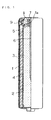
- FIG. 1 is a partially sectional front view of an exemplary alkaline battery of the present invention.
- FIG. 1 is a partially sectional front view of a cylindrical alkaline dry battery.
- a hollow cylindrical positive electrode 2 is disposed so as to closely adhere to the inner face of a cylindrical battery can 1 with a bottom, which serves as the positive electrode terminal.
- the positive electrode 2 is, for example, a positive electrode mixture that contains an active material mixture of manganese dioxide and nickel oxyhydroxide and a conductive agent of graphite.
- a cylindrical separator 4 with a bottom is disposed inside the positive electrode 2, and a negative electrode 3, into which a negative electrode current collector is inserted, is further disposed inside the separator 4.
- the negative electrode 3 is, for example, a gelled negative electrode that is prepared by dispersing a zinc or zinc alloy powder as an active material in an alkaline electrolyte containing a gelling agent such as sodium polyacrylate.
- the zinc alloy is, for example, a zinc alloy containing Bi, In, and Al.
- the electrode assembly composed of the positive electrode 2, the negative electrode 3 and the separator 4 contains an electrolyte comprising an alkaline aqueous solution.
- the negative electrode current collector 6 is integrated with a sealing member 5, a bottom plate 7 serving as the negative electrode terminal, and an insulating washer 8.
- the open edge of the battery can 1 is crimped onto the circumference of the bottom plate 7 with the edge of the sealing member 5 interposed therebetween, to seal the opeing of the battery can.
- the outer surface of the battery can 1 is covered with an outer label 9.
- the ratio of the electrical capacity of the negative electrode 3 to the electrical capacity of the positive electrode 2 (hereinafter referred to as "negative electrode capacity/positive electrode capacity”) is 1.00 to 1.15.
- the electrical capacity of the positive electrode is calculated based on electrochemical equivalent of manganese dioxide (one-electron reaction)(3.24 g/Ah) and the electrochemical equivalent of nickel oxyhydroxide (one-electron reaction)(3.42 g/Ah). Also, the electrical capacity of the negative electrode is calculated based on the electrochemical equivalent of zinc (two-electron reaction)(1.22 g/Ah).
- the negative electrode capacity/positive electrode capacity is less than 1.00, the electrical capacity of the negative electrode is too small, so that the discharge performance degrades.
- the negative electrode capacity/positive electrode capacity exceeds 1.15, the electrical capacity of the positive electrode is too small relative to the electrical capacity of the negative electrode, so that hydrogen gas is produced upon overdischarge, thereby increasing the battery inner pressure and promoting the occurrence of leakage.
- the negative electrode capacity/positive electrode capacity is preferably 1.05 to 1.15 since sufficient discharge performance is obtained.
- the volume obtained by subtracting the volume of the electrode assembly containing the electrolyte and the volume of the negative electrode current collector 6 from the internal volume of the battery that is formed by the battery can 1 and the sealing member 5 (hereinafter referred to as void rate) is 5 to 15 % of the internal volume.
- the internal volume of the battery means the volume of the inner portion enclosed by the battery can 1 and the sealing member 5 including the hole 5a.
- the volume of the negative electrode current collector 6 means the volume that the negative electrode current collector 6 occupies in the above-mentioned inner portion of the battery. That is, the volume of the portion of the negative electrode current collector 6 inserted into the hole 5a and the volume of the portion thereof exposed to the outside are excluded.
- the void rate is less than 5%, leakage is likely to occur due to deformation of the sealing member caused by expansion of the positive electrode or an increase in inner pressure caused by production of gas inside the battery. On the other hand, if the void rate exceeds 15%, the amount of active material decreases, thereby resulting in degradation of discharge performance. Further, the void rate is preferably 5 to 10 % since sufficient discharge performance is obtained.
- the positive electrode 2 contain manganese dioxide and nickel oxyhydroxide in a weight ratio of 20-90:80-10. In this case, the production of gas upon overdischarge is suppressed and excellent heavy-load discharge characteristics due to nickel oxyhydroxide can be obtained. Further, it is more preferred that the positive electrode 2 contain manganese dioxide and nickel oxyhydroxide in a weight ratio of 40-60:60-40.
- the positive electrode 2 contain not less than 40 parts by weight of nickel oxyhydroxide per 100 parts by weight of the total of nickel oxyhydroxide and manganese dioxide, since sufficient discharge performance is obtained. Also, in terms of storage characteristics and material costs, it is preferred that the positive electrode 2 contain not more than 60 parts by weight of nickel oxyhydroxide per 100 parts by weight of the total of nickel oxyhydroxide and manganese dioxide.
- the positive electrode 2 was produced as follows. First, manganese dioxide, nickel oxyhydroxide, graphite, and an alkaline electrolyte were mixed together in a weight ratio of 50:50:6:1, fully stirred, and compression-molded into flakes. The positive electrode mixture flakes were crushed into granules, which were then classified into 10 to 100 mesh with a sieve. The obtained granules were compression-molded into a hollow cylindrical shape.
- the negative electrode 3 used was a gelled negative electrode that was composed of 1 part by weight of sodium polyacrylate serving as a gelling agent, 33 parts by weight of an alkaline electrolyte, and 66 parts by weight of zinc powder.
- the separator 4 used was a non-woven fabric composed mainly of polyvinyl alcohol fibers and rayon fibers.
- the alkaline electrolyte used was a 40% by weight sodium hydroxide aqueous solution.
- Batteries 1 to 23 were produced by adjusting the weight of the positive electrode mixture and the weight of the gelled negative electrode so as to vary the negative electrode capacity/positive electrode capacity and the void rate as listed in Table 1. It should be noted that the batteries of this example are batteries 4 to 8, 10 to 14, and 16 to 20, and that the batteries of comparative example are batteries 1 to 3, 9, 15, and 21 to 23.
- the batteries were continuously discharged at a constant power of 1 W in a 20°C environment until their voltages lowered to 1.0 V.
- the obtained discharge performance was expressed as an index by defining the discharge time of the battery 13 as 100. When the index is 85 or higher, the discharge performance was judged excellent.
- Ten-day continuous discharge was performed at a load of 10 ⁇ in an environment with a temperature of 30°C and a humidity of 90%. After the discharge, the batteries were disassembled in water, and gas accumulated in the batteries was collected into a graduated cylinder to check the amount of gas produced. Also, after the discharge, the number of leaked batteries was checked. The number of batteries checked was 100. Table 1 shows the evaluation results. When the negative electrode capacity/positive electrode capacity is 1.00 to 1.15 and the void rate is 5 to 15 %, excellent leakage proof and discharge performance were obtained.
- Alkaline dry batteries 24 to 55 were produced under the same conditions as those of Example 1 except that the weight ratio between manganese dioxide and nickel oxyhydroxide was varied as listed in Table 2. The batteries were evaluated under the same conditions as those of Example 1. Table 2 shows the evaluation results.
- the alkaline battery of the present invention is preferably used as a power source for electronic devices, such as telecommunication devices and portable appliances.
Landscapes
- Chemical & Material Sciences (AREA)
- Chemical Kinetics & Catalysis (AREA)
- Electrochemistry (AREA)
- General Chemical & Material Sciences (AREA)
- Engineering & Computer Science (AREA)
- Manufacturing & Machinery (AREA)
- Composite Materials (AREA)
- Inorganic Chemistry (AREA)
- Battery Electrode And Active Subsutance (AREA)
- Primary Cells (AREA)
Applications Claiming Priority (2)
| Application Number | Priority Date | Filing Date | Title |
|---|---|---|---|
| JP2004090122A JP2005276698A (ja) | 2004-03-25 | 2004-03-25 | アルカリ電池 |
| PCT/JP2005/005391 WO2005093882A1 (ja) | 2004-03-25 | 2005-03-24 | アルカリ電池 |
Publications (2)
| Publication Number | Publication Date |
|---|---|
| EP1729362A1 true EP1729362A1 (de) | 2006-12-06 |
| EP1729362A4 EP1729362A4 (de) | 2008-04-02 |
Family
ID=35056501
Family Applications (1)
| Application Number | Title | Priority Date | Filing Date |
|---|---|---|---|
| EP05721405A Withdrawn EP1729362A4 (de) | 2004-03-25 | 2005-03-24 | Alkalibatterie |
Country Status (5)
| Country | Link |
|---|---|
| US (1) | US20070184344A1 (de) |
| EP (1) | EP1729362A4 (de) |
| JP (1) | JP2005276698A (de) |
| CN (1) | CN1934735A (de) |
| WO (1) | WO2005093882A1 (de) |
Cited By (4)
| Publication number | Priority date | Publication date | Assignee | Title |
|---|---|---|---|---|
| EP2306564A1 (de) * | 2009-10-01 | 2011-04-06 | Panasonic Corporation | Alkali-Trockenbatterie und Herstellungsverfahren dafür |
| EP2367226A4 (de) * | 2008-12-12 | 2012-07-11 | Panasonic Corp | Alkaline-trockenbatterie |
| EP2367225A4 (de) * | 2008-12-12 | 2012-07-25 | Panasonic Corp | Alkaline-trockenbatterie |
| EP2337129A4 (de) * | 2008-10-17 | 2016-01-13 | Panasonic Ip Man Co Ltd | Alkalibatterie |
Families Citing this family (3)
| Publication number | Priority date | Publication date | Assignee | Title |
|---|---|---|---|---|
| JP2009043417A (ja) * | 2007-08-06 | 2009-02-26 | Hitachi Maxell Ltd | 筒形アルカリ電池 |
| JP5820158B2 (ja) * | 2010-08-18 | 2015-11-24 | セイコーインスツル株式会社 | 電気二重層キャパシタ及びその製造方法 |
| AU2021273919B2 (en) | 2020-05-22 | 2026-07-23 | Duracell U.S. Operations, Inc. | Seal assembly for a battery cell |
Family Cites Families (8)
| Publication number | Priority date | Publication date | Assignee | Title |
|---|---|---|---|---|
| JPS5772266A (en) * | 1980-10-23 | 1982-05-06 | Matsushita Electric Ind Co Ltd | Alkaline manganese battery |
| US5188869A (en) * | 1990-08-14 | 1993-02-23 | Eveready Battery Company, Inc. | Process for burnishing anode current collectors |
| CA2046148C (en) * | 1990-08-14 | 1997-01-07 | Dale R. Getz | Alkaline cells that are substantially free of mercury |
| CN100361330C (zh) * | 1997-01-30 | 2008-01-09 | 三洋电机株式会社 | 密封碱性蓄电池 |
| JPH1173974A (ja) * | 1997-08-29 | 1999-03-16 | Toshiba Battery Co Ltd | アルカリ電池 |
| JP2002198060A (ja) * | 2000-12-26 | 2002-07-12 | Sony Corp | 電 池 |
| US7344803B2 (en) * | 2001-02-26 | 2008-03-18 | Fdk Corporation | Alkaline primary battery |
| JP4322472B2 (ja) * | 2002-05-31 | 2009-09-02 | 東芝電池株式会社 | 密閉型ニッケル亜鉛一次電池 |
-
2004
- 2004-03-25 JP JP2004090122A patent/JP2005276698A/ja not_active Withdrawn
-
2005
- 2005-03-24 EP EP05721405A patent/EP1729362A4/de not_active Withdrawn
- 2005-03-24 CN CNA200580009541XA patent/CN1934735A/zh active Pending
- 2005-03-24 US US10/593,632 patent/US20070184344A1/en not_active Abandoned
- 2005-03-24 WO PCT/JP2005/005391 patent/WO2005093882A1/ja not_active Ceased
Cited By (7)
| Publication number | Priority date | Publication date | Assignee | Title |
|---|---|---|---|---|
| EP2337129A4 (de) * | 2008-10-17 | 2016-01-13 | Panasonic Ip Man Co Ltd | Alkalibatterie |
| EP2367226A4 (de) * | 2008-12-12 | 2012-07-11 | Panasonic Corp | Alkaline-trockenbatterie |
| EP2367225A4 (de) * | 2008-12-12 | 2012-07-25 | Panasonic Corp | Alkaline-trockenbatterie |
| EP2306564A1 (de) * | 2009-10-01 | 2011-04-06 | Panasonic Corporation | Alkali-Trockenbatterie und Herstellungsverfahren dafür |
| US20110081579A1 (en) * | 2009-10-01 | 2011-04-07 | Susumu Kato | Alkaline dry battery and method for producing the same |
| CN102034982A (zh) * | 2009-10-01 | 2011-04-27 | 松下电器产业株式会社 | 碱干电池及其制造方法 |
| CN102034982B (zh) * | 2009-10-01 | 2014-03-05 | 松下电器产业株式会社 | 碱干电池及其制造方法 |
Also Published As
| Publication number | Publication date |
|---|---|
| WO2005093882A1 (ja) | 2005-10-06 |
| US20070184344A1 (en) | 2007-08-09 |
| JP2005276698A (ja) | 2005-10-06 |
| EP1729362A4 (de) | 2008-04-02 |
| CN1934735A (zh) | 2007-03-21 |
Similar Documents
| Publication | Publication Date | Title |
|---|---|---|
| US8771883B2 (en) | Alkaline battery | |
| CN103718359B (zh) | 碱性电池 | |
| KR20050016477A (ko) | 밀폐형 니켈 아연 일차전지 | |
| US8338023B2 (en) | AA alkaline battery | |
| US7553586B2 (en) | Alkaline battery | |
| US20070184344A1 (en) | Alkaline battery | |
| US7244529B2 (en) | Alkaline dry battery | |
| US20080044730A1 (en) | Alkaline battery | |
| JP4121774B2 (ja) | アルカリ乾電池 | |
| US20060003225A1 (en) | Alkaline dry battery | |
| CN1211089A (zh) | 碱性蓄电池 | |
| US20070099083A1 (en) | Alkaline battery | |
| US8283069B2 (en) | Zinc-alkaline battery | |
| HK1093262A (en) | Alkaline battery | |
| WO2020158124A1 (ja) | アルカリ乾電池 | |
| US7326496B2 (en) | Alkali dry cell | |
| EP1798789A1 (de) | Alkalizelle | |
| KR20050037489A (ko) | 알카리 건전지 | |
| HK1063532A (en) | Alkaline dry battery | |
| HK1062858A (en) | Alkali dry cell |
Legal Events
| Date | Code | Title | Description |
|---|---|---|---|
| PUAI | Public reference made under article 153(3) epc to a published international application that has entered the european phase |
Free format text: ORIGINAL CODE: 0009012 |
|
| 17P | Request for examination filed |
Effective date: 20061011 |
|
| AK | Designated contracting states |
Kind code of ref document: A1 Designated state(s): AT BE BG CH CY CZ DE DK EE ES FI FR GB GR HU IE IS IT LI LT LU MC NL PL PT RO SE SI SK TR |
|
| REG | Reference to a national code |
Ref country code: HK Ref legal event code: DE Ref document number: 1093262 Country of ref document: HK |
|
| DAX | Request for extension of the european patent (deleted) | ||
| A4 | Supplementary search report drawn up and despatched |
Effective date: 20080229 |
|
| RAP1 | Party data changed (applicant data changed or rights of an application transferred) |
Owner name: PANASONIC CORPORATION |
|
| STAA | Information on the status of an ep patent application or granted ep patent |
Free format text: STATUS: THE APPLICATION HAS BEEN WITHDRAWN |
|
| 18W | Application withdrawn |
Effective date: 20081112 |
|
| REG | Reference to a national code |
Ref country code: HK Ref legal event code: WD Ref document number: 1093262 Country of ref document: HK |