EP1731660A2 - Verfahren zur kontinuierlichen Herstellung einer geflockten und gefärbten Unterlage. - Google Patents
Verfahren zur kontinuierlichen Herstellung einer geflockten und gefärbten Unterlage. Download PDFInfo
- Publication number
- EP1731660A2 EP1731660A2 EP06290767A EP06290767A EP1731660A2 EP 1731660 A2 EP1731660 A2 EP 1731660A2 EP 06290767 A EP06290767 A EP 06290767A EP 06290767 A EP06290767 A EP 06290767A EP 1731660 A2 EP1731660 A2 EP 1731660A2
- Authority
- EP
- European Patent Office
- Prior art keywords
- fibers
- support
- ink
- flocked
- pigment ink
- Prior art date
- Legal status (The legal status is an assumption and is not a legal conclusion. Google has not performed a legal analysis and makes no representation as to the accuracy of the status listed.)
- Withdrawn
Links
Images
Classifications
-
- D—TEXTILES; PAPER
- D06—TREATMENT OF TEXTILES OR THE LIKE; LAUNDERING; FLEXIBLE MATERIALS NOT OTHERWISE PROVIDED FOR
- D06Q—DECORATING TEXTILES
- D06Q1/00—Decorating textiles
- D06Q1/12—Decorating textiles by transferring a chemical agent or a metallic or non-metallic material in particulate or other form, from a solid temporary carrier to the textile
- D06Q1/14—Decorating textiles by transferring a chemical agent or a metallic or non-metallic material in particulate or other form, from a solid temporary carrier to the textile by transferring fibres, or adhesives for fibres, to the textile
-
- D—TEXTILES; PAPER
- D06—TREATMENT OF TEXTILES OR THE LIKE; LAUNDERING; FLEXIBLE MATERIALS NOT OTHERWISE PROVIDED FOR
- D06P—DYEING OR PRINTING TEXTILES; DYEING LEATHER, FURS OR SOLID MACROMOLECULAR SUBSTANCES IN ANY FORM
- D06P5/00—Other features in dyeing or printing textiles, or dyeing leather, furs, or solid macromolecular substances in any form
- D06P5/30—Ink jet printing
Definitions
- the present invention relates to a method of continuously manufacturing a flocked and colored sheet support.
- markings are applied thermally (heat-bonded) or welded by high frequency to the textile to be decorated.
- Flocked plastic films often form the basis of these decorations, although flocked paper racks may also be used as a base for these decorations.
- Silk screen printing requires the production of "screen screens", a different screen screen being assigned to each of the colors used in the production of the decorative pattern. A drawing whose printing uses six colors therefore requires the production and use of six screen screens. Under these conditions, the short productions, ie the productions of small series of articles, and the production of samples become long and expensive operations.
- sublimable inks also known as “dispersed inks”
- these inks have the property of passing, at a temperature of about 200 ° C., from the solid phase to the vapor phase and, once vaporized, to be fixed permanently to the synthetic fibers (polyesters or polyamides) with which they are contacted, penetrating (diffusing) within said fibers while giving them a color predefined by the formulation of the ink, without altering the touch.
- the prints thus obtained have solidities (washing, rubbing, light, ...) which are high, and the colors obtained are bright and shiny, provided that the fibers used are polyester (polyamide fibers). give lower resistances and less bright colors).
- This sublimation-transfer printing process which is applicable only to certain synthetic fibers, allows the continuous manufacture (in rolls) of flocked and colored products, either united or reproducing a given single color or multicolor design. This operation is usually done in recovery. More precisely, after the flocked product has been manufactured, a provisional paper pre-printed with sublimable inks is brought into contact with the flocked product and the assembly is worn for several seconds at a temperature of about 200 ° C. which can trigger the sublimation of the dyes contained in the ink used. The impression carried by the temporary paper is thus faithfully "transferred" hot on the flocked support, giving the latter a colorful, plain or multicolored, depending on the graphic characteristics of the preprinted temporary paper.
- the object of the present invention is therefore to provide a process which makes it possible to obtain, easily and rapidly, from natural or artificial flock fibers, a flocked and colored product which has a good fastness to washing, to friction and to light, an extremely soft and pleasant touch, which can eventually lead to less a sharp and precise image, if necessary with fine gradations of colors.
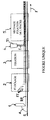
- the method according to the invention comprises a first step 1 of applying a layer of an adhesive A (polymerizable resin RP) on one side of a support S running continuously in the direction indicated by the arrow F, a second step 2 or flocking step of projecting flock fibers FF on the polymerizable resin layer RP, a third step 3 or fixing step of polymerizing the resin of the adhesive A for fixing the foot of the flock fibers FF in the resin, the free portion of said flock fibers FF extending substantially perpendicular to the surface of the resin layer, a fourth step 4 or printing step of depositing at least a pigment ink E on the flocked face of the support S by an inkjet printing technique, and a fifth step or step of drying and fixing the ink which has been projected onto the flocked side of the support S.
- an adhesive A polymerizable resin RP
- the support S can be chosen from a wide range of flockable media, such as paper, cardboard, plastic film, fabric or nonwovens.
- the support S is constituted by a plastic film based on thermo-reactivable polymer resins chosen from copolyamides, copolyesters and co-polyurethanes. Even more preferentially, a film made of a polyurethane resin will be chosen as the support S, since the polyurethane resins are elastic and allow the production of flexible marking products that can follow the elongation of the extensible fabrics without mechanical rupture.
- TPU film thermoplastic polyurethane
- conductive aluminum powder is well suited for the production of marking products intended to be fixed by HF welding on a textile substrate such as a garment.
- Such TPU films make it possible to no longer use the PVC (polyvinyl chloride) films which were previously used for this HF welding operation and which are no longer accepted by the manufacturers of the major brands.
- a TPU film having a basis weight of between 50 and 100 g / m 2 , preferably 70 g / m 2 can be used as the support S.
- the support S is constituted by a thin and flexible plastic film such as the above-mentioned TPU film
- it can, in certain cases, before treatment by the method of the invention or before step 4 of this invention.
- ci advantageously be glued temporarily on a temporary support, for example a continuous strip of paper that can be removed later by peeling. This facilitates the scrolling of the support S in the inkjet printing machine used in step 4.
- the support S may be in the form of a roll which is placed on a supply reel (not shown in FIG. figure) from which the roll is unwound continuously to perform the operations of steps 1 to 5 of the method according to the invention.
- the polymerizable resin RP used as adhesive A may be selected from PVC plastisols, polymeric resins in aqueous dispersion or in solvent (acrylic resins or polyurethanes), or, in a preferred version of the invention, polyurethane resins called 100% solid or "high solid", polymerizable thermally or by irradiation (ultraviolet or electron beam). These latter resins 100% solid or "high solid” have the advantage of being able to present a very high softening point, which may be useful when the support S, once flocked and colored, is subsequently subjected to hot at relatively high temperatures.
- step 1 An example of a "high solid” resin that can be used for step 1 is the "IMPRANIL-IMPRAFIX” system from Bayer, Germany.
- the amount of the polymerizable resin RP deposited in step 1 may for example be between 60 and 100 g / m 2 , preferably 85 g / m 2 . This quantity is sufficient to then ensure, in step 3, a good fixing of flock fibers FF to the support S and to retain the finished product flexibility and thinness.
- the polymer resin layer RP used as adhesive A may be uniformly coated or in a given pattern, for example by screen printing with the frame, rotary.
- the resin layer may have a final thickness of between 15 and 100 ⁇ m, depending on the nature of the flock fibers FF used for the second stage (flocking step 2). In general, the more the flock fibers used have a fine title and a short length, the more the thickness of the polymerizable resin layer may be low.
- step 2 flock fibers FF are projected into the polymeric resin layer RP by any of the conventional flocking techniques, which are well known and need not be described in detail.
- flock fibers are natural cotton fibers or, preferably, rayon-viscose cellulosic artificial fibers, preferably of white or unbleached color.
- the flock fibers FF used have a fine titre of between 0.5 and 2 Dtex, preferably between 0.9 and 2 Dtex, for example 1.7 Dtex, and a length of between 0.2 and 1.5 mm, preferably between 0.2 and 0.8 mm, and still more preferably a length of 0.3 mm, so as to obtain a flocked support having a very soft feel.
- the amount of rayon-viscose flock fibers projected in the resin in step 2 is preferably between 40 and 80 g / m 2 , for example 60 g / m 2 .
- step 3 the polymerizable resin RP is polymerized by irradiation (UV or electron beam) or thermally according to the type of the resin used in step 1.
- the thermal polymerization can be carried out for example by passing the support S in a tunnel furnace or on the peripheral surface of a rotating heating drum, at a temperature between 100 ° C and 160 ° C.
- an ink jet printing machine controlled by computer which comprises at least one printhead TI, of piezoelectric type, for projecting the ink E on the flocked face of the support S.
- the piezoelectric type printing heads do not cause a sharp rise in the temperature of the the projected ink, which considerably reduces the risk of clogging the nozzles in the printheads, risks which are due to the drying of the fixing agent contained in the pigment ink E.
- step 4 at least one pigment ink E is used in which the conventional binder has been replaced at least in part by a multifunctional agent (polymer) having combined properties of pigment dispersion, ink stabilization, adhesion on natural or artificial cellulosic fibers and high mechanical strength.
- a multifunctional agent polymer having combined properties of pigment dispersion, ink stabilization, adhesion on natural or artificial cellulosic fibers and high mechanical strength.
- Particularly suitable pigment inks for carrying out the process of the invention are Helizarin® EVO P 100 inks marketed by BASF, Germany.
- step 4 the ink or inks deposited on the layer of colored (printed) flock fibers of the support S is or are dried and fixed thermally to the flock fibers FF (step 5).
- This thermal fixing operation can be carried out continuously immediately after the printing step 4, for example by passing through an oven, under a ramp of infrared radiation lamps or on the peripheral surface of a rotating heating drum. .
- the heat-setting operation can be carried out in a relatively short time.
- This time can be less than 1 minute, in particular a time of 20 to 30 seconds at a temperature of 160 to 180 ° C., for example at 170 ° C., while at the same time providing printing performed on the flocked support very good fastness to washing (washing at 40 or 60 ° C), friction and light, without additional thermal fixation (crosslinking) is necessary for the application to the marking of clothing considered here.
- the heating zone of the heating device used at Step 5 may have a dimension of 25 cm in the running direction of the flocked and printed medium, so a relatively short dimension.
- the duration of the heat setting operation can however be extended if one wishes to have an even better wash fastness.
- the support S is a plastic film stabilized by a temporary support
- the latter can then be separated from the plastic film and wound on a winding reel for eventual re-use as a temporary support.
- the flocked and colored (printed) support S may be wound on a reel (not shown in the figure) for later use, for example cutting of labels, decorative patterns or the like in the holder E, placing labels or decorative patterns on textile substrates such as clothing to be labeled or decorated, and then attaching labels or decorative patterns to textile substrates by heat-sealing or HF welding.
- the step 5 can be a simple drying operation and the thermal fixing of the ink to the fibers can be carried out later simply by hot application of the label, pattern or other decorative element on the garment to be labeled or decorated (for a period of 20 to 30 seconds at 170 ° C).
- step 2 it is not absolutely essential to use flock fibers FF white or unbleached for the flocking step 2, because it is also possible to use pre-dyed cellulosic fibers.
- pre-dyed cellulosic fibers For example, it is conceivable to carry out in step 2 a solid flocking (background) with cellulosic fibers pre-dyed red, this red background then being printed for example with a black ink in the printing step 4.
- the printing step 4 does not necessarily consist in printing a single-colored or multicolored pattern on the flocked face of the support S.
- it may be a solid pigment impression: c That is, for example, uniform printing in a given color of white cellulosic fibers. This possibility can be very interesting for the realization by pigment printing of a small amount of flocked product in a special uniform shade.
- the invention has been more particularly described in its application to the marking of fabrics such as clothing, it can have many other applications such as the manufacture of paper or cardboard for the manufacture of luxury packaging .
Landscapes
- Engineering & Computer Science (AREA)
- Textile Engineering (AREA)
- Chemical & Material Sciences (AREA)
- Chemical Kinetics & Catalysis (AREA)
- General Chemical & Material Sciences (AREA)
- Coloring (AREA)
- Ink Jet (AREA)
- Application Of Or Painting With Fluid Materials (AREA)
- Inks, Pencil-Leads, Or Crayons (AREA)
- Ink Jet Recording Methods And Recording Media Thereof (AREA)
Applications Claiming Priority (1)
| Application Number | Priority Date | Filing Date | Title |
|---|---|---|---|
| FR0505380A FR2886316B1 (fr) | 2005-05-27 | 2005-05-27 | Procede de fabrication en continu d'un support en nappe flocke colore |
Publications (2)
| Publication Number | Publication Date |
|---|---|
| EP1731660A2 true EP1731660A2 (de) | 2006-12-13 |
| EP1731660A3 EP1731660A3 (de) | 2010-05-05 |
Family
ID=36127907
Family Applications (1)
| Application Number | Title | Priority Date | Filing Date |
|---|---|---|---|
| EP06290767A Withdrawn EP1731660A3 (de) | 2005-05-27 | 2006-05-12 | Verfahren zur kontinuierlichen Herstellung einer geflockten und gefärbten Unterlage. |
Country Status (2)
| Country | Link |
|---|---|
| EP (1) | EP1731660A3 (de) |
| FR (1) | FR2886316B1 (de) |
Cited By (2)
| Publication number | Priority date | Publication date | Assignee | Title |
|---|---|---|---|---|
| CN105398232A (zh) * | 2015-12-10 | 2016-03-16 | 中山市恒辉印花有限公司 | 植绒布数码喷绘印花生产系统 |
| WO2024075113A1 (en) * | 2022-10-03 | 2024-04-11 | Kornit Digital Ltd. | Printed fabric |
Families Citing this family (1)
| Publication number | Priority date | Publication date | Assignee | Title |
|---|---|---|---|---|
| CN107150859A (zh) * | 2017-04-26 | 2017-09-12 | 农思宇 | 植绒包装纸 |
Family Cites Families (4)
| Publication number | Priority date | Publication date | Assignee | Title |
|---|---|---|---|---|
| IT1179861B (it) * | 1984-12-11 | 1987-09-16 | Fil To Vel Di Contu Giovannino | Procedimento per la stampa piatta a piu colori o a colori sovrapposti in quadrioromia in sistema serigrafico su supporti figurativi floccati in rilievo |
| JPH08209555A (ja) * | 1995-01-31 | 1996-08-13 | Sanei Chem Kk | 植毛捺染生地及びその製造法 |
| US20020098329A1 (en) * | 2000-10-10 | 2002-07-25 | Abrams L. Brown | Enhanced resolution multicolored flock transfer |
| US7249837B2 (en) * | 2003-05-12 | 2007-07-31 | Abramek Edward T | Printing on flocked paper and films |
-
2005
- 2005-05-27 FR FR0505380A patent/FR2886316B1/fr not_active Expired - Fee Related
-
2006
- 2006-05-12 EP EP06290767A patent/EP1731660A3/de not_active Withdrawn
Cited By (2)
| Publication number | Priority date | Publication date | Assignee | Title |
|---|---|---|---|---|
| CN105398232A (zh) * | 2015-12-10 | 2016-03-16 | 中山市恒辉印花有限公司 | 植绒布数码喷绘印花生产系统 |
| WO2024075113A1 (en) * | 2022-10-03 | 2024-04-11 | Kornit Digital Ltd. | Printed fabric |
Also Published As
| Publication number | Publication date |
|---|---|
| EP1731660A3 (de) | 2010-05-05 |
| FR2886316A1 (fr) | 2006-12-01 |
| FR2886316B1 (fr) | 2007-07-13 |
Similar Documents
| Publication | Publication Date | Title |
|---|---|---|
| EP1625895B1 (de) | Verfahren zur kontinuierlichen Herstellung einer geflockten und gefärbten Unterlage | |
| FR2874030A1 (fr) | Procede de fabrication en continu d'un support en nappe flocke et colore | |
| EP0913271B1 (de) | Kontinuierliches automatisches Verfahren zum Drucken von mehrfarbigen Mustern auf eine hochfrequenzverschweissbare oder thermoklebende beflockte Folie, durch das Verfahren hergestellte Folie, Verfahren zum Aufbringen der Folie auf einen Gegenstand, und durch das Verfahren hergestellter dekorierter Gegenstand | |
| EP0774365B1 (de) | Verfahren zum Dekorieren von Verbundkörpern wie Ski, Surfbretter oder Skateboards | |
| FR2624035A1 (fr) | Procede de fabrication d'un transfert de flocons multicolores et articles textiles obtenus par ce procede | |
| EP2000250B1 (de) | Verfahren zum Laserschneiden von Dekorationsmotiven für Textilartikel | |
| EP0989227B1 (de) | Verfahren zur Behandlung des Flocks einer geflockten Unterlage und das so erhaltene Produkt | |
| RU2484973C2 (ru) | Нанесение рисунка на текстиль | |
| FR2672313A1 (fr) | Procede de fabrication d'entoilages thermocollants, entoilage thermocollant. | |
| EP3283684B1 (de) | Verfahren zur wärmeübertragung auf textilien und expandierbarer mehrschichtiger komplex dafür | |
| US7111949B2 (en) | Process for manufacturing retroreflective printed material | |
| EP3128982B1 (de) | Streifen oder ansatz mit schleifen in form eines laminats mit gedruckten mustern | |
| FR2886316A1 (fr) | Procede de fabrication en continu d'un support en nappe flocke colore | |
| EP2425050B1 (de) | Verfahren zur herstellung eines textilkomplexes mit dekorativmuster | |
| EP2291292A1 (de) | Material zur wärmeübertragungsdekoration und herstellungsverfahren dafür | |
| BE1005859A4 (fr) | Procede pour l'impression de motifs colores sur un substrat a base de fibres de verre et nouveau produit obtenu. | |
| EP1855894B1 (de) | Verfahren zum aufbringen einer zierfolie auf einen träger und verfahren zur herstellung von artikeln für diesen zweck | |
| FR2874031A1 (fr) | Procede de fabrication en continu d'un support en nappe flocke colore | |
| FR2534945A1 (fr) | Procede de decoration polychrome des cuirs ou analogues | |
| KR20230109364A (ko) | 액정고분자를 이용한 승화전사용 다회인쇄용지 | |
| FR2509227A1 (fr) | Motifs en relief transferables et procedes d'obtention de leurs elements | |
| FR2505260A1 (fr) | Motif decoratif ou marquage en relief applicable par transfert et son procede de realisation | |
| FR2561679A1 (fr) | Procede de flockage d'une etoffe notoirement deformable telle qu'un tricot jersey, et etoffe ainsi flockee | |
| EP1345779A1 (de) | Siebdruckverfahren und anlage, druckfarbe | |
| FR2681284A1 (fr) | Procede pour la realisation de decors, motifs a la surface de plaques ou feuilles a base de polychlorure de vinyle (pvc) et nouveau type de revetement de sol ou similaire ainsi realise. |
Legal Events
| Date | Code | Title | Description |
|---|---|---|---|
| PUAI | Public reference made under article 153(3) epc to a published international application that has entered the european phase |
Free format text: ORIGINAL CODE: 0009012 |
|
| AK | Designated contracting states |
Kind code of ref document: A2 Designated state(s): AT BE BG CH CY CZ DE DK EE ES FI FR GB GR HU IE IS IT LI LT LU LV MC NL PL PT RO SE SI SK TR |
|
| AX | Request for extension of the european patent |
Extension state: AL BA HR MK YU |
|
| 17P | Request for examination filed |
Effective date: 20070612 |
|
| PUAL | Search report despatched |
Free format text: ORIGINAL CODE: 0009013 |
|
| AK | Designated contracting states |
Kind code of ref document: A3 Designated state(s): AT BE BG CH CY CZ DE DK EE ES FI FR GB GR HU IE IS IT LI LT LU LV MC NL PL PT RO SE SI SK TR |
|
| AX | Request for extension of the european patent |
Extension state: AL BA HR MK YU |
|
| STAA | Information on the status of an ep patent application or granted ep patent |
Free format text: STATUS: THE APPLICATION HAS BEEN WITHDRAWN |
|
| 18W | Application withdrawn |
Effective date: 20100609 |