EP1733377B1 - Auf subkomponenten basierendes rendern von objekten mit räumlicher frequenzdominanz parallel zu der streifenrichtung der anzeige - Google Patents
Auf subkomponenten basierendes rendern von objekten mit räumlicher frequenzdominanz parallel zu der streifenrichtung der anzeige Download PDFInfo
- Publication number
- EP1733377B1 EP1733377B1 EP04779664.4A EP04779664A EP1733377B1 EP 1733377 B1 EP1733377 B1 EP 1733377B1 EP 04779664 A EP04779664 A EP 04779664A EP 1733377 B1 EP1733377 B1 EP 1733377B1
- Authority
- EP
- European Patent Office
- Prior art keywords
- sub
- pixel
- act
- striping
- display
- Prior art date
- Legal status (The legal status is an assumption and is not a legal conclusion. Google has not performed a legal analysis and makes no representation as to the accuracy of the status listed.)
- Expired - Lifetime
Links
Images




Classifications
-
- G—PHYSICS
- G09—EDUCATION; CRYPTOGRAPHY; DISPLAY; ADVERTISING; SEALS
- G09G—ARRANGEMENTS OR CIRCUITS FOR CONTROL OF INDICATING DEVICES USING STATIC MEANS TO PRESENT VARIABLE INFORMATION
- G09G5/00—Control arrangements or circuits for visual indicators common to cathode-ray tube indicators and other visual indicators
- G09G5/22—Control arrangements or circuits for visual indicators common to cathode-ray tube indicators and other visual indicators characterised by the display of characters or indicia using display control signals derived from coded signals representing the characters or indicia, e.g. with a character-code memory
- G09G5/24—Generation of individual character patterns
- G09G5/28—Generation of individual character patterns for enhancement of character form, e.g. smoothing
-
- G—PHYSICS
- G09—EDUCATION; CRYPTOGRAPHY; DISPLAY; ADVERTISING; SEALS
- G09G—ARRANGEMENTS OR CIRCUITS FOR CONTROL OF INDICATING DEVICES USING STATIC MEANS TO PRESENT VARIABLE INFORMATION
- G09G5/00—Control arrangements or circuits for visual indicators common to cathode-ray tube indicators and other visual indicators
- G09G5/02—Control arrangements or circuits for visual indicators common to cathode-ray tube indicators and other visual indicators characterised by the way in which colour is displayed
-
- G—PHYSICS
- G09—EDUCATION; CRYPTOGRAPHY; DISPLAY; ADVERTISING; SEALS
- G09G—ARRANGEMENTS OR CIRCUITS FOR CONTROL OF INDICATING DEVICES USING STATIC MEANS TO PRESENT VARIABLE INFORMATION
- G09G3/00—Control arrangements or circuits, of interest only in connection with visual indicators other than cathode-ray tubes
- G09G3/20—Control arrangements or circuits, of interest only in connection with visual indicators other than cathode-ray tubes for presentation of an assembly of a number of characters, e.g. a page, by composing the assembly by combination of individual elements arranged in a matrix no fixed position being assigned to or needed to be assigned to the individual characters or partial characters
- G09G3/2003—Display of colours
-
- G—PHYSICS
- G09—EDUCATION; CRYPTOGRAPHY; DISPLAY; ADVERTISING; SEALS
- G09G—ARRANGEMENTS OR CIRCUITS FOR CONTROL OF INDICATING DEVICES USING STATIC MEANS TO PRESENT VARIABLE INFORMATION
- G09G5/00—Control arrangements or circuits for visual indicators common to cathode-ray tube indicators and other visual indicators
-
- G—PHYSICS
- G09—EDUCATION; CRYPTOGRAPHY; DISPLAY; ADVERTISING; SEALS
- G09G—ARRANGEMENTS OR CIRCUITS FOR CONTROL OF INDICATING DEVICES USING STATIC MEANS TO PRESENT VARIABLE INFORMATION
- G09G2300/00—Aspects of the constitution of display devices
- G09G2300/04—Structural and physical details of display devices
- G09G2300/0439—Pixel structures
- G09G2300/0452—Details of colour pixel setup, e.g. pixel composed of a red, a blue and two green components
-
- G—PHYSICS
- G09—EDUCATION; CRYPTOGRAPHY; DISPLAY; ADVERTISING; SEALS
- G09G—ARRANGEMENTS OR CIRCUITS FOR CONTROL OF INDICATING DEVICES USING STATIC MEANS TO PRESENT VARIABLE INFORMATION
- G09G2340/00—Aspects of display data processing
- G09G2340/04—Changes in size, position or resolution of an image
- G09G2340/0457—Improvement of perceived resolution by subpixel rendering
-
- G—PHYSICS
- G09—EDUCATION; CRYPTOGRAPHY; DISPLAY; ADVERTISING; SEALS
- G09G—ARRANGEMENTS OR CIRCUITS FOR CONTROL OF INDICATING DEVICES USING STATIC MEANS TO PRESENT VARIABLE INFORMATION
- G09G3/00—Control arrangements or circuits, of interest only in connection with visual indicators other than cathode-ray tubes
- G09G3/20—Control arrangements or circuits, of interest only in connection with visual indicators other than cathode-ray tubes for presentation of an assembly of a number of characters, e.g. a page, by composing the assembly by combination of individual elements arranged in a matrix no fixed position being assigned to or needed to be assigned to the individual characters or partial characters
- G09G3/34—Control arrangements or circuits, of interest only in connection with visual indicators other than cathode-ray tubes for presentation of an assembly of a number of characters, e.g. a page, by composing the assembly by combination of individual elements arranged in a matrix no fixed position being assigned to or needed to be assigned to the individual characters or partial characters by control of light from an independent source
- G09G3/36—Control arrangements or circuits, of interest only in connection with visual indicators other than cathode-ray tubes for presentation of an assembly of a number of characters, e.g. a page, by composing the assembly by combination of individual elements arranged in a matrix no fixed position being assigned to or needed to be assigned to the individual characters or partial characters by control of light from an independent source using liquid crystals
- G09G3/3607—Control arrangements or circuits, of interest only in connection with visual indicators other than cathode-ray tubes for presentation of an assembly of a number of characters, e.g. a page, by composing the assembly by combination of individual elements arranged in a matrix no fixed position being assigned to or needed to be assigned to the individual characters or partial characters by control of light from an independent source using liquid crystals for displaying colours or for displaying grey scales with a specific pixel layout, e.g. using sub-pixels
-
- G—PHYSICS
- G09—EDUCATION; CRYPTOGRAPHY; DISPLAY; ADVERTISING; SEALS
- G09G—ARRANGEMENTS OR CIRCUITS FOR CONTROL OF INDICATING DEVICES USING STATIC MEANS TO PRESENT VARIABLE INFORMATION
- G09G5/00—Control arrangements or circuits for visual indicators common to cathode-ray tube indicators and other visual indicators
- G09G5/22—Control arrangements or circuits for visual indicators common to cathode-ray tube indicators and other visual indicators characterised by the display of characters or indicia using display control signals derived from coded signals representing the characters or indicia, e.g. with a character-code memory
- G09G5/24—Generation of individual character patterns
- G09G5/246—Generation of individual character patterns of ideographic or arabic-like characters
Definitions
- the present invention relates to rendering of objects on a display; and more specifically, to the display of such objects such that a pixel of the display may represent information from multiple sample points of the object for improved resolution.
- Computing technology has transformed the way we work and play.
- Computing systems now take a wide variety of forms including desktop computers, laptop computers, tablet PCs, Personal Digital Assistants (PDAs), and the like.
- PDAs Personal Digital Assistants
- Even household devices (such as refrigerators, ovens, sewing machines, security systems, and the like) have varying levels of processing capability and thus may be considered computing systems.
- processing capability may be incorporated into a number of devices that traditionally did not have processing capability. Accordingly, the diversity of computing systems may likely increase.
- Displays are typically composed of picture elements called "pixels".
- each pixel includes a number of pixel sub-components, each capable of emitting a particular color.
- LCDs Liquid Crystal Displays
- each pixel includes a red pixel sub-component capable of emitting only red light at varying intensities, a green pixel-subcomponent capable of emitting only green light at varying intensities, and a blue pixel sub-component capable of emitting only blue light at varying intensities.
- the light emitted from the pixel sub-components of a given pixel appears additive to the human viewer. If each pixel sub-component for a pixel has minimum intensity, the pixel appears black. If each pixel sub-component for a pixel has maximum intensity, the pixel appears white. By varying the emission intensities of the pixel sub-components, the pixel may be perceived as having any one of potentially even millions of possible colors.
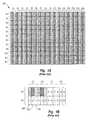
- FIG. 1A illustrates a known LCD screen 100 comprising a plurality of rows (R1-R12) and columns (C1-C16). Each row/column intersection forms a square which represents one pixel.
- Figure 1B illustrates the upper left hand portion of the known display 100 in greater detail.
- each pixel element e.g., the (R2, C1) pixel element, comprises three distinct sub-elements or sub-components, a red sub-component 106, a green sub-component 107 and a blue sub-component 108.
- Each known pixel sub-component 106, 107, 108 is one third (or approximately one third) the width of a pixel while being equal (or approximately equal) in height to the height of a pixel.
- the three 1/3 width pixel sub-components 106, 107, 108 form a single pixel element.
- RGB pixel sub-components 106, 107, 108 form what appear on close inspection to be vertical color stripes down the display 100. Accordingly, the arrangement of one third width color sub-components 106, 107, 108, in the known manner illustrated in Figures 1A and 1B , is sometimes called "vertical striping".
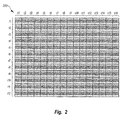
- RGB pixel sub-components form horizontal striping as illustrated in the display 200 in Figure 2 .
- the display 200 also comprises a plurality of rows (r1-r12) and columns (c1-c16). Each row/column intersection also forms a square which represents one pixel.
- each pixel sub-component for a corresponding pixel is one third (or approximately one third) the height of a pixel while being equal (or approximately equal) in width to the width of a pixel. While only 12 rows and 16 columns of pixels are shown in Figures 1A, 1B and 2 for purposes of illustration, most LCD displays will include many more rows and many more columns of pixels.
- a pixel represents one distinct sample point for an object being displayed.
- the color for a pixel is determined by sampling the color of the object at a single point.
- the corresponding pixel sub-components then emit the appropriate intensities to give the overall pixel its appropriate sampled color.
- the resolution of the displayed object corresponds one-to-one to the pixel resolution.
- this resolution will be sufficient. In many cases, however, it is desirable for the image resolution not to be restricted by the pixel resolution. For example, small objects such as text or other characters may have features that are smaller than a single pixel.
- One technology that improves image resolution of such objects beyond the pixel resolution involves sampling from different portions of the image for each pixel sub-component, even for pixel sub-components belonging to the same pixel.
- Each pixel sub-component may represent information derived from multiple image sample points. This type of sampling will be referred to as "pixel sub-component based sampling" regardless of whether the pixel sub-component represents information from one sample point or more than one sample points.
- each pixel sub-component represents information from different portions of the object being rendered. Therefore, resolution is improved in the direction opposite the striping direction. For example, in LCD displays that use vertical striping, resolution is improved in the horizontal direction.
- spatial frequency dominance when attributed to an object means that the object tends to have more vertically-oriented components than horizontally-oriented components.
- Vertical “spatial frequency dominance” when attributed to an object means that the object tends to have more horizontally-oriented components than vertically-oriented components.
- Latin-based characters have varying degrees of horizontal spatial frequency dominance. For example, the capital letter “I” and the number “1” and the lowercase letter “m” are dominated almost entirely by vertical components. Other Latin-based characters have some horizontal components but are still dominated by vertical components such as, for example, the capital letters "H” or "A”. However, not all Latin-based characters have horizontal spatial frequency dominance. A few have vertical spatial frequency dominance. For example, the dash or subtraction "-" symbol and the number sign "#” symbol are dominated by horizontal components. Accordingly, conventional pixel sub-component based sampling renders many Latin-based characters quite well when rendered on a vertically striped display.
- Latin-based characters have predominantly horizontal spatial frequency dominance
- many alphabets throughout the world have different degrees of horizontal and vertical spatial frequency dominance.
- Chinese-based pictographs i.e., pictographs of Chinese origin such as Kanji and other East Asian characters
- vertical spatial frequency dominance or at least tend to have less horizontal spatial frequency dominance
- conventional sub-component based sampling results in better quality rendering on a vertically-striped display for objects such as Latin characters tending more towards horizontal spatial frequency dominance than it does for objects such as Chinese based pictographs having less horizontal spatial frequency dominance or even vertical spatial frequency dominance.
- US 6,542,161 B1 discloses a character display apparatus including a display device having a plurality of pixels and a control section for controlling the display device.
- Each of the pixels includes a plurality of sub-pixels arranged along a predetermined direction. A corresponding one of a plurality of color elements is preassigned to each of the sub pixels.
- the control section displays a character on the display device by independently controlling the color elements respectively corresponding to the sub-pixels.
- WO 03/015066 A2 discloses methods and systems for sub-pixel rendering with gamma adjustment and adaptive filtering.
- the object to be displayed may be a text character or non-text character.
- the computing system determines that the object has spatial frequency dominance in a direction which happens to be parallel to the striping direction. For example, a particular Chinese character has many horizontal strokes and thus has vertical spatial frequency dominance.
- the display also happens to be vertically striped although the striping direction may not necessarily be known to the computing system.
- the computing system then performs pixel sub-component based sampling assuming that the striping direction is perpendicular to the actual striping direction. For example, when rendering a character of Chinese origin that has vertical spatial frequency dominance on a vertically striped display, the computing system performs pixel sub-component based sampling as though the object was going to be displayed on a horizontally-striped display. This may be accomplished by rotating a representation of the object ninety degrees, performing pixel sub-component based sampling on the rotated representation as though the object were going to be rendered on a vertically-striped display, and then rotates back ninety degrees the sampled representation of the object. Such rotation is just an example of how pixel sub-component based sampling may occur while assuming that the striping direction is perpendicular to the actual striping direction. In other algorithms, rotation is not necessary.
- the object is rendered on the display. This may be performed for each object to be displayed. If the next adjacent object has a different spatial frequency dominance, then the pixel sub-component based sample may be performed assuming the same striping direction as the actual striping direction of the display. Accordingly, the analysis and sampling may be performed per object, thereby optimizing the rendering for each object, regardless of the spatial frequency dominance of each individual object.
- the principles of the present invention relate to mechanisms for rendering an object on a portion of a display that includes pixel sub-components for each pixel.
- the pixel sub-components are striped along a certain direction (e.g., vertically or horizontally).
- the mechanism results in improved resolution due to sub-component based sampling even though the object has spatial frequency dominance in the same direction as the striping direction.
- the computing system determines that the object has spatial frequency dominance in a direction which happens to be parallel to the striping direction.
- the computing system then performs sub-component based sampling assuming that the striping direction is perpendicular to the actual striping direction.
- the pixel sub-component based sample may be performed assuming the same striping direction as the actual striping direction of the display. Accordingly, the analysis and sampling may be performed per object, thereby optimizing the object rendering for each object.
- the invention is operational with numerous other general-purpose or special-purpose computing or communications environments or configurations.
- Examples of well known computing systems, environments, and configurations suitable for use with the invention include, but are not limited to, mobile telephones, pocket computers, personal computers, servers, multiprocessor systems, microprocessor-based systems, minicomputers, mainframe computers, and distributed computing environments that include any of the above systems or devices.
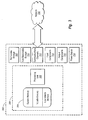
- a computing system 300 typically includes at least one processing unit 302 and memory 304.
- the memory 304 may be volatile (such as RAM), non-volatile (such as ROM, flash memory, etc.), or some combination of the two. This most basic configuration is illustrated in Figure 3 by the dashed line 306.
- the storage media devices may have additional features and functionality. For example, they may include additional storage (removable and non-removable) including, but not limited to, PCMCIA cards, magnetic and optical disks, and magnetic tape. Such additional storage is illustrated in Figure 3 by removable storage 308 and non-removable storage 310.
- Computer-storage media include volatile and non-volatile, removable and non-removable media implemented in any method or technology for storage of information such as computer-readable instructions, data structures, program modules, or other data.
- Memory 304, removable storage 308, and non-removable storage 310 are all examples of computer-storage media.
- Computer-storage media include, but are not limited to, RAM, ROM, EEPROM, flash memory, other memory technology, CD-ROM, digital versatile disks, other optical storage, magnetic cassettes, magnetic tape, magnetic disk storage, other magnetic storage devices, and any other media that can be used to store the desired information and that can be accessed by the computing system.
- module can refer to software objects or routines that execute on the computing system.
- the different components, modules, engines, and services described herein may be implemented as objects or processes that execute on the computing system (e.g., as separate threads). While the system and methods described herein are preferably implemented in software, implementations in software and hardware or hardware are also possible and contemplated.
- Computing system 300 may also contain communication channels 312 that allow the host to communicate with other systems and devices.
- Communication channels 312 are examples of communications media.
- Communications media typically embody computer-readable instructions, data structures, program modules, or other data in a modulated data signal such as a carrier wave or other transport mechanism and include any information-delivery media.
- communications media include wired media, such as wired networks and direct-wired connections, and wireless media such as acoustic, radio, infrared, and other wireless media.
- the term computer-readable media as used herein includes both storage media and communications media.
- the computing system 300 may also have input components 314 such as a keyboard, mouse, pen, a voice-input component, a touch-input device, and so forth.
- Output components 316 include screen displays, speakers, printer, etc., and rendering modules (often called “adapters") for driving them.
- the computing system 300 has a power supply 318. All these components are well known in the art and need not be discussed at length here.
- the display of the computing system 300 may be a Liquid Crystal Display having vertical striping as illustrated with respect to Figure 1A , or horizontal striping as illustrated with respect to Figure 2 .
- Figure 4 illustrates a flowchart of a method 400 for rendering an object on a portion of a display that includes a plurality of pixel sub-components for each pixel, where the pixel sub-components are striped vertically (see Figure 1A ) or horizontally (see Figure 2 ).
- Other striping configurations are suitable for use with the principles of the present invention even if not currently employed.
- the principles of the present invention may be applied to diagonal striping.
- the display often would be similarly configured such that all of the pixels in the display were each composed of a plurality of pixel subcomponents having a common striping direction. However, this need not be the case. For example, perhaps only a portion of the display has horizontal or vertical striping.
- portions of the display may have pixels striped in one direction (e.g., vertically), while other portions of the same display may have pixels striped in a different direction (e.g., horizontally).
- the principles of the present invention apply in any of these cases.
- the object may be non-text objects or may be text characters.
- the text character might be, for example, a Latin-based text character, an entire pictograph of Chinese origin (i.e., pictographs of Chinese origin such as Kanji and other East Asian characters), or just a radical of the pictograph, or any other text character.
- the object may be represented in any manner.
- the object may be represented using a bitmap, or may be represented using an outline description.
- outline descriptions is advantageous in that the object may be scaled in a more computationally efficient manner than if the object was represented using a bitmap.
- the object may also have a description of a color for the object. The color may be uniform, or different for different portions of the object.
- the computing system 300 determines that the object has spatial frequency dominance parallel to the actual striping direction (YES in decision block 401). At this stage, the computing system 300 need not have any centralized knowledge of what the actual striping direction is. However, if the actual striping direction of the display is horizontal, this act involves the computing system 300 determining that the object has horizontal spatial frequency dominance (i.e., has more vertically-oriented components). However, if the actual striping direction of the display is vertical, this act involves the computing system 300 determining that the object has vertical spatial frequency dominance (i.e., has more horizontal-oriented components).
- the object may have associated with it an identification of whether the object has horizontal spatial frequency dominance or vertical spatial frequency dominance.
- the object may include an identifier which associates the object with a set of objects (e.g., an alphabet or character set).
- the computing system 300 may then determine based on the set of objects whether or not the object likely has horizontal or vertical spatial frequency dominance. Alternatively, the computing system 300 may make the determination by examining the topology of the object.
- the computing system may apply this determination on an object-by-object bases by making this determination for each object to be rendered.
- the computing system 300 may make this determination once for one object, and apply the determination results to one or more subsequent objects to be displayed.
- step 410 the computing system 300 performs a functional, result-oriented step for rendering the object on the display as appropriate given the spatial frequency dominance of the object (step 410). While this step may include any corresponding acts that accomplish the stated result, step 410 includes acts 411, 412, 421 and 422 in the illustrated embodiment.
- the computing system 300 performs pixel sub-component based sampling assuming that the striping direction is perpendicular to the actual striping direction (act 411).
- the assumption that the striping direction is perpendicular to the actual striping direction is by definition an incorrect assumption. Nevertheless, counterintuitively, this incorrect assumption results in finer resolution when the object has spatial frequency dominance in the same direction as the striping direction.
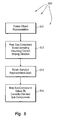
- Figure 5 illustrates a flowchart of a method 500 for performing pixel sub-component based sampling assuming that the striping direction is perpendicular to the actual striping direction.
- the method 500 is one way of performing act 411.
- a representation of the object is rotated (act 511) (See Figure 6A to 6B ).
- pixel sub-component based sampling is performed on the rotated representation of the object assuming the actual striping direction (act 512) (see Figure 6C ).
- An example of sub-component based sampling is described in commonly assigned, United States patent number 6,188,385 B1 issued February 13, 2001 , and entitled "Method and Apparatus for Displaying Images such as Text".
- Figure 6A illustrates a representation of an object of vertical spatial frequency dominance.
- the object is a Japanese Kanji character of Chinese origin. Note the large number of horizontal strokes as compared to the vertical strokes.
- the method 400 would perform pixel sub-component based sampling of the method assuming that the striping direction is horizontal, when it is actually vertical.
- Figure 6B illustrates the representation of the object rotated (and potentially scaled) as superimposed upon a grid pattern representing a vertically-striped display.
- the grid is represented by a three-by-three array of pixels, each pixel having three vertically-striped sub-components.
- Figure 6C illustrates the representation of the rotated object after scan conversion using the vertically striped grid in which each pixel sub-component has a sample value.
- the sampled object is still rotated.
- the circles marked with the X represent the sampled points that correspond to each pixel sub-component
- the lower-left pixel 600 includes sample points 601, 602 and 603.
- the pixel sub-component samples would have a horizontally-striped orientation if the samples are also rotated.
- This horizontally-striped orientation of sample points may have been more directly obtained without rotation.
- the scan conversion may be directly applied to the object of Figure 6A using a grid having horizontally striped sub-components to obtain the samples shown in Figure 6D .
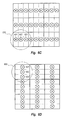
- Figure 6E illustrates the final step in which the sub-component samples are mapped to the correctly-oriented sub-components.
- Figure 6E shows that the sub-component samples are now vertically-striped. For each pixel, the horizontally-striped sub-component sample from Figure 6D is mapped to a vertically-striped sub-component sample in Figure 6E .
- the upper sub-component sample 601 from Figure 6D is mapped to the left sub-component sample 601' of Figure 6E
- the middle sub-component sample 602 from Figure 6D is mapped to the middle sub-component sample 602' of Figure 6E
- the bottom sub-component 603 of Figure 6D is mapped to the right sub-component sample 603' of Figure 6E .
- each of the pixel sub-components in pixel 600 of Figure 6D is mapped to a pixel sub-component in pixel 600' of Figure 6E .
- the upper sub-component sample 601 of the pixel 600 of Figure 6D may be mapped to the left sub-component sample 601' of pixel 600' of Figure 6E .
- the middle sub-component sample 602 of pixel 600 may be mapped to the middle sub-component sample 602' of pixel 600'
- the bottom sub-component sample 603 of pixel 600 may be mapped to the right sub-component sample 603' of Figure 6E .
- this mapping improves resolution, any mapping between the pixel sub-components of pixel 600 of Figure 6D and the pixel sub-components of pixel 600' of Figure 6E may suffice to improve resolution.
- mapping represented between Figures 6D and 6E results in improved resolution is quite surprising.
- This mapping essentially means that a sampled value representing one portion of the image is offset to a different portion of the display than one might expect.
- One of ordinary skill in the art might actually expect that this would decrease resolution.
- the inventors have discovered that performing this mapping actually improves a human being's perception of the object.
- the computing system 300 then renders at least a derivative of the sampled representation of the object on the display (act 412).
- the sample points from Figure 6D may be used directly as intensity values during the rendering.
- some other processing may also be performed prior to rendering if so desired.
- the computing system 300 determines that an object to be rendered has spatial frequency dominance perpendicular to the actual striping direction (NO in decision block 401)
- the computing system 300 performs sub-component based sampling assuming the actual striping at the striping direction is parallel to the actual striping direction (act 421). This sub-component based sampling is described in commonly assigned, United States patent number 6,188,385 B1 issued February 13, 2001 , and entitled "Method and Apparatus for Displaying Images such as Text”.
- the computing system then renders at least a derivative of the sampled representation of the object on the display (act 422).
- Figure 7A illustrates the object of vertical spatial frequency dominance when rendered at several font sizes and in which the pixel sub-component based sampling is performed assuming that the striping direction is opposite the actual vertical striping direction of the display.
- Figure 7B illustrates the object when rendered at several font sizes and in which the pixel sub-component based sampling is performing assuming that the striping direction the same as the actual striping direction. Note the improved resolution especially apparent for smaller font sizes.
- the spatial frequency dominance may be considered for each object, thereby improving resolution for each object.
Landscapes
- Engineering & Computer Science (AREA)
- Physics & Mathematics (AREA)
- Computer Hardware Design (AREA)
- General Physics & Mathematics (AREA)
- Theoretical Computer Science (AREA)
- Control Of Indicators Other Than Cathode Ray Tubes (AREA)
- Image Generation (AREA)
- Liquid Crystal Display Device Control (AREA)
- Controls And Circuits For Display Device (AREA)
Claims (15)
- Verfahren (400) zum Rendern eines Objekts auf einem Abschnitt einer Anzeige eines Rechensystems, die eine Vielzahl von Pixel-Teilkomponenten für jedes Pixel aufweist, wobei die Vielzahl von Pixel-Teilkomponenten Farbstreifen bildet, die entlang einer bestimmten Richtung angeordnet sind, wobei das Verfahren durch das Folgende gekennzeichnet ist:einen Vorgang zum Bestimmen (401), dass das Objekt eine räumliche Frequenzdominanz in eine erste Richtung hat, wobei die erste Richtung parallel zu der tatsächlichen Streifenrichtung ist, durch Bestimmen, dass das Objekt mehr Komponenten, die in eine zu der ersten Richtung senkrechten Richtung ausgerichtet sind, als Komponenten hat, die parallel zu der ersten Richtung ausgerichtet sind;einen Vorgang zum Durchführen eines auf Pixel-Teilkomponenten basierten Samplings (411) des Objekts unter der Annahme, dass die Streifenrichtung senkrecht zu der tatsächlichen Streifenrichtung ist; undeinen Vorgang zum Rendern (412) mindestens einer Ableitung der gesampelten Repräsentation des Objekts auf der Anzeige mit der tatsächlichen Streifenrichtung.
- Verfahren nach Anspruch 1, wobei das Objekt ein Schriftzeichen ist.
- Verfahren nach Anspruch 2, wobei das Schriftzeichen ein lateinisches Schriftzeichen ist.
- Verfahren nach Anspruch 2, wobei das Schriftzeichen ein Piktogramm chinesischen Ursprungs ist.
- Verfahren nach Anspruch 2, wobei das Schriftzeichen ein Radikal eines Piktogramms chinesischen Ursprungs ist.
- Verfahren nach Anspruch 1, wobei das Objekt kein Schriftzeichen ist.
- Verfahren nach Anspruch 1, wobei ein Vorgang zum Bestimmen (401), dass das Objekt eine räumliche Frequenzdominanz in eine erste Richtung hat, das Folgende umfasst:einen Vorgang zum Bestimmen, dass die Objekte aus einem Satz von Objekten eine räumliche Frequenzdominanz in die erste Richtung haben; undeinen Vorgang zum Bestimmen, dass das Objekt eines der Objekte aus dem Satz von Objekten ist.
- Verfahren nach Anspruch 1, wobei das Objekt ein erstes Objekt ist, wobei das Verfahren ferner das Folgende umfasst:einen Vorgang zum Bestimmen (401), dass ein zweites Objekt, das benachbart zu dem ersten Objekt angezeigt werden soll, eine räumliche Frequenzdominanz in eine zweite Richtung hat, wobei die zweite Richtung senkrecht zu der tatsächlichen Streifenrichtung ist;einen Vorgang zum Durchführen eines auf Teilkomponenten basierten Samplings (421) des zweiten Objekts unter der Annahme, dass die Streifenrichtung parallel zu der tatsächlichen Streifenrichtung ist; undeinen Vorgang zum Rendern (422) mindestens einer Ableitung der gesampelten Repräsentation des zweiten Objekts auf der Anzeige mit der tatsächlichen Streifenrichtung.
- Verfahren nach Anspruch 8, wobei das erste und das zweite Objekt Teile desselben chinesischen Piktogramms sind.
- Verfahren nach Anspruch 1, wobei die Streifenrichtung vertikal ist.
- Verfahren nach Anspruch 1, wobei die Streifenrichtung horizontal ist.
- Verfahren nach Anspruch 1, wobei alle Pixel in der Anzeige Streifen in die Streifenrichtung haben.
- Verfahren nach Anspruch 1, wobei der Vorgang zum Durchführen des auf Pixel-Teilkomponenten basierten Samplings (411) unter der Annahme, dass die Streifenrichtung senkrecht zu der tatsächlichen Streifenrichtung ist, das Folgende umfasst:einen Vorgang zum Drehen (511) der Repräsentation des Objekts;einen Vorgang zum Durchführen eines auf Teilkomponenten basierten Samplings (512) auf der gedrehten Repräsentation des Objekts unter der Annahme der tatsächlichen Streifenrichtung; undeinen Vorgang zum Zurückdrehen (513) der gesampelten Repräsentation des Objekts.
- Verfahren nach Anspruch 1, wobei der Vorgang zum Durchführen des auf Pixel-Teilkomponenten basierten Samplings (411) ferner das Folgende umfasst:einen Vorgang zum Abbilden (514) der gesampelten Werte auf eine Pixel-Teilkomponente.
- System, das ein Rechensystem (300) umfasst, das eine Anzeigevorrichtung mit einer Vielzahl von Pixeln (600) aufweist, zum Rendern eines Objekts auf einem Abschnitt der Anzeigevorrichtung, die eine Vielzahl von Pixel-Teilkomponenten (601, 602, 603) für jedes Pixel aufweist, wobei die Vielzahl von Pixel-Teilkomponenten Farbstreifen bildet, die entlang einer bestimmten Richtung angeordnet sind, dadurch gekennzeichnet, dass das System angeordnet ist, um das Verfahren nach einem der Ansprüche 1-14 durchzuführen.
Applications Claiming Priority (2)
| Application Number | Priority Date | Filing Date | Title |
|---|---|---|---|
| US10/745,204 US7286121B2 (en) | 2003-12-23 | 2003-12-23 | Sub-component based rendering of objects having spatial frequency dominance parallel to the striping direction of the display |
| PCT/US2004/024666 WO2005067436A2 (en) | 2003-12-23 | 2004-07-30 | Sub-component based rendering of objects having spatial frequency dominance parallel to the striping direction of the display |
Publications (3)
| Publication Number | Publication Date |
|---|---|
| EP1733377A2 EP1733377A2 (de) | 2006-12-20 |
| EP1733377A4 EP1733377A4 (de) | 2007-12-12 |
| EP1733377B1 true EP1733377B1 (de) | 2014-09-03 |
Family
ID=34679088
Family Applications (1)
| Application Number | Title | Priority Date | Filing Date |
|---|---|---|---|
| EP04779664.4A Expired - Lifetime EP1733377B1 (de) | 2003-12-23 | 2004-07-30 | Auf subkomponenten basierendes rendern von objekten mit räumlicher frequenzdominanz parallel zu der streifenrichtung der anzeige |
Country Status (6)
| Country | Link |
|---|---|
| US (1) | US7286121B2 (de) |
| EP (1) | EP1733377B1 (de) |
| JP (1) | JP4994042B2 (de) |
| KR (1) | KR101098641B1 (de) |
| CN (1) | CN100479022C (de) |
| WO (1) | WO2005067436A2 (de) |
Families Citing this family (3)
| Publication number | Priority date | Publication date | Assignee | Title |
|---|---|---|---|---|
| KR101278291B1 (ko) * | 2006-09-22 | 2013-06-21 | 삼성디스플레이 주식회사 | 표시장치 |
| US20090307578A1 (en) * | 2008-06-05 | 2009-12-10 | Microsoft Corporation | Top down chinese character display on a computing device |
| TWI763197B (zh) * | 2020-12-21 | 2022-05-01 | 珠海南北極科技有限公司 | 記憶體裝置以及應用在記憶體裝置的記憶單元 |
Family Cites Families (21)
| Publication number | Priority date | Publication date | Assignee | Title |
|---|---|---|---|---|
| US6188385B1 (en) * | 1998-10-07 | 2001-02-13 | Microsoft Corporation | Method and apparatus for displaying images such as text |
| US6307566B1 (en) | 1998-10-07 | 2001-10-23 | Microsoft Corporation | Methods and apparatus for performing image rendering and rasterization operations |
| WO2000021069A1 (en) | 1998-10-07 | 2000-04-13 | Microsoft Corporation | Mapping samples of foreground/background color image data to pixel sub-components |
| US6236390B1 (en) | 1998-10-07 | 2001-05-22 | Microsoft Corporation | Methods and apparatus for positioning displayed characters |
| US6421054B1 (en) | 1998-10-07 | 2002-07-16 | Microsoft Corporation | Methods and apparatus for performing grid fitting and hinting operations |
| US6278434B1 (en) | 1998-10-07 | 2001-08-21 | Microsoft Corporation | Non-square scaling of image data to be mapped to pixel sub-components |
| US6597360B1 (en) * | 1998-10-07 | 2003-07-22 | Microsoft Corporation | Automatic optimization of the position of stems of text characters |
| US6396505B1 (en) | 1998-10-07 | 2002-05-28 | Microsoft Corporation | Methods and apparatus for detecting and reducing color errors in images |
| US6356278B1 (en) * | 1998-10-07 | 2002-03-12 | Microsoft Corporation | Methods and systems for asymmeteric supersampling rasterization of image data |
| US6393145B2 (en) * | 1999-01-12 | 2002-05-21 | Microsoft Corporation | Methods apparatus and data structures for enhancing the resolution of images to be rendered on patterned display devices |
| US6674436B1 (en) * | 1999-02-01 | 2004-01-06 | Microsoft Corporation | Methods and apparatus for improving the quality of displayed images through the use of display device and display condition information |
| KR100324879B1 (ko) * | 1999-02-01 | 2002-02-28 | 마찌다 가쯔히꼬 | 문자 표시 장치, 문자 표시 방법 및 기록 매체 |
| US6342896B1 (en) * | 1999-03-19 | 2002-01-29 | Microsoft Corporation | Methods and apparatus for efficiently implementing and modifying foreground and background color selections |
| US6342890B1 (en) * | 1999-03-19 | 2002-01-29 | Microsoft Corporation | Methods, apparatus, and data structures for accessing sub-pixel data having left side bearing information |
| US6339426B1 (en) * | 1999-04-29 | 2002-01-15 | Microsoft Corporation | Methods, apparatus and data structures for overscaling or oversampling character feature information in a system for rendering text on horizontally striped displays |
| US6738526B1 (en) * | 1999-07-30 | 2004-05-18 | Microsoft Corporation | Method and apparatus for filtering and caching data representing images |
| US6226017B1 (en) * | 1999-07-30 | 2001-05-01 | Microsoft Corporation | Methods and apparatus for improving read/modify/write operations |
| US6282327B1 (en) * | 1999-07-30 | 2001-08-28 | Microsoft Corporation | Maintaining advance widths of existing characters that have been resolution enhanced |
| US8022969B2 (en) * | 2001-05-09 | 2011-09-20 | Samsung Electronics Co., Ltd. | Rotatable display with sub-pixel rendering |
| US7221381B2 (en) * | 2001-05-09 | 2007-05-22 | Clairvoyante, Inc | Methods and systems for sub-pixel rendering with gamma adjustment |
| JP4084105B2 (ja) * | 2002-06-28 | 2008-04-30 | 富士通株式会社 | 文字作成方法および文字作成プログラム |
-
2003
- 2003-12-23 US US10/745,204 patent/US7286121B2/en not_active Expired - Fee Related
-
2004
- 2004-07-30 WO PCT/US2004/024666 patent/WO2005067436A2/en not_active Ceased
- 2004-07-30 EP EP04779664.4A patent/EP1733377B1/de not_active Expired - Lifetime
- 2004-07-30 CN CNB2004800352630A patent/CN100479022C/zh not_active Expired - Fee Related
- 2004-07-30 JP JP2006546959A patent/JP4994042B2/ja not_active Expired - Fee Related
-
2006
- 2006-04-25 KR KR1020067007958A patent/KR101098641B1/ko not_active Expired - Fee Related
Also Published As
| Publication number | Publication date |
|---|---|
| JP2007516472A (ja) | 2007-06-21 |
| WO2005067436A2 (en) | 2005-07-28 |
| EP1733377A4 (de) | 2007-12-12 |
| CN100479022C (zh) | 2009-04-15 |
| US7286121B2 (en) | 2007-10-23 |
| WO2005067436A3 (en) | 2006-11-02 |
| KR20060113673A (ko) | 2006-11-02 |
| US20050134616A1 (en) | 2005-06-23 |
| JP4994042B2 (ja) | 2012-08-08 |
| EP1733377A2 (de) | 2006-12-20 |
| KR101098641B1 (ko) | 2011-12-23 |
| CN1973314A (zh) | 2007-05-30 |
Similar Documents
| Publication | Publication Date | Title |
|---|---|---|
| EP2579246B1 (de) | Abbilden von Mustern von Vordergrund-/Hintergrundfarbbilddaten auf Pixelunterkomponenten | |
| EP1125269B1 (de) | Verfahren und gerät zum nachweisen und vermindern von farbartefakten in bildern | |
| US6577291B2 (en) | Gray scale and color display methods and apparatus | |
| EP1125270B1 (de) | Verfahren zur Anzeige von Bildern wie Text mit verbesserter Auflösung | |
| EP1174854B1 (de) | Anzeigeeinrichtung und -Verfahren, und Datenträger der ein Computerprogramm zur Ansteuerung einer Anzeige mit unterteilten Bildelementen beinhaltet | |
| CA2748428C (en) | Automatic optimization of the position of stems of text characters | |
| EP1155396B1 (de) | Zuordnung von bilddatenproben zu bildpunkt- teilkomponenten auf einer, in streifen aufgeteilten anzeigevorrichtung | |
| EP1733377B1 (de) | Auf subkomponenten basierendes rendern von objekten mit räumlicher frequenzdominanz parallel zu der streifenrichtung der anzeige | |
| HK1183738B (en) | Mapping samples of foreground/background color image data to pixel sub-components | |
| HK1183738A (en) | Mapping samples of foreground/background color image data to pixel sub-components | |
| HK1169207A (en) | Independent mapping of portions of colour image data to pixel sub-components |
Legal Events
| Date | Code | Title | Description |
|---|---|---|---|
| PUAI | Public reference made under article 153(3) epc to a published international application that has entered the european phase |
Free format text: ORIGINAL CODE: 0009012 |
|
| 17P | Request for examination filed |
Effective date: 20060222 |
|
| AK | Designated contracting states |
Kind code of ref document: A2 Designated state(s): AT BE BG CH CY CZ DE DK EE ES FI FR GB GR HU IE IT LI LU MC NL PL PT RO SE SI SK TR |
|
| AX | Request for extension of the european patent |
Extension state: AL HR LT LV MK |
|
| DAX | Request for extension of the european patent (deleted) | ||
| A4 | Supplementary search report drawn up and despatched |
Effective date: 20071112 |
|
| RIC1 | Information provided on ipc code assigned before grant |
Ipc: G09G 5/28 20060101ALI20071106BHEP Ipc: G09G 3/36 20060101AFI20061109BHEP |
|
| 17Q | First examination report despatched |
Effective date: 20080430 |
|
| REG | Reference to a national code |
Ref country code: DE Ref legal event code: R079 Ref document number: 602004045772 Country of ref document: DE Free format text: PREVIOUS MAIN CLASS: G09G0003360000 Ipc: G09G0003200000 |
|
| RIC1 | Information provided on ipc code assigned before grant |
Ipc: G09G 5/24 20060101ALN20131216BHEP Ipc: G09G 5/28 20060101ALI20131216BHEP Ipc: G09G 3/36 20060101ALN20131216BHEP Ipc: G09G 3/20 20060101AFI20131216BHEP |
|
| GRAP | Despatch of communication of intention to grant a patent |
Free format text: ORIGINAL CODE: EPIDOSNIGR1 |
|
| INTG | Intention to grant announced |
Effective date: 20140313 |
|
| GRAS | Grant fee paid |
Free format text: ORIGINAL CODE: EPIDOSNIGR3 |
|
| GRAA | (expected) grant |
Free format text: ORIGINAL CODE: 0009210 |
|
| AK | Designated contracting states |
Kind code of ref document: B1 Designated state(s): AT BE BG CH CY CZ DE DK EE ES FI FR GB GR HU IE IT LI LU MC NL PL PT RO SE SI SK TR |
|
| REG | Reference to a national code |
Ref country code: GB Ref legal event code: FG4D |
|
| REG | Reference to a national code |
Ref country code: AT Ref legal event code: REF Ref document number: 685947 Country of ref document: AT Kind code of ref document: T Effective date: 20140915 Ref country code: CH Ref legal event code: EP |
|
| REG | Reference to a national code |
Ref country code: IE Ref legal event code: FG4D |
|
| REG | Reference to a national code |
Ref country code: DE Ref legal event code: R096 Ref document number: 602004045772 Country of ref document: DE Effective date: 20141009 |
|
| REG | Reference to a national code |
Ref country code: NL Ref legal event code: T3 |
|
| REG | Reference to a national code |
Ref country code: AT Ref legal event code: MK05 Ref document number: 685947 Country of ref document: AT Kind code of ref document: T Effective date: 20140903 |
|
| PG25 | Lapsed in a contracting state [announced via postgrant information from national office to epo] |
Ref country code: ES Free format text: LAPSE BECAUSE OF FAILURE TO SUBMIT A TRANSLATION OF THE DESCRIPTION OR TO PAY THE FEE WITHIN THE PRESCRIBED TIME-LIMIT Effective date: 20140903 Ref country code: SE Free format text: LAPSE BECAUSE OF FAILURE TO SUBMIT A TRANSLATION OF THE DESCRIPTION OR TO PAY THE FEE WITHIN THE PRESCRIBED TIME-LIMIT Effective date: 20140903 Ref country code: GR Free format text: LAPSE BECAUSE OF FAILURE TO SUBMIT A TRANSLATION OF THE DESCRIPTION OR TO PAY THE FEE WITHIN THE PRESCRIBED TIME-LIMIT Effective date: 20141204 Ref country code: FI Free format text: LAPSE BECAUSE OF FAILURE TO SUBMIT A TRANSLATION OF THE DESCRIPTION OR TO PAY THE FEE WITHIN THE PRESCRIBED TIME-LIMIT Effective date: 20140903 |
|
| PG25 | Lapsed in a contracting state [announced via postgrant information from national office to epo] |
Ref country code: AT Free format text: LAPSE BECAUSE OF FAILURE TO SUBMIT A TRANSLATION OF THE DESCRIPTION OR TO PAY THE FEE WITHIN THE PRESCRIBED TIME-LIMIT Effective date: 20140903 Ref country code: CY Free format text: LAPSE BECAUSE OF FAILURE TO SUBMIT A TRANSLATION OF THE DESCRIPTION OR TO PAY THE FEE WITHIN THE PRESCRIBED TIME-LIMIT Effective date: 20140903 |
|
| RAP2 | Party data changed (patent owner data changed or rights of a patent transferred) |
Owner name: MICROSOFT TECHNOLOGY LICENSING, LLC |
|
| REG | Reference to a national code |
Ref country code: GB Ref legal event code: 732E Free format text: REGISTERED BETWEEN 20150312 AND 20150318 |
|
| PG25 | Lapsed in a contracting state [announced via postgrant information from national office to epo] |
Ref country code: RO Free format text: LAPSE BECAUSE OF FAILURE TO SUBMIT A TRANSLATION OF THE DESCRIPTION OR TO PAY THE FEE WITHIN THE PRESCRIBED TIME-LIMIT Effective date: 20140903 Ref country code: CZ Free format text: LAPSE BECAUSE OF FAILURE TO SUBMIT A TRANSLATION OF THE DESCRIPTION OR TO PAY THE FEE WITHIN THE PRESCRIBED TIME-LIMIT Effective date: 20140903 Ref country code: EE Free format text: LAPSE BECAUSE OF FAILURE TO SUBMIT A TRANSLATION OF THE DESCRIPTION OR TO PAY THE FEE WITHIN THE PRESCRIBED TIME-LIMIT Effective date: 20140903 Ref country code: SK Free format text: LAPSE BECAUSE OF FAILURE TO SUBMIT A TRANSLATION OF THE DESCRIPTION OR TO PAY THE FEE WITHIN THE PRESCRIBED TIME-LIMIT Effective date: 20140903 Ref country code: PT Free format text: LAPSE BECAUSE OF FAILURE TO SUBMIT A TRANSLATION OF THE DESCRIPTION OR TO PAY THE FEE WITHIN THE PRESCRIBED TIME-LIMIT Effective date: 20150105 |
|
| REG | Reference to a national code |
Ref country code: DE Ref legal event code: R082 Ref document number: 602004045772 Country of ref document: DE Representative=s name: BOEHMERT & BOEHMERT ANWALTSPARTNERSCHAFT MBB -, DE |
|
| PG25 | Lapsed in a contracting state [announced via postgrant information from national office to epo] |
Ref country code: PL Free format text: LAPSE BECAUSE OF FAILURE TO SUBMIT A TRANSLATION OF THE DESCRIPTION OR TO PAY THE FEE WITHIN THE PRESCRIBED TIME-LIMIT Effective date: 20140903 |
|
| REG | Reference to a national code |
Ref country code: DE Ref legal event code: R097 Ref document number: 602004045772 Country of ref document: DE |
|
| REG | Reference to a national code |
Ref country code: DE Ref legal event code: R081 Ref document number: 602004045772 Country of ref document: DE Owner name: MICROSOFT TECHNOLOGY LICENSING, LLC, REDMOND, US Free format text: FORMER OWNER: MICROSOFT CORP., REDMOND, WASH., US Effective date: 20150430 Ref country code: DE Ref legal event code: R082 Ref document number: 602004045772 Country of ref document: DE Representative=s name: BOEHMERT & BOEHMERT ANWALTSPARTNERSCHAFT MBB -, DE Effective date: 20150430 |
|
| PLBE | No opposition filed within time limit |
Free format text: ORIGINAL CODE: 0009261 |
|
| STAA | Information on the status of an ep patent application or granted ep patent |
Free format text: STATUS: NO OPPOSITION FILED WITHIN TIME LIMIT |
|
| REG | Reference to a national code |
Ref country code: NL Ref legal event code: SD Effective date: 20150706 |
|
| PG25 | Lapsed in a contracting state [announced via postgrant information from national office to epo] |
Ref country code: DK Free format text: LAPSE BECAUSE OF FAILURE TO SUBMIT A TRANSLATION OF THE DESCRIPTION OR TO PAY THE FEE WITHIN THE PRESCRIBED TIME-LIMIT Effective date: 20140903 |
|
| 26N | No opposition filed |
Effective date: 20150604 |
|
| PG25 | Lapsed in a contracting state [announced via postgrant information from national office to epo] |
Ref country code: IT Free format text: LAPSE BECAUSE OF FAILURE TO SUBMIT A TRANSLATION OF THE DESCRIPTION OR TO PAY THE FEE WITHIN THE PRESCRIBED TIME-LIMIT Effective date: 20140903 |
|
| PG25 | Lapsed in a contracting state [announced via postgrant information from national office to epo] |
Ref country code: SI Free format text: LAPSE BECAUSE OF FAILURE TO SUBMIT A TRANSLATION OF THE DESCRIPTION OR TO PAY THE FEE WITHIN THE PRESCRIBED TIME-LIMIT Effective date: 20140903 |
|
| PG25 | Lapsed in a contracting state [announced via postgrant information from national office to epo] |
Ref country code: MC Free format text: LAPSE BECAUSE OF FAILURE TO SUBMIT A TRANSLATION OF THE DESCRIPTION OR TO PAY THE FEE WITHIN THE PRESCRIBED TIME-LIMIT Effective date: 20140903 |
|
| REG | Reference to a national code |
Ref country code: CH Ref legal event code: PL |
|
| PG25 | Lapsed in a contracting state [announced via postgrant information from national office to epo] |
Ref country code: LU Free format text: LAPSE BECAUSE OF FAILURE TO SUBMIT A TRANSLATION OF THE DESCRIPTION OR TO PAY THE FEE WITHIN THE PRESCRIBED TIME-LIMIT Effective date: 20150730 |
|
| REG | Reference to a national code |
Ref country code: IE Ref legal event code: MM4A |
|
| PG25 | Lapsed in a contracting state [announced via postgrant information from national office to epo] |
Ref country code: CH Free format text: LAPSE BECAUSE OF NON-PAYMENT OF DUE FEES Effective date: 20150731 Ref country code: LI Free format text: LAPSE BECAUSE OF NON-PAYMENT OF DUE FEES Effective date: 20150731 |
|
| REG | Reference to a national code |
Ref country code: FR Ref legal event code: PLFP Year of fee payment: 13 |
|
| PG25 | Lapsed in a contracting state [announced via postgrant information from national office to epo] |
Ref country code: IE Free format text: LAPSE BECAUSE OF NON-PAYMENT OF DUE FEES Effective date: 20150730 Ref country code: BE Free format text: LAPSE BECAUSE OF FAILURE TO SUBMIT A TRANSLATION OF THE DESCRIPTION OR TO PAY THE FEE WITHIN THE PRESCRIBED TIME-LIMIT Effective date: 20140903 |
|
| PG25 | Lapsed in a contracting state [announced via postgrant information from national office to epo] |
Ref country code: BG Free format text: LAPSE BECAUSE OF FAILURE TO SUBMIT A TRANSLATION OF THE DESCRIPTION OR TO PAY THE FEE WITHIN THE PRESCRIBED TIME-LIMIT Effective date: 20140903 Ref country code: HU Free format text: LAPSE BECAUSE OF FAILURE TO SUBMIT A TRANSLATION OF THE DESCRIPTION OR TO PAY THE FEE WITHIN THE PRESCRIBED TIME-LIMIT; INVALID AB INITIO Effective date: 20040730 |
|
| REG | Reference to a national code |
Ref country code: FR Ref legal event code: PLFP Year of fee payment: 14 |
|
| PG25 | Lapsed in a contracting state [announced via postgrant information from national office to epo] |
Ref country code: TR Free format text: LAPSE BECAUSE OF FAILURE TO SUBMIT A TRANSLATION OF THE DESCRIPTION OR TO PAY THE FEE WITHIN THE PRESCRIBED TIME-LIMIT Effective date: 20140903 |
|
| REG | Reference to a national code |
Ref country code: FR Ref legal event code: PLFP Year of fee payment: 15 |
|
| PGFP | Annual fee paid to national office [announced via postgrant information from national office to epo] |
Ref country code: FR Payment date: 20180612 Year of fee payment: 15 |
|
| PGFP | Annual fee paid to national office [announced via postgrant information from national office to epo] |
Ref country code: DE Payment date: 20180717 Year of fee payment: 15 Ref country code: NL Payment date: 20180712 Year of fee payment: 15 |
|
| PGFP | Annual fee paid to national office [announced via postgrant information from national office to epo] |
Ref country code: GB Payment date: 20180725 Year of fee payment: 15 |
|
| REG | Reference to a national code |
Ref country code: DE Ref legal event code: R119 Ref document number: 602004045772 Country of ref document: DE |
|
| GBPC | Gb: european patent ceased through non-payment of renewal fee |
Effective date: 20190730 |
|
| PG25 | Lapsed in a contracting state [announced via postgrant information from national office to epo] |
Ref country code: GB Free format text: LAPSE BECAUSE OF NON-PAYMENT OF DUE FEES Effective date: 20190730 Ref country code: NL Free format text: LAPSE BECAUSE OF NON-PAYMENT OF DUE FEES Effective date: 20190801 Ref country code: DE Free format text: LAPSE BECAUSE OF NON-PAYMENT OF DUE FEES Effective date: 20200201 |
|
| REG | Reference to a national code |
Ref country code: NL Ref legal event code: MM Effective date: 20190801 |
|
| PG25 | Lapsed in a contracting state [announced via postgrant information from national office to epo] |
Ref country code: FR Free format text: LAPSE BECAUSE OF NON-PAYMENT OF DUE FEES Effective date: 20190731 |