EP1733657A2 - Infuseur à thé - Google Patents
Infuseur à thé Download PDFInfo
- Publication number
- EP1733657A2 EP1733657A2 EP06009762A EP06009762A EP1733657A2 EP 1733657 A2 EP1733657 A2 EP 1733657A2 EP 06009762 A EP06009762 A EP 06009762A EP 06009762 A EP06009762 A EP 06009762A EP 1733657 A2 EP1733657 A2 EP 1733657A2
- Authority
- EP
- European Patent Office
- Prior art keywords
- tea strainer
- tea
- base body
- dimensionally stable
- strainer
- Prior art date
- Legal status (The legal status is an assumption and is not a legal conclusion. Google has not performed a legal analysis and makes no representation as to the accuracy of the status listed.)
- Granted
Links
- 239000000463 material Substances 0.000 claims abstract description 64
- 239000012780 transparent material Substances 0.000 claims abstract description 7
- 241001122767 Theaceae Species 0.000 claims abstract 25
- 235000013361 beverage Nutrition 0.000 claims description 26
- 229920003023 plastic Polymers 0.000 claims description 19
- 239000007788 liquid Substances 0.000 claims description 18
- 239000004033 plastic Substances 0.000 claims description 18
- XLYOFNOQVPJJNP-UHFFFAOYSA-N water Substances O XLYOFNOQVPJJNP-UHFFFAOYSA-N 0.000 claims description 18
- 239000000123 paper Substances 0.000 claims description 15
- 238000012216 screening Methods 0.000 claims description 11
- 239000008187 granular material Substances 0.000 claims description 10
- 239000011521 glass Substances 0.000 claims description 6
- 238000004080 punching Methods 0.000 claims description 4
- 239000000853 adhesive Substances 0.000 claims description 3
- 230000001070 adhesive effect Effects 0.000 claims description 3
- 229920000704 biodegradable plastic Polymers 0.000 claims description 3
- 229920001169 thermoplastic Polymers 0.000 claims description 3
- 239000004416 thermosoftening plastic Substances 0.000 claims description 3
- 238000007599 discharging Methods 0.000 claims description 2
- 238000005553 drilling Methods 0.000 claims description 2
- 235000013616 tea Nutrition 0.000 description 105
- 244000269722 Thea sinensis Species 0.000 description 103
- 239000000243 solution Substances 0.000 description 11
- 239000002245 particle Substances 0.000 description 8
- 238000004049 embossing Methods 0.000 description 6
- 239000010408 film Substances 0.000 description 6
- 239000004744 fabric Substances 0.000 description 4
- 238000010438 heat treatment Methods 0.000 description 4
- 238000013459 approach Methods 0.000 description 3
- 238000003860 storage Methods 0.000 description 3
- 230000008961 swelling Effects 0.000 description 3
- 238000003466 welding Methods 0.000 description 3
- 238000005452 bending Methods 0.000 description 2
- 238000013124 brewing process Methods 0.000 description 2
- 238000013461 design Methods 0.000 description 2
- 239000000796 flavoring agent Substances 0.000 description 2
- 235000019634 flavors Nutrition 0.000 description 2
- 239000011888 foil Substances 0.000 description 2
- 238000001746 injection moulding Methods 0.000 description 2
- 238000000034 method Methods 0.000 description 2
- 230000002093 peripheral effect Effects 0.000 description 2
- 239000002985 plastic film Substances 0.000 description 2
- 230000008569 process Effects 0.000 description 2
- 239000000126 substance Substances 0.000 description 2
- 230000009967 tasteless effect Effects 0.000 description 2
- 239000012815 thermoplastic material Substances 0.000 description 2
- 241000237858 Gastropoda Species 0.000 description 1
- 229920002472 Starch Polymers 0.000 description 1
- 235000006468 Thea sinensis Nutrition 0.000 description 1
- QVGXLLKOCUKJST-UHFFFAOYSA-N atomic oxygen Chemical compound [O] QVGXLLKOCUKJST-UHFFFAOYSA-N 0.000 description 1
- 238000006065 biodegradation reaction Methods 0.000 description 1
- 235000020279 black tea Nutrition 0.000 description 1
- 238000009835 boiling Methods 0.000 description 1
- 230000008859 change Effects 0.000 description 1
- 239000003795 chemical substances by application Substances 0.000 description 1
- 239000011248 coating agent Substances 0.000 description 1
- 238000000576 coating method Methods 0.000 description 1
- 238000004040 coloring Methods 0.000 description 1
- 239000002361 compost Substances 0.000 description 1
- 238000009264 composting Methods 0.000 description 1
- 238000011109 contamination Methods 0.000 description 1
- 230000007423 decrease Effects 0.000 description 1
- 230000001419 dependent effect Effects 0.000 description 1
- 238000002845 discoloration Methods 0.000 description 1
- 230000000694 effects Effects 0.000 description 1
- 238000007667 floating Methods 0.000 description 1
- 239000012530 fluid Substances 0.000 description 1
- 239000003292 glue Substances 0.000 description 1
- 238000007654 immersion Methods 0.000 description 1
- 239000004615 ingredient Substances 0.000 description 1
- 238000002347 injection Methods 0.000 description 1
- 239000007924 injection Substances 0.000 description 1
- 238000003780 insertion Methods 0.000 description 1
- 230000037431 insertion Effects 0.000 description 1
- 238000004519 manufacturing process Methods 0.000 description 1
- 239000002184 metal Substances 0.000 description 1
- 238000012986 modification Methods 0.000 description 1
- 230000004048 modification Effects 0.000 description 1
- 235000019645 odor Nutrition 0.000 description 1
- 239000011368 organic material Substances 0.000 description 1
- 229910052760 oxygen Inorganic materials 0.000 description 1
- 239000001301 oxygen Substances 0.000 description 1
- 229920006255 plastic film Polymers 0.000 description 1
- 229920000642 polymer Polymers 0.000 description 1
- 229910052573 porcelain Inorganic materials 0.000 description 1
- 238000002360 preparation method Methods 0.000 description 1
- 230000009467 reduction Effects 0.000 description 1
- 238000005096 rolling process Methods 0.000 description 1
- 238000000926 separation method Methods 0.000 description 1
- 239000002689 soil Substances 0.000 description 1
- 239000007787 solid Substances 0.000 description 1
- 239000011343 solid material Substances 0.000 description 1
- 238000005507 spraying Methods 0.000 description 1
- 238000003892 spreading Methods 0.000 description 1
- 230000007480 spreading Effects 0.000 description 1
- 230000006641 stabilisation Effects 0.000 description 1
- 238000011105 stabilization Methods 0.000 description 1
- 239000010935 stainless steel Substances 0.000 description 1
- 229910001220 stainless steel Inorganic materials 0.000 description 1
- 239000000725 suspension Substances 0.000 description 1
- 238000012360 testing method Methods 0.000 description 1
- 239000004753 textile Substances 0.000 description 1
- 239000010409 thin film Substances 0.000 description 1
Images



Classifications
-
- A—HUMAN NECESSITIES
- A47—FURNITURE; DOMESTIC ARTICLES OR APPLIANCES; COFFEE MILLS; SPICE MILLS; SUCTION CLEANERS IN GENERAL
- A47J—KITCHEN EQUIPMENT; COFFEE MILLS; SPICE MILLS; APPARATUS FOR MAKING BEVERAGES
- A47J31/00—Apparatus for making beverages
- A47J31/06—Filters or strainers for coffee or tea makers ; Holders therefor
- A47J31/0636—Filters or strainers for coffee or tea makers ; Holders therefor suspended from the top of the beverage container so as to remain in contact with the prepared infusion
-
- A—HUMAN NECESSITIES
- A47—FURNITURE; DOMESTIC ARTICLES OR APPLIANCES; COFFEE MILLS; SPICE MILLS; SUCTION CLEANERS IN GENERAL
- A47G—HOUSEHOLD OR TABLE EQUIPMENT
- A47G19/00—Table service
- A47G19/12—Vessels or pots for table use
- A47G19/16—Tea infusers, e.g. infusing bags, egg-shaped infuses
-
- B—PERFORMING OPERATIONS; TRANSPORTING
- B65—CONVEYING; PACKING; STORING; HANDLING THIN OR FILAMENTARY MATERIAL
- B65D—CONTAINERS FOR STORAGE OR TRANSPORT OF ARTICLES OR MATERIALS, e.g. BAGS, BARRELS, BOTTLES, BOXES, CANS, CARTONS, CRATES, DRUMS, JARS, TANKS, HOPPERS, FORWARDING CONTAINERS; ACCESSORIES, CLOSURES, OR FITTINGS THEREFOR; PACKAGING ELEMENTS; PACKAGES
- B65D65/00—Wrappers or flexible covers; Packaging materials of special type or form
- B65D65/38—Packaging materials of special type or form
- B65D65/46—Applications of disintegrable, dissolvable or edible materials
- B65D65/466—Bio- or photodegradable packaging materials
-
- Y—GENERAL TAGGING OF NEW TECHNOLOGICAL DEVELOPMENTS; GENERAL TAGGING OF CROSS-SECTIONAL TECHNOLOGIES SPANNING OVER SEVERAL SECTIONS OF THE IPC; TECHNICAL SUBJECTS COVERED BY FORMER USPC CROSS-REFERENCE ART COLLECTIONS [XRACs] AND DIGESTS
- Y02—TECHNOLOGIES OR APPLICATIONS FOR MITIGATION OR ADAPTATION AGAINST CLIMATE CHANGE
- Y02W—CLIMATE CHANGE MITIGATION TECHNOLOGIES RELATED TO WASTEWATER TREATMENT OR WASTE MANAGEMENT
- Y02W90/00—Enabling technologies or technologies with a potential or indirect contribution to greenhouse gas [GHG] emissions mitigation
- Y02W90/10—Bio-packaging, e.g. packing containers made from renewable resources or bio-plastics
Definitions
- the invention relates to tea strainers.
- a total of recyclable tea filters consist entirely of glass, porcelain, stainless steel or plastic, usually in a form-containing body made of glass or plastic, a gauze or fabric is arranged in the form of a close mesh, which consists of plastic, metal or textile material and is not or only to a limited extent self-contained. Because of the firm connection with the form-retaining basic body, these tea strainers are reused overall.
- the disposable solutions have the disadvantage that they are usually difficult for the restaurateur to handle, since here first a manual stopping of the non-dimensionally stable filter part is required.
- a further disadvantage is that such a tea filter used only once is usually not transparent and therefore the tea floating in water is not or at most visible from the filling opening.
- tea strainers regardless of whether they are intended for single or multiple use, on the one hand from a Main body consist, which is so dimensionally stable at least in use, that it has grown during use loads and in particular the load when hanging or hanging on the top of a tea container, such as a tea glass or a teapot, allowed, and on the other hand from a screen holding back the ingredients of the tea in the interior of the tea strainer.
- the shape stability offering base body and the Siebfunktion bidding Siebteil partially, but also completely merge into one another, so be functionally unified.
- the tea strainer is at least partially or wholly made of translucent material, especially a material which is highly translucent, the user may pass through this transparent material while the tea is being drawn in the tea water - if the tea container is also transparent, as is often the case - observe the swelling of the tea as well as the color change of the water and thereby on the one hand control the progress of the tea preparation and on the other hand see the quality of the tea particles used.
- the tea particles can swim in the largest possible volume of liquid, so the interior of the tea strainer is as large as possible, for example, by a cup shape or bag shape, at least of the screening part, preferably the entire tea strainer, can be very well ensured.
- the bag shape is formed by a wall surrounding the interior of the tea particles whose bottom opening is sealed by a bottom, and whose upper edge preferably protrudes radially outward, at least with a portion of the peripheral region, and there for laying on the edge of a Beverage container serves.
- the dimensionally stable body can either be dimensionally stable in principle or only in its use state, ie in the transport state, which it occupies before use, either not be dimensionally stable or have a different shape than in use.
- the screen member is only partially, preferably in its entire extension, not dimensionally stable and consists for example of a filter fleece, be it plastic or organic material such as pulp or paper, or a multi-perforated thin film, which may also be made of plastic.
- At least that part of the dimensionally stable base body, which dips into the liquid when using the tea strainer consists of the translucent, in particular transparent, material and, if possible, the sieve part, in particular its non-dimensionally stable part of the sieve part.
- Screen member and base body can either consist of basically different materials, such as a plastic on the one hand and a paper material on the other hand, or from the same base material, which only in different wall thickness and / or different physical shape, eg. B. solid material on the one hand and woven material on the other hand is present.
- the number of different materials should be kept at least as small as possible, so in different materials they are not additionally connected by an existing adhesive of a third material with each other, but the connection can be achieved for example by heating and thus bonding the one material.
- either the main body or the screen member and in particular both parts even if they are made of different materials, each consist of biodegradable materials and thus can be disposed of together and without material separation in the compost.
- a particularly easy-to-use and also to be produced design is to use a cup-like base made of dimensionally stable, transparent, biodegradable plastic as the base body, wherein at least the majority of the bottom, possibly also the lower portions of the wall of the cup, from a in are not dimensionally stable filter fleece, which is glued or welded to the body.
- a dimensionally stable cup as a base body of the bottom region only consist of an outer, annular peripheral edge region of the soil on which a correspondingly larger than the bottom opening sized filter fabric is glued or welded.
- holes can still be present in the wall area of the main body in order to improve the passage possibilities for the liquid and thus the exchange of flavors that the tea should provide between the interior and exterior with respect to the tea strainer.
- the cup-like part can also consist only of a circumferential wall, preferably around the lower edge area as a bag-like, not dimensionally stable screen member which is glued or welded.
- the dimensionally stable base body in this case has an upper edge, preferably either a radially outwardly projecting, circumferential, edge or at least individually radially outwardly projecting projections, which serve for placing on the upper edge of the beverage container.
- one of these radially projecting projections may be formed as a downwardly bent hook, for hanging on the edge of the beverage container, so that the tea strainer is outside the beverage container.
- one of the projections may be formed as an outwardly projecting handle for handling the tea strainer, or such a handle is provided in addition to the projections.
- the filter fleece can either consist of a plastic material, in particular of the same plastic as the main body, or of another material, such as a paper or pulp. However, if both materials, ie that of the main body, as well as that of the screening member, are biodegradable, so preferably for example, the body of biodegradable dimensionally stable plastic and the sieve of biodegradable filter paper, both can be fed together composting and disintegrate there completely ,
- a filter fleece it is also possible to use a thin, non-dimensionally stable foil of the same material as that of the base body, which has a multiplicity of holes which can be produced, for example, by needle rolling or by laser bombardment.
- Such tips can also be formed in that the holes are not drilled, but punched out, but not completely encircling and thus the punched-out slug at one point of the circumference still connected to the edge of the hole protrudes downwards and remains in this position and acts as a tip.
- the wall thickness is preferably between 0.2 mm and 1.8 mm, in particular between 0.25 mm and 1.1 mm, im Essentially regardless of whether the material is a plastic or z.
- B. cardboard is.
- the largest outer diameter of the tea strainer, especially at the top, is to choose greater than the free opening of the used beverage container in which the tea strainer is to be hung, and to create a sufficiently wide interior, the upper opening of the tea strainer should be at least 0, 2 times, better at least 0.3 times, better at least 0.4 times the height of the tea strainer be.
- the upper opening of the tea strainer should be at least 2 cm, better at least 3 cm, better at least 4 cm.
- the tea strainer can also consist overall of a dimensionally stable base body, for example made of transparent, biodegradable plastic material, in which then a plurality of the aforementioned and described holes are arranged at least in the bottom region, preferably also in the wall region.
- the plastic material is thermoplastic material to heat by heating - whether by means of hot stamp or by means of ultrasonic vibrations - this plastic material, which preferably consists of the body, with other non-thermoplastic materials such as filter paper, by heating to doughy, sticky To bond state without having to use an additional adhesive.
- the tea strainer is preferably dimensioned so that the volume of the interior of the tea strainer is at least 50%, in particular at least 60%, better even 70% or 80% of the inner volume of the beverage container and / or the diameter of the free opening of the Tea strainer is at least 70%, better 80%, better 90% of the diameter of the opening of the beverage container.
- the dimensionally stable base body is not made of transparent material, in particular not of plastic, but for example made of cardboard, this base body made of cardboard due to the adhesion of flavors and odors during use do not reach down into the liquid during use, but preferably only the upper edge area consist of this material.
- a non-dimensionally stable bag is then arranged as a sieve part of, for example, filter paper at the upper part of dimensionally stable material.
- the transport and storage is then greatly simplified if both together can assume a flat transport state, from which they can be transferred, in particular the in-use dimensionally stable base body made of cardboard in a non-flat state of use, by a forming process in which parts the body are moved relative to each other, for. B. folded relative to each other, rotated or moved.
- a bag-shaped tea strainer which is very advantageous to the user, can be created in that, unlike the two layers previously connected, the front and back of the bag, and a supplementary bottom, the front of the bag is not made of a nonwoven filter but of a transparent material
- a transparent plastic film is made.
- the plastic film may have holes, but is preferably unperforated, since the liquid exchange is carried out through the back formed as a filter, which is sufficient for drawing the tea, as usual in the state of use, the interior of the filter bag a substantial portion of the liquid volume of the beverage container, So the teacup or the tea pot, amounts to.
- the observer can, on the one hand, observe the swelling of the tea granules and their movement in the liquid from the front, and on the other hand, recognize the discoloration of the resulting beverage and thus the correct time to complete the testing process.
- the transparent film consists of a biodegradable, especially compostable, material, as well as the filter material, which is usually a filter paper.
- Such a mesh bag may be provided for attachment to a multiply used holder or suspension frame, or be completely sealed as a tea bag or with a fixed dimensionally stable body, and be it only an upper plate-shaped support edge for placement on a beverage container, firmly connected.
- the body may have in its lower region, preferably at its lowest point, an operable valve for discharging liquid.
- this tea strainer can be lifted out of the beverage container with the valve open, so that the liquid essentially drains into the beverage container.
- the valve For the subsequent stopping of the sieve with the wet tea granules contained therein on a separate shelf or the like, the valve then remains closed, so that no subsequent leakage or leakage of strong coloring tea liquid from the sieve is possible.
- the dimensionally stable base body comprises two mutually movable parts, which enclose between them the volume for receiving the tea granules.
- this volume between them is as large as possible, so that the tea particles float or float in a large volume of liquid.
- the parts are moved against each other such that the volume trapped therebetween is drastically limited to one-tenth or even one twentieth or less of the original volume and, in particular, can be limited until the compressed tea particles are too high in resistance to another Move the parts of the body towards each other.
- the one part of the main body is preferably the cup part of the main body, the other part may be a movable in the vertical direction, ie in the axial direction slide which seals the free cross section of the cup-shaped base body and to reduce the gap down towards the bottom of the Is pushed body.
- a bulkhead projecting outwardly from a central vertical axis of the body can accommodate the tea granules therebetween with a second bulkhead pivotable about the axis between them, together with the axis and wall of the cup-shaped screen and the ground.
- one or both of the relatively movable parts may have holes for the passage of the liquid to facilitate the relative movement.
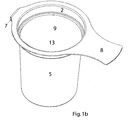
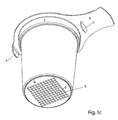
- Fig. 1 shows a cup-like tea strainer 1, in which the rigid base body 2 includes the entire upper edge region and the adjoining, down to the bottom 6 and reaching into the interior 13 tightly enclosing wall 5.
- the lower end of the all-round, the interior 13 down slightly conically tapered, wall 5 is bent inwardly and forms a substantially open passage, which is surrounded by a radially inwardly reaching bottom edge 6 ', where the actual bottom 6 tight is fixed, which represents the screening part 4 and accordingly contains holes 3.
- the base body 2 is in the upper edge region for additional stabilization in the course of the wall 5 Z-shaped cranked outwards and is at the upper end of the wall 5 in the radially outwardly projecting edge 18 via.
- the edge 18 is extended on two opposite sides radially beyond the normal radial projection and forms on one side the further radially projecting handle 8 for gripping and handling the entire tea strainer 1, and on the opposite side a downwardly bent hook. 7 , which mainly serves the hooking of the tea strainer 1 before the actual use on the outside of a tea container 11, for example a teapot, in which the hook 7 on the edge of the tea container 11th is stuck and protrudes in the Innraum down, while the rest of the tea strainer 1 is hanging outside hanging on the tea container 11.
- the entire base body 2 is dimensionally stable and usually made by injection molding or punching from a heat of almost boiling tea resisting, preferably transparent, made of material, such as a plastic or a preferably made of vegetable starch material.
- biodegradable that is to say completely compostable, materials are preferably used for the production of the base body 2, and also for the base 6 inserted into the base body 2.
- the conical taper of the tea strainer 1 down serves on the one hand the manufacturability by injection molding and on the other hand, the stackability of the finished tea strainers for storage purposes.
- the part used as the base 6 in the opening of the bottom edge 6 ' is likewise dimensionally stable, and in particular produced as an injection molded part, that is again with a wall thickness similar to the wall thickness of the base body 2, with a plurality arranged therein, for. B. drilled, punched or injection-molded holes 3.
- the holes are made by punching, are preferably the hole-punched 3 ', so the researcherssanzenden slugs, down from 6 bottom, in which they are not completely punched out, but are still connected to a portion of the circumference of the punched and projecting down.
- the problem of the holes 3, however, is that on the one hand, especially during spraying, but also during drilling, the holes can hardly be undershot a diameter of about 0.5 mm.
- Another problem is that even holes of 0.5 mm diameter, even more so but smaller holes in a flat bottom 6 when lifting the tea strainer from the beverage container 11, the water located in the interior 13 can flow out only up to a certain residual amount.
- the bottom 6 can also consist of a material which is not inherently dimensionally stable, for example filter paper 14 or a perforated film, in particular finely perforated film 19, which is connected to the radially inwardly protruding, stable bottom edge 6 'of the main body 2 Sticking or welding, preferably on the inside, so top, the bottom edge 6 '.
- a material which is not inherently dimensionally stable for example filter paper 14 or a perforated film, in particular finely perforated film 19, which is connected to the radially inwardly protruding, stable bottom edge 6 'of the main body 2 Sticking or welding, preferably on the inside, so top, the bottom edge 6 '.
- the welding takes place-by heating the thermoplastic material-if the material of the main body 2 and in particular its bottom edge 6 'is a heat-sealable material, ie for example a thermoplastic or the bottom edge 6' and / or the bottom 6 to be fixed at least in its edge region consists of this material or provided with a corresponding coating.
- a heat-sealable material ie for example a thermoplastic or the bottom edge 6' and / or the bottom 6 to be fixed at least in its edge region consists of this material or provided with a corresponding coating.
- the biodegradation may depend on various parameters required, for example the impact of UV light or sunlight on the material, the presence of oxygen, moisture, certain microbes or physical or chemical or organic parameters.
- the bottom Since in the solutions shown in FIG. 1 and 2 only or mainly the bottom has 6 holes 3, immersed here the main body 2 with its wall 5 in the water in the beverage container 11, and must therefore consist of a material which is tasteless and withstands both the heat and moisture of the tea water, at least for a limited time while the tea is being drawn.
- the bottom 6 is not formed as a flat surface, but bent downwards, preferably formed with a downwardly directed tip, which is the complete drainage the water when lifting from the beverage container 11 out facilitates.
- Fig. 3 shows a solution in which the dimensionally stable base body 2 'in the upper region analogous to that of Figs. 1 and 2 corresponds, but the walls 5' much less further down, and represent only a wall approach, where the upper edge a bag 21 made of a non-dimensionally stable filter material, be it filter paper, a filter fleece, a fabric or a multiple finely perforated film 19 attached, in particular glued or welded on the outer circumference, this again preferably by means of the weldable properties of one of the materials used and without additional Glue or welding agent.
- a bag 21 made of a non-dimensionally stable filter material, be it filter paper, a filter fleece, a fabric or a multiple finely perforated film 19 attached, in particular glued or welded on the outer circumference, this again preferably by means of the weldable properties of one of the materials used and without additional Glue or welding agent.
- the height of the bag 21 is more than 50% of the total height 10 of the tea strainer 1 ', in particular more than 70% of its height, so that the area within which there are holes for the exchange of liquid and the suspended matter, is much larger.
- the upper edge of the bag 21 is circumferentially attached to the downwardly facing walls 5 'around the opening 9.
- Fig. 3c shows in the plan view of the opening 9 from above, that despite the all-round attachment of the bag 21 on the walls 5 'of the bag in the middle with its side walls can approach each other and only by inserting the tea or inserting z.
- a spoon or the decline of the stability of the bag 21 by immersion in the tea water the bag 21 on its entire height to its full interior 13 expands.
- FIG. 4 shows a solution in which the basic body 2 "is likewise dimensionally stable, but can be changed in its shape between a transport state (FIGS. 4 a and 4 b) and a use state (FIGS. 4 c and 4 d) 2 "so low that it does not reach down to the water surface 15 in the beverage container in use, and thus only attached to the bottom of the base 2, in particular glued or welded, even non-dimensionally stable bag 21 dipped from a filter material in the tea water.
- the dimensionally stable base body 2 "does not necessarily consist of a taste-neutral and also not of a transparent material, and can therefore be inexpensive, for example made of cardboard.Disadvantage in both solutions, so according to Fig. 3 and 4, however, is that the non-dimensionally stable Filter material of the bag 21 is usually not transparent and thus the user of the swelling of the tea from the side can not be observed, but only from above through the opening 9 of the tea strainer. 1
- FIG. 4a and b show the tea strainer 1 "in the flat folded transport state in the side view (FIG. 4a) and in the front view from the side of the main body 2" (FIG. 4b).
- Fig. 4a is glued to the lower edge of the base body 2 ", the upper open edge region of the bag 21, in which the tea is introduced in use, which can be wider down or even have a constant width.
- the main body 2 " which may for example consist of cardboard, consists of a rectangular central area, which extends through an approximately in the middle between the upper and lower edge region in this rectangle extending slot 24, which does not go through to the lateral edges, in an upper Part 2a and a lower part 2b is divided.
- outwardly projecting extensions 23 follow, which together with the upper and lower part 2a, b integral with this are formed, only separated from each other by line embossing 25 a, in which the material of the Grundköpers 2 is compressed and thus has a thinner cross-section and thus represents a predetermined bending point.
- Another line embossing 25b as a predetermined bending point is present in the middle between the laterally outer edges of the lower part 2b parallel to the line embossings 25a, wherein the line embossing 25b extends over the entire height of the base body 2, both over part 2a and 2b part.
- the two upper open edges 21a, b of the bag 21 should end at different heights.
- the one edge region 21 a of the bag 21 is connected to the outside of the part 2 b, for example glued, and the opposite edge region 21 b of the bag 21 with the outside of the other, deeper part 2 b of the base body 2 " in the upper, also flat folded in the transport state, opening of the bag 21 a.
- the four halves of the total two parts 2a, b thus form an expanded parallelogram according to the Fig. 4c, d which a bias to the Line embossments 25a radially outward and due to this bias the tea strainer can be inserted from above into the opening 12 of a tea container 11 until the outwardly projecting projections 23 sit on the upper edge of the container 11 and at least the lower part 2b in the interior of the Opening 12 is located and applies with its outer edges due to the bias radially outward against the opening 12.
- the kinks on the line embossments 25b can rest exactly with its outside on the inner surfaces of the opening 12 or even too small an opening 12, the sections of the parts 2a, b wavy outwardly bent as shown in Fig. 4c.
- the spreading can - after initially moving apart of the central portions of the parts 2a, b - are also continued by compressing the outer edge of the part 2b or the extensions 23 in the direction of the main plane 20 against each other, causing an increasing spread of the opening 9.
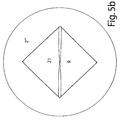
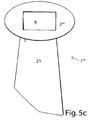
- Fig. 5 shows a solution in which the main body 2 '"consists of a flat plate, which occupies preferably both in the transport state and in use the same shape, but also for the transport state around a diagonal around with two of their halves against each other can.
- the opening 9 around the circumference of which the edge of the bag itself, made of a non-dimensionally stable sieve material, such as filter paper, is bonded 21 may consist of transparent material, for example a multi-perforated film, or of a non-transparent fleece or fabric, and it may increase in width downwards and also leak in a point, as shown in Fig. 5a, or even one have constant width over the entire height.
- the bag 21 is folded over and thereby folded flat, in a plane parallel to the plane of the plate-shaped base body 2 "', which is why even after preparing the use state as shown in Fig. 5a and 5c by the longitudinal axis of the bag 21 at right angles from the main plane of the plate-shaped main body 2 '", the opposite sides of the bag 21 relatively closely approach each other - at least from a certain distance from the base 2" "- and spaced apart only by the falling in of the tea or the insertion of the spoon become.
- the height extent of the base body 2 '" is so low that when placing this body 2'" on the edge 12 of a tea pot 11, as shown in Fig. 5a left side, the main body 2 '"not at all Inside of the beverage container 11 hineinerstreckt, the main body 2 '"in this solution also consist of a non-tasteless material such as cardboard.
Landscapes
- Engineering & Computer Science (AREA)
- Food Science & Technology (AREA)
- Life Sciences & Earth Sciences (AREA)
- Biodiversity & Conservation Biology (AREA)
- Mechanical Engineering (AREA)
- Packages (AREA)
- Apparatus For Making Beverages (AREA)
- Packging For Living Organisms, Food Or Medicinal Products That Are Sensitive To Environmental Conditiond (AREA)
- Table Devices Or Equipment (AREA)
- Centrifugal Separators (AREA)
- Glass Compositions (AREA)
Applications Claiming Priority (2)
| Application Number | Priority Date | Filing Date | Title |
|---|---|---|---|
| DE102005021834 | 2005-05-11 | ||
| DE102005040095A DE102005040095A1 (de) | 2005-05-11 | 2005-08-24 | Teesieb |
Publications (3)
| Publication Number | Publication Date |
|---|---|
| EP1733657A2 true EP1733657A2 (fr) | 2006-12-20 |
| EP1733657A3 EP1733657A3 (fr) | 2007-03-07 |
| EP1733657B1 EP1733657B1 (fr) | 2011-03-30 |
Family
ID=37103019
Family Applications (1)
| Application Number | Title | Priority Date | Filing Date |
|---|---|---|---|
| EP06009762A Expired - Lifetime EP1733657B1 (fr) | 2005-05-11 | 2006-05-11 | Infuseur à thé |
Country Status (3)
| Country | Link |
|---|---|
| EP (1) | EP1733657B1 (fr) |
| AT (1) | ATE503405T1 (fr) |
| DE (2) | DE102005040095A1 (fr) |
Families Citing this family (2)
| Publication number | Priority date | Publication date | Assignee | Title |
|---|---|---|---|---|
| WO2010010572A2 (fr) * | 2008-07-24 | 2010-01-28 | Tata Chemicals Ltd. | Système et procédé de purification d’eau |
| DE102015007402A1 (de) * | 2015-06-08 | 2016-12-08 | Linda Ramke | Vorrichtung zum Aufnehmen von Schüttgütern für die Zubereitung von Getränken |
Family Cites Families (4)
| Publication number | Priority date | Publication date | Assignee | Title |
|---|---|---|---|---|
| DE818683C (de) * | 1948-10-02 | 1951-10-25 | Willi Battke | Kaffee- und Teefilter |
| GB2052250B (en) * | 1979-06-15 | 1983-11-16 | Winberg R | Tea filter |
| DE3806695A1 (de) * | 1988-03-02 | 1989-09-14 | Volz Abc Elektrogeraete | Sieb fuer lebensmittel |
| US6314866B1 (en) * | 1996-12-16 | 2001-11-13 | Espire Incorporated | Lid for beverage container with removable inner cover having an attached infuser unit |
-
2005
- 2005-08-24 DE DE102005040095A patent/DE102005040095A1/de not_active Withdrawn
-
2006
- 2006-05-11 EP EP06009762A patent/EP1733657B1/fr not_active Expired - Lifetime
- 2006-05-11 DE DE502006009190T patent/DE502006009190D1/de not_active Expired - Lifetime
- 2006-05-11 AT AT06009762T patent/ATE503405T1/de active
Non-Patent Citations (1)
| Title |
|---|
| None |
Also Published As
| Publication number | Publication date |
|---|---|
| EP1733657B1 (fr) | 2011-03-30 |
| EP1733657A3 (fr) | 2007-03-07 |
| ATE503405T1 (de) | 2011-04-15 |
| DE502006009190D1 (de) | 2011-05-12 |
| DE102005040095A1 (de) | 2006-11-16 |
Similar Documents
| Publication | Publication Date | Title |
|---|---|---|
| EP1230166B1 (fr) | Dispositif de filtration pour liquides | |
| DE60101129T2 (de) | Filtriervorrichtung für Kaffee oder dergleichen | |
| DE69201237T2 (de) | Filtereinsatz für behälter. | |
| EP0824033B1 (fr) | Cartouche filtrant avec tamis dans un orifice de sortie | |
| DE202009018817U1 (de) | System und Kapsel zum Zubereiten eines Getränks | |
| DE602004001387T2 (de) | Kartusche für Kaffee | |
| DE202009018805U1 (de) | Kapsel zum Enthalten von Getränkezutaten | |
| EP2262738B2 (fr) | Récipient de filtration de liquide, doté d'une fenêtre de sortie d'air | |
| DE102005058336A1 (de) | Portionskapsel | |
| EP0823276A1 (fr) | Dispositif de filtration avec élément en tissu | |
| AT508887B1 (de) | Kaffeekapsel | |
| WO1997040727A1 (fr) | Systeme de filtration | |
| DE202015100812U1 (de) | Dichtung für Kaffeekapseln | |
| DE2408138A1 (de) | Wegwerf-urinbehaelter fuer bettlaegerige | |
| CH688019A5 (de) | Kaffeemaschine. | |
| DE1903949A1 (de) | Filter zum Filtern von Kaffee | |
| EP1547499B1 (fr) | Conteneur de produit | |
| EP1757213A2 (fr) | Filtre à thé | |
| EP1733657B1 (fr) | Infuseur à thé | |
| DE102007041102A1 (de) | Verfahren zur Herstellung einer Kapsel, sowie Kapsel für eine Vorrichtung zur Erzeugung von flüssigen Lebensmitteln | |
| DE8713769U1 (de) | Gießkanne | |
| DE102005040102A1 (de) | Teesieb | |
| DE69910974T2 (de) | Kaffee Brühbeutel | |
| DE4425081C2 (de) | Espressosieb | |
| DE202005014128U1 (de) | Filtereinrichtung |
Legal Events
| Date | Code | Title | Description |
|---|---|---|---|
| PUAI | Public reference made under article 153(3) epc to a published international application that has entered the european phase |
Free format text: ORIGINAL CODE: 0009012 |
|
| AK | Designated contracting states |
Kind code of ref document: A2 Designated state(s): AT BE BG CH CY CZ DE DK EE ES FI FR GB GR HU IE IS IT LI LT LU LV MC NL PL PT RO SE SI SK TR |
|
| AX | Request for extension of the european patent |
Extension state: AL BA HR MK YU |
|
| PUAL | Search report despatched |
Free format text: ORIGINAL CODE: 0009013 |
|
| AK | Designated contracting states |
Kind code of ref document: A3 Designated state(s): AT BE BG CH CY CZ DE DK EE ES FI FR GB GR HU IE IS IT LI LT LU LV MC NL PL PT RO SE SI SK TR |
|
| AX | Request for extension of the european patent |
Extension state: AL BA HR MK YU |
|
| 17P | Request for examination filed |
Effective date: 20070907 |
|
| 17Q | First examination report despatched |
Effective date: 20071015 |
|
| AKX | Designation fees paid |
Designated state(s): AT BE BG CH CY CZ DE DK EE ES FI FR GB GR HU IE IS IT LI LT LU LV MC NL PL PT RO SE SI SK TR |
|
| GRAP | Despatch of communication of intention to grant a patent |
Free format text: ORIGINAL CODE: EPIDOSNIGR1 |
|
| GRAS | Grant fee paid |
Free format text: ORIGINAL CODE: EPIDOSNIGR3 |
|
| GRAA | (expected) grant |
Free format text: ORIGINAL CODE: 0009210 |
|
| AK | Designated contracting states |
Kind code of ref document: B1 Designated state(s): AT BE BG CH CY CZ DE DK EE ES FI FR GB GR HU IE IS IT LI LT LU LV MC NL PL PT RO SE SI SK TR |
|
| REG | Reference to a national code |
Ref country code: GB Ref legal event code: FG4D Free format text: NOT ENGLISH |
|
| REG | Reference to a national code |
Ref country code: CH Ref legal event code: EP |
|
| REG | Reference to a national code |
Ref country code: IE Ref legal event code: FG4D |
|
| REF | Corresponds to: |
Ref document number: 502006009190 Country of ref document: DE Date of ref document: 20110512 Kind code of ref document: P |
|
| REG | Reference to a national code |
Ref country code: DE Ref legal event code: R096 Ref document number: 502006009190 Country of ref document: DE Effective date: 20110512 |
|
| REG | Reference to a national code |
Ref country code: NL Ref legal event code: VDEP Effective date: 20110330 |
|
| PG25 | Lapsed in a contracting state [announced via postgrant information from national office to epo] |
Ref country code: LT Free format text: LAPSE BECAUSE OF FAILURE TO SUBMIT A TRANSLATION OF THE DESCRIPTION OR TO PAY THE FEE WITHIN THE PRESCRIBED TIME-LIMIT Effective date: 20110330 Ref country code: GR Free format text: LAPSE BECAUSE OF FAILURE TO SUBMIT A TRANSLATION OF THE DESCRIPTION OR TO PAY THE FEE WITHIN THE PRESCRIBED TIME-LIMIT Effective date: 20110701 Ref country code: LV Free format text: LAPSE BECAUSE OF FAILURE TO SUBMIT A TRANSLATION OF THE DESCRIPTION OR TO PAY THE FEE WITHIN THE PRESCRIBED TIME-LIMIT Effective date: 20110330 Ref country code: SE Free format text: LAPSE BECAUSE OF FAILURE TO SUBMIT A TRANSLATION OF THE DESCRIPTION OR TO PAY THE FEE WITHIN THE PRESCRIBED TIME-LIMIT Effective date: 20110330 |
|
| PGFP | Annual fee paid to national office [announced via postgrant information from national office to epo] |
Ref country code: FR Payment date: 20110603 Year of fee payment: 6 |
|
| LTIE | Lt: invalidation of european patent or patent extension |
Effective date: 20110330 |
|
| PG25 | Lapsed in a contracting state [announced via postgrant information from national office to epo] |
Ref country code: CY Free format text: LAPSE BECAUSE OF FAILURE TO SUBMIT A TRANSLATION OF THE DESCRIPTION OR TO PAY THE FEE WITHIN THE PRESCRIBED TIME-LIMIT Effective date: 20110330 Ref country code: FI Free format text: LAPSE BECAUSE OF FAILURE TO SUBMIT A TRANSLATION OF THE DESCRIPTION OR TO PAY THE FEE WITHIN THE PRESCRIBED TIME-LIMIT Effective date: 20110330 Ref country code: SI Free format text: LAPSE BECAUSE OF FAILURE TO SUBMIT A TRANSLATION OF THE DESCRIPTION OR TO PAY THE FEE WITHIN THE PRESCRIBED TIME-LIMIT Effective date: 20110330 |
|
| PGFP | Annual fee paid to national office [announced via postgrant information from national office to epo] |
Ref country code: AT Payment date: 20110520 Year of fee payment: 6 Ref country code: GB Payment date: 20110523 Year of fee payment: 6 |
|
| REG | Reference to a national code |
Ref country code: IE Ref legal event code: FD4D |
|
| PG25 | Lapsed in a contracting state [announced via postgrant information from national office to epo] |
Ref country code: EE Free format text: LAPSE BECAUSE OF FAILURE TO SUBMIT A TRANSLATION OF THE DESCRIPTION OR TO PAY THE FEE WITHIN THE PRESCRIBED TIME-LIMIT Effective date: 20110330 Ref country code: PT Free format text: LAPSE BECAUSE OF FAILURE TO SUBMIT A TRANSLATION OF THE DESCRIPTION OR TO PAY THE FEE WITHIN THE PRESCRIBED TIME-LIMIT Effective date: 20110801 |
|
| BERE | Be: lapsed |
Owner name: VOLKL, THOMAS Effective date: 20110531 |
|
| PG25 | Lapsed in a contracting state [announced via postgrant information from national office to epo] |
Ref country code: CZ Free format text: LAPSE BECAUSE OF FAILURE TO SUBMIT A TRANSLATION OF THE DESCRIPTION OR TO PAY THE FEE WITHIN THE PRESCRIBED TIME-LIMIT Effective date: 20110330 Ref country code: IS Free format text: LAPSE BECAUSE OF FAILURE TO SUBMIT A TRANSLATION OF THE DESCRIPTION OR TO PAY THE FEE WITHIN THE PRESCRIBED TIME-LIMIT Effective date: 20110730 Ref country code: ES Free format text: LAPSE BECAUSE OF FAILURE TO SUBMIT A TRANSLATION OF THE DESCRIPTION OR TO PAY THE FEE WITHIN THE PRESCRIBED TIME-LIMIT Effective date: 20110711 Ref country code: RO Free format text: LAPSE BECAUSE OF FAILURE TO SUBMIT A TRANSLATION OF THE DESCRIPTION OR TO PAY THE FEE WITHIN THE PRESCRIBED TIME-LIMIT Effective date: 20110330 Ref country code: SK Free format text: LAPSE BECAUSE OF FAILURE TO SUBMIT A TRANSLATION OF THE DESCRIPTION OR TO PAY THE FEE WITHIN THE PRESCRIBED TIME-LIMIT Effective date: 20110330 |
|
| PG25 | Lapsed in a contracting state [announced via postgrant information from national office to epo] |
Ref country code: NL Free format text: LAPSE BECAUSE OF FAILURE TO SUBMIT A TRANSLATION OF THE DESCRIPTION OR TO PAY THE FEE WITHIN THE PRESCRIBED TIME-LIMIT Effective date: 20110330 Ref country code: MC Free format text: LAPSE BECAUSE OF NON-PAYMENT OF DUE FEES Effective date: 20110531 |
|
| REG | Reference to a national code |
Ref country code: CH Ref legal event code: PL |
|
| PG25 | Lapsed in a contracting state [announced via postgrant information from national office to epo] |
Ref country code: LI Free format text: LAPSE BECAUSE OF NON-PAYMENT OF DUE FEES Effective date: 20110531 Ref country code: CH Free format text: LAPSE BECAUSE OF NON-PAYMENT OF DUE FEES Effective date: 20110531 Ref country code: IE Free format text: LAPSE BECAUSE OF FAILURE TO SUBMIT A TRANSLATION OF THE DESCRIPTION OR TO PAY THE FEE WITHIN THE PRESCRIBED TIME-LIMIT Effective date: 20110330 |
|
| PLBE | No opposition filed within time limit |
Free format text: ORIGINAL CODE: 0009261 |
|
| STAA | Information on the status of an ep patent application or granted ep patent |
Free format text: STATUS: NO OPPOSITION FILED WITHIN TIME LIMIT |
|
| PG25 | Lapsed in a contracting state [announced via postgrant information from national office to epo] |
Ref country code: DK Free format text: LAPSE BECAUSE OF FAILURE TO SUBMIT A TRANSLATION OF THE DESCRIPTION OR TO PAY THE FEE WITHIN THE PRESCRIBED TIME-LIMIT Effective date: 20110330 Ref country code: PL Free format text: LAPSE BECAUSE OF FAILURE TO SUBMIT A TRANSLATION OF THE DESCRIPTION OR TO PAY THE FEE WITHIN THE PRESCRIBED TIME-LIMIT Effective date: 20110330 |
|
| 26N | No opposition filed |
Effective date: 20120102 |
|
| PG25 | Lapsed in a contracting state [announced via postgrant information from national office to epo] |
Ref country code: BE Free format text: LAPSE BECAUSE OF NON-PAYMENT OF DUE FEES Effective date: 20110531 |
|
| REG | Reference to a national code |
Ref country code: DE Ref legal event code: R097 Ref document number: 502006009190 Country of ref document: DE Effective date: 20120102 |
|
| PG25 | Lapsed in a contracting state [announced via postgrant information from national office to epo] |
Ref country code: IT Free format text: LAPSE BECAUSE OF FAILURE TO SUBMIT A TRANSLATION OF THE DESCRIPTION OR TO PAY THE FEE WITHIN THE PRESCRIBED TIME-LIMIT Effective date: 20110330 |
|
| REG | Reference to a national code |
Ref country code: AT Ref legal event code: MM01 Ref document number: 503405 Country of ref document: AT Kind code of ref document: T Effective date: 20120511 |
|
| GBPC | Gb: european patent ceased through non-payment of renewal fee |
Effective date: 20120511 |
|
| PG25 | Lapsed in a contracting state [announced via postgrant information from national office to epo] |
Ref country code: AT Free format text: LAPSE BECAUSE OF NON-PAYMENT OF DUE FEES Effective date: 20120511 |
|
| PGFP | Annual fee paid to national office [announced via postgrant information from national office to epo] |
Ref country code: DE Payment date: 20121129 Year of fee payment: 7 |
|
| REG | Reference to a national code |
Ref country code: FR Ref legal event code: ST Effective date: 20130131 |
|
| PG25 | Lapsed in a contracting state [announced via postgrant information from national office to epo] |
Ref country code: GB Free format text: LAPSE BECAUSE OF NON-PAYMENT OF DUE FEES Effective date: 20120511 Ref country code: FR Free format text: LAPSE BECAUSE OF NON-PAYMENT OF DUE FEES Effective date: 20120531 |
|
| PG25 | Lapsed in a contracting state [announced via postgrant information from national office to epo] |
Ref country code: LU Free format text: LAPSE BECAUSE OF NON-PAYMENT OF DUE FEES Effective date: 20110511 |
|
| PG25 | Lapsed in a contracting state [announced via postgrant information from national office to epo] |
Ref country code: BG Free format text: LAPSE BECAUSE OF FAILURE TO SUBMIT A TRANSLATION OF THE DESCRIPTION OR TO PAY THE FEE WITHIN THE PRESCRIBED TIME-LIMIT Effective date: 20110630 |
|
| PG25 | Lapsed in a contracting state [announced via postgrant information from national office to epo] |
Ref country code: TR Free format text: LAPSE BECAUSE OF FAILURE TO SUBMIT A TRANSLATION OF THE DESCRIPTION OR TO PAY THE FEE WITHIN THE PRESCRIBED TIME-LIMIT Effective date: 20110330 |
|
| PG25 | Lapsed in a contracting state [announced via postgrant information from national office to epo] |
Ref country code: HU Free format text: LAPSE BECAUSE OF FAILURE TO SUBMIT A TRANSLATION OF THE DESCRIPTION OR TO PAY THE FEE WITHIN THE PRESCRIBED TIME-LIMIT Effective date: 20110330 |
|
| PG25 | Lapsed in a contracting state [announced via postgrant information from national office to epo] |
Ref country code: DE Free format text: LAPSE BECAUSE OF NON-PAYMENT OF DUE FEES Effective date: 20131203 |
|
| REG | Reference to a national code |
Ref country code: DE Ref legal event code: R119 Ref document number: 502006009190 Country of ref document: DE Effective date: 20131203 |