EP1734143B1 - Tôle d'acier inoxydable ferritique excellente en termes de capacité au façonnage et procédé de fabrication de celle-ci - Google Patents
Tôle d'acier inoxydable ferritique excellente en termes de capacité au façonnage et procédé de fabrication de celle-ci Download PDFInfo
- Publication number
- EP1734143B1 EP1734143B1 EP05721703A EP05721703A EP1734143B1 EP 1734143 B1 EP1734143 B1 EP 1734143B1 EP 05721703 A EP05721703 A EP 05721703A EP 05721703 A EP05721703 A EP 05721703A EP 1734143 B1 EP1734143 B1 EP 1734143B1
- Authority
- EP
- European Patent Office
- Prior art keywords
- steel sheet
- value
- precipitates
- cold rolling
- sheet
- Prior art date
- Legal status (The legal status is an assumption and is not a legal conclusion. Google has not performed a legal analysis and makes no representation as to the accuracy of the status listed.)
- Expired - Lifetime
Links
Images

Classifications
-
- C—CHEMISTRY; METALLURGY
- C21—METALLURGY OF IRON
- C21D—MODIFYING THE PHYSICAL STRUCTURE OF FERROUS METALS; GENERAL DEVICES FOR HEAT TREATMENT OF FERROUS OR NON-FERROUS METALS OR ALLOYS; MAKING METAL MALLEABLE, e.g. BY DECARBURISATION OR TEMPERING
- C21D8/00—Modifying the physical properties of ferrous metals or ferrous alloys by deformation combined with, or followed by, heat treatment
- C21D8/02—Modifying the physical properties of ferrous metals or ferrous alloys by deformation combined with, or followed by, heat treatment during manufacturing of plates or strips
- C21D8/04—Modifying the physical properties of ferrous metals or ferrous alloys by deformation combined with, or followed by, heat treatment during manufacturing of plates or strips to produce plates or strips for drawing, e.g. for deep-drawing
- C21D8/0421—Modifying the physical properties of ferrous metals or ferrous alloys by deformation combined with, or followed by, heat treatment during manufacturing of plates or strips to produce plates or strips for drawing, e.g. for deep-drawing characterised by the working steps
- C21D8/0426—Hot rolling
-
- C—CHEMISTRY; METALLURGY
- C21—METALLURGY OF IRON
- C21D—MODIFYING THE PHYSICAL STRUCTURE OF FERROUS METALS; GENERAL DEVICES FOR HEAT TREATMENT OF FERROUS OR NON-FERROUS METALS OR ALLOYS; MAKING METAL MALLEABLE, e.g. BY DECARBURISATION OR TEMPERING
- C21D6/00—Heat treatment of ferrous alloys
- C21D6/002—Heat treatment of ferrous alloys containing Cr
-
- C—CHEMISTRY; METALLURGY
- C21—METALLURGY OF IRON
- C21D—MODIFYING THE PHYSICAL STRUCTURE OF FERROUS METALS; GENERAL DEVICES FOR HEAT TREATMENT OF FERROUS OR NON-FERROUS METALS OR ALLOYS; MAKING METAL MALLEABLE, e.g. BY DECARBURISATION OR TEMPERING
- C21D8/00—Modifying the physical properties of ferrous metals or ferrous alloys by deformation combined with, or followed by, heat treatment
- C21D8/02—Modifying the physical properties of ferrous metals or ferrous alloys by deformation combined with, or followed by, heat treatment during manufacturing of plates or strips
- C21D8/04—Modifying the physical properties of ferrous metals or ferrous alloys by deformation combined with, or followed by, heat treatment during manufacturing of plates or strips to produce plates or strips for drawing, e.g. for deep-drawing
- C21D8/0421—Modifying the physical properties of ferrous metals or ferrous alloys by deformation combined with, or followed by, heat treatment during manufacturing of plates or strips to produce plates or strips for drawing, e.g. for deep-drawing characterised by the working steps
- C21D8/0436—Cold rolling
-
- C—CHEMISTRY; METALLURGY
- C21—METALLURGY OF IRON
- C21D—MODIFYING THE PHYSICAL STRUCTURE OF FERROUS METALS; GENERAL DEVICES FOR HEAT TREATMENT OF FERROUS OR NON-FERROUS METALS OR ALLOYS; MAKING METAL MALLEABLE, e.g. BY DECARBURISATION OR TEMPERING
- C21D8/00—Modifying the physical properties of ferrous metals or ferrous alloys by deformation combined with, or followed by, heat treatment
- C21D8/02—Modifying the physical properties of ferrous metals or ferrous alloys by deformation combined with, or followed by, heat treatment during manufacturing of plates or strips
- C21D8/04—Modifying the physical properties of ferrous metals or ferrous alloys by deformation combined with, or followed by, heat treatment during manufacturing of plates or strips to produce plates or strips for drawing, e.g. for deep-drawing
- C21D8/0447—Modifying the physical properties of ferrous metals or ferrous alloys by deformation combined with, or followed by, heat treatment during manufacturing of plates or strips to produce plates or strips for drawing, e.g. for deep-drawing characterised by the heat treatment
- C21D8/0473—Final recrystallisation annealing
-
- C—CHEMISTRY; METALLURGY
- C22—METALLURGY; FERROUS OR NON-FERROUS ALLOYS; TREATMENT OF ALLOYS OR NON-FERROUS METALS
- C22C—ALLOYS
- C22C38/00—Ferrous alloys, e.g. steel alloys
- C22C38/02—Ferrous alloys, e.g. steel alloys containing silicon
-
- C—CHEMISTRY; METALLURGY
- C22—METALLURGY; FERROUS OR NON-FERROUS ALLOYS; TREATMENT OF ALLOYS OR NON-FERROUS METALS
- C22C—ALLOYS
- C22C38/00—Ferrous alloys, e.g. steel alloys
- C22C38/04—Ferrous alloys, e.g. steel alloys containing manganese
-
- C—CHEMISTRY; METALLURGY
- C22—METALLURGY; FERROUS OR NON-FERROUS ALLOYS; TREATMENT OF ALLOYS OR NON-FERROUS METALS
- C22C—ALLOYS
- C22C38/00—Ferrous alloys, e.g. steel alloys
- C22C38/18—Ferrous alloys, e.g. steel alloys containing chromium
- C22C38/22—Ferrous alloys, e.g. steel alloys containing chromium with molybdenum or tungsten
-
- C—CHEMISTRY; METALLURGY
- C22—METALLURGY; FERROUS OR NON-FERROUS ALLOYS; TREATMENT OF ALLOYS OR NON-FERROUS METALS
- C22C—ALLOYS
- C22C38/00—Ferrous alloys, e.g. steel alloys
- C22C38/18—Ferrous alloys, e.g. steel alloys containing chromium
- C22C38/26—Ferrous alloys, e.g. steel alloys containing chromium with niobium or tantalum
-
- C—CHEMISTRY; METALLURGY
- C22—METALLURGY; FERROUS OR NON-FERROUS ALLOYS; TREATMENT OF ALLOYS OR NON-FERROUS METALS
- C22C—ALLOYS
- C22C38/00—Ferrous alloys, e.g. steel alloys
- C22C38/18—Ferrous alloys, e.g. steel alloys containing chromium
- C22C38/28—Ferrous alloys, e.g. steel alloys containing chromium with titanium or zirconium
-
- C—CHEMISTRY; METALLURGY
- C21—METALLURGY OF IRON
- C21D—MODIFYING THE PHYSICAL STRUCTURE OF FERROUS METALS; GENERAL DEVICES FOR HEAT TREATMENT OF FERROUS OR NON-FERROUS METALS OR ALLOYS; MAKING METAL MALLEABLE, e.g. BY DECARBURISATION OR TEMPERING
- C21D2211/00—Microstructure comprising significant phases
- C21D2211/005—Ferrite
Definitions
- the present invention relates to ferritic stainless steel sheet superior in shapeability optimal for use for a part of an exhaust system of an automobile particularly requiring high temperature strength and oxidation resistance and a method of production of the same.
- Indicators of workability include indicators of the ductility, deep drawability, etc.
- the basic indicators of the elongation and r value become important.
- increasing the cold rolling reduction rate is effective, but since the above parts use relatively thick materials (1.5 to 2 mm or so) as materials, the cold rolling reduction rate cannot be sufficiently secured in current production processes where the thickness of the cold rolling material is limited to a certain extent.
- JP-A 10 237 596 controls the composite inclusions in a ferrite stainless steel for indoor and outdoor appliances.
- Japanese Patent Publication No. 2002-30346 prescribes the optimal hot rolled sheet annealing temperature from the relationship between the hot rolling finishing start temperature and end temperature and Nb content and the hot rolled sheet annealing temperature, but due to the effect of other elements (C, N, Cr, Mo, etc.) involved in Nb-based precipitates, sufficient workability sometimes cannot be obtained by this alone.
- Japanese Patent Publication No. 8-199235 discloses a method of aging a hot rolled sheet in the range of 650 to 900°C for 1 to 30 hours. The technical idea is to cause the Nb-based precipitates to precipitate before cold rolling so as to promote recrystallization, but with this method as well, sometimes sufficient workability cannot be obtained and the productivity remarkably falls.
- the present invention solves the problems in the existing art and provides a ferritic stainless steel sheet superior in shapeability.
- the gist of the present invention for solving the problem is as according to the claims on file.
- the Cr has to be added in an amount of 10% or more from the viewpoint of corrosion resistance, but addition over 20% causes deterioration of the ductility and poorer production ability and also deterioration of the quality. Therefore, the range of the Cr was made 10 to 20%. Further, from the viewpoint of securing oxidation resistance and high temperature strength, 13 to 19% is preferable.
- Nb is an element necessary for improving the high temperature strength from the viewpoints of solid solution hardening and precipitation strengthening. Further, it functions to fix C and N as carbonitrides and contributes to the recrystallized aggregate structure having an effect on the corrosion resistance and r value of the sheet product. This action appears at 0.3% or more, so the lower limit was made 0.3%. Further, in the present invention, the Nb-based precipitates before cold rolling Nb carbonitrides or Laves phase of intermetallic compounds mainly comprised of Fe, Cr, Nb, and Mo) are controlled to improve the workability. For this reason, an amount of addition of Nb greater than that for fixing the C and N is necessary. This effect is saturated at 1.0%, so the upper limit was made 1.0%. Further, considering the manufacturing cost and production ability, 0.35 to 0.55% is preferable.
- Mo is an element necessary for improving the corrosion resistance and for suppressing high temperature oxidation in heat resistant steel. Further, it is also a Laves phase forming element. To control this and improve the workability, 0.5% or more is necessary. This is because if less than 0.5%, the Laves phase necessary for promoting the recrystallized aggregate structure is not precipitated and the recrystallized aggregate structure of the sheet product does not develop. Further, if considering securing the high temperature strength by solid solution of Mo, the lower limit of Mo is made 0.5%. However, excessive addition causes deterioration of the toughness and a reduction in the elongation, so the upper limit was made 2.0%. Further, considering the manufacturing cost and production ability, 1.0 to 1.8% is preferable.
- Si is sometimes added as a deoxidizing element and also causes a rise in the oxidation resistance, but is a solid solution hardening element, so quality wise, the smaller the content, the better. Further, the addition of Si acts to promote the Laves phase. If excessively added, the amount of formation of the Laves phase becomes greater, so finely precipitates and causes a drop in the r value, so suitable addition is effective.
- the upper limit was made 0.3%.
- the lower limit was made 0.01%.
- the lower limit was made 0.05%.
- the upper limit is preferably 0.25%.
- Mn like Si
- the upper limit was made 0.3%.
- the lower limit was made 0.01%.
- the lower limit is preferably 0.10%.
- the upper limit is preferably 0.25%.
- P like Mn and Si, is a solid solution hardening element, so in terms of quality, the smaller the content, the better, so the upper limit is preferably 0.04%. However, excessive reduction leads to an increase in the refining cost, so the lower limit is preferably 0.01%. Further, considering the manufacturing cost and corrosion resistance, 0.015 to 0.025% is more preferable.
- N like C, causes the shapeability and corrosion resistance to deteriorate, so the smaller the content the better, so the upper limit was made 0.020%. However, excessive reduction leads to an increase in the refining cost, so the lower limit was made 0.001%. Further, considering the manufacturing cost, workability, and corrosion resistance, 0.004 to 0.010% is preferable.
- Ti is an element which bonds with C, N, and S and is added in accordance with need to improve the corrosion resistance , grain interface corrosion resistance, and deep drawability.
- the C and N fixing action appears from 0.05%, so the lower limit was made 0.05%.
- Nb improves the high temperature strength during long term exposure to high temperatures and contributes to improvement of the oxidation resistance and heat fatigue resistance as well.
- excessive addition causes a drop in the production ability in the steelmaking process or flaws in the cold rolling process, while the increase in solid solution Ti causes the quality to deteriorate, so the upper limit was made 0.20%. Further, considering the manufacturing cost etc., 0.07 to 0.15% is preferable.
- Al has to be added as a deoxidizing element. Its action appears from 0.005%, so the lower limit was made 0.005%. Further, addition over 0.100% causes a drop in elongation, deterioration of the weldability and surface quality, deterioration of the oxidation resistance, etc., so the upper limit was made 0.10%. Further, considering the refining cost, 0.01 to 0.08% is preferable.
- B is an element improving the secondary workability of the product by segregation at the grain boundary. This action appears from 0.0003%, so the lower limit was made 0.0003%. However, excessive addition causes a drop in the workability and corrosion resistance, so the upper limit was made 0.0050%. Further, considering the cost, 0.0005 to 0.0010% is preferable.
- Cu, W, and Sn may be added in accordance with the application so as to further stabilize the high temperature strength. If Cu is added in an amount of 0.2% or more and W and Sn are added in amounts of 0.01% or more, they contribute to the high temperature strength. On the other hand, if Cu is added in an amount of over 3.0% and W and Sn are added in amounts of over 1.0%, the ductility remarkably deteriorates and surface flaws develop. Further, considering the manufacturing costs and the production ability, 0.5 to 2.0% is preferable for Cu and 0.1 to 0.5% for W and Sn.
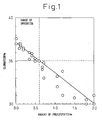
- FIG. 1 shows the relationship between the amount of precipitation of the sheet product and the elongation.
- the amount of precipitation is the amount found when using 10% acetyl acetone + 1% tetramethyl ammonium chloride + methanol to electrolyze the steel, extracting the total precipitates, and finding the wt% of the total precipitates.
- the elongation is the elongation at break when conducting a tension test in the rolling direction in accordance with JISZ2241. Due to this, when the amount of precipitation is 0.5% or less, an elongation of 35% or more is obtained. The ductility required in press working of heat resistant steel sheet is thereby obtained.
- the total amount of precipitates of the sheet product is influenced by the composition and the heat treatment temperature in the production process.
- the annealing temperature of the cold rolled sheet should be at least 1010°C, but excessive high temperature annealing is accompanied with enlargement of the crystal grain size and orange peel and breakage from the orange peel parts at the time of press working, so 1080°C or less is preferable.
- the lower the lower limit of the amount of precipitation the better the elongation, but if too low, deterioration of the high temperature characteristics is caused, so the lower limit was made 0.05%.
- the content is 0.10 to 0.50%.
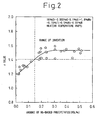
- the amount of precipitation is the amount of Nb precipitated found by extraction and analysis of the residue.
- the average r value was evaluated by obtaining a JIS 13 No. B tension test piece from the cold rolled and annealed sheet, imparting 15% strain in the rolling direction, the direction 45° to the rolling direction, and the direction 90° to the rolling direction, then using equation (1) and equation (2) to find the average r value.
- W 0 is the sheet width before tension
- W is the sheet width after tension
- t 0 is the sheet thickness before tension
- t is the sheet thickness after tension
- r 0 is the r value of the rolling direction
- r 45 is the r value in the direction 45° from the rolling direction
- r 90 is the r value in the direction perpendicular to the rolling direction.
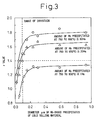
- FIG. 3 shows the relationship between the diameter of the precipitates present at the cold rolling material and the r value of the sheet product.
- the "diameter of precipitates” is the value obtained by observing precipitates of the sheet product by an electron microscope, measuring their shapes, then converting them to circle equivalent diameters.
- the circle equivalent diameters of 100 precipitates are found and their average value used as the diameter of the precipitates. From this, when the diameter of the precipitates present at the cold rolling material is 0.1 ⁇ m or more, the r value becomes 1.4 or more. However, if over 1 ⁇ m, the effect is saturated and the toughness of the material is detracted from, so the preferable range becomes 0.1 ⁇ m to 1 ⁇ m. The more preferable range is 0.2 ⁇ m to 0.6 ⁇ m.
- the cold rolling material used is a completely recrystallized material. Therefore, the hot rolling and annealing conditions are determined.
- the recrystallized grain size is large, the expected r value sometimes is difficult to obtain.
- the small anisotropy of the r value is sought.
- the anisotropy of the r value is defined by ⁇ r. If this value is large, the shape of the worked part becomes poor and a drop in the yield etc. is caused, so with such a part, a ⁇ r of 0.4 or less is sought.
- the thickness of the slab, the thickness of the hot rolled sheet, etc. should be suitably designed.
- the annealing conditions of the hot rolled sheet should be suitably selected so that the precipitates and structure before annealing fall in the scope of the invention. Depending on the composition, annealing of the hot rolled sheet may be omitted. Further, in the cold rolling, the reduction rate, roll roughness, roll diameter, rolling oil, number of rolling passes, rolling speed, rolling temperature, etc. may be suitably selected. If employing a two-step cold rolling method with intermediately annealing in the middle of the cold rolling, the characteristics are further improved.
- the intermediate annealing and the final annealing may, if necessary, be bright annealing performed in hydrogen gas or nitrogen gas or other nonoxidizing atmosphere or annealing performed in the air.
Landscapes
- Chemical & Material Sciences (AREA)
- Engineering & Computer Science (AREA)
- Mechanical Engineering (AREA)
- Materials Engineering (AREA)
- Metallurgy (AREA)
- Organic Chemistry (AREA)
- Physics & Mathematics (AREA)
- Thermal Sciences (AREA)
- Crystallography & Structural Chemistry (AREA)
- Heat Treatment Of Sheet Steel (AREA)
Claims (2)
- Tôle en acier inoxydable ferritique ayant une aptitude au façonnage supérieure contenant, en % en poids, C : 0,001 à 0,010 %, Si : 0,01 à 0,3 %, Mn : 0,01 à 0,3 %, P : 0,01 à 0,04 %, N : 0,001 à 0,020 %, Cr : 10 à 20 %, Nb : 0,3 à 1,0 %, et Mo : 0,5 à 2,0 %, Al : 0,005 à 0,100 %, et facultativement de plus contenant un ou plusieurs de Ti : 0,05 à 0,20 %, B : 0,0003 à 0,0050 %, Cu : 0,2 à 3,0 %, W : 0,01 à 1,0 % et Sn : 0,01 à 1,0 % et le reste de Fe et d'impuretés inévitables, dans laquelle les précipités totaux dans la tôle en acier inoxydable ferritique sont, en % en poids, de 0,05 à 0,60 %.
- Procédé de production d'une tôle en acier inoxydable ferritique ayant une aptitude au façonnage supérieure, caractérisé par ce qu'il comprend les étapes de :laminage à chaud d'un bloc contenant une composition telle que décrite dans la revendication 1 en une tôle en acier laminée à chaud,recuit de la tôle en acier laminée à chaud dans une plage de température allant de 750 à 950 °C pendant 30 à 36 000 secondes de sorte que les précipités à base de Nb incluant des carbonitrures de Nb et une phase de Laves contenant Nb, Mo et Cr sont alors de 0,15 à 0,60 % en volumes et ont un diamètre de 0,1 à 1 µm et une taille de grains recristallisés de 1 à 40 µm et un taux de recristallisation de 10 à 90 %, et ensuitelaminage à froid de la tôle en acier recuite, et recuit de la tôle en acier laminée à froid dans une plage de température allant de 1010 à 1080 °C.
Applications Claiming Priority (2)
| Application Number | Priority Date | Filing Date | Title |
|---|---|---|---|
| JP2004113478A JP4519505B2 (ja) | 2004-04-07 | 2004-04-07 | 成形性に優れるフェライト系ステンレス鋼板およびその製造方法 |
| PCT/JP2005/006563 WO2005098067A1 (fr) | 2004-04-07 | 2005-03-29 | Tôle d'acier inoxydable ferritique excellente en termes de capacité au façonnage et procédé de fabrication de celle-ci |
Publications (3)
| Publication Number | Publication Date |
|---|---|
| EP1734143A1 EP1734143A1 (fr) | 2006-12-20 |
| EP1734143A4 EP1734143A4 (fr) | 2007-09-26 |
| EP1734143B1 true EP1734143B1 (fr) | 2013-01-09 |
Family
ID=35125100
Family Applications (1)
| Application Number | Title | Priority Date | Filing Date |
|---|---|---|---|
| EP05721703A Expired - Lifetime EP1734143B1 (fr) | 2004-04-07 | 2005-03-29 | Tôle d'acier inoxydable ferritique excellente en termes de capacité au façonnage et procédé de fabrication de celle-ci |
Country Status (6)
| Country | Link |
|---|---|
| US (1) | US8048239B2 (fr) |
| EP (1) | EP1734143B1 (fr) |
| JP (1) | JP4519505B2 (fr) |
| KR (1) | KR100727497B1 (fr) |
| CN (1) | CN100351415C (fr) |
| WO (1) | WO2005098067A1 (fr) |
Families Citing this family (42)
| Publication number | Priority date | Publication date | Assignee | Title |
|---|---|---|---|---|
| JP2007247013A (ja) * | 2006-03-17 | 2007-09-27 | Jfe Steel Kk | 耐酸化性、加工性および高温強度に優れるフェライト系ステンレス鋼 |
| KR101120764B1 (ko) | 2006-05-09 | 2012-03-22 | 닛폰 스틸 앤드 스미킨 스테인레스 스틸 코포레이션 | 내식성이 우수한 스테인리스 강 |
| JP5297630B2 (ja) | 2007-02-26 | 2013-09-25 | 新日鐵住金ステンレス株式会社 | 耐熱性に優れたフェライト系ステンレス鋼板 |
| JP5396752B2 (ja) * | 2007-10-02 | 2014-01-22 | Jfeスチール株式会社 | 靭性に優れたフェライト系ステンレス鋼およびその製造方法 |
| CN101514431B (zh) * | 2008-02-21 | 2011-11-23 | 宝山钢铁股份有限公司 | 一种高强度高延伸率Cr17型冷轧带钢及其制造方法 |
| EP2316979A4 (fr) * | 2008-07-23 | 2014-01-22 | Nippon Steel & Sumikin Sst | Acier inoxydable ferritique destiné à être utilisé pour la production d'un réservoir d'eau-urée |
| JP5349153B2 (ja) * | 2009-06-15 | 2013-11-20 | 日新製鋼株式会社 | ろう付け用フェライト系ステンレス鋼材および熱交換器部材 |
| CN102791897A (zh) * | 2010-03-11 | 2012-11-21 | 新日铁住金不锈钢株式会社 | 耐氧化性优异的铁素体系不锈钢板和耐热性优异的铁素体系不锈钢板及其制造方法 |
| CN102822373B (zh) * | 2010-03-29 | 2016-07-06 | 新日铁住金不锈钢株式会社 | 表面光泽和耐锈性优异的铁素体系不锈钢板及其制造方法 |
| JP5659061B2 (ja) * | 2011-03-29 | 2015-01-28 | 新日鐵住金ステンレス株式会社 | 耐熱性と加工性に優れたフェライト系ステンレス鋼板及びその製造方法 |
| JP6037882B2 (ja) | 2012-02-15 | 2016-12-07 | 新日鐵住金ステンレス株式会社 | 耐スケール剥離性に優れたフェライト系ステンレス鋼板及びその製造方法 |
| JP6071608B2 (ja) * | 2012-03-09 | 2017-02-01 | 新日鐵住金ステンレス株式会社 | 耐酸化性に優れたフェライト系ステンレス鋼板 |
| JP6025362B2 (ja) * | 2012-03-29 | 2016-11-16 | 新日鐵住金ステンレス株式会社 | 耐熱性に優れたフェライト系ステンレス鋼板 |
| JP5793459B2 (ja) | 2012-03-30 | 2015-10-14 | 新日鐵住金ステンレス株式会社 | 加工性に優れた耐熱フェライト系ステンレス冷延鋼板、冷延素材用フェライト系ステンレス熱延鋼板及びそれらの製造方法 |
| ES2787353T3 (es) * | 2012-10-30 | 2020-10-15 | Nippon Steel & Sumikin Sst | Chapa de acero inoxidable ferrítico que tiene excelente resistencia al calor |
| JP5843982B2 (ja) * | 2013-02-04 | 2016-01-13 | 新日鐵住金ステンレス株式会社 | 加工性に優れたフェライト系ステンレス鋼板およびその製造方法 |
| CN104968818B (zh) | 2013-03-06 | 2017-09-08 | 新日铁住金不锈钢株式会社 | 耐热性优良的铁素体系不锈钢板 |
| EP2980251B1 (fr) | 2013-03-27 | 2017-12-13 | Nippon Steel & Sumikin Stainless Steel Corporation | Plaque d'acier inoxydable ferritique laminé à chaud, son procédé de production et bande d'acier |
| CN103276299B (zh) * | 2013-04-16 | 2017-09-05 | 宝钢不锈钢有限公司 | 一种高表面质量的铁素体不锈钢钢板及其制造方法 |
| KR101614606B1 (ko) * | 2014-08-08 | 2016-04-22 | 주식회사 포스코 | 성형성이 우수한 페라이트계 스테인리스강 및 그 제조 방법 |
| JP5846343B1 (ja) * | 2014-09-05 | 2016-01-20 | Jfeスチール株式会社 | フェライト系ステンレス冷延鋼板 |
| CN105506502A (zh) * | 2014-09-25 | 2016-04-20 | 宝钢不锈钢有限公司 | 一种耐硫酸用铁素体不锈钢及其制造方法 |
| KR20160076792A (ko) | 2014-12-23 | 2016-07-01 | 주식회사 포스코 | 페라이트계 스테인리스강 및 그 제조방법 |
| KR101631018B1 (ko) * | 2015-02-27 | 2016-06-16 | 주식회사 포스코 | 내입계부식성이 우수한 페라이트계 스테인리스강 |
| KR101697093B1 (ko) | 2015-09-22 | 2017-01-18 | 주식회사 포스코 | 페라이트계 스테인리스강 및 이의 제조 방법 |
| MX2018009402A (es) * | 2016-02-02 | 2018-12-19 | Nisshin Steel Co Ltd | Chapa de acero inoxidable ferritico que contiene nb laminada en caliente y metodo para producir la misma, y chapa de acero inoxidable ferritico que contiene nb laminada en frio y metodo para producir la misma. |
| US20200277690A1 (en) * | 2016-03-30 | 2020-09-03 | Nisshin Steel Co., Ltd. | Nb-CONTAINING FERRITIC STAINLESS STEEL SHEET AND MANUFACTURING METHOD THEREFOR |
| CN106756503B (zh) * | 2016-12-27 | 2018-05-22 | 北京首钢吉泰安新材料有限公司 | 易切削合金、合金丝、其制备方法、笔头、笔芯及笔 |
| WO2018180643A1 (fr) * | 2017-03-29 | 2018-10-04 | 新日鐵住金ステンレス株式会社 | Acier inoxydable ferritique ayant une résistance à l'usure supérieure à haute température, procédé de production de tôle d'acier inoxydable ferritique, de composants d'échappement, de composants coulissants à haute température, et de composants de turbocompresseur |
| JP6841150B2 (ja) * | 2017-04-28 | 2021-03-10 | 日本製鉄株式会社 | 耐熱部材用フェライト系ステンレス鋼板 |
| JP6851269B2 (ja) * | 2017-06-16 | 2021-03-31 | 日鉄ステンレス株式会社 | フェライト系ステンレス鋼板、鋼管および排気系部品用フェライト系ステンレス部材ならびにフェライト系ステンレス鋼板の製造方法 |
| CN107746930A (zh) * | 2017-09-29 | 2018-03-02 | 江苏理工学院 | 一种抗氧化铁素体不锈钢合金材料及其制备方法 |
| KR102135158B1 (ko) | 2018-09-19 | 2020-07-17 | 주식회사 포스코 | 가공성과 고온강도가 우수한 페라이트계 스테인리스강 및 그 제조방법 |
| KR102123665B1 (ko) * | 2018-10-23 | 2020-06-18 | 주식회사 포스코 | 클램프용 고강도 페라이트계 스테인리스강 및 그 제조방법 |
| WO2020095437A1 (fr) * | 2018-11-09 | 2020-05-14 | にってステンレス株式会社 | Tôle d'acier inoxydable ferritique |
| KR101943591B1 (ko) | 2018-11-13 | 2019-01-30 | 한국과학기술원 | 나이오븀 함유 오스테나이트계 스테인리스강 및 이의 제조방법 |
| CN109355478B (zh) * | 2018-12-24 | 2021-02-05 | 东北大学 | 提高高温抗氧化性能的b444m2型铁素体不锈钢及其制备方法 |
| KR102272790B1 (ko) * | 2019-12-18 | 2021-07-05 | 주식회사 포스코 | 클램프용 고강도 페라이트계 스테인리스강 및 그 제조방법 |
| US11891681B2 (en) * | 2021-02-17 | 2024-02-06 | Nippon Steel Stainless Steel Corporation | Ferritic stainless steel sheet, method for producing the same, and part |
| CN113549745B (zh) * | 2021-07-27 | 2022-09-13 | 内蒙古工业大学 | 一种低成本第三代汽车钢加工工艺 |
| EP4541920A4 (fr) * | 2022-09-26 | 2025-10-08 | Nippon Steel Stainless Steel Corp | Matériau d'acier inoxydable ferritique pour composants de batterie, son procédé de production et composant de batterie |
| CN116288005B (zh) * | 2023-03-22 | 2025-09-09 | 宁波宝新不锈钢有限公司 | 一种高等级装饰用铁素体不锈钢及其制造方法 |
Family Cites Families (14)
| Publication number | Priority date | Publication date | Assignee | Title |
|---|---|---|---|---|
| JPS56123327A (en) * | 1980-02-29 | 1981-09-28 | Sumitomo Metal Ind Ltd | Production of highly formable ferritic stainless steel sheet of good surface characteristic |
| JP3152576B2 (ja) * | 1995-01-19 | 2001-04-03 | 川崎製鉄株式会社 | Nb含有フェライト鋼板の製造方法 |
| JPH09118961A (ja) * | 1995-10-23 | 1997-05-06 | Nippon Steel Corp | 加工性および耐熱性に優れたフェライト系ステンレス鋼 |
| JP3501573B2 (ja) * | 1995-11-02 | 2004-03-02 | 日新製鋼株式会社 | 耐二次加工割れ性に優れたフェライト系ステンレス鋼パイプおよびその製造方法 |
| JPH09279312A (ja) | 1996-04-18 | 1997-10-28 | Nippon Steel Corp | 高温特性、耐食性及び加工性に優れたフェライト系ステンレス鋼 |
| JPH10237596A (ja) * | 1997-02-21 | 1998-09-08 | Kawasaki Steel Corp | 耐銹性に優れたフェライト系ステンレス鋼 |
| JP3551892B2 (ja) * | 2000-04-19 | 2004-08-11 | 住友金属工業株式会社 | 耐熱性フェライト系ステンレス鋼とその鋼板 |
| JP3804408B2 (ja) | 2000-07-13 | 2006-08-02 | Jfeスチール株式会社 | 成形性に優れたCr含有耐熱耐食鋼板の製造方法 |
| EP1207214B1 (fr) * | 2000-11-15 | 2012-07-04 | JFE Steel Corporation | Acier doux contenant du chrome |
| JP4562280B2 (ja) * | 2000-12-25 | 2010-10-13 | 日新製鋼株式会社 | 加工性に優れ面内異方性の小さいフェライト系ステンレス鋼及びその製造方法 |
| EP1219719B1 (fr) * | 2000-12-25 | 2004-09-29 | Nisshin Steel Co., Ltd. | Tôle d'acier inoxydable ferritique avec une bonne aptitude et procédé pour sa fabrication |
| JP3932020B2 (ja) * | 2001-11-19 | 2007-06-20 | 日新製鋼株式会社 | 深絞り性に優れ面内異方性の小さいフェライト系ステンレス鋼及びその製造方法 |
| JP4225976B2 (ja) * | 2002-12-12 | 2009-02-18 | 新日鐵住金ステンレス株式会社 | 加工性に優れたCr含有耐熱鋼板およびその製造方法 |
| JP4304109B2 (ja) | 2004-04-02 | 2009-07-29 | 新日鐵住金ステンレス株式会社 | 熱疲労特性に優れた自動車排気系部材用フェライト系ステンレス鋼 |
-
2004
- 2004-04-07 JP JP2004113478A patent/JP4519505B2/ja not_active Expired - Lifetime
-
2005
- 2005-03-29 CN CNB2005800003422A patent/CN100351415C/zh not_active Expired - Lifetime
- 2005-03-29 KR KR1020057022988A patent/KR100727497B1/ko not_active Expired - Lifetime
- 2005-03-29 WO PCT/JP2005/006563 patent/WO2005098067A1/fr not_active Ceased
- 2005-03-29 EP EP05721703A patent/EP1734143B1/fr not_active Expired - Lifetime
-
2008
- 2008-08-26 US US12/229,825 patent/US8048239B2/en not_active Expired - Lifetime
Also Published As
| Publication number | Publication date |
|---|---|
| EP1734143A1 (fr) | 2006-12-20 |
| JP2005298854A (ja) | 2005-10-27 |
| KR20060007441A (ko) | 2006-01-24 |
| KR100727497B1 (ko) | 2007-06-13 |
| CN100351415C (zh) | 2007-11-28 |
| US20090000703A1 (en) | 2009-01-01 |
| EP1734143A4 (fr) | 2007-09-26 |
| US8048239B2 (en) | 2011-11-01 |
| WO2005098067A1 (fr) | 2005-10-20 |
| CN1788102A (zh) | 2006-06-14 |
| JP4519505B2 (ja) | 2010-08-04 |
Similar Documents
| Publication | Publication Date | Title |
|---|---|---|
| EP1734143A1 (fr) | Tôle d'acier inoxydable ferritique excellente en termes de capacité au façonnage et procédé de fabrication de celle-ci | |
| CN104093871B (zh) | 耐热铁素体系不锈钢冷轧钢板、冷轧基材用铁素体系不锈钢热轧钢板及其制造方法 | |
| EP2465962B1 (fr) | Feuilles d'acier très résistantes et leurs procédés de production | |
| EP3483297B1 (fr) | Élément de formage à chaud présentant une résistance à la propagation des fissures et une ductilité excellentes, et son procédé de production | |
| EP2554699B1 (fr) | Tôle d'acier présentant une résistance à la traction élevée et une meilleure ductilité et procédé de fabrication de cette dernière | |
| CN1327009C (zh) | 加工性优良的含铬耐热钢板及其制造方法 | |
| EP1990430B1 (fr) | Plaque d'acier laminée à chaud haute résistance et son procédé de fabrication | |
| JP6851269B2 (ja) | フェライト系ステンレス鋼板、鋼管および排気系部品用フェライト系ステンレス部材ならびにフェライト系ステンレス鋼板の製造方法 | |
| EP1616971B1 (fr) | Feuille d'acier lamine a froid a resistance elevee et procede de production de celle-ci | |
| US20240384380A1 (en) | Steel having improved processing properties for working at elevated temperatures | |
| EP2036994B1 (fr) | Acier au chrome présentant une excellente résistance à la fatigue thermique | |
| EP4043597A1 (fr) | Tôle en acier inoxydable ferritique, procédé pour la produire et élément d'acier inoxydable ferritique | |
| CN111954724B (zh) | 铁素体系不锈钢钢板及其制造方法、以及铁素体系不锈钢构件 | |
| JP7255634B2 (ja) | 熱間プレス部材およびその製造方法 | |
| US20060225820A1 (en) | Ferritic stainless steel sheet excellent in formability and method for production thereof | |
| JP2001262234A (ja) | 深絞り性に優れた自動車排気系用フェライト系ステンレス鋼板の製造方法 | |
| CN114364820B (zh) | 具有改善的高温蠕变抗力的铁素体不锈钢及其制造方法 | |
| JPH05247540A (ja) | 深絞り用高強度冷延鋼板およびその製造方法 | |
| JP2006089814A (ja) | 加工性に優れるフェライト系ステンレス鋼板およびその製造方法 | |
| JP3844662B2 (ja) | マルテンサイト系ステンレス鋼板およびその製造方法 | |
| JP2001107149A (ja) | 延性、加工性および耐リジング性に優れたフェライト系ステンレス鋼板の製造方法 | |
| CA2082807A1 (fr) | Acier en feuille haute resistance pour faconnage |
Legal Events
| Date | Code | Title | Description |
|---|---|---|---|
| PUAI | Public reference made under article 153(3) epc to a published international application that has entered the european phase |
Free format text: ORIGINAL CODE: 0009012 |
|
| 17P | Request for examination filed |
Effective date: 20060105 |
|
| AK | Designated contracting states |
Kind code of ref document: A1 Designated state(s): DE FR |
|
| DAX | Request for extension of the european patent (deleted) | ||
| RBV | Designated contracting states (corrected) |
Designated state(s): DE FR |
|
| A4 | Supplementary search report drawn up and despatched |
Effective date: 20070828 |
|
| 17Q | First examination report despatched |
Effective date: 20110303 |
|
| GRAP | Despatch of communication of intention to grant a patent |
Free format text: ORIGINAL CODE: EPIDOSNIGR1 |
|
| GRAS | Grant fee paid |
Free format text: ORIGINAL CODE: EPIDOSNIGR3 |
|
| GRAA | (expected) grant |
Free format text: ORIGINAL CODE: 0009210 |
|
| AK | Designated contracting states |
Kind code of ref document: B1 Designated state(s): DE FR |
|
| REG | Reference to a national code |
Ref country code: DE Ref legal event code: R096 Ref document number: 602005037806 Country of ref document: DE Effective date: 20130307 |
|
| PLBE | No opposition filed within time limit |
Free format text: ORIGINAL CODE: 0009261 |
|
| STAA | Information on the status of an ep patent application or granted ep patent |
Free format text: STATUS: NO OPPOSITION FILED WITHIN TIME LIMIT |
|
| 26N | No opposition filed |
Effective date: 20131010 |
|
| REG | Reference to a national code |
Ref country code: DE Ref legal event code: R097 Ref document number: 602005037806 Country of ref document: DE Effective date: 20131010 |
|
| REG | Reference to a national code |
Ref country code: FR Ref legal event code: PLFP Year of fee payment: 12 |
|
| REG | Reference to a national code |
Ref country code: FR Ref legal event code: PLFP Year of fee payment: 13 |
|
| REG | Reference to a national code |
Ref country code: FR Ref legal event code: PLFP Year of fee payment: 14 |
|
| PGFP | Annual fee paid to national office [announced via postgrant information from national office to epo] |
Ref country code: DE Payment date: 20240325 Year of fee payment: 20 |
|
| PGFP | Annual fee paid to national office [announced via postgrant information from national office to epo] |
Ref country code: FR Payment date: 20240129 Year of fee payment: 20 |
|
| REG | Reference to a national code |
Ref country code: DE Ref legal event code: R071 Ref document number: 602005037806 Country of ref document: DE |