EP1734672A1 - Systeme de communication par radiofrequence au moyen de deux bandes de frequence - Google Patents
Systeme de communication par radiofrequence au moyen de deux bandes de frequence Download PDFInfo
- Publication number
- EP1734672A1 EP1734672A1 EP05729479A EP05729479A EP1734672A1 EP 1734672 A1 EP1734672 A1 EP 1734672A1 EP 05729479 A EP05729479 A EP 05729479A EP 05729479 A EP05729479 A EP 05729479A EP 1734672 A1 EP1734672 A1 EP 1734672A1
- Authority
- EP
- European Patent Office
- Prior art keywords
- network
- signals
- stage
- lmds
- transmission
- Prior art date
- Legal status (The legal status is an assumption and is not a legal conclusion. Google has not performed a legal analysis and makes no representation as to the accuracy of the status listed.)
- Withdrawn
Links
- 238000004891 communication Methods 0.000 title claims description 22
- 230000005540 biological transmission Effects 0.000 claims abstract description 62
- 238000012545 processing Methods 0.000 claims abstract description 44
- 238000005516 engineering process Methods 0.000 claims abstract description 20
- 238000013519 translation Methods 0.000 claims abstract description 7
- 238000001914 filtration Methods 0.000 claims description 8
- 230000006978 adaptation Effects 0.000 claims description 5
- 230000001172 regenerating effect Effects 0.000 claims description 4
- 238000000034 method Methods 0.000 claims description 3
- 239000002131 composite material Substances 0.000 claims description 2
- 238000012544 monitoring process Methods 0.000 claims description 2
- 239000000969 carrier Substances 0.000 description 10
- 210000004027 cell Anatomy 0.000 description 8
- 230000008901 benefit Effects 0.000 description 6
- 238000010586 diagram Methods 0.000 description 5
- 238000001228 spectrum Methods 0.000 description 5
- 230000035515 penetration Effects 0.000 description 4
- 238000013461 design Methods 0.000 description 2
- 238000011161 development Methods 0.000 description 2
- 238000009434 installation Methods 0.000 description 2
- 238000004513 sizing Methods 0.000 description 2
- 208000022673 Distal myopathy, Welander type Diseases 0.000 description 1
- 208000034384 Welander type distal myopathy Diseases 0.000 description 1
- 230000004075 alteration Effects 0.000 description 1
- 238000013475 authorization Methods 0.000 description 1
- 230000033228 biological regulation Effects 0.000 description 1
- 230000001413 cellular effect Effects 0.000 description 1
- 210000003850 cellular structure Anatomy 0.000 description 1
- 238000006243 chemical reaction Methods 0.000 description 1
- 230000000295 complement effect Effects 0.000 description 1
- 230000007423 decrease Effects 0.000 description 1
- 239000006185 dispersion Substances 0.000 description 1
- 239000000835 fiber Substances 0.000 description 1
- 238000012986 modification Methods 0.000 description 1
- 230000004048 modification Effects 0.000 description 1
- 239000013307 optical fiber Substances 0.000 description 1
- 230000009467 reduction Effects 0.000 description 1
- 238000009877 rendering Methods 0.000 description 1
- 229920006395 saturated elastomer Polymers 0.000 description 1
- 230000003068 static effect Effects 0.000 description 1
Images

Classifications
-
- H—ELECTRICITY
- H04—ELECTRIC COMMUNICATION TECHNIQUE
- H04W—WIRELESS COMMUNICATION NETWORKS
- H04W88/00—Devices specially adapted for wireless communication networks, e.g. terminals, base stations or access point devices
- H04W88/02—Terminal devices
- H04W88/06—Terminal devices adapted for operation in multiple networks or having at least two operational modes, e.g. multi-mode terminals
-
- H—ELECTRICITY
- H04—ELECTRIC COMMUNICATION TECHNIQUE
- H04B—TRANSMISSION
- H04B7/00—Radio transmission systems, i.e. using radiation field
- H04B7/24—Radio transmission systems, i.e. using radiation field for communication between two or more posts
- H04B7/26—Radio transmission systems, i.e. using radiation field for communication between two or more posts at least one of which is mobile
-
- H—ELECTRICITY
- H04—ELECTRIC COMMUNICATION TECHNIQUE
- H04W—WIRELESS COMMUNICATION NETWORKS
- H04W84/00—Network topologies
- H04W84/02—Hierarchically pre-organised networks, e.g. paging networks, cellular networks, WLAN [Wireless Local Area Network] or WLL [Wireless Local Loop]
- H04W84/10—Small scale networks; Flat hierarchical networks
- H04W84/14—WLL [Wireless Local Loop]; RLL [Radio Local Loop]
-
- H—ELECTRICITY
- H04—ELECTRIC COMMUNICATION TECHNIQUE
- H04W—WIRELESS COMMUNICATION NETWORKS
- H04W4/00—Services specially adapted for wireless communication networks; Facilities therefor
Definitions
- the present invention relates to a radio frequency communications system with use of two frequency bands, providing essential novelty features and notable advantages with regard to known means used for the same purposes in the current state of the art.
- the invention proposes the development of a system by means of which the drawbacks derived from the application of the current law relating to the regulation of available frequencies and bandwidths are overcome, given the clear inadequacies of the radio spectrum available for covering the different needs of the users (military, civil, private uses, and so on).
- the field of application of the invention is included in the telecommunications field, especially that comprising wideband wireless subscriber loop technologies.
- the radio spectrum is a critical element due to two essential characteristics of the radio license, namely the operating frequency and the bandwidth, which parameters determine both the art and the possibility of rendering certain services.
- the operating frequency entails the physical characteristics of transmission, coverage, penetration, rain attenuation, etc.
- the ability of the signal to go through "obstacles", whether the latter are walls or rain increases, i.e., the coverage and penetration increase.
- the bandwidth entails the service characteristics, since the larger the bandwidth, the greater the transmission capacity.
- the spectrum has been considered a scarce asset, and the operating bands have been assigned according to the market and the available technology, reaching a situation where the lowest operating frequencies, which due to their physical characteristics are the most valued (greatest penetration, simplest technology, etc.), are more divided into their bandwidths and thus the services they can offer are more limited.
- the different governments have reserved large bandwidths for the highest frequencies, the networks most extended today being those having a relatively small frequency and thus limited in their bandwidth.
- a typical wireless telecommunications operator does not have in its license the bandwidth necessary to meet the traffic needs required by its potential clients, which leads to the creation of cellular structures in which the available spectrum is used multiple times in a given area (e.g, a city).
- the transmission network is characterized by being a wired network, fiber optic network or radio link, typically point-to-point but sometimes point-multipoint, being of great capacity due to having to add the traffic in all cells based on high capacity digital links.
- the wireless access network is characterized by typically being point-multipoint, but sometimes point-to-point, having a reduced capacity, that necessary for the group of users of its coverage area, by establishing low capacity digital links.
- the architecture used until now for implementing these networks is based on that the connection between the management center (MC) and the access cells is carried out by means of digital, point-to-point data links, it being possible that the traffic from several cells is being added in greater capacity links in the path between a cell and the management center.
- the information is received from the MC and the access systems which by means of point-multipoint links reach the users are attacked.
- the transmission technologies used in each of the two networks usually are completely different, optimized each one of them in accordance with its function.
- a proposal for combining two of such networks is that provided by patent EP-A-0786876 , wherein a two-way radio communications system is proposed combining two subsystems, both of short range, one of high frequency (LMDS: 'Local Multipoint Distribution System') and great capacity, and the other one (DECT: 'Digital European Cordless Telecommunications') of lower frequency and smaller capacity, the first one being used for transmitting information requiring a large bandwidth (such as video) as well as for transmitting the communications between a user's DECT receiver and a corresponding DECT server, or vice versa, and the DECT subsystem being used for communications requiring a smaller bandwidth and for transmitting authorizations/encryptions.
- LMDS 'Local Multipoint Distribution System'
- DECT Digital European Cordless Telecommunications'
- Patent US-A-6477369 also proposes combining a high capacity LMDS network with a lower capacity MMDS network, although in this case said combination is in parallel and not for using one of them as a transmission network and the other as an access network, but to switch from one to the other when the first one starts becoming saturated.
- both networks may be considered as access networks and there is no reason for the abovementioned problem of using completely different transmission technologies in each of the networks to exist, as connecting both networks is not intended in the proposal made by said patent.
- the invention means a considerable advance as far as said technology is concerned since a system is developed by means of which it is possible to connect both networks and match the transmission technologies with the exception of their radio characteristics, i.e. that the signal received by the users is not generated from the actual base stations but from the management center, apart from the particular generation of information which is intended to be added. Furthermore, compared to those networks in which all signals generated in the management center are redistributed in their entirety to the access network, the invention presented here provides the advantage of being able to select those carriers which are intended to be transmitted to each of the access networks, thus facilitating a better sizing of the services offered to the user.
- point-multipoint wireless networks have been used as networks for accessing the users.
- high frequency LMDS networks i.e. those included in the so-called millimetric bands (from 24 to 31 GHz)
- the intrinsic characteristics of the transmissions in those bands make a direct view between the base station and the user's radio equipment necessary so as to establish the communication.
- This has two very significant implications, on one hand, the difficulty of providing coverage to all users in a urban area (shadow areas occur), and on the other hand, it is rather complicated to implement the signal distribution in the user, i.e. to carry the signals from the building roof to the interior where the user's modem is placed.
- LB Low Band
- MMDS Multichannel Multipoint Distribution System
- the present invention relates to a radio frequency communications system which integrates, connected in series, an LMDS transmission network, which in general covers a distance of one or several Km., and an access network, such as said LB network, said transmission network being intended for transmitting a series of contents to said access network and said access network being intended for individually supplying part of said contents to a series of users, two frequency bands being used, a first one in said LMDS transmission network, of a large bandwidth, and a second one in said access network of a smaller bandwidth.
- Said transmission network is adapted for supplying multiple services to said access network, simultaneously transmitting said series of contents by means of signals of one or more technologies and because it comprises a signal processing device embedded between both networks, suitable for selecting a certain part of the signals transmitted by the transmission network and accommodating, with a corresponding frequency translation, only said selected signals to transmission means of the access network, and also suitable for accommodating the signals from the access network to transmission means of the transmission network.
- the transmission network is made through the frequency with a large bandwidth, i.e. the high frequency one.
- the signal processing is carried out in the base stations of the access network, adapting the carriers to the corresponding cell, and their transmission is performed by means of another radio frequency system, this time at a lower frequency, given that a capacity as large as in the transmission network is not required.
- Said signal processing is not based on a simple repetition of the signal with a frequency translation, passing the circulating signal via the transmission network to the access network, but a selection of a certain part of the signals and/or contents transmitted by the transmission network and an adaptation thereof to the transmission means of the access network are carried out.
- WDMs optical-electrical converters
- the radio frequency system may be implemented provided that the (main, but only the data link layer) transmission system between the equipment allows it.
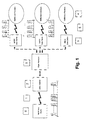
- the present invention relates to a radio frequency communications system integrating, connected in series, an LMDS transmission network 1 covering a distance of one or several Km., and an access network 5, which for the illustrated embodiment example is an MMDS network, said transmission network 1 being intended for transmitting a series of contents to said access network 5, and said access network 5 being intended for individually supplying part of said contents to a series of users, two frequency bands being used, a first one in said LMDS transmission network 1, of a large bandwidth, and a second one in said access network 5, of a smaller bandwidth.
- Said transmission network 1 is adapted for supplying said access network 5 with multiple services, simultaneously transmitting said series of contents by means of signals of one or more technologies and because it comprises at least one signal processing device 2 embedded between both networks 1, 5, suitable for selecting a certain part of the signals transmitted by the transmission network 1 and adapting, with a corresponding frequency repetition and translation, only said selected signals to transmission means of access network 5, and also suitable for adapting the signals from the access network 5 to transmission means of transmission network 1.
- said signal processing device 2 operates as an interface between both portions of the system.
- Said LMDS network 1 comprises at least one LMDS base station 6 in communication with one or more equipment 7 suitable for at least receiving the signals from said LMDS base station 6, and said MMDS network 5 comprises a plurality of MMDS base stations 3 in communication, one by one, with a plurality of corresponding MMDS equipment 4 suitable for at least receiving the corresponding signals from said MMDS base stations 3, accessible by corresponding users.
- LMDS 7 and MMDS 4 equipment have been indicated in Figure 1 as LMDS and MMDS receivers, respectively, as this is their main function, they not only can work as receivers, but they are also suitable for transmitting, making a return path from the MMDS equipment 4, accessible by the users, to the LMDS base station or stations 6 possible by using said access 5 and transmission 1 networks, and said LMDS 6 and MMDS 3 base stations being suitable for transmitting to and receiving from said equipment 7, 4, respectively.
- the invention refers to a transmission network 1 that uses LMDS technology for providing the abovementioned frequency and bandwidth characteristics
- the use of another technology of similar characteristics could also be possible.
- the access network 5 is made up of a point-multipoint radio communications system which carries out the distribution of the desired signals to the final users and is capable of providing a high penetration so as to reach in the most appropriate manner the greatest number of final users.
- MMDS technology has been chosen because it provides the desired characteristics, even though the use of another technology of similar characteristics could also be possible.
- the latter allows the simultaneous transmission of multiple signals of diverse technologies by using the millimetric bands, even though working with a single technology is also possible.
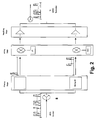
- processing device 2 that allows carrying out this type of networks described herein is that shown in Figure 2, which is thus established as a Multi-Dwelling Unit (MDU), as an access node with a given (geographic or demographic) coverage of the operator's unified transmission-access system or network.
- MDU Multi-Dwelling Unit
- Said signal processing device 2 is schematically depicted for an embodiment example, at a modular level, in said Figure 2.
- the output of LMDS equipment 7 acting as a receiver provides the input to this processing device 2, wherein all signals transmitted by the transmission network 1 are present.
- the first stage of the proposed design consists of a distribution frame 8 (arranged before or in the processing device 2 itself) which distributes the input signal into as many processing lines as carrier blocks must be processed.
- each MMDS equipment 4 shall transmit one data carrier and the whole block of the video carriers.
- the processing device 2 then comprises a filtering stage suitable for independently filtering data signals, video signals and simple or composite signals with different formats and structures coming from said LMDS network 1, with corresponding filtering substages #1...#N.
- Said filtering stage is independently designed in each of the lines to select only those carriers intended to be transmitted via the transmitter or base station 3 of the access network associated to said line of signal processing device 2.
- one of the filters shall be tuned to filter the desired data carrier and the other shall be tuned to filter the portion of the spectrum where the video carriers are located.
- the processing device then comprises a mixing stage suitable for carrying out said frequency translation, with the assistance of corresponding local oscillators LO1, LO2, with which the frequency conversion necessary for translating the carriers from the original frequencies (around 24-31 GHz) to the frequencies of access network 5 (2.4-3.5 GHz to the 10 GHz band) is carried out and if necessary proceeding to correctly place them within the bandwidth available in said network 5.
- a mixing stage suitable for carrying out said frequency translation, with the assistance of corresponding local oscillators LO1, LO2, with which the frequency conversion necessary for translating the carriers from the original frequencies (around 24-31 GHz) to the frequencies of access network 5 (2.4-3.5 GHz to the 10 GHz band) is carried out and if necessary proceeding to correctly place them within the bandwidth available in said network 5.
- the processing device comprises an amplifying stage suitable for regenerating the signals from said mixing stage and regenerating and adapting them to the input levels required by each of the MMDS base stations 3 (indicated in Figure 2 as an MMDS transmitter).
- the processing device 2 In an upwards direction, the processing device 2 must only multiplex/combine the signals from each of the MMDS base stations 3 so as to place the carriers in a coordinated manner, located at different frequencies, and resulting in said combination feeding the LMDS equipment 7 of transmission network 1.
- the system has been implemented at 28 GHz and 2.5 GHz with DOCSIS transmission systems for Data and DVB-C transmission systems for Television, although there should be no difficulty for its extension in all the LMDS band (24-42 GHz) for the frequency of transmission network 1, as well as for the entirety of the MMDS band (2-10 GHz) at the frequency of access network 5.
- the system has been carried out with a two-way DOCSIS 1.1 data system which is FDD/TDMA, nevertheless it is equally valid for TDD systems (currently there is already TDD repeater equipment commercially available), as well as for any TDMA, CDMA, FDMA access system and so on.
- said signal processing device 2 is suitable for carrying out a digital processing of the signals it receives, having as its main function the reception of a multiple signal from said LMDS network 1 with digital contents for its subsequent processing.
- the final objective of the processing is to generate a customized contents package (a subset of the total contents at input) to be sent to the access network 5, which changes in time according to control signals.
- the abovementioned signal adaptation is not static but dynamic, i.e., it varies in time according to the service needs of the users connected to the small capacity network or MMDS network 5.
- the proposed system comprises a control module suitable for controlling, by means of output or control signals, said signal processing device 2 so that the latter carries out said selection of a certain part of the received signals and the corresponding processing thereof.
- Said control module comprises a series of channel inputs for communicating with selector equipment of said users, by means of which the users may select the contents to be received via their respective MMDS equipment 4, to which they have access, by means of sending signals in form of requests to said control module.
- Said processing device 2 comprises the following stages:
- Processing device 2 modifies the contents generated at its output according to the requests of the customers.
- control module is also suitable for sending data signals to said users with information regarding the procedure for accessing the selected contents.
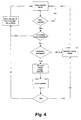
- the control module is also suitable for monitoring the state of availability of MMDS network 5, sending a locking signal thereto, removing if necessary the oldest transmitted contents, and inserting new contents to be sent to each user, after the analysis of corresponding requests received from the latter. All this according to an adequate protocol, such as that depicted by Figure 4.
- Communication between the users and processing device 2 may be physically established by different means, either cabled or wireless. For ease of installation, and in the absence of other preliminary information, a wireless installation communicating the requests of the users will be preferred. Information transmission is preferably carried out over the TCP/IP protocol, although other transmission stacks may be used.
- this processing device 2 is based on a wideband LMDS network 1 which transmits digital TV DVB-C signals and DOCSIS data signals to another lower-bandwidth network 5 where not all the TV contents fit.
- processing device 2 may be used to send to the users only those channels they request.
- FIG. 3 shows an implementation of signal processing device 2 for this variant, wherein both services, TV and data, are treated separately.
- control signals are of different natures, named in the figure: "Tuner Control” and “Control”, although they must only be interpreted by way of example.
- the TV (or STB) receivers will have to be modified so as to implement the communication protocol of Figure 4 (or another one considered adequate) when the user selects a different channel.
- the data modems would not require any adaptation, as the processing which is carried out in the processing device 2 is transparent to them.
Landscapes
- Engineering & Computer Science (AREA)
- Computer Networks & Wireless Communication (AREA)
- Signal Processing (AREA)
- Mobile Radio Communication Systems (AREA)
Applications Claiming Priority (2)
| Application Number | Priority Date | Filing Date | Title |
|---|---|---|---|
| ES200400781A ES2245590B1 (es) | 2004-03-31 | 2004-03-31 | Sistema de comunicaciones por radiofrecuencia con utilizacion de dos bandas de frecuencia. |
| PCT/ES2005/000163 WO2005096521A1 (fr) | 2004-03-31 | 2005-03-28 | Systeme de communication par radiofrequence au moyen de deux bandes de frequence |
Publications (1)
| Publication Number | Publication Date |
|---|---|
| EP1734672A1 true EP1734672A1 (fr) | 2006-12-20 |
Family
ID=35064131
Family Applications (1)
| Application Number | Title | Priority Date | Filing Date |
|---|---|---|---|
| EP05729479A Withdrawn EP1734672A1 (fr) | 2004-03-31 | 2005-03-28 | Systeme de communication par radiofrequence au moyen de deux bandes de frequence |
Country Status (4)
| Country | Link |
|---|---|
| US (1) | US20080144565A1 (fr) |
| EP (1) | EP1734672A1 (fr) |
| ES (1) | ES2245590B1 (fr) |
| WO (1) | WO2005096521A1 (fr) |
Families Citing this family (1)
| Publication number | Priority date | Publication date | Assignee | Title |
|---|---|---|---|---|
| US10382115B2 (en) * | 2016-06-30 | 2019-08-13 | Futurewei Technologies, Inc. | System and method for hybrid beamforming diversity |
Family Cites Families (4)
| Publication number | Priority date | Publication date | Assignee | Title |
|---|---|---|---|---|
| US5533009A (en) * | 1995-02-03 | 1996-07-02 | Bell Communications Research, Inc. | Bandwidth management and access control for an ATM network |
| SE515776C2 (sv) * | 1996-01-26 | 2001-10-08 | Telia Ab | System för radiokommunikation vid korta avstånd mellan sändare och mottagare |
| CA2256282A1 (fr) * | 1998-06-02 | 1999-12-02 | Northern Telecom Limited | Reseau central de donnees integrales (rcdi) |
| CA2242857A1 (fr) * | 1998-07-09 | 2000-01-09 | Erik H. Boch | Modulations maq et qpsk combinees pour optimiser la capacite de licence dans les systemes cellulaires sans fil a acces multipoints |
-
2004
- 2004-03-31 ES ES200400781A patent/ES2245590B1/es not_active Expired - Fee Related
-
2005
- 2005-03-28 WO PCT/ES2005/000163 patent/WO2005096521A1/fr not_active Ceased
- 2005-03-28 EP EP05729479A patent/EP1734672A1/fr not_active Withdrawn
- 2005-03-28 US US11/547,017 patent/US20080144565A1/en not_active Abandoned
Non-Patent Citations (1)
| Title |
|---|
| See references of WO2005096521A1 * |
Also Published As
| Publication number | Publication date |
|---|---|
| WO2005096521A1 (fr) | 2005-10-13 |
| US20080144565A1 (en) | 2008-06-19 |
| ES2245590A1 (es) | 2006-01-01 |
| ES2245590B1 (es) | 2007-03-16 |
Similar Documents
| Publication | Publication Date | Title |
|---|---|---|
| US6031645A (en) | Bi-directional optical communications subscriber transmission system using a single wavelength | |
| EP0695092B1 (fr) | Procédé et appareil pour effectuer des communications bidirectionelles à large bande pour réseaux | |
| CA2318757C (fr) | Procede et systeme de distribution de services d'abonnes par boucles bidirectionnelles sans fil a bande large | |
| DE69719912T2 (de) | Netzwerkgerät und Methode zum Liefern von komprimierten digitalen Videosignalen über Minifaserknotenpunkte | |
| US5822102A (en) | Passive optical network employing upconverted 16-cap signals | |
| US6449071B1 (en) | Digital signal processing optical transmitter | |
| US5956346A (en) | Broadband communication system using TV channel roll-off spectrum | |
| EP0762766A2 (fr) | Appareil et procédé pour réseaux pour effectuer des communications bidirectionnelles à large bande | |
| SE9702146L (sv) | System vid telekommunikationsnät | |
| EP1451948B1 (fr) | Systeme de distribution de contenu multi-canaux a large bande | |
| US5729281A (en) | Catv system in which chanel selection signal is transmitted from the subscriber location | |
| NZ247818A (en) | Video channel distribution headend for optical fibre communication system | |
| US6868255B1 (en) | Method of transmitting return signals to a satellite from a videocommunication signal distribution network | |
| EP0902553A2 (fr) | Procédé et système pour assurer une connectivité globale pour données à débits variables dans un réseau de communication par satellites | |
| EP1097591B1 (fr) | Systeme optimise de repartition des services de telecommunication et de television a partir d'un noeud peripherique vers des terminaux d'utilisateur | |
| RU2001103895A (ru) | Оптимизированная система для распределения сигналов телевизионных и телекоммуникационных служб от периферийного узла к абонентским терминалам | |
| JPH07312748A (ja) | Catvシステムおよびcatvシステムにおける変調方式判定方法 | |
| US20080144565A1 (en) | Radio Frequency Communications System With Use of Two Frequency Bands | |
| EP1157552B1 (fr) | Communication par decodeur orientee session utilisant un routage dynamique et synchronise | |
| KR100237708B1 (ko) | 케이블모뎀 방식에 기반한 광대역무선가입자망시스템 | |
| EP1041825A1 (fr) | Unité de télédiffusion pour la diffusion de services interactifs dans un réseau d'accès | |
| KR0173903B1 (ko) | 무선망을 이용한 양방향 멀티미디어 송수신 시스템 | |
| JPH09284219A (ja) | 伝送システム | |
| EP1659712A1 (fr) | Système de distribution et de communication hyperfréquence hybride et bidirectionnel | |
| AU665691B2 (en) | Switched video service |
Legal Events
| Date | Code | Title | Description |
|---|---|---|---|
| PUAI | Public reference made under article 153(3) epc to a published international application that has entered the european phase |
Free format text: ORIGINAL CODE: 0009012 |
|
| 17P | Request for examination filed |
Effective date: 20061026 |
|
| AK | Designated contracting states |
Kind code of ref document: A1 Designated state(s): AT BE BG CH CY CZ DE DK EE ES FI FR GB GR HU IE IS IT LI LT LU MC NL PL PT RO SE SI SK TR |
|
| DAX | Request for extension of the european patent (deleted) | ||
| STAA | Information on the status of an ep patent application or granted ep patent |
Free format text: STATUS: THE APPLICATION IS DEEMED TO BE WITHDRAWN |
|
| 18D | Application deemed to be withdrawn |
Effective date: 20091001 |