EP1735775B1 - Verfahren zur darstellung von mehrkanal-audiosignalen - Google Patents
Verfahren zur darstellung von mehrkanal-audiosignalen Download PDFInfo
- Publication number
- EP1735775B1 EP1735775B1 EP05735201A EP05735201A EP1735775B1 EP 1735775 B1 EP1735775 B1 EP 1735775B1 EP 05735201 A EP05735201 A EP 05735201A EP 05735201 A EP05735201 A EP 05735201A EP 1735775 B1 EP1735775 B1 EP 1735775B1
- Authority
- EP
- European Patent Office
- Prior art keywords
- channel
- parameter
- balance
- balance parameter
- channels
- Prior art date
- Legal status (The legal status is an assumption and is not a legal conclusion. Google has not performed a legal analysis and makes no representation as to the accuracy of the status listed.)
- Expired - Lifetime
Links
Images





Classifications
-
- H—ELECTRICITY
- H04—ELECTRIC COMMUNICATION TECHNIQUE
- H04R—LOUDSPEAKERS, MICROPHONES, GRAMOPHONE PICK-UPS OR LIKE ACOUSTIC ELECTROMECHANICAL TRANSDUCERS; ELECTRIC HEARING AIDS; PUBLIC ADDRESS SYSTEMS
- H04R5/00—Stereophonic arrangements
-
- G—PHYSICS
- G10—MUSICAL INSTRUMENTS; ACOUSTICS
- G10L—SPEECH ANALYSIS TECHNIQUES OR SPEECH SYNTHESIS; SPEECH RECOGNITION; SPEECH OR VOICE PROCESSING TECHNIQUES; SPEECH OR AUDIO CODING OR DECODING
- G10L19/00—Speech or audio signals analysis-synthesis techniques for redundancy reduction, e.g. in vocoders; Coding or decoding of speech or audio signals, using source filter models or psychoacoustic analysis
- G10L19/008—Multichannel audio signal coding or decoding using interchannel correlation to reduce redundancy, e.g. joint-stereo, intensity-coding or matrixing
-
- G—PHYSICS
- G10—MUSICAL INSTRUMENTS; ACOUSTICS
- G10L—SPEECH ANALYSIS TECHNIQUES OR SPEECH SYNTHESIS; SPEECH RECOGNITION; SPEECH OR VOICE PROCESSING TECHNIQUES; SPEECH OR AUDIO CODING OR DECODING
- G10L19/00—Speech or audio signals analysis-synthesis techniques for redundancy reduction, e.g. in vocoders; Coding or decoding of speech or audio signals, using source filter models or psychoacoustic analysis
- G10L19/02—Speech or audio signals analysis-synthesis techniques for redundancy reduction, e.g. in vocoders; Coding or decoding of speech or audio signals, using source filter models or psychoacoustic analysis using spectral analysis, e.g. transform vocoders or subband vocoders
- G10L19/0204—Speech or audio signals analysis-synthesis techniques for redundancy reduction, e.g. in vocoders; Coding or decoding of speech or audio signals, using source filter models or psychoacoustic analysis using spectral analysis, e.g. transform vocoders or subband vocoders using subband decomposition
-
- G—PHYSICS
- G10—MUSICAL INSTRUMENTS; ACOUSTICS
- G10L—SPEECH ANALYSIS TECHNIQUES OR SPEECH SYNTHESIS; SPEECH RECOGNITION; SPEECH OR VOICE PROCESSING TECHNIQUES; SPEECH OR AUDIO CODING OR DECODING
- G10L19/00—Speech or audio signals analysis-synthesis techniques for redundancy reduction, e.g. in vocoders; Coding or decoding of speech or audio signals, using source filter models or psychoacoustic analysis
- G10L19/02—Speech or audio signals analysis-synthesis techniques for redundancy reduction, e.g. in vocoders; Coding or decoding of speech or audio signals, using source filter models or psychoacoustic analysis using spectral analysis, e.g. transform vocoders or subband vocoders
- G10L19/032—Quantisation or dequantisation of spectral components
-
- G—PHYSICS
- G10—MUSICAL INSTRUMENTS; ACOUSTICS
- G10L—SPEECH ANALYSIS TECHNIQUES OR SPEECH SYNTHESIS; SPEECH RECOGNITION; SPEECH OR VOICE PROCESSING TECHNIQUES; SPEECH OR AUDIO CODING OR DECODING
- G10L19/00—Speech or audio signals analysis-synthesis techniques for redundancy reduction, e.g. in vocoders; Coding or decoding of speech or audio signals, using source filter models or psychoacoustic analysis
- G10L19/04—Speech or audio signals analysis-synthesis techniques for redundancy reduction, e.g. in vocoders; Coding or decoding of speech or audio signals, using source filter models or psychoacoustic analysis using predictive techniques
- G10L19/08—Determination or coding of the excitation function; Determination or coding of the long-term prediction parameters
-
- G—PHYSICS
- G10—MUSICAL INSTRUMENTS; ACOUSTICS
- G10L—SPEECH ANALYSIS TECHNIQUES OR SPEECH SYNTHESIS; SPEECH RECOGNITION; SPEECH OR VOICE PROCESSING TECHNIQUES; SPEECH OR AUDIO CODING OR DECODING
- G10L19/00—Speech or audio signals analysis-synthesis techniques for redundancy reduction, e.g. in vocoders; Coding or decoding of speech or audio signals, using source filter models or psychoacoustic analysis
- G10L19/04—Speech or audio signals analysis-synthesis techniques for redundancy reduction, e.g. in vocoders; Coding or decoding of speech or audio signals, using source filter models or psychoacoustic analysis using predictive techniques
- G10L19/16—Vocoder architecture
- G10L19/167—Audio streaming, i.e. formatting and decoding of an encoded audio signal representation into a data stream for transmission or storage purposes
-
- G—PHYSICS
- G10—MUSICAL INSTRUMENTS; ACOUSTICS
- G10L—SPEECH ANALYSIS TECHNIQUES OR SPEECH SYNTHESIS; SPEECH RECOGNITION; SPEECH OR VOICE PROCESSING TECHNIQUES; SPEECH OR AUDIO CODING OR DECODING
- G10L19/00—Speech or audio signals analysis-synthesis techniques for redundancy reduction, e.g. in vocoders; Coding or decoding of speech or audio signals, using source filter models or psychoacoustic analysis
- G10L19/04—Speech or audio signals analysis-synthesis techniques for redundancy reduction, e.g. in vocoders; Coding or decoding of speech or audio signals, using source filter models or psychoacoustic analysis using predictive techniques
- G10L19/26—Pre-filtering or post-filtering
-
- H—ELECTRICITY
- H03—ELECTRONIC CIRCUITRY
- H03M—CODING; DECODING; CODE CONVERSION IN GENERAL
- H03M7/00—Conversion of a code where information is represented by a given sequence or number of digits to a code where the same, similar or subset of information is represented by a different sequence or number of digits
- H03M7/30—Compression; Expansion; Suppression of unnecessary data, e.g. redundancy reduction
-
- H—ELECTRICITY
- H04—ELECTRIC COMMUNICATION TECHNIQUE
- H04S—STEREOPHONIC SYSTEMS
- H04S3/00—Systems employing more than two channels, e.g. quadraphonic
- H04S3/02—Systems employing more than two channels, e.g. quadraphonic of the matrix type, i.e. in which input signals are combined algebraically, e.g. after having been phase shifted with respect to each other
-
- H—ELECTRICITY
- H04—ELECTRIC COMMUNICATION TECHNIQUE
- H04S—STEREOPHONIC SYSTEMS
- H04S5/00—Pseudo-stereo systems, e.g. in which additional channel signals are derived from monophonic signals by means of phase shifting, time delay or reverberation
-
- H—ELECTRICITY
- H04—ELECTRIC COMMUNICATION TECHNIQUE
- H04S—STEREOPHONIC SYSTEMS
- H04S2400/00—Details of stereophonic systems covered by H04S but not provided for in its groups
- H04S2400/01—Multi-channel, i.e. more than two input channels, sound reproduction with two speakers wherein the multi-channel information is substantially preserved
-
- H—ELECTRICITY
- H04—ELECTRIC COMMUNICATION TECHNIQUE
- H04S—STEREOPHONIC SYSTEMS
- H04S2400/00—Details of stereophonic systems covered by H04S but not provided for in its groups
- H04S2400/03—Aspects of down-mixing multi-channel audio to configurations with lower numbers of playback channels, e.g. 7.1 -> 5.1
-
- H—ELECTRICITY
- H04—ELECTRIC COMMUNICATION TECHNIQUE
- H04S—STEREOPHONIC SYSTEMS
- H04S2420/00—Techniques used stereophonic systems covered by H04S but not provided for in its groups
- H04S2420/03—Application of parametric coding in stereophonic audio systems
Definitions
- the present invention relates to coding of multi-channel representations of audio signals using spatial parameters.
- the present invention teaches new methods for estimating and defining proper parameters for recreating a multi-channel signal from a number of channels being less than the number of output channels. In particular it aims at minimizing the bit rate for the multi-channel representation, and providing a coded representation of the multi-channel signal enabling easy encoding and decoding of the data for all possible channel configurations.
- multi-channel in this context meaning more than two output channels
- multi-channel configurations exist. The most commonly known is the 5.1 configuration (center channel, front left/right, surround left/right, and the LFE channel). However, many other configurations exist. From the complete encoder/decoder systems point-of-view, it is desirable to have a system that can use the same parameter set (e.g. IID and ICC) or subsets thereof for all channel configurations.
- ITU-R BS.775 defines several down-mix schemes to be able to obtain a channel configuration comprising fewer channels from a given channel configuration.
- a parameter set that is inherently scaleable is desirable from a scalable or embedded coding point of view, where it is e.g. possible to store the data corresponding to the surround channels in an enhancement layer in the bitstream.
- binaural cue coding Another representation of multi-channel signals using a sum signal or down mix signal and additional parametric side information is known in the art as binaural cue coding (BCC).
- BCC binaural cue coding
- binaural cue coding is a method for multi-channel spatial rendering based on one down-mixed audio channel and side information.
- Several parameters to be calculated by a BCC encoder and to be used by a BCC decoder for audio reconstruction or audio rendering include inter-channel level differences, inter-channel time differences, and inter-channel coherence parameters. These inter-channel cues are the determining factor for the perception of a spatial image. These parameters are given for blocks of time samples of the original multi-channel signal and are also given frequency-selective so that each block of multi-channel signal samples have several cues for several frequency bands.
- the inter-channel level differences and the inter-channel time differences are considered in each subband between pairs of channels, i.e., for each channel relative to a reference channel.
- One channel is defined as the reference channel for each inter-channel level difference.
- the inter-channel level differences and the inter-channel time differences it is possible to render a source to any direction between one of the loudspeaker pairs of a playback set-up that is used.
- the width or diffuseness of a rendered source it is enough to consider one parameter per subband for all audio channels. This parameter is the inter-channel coherence parameter.
- the width of the rendered source is controlled by modifying the subband signals such that all possible channel pairs have the same inter-channel coherence parameter.
- all inter-channel level differences are determined between the reference channel 1 and any other channel.
- the center channel is determined to be the reference channel
- a first inter-channel level difference between the left channel and the centre channel, a second inter-channel level difference between the right channel and the centre channel, a third inter-channel level difference between the left surround channel and the center channel, and a forth inter-channel level difference between the right surround channel and the center channel are calculated.
- This scenario describes a five-channel scheme.
- the five-channel scheme additionally includes a low frequency enhancement channel, which is also known as a "sub-woofer" channel
- a fifth inter-channels level difference between the low frequency enhancement channel and the center channel which is the single reference channel, is calculated.
- the spectral coefficients of the mono signal are modified using these cues.
- the level modification is performed using a positive real number determining the level modification for each spectral coefficient.
- the inter-channel time difference is generated using a complex number of magnitude of one determining a phase modification for each spectral coefficient. Another function determines the coherence influence.
- the factors for level modifications of each channel are computed by firstly calculating the factor for the reference channel.
- the factor for the reference channel is computed such that for each frequency partition, the sum of the power of all channels is the same as the power of the sum signal. Then, based on the level modification factor for the reference channel, the level modification factors for the other channels are calculated using the respective ICLD parameters.
- the level modification factor for the reference channel is to be calculated. For this calculation, all ICLD parameters for a frequency band are necessary. Then, based on this level modification for the single channel, the level modification factors for the other channels, i.e., the channels, which are not the reference channel, can be calculated.
- an apparatus for generating a parameter representation of a multi-channel input signal in accordance with claim 1 an apparatus for generating a re-constructed multi-channel representation in accordance with claim 16, a method in accordance with claims 23 or 24, a computer program in accordance with claim 25, or a parameter representation in accordance with claim 26.
- the present invention is based on the finding that, for a multi-channel representation, one has to rely on balance parameters between channel pairs. Additionally, it has been found out that a multi-channel signal parameter representation is possible by providing at least two different balance parameters, which indicate a balance between two different channel pairs. In particular, flexibility, scalability, error-robustness, and even bit rate efficiency are the result of the fact that the first channel pair, which is the basis for the first balance parameter is different from the second channel pair, which is the basis for the second balance parameters, wherein the four channels forming these channel pairs are all different from each other.
- the inventive concept departs from the single reference channel concept and uses a multi-balance or super-balance concept, which is more intuitive and more natural for a human being's sound impression.
- the channel pairs underlying the first and second balance parameters can include original channels, down-mix channels, or preferably, certain combinations between input channels.
- a balance parameter derived from the center channel as the first channel and a sum of the left original channel and the right original channel as the second channel of the channel pair is especially useful for providing an exact energy distribution between the center channel and the left and right channels.
- these three channels normally include most information of the audio scene, wherein particularly the left-right stereo localization is not only influenced by the balance between left and right but also by the balance between center and the sum of left and right. This observation is reflected by using this balance parameter in accordance with a preferred embodiment of the present invention.
- a left/right balance parameter when a single mono down-mix signal is transmitted, it has been found out that, in addition to the center/left plus right balance parameter, a left/right balance parameter, a rear-left/rear-right balance parameter, and a front/back balance parameter are an optimum solution for a bit rate-efficient parameter representation, which is flexible, error-robust, and to a large extent artefact-free.
- the inventive multi-balance representation additionally makes use of information on the down-mixing scheme used for generating the down-mix channel(s).
- information on the down-mixing scheme which is not used in prior art systems, is also used for up-mixing in addition to the balance parameter.
- the up-mixing operation is, therefore, performed such that the balance between the channels within a reconstructed multi-channel signal forming a channel pair for a balance parameter is determined by the balance parameter.
- This concept i.e., having different channel pairs for different balance parameters, makes it possible to generate some channels without knowledge of each and every transmitted balance parameter.
- the left, right and center channels can be reconstructed without any knowledge on any rear-left/rear-right balance or without any knowledge on a front/back balance.
- This effect allows the very fine-tuned scalability, since extracting an additional parameter from a bit stream or transmitting an additional balance parameter to a receiver consequently allows the reconstruction of one or more additional channels.
- This is in contrast to the prior art single-reference system, in which one needed each and every inter-channel level difference for reconstructing all or only a subgroup of all reconstructed output channels.
- the inventive concept is also flexible in that the choice of the balance parameters can be adapted to a certain reconstruction environment.
- a five-channel set-up forms the original multi-channel signal set-up
- a four-channel set-up forms a reconstruction multi-channel set-up, which has only a single surround speaker, which is e.g. positioned behind the listener
- a front-back balance parameter allows calculating the combined surround channel without any knowledge on the left surround channel, and the right surround channel.
- This is in contrast to a single-reference channel system, in which one has to extract an inter-channel level difference for the left surround channel and an inter-channel level difference for the right surround channel from the data stream. Then, one has to calculate the left surround channel and the right surround channel.
- the present invention relates to the problem of a parameterized multi-channel representation of audio signals. It provides an efficient manner to define the proper parameters for the multi-channel representation and also the ability to extract the parameters representing the desired channel configuration without having to decode all channels.
- the invention further solves the problem of choosing the optimal parameter configuration for a given signal segment in order to minimize the bit rate required to code the spatial parameters for the given signal segment.
- the present invention also outlines how to apply the decorrelation methods previously only applicable for the two channel case in a general multi-channel environment.
- the present invention comprises the following features:
- a balance parameter is also termed to be a "inter-channel intensity difference (IID)" parameter, it is to be emphasized that a balance parameter between a channel pair does not necessarily has to be the ratio between the energy or intensity in the first channel of the channel pair and the energy or intensity of the second channel in the channel pair.
- the balance parameter indicates the localization of a sound source between the two channels of the channel pair. Although this localization is usually given by energy/level/intensity differences, other characteristics of a signal can be used such as a power measure for both channels or time or frequency envelopes of the channels, etc.
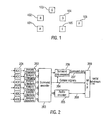
- a(t) 101 represents the left surround channel
- b(t) 102 represents the left front channel
- c(t) 103 represents the center channel
- d(t) 104 represents the right front channel
- e(t) 105 represents the right surround channel
- f(t) 106 represents the LFE (low frequency effects) channel.
- the five channels are on the encoder side down-mixed to a two channel representation or a one channel representation. This can be done in several ways, and one commonly used is the ITU down-mix defined according to:
- the IID parameters are defined as energy ratios of two arbitrarily chosen channels or weighted groups of channels. Given the energies of the channels outlined above for the 5.1 channel configuration several sets of IID parameters can be defined.
- Fig. 7 indicates a general down-mixer 700 using the above-referenced equations for calculating a single-based channel m or two preferably stereo-based channels l d and r d .
- the down-mixer uses certain down-mixing information.
- this down-mixing information includes weighting factors ⁇ , ⁇ , ⁇ , and ⁇ . It is known in the art that more or less constant or non-constant weighting factors can be used.
- ⁇ is set to 1, ⁇ and ⁇ are set to be equal, and equal to the square root of 0.5, and ⁇ is set to 0.
- the factor ⁇ can vary between 1.5 and 0.5.
- the factors ⁇ , and ⁇ can be different from each other, and vary between 0 and 1.
- the same is true for the low frequency enhancement channel f(t).
- the factor ⁇ for this channel can vary between 0 and 1.
- the factors for the left-down mix and the right-down mix do not have to be equal to each other. This becomes clear, when a non-automatic down-mix is considered, which is, for example, performed by a sound engineer.
- the sound engineer is more directed to perform a creative down-mix rather than a down-mix, which is guided by any mathematic laws. Instead, the sound engineer is guided by his own creative feeling.
- this "creative" down-mixing is recorded by a certain parameter set, it will be used in accordance with the present invention by an inventive up-mixer as shown in Fig. 8, which is not only guided by the parameters, but also by additional information on the down-mixing scheme.
- the weighting parameters are the preferred information on the down-mixing scheme to be used by the up-mixer.
- this other information can also be used by an up-mixer as the information on the down-mixing scheme.
- Such other information can, for example, be certain matrix elements or certain factors or functions within matrix elements of an upmix-matrix as, for example, indicated in Fig. 11.
- the present invention defines IID parameters that apply to all these channels, i.e. the four channel subset of the 5.1. channel configuration has a corresponding subset within the IID parameter set describing the 5.1 channels.
- the r 1 parameter corresponds to the energy ratio between the left down-mix channel and the right channel down-mix.
- the r 2 parameter corresponds to the energy ratio between the center channel and the left and right front channels.
- the r 3 parameter corresponds to the energy ratio between the three front channels and the two surround channels.
- the r 4 parameter corresponds to the energy ratio between the two surround channels.
- the r 5 parameter corresponds to the energy ratio between the LFE channel and all other channels.
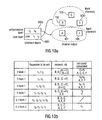
- Fig. 4 the energy ratios as explained above are illustrated.
- the different output channels are indicated by 101 to 105 and are the same as in Fig.1 and are hence not elaborated on further here.
- the speaker set-up is divided into a left and a right half, where the center channel 103 are part of both halves.
- the energy ratio between the left half plane and the right half plane is exactly the parameter referred to as r 1 according to the present invention. This is indicated by the solid line below r 1 in Fig. 4.
- the energy distribution between the center channel 103 and the left front 102 and right front 103 channels are indicated by r 2 according to the present invention.
- the energy distribution between the entire front channel set-up ( 102, 103 and 104 ) and the back channels ( 101 and 105 ) are illustrated by the arrow in Fig. 5 by the r 3 parameter.
- the energy of the M signal can be distributed to the re-constructed channels resulting in re-constructed channels having the same energies as the original channels.
- Fig. 8 The above-preferred up-mixing scheme is illustrated in Fig. 8. It becomes clear from the equations for F, A, E, C, B, and D that the information on the down-mixing scheme to be used by the up-mixer are the weighting factors ⁇ , ⁇ , ⁇ , and ⁇ , which are used for weighting the original channels before such weighted or unweighted channels are added together or subtracted from each other in order to arrive at a number of down-mix channels, which is smaller than the number of original channels.
- the energies of the reconstructed channels are not only determined by the balance parameters transmitted from an encoder-side to a decoder-side, but are also determined by the down-mixing factor ⁇ , ⁇ , ⁇ , and ⁇ .
- Fig. 10b The above described scalability feature is illustrated by the table in Fig. 10b.
- the scalable bit stream illustrated in Fig. 10a and explained later on can also be adapted to the table in Fig. 10b for obtaining a much finer scalability than shown in Fig. 10a.
- the inventive concept is especially advantageous in that the left and right channels can be easily reconstructed from a single balance parameter r 1 without knowledge or extraction of any other balance parameter.
- the channels A, C, F, and E are simply set to zero.
- the reconstructed channels are the sum between the center channel and the low frequency channel (when this channel is not set to zero) on the one hand and the sum between the left and right channels on the other hand.
- the center channel on the one hand and the mono signal on the other hand can be reconstructed using only a single parameter.
- This feature can already be useful for a simple 3-channel representation, where the left and right signals are derived from the sum of left and right such as by halving, and where the energy between the center and the sum of left and right is exactly determined by the balance parameter r 2 .
- the balance parameters r 1 or r 2 are situated in a lower scaling layer.
- the non-extracted parameter r 5 and the other non-extracted parameter r 3 are set to 0. Additionally, the non-used channels A, E, F are also set to 0, so that the 3 channels B, D, and the combination between the center channel C and the low frequency enhancement channel F can be calculated.
- r 3 could be in a next-higher scaling layer than the other parameter r 1 or r 2 .
- the 4-channel configuration is specially suitable in connection with the super-balance parameter representation of the present invention, since, as it will be described later on in connection with Fig. 6, the third balance parameter r 3 already is derived from a combination of the front channels on the one hand and the back channels on the other hand.
- the parameter r 3 is a front-back balance parameter, which is derived from the channel pair having, as a first channel, a combination of the back channels A and E, and having, as the front channels, a combination of left channel B, right channel E, and center channel C.
- the combined channel energy of both surround channels is automatically obtained without any further separate calculation and subsequent combination, as would be the case in a single reference channel set-up.
- each balance parameter is required.
- a next-higher scaling layer including the next balance parameter r 5 will have to be transmitted to a receiver and evaluated by the receiver.
- the above IID parameters can be extended to cover channel configuration s with a larger number of channels than the 5.1 configuration.
- the present invention is not limited to the examples outlined above.
- the parameters q 3 and q 4 represent the energy ratio between the front and back left channels, and the energy ratio between the front and back right channels. Several other parameterizations can be envisioned.
- Fig. 5 the modified parameterization is visualized. Instead of having one parameter outlining the energy distribution between the front and back channels (as was outlined by r 3 in Fig. 4) and a parameter describing the energy distribution between the left surround channel and the right surround channel (as was outlined by r 4 in Fig. 4) the parameters q 3 and q 4 are used describing the energy ratio between the left front 102 and left surround 101 channel, and the energy ratio between the right front channel 104 and right surround channel 105 .
- the present invention teaches that several parameter sets can be used to represent the multi-channel signals.
- An additional feature of the present invention is that different parameterizations can be chosen dependent on the type of quantization of the parameters that is used.
- a parameterization should be used that does not amplify errors during the upmixing process.
- r 1 B D
- Fig. 6 the energy ratios as explained above are illustrated.
- the different output channels are indicated by 101 to 105 and are the same as in Fig.1 and are hence not elaborated on further here.
- the speaker set-up is divided into a front part and a back part.
- the energy distribution between the entire front channel set-up ( 102, 103 and 104 ) and the back channels ( 101 and 105 ) are illustrated by the arrow in Fig. 6 indicated by the r 3 parameter.
- the above parameterization also has the advantage that the parameters used to reconstruct the three front channels are derived without any influence of the surround channels.
- the correlation measure between the center and the sum of all other channels will be rather low, since the back channels are completely uncorrelated. The same will be true for a parameter estimating the correlation between the front left/right channels, and the back left/right channels.
- the energy distribution between the center channel 103 and the left front 102 and right front 103 channels are indicated by r 2 according to the present invention.
- the energy distribution between the left surround channel 101 and the right surround channel 105 is illustrated by r4.
- the energy distribution between the left front channel 102 and the right front channel 104 is given by r1.
- all parameters are the same as outlined in Fig.4 apart from r1 that here corresponds to the energy distribution between the left front speaker and the right front speaker, as opposed to the entire left side and the entire right side.
- the parameter r5 is also given outlining the energy distribution between the center channel 103 and the lfe channel 106 .
- Fig. 6 shows an overview of the preferred parameterization embodiment of the present invention.
- the first balance parameter r 1 (indicated by the solid line) constitutes a front-left/front-right balance parameter.
- the second balance parameter r 2 is a center left-right balance parameter.
- the third balance parameter r 3 constitutes a front/back balance parameter.
- the forth balance parameter r 4 constitutes a rear-left/rear-right balance parameter.
- the fifth balance parameter r 5 constitutes a center/lfe balance parameter.
- Fig. 4 shows a related situation.
- the first balance parameter r 1 which is illustrated in Fig. 4 by solid lines in case of a down-mix-left/right balance can be replaced by an original front-left/front-right balance parameter defined between the channels B and D as the underlying channel pair. This is illustrated by the dashed line r 1 in Fig. 4 and corresponds to the solid line r 1 in Fig. 5 and Fig. 6.
- the parameters r 3 and r 4 i.e. the front/back balance parameter and the rear-left/right balance parameter are replaced by two single-sided front/rear parameters.
- the first single-sided front/rear parameter q 3 can also be regarded as the first balance parameter, which is derived from the channel pair consisting of the left surround channel A and the left channel B.
- the second single-sided front/left balance parameter is the parameter q 4 , which can be regarded as the second parameter, which is based on the second channel pair consisting of the right channel D and the right surround channel E. Again, both channel pairs are independent from each other.
- the center/left-right balance parameter r 2 which have, as a first channel, a center channel C, and as a second channel, the sum of the left and right channels B, and D.
- the above-referenced parameter set for a two-base channel set-up makes use of several reference channels.
- the parameter set in Fig. 7 solely relies on down-mix channels rather than original channels as reference channels.
- the balance parameters q 1 , q 3 , and q 4 are derived from completely different channel pairs.
- the channel pairs for deriving balance parameters include only original channels (Fig. 4, Fig. 5, Fig. 6) or include original channels as well as down-mix channels (Fig. 4, Fig. 5) or solely rely on the down-mix channels as the reference channels as indicated at the bottom of Fig. 7, it is preferred that the parameter generator included within the surround data encoder 206 of Fig. 2 is operative to only use original channels or combinations of original channels rather than a base channel or a combination of base channels for the channels in the channel pairs, on which the balance parameters are based.
- Such energy variations to the down-mix channels or the single down-mix channel can be caused by an audio encoder 205 (Fig. 2) or an audio decoder 302 (Fig. 3) operating under a low-bit rate condition.
- Such situations can result in manipulation of the energy of the mono down-mix channel or the stereo down-mix channels, which manipulation can be different between the left and right stereo down-mix channels, or can even be frequency-selective and time-selective.
- an additional level parameter is transmitted for each block and frequency band for every downmix channel in accordance with the present invention.
- the balance parameters are based on the original signal rather than the down-mix signal, a single correction factor is sufficient for each band, since any energy correction will not influence a balance situation between the original channels.
- any down-mix channel energy variations will not result in a distorted localization of sound sources in the audio image but will only result in a general loudness variation, which is not as annoying as a migration of a sound source caused by varying balance conditions.
- the energy M (of the down-mixed channels), is the sum of the energies B, D, A, E, C and F as outlined above. This is not always the case due to phase dependencies between the different channels being down-mixed in to one channel.
- Fig. 9 the application of the additional parameter r M is outlined.
- the downmixed input signal is modified by the r M parameter in 901 prior to sending it into the upmix modules of 701 - 705 .
- These are the same as in Fig. 7 and will therefore not be elaborated on further.
- the parameter rM for the single channel downmix example above can be extended to be one parameter per downmix channel, and is hence not limited to a single downmix channel.
- Fig. 9a illustrates an inventive level parameter calculator 900
- Fig. 9b indicates an inventive level corrector 902.
- Fig. 9a indicates the situation on the encoder-side
- Fig. 9b illustrates the corresponding situation on the decoder-side.
- the level parameter or "additional" parameter r M is a correction factor giving a certain energy ratio.
- the master down-mix has been generated by a sound engineer in a sound studio based on, for example, subjective quality impressions.
- a certain audio storage medium also includes the parameter down-mix, which has been performed by for example the surround encoder 203 of Fig. 2.
- the parameter down-mix includes one base channel or two base channels, which base channels form the basis for the multi-channel reconstruction using the set of balance parameters or any other parametric representation of the original multi-channel signal.
- a broadcaster wishes to not transmit the parameter down-mix but the master down-mix from a transmitter to a receiver.
- the broadcaster also transmits a parametric representation of the original multi-channel signal. Since the energy (in one band and in one block) can (and typically will) vary between the master down-mix and the parameter down-mix, a relative level parameter r M is generated in block 900 and transmitted to the receiver as an additional parameter.
- the level parameter is derived from the master down-mix and the parameter down-mix and is preferably, a ratio between the energies within one block and one band of the master down-mix and the parameter down-mix.
- the level parameter is calculated as the ratio of the sum of the energies (E orig ) of the original channels and the energy of the downmix channel(s), wherein this downmix channel(s) can be the parameter downmix (E PD ) or the master downmix (E MD ) or any other downmix signal.
- this downmix channel(s) can be the parameter downmix (E PD ) or the master downmix (E MD ) or any other downmix signal.
- the energy of the specific downmix signal is used, which is transmitted from an encoder to a decoder.
- Fig. 9b illustrates a decoder-side implementation of the level parameter usage.
- the level parameter as well as the down-mix signal are input into the level corrector block 902.
- the level corrector corrects the single-base channel or the several-base channels depending on the level parameter. Since the additional parameter r M is a relative value, this relative value is multiplied by the energy of the corresponding base channel.
- Figs. 9a and 9b indicate a situation, in which the level correction is applied to the down-mix channel or the down-mix channels, the level parameter can also be integrated into the up-mixing matrix.
- each occurrence of M in the equations in Fig. 8 is replaced by the term "r M M".
- the encoder can code the present signal segment using different parameter sets and choose the set of IID parameters that give the lowest overhead for the particular signal segment being processed. It is possible that the energy levels between the right front and back channels are similar, and that the energy levels between the front and back left channel are similar but significantly different to the levels in the right front and back channel. Given delta coding of parameters and subsequent entropy coding it can be more efficient to use parameters q 3 and q 4 instead of r 3 and r 4 . For another signal segment with different characteristics a different parameter set may give a lower bit rate overhead.
- the present invention allows to freely switching between different parameter representations in order to minimize the bit rate overhead for the presently encoded signal segment given the characteristics of the signal segment.
- the ability to switch between different parameterizations of the IID parameters in order to obtain the lowest possible bit rate overhead, and provide signaling means to indicate what parameterization is presently used, is an essential feature of the present invention.
- delta coding of the parameters can be done in either the frequency direction or in the time direction, as well as delta coding between different parameters.
- a parameter can be delta coded with respect to any other parameter, given that signaling means are provided indicating the particular delta coding used.
- An interesting feature for any coding scheme is the ability to do scalable coding.
- the core layer is decodable by itself, and the higher layers can be decoded to enhance the decoded core layer signal. For different circumstances the number of available layers may vary, but as long as the core layer is available the decoder can produce output samples.
- the parameterization for the multi-channel coding as outlined above using the r 1 to r 5 parameters lend them selves very well to scalable coding.
- bitstream layers are illustrated by 1001 and 1002 , where 1001 is the core layer holding the wave-form coded downmix signals and the parameters r1 and r2 required to re-create the front channels ( 102, 103 and 104 ).
- the enhancement layer illustrated by 1002 holds the parameters for re-creating the back channels ( 101 and 105 ).
- Another important aspect of the present invention is the usage of decorrelators in a multi-channel configuration.
- the concept of using a decorrelator was elaborated on for the one to two channel case in the PCT/SE02/01372 document.
- this theory to more than two channels several problems arise that the present invention solves.
- a decorrelator is typically an allpass or near allpass filter that given an input x(t) produces an output y ( t ) with E[
- 2 ] E[
- Further perceptual criteria come in to the design of a good decorrelator, some examples of design methods can be to also minimize the comb-filter character when adding the original signal to the decorrelated signal and to minimize the effect of a sometimes too long impulse response at transient signals.
- Some prior art decorrelators utilizes an artificial reverberator to decorrelate.
- Prior art also includes fractional delays by e.g. modifying the phase of the complex subband samples, to achieve higher echo density and hence more time diffusion.
- the present invention suggests methods of modifying a reverberation based decorrelator in order to achieve multiple decorrelators creating mutually decorrelated output signals from a common input signal.
- Two decorrelators are mutually decorrelated if their outputs y 1 ( t ) and y 2 ( t ) have vanishing or almost vanishing cross-correlation given the same input. Assuming the input is stationary white noise it follows that the impulse responses h 1 and h 2 must be orthogonal in the sense that E[h 1 h 2 *] is vanishing or almost vanishing.
- Sets of pair wise mutually decorrelated decorrelators can be constructed in several ways. An efficient way of doing such modifications is to alter the phase rotation factor q that is part of the fractional delay.
- phase rotation factors can be part of the delay lines in the all-pass filters or just an overall fractional delay. In the latter case this method is not limited to all-pass or reverberation like filters, but can also be applied to e.g. simple delays including a fractional delay part.
- 1), m is the delay line length in samples and a is the filter coefficient. For stability reasons, the magnitude of the filter coefficient has to be limited to
- a new reverberator is defined having the same reverberation decay properties but with an output significantly uncorrelated with the output from the non-modified reverberator.
- the constant C can be used as a constant phase offset or could be scaled in a way that it would correspond to a constant time offset for all frequency bands it is applied on.
- the phase offset constant C can also be a random value that is different for all frequency bands.
- decorrelated signals are produced from the signals in m by decorrelators.
- the n reconstructed signals a' , b' ,...are then contained in the column vector x ⁇ Hy
- Fig. 11 where the decorrelated signals are created by the decorrelators 1102, 1103 and 1104.
- the upmix matrix H is given by 1101 operating on the vector y giving the output signal x '.
- R E[ xx *] be the correlation matrix of the original signal vector
- R' E[ x'x' *] be the correlation matrix of the reconstructed signal.
- X * denotes the adjoint matrix, the complex conjugate transpose of X .
- H UDV
- U and Vare orthogonal matrices and D are a diagonal matrix.
- the squares of the absolute values of D can be chosen equal to the eigenvalues of R / M .
- Omitting V and sorting the eigenvalues so that the largest value is applied to the first coordinate will minimize the overall energy of decorrelated signals in the output.
- the orthogonal matrix U is in the real case parameterized by n ( n -1)/2 rotation angles. Transmitting correlation data in the form of those angles and the n diagonal values of D would immediately give the desired smooth dependence of H .
- energy data has to be transformed into eigenvalues, scalability is sacrificed by this approach.
- H 0 be is an orthogonal upmix matrix defining the preferred normalized upmix in the case of totally uncorrelated signals of equal energy.
- Examples of such preferred upmix matrices are 1 2 ⁇ 1 - 1 1 1 , 1 2 ⁇ 1 1 2 1 1 - 2 2 - 2 0 , 1 2 ⁇ 1 1 1 1 1 1 - 1 - 1 1 - 1 - 1 1 1 - 1 - 1 .
- Dividing the n channels into groups of fewer channels is a convenient way to reconstruct partial cross-correlation structure.
- a particular advantageous grouping for the case of 5.1 channels from 1 channel is ⁇ a , e ⁇ , ⁇ c ⁇ , ⁇ b , d ⁇ , ⁇ f ⁇ , where no decorrelation is applied for the groups ⁇ c ⁇ , ⁇ f ⁇ , and the groups ⁇ a , e ⁇ , ⁇ b , d ⁇ are produced by upmix of the same downmixed/decorrelated pair.
- the preferred normalized upmixes in the totally uncorrelated case are to be chosen as 1 2 ⁇ 1 - 1 1 1 , 1 2 ⁇ 1 1 1 - 1 , respectively.
- the preferred normalized upmixes in the totally uncorrelated case are to be chosen as 1 2 ⁇ 1 - 1 1 1 , 1 2 ⁇ 1 1 1 - 1 , respectively.
- the upmix matrix H is of size 6 ⁇ 2 with zeros at the two entries in the second column at rows 3 and 6 corresponding to outputs c ' and f '.
- a third approach taught by the present invention for incorporating decorrelated signals is the simpler point of view that each output channel has a different decorrelator giving rise to decorrelated signals s a ,s b ,....
- the parameters ⁇ a , ⁇ b ,... control the amount of decorrelated signal present in output channels a',b' ,....
- the correlation data is transmitted in form of these angles. It is easy to compute that the resulting normalized cross-correlation between, for instance, channel a ' and b ' is equal to the product cos ⁇ a cos ⁇ b .
- n ( n -1)/2and there are n decorrelators it will not be possible in general with this approach to match a given correlation structure if n >3, but the advantages are a very simple and stable decoding method, and the direct control on the produced amount of decorrelated signal present in each output channel. This enables for the mixing of decorrelated signals to be based on perceptual criteria incorporating for instance energy level differences of pairs of channels.
- the matrix R s is diagonal. Note that this also affects the upmix design with respect to the reconstruction of correct energies.
- the solution is to compute in the decoder, or to transmit from the encoder, information about the correlation structure R m of the downmixed signals.
- the present invention can be implemented in both hardware chips and DSPs, for various kinds of systems, for storage or transmission of signals, analogue or digital, using arbitrary codecs.
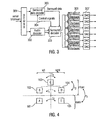
- Fig. 2 and Fig. 3 show a possible implementation of the present invention.
- a system operating on six input signals (a 5.1 channel configuration) is displayed.
- the encoder side is displayed the analogue input signals for the separate channels are converted to a digital signal 201 and analyzed using a filterbank for every channel 202 .
- the output from the filter-banks is fed to the surround encoder 203 including a parameter generator that performs a downmix creating the one or two channels encoded by the audio encoder 205 .
- the surround parameters such as the IID and ICC parameters are extracted according to the present invention, and control data outlining the time frequency grid of the data as well as which parameterization is used is extracted 204 according to the present invention.
- the extracted parameters are encoded 206 as taught by the present invention, either switching between different parameterizations or arranging the parameters in a scalable fashion.
- the surround parameters 207 , control signals and the encoded down mixed signals 208 are multiplexed 209 into a serial bitstream.
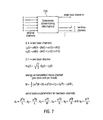
- a typical decoder implementation i.e. an apparatus for generating multi-channel reconstruction is displayed.
- the Audio decoder outputs a signal in a frequency domain representation, e.g. the output from the MPEG-4 High efficiency AAC decoder prior to the QMF synthesis filterbank.
- the serial bitstream is demultiplexed 301 and the encoded surround data is fed to the surround data decoder 303 and the down mixed encoded channels are fed to the audio decoder 302 , in this example an MPEG-4 High Efficiency AAC decoder.
- the surround data decoder decodes the surround data and feeds it to the surround decoder 305 , which includes an upmixer, that recreates six channels based on the decoded down-mixed channels and the surround data and the control signals.
- the frequency domain output from the surround decoder is synthesized 306 to time domain signals that are subsequently converted to analogue signals by the DAC 307 .
- the present invention has mainly been described with reference to the generation and usage of balance parameters, it is to be emphasized here that preferably the same grouping of channel pairs for deriving balance parameters is also used for calculating inter-channel coherence parameters or "width" parameters between these two channel pairs. Additionally, inter-channel time differences or a kind of "phase cues" can also be derived using the same channel pairs as used for the balance parameter calculation. On the receiver-side, these parameters can be used in addition or as an alternative to the balance parameters to generate a multi-channel reconstruction. Alternatively, the inter-channel coherence parameters or even the inter-channel time differences can also be used in addition to other inter-channel level differences determined by other reference channels.
- each scaling layer includes all parameters for reconstructing the sub-group of output channels, which can be generated by the respective scaling layer as outlined in the penultimate column of the Fig. 10b table.
- the present invention is useful, when only the coherence parameters or the time difference parameters between the respective channel pairs are calculated and transmitted to a decoder. In this case, the level parameters already exist at the decoder for usage when a multichannel reconstruction is performed.
- the inventive methods can be implemented in hardware or in software.
- the implementation can be performed using a digital storage medium, in particular a disk or a CD having electronically readable control signals stored thereon, which cooperate with a programmable computer system such that the inventive methods are performed.
- the present invention is, therefore, a computer program product with a program code stored on a machine readable carrier, the program code being operative for performing the inventive methods when the computer program product runs on a computer.
- the inventive methods are, therefore, a computer program having a program code for performing at least one of the inventive methods when the computer program runs on a computer.
Landscapes
- Engineering & Computer Science (AREA)
- Physics & Mathematics (AREA)
- Signal Processing (AREA)
- Acoustics & Sound (AREA)
- Multimedia (AREA)
- Computational Linguistics (AREA)
- Health & Medical Sciences (AREA)
- Audiology, Speech & Language Pathology (AREA)
- Human Computer Interaction (AREA)
- Mathematical Physics (AREA)
- Spectroscopy & Molecular Physics (AREA)
- Theoretical Computer Science (AREA)
- Algebra (AREA)
- General Physics & Mathematics (AREA)
- Mathematical Analysis (AREA)
- Mathematical Optimization (AREA)
- Pure & Applied Mathematics (AREA)
- Stereophonic System (AREA)
- Stereo-Broadcasting Methods (AREA)
- Radio Relay Systems (AREA)
- Circuits Of Receivers In General (AREA)
- Two-Way Televisions, Distribution Of Moving Picture Or The Like (AREA)
Claims (27)
- Vorrichtung zum Erzeugen einer Parameterdarstellung eines Mehrkanaleingangssignals mit ursprünglichen Kanälen, wobei die ursprünglichen Kanäle einen linken Kanal (B), einen rechten Kanal (D), einen mittleren Kanal (C), einen hinteren linken Kanal (A) und einen hinteren rechten Kanal (E) umfassen, wobei die Vorrichtung folgende Merkmale aufweist:einen Parametererzeuger (203) zum Erzeugen eines ersten Balanceparameters (r1), eines ersten Kohärenzparameters oder eines ersten Zeitdifferenzparameters zwischen einem ersten Kanalpaar, zum Erzeugen eines zweiten Balanceparameters (r2) zwischen einem zweiten Kanalpaar und zum Erzeugen eines dritten Balanceparameters (r3) zwischen einem dritten Kanalpaar, wobei die Balanceparameter, Kohärenzparameter oder Zeitparameter die Parameterdarstellung bilden,wobei jeder Kanal des Zweikanalpaars einer der ursprünglichen Kanäle oder eine gewichtete oder nicht gewichtete Kombination aus den ursprünglichen Kanälen ist, und
wobei der erste Balanceparameter (r1) ein Links/Rechts-Balanceparameter ist, und wobei das erste Kanalpaar, als einen ersten Kanal, einen linken Kanal oder einen linken abwärtsgemischten Kanal, und, als einen zweiten Kanal, einen rechten Kanal oder einen rechten abwärtsgemischten Kanal umfasst,
wobei der zweite Balanceparameter (r2) ein mittlerer Balanceparameter ist und das zweite Kanalpaar, als einen ersten Kanal, den mittleren Kanal oder eine Kanalkombination aus ursprünglichen Kanälen, die den mittleren Kanal umfassen, und, als einen zweiten Kanal, eine Kanalkombination, die den linken Kanal und den rechten Kanal umfasst, umfasst, und
wobei der dritte Balanceparameter (r2) ein Vorn/Hinten-Balanceparameter ist und das dritte Kanalpaar, als einen ersten Kanal, eine Kanalkombination, die den hinteren linken Kanal und den hinteren rechten Kanal umfasst, und, als einen zweiten Kanal, eine Kanalkombination, die einen linken Kanal und einen rechten Kanal umfasst, umfasst. - Vorrichtung gemäß Anspruch 1, bei der die ursprünglichen Kanäle zusätzlich einen Niederfrequenzverbesserungskanal umfassen, und bei der die Kanalkombination aus ursprünglichen Kanälen, die den mittleren Kanal umfasst, eine Kombination aus dem mittleren Kanal und dem Niederfrequenzverbesserungskanal umfasst.
- Vorrichtung gemäß Anspruch 1, bei der der Parametererzeuger wirksam ist, um den mittleren Balanceparameter gemäß der folgenden Gleichung zu berechnen:

wobei r2 der mittlere Balanceparameter ist, wobei C den mittleren Kanal darstellt, wobei B den linken Kanal darstellt, wobei D den rechten Kanal darstellt und
wobei γ und α Abwärtsmischfaktoren darstellen. - Vorrichtung gemäß Anspruch 1, bei der der Parametererzeuger wirksam ist, um den ersten Balanceparameter gemäß der folgenden Gleichung zu berechnen:

wobei r1 der erste Balanceparameter ist, wobei L ein erster abwärtsgemischter Kanal ist, wobei R ein zweiter abwärtsgemischter Kanal ist, wobei B den linken Kanal darstellt, wobei D den rechten Kanal darstellt,
wobei A den hinteren linken Kanal darstellt, wobei E den hinteren rechten Kanal darstellt, wobei C den mittleren Kanal darstellt, wobei F einen Niederfrequenzverbesserungskanal darstellt und wobei α, β, γ und δ Abwärtsmischfaktoren sind. - Vorrichtung gemäß Anspruch 1, bei der der Parametererzeuger wirksam ist, um den Vorn/Hinten-Parameter (r3) basierend auf der folgenden Gleichung zu berechnen:

wobei r3 der Vorn/Hinten-Balanceparameter ist, wobei A der hintere linke Kanal ist, wobei E der hintere rechte Kanal ist, wobei B den linken Kanal darstellt, wobei D den rechten Kanal darstellt, wobei C den mittleren Kanal darstellt und wobei α, β und γ Abwärtsmischparameter darstellen. - Vorrichtung gemäß einem der vorhergehenden Ansprüche,
bei der der Parametererzeuger wirksam ist, um, als einen zusätzlichen Balanceparameter, einen Hinten-Links/Rechts-Balanceparameter (r4) zwischen einem Hinten-Links/Rechts-Kanalpaar mit, als den ersten Kanal, dem hinteren linken Kanal, und, als einen zweiten Kanal, dem hinteren rechten Kanal, zu erzeugen. - Vorrichtung gemäß einem der vorhergehenden Ansprüche, bei der das ursprüngliche Mehrkanalsignal zusätzlich einen Niederfrequenzverbesserungskanal umfasst,
bei der der Parametererzeuger wirksam ist, um, als einen zusätzlichen Balanceparameter, einen Niederfrequenzverbesserungsbalanceparameter (r5) zwischen einem Niederfrequenzverbesserungskanalpaar mit, als einen ersten Kanal, dem Niederfrequenzverbesserungskanal, und, als einen zweiten Kanal, dem mittleren Kanal oder einer Kanalkombination, die den mittleren Kanal und einen linken und einen rechten Kanal der ursprünglichen Kanäle umfasst, zu erzeugen. - Vorrichtung gemäß Anspruch 7, bei der der Parametererzeuger wirksam ist, um den Niederfrequenzverbesserungsbalanceparameter gemäß der folgenden Gleichung zu berechnen:

wobei A dem hinteren linken Kanal entspricht, wobei E dem hinteren rechten Kanal entspricht, wobei B dem linken Kanal entspricht, wobei D dem rechten Kanal entspricht, wobei C dem mittleren Kanal entspricht,
wobei F dem Niederfrequenzverbesserungskanal entspricht, wobei α, β, γ und δ Abwärtsmischfaktoren sind und wobei r5 der Niederfrequenzverbesserungsbalanceparameter ist. - Vorrichtung gemäß einem der vorhergehenden Ansprüche, die ferner einen Datenstromerzeuger zum Erzeugen eines skalierbaren Datenstroms (1001, 1002) aufweist, wobei der Datenstromerzeuger wirksam ist, um den ersten oder den zweiten Balanceparameter in eine niedrigere Skalierungsschicht und jeden weiteren beliebigen Parameter in eine höhere Skalierungsschicht einzutragen.
- Vorrichtung gemäß Anspruch 9, bei der der Parametererzeuger wirksam ist, um einen oder mehrere Balanceparameter zusätzlich zu dem ersten oder dem zweiten Balanceparameter zu erzeugen, und bei der der Datenstromgenerator zum Eintragen des einen oder der mehreren zusätzlichen Balanceparameter in eine einzige oder eine Mehrzahl von höheren Skalierungsschichten wirksam ist.
- Vorrichtung gemäß Anspruch 10, bei der der Datenstromgenerator wirksam ist, um jeden zusätzlichen Parameter in eine zweckgebundene Skalierungsschicht einzubringen.
- Vorrichtung gemäß einem der vorhergehenden Ansprüche, bei der der Parametererzeuger wirksam ist, um, als einen vierten Balanceparameter, einen Hinten-Links/Rechts-Balanceparameter, und als einen fünften Balanceparameter, einen Niederfrequenzverbesserungsbalanceparameter zu erzeugen, und
bei der der Datenstromgenerator wirksam ist, um den ersten und zweiten Balanceparameter in eine niedrigere Skalierungsschicht einzutragen und den dritten bis vierten Balanceparameter oder entsprechende Kohärenzparameter oder entsprechende Zeitdifferenzen in eine oder mehrere höhere Skalierungsschichten einzutragen. - Vorrichtung gemäß einem der vorhergehenden Ansprüche, bei der der Parametererzeuger wirksam ist, um, als einen zusätzlichen Balanceparameter, zumindest einen einseitigen Vorn/Hinten-Balanceparameter (q3, q4) zwischen einem einseitigen Vorn/Hinten-Kanalpaar mit, als einen ersten Kanal, einem hinteren linken Kanal, und, als einen zweiten Kanal, einem linken Kanal, oder, als einen ersten Kanal, einem hinteren rechten Kanal und, als einen zweiten Kanal, einem rechten Kanal zu erzeugen.
- Vorrichtung gemäß einem der vorhergehenden Ansprüche, die ferner folgende Merkmale aufweist:eine Parametercodiereinrichtung zum Erzeugen einer codierten Version der Balanceparameter, der Kohärenzparameter oder der Zwischenkanalzeitdifferenzen, wobei die Parametercodiereinrichtung den Quantisierer umfasst.
- Vorrichtung gemäß einem der vorhergehenden Ansprüche,
bei der der Parametererzeuger wirksam ist, um unterschiedliche Parametersätze zu erzeugen, wobei jeder Satz zumindest zwei Parameter umfasst, wobei Kanalpaare, die zum Berechnen der Parameter in den unterschiedlichen Sätzen verwendet werden, sich voneinander unterscheiden,
bei der der Parametererzeuger ferner wirksam ist, um einen Satz der unterschiedlichen Sätze zur Ausgabe auszuwählen, was angesichts eines gewissen Parametercodierschemas zu einer niedrigeren Bitrate führt,
wobei die Vorrichtung ferner eine Parametercodiereinrichtung zum Codieren des ausgewählten Satzes unter Verwendung eines gewissen Parametercodierschemas aufweist; und
einen Parametersteuerinformationserzeuger zum Erzeugen von Steuerinformationen, die eine Charakteristik des ausgewählten Parameterschemas anzeigen. - Eine Vorrichtung zum Erzeugen einer rekonstruierten Mehrkanaldarstellung eines ursprünglichen Mehrkanalsignals mit ursprünglichen Kanälen, wobei die ursprünglichen Kanäle einen linken Kanal (B), einen rechten Kanal (D), einen mittleren Kanal (C), einen hinteren linken Kanal (A) und einen hinteren rechten Kanal (E) umfassen, unter Verwendung eines oder mehrerer Basiskanäle, die durch Umwandeln des ursprünglichen Mehrkanalsignals unter Verwendung eines Abwärtsmischschemas erzeugt werden, und unter Verwendung eines ersten Balanceparameters zwischen einem ersten Kanalpaar, eines zweiten Balanceparameters zwischen einem zweiten Kanalpaar und eines dritten Balanceparameters zwischen einem dritten Kanalpaar, wobei der erste Balanceparameter (r1) ein Links/Rechts-Balanceparameter ist, und wobei das erste Kanalpaar, als einen ersten Kanal, einen linken Kanal oder einen linken abwärtsgemischten Kanal, und, als einen zweiten Kanal, einen rechten Kanal oder einen rechten abwärtsgemischten Kanal umfasst, wobei der zweite Balanceparameter (r2) ein mittlerer Balanceparameter ist und das zweite Kanalpaar, als einen ersten Kanal, den mittleren Kanal oder eine Kanalkombination aus ursprünglichen Kanälen, die den mittleren Kanal umfasst, und, als einen zweiten Kanal, eine Kanalkombination, die den linken Kanal und den rechten Kanal umfasst, umfasst, und wobei der dritte Balanceparameter (r3) ein Vorn/Hinten-Balanceparameter ist, und das dritte Kanalpaar, als einen ersten Kanal, eine Kanalkombination, die den hinteren linken Kanal und den hinteren rechten Kanal umfasst, und, als einen zweiten Kanal, eine Kanalkombination, die einen linken Kanal und einen rechten Kanal umfasst, aufweist, wobei die Vorrichtung folgende Merkmale aufweist:einen Aufwärtsmischer (305) zum Erzeugen einer Anzahl von aufwärtsgemischten Kanälen, wobei die Anzahl von aufwärtsgemischten Kanälen größer als die Anzahl von Basiskanälen und kleiner oder gleich der Anzahl von ursprünglichen Kanälen ist,wobei der Aufwärtsmischer wirksam ist, um rekonstruierte Kanäle basierend auf Informationen bezüglich des Abwärtsmischschemas und unter Verwendung des ersten, zweiten und dritten Balanceparameters zu erzeugen,
wobei der Aufwärtsmischer wirksam ist, um einen rekonstruierten mittleren Kanal basierend auf dem zweiten Balanceparameter (r2) zu erzeugen,
wobei der Aufwärtsmischer wirksam ist, um einen rekonstruierten linken Kanal und einen rekonstruierten rechten Kanal basierend auf dem ersten Parameter (r1) zu erzeugen, und
wobei der Aufwärtsmischer wirksam ist, um hintere Kanäle unter Verwendung des Vorn/Hinten-Balanceparameters (r3) zu rekonstruieren. - Vorrichtung gemäß Anspruch 16, bei der die Parameterdarstellung als einen zusätzlichen Balanceparameter einen Hinten-Links/Rechts-Balanceparameter (r4) zwischen einem Hinten-Links/Rechts-Kanalpaar mit, als den ersten Kanal, dem hinteren linken Kanal und, als einen zweiten Kanal, dem hinteren rechten Kanal, umfasst, und
bei der der Aufwärtsmischer wirksam ist, um einen rekonstruierten hinteren linken Kanal und einen rekonstruierten hinteren rechten Kanal basierend auf dem Hinten-Links/Rechts-Balanceparameter zu erzeugen. - Vorrichtung gemäß Anspruch 16 oder 17,
bei der Parameterinformationen ferner, als einen fünften Balanceparameter, einen Niederfrequenzverbesserungsbalanceparameter umfassen, und bei der ein Datenstrom den ersten und zweiten Balanceparameter in einer niedrigeren Skalierungsschicht und den dritten und vierten Balanceparameter oder entsprechende Kohärenzparameter oder entsprechende Zeitdifferenzen in einer oder mehreren höheren Skalierungsschichten umfasst, und
bei der der Aufwärtsmischer wirksam ist, um den ersten Balanceparameter und den zweiten Balanceparameter zum Erzeugen eines linken Ausgangskanals, eines rechten Ausgangskanals und eines Ausgangskanals, der den mittleren Kanal umfasst, zu verwenden, oder
bei der der Aufwärtsmischer wirksam ist, um zusätzlich den Vorn/Hinten-Balanceparameter zum zusätzlichen Rekonstruieren einer Summe zwischen dem hinteren linken Kanal und zum Konstruieren einer Summe zwischen dem hinteren linken Kanal und dem hinteren rechten Kanal zu verwenden; oder
bei der der Aufwärtsmischer wirksam ist, um zusätzlich den Hinten-Links/Rechts-Balanceparameter zum Rekonstruieren eines hinteren linken Kanals und eines hinteren rechten Kanals zu verwenden. - Vorrichtung gemäß Anspruch 18, bei der Aufwärtsmischer wirksam ist, um das rekonstruierte Mehrkanalsignal derart zu erzeugen, dass die folgenden Gleichungen erfüllt sind:



wobei F einem Niederfrequenzverbesserungskanal entspricht, wobei A einem linken Surround-Kanal entspricht, wobei E einem rechten Surround-Kanal entspricht, wobei C einem mittleren Kanal entspricht, wobei B einem linken Kanal entspricht, wobei D einem rechten Kanal entspricht, wobei r1 ein Links/Rechts-Balanceparameter ist, wobei r2 ein mittlerer Links/Rechts-Balanceparameter ist, wobei r3 ein Vorn/Rechts-Balanceparameter ist, wobei r4 ein Hinten-Links/Rechts-Balanceparameter ist, wobei r5 ein mittlerer Niederfrequenzverbesserungsbalanceparameter ist und wobei α, β, γ und δ Abwärtsmischfaktoren sind. - Vorrichtung gemäß einem der Ansprüche 16 bis 19,
bei der die Anzahl von Basiskanälen größer oder gleich zwei ist, und bei der die Parameterdarstellung, als einen zusätzlichen Balanceparameter, zumindest einen einseitigen Vorn/Hinten-Balanceparameter (q3, q4) zwischen einem einseitigen Vorn/Hinten-Kanalpaar mit, als einen ersten Kanal, einem hinteren linken Kanal, und, als einen zweiten Kanal, einem linken Kanal, oder, als einen ersten Kanal, einem hinteren rechten Kanal, und, als einen zweiten Kanal, einem rechten Kanal, umfasst, und
bei der der Aufwärtsmischer wirksam ist, um einen rekonstruierten hinteren linken oder einen rekonstruierten hinteren rechten Kanal basierend auf einem linken Kanal oder einem rechten Kanal und dem entsprechenden einseitigen Vorn/Hinten-Balanceparameter zu erzeugen. - Vorrichtung gemäß einem der Ansprüche 16 bis 20, bei der die Balanceparameter Teil eines skalierbaren Bitstroms mit, in der niedrigeren Skalierungsschicht, dem ersten und zweiten Balanceparameter und, in zumindest einer höheren Skalierungsschicht, zumindest einem zusätzlichen Balanceparameter sind, und
die ferner einen Datenstromextrahierer zum Extrahieren der niedrigen Skalierungsschicht und einer Anzahl von höheren Skalierungsschichten aufweist, wobei die Anzahl von höheren Skalierungsschichten zwischen 0 und einer Zahl kleiner als eine Gesamtzahl von Skalierungsschichten liegt,
wobei der Datenstromextrahierer wirksam ist, um die Anzahl von höheren Skalierungsschichten abhängig von der Ausgangskanalkonfiguration, die der Vorrichtung zugeordnet ist, zu extrahieren, wobei die Kanalkonfiguration weniger Kanäle aufweist als eine Kanalkonfiguration des ursprünglichen Mehrkanalsignals. - Vorrichtung gemäß einem der Ansprüche 16 bis 21, die ferner folgende Merkmale aufweist:einen Parameterschemaselektor zum Steuern des Aufwärtsmischers, derart, dass der Aufwärtsmischer ein Parameterschema, das durch Parameterschemasteuerinformationen angezeigt ist, anwendet.
- Verfahren zum Erzeugen einer Parameterdarstellung eines Mehrkanaleingangssignals mit ursprünglichen Kanälen, wobei die ursprünglichen Kanäle einen linken Kanal (B), einen rechten Kanal (D), einen mittleren Kanal (C), einen hinteren linken Kanal (A) und einen hinteren rechten Kanal (E) umfassen, das folgende Schritte aufweist:Erzeugen (203) eines ersten Balanceparameters, wobei der erste Balanceparameter (r1) ein Links/Rechts-Balanceparameter ist, und wobei das erste Kanalpaar, als einen ersten Kanal, einen linken Kanal oder einen linken abwärtsgemischten Kanal und, als einen zweiten Kanal, einen rechten Kanal oder einen rechten abwärtsgemischten Kanal umfasst,Erzeugen eines zweiten Balanceparameters, wobei der zweite Balanceparameter (r2) ein mittlerer Balanceparameter ist und das zweite Kanalpaar, als einen ersten Kanal, den mittleren Kanal oder eine Kanalkombination aus ursprünglichen Kanälen, die den mittleren Kanal umfasst, und, als einen zweiten Kanal, eine Kanalkombination, die den linken Kanal und den rechten Kanal umfasst, umfasst,Erzeugen eines dritten Balanceparameters, wobei der dritte Balanceparameter (r3) ein Vorn/Hinten-Balanceparameter ist und das dritte Kanalpaar, als einen ersten Kanal, eine Kanalkombination, die den hinteren linken Kanal und den hinteren rechten Kanal umfasst, und, als einen zweiten Kanal, eine Kanalkombination, die einen linken Kanal und einen rechten Kanal umfasst, aufweist, undwobei jeder Kanal des Zweikanalpaars einer der ursprünglichen Kanäle, eine gewichtete oder nicht gewichtete Kombination aus den ursprünglichen Kanälen, ein abwärtsgemischter Kanal oder eine gewichtete oder nicht gewichtete Kombination aus zumindest zwei abwärtsgemischten Kanälen ist.
- Verfahren zum Erzeugen einer rekonstruierten Mehrkanaldarstellung eines ursprünglichen Mehrkanalsignals mit ursprünglichen Kanälen, wobei die ursprünglichen Kanäle einen linken Kanal (B), einen rechten Kanal (D), einen mittleren Kanal (C), einen hinteren linken Kanal (A) und einen hinteren rechten Kanal (E) umfassen, unter Verwendung eines oder mehrerer Basiskanälen, die durch Umwandeln des ursprüngliche Mehrkanalsignal unter Verwendung eines Abwärtsmischschemas erzeugt werden, und unter Verwendung eines ersten Balanceparameters zwischen einem ersten Kanalpaar, eines zweiten Balanceparameters zwischen einem zweiten Kanalpaar und eines dritten Balanceparameters zwischen einem dritten Kanalpaar, wobei der erste Balanceparameter (r1) ein Links/Rechts-Balanceparameter ist, und
wobei das erste Kanalpaar, als einen ersten Kanal, einen linken Kanal oder einen linken abwärtsgemischten Kanal, und, als einen zweiten Kanal, einen rechten Kanal oder einen rechten abwärtsgemischten Kanal umfasst, wobei der zweite Balanceparameter (r2) ein mittlerer Balanceparameter ist und das zweite Kanalpaar, als einen ersten Kanal, den mittleren Kanal oder eine Kanalkombination aus ursprünglichen Kanälen, die den mittleren Kanal umfasst, und, als einen zweiten Kanal, eine Kanalkombination, die den linken Kanal und den rechten Kanal umfasst, umfasst, und wobei der dritte Balanceparameter (r3) ein Vorn/Hinten-Balanceparameter ist und der das dritte Kanalpaar, als einen ersten Kanal, eine Kanalkombination, die den hintern linken Kanal und den hinteren rechten Kanal umfasst, und, als einen zweiten Kanal, eine Kanalkombination, die einen linken Kanal und einen rechten Kanal umfasst, umfasst, wobei das Verfahren folgende Schritte aufweist:Erzeugen (305) einer Anzahl von aufwärtsgemischten Kanälen, wobei die Anzahl von aufwärtsgemischten Kanälen größer als die Anzahl von Basiskanälen und kleiner oder gleich einer Anzahl von ursprünglichen Kanälen ist,wobei der Schritt zum Erzeugen ein Erzeugen von rekonstruierten Kanälen basierend auf Informationen bezüglich des Abwärtsmischschemas und unter Verwendung des ersten, zweiten und dritten Balanceparameters umfasst, durch Erzeugen eines rekonstruierten mittleren Kanals basierend auf dem zweiten Balanceparameter (r2), durch Erzeugen eines rekonstruierten linken Kanals und eines rekonstruierten rechten Kanals basierend auf dem ersten Parameter (r1) und durch Rekonstruieren von hinteren Kanälen unter Verwendung des Vorn/Hinten-Balanceparameters (r3). - Computerprogramm mit maschinenlesbaren Befehlen, das angepasst ist, um ein Verfahren gemäß Anspruch 23 oder 24 durchzuführen, wenn es auf einem Computer abläuft.
- Parameterdarstellung eines Mehrkanaleingangssignals mit ursprünglichen Kanälen, wobei die ursprüngliche Kanäle einen linken Kanal (B), einen rechten Kanal (D), einen mittleren Kanal (C), einen hinteren linken Kanal (A) und einen hinteren rechten Kanal (E) umfassen, die folgende Merkmale aufweist: einen ersten Balanceparameter zwischen einem ersten Kanalpaar, einen zweiten Balanceparameter zwischen einem zweiten Kanalpaar und einen dritten Balanceparameter zwischen einem dritten Kanalpaar,
wobei jeder Kanal des Zweikanalpaars einer der ursprünglichen Kanäle, eine gewichtete oder nicht gewichtete Kombination aus den ursprünglichen Kanälen, ein abwärtsgemischter Kanal oder eine gewichtete oder nicht gewichtete Kombination aus zumindest zwei abwärtsgemischten Kanälen ist, und
wobei der erste Balanceparameter (r1) ein Links/Rechts-Balanceparameter ist, und wobei das erste Kanalpaar, als einen ersten Kanal, einen linken Kanal oder einen linken abwärtsgemischten Kanal, und, als einen zweiten Kanal, einen rechten Kanal oder einen rechten abwärtsgemischten Kanal umfasst,
wobei der zweite Balanceparameter (r2) ein mittlerer Balanceparameter ist und das zweite Kanalpaar, als einen ersten Kanal, den mittleren Kanal oder eine Kanalkombination aus ursprünglichen Kanälen, die den mittleren Kanal umfasst, und, als einen zweiten Kanal, eine Kanalkombination, die den linken Kanal und den rechten Kanal umfasst, umfasst, und
wobei der dritte Balanceparameter (r3) ein Vorn/Hinten-Balanceparameter ist und das dritte Kanalpaar, als einen ersten Kanal, eine Kanalkombination, die den hinteren linken Kanal und den hinteren rechten Kanal umfasst, und, als einen zweiten Kanal, eine Kanalkombination, die einen linken Kanal und einen rechten Kanal umfasst, umfasst. - Eine Parameterdarstellung gemäß Anspruch 26 zum Steuern einer Mehrkanalrekonstruktion, wenn sie in eine Vorrichtung gemäß Anspruch 16 eingegeben wird.
Priority Applications (1)
| Application Number | Priority Date | Filing Date | Title |
|---|---|---|---|
| PL05735201T PL1735775T3 (pl) | 2004-04-16 | 2005-04-12 | Sposób prezentowania wielokanałowych sygnałów audio |
Applications Claiming Priority (2)
| Application Number | Priority Date | Filing Date | Title |
|---|---|---|---|
| SE0400998A SE0400998D0 (sv) | 2004-04-16 | 2004-04-16 | Method for representing multi-channel audio signals |
| PCT/EP2005/003849 WO2005101371A1 (en) | 2004-04-16 | 2005-04-12 | Method for representing multi-channel audio signals |
Publications (3)
| Publication Number | Publication Date |
|---|---|
| EP1735775A1 EP1735775A1 (de) | 2006-12-27 |
| EP1735775B1 true EP1735775B1 (de) | 2007-10-17 |
| EP1735775B8 EP1735775B8 (de) | 2008-11-19 |
Family
ID=32294334
Family Applications (2)
| Application Number | Title | Priority Date | Filing Date |
|---|---|---|---|
| EP05743164A Expired - Lifetime EP1695338B1 (de) | 2004-04-16 | 2005-04-12 | Vorrichtung und verfahren zur erzeugung eines pegelparameters und vorrichtung und verfahren zur erzeugung einer mehrkanal-repräsentation |
| EP05735201A Expired - Lifetime EP1735775B8 (de) | 2004-04-16 | 2005-04-12 | Verfahren zur darstellung von mehrkanal-audiosignalen |
Family Applications Before (1)
| Application Number | Title | Priority Date | Filing Date |
|---|---|---|---|
| EP05743164A Expired - Lifetime EP1695338B1 (de) | 2004-04-16 | 2005-04-12 | Vorrichtung und verfahren zur erzeugung eines pegelparameters und vorrichtung und verfahren zur erzeugung einer mehrkanal-repräsentation |
Country Status (12)
| Country | Link |
|---|---|
| US (24) | US8223976B2 (de) |
| EP (2) | EP1695338B1 (de) |
| JP (4) | JP4589962B2 (de) |
| KR (2) | KR100848365B1 (de) |
| CN (4) | CN1930608B (de) |
| AT (2) | ATE376240T1 (de) |
| DE (2) | DE602005002451T2 (de) |
| ES (2) | ES2294703T3 (de) |
| PL (2) | PL1735775T3 (de) |
| SE (1) | SE0400998D0 (de) |
| TW (1) | TWI334736B (de) |
| WO (2) | WO2005101370A1 (de) |
Families Citing this family (173)
| Publication number | Priority date | Publication date | Assignee | Title |
|---|---|---|---|---|
| AU2002220286A1 (en) * | 2000-12-19 | 2002-07-01 | Azoteq (Pty) Ltd. | Method of and apparatus for transferring data |
| SE0400998D0 (sv) | 2004-04-16 | 2004-04-16 | Cooding Technologies Sweden Ab | Method for representing multi-channel audio signals |
| JP4989468B2 (ja) * | 2004-07-14 | 2012-08-01 | コーニンクレッカ フィリップス エレクトロニクス エヌ ヴィ | オーディオチャネル変換 |
| TWI498882B (zh) * | 2004-08-25 | 2015-09-01 | Dolby Lab Licensing Corp | 音訊解碼器 |
| SE0402649D0 (sv) | 2004-11-02 | 2004-11-02 | Coding Tech Ab | Advanced methods of creating orthogonal signals |
| SE0402650D0 (sv) | 2004-11-02 | 2004-11-02 | Coding Tech Ab | Improved parametric stereo compatible coding of spatial audio |
| US7787631B2 (en) * | 2004-11-30 | 2010-08-31 | Agere Systems Inc. | Parametric coding of spatial audio with cues based on transmitted channels |
| EP1691348A1 (de) * | 2005-02-14 | 2006-08-16 | Ecole Polytechnique Federale De Lausanne | Parametrische kombinierte Kodierung von Audio-Quellen |
| CN101151659B (zh) * | 2005-03-30 | 2014-02-05 | 皇家飞利浦电子股份有限公司 | 多通道音频编码器、设备、方法及其解码器、设备和方法 |
| WO2006103584A1 (en) * | 2005-03-30 | 2006-10-05 | Koninklijke Philips Electronics N.V. | Multi-channel audio coding |
| US7840411B2 (en) * | 2005-03-30 | 2010-11-23 | Koninklijke Philips Electronics N.V. | Audio encoding and decoding |
| US7961890B2 (en) | 2005-04-15 | 2011-06-14 | Fraunhofer-Gesellschaft Zur Foerderung Der Angewandten Forschung, E.V. | Multi-channel hierarchical audio coding with compact side information |
| JP4988716B2 (ja) | 2005-05-26 | 2012-08-01 | エルジー エレクトロニクス インコーポレイティド | オーディオ信号のデコーディング方法及び装置 |
| EP1905002B1 (de) | 2005-05-26 | 2013-05-22 | LG Electronics Inc. | Verfahren und vorrichtung zum decodieren von audiosignalen |
| US8270439B2 (en) * | 2005-07-08 | 2012-09-18 | Activevideo Networks, Inc. | Video game system using pre-encoded digital audio mixing |
| US8626503B2 (en) * | 2005-07-14 | 2014-01-07 | Erik Gosuinus Petrus Schuijers | Audio encoding and decoding |
| US8074248B2 (en) | 2005-07-26 | 2011-12-06 | Activevideo Networks, Inc. | System and method for providing video content associated with a source image to a television in a communication network |
| EP1921606B1 (de) * | 2005-09-02 | 2011-10-19 | Panasonic Corporation | Vorrichtung und verfahren zur energieformung |
| KR101165640B1 (ko) | 2005-10-20 | 2012-07-17 | 엘지전자 주식회사 | 오디오 신호의 디코딩 및 인코딩 방법 및 그 장치 |
| CN1993002B (zh) * | 2005-12-28 | 2010-06-16 | 雅马哈株式会社 | 声像定位设备 |
| KR100803212B1 (ko) | 2006-01-11 | 2008-02-14 | 삼성전자주식회사 | 스케일러블 채널 복호화 방법 및 장치 |
| KR101218776B1 (ko) * | 2006-01-11 | 2013-01-18 | 삼성전자주식회사 | 다운믹스된 신호로부터 멀티채널 신호 생성방법 및 그 기록매체 |
| EP1979898B1 (de) | 2006-01-19 | 2014-08-06 | Lg Electronics Inc. | Verfahren und vorrichtung zum verarbeiten eines mediensignals |
| EP1989704B1 (de) * | 2006-02-03 | 2013-10-16 | Electronics and Telecommunications Research Institute | Verfahren und vorrichtung zur steuerung der wiedergabe eines mehrfachobjekts oder mehrfachkanal-audiosignals unter verwendung eines räumlichen hinweises |
| KR100878816B1 (ko) * | 2006-02-07 | 2009-01-14 | 엘지전자 주식회사 | 부호화/복호화 장치 및 방법 |
| KR100773562B1 (ko) * | 2006-03-06 | 2007-11-07 | 삼성전자주식회사 | 스테레오 신호 생성 방법 및 장치 |
| KR100773560B1 (ko) | 2006-03-06 | 2007-11-05 | 삼성전자주식회사 | 스테레오 신호 생성 방법 및 장치 |
| DE602007002993D1 (de) * | 2006-03-13 | 2009-12-10 | France Telecom | Gemeinsame schallsynthese und -spatialisierung |
| US8370138B2 (en) * | 2006-03-17 | 2013-02-05 | Panasonic Corporation | Scalable encoding device and scalable encoding method including quality improvement of a decoded signal |
| RU2406262C2 (ru) * | 2006-03-29 | 2010-12-10 | Долби Свидн Аб | Декодирование уменьшенного количества каналов |
| US7965848B2 (en) | 2006-03-29 | 2011-06-21 | Dolby International Ab | Reduced number of channels decoding |
| US8619998B2 (en) * | 2006-08-07 | 2013-12-31 | Creative Technology Ltd | Spatial audio enhancement processing method and apparatus |
| CN102394063B (zh) * | 2006-07-04 | 2013-03-20 | 韩国电子通信研究院 | 运动图像专家组环绕解码器和恢复多通道音频信号的方法 |
| ES2380059T3 (es) | 2006-07-07 | 2012-05-08 | Fraunhofer-Gesellschaft zur Förderung der angewandten Forschung e.V. | Aparato y método para combinar múltiples fuentes de audio codificadas paramétricamente |
| FR2903562A1 (fr) * | 2006-07-07 | 2008-01-11 | France Telecom | Spatialisation binaurale de donnees sonores encodees en compression. |
| USRE50746E1 (en) | 2006-07-07 | 2026-01-06 | Fraunhofer-Gesellschaft Zur Foerderung Der Angewandten Forschung E.V. | Concept for combining multiple parametrically coded audio sources |
| KR100763920B1 (ko) | 2006-08-09 | 2007-10-05 | 삼성전자주식회사 | 멀티채널 신호를 모노 또는 스테레오 신호로 압축한 입력신호를 2채널의 바이노럴 신호로 복호화하는 방법 및 장치 |
| CN101518103B (zh) * | 2006-09-14 | 2016-03-23 | 皇家飞利浦电子股份有限公司 | 多通道信号的甜点操纵 |
| JP4946305B2 (ja) * | 2006-09-22 | 2012-06-06 | ソニー株式会社 | 音響再生システム、音響再生装置および音響再生方法 |
| EP2487919A3 (de) * | 2006-09-29 | 2014-03-12 | Avinity Systems B.V. | Verfahren zur Bereitstellung von Medieninhalt an einer Kundenvorrichtung, System und Computersoftware |
| AU2007300813B2 (en) | 2006-09-29 | 2010-10-14 | Lg Electronics Inc. | Methods and apparatuses for encoding and decoding object-based audio signals |
| EP2575129A1 (de) | 2006-09-29 | 2013-04-03 | Electronics and Telecommunications Research Institute | Vorrichtung und Verfahren zur Kodierung und Dekodierung eines Mehrobjekt-Audiosignals mit verschiedenen Kanälen |
| WO2008046531A1 (en) * | 2006-10-16 | 2008-04-24 | Dolby Sweden Ab | Enhanced coding and parameter representation of multichannel downmixed object coding |
| MY144273A (en) * | 2006-10-16 | 2011-08-29 | Fraunhofer Ges Forschung | Apparatus and method for multi-chennel parameter transformation |
| EP2122613B1 (de) | 2006-12-07 | 2019-01-30 | LG Electronics Inc. | Verfahren und vorrichtung zum verarbeiten eines audiosignals |
| WO2008084427A2 (en) * | 2007-01-10 | 2008-07-17 | Koninklijke Philips Electronics N.V. | Audio decoder |
| US9826197B2 (en) | 2007-01-12 | 2017-11-21 | Activevideo Networks, Inc. | Providing television broadcasts over a managed network and interactive content over an unmanaged network to a client device |
| WO2008088752A2 (en) * | 2007-01-12 | 2008-07-24 | Ictv, Inc. | System and method for encoding scrolling raster images |
| WO2008100068A1 (en) * | 2007-02-13 | 2008-08-21 | Lg Electronics Inc. | A method and an apparatus for processing an audio signal |
| WO2008114982A1 (en) | 2007-03-16 | 2008-09-25 | Lg Electronics Inc. | A method and an apparatus for processing an audio signal |
| US8612237B2 (en) * | 2007-04-04 | 2013-12-17 | Apple Inc. | Method and apparatus for determining audio spatial quality |
| CN103299363B (zh) * | 2007-06-08 | 2015-07-08 | Lg电子株式会社 | 用于处理音频信号的方法和装置 |
| US20090037386A1 (en) * | 2007-08-03 | 2009-02-05 | Dietmar Theobald | Computer file processing |
| US8295494B2 (en) | 2007-08-13 | 2012-10-23 | Lg Electronics Inc. | Enhancing audio with remixing capability |
| KR101464977B1 (ko) * | 2007-10-01 | 2014-11-25 | 삼성전자주식회사 | 메모리 관리 방법, 및 멀티 채널 데이터의 복호화 방법 및장치 |
| WO2009046460A2 (en) * | 2007-10-04 | 2009-04-09 | Creative Technology Ltd | Phase-amplitude 3-d stereo encoder and decoder |
| DE102007048973B4 (de) | 2007-10-12 | 2010-11-18 | Fraunhofer-Gesellschaft zur Förderung der angewandten Forschung e.V. | Vorrichtung und Verfahren zum Erzeugen eines Multikanalsignals mit einer Sprachsignalverarbeitung |
| JPWO2009050896A1 (ja) * | 2007-10-16 | 2011-02-24 | パナソニック株式会社 | ストリーム合成装置、復号装置、方法 |
| KR101505831B1 (ko) * | 2007-10-30 | 2015-03-26 | 삼성전자주식회사 | 멀티 채널 신호의 부호화/복호화 방법 및 장치 |
| WO2009068087A1 (en) * | 2007-11-27 | 2009-06-04 | Nokia Corporation | Multichannel audio coding |
| US8204235B2 (en) * | 2007-11-30 | 2012-06-19 | Pioneer Corporation | Center channel positioning apparatus |
| WO2009093867A2 (en) | 2008-01-23 | 2009-07-30 | Lg Electronics Inc. | A method and an apparatus for processing audio signal |
| EP2083584B1 (de) | 2008-01-23 | 2010-09-15 | LG Electronics Inc. | Verfahren und Vorrichtung zur Verarbeitung eines Audiosignals |
| KR101452722B1 (ko) * | 2008-02-19 | 2014-10-23 | 삼성전자주식회사 | 신호 부호화 및 복호화 방법 및 장치 |
| CN102027535A (zh) * | 2008-04-11 | 2011-04-20 | 诺基亚公司 | 信号处理 |
| KR101381513B1 (ko) | 2008-07-14 | 2014-04-07 | 광운대학교 산학협력단 | 음성/음악 통합 신호의 부호화/복호화 장치 |
| WO2010008198A2 (en) * | 2008-07-15 | 2010-01-21 | Lg Electronics Inc. | A method and an apparatus for processing an audio signal |
| TWI559786B (zh) | 2008-09-03 | 2016-11-21 | 杜比實驗室特許公司 | 增進多聲道之再生 |
| EP2175670A1 (de) * | 2008-10-07 | 2010-04-14 | Fraunhofer-Gesellschaft zur Förderung der angewandten Forschung e.V. | Binaurale Aufbereitung eines Mehrkanal-Audiosignals |
| US9330671B2 (en) | 2008-10-10 | 2016-05-03 | Telefonaktiebolaget L M Ericsson (Publ) | Energy conservative multi-channel audio coding |
| DE102008056704B4 (de) * | 2008-11-11 | 2010-11-04 | Institut für Rundfunktechnik GmbH | Verfahren zum Erzeugen eines abwärtskompatiblen Tonformates |
| JP5468020B2 (ja) * | 2009-01-13 | 2014-04-09 | パナソニック株式会社 | 音響信号復号装置及びバランス調整方法 |
| AU2015246158B2 (en) * | 2009-03-17 | 2017-10-26 | Dolby International Ab | Advanced stereo coding based on a combination of adaptively selectable left/right or mid/side stereo coding and of parametric stereo coding. |
| GB2470059A (en) | 2009-05-08 | 2010-11-10 | Nokia Corp | Multi-channel audio processing using an inter-channel prediction model to form an inter-channel parameter |
| CN101556799B (zh) * | 2009-05-14 | 2013-08-28 | 华为技术有限公司 | 一种音频解码方法和音频解码器 |
| CN102428512A (zh) * | 2009-06-02 | 2012-04-25 | 松下电器产业株式会社 | 下混装置、编码装置以及其方法 |
| US9393412B2 (en) | 2009-06-17 | 2016-07-19 | Med-El Elektromedizinische Geraete Gmbh | Multi-channel object-oriented audio bitstream processor for cochlear implants |
| US20100322446A1 (en) * | 2009-06-17 | 2010-12-23 | Med-El Elektromedizinische Geraete Gmbh | Spatial Audio Object Coding (SAOC) Decoder and Postprocessor for Hearing Aids |
| US20100324915A1 (en) * | 2009-06-23 | 2010-12-23 | Electronic And Telecommunications Research Institute | Encoding and decoding apparatuses for high quality multi-channel audio codec |
| US8194862B2 (en) * | 2009-07-31 | 2012-06-05 | Activevideo Networks, Inc. | Video game system with mixing of independent pre-encoded digital audio bitstreams |
| JP2011066868A (ja) * | 2009-08-18 | 2011-03-31 | Victor Co Of Japan Ltd | オーディオ信号符号化方法、符号化装置、復号化方法及び復号化装置 |
| US8786852B2 (en) | 2009-12-02 | 2014-07-22 | Lawrence Livermore National Security, Llc | Nanoscale array structures suitable for surface enhanced raman scattering and methods related thereto |
| TWI444989B (zh) * | 2010-01-22 | 2014-07-11 | Dolby Lab Licensing Corp | 針對改良多通道上混使用多通道解相關之技術 |
| KR101410575B1 (ko) | 2010-02-24 | 2014-06-23 | 프라운호퍼 게젤샤프트 쭈르 푀르데룽 데어 안겐반텐 포르슝 에. 베. | 강화 다운믹스 신호를 생성하는 장치, 강화 다운믹스 신호를 생성하는 방법 및 컴퓨터 프로그램 |
| JP5604933B2 (ja) * | 2010-03-30 | 2014-10-15 | 富士通株式会社 | ダウンミクス装置およびダウンミクス方法 |
| DE102010015630B3 (de) * | 2010-04-20 | 2011-06-01 | Institut für Rundfunktechnik GmbH | Verfahren zum Erzeugen eines abwärtskompatiblen Tonformates |
| CN102314882B (zh) * | 2010-06-30 | 2012-10-17 | 华为技术有限公司 | 声音信号通道间延时估计的方法及装置 |
| JP5753899B2 (ja) * | 2010-07-20 | 2015-07-22 | ファーウェイ テクノロジーズ カンパニー リミテッド | オーディオ信号合成器 |
| US8908874B2 (en) * | 2010-09-08 | 2014-12-09 | Dts, Inc. | Spatial audio encoding and reproduction |
| KR101697550B1 (ko) * | 2010-09-16 | 2017-02-02 | 삼성전자주식회사 | 멀티채널 오디오 대역폭 확장 장치 및 방법 |
| AU2011315950B2 (en) | 2010-10-14 | 2015-09-03 | Activevideo Networks, Inc. | Streaming digital video between video devices using a cable television system |
| CN103649706B (zh) * | 2011-03-16 | 2015-11-25 | Dts(英属维尔京群岛)有限公司 | 三维音频音轨的编码及再现 |
| WO2012138660A2 (en) | 2011-04-07 | 2012-10-11 | Activevideo Networks, Inc. | Reduction of latency in video distribution networks using adaptive bit rates |
| TWI450266B (zh) * | 2011-04-19 | 2014-08-21 | Hon Hai Prec Ind Co Ltd | 電子裝置及音頻資料的解碼方法 |
| EP2523472A1 (de) | 2011-05-13 | 2012-11-14 | Fraunhofer-Gesellschaft zur Förderung der angewandten Forschung e.V. | Vorrichtung und Verfahren und Computerprogramm zur Erzeugung eines Stereoausgabesignals zur Bereitstellung zusätzlicher Ausgabekanäle |
| EP2530956A1 (de) * | 2011-06-01 | 2012-12-05 | Tom Van Achte | Verfahren zur Erzeugung eines Surround-Audiosignals aus einem Mono-/Stereo-Audiosignal |
| CA2837893C (en) | 2011-07-01 | 2017-08-29 | Dolby Laboratories Licensing Corporation | System and method for adaptive audio signal generation, coding and rendering |
| ES2534283T3 (es) * | 2011-07-01 | 2015-04-21 | Dolby Laboratories Licensing Corporation | Ecualización de conjuntos de altavoces |
| KR101842257B1 (ko) * | 2011-09-14 | 2018-05-15 | 삼성전자주식회사 | 신호 처리 방법, 그에 따른 엔코딩 장치, 및 그에 따른 디코딩 장치 |
| JP5505395B2 (ja) * | 2011-10-28 | 2014-05-28 | ヤマハ株式会社 | 音響処理装置 |
| WO2013064957A1 (en) * | 2011-11-01 | 2013-05-10 | Koninklijke Philips Electronics N.V. | Audio object encoding and decoding |
| CN103188595B (zh) * | 2011-12-31 | 2015-05-27 | 展讯通信(上海)有限公司 | 处理多声道音频信号的方法和系统 |
| US10409445B2 (en) | 2012-01-09 | 2019-09-10 | Activevideo Networks, Inc. | Rendering of an interactive lean-backward user interface on a television |
| CN103220058A (zh) * | 2012-01-20 | 2013-07-24 | 旭扬半导体股份有限公司 | 音频数据与视觉数据同步装置及其方法 |
| US9436929B2 (en) * | 2012-01-24 | 2016-09-06 | Verizon Patent And Licensing Inc. | Collaborative event playlist systems and methods |
| ITTO20120067A1 (it) | 2012-01-26 | 2013-07-27 | Inst Rundfunktechnik Gmbh | Method and apparatus for conversion of a multi-channel audio signal into a two-channel audio signal. |
| US9395304B2 (en) | 2012-03-01 | 2016-07-19 | Lawrence Livermore National Security, Llc | Nanoscale structures on optical fiber for surface enhanced Raman scattering and methods related thereto |
| US9800945B2 (en) | 2012-04-03 | 2017-10-24 | Activevideo Networks, Inc. | Class-based intelligent multiplexing over unmanaged networks |
| US9123084B2 (en) | 2012-04-12 | 2015-09-01 | Activevideo Networks, Inc. | Graphical application integration with MPEG objects |
| WO2014126689A1 (en) * | 2013-02-14 | 2014-08-21 | Dolby Laboratories Licensing Corporation | Methods for controlling the inter-channel coherence of upmixed audio signals |
| TWI618050B (zh) | 2013-02-14 | 2018-03-11 | 杜比實驗室特許公司 | 用於音訊處理系統中之訊號去相關的方法及設備 |
| WO2014126684A1 (en) * | 2013-02-14 | 2014-08-21 | Dolby Laboratories Licensing Corporation | Time-varying filters for generating decorrelation signals |
| WO2014126688A1 (en) * | 2013-02-14 | 2014-08-21 | Dolby Laboratories Licensing Corporation | Methods for audio signal transient detection and decorrelation control |
| TWI618051B (zh) | 2013-02-14 | 2018-03-11 | 杜比實驗室特許公司 | 用於利用估計之空間參數的音頻訊號增強的音頻訊號處理方法及裝置 |
| US9093064B2 (en) | 2013-03-11 | 2015-07-28 | The Nielsen Company (Us), Llc | Down-mixing compensation for audio watermarking |
| WO2014145921A1 (en) | 2013-03-15 | 2014-09-18 | Activevideo Networks, Inc. | A multiple-mode system and method for providing user selectable video content |
| WO2014161996A2 (en) * | 2013-04-05 | 2014-10-09 | Dolby International Ab | Audio processing system |
| WO2014174344A1 (en) * | 2013-04-26 | 2014-10-30 | Nokia Corporation | Audio signal encoder |
| EP2973551B1 (de) | 2013-05-24 | 2017-05-03 | Dolby International AB | Rekonstruktion von audioszenen aus einem downmix |
| CA3017077C (en) | 2013-05-24 | 2021-08-17 | Dolby International Ab | Coding of audio scenes |
| WO2014191793A1 (en) * | 2013-05-28 | 2014-12-04 | Nokia Corporation | Audio signal encoder |
| WO2014197879A1 (en) | 2013-06-06 | 2014-12-11 | Activevideo Networks, Inc. | Overlay rendering of user interface onto source video |
| US9219922B2 (en) | 2013-06-06 | 2015-12-22 | Activevideo Networks, Inc. | System and method for exploiting scene graph information in construction of an encoded video sequence |
| US9294785B2 (en) | 2013-06-06 | 2016-03-22 | Activevideo Networks, Inc. | System and method for exploiting scene graph information in construction of an encoded video sequence |
| US9386558B2 (en) * | 2013-06-27 | 2016-07-05 | Microsoft Technology Licensing, Llc | Radio channel utilization |
| EP3028274B1 (de) * | 2013-07-29 | 2019-03-20 | Dolby Laboratories Licensing Corporation | Vorrichtung und verfahren zum reduzieren zeitlicher artefakte für übergangssignale in einer dekorrelatorschaltung |
| CN103413553B (zh) | 2013-08-20 | 2016-03-09 | 腾讯科技(深圳)有限公司 | 音频编码方法、音频解码方法、编码端、解码端和系统 |
| CN109979472B (zh) | 2013-09-12 | 2023-12-15 | 杜比实验室特许公司 | 用于各种回放环境的动态范围控制 |
| US9521501B2 (en) | 2013-09-12 | 2016-12-13 | Dolby Laboratories Licensing Corporation | Loudness adjustment for downmixed audio content |
| WO2015036350A1 (en) | 2013-09-12 | 2015-03-19 | Dolby International Ab | Audio decoding system and audio encoding system |
| KR101805327B1 (ko) | 2013-10-21 | 2017-12-05 | 돌비 인터네셔널 에이비 | 오디오 신호들의 파라메트릭 재구성을 위한 역상관기 구조 |
| CN111192592B (zh) | 2013-10-21 | 2023-09-15 | 杜比国际公司 | 音频信号的参数化重构 |
| EP2866227A1 (de) | 2013-10-22 | 2015-04-29 | Fraunhofer-Gesellschaft zur Förderung der angewandten Forschung e.V. | Verfahren zur Dekodierung und Kodierung einer Downmix-Matrix, Verfahren zur Darstellung von Audioinhalt, Kodierer und Dekodierer für eine Downmix-Matrix, Audiokodierer und Audiodekodierer |
| US9391575B1 (en) * | 2013-12-13 | 2016-07-12 | Amazon Technologies, Inc. | Adaptive loudness control |
| CN108462936A (zh) * | 2013-12-13 | 2018-08-28 | 无比的优声音科技公司 | 用于音场增强的设备及方法 |
| WO2015104447A1 (en) | 2014-01-13 | 2015-07-16 | Nokia Technologies Oy | Multi-channel audio signal classifier |
| US9779739B2 (en) | 2014-03-20 | 2017-10-03 | Dts, Inc. | Residual encoding in an object-based audio system |
| US9788029B2 (en) | 2014-04-25 | 2017-10-10 | Activevideo Networks, Inc. | Intelligent multiplexing using class-based, multi-dimensioned decision logic for managed networks |
| EP2980789A1 (de) * | 2014-07-30 | 2016-02-03 | Fraunhofer-Gesellschaft zur Förderung der angewandten Forschung e.V. | Vorrichtung und Verfahren zur Verbesserung eines Audiosignals, Tonverbesserungssystem |
| US9984693B2 (en) * | 2014-10-10 | 2018-05-29 | Qualcomm Incorporated | Signaling channels for scalable coding of higher order ambisonic audio data |
| US10140996B2 (en) | 2014-10-10 | 2018-11-27 | Qualcomm Incorporated | Signaling layers for scalable coding of higher order ambisonic audio data |
| HK1245671A1 (zh) | 2015-05-29 | 2018-08-31 | Armo Biosciences, Inc. | 使用白细胞介素-10治疗疾病和病症的方法 |
| US12125492B2 (en) | 2015-09-25 | 2024-10-22 | Voiceage Coproration | Method and system for decoding left and right channels of a stereo sound signal |
| RU2765565C2 (ru) | 2015-09-25 | 2022-02-01 | Войсэйдж Корпорейшн | Способ и система для кодирования стереофонического звукового сигнала с использованием параметров кодирования первичного канала для кодирования вторичного канала |
| WO2017074321A1 (en) * | 2015-10-27 | 2017-05-04 | Ambidio, Inc. | Apparatus and method for sound stage enhancement |
| RU2727799C1 (ru) * | 2016-11-08 | 2020-07-24 | Фраунхофер-Гезелльшафт Цур Фердерунг Дер Ангевандтен Форшунг Е.Ф. | Устройство и способ понижающего или повышающего микширования многоканального сигнала с использованием фазовой компенсации |
| US10979844B2 (en) * | 2017-03-08 | 2021-04-13 | Dts, Inc. | Distributed audio virtualization systems |
| CN108665902B (zh) | 2017-03-31 | 2020-12-01 | 华为技术有限公司 | 多声道信号的编解码方法和编解码器 |
| EP3422738A1 (de) * | 2017-06-29 | 2019-01-02 | Nxp B.V. | Audioprozessor für fahrzeug mit zwei betriebsmodi in abhängigkeit der rücksitzbelegung |
| CN109215667B (zh) | 2017-06-29 | 2020-12-22 | 华为技术有限公司 | 时延估计方法及装置 |
| KR102392804B1 (ko) | 2017-07-28 | 2022-04-29 | 프라운호퍼 게젤샤프트 쭈르 푀르데룽 데어 안겐반텐 포르슝 에. 베. | 인코딩된 다채널 신호를 광대역 필터에 의해 생성된 충전 신호를 사용하여 인코딩 또는 디코딩하는 장치 |
| US10535357B2 (en) * | 2017-10-05 | 2020-01-14 | Qualcomm Incorporated | Encoding or decoding of audio signals |
| GB201718341D0 (en) | 2017-11-06 | 2017-12-20 | Nokia Technologies Oy | Determination of targeted spatial audio parameters and associated spatial audio playback |
| GB2572650A (en) | 2018-04-06 | 2019-10-09 | Nokia Technologies Oy | Spatial audio parameters and associated spatial audio playback |
| GB2574239A (en) | 2018-05-31 | 2019-12-04 | Nokia Technologies Oy | Signalling of spatial audio parameters |
| GB2574667A (en) * | 2018-06-15 | 2019-12-18 | Nokia Technologies Oy | Spatial audio capture, transmission and reproduction |
| GB2580057A (en) * | 2018-12-20 | 2020-07-15 | Nokia Technologies Oy | Apparatus, methods and computer programs for controlling noise reduction |
| EP3719799A1 (de) * | 2019-04-04 | 2020-10-07 | FRAUNHOFER-GESELLSCHAFT zur Förderung der angewandten Forschung e.V. | Mehrkanaliger audiocodierer, decodierer, verfahren und computerprogramm zum umschalten zwischen einem parametrischen mehrkanalbetrieb und einem einzelkanalbetrieb |
| FR3101741A1 (fr) * | 2019-10-02 | 2021-04-09 | Orange | Détermination de corrections à appliquer à un signal audio multicanal, codage et décodage associés |
| KR102751332B1 (ko) | 2019-11-18 | 2025-01-07 | 삼성전자주식회사 | 메모리 컨트롤러, 메모리 시스템 및 이의 동작 방법 |
| US12382234B2 (en) | 2020-06-11 | 2025-08-05 | Dolby Laboratories Licensing Corporation | Perceptual optimization of magnitude and phase for time-frequency and softmask source separation systems |
| US12424227B2 (en) * | 2020-11-05 | 2025-09-23 | Nippon Telegraph And Telephone Corporation | Sound signal refinement method, sound signal decode method, apparatus thereof, program, and storage medium |
| EP4243014A4 (de) | 2021-01-25 | 2024-07-17 | Samsung Electronics Co., Ltd. | Vorrichtung und verfahren zur verarbeitung eines mehrkanal-audiosignals |
| WO2022164229A1 (ko) | 2021-01-27 | 2022-08-04 | 삼성전자 주식회사 | 오디오 처리 장치 및 방법 |
| US11451919B2 (en) * | 2021-02-19 | 2022-09-20 | Boomcloud 360, Inc. | All-pass network system for colorless decorrelation with constraints |
| WO2022214480A1 (en) * | 2021-04-06 | 2022-10-13 | Dolby International Ab | Encoding of envelope information of an audio downmix signal |
| CN113301329B (zh) * | 2021-05-21 | 2022-08-05 | 康佳集团股份有限公司 | 基于图像识别的电视声场校正方法、装置及显示设备 |
| KR20250052461A (ko) | 2021-07-08 | 2025-04-18 | 붐클라우드 360 인코포레이티드 | 올패스 필터 네트워크를 사용한 고도 지각적 큐의 무색 생성 |
| CN116962955A (zh) * | 2022-04-15 | 2023-10-27 | 华为技术有限公司 | 多通道的混音方法、设备及介质 |
| CN116723438B (zh) * | 2023-05-26 | 2026-08-07 | 三星电子(中国)研发中心 | 修正参数生成方法和装置 |
| GB2634513A (en) * | 2023-10-09 | 2025-04-16 | Sony Interactive Entertainment Europe Ltd | A method for decorrelating a set of simulated audio signals in a virtual environment |
| CN117730367A (zh) * | 2023-10-31 | 2024-03-19 | 北京小米移动软件有限公司 | 分组方法、编码器、解码器以及存储介质 |
| CN120388584B (zh) * | 2025-06-27 | 2025-09-23 | 西南科技大学 | 一种针对工业设备作业过程中的声音异常监测处理方法和系统 |
Family Cites Families (48)
| Publication number | Priority date | Publication date | Assignee | Title |
|---|---|---|---|---|
| US5091945A (en) * | 1989-09-28 | 1992-02-25 | At&T Bell Laboratories | Source dependent channel coding with error protection |
| DK0520068T3 (da) | 1991-01-08 | 1996-07-15 | Dolby Ray Milton | Koder/dekoder for flerdimensionale lydfelter |
| US5291557A (en) * | 1992-10-13 | 1994-03-01 | Dolby Laboratories Licensing Corporation | Adaptive rematrixing of matrixed audio signals |
| DE4409368A1 (de) * | 1994-03-18 | 1995-09-21 | Fraunhofer Ges Forschung | Verfahren zum Codieren mehrerer Audiosignale |
| EP0688113A2 (de) * | 1994-06-13 | 1995-12-20 | Sony Corporation | Verfahren und Vorrichtung für die Kodierung und Dekodierung von digitalen Tonsignalen und Vorrichtung zur Aufzeichnung von digitalen Tonsignalen |
| JP3397001B2 (ja) * | 1994-06-13 | 2003-04-14 | ソニー株式会社 | 符号化方法及び装置、復号化装置、並びに記録媒体 |
| US6029129A (en) * | 1996-05-24 | 2000-02-22 | Narrative Communications Corporation | Quantizing audio data using amplitude histogram |
| WO1998046045A1 (en) * | 1997-04-10 | 1998-10-15 | Sony Corporation | Encoding method and device, decoding method and device, and recording medium |
| US5890125A (en) | 1997-07-16 | 1999-03-30 | Dolby Laboratories Licensing Corporation | Method and apparatus for encoding and decoding multiple audio channels at low bit rates using adaptive selection of encoding method |
| US6437944B2 (en) | 1997-10-20 | 2002-08-20 | Fujitsu Limited | Head slider supporting device, disk device and suspension |
| US6122619A (en) | 1998-06-17 | 2000-09-19 | Lsi Logic Corporation | Audio decoder with programmable downmixing of MPEG/AC-3 and method therefor |
| US6322189B1 (en) | 1999-01-13 | 2001-11-27 | Hewlett-Packard Company | Multiple printhead apparatus with temperature control and method |
| US6578074B1 (en) | 1999-06-25 | 2003-06-10 | Mediaone Group, Inc. | Provisioning server enhancement |
| JP2001100792A (ja) * | 1999-09-28 | 2001-04-13 | Sanyo Electric Co Ltd | 符号化方法、符号化装置およびそれを備える通信システム |
| JP4424566B2 (ja) | 1999-10-26 | 2010-03-03 | ザ・インクテック株式会社 | アルカリ可溶性接着剤 |
| JP2002175097A (ja) * | 2000-12-06 | 2002-06-21 | Yamaha Corp | 音声信号のエンコード/圧縮装置およびデコード/伸長装置 |
| JP3951690B2 (ja) * | 2000-12-14 | 2007-08-01 | ソニー株式会社 | 符号化装置および方法、並びに記録媒体 |
| US7583805B2 (en) | 2004-02-12 | 2009-09-01 | Agere Systems Inc. | Late reverberation-based synthesis of auditory scenes |
| US7292901B2 (en) * | 2002-06-24 | 2007-11-06 | Agere Systems Inc. | Hybrid multi-channel/cue coding/decoding of audio signals |
| SE0202159D0 (sv) * | 2001-07-10 | 2002-07-09 | Coding Technologies Sweden Ab | Efficientand scalable parametric stereo coding for low bitrate applications |
| TW569551B (en) | 2001-09-25 | 2004-01-01 | Roger Wallace Dressler | Method and apparatus for multichannel logic matrix decoding |
| GB0124580D0 (en) | 2001-10-12 | 2001-12-05 | Univ Reading | New composition |
| CN1288624C (zh) | 2001-11-23 | 2006-12-06 | 皇家飞利浦电子股份有限公司 | 感觉噪声替换的方法和装置 |
| US6890125B1 (en) | 2002-01-30 | 2005-05-10 | Calder Brothers Corporation | Adjustable screed system |
| AU2003202773A1 (en) | 2002-03-07 | 2003-09-16 | Koninklijke Philips Electronics N.V. | User controlled multi-channel audio conversion system |
| KR100981694B1 (ko) * | 2002-04-10 | 2010-09-13 | 코닌클리케 필립스 일렉트로닉스 엔.브이. | 스테레오 신호들의 코딩 |
| ES2300567T3 (es) * | 2002-04-22 | 2008-06-16 | Koninklijke Philips Electronics N.V. | Representacion parametrica de audio espacial. |
| BR0304541A (pt) * | 2002-04-22 | 2004-07-20 | Koninkl Philips Electronics Nv | Método e arranjo para sintetizar um primeiro e um segundo sinal de saìda a partir de um sinal de entrada, aparelho para prover um sinal de áudio decodificado, sinal de multicanal decodificado, e, meio de armazenamento |
| WO2003090207A1 (en) * | 2002-04-22 | 2003-10-30 | Koninklijke Philips Electronics N.V. | Parametric multi-channel audio representation |
| AU2003264750A1 (en) * | 2002-05-03 | 2003-11-17 | Harman International Industries, Incorporated | Multi-channel downmixing device |
| ATE377339T1 (de) * | 2002-07-12 | 2007-11-15 | Koninkl Philips Electronics Nv | Audio-kodierung |
| AU2003259213A1 (en) | 2002-07-23 | 2004-02-09 | Cargill, Incorporated | Process for treating corn and millets |
| KR20040043743A (ko) * | 2002-11-19 | 2004-05-27 | 주식회사 디지털앤디지털 | 멀티채널 검색장치와 방법 |
| RU2006111442A (ru) | 2003-09-10 | 2006-09-10 | Эй.Ди.Ай. ВИДЕО ТЕКНОЛОДЖИЗ ЛТД. (IL) | Устройство, система и способ многоканальной обработки |
| US7447317B2 (en) * | 2003-10-02 | 2008-11-04 | Fraunhofer-Gesellschaft Zur Foerderung Der Angewandten Forschung E.V | Compatible multi-channel coding/decoding by weighting the downmix channel |
| US7394903B2 (en) * | 2004-01-20 | 2008-07-01 | Fraunhofer-Gesellschaft Zur Forderung Der Angewandten Forschung E.V. | Apparatus and method for constructing a multi-channel output signal or for generating a downmix signal |
| US20050169846A1 (en) | 2004-01-31 | 2005-08-04 | Bart Kennington | Enhancement of fragrance release from candles |
| US7805313B2 (en) * | 2004-03-04 | 2010-09-28 | Agere Systems Inc. | Frequency-based coding of channels in parametric multi-channel coding systems |
| SE0400998D0 (sv) * | 2004-04-16 | 2004-04-16 | Cooding Technologies Sweden Ab | Method for representing multi-channel audio signals |
| US7508947B2 (en) * | 2004-08-03 | 2009-03-24 | Dolby Laboratories Licensing Corporation | Method for combining audio signals using auditory scene analysis |
| US7961890B2 (en) | 2005-04-15 | 2011-06-14 | Fraunhofer-Gesellschaft Zur Foerderung Der Angewandten Forschung, E.V. | Multi-channel hierarchical audio coding with compact side information |
| JP2007096002A (ja) * | 2005-09-29 | 2007-04-12 | Matsushita Electric Ind Co Ltd | 半導体装置の製造方法および半導体装置 |
| EP1979898B1 (de) * | 2006-01-19 | 2014-08-06 | Lg Electronics Inc. | Verfahren und vorrichtung zum verarbeiten eines mediensignals |
| JP2008003007A (ja) * | 2006-06-23 | 2008-01-10 | Fujitsu Ltd | 個体認識方法及び装置、個体認識範囲調整方法、及びプログラム |
| JP5228305B2 (ja) | 2006-09-08 | 2013-07-03 | ソニー株式会社 | 表示装置、表示方法 |
| MY144273A (en) | 2006-10-16 | 2011-08-29 | Fraunhofer Ges Forschung | Apparatus and method for multi-chennel parameter transformation |
| MX2010004220A (es) | 2007-10-17 | 2010-06-11 | Fraunhofer Ges Forschung | Codificacion de audio usando mezcla descendente. |
| JP5428564B2 (ja) | 2009-06-18 | 2014-02-26 | 東洋紡株式会社 | 車両内装材用部材およびそれを用いた車両用内装材 |
-
2004
- 2004-04-16 SE SE0400998A patent/SE0400998D0/xx unknown
-
2005
- 2005-04-12 DE DE602005002451T patent/DE602005002451T2/de not_active Expired - Lifetime
- 2005-04-12 PL PL05735201T patent/PL1735775T3/pl unknown
- 2005-04-12 KR KR1020067021198A patent/KR100848365B1/ko not_active Expired - Lifetime
- 2005-04-12 ES ES05735201T patent/ES2294703T3/es not_active Expired - Lifetime
- 2005-04-12 KR KR1020067017536A patent/KR100848367B1/ko not_active Expired - Lifetime
- 2005-04-12 JP JP2007505521A patent/JP4589962B2/ja not_active Expired - Lifetime
- 2005-04-12 CN CN2005800073514A patent/CN1930608B/zh not_active Expired - Lifetime
- 2005-04-12 CN CN201110097029.2A patent/CN102157155B/zh not_active Expired - Lifetime
- 2005-04-12 WO PCT/EP2005/003848 patent/WO2005101370A1/en not_active Ceased
- 2005-04-12 EP EP05743164A patent/EP1695338B1/de not_active Expired - Lifetime
- 2005-04-12 DE DE602005002942T patent/DE602005002942T2/de not_active Expired - Lifetime
- 2005-04-12 PL PL05743164T patent/PL1695338T3/pl unknown
- 2005-04-12 JP JP2007507735A patent/JP4603037B2/ja not_active Expired - Lifetime
- 2005-04-12 WO PCT/EP2005/003849 patent/WO2005101371A1/en not_active Ceased
- 2005-04-12 EP EP05735201A patent/EP1735775B8/de not_active Expired - Lifetime
- 2005-04-12 CN CN201010183360.1A patent/CN101860784B/zh not_active Expired - Lifetime
- 2005-04-12 AT AT05735201T patent/ATE376240T1/de not_active IP Right Cessation
- 2005-04-12 CN CN2005800186599A patent/CN1965351B/zh not_active Expired - Lifetime
- 2005-04-12 ES ES05743164T patent/ES2293578T3/es not_active Expired - Lifetime
- 2005-04-12 AT AT05743164T patent/ATE373301T1/de not_active IP Right Cessation
- 2005-08-09 TW TW094126936A patent/TWI334736B/zh not_active IP Right Cessation
-
2006
- 2006-09-08 US US11/517,900 patent/US8223976B2/en active Active
- 2006-10-16 US US11/549,963 patent/US7986789B2/en active Active
-
2010
- 2010-08-09 JP JP2010178268A patent/JP5185337B2/ja not_active Expired - Lifetime
- 2010-08-19 JP JP2010183775A patent/JP5185340B2/ja not_active Expired - Lifetime
- 2010-08-31 US US12/872,507 patent/US8693696B2/en not_active Expired - Lifetime
- 2010-09-15 US US12/882,894 patent/US8538031B2/en not_active Expired - Lifetime
-
2013
- 2013-04-19 US US13/866,947 patent/US10015597B2/en active Active
-
2014
- 2014-01-16 US US14/157,117 patent/US9743185B2/en active Active
-
2016
- 2016-03-22 US US15/077,798 patent/US9635462B2/en not_active Expired - Lifetime
- 2016-03-24 US US15/079,653 patent/US9621990B2/en not_active Expired - Lifetime
-
2017
- 2017-02-07 US US15/426,867 patent/US10271142B2/en not_active Expired - Lifetime
- 2017-04-26 US US15/498,393 patent/US10129645B2/en not_active Expired - Lifetime
- 2017-04-26 US US15/498,350 patent/US10244319B2/en not_active Expired - Lifetime
- 2017-04-26 US US15/498,389 patent/US10250985B2/en not_active Expired - Lifetime
- 2017-04-26 US US15/498,401 patent/US9972328B2/en not_active Expired - Fee Related
- 2017-04-26 US US15/498,417 patent/US9972330B2/en not_active Expired - Fee Related
- 2017-04-26 US US15/498,376 patent/US10244320B2/en not_active Expired - Lifetime
- 2017-04-26 US US15/498,407 patent/US9972329B2/en not_active Expired - Fee Related
- 2017-04-26 US US15/498,413 patent/US10440474B2/en not_active Expired - Lifetime
- 2017-04-26 US US15/498,384 patent/US10244321B2/en not_active Expired - Lifetime
- 2017-04-26 US US15/498,362 patent/US10250984B2/en not_active Expired - Lifetime
-
2019
- 2019-06-27 US US16/454,250 patent/US10499155B2/en not_active Expired - Lifetime
- 2019-09-26 US US16/584,655 patent/US10623860B2/en not_active Expired - Lifetime
-
2020
- 2020-04-13 US US16/846,828 patent/US11184709B2/en not_active Expired - Fee Related
-
2021
- 2021-11-22 US US17/532,962 patent/US11647333B2/en not_active Expired - Lifetime
-
2023
- 2023-05-03 US US18/311,854 patent/US12075224B2/en not_active Expired - Lifetime
Also Published As
Similar Documents
| Publication | Publication Date | Title |
|---|---|---|
| US12075224B2 (en) | Audio decoder for audio channel reconstruction | |
| HK1093594B (en) | Apparatus and method for generating a level parameter and apparatus and method for generating a multi-channel representation |
Legal Events
| Date | Code | Title | Description |
|---|---|---|---|
| PUAI | Public reference made under article 153(3) epc to a published international application that has entered the european phase |
Free format text: ORIGINAL CODE: 0009012 |
|
| 17P | Request for examination filed |
Effective date: 20061006 |
|
| AK | Designated contracting states |
Kind code of ref document: A1 Designated state(s): AT BE BG CH CY CZ DE DK EE ES FI FR GB GR HU IE IS IT LI LT LU MC NL PL PT RO SE SI SK TR |
|
| GRAP | Despatch of communication of intention to grant a patent |
Free format text: ORIGINAL CODE: EPIDOSNIGR1 |
|
| DAX | Request for extension of the european patent (deleted) | ||
| GRAS | Grant fee paid |
Free format text: ORIGINAL CODE: EPIDOSNIGR3 |
|
| GRAA | (expected) grant |
Free format text: ORIGINAL CODE: 0009210 |
|
| AK | Designated contracting states |
Kind code of ref document: B1 Designated state(s): AT BE BG CH CY CZ DE DK EE ES FI FR GB GR HU IE IS IT LI LT LU MC NL PL PT RO SE SI SK TR |
|
| REG | Reference to a national code |
Ref country code: GB Ref legal event code: FG4D |
|
| REG | Reference to a national code |
Ref country code: CH Ref legal event code: EP |
|
| REG | Reference to a national code |
Ref country code: IE Ref legal event code: FG4D |
|
| REF | Corresponds to: |
Ref document number: 602005002942 Country of ref document: DE Date of ref document: 20071129 Kind code of ref document: P |
|
| REG | Reference to a national code |
Ref country code: DE Ref legal event code: R096 Ref document number: 602005002942 Country of ref document: DE Effective date: 20071129 |
|
| REG | Reference to a national code |
Ref country code: SE Ref legal event code: TRGR |
|
| REG | Reference to a national code |
Ref country code: ES Ref legal event code: FG2A Ref document number: 2294703 Country of ref document: ES Kind code of ref document: T3 |
|
| PG25 | Lapsed in a contracting state [announced via postgrant information from national office to epo] |
Ref country code: LI Free format text: LAPSE BECAUSE OF FAILURE TO SUBMIT A TRANSLATION OF THE DESCRIPTION OR TO PAY THE FEE WITHIN THE PRESCRIBED TIME-LIMIT Effective date: 20071017 Ref country code: CH Free format text: LAPSE BECAUSE OF FAILURE TO SUBMIT A TRANSLATION OF THE DESCRIPTION OR TO PAY THE FEE WITHIN THE PRESCRIBED TIME-LIMIT Effective date: 20071017 |
|
| RAP2 | Party data changed (patent owner data changed or rights of a patent transferred) |
Owner name: CODING TECHNOLOGIES AB |
|
| REG | Reference to a national code |
Ref country code: CH Ref legal event code: PL |
|
| PG25 | Lapsed in a contracting state [announced via postgrant information from national office to epo] |
Ref country code: IS Free format text: LAPSE BECAUSE OF FAILURE TO SUBMIT A TRANSLATION OF THE DESCRIPTION OR TO PAY THE FEE WITHIN THE PRESCRIBED TIME-LIMIT Effective date: 20080217 Ref country code: LT Free format text: LAPSE BECAUSE OF FAILURE TO SUBMIT A TRANSLATION OF THE DESCRIPTION OR TO PAY THE FEE WITHIN THE PRESCRIBED TIME-LIMIT Effective date: 20071017 Ref country code: BG Free format text: LAPSE BECAUSE OF FAILURE TO SUBMIT A TRANSLATION OF THE DESCRIPTION OR TO PAY THE FEE WITHIN THE PRESCRIBED TIME-LIMIT Effective date: 20080117 Ref country code: PT Free format text: LAPSE BECAUSE OF FAILURE TO SUBMIT A TRANSLATION OF THE DESCRIPTION OR TO PAY THE FEE WITHIN THE PRESCRIBED TIME-LIMIT Effective date: 20080317 Ref country code: SI Free format text: LAPSE BECAUSE OF FAILURE TO SUBMIT A TRANSLATION OF THE DESCRIPTION OR TO PAY THE FEE WITHIN THE PRESCRIBED TIME-LIMIT Effective date: 20071017 |
|
| PG25 | Lapsed in a contracting state [announced via postgrant information from national office to epo] |
Ref country code: AT Free format text: LAPSE BECAUSE OF FAILURE TO SUBMIT A TRANSLATION OF THE DESCRIPTION OR TO PAY THE FEE WITHIN THE PRESCRIBED TIME-LIMIT Effective date: 20071017 |
|
| NLT2 | Nl: modifications (of names), taken from the european patent patent bulletin |
Owner name: CODING TECHNOLOGIES AB Effective date: 20080430 |
|
| REG | Reference to a national code |
Ref country code: DE Ref legal event code: R081 Ref document number: 602005002942 Country of ref document: DE Owner name: DOLBY INTERNATIONAL AB, IE Free format text: FORMER OWNER: CODING TECHNOLOGIES SWEDEN AB, STOCKHOLM, SE Effective date: 20080408 |
|
| PG25 | Lapsed in a contracting state [announced via postgrant information from national office to epo] |
Ref country code: DK Free format text: LAPSE BECAUSE OF FAILURE TO SUBMIT A TRANSLATION OF THE DESCRIPTION OR TO PAY THE FEE WITHIN THE PRESCRIBED TIME-LIMIT Effective date: 20071017 Ref country code: CZ Free format text: LAPSE BECAUSE OF FAILURE TO SUBMIT A TRANSLATION OF THE DESCRIPTION OR TO PAY THE FEE WITHIN THE PRESCRIBED TIME-LIMIT Effective date: 20071017 |
|
| PLBE | No opposition filed within time limit |
Free format text: ORIGINAL CODE: 0009261 |
|
| STAA | Information on the status of an ep patent application or granted ep patent |
Free format text: STATUS: NO OPPOSITION FILED WITHIN TIME LIMIT |
|
| PG25 | Lapsed in a contracting state [announced via postgrant information from national office to epo] |
Ref country code: SK Free format text: LAPSE BECAUSE OF FAILURE TO SUBMIT A TRANSLATION OF THE DESCRIPTION OR TO PAY THE FEE WITHIN THE PRESCRIBED TIME-LIMIT Effective date: 20071017 Ref country code: RO Free format text: LAPSE BECAUSE OF FAILURE TO SUBMIT A TRANSLATION OF THE DESCRIPTION OR TO PAY THE FEE WITHIN THE PRESCRIBED TIME-LIMIT Effective date: 20071017 Ref country code: BE Free format text: LAPSE BECAUSE OF FAILURE TO SUBMIT A TRANSLATION OF THE DESCRIPTION OR TO PAY THE FEE WITHIN THE PRESCRIBED TIME-LIMIT Effective date: 20071017 |
|
| 26N | No opposition filed |
Effective date: 20080718 |
|
| REG | Reference to a national code |
Ref country code: DE Ref legal event code: R097 Ref document number: 602005002942 Country of ref document: DE Effective date: 20080718 |
|
| PG25 | Lapsed in a contracting state [announced via postgrant information from national office to epo] |
Ref country code: MC Free format text: LAPSE BECAUSE OF NON-PAYMENT OF DUE FEES Effective date: 20080430 |
|
| NLT1 | Nl: modifications of names registered in virtue of documents presented to the patent office pursuant to art. 16 a, paragraph 1 |
Owner name: DOLBY SWEDEN AB Owner name: CODING TECHNOLOGIES AB |
|
| PG25 | Lapsed in a contracting state [announced via postgrant information from national office to epo] |
Ref country code: GR Free format text: LAPSE BECAUSE OF FAILURE TO SUBMIT A TRANSLATION OF THE DESCRIPTION OR TO PAY THE FEE WITHIN THE PRESCRIBED TIME-LIMIT Effective date: 20080118 Ref country code: EE Free format text: LAPSE BECAUSE OF FAILURE TO SUBMIT A TRANSLATION OF THE DESCRIPTION OR TO PAY THE FEE WITHIN THE PRESCRIBED TIME-LIMIT Effective date: 20071017 |
|
| PG25 | Lapsed in a contracting state [announced via postgrant information from national office to epo] |
Ref country code: IE Free format text: LAPSE BECAUSE OF NON-PAYMENT OF DUE FEES Effective date: 20080414 |
|
| REG | Reference to a national code |
Ref country code: PL Ref legal event code: T3 |
|
| PG25 | Lapsed in a contracting state [announced via postgrant information from national office to epo] |
Ref country code: CY Free format text: LAPSE BECAUSE OF FAILURE TO SUBMIT A TRANSLATION OF THE DESCRIPTION OR TO PAY THE FEE WITHIN THE PRESCRIBED TIME-LIMIT Effective date: 20071017 |
|
| PG25 | Lapsed in a contracting state [announced via postgrant information from national office to epo] |
Ref country code: LU Free format text: LAPSE BECAUSE OF NON-PAYMENT OF DUE FEES Effective date: 20080412 Ref country code: HU Free format text: LAPSE BECAUSE OF FAILURE TO SUBMIT A TRANSLATION OF THE DESCRIPTION OR TO PAY THE FEE WITHIN THE PRESCRIBED TIME-LIMIT Effective date: 20080418 |
|
| REG | Reference to a national code |
Ref country code: NL Ref legal event code: TD Effective date: 20111018 |
|
| REG | Reference to a national code |
Ref country code: DE Ref legal event code: R082 Ref document number: 602005002942 Country of ref document: DE Representative=s name: SCHOPPE, ZIMMERMANN, STOECKELER, ZINKLER & PAR, DE Effective date: 20111027 Ref country code: DE Ref legal event code: R081 Ref document number: 602005002942 Country of ref document: DE Owner name: DOLBY INTERNATIONAL AB, NL Free format text: FORMER OWNER: CODING TECHNOLOGIES AB, STOCKHOLM, SE Effective date: 20111027 Ref country code: DE Ref legal event code: R082 Ref document number: 602005002942 Country of ref document: DE Representative=s name: SCHOPPE, ZIMMERMANN, STOECKELER, ZINKLER, SCHE, DE Effective date: 20111027 Ref country code: DE Ref legal event code: R081 Ref document number: 602005002942 Country of ref document: DE Owner name: DOLBY INTERNATIONAL AB, IE Free format text: FORMER OWNER: CODING TECHNOLOGIES AB, STOCKHOLM, SE Effective date: 20111027 |
|
| REG | Reference to a national code |
Ref country code: ES Ref legal event code: PC2A Owner name: DOLBY SWEDEN AB Effective date: 20120222 |
|
| REG | Reference to a national code |
Ref country code: ES Ref legal event code: PC2A Owner name: DOLBY INTERNATIONAL AB Effective date: 20120223 |
|
| REG | Reference to a national code |
Ref country code: FR Ref legal event code: CA Effective date: 20121105 Ref country code: FR Ref legal event code: CD Owner name: DOLBY INTERNATIONAL AB, NL Effective date: 20121105 |
|
| REG | Reference to a national code |
Ref country code: FR Ref legal event code: PLFP Year of fee payment: 12 |
|
| REG | Reference to a national code |
Ref country code: FR Ref legal event code: PLFP Year of fee payment: 13 |
|
| REG | Reference to a national code |
Ref country code: FR Ref legal event code: PLFP Year of fee payment: 14 |
|
| REG | Reference to a national code |
Ref country code: FR Ref legal event code: PLFP Year of fee payment: 19 |
|
| REG | Reference to a national code |
Ref country code: DE Ref legal event code: R081 Ref document number: 602005002942 Country of ref document: DE Owner name: DOLBY INTERNATIONAL AB, IE Free format text: FORMER OWNER: DOLBY INTERNATIONAL AB, AMSTERDAM, NL |
|
| P01 | Opt-out of the competence of the unified patent court (upc) registered |
Effective date: 20230512 |
|
| PGFP | Annual fee paid to national office [announced via postgrant information from national office to epo] |
Ref country code: NL Payment date: 20240320 Year of fee payment: 20 |
|
| PGFP | Annual fee paid to national office [announced via postgrant information from national office to epo] |
Ref country code: FI Payment date: 20240320 Year of fee payment: 20 Ref country code: GB Payment date: 20240320 Year of fee payment: 20 |
|
| PGFP | Annual fee paid to national office [announced via postgrant information from national office to epo] |
Ref country code: TR Payment date: 20240328 Year of fee payment: 20 Ref country code: SE Payment date: 20240320 Year of fee payment: 20 Ref country code: PL Payment date: 20240325 Year of fee payment: 20 Ref country code: IT Payment date: 20240320 Year of fee payment: 20 Ref country code: FR Payment date: 20240320 Year of fee payment: 20 |
|
| PGFP | Annual fee paid to national office [announced via postgrant information from national office to epo] |
Ref country code: DE Payment date: 20240320 Year of fee payment: 20 |
|
| PGFP | Annual fee paid to national office [announced via postgrant information from national office to epo] |
Ref country code: ES Payment date: 20240502 Year of fee payment: 20 |
|
| REG | Reference to a national code |
Ref country code: DE Ref legal event code: R071 Ref document number: 602005002942 Country of ref document: DE |
|
| REG | Reference to a national code |
Ref country code: NL Ref legal event code: MK Effective date: 20250411 |
|
| REG | Reference to a national code |
Ref country code: ES Ref legal event code: FD2A Effective date: 20250425 |
|
| REG | Reference to a national code |
Ref country code: GB Ref legal event code: PE20 Expiry date: 20250411 |
|
| REG | Reference to a national code |
Ref country code: SE Ref legal event code: EUG |
|
| PG25 | Lapsed in a contracting state [announced via postgrant information from national office to epo] |
Ref country code: ES Free format text: LAPSE BECAUSE OF EXPIRATION OF PROTECTION Effective date: 20250413 Ref country code: GB Free format text: LAPSE BECAUSE OF EXPIRATION OF PROTECTION Effective date: 20250411 |