EP1736373A1 - Système de protection pour le capotage d'un véhicule automobile - Google Patents
Système de protection pour le capotage d'un véhicule automobile Download PDFInfo
- Publication number
- EP1736373A1 EP1736373A1 EP06012844A EP06012844A EP1736373A1 EP 1736373 A1 EP1736373 A1 EP 1736373A1 EP 06012844 A EP06012844 A EP 06012844A EP 06012844 A EP06012844 A EP 06012844A EP 1736373 A1 EP1736373 A1 EP 1736373A1
- Authority
- EP
- European Patent Office
- Prior art keywords
- rollover
- locking
- module
- rollover protection
- protection system
- Prior art date
- Legal status (The legal status is an assumption and is not a legal conclusion. Google has not performed a legal analysis and makes no representation as to the accuracy of the status listed.)
- Granted
Links
Images





Classifications
-
- B—PERFORMING OPERATIONS; TRANSPORTING
- B60—VEHICLES IN GENERAL
- B60R—VEHICLES, VEHICLE FITTINGS, OR VEHICLE PARTS, NOT OTHERWISE PROVIDED FOR
- B60R21/00—Arrangements or fittings on vehicles for protecting or preventing injuries to occupants or pedestrians in case of accidents or other traffic risks
- B60R21/02—Occupant safety arrangements or fittings, e.g. crash pads
- B60R21/13—Roll-over protection
-
- B—PERFORMING OPERATIONS; TRANSPORTING
- B60—VEHICLES IN GENERAL
- B60R—VEHICLES, VEHICLE FITTINGS, OR VEHICLE PARTS, NOT OTHERWISE PROVIDED FOR
- B60R21/00—Arrangements or fittings on vehicles for protecting or preventing injuries to occupants or pedestrians in case of accidents or other traffic risks
- B60R21/02—Occupant safety arrangements or fittings, e.g. crash pads
- B60R21/13—Roll-over protection
- B60R2021/132—Roll bars for convertible vehicles
- B60R2021/134—Roll bars for convertible vehicles movable from a retracted to a protection position
- B60R2021/135—Roll bars for convertible vehicles movable from a retracted to a protection position automatically during an accident
Definitions
- the invention relates to a rollover protection system for a motor vehicle, in particular for a convertible vehicle, according to the closer defined in the preamble of claim 1 and 2.
- a rollover body such as. B. have a roll bar, which is associated with a single vehicle seat or more vehicle seats and is hidden in its rest position in a vehicle-mounted cassette, from which it is suddenly recognizable upon detection of an accident of the vehicle in an upper support position and lockable in this support position.
- roll bars are typically made of a U-shaped bracket whose tubular legs are vertically guided in stanchions of a vehicle-fixed module. Inside each leg, a coil spring is arranged, which is held by a holding device under bias, which is releasable in response to a crash signal of the vehicle sensor, whereby the roll bar under the action of the spring extended in tenths of a second and locked in its supporting position by a suitable locking device becomes.
- the two tubular legs are connected to each other by a transverse yoke over which a padded impact element is usually pushed.
- DE 195 40 819 C2 and the DE 197 12 955 A1 are examples of one over the entire vehicle width extending, described in the event of a crash extendable or swing out roll bar described.
- a rollover protection device associated with each vehicle seat consisting of a cassette fixed to the vehicle, guided in the cassette and guided rollover body in the form of extending over the entire width of the cassette profile body, a locking device for self-locking the extension movement and a spring drive system for extending the profile hanger body and with a mechanical holding device for holding the rollover body in an idle state and against the biasing force of a compression spring of the spring drive system.
- rollover protection systems as well as known from practice rollover protection devices, also have the disadvantage that a through-loading possibility between the adjoining the rollover protection device vehicle spaces due to the two-sided drives of the roll bar and its guide devices is often very limited.
- the rollover protection devices which are generally arranged centrally to a vehicle seat, permit no or only small-sized through-loading between a passenger compartment and a vehicle rear-side storage space, since only the small clearance area between the rollover protection devices of the respective seats is available for the through-loading.
- Such a manufacturing advantageous embodiment of a rollover protection device is for example in the DE 195 01 584 C2 , of the DE 43 14 538 C3 and the EP 1 084 914 A2 described.
- a rollover protection system is provided with at least one rollover protection device associated with a vehicle seat, which has a first module with guide devices for a second module with a rollover body movable between a lowered rest position and an elevated support position, wherein a detachable holding device holds the second module in its position Resting position, a locking device for supporting the second module in a deviating from its rest position and a drive system with a spring energy storage device, by means of which the second module is biased in its rest position and, if necessary, in the direction of its support position displaced, are provided.
- the rollover protection devices of two vehicle seats of a seat row are arranged in each case in the opposite direction substantially eccentrically to the associated vehicle seat.
- the rollover body is designed like a rod, wherein it has an axial receiving channel for the spring force accumulator in its interior.
- the first module as a guide means of the rollover body a tubular profile, in which at rest, at least one upper end region and in support position, a lower end region of the rollover body are accommodated in the rest position of the rollover body.
- the rollover protection system according to the invention thus has for each vehicle seat on a rollover protection device which is driven independently of the rollover protection device of another seat, so that a tilting of the extendable module in its extension movement and thus an impairment of the reliability or possibly additional required synchronization devices can be avoided.
- An eccentric arrangement of the rollover protection devices that is to say that their components are arranged predominantly in the region of a vehicle side facing side of the respective vehicle seat, advantageously allows the arrangement of a generous through-opening between the vehicle seats.
- the rod-like configuration of the rollover body with an axial receiving channel for the spring energy storage has the advantage that the spring energy storage, which is required for the displacement of the rollover body, can be integrated into the rollover body, wherein the shape of the inner contour of the rollover body corresponding to the shape of the spring pressure accumulator on a additional spring guide can be omitted.
- the spring energy accumulator can be designed as a compression spring, which is supported on the body-mounted first module and the rollover body.
- a tension spring may be provided which, for example, between a coaxially extending to the interior of the roll bar thereto rod and by the detachable holding device held rollover body is installed biased such that the rollover body is transferred to a release by the releasable holding device due to the tensile force of the spring in an upper supporting position.
- such a tension spring can also be held on a bolt which is fixed to the body, which extends, for example, through a longitudinal slot into the interior of the roll bar, so that the spring energy store is guided completely through the roll body without further guidance.
- a complete guidance of the spring force accumulator by the rollover body is also possible with a compression spring, which between a trained on the rollover body stop and a extending through a recess in the rollover body-mounted stop, which may be formed, for example, as a bolt with a spring plate, under compressive stress is installed.
- the first module as a guide device of the rollover body having a tubular profile which receives at rest the rollover body at least its upper end and in support the lower region, a slim and compact design of the respective rollover protection device is achieved, which together with the eccentric arrangement of the rollover protection devices, for example, behind the rear seats offers a great through-loading facility for bulky goods between a vehicle interior and a rear-side receiving space.
- the one guide means of the rollover body forming Tube profile is arranged with its lower edge opposite a foot element of the first module spaced.
- connection profile which may be, for example, a U-profile or a box section.
- the guide means of the vehicle-mounted first module, as well as the components of the extendable module, in particular the rollover body, be made of inexpensive extruded profiles.
- the pipe profile z. Example have a peripheral recess for receiving the latching device supported thereon of the locking device, wherein the latching device is held in the direction of movement of the rollover body form-fitting manner on the tube profile and not further connected to the tube profile.
- the rollover protection devices that can be positioned compactly and off-center behind the vehicle seats can, in an advantageous embodiment, form functionally preassembled subassemblies that can be fixed to the vehicle body.
- the thus formed component group of first module, second module, holding device, locking device and drive system can be used in a single assembly step in the proposed vehicle body and then only has to be connected to the wiring harness in the vehicle.
- trigger sensors for the rollover protection devices can be integrated into the respective component group.
- the attachment of the rollover protection devices on the vehicle body can be done for example by means of screwing on a vertical vehicle transverse wall behind the seats or on shots on the vehicle side, when the component group with the rollover protection system according to the invention simultaneously forms the vehicle transverse wall.
- the stiffening in the vehicle transverse direction can be realized by a simple, the rollover protection devices connecting above a through-opening cross member.
- a restraining belt system with safety belt guides for at least one safety belt can be integrated into the first, body-mounted module.
- the components of a safety belt system such.
- a belt retractor and an upper seat belt guide can be easily integrated into the vehicle-mounted components of the rollover protection system via appropriate images, which can be provided without any special effort in the production of the profiles of the first module.
- the restraint belt system may include not only seatbelts for adult strapping, but also child seat straps, and in a particularly advantageous embodiment also an upper anchorage point for a child seat belt, which is also referred to as a top tether attachment, is arranged on a vehicle-mounted component of the rollover protection system.
- the rollover protection system according to the invention can be formed in a particularly advantageous embodiment together with the rollover protection devices and optionally a through-opening and a stiffening vehicle cross member as a completely pre-assembled assembly, so that this mulifunktionale module used as a single preconfigured module in vehicle bodywork in the body and this example, by Screw connections can be attached.
- seat components such.
- an upper and lower seatback storage include.
- the releasable holding device for holding the second module with the rollover body in its rest position may comprise in an advantageous embodiment a pivotally mounted about a fixed axis locking element, which is disc-like and which next to a pawl portion a peripheral recess into which a locking member of an actuator in rest position engages, and a peripheral stop on which the transfer of the second module in its supporting position by the actuator from the recess withdrawn locking member abuts the latch portion from engagement with the locking counter-body rotating rotation of the locking element has.
- Such an embodiment of the releasable holding device and the rollover protection device equipped therewith makes possible a secure and cost-effective locking of the rollover body in its rest position, wherein the holding device can advantageously be realized with a few components without great precision to be produced.
- the disc-like locking element replaces the lever of a known double lever system and can be stored without spring device against the locking member of the actuator.
- the locking member is linearly movable by the actuator in the axial direction, whereby an embodiment of the actuator z.
- an electromagnetic or piezoelectric actuator which retracts the locking member in the axial direction for triggering the rollover body, is possible.
- the locking member may be a biased by a spring against the locking element pin or a sheet metal element simple design.
- the axis of rotation of the locking element is formed by a bolt which is mounted on opposite sides of a base body, wherein the sides of the base body are interconnected by a cross member, which forms a seat for the actuator.
- the main body thus represents a kind of cage for the releasable holding device with which the holding device can be arranged on any body-mounted components of the rollover protection system.
- the main body may be formed substantially as a U-profile, wherein the side legs of the U-profile form the sides of the body.
- a further advantageous embodiment of the rollover protection system according to the invention provides that the pivotable locking element, which engages with a locking element counter-body of the second module in the rest position of the rollover body and releases the rollover body in the support position in the event of a crash, in the rest position by a in Crash case fusible melt insert of the actuator is held.
- the fuse link can be designed for much lower forces than it is designed for direct holding of the second module or the rollover body would.
- the correspondingly reduced dimensioning of the fuse insert in turn allows a rapid melting and thus cutting through the components connected thereto, whereby the triggering of the rollover body can be done in a very short time.
- the melting insert can in principle have any shape and z.
- pivotable locking element can be configured in principle in any form in the holding device of the rollover protection system according to the invention.
- a locking member which holds the locking element in a locking body holding the locking position or releases. It can be provided that the locking member is biased in the locked position against a seat which is held by the fusible melt insert of the actuator by means of an energy storage device.
- the seat of the locking member by melting the fuse link z. B. be lifted in a flash by applying a specially tuned voltage, so that the biased locking member escape in the direction of the lifted seat and can release the locking element.
- the energy storage device may be formed as a spring, which is supported at one end on a spring seat formed on the locking member and the other end on a housing-like base body.
- a locking member stop for limiting the path of the locking member after a release of the Seat in the event of a crash may be provided in a direction remote from the locking element.
- the seat of the locking member in the blocking position may be formed by at least two pivotally mounted jaw body, which are interconnected by the fuse link. The connection between the jaw members is thus canceled in the event of a crash, so that they can be pivoted apart by the force of the locking member.
- the locking element may optionally be pressed directly against a seat which is held by a fusible fuse in the rest position of the system.
- a fusible fuse in the rest position of the system.
- the locking element in the rest position in the rotational direction radially connected to a base body by a fuse link that it exerts a tensile force against the base body, the main body carries one end of the fuse link and the locking element the other end of the fuse link.
- the locking element may be held in the rest position in a stop position, from which it can be transferred in the event of a crash by an actuator with a pyrotechnic propellant in a rotational position.
- the locking device in a rollover protection device configured according to the invention can have at least one first latching device, which can be brought into operative connection with a second latching device for supporting the second module and which permits movement of the second module starting from its rest position in the direction of its supporting position.
- the first latching device may comprise a pawl with a tooth profile, while the second latching device is formed with a locking strip adapted to the geometry of the tooth profile of the first latching device.
- the pawl is preferably spring-mounted in the direction of the locking strip.
- the locking device for automatic locking of the extendable second module may be formed in its partially or fully extended position with a first and a second latching device, wherein one of the latching devices is connected to one of the modules and eccentrically mounted about an axis of rotation having a tooth profile designed locking body and wherein the respective other locking device is formed as a the locking body facing surface of the respective other module with which the tooth profile in an operative position of the locking body, in which a movement of the second module is prevented in the direction of its rest position is in frictional engagement.
- Such a configured rollover protection system has the advantage of a simple structure with few, without high precision requirements to be manufactured components, which in comparison to known from the prior art Rollover protection systems cost-effective production is possible.
- the second locking device of the rollover protection system can be designed as a simple surface of a component of the modules, which is available without further manufacturing steps, whereas in conventional rollover protection systems consuming and executed with tooth profiles locking devices are provided with a tooth profile of a pawl for locking of the rollover protection system must be engaged.
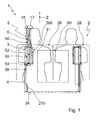
- FIG. 1 The figures of the drawing show in a simplified representation of a rollover protection system 1 of a convertible vehicle, of which two arranged in the rear vehicle seats 26, 28 are indicated in Fig. 1 schematically.
- Each of the vehicle seats 26, 28 is associated with a rollover protection device 2 and 3, which each have a body-fixed first module 4 and a moved between a lowered rest position and an elevated support position second module 5 with a rollover body 6, wherein the second module 5 at a displacement movement is performed on the first module 4.
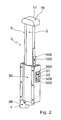
- the rollover body 6 is executed rod-like in all embodiments shown and has in its interior an axial receiving channel 8 for the spring energy storage 52.
- the spring energy accumulator 52 is shown in the figures partially only symbolically and can be carried out in a conventional manner as a helical compression spring.
- the rollover body 6 is in each case a straight rod body, although in other embodiments, where appropriate, a curvature can be provided in its upper region.
- the cross section of the rollover body 6 is in each case substantially round, wherein the inner cross-sectional contour in the embodiment according to FIG. 1 and FIG. 2 is circular and in the embodiment according to FIG. 8 is oval.
- the receiving channel for the spring energy storage in the rollover body 6 could extend only over a shorter longitudinal portion of the rollover body and the spring force accumulator be supported on a foot portion 34 of the vehicle-fixed first module 4, as for example in the embodiment shown in Fig. 8 the case is. It can thus be provided in the embodiment of FIG. 1 at a desired additional support of the spring pressure accumulator whose extension up to the foot portion 34 of the first module 4, wherein the spring pressure accumulator may optionally be arranged around a guide rod or on a rod.
- the tube profile 30 serving as guide means of the rollover body 6 is arranged with its lower edge spaced from the base element 34 of the first module 4, wherein the tube profile 30 in rest position of the rollover body 6, which in FIG. 1 is shown with reference to the rollover protection device 2 shown on the right, encompasses an upper end region of the rollover body 6 and receives the lower end region of the rollover body 6 in the supporting position of the rollover body 6, which is shown on the left in FIG. 1 on the basis of the rollover protection device 3.
- connection of the tubular profile 30 with the foot member 34 of the body-mounted module 4 takes place in the embodiments shown in each case via a connecting profile 38, which on the side facing the vehicle side of the pipe profile 30 in a correspondingly shaped profile section 30 is inserted and screwed hereby.
- the connecting profile 38 is designed like the other profiles of the rollover protection system 1 as an extruded profile, wherein in the present case for the connection profile 38, a U-section is selected.
- any other profile shape of an open or closed profile for the connection profile can be chosen according to the present application, wherein the choice of geometry with regard to a slender construction of the rollover protection device 2 or 3 is to be made.
- the through-opening 60 is shown only schematically and can be adapted in terms of their size and geometry to the prevailing conditions.
- the rollover protection devices 2, 3 are each connected to a non-illustrated, executed in a conventional manner crash sensors of the vehicle, whereby the holding device 210, 310 or 410 is driven by means of the rollover body 6 against the force of the spring force memory 52 is kept at rest.
- the respective holding device 210, 310, 410 releases the rollover body 6, so that the rollover body 6 is displaced by the force of the spring force accumulator 52 in its extended upper support position in which he by the locking device 500 and 600 against a re-entry is saved.
- a baffle profile 16 with an opposite of the cross-sectional area of the rollover body 6 enlarged baffle 17.
- This impact profile which prevents a boring of the bar-like rollover body in the respective given surface in a vehicle rollover, is present, as shown in particular in Fig. 8a, as a hollow profile with a plurality of cavities formed on its surface facing away from the body floor or baffle a Curvature has.
- On the sides of the impact profile 19 is closed with panels 20.
- FIGS. 4, 5, and 6 show, on an enlarged scale, the holding device used in the embodiment according to FIG 210 for holding the rollover body 6 of the rollover protection device. 3
- the holding device 210 comprises a locking element 214, which is mounted so as to be pivotable about a fixed axis of rotation 212 and has a pawl section 216 at its circumference, which is designed as a U-recess in the embodiment shown and for interacting with a locking element counter-body 218 is designed on the rollover body 6.
- the locking element counter body 218 is formed in the embodiment shown in a simple manner as the bolt, which also serves as a height stop for the rollover body 6.
- the dimensioning and shaping of the bolt 218 and the U-recess of the pawl portion 216 is coordinated so that the bolt 218 can easily slide out of the pawl portion 216 upon rotation of the locking member 214 about its axis of rotation 212.
- a retaining tab below a recess on the rollover body a shoulder on the rollover body or a suitable hook element may be provided as a locking element counter twill.
- the locking element 214 is secured by a locking member 222, which cooperates with an actuator 224, against a holding device 210 releasing rotation.
- the locking member 222 is presently designed as a on a cylindrical, by the actuator 224 axially movable piston fixed, flat, tongue-like sheet metal element.
- the locking member 222 engages in a peripheral recess 228 of the disc-like locking element 214, whereby the recess 228 forms a locking catch, which present in the rest position of the rollover body 6 coaxial with a longitudinal axis of the locking member 222 and the direction of action of the actuator 224, which corresponds to the direction of movement of the rollover body 6, is aligned and extending in the direction of an axis of rotation 212 of the locking element 214 forming, eccentrically arranged bolt 230 substantially perpendicular to the orientation of the U-shaped recess of the pawl portion 216.
- the actuator 224 is actuated by an associated control unit in an accident situation detected by a safety sensor of the convertible vehicle, the actuator 224 experiencing a change in state in the event of a crash, which translates the blocking member 222 in a direction opposite to the force of a compression spring 232 in the direction of the actuator 224 results.
- the blocking member 222 is pulled out by this translational movement in the direction of the actuator 224 from the peripheral recess 228 on the disc-like locking element 214 to a predefined, for example as a stop point, which this in consequence of the force exerted on the pin 218 of the rollover body 6 traction Performs rotational movement.
- a stop 234 is formed on the circumference of the disk-like locking element 214, on which the locking member 222 retracted when the holding device is released from the recess 228 comes into abutment upon rotation of the locking element 214 bringing the catch portion 216 out of engagement with the bolt 218.
- a pivoting of the locking element 214 about the rotation axis 212 by about 30 ° to trigger the holding device 210 is sufficient. Consequently, the circumferential contour of the locking element 214 in a range of approximately 30 ° in a region subsequent to the circumferential recess 228 counter to the release direction of rotation of the locking element 214 is radially retracted to the peripheral stop 234rd
- the stop 234 which holds the disc-like locking element 214 in cooperation with the locking member 222 in position after triggering the holding device 210, facilitates easy reversal of the rollover protection system in the event of a false triggering.
- the reversing takes place in a simple manner by a rotation of the locking element 214 in a blocking sense, until the pawl portion 216 again comes into engagement with the pin 218 of the rolled back into its rest position rollover body 6.
- the peripheral recess 228 is aligned with the locking member 222 which engages under the pressure of the compression spring 232 in the circumferential recess 228 and secures the locking member 214 against rotation.
- the locking element 214 is a two-stage disk, in which the arrangement and dimensioning of the recess 228 and the stopper 234 are to be selected depending on the arrangement and design of the actuator 224 and the locking member 222.
- the stop for the locking member 222 is formed on the locking element as a projection on the peripheral contour of the locking element, wherein the stop as a separate, to the locking element fixed component can be executed.
- the intended rotation angle of the locking element between the locked and unlocked position and the configuration of the actuator which may be, for example, a pin instead of the flat sheet metal element shown, the respective application selected accordingly.
- an abutment 236 is provided in the form of a bolt which serves to receive forces which in the released state of the holding means 210 on the part of the locking member 214 and the stop 234 on the locking member 222nd be exerted laterally. With the help of the abutment 236 tilting of the locking member 222 in the released state of the holding device 210 can be avoided even with a very long version of the locking member 222.
- the abutment 236, like the pivot axis 212 forming the bolt 230 is mounted on a housing element representing a base body 238 of the holding device 210, wherein the main body 238 opposite sides 240, 242, between which the bolt 230 and the abutment 236 are mounted.
- the base body 238, of which only one side 240 is shown in FIG. 6, is formed in a particularly simple manner substantially as a U-profile, which is, for. B. may be a converted flat ribbon.
- the base body 238 has in this case at its upper end in the installed state, ie at the free ends of the sides 240, 242, respectively, a ramp-like guide 246 for secure feeding of the Rolling body 6 and its retaining tab 218 in the engagement region with the pawl portion 216 of the locking element 214 on.
- a cross member 244 which is used in the present case as the seat of the actuator 224.
- the basic body 238 shown thus forms a kind of system cage, which advantageously fulfills the tasks of a housing which is often quite elaborate in the case of known designs with a considerably simpler design.
- the actuator 224 is formed in the embodiment of Fig. 4, Fig. 5, and Fig. 6 as an electromagnetic actuator of conventional design, but are also working according to another operating principle actuators, such.
- piezoelectric actuators pyrotechnic actuators or equipped with a fuse insert actuators, for use in the holding device 210th
- the rollover body 6 is automatically locked by the locking device 500 or 600, the locking device 500 according to the embodiment shown in FIGS. 1 to 3 and 7 having at least one first latching device 505 which is formed with a U-shaped pawl 508.
- the pawl 508, which is shown in Fig. 7 alone, has in the region of its U-traverse a tooth profile 507 with tapered teeth, whose geometry is chosen so that this in supporting position of the rollover body 6 in a locking bar 509 a second engage on the rollover body 6 formed locking device 506.
- the pawl 508 is supported on the tube profile 30 by being inserted into a circumferential recess 31 on the tube profile 30, which has the circumferential contour of the pawl 508 substantially.
- the pawl 508 is held in the axial direction of movement Z of the rollover body 6 form-fitting manner on the tube profile 30.
- the pawl 508 is spring-mounted by means of a leaf spring 510.
- the leaf spring 510 is initially arranged in the longitudinal direction of the pawl 508 in the mounting position shown here. With this position of the leaf spring 510, the pawl 508 can be inserted into the recess 31, for example made by milling, on the tube profile 30. By rotating the leaf spring 510 by 90 ° in its functional position, this is introduced with its axial ends in formed on the tube profile 30 receiving slots 33, whereby the pawl 508 by means of the leaf spring 510 is spring-mounted relative to the tube profile 30.
- FIG. 8 shows a variant embodiment of the rollover protection device 3, which with an identical embodiment of the corresponding rollover protection device 2 is part of an assembly shown in FIGS. 20 to 22, but also suitable for the assembly shown in FIG. 1 is. Details of the rollover protection device 3 of Fig. 8 are shown more clearly in the exploded view of Fig. 8a.
- the embodiment of the rollover protection device 2 or 3 according to FIG. 8 differs from the embodiment according to FIGS. 1 to 7 essentially by an alternative holding device 310 for the rollover body 6 and an alternative locking device 600 for supporting the rollover body 6 in its extended position and a modified drive system 50.
- the rollover body 6, which here has a substantially oval cross-sectional shape basically corresponds to the embodiment according to FIGS. 1 to 7.
- the spring energy accumulator 52 is designed here as a tension spring, which is guided in the receiving channel 8 of the rollover body 6 on a spring guide rod 53.
- a spring suspension 55 is formed at its upper end and a spring plate 56 is slidably mounted on a central region, wherein the tension spring 52 between the spring suspension 55 and abutting against a stop of the rollover body 6 spring plate 56 in the rest position of the rollover body 6 Train is biased.
- FIGS. 9 to 12 show in a simplified representation in each case the holding device 310 equipped with a melting insert 348 for holding the rollover body 6 of the rollover protection device 3.
- the holding device 310 comprises a locking element 314 pivotally mounted about a fixed axis of rotation 312, which has a pawl section 316 on its circumference, which in turn is formed as a U-recess in the embodiments shown and designed to interact with a locking element counter-body 318 on the rollover body 6 is.
- the locking element counter body could also here in a simple manner as a retaining tab below a recess on the rollover body 6 or as a bolt, a shoulder on the rollover body, or a suitable hook element may be formed.
- the locking element counter body 318 is designed as a shoulder in the region of a recess 320 which is open towards the lower edge of the rollover body 6 on the rollover body 6, the recess 320, the shoulder 318 and the pawl section 316 of the locking element 314 are designed here so matched to one another that the locking member 314 can be easily brought out of engagement with the pawl portion 316 in a rotation about its axis of rotation 312.
- the rollover body 6 is held in its lowered rest position by the engagement of the locking element 314 with the locking element counter body 318, and can be triggered by actuation of an actuator 324 by the actuator 324 at least partially rotation of the locking element 314 allows, so this out of engagement with the locking element counter body 318 device.
- the locking element 314 is held in its resting position locking the rollover body 6 by a melt insert 348 of the actuator 324 which can be melted in the event of a crash, wherein the locking element 314 is loaded radially and in tension in the rest position via the fuse link 348 is connected to a main body 338.
- the locking element 314 is formed in this embodiment lever-like manner as a kind of pivot lever.
- a lever end 315 a latch portion 316 for engagement with the locking element counter body 318 and the other end of the lever 317 a holder 360 for the connected to a power supply device 366 fuse link 348 on.
- the main body 338 is a block element with a substantially L-shaped cross section, wherein an L-leg 339 has a holder 361 for the fuse insert 348 with a Energyzu slaughter Republic Republic Korea Republic of China, and the other L-leg 341 has a bearing 374 of the pivotable locking member 314 with its bearing pin 330 carries.
- the bearing 374 constitutes a bearing plate screwed in a manner secured against rotation with the L-leg 341 of the base body 338, which is screwed on one side of the base body 338 and is curved S-shaped against the bearing of the bolt 330 of the locking element 314, so that the Locking element 314, the bearing plate 374 and the bearing pin 330 in the axial direction of the bearing pin 330 have an extension which substantially corresponds to the depth of this assembly axially overlapping body 338.
- the holding device 310 advantageously has a very small overall depth.
- the locking element 314 is aligned with a side wall 302 of the rollover body 2, which is designed essentially as a box profile and represents a cassette, and engages laterally in a recess 320 of the z. B. biased by spring force rollover body 2, wherein the locking element 314 engages behind a formed on the contour of the recess 320, nose-like shoulder 318 which forms the locking element counter body.
- the person skilled in the art can also choose an arrangement of the holding device 310 on a narrow side 303 of the rollover body 6 or an engagement in a recess with a holding lug.
- the brackets 360, 361 for the fuse link 348 are also formed here as grooves into which the present plate-shaped fuse link 348 is firmly locked inserted.
- the fuse link 348 may have a cross-sectional constriction for locking a shape adapted to the grooves holding it and for faster fusing in its middle region.
- the energy supply device 367 for generating the heat necessary for melting the fuse link 348 is expediently embodied by means of terminals 365, 367 connected to a current source and attached to the ends of the fuse link 348.
- the material of the fuse element can represent any material known for fuses made of metal and / or plastic.
- the locking element 314 is at least partially formed so flexible that the downward moving rollover body 6 when sliding along the slope 319 with the shoulder 318 deflects the locking element 314 in the direction of the apparent in Fig. 11 arrow 375 or bends away until the pawl portion 316 engages in the recess 320 of the rollover body 6 and holds it.
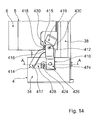
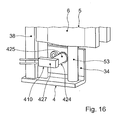
- FIGS. 13 to 16 show a simplified representation of a further embodiment of a holding device 410 for holding the rollover body 6, which with respect to the locking element corresponds to the embodiment shown in FIGS. 9 to 12, but can be driven pyrotechnically and, alternatively, to the can be used in the holding device 310 shown in FIGS. 9 to 12.
- the holding device 410 also comprises a locking element 414 which is mounted pivotably about a fixed axis of rotation 412 and which, like the locking element 314 of the holding device 310 shown in FIGS. 9 to 12, is formed on its circumference with a catch portion 416 and which cooperates with a locking element counter body 418 on the rollover body 6.
- the locking element counter body 418 is formed in this embodiment as a paragraph in the region of a lower edge of the rollover body 6 below an open recess 420 on the rollover body 6.
- the locking element 414 For triggering the rollover body 6, the locking element 414 must be transferred from a rest position shown in FIG. 13, in which the locking element 414 is in engagement with the locking element counter body 418, into a pivoted position shown in FIGS. 14 and 15, in which the locking element 414 releases the rollover body 6.
- the locking member 414 is formed in the manner of a pivoting lever, wherein a lever end 415 the latch portion 416 for engagement with the locking element counter-body representing paragraph 418 of the rollover body 6 and the other end of the lever 417 abuts a stop member 428, which is an abutment for the side the rollover body 6 forms force on the locking element 414 and prevents rotation of the locking element 414.
- a bearing plate 474 screwed to the foot element 34 of the rollover protection device is provided, which rests on one side of the foot element 34 and is guided by a tab 440 therein and at its other end a bearing pin 430 carries for the pivotable locking element 414.
- the bearing plate 474 is curved S-shaped against the bearing of the bolt 430, whereby the locking element 414, the bearing plate 474 and the bearing pin 430 in the axial direction of the bearing pin 430 have an overlap and thus require only a small overall depth.
- the actuator 424 which causes a pivoting of the locking element 414, in this case has a pyrotechnic propellant 425.
- the pyrotechnic propellant 425 is in the embodiment shown on the stop element 428th and the bearing plate 474 opposite side of the foot member 34 is arranged such that its effective direction is substantially perpendicular to the pivoting direction of the locking element 414.
- the pyrotechnic propellant charge 425 drives a bolt 426 extending through the base element 34, which is arranged in such a way that, when the locking element 414 is at rest, it bears against the latter.
- the bolt 426 is moved by the pyrotechnic propellant 425 so far in the direction of the lower end of the lever 417 of the locking member 414, that the locking member 414 with its lower end 417 on the stop element 428 is lifted. Due to the force applied to the rollover body 6 in the extension direction, the locking element 414 is then pivoted, wherein it slides on a wedge surface 429 of the stop element 428 in the direction of the foot element 34.
- the reversing of the holding device 410 for holding the rollover body 6 displaced back again in its rest position can take place in that when the bolt 426 of the pyrotechnic propellant charge 425 is displaced backward, the locking element 414 is pivoted backwards, the rollover body 6 moving towards its rest position at the upper edge of the upper end of the lever 415 of the locking member 414 formed in the axial direction of the bearing pin 430 extending slope 419 of the locking member 414 strikes.
- a certain flexibility of the locking element 414 allows for a sliding of the rollover body 6 along the slope 419 with the shoulder 418, a deflection of the locking member 414 in the axial direction its bearing pin 430 until the pawl portion 416 engages in the recess 420 of the rollover body 6.
- FIGS. 17 to 19 show in more detail the locking device 600 used in the embodiment of the rollover protection device according to FIG. 8 for the automatic locking of the extended rollover body 6 in its supporting position.
- the locking device 600 has at least one first latching device 605 fixedly connected to the first module 4, which can be brought into operative connection with a second latching device 606 fixedly connected to the second module 5 for supporting the second module 5 and which has one movement of the second module 5, starting from its rest position in the direction of its supporting position.
- the first latching device 605 of the locking device 600 comprises two blocking bodies 608A, 608B, which can be acted upon by a force in the direction of their operative position and are mounted rotatably in the body-mounted manner and each with a toothed profile 607.
- Each locking body 608A, 608B is associated with a respective spring device 609, 610 via which the locking bodies 608A, 608B are respectively sprung in the direction of the operative position of the first locking device 605 in such a manner that the locking bodies 608A, 608B around bearing pins from the position shown in FIG each pivoted in a direction of rotation represented by an arrow X in Fig. 17.
- the bearing bolts 611 are supported on the module 4 which is fixed to the body, wherein the locking bodies 608 A and 608 B act via the spring devices 609 and 610 in the form of brace wire springs in the manner shown in greater detail in FIGS. 17 and 18 and manner fixed in the axial extension of the bearing pin 611 and thus are clearly positioned.
- the spring devices 609 and 610 engage around the bearing bolts 611 on both sides of the disk-like locking bodies 608A and 608B.
- the spring means 609 and 610 are biased in the wrap region of the bearing pins 611 in the installation position to adjust the frictional force between the spring means 609 and 610 and the bearing pin 611 to such a value that the locking bodies 608A and 608B are not slidable on the bearing pin 611.
- the second latching device 606 is provided by a respective surface 606B of the second module 5 which can be moved to a blocking body 608A or 608B and which can be moved relative to the respectively corresponding blocking body 608A or 608B. or rollover body 6 is formed, with each of which the tooth profile 607 of a locking body 608A or 608B in operative position of the first latching device 605 is in frictional engagement such that a movement of the second module 5 is prevented from a position deviating from the rest position in the direction of its rest position.
- the spring devices 609 and 610 respectively associated with the blocking bodies 608A and 608B are each formed with blocking devices 609A, 610A, wherein the blocking bodies can be held in a position equivalent to a deactivated state of the first locking device 605 when the blocking device 610A is activated.
- the stirrup wire springs 609 and 610 are each provided with a first stirrup area 610B which, in order to activate the stoppers 610A, can be brought into engagement with a second stirrup area 610C in the manner illustrated in FIG. 18 such that the blocking bodies 608A and 6 ⁇ 8B in the the inactivated state of the first latching device 605 equivalent position in which a relative movement between the first module 4 and the second module 5 is not prevented by the locking device 600, are held.
- the stirrup wire springs 609 and 610 are each provided with a first leg 610D, which is substantially U-shaped, inserted into slot-like recesses 612 of the locking bodies 608A and 608B and abut with their second leg 610E on the module-fixed module 4 in such a way that the Spring means 609 and 610 are in a biasing position. Due to this bias, the blocking bodies 608A and 608B can be pivoted about the bearing pins 611 in the deactivated state of the locking devices 609A, 610A in their positions corresponding to the locking state of the first latching device 605.
- the first stirrup portions 610B of the stirrup wire springs each face the central portion, i. H. the U-traverse, the stirrup wire springs, which is inserted into the slot-like recess 612 of the locking body, subsequent areas in which the first leg 610D of the stirrup wire springs is designed with a larger width than the second stirrup areas 610C at congruent areas of the second, with two open straps trained thigh 610E.
- the legs 610D and 610E of the spring devices 609 and 610 thus form the locking devices 610A in such a way that, when the locking devices 610A are activated, they intersect in the region of the hoop areas 610B and 610C, hold each other and can not spread apart due to the internal prestressing, as shown in FIG Fig. 18 can be seen.
- the bow wire springs 609 and 610 are designed in the region of their free ends with the bow ends 610E_1 and 610E_2 which are designed to be displaceable relative to one another in the manner illustrated in more detail in FIG. That is, the locking means 610A are each deactivatable or activatable by increasing the distance of the stirrup wire ends of the spring means 609 and 610 such that the leg arms of the spring means 609 and 610 can be brought past each other in the region of the stirrup portions 610B and 610C.
- the locking bodies 608A and 608B are then either held in the non-locking position by the locking device 610A according to FIG. 18 and FIG. 19 or released for setting the operative position of the first locking device 605 according to the position shown in FIG.
- the locking body 608B When the locking means 610A of the spring means 610 associated with the locking body 608B in FIG. 17 is deactivated, the locking body 608B is pivoted about the bearing bolt 611 by the spring means 610 into a position corresponding to the operative state of the first locking means 605. Although in this position of the blocking body 608B an extension movement of the second module 5 in the direction of its supporting position by the first latching device 605 is permitted, however, a movement of the second module 5 in the direction of its rest position by an operative connection between the tooth profile 607 of the locking body 608B and the second Locking device 606 effectively prevented.
- the biasing force of the spring means 609 and 610 in the direction of the operative positions of the locking bodies 608A and 608B is presently provided such that engagement of the locking bodies 608A and 608B on the presently formed as a surface of the rollover body 6 locking means 606 does not hinder an extension movement.
- the locking elements 608A and 608B that represent the tooth-cam pivot about the bearing pin 611A counter to the direction of rotation X and thus do not build up a locking action between the two latching devices 605 and 606.
- the blocking body 608B When the blocking body 608B is pivoted into its operative position, the blocking body 608B, with its tooth profile 607 facing the latching surface 606B, at least partially penetrates into the latching surface 606B of the latching device 606, whereby there is a positive connection between the blocking body 608B and the rollover body 6 and the rollover body 6 is secure is held against a retraction in the direction of its rest position.
- the tooth geometry of the tooth profile 607 is made with pointed, knife-like teeth and the material for the tooth profile 607 against the material of the surface of the rollover body 6 harder to ensure a reliable locking of the rollover body 6.
- the rollover body 6 is formed on the underside of its impact profile 16 with wedge surfaces 18, in this case designed truncated pyramid unlocking elements 19, by means of which the locking bodies 608A, 608B are brought into the rest position in engagement with the second locking device 606 after a retraction of the rollover body.
- the blocking bodies 608A, 608B are withdrawn, with the widened bow portions 610B of the spring means 609 and 610 catching behind the free bow portions 610C and thus canceling out the effect of the bow wire springs 609, 610.
- the rollover body 6 can thus be lowered to its starting position.
- the free spring ends 610E_1, 610E_2 are pressed apart via the aforementioned unlocking elements 19 of the rollover body 6, so that the spring devices 609 and 610 bring the tooth cam or locking body 608A, 608B back against the latching surface 606B of the rollover body 6 ,
- the latching surfaces 606B in the present case are formed with a knurling or with a profile that increases the coefficient of friction of the latching surfaces.
- the locking bodies are each mounted on the body-first module, but also a reverse arrangement may be provided with a storage on the extendable module and a frictional engagement on a body-mounted surface.
- FIGS. 20 to 22 show a variant embodiment of the rollover protection system 1, in which not only the body-mounted and extendable modules 4, 5 of the rollover protection devices 2, 3 together with the holding device 210 or 310 or 410, the locking device 500 or 600 and the drive system 50 form a preassembled outside the vehicle preassembled assembly, but in which a row of seats associated rollover protection devices 2, 3 total form a pre-assembled, fixable to the vehicle body assembly.
- the body-mounted modules 4 of the rollover protection devices 2, 3 are connected to each other by means of a cross member 40.
- the ends of the cross member 40 in the present embodiment are each formed with an undercut 41 having profile 42, which corresponds in terms of its shape with a profile 44 of the pipe section 30 of the body-first module 4.
- the cross member 40 thus forms a preassemblable unit of the rollover protection devices 2, 3, which can be screwed via lateral holes 48 with the vehicle body.
- the vehicle-mounted first module 4 of the respective rollover protection device 2, 3 is in each case formed with an integrated restraining belt system 100, with a belt retractor 110 of a known type in the middle height of the tubular profile 30 a profile region 35 of the vehicle-fixed pipe profile 30, which is disposed in front of the rollover body 6 in the vehicle front-end direction, is inserted. From this belt retractor 110, the safety belt 112 is guided in the profiled area 35, which is designed as a hollow profile, to an upper safety belt guide or deflection 114. From there, the safety belt 112 extends in the vehicle forward direction in the manner shown in FIGS. 21 and 22 via a backrest of a vehicle seat upstream of the profile region 35 of the rollover protection device 2 or 3 and can be fitted with a seatbelt buckle in the usual way be connected to a vehicle occupant.
- the illustrated restraint belt system 100 includes two upper anchoring points 120, 122 for a child seat belt, each one of the upper anchoring points 120, 122 being associated with a rollover protection device 2, 3, respectively.
- the upper anchoring point 120, 122 is in each case fastened to a profile wall 36, remote from the vehicle interior, of the first module 4, fixed to the body, or of the tubular profile 30, and has a tab 124, through which a belt fastened to a child seat can be pulled or hooked therein.
- the upper anchoring point 120 or 122 for a child seat which usually at two attachment points is fixed in the seat area, a third attachment point.
- the rollover protection devices 2, 3 each have a seat attachment device 150, which in the present case is each formed with an upper and a lower rear seat back fastening bolt 152 or 154.
- the rollover protection system 1 can thus represent a multifunction module, which can connect the functionalities of a rollover protection device, a through-loading, a vehicle transverse reinforcement, a retaining belt and a seat attachment, the entire multifunction module in its proposed compact design completed separately outside the vehicle and in a vehicle for Final assembly can be used.
- the multifunction module is part of a convertible top of a convertible vehicle or that a convertible top linkage is connected to the component group having the rollover protection devices.
Landscapes
- Engineering & Computer Science (AREA)
- Mechanical Engineering (AREA)
- Seats For Vehicles (AREA)
- Current-Collector Devices For Electrically Propelled Vehicles (AREA)
- Protection Of Generators And Motors (AREA)
Applications Claiming Priority (1)
| Application Number | Priority Date | Filing Date | Title |
|---|---|---|---|
| DE102005029253A DE102005029253B4 (de) | 2005-06-23 | 2005-06-23 | Cabriolet mit einem Überrollschutzsystem |
Publications (2)
| Publication Number | Publication Date |
|---|---|
| EP1736373A1 true EP1736373A1 (fr) | 2006-12-27 |
| EP1736373B1 EP1736373B1 (fr) | 2009-05-27 |
Family
ID=36942240
Family Applications (1)
| Application Number | Title | Priority Date | Filing Date |
|---|---|---|---|
| EP06012844A Not-in-force EP1736373B1 (fr) | 2005-06-23 | 2006-06-21 | Système de protection pour le capotage d'un véhicule automobile |
Country Status (4)
| Country | Link |
|---|---|
| US (1) | US7686335B2 (fr) |
| EP (1) | EP1736373B1 (fr) |
| AT (1) | ATE432199T1 (fr) |
| DE (2) | DE102005029253B4 (fr) |
Cited By (1)
| Publication number | Priority date | Publication date | Assignee | Title |
|---|---|---|---|---|
| DE102009030408A1 (de) | 2009-06-25 | 2010-12-30 | Bayerische Motoren Werke Aktiengesellschaft | Überrollschutzsystem |
Families Citing this family (10)
| Publication number | Priority date | Publication date | Assignee | Title |
|---|---|---|---|---|
| DE102005028929B4 (de) * | 2005-06-22 | 2009-04-09 | Wilhelm Karmann Gmbh | Bauteilgruppe für ein Cabriolet-Kraftfahrzeug |
| DE102006000909B4 (de) * | 2005-06-22 | 2009-06-25 | Wilhelm Karmann Gmbh | Überrollschutzsystem für ein Cabriolet-Fahrzeug mit gekrümmtem Überrollkörper |
| DE102007046536A1 (de) | 2007-09-28 | 2009-04-02 | Dr. Ing. H.C. F. Porsche Aktiengesellschaft | Überrollschutzeinrichtung |
| DE102007046535A1 (de) * | 2007-09-28 | 2009-04-02 | Dr. Ing. H.C. F. Porsche Aktiengesellschaft | Kraftfahrzeug, insbesondere Cabriolet, mit einer hinter den Sitzen angeordneten Überrollschutzvorrichtung |
| US8955880B2 (en) * | 2013-03-11 | 2015-02-17 | Oshkosh Corporation | Carrier adjustable headboard |
| DE102015105091A1 (de) | 2015-04-01 | 2016-10-06 | Dr. Ing. H.C. F. Porsche Aktiengesellschaft | Überrollschutzsystem für ein Kraftfahrzeug |
| CN109071193B (zh) | 2016-04-08 | 2020-07-17 | 奥斯克什公司 | 用于起重装置的调平系统 |
| DE102016111355A1 (de) * | 2016-06-21 | 2017-12-21 | Dr. Ing. H.C. F. Porsche Aktiengesellschaft | Überrollschutzeinrichtung |
| DE102016111352A1 (de) * | 2016-06-21 | 2017-12-21 | Dr. Ing. H.C. F. Porsche Aktiengesellschaft | Überrollschutzeinrichtung |
| EP3470307B1 (fr) * | 2017-10-10 | 2021-01-13 | Outokumpu Oyj | Cellule de sécurité partagée pour voitures de passagers |
Citations (6)
| Publication number | Priority date | Publication date | Assignee | Title |
|---|---|---|---|---|
| DE19501584A1 (de) * | 1995-01-20 | 1996-07-25 | Porsche Ag | Kraftfahrzeug, insbesondere Cabriolet |
| DE19838989C1 (de) * | 1998-08-27 | 1999-11-11 | Ise Gmbh | Überroll-Schutzvorrichtung |
| DE10160715A1 (de) * | 2001-12-11 | 2003-06-26 | Webasto Vehicle Sys Int Gmbh | Fahrzeug mit einer Sicherheitseinrichtung für die Fahrgastzelle |
| DE10261897A1 (de) * | 2002-12-23 | 2004-07-15 | Volkswagen Ag | Überrollschutzsystem für ein Kraftfahrzeug |
| DE10357053A1 (de) * | 2003-12-04 | 2005-02-10 | Cts Fahrzeug-Dachsysteme Gmbh | Personenkraftwagen mit offenem Aufbau |
| EP1623882A2 (fr) * | 2004-08-03 | 2006-02-08 | ISE Innomotive Systems Europe GmbH | Dispositif de protection des occupants pour un véhicule automobile |
Family Cites Families (11)
| Publication number | Priority date | Publication date | Assignee | Title |
|---|---|---|---|---|
| DE3925515C1 (fr) * | 1989-08-02 | 1991-01-31 | Bayerische Motoren Werke Ag, 8000 Muenchen, De | |
| DE3927265C3 (de) * | 1989-08-18 | 2003-03-27 | Ise Gmbh | Insassenschutzeinrichtung für Kraftfahrzeuge mit einem Überrollbügel |
| DE4108189C1 (fr) * | 1991-03-14 | 1992-10-01 | Mercedes-Benz Aktiengesellschaft, 7000 Stuttgart, De | |
| DE4314538C3 (de) * | 1993-05-03 | 2000-11-09 | Bayerische Motoren Werke Ag | Überrollschutz-Vorrichtung für ein Kraftfahrzeug |
| JPH07164985A (ja) * | 1993-12-17 | 1995-06-27 | Mitsubishi Motors Corp | アクティブロールバー装置 |
| DE19501522A1 (de) * | 1994-01-29 | 1995-08-03 | Volkswagen Ag | Überrollschutzvorrichtung für eine Cabriolet |
| DE19540819C2 (de) * | 1995-11-02 | 2001-08-02 | Ise Gmbh | Cabriolet mit versenkbarem Überrollbügel |
| DE19712955B4 (de) * | 1997-03-27 | 2011-03-10 | Bayerische Motoren Werke Aktiengesellschaft | Überrollschutzsystem für ein Fahrzeug, insbesondere für ein Cabriolet |
| DE19750457C2 (de) * | 1997-11-14 | 2000-08-10 | Ise Gmbh | Ausfahrbarer Überrollbügel für Kraftfahrzeuge |
| DE19943582A1 (de) * | 1999-09-13 | 2001-03-22 | Karmann Gmbh W | Bauteilgruppe für ein Cabriolet-Fahrzeug |
| DE10318076A1 (de) * | 2003-04-17 | 2004-11-18 | Cts Fahrzeug-Dachsysteme Gmbh | Unfallschutzsystem für Fahrzeuge mit offenem Aufbau |
-
2005
- 2005-06-23 DE DE102005029253A patent/DE102005029253B4/de not_active Expired - Fee Related
-
2006
- 2006-06-21 DE DE502006003795T patent/DE502006003795D1/de active Active
- 2006-06-21 AT AT06012844T patent/ATE432199T1/de active
- 2006-06-21 EP EP06012844A patent/EP1736373B1/fr not_active Not-in-force
- 2006-06-22 US US11/425,896 patent/US7686335B2/en not_active Expired - Fee Related
Patent Citations (6)
| Publication number | Priority date | Publication date | Assignee | Title |
|---|---|---|---|---|
| DE19501584A1 (de) * | 1995-01-20 | 1996-07-25 | Porsche Ag | Kraftfahrzeug, insbesondere Cabriolet |
| DE19838989C1 (de) * | 1998-08-27 | 1999-11-11 | Ise Gmbh | Überroll-Schutzvorrichtung |
| DE10160715A1 (de) * | 2001-12-11 | 2003-06-26 | Webasto Vehicle Sys Int Gmbh | Fahrzeug mit einer Sicherheitseinrichtung für die Fahrgastzelle |
| DE10261897A1 (de) * | 2002-12-23 | 2004-07-15 | Volkswagen Ag | Überrollschutzsystem für ein Kraftfahrzeug |
| DE10357053A1 (de) * | 2003-12-04 | 2005-02-10 | Cts Fahrzeug-Dachsysteme Gmbh | Personenkraftwagen mit offenem Aufbau |
| EP1623882A2 (fr) * | 2004-08-03 | 2006-02-08 | ISE Innomotive Systems Europe GmbH | Dispositif de protection des occupants pour un véhicule automobile |
Cited By (1)
| Publication number | Priority date | Publication date | Assignee | Title |
|---|---|---|---|---|
| DE102009030408A1 (de) | 2009-06-25 | 2010-12-30 | Bayerische Motoren Werke Aktiengesellschaft | Überrollschutzsystem |
Also Published As
| Publication number | Publication date |
|---|---|
| DE102005029253B4 (de) | 2009-04-02 |
| US20060290124A1 (en) | 2006-12-28 |
| DE502006003795D1 (de) | 2009-07-09 |
| ATE432199T1 (de) | 2009-06-15 |
| DE102005029253A1 (de) | 2006-12-28 |
| EP1736373B1 (fr) | 2009-05-27 |
| US7686335B2 (en) | 2010-03-30 |
Similar Documents
| Publication | Publication Date | Title |
|---|---|---|
| EP1736376B1 (fr) | Module pré assemblé pour un véhicule cabriolet | |
| WO2010106183A1 (fr) | Système d'enrouleur de ceinture de sécurité à enclencheur | |
| EP1736373B1 (fr) | Système de protection pour le capotage d'un véhicule automobile | |
| EP1620291B1 (fr) | Structure de protection pour vehicule automobile | |
| WO2005087536A1 (fr) | Appuie-tête doté d'un élément d'appui pour siège de véhicule | |
| EP1160135B1 (fr) | Système d'arceau de sécurité pour des véhicules automobiles | |
| DE19925520C1 (de) | Überroll-Schutzsystem für Kraftfahrzeuge | |
| EP1202871B1 (fr) | Dossier de siège de véhicule à dispositif de protection intégré | |
| EP1736371B1 (fr) | Véhicule avec système de protection en cas de retournement | |
| DE102006028664B4 (de) | Überrollschutzsystem für ein Kraftfahrzeug | |
| EP1955908B1 (fr) | Système de protection en cas de tonneaux pour véhicules automobiles comprenant un arceau orientable dirigé par capteur pouvant être placé activement | |
| EP1547873B1 (fr) | système d'arceau de sécurité pour véhicule avec arceau déployable | |
| DE102005028966B4 (de) | Kraftfahrzeug mit einem Überrollschutzsystem an einer Fahrzeugquerwand | |
| DE102005028879B4 (de) | Überrollschutzsystem für ein Kraftfahrzeug | |
| EP1736374B1 (fr) | Système d'arceau de sécurité pour un véhicule à moteur | |
| DE102006000909B4 (de) | Überrollschutzsystem für ein Cabriolet-Fahrzeug mit gekrümmtem Überrollkörper | |
| DE102006002476B4 (de) | Überrollschutzsystem für ein Kraftfahrzeug | |
| DE3804177A1 (de) | Sicherheitseinrichtung | |
| DE10103249C1 (de) | Überrollschutzsystem für Kraftfahrzeuge | |
| WO2005084998A1 (fr) | Siege de vehicule | |
| EP1582420B1 (fr) | Systéme de protection pour capotage avec un arceau deployable | |
| DE102006041261A1 (de) | Überrollschutzsystem für ein Cabriolet-Fahrzeug | |
| EP1514740B1 (fr) | Dispositif d'arceau de sécurité pour véhicules avec un arceau déployable | |
| DE10103245C1 (de) | Überrollschutzsystem für Kraftfahrzeuge | |
| DE102006013913B4 (de) | Schutzvorrichtung in Kraftfahrzeugen zum Personenschutz |
Legal Events
| Date | Code | Title | Description |
|---|---|---|---|
| PUAI | Public reference made under article 153(3) epc to a published international application that has entered the european phase |
Free format text: ORIGINAL CODE: 0009012 |
|
| AK | Designated contracting states |
Kind code of ref document: A1 Designated state(s): AT BE BG CH CY CZ DE DK EE ES FI FR GB GR HU IE IS IT LI LT LU LV MC NL PL PT RO SE SI SK TR |
|
| AX | Request for extension of the european patent |
Extension state: AL BA HR MK YU |
|
| 17P | Request for examination filed |
Effective date: 20070113 |
|
| 17Q | First examination report despatched |
Effective date: 20070220 |
|
| AKX | Designation fees paid |
Designated state(s): AT BE BG CH CY CZ DE DK EE ES FI FR GB GR HU IE IS IT LI LT LU LV MC NL PL PT RO SE SI SK TR |
|
| GRAP | Despatch of communication of intention to grant a patent |
Free format text: ORIGINAL CODE: EPIDOSNIGR1 |
|
| GRAS | Grant fee paid |
Free format text: ORIGINAL CODE: EPIDOSNIGR3 |
|
| GRAA | (expected) grant |
Free format text: ORIGINAL CODE: 0009210 |
|
| AK | Designated contracting states |
Kind code of ref document: B1 Designated state(s): AT BE BG CH CY CZ DE DK EE ES FI FR GB GR HU IE IS IT LI LT LU LV MC NL PL PT RO SE SI SK TR |
|
| REG | Reference to a national code |
Ref country code: GB Ref legal event code: FG4D Free format text: NOT ENGLISH |
|
| REG | Reference to a national code |
Ref country code: CH Ref legal event code: EP |
|
| REG | Reference to a national code |
Ref country code: IE Ref legal event code: FG4D Free format text: LANGUAGE OF EP DOCUMENT: GERMAN |
|
| REF | Corresponds to: |
Ref document number: 502006003795 Country of ref document: DE Date of ref document: 20090709 Kind code of ref document: P |
|
| PG25 | Lapsed in a contracting state [announced via postgrant information from national office to epo] |
Ref country code: FI Free format text: LAPSE BECAUSE OF FAILURE TO SUBMIT A TRANSLATION OF THE DESCRIPTION OR TO PAY THE FEE WITHIN THE PRESCRIBED TIME-LIMIT Effective date: 20090527 Ref country code: LT Free format text: LAPSE BECAUSE OF FAILURE TO SUBMIT A TRANSLATION OF THE DESCRIPTION OR TO PAY THE FEE WITHIN THE PRESCRIBED TIME-LIMIT Effective date: 20090527 Ref country code: PT Free format text: LAPSE BECAUSE OF FAILURE TO SUBMIT A TRANSLATION OF THE DESCRIPTION OR TO PAY THE FEE WITHIN THE PRESCRIBED TIME-LIMIT Effective date: 20090927 |
|
| NLV1 | Nl: lapsed or annulled due to failure to fulfill the requirements of art. 29p and 29m of the patents act | ||
| PG25 | Lapsed in a contracting state [announced via postgrant information from national office to epo] |
Ref country code: NL Free format text: LAPSE BECAUSE OF FAILURE TO SUBMIT A TRANSLATION OF THE DESCRIPTION OR TO PAY THE FEE WITHIN THE PRESCRIBED TIME-LIMIT Effective date: 20090527 Ref country code: LV Free format text: LAPSE BECAUSE OF FAILURE TO SUBMIT A TRANSLATION OF THE DESCRIPTION OR TO PAY THE FEE WITHIN THE PRESCRIBED TIME-LIMIT Effective date: 20090527 Ref country code: IS Free format text: LAPSE BECAUSE OF FAILURE TO SUBMIT A TRANSLATION OF THE DESCRIPTION OR TO PAY THE FEE WITHIN THE PRESCRIBED TIME-LIMIT Effective date: 20090927 Ref country code: PL Free format text: LAPSE BECAUSE OF FAILURE TO SUBMIT A TRANSLATION OF THE DESCRIPTION OR TO PAY THE FEE WITHIN THE PRESCRIBED TIME-LIMIT Effective date: 20090527 Ref country code: SI Free format text: LAPSE BECAUSE OF FAILURE TO SUBMIT A TRANSLATION OF THE DESCRIPTION OR TO PAY THE FEE WITHIN THE PRESCRIBED TIME-LIMIT Effective date: 20090527 Ref country code: SE Free format text: LAPSE BECAUSE OF FAILURE TO SUBMIT A TRANSLATION OF THE DESCRIPTION OR TO PAY THE FEE WITHIN THE PRESCRIBED TIME-LIMIT Effective date: 20090827 |
|
| BERE | Be: lapsed |
Owner name: WILHELM KARMANN G.M.B.H. Effective date: 20090630 |
|
| REG | Reference to a national code |
Ref country code: IE Ref legal event code: FD4D |
|
| PG25 | Lapsed in a contracting state [announced via postgrant information from national office to epo] |
Ref country code: MC Free format text: LAPSE BECAUSE OF NON-PAYMENT OF DUE FEES Effective date: 20090630 Ref country code: EE Free format text: LAPSE BECAUSE OF FAILURE TO SUBMIT A TRANSLATION OF THE DESCRIPTION OR TO PAY THE FEE WITHIN THE PRESCRIBED TIME-LIMIT Effective date: 20090527 Ref country code: ES Free format text: LAPSE BECAUSE OF FAILURE TO SUBMIT A TRANSLATION OF THE DESCRIPTION OR TO PAY THE FEE WITHIN THE PRESCRIBED TIME-LIMIT Effective date: 20090907 Ref country code: RO Free format text: LAPSE BECAUSE OF FAILURE TO SUBMIT A TRANSLATION OF THE DESCRIPTION OR TO PAY THE FEE WITHIN THE PRESCRIBED TIME-LIMIT Effective date: 20090527 Ref country code: IE Free format text: LAPSE BECAUSE OF FAILURE TO SUBMIT A TRANSLATION OF THE DESCRIPTION OR TO PAY THE FEE WITHIN THE PRESCRIBED TIME-LIMIT Effective date: 20090527 Ref country code: CZ Free format text: LAPSE BECAUSE OF FAILURE TO SUBMIT A TRANSLATION OF THE DESCRIPTION OR TO PAY THE FEE WITHIN THE PRESCRIBED TIME-LIMIT Effective date: 20090527 Ref country code: DK Free format text: LAPSE BECAUSE OF FAILURE TO SUBMIT A TRANSLATION OF THE DESCRIPTION OR TO PAY THE FEE WITHIN THE PRESCRIBED TIME-LIMIT Effective date: 20090527 |
|
| PG25 | Lapsed in a contracting state [announced via postgrant information from national office to epo] |
Ref country code: SK Free format text: LAPSE BECAUSE OF FAILURE TO SUBMIT A TRANSLATION OF THE DESCRIPTION OR TO PAY THE FEE WITHIN THE PRESCRIBED TIME-LIMIT Effective date: 20090527 |
|
| PG25 | Lapsed in a contracting state [announced via postgrant information from national office to epo] |
Ref country code: BG Free format text: LAPSE BECAUSE OF FAILURE TO SUBMIT A TRANSLATION OF THE DESCRIPTION OR TO PAY THE FEE WITHIN THE PRESCRIBED TIME-LIMIT Effective date: 20090827 |
|
| PLBE | No opposition filed within time limit |
Free format text: ORIGINAL CODE: 0009261 |
|
| STAA | Information on the status of an ep patent application or granted ep patent |
Free format text: STATUS: NO OPPOSITION FILED WITHIN TIME LIMIT |
|
| 26N | No opposition filed |
Effective date: 20100302 |
|
| PG25 | Lapsed in a contracting state [announced via postgrant information from national office to epo] |
Ref country code: BE Free format text: LAPSE BECAUSE OF NON-PAYMENT OF DUE FEES Effective date: 20090630 |
|
| PG25 | Lapsed in a contracting state [announced via postgrant information from national office to epo] |
Ref country code: GR Free format text: LAPSE BECAUSE OF FAILURE TO SUBMIT A TRANSLATION OF THE DESCRIPTION OR TO PAY THE FEE WITHIN THE PRESCRIBED TIME-LIMIT Effective date: 20090828 |
|
| REG | Reference to a national code |
Ref country code: CH Ref legal event code: PL |
|
| GBPC | Gb: european patent ceased through non-payment of renewal fee |
Effective date: 20100621 |
|
| PG25 | Lapsed in a contracting state [announced via postgrant information from national office to epo] |
Ref country code: IT Free format text: LAPSE BECAUSE OF FAILURE TO SUBMIT A TRANSLATION OF THE DESCRIPTION OR TO PAY THE FEE WITHIN THE PRESCRIBED TIME-LIMIT Effective date: 20090527 Ref country code: CH Free format text: LAPSE BECAUSE OF NON-PAYMENT OF DUE FEES Effective date: 20090630 Ref country code: LI Free format text: LAPSE BECAUSE OF NON-PAYMENT OF DUE FEES Effective date: 20090630 |
|
| PG25 | Lapsed in a contracting state [announced via postgrant information from national office to epo] |
Ref country code: CH Free format text: LAPSE BECAUSE OF NON-PAYMENT OF DUE FEES Effective date: 20100630 Ref country code: LI Free format text: LAPSE BECAUSE OF NON-PAYMENT OF DUE FEES Effective date: 20100630 Ref country code: LU Free format text: LAPSE BECAUSE OF NON-PAYMENT OF DUE FEES Effective date: 20090621 |
|
| PG25 | Lapsed in a contracting state [announced via postgrant information from national office to epo] |
Ref country code: HU Free format text: LAPSE BECAUSE OF FAILURE TO SUBMIT A TRANSLATION OF THE DESCRIPTION OR TO PAY THE FEE WITHIN THE PRESCRIBED TIME-LIMIT Effective date: 20091128 |
|
| PG25 | Lapsed in a contracting state [announced via postgrant information from national office to epo] |
Ref country code: GB Free format text: LAPSE BECAUSE OF NON-PAYMENT OF DUE FEES Effective date: 20100621 |
|
| PG25 | Lapsed in a contracting state [announced via postgrant information from national office to epo] |
Ref country code: TR Free format text: LAPSE BECAUSE OF FAILURE TO SUBMIT A TRANSLATION OF THE DESCRIPTION OR TO PAY THE FEE WITHIN THE PRESCRIBED TIME-LIMIT Effective date: 20090527 |
|
| PG25 | Lapsed in a contracting state [announced via postgrant information from national office to epo] |
Ref country code: CY Free format text: LAPSE BECAUSE OF FAILURE TO SUBMIT A TRANSLATION OF THE DESCRIPTION OR TO PAY THE FEE WITHIN THE PRESCRIBED TIME-LIMIT Effective date: 20090527 |
|
| REG | Reference to a national code |
Ref country code: AT Ref legal event code: PC Ref document number: 432199 Country of ref document: AT Kind code of ref document: T Owner name: VOLKSWAGEN AG, DE Effective date: 20120309 |
|
| REG | Reference to a national code |
Ref country code: FR Ref legal event code: TP Owner name: VOLKSWAGEN AG, DE Effective date: 20120504 |
|
| REG | Reference to a national code |
Ref country code: DE Ref legal event code: R082 Ref document number: 502006003795 Country of ref document: DE Representative=s name: , Ref country code: DE Ref legal event code: R082 Ref document number: 502006003795 Country of ref document: DE |
|
| REG | Reference to a national code |
Ref country code: DE Ref legal event code: R081 Ref document number: 502006003795 Country of ref document: DE Owner name: VOLKSWAGEN AG, DE Free format text: FORMER OWNER: WILHELM KARMANN GMBH, 49084 OSNABRUECK, DE Effective date: 20130312 |
|
| REG | Reference to a national code |
Ref country code: FR Ref legal event code: PLFP Year of fee payment: 11 |
|
| REG | Reference to a national code |
Ref country code: FR Ref legal event code: PLFP Year of fee payment: 12 |
|
| PGFP | Annual fee paid to national office [announced via postgrant information from national office to epo] |
Ref country code: FR Payment date: 20170630 Year of fee payment: 12 |
|
| PGFP | Annual fee paid to national office [announced via postgrant information from national office to epo] |
Ref country code: AT Payment date: 20170627 Year of fee payment: 12 |
|
| REG | Reference to a national code |
Ref country code: AT Ref legal event code: MM01 Ref document number: 432199 Country of ref document: AT Kind code of ref document: T Effective date: 20180621 |
|
| PG25 | Lapsed in a contracting state [announced via postgrant information from national office to epo] |
Ref country code: FR Free format text: LAPSE BECAUSE OF NON-PAYMENT OF DUE FEES Effective date: 20180630 Ref country code: AT Free format text: LAPSE BECAUSE OF NON-PAYMENT OF DUE FEES Effective date: 20180621 |
|
| PGFP | Annual fee paid to national office [announced via postgrant information from national office to epo] |
Ref country code: DE Payment date: 20200630 Year of fee payment: 15 |
|
| REG | Reference to a national code |
Ref country code: DE Ref legal event code: R119 Ref document number: 502006003795 Country of ref document: DE |
|
| PG25 | Lapsed in a contracting state [announced via postgrant information from national office to epo] |
Ref country code: DE Free format text: LAPSE BECAUSE OF NON-PAYMENT OF DUE FEES Effective date: 20220101 |