EP1736768A1 - Procédé et appareil pour la détection de gaz - Google Patents
Procédé et appareil pour la détection de gaz Download PDFInfo
- Publication number
- EP1736768A1 EP1736768A1 EP05013417A EP05013417A EP1736768A1 EP 1736768 A1 EP1736768 A1 EP 1736768A1 EP 05013417 A EP05013417 A EP 05013417A EP 05013417 A EP05013417 A EP 05013417A EP 1736768 A1 EP1736768 A1 EP 1736768A1
- Authority
- EP
- European Patent Office
- Prior art keywords
- sensing device
- gas
- heat transfer
- temperature
- field
- Prior art date
- Legal status (The legal status is an assumption and is not a legal conclusion. Google has not performed a legal analysis and makes no representation as to the accuracy of the status listed.)
- Withdrawn
Links
- 238000000034 method Methods 0.000 title claims abstract description 37
- 230000005669 field effect Effects 0.000 claims abstract description 64
- 238000012546 transfer Methods 0.000 claims abstract description 53
- 238000010438 heat treatment Methods 0.000 claims abstract description 26
- 230000001105 regulatory effect Effects 0.000 claims description 11
- 238000012545 processing Methods 0.000 claims description 7
- 230000003247 decreasing effect Effects 0.000 claims description 5
- 238000005459 micromachining Methods 0.000 claims description 4
- 239000007789 gas Substances 0.000 description 120
- 238000001514 detection method Methods 0.000 description 11
- UFHFLCQGNIYNRP-UHFFFAOYSA-N Hydrogen Chemical compound [H][H] UFHFLCQGNIYNRP-UHFFFAOYSA-N 0.000 description 10
- 238000010586 diagram Methods 0.000 description 7
- 239000004065 semiconductor Substances 0.000 description 4
- 230000003197 catalytic effect Effects 0.000 description 3
- 230000007423 decrease Effects 0.000 description 3
- 230000001419 dependent effect Effects 0.000 description 3
- 239000001257 hydrogen Substances 0.000 description 3
- 229910052739 hydrogen Inorganic materials 0.000 description 3
- 238000005259 measurement Methods 0.000 description 3
- 239000002184 metal Substances 0.000 description 3
- 229910052751 metal Inorganic materials 0.000 description 3
- 238000009529 body temperature measurement Methods 0.000 description 2
- 230000000295 complement effect Effects 0.000 description 2
- 238000011161 development Methods 0.000 description 2
- 239000000446 fuel Substances 0.000 description 2
- 238000004519 manufacturing process Methods 0.000 description 2
- 239000000463 material Substances 0.000 description 2
- 229910044991 metal oxide Inorganic materials 0.000 description 2
- 150000004706 metal oxides Chemical class 0.000 description 2
- IJGRMHOSHXDMSA-UHFFFAOYSA-N Atomic nitrogen Chemical compound N#N IJGRMHOSHXDMSA-UHFFFAOYSA-N 0.000 description 1
- 230000001276 controlling effect Effects 0.000 description 1
- 230000002596 correlated effect Effects 0.000 description 1
- 230000001351 cycling effect Effects 0.000 description 1
- 238000009792 diffusion process Methods 0.000 description 1
- 229910001873 dinitrogen Inorganic materials 0.000 description 1
- 230000000694 effects Effects 0.000 description 1
- 239000002828 fuel tank Substances 0.000 description 1
- 239000011521 glass Substances 0.000 description 1
- 231100001261 hazardous Toxicity 0.000 description 1
- 239000001307 helium Substances 0.000 description 1
- 229910052734 helium Inorganic materials 0.000 description 1
- SWQJXJOGLNCZEY-UHFFFAOYSA-N helium atom Chemical compound [He] SWQJXJOGLNCZEY-UHFFFAOYSA-N 0.000 description 1
- 150000002431 hydrogen Chemical class 0.000 description 1
- 230000010354 integration Effects 0.000 description 1
- 229910052741 iridium Inorganic materials 0.000 description 1
- 238000002955 isolation Methods 0.000 description 1
- 239000000203 mixture Substances 0.000 description 1
- 238000012544 monitoring process Methods 0.000 description 1
- 229910052763 palladium Inorganic materials 0.000 description 1
- 229910052697 platinum Inorganic materials 0.000 description 1
- 229910021420 polycrystalline silicon Inorganic materials 0.000 description 1
- 239000000523 sample Substances 0.000 description 1
- 239000002341 toxic gas Substances 0.000 description 1
Images




Classifications
-
- G—PHYSICS
- G01—MEASURING; TESTING
- G01N—INVESTIGATING OR ANALYSING MATERIALS BY DETERMINING THEIR CHEMICAL OR PHYSICAL PROPERTIES
- G01N33/00—Investigating or analysing materials by specific methods not covered by groups G01N1/00 - G01N31/00
- G01N33/0004—Gaseous mixtures, e.g. polluted air
- G01N33/0009—General constructional details of gas analysers, e.g. portable test equipment
- G01N33/0027—General constructional details of gas analysers, e.g. portable test equipment concerning the detector
- G01N33/0031—General constructional details of gas analysers, e.g. portable test equipment concerning the detector comprising two or more sensors, e.g. a sensor array
- G01N33/0032—General constructional details of gas analysers, e.g. portable test equipment concerning the detector comprising two or more sensors, e.g. a sensor array using two or more different physical functioning modes
-
- G—PHYSICS
- G01—MEASURING; TESTING
- G01N—INVESTIGATING OR ANALYSING MATERIALS BY DETERMINING THEIR CHEMICAL OR PHYSICAL PROPERTIES
- G01N27/00—Investigating or analysing materials by the use of electric, electrochemical, or magnetic means
- G01N27/02—Investigating or analysing materials by the use of electric, electrochemical, or magnetic means by investigating impedance
- G01N27/04—Investigating or analysing materials by the use of electric, electrochemical, or magnetic means by investigating impedance by investigating resistance
- G01N27/14—Investigating or analysing materials by the use of electric, electrochemical, or magnetic means by investigating impedance by investigating resistance of an electrically-heated body in dependence upon change of temperature
- G01N27/18—Investigating or analysing materials by the use of electric, electrochemical, or magnetic means by investigating impedance by investigating resistance of an electrically-heated body in dependence upon change of temperature caused by changes in the thermal conductivity of a surrounding material to be tested
-
- G—PHYSICS
- G01—MEASURING; TESTING
- G01N—INVESTIGATING OR ANALYSING MATERIALS BY DETERMINING THEIR CHEMICAL OR PHYSICAL PROPERTIES
- G01N27/00—Investigating or analysing materials by the use of electric, electrochemical, or magnetic means
- G01N27/26—Investigating or analysing materials by the use of electric, electrochemical, or magnetic means by investigating electrochemical variables; by using electrolysis or electrophoresis
- G01N27/403—Cells and electrode assemblies
- G01N27/414—Ion-sensitive or chemical field-effect transistors, i.e. ISFETS or CHEMFETS
Definitions
- the present invention relates to a method, for detecting and measuring a gas concentration using a sensing device comprising a field-effect gas sensor adapted to provide a signal indicative of the gas concentration.
- the invention further relates to a sensing device, for detecting and measuring a gas concentration, comprising a field-effect gas sensor adapted to provide a signal indicative of the gas concentration.
- Gas sensors have found numerous uses as detectors or analytical instrumentation for detecting the presence of, for example, hazardous or toxic gases. To cater for the varying requirements of different applications as well as of the particular gas to be sensed, a number of sensing methods and devices have been developed in the past. These different methods have strengths and weaknesses making them more or less suited for certain applications.
- a candidate for use as a gas sensor in future hydrogen-powered cars is the field-effect gas sensor.
- Field-effect gas sensors are based on Metal Oxide Semiconductor Field Effect Transistors (MOSFETs) with a gate usually consisting of a catalytic metal.
- MOSFETs Metal Oxide Semiconductor Field Effect Transistors
- Field-effect gas sensors are commonly operated at elevated temperatures (typically 140°C) and are therefore heated. Which gas is detected by the field-effect sensor depends on which material is chosen as a gate, the catalytic metal properties and the operating temperature of the device.
- a micro-machined field-effect gas sensor is disclosed. Due to the low thermal mass, small size and good thermal isolation of the disclosed device, the power consumption of the gas sensor could be reduced.
- a general object of the present invention is to provide an improved gas sensing device and method.
- a further object of the present invention is to enable gas detection over a wider range.
- An additional object of the present invention is to provide a gas sensing device that is even more suitable for safety-related applications.
- a method for detecting and measuring a gas concentration using a sensing device comprising a field-effect gas sensor adapted to provide a signal indicative of the gas concentration, comprising the steps of heating a part of the sensing device, detecting a heat transfer from the heated part of the sensing device, the heat transfer being related to said gas concentration, and determining the gas concentration using the detected heat transfer and the signal from the field-effect gas sensor.
- a sensing device for detecting and measuring a gas concentration, comprising a field-effect gas sensor adapted to provide a signal indicative of the gas concentration, the sensing device further comprising a heater for heating a part of the sensing device, detecting means for detecting a heat transfer from the heated part of the sensing device, the heat transfer being related to the gas concentration, and processing means for determining the gas concentration using the detected heat transfer and the signal from the field-effect gas sensor.
- sensing device should here be understood a single sensor or a number of sensing units arranged to enable the combination of signals from these sensing units.
- the part of the sensing device that is heated can be heated by an external heater or, preferably, by a heater provided on the sensing device.
- the latter heater could, for example, be a micro-hotplate heater, which could comprise a resistive heater or an active element, such as a transistor, preferably an FET.
- Field-effect gas sensors are based on Metal Oxide Semiconductor Field Effect Transistors (MOSFETs) with a gate of a catalytic metal, such as Pt, Pd, Ir.
- MOSFETs Metal Oxide Semiconductor Field Effect Transistors
- the gate is the active part of the field-effect sensor and as gas molecules interact with the gate, the transistor characteristics shift.
- a field-effect gas sensor is fed by a constant current source and the output of the sensor is a voltage which is approximately proportional to the logarithm of the gas concentration in the ambient.
- Field-effect gas sensors usually operate at elevated temperatures (typically 140°C) and are therefore heated. Which gas is detected by the field-effect sensor depends on which material is chosen as a gate layer and the operating temperature of the device.
- Field-effect gas sensors are, in general, able to measure very low concentrations of a gas. At higher concentrations field-effect gas sensors saturate. On the other hand, field-effect sensors can be made very selective to a particular gas to be sensed or measured.
- the present invention is based on the realisation that a concentration of a gas can be measured more accurately and over a wider range by using a signal indicative of a gas concentration obtained from a field-effect gas sensor together with a detected heat transfer.
- This signal from the field-effect sensor and detected heat transfer can be processed by processing means in the form of, for example, an integrated or external processor or a computer, the output from the processing means typically being a gas concentration value or a measure indicative thereof.
- the output could also be a warning when a certain gas concentration threshold value has been exceeded.
- the start-up time of the sensing device is thus shortened.
- the shortened start-up time enables the use of pulsed operation with a lower duty cycle compared to prior art. Thereby, an even lower power operation may be obtained.
- the method and device according to the invention enables to reliably check whether the measured gas is the intended target gas. Thereby, false alarm events can be avoided.
- the response time of the sensing device can be shortened compared to field-effect gas sensors.
- the sensing device according to the present invention is therefore particularly useful for applications in which safety is an aspect.
- the method and device according to the present invention furthermore enables self-calibration of the gas sensing device. For example, a detected heat transfer indicating that no target gas is present may be used to zero the field-effect gas sensor and vice versa.
- the step of detecting the heat transfer from the heated part of the sensing device can comprise measuring the temperature of the heated part of the sensing device.
- a heated structure in the sensing device can be positioned at some distance from a reference structure and the heat conductivity through the gas to be investigated from the heated structure to the reference structure can be detected by measuring the temperature of this heated structure.
- the heat transfer detection could be refined further by, in addition, measuring the temperature of the reference structure.
- the temperature of selected parts of the sensing device and/or the ambient can be measured in a number of ways, such as by an external probe - IR or similar - or using a temperature sensor provided on the sensing device.
- a temperature sensor could be provided in a number of ways, such as through resistive and/or active structures.
- resistive structures could, for example, comprise Al, poly-Si and/or n-Si diffusion resistors and active structures could include transistors and/or diodes.
- a thermopile configuration could also be used to measure the temperature.
- a plurality of sensors could be arranged on the sensing device in order to measure temperature in different positions and thereby gaining additional information regarding the temperature distribution and/or a more precise temperature reading at certain locations on the sensing device.
- Temperature sensors could also be integrated in the field-effect sensor or, alternatively, the temperature dependence of the electrical characteristics of the field-effect sensor could be used to measure the temperature.
- the step of detecting the heat transfer from the heated part of the sensing device can further comprise regulating the temperature of the heated part, and detecting an electrical power supplied to the sensing device, the supplied power being indicative of the heat transfer.
- the heating power dissipation can be detected and, via the regulated temperature, correlated to the heat transfer from the sensing device.
- the supplied power is mainly constituted by the electrical power supplied to the heater which is arranged to heat a part of the sensing device. Consequently, the power supplied to the heater in order to heat that part of the sensing device is normally the only power detected. However, also the current supplied to other parts of the sensing device, such as other sensors and/or processors may contribute to the heating power. In some cases it may be necessary to take this additional power into consideration when determining the heat transfer from the sensing device.
- the temperature of the heated part of the sensing device may be regulated to a constant value.
- the supplied heating power - possibly including part of the previously mentioned driving power - is a direct measure of the heat transferred from the heated part of the sensing device to the ambient.
- the amount of heat thus transferred is an indication of the gas concentration.
- the step of detecting the heat transfer from the heated part of the sensing device can comprise measuring the decreasing temperature of the heated part of the sensing device after termination of the heating step.
- the heated part After heating the part to be heated to a predetermined (suitable) temperature, which may be dependent on the gas to be detected, the heated part can be allowed to cool down. By measuring the temperature decrease after the termination of heating, a measure indicative of the heat transfer from the heated part can be obtained.
- the step of detecting the heat transfer from the heated part of the sensing device can comprise measuring the increasing temperature of the heated part during heating.
- the heater or/and temperature sensor can be part(s) of the field-effect gas sensor.
- the field-effect gas sensor can additionally be used for heat transfer detection. Thereby, a compact and potentially low-cost gas sensor with much improved sensing range and response time can be realised.
- An advantageous way of realising a sensing device according to the present invention is through micromachining, whereby at least a part of the sensing device would be a so-called MEMS (Micro ElectroMechanical System).
- MEMS Micro ElectroMechanical System
- micromachining Through the use of micromachining, very small structures can be realised by more-or-less standard semiconductor batch manufacturing processes.
- the infrastructure of modern semiconductor fabs can be used.
- standard CMOS processes are useful and advantageous from a cost point-of-view.
- micromachining Through micromachining the manufacturing of low-power, high integration gas sensors is facilitated.
- Fig. 1 is an illustration of an example of an application for a gas sensing device according to the present invention.
- Fig. 2a is a schematic view of a sensing device according to a first embodiment of the second aspect of the present invention.
- Fig. 2b is a schematic view of a part of a sensing device according to a second embodiment of the second aspect of the present invention.
- Fig. 3a is a schematic view of first configuration for mounting a sensing device or a part of a sensing device on a board.
- Fig. 3b is a schematic view of a second configuration for mounting a sensing device or a part of a sensing device on a board.
- Fig. 4 is a flow chart illustrating a method, for detecting and measuring a gas concentration, according to a first embodiment of the first aspect of the present invention.
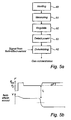
- Fig. 5a is a flow chart illustrating a method, for detecting and measuring a gas concentration, according to a second embodiment of the first aspect of the present invention.
- Fig. 5b is a schematic diagram illustrating the method in fig. 5a.
- Fig. 6a is a flow chart illustrating a method, for detecting and measuring a gas concentration, according to a third embodiment of the first aspect of the present invention.
- Fig. 6b is a schematic diagram illustrating the method in fig. 6a.
- Fig. 7a is a flow chart illustrating a method, for detecting and measuring a gas concentration, according to a fourth embodiment of the first aspect of the present invention.
- Fig. 7b is a schematic diagram illustrating the method in fig. 7a.
- a schematic fuel-cell powered car 1 is provided with a fuel tank 2, containing hydrogen gas, a supply line 3, leading gas to a fuel cell 4, where the hydrogen gas is used to generate an electric current, which is used to power the engine 5.
- a gas sensor 6 is positioned on suitable locations inside the car. These gas sensors 6, which are expected to number approximately 10-20 per vehicle, should be specific to hydrogen gas, have a short response time and be able to cover a wide concentration range.
- Fig. 2a schematically shows a first embodiment of a sensing device 10 according to the present invention.
- the sensing device 10 comprises a field-effect gas sensor 11, a heater 12 for heating a part of the sensing device 10, here in the form of a separate heat transfer sensing unit 13, detecting means in the form of a temperature sensor 14, a processor 15 and an interface 16.
- This sensing device 10 is an example of a gas sensor which would have suitable properties for the application illustrated in fig. 1, since the field-effect gas sensor 11 and the heat transfer sensing unit 13 have complementary strengths, which combined contribute to gas-specific sensing, short response time and wide detection range.
- a part of a second embodiment of a gas sensing device according the present invention is schematically shown.
- the field-effect gas sensor 20 and the heat transfer sensing unit 21 are provided in the same sensing unit 22.
- the field-effect gas sensor 20 is heated to its operational temperature by a heater 23.
- the temperature of the field-effect gas sensor is measured by a temperature sensor 24 and the heat transfer from the sensing unit 22 is detected.
- Signals from the field-effect sensor 20 as well as information regarding the heat transfer are collected by a processing unit which, in this example, is provided outside the sensing unit 22 and not included in fig 2b.
- a field-effect sensing unit and a heat transfer sensing unit could be provided as physically separated units and not be mounted on the same circuit board as long as both of these units are configured to be connected to the same processing unit.
- the field-effect gas sensor, the heat transfer sensing unit and the processing unit could be integrated on the same chip, forming a very compact system-on-chip.
- a first example of a mounting configuration of the sensing device according to the second aspect of the invention is shown.
- the sensing device 30, or part of the sensing device is suspended at a distance from a circuit board 31 by bond wires 32.
- a second example of a mounting configuration is shown.
- the sensing device 30 is mounted on the circuit board 31 via a glass carrier 32, in order to thermally insulate the sensing device 30 from the circuit board 31.
- the purpose of the above described mounting configurations is to thermally insulate the sensing element 30 from the heat sink constituted by the circuit board 31.
- the method according to this embodiment comprises the steps of heating 40 a part of the sensing device 10, detecting 41 a heat transfer from the heated part 13 of the sensing device and determining 42 the gas concentration using the detected heat transfer and a signal from the field-effect gas sensor 11.
- the above-described method is by no means limited to the sensing device in fig 2a.
- the step 41 of detecting a heat transfer from the heated part 13 of the sensing device 10 includes the steps of measuring 51 the temperature of the heated part 13 of the sensing device 10, regulating 52 the temperature of the heated part 13 to a constant value and detecting 53 the heating power supplied to the heater 12 used to heat the heated part 13 of the sensing device 10.
- the above-described method is by no means limited to the sensing device in fig 2a.
- the gas concentration can be determined in a way illustrated in fig. 5b and here exemplified using the embodiment of the sensing device wherein the field-effect gas sensor 20 and the heat transfer sensing unit 21 are integrated in the same element 22 as shown in fig 2b.
- the power supplied to the heater 23 is kept at a maximum value P max until a suitable temperature has been reached.
- the suitable temperature can be the working temperature of the field-effect gas sensor 20, T FE .
- the temperature is then kept constant at this suitable value by controlling the electric power supplied to the heater 23.
- the supplied power will be constant Po and its value will indicate a gas concentration of 0%.
- the field-effect sensor 20 Upon the entry of the gas to be detected, for example hydrogen gas, into the sensor at a time t 1 , more electric power will need to be supplied in order to keep the temperature at a constant value.
- the added electric power ⁇ F will be a measure of the hydrogen gas concentration.
- the field-effect sensor 20 Some time after the gas-entry time t 1 , the field-effect sensor 20 will indicate an increased concentration through a reduced output voltage, as is also shown in fig 5b. This signal from the field-effect sensor 20 confirms that the gas concentration indicated through detection of the heat transfer concerns the correct gas. If the gas concentration is higher than in the order of one percent, the field-effect sensor 20 may saturate.
- the field-effect sensor 20 will give a signal indicative of the gas concentration.
- the gas concentration sensed through detection 53 of the added electric power ⁇ P is the concentration of the gas to be sensed, in this case hydrogen gas
- the signal from the field-effect sensor 20 can be used. If a signal from the heat transfer unit 21 is present and there is no signal from the field-effect sensor 20, an alarm should not be initiated since the wrong gas has been sensed.
- a signal from the field-effect sensor obtained already during warm-up to the suitable working temperature can be used to provide a quick alert to persons potentially in danger, for example inside a fuel-cell powered vehicle.
- the above-described method is by no means limited to the sensing device in fig 2b.
- the step 41 of detecting a heat transfer from the heated part 22 of the sensing device includes the step 61 of measuring the decreasing temperature of the heated part 22 of the sensing device following termination of the heating.
- the amount of heat transferred from the heated part 22 can be measured in a way schematically illustrated by the diagram in fig. 6b.
- the temperature decreases from, in this case, the working temperature of the field-effect sensor T W .
- the decrease is dependent on the heat conductivity and/or the heat capacity of the surrounding gas and a measure of the gas concentration can be obtained by measuring the slope of the curve.
- a reason for using this method is that the amount of noise affecting the temperature measurement is reduced by turning off the heater 23.
- the sensing device is here operated by cycling the temperature, the heater first being turned on to allow for a measurement by the field-effect sensor 20 and then being turned off in order for the above-described temperature measurement to take place.
- the above-described method is by no means limited to the sensing device in fig 2b.
- the step 41 of detecting a heat transfer from the heated part 22 of the sensing device includes the step 71 of measuring the increasing temperature of the heated part 22 of the sensing device during heating, typically during heating to the field-effect sensor 20 working temperature Tw.
- the amount of heat transferred from the heated part 22 can be measured in a way schematically illustrated by the diagram in fig. 7b.
- the temperature increases towards the working temperature of the field-effect sensor T W .
- the increase is dependent on the heat conductivity and/or the heat capacity of the surrounding gas and a measure of the gas concentration can be obtained by measuring the slope S of the curve.
Landscapes
- Chemical & Material Sciences (AREA)
- Life Sciences & Earth Sciences (AREA)
- Engineering & Computer Science (AREA)
- Health & Medical Sciences (AREA)
- Medicinal Chemistry (AREA)
- Food Science & Technology (AREA)
- Combustion & Propulsion (AREA)
- Physics & Mathematics (AREA)
- Analytical Chemistry (AREA)
- Biochemistry (AREA)
- General Health & Medical Sciences (AREA)
- General Physics & Mathematics (AREA)
- Immunology (AREA)
- Pathology (AREA)
- Investigating Or Analyzing Materials By The Use Of Electric Means (AREA)
Priority Applications (1)
| Application Number | Priority Date | Filing Date | Title |
|---|---|---|---|
| EP05013417A EP1736768A1 (fr) | 2005-06-22 | 2005-06-22 | Procédé et appareil pour la détection de gaz |
Applications Claiming Priority (1)
| Application Number | Priority Date | Filing Date | Title |
|---|---|---|---|
| EP05013417A EP1736768A1 (fr) | 2005-06-22 | 2005-06-22 | Procédé et appareil pour la détection de gaz |
Publications (1)
| Publication Number | Publication Date |
|---|---|
| EP1736768A1 true EP1736768A1 (fr) | 2006-12-27 |
Family
ID=35169319
Family Applications (1)
| Application Number | Title | Priority Date | Filing Date |
|---|---|---|---|
| EP05013417A Withdrawn EP1736768A1 (fr) | 2005-06-22 | 2005-06-22 | Procédé et appareil pour la détection de gaz |
Country Status (1)
| Country | Link |
|---|---|
| EP (1) | EP1736768A1 (fr) |
Cited By (4)
| Publication number | Priority date | Publication date | Assignee | Title |
|---|---|---|---|---|
| CN103499597A (zh) * | 2013-10-14 | 2014-01-08 | 无锡艾科瑞思产品设计与研究有限公司 | 基于有毒气体检测的面粉中吊白块的检测装置与方法 |
| CN108956858A (zh) * | 2017-05-22 | 2018-12-07 | 天津邦特磁性材料有限公司 | 一种基于移动互联网下的烧结钕铁硼环保烟道系统 |
| US11614432B2 (en) | 2019-08-26 | 2023-03-28 | International Business Machines Corporation | Adaptive sensor temperature control for fast recovery |
| WO2025209920A1 (fr) | 2024-04-05 | 2025-10-09 | Schaeffler Technologies AG & Co. KG | Procédé, dispositif de commande, dispositif d'analyse de gaz et programme informatique pour déterminer la teneur en hydrogène dans un mélange gazeux, et véhicule et support lisible par ordinateur |
Citations (2)
| Publication number | Priority date | Publication date | Assignee | Title |
|---|---|---|---|---|
| US5659296A (en) * | 1994-10-24 | 1997-08-19 | Minnesota Mining And Manufacturing Company | Exposure indicating apparatus |
| WO2000075649A1 (fr) | 1999-06-04 | 2000-12-14 | Appliedsensor Sweden Ab | Détecteur à faible consommation d'électricité |
-
2005
- 2005-06-22 EP EP05013417A patent/EP1736768A1/fr not_active Withdrawn
Patent Citations (2)
| Publication number | Priority date | Publication date | Assignee | Title |
|---|---|---|---|---|
| US5659296A (en) * | 1994-10-24 | 1997-08-19 | Minnesota Mining And Manufacturing Company | Exposure indicating apparatus |
| WO2000075649A1 (fr) | 1999-06-04 | 2000-12-14 | Appliedsensor Sweden Ab | Détecteur à faible consommation d'électricité |
Non-Patent Citations (8)
| Title |
|---|
| BRIAND D ET AL: "Modulated operating temperature for MOSFET gas sensors: hydrogen recovery time reduction and gas discrimination", SENSORS AND ACTUATORS B, ELSEVIER SEQUOIA S.A., LAUSANNE, CH, vol. 93, no. 1-3, 1 August 2003 (2003-08-01), pages 276 - 285, XP004437111, ISSN: 0925-4005 * |
| BRIAND D ET AL: "THERMALLY ISOLATED MOSFET FOR GAS SENDING APPLICATION", IEEE ELECTRON DEVICE LETTERS, IEEE SERVICE CENTER, NEW YORK, NY, US, vol. 22, no. 1, January 2001 (2001-01-01), pages 11 - 13, XP000981140, ISSN: 0741-3106 * |
| C.C. LIU, P.J. HESKETH, G.W. HUNTER: "Chemical Microsensors", THE ELECTROCHEMICAL SOCIETY INTERFACE, 2004, pages 22 - 27, XP002352830 * |
| HIERLEMANN A ET AL: "Microfabrication techniques for chemical/biosensors", PROCEEDINGS OF THE IEEE, IEEE. NEW YORK, US, vol. 91, no. 6, 30 June 2003 (2003-06-30), pages 839 - 863, XP002309761, ISSN: 0018-9219 * |
| LERCHNER J ET AL: "Calorimetric detection of volatile organic compounds", SENSORS AND ACTUATORS B, ELSEVIER SEQUOIA S.A., LAUSANNE, CH, vol. 70, no. 1-3, 1 November 2000 (2000-11-01), pages 57 - 66, XP004224582, ISSN: 0925-4005 * |
| MIDDELHOEK S ET AL: "SILICON SENSORS", MEASUREMENT SCIENCE AND TECHNOLOGY, IOP, BRISTOL, GB, vol. 6, no. 12, 1 December 1995 (1995-12-01), pages 1641 - 1658, XP000551082, ISSN: 0957-0233 * |
| MOSELEY P T: "SOLID STATE GAS SENSORS", MEASUREMENT SCIENCE AND TECHNOLOGY, IOP, BRISTOL, GB, vol. 8, no. 3, 1 March 1997 (1997-03-01), pages 223 - 237, XP000721647, ISSN: 0957-0233 * |
| ULMER H ET AL: "Odours and flavours identified with hybrid modular sensor systems", SENSORS AND ACTUATORS B, ELSEVIER SEQUOIA S.A., LAUSANNE, CH, vol. 43, no. 1-3, September 1997 (1997-09-01), pages 24 - 33, XP004103421, ISSN: 0925-4005 * |
Cited By (5)
| Publication number | Priority date | Publication date | Assignee | Title |
|---|---|---|---|---|
| CN103499597A (zh) * | 2013-10-14 | 2014-01-08 | 无锡艾科瑞思产品设计与研究有限公司 | 基于有毒气体检测的面粉中吊白块的检测装置与方法 |
| CN103499597B (zh) * | 2013-10-14 | 2015-10-21 | 无锡艾科瑞思产品设计与研究有限公司 | 基于有毒气体检测的面粉中吊白块的检测方法 |
| CN108956858A (zh) * | 2017-05-22 | 2018-12-07 | 天津邦特磁性材料有限公司 | 一种基于移动互联网下的烧结钕铁硼环保烟道系统 |
| US11614432B2 (en) | 2019-08-26 | 2023-03-28 | International Business Machines Corporation | Adaptive sensor temperature control for fast recovery |
| WO2025209920A1 (fr) | 2024-04-05 | 2025-10-09 | Schaeffler Technologies AG & Co. KG | Procédé, dispositif de commande, dispositif d'analyse de gaz et programme informatique pour déterminer la teneur en hydrogène dans un mélange gazeux, et véhicule et support lisible par ordinateur |
Similar Documents
| Publication | Publication Date | Title |
|---|---|---|
| EP2762867B1 (fr) | Capteur de gaz avec régulation de température | |
| US7360392B2 (en) | Fluid sensor including an error detection device | |
| EP2677314B1 (fr) | Capteur chimique dans un dispositif électronique portable | |
| CN100445738C (zh) | 用于检测气体或气体混合物的装置 | |
| CN101171508B (zh) | 固态气体传感器的温度反馈控制 | |
| US10859523B2 (en) | Gas sensor | |
| JP2001522463A (ja) | 微細加工光−流量ガスセンサ | |
| JP2009540334A5 (fr) | ||
| CN116953013A (zh) | 电池故障的分层气体监测 | |
| BRPI0817851B1 (pt) | Sensor de gás e método de detecção de um ou mais gases | |
| JP7661489B2 (ja) | 測定空間内の流体媒体の少なくとも1つの特性を捕捉するためのセンサ | |
| JP5012036B2 (ja) | 硫黄成分検出装置 | |
| US20070278098A1 (en) | Gas sensor and gas detection system using the same | |
| US4870025A (en) | Method of sensing methane gas-I | |
| JP5166202B2 (ja) | ガス検出器 | |
| JP5927647B2 (ja) | ガス検知器 | |
| EP3384283B1 (fr) | Surveillance de la pollution de l'air | |
| KR20150017417A (ko) | 멤스 센서를 이용한 차량용 유해가스 유입 방지 장치 및 방법 | |
| JP5021400B2 (ja) | 可燃性ガス検出装置 | |
| JP2007024897A (ja) | 熱伝導率センサ、熱伝導率センサを製作するための方法および熱伝導率センサを運転するための方法 | |
| JP3809897B2 (ja) | 可燃性ガス濃度測定装置 | |
| Arndt | Micromachined thermal conductivity hydrogen detector for automotive applications | |
| JP3408897B2 (ja) | ガソリン・軽油識別装置及び識別方法 | |
| US20250155398A1 (en) | Gas sensor | |
| JP2010091305A (ja) | ガスセンサ |
Legal Events
| Date | Code | Title | Description |
|---|---|---|---|
| PUAI | Public reference made under article 153(3) epc to a published international application that has entered the european phase |
Free format text: ORIGINAL CODE: 0009012 |
|
| AK | Designated contracting states |
Kind code of ref document: A1 Designated state(s): AT BE BG CH CY CZ DE DK EE ES FI FR GB GR HU IE IS IT LI LT LU MC NL PL PT RO SE SI SK TR |
|
| AX | Request for extension of the european patent |
Extension state: AL BA HR LV MK YU |
|
| 17P | Request for examination filed |
Effective date: 20070625 |
|
| AKX | Designation fees paid |
Designated state(s): AT BE BG CH CY CZ DE DK EE ES FI FR GB GR HU IE IS IT LI LT LU MC NL PL PT RO SE SI SK TR |
|
| 17Q | First examination report despatched |
Effective date: 20090324 |
|
| STAA | Information on the status of an ep patent application or granted ep patent |
Free format text: STATUS: THE APPLICATION IS DEEMED TO BE WITHDRAWN |
|
| 18D | Application deemed to be withdrawn |
Effective date: 20090804 |