EP1737342B1 - Verfahren und vorrichtung zur bestimmung eines volumens im zusammenhang mit der lunge eines patienten - Google Patents
Verfahren und vorrichtung zur bestimmung eines volumens im zusammenhang mit der lunge eines patienten Download PDFInfo
- Publication number
- EP1737342B1 EP1737342B1 EP05731930.3A EP05731930A EP1737342B1 EP 1737342 B1 EP1737342 B1 EP 1737342B1 EP 05731930 A EP05731930 A EP 05731930A EP 1737342 B1 EP1737342 B1 EP 1737342B1
- Authority
- EP
- European Patent Office
- Prior art keywords
- gas
- volume
- change
- determining
- lungs
- Prior art date
- Legal status (The legal status is an assumption and is not a legal conclusion. Google has not performed a legal analysis and makes no representation as to the accuracy of the status listed.)
- Expired - Lifetime
Links
- 238000000034 method Methods 0.000 title claims description 31
- 210000004072 lung Anatomy 0.000 title claims description 30
- 230000008859 change Effects 0.000 claims description 43
- 239000000203 mixture Substances 0.000 claims description 39
- 230000029058 respiratory gaseous exchange Effects 0.000 claims description 35
- 238000005259 measurement Methods 0.000 claims description 18
- 230000001419 dependent effect Effects 0.000 claims description 10
- 230000000875 corresponding effect Effects 0.000 claims description 8
- 238000002604 ultrasonography Methods 0.000 claims description 8
- 239000002775 capsule Substances 0.000 claims description 5
- 230000002596 correlated effect Effects 0.000 claims description 3
- 230000000977 initiatory effect Effects 0.000 claims description 2
- 210000000056 organ Anatomy 0.000 claims description 2
- 239000007789 gas Substances 0.000 description 65
- QVGXLLKOCUKJST-UHFFFAOYSA-N atomic oxygen Chemical compound [O] QVGXLLKOCUKJST-UHFFFAOYSA-N 0.000 description 14
- 239000001301 oxygen Substances 0.000 description 14
- 229910052760 oxygen Inorganic materials 0.000 description 14
- 238000012360 testing method Methods 0.000 description 6
- 230000000241 respiratory effect Effects 0.000 description 5
- 238000011144 upstream manufacturing Methods 0.000 description 5
- 238000010586 diagram Methods 0.000 description 4
- 230000000694 effects Effects 0.000 description 4
- 239000001307 helium Substances 0.000 description 3
- 229910052734 helium Inorganic materials 0.000 description 3
- SWQJXJOGLNCZEY-UHFFFAOYSA-N helium atom Chemical compound [He] SWQJXJOGLNCZEY-UHFFFAOYSA-N 0.000 description 3
- 230000008569 process Effects 0.000 description 3
- 238000009423 ventilation Methods 0.000 description 3
- GQPLMRYTRLFLPF-UHFFFAOYSA-N Nitrous Oxide Chemical compound [O-][N+]#N GQPLMRYTRLFLPF-UHFFFAOYSA-N 0.000 description 2
- 238000011161 development Methods 0.000 description 2
- 230000018109 developmental process Effects 0.000 description 2
- 238000013208 measuring procedure Methods 0.000 description 2
- 231100000252 nontoxic Toxicity 0.000 description 2
- 230000003000 nontoxic effect Effects 0.000 description 2
- 230000033764 rhythmic process Effects 0.000 description 2
- MYMOFIZGZYHOMD-UHFFFAOYSA-N Dioxygen Chemical compound O=O MYMOFIZGZYHOMD-UHFFFAOYSA-N 0.000 description 1
- 241001465754 Metazoa Species 0.000 description 1
- 230000006978 adaptation Effects 0.000 description 1
- 230000003444 anaesthetic effect Effects 0.000 description 1
- 230000008901 benefit Effects 0.000 description 1
- 239000008280 blood Substances 0.000 description 1
- 210000004369 blood Anatomy 0.000 description 1
- 230000017531 blood circulation Effects 0.000 description 1
- 230000001276 controlling effect Effects 0.000 description 1
- 239000005431 greenhouse gas Substances 0.000 description 1
- 230000002452 interceptive effect Effects 0.000 description 1
- 239000012528 membrane Substances 0.000 description 1
- 238000012986 modification Methods 0.000 description 1
- 230000004048 modification Effects 0.000 description 1
- 230000003533 narcotic effect Effects 0.000 description 1
- 235000013842 nitrous oxide Nutrition 0.000 description 1
- 230000005855 radiation Effects 0.000 description 1
- 230000005236 sound signal Effects 0.000 description 1
- 230000036962 time dependent Effects 0.000 description 1
- 239000002341 toxic gas Substances 0.000 description 1
- 229910052724 xenon Inorganic materials 0.000 description 1
- FHNFHKCVQCLJFQ-UHFFFAOYSA-N xenon atom Chemical compound [Xe] FHNFHKCVQCLJFQ-UHFFFAOYSA-N 0.000 description 1
Images


Classifications
-
- A—HUMAN NECESSITIES
- A61—MEDICAL OR VETERINARY SCIENCE; HYGIENE
- A61B—DIAGNOSIS; SURGERY; IDENTIFICATION
- A61B5/00—Measuring for diagnostic purposes; Identification of persons
- A61B5/08—Measuring devices for evaluating the respiratory organs
- A61B5/091—Measuring volume of inspired or expired gases, e.g. to determine lung capacity
-
- A—HUMAN NECESSITIES
- A61—MEDICAL OR VETERINARY SCIENCE; HYGIENE
- A61B—DIAGNOSIS; SURGERY; IDENTIFICATION
- A61B5/00—Measuring for diagnostic purposes; Identification of persons
- A61B5/08—Measuring devices for evaluating the respiratory organs
- A61B5/0813—Measurement of pulmonary parameters by tracers, e.g. radioactive tracers
Definitions
- the present invention relates to a method for determining a volume related to the lungs of a patient.
- the present invention also relates to a device for determining a volume related to the lungs of a patient.
- the lungs are a dynamic organ, which during a breath change volume by the respiratory gas streaming into alveoli (inhalation, inspiration) as well as out of the alveoli (exhalation, expiration). To characterize the different volumes, a number of parameters are accepted.
- tidal volume which is a measure of the volume inhaled/exhaled during a normal breath
- vital capacity which is the total volume for a maximal inhalation and a maximal exhalation
- functional residual capacity FRC
- ineffective tidal volume which is a measure of the gas volume which does not contribute to the gas exchange between the lungs and blood circulation during a breath (constituted mainly by the volume in the bronchial branches and the wind-pipe).
- a method and an apparatus useful for determining the functional residual capacity, FRC is described.
- One example of the method principally operates in that during a washing-in phase, an inert and non-toxic labelled gas is applied with the respiratory gas during inspiration until an equilibrium in the concentration of labelled gas is obtained in the lungs.
- the supply is stopped, and by measuring the stream and concentration of labelled gas during a succession of expiration (washing-out phase), the exhaled volume of labelled gas can be determined, which (taking into consideration the dead volumes in the apparatus and the patient) constitutes FRC.
- the invention is based on the understanding that a change of the inspirational gas composition results in a variable change in the expirational gas composition (until an equilibrium is reached). By determining these variations in a measurement parameter the volume can be determined.
- an ultrasound flow meter is used to perform the determination.
- Flow determination with ultrasound is a known method, even used in medical ventilators (e.g. Servo i , Maquet Critical Care AB, Solna, Sweden).
- Servo i Maquet Critical Care AB, Solna, Sweden.
- a non-flow dependent time-of-flight (duration for the sound signal) can be obtained by determining the average for the duration times for upstream and downstream.
- the acoustical properties for gases depend among other things on the composition of the gas, e.g. the proportion of oxygen in the respiratory gas. This is used in the present invention.
- the composition of the expired gas successfully changes until an equilibrium state is reached in the lungs.
- a volume determination can be made.
- a parameter suitable to use is the non-flow dependent duration (time-of-flight). Since the composition of the gas successively changes during a series of expirations, even the non-flow dependent duration will vary. By determining the time constant for this variation, a volume for the lungs can be determined.
- a fictitious time t' can be used. This is to reduce the influence of variations in the depth of breath and breathing intervals during the measurement of spontaneously-breathing patients. That is because the change in gas composition first is a volume-dependent process and not time-dependent. The fictitious time t' is therefore determined in relation to the total passing stream volume and a taken constant flow.
- ultrasound flow measurer examples include, for example, determining the variation in gas composition with a gas concentration measurer or with a heat radiation measurer (the variation in gas composition affects the conductivity of heat).
- the change in gas composition which is supplied to the breathing gas can consist of a step change, where the change exists during the entire measuring procedure.
- the change can be performed pulsed, where a large change occurs for one or a few breaths. After that, one returns to the normal gas composition. This results in a lower effect on the patient during the entire measuring procedure.
- the change can result in a variation of the oxygen content which, for example, in a step change could result in an increase with 5% oxygen content from a usual level of 30-35%.
- a pulsed change could constitute an increase from e.g. 21% to 100% for two breaths.
- the changes can relate to some other gas component than oxygen, e.g. laughing gas or xenon (anaesthetic).
- the change can occur by supplying a specific disturbance gas (as from the state of the technique), e.g. helium.
- a specific disturbance gas as from the state of the technique
- helium e.g. helium
- a device which at least fills some of the goals is achieved in accordance with the invention through the device according to the preamble to claim 11 formed as given in the characterizing part of claim 11.
- the device is formed to be able to perform the method described above.
- the device can be formed in many different ways and with many complexities.
- the device can in this connection constitute a handheld tube with a measurement chamber and an ultrasound unit and a mouthpiece for inserting interference in the gas composition.
- the latter can constitute a capsule filled with compressed gas, e.g. oxygen or helium, which is released during one or a few breaths, after which the variation in the parameter is measured and the volume is determined according to the above.
- the device can constitute a ventilator formed to execute the method.
- Fig. 1 shows a hand held test apparatus 2 as a first example of the device.
- the test apparatus 2 comprises in principle a tube 4 provided with a mouthpiece 6 for a patient to breathe in and out through.
- the tube 4 constitutes an inspiration part as well as an expiration part for the test apparatus 2.
- patient has a wide scope which comprises all people and lung-breathing animals for which a volume related to the lungs according to the method described below can be determined.
- a disturbance must be introduced in the composition of the breathing gas.
- the breathing gas consists of regular air.
- a gas capsule 8 can be connected to the tube to supply a gas which changes the composition of the breathing gas.
- the gas capsule 8 can preferably contain a compressed gas to minimize its volume and simplify dosing.
- the gas can constitute oxygen, helium or some other non-toxic gas for which the speed of sound deviates from the speed of sound in the respiratory gas.
- the gas in the gas capsule 8 can be released during one or a few breaths.
- the release can be done by simple ventilation, fixed flow opening, breaking of a membrane, etc., depending on whether the composition shall be changed during a few or more breaths.
- first transceiver 10 and a second transceiver 12 arranged to determine a non-flow dependent duration (time-of-flight) for sound pulses in expired gas (mean value of upstream duration and downstream duration, respectively).
- the tube 4 constitutes a measuring chamber for the determination.
- the transceivers 10, 12 can in principle also be replaced with a sound sender and a sound receiver for determining the duration upstream and a second pair of sound sender and sound receiver for determining the duration downstream.
- a transceiver can be used in one end of the measuring section and a sound reflector in the other.
- Other arrangements of components can obviously also be used for determining the duration of one or more sound pulses, e.g. by determining the duration perpendicularly to the flow.
- the determination of the duration is done during a couple of breaths, during which the gas composition in the lungs returns to normal.
- a calculation unit 14 the actual calculation is made of the volume which is to be determined.
- the calculation unit 14 can be integrated with the test apparatus 2 as shown in the figure but can also constitute a separate component, which communicates with the test apparatus via cable or wireless.
- a model of a lung is shown from which a calculation model can be described.
- the lungs correspond to this model of a container 16 with the volume V.
- the volume V is ventilated with an alveolar flow V A .
- V E represents expired minute volume
- V D represents dead volume ventilation.
- FRC can be determined by subtracting the volume corresponding among others to the dead volume.
- the time constant ⁇ can be determined from the change in duration time for the sound pulses through the breathing gas.
- Fig. 3 shows a measuring series 18 of the duration time for a number of breathing cycles.
- the duration time varies during the entire breathing cycle, but at breathing cycle 20 a step change is initiated in the breathing gas composition and a lapse curve starts. From a first series of measuring points 22 the time constant ⁇ for the lapse curve can be determined.
- the measuring points 22 are correlated to one and the same time point during the respective breathing cycle, i.e. they are taken during practically identical circumstances regarding temperature, humidity, CO 2 , etc. In that way the measuring points 22 are, as much as possible, independent of all factors which can affect the duration time. In principle, the maximum and/or minimum values could also be used to determine the time constant ⁇ .
- a second series of measuring points 26 can in this connection be used to execute the same determination once again. The two measurements executed in this way can be used to control that the determined volume is appropriate.
- Fig. 4 shows a measurement series 28 where a pulsed change of the gas composition has been made in breathing cycle 30.
- the pulsed change constitutes in this case pure oxygen, which is supplied to the patient during two breathing cycles.
- the time constant ⁇ is determined from a series of measurement points 32 in the same way as described above.
- the pulse method results in a shorter time with deviating gas composition in the lungs.
- the pulse method even increases the accuracy in the determination since factors such as physical solubility in blood and metabolistic changes are minimized.
- Fig. 2 shows a model to represent the lungs and the ventilation of them.
- a drawback with the model in Fig. 2 is that it presumes a relatively constant breathing rhythm, i.e. the breathing volume and the breathing interval are constant for each breathing cycle.
- Fig. 5 illustrates the effects of a variation in breathing volume and interval for the model according to Fig. 2 .
- An upper graph shows the oxygen change over time, corresponding to the washing-in duration with a changed oxygen concentration.
- a lower graph shows the tidal volume over time for four breaths 34A, 34B, 34C, 34D.
- the exponential function 36 in the upper graph shows an ideal change at the washing-in (to determine the time constant ⁇ ).
- the curve 38 shows the actual changes during the four breathing cycles 34A, 34B, 34C, 34D.
- the actual change of the oxygen concentration depends on the breathing volume.
- the first breath 34A accordingly results in a first step change 40A in the oxygen concentration.
- the second breath 34B which has a considerably lower tidal volume, only results in a small second step change 40B.
- the third breath 34C occurs after a long pause and also has a low tidal volume.
- a third step change 40C is therefore also low and occurs after a corresponding time interval.
- the fourth breath 34D finally occurs short after the third breath 34C and has a larger tidal volume.
- the corresponding fourth step change 40D will in this connection also be larger and reaches up to the exponential function 36. The washing-in is then done.
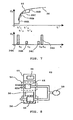
- variable fictitious time, t' is going to correspond to the time which had passed if a continuous flow had passed the lungs, i.e. more like the situation which is present at a regular breathing rhythm.
- Fig. 7 upper and lower graphs corresponding to those in Fig. 5 are shown.
- the lower graph shows the four breaths 34A, 34B, 34C and 34D.
- the upper graph shows the exponential function 34.
- the curve 44 shows how the fictitious time t' results in a better adaptation than the curve 38 in Fig. 5 .
- the first breath 34A which occurs at time point t 1 corresponds in the fictitious number scheme to a first step change 46A at time point t' 1 .
- the second breath 34B at time point t 2 had a lesser tidal volume. This corresponds to a second smaller step change 46B at time point t' 2 .
- the third breath 34C at time point t 3 corresponds in the same way to a third step change 46C at time point t' 3
- the fourth breath 34D at time point t 4 corresponds to a fourth step change 46D at time point t' 4 .
- Fig. 8 shows a second embodiment of a device.
- the device constitutes a ventilator 48 which is connectable to a patient 50 via a hose system 52.
- the ventilator 48 can, for example, be a modified Servo i , Maquet Critical Care AB, Solna, Sweden.
- the ventilator 48 comprises an inspiration part 54, an expiration part 56, a calculation unit 58 and a user interface 60.
- all components which can be used in a ventilator are not taken up, but only those which are of significance to perform volume determinations according to the above described processes. A large number of other components are known and could consequently be included in the ventilator 48.
- the inspiration part 54 in itself consequently comprises, among other things, connections 62A, 62B for gases, e.g. air and oxygen, and a gas regulator 64, which regulates the composition, pressure and flow of the breathing gas.
- the expiration part 56 comprises a flow meter 66, which measures flow with ultrasound.
- the calculation unit 58 can comprise one or more processors or the like and can include all controlling and watching functions for the ventilator 48.
- the user interface 60 can comprise an interactive screen 68 for introduction of breathing modes, initiating the process, etc., and can show measurement data, curves and calculated volumes.
- a volume-determination function for determining FRC can be implemented in the ventilator 48 is that a measurement is initiated by requesting a volume determination via the user interface 60.
- the calculation unit 58 then controls the gas regulator 64 so that a change in the breathing gas composition is initiated, e.g. in the form of two breaths with 100% oxygen.
- the duration time is determined for the sound pulses which are used to determine the flow. From the flow is even received the volume of gas passing out. Out of the duration time measurement, which in principle can be similar to the measurement shown in Fig. 4 , measuring points are taken from the same phase in the breathing cycle for a number of breathing cycles. From the measuring points the time constant ⁇ and the mean volume in the lungs are determined. To obtain FRC the dead volume is subtracted (which can be determined in a known manner).
Landscapes
- Health & Medical Sciences (AREA)
- Life Sciences & Earth Sciences (AREA)
- Pulmonology (AREA)
- Biomedical Technology (AREA)
- Medical Informatics (AREA)
- Biophysics (AREA)
- Pathology (AREA)
- Engineering & Computer Science (AREA)
- Physiology (AREA)
- Heart & Thoracic Surgery (AREA)
- Physics & Mathematics (AREA)
- Molecular Biology (AREA)
- Surgery (AREA)
- Animal Behavior & Ethology (AREA)
- General Health & Medical Sciences (AREA)
- Public Health (AREA)
- Veterinary Medicine (AREA)
- Measurement Of The Respiration, Hearing Ability, Form, And Blood Characteristics Of Living Organisms (AREA)
- Investigating Or Analysing Biological Materials (AREA)
Claims (15)
- Verfahren zum Bestimmen eines Volumens betreffend die Lunge eines Patienten unter Verwendung einer Einrichtung (48) mit einem Einatemteil (54) und einem Ausatemteil (56), mit dem Verfahrensschritt des Verursachens einer Veränderung in dem Einatemteil in einer Gaszusammensetzung, die durch dieses hindurchtritt, gekennzeichnet durch die Verfahrensschritte:- Messen eines Messparameters in einem Ausatemteil und Bestimmen einer Zeitkonstante (τ), welche die Veränderung in dem Messparameter beschreibt, der von der Veränderung in der Gaszusammensetzung abhängig ist, und- Bestimmen des Volumens ausgehend von der Zeitkonstante (τ).
- Verfahren nach Anspruch 1, gekennzeichnet durch das Erzeugen einer Folge von Geräuschpulsen und durch Aussenden dieser zu einer Messkammer in dem Ausatemteil, wobei der Messparameter ein Parameter ist, der die Reihe an Geräuschpulsen betrifft und durch die Veränderung in der Gaszusammensetzung verursacht wird.
- Verfahren nach Anspruch 2, dadurch gekennzeichnet, dass der Messparameter eine flussunabhängige Dauer (Fortbewegungszeit) für die Geräuschpulse ist, die zu der Messkammer ausgesandt wurden.
- Verfahren nach Anspruch 2, dadurch gekennzeichnet, dass der Messparameter eine fiktive Zeit (t') ist, die der Zeit entspricht, die, wenn ein kontinuierlicher Fluss durch die Lungen hindurchgetreten wäre, auf der Grundlage eines Gesamtvolumens (Vtot), welches durch die Lungen während der Bestimmung gespült wurde, und eines angenommenen konstanten Flusses (f) von Gas durch die Lungen vergangen wäre.
- Verfahren nach Anspruch 1, dadurch gekennzeichnet, dass der Messparameter die Gaskonzentration einer Komponente in der veränderten Gaszusammensetzung ist.
- Verfahren nach Anspruch 1, dadurch gekennzeichnet, dass der Messparameter eine flussunabhängige Dauer für die Wärmestrahlung zwischen zwei festen Punkten in dem Ausatemteil ist.
- Verfahren nach einem der vorhergehenden Ansprüche, dadurch gekennzeichnet, dass die Veränderung in der Gaszusammensetzung als stufenartige Veränderung durchgeführt wird.
- Verfahren nach einem der Ansprüche 1-6, dadurch gekennzeichnet, dass die Veränderung in der Gaszusammensetzung als pulsartige Veränderung durchgeführt wird.
- Verfahren nach einem der vorhergehenden Ansprüche, dadurch gekennzeichnet, dass die Zeitkonstante (τ) von Messdaten bestimmt wird, die an korrelierten Zeitpunkten während des jeweiligen Atemzyklus in einer Anzahl an Atemzügen erhalten wurden.
- Verfahren nach einem der vorhergehenden Ansprüche, dadurch gekennzeichnet, dass ein funktionales Restvolumen aufgrund des bestimmten Volumens berechnet wird.
- Einrichtung (48), die direkt oder indirekt mit einem Patienten (50) verbunden werden kann, um ein Volumen betreffend die Lunge des Patienten (50) zu bestimmen, mit einem Einatemteil (54), durch das ein Einatemgas zum Patienten (50) hindurchtritt, und einem Ausatemteil (56), durch welches das Ausatemgas von dem Patienten (50) weg hindurchtritt, wobei das Einatemteil (54) ein Mundstück (64) zum Veranlassen einer Veränderung in der Gaszusammensetzung im Einatemgas aufweist, gekennzeichnet durch eine Erfassungseinrichtung (66), die in dem Ausatemteil (56) zum Messen eines Messparameters angeordnet ist, der von der Veränderung in der Gaszusammensetzung abhängig ist, und durch eine Berechnungseinheit (58), die mit der Erfassungseinheit (66) verbunden ist, um eine Zeitkonstante (τ) zu bestimmen, die die Veränderung im Messparameter charakterisiert, und um aus der bestimmten Zeitkonstante (τ) das Volumen zu bestimmen.
- Einrichtung nach Anspruch 11, dadurch gekennzeichnet, dass die Erfassungseinrichtung (66) eine Ultraschalleinheit ist, wobei die Ultraschalleinheit Pulse in eine Messkammer in dem Ausatemteil (56) aussendet und erfasst.
- Einrichtung nach Anspruch 11 oder 12, dadurch gekennzeichnet, das die Einrichtung eine medizinische Beatmungseinrichtung ist.
- Einrichtung nach Anspruch 11 oder 12, dadurch gekennzeichnet, dass das Einatemteil und das Ausatemteil eine gemeinsame Röhre (4) bilden, die direkt mit dem Patienten verbindbar ist.
- Einrichtung nach Anspruch 11 oder 12, dadurch gekennzeichnet, dass das Organ zum Veranlassen einer Veränderung in der Gaszusammensetzung eine Kapsel (8) mit Gas bildet, die austauschbar mit der Röhre verbunden ist.
Applications Claiming Priority (2)
| Application Number | Priority Date | Filing Date | Title |
|---|---|---|---|
| SE0400946A SE0400946D0 (sv) | 2004-04-08 | 2004-04-08 | Förfarande och anordning för bestämning av en volym relaterad till lungorna hos en patient |
| PCT/EP2005/051550 WO2005096934A1 (en) | 2004-04-08 | 2005-04-07 | Method and device for determining a volume related to the lungs of a patient |
Publications (2)
| Publication Number | Publication Date |
|---|---|
| EP1737342A1 EP1737342A1 (de) | 2007-01-03 |
| EP1737342B1 true EP1737342B1 (de) | 2014-09-24 |
Family
ID=32294297
Family Applications (1)
| Application Number | Title | Priority Date | Filing Date |
|---|---|---|---|
| EP05731930.3A Expired - Lifetime EP1737342B1 (de) | 2004-04-08 | 2005-04-07 | Verfahren und vorrichtung zur bestimmung eines volumens im zusammenhang mit der lunge eines patienten |
Country Status (5)
| Country | Link |
|---|---|
| US (1) | US8663127B2 (de) |
| EP (1) | EP1737342B1 (de) |
| JP (1) | JP2007532164A (de) |
| SE (1) | SE0400946D0 (de) |
| WO (1) | WO2005096934A1 (de) |
Families Citing this family (1)
| Publication number | Priority date | Publication date | Assignee | Title |
|---|---|---|---|---|
| DE102019119575A1 (de) * | 2019-07-18 | 2021-01-21 | Hamilton Medical Ag | Verfahren zur Ermittlung einer funktionalen Restkapazität einer Patientenlunge und Beatmungsvorrichtung zur Ausführung des Verfahrens |
Family Cites Families (13)
| Publication number | Priority date | Publication date | Assignee | Title |
|---|---|---|---|---|
| US4941476A (en) * | 1986-09-29 | 1990-07-17 | Joseph Fisher | Non-invasive method and apparatus for measuring mixed venous blood carbon dioxide pressure (PVC02) and other physiological variables |
| DE4318690A1 (de) * | 1993-06-04 | 1995-01-05 | Ndd Medizintechnik Gmbh | Verfahren zur Messung der Molmasse von Gasen oder Gasgemischen und Vorrichtung zur Durchführung dieses Verfahrens |
| EP0646346A3 (de) * | 1993-09-30 | 1998-06-17 | NDD Medizintechnik GmbH | Vorrichtung zur Messung von Atemgasparametern |
| SE9303486L (sv) * | 1993-10-22 | 1995-04-23 | Siemens Elema Ab | Metod vid bestämning av den funktionella residualkapaciteten för lungor samt en ventilatoranordning för bestämning av den funktionella residualkapaciteten |
| DE19606470C2 (de) * | 1996-02-21 | 2001-03-15 | Mpo Ges Fuer Medizintechnische | Verfahren zur Bestimmung der funktionellen Residualkapazität (FRC) |
| US6139506A (en) * | 1999-01-29 | 2000-10-31 | Instrumentarium Oy | Method for measuring pulmonary functional residual capacity |
| US6629934B2 (en) * | 2000-02-02 | 2003-10-07 | Healthetech, Inc. | Indirect calorimeter for medical applications |
| DE10038818A1 (de) | 2000-08-04 | 2002-02-21 | Univ Dresden Tech | Verfahren und Anordnung zur Bestimmung der funktionellen Residualkapazität der Lungen (FRC) |
| DE10046465B4 (de) * | 2000-09-20 | 2004-08-05 | Dräger Medical AG & Co. KGaA | Verwendung von Fluorpropan als Spurengas zur Bestimmung der funktionellen Lungenresidualkapazität |
| SE0200184D0 (sv) * | 2002-01-24 | 2002-01-24 | Siemens Elema Ab | Acoustic Gas Meter |
| US7241269B2 (en) * | 2003-09-02 | 2007-07-10 | Respiratory Management Technology | Apparatus and method for delivery of an aerosol |
| US7237440B2 (en) * | 2003-10-10 | 2007-07-03 | Cidra Corporation | Flow measurement apparatus having strain-based sensors and ultrasonic sensors |
| EP1632178A1 (de) * | 2004-09-03 | 2006-03-08 | ndd Medizintechnik AG | Verfahren zur nichtkooperativen Ultraschall-Lungendiagnose |
-
2004
- 2004-04-08 SE SE0400946A patent/SE0400946D0/xx unknown
-
2005
- 2005-04-07 JP JP2007506780A patent/JP2007532164A/ja active Pending
- 2005-04-07 WO PCT/EP2005/051550 patent/WO2005096934A1/en not_active Ceased
- 2005-04-07 US US11/578,131 patent/US8663127B2/en active Active
- 2005-04-07 EP EP05731930.3A patent/EP1737342B1/de not_active Expired - Lifetime
Non-Patent Citations (1)
| Title |
|---|
| NEWTH C J L ET AL: "Multiple-breath nitrogen washout techniques: Including measurements with patients on ventilators", EUROPEAN RESPIRATORY JOURNAL, MUNKSGAARD INTERNATIONAL PUBLISHERS, COPENHAGEN, DK, vol. 10, no. 9, 1 January 1997 (1997-01-01), pages 2174 - 2185, XP002615211, ISSN: 0903-1936, DOI: 10.1183/09031936.97.10092174 * |
Also Published As
| Publication number | Publication date |
|---|---|
| SE0400946D0 (sv) | 2004-04-08 |
| EP1737342A1 (de) | 2007-01-03 |
| US20080114262A1 (en) | 2008-05-15 |
| JP2007532164A (ja) | 2007-11-15 |
| WO2005096934A1 (en) | 2005-10-20 |
| US8663127B2 (en) | 2014-03-04 |
Similar Documents
| Publication | Publication Date | Title |
|---|---|---|
| EP0956877B1 (de) | Beatmungsgerät zur Identifikation von einem Parameter | |
| US5402796A (en) | Arterial CO2 Monitor and closed loop controller | |
| EP2641536B1 (de) | Verfahren zur durchgehenden und nicht invasiven Bestimmung der effektiven Lungenvolumen- und Herzausgabe | |
| RU2008107414A (ru) | Способ и устройство для контролирования объема легких | |
| CN101340941B (zh) | 用于估计呼气末肺容量的方法和装置 | |
| US6599252B2 (en) | Method and apparatus for anatomical deadspace measurement | |
| US20130006133A1 (en) | Methods and systems for monitoring volumetric carbon dioxide | |
| US20070123792A1 (en) | System and method for determining airway obstruction | |
| JPH0924099A5 (de) | ||
| EP1503653A1 (de) | Gerät zum schätzen der hämodynamischen leistung | |
| WO2008109646A1 (en) | Method and device for determining cardiac output with carbon dioxide partial re-breathing | |
| EP1030593B1 (de) | Verfahren und vorrichtung zur bestimmung einer lungenfunktionsgrösse mittels gasaustausch | |
| CA2460201A1 (en) | Non-invasive device and method for the diagnosis of pulmonary vascular occlusions | |
| CN114917440A (zh) | 呼吸检测方法、脉冲式制氧机的控制方法及脉冲式制氧机 | |
| US11045105B2 (en) | Determination of cardiac output or effective pulmonary blood flow during mechanical ventilation | |
| US7513875B2 (en) | Method and system for managing mechanical respiratory ventilation | |
| US8663127B2 (en) | Method and device for determining a volume related to the lungs of a patient | |
| JP2008545452A (ja) | 肺の能力を分析する方法および装置 | |
| RU60358U1 (ru) | Устройство для искусственной вентиляции легких | |
| JP2002505923A (ja) | 代謝ガス交換及び非侵襲性心拍出量モニター | |
| AU651627B2 (en) | Arterial CO2 monitor and closed loop controller | |
| AU2003271342A1 (en) | A method of continuous cardiac output measurement from the airway |
Legal Events
| Date | Code | Title | Description |
|---|---|---|---|
| PUAI | Public reference made under article 153(3) epc to a published international application that has entered the european phase |
Free format text: ORIGINAL CODE: 0009012 |
|
| 17P | Request for examination filed |
Effective date: 20061023 |
|
| AK | Designated contracting states |
Kind code of ref document: A1 Designated state(s): AT BE BG CH CY CZ DE DK EE ES FI FR GB GR HU IE IS IT LI LT LU MC NL PL PT RO SE SI SK TR |
|
| RIN1 | Information on inventor provided before grant (corrected) |
Inventor name: LARSSON, AKE Inventor name: CARDELIUS, ERIK Inventor name: HOLMER, MATTIAS Inventor name: HANSON, MIKAEL Inventor name: WALL N, LARS |
|
| DAX | Request for extension of the european patent (deleted) | ||
| 17Q | First examination report despatched |
Effective date: 20120911 |
|
| GRAP | Despatch of communication of intention to grant a patent |
Free format text: ORIGINAL CODE: EPIDOSNIGR1 |
|
| INTG | Intention to grant announced |
Effective date: 20140122 |
|
| GRAP | Despatch of communication of intention to grant a patent |
Free format text: ORIGINAL CODE: EPIDOSNIGR1 |
|
| INTG | Intention to grant announced |
Effective date: 20140414 |
|
| GRAS | Grant fee paid |
Free format text: ORIGINAL CODE: EPIDOSNIGR3 |
|
| GRAA | (expected) grant |
Free format text: ORIGINAL CODE: 0009210 |
|
| AK | Designated contracting states |
Kind code of ref document: B1 Designated state(s): AT BE BG CH CY CZ DE DK EE ES FI FR GB GR HU IE IS IT LI LT LU MC NL PL PT RO SE SI SK TR |
|
| RAP1 | Party data changed (applicant data changed or rights of an application transferred) |
Owner name: MAQUET CRITICAL CARE AB |
|
| REG | Reference to a national code |
Ref country code: GB Ref legal event code: FG4D |
|
| RIN1 | Information on inventor provided before grant (corrected) |
Inventor name: LARSSON, AKE Inventor name: CARDELIUS, ERIK Inventor name: ADELSBERG, MIKAEL Inventor name: WALLEN, LARS Inventor name: HOLMER, MATTIAS |
|
| REG | Reference to a national code |
Ref country code: CH Ref legal event code: EP |
|
| REG | Reference to a national code |
Ref country code: AT Ref legal event code: REF Ref document number: 688230 Country of ref document: AT Kind code of ref document: T Effective date: 20141015 |
|
| REG | Reference to a national code |
Ref country code: IE Ref legal event code: FG4D |
|
| REG | Reference to a national code |
Ref country code: DE Ref legal event code: R096 Ref document number: 602005044781 Country of ref document: DE Effective date: 20141030 |
|
| PG25 | Lapsed in a contracting state [announced via postgrant information from national office to epo] |
Ref country code: LT Free format text: LAPSE BECAUSE OF FAILURE TO SUBMIT A TRANSLATION OF THE DESCRIPTION OR TO PAY THE FEE WITHIN THE PRESCRIBED TIME-LIMIT Effective date: 20140924 Ref country code: SE Free format text: LAPSE BECAUSE OF FAILURE TO SUBMIT A TRANSLATION OF THE DESCRIPTION OR TO PAY THE FEE WITHIN THE PRESCRIBED TIME-LIMIT Effective date: 20140924 Ref country code: GR Free format text: LAPSE BECAUSE OF FAILURE TO SUBMIT A TRANSLATION OF THE DESCRIPTION OR TO PAY THE FEE WITHIN THE PRESCRIBED TIME-LIMIT Effective date: 20141225 Ref country code: FI Free format text: LAPSE BECAUSE OF FAILURE TO SUBMIT A TRANSLATION OF THE DESCRIPTION OR TO PAY THE FEE WITHIN THE PRESCRIBED TIME-LIMIT Effective date: 20140924 |
|
| REG | Reference to a national code |
Ref country code: LT Ref legal event code: MG4D Ref country code: NL Ref legal event code: VDEP Effective date: 20140924 |
|
| PG25 | Lapsed in a contracting state [announced via postgrant information from national office to epo] |
Ref country code: CY Free format text: LAPSE BECAUSE OF FAILURE TO SUBMIT A TRANSLATION OF THE DESCRIPTION OR TO PAY THE FEE WITHIN THE PRESCRIBED TIME-LIMIT Effective date: 20140924 |
|
| REG | Reference to a national code |
Ref country code: AT Ref legal event code: MK05 Ref document number: 688230 Country of ref document: AT Kind code of ref document: T Effective date: 20140924 |
|
| PG25 | Lapsed in a contracting state [announced via postgrant information from national office to epo] |
Ref country code: NL Free format text: LAPSE BECAUSE OF FAILURE TO SUBMIT A TRANSLATION OF THE DESCRIPTION OR TO PAY THE FEE WITHIN THE PRESCRIBED TIME-LIMIT Effective date: 20140924 |
|
| PG25 | Lapsed in a contracting state [announced via postgrant information from national office to epo] |
Ref country code: SK Free format text: LAPSE BECAUSE OF FAILURE TO SUBMIT A TRANSLATION OF THE DESCRIPTION OR TO PAY THE FEE WITHIN THE PRESCRIBED TIME-LIMIT Effective date: 20140924 Ref country code: IS Free format text: LAPSE BECAUSE OF FAILURE TO SUBMIT A TRANSLATION OF THE DESCRIPTION OR TO PAY THE FEE WITHIN THE PRESCRIBED TIME-LIMIT Effective date: 20150124 Ref country code: EE Free format text: LAPSE BECAUSE OF FAILURE TO SUBMIT A TRANSLATION OF THE DESCRIPTION OR TO PAY THE FEE WITHIN THE PRESCRIBED TIME-LIMIT Effective date: 20140924 Ref country code: PT Free format text: LAPSE BECAUSE OF FAILURE TO SUBMIT A TRANSLATION OF THE DESCRIPTION OR TO PAY THE FEE WITHIN THE PRESCRIBED TIME-LIMIT Effective date: 20150126 Ref country code: CZ Free format text: LAPSE BECAUSE OF FAILURE TO SUBMIT A TRANSLATION OF THE DESCRIPTION OR TO PAY THE FEE WITHIN THE PRESCRIBED TIME-LIMIT Effective date: 20140924 Ref country code: ES Free format text: LAPSE BECAUSE OF FAILURE TO SUBMIT A TRANSLATION OF THE DESCRIPTION OR TO PAY THE FEE WITHIN THE PRESCRIBED TIME-LIMIT Effective date: 20140924 Ref country code: RO Free format text: LAPSE BECAUSE OF FAILURE TO SUBMIT A TRANSLATION OF THE DESCRIPTION OR TO PAY THE FEE WITHIN THE PRESCRIBED TIME-LIMIT Effective date: 20140924 |
|
| PG25 | Lapsed in a contracting state [announced via postgrant information from national office to epo] |
Ref country code: AT Free format text: LAPSE BECAUSE OF FAILURE TO SUBMIT A TRANSLATION OF THE DESCRIPTION OR TO PAY THE FEE WITHIN THE PRESCRIBED TIME-LIMIT Effective date: 20140924 Ref country code: PL Free format text: LAPSE BECAUSE OF FAILURE TO SUBMIT A TRANSLATION OF THE DESCRIPTION OR TO PAY THE FEE WITHIN THE PRESCRIBED TIME-LIMIT Effective date: 20140924 |
|
| REG | Reference to a national code |
Ref country code: DE Ref legal event code: R097 Ref document number: 602005044781 Country of ref document: DE |
|
| PG25 | Lapsed in a contracting state [announced via postgrant information from national office to epo] |
Ref country code: DK Free format text: LAPSE BECAUSE OF FAILURE TO SUBMIT A TRANSLATION OF THE DESCRIPTION OR TO PAY THE FEE WITHIN THE PRESCRIBED TIME-LIMIT Effective date: 20140924 |
|
| PLBE | No opposition filed within time limit |
Free format text: ORIGINAL CODE: 0009261 |
|
| STAA | Information on the status of an ep patent application or granted ep patent |
Free format text: STATUS: NO OPPOSITION FILED WITHIN TIME LIMIT |
|
| PG25 | Lapsed in a contracting state [announced via postgrant information from national office to epo] |
Ref country code: IT Free format text: LAPSE BECAUSE OF FAILURE TO SUBMIT A TRANSLATION OF THE DESCRIPTION OR TO PAY THE FEE WITHIN THE PRESCRIBED TIME-LIMIT Effective date: 20140924 |
|
| 26N | No opposition filed |
Effective date: 20150625 |
|
| PG25 | Lapsed in a contracting state [announced via postgrant information from national office to epo] |
Ref country code: LU Free format text: LAPSE BECAUSE OF FAILURE TO SUBMIT A TRANSLATION OF THE DESCRIPTION OR TO PAY THE FEE WITHIN THE PRESCRIBED TIME-LIMIT Effective date: 20150407 Ref country code: MC Free format text: LAPSE BECAUSE OF FAILURE TO SUBMIT A TRANSLATION OF THE DESCRIPTION OR TO PAY THE FEE WITHIN THE PRESCRIBED TIME-LIMIT Effective date: 20140924 |
|
| REG | Reference to a national code |
Ref country code: CH Ref legal event code: PL |
|
| GBPC | Gb: european patent ceased through non-payment of renewal fee |
Effective date: 20150407 |
|
| REG | Reference to a national code |
Ref country code: IE Ref legal event code: MM4A |
|
| PG25 | Lapsed in a contracting state [announced via postgrant information from national office to epo] |
Ref country code: LI Free format text: LAPSE BECAUSE OF NON-PAYMENT OF DUE FEES Effective date: 20150430 Ref country code: CH Free format text: LAPSE BECAUSE OF NON-PAYMENT OF DUE FEES Effective date: 20150430 Ref country code: GB Free format text: LAPSE BECAUSE OF NON-PAYMENT OF DUE FEES Effective date: 20150407 |
|
| PG25 | Lapsed in a contracting state [announced via postgrant information from national office to epo] |
Ref country code: SI Free format text: LAPSE BECAUSE OF FAILURE TO SUBMIT A TRANSLATION OF THE DESCRIPTION OR TO PAY THE FEE WITHIN THE PRESCRIBED TIME-LIMIT Effective date: 20140924 |
|
| REG | Reference to a national code |
Ref country code: FR Ref legal event code: PLFP Year of fee payment: 12 |
|
| PG25 | Lapsed in a contracting state [announced via postgrant information from national office to epo] |
Ref country code: IE Free format text: LAPSE BECAUSE OF NON-PAYMENT OF DUE FEES Effective date: 20150407 |
|
| REG | Reference to a national code |
Ref country code: FR Ref legal event code: PLFP Year of fee payment: 13 |
|
| PG25 | Lapsed in a contracting state [announced via postgrant information from national office to epo] |
Ref country code: HU Free format text: LAPSE BECAUSE OF FAILURE TO SUBMIT A TRANSLATION OF THE DESCRIPTION OR TO PAY THE FEE WITHIN THE PRESCRIBED TIME-LIMIT; INVALID AB INITIO Effective date: 20050407 Ref country code: BG Free format text: LAPSE BECAUSE OF FAILURE TO SUBMIT A TRANSLATION OF THE DESCRIPTION OR TO PAY THE FEE WITHIN THE PRESCRIBED TIME-LIMIT Effective date: 20140924 |
|
| PG25 | Lapsed in a contracting state [announced via postgrant information from national office to epo] |
Ref country code: TR Free format text: LAPSE BECAUSE OF FAILURE TO SUBMIT A TRANSLATION OF THE DESCRIPTION OR TO PAY THE FEE WITHIN THE PRESCRIBED TIME-LIMIT Effective date: 20140924 |
|
| PG25 | Lapsed in a contracting state [announced via postgrant information from national office to epo] |
Ref country code: BE Free format text: LAPSE BECAUSE OF FAILURE TO SUBMIT A TRANSLATION OF THE DESCRIPTION OR TO PAY THE FEE WITHIN THE PRESCRIBED TIME-LIMIT Effective date: 20140924 |
|
| REG | Reference to a national code |
Ref country code: FR Ref legal event code: PLFP Year of fee payment: 14 |
|
| P01 | Opt-out of the competence of the unified patent court (upc) registered |
Effective date: 20230526 |
|
| PGFP | Annual fee paid to national office [announced via postgrant information from national office to epo] |
Ref country code: FR Payment date: 20240321 Year of fee payment: 20 |
|
| PGFP | Annual fee paid to national office [announced via postgrant information from national office to epo] |
Ref country code: DE Payment date: 20240306 Year of fee payment: 20 |
|
| REG | Reference to a national code |
Ref country code: DE Ref legal event code: R071 Ref document number: 602005044781 Country of ref document: DE |