EP1739187A1 - Device and method for rapidly determining the effectiveness of sterilization or disinfection processes - Google Patents
Device and method for rapidly determining the effectiveness of sterilization or disinfection processes Download PDFInfo
- Publication number
- EP1739187A1 EP1739187A1 EP06253408A EP06253408A EP1739187A1 EP 1739187 A1 EP1739187 A1 EP 1739187A1 EP 06253408 A EP06253408 A EP 06253408A EP 06253408 A EP06253408 A EP 06253408A EP 1739187 A1 EP1739187 A1 EP 1739187A1
- Authority
- EP
- European Patent Office
- Prior art keywords
- spores
- biological indicator
- vial
- conductivity
- aqueous solution
- Prior art date
- Legal status (The legal status is an assumption and is not a legal conclusion. Google has not performed a legal analysis and makes no representation as to the accuracy of the status listed.)
- Withdrawn
Links
Images

Classifications
-
- A—HUMAN NECESSITIES
- A61—MEDICAL OR VETERINARY SCIENCE; HYGIENE
- A61L—METHODS OR APPARATUS FOR STERILISING MATERIALS OR OBJECTS IN GENERAL; DISINFECTION, STERILISATION OR DEODORISATION OF AIR; CHEMICAL ASPECTS OF BANDAGES, DRESSINGS, ABSORBENT PADS OR SURGICAL ARTICLES; MATERIALS FOR BANDAGES, DRESSINGS, ABSORBENT PADS OR SURGICAL ARTICLES
- A61L2/00—Disinfection or sterilisation of materials or objects, in general; Accessories therefor
-
- C—CHEMISTRY; METALLURGY
- C12—BIOCHEMISTRY; BEER; SPIRITS; WINE; VINEGAR; MICROBIOLOGY; ENZYMOLOGY; MUTATION OR GENETIC ENGINEERING
- C12Q—MEASURING OR TESTING PROCESSES INVOLVING ENZYMES, NUCLEIC ACIDS OR MICROORGANISMS; COMPOSITIONS OR TEST PAPERS THEREFOR; PROCESSES OF PREPARING SUCH COMPOSITIONS; CONDITION-RESPONSIVE CONTROL IN MICROBIOLOGICAL OR ENZYMOLOGICAL PROCESSES
- C12Q1/00—Measuring or testing processes involving enzymes, nucleic acids or microorganisms; Compositions therefor; Processes of preparing such compositions
- C12Q1/02—Measuring or testing processes involving enzymes, nucleic acids or microorganisms; Compositions therefor; Processes of preparing such compositions involving viable microorganisms
- C12Q1/22—Testing for sterility conditions
-
- G—PHYSICS
- G01—MEASURING; TESTING
- G01N—INVESTIGATING OR ANALYSING MATERIALS BY DETERMINING THEIR CHEMICAL OR PHYSICAL PROPERTIES
- G01N33/00—Investigating or analysing materials by specific methods not covered by groups G01N1/00 - G01N31/00
- G01N33/48—Biological material, e.g. blood, urine; Haemocytometers
- G01N33/50—Chemical analysis of biological material, e.g. blood, urine; Testing involving biospecific ligand binding methods; Immunological testing
- G01N33/52—Use of compounds or compositions for colorimetric, spectrophotometric or fluorometric investigation, e.g. use of reagent paper and including single- and multilayer analytical elements
- G01N33/521—Single-layer analytical elements
-
- G—PHYSICS
- G01—MEASURING; TESTING
- G01N—INVESTIGATING OR ANALYSING MATERIALS BY DETERMINING THEIR CHEMICAL OR PHYSICAL PROPERTIES
- G01N33/00—Investigating or analysing materials by specific methods not covered by groups G01N1/00 - G01N31/00
- G01N33/48—Biological material, e.g. blood, urine; Haemocytometers
- G01N33/50—Chemical analysis of biological material, e.g. blood, urine; Testing involving biospecific ligand binding methods; Immunological testing
- G01N33/84—Chemical analysis of biological material, e.g. blood, urine; Testing involving biospecific ligand binding methods; Immunological testing involving inorganic compounds or pH
-
- Y—GENERAL TAGGING OF NEW TECHNOLOGICAL DEVELOPMENTS; GENERAL TAGGING OF CROSS-SECTIONAL TECHNOLOGIES SPANNING OVER SEVERAL SECTIONS OF THE IPC; TECHNICAL SUBJECTS COVERED BY FORMER USPC CROSS-REFERENCE ART COLLECTIONS [XRACs] AND DIGESTS
- Y10—TECHNICAL SUBJECTS COVERED BY FORMER USPC
- Y10T—TECHNICAL SUBJECTS COVERED BY FORMER US CLASSIFICATION
- Y10T436/00—Chemistry: analytical and immunological testing
- Y10T436/11—Automated chemical analysis
Definitions
- This invention relates to a device and a method for rapidly determining the effectiveness of a sterilization or disinfection process for medical equipment.
- Medical devices are sterilized before being used in hospitals, physicians' offices, and other medical facilities. Steam, heat, ethylene oxide, and hydrogen peroxide are commonly used as sterilizing agents.
- a sterility indicator in a load of articles that are to be sterilized in a sterilizer.
- the sterility indicator provides a measure of whether the sterilization process was effective in sterilizing the articles in a particular load. If the sterilization process was not effective, as indicated by the sterility indicator, the load of equipment may be rejected for use.
- Bio indicators are generally recognized as reliable sterility indicators.
- the biological indicator includes a carrier that has been inoculated with spores or other microorganisms. Spores are often utilized as indicator organisms in biological indicators, because spores are generally more resistant to sterilization than other microorganisms.
- the biological indicator is placed into the sterilizer with the equipment to be sterilized. At the end of the sterilization process, the biological indicator is removed from the sterilizer, and the carrier is immersed in a sterile culture medium. The culture medium and carrier are incubated for a predetermined time at an appropriate temperature. At the end of the incubation period, it is determined whether any microorganisms have grown in the growth medium. If there is no growth of microorganisms in the growth medium, it is assumed that the equipment in the sterilizer has been properly sterilized. If microorganism growth is observed, the sterilization process was not effective, and the articles in the sterilizer may be rejected for use.
- the growth of microorganisms may be determined through a signal such as the generation of turbidity in the growth medium or a color change in a pH indicator due to a pH change resulting from byproducts of cell growth in the medium.
- Biological indicators are described. for example, in Burnham et al. (U.S. Patent No. 5.552.320 ) and Hendricks et al. (U.S. Patent No. 6,436,659 ). both of which are incorporated herein by reference in their entirety.
- biological indicators are accurate indicators for the effectiveness of the sterilization cycle. at least 24-48 hours are required to obtain results from the biological indicators.
- the equipment that was exposed to the sterilization procedure is sometimes kept in quarantine until the results from the biological indicator are available. Medical equipment is expensive, and storage space in medical facilities is limited. Some hospitals therefore use the equipment before the results are available. Storing quarantined medical equipment is not an efficient use of resources. There is a need for a rapid test for determining the effectiveness of a sterilization process.
- Foltz et al. (U.S. Patent No. 6,355,448 ) describe a method for determining the effectiveness of a sterilization process by measuring the deactivation of enzymes rather than spores. It is stated that the enzyme test procedure requires only a few minutes rather than the several days that are required to obtain results from biological indicators.
- Feltner et al. (U.S. 2003/0064427 ) describe a method of rapidly determining the effectiveness of a sterilization process by measuring the amount of dipicolinic acid (DPA) that is released during the sterilization process.
- the spores that are generally used as indicator organisms in sterilization processes contain approximately 10-15 weight % DPA.
- the DPA is normally present in the cortex and coat of the spore in the form of calcium dipicolinate.
- Feltner et al. found that DPA was released from the spores when the spores were deactivated.
- Feltner et al. determined the concentration of DPA in the solution surrounding the spores through spectroscopic analysis at a wavelength of approximately 545 nm or by derivative ultraviolet spectroscopic analysis.
- the sensitivity of the analysis could be enhanced by adding a lanthanide salt and by using ultraviolet light for excitation and visible light for emission.
- One aspect of the present invention involves a method for determining the effectiveness of a sterilization or disinfection process.
- the method includes providing a biological indicator containing an initial known number of live spores, where the live spores contain at least one mineral selected from the group consisting of calcium, manganese, magnesium, potassium, and sodium.
- the method also includes exposing the biological indicator to a sterilization or disinfection process, thereby killing at least a portion of the live spores, generating a quantity of dead spores.
- the method further includes contacting the dead spores with water to generate an aqueous solution containing at least one mineral selected from the group consisting of calcium, manganese, magnesium, potassium, and sodium released from the dead spores, measuring a parameter related to a concentration of at least one mineral in the aqueous solution, where contacting is before measuring.
- the method also includes determining the effectiveness of the sterilization or disinfection process from the parameter and the initial known number of live spores in the biological indicator.
- the parameter is measured with a method selected from the group consisting of atomic absorption, flame emission, ICP, ion chromatography, EDTA titration, complexation titration, spectroscopic analysis of a complex of a fluorescent dye indicator with the at least one ion, and conductivity.
- the parameter is measured by measuring the conductivity of the aqueous solution.
- determining the effectiveness of the sterilization or disinfection process from the parameter includes determining the number of dead spores by comparing the conductivity of the aqueous solution to calibration curves of conductivity versus a number of dead spores and calculating the effectiveness from the number of dead spores and the initial number of live spores.
- the sterilant or disinfectant is selected from the group consisting of heat, steam, hydrogen peroxide, peracetic acid, ethylene oxide, ozone, chlorine dioxide, ultraviolet light, and radiation.
- the contacting is before the exposing.
- contacting the dead spores with water includes releasing water from a breakable ampoule by breaking the ampoule.
- the contacting is after the exposing.
- the initial known number of live spores is at least approximately 1.0 x 10 6 spores.
- the initial known number of live spores is at least approximately 1.0 x 10 7 spores.
- the method may also include culturing spores in a growth medium after measuring and confirming the effectiveness of sterilization or disinfection and determining whether a change occurs in an indicator in the growth medium.
- the biological indicator includes a known number of live spores, a vial containing the known number of live spores and a breakable ampoule containing distilled water or deionized water. Breaking the ampoule brings the water into contact with the spores in the vial.
- the vial may also include a gas-permeable window into the vial, where the gas-permeable window allows sterilant or disinfectant to enter the interior of the vial, contacting the sterilant or disinfectant with the live spores.
- the biological indicator may also include a porous substrate supporting the spores.
- the biological indicator may also include a second ampoule that contains growth medium.
- Another aspect of the present invention concerns a biological indicator that includes a known number of live spores, a vial containing the spores, a breakable ampoule which contains a solution containing water, where breaking the ampoule brings the water into contact with the spores in the vial.
- the biological indicator also includes probes extending from an exterior of the vial into an interior of the vial, where the probes contact the water in the vial after the ampoule is broken.
- the solution containing water is selected from the group consisting of a growth medium, deionized water, and distilled water.
- the probes are electrodes.
- the biological indicator also includes a gas-permeable window into the vial, where the gas-permeable window allows sterilant or disinfectant to enter an interior of said vial, thereby contacting the sterilant or disinfectant with the live spores.
- the biological indicator also includes a second ampoule that contains growth medium.
- germicidal process includes both sterilization and disinfection.
- the embodiments of the present invention provide a device and a method for rapidly determining the effectiveness of a germicidal process. Some of the embodiments of the device and the method may be practiced inside a sterilization apparatus, providing an apparatus and a method for monitoring the effectiveness of a germicidal process while the germicidal process is being performed. Some of the embodiments of the method may be performed quickly, for example, approximately a minute, compared to the 24-48 hours that are required to obtain results from a conventional biological indicator.
- Bacterial spores contain minerals such as calcium, manganese, magnesium, potassium and sodium. At least a portion of the minerals may be released from the spores when the spores are deactivated. In an embodiment, the number of spores that are killed during the germicidal process may be determined by measuring a parameter that is related to a concentration of at least one of the minerals that is released into an aqueous solution surrounding the spores in a biological indicator upon death of the spores.
- the minerals may be calcium, manganese, magnesium, potassium, sodium, or any other suitable mineral.
- the number of dead spores in the biological indicator may be determined from the parameter related to the mineral concentration in the solution surrounding the spores.
- the effectiveness of the germicidal process may be determined by comparing the number of dead spores to the number of live spores that were originally introduced into the biological indicator. In some embodiments, the effectiveness of the germicidal process may be determined at any point in the germicidal process.
- the effectiveness of the germicidical process may be confirmed by culturing the microorganisms or spores in the growth medium in the biological indicator and determining whether growth has occurred by determining a change in a parameter in the growth medium with an indicator, for example a pH indicator or other suitable indicator.
- an indicator for example a pH indicator or other suitable indicator.
- the growth medium may be introduced into the biological indicator after the effectiveness of the sterilization or disinfection process has been determined.
- the growth medium may be present in the biological indicator before the effectiveness of the sterilization or disinfection process has been determined.
- the growth medium may be contained in a crushable ampoule in the biological indicator, and the growth medium may be released into the biological indicator by crushing the crushable ampoule.
- a second crushable ampoule may contain water or an aqueous solution. The water or aqueous solution may be released into the biological indicator by crushing the second ampoule.
- the water or aqueous solution in the second crushable ampoule may dissolve the minerals in the dead spores.
- a parameter related to the mineral concentration in the aqueous solution that may be obtained by dissolving the minerals from the dead spores in the water or aqueous solution released by crushing the second crushable ampoule may be determined.
- the effectiveness of the sterilization or disinfection process may be determined from the parameter and the initial known number of live spores in the biological indicator.
- the effectiveness of the sterilization or disinfection process may be confirmed by determining whether growth of microorganisms or spores occurs when the microorganisms or spores are cultured in the growth medium obtained by crushing the crushable ampoule that contained the growth medium.
- Determining whether microorganism or spore growth occurs in the growth medium may confirm the sterilization or disinfection effectiveness results from the parameter related the mineral concentration in the aqueous solution that is obtained by crushing the second crushable ampoule that contains the water or aqueous solution.
- Measuring a parameter related to the concentration of a mineral in the aqueous solution in a biological indicator may be performed with a variety of methods, as described in more detail below. Some suitable methods include, but are not limited to, atomic absorption, flame emission, ICP, ion chromatography, EDTA titration, complexation titration, spectroscopic analysis of complex of a fluorescent dye indicator with a mineral ion, and conductivity. Other methods may also be suitable.
- Measuring a parameter related to the concentration of minerals in the aqueous solution in a biological indicator may have advantages over measuring the DPA concentration spectroscopically, as taught by Feltner et al.
- Data analysis with the method of Feltner et al. is complex.
- the equipment that is used in the analysis is expensive.
- Analyzing the data from determining a parameter related to the dissolved mineral concentration in the aqueous solution in a biological indicator is generally straightforward. Many of the methods of analyzing the dissolved minerals utilize inexpensive equipment. Some of the analytical methods may be performed inside the sterilization apparatus. Many of the analytical methods may be performed rapidly, within a few minutes. The detection limits for many of the methods are very low.
- the device and the method according to embodiments of the present invention may be used with a variety of germicidal processes.
- the description of germicidal processes such as sterilization or disinfection with hydrogen peroxide and plasma through the STERRAD® process is illustrative only and is not meant to be limiting.
- the device and the method according to embodiments of the present invention may be used with a variety of germicides including, but not limited to heat, steam, hydrogen peroxide, peracetic acid, ethylene oxide, ozone, chlorine dioxide, ultra-violet light, or radiation, for example, gamma-radiation with or without the use of plasma.
- germicides including, but not limited to heat, steam, hydrogen peroxide, peracetic acid, ethylene oxide, ozone, chlorine dioxide, ultra-violet light, or radiation, for example, gamma-radiation with or without the use of plasma.
- the germicide may be a physical germicide or a chemical germicide.
- Physical germicides may kill microorganisms through physical methods, for example, heat, steam, ultra-violet light, or radiation.
- Chemical germicides may kill microorganisms by exposing the microorganisms to a chemical that may be lethal to the microorganism, for example, hydrogen peroxide, peracetic acid, ethylene oxide, ozone, or chlorine.
- Plasma may be considered to be either a physical or a chemical germicide. Plasma may kill the microorganisms directly, or the plasma may react with a chemical, for example, hydrogen peroxide, to generate an agent that may kill the microorganisms. If the germicide is a chemical, the chemical germicide may be a liquid, a vapor, or a gas.
- the STERRAD® process is an exemplary embodiment of a sterilization or disinfection process.
- the STERRAD® process is described in detail in, for example, U.S. Patent No. 4,756,882 , U.S. Patent No. 6,325,972 , and U.S. Patent No. 6,365,102 , all of which are incorporated herein by reference in their entirety.
- the STERRAD® Sterilization Process is performed in the following manner.
- the items to be sterilized are placed in a sterilization chamber, the chamber is closed, and a vacuum is drawn.
- An aqueous solution of hydrogen peroxide is injected and vaporized into the chamber so that it surrounds the items to be sterilized.
- a low-temperature gas plasma is initiated by applying radio frequency energy to create an electrical field.
- the hydrogen peroxide vapor is dissociated in the plasma into reactive species that collide, react with, and kill microorganisms. After the activated components react with the organisms or each other, they lose their high energy and recombine to form oxygen, water, and other nontoxic byproducts.
- Plasma is maintained for a sufficient time to achieve sterilization and remove residuals.
- the RF energy is turned off, the vacuum is released, and the chamber is returned to atmospheric pressure by introducing High Efficiency Particulate-Filtered Air (HEPA) into the chamber.
- Plasma may also be generated with a low-frequency power source, as described, for example, in U.S. Patent No. 6,447,719 , which is incorporated herein by reference in its entirety.
- the device and the method according to embodiments of the present invention are generally not dependent on the form of the germicide that is used in the germicidal process.
- the embodiments of the device and the method therefore have broad application to a wide range of germicidal processes.
- Dipicolinic acid is about 10% of the dry weight of the organisms.
- the dissolved mineral ions in the aqueous solution surrounding the spores in the biological indicator may be measured in a variety of ways.
- the dissolved minerals may be, for example, calcium, manganese, magnesium, potassium, and sodium, although other minerals may be measured in microorganisms that contain the other minerals.
- Detection limits may be provided below for some of the analytical methods for the dissolved mineral ions.
- the detection limits are believed to be current as of 2005.
- the detection limits may decrease over time as the instrumentation and methods of analysis improve.
- the detection limits are not meant to be limiting and are provided only for convenience as a guide for preliminary screening of suitable analytical methods for the dissolved mineral ions.
- At least one of calcium, manganese, magnesium, potassium, and sodium in the aqueous solution in the biological indicator may be analyzed through atomic absorption or flame emission. Analysis through atomic absorption is described, for example, in the Official Methods of AOAC International (2000) 17 th Ed. AOAC INTERNATIONAL, Gaithersburg, MD, Official Methods 965.09, 968.08, 085.35.
- the EPA method of analysis for calcium by atomic absorption is Method 215.1.
- the corresponding EPA methods for magnesium, potassium, sodium, and manganese are Methods 242.1, 258.1, 273.1, 243.1, respectively.
- the detection limits that are provided in the EPA methods are 0.01 mg/L for calcium, 0.01 mg/L for manganese, 0.002 mg/L for sodium, 0.001 mg/L for magnesium, and 0.01 mg/L for potassium.
- the detection limits may change over time.
- At least one of calcium, manganese, magnesium, potassium, or sodium in the aqueous solution may be analyzed through ICP (inductively coupled plasma) analysis.
- Analysis of calcium, manganese, magnesium, or sodium through ICP analysis may comprise various detection methods.
- the term ICP as used herein comprises all of the ICP detection methods.
- ICP method is described, for example, in NIOSH Manual of Analytical Methods (NMAM, Fourth Edition, March 15, 2003, Method 7303.
- NMAM NIOSH Manual of Analytical Methods
- Method 7303 uses the method of inductively coupled argon plasma, atomic emission spectroscopy (ICP-AES), EPA Method 200.7.
- ICP-AES inductively coupled argon plasma, atomic emission spectroscopy
- ICP-AES is sometimes referred to as ICP-OES, or inductively coupled argon plasma, optical emission spectroscopy.
- ICAP inductively coupled argon plasma
- ICP-AES, ICAP-AES, ICP-OES, and ICAP-OES are different abbreviations for the same method, inductively coupled argon plasma, atomic emission spectroscopy.
- typical detection limits by EPA 200.7 (ICP-AES) for calcium, magnesium, manganese, sodium, and potassium, respectively, are 30 ⁇ g/L, 30 ⁇ g/L, 1.4 ⁇ g/L, 29 ⁇ g/L, and 700 ⁇ g/L, respectively.
- ICP detection methods may be employed in alternative embodiments.
- mass spectrometry may be used as an ICP detection method.
- the EPA method for ICP using mass spectrometry as the detection method is Method 200.8, inductively coupled plasma-mass spectrometry or ICP-MS.
- Manganese is listed as an analyte in Method 200.8 for ICP-MS.
- magnesium, sodium, and potassium may also be analyzed by ICP-MS, even though they are not specifically listed as analytes in the method. See, for example, www.standardmethods.org.
- the reporting limits for aqueous samples of calcium, magnesium, manganese, sodium and potassium, respectively, by ICP-MS are 50 ⁇ g/L, 10 ⁇ g/L, I ⁇ g/L, 20 ⁇ g/L, and 40 ⁇ g/L, respectively
- ICP detection methods may be used in other embodiments.
- calcium, magnesium, manganese, sodium or potassium in an aqueous solution may be separated and analyzed through ion chromatography. Suitable ion chromatographic methods are described, for example, in Application Notes #A0009 and A0012 by Alltech Associates, Inc., 2051 Waukegan Road, Deerfield, Illinois 60015-1899 or in Application Note 120 by Dionex Corporation, 1228 Titan Way, Sunnyvale, California 94088-3603.
- calcium may be analyzed by EDTA titration, and magnesium may be analyzed through complexation titrimetric methods, as described, for example, in ASTM method D511-93A.
- Some biological indicators may comprise a phosphate-based buffer.
- Biological indicators that comprise phosphate buffers may contain phosphate levels that are greater than 50 mg/L.
- the concentration of calcium or magnesium may be measured through spectroscopic analysis using a fluorescent dye indicator as a probe.
- the mineral ions calcium, magnesium, sodium, and potassium ions do not naturally fluoresce.
- the concentrations of the mineral ions may be measured by forming a complex of the ion with a fluorescent indicator molecule.
- the concentration of the complex of the ion and the fluorescent indicator molecule may be determined through spectroscopic analysis methods, for example, fluorescence spectroscopy.
- UV-excitable indicators include, for example, quin 2, indo 1, fura 2, indo 1FF, fura 2FF, fura PE2, indo PE3, bis-fura 2, C 18 -fura 2, FFT18, and FIP 18.
- Many of the fluorescent dye indicators have a high affinity for calcium.
- Mag-indo 1, mag-fura 2, and mag-fura 5 are examples of UV-excitable indicators that have a high affinity for magnesium rather than calcium.
- Some visible-wavelength-excitable indicators include, for example, fluo 3, calcium green, Oregon green BAPTA, calcium orange, calcium crimson, fura red, rhod 2, calcium green C 18 , and fura-indoline-C 18 .
- the fluorescent indicators may also be classified as nonratiometic indicators or as ratiometic indicators.
- the excitation and emission wavelengths for nonratiometic indicators are the same whether the indicator is complexed to an ion or not.
- the wavelength of the excitation or emission spectrum of ratiometric indicators shifts when the indicator is complexed with Ca +2 or other ion.
- Fura 2 is an example of a ratiometric indicator that undergoes a shift in the excitation spectrum when bound to calcium.
- the excitation maximum for fura 2 is 372 nm when no calcium is present.
- the excitation maximum shifts to 340 nm when fura 2 is bound to calcium.
- the fluorescence emission for fura 2 is at 510 nm whether it is complexed with an ion or not.
- the fluorescence maximum rather than the emission maximum for some ratiometric indicators may shift when the indicator binds to an ion.
- the ratiometric indicator indo I has an emission maximum at 472 nm as a free dye.
- the emission maximum for indo 1 shifts from 472 nm to 400 nm when indo 1 is complexed with calcium.
- ratiometric indicators rather than nonratiometric indicators to analyze mineral ions.
- the ratio of the fluorescence intensity of the ion-bound dye and the ion-free dye for a ratiometric indicator is independent of the concentration of the indicator and the optical path length. Degradation of a ratiometric indicator due to exposure to the excitation source does not affect the ratio of the intensities of the bound dye and the free dye. Determining the concentration of calcium ion or other suitable ion with a ratiometric indicator is independent of the dye loading, cell thickness, dye degradation, excitation source intensity, photobleaching of the dye, detector efficiency, and other variables.
- the concentration of a mineral ion such as calcium, magnesium, potassium, sodium, or manganese in the aqueous solution surrounding the spores in the biological indicator may be determined through spectroscopic determination of a complex of the mineral ion with a fluorescent dye indicator.
- the fluorescent dye indicator may be a ratiometric indicator.
- the spectroscopic determination of the complex may be performed using fluorescence spectroscopy. Other spectroscopic methods may also be suitable.
- the concentration of mineral ions may be determined with an ion-sensitive electrode.
- Ion-sensitive electrodes may be prepared by incorporating an ion-complexing agent into a lipophilic membrane. The membrane in the ion-specific electrode separates a sample solution from a reference solution that contains a known concentration of an ion. The concentration of the ion in the sample solution may be determined from the potential difference between the sample solution and the reference solution by using the Nernst equation.
- Calcium-selective electrodes are commercially available, for example, from Fluka and Riedel-de Ha ⁇ n, part of the Sigma-Aldrich family of companies, as Calcium Ionophore Selectophore ® , from Thermo Electron Corporation as Orion ion-plus® calcium electrodes, or from Radiometer Analytical SAS as ISE25Ca. Other calcium-selective electrodes may also be suitable.
- the range of calcium concentrations that may be measured with calcium-selective electrodes is wider than the range of calcium concentrations that can be measured with fluorescent dye indicators.
- the pCa for calcium-selective electrodes is pCa 9 to pCa 1, compared to pCa 7.5 to pCa 5 for, for example, indo 1 fluorescent dye.
- the Radiometer Analytical ISE25Ca electrode has a range of 10 -6 to 10 0 M Ca.
- Other calcium-specific electrodes may have different ranges. It is stated in Takahashi, et al. that the response time of calcium-selective electrodes is slower than the response time of fluorescent indicators, however.
- the concentration of dissolved minerals may be determined by measuring the conductivity of an aqueous solution surrounding the spores in a biological indicator. Ions such as calcium, magnesium, potassium, sodium, or manganese conduct electricity. The conductivity of the aqueous solution increases as the concentration of dissolved mineral ions increases.
- aqueous solutions containing varying concentrations of ions may be prepared, the conductivities of the solutions may be measured, and calibration curves of ion concentration versus conductivity may be prepared. The concentrations of ions in aqueous solutions may then be determined by measuring the conductivity of the solution and relating the conductivity of the aqueous solution to the concentration of the ions using the calibration curve of ion concentration versus conductivity.
- calibration curves of the number of dead spores versus conductivity may be generated, as shown in Example 1 below.
- the number of dead spores in the aqueous solution in the biological indicator may be determined, for example, by measuring the conductivity of the aqueous solution that surrounds the spores in a biological indicator and relating the conductivity to the number of dead spores through the calibration curves.
- the conductivity of the solution may be measured, for example, with a conductivity meter. Other instruments for measuring the conductivity of the solution are also suitable.
- FIG. 1 An example of a suitable apparatus or device for determining the conductivity of an aqueous solution in a biological indicator is shown in Figure 1.
- the apparatus or kit of Figure 1 is only one form of an apparatus that may be used for determining the conductivity. Other forms of apparatus for determining the conductivity may also be suitable.
- a conductivity biological indicator 10 may comprise vial 20 having gas-permeable window 30.
- gas-permeable window 30 may comprise a material that is permeable to germicide, for example, TYVEK ® , a trademark registered to DuPont for spun polyethylene. Other gas permeable membranes may also be suitable.
- gas-permeable window 30 may comprise an uncovered opening in vial 20.
- gas-permeable window 30 may comprise a pinhole, an opening small enough that liquid may not leak out of the biological indicator 10.
- vial 20 may comprise a cap to completely close the vial.
- Probes 40 extend from an exterior of vial 20 into an interior of vial 20. Vial 20 contains an initial number of spores 50.
- the probes 40 may generally comprise a conductive metal, for example platinum or copper.
- the probe 40 may comprise, for example a wire, plate, or bar.
- a portion of the probe 40 may be coated with a protective coating, for example, plastic. The protective coating may decrease an amount of reaction of the germicide with the probe 40.
- the probes 40 may comprise electrodes.
- the initial number of spores 50 may be determined by standard methods known to those skilled in the art.
- the spores 50 may be any suitable spores.
- the spores of Table 1, B. megaterium, B. subtilis niger, and B. stearothermophilus may be suitable.
- the spores 50 may comprise, for example, at least one mineral selected from the group consisting of calcium, manganese, magnesium, potassium, and sodium. Other spores may comprise other minerals.
- the spores 50 may be in a form of dried spores.
- the spores 50 may be supported on a porous substrate, for example, a porous glass disk.
- Conductivity biological indicator 10 comprises crushable ampoule 60.
- Crushable ampoule 60 may be made of a frangible material, for example, glass.
- Crushable ampoule 60 contains an aqueous solution.
- Crushable ampoule 60 may be any breakable enclosure that allows the aqueous solution to escape the crushable ampoule 60 when the crushable ampoule is crushed.
- the aqueous solution may comprise any suitable aqueous solution, for example, deionized water, distilled water, or a growth medium for the spores 50.
- the aqueous solution may comprise a chemical that reacts with the mineral ion or an aqueous solution that does not contain the mineral that is to be detected.
- the biological indicator 10 may further comprise a second crushable ampoule (not shown) that contains growth medium.
- the gas-permeable window 30 is shown at the top of vial 20 in Figure 1. Other locations in the vial 20 are also suitable.
- vial 20 may be made of a deformable material, for example, polypropylene.
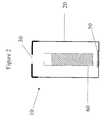
- Figure 2 shows an alternative embodiment of a biological indicator 10.
- the embodiment of the biological indicator 10 of Figure 2 is similar to the embodiment of the conductivity biological indicator 10 of Figure 1.
- the biological indicator of Figure 2 does not comprise probes 40.
- the parameter related to the concentration of minerals may be determined with a variety of methods.
- the crushable ampoule 60 of the biological indicator 10 of Figure 2 contains water, for example deionized water or distilled water.
- the aqueous solution may comprise a chemical that reacts with the mineral ion or an aqueous solution that does not contain the mineral that is to be detected.
- the water in the crushable ampoule 60 of the embodiment of the biological indicator 10 shown in Figure 2 does not support the growth of microorganisms.
- the biological indicator of Figure 2 may further comprise a second crushable ampoule (not shown) containing growth medium.
- the conductivity biological indicator 10 shown in Figure 1 may be placed in a sterilization apparatus, and a germicidal cycle may be run. Germicide may enter vial 20 through gas-permeable window 30 during the germicidal cycle. The germicide may contact the spores 50, thereby killing at least a portion of the spores 50 enclosed in vial 20.
- crushable ampoule 60 may be crushed in any suitable manner.
- vial 20 may be deformed. If the vial 20 is deformed, the walls of the vial 20 may contact the crushable ampoule 60, crushing the crushable ampoule 60.
- Crushing crushable ampoule 60 releases the aqueous solution that is contained in the crushable ampoule.
- the aqueous solution may contact the spores 50 in vial 20.
- Contacting the spores 50 with the aqueous solution contained in crushable ampoule 60 may dissolve the minerals that were contained in the spores, forming an aqueous solution comprising the minerals.
- the aqueous solution of the dissolved minerals may contact probes 40.
- a conductivity meter or other suitable device for measuring conductivity may be connected to probes 40 to measure the conductivity of the aqueous solution in vial 20.
- the conductivity of the water enclosed in vial 20 increases as the number of dead spores in the vial 20 increases.
- the increased conductivity of the aqueous solution may be related to the increased concentration of dissolved minerals, for example calcium, magnesium, sodium, or potassium, which are released from the spores when the spores are killed with the germicide.
- the increased conductivity of the water in vial 20 may be correlated with the effectiveness of the germicidal treatment by comparing the number of dead spores, determined from the conductivity of the aqueous solution in the conductivity biological indicator 10, with the initial number of live spores in the conductivity biological indicator 10.
- Wires may be connected to the probes 40 on the self-contained biological indicator 10 to transmit the conductivity of the aqueous solution enclosed in the vial 20 to a conductivity meter or other suitable device for measuring the conductivity of the aqueous solution.
- the wires may pass through the walls of the sterilization apparatus so that the conductivity results may be measured outside of the sterilization apparatus while the germicidal treatment is being performed or after the germicidal process is complete.
- the conductivity results with the conductivity biological indicator of Figure 1 may be measured either inside or outside of a sterilization or germicidal treatment apparatus.
- a method of determining the completeness of a germicidal treatment with the biological indicator 10 of Figure 2 is generally similar to the method for the conductivity biological indicator 10 of Figure 1.
- the biological indicator 10 of Figure 2 may be placed in a sterilization apparatus or germicidal treatment apparatus, and a germicidal cycle may be run.
- Germicide may enter vial 20 through gas-permeable window 30 during the germicidal cycle.
- the germicide may contact the spores 50, thereby killing at least a portion of the spores 50 enclosed in vial 20. Killing the spores 50 may release the minerals that are contained in the spores 50.
- crushable ampoule 60 may be crushed in any suitable manner.
- vial 20 may be deformed. Deforming the vial 20 may contact the walls of the vial 20 with the crushable ampoule 60, crushing the crushable ampoule 60.
- the crushable ampoule 60 of the embodiment of the biological indicator 10 of Figure 2 may be crushed inside the sterilization apparatus or germicidal treatment apparatus or may be crushed outside the apparatus.
- Crushing crushable ampoule 60 releases the water that is contained in the crushable ampoule.
- the water may contact the spores 50 contained in vial 20.
- Contacting the spores 50 with the water contained in crushable ampoule 60 may dissolve the minerals that were contained in the spores, forming an aqueous solution comprising the minerals that were released when the spores 50 in the vial 20 were killed.
- the minerals in the aqueous solution may be detected by any suitable method. Determination by conductivity is described to illustrate the method.
- Probes may be inserted into the aqueous solution comprising dissolved minerals in vial 20.
- the conductivity of the aqueous solution in the vial 20 may be determined with any suitable measuring device, for example, a conductivity meter.
- the determination of conductivity of the conductivity biological indicator 10 of Figure 2 is performed outside of the sterilization apparatus or germicidal apparatus, because the probes are inserted into the vial outside of the apparatus.
- the probes may be inserted, for example, through the gas permeable window 30.
- a portion of the vial 20 may be removed, at least temporally, in order to insert probes into the aqueous solution in the vial 20 of the conductivity biological indicator 10 of Figure 2.
- the effectiveness of the germicidal treatment may be determined from the conductivity of the aqueous solution in the vial 20 of the conductivity biological indicator 10 of Figure 2 in a manner similar to the method previously described for the conductivity biological indicator 10 of Figure 1.
- the cost of a conductivity meter is very low.
- the cost of instruments such as the derivative ultraviolet spectrometer of Felkner et al. is very high. Measuring the conductivity of a solution is very rapid, less than a minute, far faster than the 1-2 days required to obtain sterilization results from biological indicators.
- the conductivity of the aqueous solution is very sensitive to the number of dead spores.
- the conductivity increases from 1.15 ⁇ S/cm when 8.2 x 10 6 dead spores are present to 3.36 ⁇ S/cm when 8.2 x 10 7 dead spores are present.
- the 2 ⁇ S/cm change in conductivity when going from 8.2 x 10 6 dead spores to 8.2 x 10 7 dead spores is readily distinguishable.
- the conductivity of the aqueous solution in the biological indicator changes significantly as the number of dead spores increase.
- the deionized water that was used in Example 1 had a conductivity of 0.90 ⁇ S/cm.
- the total conductivities that were measured in Example 1 ranged from 0.90 ⁇ S/cm for a sample containing 1.6 x 10 4 dead spores to 50.10 ⁇ S/cm for a sample containing 1.6 x 10 9 dead spores.
- the conductivity of a sample containing 8.2 x 10 4 or fewer spores has the same conductivity as deionized water.
- the conductivity of the water may be lowered through methods such as reverse osmosis. Lowering the conductivity of the water that is used in the conductivity biological indicator would reduce the "noise" in the conductivity determination, thereby increasing the sensitivity of determining the number of dead spores in a biological indicator through conductivity measurements.
- the parameter related to the concentration of the mineral ions in the aqueous solution in a biological indicator may be determined by a wide variety of methods.
- An embodiment of determining a conductivity of the aqueous solution contained in the biological indicator is an exemplary embodiment.
- Other methods for determining the parameter related to the concentration of mineral ions in the aqueous solution may also be suitable.
- the conductivity of aqueous solutions containing various populations of live B. stearothermophilus spores was determined.
- the conductivity of the aqueous solution was approximately 0.89 ⁇ S/cm, regardless of the live spore population.
- Sterile deionized water also had a conductivity of 0.89 ⁇ S/cm. Live spores therefore do not have any significant impact on the conductivity of the aqueous solution.
- the conductivity due to the live spores and deionized water is reported as 0.90 ⁇ S/cm in all of the examples in Table 2 below.
- Varying numbers of B. stearothermophilus spores were placed onto porous glass substrates.
- the substrates and spores were treated with hydrogen peroxide/plasma in a Sterrad ® 100S Sterilizer, commercially available from Advanced Sterilization Systems, Irvine, California. All of the spores on the porous glass substrates were killed under the conditions of the experiments. Deionized water was added to the glass substrate, and the conductivities of the solutions were determined. The results are shown in Table 2 below.
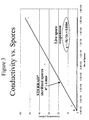
- Figure 3 shows the data graphically as a plot of conductivity versus number of dead spores.
- the conductivity of an aqueous suspension containing 8.2 x 10 6 dead spores was 1.15 ⁇ S/cm, while the conductivity of an aqueous suspension containing 1.6 x 10 9 dead spores was 50.10 ⁇ S/cm.
- An aqueous suspension containing 8.2 x 10 6 dead spores is therefore readily differentiable from a suspension having 1.6 x 10 9 dead spores.
- An aqueous suspension containing 8.2 x 10 5 dead spores has a conductivity of 0.92 ⁇ S/cm, not distinguishable from the conductivity of 0.90 ⁇ S/cm for a suspension of 8.2 x 10 4 dead spores.
- a conductivity of 1.15 ⁇ S/cm after sterilization indicates that at least 8.2 x 10 6 spores were killed during the sterilization.
- at least approximately 1.0 x 10 6 spores are utilized in the biological indicator.
- a conductivity of approximately 1.15 ⁇ S/cm in the aqueous solution after sterilization would indicate that at least 8.2 x 10 6 spores were killed.
- Utilizing a larger number of live spores in the biological indicator may provide an even higher degree of assurance that effective sterilization has been achieved when the conductivity of the aqueous solution in the conductivity biological indicator is at least 1.15 ⁇ S/cm.
- the initial number of live spores in the conductivity biological indicator may be at least approximately 1.0 x 10 7 live spores. Using a larger number of live spores provides even greater assurance that the germicidal treatment has been effective.
Landscapes
- Health & Medical Sciences (AREA)
- Life Sciences & Earth Sciences (AREA)
- Chemical & Material Sciences (AREA)
- Engineering & Computer Science (AREA)
- Immunology (AREA)
- Hematology (AREA)
- Molecular Biology (AREA)
- Biomedical Technology (AREA)
- Urology & Nephrology (AREA)
- General Health & Medical Sciences (AREA)
- Analytical Chemistry (AREA)
- Biochemistry (AREA)
- Physics & Mathematics (AREA)
- Biotechnology (AREA)
- Microbiology (AREA)
- Organic Chemistry (AREA)
- Medicinal Chemistry (AREA)
- Cell Biology (AREA)
- Pathology (AREA)
- General Physics & Mathematics (AREA)
- Wood Science & Technology (AREA)
- Food Science & Technology (AREA)
- Proteomics, Peptides & Aminoacids (AREA)
- Zoology (AREA)
- Public Health (AREA)
- Epidemiology (AREA)
- Biophysics (AREA)
- Genetics & Genomics (AREA)
- General Engineering & Computer Science (AREA)
- Bioinformatics & Cheminformatics (AREA)
- Inorganic Chemistry (AREA)
- Animal Behavior & Ethology (AREA)
- Veterinary Medicine (AREA)
- Apparatus For Disinfection Or Sterilisation (AREA)
- Measuring Or Testing Involving Enzymes Or Micro-Organisms (AREA)
- Investigating Or Analysing Biological Materials (AREA)
Applications Claiming Priority (1)
| Application Number | Priority Date | Filing Date | Title |
|---|---|---|---|
| US11/172,553 US7642067B2 (en) | 2005-06-30 | 2005-06-30 | Device and method for rapidly determining the effectiveness of sterilization or disinfection processes |
Publications (1)
| Publication Number | Publication Date |
|---|---|
| EP1739187A1 true EP1739187A1 (en) | 2007-01-03 |
Family
ID=37103140
Family Applications (1)
| Application Number | Title | Priority Date | Filing Date |
|---|---|---|---|
| EP06253408A Withdrawn EP1739187A1 (en) | 2005-06-30 | 2006-06-29 | Device and method for rapidly determining the effectiveness of sterilization or disinfection processes |
Country Status (13)
| Country | Link |
|---|---|
| US (1) | US7642067B2 (pt) |
| EP (1) | EP1739187A1 (pt) |
| JP (1) | JP2007007421A (pt) |
| KR (1) | KR20070003672A (pt) |
| CN (1) | CN101095961A (pt) |
| AR (1) | AR057419A1 (pt) |
| AU (1) | AU2006202594A1 (pt) |
| BR (1) | BRPI0602594A (pt) |
| CA (1) | CA2551380A1 (pt) |
| CO (1) | CO5780138A1 (pt) |
| RU (1) | RU2006123331A (pt) |
| TW (1) | TW200741008A (pt) |
| ZA (1) | ZA200605394B (pt) |
Cited By (6)
| Publication number | Priority date | Publication date | Assignee | Title |
|---|---|---|---|---|
| NL1037222C2 (nl) * | 2009-08-24 | 2011-02-28 | Easymeasure Developments B V | Werkwijze en inrichting voor het steriliseren of het screenen of het veredelen van een populatie van organismen. |
| WO2013177622A1 (en) * | 2012-05-31 | 2013-12-05 | Australian Biotechnologies Pty. Limited | Method validation unit |
| EP2746401A3 (en) * | 2010-07-20 | 2014-10-01 | American Sterilizer Company | Method for monitoring a sterilization process |
| US8969029B2 (en) | 2008-10-17 | 2015-03-03 | 3M Innovative Properties Company | Biological sterilization indicator, system, and methods of using same |
| EP3492114A1 (en) * | 2017-12-01 | 2019-06-05 | Ethicon, Inc. | Self-contained biological indicator |
| EP3988652A1 (en) * | 2020-10-23 | 2022-04-27 | Aden Hygiene, Ent. | Biological indicator for rapid verification of disinfection or sterilization |
Families Citing this family (33)
| Publication number | Priority date | Publication date | Assignee | Title |
|---|---|---|---|---|
| RU2436082C2 (ru) * | 2009-11-16 | 2011-12-10 | Федеральное государственное унитарное предприятие "Государственный научно-исследовательский институт биологического приборостроения" Федерального медико-биологического агентства (ФГУП "ГосНИИБП") | Способ и состав индикаторной рецептуры для экспресс-обнаружения дезинфектантов с действующим веществом окислительного характера на поверхностях объектов и выявления полноты дезинфекции |
| CN103282772B (zh) | 2010-12-22 | 2016-08-17 | 3M创新有限公司 | 包括中和剂的灭菌指示器以及方法 |
| US8858884B2 (en) * | 2013-03-15 | 2014-10-14 | American Sterilizer Company | Coupled enzyme-based method for electronic monitoring of biological indicator |
| RU2562577C1 (ru) * | 2014-06-09 | 2015-09-10 | Федеральное государственное бюджетное учреждение "Всероссийский научно-исследовательский институт по проблемам гражданской обороны и чрезвычайных ситуаций МЧС России" (федеральный центр науки и высоких технологий) | Индикаторный состав для обнаружения дезинфектантов с действующим веществом на основе четвертичных аммониевых соединений |
| RU2562563C1 (ru) * | 2014-06-09 | 2015-09-10 | Федеральное государственное бюджетное учреждение "Всероссийский научно-исследовательский институт по проблемам гражданской обороны и чрезвычайных ситуаций МЧС России" (федеральный центр науки и высоких технологий) | Индикаторный состав для обнаружения дезинфектантов с действующим веществом на основе четвертичных аммониевых соединений |
| RU2566285C1 (ru) * | 2014-06-09 | 2015-10-20 | Федеральное государственное бюджетное учреждение "Всероссийский научно-исследовательский институт по проблемам гражданской обороны и чрезвычайных ситуаций МЧС России" (федеральный центр науки и высоких технологий) | Способ экспресс-обнаружения дезинфектантов с действующим веществом на основе четвертичных аммониевых соединений |
| RU2566283C1 (ru) * | 2014-06-09 | 2015-10-20 | Федеральное государственное бюджетное учреждение "Всероссийский научно-исследовательский институт по проблемам гражданской обороны и чрезвычайных ситуаций МЧС России" (федеральный центр науки и высоких технологий) | Способ экспресс-обнаружения дезинфектантов с действующим веществом на основе четвертичных аммониевых соединений |
| RU2562578C1 (ru) * | 2014-06-09 | 2015-09-10 | Федеральное государственное бюджетное учреждение "Всероссийский научно-исследовательский институт по проблемам гражданской обороны и чрезвычайных ситуаций МЧС России" (федеральный центр науки и высоких технологий) | Индикаторный состав для обнаружения дезинфектантов с действующим веществом на основе четвертичных аммониевых соединений |
| RU2563121C1 (ru) * | 2014-06-09 | 2015-09-20 | Федеральное государственное бюджетное учреждение "Всероссийский научно-исследовательский институт по проблемам гражданской обороны и чрезвычайных ситуаций МЧС России" (федеральный центр науки и высоких технологий) | Способ экспресс-обнаружения дезинфектантов с действующим веществом на основе четвертичных аммониевых соединений |
| RU2561056C1 (ru) * | 2014-06-09 | 2015-08-20 | Федеральное государственное бюджетное учреждение "Всероссийский научно-исследовательский институт по проблемам гражданской обороны и чрезвычайных ситуаций МЧС России" (федеральный центр науки и высоких технологий) | Способ экспресс-обнаружения дезинфектантов с действующим веществом на основе четвертичных аммониевых соединений |
| RU2566286C1 (ru) * | 2014-06-09 | 2015-10-20 | Федеральное государственное бюджетное учреждение "Всероссийский научно-исследовательский институт по проблемам гражданской обороны и чрезвычайных ситуаций МЧС России" (федеральный центр науки и высоких технологий) | Способ экспресс-обнаружения дезинфектантов с действующим вещестом на основе четвертичных аммониевых соединений |
| RU2566284C1 (ru) * | 2014-06-09 | 2015-10-20 | Федеральное государственное бюджетное учреждение "Всероссийский научно-исследовательский институт по проблемам гражданской обороны и чрезвычайных ситуаций МЧС России" (федеральный центр науки и высоких технологий) | Способ экспресс-обнаружения дезинфектантов с действующим веществом на основе четвертичных аммониевых соединений |
| RU2562564C1 (ru) * | 2014-06-09 | 2015-09-10 | Федеральное государственное бюджетное учреждение "Всероссийский научно-исследовательский институт по проблемам гражданской обороны и чрезвычайных ситуаций МЧС России" (федеральный центр науки и высоких технологий) | Индикаторный состав для обнаружения дезинфектантов с действующим веществом на основе четвертичных аммониевых соединений |
| RU2562567C1 (ru) * | 2014-06-09 | 2015-09-10 | Федеральное государственное бюджетное учреждение "Всероссийский научно-исследовательский институт по проблемам гражданской обороны и чрезвычайных ситуаций МЧС России" (федеральный центр науки и высоких технологий) | Индикаторный состав для обнаружения дезинфектантов с действующим веществом на основе четвертичных аммониевых соединений |
| CN105087361A (zh) * | 2015-09-08 | 2015-11-25 | 湖州一控医疗科技有限公司 | 一种悬液式生物指示剂及其制备方法 |
| EP3408405B1 (en) * | 2016-01-25 | 2020-06-17 | American Sterilizer Company | Capacitor for detecting viable microorganisms |
| US10907126B2 (en) | 2016-03-01 | 2021-02-02 | Asp Global Manufacturing Gmbh | Self-contained biological indicator |
| US10668180B2 (en) | 2016-03-02 | 2020-06-02 | Asp Global Manufacturing Gmbh | Apparatus and method for sterilizing medical devices |
| US10561753B2 (en) | 2016-03-02 | 2020-02-18 | Asp Global Manufacturing Gmbh | Method of sterilizing medical devices, analyzing biological indicators, and linking medical device sterilization equipment |
| US10443083B2 (en) | 2016-03-02 | 2019-10-15 | Asp Global Manufacturing Gmbh | Apparatus and method for analyzing biological indicators |
| CN106434846A (zh) * | 2016-11-18 | 2017-02-22 | 马应龙药业集团股份有限公司 | 一种油性基质灭菌d值的检测方法 |
| KR102694163B1 (ko) * | 2016-12-14 | 2024-08-13 | 삼성메디슨 주식회사 | 초음파 프로브 |
| US11242505B2 (en) * | 2017-01-03 | 2022-02-08 | Asp Global Manufacturing Gmbh | Self-contained biological indicator |
| CN110268261A (zh) * | 2017-02-14 | 2019-09-20 | 莎罗雅株式会社 | 过羧酸浓度判定工具及用于其制备的指示剂溶液 |
| US11053534B2 (en) | 2017-06-30 | 2021-07-06 | Asp Global Manufacturing Gmbh | Systems and methods for confirming activation of biological indicators |
| US10889848B2 (en) | 2017-07-14 | 2021-01-12 | American Sterilizer Company | Process for determining viability of test microorganisms of biological indicator and sterilization detection device for determining same |
| US10876144B2 (en) | 2017-07-14 | 2020-12-29 | American Sterilizer Company | Process for determining viability of test microorganisms of biological indicator and sterilization detection device for determining same |
| US10900062B2 (en) | 2017-07-14 | 2021-01-26 | American Sterilizer Company | Process for determining viability of test microorganisms of biological indicator and sterilization detection device for determining same |
| US11850320B2 (en) * | 2018-12-20 | 2023-12-26 | Asp Global Manufacturing Gmbh | Liquid-chemical sterilization system with biological indicator |
| CN109701053B (zh) * | 2018-12-26 | 2020-12-04 | 宁波大学 | 消毒方法 |
| AU2020350213A1 (en) | 2019-09-20 | 2022-03-31 | Asp Global Manufacturing Gmbh | Biological indicator for use with a liquid sterilant |
| CA3197939A1 (en) | 2020-11-10 | 2022-05-19 | Nick N. Nguyen | Ampoule breaker for a biological indicator |
| US11603551B2 (en) | 2020-12-02 | 2023-03-14 | Steritec Products Mfg. Co., Inc. | Biological indicators, and systems and methods for determining efficacy of sterilization |
Citations (2)
| Publication number | Priority date | Publication date | Assignee | Title |
|---|---|---|---|---|
| WO2000066763A1 (en) * | 1999-05-03 | 2000-11-09 | Icf Technologies, Inc. | Methods, compositions and kits for biological indicator of sterilization |
| US20030064427A1 (en) * | 2001-09-15 | 2003-04-03 | Icf Technologies, Inc. | Kits and methods for determining the effectiveness of sterilization of disinfection processes |
Family Cites Families (9)
| Publication number | Priority date | Publication date | Assignee | Title |
|---|---|---|---|---|
| US4756882A (en) * | 1985-06-21 | 1988-07-12 | Surgikos Inc. | Hydrogen peroxide plasma sterilization system |
| US5486459A (en) * | 1989-12-14 | 1996-01-23 | Medical College Of Ohio | Biologically relevant methods for the rapid determination of sterility |
| AU687819B2 (en) * | 1993-08-09 | 1998-03-05 | Johnson & Johnson Medical, Inc. | Self-contained biological indicator |
| US6325972B1 (en) * | 1998-12-30 | 2001-12-04 | Ethicon, Inc. | Apparatus and process for concentrating a liquid sterilant and sterilizing articles therewith |
| US6355448B1 (en) * | 1998-06-02 | 2002-03-12 | 3M Innovative Properties Company | Sterilization indicator with chemically stabilized enzyme |
| US6365102B1 (en) * | 1999-03-31 | 2002-04-02 | Ethicon, Inc. | Method of enhanced sterilization with improved material compatibility |
| US6528277B1 (en) * | 1999-11-22 | 2003-03-04 | 3M Innovative Properties Company | Indicator systems for determination of sterilization |
| US6447719B1 (en) * | 2000-10-02 | 2002-09-10 | Johnson & Johnson | Power system for sterilization systems employing low frequency plasma |
| US6436659B1 (en) * | 2000-10-27 | 2002-08-20 | Ethicon, Inc. | Biological indicator for sterilization processes with double buffer system |
-
2005
- 2005-06-30 US US11/172,553 patent/US7642067B2/en not_active Expired - Lifetime
-
2006
- 2006-06-19 AU AU2006202594A patent/AU2006202594A1/en not_active Abandoned
- 2006-06-29 EP EP06253408A patent/EP1739187A1/en not_active Withdrawn
- 2006-06-29 CA CA002551380A patent/CA2551380A1/en not_active Abandoned
- 2006-06-29 RU RU2006123331/15A patent/RU2006123331A/ru not_active Application Discontinuation
- 2006-06-29 ZA ZA200605394A patent/ZA200605394B/xx unknown
- 2006-06-29 TW TW095123450A patent/TW200741008A/zh unknown
- 2006-06-29 JP JP2006180074A patent/JP2007007421A/ja active Pending
- 2006-06-29 AR ARP060102804A patent/AR057419A1/es not_active Application Discontinuation
- 2006-06-30 BR BRPI0602594-3A patent/BRPI0602594A/pt not_active Application Discontinuation
- 2006-06-30 CO CO06063860A patent/CO5780138A1/es not_active Application Discontinuation
- 2006-06-30 CN CNA2006101060950A patent/CN101095961A/zh active Pending
- 2006-06-30 KR KR1020060060622A patent/KR20070003672A/ko not_active Withdrawn
Patent Citations (2)
| Publication number | Priority date | Publication date | Assignee | Title |
|---|---|---|---|---|
| WO2000066763A1 (en) * | 1999-05-03 | 2000-11-09 | Icf Technologies, Inc. | Methods, compositions and kits for biological indicator of sterilization |
| US20030064427A1 (en) * | 2001-09-15 | 2003-04-03 | Icf Technologies, Inc. | Kits and methods for determining the effectiveness of sterilization of disinfection processes |
Non-Patent Citations (1)
| Title |
|---|
| WARTH A D: "DETERMINATION OF DIPICOLINIC ACID IN BACTERIAL SPORES BY DERIVATIVE SPECTROSCOPY", ANALYTICAL BIOCHEMISTRY, ACADEMIC PRESS, NEW YORK, NY, US, vol. 130, no. 2, 1983, pages 502 - 505, XP009050883, ISSN: 0003-2697 * |
Cited By (9)
| Publication number | Priority date | Publication date | Assignee | Title |
|---|---|---|---|---|
| US8969029B2 (en) | 2008-10-17 | 2015-03-03 | 3M Innovative Properties Company | Biological sterilization indicator, system, and methods of using same |
| US9717812B2 (en) | 2008-10-17 | 2017-08-01 | 3M Innovative Properties Co. | Biological sterilization indicator, system, and methods of using same |
| NL1037222C2 (nl) * | 2009-08-24 | 2011-02-28 | Easymeasure Developments B V | Werkwijze en inrichting voor het steriliseren of het screenen of het veredelen van een populatie van organismen. |
| EP2746401A3 (en) * | 2010-07-20 | 2014-10-01 | American Sterilizer Company | Method for monitoring a sterilization process |
| WO2013177622A1 (en) * | 2012-05-31 | 2013-12-05 | Australian Biotechnologies Pty. Limited | Method validation unit |
| AU2013270444B2 (en) * | 2012-05-31 | 2014-10-09 | Australian Biotechnologies Pty. Limited | Method validation unit |
| EP3492114A1 (en) * | 2017-12-01 | 2019-06-05 | Ethicon, Inc. | Self-contained biological indicator |
| AU2018271298B2 (en) * | 2017-12-01 | 2023-03-30 | Asp Global Manufacturing Gmbh | Self-contained biological indicator |
| EP3988652A1 (en) * | 2020-10-23 | 2022-04-27 | Aden Hygiene, Ent. | Biological indicator for rapid verification of disinfection or sterilization |
Also Published As
| Publication number | Publication date |
|---|---|
| US7642067B2 (en) | 2010-01-05 |
| ZA200605394B (en) | 2008-05-28 |
| RU2006123331A (ru) | 2008-01-10 |
| CN101095961A (zh) | 2008-01-02 |
| BRPI0602594A (pt) | 2007-02-21 |
| JP2007007421A (ja) | 2007-01-18 |
| AR057419A1 (es) | 2007-12-05 |
| AU2006202594A1 (en) | 2007-01-18 |
| CO5780138A1 (es) | 2007-07-31 |
| CA2551380A1 (en) | 2006-12-30 |
| KR20070003672A (ko) | 2007-01-05 |
| TW200741008A (en) | 2007-11-01 |
| US20070003995A1 (en) | 2007-01-04 |
Similar Documents
| Publication | Publication Date | Title |
|---|---|---|
| US7642067B2 (en) | Device and method for rapidly determining the effectiveness of sterilization or disinfection processes | |
| US7183048B2 (en) | Kits and methods for determining the effectiveness of sterilization of disinfection processes | |
| US8822174B1 (en) | Sterilization indicator for oxidative sterilants | |
| EP2344664B1 (en) | Biological articles and methods for monitoring sterilization processes | |
| CN106794271B (zh) | 使用耐灭菌剂调节物的生物灭菌指示器 | |
| US11053534B2 (en) | Systems and methods for confirming activation of biological indicators | |
| US7326562B2 (en) | Biological indicator system to detect effectiveness of sterilization | |
| US6942989B2 (en) | Methods, compositions and kits for biological indicator of sterilization | |
| AU777746B2 (en) | Methods, compositions and kits for biological indicator of sterilization | |
| MXPA06007515A (en) | Device and method for rapidly determining the effectiveness of sterilization or disinfection processes | |
| WO2020136608A1 (en) | Instant read-out biological indicator | |
| WO2020136613A1 (en) | Instant read-out biological indicator with growth confirmation |
Legal Events
| Date | Code | Title | Description |
|---|---|---|---|
| PUAI | Public reference made under article 153(3) epc to a published international application that has entered the european phase |
Free format text: ORIGINAL CODE: 0009012 |
|
| AK | Designated contracting states |
Kind code of ref document: A1 Designated state(s): AT BE BG CH CY CZ DE DK EE ES FI FR GB GR HU IE IS IT LI LT LU LV MC NL PL PT RO SE SI SK TR |
|
| AX | Request for extension of the european patent |
Extension state: AL BA HR MK YU |
|
| 17P | Request for examination filed |
Effective date: 20070608 |
|
| 17Q | First examination report despatched |
Effective date: 20070705 |
|
| AKX | Designation fees paid |
Designated state(s): AT BE BG CH CY CZ DE DK EE ES FI FR GB GR HU IE IS IT LI LT LU LV MC NL PL PT RO SE SI SK TR |
|
| GRAP | Despatch of communication of intention to grant a patent |
Free format text: ORIGINAL CODE: EPIDOSNIGR1 |
|
| STAA | Information on the status of an ep patent application or granted ep patent |
Free format text: STATUS: THE APPLICATION IS DEEMED TO BE WITHDRAWN |
|
| 18D | Application deemed to be withdrawn |
Effective date: 20090609 |