EP1740004B1 - Systeme de communication mobile - Google Patents
Systeme de communication mobile Download PDFInfo
- Publication number
- EP1740004B1 EP1740004B1 EP05727692.5A EP05727692A EP1740004B1 EP 1740004 B1 EP1740004 B1 EP 1740004B1 EP 05727692 A EP05727692 A EP 05727692A EP 1740004 B1 EP1740004 B1 EP 1740004B1
- Authority
- EP
- European Patent Office
- Prior art keywords
- base station
- specific use
- identification signal
- identification
- mobile communication
- Prior art date
- Legal status (The legal status is an assumption and is not a legal conclusion. Google has not performed a legal analysis and makes no representation as to the accuracy of the status listed.)
- Ceased
Links
Images

Classifications
-
- H—ELECTRICITY
- H04—ELECTRIC COMMUNICATION TECHNIQUE
- H04W—WIRELESS COMMUNICATION NETWORKS
- H04W48/00—Access restriction; Network selection; Access point selection
- H04W48/20—Selecting an access point
-
- H—ELECTRICITY
- H04—ELECTRIC COMMUNICATION TECHNIQUE
- H04W—WIRELESS COMMUNICATION NETWORKS
- H04W24/00—Supervisory, monitoring or testing arrangements
- H04W24/10—Scheduling measurement reports ; Arrangements for measurement reports
Definitions
- the present invention relates to a mobile communication system.
- a base station in a mobile communication system has become compact and light. Further, the base station is examined as an in-structure base station to be installed in a structure, in particular, at each home.
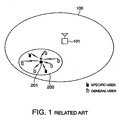
- Fig. 1 shows a mobile communication system according to a related art, in which a large covered area (or, service area) 100 having an existing base station 101 includes an in-structure base station 201 having a small cover area (or, service area) 200, and the covered area 100 of the existing base station 101 includes the covered area 200 of the in-structure base station 201.
- the in-structure base station 201 Upon using the base station as the in-structure base station 201 as mentioned above, the in-structure base station 201 is used only by a specific user (user of the in-structure base station 201 is assumed), it is required that a general user that unexpectedly enters the covered area 200 of the in-structure base station 201 cannot use resources.
- the current mobile communication system does not correspond to access limit varied depending on users or base stations as the unit basis.
- a downlink common channel should send data compatible with that of the existing base station.
- a terminal that is not allowed to use the resource of the in-structure base station and the home base station can access and use the resource. If the identification is devised on a network, the request of positional registration or of calling from the terminal cannot be prevented.
- Japanese Patent No. 2953113 discloses a method by which each mobile station stores an identification number of an accessible base station, the stored identification number is compared with a base station ID number in a downlink common channel, and the access is permitted only when both the identification numbers match each other. It is not practical that all base station ID numbers that are permitted (or are not permitted) with respect to the access are stored and one base station ID number is compared with all ones every time.
- DE 196 43 186 A1 discloses a wireless connection of mobile communication terminals to public, private or home communication area base stations. Identifications of communication areas to which mobile communication terminals subscribe are stored in the communication terminals. Priorities can be allocated to stored identifications. When access to various areas is possible the mobile communication terminal accesses the area with the highest priority as far as stored identification is concerned.
- WO 99/14974 A1 discloses a mobile cellular communications system and method, which limit access to private network cells only to mobile terminals that are used by subscribers to those private networks.
- cells belonging to the public network only information about the public cells is broadcast on the public system information control channels. This public cell information is thus the only cell information that the non-subscribers' mobile terminals are able to receive.
- the public network transmits a radio link control message to that mobile terminal, which contains information about the candidate cells for selection associated with the private network(s) involved.
- the private network transmits system information via the private cell to a subscribing mobile terminal about the private and public cells' neighboring cells.
- the subscribing mobile terminal will regard the public network cells and private network cells as integral parts of the overall cellular system. Cells associated with private networks to which that mobile terminal's end user is a "non-subscriber" are thus "invisible" to that mobile terminal.
- a mobile communication system in which a general user cannot access a base station for specific use and a specific user thus can occupy and use the base station for specific use.
- a mobile communication system comprises a base station and a terminal, wherein the base station is adapted to allow a downlink signal to include not only a base station ID number indicating the base station but also an identification signal for specific use indicating that the base station is for specific use and to send the downlink signal, and the terminal comprises a memory that is adapted to store a list of base station ID numbers of an accessible base station or an inaccessible base station for every identification signal for specific use, and to search whether or not the base station ID numbers in the received downlink signal is in the list of base station ID numbers for every detected identification signal for specific use when the identification signal for specific use detected from the downlink signal is ON, to determine whether or not access to the base station is permitted on the basis of the search in the list of base station ID numbers, and to perform communication with the base station only when the access is permitted.
- the base station comprises an identification signal generation unit that is adapted to generate the identification signal for specific use being ON if the access to the base station is limited and a modulation unit that is adapted to allow the generated identification signal for specific use and the base station identification signal to be included in the downlink signal, and to send the downlink signal.
- a general user cannot access the base station for specific use.
- the present invention it is possible to prevent the use of resources of a base station from a general user other than a specific user and the deterioration in service quality to the specific user as the using result in an in-structure base station or home base station that is assumed to provide services to the specific user.
- a relatively easy method can accomplish the access limit varied depending on the terminal and the base station only between the terminal and the base station, which can be conventionally realized only at the core of a mobile communication network, e.g., a management center of user information.
- a base station ID number indicating a base station but also an identification signal for specific use indicating a base station for specific use (for in-structure, home, or hot spot) is added to a downlink common channel for sending data from the base station.
- a terminal stores a list of base station ID number of an accessible (or inaccessible) base station every identification signal for specific use. Upon detecting the received identification signal for specific use from the downlink common channel, the received base station ID number in the downlink common channel is searched from the list of base station ID numbers of the detected identification signal for specific use and communication is performed only when the access of the base station ID number is permitted.
- the list of base station ID number for each identification signals for specific use is stored in a memory such as an SIM (Subscriber Identify Module). Alternatively, it may be written by a shop or may be rewritten during the communication.
- SIM Subscriber Identify Module
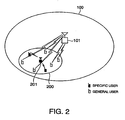
- a mobile communication system according to the present invention will be described with reference to Fig. 2 .
- the mobile communication system shown in Fig. 2 has such an arrangement that a large covered area (or, service area) 100 of an existing base station 101 includes an in-structure base station 201 of a small covered area (or, service area) 200 and the covered area 100 of the existing base station 101 includes the covered area 200 of the in-structure base station 201.
- the present invention provides the mobile communication system in which a specific user (user of the in-structure base station 201) can occupy and use the base station 201 by preventing the access of general users to the base station 201 for specific use, as shown in Fig. 2 . That is, according to the present invention, the resource assigned to the specific user is assured by preventing the access of general users to the in-structure base station 201.
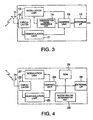
- Fig. 3 shows the structure of a mobile communication system base station (hereinafter, simply referred to as a base station) in a mobile communication system according to the first embodiment of the present invention.
- an identification signal generation unit 14 generates an identification signal for specific use indicating the base station for specific user (in-structure, home, or hot spot), and sends the identification signal to a modulation unit 13.
- the identification signal for specific use is generated in accordance with an instruction from a control unit 15 or an external instruction via an external 1/F (interface) 16.
- identification signal generation unit 14 can partly form the control unit 15.
- the modulation unit 13 multiplexes and modulates the identification signal for specific use as well as another control signal or user data sent from the control unit 15 and the base-station identification signal of the base station, and sends the multiplexed and modulated signals via a circulator 12 and an antenna 11.
- a demodulation unit 17 has a function for demodulating a signal sent from the terminal.
- the antenna 11, the circulator 12, the modulation unit 13, the demodulation unit 17, and the external 1/F 16 are well known by those in the art and do not directly relate to the present invention. Accordingly, a specific description thereof is omitted.
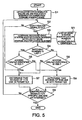
- Fig. 4 shows the structure of a mobile communication terminal (hereinafter, referred to as a terminal) in the mobile communication system according to the first embodiment.
- a signal sent from the base station is captured to a demodulation unit 23 via an antenna 21 and a circulator 22, and the identification signal for specific use is received.
- the identification signal for specific use is sent from a control unit 24 to an access YES/NO determination unit 26, and is determined on the basis of the list of base station ID number for each identification signal for specific use, stored in a ROM (Read-Only Memory) 25, whether or not the access to the base station is permitted. If it is determined that the access is permitted, an up sending signal is generated by a modulation unit 27 and is sent via the circulator 22 and the antenna 21.
- the access YES/NO determination unit 26 can partly form the control unit 24.
- the antenna 21, the circulator 22, the modulation unit 27, the demodulation unit 23, and the terminal 1/F 28 are well known by those in the art and do not directly relate to the present invention. Thus, a specific description thereof is omitted.
- the demodulation unit obtains the identification signal for specific use and the base station ID number from a downlink reception signal (S1). Subsequently, it is determined whether or not the identification signal for specific use corresponding to the specific use, indicated by the received identification signal for specific use, is ON (S2). If it is determined that the identification signal for specific use is OFF, the access is not limited and it is therefore determined that the access is permitted (S7).
- the received base station ID number is searched in the list of base station ID number, stored in a memory 25 (M1 in Fig. 5 ) of the terminal (S3). It is noted that the list can be "null”. If the list is "null", the matching number does not always exist.
- an access YES/NO identifier stored in the memory 25 is checked (S5). If the access YES/NO identifier indicates YES, it is determined that the access is permitted (S7). If not so, it is determined that the access is not permitted (S8).
- the access YES/NO identifier (M1) is checked (S6). If the access is permitted in S6, on the contrary to S5, it is determined that the access is not permitted (S8). If not so, it is determined that the access is permitted (S7).
- the processing returns to S2 and the processing is performed (S9). After all processing is performed, the sequence ends.
- the control unit 15 in the base station directly determines whether or not the identification signal for specific use is generated.
- an upper layer of the control unit on a mobile communication network determines it and notifies the result to the base station. Further, an instruction from the upper layer and processing of the base station control unit can be combined.
- a service provider can be uniquely determined depending on the setting place or the setting object. Further, information such as the resource using situation or time zone of the base station is added and can be sequentially switched.
- the terminal can determine whether or not the access is permitted only from the downlink common channel. Therefore, the identification is not necessary on the upper layer on the network and the access can be limited variably depending on the terminal and the base station. Further, this enables the reduction of unnecessary positional registration and of handover frequency. As a consequence, the power consumption of the terminal and the base station can be reduced.
- ON/OFF operation of the identification signal for specific use can be controlled. Even at the in-structure base station or home base station for specific user, flexible switching depending on the resource using situation and day of the week and time zone enables efficient use of equipment of the base station and the resource.
- the method according to the first embodiment is compared with the conventional method disclosed in Japanese Patent No. 2953113 .
- the terminal has to store all identification numbers of accessible base stations.
- few or tens several thousands identification numbers need to be registered. Every area movement, in the worst case, the identification numbers of all the areas need to be compared with the identification numbers of the moved base stations. Further, when the base station is added, the lists of all the terminals need to be written.
- the identification number is compared with the list of base station identification numbers. Therefore, any user is not affected by the addition and deletion of an accessible general base station.
- the list is "null” and the access YES/NO identifier is set to "access YES”. If so, the load of the processing is not caused and the user is not affected when the base station for specific use is added.
- the number of base station for specific use of one user is sufficiently 10 to 20. Therefore, if the identification number is compared with the list thereof every area movement, the amount of processing is not so large.
- the user of the fast communication needs to be able to use any host spots. Even in this case, the user that does not use the fast communication sets the list for use thereof as "null” and also sets the access YES/NO identifier as "access YES”. Further, the user that does not use the fast communication sets the list as "null” and also sets the access YES/NO identifier as "access NO”. As a consequence, the access of many specific users/base stations can be easily limited.
- the description has been given of the method for controlling the determination as the generation of the identifications signal for specific use depending on the setting place, setting object, day of the week, and the time zone.
- the user is not periodically at home and even when he is at home, the resource of the base station does not need to be occupied. Thus, the best control is not necessarily performed.
- a description is given of another mobile communication system base-station corresponding to the above case according to the present invention.
- a base station the structure of the other mobile communication system base station (hereinafter, referred to as a base station) is shown according to the present invention.
- the base station shown in Fig. 6 has additionally has an input unit 48.
- a specific user of the base station inputs whether or not the resource of the base station for specific use is occupied with the input unit and the input result is sent to a control unit 45.
- control unit 45 determines whether or not an identification signal for specific use is generated, the control unit 45 uses the input result as a determination resource upon generating the identification signal for specific use and sends the result to an identification signal generation unit 44.
- the control unit 45 sends an input result via an external 1/F 46 and receives the determination result of generating the externally-determined identification signal for specific use.
- the input unit 48 can input a resource using rate desired by the specific user, thereby enabling the fine control.
- the specific user at the setting place of the base station needs to frequently set the base station in accordance with the using situation. Only if there are any merits obtained by frequent setting operation, the user can be guided as mentioned above.
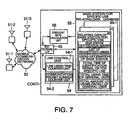
- Fig. 7 shows the structure of a mobile communication system according to the second embodiment of the present invention.
- reference numerals 51-1 to 51-3 denote base stations for specific use having the structure shown in Fig. 6 .
- the base stations periodically sends information indicating whether the identification signal for specific use is ON or OFF to a mobile communication network 52 from the identification signal generation unit 44.
- the information is sent to a control unit CONT in the mobile communication network 52 and is further sent to a base station relating database 55 (hereinafter, referred to as a database 55) for specific use via an external 1/F 53 thereof.
- the database 55 has the following information as databases every base station for specific use.
- a counter unit 54-1 of a line using time counts the using time of the line and a counter unit 54-2 of the number of communication packets counts the amount of communication packets.
- the line control unit 54 sends the counting number to the database 55. Further, the line control unit 54 simultaneously sends the identification number of the user who calls and the identification number of the base station. When the user moves from one base station to another base station during the communication, a plurality of identification numbers of the base stations that perform the communication are sent.
- the sent base station identification number is compared with the base station identification number stored in the database, and it is determined whether or not the communication is performed at the base station for specific use. If it is determined that the communication is not performed at the base station for specific use, the processing for the communication ends.
- the identification number of the user that performs the communication is compared with the list of registered users of the base station and it is checked whether or not the user is a specific user of the base station. If matching, that is, it is determined that the user is a specific user of the base station, the processing for the communication ends.
- the sent counted using time and counted number of packets are added to the "total using time of general user" and the “total number of using packets of general user", respectively.
- a base station ID number discount rate calculation unit 56 calculates a charge discount rate for user of the base station on the basis of using information of the base station stored in the database 55. Generally, as the total time of the identification signal ON for specific use is shorter and as the using time and the amount of using packets of general user are larger, the discount rate is larger to discount the charge.
- the user of the base station for specific uses actively opens the resource of the base station to general users during the time when the user does not use the base station and such a merit that the charge to be paid to the carrier by the user can be suppressed.
- the carrier can improve the using efficient of the set base station equipment, and can improve the service quality of all users as a result.
Landscapes
- Engineering & Computer Science (AREA)
- Computer Networks & Wireless Communication (AREA)
- Signal Processing (AREA)
- Computer Security & Cryptography (AREA)
- Mobile Radio Communication Systems (AREA)
Claims (9)
- Système de communication mobile comprenant une station de base (201) et un terminal,
la station de base (201) étant apte à permettre à un signal de liaison descendante d'inclure non seulement un numéro de station de base indiquant la station de base (201) mais également un signal d'identification pour un usage spécifique indiquant que la station de base (201) est destinée à un usage spécifique et envoyer le signal de liaison descendante, et
le terminal comprenant une mémoire (25) qui est apte à stocker une liste de numéros de station de base d'identification d'une station de base accessible ou d'une station de base inaccessible pour chaque signal identification pour un usage spécifique, rechercher si le numéro d'identification de station de base dans le signal de liaison descendante reçu se trouve dans la liste de numéros de station de base pour chaque signal d'identification pour un usage spécifique détecté lorsque le signal d'identification pour un usage spécifique détecté à partir du signal de liaison descendante est ON, déterminer si l'accès à la station de base est permis sur la base du résultat de la recherche dans la liste de numéros de station de base d'identification, et effectuer une communication avec la station de base uniquement lorsque l'accès est permis. - Système de communication mobile selon la revendication 1, dans lequel la station de base est apte à inclure le signal d'identification pour un usage spécifique dans un canal commun de liaison descendante et envoyer le signal.
- Système de communication mobile selon la revendication 1, comprenant en outre un réseau de communication mobile (52) relié à la station de base,
dans lequel la station de base est apte à envoyer périodiquement des informations indiquant si le signal d'identification pour un usage spécifique est envoyé, et
le réseau de communication mobile (52) est apte à envoyer les informations à une base de données (55) pour stocker les informations. - Système de communication mobile selon la revendication 3, dans lequel le réseau de communication mobile (52) comprend une unité de calcul de taux d'escompte apte à calculer un taux d'escompte de charge d'un utilisateur de la station de base sur la base de l'utilisation d'informations sur la station de base stockées dans la base de données (55).
- Système de communication mobile selon la revendication 4, dans lequel l'unité de calcul de taux d'escompte est apte à augmenter le taux d'escompte de charge de l'utilisateur de la station de base lorsque le temps total pour envoyer le signal d'identification pour un usage spécifique est court ou lorsque le temps d'utilisation ou la quantité d'utilisation de paquet d'un utilisateur général autre que l'utilisateur de la station de base est plus grand.
- Station de base dans un système de communication mobile, le système de communication mobile comprenant la station de base et un terminal,
la station de base étant apte à permettre à un signal de liaison descendante d'inclure non seulement un numéro d'identification de station de base indiquant la station de base mais également un signal d'identification pour un usage spécifique indiquant que la station de base est destinée à un usage spécifique et envoyer le signal de liaison descendante,
la station de base comprenant une unité de génération de signal d'identification (14, 44) qui est apte à générer le signal d'identification pour un usage spécifique qui est ON si l'accès à la station de base est limité et une unité de modulation (13) qui est apte à inclure le signal d'identification pour un usage spécifique généré et le signal d'identification de station de base dans le signal de liaison descendante, et envoyer le signal de liaison descendante. - Station de base selon la revendication 6, dans laquelle la station de base est apte à inclure le signal d'identification pour un usage spécifique dans un canal commun de liaison descendante et envoyer le signal.
- Station de base selon la revendication 6, comprenant en outre
une unité d'entrée (48) qui est apte à entrer si une ressource de la station de base doit être occupée,
dans laquelle l'unité de génération de signal d'identification est apte à générer le signal identification pour un usage spécifique sur la base d'un résultat d'entrée de l'unité d'entrée (48) indiquant que la ressource de la station de base doit être occupée. - Terminal dans un système de communication mobile, le système de communication mobile comprenant une station de base et le terminal,
le terminal étant apte à recevoir, en provenance de la station de base, un signal de liaison descendante comprenant non seulement un numéro d'identification de station de base indiquant la station de base mais également un signal d'identification pour un usage spécifique indiquant que la station de base est destinée à un usage spécifique, le terminal comprenant :une mémoire (25) qui est apte à stocker une liste de numéros d'identification de station de base d'une station de base accessible ou d'une station de base inaccessible pour chaque signal identification pour un usage spécifique ; etune unité de détermination (26) qui est apte à rechercher si le numéro de station de base d'identification dans le signal de liaison descendante reçu se trouve dans la liste de numéros d'identification de station de base pour chaque signal d'identification pour un usage spécifique détecté lorsque le signal d'identification pour un usage spécifique détecté à partir du signal de liaison descendante est ON, déterminer si l'accès à la station de base est permis sur la base du résultat de la recherche dans la liste de numéros de station de base d'identification, et effectuer une communication avec la station de base uniquement lorsque l'accès est permis.
Applications Claiming Priority (2)
| Application Number | Priority Date | Filing Date | Title |
|---|---|---|---|
| JP2004089003 | 2004-03-25 | ||
| PCT/JP2005/006415 WO2005094111A1 (fr) | 2004-03-25 | 2005-03-25 | Système de communication mobile |
Publications (3)
| Publication Number | Publication Date |
|---|---|
| EP1740004A1 EP1740004A1 (fr) | 2007-01-03 |
| EP1740004A4 EP1740004A4 (fr) | 2011-08-10 |
| EP1740004B1 true EP1740004B1 (fr) | 2013-10-09 |
Family
ID=35056575
Family Applications (1)
| Application Number | Title | Priority Date | Filing Date |
|---|---|---|---|
| EP05727692.5A Ceased EP1740004B1 (fr) | 2004-03-25 | 2005-03-25 | Systeme de communication mobile |
Country Status (6)
| Country | Link |
|---|---|
| US (1) | US20080171538A1 (fr) |
| EP (1) | EP1740004B1 (fr) |
| JP (1) | JP4591712B2 (fr) |
| KR (1) | KR20060124788A (fr) |
| CN (1) | CN1934894A (fr) |
| WO (1) | WO2005094111A1 (fr) |
Families Citing this family (16)
| Publication number | Priority date | Publication date | Assignee | Title |
|---|---|---|---|---|
| US8275377B2 (en) * | 2006-04-20 | 2012-09-25 | Qualcomm Incorporated | Wireless handoffs between multiple networks |
| JP2007318354A (ja) * | 2006-05-24 | 2007-12-06 | Fujitsu Ten Ltd | 移動体用通信装置および移動体用通信方法 |
| FR2907302A1 (fr) * | 2006-10-17 | 2008-04-18 | France Telecom | Procede et systeme de mobilite personnalisee par l'utilisateur dans un systeme de communication mobile |
| KR101321240B1 (ko) * | 2007-01-16 | 2013-12-19 | 삼성전자주식회사 | 이동통신시스템에서 홈셀 또는 개인네트워크로 셀 선택하는 장치 및 방법 |
| US9572089B2 (en) * | 2007-09-28 | 2017-02-14 | Interdigital Patent Holdings, Inc. | Method and apparatus for supporting home Node B services |
| US20090086672A1 (en) * | 2007-10-01 | 2009-04-02 | Qualcomm Incorporated | Equivalent home id for mobile communications |
| US20090219905A1 (en) * | 2008-03-03 | 2009-09-03 | Qualcomm Incorporated | Wireless communication collision detection |
| JP5281142B2 (ja) * | 2008-03-18 | 2013-09-04 | ノキア コーポレイション | パケットベースの無線通信システムにおいて限定加入者グループを提供するためのシステムおよび方法 |
| US9363745B2 (en) * | 2008-03-26 | 2016-06-07 | Srinivasan Balasubramanian | Device managed access point lists in wireless communications |
| JP5277712B2 (ja) * | 2008-05-12 | 2013-08-28 | 富士通株式会社 | 無線端末および無線端末における接続方法 |
| GB0810004D0 (en) * | 2008-06-02 | 2008-07-09 | Nec Corp | Microwave radio communications device and related method of operation and network arrangement |
| EP2166794A1 (fr) * | 2008-09-22 | 2010-03-24 | Mitsubishi Electric R&D Centre Europe B.V. | Procédé et dispositif permettant à un terminal mobile d'accéder un réseau de communications cellulaire sans fil |
| WO2010072025A1 (fr) * | 2008-12-24 | 2010-07-01 | 中兴通讯股份有限公司 | Procédé d'amélioration de l'accès de terminaux et système de communication sans fil associé |
| WO2010082285A2 (fr) * | 2009-01-15 | 2010-07-22 | シャープ株式会社 | Système de communication sans fil, terminal de communication mobile et procédé de connexion de communication |
| JP5472401B2 (ja) * | 2012-08-20 | 2014-04-16 | 富士通株式会社 | 無線端末、無線通信システム、および無線端末における接続方法 |
| WO2018139588A1 (fr) * | 2017-01-27 | 2018-08-02 | 日本電気株式会社 | Terminal de communication, procédé de gestion d'informations et support lisible par ordinateur |
Family Cites Families (12)
| Publication number | Priority date | Publication date | Assignee | Title |
|---|---|---|---|---|
| JP2953113B2 (ja) | 1991-06-24 | 1999-09-27 | 日本電信電話株式会社 | 移動通信方式 |
| DE4330704A1 (de) * | 1993-09-10 | 1995-03-16 | Sel Alcatel Ag | Telepoint-System |
| DE19643186C2 (de) * | 1996-10-18 | 1998-12-03 | Siemens Ag | Verfahren zum Zugreifen von mobilen Kommunikationsendgeräten auf öffentliche, private bzw. Heim-Kommunikationsbereiche |
| US5940755A (en) * | 1996-12-31 | 1999-08-17 | Mci Communications Corporation | System and method for wireless network of unlicensed personal communications service areas with local switch interfaces and enhanced customer features |
| MY119475A (en) * | 1997-01-03 | 2005-05-31 | Nokia Telecommunications Oy | Localised special services in a mobile communications system. |
| JP3260106B2 (ja) * | 1997-07-08 | 2002-02-25 | 株式会社ケンウッド | Phs端末 |
| US6058302A (en) | 1997-09-17 | 2000-05-02 | Telefonaktiebolaget L M Ericsson (Publ) | Limiting access to private networks in cellular communications systems |
| FR2778812B1 (fr) * | 1998-05-12 | 2000-06-16 | Alsthom Cge Alcatel | Systeme de radiocommunications mobiles incluant un systeme public et au moins un systeme prive |
| US6097937A (en) * | 1998-08-17 | 2000-08-01 | Telefonaktiebolaget Lm Ericsson (Publ) | System and method of implementing a private charge rate in a radio telecommunications network |
| DE60209826T2 (de) * | 2001-03-16 | 2006-10-05 | Nippon Telegraph And Telephone Corp. | Drahtloses Kommunikationssystem mit nutzereigenen Zugangspunkten |
| JP3918616B2 (ja) * | 2002-04-15 | 2007-05-23 | 株式会社デンソー | 無線通信装置及び無線通信システム |
| US7006831B2 (en) * | 2002-09-27 | 2006-02-28 | Bellsouth Intellectual Property Corporation | Apparatus and method for providing dynamic communications network traffic control |
-
2005
- 2005-03-25 EP EP05727692.5A patent/EP1740004B1/fr not_active Ceased
- 2005-03-25 US US10/599,309 patent/US20080171538A1/en not_active Abandoned
- 2005-03-25 JP JP2006511598A patent/JP4591712B2/ja not_active Expired - Fee Related
- 2005-03-25 WO PCT/JP2005/006415 patent/WO2005094111A1/fr not_active Ceased
- 2005-03-25 CN CNA2005800094898A patent/CN1934894A/zh active Pending
- 2005-03-25 KR KR1020067021989A patent/KR20060124788A/ko not_active Ceased
Also Published As
| Publication number | Publication date |
|---|---|
| JP4591712B2 (ja) | 2010-12-01 |
| WO2005094111A1 (fr) | 2005-10-06 |
| JPWO2005094111A1 (ja) | 2008-02-14 |
| EP1740004A4 (fr) | 2011-08-10 |
| KR20060124788A (ko) | 2006-12-05 |
| CN1934894A (zh) | 2007-03-21 |
| US20080171538A1 (en) | 2008-07-17 |
| EP1740004A1 (fr) | 2007-01-03 |
Similar Documents
| Publication | Publication Date | Title |
|---|---|---|
| EP1740004B1 (fr) | Systeme de communication mobile | |
| EP1471665B1 (fr) | Commutation sans interruption dans un systeme de communication sans fil a courte et longue distance | |
| EP1038412B1 (fr) | Procede pour l'allocation de ressources radio dans un systeme de communications mobile | |
| US6603968B2 (en) | Roaming in wireless networks with dynamic modification of subscriber identification | |
| FI106768B (fi) | Solunvalinta pakettiverkossa | |
| US20020058516A1 (en) | Method and apparatus for providing partitioned telecommunication services | |
| US8743766B2 (en) | Method and system for network discovery and selection in wireless network systems | |
| WO1999016267A1 (fr) | Systeme d'obtention de tarifs par reseau, destine aux abonnes mobiles itinerants | |
| US6535745B1 (en) | Paging network optimization utilizing handoff statistics | |
| KR20040036474A (ko) | 개선된 로밍 서비스를 제공하는 방법 및 이동 통신 시스템 | |
| US9357383B2 (en) | Hash key generation apparatus and method for multiple cards communication system | |
| EP1188253B1 (fr) | Procede et appareil permettant d'attribuer une station mobile a une ressource de telecommunication | |
| EP1617697B1 (fr) | L'enregistrement dans un réseau de communication mobile comportant un réseau à accès radio du type GSM/GPRS et un autre réseau à accès radio basé sur WLAN/BLuetooth | |
| EP1626599B1 (fr) | Procede permettant d'etablir une connexion de service | |
| EP1474945B1 (fr) | Reselection de cellules dans un systeme radio cellulaire | |
| US8229429B2 (en) | Position registering method, radio control station, and exchange | |
| CN100403843C (zh) | Mnc转换和不同mnc之间进行切换的方法 | |
| JP3028801B2 (ja) | 移動通信システムと移動機およびその発信方法 | |
| KR101104708B1 (ko) | 와이브로 망에서 pss를 페이징하기 위한 방법 및 시스템 | |
| AU5710498A (en) | Special handling of repeated paging | |
| KR20000061143A (ko) | 계층셀을 지원하는 이동통신 시스팀에서의 페이징 방법 | |
| HK1029244A (en) | Cell selection based on user profile in cellular radio system | |
| MXPA00002857A (en) | Network based tariff acquisition system for roaming mobile subscribers |
Legal Events
| Date | Code | Title | Description |
|---|---|---|---|
| PUAI | Public reference made under article 153(3) epc to a published international application that has entered the european phase |
Free format text: ORIGINAL CODE: 0009012 |
|
| 17P | Request for examination filed |
Effective date: 20061025 |
|
| AK | Designated contracting states |
Kind code of ref document: A1 Designated state(s): DE FR GB IT |
|
| RBV | Designated contracting states (corrected) |
Designated state(s): DE FR GB IT |
|
| DAX | Request for extension of the european patent (deleted) | ||
| A4 | Supplementary search report drawn up and despatched |
Effective date: 20110712 |
|
| 17Q | First examination report despatched |
Effective date: 20120326 |
|
| REG | Reference to a national code |
Ref country code: DE Ref legal event code: R079 Ref document number: 602005041449 Country of ref document: DE Free format text: PREVIOUS MAIN CLASS: H04Q0007380000 Ipc: H04W0048200000 |
|
| RIC1 | Information provided on ipc code assigned before grant |
Ipc: H04W 48/20 20090101AFI20121016BHEP |
|
| GRAP | Despatch of communication of intention to grant a patent |
Free format text: ORIGINAL CODE: EPIDOSNIGR1 |
|
| RIN1 | Information on inventor provided before grant (corrected) |
Inventor name: NAITO, KOSUKE Inventor name: OGAMI, TADASHI |
|
| GRAS | Grant fee paid |
Free format text: ORIGINAL CODE: EPIDOSNIGR3 |
|
| GRAP | Despatch of communication of intention to grant a patent |
Free format text: ORIGINAL CODE: EPIDOSNIGR1 |
|
| INTG | Intention to grant announced |
Effective date: 20130719 |
|
| GRAA | (expected) grant |
Free format text: ORIGINAL CODE: 0009210 |
|
| AK | Designated contracting states |
Kind code of ref document: B1 Designated state(s): DE FR GB IT |
|
| REG | Reference to a national code |
Ref country code: GB Ref legal event code: FG4D |
|
| REG | Reference to a national code |
Ref country code: DE Ref legal event code: R096 Ref document number: 602005041449 Country of ref document: DE Effective date: 20131205 |
|
| REG | Reference to a national code |
Ref country code: DE Ref legal event code: R097 Ref document number: 602005041449 Country of ref document: DE |
|
| PLBE | No opposition filed within time limit |
Free format text: ORIGINAL CODE: 0009261 |
|
| STAA | Information on the status of an ep patent application or granted ep patent |
Free format text: STATUS: NO OPPOSITION FILED WITHIN TIME LIMIT |
|
| 26N | No opposition filed |
Effective date: 20140710 |
|
| REG | Reference to a national code |
Ref country code: DE Ref legal event code: R097 Ref document number: 602005041449 Country of ref document: DE Effective date: 20140710 |
|
| REG | Reference to a national code |
Ref country code: FR Ref legal event code: PLFP Year of fee payment: 12 |
|
| REG | Reference to a national code |
Ref country code: FR Ref legal event code: PLFP Year of fee payment: 13 |
|
| REG | Reference to a national code |
Ref country code: FR Ref legal event code: PLFP Year of fee payment: 14 |
|
| PGFP | Annual fee paid to national office [announced via postgrant information from national office to epo] |
Ref country code: GB Payment date: 20180321 Year of fee payment: 14 Ref country code: DE Payment date: 20180313 Year of fee payment: 14 |
|
| PGFP | Annual fee paid to national office [announced via postgrant information from national office to epo] |
Ref country code: IT Payment date: 20180321 Year of fee payment: 14 Ref country code: FR Payment date: 20180223 Year of fee payment: 14 |
|
| REG | Reference to a national code |
Ref country code: DE Ref legal event code: R119 Ref document number: 602005041449 Country of ref document: DE |
|
| GBPC | Gb: european patent ceased through non-payment of renewal fee |
Effective date: 20190325 |
|
| PG25 | Lapsed in a contracting state [announced via postgrant information from national office to epo] |
Ref country code: DE Free format text: LAPSE BECAUSE OF NON-PAYMENT OF DUE FEES Effective date: 20191001 Ref country code: GB Free format text: LAPSE BECAUSE OF NON-PAYMENT OF DUE FEES Effective date: 20190325 |
|
| PG25 | Lapsed in a contracting state [announced via postgrant information from national office to epo] |
Ref country code: FR Free format text: LAPSE BECAUSE OF NON-PAYMENT OF DUE FEES Effective date: 20190331 Ref country code: IT Free format text: LAPSE BECAUSE OF NON-PAYMENT OF DUE FEES Effective date: 20190325 |