EP1740545B1 - Verfahren zur herstellung von montelukast und zwischenprodukte dafür - Google Patents
Verfahren zur herstellung von montelukast und zwischenprodukte dafür Download PDFInfo
- Publication number
- EP1740545B1 EP1740545B1 EP05735077A EP05735077A EP1740545B1 EP 1740545 B1 EP1740545 B1 EP 1740545B1 EP 05735077 A EP05735077 A EP 05735077A EP 05735077 A EP05735077 A EP 05735077A EP 1740545 B1 EP1740545 B1 EP 1740545B1
- Authority
- EP
- European Patent Office
- Prior art keywords
- compound
- formula
- process according
- group
- reaction
- Prior art date
- Legal status (The legal status is an assumption and is not a legal conclusion. Google has not performed a legal analysis and makes no representation as to the accuracy of the status listed.)
- Expired - Lifetime
Links
- 238000000034 method Methods 0.000 title claims abstract description 51
- 230000008569 process Effects 0.000 title claims abstract description 39
- UCHDWCPVSPXUMX-TZIWLTJVSA-N Montelukast Chemical compound CC(C)(O)C1=CC=CC=C1CC[C@H](C=1C=C(\C=C\C=2N=C3C=C(Cl)C=CC3=CC=2)C=CC=1)SCC1(CC(O)=O)CC1 UCHDWCPVSPXUMX-TZIWLTJVSA-N 0.000 title claims abstract description 30
- 229960005127 montelukast Drugs 0.000 title claims abstract description 29
- 239000000543 intermediate Substances 0.000 title description 8
- 150000001875 compounds Chemical class 0.000 claims abstract description 123
- 150000003839 salts Chemical class 0.000 claims abstract description 11
- -1 chloro, bromo, mesyloxy Chemical group 0.000 claims description 61
- 238000006243 chemical reaction Methods 0.000 claims description 55
- RTZKZFJDLAIYFH-UHFFFAOYSA-N Diethyl ether Chemical compound CCOCC RTZKZFJDLAIYFH-UHFFFAOYSA-N 0.000 claims description 47
- DVSDBMFJEQPWNO-UHFFFAOYSA-N methyllithium Chemical compound C[Li] DVSDBMFJEQPWNO-UHFFFAOYSA-N 0.000 claims description 21
- WMFOQBRAJBCJND-UHFFFAOYSA-M Lithium hydroxide Chemical group [Li+].[OH-] WMFOQBRAJBCJND-UHFFFAOYSA-M 0.000 claims description 18
- AMXOYNBUYSYVKV-UHFFFAOYSA-M lithium bromide Chemical compound [Li+].[Br-] AMXOYNBUYSYVKV-UHFFFAOYSA-M 0.000 claims description 18
- 239000002904 solvent Substances 0.000 claims description 15
- WYURNTSHIVDZCO-UHFFFAOYSA-N Tetrahydrofuran Chemical group C1CCOC1 WYURNTSHIVDZCO-UHFFFAOYSA-N 0.000 claims description 14
- 125000002496 methyl group Chemical group [H]C([H])([H])* 0.000 claims description 14
- 125000004178 (C1-C4) alkyl group Chemical group 0.000 claims description 13
- 125000005279 aryl sulfonyloxy group Chemical group 0.000 claims description 6
- 239000001257 hydrogen Substances 0.000 claims description 6
- 229910052739 hydrogen Inorganic materials 0.000 claims description 6
- YLQBMQCUIZJEEH-UHFFFAOYSA-N tetrahydrofuran Natural products C=1C=COC=1 YLQBMQCUIZJEEH-UHFFFAOYSA-N 0.000 claims description 6
- JYWKEVKEKOTYEX-UHFFFAOYSA-N 2,6-dibromo-4-chloroiminocyclohexa-2,5-dien-1-one Chemical compound ClN=C1C=C(Br)C(=O)C(Br)=C1 JYWKEVKEKOTYEX-UHFFFAOYSA-N 0.000 claims description 5
- 125000001495 ethyl group Chemical group [H]C([H])([H])C([H])([H])* 0.000 claims description 5
- 229910052736 halogen Inorganic materials 0.000 claims description 5
- 150000002367 halogens Chemical class 0.000 claims description 5
- 125000004435 hydrogen atom Chemical group [H]* 0.000 claims description 5
- 230000003301 hydrolyzing effect Effects 0.000 claims description 5
- 125000005278 alkyl sulfonyloxy group Chemical group 0.000 claims description 4
- 125000005424 tosyloxy group Chemical group S(=O)(=O)(C1=CC=C(C)C=C1)O* 0.000 claims description 4
- 238000005904 alkaline hydrolysis reaction Methods 0.000 claims description 3
- KOUKXHPPRFNWPP-UHFFFAOYSA-N pyrazine-2,5-dicarboxylic acid;hydrate Chemical compound O.OC(=O)C1=CN=C(C(O)=O)C=N1 KOUKXHPPRFNWPP-UHFFFAOYSA-N 0.000 claims description 3
- RBBWNXJFTBCLKT-UHFFFAOYSA-M sodium;ethanethioate Chemical compound [Na+].CC([S-])=O RBBWNXJFTBCLKT-UHFFFAOYSA-M 0.000 claims 1
- XEKOWRVHYACXOJ-UHFFFAOYSA-N Ethyl acetate Chemical compound CCOC(C)=O XEKOWRVHYACXOJ-UHFFFAOYSA-N 0.000 description 66
- LFQSCWFLJHTTHZ-UHFFFAOYSA-N Ethanol Chemical compound CCO LFQSCWFLJHTTHZ-UHFFFAOYSA-N 0.000 description 40
- YXFVVABEGXRONW-UHFFFAOYSA-N Toluene Chemical compound CC1=CC=CC=C1 YXFVVABEGXRONW-UHFFFAOYSA-N 0.000 description 36
- YMWUJEATGCHHMB-UHFFFAOYSA-N Dichloromethane Chemical compound ClCCl YMWUJEATGCHHMB-UHFFFAOYSA-N 0.000 description 30
- 239000000203 mixture Substances 0.000 description 30
- XLYOFNOQVPJJNP-UHFFFAOYSA-N water Substances O XLYOFNOQVPJJNP-UHFFFAOYSA-N 0.000 description 28
- 239000000243 solution Substances 0.000 description 26
- OKKJLVBELUTLKV-UHFFFAOYSA-N Methanol Chemical compound OC OKKJLVBELUTLKV-UHFFFAOYSA-N 0.000 description 24
- 239000003921 oil Substances 0.000 description 23
- 235000019198 oils Nutrition 0.000 description 23
- 239000011541 reaction mixture Substances 0.000 description 23
- 229940093499 ethyl acetate Drugs 0.000 description 22
- 235000019439 ethyl acetate Nutrition 0.000 description 22
- PMZURENOXWZQFD-UHFFFAOYSA-L Sodium Sulfate Chemical compound [Na+].[Na+].[O-]S([O-])(=O)=O PMZURENOXWZQFD-UHFFFAOYSA-L 0.000 description 19
- ZMANZCXQSJIPKH-UHFFFAOYSA-N Triethylamine Chemical compound CCN(CC)CC ZMANZCXQSJIPKH-UHFFFAOYSA-N 0.000 description 18
- 239000002253 acid Substances 0.000 description 16
- 229910052938 sodium sulfate Inorganic materials 0.000 description 16
- 239000012044 organic layer Substances 0.000 description 15
- 150000002148 esters Chemical class 0.000 description 14
- 239000007832 Na2SO4 Substances 0.000 description 13
- 230000015572 biosynthetic process Effects 0.000 description 13
- UIIMBOGNXHQVGW-UHFFFAOYSA-M Sodium bicarbonate Chemical class [Na+].OC([O-])=O UIIMBOGNXHQVGW-UHFFFAOYSA-M 0.000 description 12
- YAINYZJQSQEGND-UHFFFAOYSA-N [1-(hydroxymethyl)cyclopropyl]methanol Chemical compound OCC1(CO)CC1 YAINYZJQSQEGND-UHFFFAOYSA-N 0.000 description 11
- 239000012267 brine Substances 0.000 description 11
- 239000012043 crude product Substances 0.000 description 11
- HPALAKNZSZLMCH-UHFFFAOYSA-M sodium;chloride;hydrate Chemical compound O.[Na+].[Cl-] HPALAKNZSZLMCH-UHFFFAOYSA-M 0.000 description 11
- ZMXDDKWLCZADIW-UHFFFAOYSA-N N,N-Dimethylformamide Chemical compound CN(C)C=O ZMXDDKWLCZADIW-UHFFFAOYSA-N 0.000 description 10
- 239000000047 product Substances 0.000 description 10
- KWYUFKZDYYNOTN-UHFFFAOYSA-M Potassium hydroxide Chemical compound [OH-].[K+] KWYUFKZDYYNOTN-UHFFFAOYSA-M 0.000 description 9
- VYPSYNLAJGMNEJ-UHFFFAOYSA-N Silicium dioxide Chemical compound O=[Si]=O VYPSYNLAJGMNEJ-UHFFFAOYSA-N 0.000 description 9
- 150000002825 nitriles Chemical class 0.000 description 9
- 239000007858 starting material Substances 0.000 description 9
- WEVYAHXRMPXWCK-UHFFFAOYSA-N Acetonitrile Chemical compound CC#N WEVYAHXRMPXWCK-UHFFFAOYSA-N 0.000 description 8
- IMNFDUFMRHMDMM-UHFFFAOYSA-N N-Heptane Chemical compound CCCCCCC IMNFDUFMRHMDMM-UHFFFAOYSA-N 0.000 description 8
- DHKHKXVYLBGOIT-UHFFFAOYSA-N acetaldehyde Diethyl Acetal Natural products CCOC(C)OCC DHKHKXVYLBGOIT-UHFFFAOYSA-N 0.000 description 8
- 125000002777 acetyl group Chemical class [H]C([H])([H])C(*)=O 0.000 description 8
- 239000010410 layer Substances 0.000 description 8
- 125000003396 thiol group Chemical class [H]S* 0.000 description 8
- 238000005160 1H NMR spectroscopy Methods 0.000 description 7
- OVMNWDIMDCLADX-UHFFFAOYSA-N 2-[1-(hydroxymethyl)cyclopropyl]acetic acid Chemical compound OC(=O)CC1(CO)CC1 OVMNWDIMDCLADX-UHFFFAOYSA-N 0.000 description 7
- 239000012359 Methanesulfonyl chloride Substances 0.000 description 7
- 239000002585 base Substances 0.000 description 7
- 230000007062 hydrolysis Effects 0.000 description 7
- 238000006460 hydrolysis reaction Methods 0.000 description 7
- QARBMVPHQWIHKH-UHFFFAOYSA-N methanesulfonyl chloride Chemical compound CS(Cl)(=O)=O QARBMVPHQWIHKH-UHFFFAOYSA-N 0.000 description 7
- 238000003786 synthesis reaction Methods 0.000 description 7
- 239000006227 byproduct Substances 0.000 description 6
- 238000004440 column chromatography Methods 0.000 description 6
- QTMDXZNDVAMKGV-UHFFFAOYSA-L copper(ii) bromide Chemical compound [Cu+2].[Br-].[Br-] QTMDXZNDVAMKGV-UHFFFAOYSA-L 0.000 description 6
- 238000010511 deprotection reaction Methods 0.000 description 6
- 238000004128 high performance liquid chromatography Methods 0.000 description 6
- RCEKMFFZANHPNW-UHFFFAOYSA-N methyl 2-[1-(hydroxymethyl)cyclopropyl]acetate Chemical compound COC(=O)CC1(CO)CC1 RCEKMFFZANHPNW-UHFFFAOYSA-N 0.000 description 6
- 150000004702 methyl esters Chemical class 0.000 description 6
- FYSNRJHAOHDILO-UHFFFAOYSA-N thionyl chloride Chemical compound ClS(Cl)=O FYSNRJHAOHDILO-UHFFFAOYSA-N 0.000 description 6
- ZGYIXVSQHOKQRZ-COIATFDQSA-N (e)-n-[4-[3-chloro-4-(pyridin-2-ylmethoxy)anilino]-3-cyano-7-[(3s)-oxolan-3-yl]oxyquinolin-6-yl]-4-(dimethylamino)but-2-enamide Chemical compound N#CC1=CN=C2C=C(O[C@@H]3COCC3)C(NC(=O)/C=C/CN(C)C)=CC2=C1NC(C=C1Cl)=CC=C1OCC1=CC=CC=N1 ZGYIXVSQHOKQRZ-COIATFDQSA-N 0.000 description 5
- PVFOHMXILQEIHX-UHFFFAOYSA-N 8-[(6-bromo-1,3-benzodioxol-5-yl)sulfanyl]-9-[2-(2-bromophenyl)ethyl]purin-6-amine Chemical compound C=1C=2OCOC=2C=C(Br)C=1SC1=NC=2C(N)=NC=NC=2N1CCC1=CC=CC=C1Br PVFOHMXILQEIHX-UHFFFAOYSA-N 0.000 description 5
- QAOWNCQODCNURD-UHFFFAOYSA-N Sulfuric acid Chemical compound OS(O)(=O)=O QAOWNCQODCNURD-UHFFFAOYSA-N 0.000 description 5
- 230000001590 oxidative effect Effects 0.000 description 5
- ZRSNZINYAWTAHE-UHFFFAOYSA-N p-methoxybenzaldehyde Chemical compound COC1=CC=C(C=O)C=C1 ZRSNZINYAWTAHE-UHFFFAOYSA-N 0.000 description 5
- 229910000030 sodium bicarbonate Inorganic materials 0.000 description 5
- HEMHJVSKTPXQMS-UHFFFAOYSA-M sodium hydroxide Inorganic materials [OH-].[Na+] HEMHJVSKTPXQMS-UHFFFAOYSA-M 0.000 description 5
- 239000007787 solid Substances 0.000 description 5
- QTBSBXVTEAMEQO-UHFFFAOYSA-N Acetic acid Natural products CC(O)=O QTBSBXVTEAMEQO-UHFFFAOYSA-N 0.000 description 4
- NLXLAEXVIDQMFP-UHFFFAOYSA-N Ammonia chloride Chemical compound [NH4+].[Cl-] NLXLAEXVIDQMFP-UHFFFAOYSA-N 0.000 description 4
- IJGRMHOSHXDMSA-UHFFFAOYSA-N Atomic nitrogen Chemical compound N#N IJGRMHOSHXDMSA-UHFFFAOYSA-N 0.000 description 4
- CPELXLSAUQHCOX-UHFFFAOYSA-M Bromide Chemical compound [Br-] CPELXLSAUQHCOX-UHFFFAOYSA-M 0.000 description 4
- CDBYLPFSWZWCQE-UHFFFAOYSA-L Sodium Carbonate Chemical compound [Na+].[Na+].[O-]C([O-])=O CDBYLPFSWZWCQE-UHFFFAOYSA-L 0.000 description 4
- WPYMKLBDIGXBTP-UHFFFAOYSA-N benzoic acid Chemical group OC(=O)C1=CC=CC=C1 WPYMKLBDIGXBTP-UHFFFAOYSA-N 0.000 description 4
- 150000002009 diols Chemical class 0.000 description 4
- PATOLOIVIHYEHZ-UHFFFAOYSA-N ethyl 2-[1-(hydroxymethyl)cyclopropyl]acetate Chemical compound CCOC(=O)CC1(CO)CC1 PATOLOIVIHYEHZ-UHFFFAOYSA-N 0.000 description 4
- 239000012442 inert solvent Substances 0.000 description 4
- 239000007788 liquid Substances 0.000 description 4
- 125000005905 mesyloxy group Chemical group 0.000 description 4
- PNDWPPJIBOBEOE-UHFFFAOYSA-N methyl 2-[1-(bromomethyl)cyclopropyl]acetate Chemical compound COC(=O)CC1(CBr)CC1 PNDWPPJIBOBEOE-UHFFFAOYSA-N 0.000 description 4
- 230000002829 reductive effect Effects 0.000 description 4
- 238000010992 reflux Methods 0.000 description 4
- 229920006395 saturated elastomer Polymers 0.000 description 4
- 239000000377 silicon dioxide Substances 0.000 description 4
- 235000017557 sodium bicarbonate Nutrition 0.000 description 4
- 235000011152 sodium sulphate Nutrition 0.000 description 4
- JOXIMZWYDAKGHI-UHFFFAOYSA-N toluene-4-sulfonic acid Chemical compound CC1=CC=C(S(O)(=O)=O)C=C1 JOXIMZWYDAKGHI-UHFFFAOYSA-N 0.000 description 4
- OVDGUTHABMXVMI-UHFFFAOYSA-N 3-nitro-4-(propylamino)benzoic acid Chemical compound CCCNC1=CC=C(C(O)=O)C=C1[N+]([O-])=O OVDGUTHABMXVMI-UHFFFAOYSA-N 0.000 description 3
- QTBSBXVTEAMEQO-UHFFFAOYSA-M Acetate Chemical compound CC([O-])=O QTBSBXVTEAMEQO-UHFFFAOYSA-M 0.000 description 3
- UHOVQNZJYSORNB-UHFFFAOYSA-N Benzene Chemical compound C1=CC=CC=C1 UHOVQNZJYSORNB-UHFFFAOYSA-N 0.000 description 3
- 229910021590 Copper(II) bromide Inorganic materials 0.000 description 3
- XFXPMWWXUTWYJX-UHFFFAOYSA-N Cyanide Chemical compound N#[C-] XFXPMWWXUTWYJX-UHFFFAOYSA-N 0.000 description 3
- XDTMQSROBMDMFD-UHFFFAOYSA-N Cyclohexane Chemical compound C1CCCCC1 XDTMQSROBMDMFD-UHFFFAOYSA-N 0.000 description 3
- VEXZGXHMUGYJMC-UHFFFAOYSA-N Hydrochloric acid Chemical compound Cl VEXZGXHMUGYJMC-UHFFFAOYSA-N 0.000 description 3
- DGAQECJNVWCQMB-PUAWFVPOSA-M Ilexoside XXIX Chemical compound C[C@@H]1CC[C@@]2(CC[C@@]3(C(=CC[C@H]4[C@]3(CC[C@@H]5[C@@]4(CC[C@@H](C5(C)C)OS(=O)(=O)[O-])C)C)[C@@H]2[C@]1(C)O)C)C(=O)O[C@H]6[C@@H]([C@H]([C@@H]([C@H](O6)CO)O)O)O.[Na+] DGAQECJNVWCQMB-PUAWFVPOSA-M 0.000 description 3
- LSNNMFCWUKXFEE-UHFFFAOYSA-N Sulfurous acid Chemical compound OS(O)=O LSNNMFCWUKXFEE-UHFFFAOYSA-N 0.000 description 3
- 125000000217 alkyl group Chemical group 0.000 description 3
- HUMNYLRZRPPJDN-UHFFFAOYSA-N benzenecarboxaldehyde Natural products O=CC1=CC=CC=C1 HUMNYLRZRPPJDN-UHFFFAOYSA-N 0.000 description 3
- 125000004093 cyano group Chemical group *C#N 0.000 description 3
- 238000005886 esterification reaction Methods 0.000 description 3
- 239000000284 extract Substances 0.000 description 3
- 239000012535 impurity Substances 0.000 description 3
- 125000000956 methoxy group Chemical group [H]C([H])([H])O* 0.000 description 3
- 125000006431 methyl cyclopropyl group Chemical group 0.000 description 3
- 125000004170 methylsulfonyl group Chemical group [H]C([H])([H])S(*)(=O)=O 0.000 description 3
- 150000004682 monohydrates Chemical class 0.000 description 3
- LBFBRXGCXUHRJY-HKHDRNBDSA-M montelukast sodium Chemical compound [Na+].CC(C)(O)C1=CC=CC=C1CC[C@H](C=1C=C(\C=C\C=2N=C3C=C(Cl)C=CC3=CC=2)C=CC=1)SCC1(CC([O-])=O)CC1 LBFBRXGCXUHRJY-HKHDRNBDSA-M 0.000 description 3
- VLKZOEOYAKHREP-UHFFFAOYSA-N n-Hexane Chemical compound CCCCCC VLKZOEOYAKHREP-UHFFFAOYSA-N 0.000 description 3
- QNGNSVIICDLXHT-UHFFFAOYSA-N para-ethylbenzaldehyde Natural products CCC1=CC=C(C=O)C=C1 QNGNSVIICDLXHT-UHFFFAOYSA-N 0.000 description 3
- WSLDOOZREJYCGB-UHFFFAOYSA-N 1,2-Dichloroethane Chemical compound ClCCCl WSLDOOZREJYCGB-UHFFFAOYSA-N 0.000 description 2
- TXEBWPPWSVMYOA-UHFFFAOYSA-N 4-[3-[(1-amino-2-chloroethyl)amino]propyl]-1-[[3-(2-chlorophenyl)phenyl]methyl]-5-hydroxyimidazolidin-2-one Chemical compound NC(CCl)NCCCC1NC(=O)N(Cc2cccc(c2)-c2ccccc2Cl)C1O TXEBWPPWSVMYOA-UHFFFAOYSA-N 0.000 description 2
- TZKBVRDEOITLRB-UHFFFAOYSA-N 4-methyl-n-[4-[(4-methylpiperazin-1-yl)methyl]-3-(trifluoromethyl)phenyl]-3-[2-(1h-pyrazolo[3,4-b]pyridin-5-yl)ethynyl]benzamide Chemical compound C1CN(C)CCN1CC(C(=C1)C(F)(F)F)=CC=C1NC(=O)C1=CC=C(C)C(C#CC=2C=C3C=NNC3=NC=2)=C1 TZKBVRDEOITLRB-UHFFFAOYSA-N 0.000 description 2
- XKRFYHLGVUSROY-UHFFFAOYSA-N Argon Chemical compound [Ar] XKRFYHLGVUSROY-UHFFFAOYSA-N 0.000 description 2
- HEDRZPFGACZZDS-UHFFFAOYSA-N Chloroform Chemical compound ClC(Cl)Cl HEDRZPFGACZZDS-UHFFFAOYSA-N 0.000 description 2
- YXHKONLOYHBTNS-UHFFFAOYSA-N Diazomethane Chemical compound C=[N+]=[N-] YXHKONLOYHBTNS-UHFFFAOYSA-N 0.000 description 2
- OAKJQQAXSVQMHS-UHFFFAOYSA-N Hydrazine Chemical compound NN OAKJQQAXSVQMHS-UHFFFAOYSA-N 0.000 description 2
- 239000002841 Lewis acid Substances 0.000 description 2
- 238000005481 NMR spectroscopy Methods 0.000 description 2
- 0 Nc1cc(N=C(CC2)C=Cc(cc3[C@](CCc4c5cccc4)/C=S/CC4(CC(O)=O)CC4)cc*3C5=O)c2cc1 Chemical compound Nc1cc(N=C(CC2)C=Cc(cc3[C@](CCc4c5cccc4)/C=S/CC4(CC(O)=O)CC4)cc*3C5=O)c2cc1 0.000 description 2
- 235000019270 ammonium chloride Nutrition 0.000 description 2
- 239000007864 aqueous solution Substances 0.000 description 2
- 239000012298 atmosphere Substances 0.000 description 2
- 125000001246 bromo group Chemical group Br* 0.000 description 2
- 238000003776 cleavage reaction Methods 0.000 description 2
- 238000007796 conventional method Methods 0.000 description 2
- 239000013078 crystal Substances 0.000 description 2
- 125000002228 disulfide group Chemical group 0.000 description 2
- 230000032050 esterification Effects 0.000 description 2
- 125000004494 ethyl ester group Chemical group 0.000 description 2
- PQVSTLUFSYVLTO-UHFFFAOYSA-N ethyl n-ethoxycarbonylcarbamate Chemical compound CCOC(=O)NC(=O)OCC PQVSTLUFSYVLTO-UHFFFAOYSA-N 0.000 description 2
- 238000001704 evaporation Methods 0.000 description 2
- 238000010438 heat treatment Methods 0.000 description 2
- 125000002887 hydroxy group Chemical group [H]O* 0.000 description 2
- 239000011261 inert gas Substances 0.000 description 2
- 150000007517 lewis acids Chemical class 0.000 description 2
- GLXDVVHUTZTUQK-UHFFFAOYSA-M lithium hydroxide monohydrate Substances [Li+].O.[OH-] GLXDVVHUTZTUQK-UHFFFAOYSA-M 0.000 description 2
- 229940040692 lithium hydroxide monohydrate Drugs 0.000 description 2
- 229910052751 metal Inorganic materials 0.000 description 2
- 239000002184 metal Substances 0.000 description 2
- 239000002808 molecular sieve Substances 0.000 description 2
- 229960001951 montelukast sodium Drugs 0.000 description 2
- 238000006386 neutralization reaction Methods 0.000 description 2
- 125000000449 nitro group Chemical group [O-][N+](*)=O 0.000 description 2
- 229910052757 nitrogen Inorganic materials 0.000 description 2
- 239000012454 non-polar solvent Substances 0.000 description 2
- 238000005580 one pot reaction Methods 0.000 description 2
- 239000007800 oxidant agent Substances 0.000 description 2
- 125000001997 phenyl group Chemical group [H]C1=C([H])C([H])=C(*)C([H])=C1[H] 0.000 description 2
- NNFCIKHAZHQZJG-UHFFFAOYSA-N potassium cyanide Chemical compound [K+].N#[C-] NNFCIKHAZHQZJG-UHFFFAOYSA-N 0.000 description 2
- 125000001436 propyl group Chemical group [H]C([*])([H])C([H])([H])C([H])([H])[H] 0.000 description 2
- 238000007086 side reaction Methods 0.000 description 2
- 239000011734 sodium Substances 0.000 description 2
- 229910052708 sodium Inorganic materials 0.000 description 2
- URGAHOPLAPQHLN-UHFFFAOYSA-N sodium aluminosilicate Chemical compound [Na+].[Al+3].[O-][Si]([O-])=O.[O-][Si]([O-])=O URGAHOPLAPQHLN-UHFFFAOYSA-N 0.000 description 2
- 229910000029 sodium carbonate Inorganic materials 0.000 description 2
- 239000012265 solid product Substances 0.000 description 2
- 238000003756 stirring Methods 0.000 description 2
- 125000001424 substituent group Chemical group 0.000 description 2
- 239000000725 suspension Substances 0.000 description 2
- JRMUNVKIHCOMHV-UHFFFAOYSA-M tetrabutylammonium bromide Chemical compound [Br-].CCCC[N+](CCCC)(CCCC)CCCC JRMUNVKIHCOMHV-UHFFFAOYSA-M 0.000 description 2
- UGNWTBMOAKPKBL-UHFFFAOYSA-N tetrachloro-1,4-benzoquinone Chemical compound ClC1=C(Cl)C(=O)C(Cl)=C(Cl)C1=O UGNWTBMOAKPKBL-UHFFFAOYSA-N 0.000 description 2
- 125000002023 trifluoromethyl group Chemical group FC(F)(F)* 0.000 description 2
- 125000000391 vinyl group Chemical group [H]C([*])=C([H])[H] 0.000 description 2
- 238000005406 washing Methods 0.000 description 2
- SZUVGFMDDVSKSI-WIFOCOSTSA-N (1s,2s,3s,5r)-1-(carboxymethyl)-3,5-bis[(4-phenoxyphenyl)methyl-propylcarbamoyl]cyclopentane-1,2-dicarboxylic acid Chemical compound O=C([C@@H]1[C@@H]([C@](CC(O)=O)([C@H](C(=O)N(CCC)CC=2C=CC(OC=3C=CC=CC=3)=CC=2)C1)C(O)=O)C(O)=O)N(CCC)CC(C=C1)=CC=C1OC1=CC=CC=C1 SZUVGFMDDVSKSI-WIFOCOSTSA-N 0.000 description 1
- SHAHPWSYJFYMRX-GDLCADMTSA-N (2S)-2-(4-{[(1R,2S)-2-hydroxycyclopentyl]methyl}phenyl)propanoic acid Chemical compound C1=CC([C@@H](C(O)=O)C)=CC=C1C[C@@H]1[C@@H](O)CCC1 SHAHPWSYJFYMRX-GDLCADMTSA-N 0.000 description 1
- 238000001644 13C nuclear magnetic resonance spectroscopy Methods 0.000 description 1
- MFYSUUPKMDJYPF-UHFFFAOYSA-N 2-[(4-methyl-2-nitrophenyl)diazenyl]-3-oxo-n-phenylbutanamide Chemical compound C=1C=CC=CC=1NC(=O)C(C(=O)C)N=NC1=CC=C(C)C=C1[N+]([O-])=O MFYSUUPKMDJYPF-UHFFFAOYSA-N 0.000 description 1
- NJIAKNWTIVDSDA-FQEVSTJZSA-N 7-[4-(1-methylsulfonylpiperidin-4-yl)phenyl]-n-[[(2s)-morpholin-2-yl]methyl]pyrido[3,4-b]pyrazin-5-amine Chemical compound C1CN(S(=O)(=O)C)CCC1C1=CC=C(C=2N=C(NC[C@H]3OCCNC3)C3=NC=CN=C3C=2)C=C1 NJIAKNWTIVDSDA-FQEVSTJZSA-N 0.000 description 1
- HBAQYPYDRFILMT-UHFFFAOYSA-N 8-[3-(1-cyclopropylpyrazol-4-yl)-1H-pyrazolo[4,3-d]pyrimidin-5-yl]-3-methyl-3,8-diazabicyclo[3.2.1]octan-2-one Chemical class C1(CC1)N1N=CC(=C1)C1=NNC2=C1N=C(N=C2)N1C2C(N(CC1CC2)C)=O HBAQYPYDRFILMT-UHFFFAOYSA-N 0.000 description 1
- 239000005711 Benzoic acid Substances 0.000 description 1
- BVKZGUZCCUSVTD-UHFFFAOYSA-M Bicarbonate Chemical compound OC([O-])=O BVKZGUZCCUSVTD-UHFFFAOYSA-M 0.000 description 1
- GVPJFGJXUSBJAV-JGCGQSQUSA-N CC(C)(c1c(CC[C@H](c2cccc(/C=C/c(cc3)[n-]c4c3ccc(Cl)c4)c2)SCC2(CC(O)=O)CC2)cccc1)O Chemical compound CC(C)(c1c(CC[C@H](c2cccc(/C=C/c(cc3)[n-]c4c3ccc(Cl)c4)c2)SCC2(CC(O)=O)CC2)cccc1)O GVPJFGJXUSBJAV-JGCGQSQUSA-N 0.000 description 1
- PFKQEHVEJIQYSG-BULTVDLSSA-N COC(c1c(CC[C@@H](c2cccc(/C=C/c(cc3)nc4c3ccc(Cl)c4)c2)I)cccc1)=O Chemical compound COC(c1c(CC[C@@H](c2cccc(/C=C/c(cc3)nc4c3ccc(Cl)c4)c2)I)cccc1)=O PFKQEHVEJIQYSG-BULTVDLSSA-N 0.000 description 1
- NUFHORPXJUUAJR-MLARANPPSA-N COC(c1c(CC[C@H](C2=CC(CCc(cc3)nc4c3ccc(Cl)c4)CC=C2)S)cccc1)=O Chemical compound COC(c1c(CC[C@H](C2=CC(CCc(cc3)nc4c3ccc(Cl)c4)CC=C2)S)cccc1)=O NUFHORPXJUUAJR-MLARANPPSA-N 0.000 description 1
- QCMHGCDOZLWPOT-FMNCTDSISA-N COC1=C(CC[C@@H]2CCC3=C(C2)C=CC(=C3)[C@H]2CC[C@](N)(CO)C2)C=CC=C1 Chemical compound COC1=C(CC[C@@H]2CCC3=C(C2)C=CC(=C3)[C@H]2CC[C@](N)(CO)C2)C=CC=C1 QCMHGCDOZLWPOT-FMNCTDSISA-N 0.000 description 1
- UXVMQQNJUSDDNG-UHFFFAOYSA-L Calcium chloride Chemical compound [Cl-].[Cl-].[Ca+2] UXVMQQNJUSDDNG-UHFFFAOYSA-L 0.000 description 1
- AEMRFAOFKBGASW-UHFFFAOYSA-N Glycolic acid Chemical compound OCC(O)=O AEMRFAOFKBGASW-UHFFFAOYSA-N 0.000 description 1
- UFHFLCQGNIYNRP-UHFFFAOYSA-N Hydrogen Chemical compound [H][H] UFHFLCQGNIYNRP-UHFFFAOYSA-N 0.000 description 1
- TZYWCYJVHRLUCT-VABKMULXSA-N N-benzyloxycarbonyl-L-leucyl-L-leucyl-L-leucinal Chemical compound CC(C)C[C@@H](C=O)NC(=O)[C@H](CC(C)C)NC(=O)[C@H](CC(C)C)NC(=O)OCC1=CC=CC=C1 TZYWCYJVHRLUCT-VABKMULXSA-N 0.000 description 1
- 235000019502 Orange oil Nutrition 0.000 description 1
- WQDUMFSSJAZKTM-UHFFFAOYSA-N Sodium methoxide Chemical compound [Na+].[O-]C WQDUMFSSJAZKTM-UHFFFAOYSA-N 0.000 description 1
- CEUAHEFLZYKORM-UHFFFAOYSA-N [1-(bromomethyl)cyclopropyl]methyl 4-methoxybenzoate Chemical compound C1=CC(OC)=CC=C1C(=O)OCC1(CBr)CC1 CEUAHEFLZYKORM-UHFFFAOYSA-N 0.000 description 1
- 230000002378 acidificating effect Effects 0.000 description 1
- 150000007513 acids Chemical class 0.000 description 1
- 229910052783 alkali metal Inorganic materials 0.000 description 1
- 150000008044 alkali metal hydroxides Chemical class 0.000 description 1
- 239000000010 aprotic solvent Substances 0.000 description 1
- 229910052786 argon Inorganic materials 0.000 description 1
- 208000006673 asthma Diseases 0.000 description 1
- 238000010533 azeotropic distillation Methods 0.000 description 1
- 235000010233 benzoic acid Nutrition 0.000 description 1
- 125000003236 benzoyl group Chemical group [H]C1=C([H])C([H])=C(C([H])=C1[H])C(*)=O 0.000 description 1
- 238000009835 boiling Methods 0.000 description 1
- 125000003557 bromooxy group Chemical group BrO[*] 0.000 description 1
- 239000001110 calcium chloride Substances 0.000 description 1
- 229910001628 calcium chloride Inorganic materials 0.000 description 1
- 229910052799 carbon Inorganic materials 0.000 description 1
- 125000004432 carbon atom Chemical group C* 0.000 description 1
- BVKZGUZCCUSVTD-UHFFFAOYSA-N carbonic acid Chemical class OC(O)=O BVKZGUZCCUSVTD-UHFFFAOYSA-N 0.000 description 1
- 238000006555 catalytic reaction Methods 0.000 description 1
- KXZJHVJKXJLBKO-UHFFFAOYSA-N chembl1408157 Chemical compound N=1C2=CC=CC=C2C(C(=O)O)=CC=1C1=CC=C(O)C=C1 KXZJHVJKXJLBKO-UHFFFAOYSA-N 0.000 description 1
- 239000003153 chemical reaction reagent Substances 0.000 description 1
- 239000007910 chewable tablet Substances 0.000 description 1
- 238000004587 chromatography analysis Methods 0.000 description 1
- 229940126543 compound 14 Drugs 0.000 description 1
- 229940125782 compound 2 Drugs 0.000 description 1
- 229940125810 compound 20 Drugs 0.000 description 1
- 239000000356 contaminant Substances 0.000 description 1
- LBJNMUFDOHXDFG-UHFFFAOYSA-N copper;hydrate Chemical compound O.[Cu].[Cu] LBJNMUFDOHXDFG-UHFFFAOYSA-N 0.000 description 1
- 238000005859 coupling reaction Methods 0.000 description 1
- 238000002425 crystallisation Methods 0.000 description 1
- 230000008025 crystallization Effects 0.000 description 1
- 125000001559 cyclopropyl group Chemical group [H]C1([H])C([H])([H])C1([H])* 0.000 description 1
- 230000003247 decreasing effect Effects 0.000 description 1
- KYYUCZOHNYSLFV-UHFFFAOYSA-N diethyl cyclopropane-1,1-dicarboxylate Chemical compound CCOC(=O)C1(C(=O)OCC)CC1 KYYUCZOHNYSLFV-UHFFFAOYSA-N 0.000 description 1
- BDUPRNVPXOHWIL-UHFFFAOYSA-N dimethyl sulfite Chemical compound COS(=O)OC BDUPRNVPXOHWIL-UHFFFAOYSA-N 0.000 description 1
- IIKLEMKAKOISSP-UHFFFAOYSA-N dipropan-2-yl sulfite Chemical compound CC(C)OS(=O)OC(C)C IIKLEMKAKOISSP-UHFFFAOYSA-N 0.000 description 1
- 238000001035 drying Methods 0.000 description 1
- 125000004185 ester group Chemical group 0.000 description 1
- 239000004210 ether based solvent Substances 0.000 description 1
- 230000008020 evaporation Effects 0.000 description 1
- 239000002360 explosive Substances 0.000 description 1
- 238000000605 extraction Methods 0.000 description 1
- 239000000706 filtrate Substances 0.000 description 1
- 239000012467 final product Substances 0.000 description 1
- 239000006260 foam Substances 0.000 description 1
- 230000008570 general process Effects 0.000 description 1
- 239000008187 granular material Substances 0.000 description 1
- JAXFJECJQZDFJS-XHEPKHHKSA-N gtpl8555 Chemical compound OC(=O)C[C@H](N)C(=O)N[C@@H](CCC(O)=O)C(=O)N[C@@H](C(C)C)C(=O)N[C@@H](C(C)C)C(=O)N1CCC[C@@H]1C(=O)N[C@H](B1O[C@@]2(C)[C@H]3C[C@H](C3(C)C)C[C@H]2O1)CCC1=CC=C(F)C=C1 JAXFJECJQZDFJS-XHEPKHHKSA-N 0.000 description 1
- 125000001475 halogen functional group Chemical group 0.000 description 1
- 125000004029 hydroxymethyl group Chemical group [H]OC([H])([H])* 0.000 description 1
- 238000011065 in-situ storage Methods 0.000 description 1
- 230000000670 limiting effect Effects 0.000 description 1
- 238000004895 liquid chromatography mass spectrometry Methods 0.000 description 1
- 238000004519 manufacturing process Methods 0.000 description 1
- 238000003328 mesylation reaction Methods 0.000 description 1
- 239000012046 mixed solvent Substances 0.000 description 1
- 239000012452 mother liquor Substances 0.000 description 1
- 230000007935 neutral effect Effects 0.000 description 1
- 125000002560 nitrile group Chemical group 0.000 description 1
- 238000010641 nitrile hydrolysis reaction Methods 0.000 description 1
- 239000012299 nitrogen atmosphere Substances 0.000 description 1
- 238000010534 nucleophilic substitution reaction Methods 0.000 description 1
- 239000007935 oral tablet Substances 0.000 description 1
- 239000010502 orange oil Substances 0.000 description 1
- 239000012074 organic phase Substances 0.000 description 1
- 239000003960 organic solvent Substances 0.000 description 1
- 150000002902 organometallic compounds Chemical class 0.000 description 1
- 230000003647 oxidation Effects 0.000 description 1
- 238000007254 oxidation reaction Methods 0.000 description 1
- 230000036961 partial effect Effects 0.000 description 1
- 125000001147 pentyl group Chemical group C(CCCC)* 0.000 description 1
- 239000008177 pharmaceutical agent Substances 0.000 description 1
- 239000002244 precipitate Substances 0.000 description 1
- 238000002360 preparation method Methods 0.000 description 1
- 125000006239 protecting group Chemical group 0.000 description 1
- 238000000746 purification Methods 0.000 description 1
- ZDYVRSLAEXCVBX-UHFFFAOYSA-N pyridinium p-toluenesulfonate Chemical compound C1=CC=[NH+]C=C1.CC1=CC=C(S([O-])(=O)=O)C=C1 ZDYVRSLAEXCVBX-UHFFFAOYSA-N 0.000 description 1
- 239000012429 reaction media Substances 0.000 description 1
- 230000007017 scission Effects 0.000 description 1
- 239000000741 silica gel Substances 0.000 description 1
- 229910002027 silica gel Inorganic materials 0.000 description 1
- 159000000000 sodium salts Chemical class 0.000 description 1
- 239000011343 solid material Substances 0.000 description 1
- 150000003512 tertiary amines Chemical class 0.000 description 1
- 125000001412 tetrahydropyranyl group Chemical group 0.000 description 1
- 231100000331 toxic Toxicity 0.000 description 1
- 230000002588 toxic effect Effects 0.000 description 1
- JQSHBVHOMNKWFT-DTORHVGOSA-N varenicline Chemical compound C12=CC3=NC=CN=C3C=C2[C@H]2C[C@@H]1CNC2 JQSHBVHOMNKWFT-DTORHVGOSA-N 0.000 description 1
Classifications
-
- C—CHEMISTRY; METALLURGY
- C07—ORGANIC CHEMISTRY
- C07D—HETEROCYCLIC COMPOUNDS
- C07D215/00—Heterocyclic compounds containing quinoline or hydrogenated quinoline ring systems
- C07D215/02—Heterocyclic compounds containing quinoline or hydrogenated quinoline ring systems having no bond between the ring nitrogen atom and a non-ring member or having only hydrogen atoms or carbon atoms directly attached to the ring nitrogen atom
- C07D215/16—Heterocyclic compounds containing quinoline or hydrogenated quinoline ring systems having no bond between the ring nitrogen atom and a non-ring member or having only hydrogen atoms or carbon atoms directly attached to the ring nitrogen atom with hetero atoms or with carbon atoms having three bonds to hetero atoms with at the most one bond to halogen, e.g. ester or nitrile radicals, directly attached to ring carbon atoms
- C07D215/18—Halogen atoms or nitro radicals
-
- A—HUMAN NECESSITIES
- A61—MEDICAL OR VETERINARY SCIENCE; HYGIENE
- A61P—SPECIFIC THERAPEUTIC ACTIVITY OF CHEMICAL COMPOUNDS OR MEDICINAL PREPARATIONS
- A61P11/00—Drugs for disorders of the respiratory system
- A61P11/06—Antiasthmatics
Definitions
- the present invention relates to a process for the synthesis of montelukast, a pharmaceutical agent, as well as to intermediates useful in the process.
- Montelukast monosodium salt (montelukast sodium) is commonly used for treatment of asthma. It is marketed under the brand name SINGULAIR ® (Merck) in the form of oral tablets, chewable tablets, and granules.
- U.S. Patent No. 5,565,473 to BELLEY et al . discloses a genus of pharmaceutically useful compounds that encompasses montelukast and salts thereof.
- Example 161 in connection with example 146 of U.S. 5,565,473 disclose the synthesis of montelukast sodium as follows: THP as used herein means tetrahydropyranyl group, typically of the formula: wherein the asterisk indicates a chiral carbon atom.
- Method B in U.S. 5,565,473 comprises reacting a compound of "general formula (XII)" with an organometallic compound of formula R 2 M to give a compound of "general formula (Ia)".
- Method B comprises reacting a compound of "general formula (XII)" with an organometallic compound of formula R 2 M to give a compound of "general formula (Ia)".
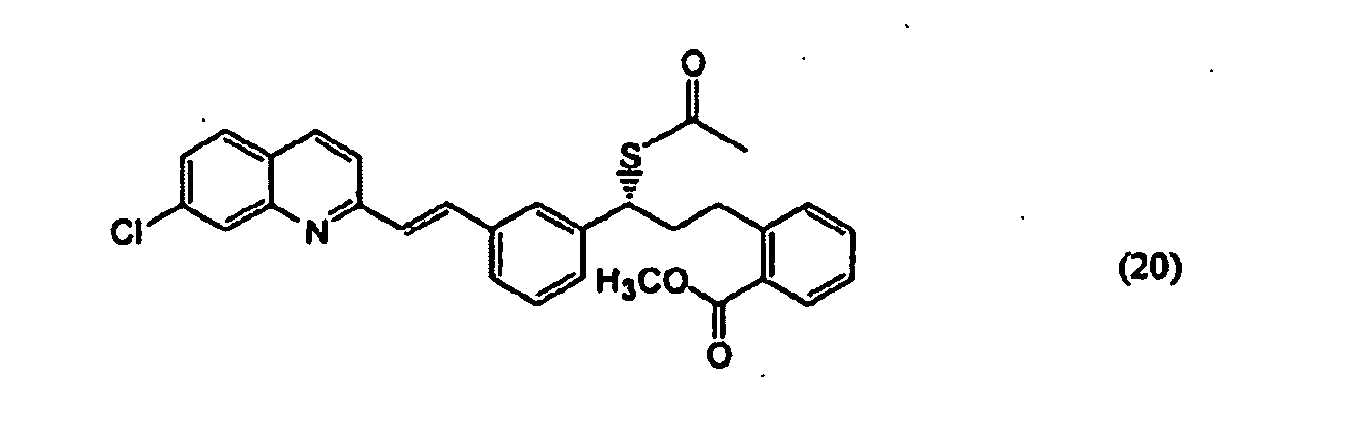
- the present invention is based on the discovery of a new process for making montelukast and the intermediates therefor. Accordingly, one aspect of the present invention relates to a compound of formula (20).
- the compound of formula (20) is useful, inter alia, in the process for making montelukast.
- Another aspect of the invention relates to a process which comprises reacting in the presence of a base a compound of formula (20): with a compound of formula (5): wherein R is hydrogen or C1-C4 alkyl group, and L is a leaving group selected from a halogen or an alkyl- or aryl-sulfonyloxy group, to form a compound of formula (2) or (2a): wherein R is a C1-C4 alkyl group.
- R is hydrogen the compound (2) is directly formed.
- R is a C1-C4 alkyl group, then the compound of formula (2a) is formed.
- L represents a chloro, bromo, mesyloxy, besyloxy or tosyloxy group and the base is lithium hydroxide.
- the reaction can take place in an inert solvent and preferably under the atmosphere of an inert gas.
- the compounds of formula (2) and (2a) can be converted to montelukast or a salt thereof.
- the conversion generally comprises reacting the compound of formula (2) with a methyl lithium compound to form montelukast of formula (1).
- the compound of formula (2a) was formed, then it is usually hydrolyzed first to form the compound of formula (2) and then reacted with the methyl lithium compound.
- Another aspect of the invention relates to a process for making montelukast from a compound of formula (20), which comprises reactively contacting a compound of formula (2) with a complex of methyl lithium and lithium bromide in a solvent preferably in an ether solvent to form montelukast of formula (1).
- the ether solvent is typically tetrahydrofuran, diethyl ether or a combination thereof.
- the reaction temperature is generally from -40°C to -10°C.
- Still another aspect of the invention relates to the use of a compound of formula (20) in the making of montelukast and its salts.
- the present invention provides a new process for making montelukast and its salts, from a compound of formula (20).
- the suitable conversion of the compound of formula (20) into the desired key intermediate of formula (2) comprises the following sequence:
- the compound (20) is subjected to a reaction with a compound of formula (5).
- the R in the compound of formula (5) may be hydrogen or an C1-C4 alkyl group, but preferably is a methyl or ethyl group.
- the leaving group L may be halogen or and C1-C4 alkyl- or C6-C8 aryl-sulfonyloxy group, and typically is a bromo group.
- the reaction of compound (20) with the compound (5) generally proceeds via a thiol intermediate (3).
- the thiol intermediates can be intentionally formed by a cleavage reaction using hydrazine or sodium methanolate, according to methods generally known in the art, prior to contacting with the compound (5). Such a two-step process is included within the scope of "reacting" the compound of formula (20) with a compound of formula (5).
- the thiol intermediate is very reactive and therefore it is also very sensitive to side reactions, particularly to the oxidation of the thiol group into a disulfide group.
- the compound of formula (5) should be added shortly after the cleavage step in order to reduce impurities/side-products; generally within three hours and typically within one hour. But more preferably the separate step of cleaving, i.e. prior to adding the compound (5) into the reaction mixture, is avoided.
- the reaction can be directed in such a way that the thiol group is formed, if at all, in situ as part of the reaction mechanism and in the presence of the compound (5). In this way, the thiol intermediate can react immediately after its formation. This can be achieved, for instance, by the use of lithium hydroxide.
- the lithium hydroxide both cleaves the S-COCH 3 bond and serves as a base for the nucleophilic substitution of the side chain (5) as well.
- This kind of reaction allows for the efficient conversion of the compound of formula (20) to a compound of formula (2) or (2a) in a one pot process and/or one step process.
- the compound of formula (5) could be added subsequently, i.e. after cleaving begins or has completed via the lithium hydroxide, in an analogous manner as the first reaction scheme embodiment, though such a method is generally not advantageous.
- the reaction normally proceeds in a solvent, which is preferably a mixed solvent containing an alcohol, for instance a methanol/acetonitrile mixture for the one pot process embodiment just described.
- the reaction is typically carried out under an atmosphere of an inert gas, such as nitrogen or argon.
- the combination of the above conditions serves to minimize the undesired side reaction of the thiol group into a disulfide group.
- the product of the reaction is an ester compound of formula (2a)
- it is normally converted by hydrolysis to provide the compound (2).
- Preferred hydrolytic conditions comprise an alkaline hydrolysis. Care is to be taken during the alkaline hydrolysis, as the second ester group (at the benzoate moiety) may also be hydrolyzed resulting in the formation of an undesired diacid.
- the diacid, if formed, may however be removed from the desired acid (2) by washing the reaction mixture with a diluted sodium carbonate solution, in which the diacid, contrary to of the acid (2), is far more soluble and may be thus removed.
- the compound of formula (2) can be converted into montelukast by any suitable means as suggested by the prior art.
- a preferred method of the present invention uses a methyl lithium compound.
- methyl lithium itself is unstable, there exist various commercial products comprising methyl lithium, e.g.. solutions of methyl lithium in various solvents, preferably in an ether solvent. It has been discovered that when the "methyl lithium compound” is a complex of methyl lithium with lithium bromide, good results can be obtained. Such a complex is also available commercially in an ether solution. Consequently, it is convenient, but not required, that the reaction of the compound (2) with the methyl lithium compound proceeds in an ether solvent.
- Typical ether solvents include tetrahydrofuran, diethyl ether and combinations thereof.
- the reaction generally proceeds under temperatures below 0°C, preferably between -10 and - 40°C. A 2-4 fold molar equivalent of methyl lithium is usually required.
- suitable method for instance by HPLC.
- the remainder of the methyl lithium compound is decomposed by conventional methods, for instance by ammonium chloride, the inorganic side products are removed by extraction with water, and the product is isolated by any suitable method.
- the product of the reaction is montelukast acid. It may be used in pharmaceutical applications per se, for instance in a solid form, which has been disclosed in U.S. Patent Application 10/960,639, filed October 8, 2004 , entitled “Solid State Montelukast,” the entire contents of which are incorporated herein by reference. Alternately, the montelukast acid may be converted into various salts, of which the sodium salt is preferred.
- a suitable process for making the starting compound of formula (20) starts from a methyl ester compound (18) as shown in the following reaction scheme:
- the compound (18) is also a known compound of the prior art (see Compound XXVII in EP 480717 ) and can be produced by Steps 1-2 of the example 146 in EP 480717 . It can be isolated in solid form as a monohydrate.
- a suitable process for conversion of the compound (18) into compound (20) comprises the following sequence:
- the OH- group in (18) is first made labile by converting it into a reactive group L such as an alkyl-or aryl sulfonyloxy group, preferably a mesyloxy group.
- the product is the compound of general formula (19).
- Preferred is the compound bearing the mesyloxy group (19a).
- the mesylation reaction comprises contacting compound (18) with methanesulfonyl chloride in an inert solvent in the presence of a suitable base, e.g. a tertiary amine such as triethylamine.
- the labile compound (19) is then converted into acetylthio ester compound (20) by reaction with a thioacetic acid or salt thereof, preferably sodium or potassium thioacetate, in an inert solvent.
- a thioacetic acid or salt thereof preferably sodium or potassium thioacetate
- the reaction normally proceeds in a suitable inert solvent such as toluene, dimethylformamide or mixtures thereof, and generally at temperatures close to and including ambient, e.g. 0-40°C.
- step 2 of Example 161 provides only a mixture of mono- and dibenzoylated diol in approximately equal yield. Apart from the fact that approx. 50% of the starting material is thereby lost, the resulting mixture of diols has to be resolved by two-fold column chromatography, which is inconvenient for scaling up.
- the compound (5) may also be produced by two novel reaction sequences starting from the compound (7).
- the scheme comprises
- This first scheme for making the starting ester compound of formula (5) relates to the surprising discovery that 1,1-cyclopropane dimethanol (7) may react with a benzaldehyde compound (8), wherein X is hydrogen, hydroxy, methoxy, halo, methyl, trifluoromethyl or nitro group, preferably the methoxy group, under conditions susceptible to form an acetal, whereby the OH-protection in the form of an acetal has the substantial advantage that selective deprotection can be done stepwise. That is, in a first deprotection step only one OH- group is liberated and subjected to further reactions, while the remaining one remains protected for the desired time and is liberated only at the moment of need.
- the formation and use of the compound of formula (9) is a particular aspect of the invention, especially in forming the compound (5).
- the reaction between (7) and (8), preferably (8a), normally proceeds in a suitable non polar solvent such as benzene, toluene, hexane or cyclohexane at temperatures up to reflux and is either catalyzed by an acid, particularly by p-toluenesulfonic acid, or proceeds under neutral conditions catalyzed by, e.g., pyridinium p-toluene sulfonate (PPTS).
- PPTS pyridinium p-toluene sulfonate
- the water formed by the reaction is advantageously removed, e.g. by azeotropic distillation, by a molecular sieve or by any other conventional process.
- the next step comprises the oxidative opening of the acetal (9) under formation of the protected nitrile (11).
- Suitable oxidant is DDQ or p-chloranil; water present in the reaction mixture should be avoided. In the presence of water, partial or complete deprotection may be obtained yielding the undesired alcohol or diol. From practical reasons, the reaction may be performed stepwise.
- the oxidative opening of the acetal ring in an anhydrous environment is performed in the presence of a bromide donor having a character of Lewis acid to produce the protected bromo compound (10).
- Suitable bromide donors include CuBr 2 , LiBr, and a combination of Bu 4 NBr/CuBr 2 .
- About one molar equivalent of DDQ is sufficient, as higher amounts generally do not increase the speed and yield of the reaction.
- Suitable solvent for the reaction is an aprotic solvent, e.g. 1,2-dichloroethane, toluene or dichloromethane; the reaction readily proceeds even at ambient temperature but may be speeded up by heating the mixture up to the boiling point; however higher temperatures often cause the formation of impurities.
- the monobenzoyl bromo derivative (10) may be advantageously purified from side products (particularly from monobenzoyl alcohol) by conventional means, e.g. by chromatography on silica gel, but can be used in the next step in a crude state as well.
- reaction of the monobenzoyl bromo derivative (10) with metal cyanide e.g. sodium or potassium cyanide yields the protected nitrile compound (11).
- metal cyanide e.g. sodium or potassium cyanide
- the reaction proceeds in a suitable solvent, e.g. ethanol/water mixture.
- reaction may directly lead to the protected nitrile (11), without forming and isolating the protected bromide.
- the benzoyl group may be removed and a deprotected nitrile (12) is formed.
- the cyano group in (12) is susceptible to a hydrolysis by the base.
- the final product of deprotection and hydrolysis is, after neutralization of the alkaline environment and removal of inorganic side products, the hydroxymethyl carboxylic acid (13).
- the reactions may be advantageously performed stepwise in as much as the split-off benzoic acid can be better removed from the product in the stage of the nitrile compound (12).
- the nitrile can be extracted well from the alkaline reaction medium by a non-polar solvent.
- a base under which only the deprotection occurs (a temperature close to ambient)
- the nitrile hydrolysis may be performed, e.g., by heating the nitrile with an alkali metal hydroxide in water, lower alcohol or in a mixture of both.
- the acid (13) is obtained. It may be isolated as a solid product and/or purified by conventional means, for instance by crystallization from a suitable solvent, for instance from ethyl acetate. Solid crystalline form of the acid (13) is another aspect of the present invention.
- the acid (13) is esterified.
- diazomethane is a toxic and explosive compound and can only form the methyl ester.
- the hydroxymethyl acid (13) which is expected to be sensitive to acidic environment/conditions, can be esterified by conventional techniques including by treatment with a corresponding alcohol under catalysis of a strong acid.
- esters of formula (14) not only the methyl ester (14a).
- the preferred ester is the methyl ester (14a) or ethyl ester (14b) formed by using methanol and ethanol, respectively. Furthermore, no column chromatography is required within the above process.
- the labile group L preferably comprises bromo- or mesyloxy group.
- Preferred compounds of formula (5) are compounds (5a) to (5d).
- the compounds (5a) and (5b) may be made by reacting the corresponding ester of formula (14) with a mesylchloride.
- a second improved process for making the ester compounds of formula (5) involves converting the starting compound of formula (7) into a compound of formula (12) by a route that can be represented by the following scheme:
- the scheme comprises:
- the compound (7) reacts with thionyl chloride or with a dialkyl sulfite, preferably dimethyl sulfite or di-isopropylsulfite to yield a cyclic sulfite compound (21).
- the alkyl groups are generally the same, although different alkyls are not excluded.
- the compound (21) is generally isolated as a solid product and, if desired, purified from side products. Whether isolated or not, the compound of formula (21) is then reacted with an alkaline metal cyanide, preferably with sodium cyanide, to form the compound of formula (12). Both of these steps (a) and (b) can be performed using the conditions described in U.S. 5,270,324 or U.S.
- Step 1 Methyl 2-(1- ⁇ [(methylsulfonyl)oxy]methylcyclopropyl)acetate (compound 5a)
- Step 1 1.1-cyclopropanedimethanol O-p-methoxybenzylidene acetal (compound 9a)
- the crude product is dissolved in heptane/ethyl acetate: 4/1 and eluted over silica.
- the filtrate is dried (Na 2 SO 4 and evaporated to give the title product.
- Step 3 the 1- p-methoxybenzoyloxymethyl)cyclopropane-1-acetonitrile (11a)
- the crude product was crystallized from ethyl acetate (1.2 g of crystals were obtained). The mother liquor was evaporated and the recovered crude product was used in the esterification reaction (7.4 g).
- Step 1 Methyl 2- ⁇ (3R)-3- ⁇ 3-[(E)-2-(7-chloro-2-quinolinyl)ethenyl]-phenyl ⁇ -5-[1-(2-methoxy-2-oxoethyl)cyclopropyl]pentyl ⁇ benzoate (2a)
- Step 2 2- ⁇ 1-[( ⁇ (1R)-1- ⁇ 3-[(E)-2-(7-chloro-2-quinolinyl)ethenyll-phenyl ⁇ -3-[2-(methoxycarbonyl)phenyl]propyl ⁇ sulfanyl)methyl]-cyclopropyl ⁇ acetic acid (compound 2)
- Step 3 2- ⁇ 1-[( ⁇ (1R)- ⁇ 3-[(E)-2-(7-chloro-2-quinolinyl)ethenyl]-phenyl ⁇ -3-[2-(1-hydroxy-1-methylethyl)phenyl]propyl ⁇ sulfanyl)methyl]-cyclopropyl ⁇ acetic acid, (compound (1)
Landscapes
- Chemical & Material Sciences (AREA)
- Organic Chemistry (AREA)
- Health & Medical Sciences (AREA)
- Pulmonology (AREA)
- Medicinal Chemistry (AREA)
- Life Sciences & Earth Sciences (AREA)
- Chemical Kinetics & Catalysis (AREA)
- General Chemical & Material Sciences (AREA)
- Engineering & Computer Science (AREA)
- Nuclear Medicine, Radiotherapy & Molecular Imaging (AREA)
- Pharmacology & Pharmacy (AREA)
- Bioinformatics & Cheminformatics (AREA)
- Animal Behavior & Ethology (AREA)
- General Health & Medical Sciences (AREA)
- Public Health (AREA)
- Veterinary Medicine (AREA)
- Organic Low-Molecular-Weight Compounds And Preparation Thereof (AREA)
- Pharmaceuticals Containing Other Organic And Inorganic Compounds (AREA)
- Quinoline Compounds (AREA)
Claims (16)
- Verfahren, welches die Umsetzung einer Verbindung der Formel (20):


- Verfahren nach Anspruch 1, bei dem L eine Chlor-, Brom-, Mesyloxy-, Besyloxy- oder Tosyloxy-Gruppe ist.
- Verfahren nach Anspruch 1 oder 2, bei dem die Base Lithiumhydroxid ist.
- Verfahren nach Anspruch 1 - 3, welches weiter die Überführung der Verbindung der Formel (2) oder (2a) in eine Verbindung der Formel (1):

- Verfahren nach Anspruch 4, bei dem der Schritt der Überführung die Umsetzung der Verbindung der Formel (2) oder (2a) mit Methyllithium zur Bildung der Verbindung der Formel (1) umfasst.
- Verfahren nach Anspruch 4 oder 6, bei dem R eine (C1-C4)-Alkylgruppe ist und bei dem der Schritt der Überführung vor der Durchführung des Reaktionsschritts mit Methyllithium zur Bildung der Verbindung der Formel (1) weiter die Hydrolyse der Verbindung der Formel (2a) zur Bildung der Verbindung der Formel (2) umfasst.
- Verfahren nach Anspruch 5 oder 6, bei dem das Methyllithium ein Komplex von Methyllithium mit Lithiumbromid ist.
- Verfahren nach Anspruch 5-7, bei dem die Umsetzung der Verbindung (2) mit Methyllithium in einem Ether-Lösungsmittel durchgeführt wird.
- Verfahren nach Anspruch 8, bei dem das Ether-Lösungsmittel Tetrahydrofuran, Diethylether oder eine Kombination derselben ist.
- Verfahren nach Anspruch 1 - 9, das weiter die Umsetzung einer Verbindung der Formel (19):

- Verfahren nach Anspruch 10, bei dem L eine Methylsulfonyloxy-Gruppe ist und die Thioessigsäure oder das Salz derselben aus Natriumthioacetat und Kaliumthioacetat ausgewählt ist.
- Verfahren, welches umfasst:(a) Umsetzen einer Verbindung der Formel (20):

 (b) Hydrolyse der Verbindung der Formel (2a), um eine Verbindung der Formel (2) zu bilden:
 (c) Umsetzen der Verbindung der Formel (2) mit einem Komplex von Methyllithium und Lithiumbromid in einem Ether-Lösungsmittel, um Montelukast der Formel (1)
- Verfahren nach Anspruch 12, bei dem L eine Chlor-, Brom-, Mesyloxy-, Besyloxy- oder Tosyloxy-Gruppe ist.
- Verfahren nach Anspruch 13, bei dem die Base Lithiumhydroxid ist, R eine Methyl- oder Ethylgruppe ist und das Ether-Lösungsmittel Tetrahydrofuran, Diethylether oder eine Kombination derselben ist.
- Verfahren nach Anspruch 12 - 14, bei dem der Hydrolyseschritt (b) eine alkalische Hydrolyse verwendet.
- Verfahren nach Anspruch 12 - 15, das weiter die Bildung eines Salzes des Montelukasts der Formel (1) umfasst.
Applications Claiming Priority (4)
| Application Number | Priority Date | Filing Date | Title |
|---|---|---|---|
| US56660304P | 2004-04-30 | 2004-04-30 | |
| US58467504P | 2004-07-02 | 2004-07-02 | |
| US11/081,689 US7829716B2 (en) | 2004-04-30 | 2005-03-17 | Process for making montelukast and intermediates therefor |
| PCT/EP2005/004014 WO2005105750A1 (en) | 2004-04-30 | 2005-04-14 | Process for making montelukast and intermediates therefor |
Publications (2)
| Publication Number | Publication Date |
|---|---|
| EP1740545A1 EP1740545A1 (de) | 2007-01-10 |
| EP1740545B1 true EP1740545B1 (de) | 2010-03-24 |
Family
ID=34965297
Family Applications (1)
| Application Number | Title | Priority Date | Filing Date |
|---|---|---|---|
| EP05735077A Expired - Lifetime EP1740545B1 (de) | 2004-04-30 | 2005-04-14 | Verfahren zur herstellung von montelukast und zwischenprodukte dafür |
Country Status (6)
| Country | Link |
|---|---|
| US (1) | US7829716B2 (de) |
| EP (1) | EP1740545B1 (de) |
| AR (1) | AR048876A1 (de) |
| AT (1) | ATE461919T1 (de) |
| DE (1) | DE602005020125D1 (de) |
| WO (1) | WO2005105750A1 (de) |
Families Citing this family (13)
| Publication number | Priority date | Publication date | Assignee | Title |
|---|---|---|---|---|
| AU2004283832B2 (en) * | 2003-10-10 | 2011-04-07 | Synthon B.V. | Solid-state montelukast |
| US7501517B2 (en) * | 2004-04-30 | 2009-03-10 | Synthon Ip, Inc. | Process for making montelukast and intermediates therefor |
| CN101213177A (zh) | 2005-07-05 | 2008-07-02 | 特瓦制药工业有限公司 | 孟鲁司特的纯化 |
| CN101365683A (zh) * | 2005-11-18 | 2009-02-11 | 斯索恩有限公司 | 制备孟鲁司特及其中间体的方法 |
| AR057908A1 (es) | 2005-11-18 | 2007-12-26 | Synthon Bv | Proceso para preparar montelukast e intermediarios del mismo |
| CN101432267A (zh) * | 2006-03-17 | 2009-05-13 | 斯索恩有限公司 | 孟鲁司特金刚烷胺盐 |
| EP1886998A1 (de) | 2006-08-09 | 2008-02-13 | Esteve Quimica, S.A. | Verfahren zur Reinigung von Montelukast und dessen Aminesalzen |
| CN101889081B (zh) | 2007-09-28 | 2014-06-18 | 科德克希思公司 | 酮还原酶多肽及其用途 |
| WO2009130056A1 (en) * | 2008-04-25 | 2009-10-29 | Synthon B.V. | Process for making montelukast intermediates |
| WO2011121091A1 (en) | 2010-03-31 | 2011-10-06 | Krka, D.D., Novo Mesto | Efficient synthesis for the preparation of montelukast and novel crystalline form of intermediates therein |
| US8471030B2 (en) | 2010-12-06 | 2013-06-25 | Orochem Technologies Inc. | Purification of montelukast using simulated moving bed |
| EP2502910A1 (de) | 2011-03-15 | 2012-09-26 | Laboratorios Lesvi, S.L. | Camphersulfonsalz eines Montelukastschlüssels Zwischenprodukt |
| US10966943B2 (en) | 2018-09-06 | 2021-04-06 | Innopharmascreen Inc. | Methods and compositions for treatment of asthma or parkinson's disease |
Family Cites Families (16)
| Publication number | Priority date | Publication date | Assignee | Title |
|---|---|---|---|---|
| CA2053209C (en) | 1990-10-12 | 1998-12-08 | Michel L. Belley | Unsaturated hydroxyalkylquinoline acids as leukotriene antagonists |
| US5565473A (en) * | 1990-10-12 | 1996-10-15 | Merck Frosst Canada, Inc. | Unsaturated hydroxyalkylquinoline acids as leukotriene antagonists |
| US5266568A (en) * | 1990-10-12 | 1993-11-30 | Merck Frosst Canada, Inc. | Hydroxyalkylquinoline ether acids as leukotriene antagonists |
| US5856322A (en) * | 1990-10-12 | 1999-01-05 | Merck Frosst Canada, Inc. | Unsaturated hydroxyalkylquinoline acids as leukotriene antagonists |
| US5270324A (en) * | 1992-04-10 | 1993-12-14 | Merck Frosst Canada, Inc. | Fluorinated hydroxyalkylquinoline acids as leukotriene antagonists |
| TW448160B (en) * | 1993-12-28 | 2001-08-01 | Merck & Co Inc | Novel dicyclohexylamine salt and process for the preparation of leukotriene antagonists |
| GB9423511D0 (en) * | 1994-11-22 | 1995-01-11 | Glaxo Wellcome Inc | Compositions |
| US5585115A (en) | 1995-01-09 | 1996-12-17 | Edward H. Mendell Co., Inc. | Pharmaceutical excipient having improved compressability |
| US5523477A (en) * | 1995-01-23 | 1996-06-04 | Merck & Co., Inc. | Process for the preparation of 1-(thiomethyl)-cyclopropaneacetic acid |
| US5869673A (en) * | 1997-02-28 | 1999-02-09 | Merck & Co., Inc. | Process for 3-(2-(7-chloro-2-quinolinyl)ethenyl) - benzaldehyde |
| US6585115B1 (en) * | 2000-11-28 | 2003-07-01 | Baker Hughes Incorporated | Apparatus and method for transferring dry oil and gas well drill cuttings |
| CN1420113A (zh) * | 2001-11-16 | 2003-05-28 | 北京上地新世纪生物医药研究所 | 孟鲁司特钠的制备方法及其制备中间体 |
| CN1171873C (zh) * | 2001-12-26 | 2004-10-20 | 北京上地新世纪生物医药研究所 | 一种孟鲁司特钠的制备方法及其制备中间体 |
| US20040265375A1 (en) * | 2003-04-16 | 2004-12-30 | Platteeuw Johannes J. | Orally disintegrating tablets |
| AU2004283832B2 (en) * | 2003-10-10 | 2011-04-07 | Synthon B.V. | Solid-state montelukast |
| US7501517B2 (en) * | 2004-04-30 | 2009-03-10 | Synthon Ip, Inc. | Process for making montelukast and intermediates therefor |
-
2005
- 2005-03-17 US US11/081,689 patent/US7829716B2/en not_active Expired - Fee Related
- 2005-04-14 AT AT05735077T patent/ATE461919T1/de not_active IP Right Cessation
- 2005-04-14 DE DE602005020125T patent/DE602005020125D1/de not_active Expired - Fee Related
- 2005-04-14 WO PCT/EP2005/004014 patent/WO2005105750A1/en not_active Ceased
- 2005-04-14 EP EP05735077A patent/EP1740545B1/de not_active Expired - Lifetime
- 2005-04-25 AR ARP050101620A patent/AR048876A1/es not_active Application Discontinuation
Also Published As
| Publication number | Publication date |
|---|---|
| WO2005105750A1 (en) | 2005-11-10 |
| AR048876A1 (es) | 2006-06-07 |
| US7829716B2 (en) | 2010-11-09 |
| EP1740545A1 (de) | 2007-01-10 |
| US20050245568A1 (en) | 2005-11-03 |
| ATE461919T1 (de) | 2010-04-15 |
| DE602005020125D1 (de) | 2010-05-06 |
Similar Documents
| Publication | Publication Date | Title |
|---|---|---|
| US7501517B2 (en) | Process for making montelukast and intermediates therefor | |
| US7829716B2 (en) | Process for making montelukast and intermediates therefor | |
| CA2472776C (en) | Process for the manufacture of hmg-coa reductase inhibitors | |
| US5401868A (en) | Aryloxymethylcarbonochloridate ester intermediates for use in synthesizing pro drugs and their use therefor | |
| US20100099879A1 (en) | Process for making montelukast and intermediates therefor | |
| ZA200403722B (en) | Process for producing optically active oxoheptenoic acid ester. | |
| CN104781231B (zh) | 制备曲伏前列素的方法 | |
| CN103833737A (zh) | 匹伐他汀或其盐的中间体的制备方法 | |
| CN101356157B (zh) | 制备孟鲁司特及其中间体的方法 | |
| JP6059157B2 (ja) | モンテルカスト中間体のカンファースルホン酸塩 | |
| JP2940395B2 (ja) | オキシグルタル酸エステル誘導体の製法 | |
| KR100502833B1 (ko) | 심바스타틴 및 이의 중간체 화합물들의 개선된 제조방법 | |
| JP2003137870A (ja) | 3,5−ジオキソ−6−ヘプテン酸誘導体類の製造方法及びその中間体 | |
| JPH11171855A (ja) | 光学活性N置換α−アミノ−γ−ハロゲノ酪酸エステルの製造方法 | |
| HK1070651B (en) | Process for the manufacture of hmg-coa reductase inhibitors | |
| JPH11124346A (ja) | シクロプロピルアセチレン誘導体の製造方法 |
Legal Events
| Date | Code | Title | Description |
|---|---|---|---|
| PUAI | Public reference made under article 153(3) epc to a published international application that has entered the european phase |
Free format text: ORIGINAL CODE: 0009012 |
|
| 17P | Request for examination filed |
Effective date: 20061024 |
|
| AK | Designated contracting states |
Kind code of ref document: A1 Designated state(s): AT BE BG CH CY CZ DE DK EE ES FI FR GB GR HU IE IS IT LI LT LU MC NL PL PT RO SE SI SK TR |
|
| DAX | Request for extension of the european patent (deleted) | ||
| 17Q | First examination report despatched |
Effective date: 20080201 |
|
| GRAP | Despatch of communication of intention to grant a patent |
Free format text: ORIGINAL CODE: EPIDOSNIGR1 |
|
| GRAS | Grant fee paid |
Free format text: ORIGINAL CODE: EPIDOSNIGR3 |
|
| GRAA | (expected) grant |
Free format text: ORIGINAL CODE: 0009210 |
|
| AK | Designated contracting states |
Kind code of ref document: B1 Designated state(s): AT BE BG CH CY CZ DE DK EE ES FI FR GB GR HU IE IS IT LI LT LU MC NL PL PT RO SE SI SK TR |
|
| REG | Reference to a national code |
Ref country code: GB Ref legal event code: FG4D |
|
| REG | Reference to a national code |
Ref country code: CH Ref legal event code: EP |
|
| REG | Reference to a national code |
Ref country code: IE Ref legal event code: FG4D |
|
| REF | Corresponds to: |
Ref document number: 602005020125 Country of ref document: DE Date of ref document: 20100506 Kind code of ref document: P |
|
| REG | Reference to a national code |
Ref country code: NL Ref legal event code: VDEP Effective date: 20100324 |
|
| PG25 | Lapsed in a contracting state [announced via postgrant information from national office to epo] |
Ref country code: LT Free format text: LAPSE BECAUSE OF FAILURE TO SUBMIT A TRANSLATION OF THE DESCRIPTION OR TO PAY THE FEE WITHIN THE PRESCRIBED TIME-LIMIT Effective date: 20100324 |
|
| LTIE | Lt: invalidation of european patent or patent extension |
Effective date: 20100324 |
|
| PG25 | Lapsed in a contracting state [announced via postgrant information from national office to epo] |
Ref country code: PL Free format text: LAPSE BECAUSE OF FAILURE TO SUBMIT A TRANSLATION OF THE DESCRIPTION OR TO PAY THE FEE WITHIN THE PRESCRIBED TIME-LIMIT Effective date: 20100324 Ref country code: FI Free format text: LAPSE BECAUSE OF FAILURE TO SUBMIT A TRANSLATION OF THE DESCRIPTION OR TO PAY THE FEE WITHIN THE PRESCRIBED TIME-LIMIT Effective date: 20100324 Ref country code: AT Free format text: LAPSE BECAUSE OF FAILURE TO SUBMIT A TRANSLATION OF THE DESCRIPTION OR TO PAY THE FEE WITHIN THE PRESCRIBED TIME-LIMIT Effective date: 20100324 Ref country code: SI Free format text: LAPSE BECAUSE OF FAILURE TO SUBMIT A TRANSLATION OF THE DESCRIPTION OR TO PAY THE FEE WITHIN THE PRESCRIBED TIME-LIMIT Effective date: 20100324 |
|
| PG25 | Lapsed in a contracting state [announced via postgrant information from national office to epo] |
Ref country code: ES Free format text: LAPSE BECAUSE OF FAILURE TO SUBMIT A TRANSLATION OF THE DESCRIPTION OR TO PAY THE FEE WITHIN THE PRESCRIBED TIME-LIMIT Effective date: 20100705 Ref country code: GR Free format text: LAPSE BECAUSE OF FAILURE TO SUBMIT A TRANSLATION OF THE DESCRIPTION OR TO PAY THE FEE WITHIN THE PRESCRIBED TIME-LIMIT Effective date: 20100625 Ref country code: NL Free format text: LAPSE BECAUSE OF FAILURE TO SUBMIT A TRANSLATION OF THE DESCRIPTION OR TO PAY THE FEE WITHIN THE PRESCRIBED TIME-LIMIT Effective date: 20100324 Ref country code: SE Free format text: LAPSE BECAUSE OF FAILURE TO SUBMIT A TRANSLATION OF THE DESCRIPTION OR TO PAY THE FEE WITHIN THE PRESCRIBED TIME-LIMIT Effective date: 20100324 Ref country code: RO Free format text: LAPSE BECAUSE OF FAILURE TO SUBMIT A TRANSLATION OF THE DESCRIPTION OR TO PAY THE FEE WITHIN THE PRESCRIBED TIME-LIMIT Effective date: 20100324 Ref country code: BE Free format text: LAPSE BECAUSE OF FAILURE TO SUBMIT A TRANSLATION OF THE DESCRIPTION OR TO PAY THE FEE WITHIN THE PRESCRIBED TIME-LIMIT Effective date: 20100324 Ref country code: EE Free format text: LAPSE BECAUSE OF FAILURE TO SUBMIT A TRANSLATION OF THE DESCRIPTION OR TO PAY THE FEE WITHIN THE PRESCRIBED TIME-LIMIT Effective date: 20100324 |
|
| PG25 | Lapsed in a contracting state [announced via postgrant information from national office to epo] |
Ref country code: IS Free format text: LAPSE BECAUSE OF FAILURE TO SUBMIT A TRANSLATION OF THE DESCRIPTION OR TO PAY THE FEE WITHIN THE PRESCRIBED TIME-LIMIT Effective date: 20100724 Ref country code: SK Free format text: LAPSE BECAUSE OF FAILURE TO SUBMIT A TRANSLATION OF THE DESCRIPTION OR TO PAY THE FEE WITHIN THE PRESCRIBED TIME-LIMIT Effective date: 20100324 Ref country code: BG Free format text: LAPSE BECAUSE OF FAILURE TO SUBMIT A TRANSLATION OF THE DESCRIPTION OR TO PAY THE FEE WITHIN THE PRESCRIBED TIME-LIMIT Effective date: 20100624 Ref country code: CZ Free format text: LAPSE BECAUSE OF FAILURE TO SUBMIT A TRANSLATION OF THE DESCRIPTION OR TO PAY THE FEE WITHIN THE PRESCRIBED TIME-LIMIT Effective date: 20100324 Ref country code: MC Free format text: LAPSE BECAUSE OF NON-PAYMENT OF DUE FEES Effective date: 20100430 |
|
| REG | Reference to a national code |
Ref country code: CH Ref legal event code: PL |
|
| PLBE | No opposition filed within time limit |
Free format text: ORIGINAL CODE: 0009261 |
|
| STAA | Information on the status of an ep patent application or granted ep patent |
Free format text: STATUS: NO OPPOSITION FILED WITHIN TIME LIMIT |
|
| PG25 | Lapsed in a contracting state [announced via postgrant information from national office to epo] |
Ref country code: PT Free format text: LAPSE BECAUSE OF FAILURE TO SUBMIT A TRANSLATION OF THE DESCRIPTION OR TO PAY THE FEE WITHIN THE PRESCRIBED TIME-LIMIT Effective date: 20100726 Ref country code: DK Free format text: LAPSE BECAUSE OF FAILURE TO SUBMIT A TRANSLATION OF THE DESCRIPTION OR TO PAY THE FEE WITHIN THE PRESCRIBED TIME-LIMIT Effective date: 20100324 Ref country code: IE Free format text: LAPSE BECAUSE OF NON-PAYMENT OF DUE FEES Effective date: 20100414 |
|
| GBPC | Gb: european patent ceased through non-payment of renewal fee |
Effective date: 20100624 |
|
| PG25 | Lapsed in a contracting state [announced via postgrant information from national office to epo] |
Ref country code: LI Free format text: LAPSE BECAUSE OF NON-PAYMENT OF DUE FEES Effective date: 20100430 Ref country code: DE Free format text: LAPSE BECAUSE OF NON-PAYMENT OF DUE FEES Effective date: 20101103 Ref country code: CH Free format text: LAPSE BECAUSE OF NON-PAYMENT OF DUE FEES Effective date: 20100430 |
|
| 26N | No opposition filed |
Effective date: 20101228 |
|
| PG25 | Lapsed in a contracting state [announced via postgrant information from national office to epo] |
Ref country code: IT Free format text: LAPSE BECAUSE OF FAILURE TO SUBMIT A TRANSLATION OF THE DESCRIPTION OR TO PAY THE FEE WITHIN THE PRESCRIBED TIME-LIMIT Effective date: 20100324 |
|
| PG25 | Lapsed in a contracting state [announced via postgrant information from national office to epo] |
Ref country code: GB Free format text: LAPSE BECAUSE OF NON-PAYMENT OF DUE FEES Effective date: 20100624 |
|
| REG | Reference to a national code |
Ref country code: FR Ref legal event code: ST Effective date: 20111125 |
|
| PG25 | Lapsed in a contracting state [announced via postgrant information from national office to epo] |
Ref country code: FR Free format text: LAPSE BECAUSE OF NON-PAYMENT OF DUE FEES Effective date: 20100525 |
|
| PG25 | Lapsed in a contracting state [announced via postgrant information from national office to epo] |
Ref country code: CY Free format text: LAPSE BECAUSE OF FAILURE TO SUBMIT A TRANSLATION OF THE DESCRIPTION OR TO PAY THE FEE WITHIN THE PRESCRIBED TIME-LIMIT Effective date: 20100324 |
|
| PG25 | Lapsed in a contracting state [announced via postgrant information from national office to epo] |
Ref country code: HU Free format text: LAPSE BECAUSE OF FAILURE TO SUBMIT A TRANSLATION OF THE DESCRIPTION OR TO PAY THE FEE WITHIN THE PRESCRIBED TIME-LIMIT Effective date: 20100925 Ref country code: LU Free format text: LAPSE BECAUSE OF NON-PAYMENT OF DUE FEES Effective date: 20100414 |
|
| PG25 | Lapsed in a contracting state [announced via postgrant information from national office to epo] |
Ref country code: TR Free format text: LAPSE BECAUSE OF FAILURE TO SUBMIT A TRANSLATION OF THE DESCRIPTION OR TO PAY THE FEE WITHIN THE PRESCRIBED TIME-LIMIT Effective date: 20100324 |