EP1741035B1 - Sitzungsbeschreibungs-nachrichtenerweiterungen - Google Patents
Sitzungsbeschreibungs-nachrichtenerweiterungen Download PDFInfo
- Publication number
- EP1741035B1 EP1741035B1 EP04778920.1A EP04778920A EP1741035B1 EP 1741035 B1 EP1741035 B1 EP 1741035B1 EP 04778920 A EP04778920 A EP 04778920A EP 1741035 B1 EP1741035 B1 EP 1741035B1
- Authority
- EP
- European Patent Office
- Prior art keywords
- extension
- parameters
- computer readable
- multimedia presentation
- recited
- Prior art date
- Legal status (The legal status is an assumption and is not a legal conclusion. Google has not performed a legal analysis and makes no representation as to the accuracy of the status listed.)
- Expired - Lifetime
Links
- 239000003550 marker Substances 0.000 claims description 37
- 238000005538 encapsulation Methods 0.000 claims description 14
- 238000000034 method Methods 0.000 claims description 11
- 238000012913 prioritisation Methods 0.000 claims description 11
- 230000006835 compression Effects 0.000 claims description 3
- 238000007906 compression Methods 0.000 claims description 3
- 230000002123 temporal effect Effects 0.000 claims description 3
- 230000007717 exclusion Effects 0.000 description 15
- 230000015654 memory Effects 0.000 description 14
- 230000003287 optical effect Effects 0.000 description 9
- 238000004891 communication Methods 0.000 description 6
- 210000001072 colon Anatomy 0.000 description 5
- 230000008569 process Effects 0.000 description 4
- 230000007246 mechanism Effects 0.000 description 3
- 230000006855 networking Effects 0.000 description 3
- 230000002093 peripheral effect Effects 0.000 description 3
- 238000012545 processing Methods 0.000 description 3
- 238000012546 transfer Methods 0.000 description 3
- 238000005516 engineering process Methods 0.000 description 2
- 230000001788 irregular Effects 0.000 description 2
- 230000009286 beneficial effect Effects 0.000 description 1
- 230000001413 cellular effect Effects 0.000 description 1
- 238000012937 correction Methods 0.000 description 1
- 230000001419 dependent effect Effects 0.000 description 1
- 238000001514 detection method Methods 0.000 description 1
- 230000006870 function Effects 0.000 description 1
- 230000000977 initiatory effect Effects 0.000 description 1
- 238000007726 management method Methods 0.000 description 1
- 238000013507 mapping Methods 0.000 description 1
- 230000005055 memory storage Effects 0.000 description 1
- 230000004044 response Effects 0.000 description 1
- 238000004088 simulation Methods 0.000 description 1
- 238000010025 steaming Methods 0.000 description 1
- 230000007723 transport mechanism Effects 0.000 description 1
- 230000000007 visual effect Effects 0.000 description 1
Images



Classifications
-
- H—ELECTRICITY
- H04—ELECTRIC COMMUNICATION TECHNIQUE
- H04L—TRANSMISSION OF DIGITAL INFORMATION, e.g. TELEGRAPHIC COMMUNICATION
- H04L12/00—Data switching networks
- H04L12/28—Data switching networks characterised by path configuration, e.g. LAN [Local Area Networks] or WAN [Wide Area Networks]
-
- H—ELECTRICITY
- H04—ELECTRIC COMMUNICATION TECHNIQUE
- H04N—PICTORIAL COMMUNICATION, e.g. TELEVISION
- H04N7/00—Television systems
- H04N7/16—Analogue secrecy systems; Analogue subscription systems
- H04N7/173—Analogue secrecy systems; Analogue subscription systems with two-way working, e.g. subscriber sending a programme selection signal
- H04N7/17309—Transmission or handling of upstream communications
- H04N7/17336—Handling of requests in head-ends
-
- H—ELECTRICITY
- H04—ELECTRIC COMMUNICATION TECHNIQUE
- H04L—TRANSMISSION OF DIGITAL INFORMATION, e.g. TELEGRAPHIC COMMUNICATION
- H04L12/00—Data switching networks
- H04L12/66—Arrangements for connecting between networks having differing types of switching systems, e.g. gateways
-
- H—ELECTRICITY
- H04—ELECTRIC COMMUNICATION TECHNIQUE
- H04L—TRANSMISSION OF DIGITAL INFORMATION, e.g. TELEGRAPHIC COMMUNICATION
- H04L65/00—Network arrangements, protocols or services for supporting real-time applications in data packet communication
- H04L65/1066—Session management
- H04L65/1101—Session protocols
-
- H—ELECTRICITY
- H04—ELECTRIC COMMUNICATION TECHNIQUE
- H04L—TRANSMISSION OF DIGITAL INFORMATION, e.g. TELEGRAPHIC COMMUNICATION
- H04L65/00—Network arrangements, protocols or services for supporting real-time applications in data packet communication
- H04L65/60—Network streaming of media packets
- H04L65/70—Media network packetisation
-
- H—ELECTRICITY
- H04—ELECTRIC COMMUNICATION TECHNIQUE
- H04N—PICTORIAL COMMUNICATION, e.g. TELEVISION
- H04N21/00—Selective content distribution, e.g. interactive television or video on demand [VOD]
- H04N21/60—Network structure or processes for video distribution between server and client or between remote clients; Control signalling between clients, server and network components; Transmission of management data between server and client, e.g. sending from server to client commands for recording incoming content stream; Communication details between server and client
- H04N21/61—Network physical structure; Signal processing
- H04N21/6106—Network physical structure; Signal processing specially adapted to the downstream path of the transmission network
- H04N21/6125—Network physical structure; Signal processing specially adapted to the downstream path of the transmission network involving transmission via Internet
-
- H—ELECTRICITY
- H04—ELECTRIC COMMUNICATION TECHNIQUE
- H04N—PICTORIAL COMMUNICATION, e.g. TELEVISION
- H04N21/00—Selective content distribution, e.g. interactive television or video on demand [VOD]
- H04N21/60—Network structure or processes for video distribution between server and client or between remote clients; Control signalling between clients, server and network components; Transmission of management data between server and client, e.g. sending from server to client commands for recording incoming content stream; Communication details between server and client
- H04N21/63—Control signaling related to video distribution between client, server and network components; Network processes for video distribution between server and clients or between remote clients, e.g. transmitting basic layer and enhancement layers over different transmission paths, setting up a peer-to-peer communication via Internet between remote STB's; Communication protocols; Addressing
- H04N21/633—Control signals issued by server directed to the network components or client
- H04N21/6332—Control signals issued by server directed to the network components or client directed to client
-
- H—ELECTRICITY
- H04—ELECTRIC COMMUNICATION TECHNIQUE
- H04N—PICTORIAL COMMUNICATION, e.g. TELEVISION
- H04N21/00—Selective content distribution, e.g. interactive television or video on demand [VOD]
- H04N21/60—Network structure or processes for video distribution between server and client or between remote clients; Control signalling between clients, server and network components; Transmission of management data between server and client, e.g. sending from server to client commands for recording incoming content stream; Communication details between server and client
- H04N21/63—Control signaling related to video distribution between client, server and network components; Network processes for video distribution between server and clients or between remote clients, e.g. transmitting basic layer and enhancement layers over different transmission paths, setting up a peer-to-peer communication via Internet between remote STB's; Communication protocols; Addressing
- H04N21/643—Communication protocols
- H04N21/6437—Real-time Transport Protocol [RTP]
Definitions
- This invention relates to streaming media and data transfers, and particularly to session description message extensions.
- Content streaming such as the streaming of audio, video, and/or text is becoming increasingly popular.
- streaming is typically used to indicate that the data representing the media is provided over a network to a client computer on an as-needed basis rather than being pre-delivered in its entirety before playback.
- the client computer renders streaming content as it is received from a network server, rather than waiting for an entire "file" to be delivered.
- streaming multimedia content enables a variety of informational content that was not previously available over the Internet or other computer networks.
- Live content is one significant example of such content.
- streaming multimedia, audio, video, or audio/visual coverage of noteworthy events can be broadcast over the Internet as the events unfold.
- television and radio stations can transmit their live content over the Internet.
- SDP Session Description Protocol
- RRC Network Working Group Request for Comments 2327, April 1998
- SDP has been developed as an application level protocol intended for describing multimedia sessions for the purposes of session announcement, session invitation, and other forms of multimedia session initiation.
- SDP can be used in accordance with other protocols, such as the Real-Time Streaming Protocol (RTSP) or the HyperText Transfer Protocol (HTTP), to describe and/or negotiate properties of a multimedia session used for delivery of streaming data.
- RTSP Real-Time Streaming Protocol
- HTTP HyperText Transfer Protocol
- SDP is limited in the properties of the multimedia presentation that can be described.
- One solution to such limitations is to embed a different file header, such as an ASF (Advanced Streaming Format or Advanced Systems Format) file header, within an SDP message.
- ASF Advanced Streaming Format or Advanced Systems Format
- Such a solution is described, for example, in U.S. Patent Application No. 2003/0236912 , entitled "System and Method for Embedding a Streaming Media Format Header Within a Session Description Message”.
- ASF Advanced Streaming Format
- U.S. Patent Application No. 2003/0236912 entitled "System and Method for Embedding a Streaming Media Format Header Within a Session Description Message".
- embedding such a file header can create problems, such as requiring the recipient of such an SDP message to be able to parse and understand the different file header, and increasing the size of the SDP message that includes the different file header.
- Session description message extensions are described herein. These extensions extend the information that can be included in a session description message for streaming media.
- the session description message extensions include one or more of: a mutual exclusivity extension that specifies which of multiple media streams of a multimedia (or single media) presentation are mutually exclusive, a marker extension that specifies an index into a multimedia presentation, a script command extension that specifies data that is to be presented during playback of a multimedia presentation, a leaky bucket extension that specifies how much data of a multimedia presentation to buffer when playing the multimedia presentation at a particular bit rate, a caching information extension that specifies information about caching of a multimedia presentation, an encapsulation extension that specifies codec parameters for one or more of a plurality of different codecs, a bandwidth sharing extension that specifies media streams of a multimedia presentation that share bandwidth, or a stream prioritization extension that specifies which media streams of a multimedia presentation should have priority over which other media streams of the multimedia presentation.
- a mutual exclusivity extension that specifies which of multiple media streams of a multimedia (or single media) presentation are mutually exclusive
- a marker extension that specifies an index into a multimedia presentation
- Session description message extensions are described herein.
- a session description message includes information describing a multimedia presentation or a single media presentation.
- the session description message is typically sent from a server device to a client device to which the multimedia presentation will be streamed.
- Several extensions are described herein that extend the information that can be included in the session description message.
- Fig. 1 illustrates an example network environment 100 that can be used to stream media using the session description message extensions described herein.
- multiple ( a ) client computing devices 102(1), 102(2), ..., 102( a ) are coupled to multiple ( b ) server computing devices 104(1), 104(2), ..., 104( b ) via a network 106.
- Network 106 is intended to represent any of a variety of conventional network topologies and types (including wired and/or wireless networks), employing any of a variety of conventional network protocols (including public and/or proprietary protocols).
- Network 106 may include, for example, the Internet as well as possibly at least portions of one or more local area networks (LANs).
- LANs local area networks
- Computing devices 102 and 104 can each be any of a variety of conventional computing devices, including desktop PCs, workstations, mainframe computers, Internet appliances, gaming consoles, handheld PCs, cellular telephones, personal digital assistants (PDAs), etc.
- desktop PCs workstations
- mainframe computers mainframe computers
- gaming consoles handheld PCs
- cellular telephones personal digital assistants
- PDAs personal digital assistants
- One or more of devices 102 and 104 can be the same types of devices, or alternatively different types of devices.
- Server devices 104 can make any of a variety of data available for streaming to clients 102.
- the term "streaming" is used to indicate that the data representing the media is provided over a network to a client device and that playback of the content can begin prior to the content being delivered in its entirety (e.g., providing the data on an as-needed basis rather than pre-delivering the data in its entirety before playback).
- the data may be publicly available or alternatively restricted (e.g., restricted to only certain users, available only if the appropriate fee is paid, etc.).
- the data may be any of a variety of one or more types of content, such as audio, video, text, animation, etc. Additionally, the data may be pre-recorded or alternatively "live” (e.g., a digital representation of a concert being captured as the concert is performed and made available for streaming shortly after capture).
- a client device 102 may receive streaming media from a server 104 that stores the streaming media content as a file, or alternatively from a server 104 that receives the streaming media from some other source.
- server 104 may receive the streaming media from another server that stores the streaming media content as a file, or may receive the streaming media from some other source (e.g., an encoder that is encoding a "live" event).
- streaming media refers to streaming one or more media streams from one device to another (e.g., from a server device 104 to a client device 102).
- the media streams can include any of a variety of types of content, such as one or more of audio, video, text, and so forth.
- Fig. 2 illustrates example client and server devices that can stream media content using the session description message extensions described herein.
- Client device 102 includes a streaming media player 142 configured to access a streaming module 144 of server device 104.
- Media content including session description message(s) 146 is streamed from streaming module 144 to streaming media player 142, where the steaming media can be presented to a user of client device 102.
- the streaming media 146 can be streamed in accordance with different protocols, such as the Real-Time Streaming Protocol (RTSP) or the HyperText Transport Protocol (HTTP).
- RTSP Real-Time Streaming Protocol
- HTTP HyperText Transport Protocol
- one or more additional devices e.g., firewalls, routers, gateways, bridges, etc. may be situated between client device 102 and server device 104.
- One or more session description messages are used to describe properties of the multimedia presentation streamed as streaming media 146.
- Different media formats or protocols can be used for such session description messages.
- An example of such a media format is the Session Description Protocol (SDP), Network Working Group Request for Comments (RFC) 2327, April 1998.
- SDP Session Description Protocol
- RFC Network Working Group Request for Comments
- the session description message discussed herein is a message in accordance with the SDP format described in RFC 2327.
- one or more session description messages are sent from streaming module 144 to streaming media player 142 that include identifier(s) of the properties.
- a single session description message may be sent by streaming module 144 for a particular multimedia presentation, or alternatively multiple session description messages may be sent. If multiple session description messages are sent, the multiple messages may include the same information, different information, or overlapping information.
- a session description message includes, for example, one or more of: descriptions of each media stream available in the multimedia presentation (e.g., indicating the type of stream (e.g., video or audio), a bit-rate of each media stream, a language used in the stream, etc.); error correction information; security/authentication information; encryption information; or digital rights management (DRM) information; etc.
- descriptions of each media stream available in the multimedia presentation e.g., indicating the type of stream (e.g., video or audio), a bit-rate of each media stream, a language used in the stream, etc.
- error correction information e.g., security/authentication information
- encryption information e.g., a digital rights management (DRM) information
- DRM digital rights management
- Fig. 3 illustrates an example session description message format. Although illustrated as a specific example in Fig. 3 , the session description message could have a format with fields or portions in different orders, or alternatively spread across different messages.
- Session description message 180 includes a session level description portion 182 and zero or more media level description portions 184.
- Session level description portion 182 includes one or more fields having data that applies to the whole session and all media streams that are part of the session.
- Each media level description portion 182, on the other hand, includes one or more fields having data that applies only to a single media stream.
- the data fields in media level description portion 182 describe properties for particular media streams. These properties may be in addition to properties described in session level description portion 182, or in place of properties described in session level description portion 182. For example, one or more properties in a particular media level description portion 182 may override, for the particular media stream associated with that particular media level description portion 182, properties identified in session level description portion 182.
- Session description message 180 and the structure of message 180 is discussed in additional detail below specifically with respect to SDP. It is to be appreciated that these specific structures are only examples, and that the session description message can take different forms.
- Session level description portion 182 begins with a particular field, referred to as the protocol version field.
- media level description portions 184 each start with a particular field, referred to as a media name and transport address field.
- multiple fields of the same type may be included in a session description message (e.g., a single session description message may have two or more attribute fields).
- Table I below illustrates example fields that may be included in session level description portion 182.
- Table I includes a name for each example field, an abbreviation or type for each example field, and a brief discussion of each example field.
- the protocol version field, the owner/creator and session identifier field, the session name field, and the time description field are required whereas all other fields in Table I are optional.
- session name s The name of the session.
- session information i Information about the session.
- URI of description u A pointer to additional information about the session.
- connection information c Connection data describing the connection for the session, such as network type, type of addressing being used, and a connection address.
- encryption key k Indicates the mechanism to be used to obtain an encryption key for the session by external means, or from an included encoded encryption key.
- attribute a Attribute of the session extending the SDP.
- Table II below illustrates the time description field in additional detail.
- Table II includes a name for each field in the time description field, an abbreviation or type for each field in the time description field, and a brief discussion of each field in the time description field.
- the time the session is active field is required whereas the zero or more repeat times field is optional.
- Table III below illustrates example fields that may be included in a media level description portion 184.
- Table III includes a name for each example field, an abbreviation or type for each example field, and a brief discussion of each example field.
- the media announcement field is required whereas all other fields in Table III are optional.
- Table III Name Type Description media announcement m The media type of the media stream, the transport port to which the media stream will be sent, the transport protocol for the media stream, and the media format(s) for the media stream.
- media title i Information about the media stream (e.g., a label for the media stream).
- connection information c Connection data describing the connection for the media stream, such as network type, type of addressing being used, and a connection address.
- bandwidth information b The proposed bandwidth to be used by the media stream.
- encryption key k Indicates the mechanism to be used to obtain an encryption key for the media stream by external means, or from an included encoded encryption key.
- attribute a Attribute of the media stream extending the SDP.
- the session description message extensions discussed herein are included as attribute fields in the session level description 182 and/or one or more media level descriptions 184.
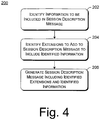
- Fig. 4 is a flowchart illustrating an example process 200 for extending a session description message for a multimedia presentation.
- Process 200 may be performed in software, firmware, hardware, or combinations thereof.
- Process 200 is typically performed by a source of the multimedia presentation (e.g., an encoder device that is generating the multimedia presentation).
- a source of the multimedia presentation e.g., an encoder device that is generating the multimedia presentation.
- the information included in the session description message extensions is typically also stored along with the multimedia presentation or alternatively elsewhere.
- the stored information can be retrieved and the session description message, with extensions, generated.
- the information included in the session description message is added to the session description message (e.g., by a human user or automatically by a computing device) at the beginning of the multimedia presentation and/or during the multimedia presentation (e.g., information may be added to or changed in the session description message as the live multimedia presentation changes).
- the information to be included in the session description message is identified (act 202).
- This information can be identified in one or more different manners.
- One manner in which this information can be identified is retrieval from a file or record.
- at least some of the information is stored in a file or record associated with the multimedia presentation that the session description message is to describe. This file or record is accessed in act 202 to retrieve the information stored therein.
- Another manner in which this information can be identified is receipt from a human user.
- at least some of the information is received from a human user.
- These user inputs are used in act 202 as at least some of the information to be included in the session description message.
- this information can be identified automatically by a computing device by analyzing the source of the multimedia presentation or the multimedia presentation itself. This automatically detected information is used in act 202 as at least some of the information to be included in the session description message.
- the extensions to be added to the session description message in order to include all of the identified information are then identified (act 204).
- These extensions can be identified in different manners.
- One manner in which these extensions can be identified is automatically based on the identified information. In this manner, given the information that is identified, the particular extensions to be used to include that information in the session description message are automatically identified. For example, a table or record mapping information to extension may be accessed, the device performing the automatic configuration may be configured or programmed with the appropriate extensions for particular information, and so forth.
- extension information Another manner in which these extensions can be identified is identification of the extension information with the information itself.
- the information may also include the identification of which extension to use to include the information in the session description message.
- the session description message is then generated including the extensions identified in act 204 and the information identified in act 202 (act 206). Once generated, the session description message can be sent to the client device to inform the client device of the information describing the multimedia presentation associated with the session description message.
- session description message extensions include information that would also be included in an ASF file header associated with the multimedia presentation.
- the ASF file header would not need to be communicated to the client device. This alleviates the need for the client device to be able to understand the ASF file header, can reduce the size of the session description message by not embedding the entirety of the ASF file header in the session description message, and can eliminate the need to generate an ASF file header in situations where an ASF file header has not already been generated.
- session description message extensions discussed herein are separate from the ASF file header. These session description message extensions are defined as being separate from any ASF file header (i.e., these session description message extensions are not simply part of an ASF file header that is embedded in a session description message). These session description message extensions can also be used in situations where there is no ASF file header associated with the multimedia presentation.
- Table IV below is a summary of several extensions that can be included in a session description message. In certain embodiments, each of these extensions are added using an attribute field of the session description. The discussions of these extensions following Table IV indicate whether these extensions are typically found in session level description 182 or media level description 184, although alternatively these extensions could be located in either session level description 182 or media level description 184.
- Table IV Name Description Mutual Exclusivity Specifies whether media streams are mutually exclusive. Marker User-friendly indexes into the media stream(s). Script Command Specifies text (or other data) that is to be displayed or an identifier of a web page that should be displayed at a particular time during playback of the media stream(s).
- Leaky Bucket When playing back variable bit-rate content at a constant bit-rate, specifies how much data of the media stream(s) the client should buffer.
- Caching Information Specifies information about caching of the media stream(s), such as whether the stream(s) can be cached, how long the stream(s) are considered fresh, etc.
- RTP Encapsulation Specifies codec initialization parameters generically across a broad variety of codecs for data transmitted over RTP.
- Bandwidth Sharing Specifies streams that share bandwidth so that the maximum bandwidth of the set of specified streams is less than the sum of the maximum bandwidths of the individual streams.
- Stream Prioritization Specifies which streams should have priority over which other streams (e.g., which streams should or should not be dropped in the event of network congestion).
- identifiers of the media streams are created by an author or designer (or alternatively automatically) when the media stream is encoded (e.g., for a live broadcast) or when the media stream is stored (e.g., as an ASF file). In other embodiments, identifiers of the media streams are created when the streaming of the multimedia presentation (or single media presentation) from the server device begins.
- the identifiers themselves can be generated in any of a variety of manners.
- the identifiers are identifiers of RTP sessions.
- individual media streams are streamed from the server device to the client device using the Realtime Transport Protocol (RTP) as described in Network Working Group Request for Comments (RFC) 3550, July 2003.
- RTP provides end-to-end network transport functions suitable for applications transmitting real-time data, such as audio, video or simulation data, over multicast or unicast network services. Each media stream is streamed over a different RTP session.
- the identifiers may be generated by simply using the same identifiers as the ASF Stream IDs, as assigned in the ASF file header.
- the mutual exclusivity extension specifies whether media streams are mutually exclusive.
- streams are mutually exclusive based on bit rate and language.
- a multimedia presentation may have multiple streams of the same content (e.g., audio or video) that are encoded at different bit rates. Only one of these streams at a time, having the desired bit rate, should be selected for streaming to the client device.
- a multimedia presentation may have multiple streams of the same content (e.g., audio) that are in different languages. Only one of these streams at a time, in the desired language, should be selected for streaming to the client device.
- the parameters for the mutual exclusivity extension are obtained by accessing the Bitrate Mutual Exclusion Object or Advanced Mutual Exclusion Object in an ASF file header associated with the multimedia presentation.
- the parameters identified in the ASF file header are retrieved and used as the parameters of the mutual exclusivity extension. If there are multiple Bitrate Mutual Exclusion Objects and/or Advanced Mutual Exclusion Objects in the ASF file header, then a separate mutual exclusivity extension is included in the session description message for each of those multiple Bitrate Mutual Exclusion Objects and/or Advanced Mutual Exclusion Objects.
- the ExclusionType parameter can be set to different values to indicate the type of the mutual exclusivity.
- the ExclusionType parameter may be set to "MBR" to indicate that the streams are mutually exclusive based on bit rate, but set to "LANG” to indicate that the streams are mutually exclusive based on language.
- the ExclusionType parameter when basing the mutual exclusivity extension on the information in an ASF file header, if the value of the "Exclusion Type" GUID in the Bitrate Mutual Exclusion Object or Advanced Mutual Exclusion Object of the ASF file header is ASF_Mutex_Language then the ExclusionType parameter is set to "LANG", and if the value of the "Exclusion Type” GUID in the Bitrate Mutual Exclusion Object or Advanced Mutual Exclusion Object of the ASF file header is ASF_Mutex_Bitrate then the ExclusionType parameter is set to "MBR".
- the StreamNumbers parameter contains a list of streams that the mutual exclusion applies to. These streams are identified, for example, by their RTP sessions. In certain embodiments, when basing the mutual exclusivity extension on the information in an ASF file header, for each stream in the "Stream Numbers" field of the Bitrate Mutual Exclusion Object or Advanced Mutual Exclusion Object of the ASF file, the number assigned to the corresponding RTP session is added to the list of streams in the StreamNumbers parameter.
- the marker extension specifies user-friendly indexes into the media stream(s). These user-friendly indexes are intended to be easily understood by human readers.
- the parameters for the marker extension are obtained by accessing the Marker Object in an ASF file header associated with the multimedia presentation.
- the parameters identified in the ASF file header are retrieved and used as the parameters of the marker extension. If there are multiple Markers in the ASF file header, then a single marker extension can be used to identify all of the multiple Markers. Alternatively, a separate marker extension may be included in the session description message for each of those multiple Markers.
- the name parameter specifies the name of the marker being specified by the marker extension.
- the value of "Name" in the Marker Object of the ASF file header is UTF-8 encoded and used as the value of the name parameter in the marker extension.
- the time parameter specifies the presentation time of the marker.
- the value of "Presentation Time” in the Marker Object of the ASF file header is used as the value of the time parameter in the marker extension.
- the ASF file header specifies an amount of time to buffer data before starting to play the multimedia presentation (e.g., in the "Preroll” field of the File Properties Object)
- that specified amount of time is subtracted from the value of "Presentation Time” in the Marker Object of the ASF file header, and the resulting difference is used as the value of the time parameter in the marker extension.
- the desc parameter specifies the user-friendly index that is to be presented to the user as the marker.
- the value of "Marker Description" in the Marker Object of the ASF file header is UTF-8 encoded and used as the value of the desc parameter in the marker extension.
- the script command extension specifies text (or other data) that is to be displayed at a particular time during playback of the media stream(s), or specifies an identifier of a web page that should be displayed (e.g., within a web browser) at a particular time during playback of the media stream(s).
- the parameters for the script command extension are obtained by accessing the Script Command Object in an ASF file header associated with the multimedia presentation.
- the parameters identified in the ASF file header are retrieved and used as the parameters of the script command extension. If there are multiple Commands in the ASF file header, then a single script command extension can be used to identify all of the multiple Commands. Alternatively, a separate script command extension may be included in the session description message for each of those multiple Commands.
- the type parameter specifies the name of a type of command being specified by the script command extension.
- the value of "Command Type Name" in the Script Command Object of the ASF file header is UTF-8 encoded and used as the value of the type parameter in the script command extension. If a Script Command Object in the ASF file header can contain multiple "Command Type Fields", then a separate script command extension is used for each such field.
- the time parameter specifies the presentation time of the command.
- the value of "Presentation Time” in the Script Command Object of the ASF file header is used as the value of the time parameter in the script command extension.
- the ASF file header specifies an amount of time to buffer data before starting to play the multimedia presentation (e.g., in the "Preroll” field of the File Properties Object)
- that specified amount of time is subtracted from the value of "Presentation Time” in the Script Command Object of the ASF file header, and the resulting difference is used as the value of the time parameter in the script command extension.
- the command parameter specifies the text (or other data) that is to be displayed or the identifier of the web page(s) that should be displayed (e.g., within a web browser).
- the value of "Command Name" in the Script Command Object of the ASF file header is UTF-8 encoded and used as the value of the command parameter in the script command extension.
- the leaky bucket extension specifies, when playing back variable bit-rate content at a constant bit-rate, how much data of the media stream(s) the client should buffer.
- a leaky bucket refers to a buffer that empties at a constant positive leak rate, into which bits can be dumped at irregular times and in irregular amounts.
- a leaky bucket is specified by its leak rate (e.g., in bits per second) and its size or capacity (e.g., in bits).
- the parameters for the leaky bucket extension are obtained by accessing the Extended Content Description Object in an ASF file header associated with the multimedia presentation.
- the Extended Content Description Object includes a name-value pair named "ASFLeakyBucketPairs".
- the value of the "ASFLeakyBucketPairs" name-value pair is the leaky bucket information, which is used as the parameters for the leaky bucket extension.
- the parameters for the leaky bucket extension may come from elsewhere in an ASF file header, such as the Extended Stream Description Object.
- a single leaky bucket extension can be used to identify all of the multiple "ASFLeakyBucketPairs" name-value pairs.
- a separate leaky bucket extension may be included in the session description message for each of those multiple Extended Content Description Objects or multiple "ASFLeakyBucketPairs" name-value pairs.
- the R1 parameter specifies the bit rate (the leak rate) for the first leaky bucket, and the B1 parameter specifies the size (e.g., in milliseconds) of the first leaky bucket.
- the R2 parameter specifies the bit rate (the leak rate) for the second leaky bucket, and the B2 parameter specifies the size of the second leaky bucket.
- the value of the "ASFLeakyBucketPairs" name-value pair in the Extended Content Description Object of the ASF header file is used as the value of the R and B parameters in the leaky bucket extension.
- the first part of the "Descriptor Value” e.g., the first four bytes
- the second part of the "Descriptor Value” e.g., the second four bytes
- the caching information extension specifies information about caching of the media stream(s), such as whether the stream(s) can be cached, how long the stream(s) are considered fresh, and so forth.
- the caching information is determined based on the caching policy implemented by the server device (e.g., server device 104).
- the Rights parameter is one or more directives, separated by space characters (or alternatively some other characters, such as commas, periods, semicolons, colons, etc.).
- these directives include a no-cache directive, a no-splitting directive, and an expiration directive.
- the no-cache directive is defined as "no-cache", and indicates to the client device, as well as any intermediate devices between the server and client devices, that the device is not allowed to cache the media stream(s) for playback at a later time.
- the no-splitting directive is defined as "no-splitting", and indicates to the client device, as well as any intermediate devices between the server and client devices, that the device is not allowed to rebroadcast or redistribute the content.
- Splitting of streaming media content refers to the same content being communicated to multiple clients.
- the no-splitting directive indicate that such splitting is not allowed.
- the Timeout parameter specifies when cached copies of the media stream(s) are considered stale (no longer fresh).
- the Timeout parameter may specify a period of time (e.g., a number of seconds, minutes, days, etc.) until the cached copies are considered stale, or alternatively may specify a particular date and/or time (e.g., April 15, 2004 at 3:00 pm) when the cached copies become stale.
- a device with a cached copy is not allowed to use stale media stream(s).
- the device can use a stale cached copy of a media stream(s), but the device should attempt to determine if a newer version of the media stream(s) is available, and use that newer version instead if possible.
- the RTP encapsulation extension specifies codec initialization parameters generically across a broad variety of codecs for data transmitted over RTP. A variety of different codecs can be used with RTP, and these different codecs oftentimes have their own encapsulation schemes and their own initialization parameters.
- the RTP encapsulation extension allows the same syntax (which is the RTP encapsulation extension) to describe the properties of a variety of different codecs, thereby alleviating the need for many different syntaxes to describe many different codes.
- the pt parameter is the RTP payload type number, which identifies the format or type of the RTP payload. In certain implementations, any number between 0 and 127 is valid.
- the MIME parameter is an identifier of the codec used in the media stream.
- the MIME parameter is a MIME (Multipurpose Internet Mail Extensions) type that is formed according to the rules in "WAVE and AVI Codec Registries", Network Working Group Request for Comments (RFC) 2361, June 1998.
- this identifier is the codec GUID from the ASF file.
- the identifier may be stored in the ASF file as, for example, the Media Type GUID from the Stream Properties Object in the ASF file, or the Type-Specific Data section of the Stream Properties Object in the ASF file.
- the config config-info parameter identifies the codec initialization data, where config-info is replaced by a series of sub-parameters.
- the sub-parameters are Base64 encoded. These sub-parameters are separated by "/" characters, or alternatively other characters (e.g., periods, commas, colons, semi-colons, etc.).
- the syntax of config-info is as follows: MajorType/FixedSizeSamples/TemporalCompression/SampleSize/FormatTy pe/FormatData
- the MajorType sub-parameter is an identifier (e.g., a GUID (Globally Unique ID)) that identifies the type of the media stream.
- valid values include "73647561-0000-0010-8000-00AA00389B71" for an audio stream, and "73646976-0000-0010-8000-00AA00389B71" for a video stream.
- the FixedSizeSamples sub-parameter indicates whether the codec uses fixed size samples (packets). In certain implementations, the FixedSizeSamples sub-parameter is "1” if the codec uses fixed size media samples (packets), or "0” otherwise. For example, usually this field will be “1” for audio and uncompressed video, but "0" for compressed video.
- the TemporalCompression sub-parameter indicates whether the stream uses temporal compression.
- the TemporalCompression sub-parameter is "1" if the stream uses temporal compression, meaning that not all media samples are "key-frames”. Otherwise, it is set to "0". This field may be set to "1" for many types of compressed video, because such streams may have non-key frame media samples.
- the SampleSize sub-parameter indicates the size of the media samples when the codec uses fixed size samples (packets).
- the SampleSize sub-parameter is a decimal number which gives the size of the media samples when FixedSizeSamples is "1".
- the SampleSize sub-parameter can be set to "0", and should be ignored, when FixedSizeSamples is "0".
- the FormatType sub-parameter is an identifier (e.g., a GUID) that identifies the format of the FormatData sub-parameter.
- the FormatData sub-parameter is the codec initialization data identified by the FormatType sub-parameter. Any of a variety of different structures that describe properties of a codec can be used for the FormatData sub-parameter.
- the data structure describing properties of a codec for an audio stream may include information about the audio sample rate and the number of bits per sample.
- the data structure describing properties of a codec for a video stream may include information about the width and height (e.g., in pixels) of the video information, as well as the pixel aspect ratio.
- each byte in the codec initialization data is represented as two hexadecimal digits in SDP. Alternatively, other representations may be used such as Base64 encoding.
- the bandwidth sharing extension specifies streams that share bandwidth in such a way that the maximum bandwidth of the set of specified streams is less than the sum of the maximum bandwidths of the individual specified streams.
- the parameters for the bandwidth sharing extension are obtained by accessing the Bandwidth Sharing Object in an ASF file header associated with the multimedia presentation.
- the parameters identified in the ASF file header are retrieved and used as the parameters of the bandwidth sharing extension. If there are multiple Bandwidth Sharing Objects in the ASF file header, then a separate bandwidth sharing extension is included in the session description message for each of those multiple Bandwidth Sharing Objects.
- the SharingType parameter can be set to different values to indicate the type of sharing.
- the SharingType parameter may be set to "PART" to indicate that any number of the specified streams may be streaming data at any given time, but set to "EXCL" if only one of the specified streams may be streaming data at any given time.
- the SharingType parameter when basing the bandwidth sharing extension on the information in an ASF file header, if the value of the "Sharing Type" GUID in the Bandwidth Sharing Object of the ASF file header is ASF_Bandwidth_Sharing_Partial then the SharingType parameter is set to "PART", and if the value of the "Sharing Type” GUID in the Bandwidth Sharing Object of the ASF file header is ASF_Bandwidth_Sharing_Exclusive then the SharingType parameter is set to "EXCL".
- the R parameter specifies the leak rate (e.g., in bits per second) of a leaky bucket that contains the data portion of all of the streams without overflowing.
- the size of the leaky bucket is specified as the B parameter.
- the R parameter when basing the bandwidth sharing extension on the information in an ASF file header, the R parameter is the value of the "Data Bitrate" field in the ASF file header, expressed as a decimal number.
- the B parameter specifies the size (e.g., in milliseconds) of the leaky bucket.
- the B parameter when basing the bandwidth sharing extension on the information in an ASF file header, is the value of the "Buffer Size" field in the ASF file header, expressed as a decimal number.
- the stream prioritization extension specifies which streams in the multimedia presentation should have priority over which other streams. This prioritization can be used, for example, to identify which streams should or should not be dropped in the event of network congestion.
- Certain RTP sessions can be identified as mandatory, which indicates that those certain sessions are not supposed to be dropped in response to network congestion.
- RTP sessions 1 and 2 are mandatory.
- RTP session 3 has lower priority than the other sessions, and may be dropped in the event of network congestion.
- the stream priorities are obtained by accessing the Stream Prioritization Object in an ASF file header associated with the multimedia presentation.
- the streams identified in the ASF file header correspond to RTP sessions, and the stream priorities identified in the ASF file header are used as the priorities for the corresponding RTP sessions. If the "Mandatory Flag" is set for a particular ASF stream, then the corresponding RTP session is also considered mandatory.
- Fig. 5 illustrates a general computer environment 300, which can be used to implement the techniques described herein.
- the computer environment 300 is only one example of a computing environment and is not intended to suggest any limitation as to the scope of use or functionality of the computer and network architectures. Neither should the computer environment 300 be interpreted as having any dependency or requirement relating to any one or combination of components illustrated in the exemplary computer environment 300.
- Computer environment 300 includes a general-purpose computing device in the form of a computer 302.
- Computer 302 can be, for example, a client device 102 or server device 104 of Figs. 1 and 2 .
- Computer 302 can also be an encoder device that is the source of a multimedia presentation.
- the components of computer 302 can include, but are not limited to, one or more processors or processing units 304, a system memory 306, and a system bus 308 that couples various system components including the processor 304 to the system memory 306.
- the system bus 308 represents one or more of any of several types of bus structures, including a memory bus or memory controller, a peripheral bus, an accelerated graphics port, and a processor or local bus using any of a variety of bus architectures.
- bus architectures can include an Industry Standard Architecture (ISA) bus, a Micro Channel Architecture (MCA) bus, an Enhanced ISA (EISA) bus, a Video Electronics Standards Association (VESA) local bus, and a Peripheral Component Interconnects (PCI) bus also known as a Mezzanine bus.
- Computer 302 typically includes a variety of computer readable media. Such media can be any available media that is accessible by computer 302 and includes both volatile and non-volatile media, removable and non-removable media.
- the system memory 306 includes computer readable media in the form of volatile memory, such as random access memory (RAM) 310, and/or non-volatile memory, such as read only memory (ROM) 312.
- RAM random access memory
- ROM read only memory
- BIOS basic input/output system
- RAM 310 typically contains data and/or program modules that are immediately accessible to and/or presently operated on by the processing unit 304.
- Computer 302 may also include other removable/non-removable, volatile/non-volatile computer storage media.
- Fig. 5 illustrates a hard disk drive 316 for reading from and writing to a non-removable, non-volatile magnetic media (not shown), a magnetic disk drive 318 for reading from and writing to a removable, non-volatile magnetic disk 320 (e.g., a "floppy disk"), and an optical disk drive 322 for reading from and/or writing to a removable, non-volatile optical disk 324 such as a CD-ROM, DVD-ROM, or other optical media.
- a hard disk drive 316 for reading from and writing to a non-removable, non-volatile magnetic media (not shown)
- a magnetic disk drive 318 for reading from and writing to a removable, non-volatile magnetic disk 320 (e.g., a "floppy disk")
- an optical disk drive 322 for reading from and/or writing to a removable, non-volatile optical
- the hard disk drive 316, magnetic disk drive 318, and optical disk drive 322 are each connected to the system bus 308 by one or more data media interfaces 326.
- the hard disk drive 316, magnetic disk drive 318, and optical disk drive 322 can be connected to the system bus 308 by one or more interfaces (not shown).
- the disk drives and their associated computer-readable media provide non-volatile storage of computer readable instructions, data structures, program modules, and other data for computer 302.
- a hard disk 316 a removable magnetic disk 320, and a removable optical disk 324
- other types of computer readable media which can store data that is accessible by a computer, such as magnetic cassettes or other magnetic storage devices, flash memory cards, CD-ROM, digital versatile disks (DVD) or other optical storage, random access memories (RAM), read only memories (ROM), electrically erasable programmable read-only memory (EEPROM), and the like, can also be utilized to implement the exemplary computing system and environment.
- RAM random access memories
- ROM read only memories
- EEPROM electrically erasable programmable read-only memory
- Any number of program modules can be stored on the hard disk 316, magnetic disk 320, optical disk 324, ROM 312, and/or RAM 310, including by way of example, an operating system 326, one or more application programs 328, other program modules 330, and program data 332.
- an operating system 326 may implement all or part of the resident components that support the distributed file system.
- a user can enter commands and information into computer 302 via input devices such as a keyboard 334 and a pointing device 336 (e.g., a "mouse").
- Other input devices 338 may include a microphone, joystick, game pad, satellite dish, serial port, scanner, and/or the like.
- input/output interfaces 340 that are coupled to the system bus 308, but may be connected by other interface and bus structures, such as a parallel port, game port, or a universal serial bus (USB).
- a monitor 342 or other type of display device can also be connected to the system bus 308 via an interface, such as a video adapter 344.
- other output peripheral devices can include components such as speakers (not shown) and a printer 346 which can be connected to computer 302 via the input/output interfaces 340.
- Computer 302 can operate in a networked environment using logical connections to one or more remote computers, such as a remote computing device 348.
- the remote computing device 348 can be a personal computer, portable computer, a server, a router, a network computer, a peer device or other common network node, and the like.
- the remote computing device 348 is illustrated as a portable computer that can include many or all of the elements and features described herein relative to computer 302.
- Logical connections between computer 302 and the remote computer 348 are depicted as a local area network (LAN) 350 and a general wide area network (WAN) 352.
- LAN local area network
- WAN wide area network
- Such networking environments are commonplace in offices, enterprise-wide computer networks, intranets, and the Internet.
- the computer 302 When implemented in a LAN networking environment, the computer 302 is connected to a local network 350 via a network interface or adapter 354. When implemented in a WAN networking environment, the computer 302 typically includes a modem 356 or other means for establishing communications over the wide network 352.
- the modem 356, which can be internal or external to computer 302, can be connected to the system bus 308 via the input/output interfaces 340 or other appropriate mechanisms. It is to be appreciated that the illustrated network connections are exemplary and that other means of establishing communication link(s) between the computers 302 and 348 can be employed.
- remote application programs 358 reside on a memory device of remote computer 348.
- application programs and other executable program components such as the operating system are illustrated herein as discrete blocks, although it is recognized that such programs and components reside at various times in different storage components of the computing device 302, and are executed by the data processor(s) of the computer.
- program modules include routines, programs, objects, components, data structures, etc. that perform particular tasks or implement particular abstract data types.
- functionality of the program modules may be combined or distributed as desired in various embodiments.
- Computer readable media can be any available media that can be accessed by a computer.
- Computer readable media may comprise "computer storage media” and "communications media.”
- Computer storage media includes volatile and non-volatile, removable and non-removable media implemented in any method or technology for storage of information such as computer readable instructions, data structures, program modules, or other data.
- Computer storage media includes, but is not limited to, RAM, ROM, EEPROM, flash memory or other memory technology, CD-ROM, digital versatile disks (DVD) or other optical storage, magnetic cassettes, magnetic tape, magnetic disk storage or other magnetic storage devices, or any other medium which can be used to store the desired information and which can be accessed by a computer.
- Communication media typically embodies computer readable instructions, data structures, program modules, or other data in a modulated data signal, such as carrier wave or other transport mechanism.
- Communication media also includes any information delivery media.
- modulated data signal means a signal that has one or more of its characteristics set or changed in such a manner as to encode information in the signal.
- communication media includes wired media such as a wired network or direct-wired connection, and wireless media such as acoustic, RF, infrared, and other wireless media. Combinations of any of the above are also included within the scope of computer readable media.
Landscapes
- Engineering & Computer Science (AREA)
- Multimedia (AREA)
- Signal Processing (AREA)
- Computer Networks & Wireless Communication (AREA)
- Business, Economics & Management (AREA)
- General Business, Economics & Management (AREA)
- Data Exchanges In Wide-Area Networks (AREA)
- Information Transfer Between Computers (AREA)
- Two-Way Televisions, Distribution Of Moving Picture Or The Like (AREA)
- Computer And Data Communications (AREA)
Claims (31)
- Verfahren, mit
Erzeugen (206) einer Sitzungsbeschreibungsnachricht (180), die Eigenschaften einer Multimediapräsentation beschreibt, die einer Klienteneinrichtung zuzuleiten ist, wobei die Multimediapräsentation mehrere Mediendatenströme hat, und wobei die Sitzungsbeschreibungsnachricht aufweist:eine sich gegenseitig ausschließende Erweiterung, die separat ist zu einem Dateikopf für erweitertes Datenstromformat, ASF, und die angibt, welche der mehreren Mediendatenströme sich gegenseitig ausschließen;eine Markierungserweiterung, die separat zu dem ASF-Dateikopf ist und die einen Index für die Multimediapräsentation angibt;eine Skriptbefehlserweiterung, die separat zu dem ASF-Dateikopf ist und Daten angibt, die während der Wiedergabe der Multimediapräsentation zu präsentieren sind;eine Erweiterung des Typs "leckender Behälter", die separat zu dem ASF-Dateikopf ist und die angibt, wie viele Daten der Multimediapräsentation zu speichern sind, wenn die Multimediapräsentation mit einer speziellen Bitrate wiedergegeben wird;eine Zwischenspeicherinformationserweiterung, die separat zu dem ASF-Dateikopf ist und die Information über das Zwischenspeichern der Multimediapräsentation angibt;eine Einkapselungserweiterung, die separat zu dem ASF-Dateikopf ist und die Codec-Parameter für einen oder mehrere von mehreren unterschiedlichen Codecs angibt;eine Erweiterung für gemeinsame Nutzung einer Bandbreite, die separat zu dem ASF-Dateikopf ist und die Mediendatenströme der mehreren Mediendatenströme angibt, die Bandbreite gemeinsam nutzen;eine Datenstrompriorisierungserweiterung, die separat zu dem ASF-Dateikopf ist und die angibt, welche der mehreren Mediendateiströme Priorität über andere der mehreren Mediendateiströme haben sollen; undEinfügen der Sitzungsbeschreibungsnachricht als Teil der der Klienteneinrichtung zugeführten Daten. - Ein oder mehrere computerlesbare Medien mit mehreren darauf gespeicherten Befehlen, die bei Ausführung durch einen oder mehrere Prozessoren den einen oder die mehreren Prozessoren veranlassen zum:Erzeugen (206) einer Sitzungsbeschreibungsnachricht (180), die Eigenschaften einer Multimediapräsentation beschreibt, die einer Klienteneinrichtung zuzuleiten ist, wobei die Multimediapräsentation mehrere Mediendatenströme hat, und wobei die Sitzungsbeschreibungsnachricht aufweist:eine sich gegenseitig ausschließende Erweiterung, die separat ist zu einem Dateikopf für erweitertes Datenstromformat, ASF, und die angibt, welche der mehreren Mediendatenströme sich gegenseitig ausschließen;eine Markierungserweiterung, die separat zu dem ASF-Dateikopf ist und die einen Index für die Multimediapräsentation angibt;eine Skriptbefehlserweiterung, die separat zu dem ASF-Dateikopf ist und Daten angibt, die während der Wiedergabe der Multimediapräsentation zu präsentieren sind;eine Erweiterung des Typs "leckender Behälter", die separat zu dem ASF-Dateikopf ist und die angibt, wie viele Daten der Multimediapräsentation zu speichern sind, wenn die Multimediapräsentation mit einer speziellen Bitrate wiedergegeben wird;eine Zwischenspeicherinformationserweiterung, die separat zu dem ASF-Dateikopf ist und die Information über das Zwischenspeichern der Multimediapräsentation angibt;eine Einkapselungserweiterung, die separat zu dem ASF-Dateikopf ist und die Codec-Parameter für einen oder mehrere von mehreren unterschiedlichen Codecs angibt;eine Erweiterung für gemeinsame Nutzung einer Bandbreite, die separat zu dem ASF-Dateikopf ist und die Mediendatenströme der mehreren Mediendatenströme angibt, die Bandbreite gemeinsam nutzen;eine Datenstrompriorisierungserweiterung, die separat zu dem ASF-Dateikopf ist und die angibt, welche der mehreren Mediendateiströme Priorität über andere der mehreren Mediendateiströme haben sollen; undEinfügen der Sitzungsbeschreibungsnachricht als Teil der der Klienteneinrichtung zugeführten Daten..
- Ein oder mehrere computerlesbare Medien nach Anspruch 2, wobei die Sitzungsbeschreibungsnachricht eine Sitzungsbeschreibungsprotokoll-, SDP-, Nachricht ist.
- Ein oder mehrere computerlesbare Medien nach Anspruch 2, wobei die Befehle, die den einen oder die mehreren Prozessoren zur Erzeugung der Sitzungsbeschreibungsnachricht veranlassen, ferner den einen oder die mehreren Prozessoren veranlassen zum:Identifizieren eines Objekts eines ASF-Dateikopfs der Multimediapräsentation;Abrufen eines oder mehrerer Parameter aus dem Objekt; undAnalysieren des abgerufenen einen oder der mehreren Parameter zur Ermittlung der Parameter für die Erweiterung des gegenseitigen Ausschließens.
- Ein oder mehrere computerlesbare Medien nach Anspruch 2, wobei ein Wert ExclusiveType einen Typ des gegenseitigen Ausschließens repräsentiert, einen Wert StreamNumbers die Mediendatenströme repräsentiert, die sich gegenseitig ausschließen, und die Erweiterung zur gegenseitigen Ausschließung aufweist:
a=group: ExclusiveType StreamNumbers. - Ein oder mehrere computerlesbare Medien nach Anspruch 2, wobei die mehreren Medienenddatenströme sich gegenseitig ausschließend sind auf der Grundlage der Bitrate.
- Ein oder mehrere computerlesbare Medien nach Anspruch 2, wobei die mehreren Medienenddatenströme sich gegenseitig auf der Grundlage von Sprache ausschließen.
- Ein oder mehrere computerlesbare Medien nach Anspruch 2, wobei die Befehle, die den einen oder den mehreren Prozessoren veranlassen, die Sitzungsbeschreibungsnachricht zu erzeugen, ferner den einen oder die mehreren Prozessoren veranlassen zum:Identifizieren eines Objekts eines ASF-Dateikopfs der Multimediapräsentation;Abrufen eines oder mehrerer Parameter aus dem Objekt; undAnalysieren des abgerufenen einen oder der mehreren Parameter zur Ermittlung der Parameter für die Markierungserweiterung.
- Ein oder mehrere computerlesbare Medien nach Anspruch 2, wobei ein Wert name einen Namen der Markierung repräsentiert, eine Wert time eine Darstellungszeit der Markierung repräsentiert, einen Wert desc den Index repräsentiert und die Markierungserweiterung umfasst:
a=marker: name time; desc. - Ein oder mehrere computerlesbare Medien nach Anspruch 2, wobei die Befehle, die den einen oder die mehreren Prozessoren veranlassen, die Sitzungsbeschreibungsnachricht zu erzeugen, ferner den einen oder die mehreren Prozessoren veranlassen zum:Identifizieren eines Objekts eines ASF-Dateikopfs der Multimediapräsentation;Abrufen eines oder mehrerer Parameter aus dem Objekt; undAnalysieren des abgerufenen einen oder der mehreren Parameter zur Ermittlung der Parameter für die Skriptbefehlserweiterung.
- Ein oder mehrere computerlesbare Medien nach Anspruch 2, wobei die Skriptbefehlserweiterung die Daten durch Einfügen einer Kennung einer Netzseite, die die Daten aufweist, angibt.
- Ein oder mehrere computerlesbare Medien nach Anspruch 2, wobei ein Wert type einen Typ eines Befehls repräsentiert, eine Wert time eine Darstellungszeit der Multimediapräsentation repräsentiert, wenn die Daten zu präsentieren sind, ein Wert command Daten repräsentiert, die in der Darstellungszeit anzuzeigen sind, und die Skriptbefehlserweiterung umfasst:
a=script: type time; command. - Ein oder mehrere computerlesbare Medien nach Anspruch 2, wobei die Befehle, die den einen oder die mehreren Prozessoren veranlassen, die Sitzungsbeschreibungsnachricht zu erzeugen, ferner den einen oder die mehreren Prozessoren veranlassen zum:Identifizieren eines Objekts eines ASF-Dateikopfs der Multimediapräsentation;Abrufen eines oder mehrerer Parameter aus dem Objekt; undAnalysieren des abgerufenen einen oder der mehreren Parameter zur Ermittlung der Parameter für die Erweiterung des Typs "leckender Behälter".
- Ein oder mehrere computerlesbare Medien nach Anspruch 2, wobei ein Wert Rx eine Leckrate für einen leckenden Behälter x repräsentiert, einen Wert Bx eine Größe des leckenden Behälters x repräsentiert und die Erweiterung des Typs "leckender Behälter" umfasst:
a=bucketinfo :Rx;Bx. - Ein oder mehrere computerlesbare Medien nach Anspruch 2, wobei die Befehle, die den einen oder die mehreren Prozessoren veranlassen, die Sitzungsbeschreibungsnachricht zu erzeugen, ferner den einen oder die mehreren Prozessoren veranlassen zum:Identifizieren eines Objekts eines ASF-Dateikopfs der Multimediapräsentation;Abrufen eines oder mehrerer Parameter aus dem Objekt; undAnalysieren des abgerufenen einen oder der mehreren Parameter zur Ermittlung der Parameter für die Zwischenspeicherungsinformationserweiterung.
- Ein oder mehrere computerlesbare Medien nach Anspruch 2, wobei die Information über die Zwischenspeicherung der Multimediapräsentation Information enthält, die angibt, ob die Klienteneinrichtung die Multimediapräsentation zwischenspeichern darf.
- Ein oder mehrere computerlesbare Medien nach Anspruch 2, wobei die Information über die Zwischenspeicherung der Multimediapräsentation Information enthält, die angibt, ob die Klienteneinrichtung die Multimediapräsentation erneut im Rundruf senden darf.
- Ein oder mehrere computerlesbare Medien nach Anspruch 2, wobei ein Wert rights die Information über die Zwischenspeicherung der Multimediapräsentation repräsentiert und die Zwischenspeicherinformationserweiterung umfasst:
a=cachectrl: rights. - Ein oder mehrere computerlesbare Medien nach Anspruch 2, wobei die Sitzungsbeschreibungsnachricht mehrere Einkapselungserweiterungen enthält, wobei jede der mehreren Einkapselungserweiterungen die gleiche Syntax hat, die aber für einen anderen der mehreren unterschiedlichen Codecs vorgesehen ist.
- Ein oder mehrere computerlesbare Medien nach Anspruch 2, wobei die Befehle, die den einen oder die mehreren Prozessoren veranlassen, die Sitzungsbeschreibungsnachricht zu erzeugen, den einen oder die mehreren Prozessoren ferner veranlassen zum:Identifizieren eines Objekts eines ASF-Dateikopfs der Multimediapräsentation;Abrufen eines oder mehrerer Parameter aus dem Objekt; undAnalysieren des abgerufenen einen oder der mehreren Parameter zur Ermittlung der Parameter für die Einkapselungserweiterung.
- Ein oder mehrere computerlesbare Medien nach Anspruch 2, wobei ein Wert pt eine Nutzdatentypnummer repräsentiert, ein Wert MIME eine Kennung eines der mehreren unterschiedlichen Codecs repräsentiert, ein Wert config-info Initialisierungsdaten für den einen der mehreren unterschiedlichen Codecs repräsentiert und die Einkapselungserweiterung umfasst:
a=fmtp:pt MIME config=config-info. - Ein oder mehrere computerlesbare Medien nach Anspruch 2, wobei die Codec-Parameter eine Kennung eines Typs eines Mediadatenstroms der Multimediapräsentation enthalten, die von dem einen oder den mehreren Codecs zu decodieren ist.
- Ein oder mehrere computerlesbare Medien nach Anspruch 2, wobei die Codec-Parameter eine Angabe enthalten, ob der eine oder die mehreren Codecs Pakete mit festgelegter Größe verwenden.
- Ein oder mehrere computerlesbare Medien nach Anspruch 23, wobei die Codec-Parameter eine Angabe über die Größe der Pakete mit festgelegter Größe enthalten.
- Ein oder mehrere computerlesbare Medien nach Anspruch 2, wobei die Codec-Parameter eine Angabe enthalten, ob ein Mediendatenstrom der Multimediapräsentation, die von dem einen oder den mehreren Codex zu decodieren ist, eine zeitliche Kompression verwendet.
- Ein oder mehrere computerlesbare Medien nach Anspruch 2, wobei die Codec-Parameter Initialisierungsdaten für den einen oder die mehreren Codecs enthalten.
- Ein oder mehrere computerlesbare Medien nach Anspruch 26, wobei die Codec-Parameter ein Format der Initialisierungsdaten in der Sitzungsbeschreibungsnachricht enthalten.
- Ein oder mehrere computerlesbare Medien nach Anspruch 2, wobei die Befehle, die den einen oder die mehreren Prozessoren veranlassen, die Sitzungsbeschreibungsnachricht zu erzeugen, den einen oder die mehreren Prozessoren ferner veranlassen zum:Identifizieren eines Objekts eines ASF-Dateikopfs der Multimediapräsentation;Abrufen eines oder mehrerer Parameter aus dem Objekt; undAnalysieren des abgerufenen einen oder der mehreren Parameter zur Ermittlung der Parameter für die Erweiterung zur gemeinsamen Nutzung von Bandbreite.
- Ein oder mehrere computerlesbare Medien nach Anspruch 2, wobei ein Wert SharingType einen Typ der gemeinsamen Nutzung der Bandbreite repräsentiert, einen Wert R eine Leckrate für einen leckenden Behälter repräsentiert, der alle angegebenen Mediendatenströme enthält, einen Wert B eine Größe des leckenden Behälters repräsentiert, einen Wert SessionList die angegebenen Mediendatenströme kennzeichnet, und die Erweiterung zur gemeinsamen Benutzung von Bandbereite umfasst:
a=bwshare:SharingType R B SessionList. - Ein oder mehrere computerlesbare Medien nach Anspruch 2, wobei die Befehle, die den einen oder die mehreren Prozessoren veranlassen, die Sitzungsbeschreibungsnachricht zu erzeugen, den einen oder die mehreren Prozessoren ferner veranlassen zum:Identifizieren eines Objekts eines ASF-Dateikopfs der Multimediapräsentation;Abrufen eines oder mehrerer Parameter aus dem Objekt; undAnalysieren des abgerufenen einen oder der mehreren Parameter zur Ermittlung der Parameter für die Datenstrompriorisierungserweiterung.
- Ein oder mehrere computerlesbare Medien nach Anspruch 2, wobei die Datenstrompriorisierungserweiterung a=prio gefolgt von einer Liste aus Mediendatenströmen in der Prioritätsreihenfolge umfasst.
Applications Claiming Priority (2)
| Application Number | Priority Date | Filing Date | Title |
|---|---|---|---|
| US10/836,141 US7162533B2 (en) | 2004-04-30 | 2004-04-30 | Session description message extensions |
| PCT/US2004/023628 WO2005111836A2 (en) | 2004-04-30 | 2004-07-22 | Session description message extensions |
Publications (3)
| Publication Number | Publication Date |
|---|---|
| EP1741035A2 EP1741035A2 (de) | 2007-01-10 |
| EP1741035A4 EP1741035A4 (de) | 2014-12-10 |
| EP1741035B1 true EP1741035B1 (de) | 2018-07-04 |
Family
ID=35376504
Family Applications (1)
| Application Number | Title | Priority Date | Filing Date |
|---|---|---|---|
| EP04778920.1A Expired - Lifetime EP1741035B1 (de) | 2004-04-30 | 2004-07-22 | Sitzungsbeschreibungs-nachrichtenerweiterungen |
Country Status (11)
| Country | Link |
|---|---|
| US (3) | US7162533B2 (de) |
| EP (1) | EP1741035B1 (de) |
| JP (1) | JP4592749B2 (de) |
| KR (2) | KR101037263B1 (de) |
| CN (1) | CN101120331B (de) |
| AU (1) | AU2004288595B2 (de) |
| BR (1) | BRPI0406531B1 (de) |
| CA (1) | CA2508888C (de) |
| MX (1) | MXPA05007088A (de) |
| RU (1) | RU2364922C2 (de) |
| WO (1) | WO2005111836A2 (de) |
Families Citing this family (36)
| Publication number | Priority date | Publication date | Assignee | Title |
|---|---|---|---|---|
| KR100640862B1 (ko) * | 2004-08-03 | 2006-11-02 | 엘지전자 주식회사 | 순방향 메시지 전송 중 타임아웃의 동적 제어방법 |
| WO2006114020A1 (en) * | 2005-04-27 | 2006-11-02 | Intel Corporation | Method and system for a process monitor using a hardware communication format |
| US7761773B2 (en) * | 2005-06-30 | 2010-07-20 | Sigmatel, Inc. | Semiconductor device including a unique identifier and error correction code |
| WO2007110550A2 (fr) * | 2006-03-28 | 2007-10-04 | France Telecom | Procede de generation d'un fichier de description d'un flux binaire, dispositif et produit programme d'ordinateur correspondants |
| CN101473654B (zh) * | 2006-06-19 | 2011-08-03 | 艾利森电话股份有限公司 | 媒体频道管理 |
| WO2008023335A2 (en) * | 2006-08-21 | 2008-02-28 | Nokia Corporation | Caching directives for a file delivery protocol |
| CN101166179A (zh) * | 2006-10-16 | 2008-04-23 | 华为技术有限公司 | 会话描述协议能力信息获取方法、系统和网络实体 |
| US8856267B2 (en) * | 2006-11-16 | 2014-10-07 | Rangecast Technologies, Llc | Network audio directory server and method |
| EP2130346B1 (de) * | 2007-03-29 | 2020-07-22 | Telefonaktiebolaget LM Ericsson (publ) | Medienstrom-aufbau in einem gruppenkommunikationssystem |
| US7831867B2 (en) * | 2007-04-17 | 2010-11-09 | International Business Machines Corporation | Apparatus and method to integrate hardware adapter tracing with a host OS tracing through signaling |
| US7729879B2 (en) * | 2007-04-17 | 2010-06-01 | International Business Machines Corporation | Apparatus and method to integrate hardware adapter diagnostics with a host OS diagnostics through signaling |
| KR101486372B1 (ko) * | 2007-07-25 | 2015-01-26 | 엘지전자 주식회사 | 디지털 방송 시스템 및 데이터 처리 방법 |
| US8325800B2 (en) | 2008-05-07 | 2012-12-04 | Microsoft Corporation | Encoding streaming media as a high bit rate layer, a low bit rate layer, and one or more intermediate bit rate layers |
| US8379851B2 (en) | 2008-05-12 | 2013-02-19 | Microsoft Corporation | Optimized client side rate control and indexed file layout for streaming media |
| US7860996B2 (en) * | 2008-05-30 | 2010-12-28 | Microsoft Corporation | Media streaming with seamless ad insertion |
| US8352996B2 (en) * | 2008-06-27 | 2013-01-08 | Microsoft Corporation | Adaptive video switching for variable network conditions |
| US8265140B2 (en) * | 2008-09-30 | 2012-09-11 | Microsoft Corporation | Fine-grained client-side control of scalable media delivery |
| BR112012011581A2 (pt) * | 2009-11-04 | 2017-09-19 | Huawei Tech Co Ltd | sistema e método para streaming de conteúdo de mídia |
| CN102088674B (zh) * | 2009-12-08 | 2013-07-03 | 深圳市彩讯科技有限公司 | 基于虚拟合成技术的彩信报表生成方法 |
| EP2600783A4 (de) | 2010-08-02 | 2017-05-17 | Guided Therapy Systems, L.L.C. | Ultraschallbehandlungssysteme und -verfahren |
| US9118593B2 (en) * | 2010-10-07 | 2015-08-25 | Enghouse Networks Limited | System and method for best value routing |
| EP2661866A4 (de) * | 2011-01-07 | 2014-10-15 | Nokia Corp | Verfahren und vorrichtung zur darstellung von signalisierungen |
| US9590814B2 (en) * | 2011-08-01 | 2017-03-07 | Qualcomm Incorporated | Method and apparatus for transport of dynamic adaptive streaming over HTTP (DASH) initialization segment description fragments as user service description fragments |
| US9276856B2 (en) | 2011-10-10 | 2016-03-01 | Salesforce.Com, Inc. | Slipstream bandwidth management algorithm |
| US9183090B2 (en) | 2011-10-10 | 2015-11-10 | Salesforce.Com, Inc. | Systems, methods, and apparatuses for implementing a streaming platform IO pump and regulator |
| US9367501B2 (en) | 2011-11-10 | 2016-06-14 | International Business Machines Corporation | Dynamic streaming data dispatcher |
| US8977704B2 (en) * | 2011-12-29 | 2015-03-10 | Nokia Corporation | Method and apparatus for flexible caching of delivered media |
| US9401968B2 (en) | 2012-01-20 | 2016-07-26 | Nokia Techologies Oy | Method and apparatus for enabling pre-fetching of media |
| US9055129B2 (en) * | 2012-04-23 | 2015-06-09 | Hulu, LLC | Automation framework to remotely control devices and process asynchronous events |
| US9185149B2 (en) * | 2012-06-25 | 2015-11-10 | Salesforce.Com, Inc. | Systems, methods, and apparatuses for implementing frame aggregation with screen sharing |
| US20140199044A1 (en) * | 2013-01-15 | 2014-07-17 | Qualcomm Incorporated | Supporting transport diversity and time-shifted buffers for media streaming over a network |
| US9020469B2 (en) | 2013-06-04 | 2015-04-28 | Rangecast Technologies, Llc | Network audio distribution system and method |
| US10904312B2 (en) * | 2014-12-10 | 2021-01-26 | Akamai Technologies, Inc. | Server-side prediction of media client steady state |
| US10581925B2 (en) * | 2015-07-06 | 2020-03-03 | Avaya Inc. | Session description protocol template modifiers for flexible control of media server resources |
| CN108701225B (zh) | 2016-02-26 | 2023-04-04 | 日本电气株式会社 | 面部辨识系统、面部辨识方法和存储介质 |
| WO2025107179A1 (en) * | 2023-11-22 | 2025-05-30 | Nokia Technologies Oy | Sdp message associated with data channel streams |
Family Cites Families (126)
| Publication number | Priority date | Publication date | Assignee | Title |
|---|---|---|---|---|
| JPH021671A (ja) * | 1988-03-17 | 1990-01-05 | Toshiba Corp | パケット交換機の負荷制御方式 |
| US5083263A (en) * | 1988-07-28 | 1992-01-21 | Sun Microsystems, Inc. | BISC with interconnected register ring and selectively operating portion of the ring as a conventional computer |
| US5057932A (en) * | 1988-12-27 | 1991-10-15 | Explore Technology, Inc. | Audio/video transceiver apparatus including compression means, random access storage means, and microwave transceiver means |
| US5164839A (en) * | 1988-12-27 | 1992-11-17 | Explore Technology, Inc. | Method for handling audio/video source information |
| US4963995A (en) * | 1988-12-27 | 1990-10-16 | Explore Technology, Inc. | Audio/video transceiver apparatus including compression means |
| US5262875A (en) * | 1992-04-30 | 1993-11-16 | Instant Video Technologies, Inc. | Audio/video file server including decompression/playback means |
| US5412782A (en) | 1992-07-02 | 1995-05-02 | 3Com Corporation | Programmed I/O ethernet adapter with early interrupts for accelerating data transfer |
| US5440334A (en) * | 1993-02-01 | 1995-08-08 | Explore Technology, Inc. | Broadcast video burst transmission cyclic distribution apparatus and method |
| US20020048448A1 (en) * | 1993-03-29 | 2002-04-25 | Microsoft Corporation | Pausing the display of a television program as a signal including the television program is received |
| CA2130395C (en) * | 1993-12-09 | 1999-01-19 | David G. Greenwood | Multimedia distribution over wide area networks |
| JPH07219774A (ja) * | 1994-02-07 | 1995-08-18 | Fujitsu Ltd | データ処理装置および例外処理方法 |
| CA2140850C (en) * | 1994-02-24 | 1999-09-21 | Howard Paul Katseff | Networked system for display of multimedia presentations |
| US5978567A (en) * | 1994-07-27 | 1999-11-02 | Instant Video Technologies Inc. | System for distribution of interactive multimedia and linear programs by enabling program webs which include control scripts to define presentation by client transceiver |
| DE69625597D1 (de) * | 1995-06-15 | 2003-02-06 | Intel Corp | I/o-prozessor architektur mit integrierter pci-pci brücke |
| US5758076A (en) | 1995-07-19 | 1998-05-26 | International Business Machines Corporation | Multimedia server system having rate adjustable data retrieval based on buffer capacity |
| US5822524A (en) | 1995-07-21 | 1998-10-13 | Infovalue Computing, Inc. | System for just-in-time retrieval of multimedia files over computer networks by transmitting data packets at transmission rate determined by frame size |
| US5787472A (en) * | 1995-07-31 | 1998-07-28 | Ibm Corporation | Disk caching system for selectively providing interval caching or segment caching of vided data |
| US5835495A (en) * | 1995-10-11 | 1998-11-10 | Microsoft Corporation | System and method for scaleable streamed audio transmission over a network |
| US5680461A (en) * | 1995-10-26 | 1997-10-21 | Sun Microsystems, Inc. | Secure network protocol system and method |
| US6041345A (en) * | 1996-03-08 | 2000-03-21 | Microsoft Corporation | Active stream format for holding multiple media streams |
| US5931961A (en) * | 1996-05-08 | 1999-08-03 | Apple Computer, Inc. | Discovery of acceptable packet size using ICMP echo |
| CA2261933A1 (en) * | 1996-07-25 | 1998-02-05 | Hybrid Networks, Inc. | Two-way asymmetric communication system |
| US5913038A (en) * | 1996-12-13 | 1999-06-15 | Microsoft Corporation | System and method for processing multimedia data streams using filter graphs |
| US6005621A (en) * | 1996-12-23 | 1999-12-21 | C-Cube Microsystems, Inc. | Multiple resolution video compression |
| US6014706A (en) * | 1997-01-30 | 2000-01-11 | Microsoft Corporation | Methods and apparatus for implementing control functions in a streamed video display system |
| US6292834B1 (en) * | 1997-03-14 | 2001-09-18 | Microsoft Corporation | Dynamic bandwidth selection for efficient transmission of multimedia streams in a computer network |
| US6118817A (en) * | 1997-03-14 | 2000-09-12 | Microsoft Corporation | Digital video signal encoder and encoding method having adjustable quantization |
| ZA973611B (en) * | 1997-03-21 | 1998-03-23 | Canal Plus Sa | Extraction data sections from a transmitted data stream. |
| US6111567A (en) * | 1997-04-03 | 2000-08-29 | Microsoft Corporation | Seamless multimedia branching |
| US6209041B1 (en) * | 1997-04-04 | 2001-03-27 | Microsoft Corporation | Method and computer program product for reducing inter-buffer data transfers between separate processing components |
| US6216163B1 (en) * | 1997-04-14 | 2001-04-10 | Lucent Technologies Inc. | Method and apparatus providing for automatically restarting a client-server connection in a distributed network |
| US5963202A (en) * | 1997-04-14 | 1999-10-05 | Instant Video Technologies, Inc. | System and method for distributing and managing digital video information in a video distribution network |
| US6892354B1 (en) * | 1997-04-16 | 2005-05-10 | Sony Corporation | Method of advertising on line during a communication link idle time |
| US6195692B1 (en) * | 1997-06-02 | 2001-02-27 | Sony Corporation | Television/internet system having multiple data stream connections |
| US6014694A (en) | 1997-06-26 | 2000-01-11 | Citrix Systems, Inc. | System for adaptive video/audio transport over a network |
| US6385647B1 (en) * | 1997-08-18 | 2002-05-07 | Mci Communications Corporations | System for selectively routing data via either a network that supports Internet protocol or via satellite transmission network based on size of the data |
| JPH11163947A (ja) * | 1997-09-22 | 1999-06-18 | Toshiba Corp | ゲートウェイ装置、無線端末装置、ルータ装置および通信ネットワークのゲートウェイ制御方法 |
| US5996015A (en) * | 1997-10-31 | 1999-11-30 | International Business Machines Corporation | Method of delivering seamless and continuous presentation of multimedia data files to a target device by assembling and concatenating multimedia segments in memory |
| JP3655071B2 (ja) * | 1997-10-31 | 2005-06-02 | 株式会社ニデック | 眼屈折力測定装置 |
| JP3235655B2 (ja) | 1997-12-01 | 2001-12-04 | 日本電気株式会社 | バースト性をもつ低速汎用データの固定長パケット多重装置 |
| US5983263A (en) * | 1998-01-02 | 1999-11-09 | Intel Corporation | Method and apparatus for transmitting images during a multimedia teleconference |
| US6161201A (en) * | 1998-02-26 | 2000-12-12 | 3Com Corporation | Method and apparatus for concurrent interaction with a modem having an open connection |
| JP3844588B2 (ja) * | 1998-03-05 | 2006-11-15 | 富士通株式会社 | 情報管理システム、ローカルコンピュータ、及び情報取得プログラムを記録したコンピュータ読み取り可能な記録媒体 |
| US6327421B1 (en) * | 1998-03-10 | 2001-12-04 | International Business Machines Corporation | Multiple speed fast forward/rewind compressed video delivery system |
| US6054943A (en) * | 1998-03-25 | 2000-04-25 | Lawrence; John Clifton | Multilevel digital information compression based on lawrence algorithm |
| US6292880B1 (en) * | 1998-04-15 | 2001-09-18 | Inktomi Corporation | Alias-free content-indexed object cache |
| US6314492B1 (en) * | 1998-05-27 | 2001-11-06 | International Business Machines Corporation | System and method for server control of client cache |
| US6421348B1 (en) | 1998-07-01 | 2002-07-16 | National Semiconductor Corporation | High-speed network switch bus |
| US6480498B1 (en) | 1998-07-01 | 2002-11-12 | National Semiconductor Corporation | High speed network switch bus clock |
| JP3602972B2 (ja) * | 1998-07-28 | 2004-12-15 | 富士通株式会社 | 通信性能測定装置及びその測定方法 |
| US6502135B1 (en) * | 1998-10-30 | 2002-12-31 | Science Applications International Corporation | Agile network protocol for secure communications with assured system availability |
| US6249844B1 (en) * | 1998-11-13 | 2001-06-19 | International Business Machines Corporation | Identifying, processing and caching object fragments in a web environment |
| US6553376B1 (en) * | 1998-11-18 | 2003-04-22 | Infolibria, Inc. | Efficient content server using request redirection |
| NO308019B1 (no) * | 1998-11-27 | 2000-07-03 | Ericsson Telefon Ab L M | FremgangsmÕte for Õ utvide bruken av SIP (Session Initiation Protocol) |
| US6449269B1 (en) * | 1998-12-31 | 2002-09-10 | Nortel Networks Limited | Packet voice telephony system and method |
| US6351767B1 (en) * | 1999-01-25 | 2002-02-26 | International Business Machines Corporation | Method and system for automatically caching dynamic content based on a cacheability determination |
| JP3587352B2 (ja) * | 1999-02-04 | 2004-11-10 | 富士通株式会社 | ネットワーク通信性能測定方法及び装置並びにネットワーク通信性能測定プログラムを格納したコンピュータ読取り可能な記録媒体 |
| US6691312B1 (en) | 1999-03-19 | 2004-02-10 | University Of Massachusetts | Multicasting video |
| US6405256B1 (en) * | 1999-03-31 | 2002-06-11 | Lucent Technologies Inc. | Data streaming using caching servers with expandable buffers and adjustable rate of data transmission to absorb network congestion |
| US6725333B1 (en) * | 1999-04-22 | 2004-04-20 | International Business Machines Corporation | System and method for managing cachable entities |
| US6369835B1 (en) * | 1999-05-18 | 2002-04-09 | Microsoft Corporation | Method and system for generating a movie file from a slide show presentation |
| US6611868B1 (en) * | 1999-05-21 | 2003-08-26 | 3Com Corporation | Method and system for automatic link hang up |
| US6735634B1 (en) * | 1999-06-10 | 2004-05-11 | Blue Coat Systems | Method for real time protocol media recording |
| JP3463803B2 (ja) * | 1999-11-09 | 2003-11-05 | 松下電器産業株式会社 | クラスタサーバ装置 |
| US6643259B1 (en) * | 1999-11-12 | 2003-11-04 | 3Com Corporation | Method for optimizing data transfer in a data network |
| US6779043B1 (en) | 1999-11-16 | 2004-08-17 | National Semiconductor Corporation | Network address manager |
| US6990070B1 (en) | 1999-12-17 | 2006-01-24 | Nortel Networks Limited | Method and apparatus for adjusting packet transmission volume from a source |
| US7051110B2 (en) * | 1999-12-20 | 2006-05-23 | Matsushita Electric Industrial Co., Ltd. | Data reception/playback method and apparatus and data transmission method and apparatus for providing playback control functions |
| US6329165B1 (en) * | 1999-12-30 | 2001-12-11 | Nalco Chemical Company | Measurement and control of sessile and planktonic microbiological activity in industrial water systems |
| US7096481B1 (en) * | 2000-01-04 | 2006-08-22 | Emc Corporation | Preparation of metadata for splicing of encoded MPEG video and audio |
| US6519648B1 (en) * | 2000-01-24 | 2003-02-11 | Friskit, Inc. | Streaming media search and continuous playback of multiple media resources located on a network |
| US6389467B1 (en) * | 2000-01-24 | 2002-05-14 | Friskit, Inc. | Streaming media search and continuous playback system of media resources located by multiple network addresses |
| US7159233B2 (en) * | 2000-01-28 | 2007-01-02 | Sedna Patent Services, Llc | Method and apparatus for preprocessing and postprocessing content in an interactive information distribution system |
| SE0000908L (sv) | 2000-03-20 | 2001-09-21 | Ericsson Telefon Ab L M | Load regulation |
| US6765878B1 (en) * | 2000-03-28 | 2004-07-20 | Intel Corporation | Selective use of transmit complete interrupt delay on small sized packets in an ethernet controller |
| US7007090B1 (en) | 2000-03-31 | 2006-02-28 | Intel Corporation | Techniques of utilizing actually unused bandwidth |
| US6952424B1 (en) | 2000-04-13 | 2005-10-04 | International Business Machines Corporation | Method and system for network processor scheduling outputs using queueing |
| US6760749B1 (en) * | 2000-05-10 | 2004-07-06 | Polycom, Inc. | Interactive conference content distribution device and methods of use thereof |
| US6801947B1 (en) | 2000-08-01 | 2004-10-05 | Nortel Networks Ltd | Method and apparatus for broadcasting media objects with guaranteed quality of service |
| US7185082B1 (en) | 2000-08-09 | 2007-02-27 | Microsoft Corporation | Fast dynamic measurement of connection bandwidth using at least a pair of non-compressible packets having measurable characteristics |
| US6985934B1 (en) | 2000-10-23 | 2006-01-10 | Binham Communications Corporation | Method and system for providing rich media content over a computer network |
| US6741648B2 (en) * | 2000-11-10 | 2004-05-25 | Nokia Corporation | Apparatus, and associated method, for selecting an encoding rate by which to encode video frames of a video sequence |
| US7050441B2 (en) | 2000-11-29 | 2006-05-23 | Pts Corporation | Method and apparatus for hybrid communication network |
| US20020077900A1 (en) | 2000-12-14 | 2002-06-20 | Thompson Tiffany A. | Internet protocol-based interstitial advertising |
| US6611898B1 (en) * | 2000-12-22 | 2003-08-26 | Convergys Customer Management Group, Inc. | Object-oriented cache management system and method |
| US6407680B1 (en) * | 2000-12-22 | 2002-06-18 | Generic Media, Inc. | Distributed on-demand media transcoding system and method |
| US6772375B1 (en) * | 2000-12-22 | 2004-08-03 | Network Appliance, Inc. | Auto-detection of limiting factors in a TCP connection |
| KR100392384B1 (ko) * | 2001-01-13 | 2003-07-22 | 한국전자통신연구원 | 엠펙-2 데이터에 엠펙-4 데이터를 동기화시켜 전송하는장치 및 그 방법 |
| US7054949B2 (en) * | 2001-01-19 | 2006-05-30 | World Streaming Network, Inc. | System and method for streaming media |
| KR20020069272A (ko) | 2001-02-24 | 2002-08-30 | (주)엔아이씨티 | 동영상 파일의 압축 및 디스플레이 방법 |
| US6990512B1 (en) | 2001-03-19 | 2006-01-24 | Novell, Inc. | Method and system for using live time shift technology to control a multimedia file |
| AU2002314450A1 (en) | 2001-03-23 | 2002-10-08 | Popwire.Com | Method and apparatus for streaming video |
| US20020138641A1 (en) | 2001-03-26 | 2002-09-26 | Taylor Christopher Stephen | Targeted multimedia proxy server (tmps) |
| US20020184510A1 (en) | 2001-04-17 | 2002-12-05 | At&T Wireless Services, Inc. | Binding information for IP media flows |
| US20020194608A1 (en) | 2001-04-26 | 2002-12-19 | Goldhor Richard S. | Method and apparatus for a playback enhancement system implementing a "Say Again" feature |
| US6742082B1 (en) * | 2001-06-12 | 2004-05-25 | Network Appliance | Pre-computing streaming media payload method and apparatus |
| US7054911B1 (en) * | 2001-06-12 | 2006-05-30 | Network Appliance, Inc. | Streaming media bitrate switching methods and apparatus |
| US7076560B1 (en) * | 2001-06-12 | 2006-07-11 | Network Appliance, Inc. | Methods and apparatus for storing and serving streaming media data |
| US6986018B2 (en) * | 2001-06-26 | 2006-01-10 | Microsoft Corporation | Method and apparatus for selecting cache and proxy policy |
| US6792449B2 (en) | 2001-06-28 | 2004-09-14 | Microsoft Corporation | Startup methods and apparatuses for use in streaming content |
| US20020049817A1 (en) * | 2001-07-12 | 2002-04-25 | Eatamar Drory | Storageless system and method for unified messaging on existing mail accounts via standard internet mail protocols |
| US20030055809A1 (en) | 2001-09-18 | 2003-03-20 | Sun Microsystems, Inc. | Methods, systems, and articles of manufacture for efficient log record access |
| US7028089B2 (en) * | 2001-09-21 | 2006-04-11 | International Business Machines Corporation | Method and apparatus for caching subscribed and non-subscribed content in a network data processing system |
| US20030099364A1 (en) | 2001-11-28 | 2003-05-29 | Thompson Mark R. | Playback manipulation of HTTP streamed content objects |
| GB0130041D0 (en) * | 2001-12-14 | 2002-02-06 | Ibm | Preparing multimedia content in a distributed data processing system |
| US7412535B2 (en) * | 2001-12-19 | 2008-08-12 | International Business Machines Corporation | Method and system for caching fragments while avoiding parsing of pages that do not contain fragments |
| JP4039489B2 (ja) * | 2002-01-12 | 2008-01-30 | コアトラスト インコーポレーテッド | マルチメディアコンテンツの情報保護方法及びシステム |
| JP2003229843A (ja) * | 2002-01-31 | 2003-08-15 | Sony Corp | ストリーミングシステム及びストリーミング方法、クライアント端末及びコンテンツデータ復号方法、ストリームサーバ及びストリーム配信方法、オーサリング装置及びオーサリング方法、並びにプログラム及び記録媒体 |
| AU2003208588A1 (en) | 2002-02-22 | 2003-09-09 | Colin Davies | Scrambled packet stream processing |
| CN101827262B (zh) | 2002-04-26 | 2014-09-17 | 索尼株式会社 | 解码设备和方法 |
| US7133881B2 (en) * | 2002-04-29 | 2006-11-07 | Intel Corporation | Encoding and transferring media content onto removable storage |
| US7457312B2 (en) * | 2002-06-19 | 2008-11-25 | Microsoft Corporation | Bandwidth sharing in advanced streaming format |
| US7451229B2 (en) * | 2002-06-24 | 2008-11-11 | Microsoft Corporation | System and method for embedding a streaming media format header within a session description message |
| US20040003101A1 (en) * | 2002-06-26 | 2004-01-01 | Roth David J. | Caching control for streaming media |
| US7246318B2 (en) * | 2002-06-28 | 2007-07-17 | Microsoft Corporation | Application programming interface for utilizing multimedia data |
| KR100450405B1 (ko) * | 2002-08-12 | 2004-09-30 | 한국전자통신연구원 | 개인식별정보를 이용한 라우터간 접근정책 전송방법 |
| US7401221B2 (en) * | 2002-09-04 | 2008-07-15 | Microsoft Corporation | Advanced stream format (ASF) data stream header object protection |
| AU2003266691A1 (en) * | 2002-09-30 | 2004-04-19 | Matsushita Electric Industrial Co., Ltd. | Data processing device |
| US7366780B2 (en) | 2002-12-31 | 2008-04-29 | Motorola, Inc. | System and method for controlling and managing sessions between endpoints in a communications system |
| US7020087B2 (en) * | 2003-01-13 | 2006-03-28 | Motorola, Inc. | Segmented and distributed path optimization in a communication network |
| KR100759954B1 (ko) | 2003-02-13 | 2007-09-19 | 노키아 코포레이션 | 멀티미디어 스트리밍에서 클라이언트 레이트 능력을시그널링하는 방법 |
| US7266147B2 (en) * | 2003-03-31 | 2007-09-04 | Sharp Laboratories Of America, Inc. | Hypothetical reference decoder |
| US7454510B2 (en) * | 2003-05-29 | 2008-11-18 | Microsoft Corporation | Controlled relay of media streams across network perimeters |
| US7054774B2 (en) * | 2003-06-27 | 2006-05-30 | Microsoft Corporation | Midstream determination of varying bandwidth availability |
| US7359373B2 (en) * | 2003-10-17 | 2008-04-15 | Nokia Corporation | System, apparatus, and method for establishing circuit-switched communications via packet-switched network signaling |
| WO2005088930A1 (en) * | 2004-02-12 | 2005-09-22 | Nokia Corporation | Transmission of asset information in streaming services |
-
2004
- 2004-04-30 US US10/836,141 patent/US7162533B2/en not_active Expired - Lifetime
- 2004-07-22 CN CN2004800119941A patent/CN101120331B/zh not_active Expired - Lifetime
- 2004-07-22 CA CA2508888A patent/CA2508888C/en not_active Expired - Lifetime
- 2004-07-22 BR BRPI0406531A patent/BRPI0406531B1/pt not_active IP Right Cessation
- 2004-07-22 WO PCT/US2004/023628 patent/WO2005111836A2/en not_active Ceased
- 2004-07-22 EP EP04778920.1A patent/EP1741035B1/de not_active Expired - Lifetime
- 2004-07-22 MX MXPA05007088A patent/MXPA05007088A/es active IP Right Grant
- 2004-07-22 KR KR1020057012340A patent/KR101037263B1/ko not_active Expired - Fee Related
- 2004-07-22 JP JP2007510686A patent/JP4592749B2/ja not_active Expired - Fee Related
- 2004-07-22 RU RU2005120686/09A patent/RU2364922C2/ru active
- 2004-07-22 KR KR1020117003436A patent/KR101120796B1/ko not_active Expired - Fee Related
- 2004-07-22 AU AU2004288595A patent/AU2004288595B2/en not_active Expired
-
2005
- 2005-12-13 US US11/275,127 patent/US7809851B2/en not_active Expired - Fee Related
-
2006
- 2006-07-21 US US11/459,279 patent/US7783772B2/en not_active Expired - Lifetime
Also Published As
| Publication number | Publication date |
|---|---|
| US7809851B2 (en) | 2010-10-05 |
| KR20110027845A (ko) | 2011-03-16 |
| EP1741035A2 (de) | 2007-01-10 |
| US20070011345A1 (en) | 2007-01-11 |
| US20060092822A1 (en) | 2006-05-04 |
| CA2508888A1 (en) | 2005-10-30 |
| CN101120331A (zh) | 2008-02-06 |
| KR101120796B1 (ko) | 2012-03-22 |
| WO2005111836A3 (en) | 2006-09-21 |
| AU2004288595B2 (en) | 2010-02-18 |
| JP2007535860A (ja) | 2007-12-06 |
| BRPI0406531B1 (pt) | 2017-02-21 |
| KR101037263B1 (ko) | 2011-05-26 |
| CA2508888C (en) | 2013-01-15 |
| US7162533B2 (en) | 2007-01-09 |
| US20050262187A1 (en) | 2005-11-24 |
| JP4592749B2 (ja) | 2010-12-08 |
| AU2004288595A1 (en) | 2005-11-17 |
| BRPI0406531A (pt) | 2006-05-09 |
| RU2364922C2 (ru) | 2009-08-20 |
| US7783772B2 (en) | 2010-08-24 |
| CN101120331B (zh) | 2012-02-01 |
| EP1741035A4 (de) | 2014-12-10 |
| RU2005120686A (ru) | 2006-03-20 |
| MXPA05007088A (es) | 2006-01-23 |
| WO2005111836A2 (en) | 2005-11-24 |
| KR20070019925A (ko) | 2007-02-16 |
Similar Documents
| Publication | Publication Date | Title |
|---|---|---|
| EP1741035B1 (de) | Sitzungsbeschreibungs-nachrichtenerweiterungen | |
| EP2365449B1 (de) | Einbettung einer Sitzungsbeschreibungsnachricht in eine Echtzeit-Steuerungsprotokoll-Nachricht | |
| US7876896B2 (en) | RTP payload format | |
| EP1676216B1 (de) | Einbettung einer Session-Beschreibungsnachricht (SDP) in eine Nachricht des Echtzeitsteuerprotokolls (RTCP) |
Legal Events
| Date | Code | Title | Description |
|---|---|---|---|
| PUAI | Public reference made under article 153(3) epc to a published international application that has entered the european phase |
Free format text: ORIGINAL CODE: 0009012 |
|
| 17P | Request for examination filed |
Effective date: 20050623 |
|
| AK | Designated contracting states |
Kind code of ref document: A2 Designated state(s): AT BE BG CH CY CZ DE DK EE ES FI FR GB GR HU IE IT LI LU MC NL PL PT RO SE SI SK TR |
|
| AX | Request for extension of the european patent |
Extension state: AL HR LT LV MK |
|
| DAX | Request for extension of the european patent (deleted) | ||
| A4 | Supplementary search report drawn up and despatched |
Effective date: 20141112 |
|
| RIC1 | Information provided on ipc code assigned before grant |
Ipc: G06F 15/16 20060101AFI20141106BHEP |
|
| RAP1 | Party data changed (applicant data changed or rights of an application transferred) |
Owner name: MICROSOFT TECHNOLOGY LICENSING, LLC |
|
| 17Q | First examination report despatched |
Effective date: 20170329 |
|
| REG | Reference to a national code |
Ref country code: DE Ref legal event code: R079 Ref document number: 602004052895 Country of ref document: DE Free format text: PREVIOUS MAIN CLASS: G06F0015160000 Ipc: H04L0029060000 |
|
| GRAP | Despatch of communication of intention to grant a patent |
Free format text: ORIGINAL CODE: EPIDOSNIGR1 |
|
| RIC1 | Information provided on ipc code assigned before grant |
Ipc: H04L 29/06 20060101AFI20170925BHEP |
|
| INTG | Intention to grant announced |
Effective date: 20171011 |
|
| RIN1 | Information on inventor provided before grant (corrected) |
Inventor name: KLEMETS, ANDERS, E. |
|
| GRAJ | Information related to disapproval of communication of intention to grant by the applicant or resumption of examination proceedings by the epo deleted |
Free format text: ORIGINAL CODE: EPIDOSDIGR1 |
|
| GRAP | Despatch of communication of intention to grant a patent |
Free format text: ORIGINAL CODE: EPIDOSNIGR1 |
|
| INTC | Intention to grant announced (deleted) | ||
| INTG | Intention to grant announced |
Effective date: 20180207 |
|
| GRAS | Grant fee paid |
Free format text: ORIGINAL CODE: EPIDOSNIGR3 |
|
| GRAA | (expected) grant |
Free format text: ORIGINAL CODE: 0009210 |
|
| AK | Designated contracting states |
Kind code of ref document: B1 Designated state(s): AT BE BG CH CY CZ DE DK EE ES FI FR GB GR HU IE IT LI LU MC NL PL PT RO SE SI SK TR |
|
| REG | Reference to a national code |
Ref country code: GB Ref legal event code: FG4D |
|
| REG | Reference to a national code |
Ref country code: CH Ref legal event code: EP |
|
| REG | Reference to a national code |
Ref country code: AT Ref legal event code: REF Ref document number: 1015693 Country of ref document: AT Kind code of ref document: T Effective date: 20180715 |
|
| REG | Reference to a national code |
Ref country code: IE Ref legal event code: FG4D |
|
| REG | Reference to a national code |
Ref country code: DE Ref legal event code: R096 Ref document number: 602004052895 Country of ref document: DE Ref country code: FR Ref legal event code: PLFP Year of fee payment: 15 |
|
| REG | Reference to a national code |
Ref country code: NL Ref legal event code: FP |
|
| REG | Reference to a national code |
Ref country code: AT Ref legal event code: MK05 Ref document number: 1015693 Country of ref document: AT Kind code of ref document: T Effective date: 20180704 |
|
| PG25 | Lapsed in a contracting state [announced via postgrant information from national office to epo] |
Ref country code: AT Free format text: LAPSE BECAUSE OF FAILURE TO SUBMIT A TRANSLATION OF THE DESCRIPTION OR TO PAY THE FEE WITHIN THE PRESCRIBED TIME-LIMIT Effective date: 20180704 Ref country code: SE Free format text: LAPSE BECAUSE OF FAILURE TO SUBMIT A TRANSLATION OF THE DESCRIPTION OR TO PAY THE FEE WITHIN THE PRESCRIBED TIME-LIMIT Effective date: 20180704 Ref country code: GR Free format text: LAPSE BECAUSE OF FAILURE TO SUBMIT A TRANSLATION OF THE DESCRIPTION OR TO PAY THE FEE WITHIN THE PRESCRIBED TIME-LIMIT Effective date: 20181005 Ref country code: FI Free format text: LAPSE BECAUSE OF FAILURE TO SUBMIT A TRANSLATION OF THE DESCRIPTION OR TO PAY THE FEE WITHIN THE PRESCRIBED TIME-LIMIT Effective date: 20180704 Ref country code: CZ Free format text: LAPSE BECAUSE OF FAILURE TO SUBMIT A TRANSLATION OF THE DESCRIPTION OR TO PAY THE FEE WITHIN THE PRESCRIBED TIME-LIMIT Effective date: 20180704 Ref country code: PL Free format text: LAPSE BECAUSE OF FAILURE TO SUBMIT A TRANSLATION OF THE DESCRIPTION OR TO PAY THE FEE WITHIN THE PRESCRIBED TIME-LIMIT Effective date: 20180704 Ref country code: BG Free format text: LAPSE BECAUSE OF FAILURE TO SUBMIT A TRANSLATION OF THE DESCRIPTION OR TO PAY THE FEE WITHIN THE PRESCRIBED TIME-LIMIT Effective date: 20181004 |
|
| PG25 | Lapsed in a contracting state [announced via postgrant information from national office to epo] |
Ref country code: ES Free format text: LAPSE BECAUSE OF FAILURE TO SUBMIT A TRANSLATION OF THE DESCRIPTION OR TO PAY THE FEE WITHIN THE PRESCRIBED TIME-LIMIT Effective date: 20180704 |
|
| REG | Reference to a national code |
Ref country code: CH Ref legal event code: PL |
|
| PG25 | Lapsed in a contracting state [announced via postgrant information from national office to epo] |
Ref country code: LU Free format text: LAPSE BECAUSE OF NON-PAYMENT OF DUE FEES Effective date: 20180722 |
|
| REG | Reference to a national code |
Ref country code: BE Ref legal event code: MM Effective date: 20180731 |
|
| REG | Reference to a national code |
Ref country code: DE Ref legal event code: R097 Ref document number: 602004052895 Country of ref document: DE |
|
| REG | Reference to a national code |
Ref country code: IE Ref legal event code: MM4A |
|
| PG25 | Lapsed in a contracting state [announced via postgrant information from national office to epo] |
Ref country code: CH Free format text: LAPSE BECAUSE OF NON-PAYMENT OF DUE FEES Effective date: 20180731 Ref country code: EE Free format text: LAPSE BECAUSE OF FAILURE TO SUBMIT A TRANSLATION OF THE DESCRIPTION OR TO PAY THE FEE WITHIN THE PRESCRIBED TIME-LIMIT Effective date: 20180704 Ref country code: IE Free format text: LAPSE BECAUSE OF NON-PAYMENT OF DUE FEES Effective date: 20180722 Ref country code: RO Free format text: LAPSE BECAUSE OF FAILURE TO SUBMIT A TRANSLATION OF THE DESCRIPTION OR TO PAY THE FEE WITHIN THE PRESCRIBED TIME-LIMIT Effective date: 20180704 Ref country code: LI Free format text: LAPSE BECAUSE OF NON-PAYMENT OF DUE FEES Effective date: 20180731 Ref country code: MC Free format text: LAPSE BECAUSE OF FAILURE TO SUBMIT A TRANSLATION OF THE DESCRIPTION OR TO PAY THE FEE WITHIN THE PRESCRIBED TIME-LIMIT Effective date: 20180704 Ref country code: IT Free format text: LAPSE BECAUSE OF FAILURE TO SUBMIT A TRANSLATION OF THE DESCRIPTION OR TO PAY THE FEE WITHIN THE PRESCRIBED TIME-LIMIT Effective date: 20180704 |
|
| PLBE | No opposition filed within time limit |
Free format text: ORIGINAL CODE: 0009261 |
|
| STAA | Information on the status of an ep patent application or granted ep patent |
Free format text: STATUS: NO OPPOSITION FILED WITHIN TIME LIMIT |
|
| PG25 | Lapsed in a contracting state [announced via postgrant information from national office to epo] |
Ref country code: SK Free format text: LAPSE BECAUSE OF FAILURE TO SUBMIT A TRANSLATION OF THE DESCRIPTION OR TO PAY THE FEE WITHIN THE PRESCRIBED TIME-LIMIT Effective date: 20180704 Ref country code: DK Free format text: LAPSE BECAUSE OF FAILURE TO SUBMIT A TRANSLATION OF THE DESCRIPTION OR TO PAY THE FEE WITHIN THE PRESCRIBED TIME-LIMIT Effective date: 20180704 Ref country code: BE Free format text: LAPSE BECAUSE OF NON-PAYMENT OF DUE FEES Effective date: 20180731 |
|
| 26N | No opposition filed |
Effective date: 20190405 |
|
| PG25 | Lapsed in a contracting state [announced via postgrant information from national office to epo] |
Ref country code: SI Free format text: LAPSE BECAUSE OF FAILURE TO SUBMIT A TRANSLATION OF THE DESCRIPTION OR TO PAY THE FEE WITHIN THE PRESCRIBED TIME-LIMIT Effective date: 20180704 |
|
| PG25 | Lapsed in a contracting state [announced via postgrant information from national office to epo] |
Ref country code: TR Free format text: LAPSE BECAUSE OF FAILURE TO SUBMIT A TRANSLATION OF THE DESCRIPTION OR TO PAY THE FEE WITHIN THE PRESCRIBED TIME-LIMIT Effective date: 20180704 |
|
| PG25 | Lapsed in a contracting state [announced via postgrant information from national office to epo] |
Ref country code: PT Free format text: LAPSE BECAUSE OF FAILURE TO SUBMIT A TRANSLATION OF THE DESCRIPTION OR TO PAY THE FEE WITHIN THE PRESCRIBED TIME-LIMIT Effective date: 20180704 Ref country code: HU Free format text: LAPSE BECAUSE OF FAILURE TO SUBMIT A TRANSLATION OF THE DESCRIPTION OR TO PAY THE FEE WITHIN THE PRESCRIBED TIME-LIMIT; INVALID AB INITIO Effective date: 20040722 |
|
| PG25 | Lapsed in a contracting state [announced via postgrant information from national office to epo] |
Ref country code: CY Free format text: LAPSE BECAUSE OF FAILURE TO SUBMIT A TRANSLATION OF THE DESCRIPTION OR TO PAY THE FEE WITHIN THE PRESCRIBED TIME-LIMIT Effective date: 20180704 |
|
| REG | Reference to a national code |
Ref country code: DE Ref legal event code: R079 Ref document number: 602004052895 Country of ref document: DE Free format text: PREVIOUS MAIN CLASS: H04L0029060000 Ipc: H04L0065000000 |
|
| P01 | Opt-out of the competence of the unified patent court (upc) registered |
Effective date: 20230505 |
|
| PGFP | Annual fee paid to national office [announced via postgrant information from national office to epo] |
Ref country code: NL Payment date: 20230622 Year of fee payment: 20 Ref country code: FR Payment date: 20230621 Year of fee payment: 20 |
|
| PGFP | Annual fee paid to national office [announced via postgrant information from national office to epo] |
Ref country code: GB Payment date: 20230620 Year of fee payment: 20 |
|
| PGFP | Annual fee paid to national office [announced via postgrant information from national office to epo] |
Ref country code: DE Payment date: 20230620 Year of fee payment: 20 |
|
| REG | Reference to a national code |
Ref country code: DE Ref legal event code: R071 Ref document number: 602004052895 Country of ref document: DE |
|
| REG | Reference to a national code |
Ref country code: NL Ref legal event code: MK Effective date: 20240721 |
|
| REG | Reference to a national code |
Ref country code: GB Ref legal event code: PE20 Expiry date: 20240721 |
|
| PG25 | Lapsed in a contracting state [announced via postgrant information from national office to epo] |
Ref country code: GB Free format text: LAPSE BECAUSE OF EXPIRATION OF PROTECTION Effective date: 20240721 |
|
| PG25 | Lapsed in a contracting state [announced via postgrant information from national office to epo] |
Ref country code: GB Free format text: LAPSE BECAUSE OF EXPIRATION OF PROTECTION Effective date: 20240721 |