EP1741679B1 - Dispositif pour améliorer l'alimentation de calcium et magnésium dans une installation de traitement biologique d'eau usée - Google Patents
Dispositif pour améliorer l'alimentation de calcium et magnésium dans une installation de traitement biologique d'eau usée Download PDFInfo
- Publication number
- EP1741679B1 EP1741679B1 EP20060013968 EP06013968A EP1741679B1 EP 1741679 B1 EP1741679 B1 EP 1741679B1 EP 20060013968 EP20060013968 EP 20060013968 EP 06013968 A EP06013968 A EP 06013968A EP 1741679 B1 EP1741679 B1 EP 1741679B1
- Authority
- EP
- European Patent Office
- Prior art keywords
- reactor
- weight
- activated sludge
- magnesium
- caco
- Prior art date
- Legal status (The legal status is an assumption and is not a legal conclusion. Google has not performed a legal analysis and makes no representation as to the accuracy of the status listed.)
- Not-in-force
Links
Images
Classifications
-
- C—CHEMISTRY; METALLURGY
- C02—TREATMENT OF WATER, WASTE WATER, SEWAGE, OR SLUDGE
- C02F—TREATMENT OF WATER, WASTE WATER, SEWAGE, OR SLUDGE
- C02F3/00—Biological treatment of water, waste water, or sewage
- C02F3/02—Aerobic processes
- C02F3/12—Activated sludge processes
-
- C—CHEMISTRY; METALLURGY
- C02—TREATMENT OF WATER, WASTE WATER, SEWAGE, OR SLUDGE
- C02F—TREATMENT OF WATER, WASTE WATER, SEWAGE, OR SLUDGE
- C02F1/00—Treatment of water, waste water, or sewage
- C02F1/68—Treatment of water, waste water, or sewage by addition of specified substances, e.g. trace elements, for ameliorating potable water
-
- C—CHEMISTRY; METALLURGY
- C02—TREATMENT OF WATER, WASTE WATER, SEWAGE, OR SLUDGE
- C02F—TREATMENT OF WATER, WASTE WATER, SEWAGE, OR SLUDGE
- C02F1/00—Treatment of water, waste water, or sewage
- C02F1/68—Treatment of water, waste water, or sewage by addition of specified substances, e.g. trace elements, for ameliorating potable water
- C02F1/685—Devices for dosing the additives
- C02F1/688—Devices in which the water progressively dissolves a solid compound
-
- C—CHEMISTRY; METALLURGY
- C02—TREATMENT OF WATER, WASTE WATER, SEWAGE, OR SLUDGE
- C02F—TREATMENT OF WATER, WASTE WATER, SEWAGE, OR SLUDGE
- C02F2301/00—General aspects of water treatment
- C02F2301/04—Flow arrangements
- C02F2301/043—Treatment of partial or bypass streams
-
- C—CHEMISTRY; METALLURGY
- C02—TREATMENT OF WATER, WASTE WATER, SEWAGE, OR SLUDGE
- C02F—TREATMENT OF WATER, WASTE WATER, SEWAGE, OR SLUDGE
- C02F2303/00—Specific treatment goals
- C02F2303/06—Sludge reduction, e.g. by lysis
-
- C—CHEMISTRY; METALLURGY
- C02—TREATMENT OF WATER, WASTE WATER, SEWAGE, OR SLUDGE
- C02F—TREATMENT OF WATER, WASTE WATER, SEWAGE, OR SLUDGE
- C02F2305/00—Use of specific compounds during water treatment
- C02F2305/12—Inert solids used as ballast for improving sedimentation
-
- Y—GENERAL TAGGING OF NEW TECHNOLOGICAL DEVELOPMENTS; GENERAL TAGGING OF CROSS-SECTIONAL TECHNOLOGIES SPANNING OVER SEVERAL SECTIONS OF THE IPC; TECHNICAL SUBJECTS COVERED BY FORMER USPC CROSS-REFERENCE ART COLLECTIONS [XRACs] AND DIGESTS
- Y02—TECHNOLOGIES OR APPLICATIONS FOR MITIGATION OR ADAPTATION AGAINST CLIMATE CHANGE
- Y02W—CLIMATE CHANGE MITIGATION TECHNOLOGIES RELATED TO WASTEWATER TREATMENT OR WASTE MANAGEMENT
- Y02W10/00—Technologies for wastewater treatment
- Y02W10/10—Biological treatment of water, waste water, or sewage
Definitions
- the invention relates to a process for the improved supply of a biological sewage treatment plant operated by the aerobic activated sludge process with calcium and magnesium.
- the inventive method leads to a reduction or avoidance of the formation of bulking sludge, scum and foam.
- the nitrification, the hydraulics of the sewage treatment plant and the function of the digester are stabilized.
- a ventilated reaction tank activated sludge tank
- the microorganisms especially bacteria, ensure the breakdown of dissolved organic matter in the wastewater. They grow and multiply through the degradation of organic matter, creating additional biomass.
- a downstream sedimentation tank sedimentation tank
- the activated sludge flakes are sedimented, the purified wastewater is removed in an overflow and a portion of the separated biomass recycled as return sludge in the reaction tank.
- the activated sludge usually consists of irregularly shaped flakes between 50 and 300 microns in diameter and a specific gravity> 1.
- the flakes consist on the one hand of the microorganisms, especially bacteria, and on the other hand of organic excretory products of the bacteria, i. w. Macromolecules, such as polysaccharides and proteins, which are also called extracellular polymeric substances (EPS).
- EPS extracellular polymeric substances
- These EPS form a three-dimensional gel-like network, which holds the bacteria together and protects. The stability of the network is ensured by stored inorganic substances such as carbonates, phosphates or metal hydroxides.
- lime-carbonic acid balance plays an important role not only in processes for (drinking) water treatment, but also in wastewater treatment. Everything indicates that the excessive growth of the filamentous bacteria and the formation of bulking mud can be traced back to a disturbed lime-carbonic acid balance (brochure "Control of filamentous bacteria", Kronos International Inc., Leverkusen, Kronos ecochem 2002, DS 2082D / 10022D).
- this balance is severely disturbed by increased production of carbon dioxide and carbon dioxide (CO 2 ).
- CO 2 carbon dioxide
- the calcareous aggressive environment leads to the dissolution of the calcium carbonate stabilizing the flake structure. Due to the lack of calcium carbonate, the floc structure of the activated sludge breaks down and the settling characteristics deteriorate. At the same time there is a growth advantage for the filamentous bacteria over the remaining bacteria.
- the DE 196 35 391 A1 describes the addition of dolomitic lime hydrate into the aeration tank.
- the dosing of the lime or dolomitic lime hydrate in said processes is pH-controlled either in a dry form or as a suspension. Both forms require a complex system and control technology. Especially in the handling of lime suspension occur in winter problems.
- the notes DE 196 35 391 A1 a significant increase in sludge.
- the JP 2005-034702 A discloses a flocculation unit comprising a tube from which magnesium ions can be eluted, wherein a plurality of tubes may be co-located with a cylinder through which effluent passes and elutes magnesium ions as it passes, thereby increasing the flocculation effect of the suspended particles contained in the effluent.
- the JP 2004-167372 A describes a flocculation process in which cations are supplied to a waste water to improve the flocculation of the suspended particles.
- which flocculant may be MgO, Mg (OH) 2 , CaO, Ca (OH) 2 , CaCO 3 , Al, Al 2 O 3 or Al (OH) 3
- the wastewater is passed through a filter containing an oil component.
- the GB 684 607 A describes a process for the treatment of waste water, in which an oxygen-containing gas and calcium carbonate are introduced into the waste water and mixed, whereupon the solids formed are separated.
- the FR 2 869 895 A describes a process for treating activated sludge by incorporating a powdered mineral substance, which may be calcite, dolomite or magnesite, into wastewater treated with microorganisms to increase the flocculation of the biomass from the wastewater.
- a powdered mineral substance which may be calcite, dolomite or magnesite
- the invention is therefore an object of the invention to provide a method that in addition to the symptoms, especially in the long term, the causes of increased growth of the filamentous bacteria and the formation of bulking mud, scum and foam and the other causes of disturbances mentioned above minimized and also cost and in the daily practice is easy and low maintenance to operate.
- the solution to this problem consists in a method for supplying a operated according to the aerobic activated sludge process biological wastewater treatment plant with calcium and magnesium, wherein a Sectionvoiumenstrom of activated sludge through a reactor containing as reactor filler calcium and magnesium compounds, passed and then out of the reactor in the activated sludge tank is recycled, the activated sludge flake CaCO 3 content increasing and the base capacity decreasing, the reactor filler being thermally treated dolomite containing 15 to 30 wt% MgO, 0 to 21 wt% MgCO 3 , 0 to 4 Wt .-% CaO and 63 to 75 wt .-% CaCO 3 , wherein the ignition loss is 31 to 39 wt .-%. Further advantageous embodiments of the invention are described in the subclaims.
- a partial volume flow of the activated sludge preferably 1 to 100%, in particular 1 to 20%, of the inflow volume flow of the wastewater treatment plant, taken at a suitable point the clarification and passed through a reactor.
- the reactor contains calcium- and magnesium-containing compounds, which are referred to below as Reaktor colllmaterial.
- the partial volume flow of the activated sludge introduced into the reactor is brought into intensive contact with the reactor filling material.
- the passage through the reactor is preferably carried out from bottom to top, then the activated sludge is discharged in free flow out of the reactor and back into the activated sludge tank.
- the reactor filler material is thermally treated dolomite, the 15 to 30% by weight of MgO, 0 to 21% by weight of MgCO 3 , 0 to 4% by weight of CaO and 63 to 75% by weight of CaCO 3 , the loss on ignition being 31 to 39% by weight.
- the reactor filler material preferably contains 23 to 28% by weight of MgO, 0 to 8% by weight of MgCO 3 , 0 to 2% by weight of CaO and 67 to 72% by weight of CaCO 3 , the loss on ignition being 31 to 35% by weight. is.
- the reactor filler is usually in a particle size ⁇ 20 mm, preferably 2 to 12 mm, before.
- the bed height of the reactor filler is 20 to 500 cm, preferably 60 to 200 cm.
- the reactor should be flowed through evenly.
- a secure operation is possible in particular when the reactor is charged with 1 to 30 m 3 , preferably 5 to 15 m 3 , sludge per hour and m 2 cross-sectional area of the reactor.
- a series of reactors or a reactor cascade can also be used.
- the passage of the activated sludge through the reactor according to the inventive method causes the content of CaCO 3 of the activated sludge flake increases significantly, while the free carbonic acid (base capacity) decreases.
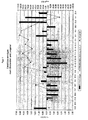
- the content of CaCO 3 of the activated slime flake could be approximately doubled within 4 weeks with the method according to the invention (see FIG. 1 ), while the amount of free carbonic acid dropped to about 50% at the same time.
- the calcite dissolving power (CLV) according to Strohecker and Langier is used. The calcite dissolving power is shifted by the reactor into the negative range (see FIG. 1 ).
- the activated sludge was supplied within a short time with calcium carbonate and magnesium carbonate and reduced the formation of scum and bulking sludge.
- the depth of vision in the final clarification improved significantly, and the hydraulics in the treatment plants was stabilized. Further, foaming or spitting occurred the digestion towers prevented. In addition, an increase in the biodegradation of nitrogen and phosphate could be observed.
- the lime-aggressive carbonic acid is neutralized.
- the ratio of the neutralized carbon dioxide to the total volume of the biomass can be determined.
- the content of CaCO 3 of the activated sludge flake is deliberately increased, so that bridging and crosslinking of the EPS macromolecules is improved by calcium-magnesium ions.
- the reactor does not need to be backflushed because the feed from below does not allow clogging of the reactor.
- Operation is easy and low maintenance. It is only necessary to ensure the degree of filling with the reactor filling material, since the material consumes over time. The consumption depends on the neutralized amount of carbon dioxide.
- FIG. 1 The invention will now be described by way of example and with the accompanying FIG. 1 further illustrated.
- a reactor with a volume of 1 m 3 was filled with a treated dolomite granules.
- the dolomite granules had the following composition: mgO: 25.3% by weight MgCO 3 : 4.0% by weight CaO: 0% by weight CaCO 3 : 69.9 wt .-%.
- activated sludge from the biology of a sewage treatment plant was injected from below into the reactor.
- the treatment plant was a system designed for 30,000 population equivalents.
- the activated sludge was returned to biology via an overflow of the reactor.
- the average dry weather input of the treatment plant was about 2000 m 3 / day.
- the amount of wastewater fluctuated between 1800 m 3 / day in dry weather and 6000 m 3 / day in rainy weather.
- a partial flow volume of the activated sludge could be achieved by the reactor of about 10% of the dry weather inlet of the sewage treatment plant.
- the partial volume flow of the activated sludge through the reactor was 204 m 3 / day.
- Example 1 was completed in a period of June 15 (June 15 in the FIG. 1 ) until 25 April (25 April in the FIG. 1 ) of the following year.
- CLV calcite dissolving power or the calcite saturation
- the CLV is calculated by calculating the saturation pH according to Strohecker and Langelier in accordance with DIN 38404 Part 10 R 2.
- the CLV was 49 mg / l. This is in the FIG. 1 read on the right Y-axis.
- the course of the experiment shows that the reactor was able to reduce the CLV to negative values.
- a negative Calcitlierecore means that after the lime-carbonic acid balance calcium carbonate is deposited. This shows that the reactor was sufficiently dimensioned for this sewage treatment plant.
- Example 1 showed that the percentage of calcium carbonate (CaCO 3 ) on the activated sludge flake was increased.
- Rainy weather and cold waste water temperatures in winter increase the CLV.
- Example 1 during the period of August, there were long periods of rain that shifted the CLV into positive territory. The direct influence on the calcium carbonate content is clearly visible.
- the CLV rose with colder temperatures from October to January, but remained in negative territory. The changing conditions between January and March with rain, snowfall and snow melt could compensate the reactor. It was not until the failure of the pumps described above at the end of March that the CLV in biology increased to over 100 mg / l, so that the calcium carbonate content on the activated sludge flake dropped from about 15% to 5%. In the plant of Example 1, it was observed that at a calcium carbonate content of less than 4%, floating scum occurred more. After repair of the pump, the calcium carbonate content could be increased again to over 10%.
- a poor supply of the activated sludge flake with calcium and magnesium can be improved in a very short time, thereby reducing or reducing bulking sludge, floating sludge and foaming.
- Example 1 about 4 tons / year of the treated dolomite granules were consumed in the trial period. It was continuously filled by plant personnel into the reactor. The filling level was kept at the same level by refilling. Depending on the season, the amount of replenishment fluctuated between 50 kg per week and up to 100 kg per week. On average, 67 kg per week were refilled. As the process uses carbonic acid itself, consumption varies as needed. The control for the process was simple, since with a dipstick only the level was to control and was too low level simply refilled reactor filler. The simple construction and the easy maintenance advantageously contributes to the simplification of a method for supplying one after the aerobic Activated sludge process operated biological wastewater treatment plant with calcium and magnesium.
- Example 1 The procedure carried out in Example 1 was carried out on four other systems with different feed conditions and led to similar results as obtained in Example 1 and in the FIG. 1 are shown.
Landscapes
- Chemical & Material Sciences (AREA)
- Life Sciences & Earth Sciences (AREA)
- Hydrology & Water Resources (AREA)
- Engineering & Computer Science (AREA)
- Environmental & Geological Engineering (AREA)
- Water Supply & Treatment (AREA)
- Organic Chemistry (AREA)
- Health & Medical Sciences (AREA)
- Medicinal Chemistry (AREA)
- Biodiversity & Conservation Biology (AREA)
- Microbiology (AREA)
- Activated Sludge Processes (AREA)
Claims (8)
- Procédé pour l'alimentation d'une installation d'épuration d'eaux résiduaires biologique fonctionnant selon le procédé aérobie aux boues activées avec du calcium et du magnésium, dans lequel un courant volumique partiel des boues activées est introduit à travers un réacteur qui contient comme matériau de charge du réacteur des composés contenant du calcium et du magnésium et est ensuite renvoyé à partir du réacteur dans le récipient des boues activées, dans lequel la teneur en CaCO3 des flocons de boues activées augmente et la capacité des bases diminue, dans lequel le matériau de charge du réacteur est de la dolomite traitée thermiquement, qui contient de 15 à 30 % en masse de MgO, de 0 à 21 % en masse de MgCO3, de 0 à 4 % en masse de CaO et de 63 à 75 % en masse de CaCO3, dans lequel la perte par calcination est de 31 à 39 % en masse.
- Procédé selon la revendication 1, caractérisé en ce que le matériau de charge du réacteur présente une taille de grain < 20 mm, de préférence de 2 à 12 mm.
- Procédé selon la revendication 1 ou 2, caractérisé en ce que le courant volumique partiel des boues activées est de 1 à 100 %, de préférence de 1 à 20 %, encore mieux de 5 à 15 %, du courant volumique d'alimentation de l'installation d'épuration d'eaux résiduaires.
- Procédé selon l'une ou plusieurs quelconques des revendications 1 à 3, caractérisé en ce que les boues activées sont introduites à travers le réacteur à partir du bas.
- Procédé selon l'une ou plusieurs quelconques des revendications 1 à 4, caractérisé en ce que l'on utilise une série de réacteur ou une cascade de réacteurs.
- Procédé selon la revendication 1, caractérisé en ce que le matériau de charge du réacteur contient de 23 à 28 % en masse de MgO, de 0 à 8 % en masse de MgCO3, de 0 à 2 % en masse de CaO et de 67 à 72 % en masse de CaCO3 et la perte par calcination est de 31 à 35 % en masse.
- Procédé selon l'une ou plusieurs quelconques des revendications 1 à 6, caractérisé en ce que le réacteur est muni de 1 à 30 m3, de préférence de 5 à 15 m3, de volume de boues par heure et par m2 de surface transversale du réacteur.
- Procédé selon l'une ou plusieurs quelconques des revendications 1 à 7, caractérisé en ce que la hauteur de remblai du matériau de charge de réacteur est de 20 à 500 cm, de préférence de 60 à 200 cm.
Applications Claiming Priority (1)
| Application Number | Priority Date | Filing Date | Title |
|---|---|---|---|
| DE200510031865 DE102005031865A1 (de) | 2005-07-06 | 2005-07-06 | Verfahren zur Vermeidung der Bildung von Blähschlamm in biologischen Kläranlagen |
Publications (3)
| Publication Number | Publication Date |
|---|---|
| EP1741679A2 EP1741679A2 (fr) | 2007-01-10 |
| EP1741679A3 EP1741679A3 (fr) | 2008-07-30 |
| EP1741679B1 true EP1741679B1 (fr) | 2012-09-12 |
Family
ID=36933611
Family Applications (1)
| Application Number | Title | Priority Date | Filing Date |
|---|---|---|---|
| EP20060013968 Not-in-force EP1741679B1 (fr) | 2005-07-06 | 2006-07-05 | Dispositif pour améliorer l'alimentation de calcium et magnésium dans une installation de traitement biologique d'eau usée |
Country Status (2)
| Country | Link |
|---|---|
| EP (1) | EP1741679B1 (fr) |
| DE (1) | DE102005031865A1 (fr) |
Families Citing this family (5)
| Publication number | Priority date | Publication date | Assignee | Title |
|---|---|---|---|---|
| DE102007027074A1 (de) * | 2007-06-12 | 2008-12-18 | Peter Schöndorfer | Verwendung eines anorganischen Materials in Abwasser zur Verringerung oder Vermeidung von Verschleiß von Beton durch einen lösenden Angriff |
| DE102007035253A1 (de) | 2007-07-27 | 2009-01-29 | Anton Hausberger | Vorrichtung zum Dispergieren eines Feststoffs in Abwasser |
| LT2565165T (lt) * | 2011-08-31 | 2016-11-25 | Omya International Ag | Nudruskintojo arba gėlo vandens remineralizacija, pridedant kalcio karbonato tirpalo į minkštą vandenį |
| CN109095601B (zh) * | 2018-10-25 | 2021-07-06 | 江西理工大学 | 基于粒径控制的好氧颗粒污泥反应器运行稳定性维持方法 |
| RU2748331C1 (ru) * | 2020-06-03 | 2021-05-24 | Общество с ограниченной ответственностью "КНТП" | Способ обработки сточных вод |
Citations (1)
| Publication number | Priority date | Publication date | Assignee | Title |
|---|---|---|---|---|
| FR2869895A1 (fr) * | 2004-05-07 | 2005-11-11 | Halter Hydro Environnement Ent | Procede de lestage de boues activees |
Family Cites Families (9)
| Publication number | Priority date | Publication date | Assignee | Title |
|---|---|---|---|---|
| GB684607A (en) * | 1949-06-11 | 1952-12-24 | Infilco Inc | Improvements in or relating to a sewage treating process |
| JPS51120055A (en) * | 1975-04-15 | 1976-10-21 | Nippon Peroxide Co Ltd | A composition imparting activity to active mud |
| JPS6015396B2 (ja) * | 1977-02-25 | 1985-04-19 | 日立化成工業株式会社 | 生物学的硝化方法 |
| JPS5559894A (en) * | 1978-10-26 | 1980-05-06 | Nippon Steel Corp | Denitrifying method for waste water by activated sludge process system |
| US5500131A (en) * | 1994-04-05 | 1996-03-19 | Metz; Jean-Paul | Compositions and methods for water treatment |
| JP3335500B2 (ja) * | 1994-08-03 | 2002-10-15 | シャープ株式会社 | 排水処理装置および排水処理方法 |
| DE10244416A1 (de) * | 2002-09-24 | 2004-04-01 | Vta Engineering Und Umwelttechnik Gmbh | Verfahren zum Unterdrücken einer Schwimm- und Blähschlammbildung in der aeroben Behandlungsstufe einer biologischen Abwasserreinigung |
| JP2004167372A (ja) * | 2002-11-20 | 2004-06-17 | Sumitomo Densetsu Corp | 懸濁粒子の凝集方法および凝集装置 |
| JP2005034702A (ja) * | 2003-07-16 | 2005-02-10 | Sumitomo Densetsu Corp | 懸濁粒子凝集ユニット及び廃液浄化装置 |
-
2005
- 2005-07-06 DE DE200510031865 patent/DE102005031865A1/de not_active Withdrawn
-
2006
- 2006-07-05 EP EP20060013968 patent/EP1741679B1/fr not_active Not-in-force
Patent Citations (1)
| Publication number | Priority date | Publication date | Assignee | Title |
|---|---|---|---|---|
| FR2869895A1 (fr) * | 2004-05-07 | 2005-11-11 | Halter Hydro Environnement Ent | Procede de lestage de boues activees |
Non-Patent Citations (1)
| Title |
|---|
| THOMPSON G ET AL: "Bulking in activated sludge plants treating paper mill wastewaters", WATER RESEARCH, ELSEVIER, AMSTERDAM, NL, vol. 37, no. 11, 1 June 2003 (2003-06-01), pages 2636 - 2644, XP004424030, ISSN: 0043-1354 * |
Also Published As
| Publication number | Publication date |
|---|---|
| DE102005031865A1 (de) | 2007-01-18 |
| EP1741679A3 (fr) | 2008-07-30 |
| EP1741679A2 (fr) | 2007-01-10 |
Similar Documents
| Publication | Publication Date | Title |
|---|---|---|
| DE102008050349B4 (de) | Verfahren zur Ausfällung von Phosphor aus phosphatbelastetem Abwasser | |
| DE69512727T2 (de) | Vorrichtung und Verfahren zur Behandlung von Fluor und Tenside enthaltenden Abwässern und/oder Abgasen | |
| DE102013103704B4 (de) | Verfahren zur Optimierung der biologischen Nährstoffeliminierung aus Abwasser | |
| EP2576449B1 (fr) | Méthode pour produire un mélange de matières destiné à réduire l'apparition de magnésium, d'ammonium, et de phosphate (struvite) dans des installations d'épuration | |
| EP1807360B1 (fr) | Dispositif et procede pour purifier les eaux usees | |
| EP0383156B1 (fr) | Procédé pour l'élimination de phosphates et de phosphores organiquement liés des eaux résiduaires et d'adduction | |
| DE69400915T2 (de) | Verbesserte methode zur reinigung von abwasser unter anwendung von belebtem schlamm zur vergrösserung der reinigungsausbeuten | |
| EP1241140B1 (fr) | Procédé pour la réduction d'entartrage dans la réception et l'évacuation d'eau | |
| EP1741679B1 (fr) | Dispositif pour améliorer l'alimentation de calcium et magnésium dans une installation de traitement biologique d'eau usée | |
| DE3833039A1 (de) | Verfahren und vorrichtung zur reinigung phosphat- und stickstoffhaltigen abwassers | |
| EP3429968B1 (fr) | Procédé et dispositif pour le traitement de l'eau pour un nettoyage effectif de l'eau usée | |
| DE102006011951B4 (de) | Verfahren zur anaeroben Aufbereitung von Abwasser | |
| EP1634854B1 (fr) | Méthode de sélection directe d'un indice de boue souhaitée dans une méthode de boues activées par selection de boue externe | |
| DE102015002850A1 (de) | Abfolge von Verfahren zur Behandlung von Abwasser | |
| EP0534351A2 (fr) | Procédé et installation pour le traitement d'eau usée ammonicale à haute concentration | |
| WO2016202628A1 (fr) | Procédé de traitement aérobie d'un flux d'eaux usées biodégradables | |
| EP2822900B1 (fr) | Installation et procédé biologique avec traitement avec flux de gaz etant au moins partiellement ionisé | |
| DE19635391C2 (de) | Abwasserreinigungsverfahren mit biologischer Phosphatelimination unter konstantem pH-Wert | |
| Beer et al. | Chemical flocculation as a tertiary treatment for pig effluent | |
| AT409857B (de) | Verfahren zum unterdrücken einer schwimm- und blähschlammbildung in der aeroben behandlungsstufe einer biologischen abwasserreinigung | |
| DE102005037541A1 (de) | Verfahren und Vorrichtung zum Aufbereiten von Brauwasser | |
| DE102007035253A1 (de) | Vorrichtung zum Dispergieren eines Feststoffs in Abwasser | |
| DE10009014A1 (de) | Verfahren und Vorrichtung zum mikrobiologischen Abbau von Schadstoffen in Fluiden | |
| DE102004018972A1 (de) | Verfahren zur Verwertung von alkalischen Eisenhydroxydschlämmen aus Konditionierungsanlagen | |
| DE10244416A1 (de) | Verfahren zum Unterdrücken einer Schwimm- und Blähschlammbildung in der aeroben Behandlungsstufe einer biologischen Abwasserreinigung |
Legal Events
| Date | Code | Title | Description |
|---|---|---|---|
| PUAI | Public reference made under article 153(3) epc to a published international application that has entered the european phase |
Free format text: ORIGINAL CODE: 0009012 |
|
| AK | Designated contracting states |
Kind code of ref document: A2 Designated state(s): AT BE BG CH CY CZ DE DK EE ES FI FR GB GR HU IE IS IT LI LT LU LV MC NL PL PT RO SE SI SK TR |
|
| AX | Request for extension of the european patent |
Extension state: AL BA HR MK YU |
|
| PUAL | Search report despatched |
Free format text: ORIGINAL CODE: 0009013 |
|
| AK | Designated contracting states |
Kind code of ref document: A3 Designated state(s): AT BE BG CH CY CZ DE DK EE ES FI FR GB GR HU IE IS IT LI LT LU LV MC NL PL PT RO SE SI SK TR |
|
| AX | Request for extension of the european patent |
Extension state: AL BA HR MK RS |
|
| 17P | Request for examination filed |
Effective date: 20090130 |
|
| 17Q | First examination report despatched |
Effective date: 20090306 |
|
| AKX | Designation fees paid |
Designated state(s): AT BE BG CH CY CZ DE DK EE ES FI FR GB GR HU IE IS IT LI LT LU LV MC NL PL PT RO SE SI SK TR |
|
| GRAP | Despatch of communication of intention to grant a patent |
Free format text: ORIGINAL CODE: EPIDOSNIGR1 |
|
| GRAS | Grant fee paid |
Free format text: ORIGINAL CODE: EPIDOSNIGR3 |
|
| GRAA | (expected) grant |
Free format text: ORIGINAL CODE: 0009210 |
|
| AK | Designated contracting states |
Kind code of ref document: B1 Designated state(s): AT BE BG CH CY CZ DE DK EE ES FI FR GB GR HU IE IS IT LI LT LU LV MC NL PL PT RO SE SI SK TR |
|
| REG | Reference to a national code |
Ref country code: GB Ref legal event code: FG4D Free format text: NOT ENGLISH |
|
| REG | Reference to a national code |
Ref country code: CH Ref legal event code: EP |
|
| REG | Reference to a national code |
Ref country code: AT Ref legal event code: REF Ref document number: 574976 Country of ref document: AT Kind code of ref document: T Effective date: 20120915 |
|
| REG | Reference to a national code |
Ref country code: IE Ref legal event code: FG4D Free format text: LANGUAGE OF EP DOCUMENT: GERMAN |
|
| REG | Reference to a national code |
Ref country code: DE Ref legal event code: R096 Ref document number: 502006011958 Country of ref document: DE Effective date: 20121108 |
|
| REG | Reference to a national code |
Ref country code: CH Ref legal event code: NV Representative=s name: BOHEST AG, CH |
|
| PG25 | Lapsed in a contracting state [announced via postgrant information from national office to epo] |
Ref country code: FI Free format text: LAPSE BECAUSE OF FAILURE TO SUBMIT A TRANSLATION OF THE DESCRIPTION OR TO PAY THE FEE WITHIN THE PRESCRIBED TIME-LIMIT Effective date: 20120912 Ref country code: LT Free format text: LAPSE BECAUSE OF FAILURE TO SUBMIT A TRANSLATION OF THE DESCRIPTION OR TO PAY THE FEE WITHIN THE PRESCRIBED TIME-LIMIT Effective date: 20120912 |
|
| REG | Reference to a national code |
Ref country code: NL Ref legal event code: VDEP Effective date: 20120912 |
|
| REG | Reference to a national code |
Ref country code: LT Ref legal event code: MG4D Effective date: 20120912 |
|
| PG25 | Lapsed in a contracting state [announced via postgrant information from national office to epo] |
Ref country code: GR Free format text: LAPSE BECAUSE OF FAILURE TO SUBMIT A TRANSLATION OF THE DESCRIPTION OR TO PAY THE FEE WITHIN THE PRESCRIBED TIME-LIMIT Effective date: 20121213 Ref country code: LV Free format text: LAPSE BECAUSE OF FAILURE TO SUBMIT A TRANSLATION OF THE DESCRIPTION OR TO PAY THE FEE WITHIN THE PRESCRIBED TIME-LIMIT Effective date: 20120912 Ref country code: SE Free format text: LAPSE BECAUSE OF FAILURE TO SUBMIT A TRANSLATION OF THE DESCRIPTION OR TO PAY THE FEE WITHIN THE PRESCRIBED TIME-LIMIT Effective date: 20120912 Ref country code: SI Free format text: LAPSE BECAUSE OF FAILURE TO SUBMIT A TRANSLATION OF THE DESCRIPTION OR TO PAY THE FEE WITHIN THE PRESCRIBED TIME-LIMIT Effective date: 20120912 |
|
| PG25 | Lapsed in a contracting state [announced via postgrant information from national office to epo] |
Ref country code: RO Free format text: LAPSE BECAUSE OF FAILURE TO SUBMIT A TRANSLATION OF THE DESCRIPTION OR TO PAY THE FEE WITHIN THE PRESCRIBED TIME-LIMIT Effective date: 20120912 Ref country code: NL Free format text: LAPSE BECAUSE OF FAILURE TO SUBMIT A TRANSLATION OF THE DESCRIPTION OR TO PAY THE FEE WITHIN THE PRESCRIBED TIME-LIMIT Effective date: 20120912 Ref country code: EE Free format text: LAPSE BECAUSE OF FAILURE TO SUBMIT A TRANSLATION OF THE DESCRIPTION OR TO PAY THE FEE WITHIN THE PRESCRIBED TIME-LIMIT Effective date: 20120912 Ref country code: ES Free format text: LAPSE BECAUSE OF FAILURE TO SUBMIT A TRANSLATION OF THE DESCRIPTION OR TO PAY THE FEE WITHIN THE PRESCRIBED TIME-LIMIT Effective date: 20121223 Ref country code: IS Free format text: LAPSE BECAUSE OF FAILURE TO SUBMIT A TRANSLATION OF THE DESCRIPTION OR TO PAY THE FEE WITHIN THE PRESCRIBED TIME-LIMIT Effective date: 20130112 Ref country code: CZ Free format text: LAPSE BECAUSE OF FAILURE TO SUBMIT A TRANSLATION OF THE DESCRIPTION OR TO PAY THE FEE WITHIN THE PRESCRIBED TIME-LIMIT Effective date: 20120912 |
|
| PG25 | Lapsed in a contracting state [announced via postgrant information from national office to epo] |
Ref country code: SK Free format text: LAPSE BECAUSE OF FAILURE TO SUBMIT A TRANSLATION OF THE DESCRIPTION OR TO PAY THE FEE WITHIN THE PRESCRIBED TIME-LIMIT Effective date: 20120912 Ref country code: CY Free format text: LAPSE BECAUSE OF FAILURE TO SUBMIT A TRANSLATION OF THE DESCRIPTION OR TO PAY THE FEE WITHIN THE PRESCRIBED TIME-LIMIT Effective date: 20120912 Ref country code: PT Free format text: LAPSE BECAUSE OF FAILURE TO SUBMIT A TRANSLATION OF THE DESCRIPTION OR TO PAY THE FEE WITHIN THE PRESCRIBED TIME-LIMIT Effective date: 20130114 Ref country code: PL Free format text: LAPSE BECAUSE OF FAILURE TO SUBMIT A TRANSLATION OF THE DESCRIPTION OR TO PAY THE FEE WITHIN THE PRESCRIBED TIME-LIMIT Effective date: 20120912 |
|
| PLBE | No opposition filed within time limit |
Free format text: ORIGINAL CODE: 0009261 |
|
| STAA | Information on the status of an ep patent application or granted ep patent |
Free format text: STATUS: NO OPPOSITION FILED WITHIN TIME LIMIT |
|
| PG25 | Lapsed in a contracting state [announced via postgrant information from national office to epo] |
Ref country code: BG Free format text: LAPSE BECAUSE OF FAILURE TO SUBMIT A TRANSLATION OF THE DESCRIPTION OR TO PAY THE FEE WITHIN THE PRESCRIBED TIME-LIMIT Effective date: 20121212 Ref country code: DK Free format text: LAPSE BECAUSE OF FAILURE TO SUBMIT A TRANSLATION OF THE DESCRIPTION OR TO PAY THE FEE WITHIN THE PRESCRIBED TIME-LIMIT Effective date: 20120912 |
|
| 26N | No opposition filed |
Effective date: 20130613 |
|
| REG | Reference to a national code |
Ref country code: DE Ref legal event code: R097 Ref document number: 502006011958 Country of ref document: DE Effective date: 20130613 |
|
| BERE | Be: lapsed |
Owner name: SCHONDORFER, PETER Effective date: 20130731 |
|
| PG25 | Lapsed in a contracting state [announced via postgrant information from national office to epo] |
Ref country code: MC Free format text: LAPSE BECAUSE OF FAILURE TO SUBMIT A TRANSLATION OF THE DESCRIPTION OR TO PAY THE FEE WITHIN THE PRESCRIBED TIME-LIMIT Effective date: 20120912 |
|
| GBPC | Gb: european patent ceased through non-payment of renewal fee |
Effective date: 20130705 |
|
| REG | Reference to a national code |
Ref country code: IE Ref legal event code: MM4A |
|
| PG25 | Lapsed in a contracting state [announced via postgrant information from national office to epo] |
Ref country code: BE Free format text: LAPSE BECAUSE OF NON-PAYMENT OF DUE FEES Effective date: 20130731 Ref country code: GB Free format text: LAPSE BECAUSE OF NON-PAYMENT OF DUE FEES Effective date: 20130705 |
|
| PG25 | Lapsed in a contracting state [announced via postgrant information from national office to epo] |
Ref country code: IE Free format text: LAPSE BECAUSE OF NON-PAYMENT OF DUE FEES Effective date: 20130705 |
|
| REG | Reference to a national code |
Ref country code: CH Ref legal event code: PCAR Free format text: NEW ADDRESS: HOLBEINSTRASSE 36-38, 4051 BASEL (CH) |
|
| PG25 | Lapsed in a contracting state [announced via postgrant information from national office to epo] |
Ref country code: TR Free format text: LAPSE BECAUSE OF FAILURE TO SUBMIT A TRANSLATION OF THE DESCRIPTION OR TO PAY THE FEE WITHIN THE PRESCRIBED TIME-LIMIT Effective date: 20120912 |
|
| PG25 | Lapsed in a contracting state [announced via postgrant information from national office to epo] |
Ref country code: LU Free format text: LAPSE BECAUSE OF NON-PAYMENT OF DUE FEES Effective date: 20130705 Ref country code: HU Free format text: LAPSE BECAUSE OF FAILURE TO SUBMIT A TRANSLATION OF THE DESCRIPTION OR TO PAY THE FEE WITHIN THE PRESCRIBED TIME-LIMIT; INVALID AB INITIO Effective date: 20060705 |
|
| REG | Reference to a national code |
Ref country code: FR Ref legal event code: PLFP Year of fee payment: 11 |
|
| REG | Reference to a national code |
Ref country code: FR Ref legal event code: PLFP Year of fee payment: 12 |
|
| REG | Reference to a national code |
Ref country code: FR Ref legal event code: PLFP Year of fee payment: 13 |
|
| PGFP | Annual fee paid to national office [announced via postgrant information from national office to epo] |
Ref country code: DE Payment date: 20190710 Year of fee payment: 14 Ref country code: FR Payment date: 20190725 Year of fee payment: 14 Ref country code: IT Payment date: 20190731 Year of fee payment: 14 |
|
| PGFP | Annual fee paid to national office [announced via postgrant information from national office to epo] |
Ref country code: AT Payment date: 20190723 Year of fee payment: 14 |
|
| PGFP | Annual fee paid to national office [announced via postgrant information from national office to epo] |
Ref country code: CH Payment date: 20190725 Year of fee payment: 14 |
|
| REG | Reference to a national code |
Ref country code: DE Ref legal event code: R119 Ref document number: 502006011958 Country of ref document: DE |
|
| REG | Reference to a national code |
Ref country code: CH Ref legal event code: PL |
|
| REG | Reference to a national code |
Ref country code: AT Ref legal event code: MM01 Ref document number: 574976 Country of ref document: AT Kind code of ref document: T Effective date: 20200705 |
|
| PG25 | Lapsed in a contracting state [announced via postgrant information from national office to epo] |
Ref country code: FR Free format text: LAPSE BECAUSE OF NON-PAYMENT OF DUE FEES Effective date: 20200731 Ref country code: CH Free format text: LAPSE BECAUSE OF NON-PAYMENT OF DUE FEES Effective date: 20200731 Ref country code: LI Free format text: LAPSE BECAUSE OF NON-PAYMENT OF DUE FEES Effective date: 20200731 |
|
| PG25 | Lapsed in a contracting state [announced via postgrant information from national office to epo] |
Ref country code: DE Free format text: LAPSE BECAUSE OF NON-PAYMENT OF DUE FEES Effective date: 20210202 Ref country code: AT Free format text: LAPSE BECAUSE OF NON-PAYMENT OF DUE FEES Effective date: 20200705 |
|
| PG25 | Lapsed in a contracting state [announced via postgrant information from national office to epo] |
Ref country code: IT Free format text: LAPSE BECAUSE OF NON-PAYMENT OF DUE FEES Effective date: 20200705 |