EP1742166B1 - Procédé destiné à la commande d'accès à un transpondeur - Google Patents
Procédé destiné à la commande d'accès à un transpondeur Download PDFInfo
- Publication number
- EP1742166B1 EP1742166B1 EP06013552A EP06013552A EP1742166B1 EP 1742166 B1 EP1742166 B1 EP 1742166B1 EP 06013552 A EP06013552 A EP 06013552A EP 06013552 A EP06013552 A EP 06013552A EP 1742166 B1 EP1742166 B1 EP 1742166B1
- Authority
- EP
- European Patent Office
- Prior art keywords
- identification
- transponder
- password
- assigned
- identifier
- Prior art date
- Legal status (The legal status is an assumption and is not a legal conclusion. Google has not performed a legal analysis and makes no representation as to the accuracy of the status listed.)
- Not-in-force
Links
Images

Classifications
-
- G—PHYSICS
- G06—COMPUTING OR CALCULATING; COUNTING
- G06F—ELECTRIC DIGITAL DATA PROCESSING
- G06F21/00—Security arrangements for protecting computers, components thereof, programs or data against unauthorised activity
- G06F21/30—Authentication, i.e. establishing the identity or authorisation of security principals
- G06F21/31—User authentication
- G06F21/34—User authentication involving the use of external additional devices, e.g. dongles or smart cards
- G06F21/35—User authentication involving the use of external additional devices, e.g. dongles or smart cards communicating wirelessly
-
- G—PHYSICS
- G06—COMPUTING OR CALCULATING; COUNTING
- G06F—ELECTRIC DIGITAL DATA PROCESSING
- G06F21/00—Security arrangements for protecting computers, components thereof, programs or data against unauthorised activity
- G06F21/70—Protecting specific internal or peripheral components, in which the protection of a component leads to protection of the entire computer
- G06F21/71—Protecting specific internal or peripheral components, in which the protection of a component leads to protection of the entire computer to assure secure computing or processing of information
- G06F21/77—Protecting specific internal or peripheral components, in which the protection of a component leads to protection of the entire computer to assure secure computing or processing of information in smart cards
-
- G—PHYSICS
- G06—COMPUTING OR CALCULATING; COUNTING
- G06K—GRAPHICAL DATA READING; PRESENTATION OF DATA; RECORD CARRIERS; HANDLING RECORD CARRIERS
- G06K19/00—Record carriers for use with machines and with at least a part designed to carry digital markings
- G06K19/06—Record carriers for use with machines and with at least a part designed to carry digital markings characterised by the kind of the digital marking, e.g. shape, nature, code
- G06K19/067—Record carriers with conductive marks, printed circuits or semiconductor circuit elements, e.g. credit or identity cards also with resonating or responding marks without active components
- G06K19/07—Record carriers with conductive marks, printed circuits or semiconductor circuit elements, e.g. credit or identity cards also with resonating or responding marks without active components with integrated circuit chips
- G06K19/073—Special arrangements for circuits, e.g. for protecting identification code in memory
- G06K19/07309—Means for preventing undesired reading or writing from or onto record carriers
-
- G—PHYSICS
- G06—COMPUTING OR CALCULATING; COUNTING
- G06Q—INFORMATION AND COMMUNICATION TECHNOLOGY [ICT] SPECIALLY ADAPTED FOR ADMINISTRATIVE, COMMERCIAL, FINANCIAL, MANAGERIAL OR SUPERVISORY PURPOSES; SYSTEMS OR METHODS SPECIALLY ADAPTED FOR ADMINISTRATIVE, COMMERCIAL, FINANCIAL, MANAGERIAL OR SUPERVISORY PURPOSES, NOT OTHERWISE PROVIDED FOR
- G06Q20/00—Payment architectures, schemes or protocols
- G06Q20/30—Payment architectures, schemes or protocols characterised by the use of specific devices or networks
- G06Q20/34—Payment architectures, schemes or protocols characterised by the use of specific devices or networks using cards, e.g. integrated circuit [IC] cards or magnetic cards
- G06Q20/341—Active cards, i.e. cards including their own processing means, e.g. including an IC or chip
-
- G—PHYSICS
- G06—COMPUTING OR CALCULATING; COUNTING
- G06Q—INFORMATION AND COMMUNICATION TECHNOLOGY [ICT] SPECIALLY ADAPTED FOR ADMINISTRATIVE, COMMERCIAL, FINANCIAL, MANAGERIAL OR SUPERVISORY PURPOSES; SYSTEMS OR METHODS SPECIALLY ADAPTED FOR ADMINISTRATIVE, COMMERCIAL, FINANCIAL, MANAGERIAL OR SUPERVISORY PURPOSES, NOT OTHERWISE PROVIDED FOR
- G06Q20/00—Payment architectures, schemes or protocols
- G06Q20/30—Payment architectures, schemes or protocols characterised by the use of specific devices or networks
- G06Q20/34—Payment architectures, schemes or protocols characterised by the use of specific devices or networks using cards, e.g. integrated circuit [IC] cards or magnetic cards
- G06Q20/357—Cards having a plurality of specified features
- G06Q20/3576—Multiple memory zones on card
-
- G—PHYSICS
- G07—CHECKING-DEVICES
- G07F—COIN-FREED OR LIKE APPARATUS
- G07F7/00—Mechanisms actuated by objects other than coins to free or to actuate vending, hiring, coin or paper currency dispensing or refunding apparatus
- G07F7/08—Mechanisms actuated by objects other than coins to free or to actuate vending, hiring, coin or paper currency dispensing or refunding apparatus by coded identity card or credit card or other personal identification means
- G07F7/10—Mechanisms actuated by objects other than coins to free or to actuate vending, hiring, coin or paper currency dispensing or refunding apparatus by coded identity card or credit card or other personal identification means together with a coded signal, e.g. in the form of personal identification information, like personal identification number [PIN] or biometric data
- G07F7/1008—Active credit-cards provided with means to personalise their use, e.g. with PIN-introduction/comparison system
-
- H—ELECTRICITY
- H04—ELECTRIC COMMUNICATION TECHNIQUE
- H04L—TRANSMISSION OF DIGITAL INFORMATION, e.g. TELEGRAPHIC COMMUNICATION
- H04L9/00—Cryptographic mechanisms or cryptographic arrangements for secret or secure communications; Network security protocols
- H04L9/32—Cryptographic mechanisms or cryptographic arrangements for secret or secure communications; Network security protocols including means for verifying the identity or authority of a user of the system or for message authentication, e.g. authorization, entity authentication, data integrity or data verification, non-repudiation, key authentication or verification of credentials
- H04L9/3226—Cryptographic mechanisms or cryptographic arrangements for secret or secure communications; Network security protocols including means for verifying the identity or authority of a user of the system or for message authentication, e.g. authorization, entity authentication, data integrity or data verification, non-repudiation, key authentication or verification of credentials using a predetermined code, e.g. password, passphrase or PIN
-
- H—ELECTRICITY
- H04—ELECTRIC COMMUNICATION TECHNIQUE
- H04L—TRANSMISSION OF DIGITAL INFORMATION, e.g. TELEGRAPHIC COMMUNICATION
- H04L2209/00—Additional information or applications relating to cryptographic mechanisms or cryptographic arrangements for secret or secure communication H04L9/00
- H04L2209/80—Wireless
- H04L2209/805—Lightweight hardware, e.g. radio-frequency identification [RFID] or sensor
-
- H—ELECTRICITY
- H04—ELECTRIC COMMUNICATION TECHNIQUE
- H04L—TRANSMISSION OF DIGITAL INFORMATION, e.g. TELEGRAPHIC COMMUNICATION
- H04L63/00—Network architectures or network communication protocols for network security
- H04L63/06—Network architectures or network communication protocols for network security for supporting key management in a packet data network
Definitions
- the invention relates to a method for access control to a transponder according to the preamble of claim 1.
- Such access control methods are used, for example, in contactless identification systems or so-called Radio Frequency Identification (RFID) systems.
- RFID Radio Frequency Identification
- Such a system usually consists of a base station or a reader or a reading unit and a plurality of transponders or remote sensors, which are located simultaneously in the response range of the base station.
- the transponders or their transmitting and receiving devices usually do not have an active transmitter for the data transmission to the base station.
- inactive systems are referred to as passive systems if they do not have their own power supply, and are referred to as semi-passive systems if they have their own power supply.
- Passive transponders extract the energy needed for their supply from the electromagnetic field emitted by the base station.
- the so-called backscatter or backscatter coupling is usually used.
- electromagnetic carrier waves are emitted by the base station, which are modulated by the transmitting and receiving device of the transponder according to the data to be transmitted to the base station with a modulation method and reflected.
- the typical modulation techniques for this are amplitude modulation, phase modulation and amplitude shift keying (ASK) subcarrier modulation, in which the frequency or phase of the subcarrier is changed.
- ASK amplitude shift keying
- the standardization proposal ISO / IEC_CD 18000-6C dated 07.01.2005 describes an access control procedure for transponders.
- the transponder is first selected in a selection or arbitration process from a set of transponders.
- the described selection process is a stochastic process in the form of a slot-based ALOHA process.
- Such selection methods are described in detail, for example, in the textbook Klaus Finkenzeller, RFID Handbook, 3rd ed., HANSER, 2002.
- the reading unit transmits a request to the transponder in the form of a return transmission of a random number previously transmitted by the transponder in the context of the arbitration procedure, whereupon the transponder protocol control bits (PC) and an identifier in the form of a so-called electronic product codes (EPC) to the reading unit.
- the protocol control bits include information regarding a physical layer of the transmission link.
- the identifier or the electronic product code EPC forms inter alia a product identified by the transponder.
- the assignment from the EPC to the marked product is standardized, so that from the knowledge EPC can be concluded on the goods.
- the EPC can be used by the reading unit as a pointer to further information, for example to a password assigned to the EPC.
- the password can be used to lock memory areas of the transponder for write accesses.
- the transmission of the EPC on request to the reader unit involves certain risks.
- unauthorized persons can intentionally search for goods of a certain type, for example for high-quality watches or weapons, during transport of the goods, since the goods-identifying EPC is transmitted unprotected.
- a suitable reader in the range of the transponder to bring, for example on a motorway parking lot or in stations.
- a challenge-response authentication method wherein, for example, by a transponder a random number (“Challenge Vatue") is generated and transmitted to a reading unit from the reading unit, the random number by means of mathematical operations with one in her stored identifier is linked and the encrypted signal ("Challenge Reply") is sent to the transponder.
- the transponder associates the random number with a known random number corresponding to the identifier of the reading unit and compares the result with the received signal. In the case of a successful authentication, access for the reading unit to the transponder is released. This avoids transmission of the identifier in plain text.
- a system comprising first and second transponders
- the first transponder has a first memory device in which a first key is stored
- the second transponder has a second memory device and has access to a second key.
- the first transponder generates a first message, encrypts it with a random number and encrypts the already encrypted message by means of the first key. By the second key, the thus encrypted message can be decrypted.
- personal data may be stored as memory content. Again, it is desirable to regulate the access to this data, for example, when entering a department store not be able to automatically determine by reading the memory contents, whether the customer in question still has money on the smart card or not.
- the invention is therefore based on the object of providing a method for access control to a, in particular passive and / or backscatter-based, transponder of the type mentioned above, which reliably prevents unauthorized access to memory areas of the transponder, in particular the EPC, and at the same time compatible with the said ISO standardization proposal.
- the invention solves this problem by a method having the features of claim 1.
- the release of the access may extend to a read-only authorization of only individual, adjustable areas of a transponder memory or of a sensor value or, in the case of a maximum access authorization, to a read and write authorization of all memory areas or sensors and actuators, if present, of the transponder. Since the transponder transmits an identifier independently of the value of the identifier selection criterion, the method according to the invention is in principle compatible with standards. If the identifier selection criterion is set such that the second identifier is sent by the transponder, the transmission of the first identifier is suppressed. If the first identifier contains security-relevant information and the second identifier is merely a pointer or a reference to information that is worthless to an unauthorized user, unauthorized access can thus result
- the transponder can also be used in conventional systems that do not support an access method according to the invention.
- the first identifier depicts a product identified by the transponder.
- the first identifier here may be the EPC in particular. This allows effective protection of the EPC from unauthorized access, with authorized users gaining access to the EPC by entering the password associated with the second identifier.
- the second identifier and / or the identifier selection criterion can be set during the operation of the transponder, after the password assigned to the second identifier is transmitted to the transponder by the reading unit. This allows a simple change of the second identifier, for example, when goods marked by the transponder are exchanged or changed.
- a password is assigned to the first identifier, wherein a change of the first identifier and / or a release or a locking of memory areas for write and / or read accesses of the transponder can only be carried out after the password assigned to the first identifier is transmitted to the transponder.
- This will be a second Access level created, which can be accessed when activated second identifier, after the password assigned to the second identifier is entered. In this way, for example, a larger group of people can gain access via the second identifier, wherein the first identifier or its associated password has only a limited number of people who can perform the highly security-relevant operations accessible via it.
- the password associated with the first identifier and / or the password associated with the second identifier are each assigned to an associated public password, the respective password and the associated * public password being uniquely associated with one another via a cryptographic algorithm.
- a cryptographic algorithm is, for example, in DE 10 2005 005436 . US 2005/231369 and EP 1 587 001 described.
- the respective public password can also be written to the transponder via a non-secure radio link, where it can simply be stored in memory, for example if it is not locked, read-locked or encrypted. Since the - private - password can not or only with great effort from the public password can be calculated and a "Unlock" using the public password is not possible, the password or password storage is much easier.
- the cryptographic algorithm can be realized, for example, by a linear feedback slice register, at the input of which the private password or a bit sequence derived therefrom is applied, wherein the public password is present at an adjustable stage of the shift register or is output as a bit sequence.
- At least one parameter of the cryptographic algorithm in a rewritable, nonvolatile memory of the transponder becomes advantageous saved.
- the parameter may be, for example, a type of the cryptographic algorithm and / or a level specification applied to the public password when a linear feedback slice register is used to implement the cryptographic algorithm.
- the first identifier, the second identifier, a public password assigned to the first identifier and / or the public password assigned to the second identifier are stored in a nonvolatile memory of the transponder.
- the second identifier is stored in a memory area assigned to the first identifier together with the first identifier.
- the physical memory of the transponder is divided into four logical areas or banks.
- the EPC i. in this case the first identifier, a separate area assigned, wherein in the area still protocol control bits PC and a CRC are stored.
- the length i. the number of bits of the EPC is adjustable here. If the memory area is not completely occupied by the EPC, the PC and the CRC, it is available for storing the second identifier.
- the public identifier assigned to the second identifier is stored in the memory area assigned to the first identifier together with the first identifier and the second identifier. This is useful if space is still available in the area.
- the transponder is permanently deactivated when a kill password is transmitted to the transponder by the reading unit, wherein the kill password is stored in a memory area of the transponder assigned to it.
- the Transmission of the kill password to the transponder causes the transponder is permanently disabled. A reading or writing access to it is then no longer possible. This is done, for example, for privacy reasons in a scrapping of goods marked by the transponder.
- a separate logical area in the physical memory of the transponder is provided for password storage, whereby here both the kill password and a password assigned to the first identifier are stored.
- the public password assigned to the second identifier is stored in the memory area assigned to the kill password if the kill password is deactivated. In this way, a good memory utilization can be achieved.
- the identifier selection criterion is stored as a bit value in a nonvolatile memory of the transponder.
- a logical bit value "0" of the identifier selection criterion a deactivated second identifier and a logical bit value "1" an activated second. Show identifier.
- a number of erroneous transmissions of the password associated with the second identifier is counted in the transponder, and upon reaching an adjustable counter threshold value, a clock supply of the transponder is deactivated.
- the entire transponder is deactivated, ie access to the transponder is no longer possible.
- a renewed activation of the transponder or its clock supply can be achieved, for example, that it from one of the reading unit emitted electromagnetic field is removed so far that the power taken from the field for its supply is no longer sufficient. If it is then returned to the field, a so-called power-on reset takes place, whereby access to the transponder is possible again.
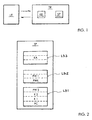
- Fig. 1 1 schematically shows a block diagram of an RFID system having a reading unit LE and a passive backscatter-based transponder TR, each configured to operate in its basic functions in accordance with ISO / IEC_CD 18000-6C of Jan. 7, 2005.
- the transponder TR comprises, among other conventional functional units, not shown, a nonvolatile memory SP and a cryptography unit KE.
- Fig. 2 shows a memory image of the in Fig. 1 shown memory SP of the transponder TR.
- the physical memory SP is divided into logical areas LB1 to LB3, which are used as address information or index in a memory access of the reading unit LE to the transponder TR.
- further areas may also be provided.
- the logical area LB1 serves to store a first identifier K1 in the form of an electronic product code EPC, a second identifier K2 and protocol control bits PC.
- the logical area LB2 serves to store a public password PW1 associated with the first identifier K1 and a so-called kill password PWK.
- the kill password PWK is used to permanently deactivate the transponder TR for privacy reasons, for example when scrapping a product identified by the transponder TR, ie. Permanently disable read and write access.
- the area LB3, which forms a user memory for storing user-specific data, contains an identifier selection criterion KA in the form of an adjustable bit value. If the bit value is "1", the first identifier is selected, and if the bit value is "0", the second identifier is selected.
- a public password PW2 associated with the second identifier K2 can be stored in the area LB2 and / or in the area LB1.
- the password PW2 is stored in the area LB1, since the kill password PWK and an associated kill functionality are activated. However, if the kill functionality is disabled, i. If no kill password PWK is required, the password PW2 can also be stored in the memory area LB2 of the kill password PWK.
- the cryptography unit KE executes a cryptographic algorithm which generates an output bit sequence from a private password received by the transponder TR, which corresponds to the associated public password PW1 or PW2.
- the reading unit LE first sends the private password to the transponder TR, whereupon it generates an associated input bit sequence for the cryptography unit KE.
- the cryptography unit KE converts the input bit sequence into a réellebit hurdle, which is compared with the public, stored in the transponder TR password PW1 or PW2. Only if the public password PW1 or PW2 and the output bit sequence generated by the cryptography unit KE match, the password input is successful and there is a corresponding access release.
- the cryptography unit KE comprises a not shown, linear feedback shift register, the output bit sequence being present at a specific, adjustable register stage of the shift register.
- the cryptography unit KE can be deactivated, ie public password and private password then match. This is useful, for example, when using the transponder in systems that do not support such encryption.
- Activation of the public passwords PW1 and PW2 can be effected, for example, by transmitting them to the transponder TR and subsequently storing them. However, this is only possible until the first time a valid password is set or transmitted. For example, if it is agreed that, for a valid public password in binary representation, at least one bit must have a value of "1", then activation can occur simultaneously by sending a valid password and then saving. After activation, a password change can only be made after entering the old password. In order to change the password PW1, the private password associated with the password PW2 must first be entered before the private password associated with the password PW1 can be entered.
- Fig. 3 shows a flowchart of an access of the reading unit LE to the transponder TR when the identifier selection criterion KA is set to select the second identifier K2, ie, when the associated bit value is "0".
- the selection process is a conventional slot-based ALOHA process.
- the reading unit LE sends a so-called query command to the transponder TR. If a transponder-internal slot counter has a value of zero, the transponder TR sends an internally generated 16-bit random number RN16 to the reading unit LE.
- the random number RN16 is received by the reading unit LE.
- the reading unit then sends a request in the form of a so-called ACK command to the transponder TR, which contains the received random number RN16 as a command parameter.
- the transponder TR receives the ACK command and the random number contained therein and checks whether the random number RN16 it sends matches the received random number. If the random numbers do not match, the transponder TR does not respond to the request or the received ACK command. If they match, the transponder TR checks its identifier selection criterion KA and, since the second identifier K2 is selected in the case shown, transmits the second identifier K2 and protocol control bits PC to the reading unit LE.
- the protocol control bits PC include information regarding a physical layer of the transmission link. In the exemplary embodiment shown, the protocol control bits PC are assigned to the first identifier K1. However, it is also possible to introduce a further set of protocol control bits which are assigned exclusively to the second identifier.
- the reading unit LE receives the second identifier K2 and the protocol control bits PC.
- the second identifier K2 serves as a reference for a private password PWP2 associated with the second identifier.
- the reading unit LE uses the database and the second identifier to determine the associated private password PWP2 belonging to the public password PW2.
- the reading unit LE now sends a Req_RN command in which the previously received random number is included as a parameter.
- the transponder TR receives the Req_RN command and the random number contained therein. If the received random number coincides with the random number RN16, the transponder TR transmits a so-called handle HA to the reading unit LE, which uses this in subsequent accesses as a parameter representing an existing, ie. indicates valid connection. If the random numbers do not match, there is no response from the transponder. Sending the Req_RN command and returning the handle HA is optional.
- the reading unit now sends a so-called access command, in which the private password PWP2 and the handle HA are contained as parameters.
- the transponder TR receives the access command and first checks whether a valid handle HA has been received. If this is not the case, the received Access command is ignored. If a valid handle HA is present, the received private password PWP2 is converted into a bit sequence which is input to the cryptography unit KE as an input bit sequence. The output bit sequence of the cryptography unit KE is compared with the public password PW2 stored in area LB1. If the output bit sequence and the password PW2 match, read and write accesses to the transponder TR are possible as of this time. If not, no read and write access is possible. This prevents that in a case when the reading unit LE is operated by an unauthorized user, for example, the first identifier K1 can be read out in the form of a product identifier.
- the identifier selection criterion KA and the second password PW2 or PWP2 can be changed by a user during the operation of the transponder TR.
- the old private password PWP2 must first be transmitted together with an access command to the transponder TR.
- the new password or a new value of the identifier selection criterion KA is transmitted together with a corresponding command to the transponder.
- the first public password PW1 or a private password PWP1 assigned to it is used for locking or unlocking write accesses to specific memory areas of the transponder. Such operations are usually carried out only by a privileged group of people.
- the request to trigger the identification transmission by the transponder TR is transmitted in the embodiment shown in the form of an ACK command to the transponder TR. If the transponder works alternatively or additionally also according to the so-called reader-talks-first principle, a request can implicitly also be effected by the transponder entering a response range of the reading unit LE and thus by an electromagnetic field emitted by the reading unit Voltage is supplied.
- the transfer of the private passwords PWP1 or PWP2 can optionally be encrypted.
- the random number RN16 transmitted by the transponder can be used, which can not practically be eavesdropped by an "attacker" who tries to intercept the data traffic because of the minimal signal strengths of the backscattered signal caused by the backscatter operation.
- the reading unit then performs an XOR operation on the private password PWP1 or PWP2 to be sent and the random number RN16. Decryption is again carried out in the transponder by performing an XOR operation with the received, encrypted private password PWP1 or PWP2 and the random number RN16.
- a stochastic selection method in the form of the slot-based ALOHA method is carried out for transponder selection.
- a deterministic selection method can also be carried out, to which the described access-controlling steps can follow after the selection.
- the access control method shown effectively prevents unauthorized access to memory areas of the transponder TR, in particular to the first identifier or the EPC, and is at the same time compatible with the aforementioned ISO standardization proposal.
Landscapes
- Engineering & Computer Science (AREA)
- Physics & Mathematics (AREA)
- Theoretical Computer Science (AREA)
- Computer Security & Cryptography (AREA)
- General Physics & Mathematics (AREA)
- Computer Hardware Design (AREA)
- Computer Networks & Wireless Communication (AREA)
- Business, Economics & Management (AREA)
- General Engineering & Computer Science (AREA)
- Microelectronics & Electronic Packaging (AREA)
- Software Systems (AREA)
- Accounting & Taxation (AREA)
- Strategic Management (AREA)
- General Business, Economics & Management (AREA)
- Signal Processing (AREA)
- Mathematical Physics (AREA)
- Lock And Its Accessories (AREA)
- Storage Device Security (AREA)
Claims (14)
- Procédé pour la commande de l'accès à un transpondeur (TR), dans lequel on mémorise une première caractéristique (K1) et une deuxième caractéristique (K2) dans le transpondeur (TR), et dans lequel une unité de lecture (LE) transmet une demande de connexion de la transmission d'une caractéristique au transpondeur (TR), caractérisé en ce que. un critère de sélection de caractéristique (KA) est mémorisé dans le transpondeur, une valeur du critère de sélection de caractéristique (KA) étant modifiable,. lorsque l'unité de lecture (LE) demande la connexion précitée de la transmission d'une caractéristique, le transpondeur transmet en fonction de la valeur du critère de sélection de caractéristique (KA) soit la première caractéristique (K1) soit la deuxième caractéristique (K2), et. lorsque la valeur du critère de sélection de caractéristique (KA) est déterminée de manière à transmettre la deuxième caractéristique (K2), un accès à la première caractéristique et/ou à des zones de mémoire réglables du transpondeur n'est autorisé par le transpondeur que lorsque l'unité de lecture (LE) transmet au transpondeur un mot de passe (PWP2) associé à la deuxième caractéristique (K2).
- Procédé selon la revendication 1, caractérisé en ce que lorsque le critère de sélection de caractéristique (KA) est déterminé de manière à transmettre la deuxième caractéristique (K2), un accès à la première caractéristique (K1) n'est autorisé par le transpondeur que lorsque l'unité de lecture (LE) transmet au transpondeur un mot de passe (PWP2) associé à la deuxième caractéristique (K2).
- Procédé selon la revendication 1 ou 2, caractérisé en ce que la première caractéristique (K1, EPC) représente un article marqué par le transpondeur (TR).
- Procédé selon la revendication 1, 2 ou 3, caractérisé en ce que la deuxième caractéristique (K2) et/ou le critère de sélection de caractéristique (KA) peuvent être modifiés en cours de fonctionnement du transpondeur, après transmission par l'unité de lecture (LE) au transpondeur (TR) du mot de passe (PWP2) associé à la deuxième caractéristique (K2).
- Procédé selon l'une quelconque des revendications précédentes, caractérisé en ce qu'un mot de passe (PWP1) est associé à la première caractéristique (K1), sachant qu'une modification de la première caractéristique (K1) et/ou une libération ou un verrouillage de zones de mémoires pour des accès en écriture et/ou en lecture du transpondeur ne peuvent être effectués qu'après transmission au transpondeur (TR) du mot de passe (PWP1) associé à la première caractéristique.
- Procédé selon la revendication 5, caractérisé en ce que le mot de passe (PWP1) associé à la première caractéristique (K1) et/ou le mot de passe (PWP2) associé à la deuxième caractéristique (K2) sont chacun associés à un mot de passe (PW1, PW2) public associé, chacun des mots de passe (PWP1, PWP2) et le mot de passe public associé (PW1, PW2) étant associés l'un à l'autre de manière biunivoque par un algorithme cryptographique.
- Procédé selon la revendication 6, caractérisé en ce qu'au moins un paramètre de l'algorithme cryptographique est mémorisé dans une mémoire réinscriptible, non-volatile du transpondeur.
- Procédé selon l'une quelconque des revendications 6 ou 7, caractérisé en ce que la première caractéristique (K1), la deuxième caractéristique (K2), un mot de passe public (PW1) associé à la première caractéristique et/ou le mot de passe public (PW2) associé à la deuxième caractéristique sont mémorisés dans une mémoire non-volatile (SP) du transpondeur.
- Procédé selon la revendication 8, caractérisé en ce que la deuxième caractéristique est mémorisée avec la première caractéristique (K1) dans une zone de mémoire (LB1) associée à la première caractéristique.
- Procédé selon la revendication 9, caractérisé en ce que le mot de passe public (PW2) associé à la deuxième caractéristique (K2) est mémorisé ensemble avec la première caractéristique (K1) et la deuxième caractéristique (K2) dans la zone de mémoire (LB1) associée à la première caractéristique (K1).
- Procédé selon l'une quelconque des revendications précédentes, caractérisé en ce que le transpondeur (TR) est désactivé durablement lorsqu'un mot de passe fatal (PWK) est transmis par l'unité de lecture (LE) au transpondeur (TR), le mot de passe fatal (PWK) étant mémorisé dans une zone de mémoire (LB2) qui lui est associée du transpondeur (TR).
- Procédé selon la revendication 11, caractérisé en ce que le mot de passe public (PW2) associé à la deuxième caractéristique (K2) est mémorisé dans la zone de mémoire (LB2) associée au mot de passe fatal, lorsque le mot de passe fatal est désactivé.
- Procédé selon l'une quelconque des revendications précédentes, caractérisé en ce que le critère de sélection de caractéristique (KA) est mémorisé sous la forme d'une valeur en bits dans une mémoire non-volatile (SP, LB3) du transpondeur (TR).
- Procédé selon l'une quelconque des revendications précédentes, caractérisé en ce qu'un nombre de transmissions erronées du mot de passe (PWP2) associé à la deuxième caractéristique (K2) est compté dans le transpondeur (TR) et en ce que lorsqu'une valeur de seuil de comptage réglable est atteinte, une impulsion d'horloge du transpondeur est désactivée.
Applications Claiming Priority (1)
| Application Number | Priority Date | Filing Date | Title |
|---|---|---|---|
| DE102005032473A DE102005032473B4 (de) | 2005-07-07 | 2005-07-07 | Verfahren zur Zugriffssteuerung auf einen Transponder |
Publications (2)
| Publication Number | Publication Date |
|---|---|
| EP1742166A1 EP1742166A1 (fr) | 2007-01-10 |
| EP1742166B1 true EP1742166B1 (fr) | 2008-08-13 |
Family
ID=36754198
Family Applications (1)
| Application Number | Title | Priority Date | Filing Date |
|---|---|---|---|
| EP06013552A Not-in-force EP1742166B1 (fr) | 2005-07-07 | 2006-06-30 | Procédé destiné à la commande d'accès à un transpondeur |
Country Status (3)
| Country | Link |
|---|---|
| US (1) | US7872567B2 (fr) |
| EP (1) | EP1742166B1 (fr) |
| DE (2) | DE102005032473B4 (fr) |
Families Citing this family (49)
| Publication number | Priority date | Publication date | Assignee | Title |
|---|---|---|---|---|
| US9020854B2 (en) | 2004-03-08 | 2015-04-28 | Proxense, Llc | Linked account system using personal digital key (PDK-LAS) |
| WO2006069330A2 (fr) | 2004-12-20 | 2006-06-29 | Proxense, Llc | Authentification d'une cle de donnees personnelles biometriques |
| KR101207037B1 (ko) * | 2005-09-07 | 2012-12-03 | 삼성전자주식회사 | 무선 주파수 시스템에서의 패스워드 관리 방법 및 무선주파수 시스템 |
| US8433919B2 (en) | 2005-11-30 | 2013-04-30 | Proxense, Llc | Two-level authentication for secure transactions |
| KR100653180B1 (ko) * | 2005-12-09 | 2006-12-05 | 한국전자통신연구원 | 센서 내장형 rfid 태그 데이터 저장 장치 |
| US8340672B2 (en) | 2006-01-06 | 2012-12-25 | Proxense, Llc | Wireless network synchronization of cells and client devices on a network |
| US11206664B2 (en) | 2006-01-06 | 2021-12-21 | Proxense, Llc | Wireless network synchronization of cells and client devices on a network |
| US7999659B2 (en) | 2006-01-16 | 2011-08-16 | Atmel Corporation | Method for access control |
| DE102006002516A1 (de) * | 2006-01-16 | 2007-07-19 | Atmel Germany Gmbh | Verfahren zur Zugriffssteuerung |
| DE102006030767B4 (de) | 2006-06-23 | 2008-04-10 | Atmel Germany Gmbh | Verfahren, Transponder und System zum sicheren Datenaustausch |
| DE102006030406A1 (de) * | 2006-06-29 | 2008-01-03 | Bundesdruckerei Gmbh | Wert- oder Sicherheitsdokument mit zumindest zwei Anzeigevorrichtungen |
| US7791451B2 (en) * | 2006-10-17 | 2010-09-07 | International Business Machines Corporation | Methods, systems, and computer program products for providing mutual authentication for radio frequency identification (RFID) security |
| US8228175B1 (en) * | 2008-04-07 | 2012-07-24 | Impinj, Inc. | RFID tag chips and tags with alternative behaviors and methods |
| US8044774B1 (en) * | 2006-10-24 | 2011-10-25 | Impinj, Inc. | RFID tag chips and tags able to be partially killed and methods |
| US9269221B2 (en) | 2006-11-13 | 2016-02-23 | John J. Gobbi | Configuration of interfaces for a location detection system and application |
| US8332656B2 (en) * | 2007-01-09 | 2012-12-11 | Mojix, Inc. | Systems and methods for secure supply chain management and inventory control |
| DE102007003514B3 (de) * | 2007-01-19 | 2008-05-29 | Atmel Germany Gmbh | Verfahren und Vorrichtung zur Fälschungssicherung von Produkten |
| DE102007007309A1 (de) * | 2007-02-07 | 2008-08-14 | Atmel Germany Gmbh | Verfahren zum wenigstens temporären Freischalten einer bidirektionalen Kommunikation und Transponder |
| US9640013B2 (en) * | 2007-03-02 | 2017-05-02 | Ruizhang Technology Limited Company | Tiered radio frequency identification |
| JP4990652B2 (ja) * | 2007-03-13 | 2012-08-01 | 株式会社日立製作所 | 電子タグデータ書き込み方法および電子タグデータ書き込みシステム |
| DE102007016467B3 (de) * | 2007-03-27 | 2008-03-27 | Atmel Germany Gmbh | Transponder mit Zugriffsschutz und Verfahren zum Zugriff auf den Transponder |
| US8237546B2 (en) * | 2007-06-28 | 2012-08-07 | Symbol Technologies, Inc. | Backscatter limited tags |
| WO2009062194A1 (fr) | 2007-11-09 | 2009-05-14 | Proxense, Llc | Capteur de proximité de support de services d'applications multiples |
| US8171528B1 (en) | 2007-12-06 | 2012-05-01 | Proxense, Llc | Hybrid device having a personal digital key and receiver-decoder circuit and methods of use |
| KR100931507B1 (ko) * | 2007-12-11 | 2009-12-11 | 한국전자통신연구원 | Rfid 시스템에서 대칭키 암호화 기반 통신 데이터 보호방법과 이를 수행하기 위한 리더 및 태그 |
| US9251332B2 (en) | 2007-12-19 | 2016-02-02 | Proxense, Llc | Security system and method for controlling access to computing resources |
| EP2247986B1 (fr) | 2008-01-30 | 2014-12-31 | Neology, Inc. | Architecture d'authentification d'étiquettes d'identification par radiofréquence et procédés d'identification d'étiquettes rfid |
| US8508336B2 (en) | 2008-02-14 | 2013-08-13 | Proxense, Llc | Proximity-based healthcare management system with automatic access to private information |
| US7940170B2 (en) * | 2008-03-05 | 2011-05-10 | Omnivision Technologies, Inc. | Tracking system with user-definable private ID for improved privacy protection |
| US11120449B2 (en) | 2008-04-08 | 2021-09-14 | Proxense, Llc | Automated service-based order processing |
| TWI358670B (en) * | 2008-04-16 | 2012-02-21 | Mstar Semiconductor Inc | Rfid tag, operating method of rfid tag, and operat |
| US20100001840A1 (en) * | 2008-07-07 | 2010-01-07 | You Sung Kang | Method and system for authenticating rfid tag |
| CN101329719B (zh) * | 2008-08-01 | 2010-11-10 | 西安西电捷通无线网络通信股份有限公司 | 一种适合于同类电子标签的匿名认证方法 |
| US20100146273A1 (en) * | 2008-12-04 | 2010-06-10 | Electronics And Telecommunications Research Institute | Method for passive rfid security according to security mode |
| EP2359307A1 (fr) * | 2008-12-12 | 2011-08-24 | Siemens Sas | Méthode de contrôle de lecture de transpondeur mobile |
| CN101504715B (zh) * | 2009-03-04 | 2011-11-16 | 深圳市众合联科技有限公司 | 产品身份数码标识装置、检验装置、产品及防伪检验方法 |
| US20100277283A1 (en) * | 2009-05-01 | 2010-11-04 | Burkart Scott M | Systems and methods for RFID tag operation |
| US20100277280A1 (en) * | 2009-05-01 | 2010-11-04 | Burkart Scott M | Systems and methods for relaying information with RFID tags |
| US8368513B2 (en) * | 2009-05-01 | 2013-02-05 | L-3 Communications Integrated Systems L.P. | Data separation in high density environments |
| US8456282B2 (en) | 2009-05-01 | 2013-06-04 | L-3 Communications Integrated Systems L.P. | Synchronization of devices in a RFID communications environment |
| US9418205B2 (en) | 2010-03-15 | 2016-08-16 | Proxense, Llc | Proximity-based system for automatic application or data access and item tracking |
| US8918854B1 (en) | 2010-07-15 | 2014-12-23 | Proxense, Llc | Proximity-based system for automatic application initialization |
| US8857716B1 (en) | 2011-02-21 | 2014-10-14 | Proxense, Llc | Implementation of a proximity-based system for object tracking and automatic application initialization |
| EP2495690B1 (fr) * | 2011-03-01 | 2015-05-13 | Nxp B.V. | Transpondeur et procédé de surveillance d'accès aux données d'application du transpondeur |
| US8478195B1 (en) * | 2012-02-17 | 2013-07-02 | Google Inc. | Two-factor user authentication using near field communication |
| US9231660B1 (en) | 2012-02-17 | 2016-01-05 | Google Inc. | User authentication using near field communication |
| US10367642B1 (en) * | 2012-12-12 | 2019-07-30 | EMC IP Holding Company LLC | Cryptographic device configured to transmit messages over an auxiliary channel embedded in passcodes |
| WO2014183106A2 (fr) | 2013-05-10 | 2014-11-13 | Proxense, Llc | Element securise sous la forme de poche numerique |
| US9647802B2 (en) * | 2014-10-15 | 2017-05-09 | Qualcomm Incorporated | Systems and methods for mitigating effects of an unresponsive secure element |
Family Cites Families (10)
| Publication number | Priority date | Publication date | Assignee | Title |
|---|---|---|---|---|
| DE4205567A1 (de) * | 1992-02-22 | 1993-08-26 | Philips Patentverwaltung | Verfahren zum steuern des zugriffs auf einen speicher sowie anordnung zur durchfuehrung des verfahrens |
| DE4342641A1 (de) * | 1993-12-14 | 1995-06-22 | Siemens Ag | Verfahren zur Authentifikation zwischen einem mobilen Datenträger und einer stationären Datenstation |
| DE10158442B4 (de) * | 2001-12-01 | 2004-11-25 | Atmel Germany Gmbh | Sende- und Empfangseinrichtung für eine kontaktlose Datenübertragung |
| US6957333B2 (en) * | 2002-09-12 | 2005-10-18 | Symbol Technologies, Inc. | System and method for encrypted communications between electronic devices |
| US6842106B2 (en) * | 2002-10-04 | 2005-01-11 | Battelle Memorial Institute | Challenged-based tag authentication model |
| US7221258B2 (en) * | 2002-11-23 | 2007-05-22 | Kathleen Lane | Hierarchical electronic watermarks and method of use |
| DE102005005436A1 (de) | 2004-04-14 | 2005-11-24 | Atmel Germany Gmbh | Sicherheitseinrichtung für einen Transponder |
| GB2413195A (en) * | 2004-04-17 | 2005-10-19 | Hewlett Packard Development Co | A memory tag and reader with password protection of tag memory |
| TWI298837B (en) * | 2004-05-03 | 2008-07-11 | Lg Electronics Inc | Apparatus and method for preventing data copy by cardbus devices |
| US7646300B2 (en) * | 2004-10-27 | 2010-01-12 | Intelleflex Corporation | Master tags |
-
2005
- 2005-07-07 DE DE102005032473A patent/DE102005032473B4/de not_active Withdrawn - After Issue
-
2006
- 2006-06-30 DE DE502006001312T patent/DE502006001312D1/de active Active
- 2006-06-30 EP EP06013552A patent/EP1742166B1/fr not_active Not-in-force
- 2006-07-07 US US11/481,896 patent/US7872567B2/en active Active
Also Published As
| Publication number | Publication date |
|---|---|
| EP1742166A1 (fr) | 2007-01-10 |
| DE102005032473B4 (de) | 2007-05-10 |
| DE502006001312D1 (de) | 2008-09-25 |
| US7872567B2 (en) | 2011-01-18 |
| US20070008070A1 (en) | 2007-01-11 |
| DE102005032473A1 (de) | 2007-01-11 |
Similar Documents
| Publication | Publication Date | Title |
|---|---|---|
| EP1742166B1 (fr) | Procédé destiné à la commande d'accès à un transpondeur | |
| DE102007016467B3 (de) | Transponder mit Zugriffsschutz und Verfahren zum Zugriff auf den Transponder | |
| DE102006030767B4 (de) | Verfahren, Transponder und System zum sicheren Datenaustausch | |
| EP1876751A2 (fr) | Transpondeur, système RFID et procédé pour système RFID à gestion des clés | |
| EP1876571A2 (fr) | Procédé échelonnable destiné à la commande d'accès | |
| DE102009051201B4 (de) | Authentifikation und Datenintegritätschutz eines Tokens | |
| DE60317735T2 (de) | Authentifizierung eines elektronischen Etiketts | |
| EP2274702A1 (fr) | Procédé d'authentification d'une étiquette rfid | |
| WO2009040273A1 (fr) | Procédé de protection contre un accès non autorisé d'au moins certaines parties de données de produit conservées dans au moins un serveur et/ou dans au moins une base de données et associées à un produit identifié par une étiquette rfid | |
| DE112008000057B4 (de) | Vorrichtung und Verfahren zur Erzeugung einer Zufallszahl | |
| WO2017178114A9 (fr) | Identification d'un support d'identité | |
| DE102004061452A1 (de) | Mehrfaches RFID-Antikollisions-Abfrageverfahren | |
| EP3252641B1 (fr) | Appareil de lecture pour une carte à puce et système informatique | |
| EP2389644B1 (fr) | Procédé de déverrouillage d'une fonction de carte à puce, et lecteur de carte | |
| EP1870833A2 (fr) | Procédé, transporteur et système destinés à la transmission rapide de données | |
| DE69901589T2 (de) | Verfahren zur Verhinderung oder Erkennung von Betrug in einem Identifikationssystem | |
| EP2590357B1 (fr) | Procédé et système d'identification d'une étiquette RFID par un appareil de lecture | |
| EP1735760B1 (fr) | Systeme d'identification par radiofrequence (rfid) satisfaisant a la protection des donnees et reposant sur une fonctionnalite d'etiquette rfid controlee par le proprietaire | |
| DE19913931B4 (de) | Überprüfungsverfahren und elektromechanisches Schließsystem | |
| EP1811434B1 (fr) | Procédé destiné à la commande d'accès au memoire d'un transpondeur | |
| DE69814044T2 (de) | Authentifizierungssystem, authentifizierungsvorrichtung, vorrichtung zur erzeugung von authentifizierungsdaten und authentifizierungsverfahren | |
| WO2008095664A2 (fr) | Procédé permettant d'établir au moins temporairement une communication bidirectionnelle, et transpondeur correspondant | |
| DE102006049376A1 (de) | RFID-Chip | |
| DE102012022037A1 (de) | Sicherheitsvorrichtung zur Herstellung von Sicherheitsetiketten und Sicherheitsetikett | |
| DE102004026933A1 (de) | System und Verfahren zur Authentifizierung eines Benutzers |
Legal Events
| Date | Code | Title | Description |
|---|---|---|---|
| PUAI | Public reference made under article 153(3) epc to a published international application that has entered the european phase |
Free format text: ORIGINAL CODE: 0009012 |
|
| 17P | Request for examination filed |
Effective date: 20060630 |
|
| AK | Designated contracting states |
Kind code of ref document: A1 Designated state(s): AT BE BG CH CY CZ DE DK EE ES FI FR GB GR HU IE IS IT LI LT LU LV MC NL PL PT RO SE SI SK TR |
|
| AX | Request for extension of the european patent |
Extension state: AL BA HR MK YU |
|
| 17Q | First examination report despatched |
Effective date: 20070207 |
|
| 17Q | First examination report despatched |
Effective date: 20070207 |
|
| AKX | Designation fees paid |
Designated state(s): DE FR |
|
| GRAP | Despatch of communication of intention to grant a patent |
Free format text: ORIGINAL CODE: EPIDOSNIGR1 |
|
| GRAS | Grant fee paid |
Free format text: ORIGINAL CODE: EPIDOSNIGR3 |
|
| GRAA | (expected) grant |
Free format text: ORIGINAL CODE: 0009210 |
|
| AK | Designated contracting states |
Kind code of ref document: B1 Designated state(s): DE FR |
|
| REF | Corresponds to: |
Ref document number: 502006001312 Country of ref document: DE Date of ref document: 20080925 Kind code of ref document: P |
|
| REG | Reference to a national code |
Ref country code: DE Ref legal event code: R096 Ref document number: 502006001312 Country of ref document: DE Effective date: 20080925 |
|
| PLBE | No opposition filed within time limit |
Free format text: ORIGINAL CODE: 0009261 |
|
| STAA | Information on the status of an ep patent application or granted ep patent |
Free format text: STATUS: NO OPPOSITION FILED WITHIN TIME LIMIT |
|
| 26N | No opposition filed |
Effective date: 20090514 |
|
| PGFP | Annual fee paid to national office [announced via postgrant information from national office to epo] |
Ref country code: FR Payment date: 20090615 Year of fee payment: 4 |
|
| REG | Reference to a national code |
Ref country code: DE Ref legal event code: R097 Ref document number: 502006001312 Country of ref document: DE Effective date: 20090514 |
|
| REG | Reference to a national code |
Ref country code: DE Ref legal event code: R081 Ref document number: 502006001312 Country of ref document: DE Owner name: ATMEL CORP., SAN JOSE, US Free format text: FORMER OWNER: ATMEL GERMANY GMBH, 74072 HEILBRONN, DE Effective date: 20090724 |
|
| REG | Reference to a national code |
Ref country code: FR Ref legal event code: ST Effective date: 20110228 |
|
| PG25 | Lapsed in a contracting state [announced via postgrant information from national office to epo] |
Ref country code: FR Free format text: LAPSE BECAUSE OF NON-PAYMENT OF DUE FEES Effective date: 20100630 |
|
| REG | Reference to a national code |
Ref country code: DE Ref legal event code: R082 Ref document number: 502006001312 Country of ref document: DE Representative=s name: GRUENECKER, KINKELDEY, STOCKMAIR & SCHWANHAEUS, DE Effective date: 20130529 Ref country code: DE Ref legal event code: R081 Ref document number: 502006001312 Country of ref document: DE Owner name: ATMEL CORP., US Free format text: FORMER OWNER: ATMEL AUTOMOTIVE GMBH, 74072 HEILBRONN, DE Effective date: 20130529 Ref country code: DE Ref legal event code: R081 Ref document number: 502006001312 Country of ref document: DE Owner name: ATMEL CORP., SAN JOSE, US Free format text: FORMER OWNER: ATMEL AUTOMOTIVE GMBH, 74072 HEILBRONN, DE Effective date: 20130529 Ref country code: DE Ref legal event code: R082 Ref document number: 502006001312 Country of ref document: DE Representative=s name: GRUENECKER PATENT- UND RECHTSANWAELTE PARTG MB, DE Effective date: 20130529 |
|
| P01 | Opt-out of the competence of the unified patent court (upc) registered |
Effective date: 20230528 |
|
| PGFP | Annual fee paid to national office [announced via postgrant information from national office to epo] |
Ref country code: DE Payment date: 20240521 Year of fee payment: 19 |
|
| REG | Reference to a national code |
Ref country code: DE Ref legal event code: R119 Ref document number: 502006001312 Country of ref document: DE |
|
| PG25 | Lapsed in a contracting state [announced via postgrant information from national office to epo] |
Ref country code: DE Free format text: LAPSE BECAUSE OF NON-PAYMENT OF DUE FEES Effective date: 20260101 |