EP1742478A1 - Méthode et appareil pour le codage et le décodage échelonnable de la chrominance - Google Patents
Méthode et appareil pour le codage et le décodage échelonnable de la chrominance Download PDFInfo
- Publication number
- EP1742478A1 EP1742478A1 EP05300567A EP05300567A EP1742478A1 EP 1742478 A1 EP1742478 A1 EP 1742478A1 EP 05300567 A EP05300567 A EP 05300567A EP 05300567 A EP05300567 A EP 05300567A EP 1742478 A1 EP1742478 A1 EP 1742478A1
- Authority
- EP
- European Patent Office
- Prior art keywords
- data
- chrominance
- format
- bitstream
- residual
- Prior art date
- Legal status (The legal status is an assumption and is not a legal conclusion. Google has not performed a legal analysis and makes no representation as to the accuracy of the status listed.)
- Withdrawn
Links
- 238000000034 method Methods 0.000 title claims description 29
- 238000005070 sampling Methods 0.000 abstract description 5
- 239000010410 layer Substances 0.000 description 20
- 230000000875 corresponding effect Effects 0.000 description 9
- 230000002123 temporal effect Effects 0.000 description 3
- 230000008901 benefit Effects 0.000 description 2
- 241000023320 Luma <angiosperm> Species 0.000 description 1
- 230000005540 biological transmission Effects 0.000 description 1
- 230000002596 correlated effect Effects 0.000 description 1
- 230000001419 dependent effect Effects 0.000 description 1
- 230000000694 effects Effects 0.000 description 1
- 239000011229 interlayer Substances 0.000 description 1
- OSWPMRLSEDHDFF-UHFFFAOYSA-N methyl salicylate Chemical compound COC(=O)C1=CC=CC=C1O OSWPMRLSEDHDFF-UHFFFAOYSA-N 0.000 description 1
- 230000004048 modification Effects 0.000 description 1
- 238000012986 modification Methods 0.000 description 1
- 230000009466 transformation Effects 0.000 description 1
- 238000000844 transformation Methods 0.000 description 1
Images

Classifications
-
- H—ELECTRICITY
- H04—ELECTRIC COMMUNICATION TECHNIQUE
- H04N—PICTORIAL COMMUNICATION, e.g. TELEVISION
- H04N19/00—Methods or arrangements for coding, decoding, compressing or decompressing digital video signals
- H04N19/10—Methods or arrangements for coding, decoding, compressing or decompressing digital video signals using adaptive coding
- H04N19/169—Methods or arrangements for coding, decoding, compressing or decompressing digital video signals using adaptive coding characterised by the coding unit, i.e. the structural portion or semantic portion of the video signal being the object or the subject of the adaptive coding
- H04N19/186—Methods or arrangements for coding, decoding, compressing or decompressing digital video signals using adaptive coding characterised by the coding unit, i.e. the structural portion or semantic portion of the video signal being the object or the subject of the adaptive coding the unit being a colour or a chrominance component
Definitions
- the invention relates to a method and to an apparatus for generating, from original chrominance signal data in 4:2:0 and 4:2:2 and 4:4:4 format, for a video signal bitstream encoded chrominance data for the chrominance formats 4:2:0 and 4:2:2 and 4:4:4. It also relates to a method for generating, from encoded chrominance data in a video signal bitstream, chrominance signal data in 4:2:2 or 4:4:4 format.
- Scalable video coding is an attractive technology for a couple of applications. Different methods for facilitating such scalability have been standardised already, including SNR (signal-to-noise ratio) scalability, spatial scalability, temporal scalability, and fine grain scalability, in the scalability profiles of the MPEG-2 and MPEG-4 video coding/decoding standards. Most of the work in scalable coding has been aimed at providing bitrate scalability, which can improve the transmission, storage and security of video content. MPEG is currently preparing a new standard to address the scalable video coding requirements in new applications. It will be based on the ISO/IEC 14496-10 (or H.264 or AVC) standard and add some scalable extension.
- ISO/IEC 14496-10 or H.264 or AVC
- colour space scalability which aims to provide 4:2:0 ⁇ 4:2:2 ⁇ 4:4:4 scalability.
- a sub-bitstream with lower chroma sampling rate for instance 4:2:0 or 4:2:2
- Such feature would avoid the need of providing several copies of same video content with different chroma sub-sampling rates.
- the High Profile of H.264 also known as FRExt, has introduced a new colour space called YC g C o for coding 4:2:2 and 4:4:4 video material, where C g denotes green chroma and C o denotes orange chroma.
- This new colour space is intended to replace the YC b C r colour space and has several benefits:
- a problem to be solved by the invention is to provide such coding tool. This problem is solved by the methods disclosed in claims 1 and 2. An apparatus that utilises this method is disclosed in claims 3 and 4.
- performing colour space scalability exploits the redundancy between different sampling positions of chroma components by interpolation and in-frame prediction.
- motion compensation is used for the additional chroma components to form a residual.
- the enhancement layer residual is predicted from the base layer chroma residual. The resulting difference only is then encoded.
- the inventive method is suited for generating, from original chrominance signal data in 4:2:0 and 4:2:2 and optionally 4:4:4 format, for a video signal bitstream encoded chrominance data for the chrominance formats 4:2:0 and 4:2:2 and optionally 4:4:4, whereby said original chrominance signal data for the 4:2:0 format are encoded as 4:2:0 format data and are combined with said bitstream, said method including the steps:
- the inventive apparatus is suited for generating, from original chrominance signal data in 4:2:0 and 4:2:2 and optionally 4:4:4 format, for a video signal bitstream encoded chrominance data for the chrominance formats 4:2:0 and 4:2:2 and optionally 4:4:4, whereby said original chrominance signal data for the 4:2:0 format are encoded as 4:2:0 format data and are combined with said bitstream, said apparatus including:
- the inventive method is suited for generating, from encoded chrominance data in a video signal bitstream, chrominance signal data in 4:2:2 format, whereby said 4:2:2 chrominance signal data in the 4:2:2 format were encoded as supplementary data for 4:2:0 format chrominance signal data contained in said bitstream (OBS), said method including the steps:
- the base layer contains a 4:2:0 bitstream that could be a H.264/AVC standard compatible bitstream or an SNR/Spatial/Temporal scalable bitstream.
- the enhancement layer adds new chroma component information. No additional luma information will be present in this enhancement layer.
- the first embodiment uses in-frame chroma prediction.
- the chroma component of a reconstructed 4:2:0 frame is vertically interpolated and upsampled to obtain a reference signal for the chroma components of the 4:2:2 and/or 4:4:4 format frame.
- in-frame chroma prediction can be carried out by forming the difference between the 4:2:2 original chroma component and that reference signal.
- the residual chroma can be encoded in the same way as in ISO/IEC 14496-10:2004/FDAM1 AVC Fidelity Range Extensions (see section 8.5), except that the chroma DC components of each 4*4 block do not need further Hadamard transform (see section 8.5.7 therein).
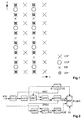
- the interpolation process for 4:2:0 ⁇ 4:2:2 is illustrated in Fig. 1 for one of the two chroma components.
- the big crosses represent luminance component pixels LCP in the vertical-horizontal plane.
- the big circles represent 4:2:0 format chrominance component pixels CCP in the vertical-horizontal plane. Only vertical interpolation (i.e. in y direction) is employed to get the desired interpolated chrominance component pixels ICP (represented by small circles) for the 4:2:2 format reference signal or picture.
- the interpolation of the missing chrominance pixel values ICP can be accomplished in two steps: in a first step virtual chrominance pixels IVP (represented by small crosses in the drawing) can be interpolated which will not be present in the finally generated reference picture signal.
- This interpolation process starts from the CCP pixel values and may use a 6-tap filter [1 -5 20 20 -5 -1]/32 that is also used in the H.264/AVC luminance half-pel interpolation.
- the 4:2:2 chroma pixels are interpolated from the CCP and IVP chroma pixel values by applying a 2-tap linear filter [1 1]/2 (i.e. by forming the average value).
- the ICP pixel values can be calculated directly from the CCP values using appropriate interpolation filter coefficients.
- This kind of processing is applied to both chrominance components.
- the above H.264/AVC half-pel interpolation filter can be applied without any modification.
- the interpolated signal forms a new reference frame for the chroma components. Following that interpolation process, the generated reference frame can be stored into the reference frame buffer, which buffer may contain only chroma components.
- the reference frame that achieves best Rate-Distortion performance is selected and, following motion compensation, prediction and residual coding is applied.
- the decoder parses the reference frame index and then uses the corresponding reference frame to accomplish the motion compensation prediction. If the reference frame is upsampled base layer, the motion compensation process can be regarded as using zero motion. Because the chroma components are highly correlated, the generated reference frame will achieve a better Rate-Distortion performance than without employing this technique.
- the other embodiment is chroma component residual prediction.
- vertical interpolated is used.
- the reconstructed chroma residual signal of the base layer is upsampled with linear interpolation along vertical direction.
- the chroma residual signal of the enhancement layer can be predicted (or subtracted) from the upsampled chroma residual signal of the base layer. That means only the difference between the enhancement layer residual chroma signal and the predicted residual chroma signal needs to be coded.
- the residual prediction should be used macroblock-wise adaptively. Concerning the upsampling of the residual from 4:2:0 ⁇ 4:2:2, a two-tap linear filter can be used for the interpolation of the residual along the vertical direction.
- a chrominance input signal ICS in 4:4:4 format passes through a 4:2:2 converter, a 4:2:0 converter and a value block or macroblock coder COD to a bitstream formatter BSF.
- Reconstructed frame chrominance data REC from coder COD are fed to a vertical interpolator VINT in which they are interpolated and upsampled as described in connection with Fig. 1.
- an intra-frame predictor 2IFP for the 4:2:2 format the difference between the output signals of VINT and the output signals of converter 4:2:2 is formed and passes through a value block or macroblock coder 2COD to bitstream formatter BSF.
- Reconstructed frame chrominance data 2REC from coder 2COD are fed to a horizontal interpolator HINT in which they are horizontally interpolated and upsampled as described in connection with Fig. 1.
- HINT horizontal interpolator
- an intra-frame predictor 4IFP for the 4:4:4 format the difference between the output signals of HINT and converter 4:4:4 is formed and passes through a value block or macroblock coder 4COD to bitstream formatter BSF.
- the coders COD, 2COD and 4COD may operate as described for Fig. 4.
- Bitstream formatter BSF receives also other information data items OI like luminance data and motion information, and provides the corresponding combined output bitstream OBS. This kind of processing is applied to both chrominance components.
- a chrominance input signal ICS in 4:4:4 format passes through a 4:2:2 converter, a 4:2:0 converter and a value block or macroblock coder COD to a bitstream formatter BSF.
- a vertical interpolator VINT receives from coder COD, following prediction, a reconstructed base layer residual chroma signal RES and interpolates and upsamples it vertically to form a predicted 4:2:2 residual signal.
- a first subtractor 2SUB the difference between the 'original' motion compensated 4:2:2 format residual calculated in stage 2RES and the output signal of VINT is formed and passes through a value block or macroblock coder 2COD to bitstream formatter BSF.
- the 'original' 4:2:2 format residual was generated in a 4:2:2 residual calculator 2RES using motion compensation.
- the 'residual' is the prediction error signal resulting after the motion compensation.
- a horizontal interpolator HINT receives from coder 2COD, following prediction, a reconstructed 4:2:2 enhancement layer residual chroma signal 2RES and interpolates and upsamples it horizontally to form a predicted 4:4:4 residual signal.
- a second subtractor 4SUB the difference between the 'original' 4:4:4 format residual and the output signal of HINT is formed and passes through a value block or macroblock coder 4COD to bitstream formatter BSF.
- the 'original' 4:4:4 format residual was generated in a 4:4:4 residual calculator 4RES using motion compensation (cf. above for 2RES).
- the coders COD, 2COD and 4COD may operate as described for Fig. 4, and provide the required residual signals.
- Bitstream formatter BSF receives also other information data items OI like luminance data and motion information, and provides the corresponding combined output bitstream OBS. This kind of processing is applied to both chrominance components.
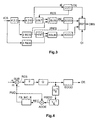
- the video data input signal IE of the chroma block encoder in Fig. 4 contains macroblock data for encoding.
- a subtractor SUB simply allows these to pass. They are processed in transform means T and quantising means Q and are fed to an entropy encoder ECOD, which outputs the encoder chroma data output signal OE.
- ECOD can, for example, carry out Huffman coding for the coefficients and add header information and motion vector data.
- predicted block or macroblock data PMD are subtracted from the input signal IE in the subtractor SUB and the difference chroma data are fed to the entropy encoder ECOD via the transform means T and the quantising means Q.
- the output signal of Q is also processed in inverse quantising means Q E -1 , the output signal of which is fed via inverse transform means T E -1 to the combiner ADDE in the form of reconstructed block or macroblock difference data RMDD.
- the output signal of ADDE is buffer-stored in a frame store in motion estimation and compensation means FS_MC_E, which carry out motion compensation for reconstructed block or macroblock data and output block or macroblock data PMD predicted in this way to the subtracting input of SUB and to the other input of the combiner ADDE.
- the quantising means Q and the inverse quantising means Q E -1 can be controlled by the occupancy level of the encoder buffer ENCB. This kind of processing is applied to both chrominance components.
- the output signal of ADDE is output by the encoder COD as reconstructed frame data REC.
- the output signal of SUB is output by the encoder COD as residual frame data RES.
- an input bitstream IBS (corresponding to output bitstream OBS) is fed to a parser PAR that provides encoded 4:2:0 base layer chrominance data and encoded 4:2:2 and 4:4:4 enhancement layer chrominance data.
- the 4:2:0 format output passes through a 4:2:0 decoder DEC that may operate as described in connection with Fig. 6 and that outputs decoded 4:2:0 chroma data 4:2:0C.
- the encoded 4:2:2 enhancement layer data from parser PAR pass through a first enhancement layer data decoder 2DEC to a combiner C4:2:2, which receives also chrominance data (i.e.
- the encoded 4:4:4 enhancement layer data from parser PAR pass through a second enhancement layer data decoder 4DEC to a combiner C4:4:4, which receives also data that are horizontally interpolated in a horizontal interpolator HIP from the output signal 4:2:2C or 2REC in the first embodiment, or from a residual signal 2RES from decoder 2DEC in the second embodiment, and which combiner C4:4:4 outputs the combined decoded 4:4:4 chroma data 4:4:4C.
- This kind of processing is applied to both chrominance components.
- the decoding processing according to Fig. 5 reverses the encoding processing according to Fig. 2 or 3.
- the chroma data input signal ID is fed via entropy decoder means EDEC, inverse quantising means Q D -1 and inverse transform means T D -1 to a combiner ADDD, which outputs the chroma data output signal OD.
- EDEC can, for example, carry out Huffman decoding for the coefficients and decode and/or evaluate header information and motion vector data.
- Q E -1 , Q D -1 , T E -1 , T D -1 and EDEC have a function which is the corresponding inverse of the function of Q, T and ECOD.
- the output signal of ADDD is buffer-stored in a frame store in motion compensation means FS_MC_D.
- FS_MC_D effects a motion compensation for reconstructed block or macroblock data.
- the block or macroblock data PMD predicted in FS_MC_D are passed to the second input of the combiner ADDE only in the case of interframe-decoded block or macroblock data.
- the combiner ADDD simply passes on the output signal from T D -1 .
- the transform and the inverse transform in figures 4 and 6 can be a DCT or inverse DCT, respectively. This kind of processing is applied to both chrominance components.
- the output signal of stage T D -1 is output by the decoder DEC as residual frame data RES.
Landscapes
- Engineering & Computer Science (AREA)
- Multimedia (AREA)
- Signal Processing (AREA)
- Compression Or Coding Systems Of Tv Signals (AREA)
- Color Television Systems (AREA)
Priority Applications (1)
| Application Number | Priority Date | Filing Date | Title |
|---|---|---|---|
| EP05300567A EP1742478A1 (fr) | 2005-07-07 | 2005-07-07 | Méthode et appareil pour le codage et le décodage échelonnable de la chrominance |
Applications Claiming Priority (1)
| Application Number | Priority Date | Filing Date | Title |
|---|---|---|---|
| EP05300567A EP1742478A1 (fr) | 2005-07-07 | 2005-07-07 | Méthode et appareil pour le codage et le décodage échelonnable de la chrominance |
Publications (1)
| Publication Number | Publication Date |
|---|---|
| EP1742478A1 true EP1742478A1 (fr) | 2007-01-10 |
Family
ID=35517246
Family Applications (1)
| Application Number | Title | Priority Date | Filing Date |
|---|---|---|---|
| EP05300567A Withdrawn EP1742478A1 (fr) | 2005-07-07 | 2005-07-07 | Méthode et appareil pour le codage et le décodage échelonnable de la chrominance |
Country Status (1)
| Country | Link |
|---|---|
| EP (1) | EP1742478A1 (fr) |
Cited By (4)
| Publication number | Priority date | Publication date | Assignee | Title |
|---|---|---|---|---|
| EP2717588A1 (fr) * | 2012-09-06 | 2014-04-09 | British Broadcasting Corporation | Codage et décodage vidéo avec sous-échantillonnage de chrominance |
| US20150256833A1 (en) * | 2014-03-06 | 2015-09-10 | Samsung Electronics Co., Ltd. | Video decoding method and apparatus and video encoding method and apparatus |
| WO2024093317A1 (fr) * | 2022-10-31 | 2024-05-10 | 华为技术有限公司 | Procédé et appareil de codage hiérarchique pour une image |
| EP4611369A4 (fr) * | 2022-10-31 | 2026-02-18 | Huawei Tech Co Ltd | Procédé et appareil de codage d'image, et procédé et appareil de décodage d'image |
-
2005
- 2005-07-07 EP EP05300567A patent/EP1742478A1/fr not_active Withdrawn
Non-Patent Citations (1)
| Title |
|---|
| CHEN YING, ZHAI JIEFU, YIN PENG, PANDIT PURVIN: "4:2:0 chroma sample format for phase difference eliminating and color space scalability", 14 April 2005 (2005-04-14), Busan, KR, pages 1 - 13, XP002362574, Retrieved from the Internet <URL:http://ftp3.itu.ch/av-arch/jvt-site/2005_04_Busan/> [retrieved on 20060112] * |
Cited By (5)
| Publication number | Priority date | Publication date | Assignee | Title |
|---|---|---|---|---|
| EP2717588A1 (fr) * | 2012-09-06 | 2014-04-09 | British Broadcasting Corporation | Codage et décodage vidéo avec sous-échantillonnage de chrominance |
| US20150256833A1 (en) * | 2014-03-06 | 2015-09-10 | Samsung Electronics Co., Ltd. | Video decoding method and apparatus and video encoding method and apparatus |
| US10291915B2 (en) * | 2014-03-06 | 2019-05-14 | Samsung Electronics Co., Ltd. | Video decoding method and apparatus and video encoding method and apparatus |
| WO2024093317A1 (fr) * | 2022-10-31 | 2024-05-10 | 华为技术有限公司 | Procédé et appareil de codage hiérarchique pour une image |
| EP4611369A4 (fr) * | 2022-10-31 | 2026-02-18 | Huawei Tech Co Ltd | Procédé et appareil de codage d'image, et procédé et appareil de décodage d'image |
Similar Documents
| Publication | Publication Date | Title |
|---|---|---|
| US11115651B2 (en) | Quality scalable coding with mapping different ranges of bit depths | |
| Marpe et al. | The H. 264/MPEG4 advanced video coding standard and its applications | |
| US9282343B2 (en) | Multiview and bitdepth scalable video delivery | |
| CN102084653B (zh) | 支持像素值细化可缩放性的可缩放视频编码 | |
| Wiegand et al. | Rate-constrained coder control and comparison of video coding standards | |
| Wiegand et al. | Overview of the H. 264/AVC video coding standard | |
| KR100934290B1 (ko) | 엠피이지-2 4:2:2-프로파일 비트스트림을 메인-프로파일비트스트림으로 컨버팅 하기 위한 방법 및 아키텍처 | |
| JP5203503B2 (ja) | ビット深度スケーラビリティ | |
| US6081295A (en) | Method and apparatus for transcoding bit streams with video data | |
| EP2206349B1 (fr) | Procédés et dispositif pour la prédiction de résidu intercouche pour une vidéo redimensionnable | |
| Ye et al. | The scalable extensions of HEVC for ultra-high-definition video delivery | |
| US20050259729A1 (en) | Video coding with quality scalability | |
| US20090141809A1 (en) | Extension to the AVC standard to support the encoding and storage of high resolution digital still pictures in parallel with video | |
| US20080212682A1 (en) | Reduced resolution video transcoding with greatly reduced complexity | |
| CN1751519A (zh) | 视频编码 | |
| US6621865B1 (en) | Method and system for encoding and decoding moving and still pictures | |
| WO2005064948A1 (fr) | Signaux compatibles de type sdtv entrelacee et hdtv progressive | |
| US7003036B2 (en) | Encoder, decoder, encoding method and decoding method for color moving image and method of transferring bitstream of color moving image | |
| Chen | Transporting compressed digital video | |
| Bjelopera et al. | Scalable video coding extension of H. 264/AVC | |
| Yuan et al. | Color space compatible coding framework for YUV422 video coding | |
| Qian et al. | Transform domain transcoding from MPEG-2 to H. 264 with interpolation error drift compensation | |
| Kwon et al. | Video compression | |
| Sun | Emerging Multimedia Standards | |
| Błaszak et al. | Scalability of Modified AVC/H. 264 Video Codecs |
Legal Events
| Date | Code | Title | Description |
|---|---|---|---|
| PUAI | Public reference made under article 153(3) epc to a published international application that has entered the european phase |
Free format text: ORIGINAL CODE: 0009012 |
|
| AK | Designated contracting states |
Kind code of ref document: A1 Designated state(s): AT BE BG CH CY CZ DE DK EE ES FI FR GB GR HU IE IS IT LI LT LU LV MC NL PL PT RO SE SI SK TR |
|
| AX | Request for extension of the european patent |
Extension state: AL BA HR MK YU |
|
| AKX | Designation fees paid | ||
| STAA | Information on the status of an ep patent application or granted ep patent |
Free format text: STATUS: THE APPLICATION IS DEEMED TO BE WITHDRAWN |
|
| 18D | Application deemed to be withdrawn |
Effective date: 20070711 |
|
| REG | Reference to a national code |
Ref country code: DE Ref legal event code: 8566 |