EP1743659A1 - Sutures monofilamentaires fabriqué a partir d'une composition contenant de polyéthylène à poids moléculaire ultra-élevé - Google Patents
Sutures monofilamentaires fabriqué a partir d'une composition contenant de polyéthylène à poids moléculaire ultra-élevé Download PDFInfo
- Publication number
- EP1743659A1 EP1743659A1 EP06012672A EP06012672A EP1743659A1 EP 1743659 A1 EP1743659 A1 EP 1743659A1 EP 06012672 A EP06012672 A EP 06012672A EP 06012672 A EP06012672 A EP 06012672A EP 1743659 A1 EP1743659 A1 EP 1743659A1
- Authority
- EP
- European Patent Office
- Prior art keywords
- suture
- molecular weight
- monofilament
- ultra high
- high molecular
- Prior art date
- Legal status (The legal status is an assumption and is not a legal conclusion. Google has not performed a legal analysis and makes no representation as to the accuracy of the status listed.)
- Withdrawn
Links
Images

Classifications
-
- A—HUMAN NECESSITIES
- A61—MEDICAL OR VETERINARY SCIENCE; HYGIENE
- A61L—METHODS OR APPARATUS FOR STERILISING MATERIALS OR OBJECTS IN GENERAL; DISINFECTION, STERILISATION OR DEODORISATION OF AIR; CHEMICAL ASPECTS OF BANDAGES, DRESSINGS, ABSORBENT PADS OR SURGICAL ARTICLES; MATERIALS FOR BANDAGES, DRESSINGS, ABSORBENT PADS OR SURGICAL ARTICLES
- A61L17/00—Materials for surgical sutures or for ligaturing blood vessels ; Materials for prostheses or catheters
- A61L17/04—Non-resorbable materials
-
- A—HUMAN NECESSITIES
- A61—MEDICAL OR VETERINARY SCIENCE; HYGIENE
- A61L—METHODS OR APPARATUS FOR STERILISING MATERIALS OR OBJECTS IN GENERAL; DISINFECTION, STERILISATION OR DEODORISATION OF AIR; CHEMICAL ASPECTS OF BANDAGES, DRESSINGS, ABSORBENT PADS OR SURGICAL ARTICLES; MATERIALS FOR BANDAGES, DRESSINGS, ABSORBENT PADS OR SURGICAL ARTICLES
- A61L17/00—Materials for surgical sutures or for ligaturing blood vessels ; Materials for prostheses or catheters
- A61L17/14—Post-treatment to improve physical properties
- A61L17/145—Coating
-
- A—HUMAN NECESSITIES
- A61—MEDICAL OR VETERINARY SCIENCE; HYGIENE
- A61L—METHODS OR APPARATUS FOR STERILISING MATERIALS OR OBJECTS IN GENERAL; DISINFECTION, STERILISATION OR DEODORISATION OF AIR; CHEMICAL ASPECTS OF BANDAGES, DRESSINGS, ABSORBENT PADS OR SURGICAL ARTICLES; MATERIALS FOR BANDAGES, DRESSINGS, ABSORBENT PADS OR SURGICAL ARTICLES
- A61L31/00—Materials for other surgical articles, e.g. stents, stent-grafts, shunts, surgical drapes, guide wires, materials for adhesion prevention, occluding devices, surgical gloves, tissue fixation devices
- A61L31/04—Macromolecular materials
- A61L31/048—Macromolecular materials obtained by reactions only involving carbon-to-carbon unsaturated bonds
-
- C—CHEMISTRY; METALLURGY
- C08—ORGANIC MACROMOLECULAR COMPOUNDS; THEIR PREPARATION OR CHEMICAL WORKING-UP; COMPOSITIONS BASED THEREON
- C08L—COMPOSITIONS OF MACROMOLECULAR COMPOUNDS
- C08L23/00—Compositions of homopolymers or copolymers of unsaturated aliphatic hydrocarbons having only one carbon-to-carbon double bond; Compositions of derivatives of such polymers
- C08L23/02—Compositions of homopolymers or copolymers of unsaturated aliphatic hydrocarbons having only one carbon-to-carbon double bond; Compositions of derivatives of such polymers not modified by chemical after-treatment
- C08L23/04—Homopolymers or copolymers of ethene
- C08L23/06—Polyethylene
-
- A—HUMAN NECESSITIES
- A61—MEDICAL OR VETERINARY SCIENCE; HYGIENE
- A61B—DIAGNOSIS; SURGERY; IDENTIFICATION
- A61B17/00—Surgical instruments, devices or methods
- A61B17/04—Surgical instruments, devices or methods for suturing wounds; Holders or packages for needles or suture materials
- A61B17/06—Needles ; Sutures; Needle-suture combinations; Holders or packages for needles or suture materials
- A61B17/06066—Needles, e.g. needle tip configurations
-
- A—HUMAN NECESSITIES
- A61—MEDICAL OR VETERINARY SCIENCE; HYGIENE
- A61B—DIAGNOSIS; SURGERY; IDENTIFICATION
- A61B17/00—Surgical instruments, devices or methods
- A61B17/04—Surgical instruments, devices or methods for suturing wounds; Holders or packages for needles or suture materials
- A61B17/06—Needles ; Sutures; Needle-suture combinations; Holders or packages for needles or suture materials
- A61B17/06166—Sutures
-
- A—HUMAN NECESSITIES
- A61—MEDICAL OR VETERINARY SCIENCE; HYGIENE
- A61B—DIAGNOSIS; SURGERY; IDENTIFICATION
- A61B17/00—Surgical instruments, devices or methods
- A61B17/04—Surgical instruments, devices or methods for suturing wounds; Holders or packages for needles or suture materials
- A61B17/06—Needles ; Sutures; Needle-suture combinations; Holders or packages for needles or suture materials
- A61B2017/06052—Needle-suture combinations in which a suture is extending inside a hollow tubular needle, e.g. over the entire length of the needle
-
- C—CHEMISTRY; METALLURGY
- C08—ORGANIC MACROMOLECULAR COMPOUNDS; THEIR PREPARATION OR CHEMICAL WORKING-UP; COMPOSITIONS BASED THEREON
- C08L—COMPOSITIONS OF MACROMOLECULAR COMPOUNDS
- C08L23/00—Compositions of homopolymers or copolymers of unsaturated aliphatic hydrocarbons having only one carbon-to-carbon double bond; Compositions of derivatives of such polymers
- C08L23/02—Compositions of homopolymers or copolymers of unsaturated aliphatic hydrocarbons having only one carbon-to-carbon double bond; Compositions of derivatives of such polymers not modified by chemical after-treatment
- C08L23/04—Homopolymers or copolymers of ethene
- C08L23/08—Copolymers of ethene
- C08L23/0807—Copolymers of ethene with unsaturated hydrocarbons only containing four or more carbon atoms
- C08L23/0815—Copolymers of ethene with unsaturated hydrocarbons only containing four or more carbon atoms with aliphatic 1-olefins containing one carbon-to-carbon double bond
-
- C—CHEMISTRY; METALLURGY
- C08—ORGANIC MACROMOLECULAR COMPOUNDS; THEIR PREPARATION OR CHEMICAL WORKING-UP; COMPOSITIONS BASED THEREON
- C08L—COMPOSITIONS OF MACROMOLECULAR COMPOUNDS
- C08L23/00—Compositions of homopolymers or copolymers of unsaturated aliphatic hydrocarbons having only one carbon-to-carbon double bond; Compositions of derivatives of such polymers
- C08L23/02—Compositions of homopolymers or copolymers of unsaturated aliphatic hydrocarbons having only one carbon-to-carbon double bond; Compositions of derivatives of such polymers not modified by chemical after-treatment
- C08L23/10—Homopolymers or copolymers of propene
Definitions
- the present disclosure relates to surgical sutures, and particularly to monofilament sutures made from a composition containing ultra high molecular weight polyethylene.
- Polyolefin sutures are known in the art. Such sutures are non-absorbable and generally include polypropylene or polymeric combinations of ethylene and propylene.
- the polymeric components of the polyolefin sutures are generally melt spun to produce filaments for use in fabricating the surgical suture strands.
- Polypropylene sutures are advantageously produced as monofilament sutures.
- monofilament sutures can be prepared from polymeric compositions containing ultra high molecular weight polyethylene.
- the ultra high molecular weight polyethylene may possess a weight average molecular weight of greater than about 400,000.
- a method for fabricating an ultra high molecular weight polyethylene suture is also provided herein.
- the present disclosure also provides a surgical needle-suture combination including a surgical needle and a suture attached to the needle, the suture including a monofilament of an ultra high molecular weight polyethylene possessing a weight average molecular weight of greater than about 400,000.
- Methods of suturing wounds with sutures of the present disclosure include providing a monofilament suture having an ultra high molecular weight polyethylene possessing a weight average molecular weight of greater than about 400,000 attached to a needle to form a needled suture, and passing the needled suture through tissue to create wound closure.
- the present disclosure relates to a composition from which monofilament sutures can be produced, such as, for example, by melt extrusion, or "spinning", of polymeric compositions containing ultra high molecular weight polyethylene.
- Typical compositions include ultra high molecular weight polyethylene.
- the ultra high molecular weight polyethylene can be used alone or blended with other polymers such as, for example, polyvinyl ether, poly(phenylene ether), acetal resin, thermoplastic polyester, polycarbonate, cellulose ester, thermoplastic polyamide, polyetheramide, polyesteramide, thermoplastic polyurethane, polyvinylhalide, polyvinylidene halide, halogenated polyolefin, acrylic resin, polystyrene, polyacrylonitrile, polyvinylester, polyimide, polyetherimide, polysulfone, and combinations thereof.
- polymers such as, for example, polyvinyl ether, poly(phenylene ether), acetal resin, thermoplastic polyester, polycarbonate, cellulose ester, thermoplastic polyamide, polyetheramide, polyesteramide, thermoplastic polyurethane, polyvinylhalide, polyvinylidene halide, halogenated polyolefin, acrylic resin, polystyrene, polyacrylonitrile, polyvinyle
- the ultra high molecular weight polyethylene may be blended with one or more materials such as polyethylenes of lower molecular weight, polypropylene, or copolymers of polyethylene and polypropylene.
- Blends of the ultra high molecular weight polyethylene with one or more other thermoplastic resins may contain from about 5 to about 95 weight percent, in embodiments from about 20 to about 80 weight percent, ultra high molecular weight polyethylene, the balance of the blend containing a different thermoplastic resin, such as, for example, a lower molecular weight polyethylene, isotactic polypropylene, atactic polypropylene, or syndiotactic polypropylene, and the like.
- the composition containing ultra high molecular weight polyethylene can include a copolymer made from ultra high molecular weight polyethylene.
- random, block, or graft copolymers can be formed from the copolymerization of ultra high molecular weight polyethylene with one or more monomers or sequences of monomers copolymerizable therewith including, but not limited to, other alpha-olefins such as, for example, polypropylene units, e.g., isotactic, syndiotactic and/or atactic polypropylenes.
- Useful ultra high molecular weight polyethylene resins include those possessing a weight average molecular weight (Mw) of greater than about 400,000, typically greater than about 1,000,000. Useful ultra high molecular weight polyethylene resins may advantageously possess a melting point of from about 144° C to about 152° C. Ultra high molecular weight polyethylene resins which can be used herein include those sold under the trade names DYNEEMA and SPECTRA which are available from DSM (Heerlen, the Netherlands).
- the composition utilized to form a suture of the present disclosure may optionally include a fatty acid diester to reduce fraying and facilitate suture formation.
- the fatty acid diester may include a diester of a polyalkylene glycol.
- Suitable fatty acids include C 10 -C 26 fatty acids such as stearic, lauric, palmitic, myristic, arachidic, behenic, and similar acids.
- Suitable polyalkylene glycols include C 2 -C 6 alklyene glycols, such as polyethylene glycols and polypropylene glycols.
- sutures may be desirable to dye the present sutures in order to increase visibility of the suture in the surgical field.
- Dyes known to be suitable for incorporation in sutures can be used. Such dyes include, but are not limited to, carbon black, bone black, D&C Green No. 6, and D&C Violet No. 2 as described in the handbook of U.S. Colorants for Food, Drugs and Cosmetics by Daniel M. Marrion (1979 ).
- sutures may be dyed by adding up to about a few percent, in embodiments about 0.2%, of a dye to the resin prior to formation of the monofilament.
- one exemplary method for manufacture of stretched filaments from a composition containing ultra high molecular weight polyethylene includes subjecting a solution of the composition in a solvent to spinning or film-forming, followed by cooling to give a gel-like filament containing the solvent, and stretching the gel-like filament at a high stretch ratio.
- Such processes are described, for example, in European Patent No. 77590 , and U.S. Patent Nos. 4,344,908 , 4,413,110 , 4,422,993 , 4,430,383 , and 5,202,073 , the entire disclosures of each of which are incorporated herein by this reference.
- the composition containing ultra high molecular weight polyethylene may be heated to form a polymer melt. This melt may then be extruded and cooled to form a filament which can then be sent to further processing such as stretching.
- the melt may contain substantially no water or organic solvents, and no substances which would be incompatible with body tissue.
- the composition containing ultra high molecular weight polyethylene may contain some colorant to facilitate visualizing the suture filament during a surgical procedure.
- Extruder unit 10 is of a known or conventional type and is equipped with controls for regulating the temperature of barrel 11 in various zones thereof, e.g., progressively higher temperatures in three consecutive zones A, B and C along the length of the barrel.
- Pellets or powder of the composition containing ultra high molecular weight polyethylene are introduced to the extruder through drier-hopper 12.
- Motor-driven metering pump 13 delivers extruded resin at a constant rate to spin pack 14 and thereafter through spinneret 15 possessing one or more orifices of desired diameter to provide a molten monofilament 16 which then enters quench bath 17, e.g., containing water, where the monofilament solidifies.
- the distance monofilament 16 travels after emerging from spinneret 15 to the point where it enters quench bath 17, i.e., the air gap can vary and can advantageously be from about 0.5 cm to about 100 cm, in embodiments from about 1 cm to about 20 cm.
- barrel zone A of the extruder can be maintained at a temperature of from about 180° C to about 230° C, zone B at from about 190° C to about 230° C, and zone C at from about 190° C to about 230° C.
- Additional temperature parameters include: metering pump block 13 at from about 190° C to about 230° C, spin pack 14 at from about 190° C to about 230° C, spinneret 15 at from about 190° C to about 230° C, and quench bath 17 at from about 30° C to about 80° C.
- monofilament 16 is passed by driven roller 18 over idler rollers 19 and 20 and thereafter is wrapped around a first godet 21 provided with nip roll 22 to prevent slippage which might otherwise result from the subsequent stretching operation.
- Monofilament 16 passing from godet 21 is stretched in order to effect its orientation and thereby increase its tensile strength.
- Techniques and conditions for drawing i.e., stretching polyolefin monofilaments are within the purview of those skilled in the art. In one embodiment, described in detail below, the monofilament undergoes two heated draw operations.
- monofilament 16 may be drawn through heating unit 23, which can be an oven chamber or a hot water trough, by means of second godet 24 which rotates at a higher speed than first godet 21, thereby stretching the monofilament from about 4 times to about 7 times its original length, in embodiments from about 6 times to about 7 times its original length, and in other embodiments from about 6.5 times to about 6.8 times its original length.
- heating unit 23 is an oven chamber
- its temperature may be advantageously maintained at from about 90° C to about 180° C, and in embodiments from about 110° C to about 160° C.
- Monofilament 16 may be drawn a second time by passing it through heating unit 25, which can be an even chamber or a hot water trough, by means of third godet 26.
- the second draw may achieve a draw ratio of from about 1.1 to about 1.5, in embodiments from about 1.3 to about 1.4.
- heating unit 25 is an oven chamber, the temperature may be advantageously maintained at from about 100° C to about 170° C, in embodiments from about 120° C to about 150° C.
- the monofilament may optionally be subjected to conditions which allow relaxation or shrinkage of the monofilament.
- Techniques and conditions suitable for achieving relaxation are within the purview of those skilled in the art.
- An example of a suitable technique is shown schematically in FIG. 1, wherein the monofilament is then passed through a third heating unit 27, e.g., maintained at a temperature of from about 100° C to about 180° C, in embodiments from about 110° C to about 175° C, by means of a fourth godet 28 to heat-treat the monofilament prior to the equilibration and annealing operations.
- This third heat treatment results in on-line relaxation, or shrinkage, of the monofilament, e.g., for a recovery of from about 65 percent to about 96 percent, in embodiments from about 70 percent to about 76 percent, of the stretched length of the monofilament.
- the fourth godet 28 is driven at a speed which is somewhat less than that of the third godet 26.
- monofilament from godet 28 is taken up on a spool (not shown).
- the spool may then be set aside for a period of time sufficient to permit the monofilament to achieve a condition of equilibration. While the period of equilibration may vary depending on the particular composition containing ultra high molecular weight polyethylene selected and/or the conditions under which the resin is extruded, cooled and oriented, in most cases storage of the monofilament following its orientation occurs for at least about 2 days, in embodiments at least about 3 days, and in other embodiments at least about 4 days. It may be advantageous to store the spooled monofilament at ambient temperature, e.g., from about 20° C to about 23° C, and a relative humidity of about 50%.
- the desired length of equilibrated suture may be wound around a creel and the creel placed in a heating cabinet maintained at the desired temperature, e.g., about 150° C, as described in U.S. Patent No. 3,630,205 .
- the sutures can be cut to a desired length and heat set at that desired length.
- the creel may be rotated within the heating cabinet in order to ensure uniform heating of the monofilament or the cabinet may be of the circulating hot air type in which case uniform heating of the monofilament may be achieved without the need to rotate the creel.
- the creel with its annealed suture may be removed from the heating cabinet and, when returned to room temperature, the suture may be conveniently removed from the creel by cutting the wound monofilament at opposite ends of the creel.
- the annealed sutures, optionally attached to surgical needles, are than ready to be packaged and sterilized.
- the monofilament suture may be drawn in two separate drawing steps in an amount from about 4 times to about 8.5 times and aged for less than about two days followed by annealing the filament to provide a suture.
- a more detailed disclosure of a suitable process of this type can be found in U.S. Patent No. 5,871,502 .
- the solidified monofilament may be allowed to dwell at ambient conditions for a predetermined period of time ranging from about 2 minutes to about 30 minutes prior to being drawn.
- a suitable process of this type can be found in U.S. Patent No. 5,456,696 , the entire disclosure of which is incorporated by reference herein.
- drawn and oriented thermoplastic suture monofilaments may be subjected to a heat treatment to reduce modulus and otherwise improve physical properties by passing the suture filament through a radiant heater at a temperature maintained above the melting temperature of the suture monofilament.
- Operating conditions may be controlled so that the suture monofilament is subjected to a sufficient time/temperature exposure to modify the near-surface crystalline structure of the suture monofilament.
- the suture monofilament may be maintained under tension and typically drawn slightly during the heat treatment. Draw ratios of about 10 percent to about 20 percent or higher are possible with most materials.
- Treatment temperature may be from about 5° C to about 100° C or more above the melting temperature of the suture monofilament, with exposure time adjusted to obtain the desired effect on crystalline structure without penetrating too deeply within the suture monofilament.
- the monofilament may be relaxed and annealed to further increase crystallinity and decrease the degree of amorphous orientation, and then sterilized to render the monofilament suitable for use as a surgical suture.
- melt extruded, liquid quenched suture monofilaments may be drawn through a radiant heater maintained at a temperature above the melting temperature of the suture monofilaments.
- Draw speed, draw ratio, heater temperature and dwell time may be regulated to obtain the maximum stable draw ratio for the particular suture monofilament material. This draw ratio will generally be from about 3 times to about 6 times and from about 10 percent to about 30 percent more than the maximum stable draw ratio obtainable in the absence of the radiant heater.
- the use of the radiant heater to increase the overall stretch imparted to the suture filament during the initial drawing and orientation step thus further improves the ultimate physical properties obtainable for the suture.
- the present monofilaments can optionally be treated to provide a roughened surface that have varied morphologies that exhibit non-uniform pitting and porosity. These characteristics assist with the ability of the monofilament to hold a knot and assist with the adhesion of materials to the surfaces of the monofilament.
- Plasma etching is one suitable method for producing irregularly roughened surfaces on a suture.
- the use of appropriate plasma gases and plasma operating conditions during etching may produce a monofilament suture having a surface with distinctive morphologies.
- the surface treatment process may be based on specific sequences of procedures that utilize specific combinations of inert and reactive gases, contingent on the exact nature of the composition containing ultra high molecular weight polyethylene to be processed.
- the gases should be capable of creating a plasma.
- the plasma when appropriately generated and typically in conjunction with a dynamic masking process, may etch surfaces of the monofilament materials.
- radio frequency (RF) generated cold plasmas in the presence of inert gases and/or reactive gases sustained in a reaction chamber may be used to modify and micro-sculpt surfaces of monofilaments.
- the surface modification effects may be achieved through the dry, chemical etching action of plasma particles. Etching occurs through chemical reactions between reactive plasma species and the monofilament surface to produce reaction products which may be removed from the system either as volatile reaction products or complexed with other agents (e.g., water vapor).
- One embodiment for surface etching uses a generated plasma, housed in a chamber capable of sustaining the plasma at low pressures and with the capability to vary the plasma gas flow rates.
- the method utilizes a low power-to-surface-area radio frequency generated plasma operated at relatively low vacuums, as compared to the high power levels and ultra-low pressures commonly used in the semiconductor industry.
- the plasma method frequently employs the use of contaminant or extrinsic species that may or may not be reactive with the monofilament but which may, in some way, promote an integrated interaction with the monofilament and the plasma.
- extrinsic species may originate from the reaction chamber wall residues, the weak vacuum conditions, and residual atmospheric substances.
- Plasma contaminants may include water vapor, carbon dioxide, dust/particulates, and/or sputter ions from holder materials, chamber walls or specific sputtering targets.
- the presence of extrinsic species during the etching process can result in irregular etching.
- the irregular etching may be due to random local fluctuations in the plasma field or to variable random masking of the monofilament surface from the applied plasma by the extrinsic species.
- the plasma etching process may be characterized by a dynamic masking, promoted by the presence of extrinsic species (e.g., water vapor, carbon dioxide, hydrocarbons, particulates, etc.), that are expected to be found in the reactor chamber environment at the relatively low pressures used (e.g., less than about 10 Torr).
- extrinsic species e.g., water vapor, carbon dioxide, hydrocarbons, particulates, etc.
- the intensity and quality of the plasma to which a monofilament material is exposed can be varied over time and space, producing a randomized, irregularly etched surface that may be characterized by dimensional (i.e., depth and width) and morphological (i.e., geometry and porosity density) variations on the monofilament surface, having relief depths from at least about 1 ⁇ m to about 20 ⁇ m, surface cavity diameters from about 1 ⁇ m to about 3 ⁇ m, and porosity densities from about 4 to about 120 pores per ⁇ m 2 .
- low background pressures and relatively low power-to-surface-area levels may be employed.
- radio frequency (RF) generated plasma may be used.
- cold plasmas may also be generated by alternative methods (e.g., microwaves or direct current).
- Low pressure cold plasmas can be generated with radio frequencies of from about 10 kHz to about 27 MHz; at pressures from about 0.01 to about 0.20 Torr; with gas flows ranging from about 10 to about 200 standard cubic centimeters per min (sccm); with gas temperatures from about 300° Kelvin to about 600° Kelvin; with ion energies (potential) from about 10 to about 500 electron volts (eV); and approximate RF power densities from about 0.05 to about 1 watts (W) per cm 2 .
- a noble gas may be used to cool and stabilize the plasma and a reactive gas may be used to effect the actual chemical etching process.
- argon or helium are typical inert, noble gases.
- Reactive gases may be used to create chemical species that will react with the target surface; the type of reactive gas may be dependent on the material to be etched. The appropriate selection of the reactive gas requires that volatile reaction products be created in the reaction between the reactive gas plasma species and the target material, creating species that may be redeposited onto the surface and/or be carried away from the surface via the reaction chamber vacuum system.
- Useful reactive gases used to etch a material may be selected from the repertoire of those well versed in the art of cold plasma, dry etching processes.
- those combinations of plasma gases that have been used in the semiconductor industry for regular etching and/or cleaning of circuit boards and electronic components may be suitable. Suitable guidance can be found in the Handbook of Plasma Processing Technology (Rossnagel, et al. (editors); Noyes Publications, Westwood, New Jersey; 1990 ) and Cold Plasmas in Materials Fabrication (Grill, Alfred; IEEE Press, Piscataway, New Jersey; 1993 ), herein incorporated by reference. Generally, candidate volatile reaction products of the specific material surface will be identified, and reactive gases used in the RF plasma will be selected based on their potential to form the volatile species.
- Noble gases may act to stabilize, cool and dilute the reactive gases in the plasma, while halogen-based gases create the chemically reactive etching species.
- inert gases such as argon or helium, act as carrier gases when bubbled through liquid reactants, thereby increasing the evaporation rate of the liquid reactant into its vapor state.
- water vapor can constitute the reactive gas and argon the plasma stabilizing/cooling gas.
- Water molecules may be dissociated in the plasma to form activated moieties, such as OH - and H + radicals and/or other charged species. These species break polymer bonds and/or react with the organic components of the polymeric surface to create a more roughened and porous morphology.
- conditions for etching the surface of the present monofilaments employ either a He plasma, a F 2 /He plasma, or a CF 4 /He plasma with an operating temperature from about 25° C to about 100° C and pressure from about 0.005 to about 0.20 Torr.
- RF power levels should be from about 10 to about 200 watts.
- etching feasibility studies may be required. Testing should be conducted in such a manner as to be able to determine the volatility of the plasma reaction products, their redeposition characteristics, the type of surface morphology changes, and the parameters of the plasma system used to bring about the etching reaction.
- hydrogen gas may be added to remove oxygen atoms from a monofilament surface, or to retard the etch rate.
- oxygen may be introduced into the plasma to accelerate etch rates.
- O 2 may be used to oxidize harmful etching reaction by-products into a volatile species or also can be used to remove unwanted residual organic species by the technique known as plasma ashing.
- Additional surface treatment processes may be applied to monofilaments previously conditioned by plasma etching.
- These optional, post-etch procedures may include, but are not limited to, some, or a combination, of the following commonly used surface coating/treatment methods: wet or dry coating applications, plating, vapor deposition, anodizing, surface polymerization, and re-etching of previously coated and/or etched surfaces of a device.
- Post-etch operations can be employed to either prepare the surface for a desired morphology or to make the surface smooth without any configuration.
- Immobilized artificial coatings can be applied to monofilaments to enhance biocompatibility.
- Plasma pre-treatment may enhance adherence of a coating to monofilament surfaces by improving the adhesion characteristics of the monofilament, which in turn provides for better coating uniformity and thickness of biocompatible polymeric materials because the plasma treatment roughens and changes the micro-morphological configurations of the surface.
- Some immobilized polymeric coatings that can be used include: polyolefins, polyamides, polyimides, polyethers, polyesters, polystyrenes, polyvinyl chlorides, polypropylenes, polyisoprenes, polytetrafluoroethylenes, polyurethanes, polycarbonates, polyalkylimines, optionally in combination with cross-linking agents such as glutaraldehyde, glyoxal, malonaldehyde, succinaldehyde, adipaldehyde, or dialdehyde starch.
- U.S. Patent No. 5,415,938 the entire disclosure of which is incorporated by reference herein, identifies some of the existing art used to polymer coat medical implant devices. Chemical modifications can include surface polymerization via plasma reactions; polymer application via sprays, dipping, or cold vapor deposition; acid etching; electroplating; and/or passivation.
- the present disclosure embraces a method for improving the handling characteristics of a monofilament suture by utilizing a plasma polymerization process to apply to the suture a coating including a siloxane polymer.
- Coatings may be formed by a plasma polymerization process whereby aliphatic hydrocyclosiloxane monomers are polymerized on the surface of the suture to form a siloxane coating on the suture.
- amine groups may be introduced onto the polymer coating by co-polymerizing an organo-based monomer with the aliphatic hydrocyclosiloxane monomer or by carrying out a second plasma polymerization process for the introduction of the organo-based monomer.
- the amine groups on the polymer coating may then be reacted with carbonate polyoxyalkylenes to give polyoxyalkylene modified polymer coatings which enhance the handling characteristics of the coated sutures.
- carbonate polyoxyalkylenes to give polyoxyalkylene modified polymer coatings which enhance the handling characteristics of the coated sutures.
- Sutures as described herein can be used to secure tissue in a desired position.
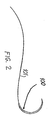
- suture 101 may be attached to a surgical needle 100 by methods within the purview of those skilled in the art. Wounds may be sutured by approximating tissue and passing the needled suture through tissue to create wound closure. The needle is then typically removed from the suture and the suture tied.
- the monofilaments prepared in accordance with this disclosure can have needles attached thereto using conventional techniques.
- the sutures can be packaged and sterilized using methods and materials within the purview of those skilled in the art.
Landscapes
- Health & Medical Sciences (AREA)
- Chemical & Material Sciences (AREA)
- Animal Behavior & Ethology (AREA)
- General Health & Medical Sciences (AREA)
- Surgery (AREA)
- Vascular Medicine (AREA)
- Epidemiology (AREA)
- Life Sciences & Earth Sciences (AREA)
- Veterinary Medicine (AREA)
- Public Health (AREA)
- Chemical Kinetics & Catalysis (AREA)
- Engineering & Computer Science (AREA)
- Materials Engineering (AREA)
- Heart & Thoracic Surgery (AREA)
- Medicinal Chemistry (AREA)
- Polymers & Plastics (AREA)
- Organic Chemistry (AREA)
- Materials For Medical Uses (AREA)
Applications Claiming Priority (1)
| Application Number | Priority Date | Filing Date | Title |
|---|---|---|---|
| US69867105P | 2005-07-13 | 2005-07-13 |
Publications (1)
| Publication Number | Publication Date |
|---|---|
| EP1743659A1 true EP1743659A1 (fr) | 2007-01-17 |
Family
ID=37401053
Family Applications (1)
| Application Number | Title | Priority Date | Filing Date |
|---|---|---|---|
| EP06012672A Withdrawn EP1743659A1 (fr) | 2005-07-13 | 2006-06-20 | Sutures monofilamentaires fabriqué a partir d'une composition contenant de polyéthylène à poids moléculaire ultra-élevé |
Country Status (5)
| Country | Link |
|---|---|
| US (1) | US20070016251A1 (fr) |
| EP (1) | EP1743659A1 (fr) |
| JP (1) | JP2007021194A (fr) |
| AU (1) | AU2006202427A1 (fr) |
| CA (1) | CA2550534A1 (fr) |
Cited By (6)
| Publication number | Priority date | Publication date | Assignee | Title |
|---|---|---|---|---|
| WO2011015620A1 (fr) | 2009-08-06 | 2011-02-10 | Dsm Ip Assets B.V. | Fils de hppe |
| WO2011015485A1 (fr) | 2009-08-04 | 2011-02-10 | Dsm Ip Assets B.V. | Fibres revêtues de résistance élevée |
| WO2011058123A2 (fr) | 2009-11-13 | 2011-05-19 | Dsm Ip Assets B.V. | Fils de hppe monofilaments ou multifilaments |
| EP2481847A1 (fr) | 2011-01-31 | 2012-08-01 | DSM IP Assets B.V. | Fibre haute résistance stabilisée contre les UV |
| US8541027B2 (en) | 2001-06-06 | 2013-09-24 | Smith & Nephew, Inc. | Fixation devices for tissue repair |
| EP1966417B1 (fr) * | 2005-12-22 | 2016-08-10 | DSM IP Assets B.V. | Article pour restauration chirurgicale contenant des filaments à base d'uhmwpe |
Families Citing this family (41)
| Publication number | Priority date | Publication date | Assignee | Title |
|---|---|---|---|---|
| US8795332B2 (en) * | 2002-09-30 | 2014-08-05 | Ethicon, Inc. | Barbed sutures |
| US5931855A (en) | 1997-05-21 | 1999-08-03 | Frank Hoffman | Surgical methods using one-way suture |
| US7056331B2 (en) * | 2001-06-29 | 2006-06-06 | Quill Medical, Inc. | Suture method |
| NZ588140A (en) | 2004-05-14 | 2012-05-25 | Quill Medical Inc | Suture methods and device using an enlongated body with cut barbs and a needle at one end and a loop at the other |
| US8915943B2 (en) * | 2007-04-13 | 2014-12-23 | Ethicon, Inc. | Self-retaining systems for surgical procedures |
| ES2488406T3 (es) * | 2007-09-27 | 2014-08-27 | Ethicon Llc | Suturas de auto-retención que incluyen elementos de retención a tejido con resistencia mejorada |
| US8916077B1 (en) | 2007-12-19 | 2014-12-23 | Ethicon, Inc. | Self-retaining sutures with retainers formed from molten material |
| US8118834B1 (en) | 2007-12-20 | 2012-02-21 | Angiotech Pharmaceuticals, Inc. | Composite self-retaining sutures and method |
| EP2249712B8 (fr) * | 2008-02-21 | 2018-12-26 | Ethicon LLC | Procédé et appareil permettant de relever des éléments de rétention sur des sutures autorétentives |
| US20090228021A1 (en) * | 2008-03-06 | 2009-09-10 | Leung Jeffrey C | Matrix material |
| US20110238092A1 (en) * | 2008-06-20 | 2011-09-29 | Dsm Ip Assets B.V. | Ultrahigh molecular weight polyethylene yarn |
| MX381532B (es) | 2008-11-03 | 2025-03-12 | Ethicon Llc | Longitud de sutura autorretenible y metodo y dispositivo para su uso. |
| JP5430649B2 (ja) * | 2009-03-27 | 2014-03-05 | Ykk株式会社 | 連続ファスナーエレメント及びファスナーストリンガー、並びに、連続ファスナーエレメントの製造方法 |
| WO2011090628A2 (fr) | 2009-12-29 | 2011-07-28 | Angiotech Pharmaceuticals, Inc. | Sutures bidirectionnelles d'auto-retenue ayant des indices marqués au laser et/ou non marqués au laser et procédés associés |
| KR102045300B1 (ko) | 2010-05-04 | 2019-11-18 | 에티컨, 엘엘씨 | 레이저 커팅된 리테이너를 갖는 자가-유지형 시스템 |
| US20110277249A1 (en) * | 2010-05-14 | 2011-11-17 | Ferass Abuzaina | Method of Producing Colored High-Strength Fibers |
| NZ604320A (en) | 2010-06-11 | 2014-07-25 | Ethicon Llc | Suture delivery tools for endoscopic and robot-assisted surgery and methods |
| AU2011323299B2 (en) | 2010-11-03 | 2016-06-30 | Ethicon Llc | Drug-eluting self-retaining sutures and methods relating thereto |
| ES2612757T3 (es) | 2010-11-09 | 2017-05-18 | Ethicon Llc | Suturas de autorretención de emergencia |
| CN103889340B (zh) | 2011-03-23 | 2018-09-28 | 伊西康有限责任公司 | 自固位式可变套环缝合线 |
| US20130172931A1 (en) | 2011-06-06 | 2013-07-04 | Jeffrey M. Gross | Methods and devices for soft palate tissue elevation procedures |
| US9222864B2 (en) | 2011-09-06 | 2015-12-29 | Honeywell International Inc. | Apparatus and method to measure back face signature of armor |
| US9163335B2 (en) | 2011-09-06 | 2015-10-20 | Honeywell International Inc. | High performance ballistic composites and method of making |
| US9168719B2 (en) | 2011-09-06 | 2015-10-27 | Honeywell International Inc. | Surface treated yarn and fabric with enhanced physical and adhesion properties and the process of making |
| US9023452B2 (en) | 2011-09-06 | 2015-05-05 | Honeywell International Inc. | Rigid structural and low back face signature ballistic UD/articles and method of making |
| US9023451B2 (en) | 2011-09-06 | 2015-05-05 | Honeywell International Inc. | Rigid structure UHMWPE UD and composite and the process of making |
| US9023450B2 (en) | 2011-09-06 | 2015-05-05 | Honeywell International Inc. | High lap shear strength, low back face signature UD composite and the process of making |
| US9642638B1 (en) * | 2014-04-02 | 2017-05-09 | Vicki J. Carrier | Morcellated tissue collection pouch |
| US10427345B2 (en) * | 2014-05-07 | 2019-10-01 | Massachusetts Institute Of Technology | Continuous fabrication system and method for highly aligned polymer films |
| EP3180040B1 (fr) * | 2014-08-15 | 2020-05-13 | Tepha, Inc. | Sutures auto-rétentives de poly-4-hydroxybutyrate et de copolymères de celui-ci |
| US10820918B2 (en) | 2015-07-17 | 2020-11-03 | Crossroads Extremity Systems, Llc | Transosseous guide and method |
| US10154868B2 (en) | 2015-07-17 | 2018-12-18 | Kator, Llc | Transosseous method |
| US9962174B2 (en) | 2015-07-17 | 2018-05-08 | Kator, Llc | Transosseous method |
| US12383253B2 (en) | 2015-08-04 | 2025-08-12 | Crossroads Extremity Systems, Llc | Suture anchor |
| US10226243B2 (en) | 2015-08-04 | 2019-03-12 | Kator, Llc | Transosseous suture anchor |
| BR112018007107B1 (pt) * | 2015-10-09 | 2022-07-12 | Tensar Corporation, Llc | Geogrelha integral feita a partir de um material de partida polimérico em multicamada coextrudido, e um método de fabricação de tal geogrelha integral |
| ES2945211T3 (es) * | 2019-03-01 | 2023-06-29 | Dsm Ip Assets Bv | Componente de implante médico que comprende un biotextil compuesto y método de fabricación |
| KR102891189B1 (ko) * | 2019-03-01 | 2025-11-26 | 디에스엠 아이피 어셋츠 비.브이. | 복합 바이오텍스타일의 제조 방법 및 이러한 복합 바이오텍스타일을 포함하는 의료용 임플란트 |
| CN114786594A (zh) * | 2019-12-18 | 2022-07-22 | 波士顿科学国际有限公司 | 具有抗凝血覆盖物的左心耳闭合装置 |
| CN114588308B (zh) * | 2022-01-25 | 2022-12-23 | 浙江科惠医疗器械股份有限公司 | 一种高强度易缝合的不可吸收医用缝合线及其制备方法 |
| CN120099691B (zh) * | 2025-05-08 | 2025-08-15 | 波司登羽绒服装有限公司 | 一种高强耐磨轻量面料及其制备方法和应用 |
Citations (5)
| Publication number | Priority date | Publication date | Assignee | Title |
|---|---|---|---|---|
| GB2051667A (en) * | 1979-06-27 | 1981-01-21 | Stamicarbon | Preparing polyethylene filaments |
| US4413110A (en) * | 1981-04-30 | 1983-11-01 | Allied Corporation | High tenacity, high modulus polyethylene and polypropylene fibers and intermediates therefore |
| US5217485A (en) * | 1991-07-12 | 1993-06-08 | United States Surgical Corporation | Polypropylene monofilament suture and process for its manufacture |
| EP0561108A2 (fr) * | 1992-02-03 | 1993-09-22 | United States Surgical Corporation | Article de suture pour restauration chirurgicale |
| EP1293218A1 (fr) * | 2001-09-13 | 2003-03-19 | Arthrex Inc | Suture avec une haute résistance à base de polyéthylène de masse moléculaire ultra-élevée |
Family Cites Families (35)
| Publication number | Priority date | Publication date | Assignee | Title |
|---|---|---|---|---|
| DE1016022B (de) * | 1954-01-19 | 1957-09-19 | Dr Dr E H Karl Ziegler | Verfahren zur Herstellung von hochmolekularen Polyaethylenen |
| US3105493A (en) * | 1960-04-21 | 1963-10-01 | Phillips Petroleum Co | Suture |
| US3359983A (en) * | 1963-01-23 | 1967-12-26 | American Cyanamid Co | Synthetic surgical sutures |
| US3458471A (en) * | 1963-07-09 | 1969-07-29 | Johnson & Johnson | Stabilized poly-alpha-olefin compositions |
| US3432514A (en) * | 1966-03-16 | 1969-03-11 | Eastman Kodak Co | Polyolefin compositions and their preparation |
| US3505164A (en) * | 1967-06-23 | 1970-04-07 | Hercules Inc | Self-bulking conjugate filaments |
| US3630205A (en) * | 1969-07-31 | 1971-12-28 | Ethicon Inc | Polypropylene monofilament sutures |
| CH507714A (fr) * | 1969-12-26 | 1971-05-31 | Sutramed Sarl | Procédé de fabrication d'un matériau pour suture chirurgicale et matériau pour suture chirurgicale obtenu par la mise en oeuvre de ce procédé |
| US4356138A (en) * | 1981-01-15 | 1982-10-26 | Allied Corporation | Production of high strength polyethylene filaments |
| US4584347A (en) * | 1982-09-30 | 1986-04-22 | Allied Corporation | Modified polyolefin fiber |
| US4455273A (en) * | 1982-09-30 | 1984-06-19 | Allied Corporation | Producing modified high performance polyolefin fiber |
| US4520822A (en) * | 1982-10-04 | 1985-06-04 | Ethicon, Inc. | Ethylene-propylene copolymer sutures |
| US4620542A (en) * | 1982-10-04 | 1986-11-04 | Ethicon, Inc. | Ethylene-propylene copolymer sutures |
| US5202073A (en) * | 1983-08-15 | 1993-04-13 | Toyo Boseki Kabushiki Kaisha | Production of stretched polymeric material having high strength and high modulus |
| US4557264A (en) * | 1984-04-09 | 1985-12-10 | Ethicon Inc. | Surgical filament from polypropylene blended with polyethylene |
| CA1216119A (fr) * | 1984-05-16 | 1987-01-06 | Mitsui Chemicals, Incorporated | Production d'un article lamine en polyethylene de masse moleculaire tres elevee |
| US4655769A (en) * | 1984-10-24 | 1987-04-07 | Zachariades Anagnostis E | Ultra-high-molecular-weight polyethylene products including vascular prosthesis devices and methods relating thereto and employing pseudo-gel states |
| US5256358A (en) * | 1985-01-29 | 1993-10-26 | Mitsui Petrochemical Industries, Ltd. | Method of making stretched filaments of ultra-high-molecular weight polyethylene |
| CA1319545C (fr) * | 1988-04-26 | 1993-06-29 | Narimichi Honda | Soie dentaire et instrument de nettoyage interdentaire |
| US5230854A (en) * | 1991-12-09 | 1993-07-27 | Allied-Signal Inc. | Method for removal of spinning solvent from spun fiber |
| US5540703A (en) * | 1993-01-06 | 1996-07-30 | Smith & Nephew Richards Inc. | Knotted cable attachment apparatus formed of braided polymeric fibers |
| US5308641A (en) * | 1993-01-19 | 1994-05-03 | Medtronic, Inc. | Biocompatibility of solid surfaces |
| US5456696A (en) * | 1993-07-20 | 1995-10-10 | United States Surgical Corporation | Monofilament suture and process for its manufacture |
| US6054086A (en) * | 1995-03-24 | 2000-04-25 | Nippon Petrochemicals Co., Ltd. | Process of making high-strength yarns |
| BR9609594A (pt) * | 1995-06-30 | 1999-02-23 | Commw Scient Ind Res Org | Tratamento melhorado da superfície de polímeros |
| JP3664195B2 (ja) * | 1996-03-22 | 2005-06-22 | 新日本石油株式会社 | ポリオレフィン材料の製造方法 |
| US5871502A (en) * | 1996-04-08 | 1999-02-16 | Ethicon, Inc. | Process for manufacturing a polypropylene monofilament suture |
| US5718251A (en) * | 1996-04-26 | 1998-02-17 | W. L. Gore & Associates, Inc. | Dental floss article |
| US6172163B1 (en) * | 1996-09-02 | 2001-01-09 | Dimitry Rein | Ultra-high molecular weight polyolefin fiber composite matrix, and process for the manufacture thereof |
| EP0941284B1 (fr) * | 1997-09-22 | 2004-02-25 | Basell Poliolefine Italia S.p.A. | Compositions de polyolefines comportant un polymere de polypropylene et un polyethylene de poids moleculaire tres eleve (uhmwpe) |
| US6613432B2 (en) * | 1999-12-22 | 2003-09-02 | Biosurface Engineering Technologies, Inc. | Plasma-deposited coatings, devices and methods |
| EP1372746A2 (fr) * | 2001-03-26 | 2004-01-02 | Tyco Healthcare Group Lp | Sutures en polyolefine a caracteristiques de traitement ameliorees |
| US6716234B2 (en) * | 2001-09-13 | 2004-04-06 | Arthrex, Inc. | High strength suture material |
| EP1552045B1 (fr) * | 2002-10-10 | 2006-08-30 | DSM IP Assets B.V. | Procede de fabrication d'un produit de type monofilament |
| US20050125036A1 (en) * | 2003-08-14 | 2005-06-09 | Mark Roby | Heterogeneous yarns for surgical articles |
-
2006
- 2006-06-07 AU AU2006202427A patent/AU2006202427A1/en not_active Abandoned
- 2006-06-20 EP EP06012672A patent/EP1743659A1/fr not_active Withdrawn
- 2006-06-20 CA CA002550534A patent/CA2550534A1/fr not_active Abandoned
- 2006-06-21 JP JP2006171374A patent/JP2007021194A/ja active Pending
- 2006-07-11 US US11/485,590 patent/US20070016251A1/en not_active Abandoned
Patent Citations (5)
| Publication number | Priority date | Publication date | Assignee | Title |
|---|---|---|---|---|
| GB2051667A (en) * | 1979-06-27 | 1981-01-21 | Stamicarbon | Preparing polyethylene filaments |
| US4413110A (en) * | 1981-04-30 | 1983-11-01 | Allied Corporation | High tenacity, high modulus polyethylene and polypropylene fibers and intermediates therefore |
| US5217485A (en) * | 1991-07-12 | 1993-06-08 | United States Surgical Corporation | Polypropylene monofilament suture and process for its manufacture |
| EP0561108A2 (fr) * | 1992-02-03 | 1993-09-22 | United States Surgical Corporation | Article de suture pour restauration chirurgicale |
| EP1293218A1 (fr) * | 2001-09-13 | 2003-03-19 | Arthrex Inc | Suture avec une haute résistance à base de polyéthylène de masse moléculaire ultra-élevée |
Non-Patent Citations (1)
| Title |
|---|
| XP002408327, Retrieved from the Internet <URL:http://www.touchbriefings.com/pdf/954/DSM_tech.pdf> [retrieved on 20061121] * |
Cited By (8)
| Publication number | Priority date | Publication date | Assignee | Title |
|---|---|---|---|---|
| US8541027B2 (en) | 2001-06-06 | 2013-09-24 | Smith & Nephew, Inc. | Fixation devices for tissue repair |
| EP1966417B1 (fr) * | 2005-12-22 | 2016-08-10 | DSM IP Assets B.V. | Article pour restauration chirurgicale contenant des filaments à base d'uhmwpe |
| WO2011015485A1 (fr) | 2009-08-04 | 2011-02-10 | Dsm Ip Assets B.V. | Fibres revêtues de résistance élevée |
| WO2011015620A1 (fr) | 2009-08-06 | 2011-02-10 | Dsm Ip Assets B.V. | Fils de hppe |
| WO2011058123A2 (fr) | 2009-11-13 | 2011-05-19 | Dsm Ip Assets B.V. | Fils de hppe monofilaments ou multifilaments |
| US20140147671A1 (en) * | 2009-11-13 | 2014-05-29 | Claudia Maria Vaz | Monofilament or multifilament hppe yarns |
| US10100461B2 (en) * | 2009-11-13 | 2018-10-16 | Dsm Ip Assets B.V. | Monofilament or multifilament HPPE yarns |
| EP2481847A1 (fr) | 2011-01-31 | 2012-08-01 | DSM IP Assets B.V. | Fibre haute résistance stabilisée contre les UV |
Also Published As
| Publication number | Publication date |
|---|---|
| AU2006202427A1 (en) | 2007-02-01 |
| CA2550534A1 (fr) | 2007-01-13 |
| JP2007021194A (ja) | 2007-02-01 |
| US20070016251A1 (en) | 2007-01-18 |
Similar Documents
| Publication | Publication Date | Title |
|---|---|---|
| EP1743659A1 (fr) | Sutures monofilamentaires fabriqué a partir d'une composition contenant de polyéthylène à poids moléculaire ultra-élevé | |
| CA2136059C (fr) | Mode de fabrication d'une suture monofilament | |
| EP2255716B1 (fr) | Fils de suture traités par procédé de polymérisation par plasma | |
| CN105734691B (zh) | 用于制造熔喷无纺织物的喷丝头 | |
| JP4642232B2 (ja) | 染色した編み縫合糸の形成方法 | |
| AU2002247401B2 (en) | Polyolefin sutures having improved processing and handling characteristics | |
| US6063105A (en) | Medical devices fabricated from elastomeric alpha-olefins | |
| AU710815B2 (en) | Improved process for manufacturing a polypropylene monofilament suture | |
| AU2002247401A1 (en) | Polyolefin sutures having improved processing and handling characteristics | |
| US5269807A (en) | Suture fabricated from syndiotactic polypropylene | |
| CA2282164C (fr) | Copolymeres sequences et articles chirurgicaux qui en sont fabriques | |
| Pavliňák et al. | Functionalisation and pore size control of electrospun PA6 nanofibres using a microwave jet plasma | |
| US5456696A (en) | Monofilament suture and process for its manufacture | |
| US5587122A (en) | In-line annealing of sutures | |
| US5626811A (en) | Process of making a monofilament | |
| US20060125142A1 (en) | Process of making bioabsorbable filaments | |
| AU2008201832B2 (en) | Plasma coated sutures | |
| AU2003277264B2 (en) | Process of making bioabsorbable filaments | |
| JPS60139807A (ja) | 多孔質ポリプロピレン中空糸の製造法 | |
| Karpova et al. | Structural-dynamic analysis of fibrous matrixes based on poly (3-hydroxybutyrate)-chitosan composites | |
| JPS62184110A (ja) | 新規なポリエチレンフイラメント | |
| Hu et al. | Preparation of a plasma polymerized tetramethylhydrocyclotetrasiloxane membrane on microporous hollow fibers | |
| JPS62183757A (ja) | 人工血管及びその製造方法 |
Legal Events
| Date | Code | Title | Description |
|---|---|---|---|
| PUAI | Public reference made under article 153(3) epc to a published international application that has entered the european phase |
Free format text: ORIGINAL CODE: 0009012 |
|
| AK | Designated contracting states |
Kind code of ref document: A1 Designated state(s): AT BE BG CH CY CZ DE DK EE ES FI FR GB GR HU IE IS IT LI LT LU LV MC NL PL PT RO SE SI SK TR |
|
| AX | Request for extension of the european patent |
Extension state: AL BA HR MK YU |
|
| 17P | Request for examination filed |
Effective date: 20070717 |
|
| 17Q | First examination report despatched |
Effective date: 20070821 |
|
| AKX | Designation fees paid |
Designated state(s): DE ES FR GB IE IT |
|
| STAA | Information on the status of an ep patent application or granted ep patent |
Free format text: STATUS: THE APPLICATION HAS BEEN WITHDRAWN |
|
| 18W | Application withdrawn |
Effective date: 20100315 |