EP1743907A1 - Konjugat aus Cyclodextrin und Poly(oxyethylen) und Verfahren zu seiner Herstellung - Google Patents
Konjugat aus Cyclodextrin und Poly(oxyethylen) und Verfahren zu seiner Herstellung Download PDFInfo
- Publication number
- EP1743907A1 EP1743907A1 EP06014064A EP06014064A EP1743907A1 EP 1743907 A1 EP1743907 A1 EP 1743907A1 EP 06014064 A EP06014064 A EP 06014064A EP 06014064 A EP06014064 A EP 06014064A EP 1743907 A1 EP1743907 A1 EP 1743907A1
- Authority
- EP
- European Patent Office
- Prior art keywords
- cyclodextrin
- poly
- conjugate
- oxyethylene
- bis
- Prior art date
- Legal status (The legal status is an assumption and is not a legal conclusion. Google has not performed a legal analysis and makes no representation as to the accuracy of the status listed.)
- Withdrawn
Links
Images

Classifications
-
- C—CHEMISTRY; METALLURGY
- C08—ORGANIC MACROMOLECULAR COMPOUNDS; THEIR PREPARATION OR CHEMICAL WORKING-UP; COMPOSITIONS BASED THEREON
- C08B—POLYSACCHARIDES; DERIVATIVES THEREOF
- C08B37/00—Preparation of polysaccharides not provided for in groups C08B1/00 - C08B35/00; Derivatives thereof
- C08B37/0006—Homoglycans, i.e. polysaccharides having a main chain consisting of one single sugar, e.g. colominic acid
- C08B37/0009—Homoglycans, i.e. polysaccharides having a main chain consisting of one single sugar, e.g. colominic acid alpha-D-Glucans, e.g. polydextrose, alternan, glycogen; (alpha-1,4)(alpha-1,6)-D-Glucans; (alpha-1,3)(alpha-1,4)-D-Glucans, e.g. isolichenan or nigeran; (alpha-1,4)-D-Glucans; (alpha-1,3)-D-Glucans, e.g. pseudonigeran; Derivatives thereof
- C08B37/0012—Cyclodextrin [CD], e.g. cycle with 6 units (alpha), with 7 units (beta) and with 8 units (gamma), large-ring cyclodextrin or cycloamylose with 9 units or more; Derivatives thereof
-
- A—HUMAN NECESSITIES
- A61—MEDICAL OR VETERINARY SCIENCE; HYGIENE
- A61K—PREPARATIONS FOR MEDICAL, DENTAL OR TOILETRY PURPOSES
- A61K47/00—Medicinal preparations characterised by the non-active ingredients used, e.g. carriers or inert additives; Targeting or modifying agents chemically bound to the active ingredient
- A61K47/50—Medicinal preparations characterised by the non-active ingredients used, e.g. carriers or inert additives; Targeting or modifying agents chemically bound to the active ingredient the non-active ingredient being chemically bound to the active ingredient, e.g. polymer-drug conjugates
- A61K47/51—Medicinal preparations characterised by the non-active ingredients used, e.g. carriers or inert additives; Targeting or modifying agents chemically bound to the active ingredient the non-active ingredient being chemically bound to the active ingredient, e.g. polymer-drug conjugates the non-active ingredient being a modifying agent
- A61K47/56—Medicinal preparations characterised by the non-active ingredients used, e.g. carriers or inert additives; Targeting or modifying agents chemically bound to the active ingredient the non-active ingredient being chemically bound to the active ingredient, e.g. polymer-drug conjugates the non-active ingredient being a modifying agent the modifying agent being an organic macromolecular compound, e.g. an oligomeric, polymeric or dendrimeric molecule
- A61K47/59—Medicinal preparations characterised by the non-active ingredients used, e.g. carriers or inert additives; Targeting or modifying agents chemically bound to the active ingredient the non-active ingredient being chemically bound to the active ingredient, e.g. polymer-drug conjugates the non-active ingredient being a modifying agent the modifying agent being an organic macromolecular compound, e.g. an oligomeric, polymeric or dendrimeric molecule obtained otherwise than by reactions only involving carbon-to-carbon unsaturated bonds, e.g. polyureas or polyurethanes
- A61K47/60—Medicinal preparations characterised by the non-active ingredients used, e.g. carriers or inert additives; Targeting or modifying agents chemically bound to the active ingredient the non-active ingredient being chemically bound to the active ingredient, e.g. polymer-drug conjugates the non-active ingredient being a modifying agent the modifying agent being an organic macromolecular compound, e.g. an oligomeric, polymeric or dendrimeric molecule obtained otherwise than by reactions only involving carbon-to-carbon unsaturated bonds, e.g. polyureas or polyurethanes the organic macromolecular compound being a polyoxyalkylene oligomer, polymer or dendrimer, e.g. PEG, PPG, PEO or polyglycerol
-
- A—HUMAN NECESSITIES
- A61—MEDICAL OR VETERINARY SCIENCE; HYGIENE
- A61K—PREPARATIONS FOR MEDICAL, DENTAL OR TOILETRY PURPOSES
- A61K47/00—Medicinal preparations characterised by the non-active ingredients used, e.g. carriers or inert additives; Targeting or modifying agents chemically bound to the active ingredient
- A61K47/50—Medicinal preparations characterised by the non-active ingredients used, e.g. carriers or inert additives; Targeting or modifying agents chemically bound to the active ingredient the non-active ingredient being chemically bound to the active ingredient, e.g. polymer-drug conjugates
- A61K47/69—Medicinal preparations characterised by the non-active ingredients used, e.g. carriers or inert additives; Targeting or modifying agents chemically bound to the active ingredient the non-active ingredient being chemically bound to the active ingredient, e.g. polymer-drug conjugates the conjugate being characterised by physical or galenical forms, e.g. emulsion, particle, inclusion complex, stent or kit
- A61K47/6949—Medicinal preparations characterised by the non-active ingredients used, e.g. carriers or inert additives; Targeting or modifying agents chemically bound to the active ingredient the non-active ingredient being chemically bound to the active ingredient, e.g. polymer-drug conjugates the conjugate being characterised by physical or galenical forms, e.g. emulsion, particle, inclusion complex, stent or kit inclusion complexes, e.g. clathrates, cavitates or fullerenes
- A61K47/6951—Medicinal preparations characterised by the non-active ingredients used, e.g. carriers or inert additives; Targeting or modifying agents chemically bound to the active ingredient the non-active ingredient being chemically bound to the active ingredient, e.g. polymer-drug conjugates the conjugate being characterised by physical or galenical forms, e.g. emulsion, particle, inclusion complex, stent or kit inclusion complexes, e.g. clathrates, cavitates or fullerenes using cyclodextrin
-
- B—PERFORMING OPERATIONS; TRANSPORTING
- B82—NANOTECHNOLOGY
- B82Y—SPECIFIC USES OR APPLICATIONS OF NANOSTRUCTURES; MEASUREMENT OR ANALYSIS OF NANOSTRUCTURES; MANUFACTURE OR TREATMENT OF NANOSTRUCTURES
- B82Y5/00—Nanobiotechnology or nanomedicine, e.g. protein engineering or drug delivery
Definitions
- the present invention relates to a novel cyclodextrin conjugate and a process for the preparation thereof
- Cyclodextrin (CD) belongs to the cyclic oligosaccharide family composed ⁇ (1,4)-linked glucopyranose subunits, and it has a cage-like structure capable of forming inclusion complexes through host-guest interaction.
- CD has, therefore, been widely used in industrial and analytical application on account of its capability to trap diverse guest molecules in its cavity and also because of its negligible cytotoxity. Accordingly, there have been numerous attempts to develop CD derivatives which can be employed in such fields as drug delivery, food and flavors, cosmetics, packaging, textiles, separation processes, environment protection, fermentation and catalysis ( Martin del Valle, E. M., Process Biochemistry, 39, 1033-1046 (2004) ; Szejtli, J., J. Chem. Rev., 98, 1743-1753 (1988) ; Szejtli, J., J. Cyclodextrin Technology, 450 (1988 ); Szejtli, J.
- CD derivatives are mono-CD conjugates having limited complex-forming capability.
- dimeric CD derivatives reported in the literable, there exist problems of requiring complicated synthetic procedures or linking spacers need in the preparation thereof being cytotoxic.
- the ⁇ -CD dimer disclosed in Liu, Y et al., Org. Lett., 3(11), 1657-1660 (2001) , has the structure of two CD molecules linked by a bipyridine spacer having hydrophilic ester moieties, and it is capable of quenching the fluorescence of Rhodamine B (RhB) because of the proximity of the carboxyl group of RhB to the spacer.
- RhB Rhodamine B
- this ⁇ -CD dimer is not biocompatible due to the cytotoxicity of the bipyridine moiety.
- the present inventors have endeavored to develop a cyclodextrin conjugate that is free from the problems mentioned above, and have unexpectedly found that a cyclodextrin conjugate having a poly(oxyethylene) spacer can form biocompatible supramolecular structures which exhibit excellent properties for forming inclusive complexes.
- a cyclodextrin (CD) conjugate having a poly(oxyethylene) (POE) moiety as a spacer.
- a method for preparing said CD conjugate comprising: (i) reacting poly(ethylene glycol) bis(carboxymethyl) ether with thionyl chloride or oxalyl chloride to obtain a poly(oxyethylene) bis-acid chloride derivative; and (ii) reacting the poly(oxyethylene) bis-acid chloride derivative obtained in step (i) with cyclodextrin.
- a method for preparing said CD conjugate comprising reacting poly(ethylene glycol) bis(carboxymethyl) ether with cyclodextrin in the presence of a carboxyl group-activating coupling agent.
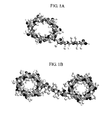
- the conjugate of cyclodextrin (CD) and poly(oxyethylene) (POE) of the present invention may be a CD molecule linked with one POE (monomeric CD), as shown in FIG 1A; a polymer comprising such monomeric CD repeating units (polymeric CD); or two CD molecules linked by one POE (dimeric CD), as shown in FIG 1B, and in most cases, the inventive CD conjugate exist as a mixture thereof
- the CD may be ⁇ -CD, ⁇ -CD, ⁇ -CD or ⁇ -CD.
- the CD conjugate of the present invention can accommodate a variety of guest molecules into its CD hydrophobic cavity through van der Waals force and hydrophobic interaction between the CD cavity and guest molecule. Further, the inventive CD conjugate can form diverse supramolecular structures such as linear-polymer, dendrimer and star-polymer comprising the monomeric or dimeric CD as repeating unit, while the monomeric or dimeric CD may be modified by adjusting the length of the POE spacer, which preferably has a molecular weight ranging from 88 to 10,000.
- the inventive CD conjugate may be prepared by a process comprising (i) reacting poly(ethyleneglycol) bis(carboxymethyl) ether with thionyl chloride or oxalyl chloride under a nitrogen atmosphere to obtain a poly(oxyethylene) bis-acid chloride derivative; and (ii) reacting the acid chloride derivative obtained in step (i) with cyclodextrin in a solvent.
- thionyl chloride or oxalyl chloride may be employed in an amount ranging from 20 to 35 ml, preferably from 30 to 35 ml based on 1 g of poly(ethyleneglycol) bis(carboxymethyl) ether, and the reaction may be conducted at a temperature raging from 70 to 80°C, preferably from 75 to 80°C for 5 to 8 hours, preferably 6 to 7 hours.
- the CD which may be selected from the group consisting of ⁇ -CD, ⁇ -CD, ⁇ -CD and ⁇ -CD, is employed in amounts of 1 to 10 folds, preferably 3 to 4 folds by weight based on the weight of the POE bis-acid chloride derivative, and the solvent may be selected from the group consisting of anhydrous N,N-dimethylformamide (DMF), pyridine, acetonitrile, ethyl ether, dimethyl sulfoxide and water, depending on the solubility of the educts and the coupling method.
- Step (ii) may be conducted at a temperature ranging from 0 to 150°C for 2 hours to 2 weeks with slowly heating.
- inventive CD conjugate may be prepared by a process comprising directly reacting poly(ethylene glycol) bis(carboxymethyl) ether with cyclodextrin in the presence of a carboxyl group-activating coupling agent.
- the carboxyl group-activating coupling agent may be selected from the group consisting of carbonyl diimidazole and carbodicyclohexylcarboiimide, and the carboxyl group-activating coupling agent or poly(ethylene glycol) bis(carboxymethyl) ether may be employed in an amount ranging from 0.1 to 2 moles, preferably 0.5 mole based on cyclodextrin.
- the reaction may be conducted in a solvent selected from selected from the group consisting of anhydrous N,N-dimethylformamide (DMF), pyridine, acetonitrile, ethyl ether, dimethyl sulfoxide and water at a temperature ranging from 0 to 150°C.
- the CD conjugate obtained by the inventive process may be a mixture composed of mainly dimeric CD together with some monomeric CD and polymeric CD, and the composition of the mixture can be controlled by modifying the relative amounts of reactants, reaction temperature, and reaction time in the inventive method.
- the CD conjugate prepared by the present invention can form biocompatible supramolecular structures having excellent inclusive property and structural diversity, and thus, can be beneficially employed in various fields such as drug delivery, food and flavors, cosmetics, packing, textiles, separation processes, environment protection, fermentation and catalysis.
- Example 1 Preparation of the inventive cyclodextrin conjugate having a poly(oxyethylene) spacer
- the compound mixture thus obtained was subjected to column chromatography using a Sephadex G-25 column and deionized water as an eluent to separate therefrom monomeric, dimeric and polymeric CD conjugates.
- Each of the isolated CD derivatives was gravimetrically analyzed. As a result, it was found that the product was composed of 37% (399 mg) dimeric CD, the remainder being monomeric CD, polymeric CD, and residual starting CD.
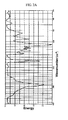
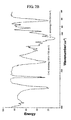
- FIGs. 2A and 2B FT-IR spectra of poly(ethyleneglycol) bis(carboxymethyl) ether and poly(oxyethylene) bis-acid chloride derivative are shown in FIGs. 2A and 2B, respectively.
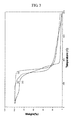
- ⁇ -Cyclodextrin (a), poly(oxyethylene) bis-acid chloride derivative (b), and the dimeric ⁇ -CD conjugate obtained in Example 1 (c) were subjected to TGA (thermogravimetric analysis) in order to study their thermal stabilities, and the results are shown in FIG 3.
- the pristine ⁇ -CD has the highest thermal stability and the poly(oxyethylene) bis-acid chloride derivative has the lowest, among those three compounds, and as expected, the thermal stability of the inventive dimeric ⁇ -CD was intermediate between the above-mentioned two.
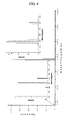
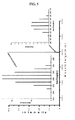
- Example 2 The pristine ⁇ -CD and the dimeric ⁇ -CD conjugate obtained in Example 1 were subjected to MALDI-TOF MS (matrix material: cyano-4-hydroxycinamic acid (CHCA)), and the results are shown in FIGs. 4 and 5, respectively.
- MALDI-TOF MS matrix material: cyano-4-hydroxycinamic acid (CHCA)
- the molecular mass of ⁇ -CD is 1135 and that of the inventive ⁇ -CD conjugate is 2480, which indicates that the inventive dimeric ⁇ -CD is composed of two ⁇ -CDs and one POE spacer.
- the inclusive property of the inventive CD conjugate was evaluated by performing fluorescence quenching using a 20% acetonitrile aqueous solution containing 1.0 x 10 -6 M Rhodamine B (RhB), as follows.
- the dimeric ⁇ -CD conjugate obtained in Example 1 was added to the RhB acetonitrile solution to a concentration of 0 M (a), 6.0 x 10 -5 M (b), 1.3 x 10 -4 M (c), 2.3 x 10 -4 M (d), 3.5 x 10 -4 M (e), 4.9 x 10 -4 M (f) or 6.3 x 10 -4 M (g), and each test solution thus obtained was subjected to UV/Vis spectrometry to obtain the photofluorescence spectra shown in FIG 6.
- FIG 6 shows that the degree of fluorescence quenching of the test solution is dependent on the concentration of the dimeric ⁇ -CD, and this quenching phenomenon is due to the equilibrium shift of RhB from the hydrophilic and fluorescent carboxylate ion form to the hydrophobic and nonfluorescent lactone form produced by the host-guest interaction with the dimeric ⁇ -CD.
- the novel CD conjugate of the present invention is composed of non-toxic compounds to form highly biocompatible supramolecular structures exhibiting significant inclusive property and structural diversity, and thus, can be beneficially employed in various fields such as drug delivery, food and flavors, cosmetics, packing, textiles, separation processes, environment protection, fermentation and catalysis.
Landscapes
- Health & Medical Sciences (AREA)
- Chemical & Material Sciences (AREA)
- Engineering & Computer Science (AREA)
- Life Sciences & Earth Sciences (AREA)
- General Health & Medical Sciences (AREA)
- Medicinal Chemistry (AREA)
- Bioinformatics & Cheminformatics (AREA)
- Pharmacology & Pharmacy (AREA)
- Molecular Biology (AREA)
- Epidemiology (AREA)
- Nanotechnology (AREA)
- Veterinary Medicine (AREA)
- Animal Behavior & Ethology (AREA)
- Public Health (AREA)
- Biochemistry (AREA)
- Materials Engineering (AREA)
- Chemical Kinetics & Catalysis (AREA)
- Polymers & Plastics (AREA)
- Organic Chemistry (AREA)
- Biophysics (AREA)
- General Engineering & Computer Science (AREA)
- Medical Informatics (AREA)
- Crystallography & Structural Chemistry (AREA)
- Biotechnology (AREA)
- Polysaccharides And Polysaccharide Derivatives (AREA)
- Polyethers (AREA)
Applications Claiming Priority (1)
| Application Number | Priority Date | Filing Date | Title |
|---|---|---|---|
| KR1020050062830A KR100642220B1 (ko) | 2005-07-12 | 2005-07-12 | 사이클로덱스트린과 폴리(옥시에틸렌)의 결합체 및 그제조방법 |
Publications (1)
| Publication Number | Publication Date |
|---|---|
| EP1743907A1 true EP1743907A1 (de) | 2007-01-17 |
Family
ID=37192460
Family Applications (1)
| Application Number | Title | Priority Date | Filing Date |
|---|---|---|---|
| EP06014064A Withdrawn EP1743907A1 (de) | 2005-07-12 | 2006-07-06 | Konjugat aus Cyclodextrin und Poly(oxyethylen) und Verfahren zu seiner Herstellung |
Country Status (4)
| Country | Link |
|---|---|
| US (1) | US20070015729A1 (de) |
| EP (1) | EP1743907A1 (de) |
| JP (1) | JP4537354B2 (de) |
| KR (1) | KR100642220B1 (de) |
Cited By (1)
| Publication number | Priority date | Publication date | Assignee | Title |
|---|---|---|---|---|
| US11279774B2 (en) | 2019-01-03 | 2022-03-22 | Underdog Pharmaceuticals, Inc. | Cyclodextrin dimers, compositions thereof, and uses thereof |
Families Citing this family (4)
| Publication number | Priority date | Publication date | Assignee | Title |
|---|---|---|---|---|
| WO2014058438A1 (en) * | 2012-10-12 | 2014-04-17 | Empire Technology Development Llc | Paints and coatings containing cyclodextrin additives |
| US10208167B2 (en) * | 2015-10-14 | 2019-02-19 | The Board Of Trustees Of The California State University | Cyclodextrins with one or more poly(ethylene glycol) units, inclusion compounds and drug delivery vehicles including the same, and methods of making and using the same |
| JP7600886B2 (ja) | 2021-06-08 | 2024-12-17 | 信越化学工業株式会社 | オルガノポリシロキサン変性シクロデキストリン化合物及びこれを含有する化粧料 |
| JP7605038B2 (ja) | 2021-06-18 | 2024-12-24 | 信越化学工業株式会社 | オルガノポリシロキサン変性シクロデキストリン化合物を含有する化粧料 |
Citations (4)
| Publication number | Priority date | Publication date | Assignee | Title |
|---|---|---|---|---|
| RU2072361C1 (ru) * | 1993-08-30 | 1997-01-27 | МГУ (химический факультет) | Конъюгаты альфа - или бета - циклодекстринов с полиэтиленоксидом в качестве комплексообразователя и эмульгатора и способ их получения |
| RU2094059C1 (ru) * | 1993-08-30 | 1997-10-27 | Московский государственный университет, химический факультет | Способ транспорта нейротропных препаратов в мозг |
| US20020151523A1 (en) * | 1998-07-01 | 2002-10-17 | California Institute Of Technology | Linear cyclodextrin copolymers |
| WO2003047518A2 (en) * | 2001-11-30 | 2003-06-12 | Genta Salus Llc | Cyclodextrin grafted biocompatible amphiphilic polymer and methods of preparation and use thereof |
Family Cites Families (8)
| Publication number | Priority date | Publication date | Assignee | Title |
|---|---|---|---|---|
| AU677789B2 (en) * | 1992-07-02 | 1997-05-08 | Collagen Corporation | Biocompatible polymer conjugates |
| US5538655A (en) * | 1994-06-29 | 1996-07-23 | Arthur D. Little, Inc. | Molecular complexes for use as electrolyte components |
| US5792821A (en) * | 1997-01-06 | 1998-08-11 | American Dental Association Health Foundation | Polymerizable cyclodextrin derivatives |
| KR100341545B1 (ko) * | 1999-12-20 | 2002-06-21 | 김효근 | 수용성 거대고리-플러렌 유도체 |
| KR20030068034A (ko) * | 2000-04-28 | 2003-08-19 | 유니버시티 칼리지 더블린 | 친양쪽성 매크로사이클 유도체 및 그의 유사체 |
| TWI321054B (en) * | 2000-12-19 | 2010-03-01 | California Inst Of Techn | Compositions containing inclusion complexes |
| TWI246524B (en) * | 2001-01-19 | 2006-01-01 | Shearwater Corp | Multi-arm block copolymers as drug delivery vehicles |
| ES2601143T3 (es) * | 2002-07-19 | 2017-02-14 | Omeros Corporation | Copolímeros tribloque biodegradables, métodos de síntesis de los mismos, e hidrogeles y biomateriales preparados a partir de los mismos |
-
2005
- 2005-07-12 KR KR1020050062830A patent/KR100642220B1/ko not_active Expired - Fee Related
-
2006
- 2006-07-06 EP EP06014064A patent/EP1743907A1/de not_active Withdrawn
- 2006-07-12 US US11/485,948 patent/US20070015729A1/en not_active Abandoned
- 2006-07-12 JP JP2006191430A patent/JP4537354B2/ja not_active Expired - Fee Related
Patent Citations (4)
| Publication number | Priority date | Publication date | Assignee | Title |
|---|---|---|---|---|
| RU2072361C1 (ru) * | 1993-08-30 | 1997-01-27 | МГУ (химический факультет) | Конъюгаты альфа - или бета - циклодекстринов с полиэтиленоксидом в качестве комплексообразователя и эмульгатора и способ их получения |
| RU2094059C1 (ru) * | 1993-08-30 | 1997-10-27 | Московский государственный университет, химический факультет | Способ транспорта нейротропных препаратов в мозг |
| US20020151523A1 (en) * | 1998-07-01 | 2002-10-17 | California Institute Of Technology | Linear cyclodextrin copolymers |
| WO2003047518A2 (en) * | 2001-11-30 | 2003-06-12 | Genta Salus Llc | Cyclodextrin grafted biocompatible amphiphilic polymer and methods of preparation and use thereof |
Non-Patent Citations (3)
| Title |
|---|
| DATABASE WPI Derwent World Patents Index; AN 1997-392229 [36] * |
| DATABASE WPI Derwent World Patents Index; AN 1998-310516 [27] * |
| HASEGAWA YASUSHI ET AL: "Supramolecular polymers formed from beta -cyclodextrins dimer linked by poly(ethylene glycol) and guest dimers", MACROMOLECULES; MACROMOLECULES MAY 3 2005, vol. 38, no. 9, 3 May 2005 (2005-05-03), pages 3724 - 3730, XP002406129 * |
Cited By (2)
| Publication number | Priority date | Publication date | Assignee | Title |
|---|---|---|---|---|
| US11279774B2 (en) | 2019-01-03 | 2022-03-22 | Underdog Pharmaceuticals, Inc. | Cyclodextrin dimers, compositions thereof, and uses thereof |
| US12157779B2 (en) | 2019-01-03 | 2024-12-03 | Cyclarity Therapeutics, Inc. | Cyclodextrin dimers, compositions thereof, and uses thereof |
Also Published As
| Publication number | Publication date |
|---|---|
| JP2007023280A (ja) | 2007-02-01 |
| JP4537354B2 (ja) | 2010-09-01 |
| KR100642220B1 (ko) | 2006-11-03 |
| US20070015729A1 (en) | 2007-01-18 |
Similar Documents
| Publication | Publication Date | Title |
|---|---|---|
| KR100977933B1 (ko) | 소수성 수식 폴리로탁산 및 가교 폴리로탁산 | |
| US9688631B2 (en) | Thermosetting ring-opening metathesis polymerization materials with thermally degradable linkages | |
| CA1277980C (en) | Partially methylated cyclodextrins and process for producing the same | |
| EP2081965A1 (de) | Verfahren zur herstellung von cyclodextrin-oligomeren oder -polymeren, in dem verfahren gewonnene produkte und verwendungen davon | |
| US20170130052A1 (en) | A polymer based on a maltodextrin for encapsulating organic compounds | |
| Kasza et al. | Hyperbranched polyglycerol nanoparticles based multifunctional, nonmigrating hindered phenolic macromolecular antioxidants: Synthesis, characterization and its stabilization effect on poly (vinyl chloride) | |
| EP1743907A1 (de) | Konjugat aus Cyclodextrin und Poly(oxyethylen) und Verfahren zu seiner Herstellung | |
| WO1997010281A1 (en) | Selectively functionalizable desdendrimers | |
| TWI822879B (zh) | 環狀低聚糖和其製造方法 | |
| Byrne et al. | Poly-6-cationic amphiphilic cyclodextrins designed for gene delivery | |
| Shen et al. | A convenient preparation of 6-oligo (lactic acid) cyclomaltoheptaose as kinetically degradable derivative for controlled release of amoxicillin | |
| HUE032590T2 (en) | Polymer conjugates of active substances, processes for their preparation, and intermediates of polymers | |
| CN111253505B (zh) | 具有细胞靶向性的水溶性环糊精药物载体及其制备方法 | |
| Shibata et al. | Synthesis and properties of etherified pullulans | |
| Choi et al. | Epoxidized polybutadiene as a thermal stabilizer for poly (3-hydroxybutyrate). II. Thermal stabilization of poly (3-hydroxybutyrate) by epoxidized polybutadiene | |
| Peptu et al. | Custom-modified oligolactide-cyclodextrin derivatives for electrospun drug formulations | |
| US20200105513A1 (en) | Functionalized calibrants for spectrometry and chromatography | |
| Dodziuk et al. | Synthesis and NMR study of a first generation dendrimer having four branches involving four glycine and one carbomoyl-(3, 7-dimethoxy-2-naphthalene) groups and attempts to complex it with α-, β-or γ-cyclodextrins | |
| EP3052530B1 (de) | Auf amphiphilen cyclodextrinen basierte glykodendrimere | |
| Kim et al. | Degradable thermosets from cellulose acetate allyl carbonate via thiol–ene click chemistry | |
| JP2009024094A (ja) | 新規シクロデキストリン化合物 | |
| Dušková | Cyclodextrin-drug conjugates-synthesis and study of their properties | |
| EP0486445A2 (de) | Polyfunktionelle Derivate aus Cyclodextrin | |
| US10214609B2 (en) | Polyglyoxylates, manufacture and use thereof | |
| KR101622851B1 (ko) | pH 응답성 사이클로덱스트린 유도체, 이의 제조방법 및 상기 사이클로덱스트린 유도체와 약물의 pH 응답성 결합체 |
Legal Events
| Date | Code | Title | Description |
|---|---|---|---|
| PUAI | Public reference made under article 153(3) epc to a published international application that has entered the european phase |
Free format text: ORIGINAL CODE: 0009012 |
|
| 17P | Request for examination filed |
Effective date: 20060706 |
|
| AK | Designated contracting states |
Kind code of ref document: A1 Designated state(s): AT BE BG CH CY CZ DE DK EE ES FI FR GB GR HU IE IS IT LI LT LU LV MC NL PL PT RO SE SI SK TR |
|
| AX | Request for extension of the european patent |
Extension state: AL BA HR MK YU |
|
| 17Q | First examination report despatched |
Effective date: 20070820 |
|
| AKX | Designation fees paid |
Designated state(s): AT BE BG CH CY CZ DE DK EE ES FI FR GB GR HU IE IS IT LI LT LU LV MC NL PL PT RO SE SI SK TR |
|
| STAA | Information on the status of an ep patent application or granted ep patent |
Free format text: STATUS: THE APPLICATION IS DEEMED TO BE WITHDRAWN |
|
| 18D | Application deemed to be withdrawn |
Effective date: 20150203 |