EP1744257A1 - Procédé et dispositif pour acceder/mémoriser des données électronique dans un système avec plusieurs entité de traitement de donnée - Google Patents
Procédé et dispositif pour acceder/mémoriser des données électronique dans un système avec plusieurs entité de traitement de donnée Download PDFInfo
- Publication number
- EP1744257A1 EP1744257A1 EP05015324A EP05015324A EP1744257A1 EP 1744257 A1 EP1744257 A1 EP 1744257A1 EP 05015324 A EP05015324 A EP 05015324A EP 05015324 A EP05015324 A EP 05015324A EP 1744257 A1 EP1744257 A1 EP 1744257A1
- Authority
- EP
- European Patent Office
- Prior art keywords
- memory
- entry
- memories
- routing table
- entries
- Prior art date
- Legal status (The legal status is an assumption and is not a legal conclusion. Google has not performed a legal analysis and makes no representation as to the accuracy of the status listed.)
- Granted
Links
Images



Classifications
-
- H—ELECTRICITY
- H04—ELECTRIC COMMUNICATION TECHNIQUE
- H04L—TRANSMISSION OF DIGITAL INFORMATION, e.g. TELEGRAPHIC COMMUNICATION
- H04L67/00—Network arrangements or protocols for supporting network services or applications
- H04L67/01—Protocols
- H04L67/10—Protocols in which an application is distributed across nodes in the network
- H04L67/104—Peer-to-peer [P2P] networks
-
- H—ELECTRICITY
- H04—ELECTRIC COMMUNICATION TECHNIQUE
- H04L—TRANSMISSION OF DIGITAL INFORMATION, e.g. TELEGRAPHIC COMMUNICATION
- H04L61/00—Network arrangements, protocols or services for addressing or naming
-
- H—ELECTRICITY
- H04—ELECTRIC COMMUNICATION TECHNIQUE
- H04L—TRANSMISSION OF DIGITAL INFORMATION, e.g. TELEGRAPHIC COMMUNICATION
- H04L67/00—Network arrangements or protocols for supporting network services or applications
- H04L67/01—Protocols
- H04L67/10—Protocols in which an application is distributed across nodes in the network
- H04L67/104—Peer-to-peer [P2P] networks
- H04L67/1061—Peer-to-peer [P2P] networks using node-based peer discovery mechanisms
- H04L67/1065—Discovery involving distributed pre-established resource-based relationships among peers, e.g. based on distributed hash tables [DHT]
-
- H—ELECTRICITY
- H04—ELECTRIC COMMUNICATION TECHNIQUE
- H04L—TRANSMISSION OF DIGITAL INFORMATION, e.g. TELEGRAPHIC COMMUNICATION
- H04L69/00—Network arrangements, protocols or services independent of the application payload and not provided for in the other groups of this subclass
- H04L69/30—Definitions, standards or architectural aspects of layered protocol stacks
- H04L69/32—Architecture of open systems interconnection [OSI] 7-layer type protocol stacks, e.g. the interfaces between the data link level and the physical level
- H04L69/322—Intralayer communication protocols among peer entities or protocol data unit [PDU] definitions
- H04L69/329—Intralayer communication protocols among peer entities or protocol data unit [PDU] definitions in the application layer [OSI layer 7]
-
- H—ELECTRICITY
- H04—ELECTRIC COMMUNICATION TECHNIQUE
- H04L—TRANSMISSION OF DIGITAL INFORMATION, e.g. TELEGRAPHIC COMMUNICATION
- H04L69/00—Network arrangements, protocols or services independent of the application payload and not provided for in the other groups of this subclass
- H04L69/40—Network arrangements, protocols or services independent of the application payload and not provided for in the other groups of this subclass for recovering from a failure of a protocol instance or entity, e.g. service redundancy protocols, protocol state redundancy or protocol service redirection
Definitions
- the invention relates to an apparatus and method for retrieving / storing electronic data in a system having a plurality of data processing units, each implementing a functionality of a random access memory.
- P2P peer-to-peer
- scalability the boundary between the role of a user and that of a service provider blurs.
- a user joins a P2P system he also acts as a service provider, increasing the overall capacity of the system. This will also cause the system to scale as the number of memories changes dynamically.
- P2P systems a stable, reliable overall system is realized with the aid of equal individual components, namely read-write memories, which can also be referred to as memory for short.
- the memories are connected via communication links and can independently fail without notice, meaning that they are unreliable. Unreliability of memory can be caused either by communication errors that make memory unavailable to other memory, or by an error or decision by a memory to respond to queries from other memory. New storage can be added to the system at any time.
- a major problem in P2P computing is building a reliable global data structure based on unreliable storage, where objects can be stored and retrieved.
- An object consists of a name and a list of attributes. Objects can represent anything, including the address or details of users, machines, networks, services, or other objects.
- a name can be from a Any type of data, but is usually a string or a number.
- An attribute in turn, consists of attribute name and attribute value, each of which can be of any data type. Objects that do not fit into this scheme are easily mapped to it by storing the entire contents of the object as a Content attribute.
- name and directory services provide a mapping between names and attributes.
- the name service allows to query for a given name all attributes of the associated object.
- a directory service is the counterpart to the name service. Here, objects are searched for using one or more of their attributes. The result is a list of names. With a directory service it is possible to answer questions of the following kind: "Show me all PDF documents that are stored on this computer and written by Donald Knuth before 1995.” A directory service is similar to the yellow pages. Microsoft's Active Directory Services, X.500 and the leaner LDAP variant are typical examples.
- such a system generally comprises three components: a search processor, a routing layer, and a database.
- the search processor receives requests and maps the requests to the underlying routing layer.
- Simple queries such as "Martin Schmidt” are forwarded directly, while more complex queries, such as the above-mentioned request for Knuth's PDF documents, are broken down into several steps, which are processed individually.
- the routing layer is between the search engine and the database. It is needed in distributed systems to find the stores containing the needed objects. For example, in the Domain Name Service (DNS) of the Internet, which finds the Internet address for computer names, the routing layer is implemented as a hierarchy of stores. Starting from a central store, the responsibility branches in several steps to other stores until the memory that has stored the searched object is reached. In P2P systems, for routing, e.g. Chordal graphs or multi-dimensional tori or hypercubes are used.
- DNS Domain Name Service
- the database contains the actual objects of a memory.
- DHTs distributed hash tables
- chordalgraphs Many current P2P systems are based on distributed hash tables (DHTs) and chordalgraphs.
- DHTs distributed hash tables
- chordalgraphs When saving a new object, its name is converted to a numeric value using the hash function.
- the routing method is then used to determine the memory responsible for this value, and then the object is entered in the database in this memory.
- Finding objects works in the same way: the name of the searched object is converted into a numerical value using the hash function, and the responsible memory is determined using the routing method. From this memory, the object can then be read from the database.
- each memory has a so-called routing table with information on how other memories can be contacted.
- the routing table has a limited size and contains the communication links to O (log (N)) other stores, if N is the number of stores in the entire system.
- the object of the invention is to provide an apparatus and a method for retrieving / storing electronic data in a system having a plurality of data processing units, each implementing a functionality of a random access memory, in particular in terms of time economy, even if individual from the data processing units are unreliable.
- the invention is solved by a device according to independent claim 1 and a method according to independent claim 5.
- the invention preserves the positive characteristics of existing P2P systems and provides more powerful polling capabilities. It always ensures the efficiency and scalability characteristics by working accurately and not based on probabilities. Search queries are processed with logarithmic effort in the number of memories. Let N be the number of memories. By accurately using and determining the entries in the routing tables that are not probabilistic, as in previously existing systems, a maximum of [log b N], where N is the number of memories in the system, uses many communication links before one searched memory that has stored an associated object.
- the individual memories can join the system at any time and leave it again. Because of the low search and insertion costs, the system can be scaled virtually arbitrarily: even with millions of different memories, search queries can still be found using less than a dozen communication links. Since the available storage space in the system is the sum of all storage, modern personal computers can easily build systems that can work with trillions of data records.
- Chord a distributed hash table
- Chord A Scalable Peer-to-Peer Lookup Protocol for Internet Applications. IEEE / ACM Transactions on Networking. Volume 11, Issue 1 February 2003, pp. 17-32 ).
- Chord does not support range queries. This disadvantage is overcome with the invention.
- the advantageous properties of Chord are maintained in terms of efficiency.
- Fig. 1 shows a schematic representation of a system, which is for example a computer network, with a plurality of independent memories 101, which are designed as read-write memory, and communication links 102 between the memories 101.
- the entirety of the communication links 102 between the memories 101 is referred to as a "overlay network" because the communication links 102 do not communicate with the (physical) communication links in the underlying physical network of data processing equipment.
- data may be written to the plurality of memories 101 and retrieved later by a read-out search. Since the memories 101 are designed as read-write memories and electronic data is interchangeable between them, the computer capacity required for this purpose is also made available in the system, for example with the aid of suitable processors.
- a communication link must be established to any of the memory 101 already in the system.
- an overloaded one of the plurality of memories 101 can be searched for to take over directly from it a part of the assigned namespace (see below).
- the name space of the overloaded memory is then divided into two parts.
- the previously overloaded memory and the added memory are henceforth responsible for one of the two parts of the namespace.
- the stored objects of the previously overloaded memory are distributed to the two memories accordingly. Both memories store information locally for which namespace they are responsible. Then both memories check the structure of an associated routing table, which is described in detail below.
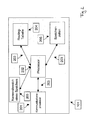
- FIG. 2 shows a schematic representation of components of one of the memories 101 in FIG. 1 in detail.
- a communication processor 201 a processor 202, internal communication links 203, a routing table 204, an electronic information store via an associated namespace 206 and memory cells 205 are provided.
- the processor 202 arbitrates between the communication processor 201 and the memory cells 205.
- the communication processor 201 is responsible for communicating between the memories 101 via the communication links 102 with other memories 101 for which respective reference information is stored in the routing table 204.
- the namespace of the memory 206 is necessary to persistently store the responsibilities of the plurality of memories 101.
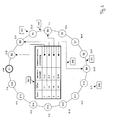
- FIG. 3 shows a schematic representation in which the plurality of memories 101 of the system of FIG. 1 are arranged on a logical ring 300 and connected via communication links 301 which correspond in part to the communication links 102 in FIG.
- an associated routing table 302 is shown for one of the multiple independent memories S1 on the logical ring 300.
- the associated routing table 302 contains reference information about other communication links 303 to other of the multiple independent memories 101. Referring to FIG. 3, the embodiment here is reference information to the memories S2, S3, S5, and S9.
- FIG. 3 thus shows a virtual network which is a suitable electronic representation of an associated physical computer network, as shown by way of example in FIG.
- the search speed, scalability and reliability in the system of a plurality of memories 101 depend on the configuration of the respective routing table 204 in which electronic information about the communication links 102 is contained between the plurality of memories 101.
- the number of communication links 302 registered in the routing table maintained by the associated memory 101 can be adapted to the particular application conditions.
- the namespace is logically construed as ring 300 ( Figure 3), i. the beginning and the end of the namespace are connected or adjacent. By means of this order, a natural neighborhood relationship results between the namespaces of the plurality of memories 101 / the memories S1, ..., S16.
- Chord While in Chord a hash function is applied to the names of the objects to guarantee efficiency properties with a certain probability, in the method proposed here no hash function is applied to map preserving names in the logical ring 300. This first allows range queries.
- Chord's routing method assumes that the memories are evenly distributed. If then the namespaces of a memory are shifted by means of load balancing, in extreme cases the routing performance is reduced from O (log N) to O (N). Such a system is no longer scalable.
- the method proposed here overcomes these disadvantages by reconfiguring the memory routing tables.
- FIG. 4 is a schematic diagram for explaining a search request in which, as shown in FIG. 3, the system of memories is depicted on the logical ring 300.
- the several independent memories S1,..., S16 each have a namespace in a namespace for which they are responsible.
- Each object which is stored or to be stored as a set of electronic data in the system having the plurality of memories S1, ..., S16 is assigned a name over which it can be searched.
- the set of valid names forms the namespace.
- On the namespace a total order is defined, that is, it can be decided on any pair of names which is "smaller". This is required if you want to support range queries. This can be realized for example by means of interpretation of the bit representation of the name as a binary number. If names are strings, the lexicographical order can also be used, for example. If, for example, the set of all colors is selected as the namespace, it is not necessary to define whether "night blue" is smaller or larger than "sky blue". In this case, an artificial order is sufficient, for example, a color temperature, or in other cases a lexicographic or decimal Dewey order.
- the namespace is divided into continuous disjoint namespaces so that the entire namespace is covered.
- Each of the memories S1, ..., S16 is assigned such a name range.
- the size of this name range of a memory can be chosen arbitrarily. For example, small ones of the multiple memories S1,..., S16 may be allocated a smaller name range than larger ones.
- the first namespace of a memory is considered to be connected to the last namespace of a memory. As a result, the entirety of the namespaces forms a virtual ring. This ring need not be reflected in the physical network between the memories 101.
- the individual namespaces of a memory 206 are readjusted in timed intervals or on demand, both in number and size. For example, if one of the memories S1, ..., S16 notices that it has too high a load, i. his not yet occupied memory cells 205 are running short, he initiated a load balancing. Which concrete method is used for load balancing is not relevant to the method described here. For example, a part of the name range, for which an overloaded one of the plurality of memories S1,..., S16 is responsible, can be delivered to a memory adjacent to the logical ring 300.
- Both an insertion and a search operation consists of finding that of the memories S1, ..., S16 with the searched object, in which the name of the sought object falls within the name range of this memory, and the access via one of the communication links 102 to this memory with the searched object.
- Each of the memories S1,..., S16 corresponding to the plurality of memories 101 in FIG. 1 can perform both a search and an insert operation for an object via the communication links 102, that in FIG. 3 by means of the communication links 301 and the other communication links 303, and execute the communication processor 201. If a data processing unit wants to perform such an operation outside the system with the multiple memories 101, it needs a communication link to one of the memories 101, which then performs the operation on behalf of.
- the representative memory can be selected according to various aspects, such as memory usage or proximity.
- a search for an object with the name "8-Test" starts according to FIG. 4 from a searching memory 403 (S1) from which the search starts and which decides on the basis of its associated routing table 302 (see FIG. to pass on the search query via one of the further communication links 303, which is entered in the routing table 204, to the memory S9, which is reached during the search using the further communication link 303.
- the routing table 302 is used.
- the request is forwarded to the memory which is (i) closest to the memory with the searched object (S16) on the virtual ring 300 and (ii) is entered in the routing table 302.
- the distance between two of the memories S1, ..., S 16 is measured clockwise or counterclockwise and is proportional to the number of names in between.
- the logical ring 300 is halved in forwarding to the memory S9.
- the memory S9 uses information available to it via the logical ring 300. Concretely, the memory S9 can fall back on electronic information that the name "8-test" lies in the second ring half with the memories S9 to S16. Therefore, according to a reference contained in the routing table to memory S9, the memory S 13 is jumped over a communication link.
- the memory S 13 and further of the several independent memories S1,..., S16 proceed analogously until the search request has arrived at the memory S16 with the searched object, which stores the searched object in its memory cells 205 (see FIG and returns the object to the searching memory 403 (S 1).
- Range queries are based on simple searches. For example, if you want to search for all objects whose names are between A and C, the memories that are responsible for A / C are first searched for. Subsequently, all the memories that are located on the virtual ring 300 between these two memories are queried for the objects whose names are between A and C.
- Fig. 5 is a diagram for explaining a procedure when filling a routing table 204 by the processor 202 (see Fig. 2).
- the process begins with an initialization of a counter 501.
- the counter controls how often a loop 502 is traversed.
- Each loop pass begins checking for cancellation of a loop 503, then a check 504 is made to see if it is a first loop pass. If it is the first loop pass, the following step consists of remembering 505 the communication link to the neighbor memory, otherwise the step consists of remembering 506 the communication link to the double spaced memory.
- the conclusion is the storage 507 of the noted communication link in the routing table. When the method arrives at the end 508, the execution is aborted.
- the electronic information distributed in the routing tables of the memories is used.
- the invention described herein makes it possible to save the hash function used in Chord and other P2P systems without losing its positive characteristics such as scalability, fault tolerance or the like.
- Table 1 shows by way of example at least part of the structure of a routing table for one of the memories 101.
- the entry "current memory + 16" is to be read as the 16th neighbor of the current memory, in addition to each of the memories 101 the associated name range is stored , With this method, each of the memories 101 can be averaged using a number of 0.5 log 2 N of the communication links 102, where N is the total number of the plurality of memories 101 in the system.
- the method also works with other topologies, such as hypercubes, space-filling curves, hierarchical rings, or multi-dimensional tori.
- topologies such as hypercubes, space-filling curves, hierarchical rings, or multi-dimensional tori.
- the results of the different methods can be compared and used to check the correctness of the entries. If the results differ, at least one of the entries involved is incorrect. In this case, the entries used for the calculation can themselves be recalculated or checked in the same way.
- entries When starting the virtual network, many entries will initially contain no or incorrect entries, except those for the directly adjacent memories with index 1. Then, if all memories first match the entries with index 2, then those with index 3, etc., then all entries will be set correctly in the routing table. As the system runs, new memories 101 will be added and old ones will be removed, requiring the entries to be updated time and again. The updates may be performed at periodic intervals or due to certain events, such as when a search requires on average more than 0.5 log b N steps.
- the search operations can be used to update the information in the routing tables.
- the sought objects are returned in the same way as they were used for the search, not directly.
- the processor 202 see Fig. 2
- the memory Sy may pass this information on forwarding.
- the memory Sy may pass the ith entry from its associated routing table 204 to the memory Sx that the memory Sx uses to store its routing table 204 at the Place i + 1 to update. This method adds insignificance to the search query and automatically updates the routing entries.
Landscapes
- Engineering & Computer Science (AREA)
- Computer Networks & Wireless Communication (AREA)
- Signal Processing (AREA)
- Computer Security & Cryptography (AREA)
- Data Exchanges In Wide-Area Networks (AREA)
- Computer And Data Communications (AREA)
- Information Retrieval, Db Structures And Fs Structures Therefor (AREA)
- Information Transfer Between Computers (AREA)
Priority Applications (4)
| Application Number | Priority Date | Filing Date | Title |
|---|---|---|---|
| EP05015324A EP1744257B1 (fr) | 2005-07-14 | 2005-07-14 | Procédé et dispositif pour acceder/mémoriser des données électronique dans un système avec plusieurs entité de traitement de donnée |
| DE502005001390T DE502005001390D1 (de) | 2005-07-14 | 2005-07-14 | Vorrichtung und Verfahren zum Abrufen/Speichern von elektronischen Daten in einem System mit mehreren Datenverarbeitungseinheiten |
| AT05015324T ATE371904T1 (de) | 2005-07-14 | 2005-07-14 | Vorrichtung und verfahren zum abrufen/speichern von elektronischen daten in einem system mit mehreren datenverarbeitungseinheiten |
| US11/485,904 US7623511B2 (en) | 2005-07-14 | 2006-07-13 | Device and method for retrieving/storing electronic data in a system with a plurality of data processing units |
Applications Claiming Priority (1)
| Application Number | Priority Date | Filing Date | Title |
|---|---|---|---|
| EP05015324A EP1744257B1 (fr) | 2005-07-14 | 2005-07-14 | Procédé et dispositif pour acceder/mémoriser des données électronique dans un système avec plusieurs entité de traitement de donnée |
Publications (2)
| Publication Number | Publication Date |
|---|---|
| EP1744257A1 true EP1744257A1 (fr) | 2007-01-17 |
| EP1744257B1 EP1744257B1 (fr) | 2007-08-29 |
Family
ID=35432555
Family Applications (1)
| Application Number | Title | Priority Date | Filing Date |
|---|---|---|---|
| EP05015324A Expired - Lifetime EP1744257B1 (fr) | 2005-07-14 | 2005-07-14 | Procédé et dispositif pour acceder/mémoriser des données électronique dans un système avec plusieurs entité de traitement de donnée |
Country Status (4)
| Country | Link |
|---|---|
| US (1) | US7623511B2 (fr) |
| EP (1) | EP1744257B1 (fr) |
| AT (1) | ATE371904T1 (fr) |
| DE (1) | DE502005001390D1 (fr) |
Families Citing this family (7)
| Publication number | Priority date | Publication date | Assignee | Title |
|---|---|---|---|---|
| EP1868114B1 (fr) * | 2006-06-12 | 2015-11-18 | Konrad-Zuse-Zentrum für Informationstechnik Berlin | Dispositif et procédé destinés à l'enregistrement et l'extraction d'objets contenant des données électroniques adressées de manière multidimensionnelle |
| DE102010026174A1 (de) * | 2010-07-06 | 2012-01-12 | Siemens Aktiengesellschaft | System und Verfahren zum Speichern von Netzparameterdaten eines Stromversorgungsnetzwerkes |
| JP5733124B2 (ja) * | 2011-09-12 | 2015-06-10 | 富士通株式会社 | データ管理装置、データ管理システム、データ管理方法、及びプログラム |
| US8612618B2 (en) * | 2011-10-31 | 2013-12-17 | King Fahd University Of Petroleum And Minerals | Peer-to-peer DNS networking method |
| CN105956276B (zh) * | 2016-05-04 | 2019-01-25 | 西南交通大学 | 针对多scd的智能变电站目标关联对快速搜索优化方法 |
| US20230010339A1 (en) * | 2021-07-12 | 2023-01-12 | Lamacchia Realty, Inc. | Methods and systems for device-specific event handler generation |
| CN114338661B (zh) * | 2021-08-27 | 2024-05-03 | 南京曦光信息科技研究院有限公司 | 一种基于光分组交换的分布式边缘数据中心系统及应用 |
Citations (4)
| Publication number | Priority date | Publication date | Assignee | Title |
|---|---|---|---|---|
| US20040064556A1 (en) * | 2002-10-01 | 2004-04-01 | Zheng Zhang | Placing an object at a node in a peer-to-peer system based on storage utilization |
| WO2004027581A2 (fr) * | 2002-09-18 | 2004-04-01 | Skyris Networks, Inc. | Systemes, procedes et programmation pour l'acheminement et l'indexation d'objets adressables mondialement et modeles operationnels associes |
| US6772141B1 (en) * | 1999-12-14 | 2004-08-03 | Novell, Inc. | Method and apparatus for organizing and using indexes utilizing a search decision table |
| WO2005057427A1 (fr) * | 2003-12-12 | 2005-06-23 | British Telecommunications Public Limited Company | Systeme d'exploitation reparti |
Family Cites Families (2)
| Publication number | Priority date | Publication date | Assignee | Title |
|---|---|---|---|---|
| US7613796B2 (en) * | 2002-09-11 | 2009-11-03 | Microsoft Corporation | System and method for creating improved overlay network with an efficient distributed data structure |
| US7203871B2 (en) * | 2004-06-03 | 2007-04-10 | Cisco Technology, Inc. | Arrangement in a network node for secure storage and retrieval of encoded data distributed among multiple network nodes |
-
2005
- 2005-07-14 DE DE502005001390T patent/DE502005001390D1/de not_active Expired - Lifetime
- 2005-07-14 AT AT05015324T patent/ATE371904T1/de not_active IP Right Cessation
- 2005-07-14 EP EP05015324A patent/EP1744257B1/fr not_active Expired - Lifetime
-
2006
- 2006-07-13 US US11/485,904 patent/US7623511B2/en not_active Expired - Fee Related
Patent Citations (4)
| Publication number | Priority date | Publication date | Assignee | Title |
|---|---|---|---|---|
| US6772141B1 (en) * | 1999-12-14 | 2004-08-03 | Novell, Inc. | Method and apparatus for organizing and using indexes utilizing a search decision table |
| WO2004027581A2 (fr) * | 2002-09-18 | 2004-04-01 | Skyris Networks, Inc. | Systemes, procedes et programmation pour l'acheminement et l'indexation d'objets adressables mondialement et modeles operationnels associes |
| US20040064556A1 (en) * | 2002-10-01 | 2004-04-01 | Zheng Zhang | Placing an object at a node in a peer-to-peer system based on storage utilization |
| WO2005057427A1 (fr) * | 2003-12-12 | 2005-06-23 | British Telecommunications Public Limited Company | Systeme d'exploitation reparti |
Non-Patent Citations (5)
| Title |
|---|
| A. BHARAMBE: "Mercury: Supporting Scalable Multi- Attribute Range Queries", SIGCOMM 2004, August 2004 (2004-08-01) |
| BHARAMBE A R ET AL: "MERCURY: SUPPORTING SCALABLE MULTI-ATTRIBUTE RANGE QUERIES", COMPUTER COMMUNICATION REVIEW, ACM, NEW YORK, NY, US, vol. 34, no. 4, October 2004 (2004-10-01), pages 353 - 366, XP001224062, ISSN: 0146-4833 * |
| D. KARGER: "Consistent hashing and random trees: Distributed caching protocols for relieving hot spots on the World Wide Web", IN PROCEEDINGS OF THE 29TH ANNUAL ACM SYMPOSIUM ON THEORY OF COMPUTING, May 1997 (1997-05-01), pages 654 - 663, XP002183010, DOI: doi:10.1145/258533.258660 |
| I. STOICA: "Chord: a scalable Peer-to-Peer Lookup Protocol for Internet Applications", IEEE / ACM TRANSACTIONS ON NETWORKING, vol. 11, February 2003 (2003-02-01), pages 17 - 32, XP001144289, DOI: doi:10.1109/TNET.2002.808407 |
| STOICA I ET AL: "CHORD: A SCALABLE PEER-TO-PEER LOOKUP PROTOCOL FOR INTERNET APPLICATIONS", IEEE / ACM TRANSACTIONS ON NETWORKING, IEEE / ACM, NEW YORK, NY, US, vol. 11, no. 1, February 2003 (2003-02-01), pages 17 - 32, XP001144289, ISSN: 1063-6692 * |
Also Published As
| Publication number | Publication date |
|---|---|
| ATE371904T1 (de) | 2007-09-15 |
| US7623511B2 (en) | 2009-11-24 |
| EP1744257B1 (fr) | 2007-08-29 |
| DE502005001390D1 (de) | 2007-10-11 |
| US20070165619A1 (en) | 2007-07-19 |
Similar Documents
| Publication | Publication Date | Title |
|---|---|---|
| DE69916928T2 (de) | Zugriffsverfahren und Server für Netzwerkverzeichnis | |
| DE69025846T2 (de) | Verfahren zur Verwendung gespeicherter partieller Bäume zur Berechnung eines Weges in einem Datenkommunikationsnetz | |
| DE68923489T2 (de) | Verfahren zur Auswahl eines optimalen Weges zwischen Knoten in einem Datenkommunikationsnetz. | |
| DE60317925T2 (de) | Steuerung von netzwerkverkehr in einer peer-to-peer umgebung | |
| DE60317403T2 (de) | Mehrstufige Cache-Speicherarchitektur und Cache-Speicherverwaltungsverfahren für gleichrangiges Namensauflösungs-Protokoll | |
| Sahin et al. | A peer-to-peer framework for caching range queries | |
| DE60132718T2 (de) | System und methode zum auffinden von informationsobjekten und informationsobjektspeichern in rechnernetzen | |
| DE69636761T2 (de) | Speichern und wiederauffinden von geordneten schlüsselmengen in einem kompakten 0-kompletten baum | |
| DE69227665T2 (de) | Verfahren zum Betrieb eines Rechners in einem Netz | |
| DE69829830T2 (de) | Weglenkungsverfahren unter Anwendung eines genetischen Algorithmus | |
| DE4323947C2 (de) | Verfahren zum Steuern von Datenbankabfragen in einem heterogenen, verteilten Datenbanksystem | |
| CA2117846C (fr) | Methode informatique et structure pour le stockage et l'extraction de donnees multidimensionnelles | |
| DE10085387T5 (de) | Verfahren und Vorrichtung zur Adresssuche längster Übereinstimmung | |
| DE69815819T2 (de) | Adaptives verteiltes informationsnetzwerk | |
| DE19747583A1 (de) | Kommunikationssystem und Verfahren | |
| DE60032674T2 (de) | Verfahren zum Suchen von Adressen | |
| EP2095611B1 (fr) | Procédé de répartition de charge dans un réseau dédié au poste à poste | |
| EP1744257B1 (fr) | Procédé et dispositif pour acceder/mémoriser des données électronique dans un système avec plusieurs entité de traitement de donnée | |
| Arge et al. | Skip-webs: efficient distributed data structures for multi-dimensional data sets | |
| DE112020004493T5 (de) | Zwischenspeicherfähigkeit von single-page-anwendungen | |
| EP0912952B1 (fr) | Systeme de banque de donnees et procede de gestion d'un stock de donnees n-dimensionnel | |
| EP2044738A1 (fr) | Procédé pour l'exploitation d'un reseau de données decentralisé | |
| EP1647898A1 (fr) | Système de replication de base de données sans serveur | |
| EP1868114B1 (fr) | Dispositif et procédé destinés à l'enregistrement et l'extraction d'objets contenant des données électroniques adressées de manière multidimensionnelle | |
| DE102004050348B3 (de) | Verfahren zur Initialisierung eines Datennetzes |
Legal Events
| Date | Code | Title | Description |
|---|---|---|---|
| PUAI | Public reference made under article 153(3) epc to a published international application that has entered the european phase |
Free format text: ORIGINAL CODE: 0009012 |
|
| 17P | Request for examination filed |
Effective date: 20060113 |
|
| AK | Designated contracting states |
Kind code of ref document: A1 Designated state(s): AT BE BG CH CY CZ DE DK EE ES FI FR GB GR HU IE IS IT LI LT LU LV MC NL PL PT RO SE SI SK TR |
|
| AX | Request for extension of the european patent |
Extension state: AL BA HR MK YU |
|
| GRAP | Despatch of communication of intention to grant a patent |
Free format text: ORIGINAL CODE: EPIDOSNIGR1 |
|
| GRAS | Grant fee paid |
Free format text: ORIGINAL CODE: EPIDOSNIGR3 |
|
| GRAA | (expected) grant |
Free format text: ORIGINAL CODE: 0009210 |
|
| AK | Designated contracting states |
Kind code of ref document: B1 Designated state(s): AT BE BG CH CY CZ DE DK EE ES FI FR GB GR HU IE IS IT LI LT LU LV MC NL PL PT RO SE SI SK TR |
|
| REG | Reference to a national code |
Ref country code: GB Ref legal event code: FG4D Free format text: NOT ENGLISH |
|
| AKX | Designation fees paid |
Designated state(s): AT BE BG CH CY CZ DE DK EE ES FI FR GB GR HU IE IS IT LI LT LU LV MC NL PL PT RO SE SI SK TR |
|
| REG | Reference to a national code |
Ref country code: CH Ref legal event code: EP |
|
| REG | Reference to a national code |
Ref country code: IE Ref legal event code: FG4D Free format text: LANGUAGE OF EP DOCUMENT: GERMAN |
|
| REF | Corresponds to: |
Ref document number: 502005001390 Country of ref document: DE Date of ref document: 20071011 Kind code of ref document: P |
|
| PG25 | Lapsed in a contracting state [announced via postgrant information from national office to epo] |
Ref country code: IS Free format text: LAPSE BECAUSE OF FAILURE TO SUBMIT A TRANSLATION OF THE DESCRIPTION OR TO PAY THE FEE WITHIN THE PRESCRIBED TIME-LIMIT Effective date: 20071229 Ref country code: FI Free format text: LAPSE BECAUSE OF FAILURE TO SUBMIT A TRANSLATION OF THE DESCRIPTION OR TO PAY THE FEE WITHIN THE PRESCRIBED TIME-LIMIT Effective date: 20070829 Ref country code: ES Free format text: LAPSE BECAUSE OF FAILURE TO SUBMIT A TRANSLATION OF THE DESCRIPTION OR TO PAY THE FEE WITHIN THE PRESCRIBED TIME-LIMIT Effective date: 20071210 Ref country code: LT Free format text: LAPSE BECAUSE OF FAILURE TO SUBMIT A TRANSLATION OF THE DESCRIPTION OR TO PAY THE FEE WITHIN THE PRESCRIBED TIME-LIMIT Effective date: 20070829 Ref country code: NL Free format text: LAPSE BECAUSE OF FAILURE TO SUBMIT A TRANSLATION OF THE DESCRIPTION OR TO PAY THE FEE WITHIN THE PRESCRIBED TIME-LIMIT Effective date: 20070829 |
|
| NLV1 | Nl: lapsed or annulled due to failure to fulfill the requirements of art. 29p and 29m of the patents act | ||
| GBT | Gb: translation of ep patent filed (gb section 77(6)(a)/1977) |
Effective date: 20080123 |
|
| PG25 | Lapsed in a contracting state [announced via postgrant information from national office to epo] |
Ref country code: PL Free format text: LAPSE BECAUSE OF FAILURE TO SUBMIT A TRANSLATION OF THE DESCRIPTION OR TO PAY THE FEE WITHIN THE PRESCRIBED TIME-LIMIT Effective date: 20070829 |
|
| PG25 | Lapsed in a contracting state [announced via postgrant information from national office to epo] |
Ref country code: LV Free format text: LAPSE BECAUSE OF FAILURE TO SUBMIT A TRANSLATION OF THE DESCRIPTION OR TO PAY THE FEE WITHIN THE PRESCRIBED TIME-LIMIT Effective date: 20070829 |
|
| EN | Fr: translation not filed | ||
| PG25 | Lapsed in a contracting state [announced via postgrant information from national office to epo] |
Ref country code: DK Free format text: LAPSE BECAUSE OF FAILURE TO SUBMIT A TRANSLATION OF THE DESCRIPTION OR TO PAY THE FEE WITHIN THE PRESCRIBED TIME-LIMIT Effective date: 20070829 Ref country code: GR Free format text: LAPSE BECAUSE OF FAILURE TO SUBMIT A TRANSLATION OF THE DESCRIPTION OR TO PAY THE FEE WITHIN THE PRESCRIBED TIME-LIMIT Effective date: 20071130 |
|
| PG25 | Lapsed in a contracting state [announced via postgrant information from national office to epo] |
Ref country code: SK Free format text: LAPSE BECAUSE OF FAILURE TO SUBMIT A TRANSLATION OF THE DESCRIPTION OR TO PAY THE FEE WITHIN THE PRESCRIBED TIME-LIMIT Effective date: 20070829 Ref country code: CZ Free format text: LAPSE BECAUSE OF FAILURE TO SUBMIT A TRANSLATION OF THE DESCRIPTION OR TO PAY THE FEE WITHIN THE PRESCRIBED TIME-LIMIT Effective date: 20070829 Ref country code: PT Free format text: LAPSE BECAUSE OF FAILURE TO SUBMIT A TRANSLATION OF THE DESCRIPTION OR TO PAY THE FEE WITHIN THE PRESCRIBED TIME-LIMIT Effective date: 20080129 |
|
| PG25 | Lapsed in a contracting state [announced via postgrant information from national office to epo] |
Ref country code: SE Free format text: LAPSE BECAUSE OF FAILURE TO SUBMIT A TRANSLATION OF THE DESCRIPTION OR TO PAY THE FEE WITHIN THE PRESCRIBED TIME-LIMIT Effective date: 20071129 Ref country code: RO Free format text: LAPSE BECAUSE OF FAILURE TO SUBMIT A TRANSLATION OF THE DESCRIPTION OR TO PAY THE FEE WITHIN THE PRESCRIBED TIME-LIMIT Effective date: 20070829 |
|
| PLBE | No opposition filed within time limit |
Free format text: ORIGINAL CODE: 0009261 |
|
| STAA | Information on the status of an ep patent application or granted ep patent |
Free format text: STATUS: NO OPPOSITION FILED WITHIN TIME LIMIT |
|
| 26N | No opposition filed |
Effective date: 20080530 |
|
| PG25 | Lapsed in a contracting state [announced via postgrant information from national office to epo] |
Ref country code: MC Free format text: LAPSE BECAUSE OF NON-PAYMENT OF DUE FEES Effective date: 20080731 |
|
| PG25 | Lapsed in a contracting state [announced via postgrant information from national office to epo] |
Ref country code: EE Free format text: LAPSE BECAUSE OF FAILURE TO SUBMIT A TRANSLATION OF THE DESCRIPTION OR TO PAY THE FEE WITHIN THE PRESCRIBED TIME-LIMIT Effective date: 20070829 |
|
| PG25 | Lapsed in a contracting state [announced via postgrant information from national office to epo] |
Ref country code: SI Free format text: LAPSE BECAUSE OF FAILURE TO SUBMIT A TRANSLATION OF THE DESCRIPTION OR TO PAY THE FEE WITHIN THE PRESCRIBED TIME-LIMIT Effective date: 20070829 |
|
| PG25 | Lapsed in a contracting state [announced via postgrant information from national office to epo] |
Ref country code: CY Free format text: LAPSE BECAUSE OF FAILURE TO SUBMIT A TRANSLATION OF THE DESCRIPTION OR TO PAY THE FEE WITHIN THE PRESCRIBED TIME-LIMIT Effective date: 20070829 |
|
| PG25 | Lapsed in a contracting state [announced via postgrant information from national office to epo] |
Ref country code: BG Free format text: LAPSE BECAUSE OF FAILURE TO SUBMIT A TRANSLATION OF THE DESCRIPTION OR TO PAY THE FEE WITHIN THE PRESCRIBED TIME-LIMIT Effective date: 20071129 |
|
| PG25 | Lapsed in a contracting state [announced via postgrant information from national office to epo] |
Ref country code: AT Free format text: LAPSE BECAUSE OF NON-PAYMENT OF DUE FEES Effective date: 20080714 |
|
| REG | Reference to a national code |
Ref country code: CH Ref legal event code: PL |
|
| PG25 | Lapsed in a contracting state [announced via postgrant information from national office to epo] |
Ref country code: CH Free format text: LAPSE BECAUSE OF NON-PAYMENT OF DUE FEES Effective date: 20090731 Ref country code: LI Free format text: LAPSE BECAUSE OF NON-PAYMENT OF DUE FEES Effective date: 20090731 |
|
| PG25 | Lapsed in a contracting state [announced via postgrant information from national office to epo] |
Ref country code: BE Free format text: LAPSE BECAUSE OF NON-PAYMENT OF DUE FEES Effective date: 20080731 Ref country code: LU Free format text: LAPSE BECAUSE OF NON-PAYMENT OF DUE FEES Effective date: 20080714 Ref country code: HU Free format text: LAPSE BECAUSE OF FAILURE TO SUBMIT A TRANSLATION OF THE DESCRIPTION OR TO PAY THE FEE WITHIN THE PRESCRIBED TIME-LIMIT Effective date: 20080301 |
|
| PG25 | Lapsed in a contracting state [announced via postgrant information from national office to epo] |
Ref country code: TR Free format text: LAPSE BECAUSE OF FAILURE TO SUBMIT A TRANSLATION OF THE DESCRIPTION OR TO PAY THE FEE WITHIN THE PRESCRIBED TIME-LIMIT Effective date: 20070829 |
|
| PG25 | Lapsed in a contracting state [announced via postgrant information from national office to epo] |
Ref country code: IT Free format text: LAPSE BECAUSE OF NON-PAYMENT OF DUE FEES Effective date: 20080731 |
|
| PG25 | Lapsed in a contracting state [announced via postgrant information from national office to epo] |
Ref country code: FR Free format text: LAPSE BECAUSE OF FAILURE TO SUBMIT A TRANSLATION OF THE DESCRIPTION OR TO PAY THE FEE WITHIN THE PRESCRIBED TIME-LIMIT Effective date: 20080425 |
|
| REG | Reference to a national code |
Ref country code: DE Ref legal event code: R079 Ref document number: 502005001390 Country of ref document: DE Free format text: PREVIOUS MAIN CLASS: G06F0017300000 Ipc: G06F0016000000 |
|
| PGFP | Annual fee paid to national office [announced via postgrant information from national office to epo] |
Ref country code: IE Payment date: 20210823 Year of fee payment: 17 |
|
| PGFP | Annual fee paid to national office [announced via postgrant information from national office to epo] |
Ref country code: GB Payment date: 20210824 Year of fee payment: 17 Ref country code: DE Payment date: 20210824 Year of fee payment: 17 |
|
| REG | Reference to a national code |
Ref country code: DE Ref legal event code: R119 Ref document number: 502005001390 Country of ref document: DE |
|
| GBPC | Gb: european patent ceased through non-payment of renewal fee |
Effective date: 20220714 |
|
| PG25 | Lapsed in a contracting state [announced via postgrant information from national office to epo] |
Ref country code: GB Free format text: LAPSE BECAUSE OF NON-PAYMENT OF DUE FEES Effective date: 20220714 Ref country code: DE Free format text: LAPSE BECAUSE OF NON-PAYMENT OF DUE FEES Effective date: 20230201 |
|
| PG25 | Lapsed in a contracting state [announced via postgrant information from national office to epo] |
Ref country code: IE Free format text: LAPSE BECAUSE OF NON-PAYMENT OF DUE FEES Effective date: 20220714 |